Cross-Border Privacy
Intellectual Property Issues


                          Karl Larson
                         April 13, 2007


                                          1
Presentation Overview
• Privacy Limitation Justifications
• Models of Privacy Protection
• United States Protection of Information
  Privacy
• European Union Data Protection Directive
• US Department of Commerce-Safe Harbor
• Model Contracts for the Transfer of Personal
  Data to Foreign Countries


                                                 2
Presentation Overview
• Electronic Privacy Information Center (EPIC)
• Privacy International
• Data Protection Laws Around the World
• Privacy Laws Around the World


                                                 3
Threats to Privacy

   • Increasing sophistication of information technology
            – Greater capacity to collect, analyze and disseminate information
   • New developments in medical research and care,
     telecommunications, advanced transportation systems and
     financial transfers
            – Increased level of information generated by each individual
   • Computers linked together by high speed networks
            – Increased capability of creating comprehensive dossiers on any
              person
   • New technologies in law enforcement, civilian agencies and
     private companies

See Andrew T. Kenyon and Megan Richardson, New Dimensions in Privacy Law, International and Comparative Perspectives
3-10 (Cambridge University Press, 2006)                                                                                4
Privacy Limitation Justifications

   •      Free speech
   •      Market imperatives of commerce
   •      Public security
   •      Means to forge close relationships based on trust


See Andrew T. Kenyon and Megan Richardson, New Dimensions in Privacy Law, International and Comparative Perspectives
3-10 (Cambridge University Press, 2006)                                                                                5
Models of Privacy Protection

• Comprehensive laws
  – Europe, Australia, Hong Kong, New Zealand and
    Canada
• Sectoral Laws
  – United States
• Self-Regulation
  – United States
• Technologies of Privacy


                                                    6
United States Protection of Information Privacy
Targeted Approach
• No precise constitutional guarantee of the right to
  privacy in the United States
      – Constitutional rights apply to government, not private sectors
• Laws are typically targeted based on the type of data
  rather than all computerized personal data
• The four basic types of privacy rights under common
  law do not offer protection for informational privacy:
      –     Intrusion upon seclusion
      –     Publication of embarrassing private facts
      –     Placing a person in a false light
      –     Appropriation of name, likeness and identity
  See, e.g., Anita L. Allen-Catellitto, Origins and Growth of U.S. Privacy Law, Second Annual Institute on Privacy Law: Strategies for
  Legal Compliance in a High-Tech & Changing Regulatory Environment 9, 24 (Practicing Law Institute 2001).


                                                                                                                                         7
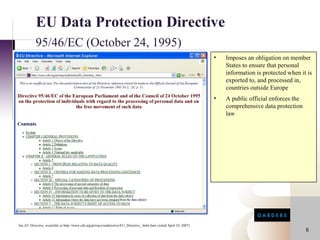
EU Data Protection Directive
           95/46/EC (October 24, 1995)
                                                                                                                         •   Imposes an obligation on member
                                                                                                                             States to ensure that personal
                                                                                                                             information is protected when it is
                                                                                                                             exported to, and processed in,
                                                                                                                             countries outside Europe
                                                                                                                         •   A public official enforces the
                                                                                                                             comprehensive data protection
                                                                                                                             law


See EU Directive, available at http://www.cdt.org/privacy/eudirective/EU_Directive_.html (last visited April 10, 2007)
                                                                                                                                                              8
EU Data Protection Directive
Objective
• protect fundamental rights and freedoms of natural
  persons, including
   – right to privacy with respect to the processing of
     personal data
• the free flow of personal data between Member States
  is not to be restricted or prohibited


                                                          9
EU Data Protection Directive
Intent
Data-processing systems must respect fundamental rights
and freedoms (whatever the nationality or residence of
natural persons) including:
• right to privacy

• contributing to economic and social progress, trade
  expansion and the well-being of individuals


                                                          10
European Union Data Protection Directive
Article 2 – Definitions
• personal data – any information relating to an
  identified or identifiable natural person

• processing of personal data – any operation
  performed on personal data (e.g., collection . . . )

• the data subject's consent – any freely given specific
  and informed indication of his wishes by which the
  data subject signifies his agreement to personal data


                                                           11
European Union Data Protection Directive
Article 3 – Scope
The Directive applies to processing of all personal data except:
• Public security
• Defense
• State security
• Criminal activities of the State
• In the course of a purely personal or household activity


                                                              12
European Union Data Protection Directive
Article 6 – Personal data must be:
• processed fairly and lawfully
• collected for specified, explicit and legitimate purposes and
  not further processed in a way incompatible with those
  purposes
• adequate, relevant and not excessive in relation to the
  purposes for which they are collected and/or further processed
• accurate and, where necessary, kept up to date
• kept in a form which permits identification of data subjects
  for no longer than is necessary for the purposes for which the
  data were collected or for which they are further processed


                                                                   13
EU Data Protection Directive
Article 7 – Personal data may be processed only if:
•   the data subject has unambiguously given his consent; or
•   processing is necessary for the performance of a contract to which the data
    subject is party or in order to take steps at the request of the data subject prior to
    entering into a contract; or
•   processing is necessary for compliance with a legal obligation to which the
    controller is subject; or
•   processing is necessary in order to protect the vital interests of the data subject;
    or
•   processing is necessary for the performance of a task carried out in the public
    interest or in the exercise of official authority vested in the controller or in a
    third party to whom the data are disclosed; or
•   processing is necessary for the purposes of the legitimate interests pursued by
    the controller or by the third party or parties to whom the data are disclosed,
    except where such interests are overridden by the interests for fundamental


                                                                                       14
EU Data Protection Directive
Articles 10, 11 and 12
Subject has right to know :
• the identity of collector of information
• purpose for the collection


                                             15
EU Data Protection Directive
Article 25 – transfers to non-European countries
• Transfer of personal data to a non-European country may
  take place only if the country ensures an “adequate level of
  data protection”
• EU and United States use different approaches:
   – United States – targeted privacy laws (typically
     targeting specific records)
   – EU – Omnibus approach (comprehensive privacy
     regulations)
• Where no adequate protection – transfer is permitted only
  by one of the narrow exceptions in Article 26


                                                            16
EU Data Protection Directive
Article 26 – Exceptions where no adequate protection
• subject has given unambiguous consent; or
• transfer is necessary for the performance of a
  contract


                                                   17
U.S. Department of Commerce
          Commerce-Safe Harbor
                                                                                                               •   Created in response to the EU
                                                                                                                   Data Protection Directive


See Welcome to the Safe Harbor, available at http://www.export.gov/safeharbor/ (last visited April 10, 2007)                                       18
US Department of Commerce-Safe Harbor
Seven Safe Harbor Principles
• Notice – must provide conspicuous notice to individuals
  about
   – purposes for which it collects and uses the personal information
   – types of third parties to which it discloses the personal
     information
   – contact information for complaints and inquires
• Choice – must allow individual to opt-out or opt-in
   – opt-out of transferring personal information to a third party or
     using personal information for non-stated purpose if not sensitive
   – opt-in of transferring personal information to a third party or
     using personal information for non-stated purpose if sensitive
     (e.g., medical condition, political opinion, religious beliefs, sex
     life)

                                                                           19
US Department of Commerce-Safe Harbor
Seven Safe Harbor Principles
• Transfers to Third Parties – must ensure that third party:
   – subscribes to the Safe Harbor
   – is subject to the EU Directive
   – other adequate finding
   – agrees to provide at least the same level of privacy protection as is
     required by the Safe Harbor
• Security – reasonable precautions to protect personal
  information from “loss, misuse and unauthorized access,
  disclosure, alteration and destruction”


                                                                             20
US Department of Commerce-Safe Harbor
Seven Safe Harbor Principles
• Relevance – personal information must be relevant for
  the purposes for which it is to be used
• Access - individuals must have access to personal
  information about them and be able to “correct, amend,
  or delete” inaccurate information
• Enforcement – must include
   – mechanism for assuring compliance
   – recourse for individuals to whom the data relate affected by non-
     compliance
   – consequences when organization fails to comply


                                                                         21
US Department of Commerce-Safe Harbor
            Safe Harbor List


See Safe Harbor List, available at http://web.ita.doc.gov/safeharbor/shlist.nsf/webPages/safe+harbor+list (last visited April 10, 2007)
                                                                                                                                          22
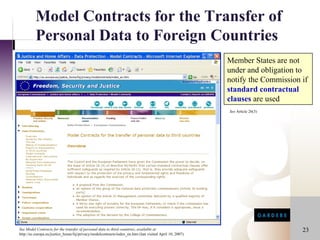
Model Contracts for the Transfer of
          Personal Data to Foreign Countries
                                                                                                         Member States are not
                                                                                                         under and obligation to
                                                                                                         notify the Commission if
                                                                                                         standard contractual
                                                                                                         clauses are used
                                                                                                         See Article 26(3)


See Model Contracts for the transfer of personal data to third countries, available at                                         23
http://ec.europa.eu/justice_home/fsj/privacy/modelcontracts/index_en.htm (last visited April 10, 2007)
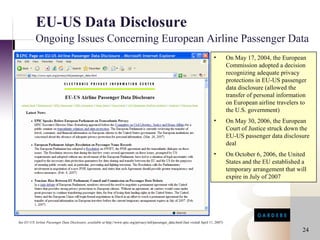
EU-US Data Disclosure
           Ongoing Issues Concerning European Airline Passenger Data
                                                                                                                                     •         On May 17, 2004, the European
                                                                                                                                               Commission adopted a decision
                                                                                                                                               recognizing adequate privacy
                                                                                                                                               protections in EU-US passenger
                                                                                                                                               data disclosure (allowed the
                                                                                                                                               transfer of personal information
                                                                                                                                               on European airline travelers to
                                                                                                                                               the U.S. government)
                                                                                                                                     •         On May 30, 2006, the European
                                                                                                                                               Court of Justice struck down the
                                                                                                                                               EU-US passenger data disclosure
                                                                                                                                               deal
                                                                                                                                     •         On October 6, 2006, the United
                                                                                                                                               States and the EU established a
                                                                                                                                               temporary arrangement that will
                                                                                                                                               expire in July of 2007


See EU-US Airline Passenger Data Disclosure, available at http://www.epic.org/privacy/intl/passenger_data.html (last visited April 11, 2007)

                                                                                                                                                                             24
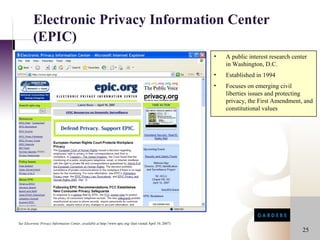
Electronic Privacy Information Center
          (EPIC)
                                                                                                             •   A public interest research center
                                                                                                                 in Washington, D.C.
                                                                                                             •   Established in 1994
                                                                                                             •   Focuses on emerging civil
                                                                                                                 liberties issues and protecting
                                                                                                                 privacy, the First Amendment, and
                                                                                                                 constitutional values


See Electronic Privacy Information Center, available at http://www.epic.org/ (last visited April 10, 2007)

                                                                                                                                                25
Privacy International
                                                                                                             •   A human rights group formed in
                                                                                                                 1990 as a watchdog on privacy
                                                                                                                 issues
                                                                                                             •   Based in London (an office in
                                                                                                                 Washington, D.C.)
                                                                                                             •   Conducts campaigns and research
                                                                                                                 throughout the world


See Privacy International, available at http://www.privacyinternational.org/ (last visited April 10, 2007)
                                                                                                                                                 26
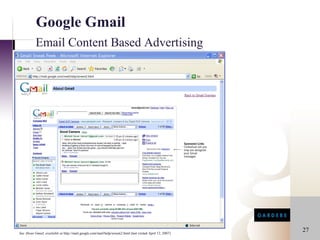
Google Gmail
           Email Content Based Advertising


See About Gmail, available at http://mail.google.com/mail/help/screen2.html (last visited April 12, 2007)
                                                                                                            27
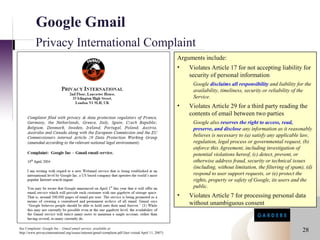
Google Gmail
           Privacy International Complaint
                                                                                                        Arguments include:
                                                                                                        •   Violates Article 17 for not accepting liability for
                                                                                                            security of personal information
                                                                                                             Google disclaims all responsibility and liability for the
                                                                                                             availability, timeliness, security or reliability of the
                                                                                                             Service.
                                                                                                        •   Violates Article 29 for a third party reading the
                                                                                                            contents of email between two parties
                                                                                                             Google also reserves the right to access, read,
                                                                                                             preserve, and disclose any information as it reasonably
                                                                                                             believes is necessary to (a) satisfy any applicable law,
                                                                                                             regulation, legal process or governmental request, (b)
                                                                                                             enforce this Agreement, including investigation of
                                                                                                             potential violations hereof, (c) detect, prevent, or
                                                                                                             otherwise address fraud, security or technical issues
                                                                                                             (including, without limitation, the filtering of spam), (d)
                                                                                                             respond to user support requests, or (e) protect the
                                                                                                             rights, property or safety of Google, its users and the
                                                                                                             public.
                                                                                                        •   Violates Article 7 for processing personal data
                                                                                                            without unambiguous consent


See Complaint: Google Inc – Gmail email service, available at
http://www.privacyinternational.org/issues/internet/gmail-complaint.pdf (last visited April 11, 2007)
                                                                                                                                                                   28
Google Gmail
           Groups Call for Investigation of Gmail
                                                                                                                            •   On May 3, 2004, EPIC, Privacy
                                                                                                                                Rights Clearinghouse, and the
                                                                                                                                World Privacy Forum urged the
                                                                                                                                Attorney General of California to
                                                                                                                                investigate Google’s Gmail
                                                                                                                                service
                                                                                                                                 –   Argued that the scanning of e-
                                                                                                                                     mails for targeted marketing
                                                                                                                                     violates California’s wiretapping
                                                                                                                                     laws (California Penal Code §
                                                                                                                                     631)
                                                                                                                            •   The groups also called upon
                                                                                                                                Google to suspend the service
                                                                                                                                again, as Gmail users could be
                                                                                                                                liable for violations of the law.


See Groups Call for Investigation of Gmail, available at http://www.epic.org/news/2004.html (last visited April 12, 2007)

                                                                                                                                                                  29
Data Protection Laws Around the World


                                                                                                                                             •   Blue – Comprehensive
                                                                                                                                                 Data Protection Law
                                                                                                                                                 Enacted
                                                                                                                                             •   Red – Pending Effort to
                                                                                                                                                 Enact Law
                                                                                                                                             •   White – No Law


See Data Protection Laws Around the World, available at http://www.privacyinternational.org/survey/dpmap.jpg (last visited April 12, 2007)

                                                                                                                                                                     30
Privacy Laws Around the World
           Canada – The Personal Information Protection and Electronic Documents Act
             •       Passed on April 13, 2000
             •       Applies to organizations that collect, use or disclose personal information
                     in the course of commercial activities
                        – Excludes certain government institutions to which the Privacy Act applies
                        – Excludes certain individuals collecting, using or disclosing public information
                          solely for person or domestic purposes
                        – Excludes certain organizations collecting, using or disclosing public
                          information solely for journalistic, artistic or literary purposes
             •       Personal Information – “information about an identifiable individual, but
                     does not include the name, title or business address or telephone number
                     of an employee of an organization.”
             •       Appropriate purposes - an organization may collect, use or disclose
                     personal information only for purposes that a reasonable person would
                     consider are appropriate in the circumstances


See The Personal Information Protection and Electronic Documents Act, available at                          31
http://www.privcom.gc.ca/legislation/02_06_01_e.asp (last visited April 12, 2007)
Privacy Laws Around the World
           Canada – The Personal Information Protection and Electronic Documents Act

             • Notice – must provide notice to individuals about
                        – purposes for which it collects and uses the personal information
                        – procedures to gain access to personal information held by the
                          organization
                        – contact information of the person who is accountable for the
                          organization’s policies and to whom complaints or inquires can be
                          sent
             • Limited Collection – collection of personal information
               shall be limited to that which is necessary for the purposes
               identified by the organization


See The Personal Information Protection and Electronic Documents Act, available at            32
http://www.privcom.gc.ca/legislation/02_06_01_e.asp (last visited April 12, 2007)
Privacy Laws Around the World
           Canada – The Personal Information Protection and Electronic Documents Act

             • Security – must implement security safeguards against
               loss or theft, unauthorized access, disclosure, copying, use,
               or modification
             • Choice – Very limited exceptions where personal
               information may be used, disclosed or collected without
               prior consent
             • Accurate – must be accurate, complete and up-to-date as
               is necessary for the purpose for which it is to be used
             • Purpose – must not be used or disclosed for purposes
               other than those for which it was collected, except with the
               consent of the individual or as required by law

See The Personal Information Protection and Electronic Documents Act, available at     33
http://www.privcom.gc.ca/legislation/02_06_01_e.asp (last visited April 12, 2007)
Privacy Laws Around the World
Japan – Personal Information Protection Law
•   Passed on May 23, 2003
•   Protects information of individuals
     – does not cover information of corporations
•   Applies to the National government, public organizations, and Personal
    Information Handling Enterprises
•   Establishes penalties for data collectors who violate the law
•   Personal Information – “information that may make a living individual
    distinguishable from others.”
•   Personal Information Handling Enterprises – entities that use Personal
    Information Databases in their businesses
     – Excludes the National government, local public organizations, independent
       administrative agencies and local independent administrative agencies
     – Excludes enterprises that process less than 5,000 personal information records
       per day


                                                                                        34
Privacy Laws Around the World
Japan – Personal Information Protection Law
• Notice – must provide notice to individuals about
   – name of the data collector
   – purposes for which it collects and uses the Personal Information
       • personal information may not be used in a manner that exceeds the
         scope without prior consent from the individual
   – procedures to access, modify and terminate the use of personal
     information
   – contact information for complaints and inquires (complaints
     must be responded to adequately and promptly)
• Relevance – personal information must be relevant for the
  purposes for which it is to be used


                                                                             35
Privacy Laws Around the World
Japan – Personal Information Protection Law
• Security – must implement security safeguards and
  provide proper supervision of employees and other entities
  to which personal information may be may be entrusted
• Choice – Generally, personal information may not be
  disclosed or made available to third parties without prior
  consent (“opt in”); exceptions, when disclosure is:
   – made in accordance with the law
   – necessary to protect life, body or property
   – necessary to protect public health
   – necessary for governmental purposes


                                                               36
Privacy Laws Around the World
            Australia – Federal Privacy Act


See The Office of the Privacy Commissioner, Federal Privacy Law, available at http://www.privacy.gov.au/act/index.html (last visited April 12, 2007)
                                                                                                                                                       37
Privacy Laws Around the World
Other Countries
• Mexico
    – Article 214 of the Penal Code protects the disclosure of personal
      information held by government agencies
    – The General Population Act regulates the National Registry of
      Population and Personal Information
• Russia
    – Article 24 of the Russian Federation forbids gathering, storing,
      using and disseminating information on the private life of any
      person without consent
• France
    – The Data Protection Act covers personal information held by
      government agencies and private entities


                                                                          38
Cross-Border Privacy Tips

•   There is a global trend toward comprehensive protection which must be
    taken into consideration; may require personal information to be:
     –   obtained fairly and lawfully
     –   used only for the original specified purpose
     –   adequate, relevant and not excessive to purpose
     –   accurate and up to date
     –   destroyed after its purpose is complete
•   Current international laws should be reviewed prior to any cross-border
    transfers of personal information and periodically reevaluated
     – Confirm compliance with Safe Harbor provisions for transfers between US
       and EU
•   You are likely to be required to provide additional privacy protections
    for any cross-border transfers


                                                                              39
Useful Resources
•   www.privacy.org
     – Joint project of the Electronic Privacy Information Center (EPIC) and Privacy
       International
•   www.privacyinternational.org
     – Privacy International
•   www.epic.org
     – Electronic Privacy Information Center
•   www.coe.int
     – Council of Europe
•   www.oecd.org
     – Organization for Economic Co-operation and Development
•   www.export.gov/safeharbor
     – U.S. Department of Commerce Safe Harbor
•   www.privacy.gov.au
     – The Office of the Privacy Commissioner of Australia


                                                                                       40
Gardere Wynne Sewell LLP
                            Karl Larson
               3000 Thanksgiving Tower
                         1601 Elm Street
                 Dallas, TX 75201-4761
Phone: 214.999.4582 Fax: 214.999.3582
                   klarson@gardere.com


                                           41

Cross Border Privacy : Intellectual Property Issues

  • 1.
    Cross-Border Privacy Intellectual PropertyIssues Karl Larson April 13, 2007 1
  • 2.
    Presentation Overview • PrivacyLimitation Justifications • Models of Privacy Protection • United States Protection of Information Privacy • European Union Data Protection Directive • US Department of Commerce-Safe Harbor • Model Contracts for the Transfer of Personal Data to Foreign Countries 2
  • 3.
    Presentation Overview • ElectronicPrivacy Information Center (EPIC) • Privacy International • Data Protection Laws Around the World • Privacy Laws Around the World 3
  • 4.
    Threats to Privacy • Increasing sophistication of information technology – Greater capacity to collect, analyze and disseminate information • New developments in medical research and care, telecommunications, advanced transportation systems and financial transfers – Increased level of information generated by each individual • Computers linked together by high speed networks – Increased capability of creating comprehensive dossiers on any person • New technologies in law enforcement, civilian agencies and private companies See Andrew T. Kenyon and Megan Richardson, New Dimensions in Privacy Law, International and Comparative Perspectives 3-10 (Cambridge University Press, 2006) 4
  • 5.
    Privacy Limitation Justifications • Free speech • Market imperatives of commerce • Public security • Means to forge close relationships based on trust See Andrew T. Kenyon and Megan Richardson, New Dimensions in Privacy Law, International and Comparative Perspectives 3-10 (Cambridge University Press, 2006) 5
  • 6.
    Models of PrivacyProtection • Comprehensive laws – Europe, Australia, Hong Kong, New Zealand and Canada • Sectoral Laws – United States • Self-Regulation – United States • Technologies of Privacy 6
  • 7.
    United States Protectionof Information Privacy Targeted Approach • No precise constitutional guarantee of the right to privacy in the United States – Constitutional rights apply to government, not private sectors • Laws are typically targeted based on the type of data rather than all computerized personal data • The four basic types of privacy rights under common law do not offer protection for informational privacy: – Intrusion upon seclusion – Publication of embarrassing private facts – Placing a person in a false light – Appropriation of name, likeness and identity See, e.g., Anita L. Allen-Catellitto, Origins and Growth of U.S. Privacy Law, Second Annual Institute on Privacy Law: Strategies for Legal Compliance in a High-Tech & Changing Regulatory Environment 9, 24 (Practicing Law Institute 2001). 7
  • 8.
    EU Data ProtectionDirective 95/46/EC (October 24, 1995) • Imposes an obligation on member States to ensure that personal information is protected when it is exported to, and processed in, countries outside Europe • A public official enforces the comprehensive data protection law See EU Directive, available at http://www.cdt.org/privacy/eudirective/EU_Directive_.html (last visited April 10, 2007) 8
  • 9.
    EU Data ProtectionDirective Objective • protect fundamental rights and freedoms of natural persons, including – right to privacy with respect to the processing of personal data • the free flow of personal data between Member States is not to be restricted or prohibited 9
  • 10.
    EU Data ProtectionDirective Intent Data-processing systems must respect fundamental rights and freedoms (whatever the nationality or residence of natural persons) including: • right to privacy • contributing to economic and social progress, trade expansion and the well-being of individuals 10
  • 11.
    European Union DataProtection Directive Article 2 – Definitions • personal data – any information relating to an identified or identifiable natural person • processing of personal data – any operation performed on personal data (e.g., collection . . . ) • the data subject's consent – any freely given specific and informed indication of his wishes by which the data subject signifies his agreement to personal data 11
  • 12.
    European Union DataProtection Directive Article 3 – Scope The Directive applies to processing of all personal data except: • Public security • Defense • State security • Criminal activities of the State • In the course of a purely personal or household activity 12
  • 13.
    European Union DataProtection Directive Article 6 – Personal data must be: • processed fairly and lawfully • collected for specified, explicit and legitimate purposes and not further processed in a way incompatible with those purposes • adequate, relevant and not excessive in relation to the purposes for which they are collected and/or further processed • accurate and, where necessary, kept up to date • kept in a form which permits identification of data subjects for no longer than is necessary for the purposes for which the data were collected or for which they are further processed 13
  • 14.
    EU Data ProtectionDirective Article 7 – Personal data may be processed only if: • the data subject has unambiguously given his consent; or • processing is necessary for the performance of a contract to which the data subject is party or in order to take steps at the request of the data subject prior to entering into a contract; or • processing is necessary for compliance with a legal obligation to which the controller is subject; or • processing is necessary in order to protect the vital interests of the data subject; or • processing is necessary for the performance of a task carried out in the public interest or in the exercise of official authority vested in the controller or in a third party to whom the data are disclosed; or • processing is necessary for the purposes of the legitimate interests pursued by the controller or by the third party or parties to whom the data are disclosed, except where such interests are overridden by the interests for fundamental 14
  • 15.
    EU Data ProtectionDirective Articles 10, 11 and 12 Subject has right to know : • the identity of collector of information • purpose for the collection 15
  • 16.
    EU Data ProtectionDirective Article 25 – transfers to non-European countries • Transfer of personal data to a non-European country may take place only if the country ensures an “adequate level of data protection” • EU and United States use different approaches: – United States – targeted privacy laws (typically targeting specific records) – EU – Omnibus approach (comprehensive privacy regulations) • Where no adequate protection – transfer is permitted only by one of the narrow exceptions in Article 26 16
  • 17.
    EU Data ProtectionDirective Article 26 – Exceptions where no adequate protection • subject has given unambiguous consent; or • transfer is necessary for the performance of a contract 17
  • 18.
    U.S. Department ofCommerce Commerce-Safe Harbor • Created in response to the EU Data Protection Directive See Welcome to the Safe Harbor, available at http://www.export.gov/safeharbor/ (last visited April 10, 2007) 18
  • 19.
    US Department ofCommerce-Safe Harbor Seven Safe Harbor Principles • Notice – must provide conspicuous notice to individuals about – purposes for which it collects and uses the personal information – types of third parties to which it discloses the personal information – contact information for complaints and inquires • Choice – must allow individual to opt-out or opt-in – opt-out of transferring personal information to a third party or using personal information for non-stated purpose if not sensitive – opt-in of transferring personal information to a third party or using personal information for non-stated purpose if sensitive (e.g., medical condition, political opinion, religious beliefs, sex life) 19
  • 20.
    US Department ofCommerce-Safe Harbor Seven Safe Harbor Principles • Transfers to Third Parties – must ensure that third party: – subscribes to the Safe Harbor – is subject to the EU Directive – other adequate finding – agrees to provide at least the same level of privacy protection as is required by the Safe Harbor • Security – reasonable precautions to protect personal information from “loss, misuse and unauthorized access, disclosure, alteration and destruction” 20
  • 21.
    US Department ofCommerce-Safe Harbor Seven Safe Harbor Principles • Relevance – personal information must be relevant for the purposes for which it is to be used • Access - individuals must have access to personal information about them and be able to “correct, amend, or delete” inaccurate information • Enforcement – must include – mechanism for assuring compliance – recourse for individuals to whom the data relate affected by non- compliance – consequences when organization fails to comply 21
  • 22.
    US Department ofCommerce-Safe Harbor Safe Harbor List See Safe Harbor List, available at http://web.ita.doc.gov/safeharbor/shlist.nsf/webPages/safe+harbor+list (last visited April 10, 2007) 22
  • 23.
    Model Contracts forthe Transfer of Personal Data to Foreign Countries Member States are not under and obligation to notify the Commission if standard contractual clauses are used See Article 26(3) See Model Contracts for the transfer of personal data to third countries, available at 23 http://ec.europa.eu/justice_home/fsj/privacy/modelcontracts/index_en.htm (last visited April 10, 2007)
  • 24.
    EU-US Data Disclosure Ongoing Issues Concerning European Airline Passenger Data • On May 17, 2004, the European Commission adopted a decision recognizing adequate privacy protections in EU-US passenger data disclosure (allowed the transfer of personal information on European airline travelers to the U.S. government) • On May 30, 2006, the European Court of Justice struck down the EU-US passenger data disclosure deal • On October 6, 2006, the United States and the EU established a temporary arrangement that will expire in July of 2007 See EU-US Airline Passenger Data Disclosure, available at http://www.epic.org/privacy/intl/passenger_data.html (last visited April 11, 2007) 24
  • 25.
    Electronic Privacy InformationCenter (EPIC) • A public interest research center in Washington, D.C. • Established in 1994 • Focuses on emerging civil liberties issues and protecting privacy, the First Amendment, and constitutional values See Electronic Privacy Information Center, available at http://www.epic.org/ (last visited April 10, 2007) 25
  • 26.
    Privacy International • A human rights group formed in 1990 as a watchdog on privacy issues • Based in London (an office in Washington, D.C.) • Conducts campaigns and research throughout the world See Privacy International, available at http://www.privacyinternational.org/ (last visited April 10, 2007) 26
  • 27.
    Google Gmail Email Content Based Advertising See About Gmail, available at http://mail.google.com/mail/help/screen2.html (last visited April 12, 2007) 27
  • 28.
    Google Gmail Privacy International Complaint Arguments include: • Violates Article 17 for not accepting liability for security of personal information Google disclaims all responsibility and liability for the availability, timeliness, security or reliability of the Service. • Violates Article 29 for a third party reading the contents of email between two parties Google also reserves the right to access, read, preserve, and disclose any information as it reasonably believes is necessary to (a) satisfy any applicable law, regulation, legal process or governmental request, (b) enforce this Agreement, including investigation of potential violations hereof, (c) detect, prevent, or otherwise address fraud, security or technical issues (including, without limitation, the filtering of spam), (d) respond to user support requests, or (e) protect the rights, property or safety of Google, its users and the public. • Violates Article 7 for processing personal data without unambiguous consent See Complaint: Google Inc – Gmail email service, available at http://www.privacyinternational.org/issues/internet/gmail-complaint.pdf (last visited April 11, 2007) 28
  • 29.
    Google Gmail Groups Call for Investigation of Gmail • On May 3, 2004, EPIC, Privacy Rights Clearinghouse, and the World Privacy Forum urged the Attorney General of California to investigate Google’s Gmail service – Argued that the scanning of e- mails for targeted marketing violates California’s wiretapping laws (California Penal Code § 631) • The groups also called upon Google to suspend the service again, as Gmail users could be liable for violations of the law. See Groups Call for Investigation of Gmail, available at http://www.epic.org/news/2004.html (last visited April 12, 2007) 29
  • 30.
    Data Protection LawsAround the World • Blue – Comprehensive Data Protection Law Enacted • Red – Pending Effort to Enact Law • White – No Law See Data Protection Laws Around the World, available at http://www.privacyinternational.org/survey/dpmap.jpg (last visited April 12, 2007) 30
  • 31.
    Privacy Laws Aroundthe World Canada – The Personal Information Protection and Electronic Documents Act • Passed on April 13, 2000 • Applies to organizations that collect, use or disclose personal information in the course of commercial activities – Excludes certain government institutions to which the Privacy Act applies – Excludes certain individuals collecting, using or disclosing public information solely for person or domestic purposes – Excludes certain organizations collecting, using or disclosing public information solely for journalistic, artistic or literary purposes • Personal Information – “information about an identifiable individual, but does not include the name, title or business address or telephone number of an employee of an organization.” • Appropriate purposes - an organization may collect, use or disclose personal information only for purposes that a reasonable person would consider are appropriate in the circumstances See The Personal Information Protection and Electronic Documents Act, available at 31 http://www.privcom.gc.ca/legislation/02_06_01_e.asp (last visited April 12, 2007)
  • 32.
    Privacy Laws Aroundthe World Canada – The Personal Information Protection and Electronic Documents Act • Notice – must provide notice to individuals about – purposes for which it collects and uses the personal information – procedures to gain access to personal information held by the organization – contact information of the person who is accountable for the organization’s policies and to whom complaints or inquires can be sent • Limited Collection – collection of personal information shall be limited to that which is necessary for the purposes identified by the organization See The Personal Information Protection and Electronic Documents Act, available at 32 http://www.privcom.gc.ca/legislation/02_06_01_e.asp (last visited April 12, 2007)
  • 33.
    Privacy Laws Aroundthe World Canada – The Personal Information Protection and Electronic Documents Act • Security – must implement security safeguards against loss or theft, unauthorized access, disclosure, copying, use, or modification • Choice – Very limited exceptions where personal information may be used, disclosed or collected without prior consent • Accurate – must be accurate, complete and up-to-date as is necessary for the purpose for which it is to be used • Purpose – must not be used or disclosed for purposes other than those for which it was collected, except with the consent of the individual or as required by law See The Personal Information Protection and Electronic Documents Act, available at 33 http://www.privcom.gc.ca/legislation/02_06_01_e.asp (last visited April 12, 2007)
  • 34.
    Privacy Laws Aroundthe World Japan – Personal Information Protection Law • Passed on May 23, 2003 • Protects information of individuals – does not cover information of corporations • Applies to the National government, public organizations, and Personal Information Handling Enterprises • Establishes penalties for data collectors who violate the law • Personal Information – “information that may make a living individual distinguishable from others.” • Personal Information Handling Enterprises – entities that use Personal Information Databases in their businesses – Excludes the National government, local public organizations, independent administrative agencies and local independent administrative agencies – Excludes enterprises that process less than 5,000 personal information records per day 34
  • 35.
    Privacy Laws Aroundthe World Japan – Personal Information Protection Law • Notice – must provide notice to individuals about – name of the data collector – purposes for which it collects and uses the Personal Information • personal information may not be used in a manner that exceeds the scope without prior consent from the individual – procedures to access, modify and terminate the use of personal information – contact information for complaints and inquires (complaints must be responded to adequately and promptly) • Relevance – personal information must be relevant for the purposes for which it is to be used 35
  • 36.
    Privacy Laws Aroundthe World Japan – Personal Information Protection Law • Security – must implement security safeguards and provide proper supervision of employees and other entities to which personal information may be may be entrusted • Choice – Generally, personal information may not be disclosed or made available to third parties without prior consent (“opt in”); exceptions, when disclosure is: – made in accordance with the law – necessary to protect life, body or property – necessary to protect public health – necessary for governmental purposes 36
  • 37.
    Privacy Laws Aroundthe World Australia – Federal Privacy Act See The Office of the Privacy Commissioner, Federal Privacy Law, available at http://www.privacy.gov.au/act/index.html (last visited April 12, 2007) 37
  • 38.
    Privacy Laws Aroundthe World Other Countries • Mexico – Article 214 of the Penal Code protects the disclosure of personal information held by government agencies – The General Population Act regulates the National Registry of Population and Personal Information • Russia – Article 24 of the Russian Federation forbids gathering, storing, using and disseminating information on the private life of any person without consent • France – The Data Protection Act covers personal information held by government agencies and private entities 38
  • 39.
    Cross-Border Privacy Tips • There is a global trend toward comprehensive protection which must be taken into consideration; may require personal information to be: – obtained fairly and lawfully – used only for the original specified purpose – adequate, relevant and not excessive to purpose – accurate and up to date – destroyed after its purpose is complete • Current international laws should be reviewed prior to any cross-border transfers of personal information and periodically reevaluated – Confirm compliance with Safe Harbor provisions for transfers between US and EU • You are likely to be required to provide additional privacy protections for any cross-border transfers 39
  • 40.
    Useful Resources • www.privacy.org – Joint project of the Electronic Privacy Information Center (EPIC) and Privacy International • www.privacyinternational.org – Privacy International • www.epic.org – Electronic Privacy Information Center • www.coe.int – Council of Europe • www.oecd.org – Organization for Economic Co-operation and Development • www.export.gov/safeharbor – U.S. Department of Commerce Safe Harbor • www.privacy.gov.au – The Office of the Privacy Commissioner of Australia 40
  • 41.
    Gardere Wynne SewellLLP Karl Larson 3000 Thanksgiving Tower 1601 Elm Street Dallas, TX 75201-4761 Phone: 214.999.4582 Fax: 214.999.3582 klarson@gardere.com 41
Editor's Notes

  • #17 Protection in the United States is a fractured, eposodic, recorded targeted patchwork of laws. No precise constitutional guarantee of the right to privacy in the United States