Abstract
• LLM forMental Health leverages Large Language Models (LLMs) to create
an AI-driven assistant that offers personalized, empathetic conversations to
provide mental health support.
• The system includes features like stress relief practices, mindfulness
meditation, and personalized health reports that track emotional states and
suggest targeted interventions for long-term well-being.
• This application provides immediate, accessible mental health support,
especially for individuals who may face barriers to traditional therapy due to
financial, geographical, or time constraints.
3.
The Large LanguageModel (LLM) is an advanced artificial intelligence
system designed to understand, generate, and process human language
in a meaningful way. These models are trained on vast datasets
comprising diverse text sources and leverage deep learning techniques,
particularly the transformer architecture, to analyze and generate text
that mimics human-like responses
Examples of LLMs include GPT (Generative Pre-trained Transformer)
and BERT (Bidirectional Encoder Representations from Transformers)
They are used in applications like chatbots, content creation, language
translation, and more
Large Language Model(LLM)
4.
Lack of knowledgeof Mental health status: Lack of knowledge about
mental health can lead to delayed diagnoses, worsening symptoms,
increased stigma, strained relationships, higher healthcare costs, and
an increased risk of crises, all of which highlight the importance of early
recognition, education, and accessible resources
Unawareness Of Psychologists: Lack of awareness about psychologists
and their role often leads to individuals not seeking professional mental
health support, perpetuating untreated conditions, stigma, and reliance
on non-expert advice, which can worsen mental health outcomes. Enhancing
public knowledge through education, campaigns, and accessible resources
is essential to bridge this gap and ensure timely, appropriate care
Disadvantages
Of Existing System
5.
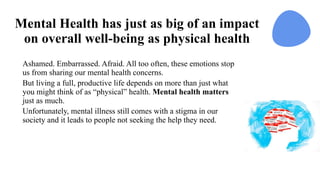
Mental Health hasjust as big of an impact
on overall well-being as physical health
Ashamed. Embarrassed. Afraid. All too often, these emotions stop
us from sharing our mental health concerns.
But living a full, productive life depends on more than just what
you might think of as “physical” health. Mental health matters
just as much.
Unfortunately, mental illness still comes with a stigma in our
society and it leads to people not seeking the help they need.
6.
Advantages of ProposalSystem
Mental Health Test Reports :
This platforms typically provide online screenings or
assessments, which can help detect symptoms of mental health issues such
as anxiety, depression, and stress.
Information of Psychologist :
This feature provides detailed profiles of licensed psychologists,
including their areas of expertise, qualifications, and availability,
helping users find the right professional for their needs.
Activities provided for Mental Stress relief :
This feature offers a variety of techniques, such as mindfulness
exercises, breathing practices, and physical activities, to help users
manage and reduce stress effectively.
Major Focus OnStudents
1. Prevalence: Approximately 25% of college students experience
mental health disorders, including anxiety, depression, and alcohol
use disorders
2. Common Challenges: Stress due to academic pressure, financial
constraints, and social dynamics are major contributors
3. Help-Seeking: Only 13% of students with mental health issues
utilize on-campus counseling services, despite 93% being aware
of such resources
9.
Major Focus OnBusiness Professionals
1. Prevalence: Around 1 in 5 working adults reports
experiencing mental health conditions like anxiety and
depression
.
2. Burnout: Business leaders and entrepreneurs are especially
vulnerable to burnout, with studies suggesting that they face
50% higher rates of mental health issues compared to the
general population.
3. Barriers: Fear of stigma often prevents professionals from
seeking help, despite workplace initiatives like Employee
Assistance Programs (EAPs).
10.
Major Focus OnCommon People
1. Global Impact: 1 in 8 people worldwide suffer from mental
health conditions, affecting a significant portion of the global
population across age groups
2. Global Prevalence: Anxiety and depression are among the most
common mental health conditions, affecting approximately
18% of the adult population in each year
3. Undiagnosed Cases: Despite these numbers, a significant
proportion of those affected do not receive treatment, with about
half of adolescents with mental health issues not receiving the
necessary care