The Association of Croatian ICT Clusters @


                      Agenda:
          The Croatian ICT Cluster Initiative
 cro.ict – The Association of Croatian ICT Clusters
              Questions and Answers


           Boris Krstanović, President
             Belgarde, June 21, 2010
Boris Krstanović

           - CEO (1989. -)
             Multilink, ICT Solution Engineering and Consulting Inc.


           - President (Cluster Manager) (2005. – 2009.)
             GRIT ICT Cluster, Rijeka

           - President (2007. - )
             cro.ict – Association of Croatian ICT Clusters, Rijeka

           - Vice-President (2008. - )
             Affiliation of Croatian Clusters within
             Croatian Chamber of Commerce
Introduction: State of the Cluster Development in Croatia

•   At present 70 clusters registered in Croatia in following industry sectors:
    civil engineering and construction, ICT, wood processing, shipbuilding and naval
    architecture, (small) watercraft, engineering and building, graphic design and printing,
    ecological food production, shoemaking, metallurgy, railroad infrastructure and transport
•   Only 50 active (estimation)
•   Tree institutions evolved in cluster development support:

                    Ministry of Economy (www.mingorp.hr)


                    Croatian Chamber of Economy (www.hgk.hr)
                    The Affiliation of Croatian Clusters


                    Croatian Employers’ Association
                    National Center for Clusters

•   Croatian Cluster Strategy– Project in progress under MoE guidance nad GTZ
    support (Analysis, Objectives of Strategy, Measures/Action Plan)

•   EuropeAid/127604/D/SER/HR IPA Project Forecast: Support for Cluster Development
    (Goal: Better development of current initiatives Indicative; Budget: 3.000.000 Euro)
1. Introduction: ICT and Competitiveness
Introduction: Information and Communication Technology


Information and Communications Technology (ICT) plays a key role in
accelerating productivity and economic growth – just as highways, railroads
and electrical energy once did!


4 Basic Ways in Which ICT Promotes Economic Growth

• ICT promotes efficiency in every part of business, from development to
  marketing to accounting
• ICT promotes innovation, shortening the time needed for new product
  development
• ICT improves market conditions and access to information
• ICT is a global technology – ICT and the processes of globalization are
  directly related

Information and communications technology has an important influence
on the development of business and fundamentally changes social life.
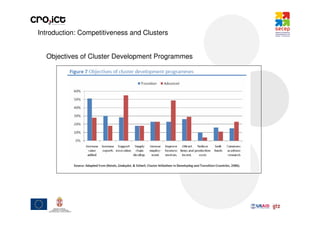
Introduction: Competitiveness and Clusters


  Objectives of Cluster Development Programmes
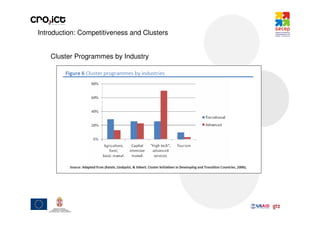
Introduction: Competitiveness and Clusters


    Cluster Programmes by Industry
ICT Cluster Initiative
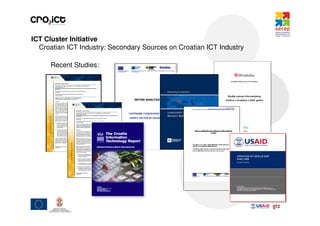
  Croatian ICT Industry: Secondary Sources on Croatian ICT Industry

      Recent Studies:
ICT Cluster Initiative
  Croatian High-Tech Sector SWAT
  SWOT Analysis: Weakness
  • Low Image/Recognition of Croatia as an ICT location
  • Expensive Location (compared to the SEE region)
  • Perceived lack of Government Priority in ICT Sector
  • Low Government Spending on Education (4.3% of GDP)
  • Low Export Orientation…

  SWOT Analysis: Strength
  • Quality of Human Resources
  • Quality of Technical Universities
  • Quality of Infrastructure: Telecommunications
  • Quality of Living
  • ICT Environment
  •…
         Source: High Technology Study on Croatia, The World Bank, MIGA, 2005.
Introduction: Croatian ICT Industry SWAT Analysis


                    Strengths                                     Weaknesses
   • Excellent TC infrastructure                  •   Small domestic market
   • Excellent education                          •   Company size
   • Foreign languages (German, Italian ,         •   Lack of branding
     English)                                     •   Systematic quality management
   • Technical capabilities                       •   Lack of standards, methodology/processes
   • Strong entrepreneurial spirit                •   Labour costs
   • Availability of IT-expertise and resources   •   Graduates lack practical experience
   • Safety…                                      •   Government role/prioritization of ICT

                  Opportunities                                      Threats
   •   Proximity "Near Shore"                     •   Competition from the region
   •   Cultural proximity                         •   International competition (India, China)
   •   Lack of IT resources in the EU             •   Lack of scale
   •   Diaspora                                   •   New technologies
   •   Close ties with Germany & Austria          •   Centralization vs Regional Development
   •   Good education system                      •   Brain drain
   •   Positioning in niche markets
Cluster Initiative: Introduction: ICT/SW Industry Potentials in Croatia


     Findings:
     • Croatian SW companies should focus on new market niches and
       move from SW services (body-shopping) to SW products

     • Croatian SW companies should invest in development of high-quality
       SW products and solutions for the global market

     • Cluster formation is a key factor for Croatian SW companies in their
       SW export orientation
     •…
     Source: Croatian SW Sector Analysis, 2006 (CARDS 2002 Project)
ICT Cluster Initiative: Incubation: BEAM (2004)


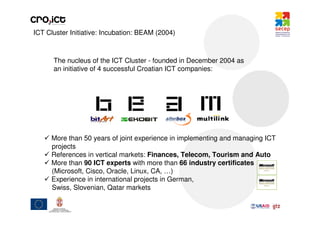
      The nucleus of the ICT Cluster - founded in December 2004 as
      an initiative of 4 successful Croatian ICT companies:


     More than 50 years of joint experience in implementing and managing ICT
     projects
     References in vertical markets: Finances, Telecom, Tourism and Auto
     More than 90 ICT experts with more than 66 industry certificates
     (Microsoft, Cisco, Oracle, Linux, CA, …)
     Experience in international projects in German,
     Swiss, Slovenian, Qatar markets
ICT Cluster Initiative: Incubation: BEAM (2004)


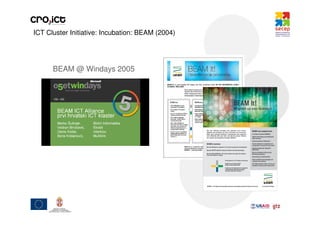
      BEAM @ Windays 2005
ICT Cluster Initiative: Incubation: BEAM (2004)


      BEAM (& Partners) first joint project:


      Target: Top management of the biggest Croatian hotel companies
      Goal: To inform hoteliers about comprehensive BEAM solutions, consulting,
              implementation and integration services
ICT Cluster Initiative: Incubation: BEAM (2004)


  Unfortunately, BEAM ICT cluster never achieved its commercial objectives.
  The lessons learnt from this include:

  - ICT clusters should be established locally (as regional CI)
  - Cluster has to be managed by a full-time Cluster Manager
  - Cluster strategy, business plans and action plans are needed to ensure
    successful cluster implementation
  - Statutes, setting out the framework and rules for cooperation have to
    be defined (roles and responsibilities of members)
  - Cluster services which generate concrete, tangible benefits for the
    members have to be developed and implemented (e.g. export
    promotion service...)
  - Education of cluster members leads to better identification with cluster
    goals and better commitment (expectations vs. outcomes)
  - The cluster development process should be supported and monitored
    by institutions (RDA and MoE..) …
ICT Cluster Initiative: Incubation: GRIT (2005)


  •   Re-engineering of the program in July 2005 based on the BEAM experience
      and the experience from the industry of the neighboring countries
      (with USAID and GTZ program assistance)
  •   The first regional ICT Cluster: GRIT was founded in October 2005


      as a bottom-up cluster initiative of the 8 leading ICT companies in the PGZ
      County and:
                                       - Porin Regional Development Agency,
                                         Rijeka as a supporting member

                                        - University in Rijeka as a strategic
                                          partner
ICT Cluster Initiative: Incubation: GRIT ICT Cluster


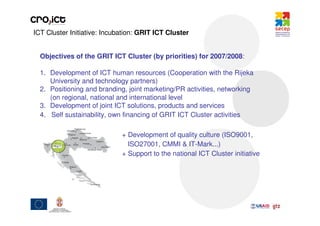
  Objectives of the GRIT ICT Cluster (by priorities) for 2007/2008:

  1. Development of ICT human resources (Cooperation with the Rijeka
     University and technology partners)
  2. Positioning and branding, joint marketing/PR activities, networking
     (on regional, national and international level
  3. Development of joint ICT solutions, products and services
  4. Self sustainability, own financing of GRIT ICT Cluster activities

                             + Development of quality culture (ISO9001,
                               ISO27001, CMMI & IT-Mark...)
                             + Support to the national ICT Cluster initiative
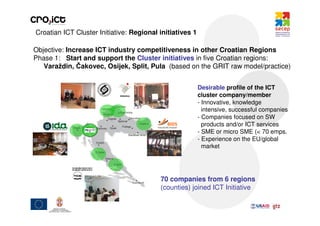
Croatian ICT Cluster Initiative: Regional initiatives 1

Objective: Increase ICT industry competitiveness in other Croatian Regions
Phase 1: Start and support the Cluster initiatives in five Croatian regions:
   Varaždin, Čakovec, Osijek, Split, Pula (based on the GRIT raw model/practice)


                                                          Desirable profile of the ICT
                                                          cluster company/member
                                                          - Innovative, knowledge
                                                            intensive, successful companies
                                                          - Companies focused on SW
                                                            products and/or ICT services
                                                          - SME or micro SME (< 70 emps.
                                                          - Experience on the EU/global
                                                            market


                                          70 companies from 6 regions
                                          (counties) joined ICT Initiative
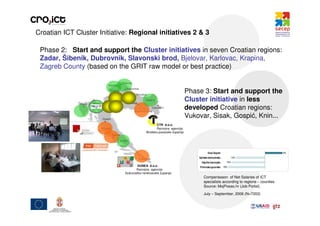
Croatian ICT Cluster Initiative: Regional initiatives 2 & 3

 Phase 2: Start and support the Cluster initiatives in seven Croatian regions:
 Zadar, Šibenik, Dubrovnik, Slavonski brod, Bjelovar, Karlovac, Krapina,
 Zagreb County (based on the GRIT raw model or best practice)


                                                                        Phase 3: Start and support the
                                                                        Cluster initiative in less
                                                                        developed Croatian regions:
                                                                        Vukovar, Sisak, Gospić, Knin...
                                                   CTR d.o.o.
                                                   Razvojna agencija
                                            Brodsko-posavske županije


                                                                                   Grad Zagreb                                8%
                                                                            Splitsko-dalmatinska      -14%
                                                                              Osječko-baranjska    -16%
                                      DUNEA d.o.o.                          Primorsko-goranska -18%
                                     Razvojna agencija
                              Dubrovačko-neretvanske županije
                                                                                Comperissson of Net Salaries of ICT
                                                                                specialists according to regions – counties
                                                                                Source: MojPosao.hr (Job Portal),
                                                                                July – September, 2006 (N=7203)
cro.ict – Association of Croatian ICT Clusters


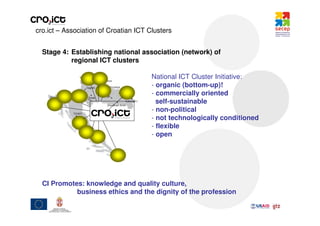
  Stage 4: Establishing national association (network) of
           regional ICT clusters

                                       National ICT Cluster Initiative:
                                       - organic (bottom-up)!
                                       - commercially oriented
                                         self-sustainable
                                       - non-political
                                       - not technologically conditioned
                                       - flexible
                                       - open


  CI Promotes: knowledge and quality culture,
            business ethics and the dignity of the profession
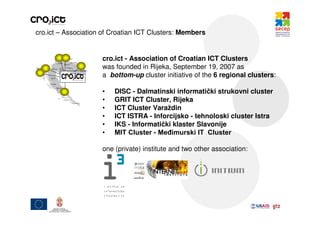
cro.ict – Association of Croatian ICT Clusters: Members


                     cro.ict - Association of Croatian ICT Clusters
                     was founded in Rijeka, September 19, 2007 as
                     a bottom-up cluster initiative of the 6 regional clusters:

                     •   DISC - Dalmatinski informatički strukovni cluster
                     •   GRIT ICT Cluster, Rijeka
                     •   ICT Cluster Varaždin
                     •   ICT ISTRA - Inforcijsko - tehnoloski cluster Istra
                     •   IKS - Informatički klaster Slavonije
                     •   MIT Cluster - Me imurski IT Cluster

                     one (private) institute and two other association:
3. cro.ict – Association of Croatian ICT Clusters
Vision:
Croatian ICT industry should become a key milestone on Croatia’s path towards the
knowledge society, competitive near-shoring destination as well as important export
sector (innovative ICT services, solutions and products).

Mission:
Organic, sustainable and non-political National ICT association will:
- promote the culture of knowledge and business ethics
- encourage collaboration within the ICT industry, with academia and stakeholders
   of regional development on:
    - (ICT) capacity building
    - joint applied R&D
    - development of new, innovative ICT services, solutions and products
- foster deployment of ICT in business (SME) and government

in order to raise the competitiveness of
(knowledge intensive sector of) Croatian ICT industry.
cro.ict – Association of Croatian ICT Clusters: 2009 -2010 Goals


    • Strengthening of National Cluster Association, Regional ICT Clusters and
      member companies
    • Fostering innovation and technology transfer
    • Penetrating new markets
    • Developing capacities (human resources and ICT infrastructure development
      to enable industry growth)


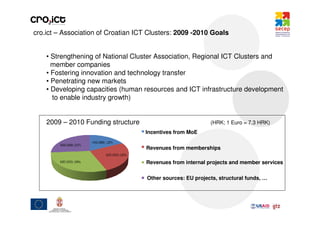
    2009 – 2010 Funding structure                            (HRK; 1 Euro = 7.3 HRK)
                                    Incentives from MoE

                                    Revenues from memberships

                                    Revenues from internal projects and member services

                                     Other sources: EU projects, structural funds, …
Summary: Croatian ICT Cluster Initiative: Summary

                •   Formation of clusters in necessary to increase
                    competitiveness of (Croatian) ICT industry

                •   Experience from EU (but also from transition economies)
                    shows the necessity of institutional support in the creation
                    and start up of (horizontal and vertical) clusters

                •   Regional partners (RDAs/Centers/Incubators) - flagships
                    of regional initiatives and activities; technical and financial
                    support is crucial: Donors (USAID, GTZ,..), MoE…

                •   Clusters (regardless of globalization and de-materialization
                    of production) are formed regionally. Cooperation with
                    regional development partners (agencies, technology
                    centers, business incubators…) and the regional
                    universities is essential

                •   Croatian ICT Cluster initiative - approach proven in practice,
                    verified concept and scenario for creating links between the
                    knowledge-intensive sector of Croatian ICT industry
Questions and Answers
Contacts:

            cro.ict – Croatian ICT Cluster Initiative
            Association of Croatian ICT Clusters
            c/o Porin, PIU Torpedo
            51000 Rijeka; Croatia
            Phone: + 385 98 210 105
            www.cro-ict.net
            Boris Krstanović
            e-mail: boris@multilink.hr

Cro.ict@secep 210610s

  • 1.
    The Association ofCroatian ICT Clusters @ Agenda: The Croatian ICT Cluster Initiative cro.ict – The Association of Croatian ICT Clusters Questions and Answers Boris Krstanović, President Belgarde, June 21, 2010
  • 2.
    Boris Krstanović - CEO (1989. -) Multilink, ICT Solution Engineering and Consulting Inc. - President (Cluster Manager) (2005. – 2009.) GRIT ICT Cluster, Rijeka - President (2007. - ) cro.ict – Association of Croatian ICT Clusters, Rijeka - Vice-President (2008. - ) Affiliation of Croatian Clusters within Croatian Chamber of Commerce
  • 3.
    Introduction: State ofthe Cluster Development in Croatia • At present 70 clusters registered in Croatia in following industry sectors: civil engineering and construction, ICT, wood processing, shipbuilding and naval architecture, (small) watercraft, engineering and building, graphic design and printing, ecological food production, shoemaking, metallurgy, railroad infrastructure and transport • Only 50 active (estimation) • Tree institutions evolved in cluster development support: Ministry of Economy (www.mingorp.hr) Croatian Chamber of Economy (www.hgk.hr) The Affiliation of Croatian Clusters Croatian Employers’ Association National Center for Clusters • Croatian Cluster Strategy– Project in progress under MoE guidance nad GTZ support (Analysis, Objectives of Strategy, Measures/Action Plan) • EuropeAid/127604/D/SER/HR IPA Project Forecast: Support for Cluster Development (Goal: Better development of current initiatives Indicative; Budget: 3.000.000 Euro)
  • 4.
    1. Introduction: ICTand Competitiveness
  • 5.
    Introduction: Information andCommunication Technology Information and Communications Technology (ICT) plays a key role in accelerating productivity and economic growth – just as highways, railroads and electrical energy once did! 4 Basic Ways in Which ICT Promotes Economic Growth • ICT promotes efficiency in every part of business, from development to marketing to accounting • ICT promotes innovation, shortening the time needed for new product development • ICT improves market conditions and access to information • ICT is a global technology – ICT and the processes of globalization are directly related Information and communications technology has an important influence on the development of business and fundamentally changes social life.
  • 6.
    Introduction: Competitiveness andClusters Objectives of Cluster Development Programmes
  • 7.
    Introduction: Competitiveness andClusters Cluster Programmes by Industry
  • 8.
  • 9.
    ICT Cluster Initiative Croatian ICT Industry: Secondary Sources on Croatian ICT Industry Recent Studies:
  • 10.
    ICT Cluster Initiative Croatian High-Tech Sector SWAT SWOT Analysis: Weakness • Low Image/Recognition of Croatia as an ICT location • Expensive Location (compared to the SEE region) • Perceived lack of Government Priority in ICT Sector • Low Government Spending on Education (4.3% of GDP) • Low Export Orientation… SWOT Analysis: Strength • Quality of Human Resources • Quality of Technical Universities • Quality of Infrastructure: Telecommunications • Quality of Living • ICT Environment •… Source: High Technology Study on Croatia, The World Bank, MIGA, 2005.
  • 11.
    Introduction: Croatian ICTIndustry SWAT Analysis Strengths Weaknesses • Excellent TC infrastructure • Small domestic market • Excellent education • Company size • Foreign languages (German, Italian , • Lack of branding English) • Systematic quality management • Technical capabilities • Lack of standards, methodology/processes • Strong entrepreneurial spirit • Labour costs • Availability of IT-expertise and resources • Graduates lack practical experience • Safety… • Government role/prioritization of ICT Opportunities Threats • Proximity "Near Shore" • Competition from the region • Cultural proximity • International competition (India, China) • Lack of IT resources in the EU • Lack of scale • Diaspora • New technologies • Close ties with Germany & Austria • Centralization vs Regional Development • Good education system • Brain drain • Positioning in niche markets
  • 12.
    Cluster Initiative: Introduction:ICT/SW Industry Potentials in Croatia Findings: • Croatian SW companies should focus on new market niches and move from SW services (body-shopping) to SW products • Croatian SW companies should invest in development of high-quality SW products and solutions for the global market • Cluster formation is a key factor for Croatian SW companies in their SW export orientation •… Source: Croatian SW Sector Analysis, 2006 (CARDS 2002 Project)
  • 13.
    ICT Cluster Initiative:Incubation: BEAM (2004) The nucleus of the ICT Cluster - founded in December 2004 as an initiative of 4 successful Croatian ICT companies: More than 50 years of joint experience in implementing and managing ICT projects References in vertical markets: Finances, Telecom, Tourism and Auto More than 90 ICT experts with more than 66 industry certificates (Microsoft, Cisco, Oracle, Linux, CA, …) Experience in international projects in German, Swiss, Slovenian, Qatar markets
  • 14.
    ICT Cluster Initiative:Incubation: BEAM (2004) BEAM @ Windays 2005
  • 15.
    ICT Cluster Initiative:Incubation: BEAM (2004) BEAM (& Partners) first joint project: Target: Top management of the biggest Croatian hotel companies Goal: To inform hoteliers about comprehensive BEAM solutions, consulting, implementation and integration services
  • 16.
    ICT Cluster Initiative:Incubation: BEAM (2004) Unfortunately, BEAM ICT cluster never achieved its commercial objectives. The lessons learnt from this include: - ICT clusters should be established locally (as regional CI) - Cluster has to be managed by a full-time Cluster Manager - Cluster strategy, business plans and action plans are needed to ensure successful cluster implementation - Statutes, setting out the framework and rules for cooperation have to be defined (roles and responsibilities of members) - Cluster services which generate concrete, tangible benefits for the members have to be developed and implemented (e.g. export promotion service...) - Education of cluster members leads to better identification with cluster goals and better commitment (expectations vs. outcomes) - The cluster development process should be supported and monitored by institutions (RDA and MoE..) …
  • 17.
    ICT Cluster Initiative:Incubation: GRIT (2005) • Re-engineering of the program in July 2005 based on the BEAM experience and the experience from the industry of the neighboring countries (with USAID and GTZ program assistance) • The first regional ICT Cluster: GRIT was founded in October 2005 as a bottom-up cluster initiative of the 8 leading ICT companies in the PGZ County and: - Porin Regional Development Agency, Rijeka as a supporting member - University in Rijeka as a strategic partner
  • 18.
    ICT Cluster Initiative:Incubation: GRIT ICT Cluster Objectives of the GRIT ICT Cluster (by priorities) for 2007/2008: 1. Development of ICT human resources (Cooperation with the Rijeka University and technology partners) 2. Positioning and branding, joint marketing/PR activities, networking (on regional, national and international level 3. Development of joint ICT solutions, products and services 4. Self sustainability, own financing of GRIT ICT Cluster activities + Development of quality culture (ISO9001, ISO27001, CMMI & IT-Mark...) + Support to the national ICT Cluster initiative
  • 19.
    Croatian ICT ClusterInitiative: Regional initiatives 1 Objective: Increase ICT industry competitiveness in other Croatian Regions Phase 1: Start and support the Cluster initiatives in five Croatian regions: Varaždin, Čakovec, Osijek, Split, Pula (based on the GRIT raw model/practice) Desirable profile of the ICT cluster company/member - Innovative, knowledge intensive, successful companies - Companies focused on SW products and/or ICT services - SME or micro SME (< 70 emps. - Experience on the EU/global market 70 companies from 6 regions (counties) joined ICT Initiative
  • 20.
    Croatian ICT ClusterInitiative: Regional initiatives 2 & 3 Phase 2: Start and support the Cluster initiatives in seven Croatian regions: Zadar, Šibenik, Dubrovnik, Slavonski brod, Bjelovar, Karlovac, Krapina, Zagreb County (based on the GRIT raw model or best practice) Phase 3: Start and support the Cluster initiative in less developed Croatian regions: Vukovar, Sisak, Gospić, Knin... CTR d.o.o. Razvojna agencija Brodsko-posavske županije Grad Zagreb 8% Splitsko-dalmatinska -14% Osječko-baranjska -16% DUNEA d.o.o. Primorsko-goranska -18% Razvojna agencija Dubrovačko-neretvanske županije Comperissson of Net Salaries of ICT specialists according to regions – counties Source: MojPosao.hr (Job Portal), July – September, 2006 (N=7203)
  • 21.
    cro.ict – Associationof Croatian ICT Clusters
  • 22.
    cro.ict – Associationof Croatian ICT Clusters Stage 4: Establishing national association (network) of regional ICT clusters National ICT Cluster Initiative: - organic (bottom-up)! - commercially oriented self-sustainable - non-political - not technologically conditioned - flexible - open CI Promotes: knowledge and quality culture, business ethics and the dignity of the profession
  • 23.
    cro.ict – Associationof Croatian ICT Clusters: Members cro.ict - Association of Croatian ICT Clusters was founded in Rijeka, September 19, 2007 as a bottom-up cluster initiative of the 6 regional clusters: • DISC - Dalmatinski informatički strukovni cluster • GRIT ICT Cluster, Rijeka • ICT Cluster Varaždin • ICT ISTRA - Inforcijsko - tehnoloski cluster Istra • IKS - Informatički klaster Slavonije • MIT Cluster - Me imurski IT Cluster one (private) institute and two other association:
  • 24.
    3. cro.ict –Association of Croatian ICT Clusters Vision: Croatian ICT industry should become a key milestone on Croatia’s path towards the knowledge society, competitive near-shoring destination as well as important export sector (innovative ICT services, solutions and products). Mission: Organic, sustainable and non-political National ICT association will: - promote the culture of knowledge and business ethics - encourage collaboration within the ICT industry, with academia and stakeholders of regional development on: - (ICT) capacity building - joint applied R&D - development of new, innovative ICT services, solutions and products - foster deployment of ICT in business (SME) and government in order to raise the competitiveness of (knowledge intensive sector of) Croatian ICT industry.
  • 25.
    cro.ict – Associationof Croatian ICT Clusters: 2009 -2010 Goals • Strengthening of National Cluster Association, Regional ICT Clusters and member companies • Fostering innovation and technology transfer • Penetrating new markets • Developing capacities (human resources and ICT infrastructure development to enable industry growth) 2009 – 2010 Funding structure (HRK; 1 Euro = 7.3 HRK) Incentives from MoE Revenues from memberships Revenues from internal projects and member services Other sources: EU projects, structural funds, …
  • 26.
    Summary: Croatian ICTCluster Initiative: Summary • Formation of clusters in necessary to increase competitiveness of (Croatian) ICT industry • Experience from EU (but also from transition economies) shows the necessity of institutional support in the creation and start up of (horizontal and vertical) clusters • Regional partners (RDAs/Centers/Incubators) - flagships of regional initiatives and activities; technical and financial support is crucial: Donors (USAID, GTZ,..), MoE… • Clusters (regardless of globalization and de-materialization of production) are formed regionally. Cooperation with regional development partners (agencies, technology centers, business incubators…) and the regional universities is essential • Croatian ICT Cluster initiative - approach proven in practice, verified concept and scenario for creating links between the knowledge-intensive sector of Croatian ICT industry
  • 27.
  • 28.
    Contacts: cro.ict – Croatian ICT Cluster Initiative Association of Croatian ICT Clusters c/o Porin, PIU Torpedo 51000 Rijeka; Croatia Phone: + 385 98 210 105 www.cro-ict.net Boris Krstanović e-mail: boris@multilink.hr