Criterion 5: Reflection on Peer Feedback

                                                  “As a rule, all he
                            s the                                     roism is
                      egin
          c a ti on b       a d in
                                   g,           due to a lack of
                                                                    reflection,
   “E d u        n, b ut re                      and this it is nec
        lema                an d                                     essary to
  gent         co m  p an y       h                 maintain a mas
      good                  finis                                       s of
                     m ust                         im beciles. If they
            c t io n                                                    once
     refle         hi m ”                       understand them
                                                                     selves the
                               e                 ruling men will
                          ck                                         be lost.”
                     n Lo
               - Joh
                                                        - Ernest Renan


Stage 1: Development of an idea


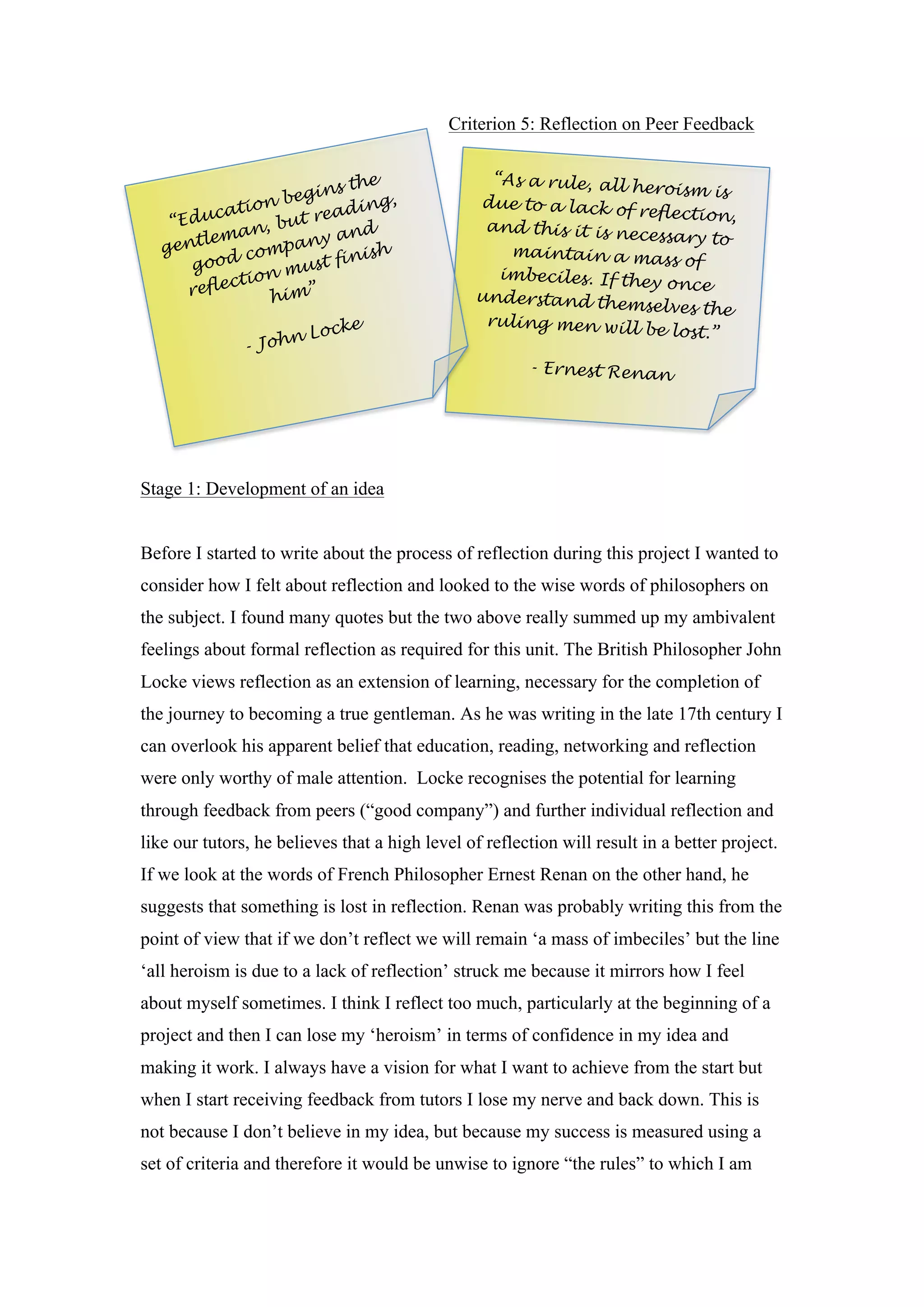
Before I started to write about the process of reflection during this project I wanted to
consider how I felt about reflection and looked to the wise words of philosophers on
the subject. I found many quotes but the two above really summed up my ambivalent
feelings about formal reflection as required for this unit. The British Philosopher John
Locke views reflection as an extension of learning, necessary for the completion of
the journey to becoming a true gentleman. As he was writing in the late 17th century I
can overlook his apparent belief that education, reading, networking and reflection
were only worthy of male attention. Locke recognises the potential for learning
through feedback from peers (“good company”) and further individual reflection and
like our tutors, he believes that a high level of reflection will result in a better project.
If we look at the words of French Philosopher Ernest Renan on the other hand, he
suggests that something is lost in reflection. Renan was probably writing this from the
point of view that if we don’t reflect we will remain ‘a mass of imbeciles’ but the line
‘all heroism is due to a lack of reflection’ struck me because it mirrors how I feel
about myself sometimes. I think I reflect too much, particularly at the beginning of a
project and then I can lose my ‘heroism’ in terms of confidence in my idea and
making it work. I always have a vision for what I want to achieve from the start but
when I start receiving feedback from tutors I lose my nerve and back down. This is
not because I don’t believe in my idea, but because my success is measured using a
set of criteria and therefore it would be unwise to ignore “the rules” to which I am
expected to work. Personally I find this frustrating because I feel I lose rather than
gain in the planning stages of the project and while I felt that with the first unit, I have
definitely identified this as an issue for me on this second unit.


So in the process of learning from reflecting, the development stages are a key area of
development for me. I initially chose creativity because in my head the creativity had
everything to do with practice but by putting my thought-flow up on the forum too
early, I think I think I ‘exposed’ my idea too soon in terms of receiving feedback from
others. As I hadn’t fully developed an angle with the project, the feedback I was
receiving was feedback on my thought process rather than on a fully realised project
proposal. As you can see I was still working through the questions in my head:
“My idea for the next assignment is based on investigating the idea of creativity in
secondary education. What is creativity? Can it be defined in an educational context
or is it an ideological construction as suggested by Nelson (2010). If a school is
judged as effective by hitting exam targets, then is learning by exploration and
making and learning from mistakes lost? Is there pressure on teachers to “spoon
feed” answers to students for coursework and exam preparation? Does it matter?
Does it affect our workforce in the UK?” (28th September)


Looking back at this post now I can see the possibilities with ‘Can it be defined in an
educational context?’ and how I could have developed this one idea. Of course that’s
the advantage of being able to look back at something when there is not so much
emotion attached to it. At the time I was very eager to get started. Mark and Pete both
responded the following day with suggestions that this idea would be better suited to
the next unit on pedagogy so I shelved it and went to plan B. On reflection I wish I
hadn’t been so hasty and had tried to make it work because creativity and practice are
related of course, but I lost my nerve and walked away. Looking at the date of my
next post I can see that I took some time to ‘stew’ over what I felt had been wasted
time – by wasting more time. Again with my second idea I had in my head what the
project and artefact would look like but this is not well communicated on my post and
again I think this is related to confidence. Pete picked up on this by posting; ‘hard to
do all that in 5 mins and how do you get away from the potentially dull talking heads
with clips video?’ I note that I didn’t respond to that post but I did think about it quite
a lot. I was wondering why I hadn’t spent more time explaining the artefact because
in my head the vision for it was an experiment where I would film a female student
going out one morning on her usual walk to school and then during the school day. I
would also film her the following day but this time she would not be able to wear
make-up or style her hair. I wanted to record a conversation with her afterwards about
how she felt as she went about her normal activities in each instance and analyse her
actions with others with and without make-up. I was going to link all of this to ideas
about beauty, power and equality. At the time I thought this idea wouldn’t be enough
to meet the criteria, that it would be too ‘thin’ but now I realise this idea would have
worked very well in the context of media practice. Again, I seemed to be struggling
with confidence in my idea and on September 10th I posted; “Am I getting this or am
I off on the wrong path again? I've been doing some reading around practice theory
and now I've really confused myself - I keep looking back at a quote from John
Postill; "practice theory is a body of work about the work of the body". I'm probably
over thinking it all.” I was overthinking it all and linking back to what I said in my
introduction, I can see now that I lose my “heroism” at this stage because there is a
danger for me in seeking feedback from others too early. I need to fully develop my
proposal by asking one clear question as the basis of research for my project. This is
also something that Richard said to me during a phone conversation, just focus on one
question and by keeping it simple you will be keeping it focused. I need to take time
to reflect on all of this myself before posting for peer and tutor review.


Stage 2: Realisation of an idea


So finally, after a lot of reading, a lot of thinking and a lot of activity on my thread, it
boiled down to two questions, which would be the basis for my project;
    1. Where are all the female role models or young women?
    2. Why are all the female directors?


I think the contributions from Renee and Richard on my thread were key in helping
me reach that point where I had something I was interested in and could see that it
was of interest to others. So what I set out to make in the end was a short film that
explored the gender gap in the film industry. It would have been fairly straightforward
to produce a short film on the statistics but I wanted to make it more academic than
that. I didn’t want a film that explained everything away with childcare issues because
that isn’t actually the whole story and I felt it necessary to explore the role of the
director from an academic perspective. I have never studied auteur theory before so
my reading and research took me down an unexpected route to find a key theory in
film studies, which actually discriminated against women. It’s times like that when I
see my overthinking as a positive because it drives me to keep looking for answers
and solutions. On the negative side however, all that searching and reading and
reflecting takes up a lot of time and it was the end of October before I was really
ready to start writing a script for my film, confident that I was now working on
something my students would find interesting.


I instinctively wanted to talk to people in the industry about their experiences too and
I interviewed at Women in Film and Television and also conducted two Skype
interviews with female filmmakers, Mairead who was my film lecturer at university
and Lesley who is a friend of Donal’s from Ireland. From my final artefact you will
see that only one small clip from an interview is used and that is the interview with
Rebecca at Wftv. I hadn’t originally planned to have three interviews in my artefact
but I thought it would be interesting to capture what people had to say about their
experiences in the industry. All three were very interesting interviewees and I did
consider their inclusion but as I was writing my script it just didn’t seem natural for
them to appear. I used a clip from Rebecca to set the scene and justify my study but
because I wanted to focus on the theory, the Skype clips just didn’t support what I
wanted to do within a 5-8 minute film. I think getting interviews is just an instinctive
thing I do because of my journalism training and my old ambitions to be a journalist.
It helps me work through ideas if I can talk to real people about their experiences
rather than just gather information through secondary research. It does take up time
but I’m glad I did the interviews and they did prove useful in the end because
Rebecca’s clip works so well in the piece and she’s close in age to the target audience
so they can identify with her and perhaps she even challenges their ideas about a what
a woman who thinks feminism is important actually looks like. Not that different
from them. In a way Rebecca actually works as a role model within this artefact.


Stage 3: Does it work?
With two days to go I felt the end was in sight but there was still a lot to do. Posting
my unfinished film at this stage proved very useful because I was able to incorporate
changes before the film was exported and uploaded. It’s funny because the feedback
you get is often things you know yourself but for me at least, it takes someone else to
spot the problem too before I’ll change it. I would never have been like that when I
was studying for my first degree. It would have to have been perfect. Now I think
everything comes down to time management and being able to assess how important
things are in the grander scheme of things. I think that’s an important part of
developing as a reflective practitioner, accepting that you have to let some things go
in order to keep moving forward. In terms of ‘even better if’ feedback this is what I
got from the forum:


Helen pointed out the speed at which the male directors whizzed past on the screen;
“Can the pics of Directors be slower? I don't have time to see who's in the pictures.”
To which I replied; “Cheers Helen - I agree, I feel slightly sick because they go too
fast.” This is something I addressed right away and because I didn’t want to extend
the time of the programme I took two of the images out, giving the four remaining
more time on the screen. Helen also asked, “And do you explain '...by setting
standards for greatness only achievable by men’ somewhere else? Because I can't get
that from the information here, and I want to know more.” I replied; “I'll also think
about how to make 'standards' more prominent.” On contemplating how I might do
this I realised that if I tried to fully explain Auteur theory in the film, I would lose the
flow of the film and most likely the attention of the students. I had to remember that
the film was only a starting point and the theory could be explained in full for the
students in another lesson and for the purposes of my project, it would be explained in
the essays.


Ken reminded me; “Make sure you dip your music under your VO and consider
adding a de-interlace filter to your video clips if you haven't already, this should cure
any jitters. If you need any help doing this give me a shout. Well done. This is
something I made a further enquiry about with him because I wasn’t sure what a ‘de-
interlace filter’ was so that was certainly helpful when preparing my final film for
export.


Leanne asked me an interesting question about audience; “In terms of audience how
are you going to tackle it not possibly excluding boys? I'm not sure if it does but just a
thought.” To which I responded: “Hi Leanne! The 16-18 yr old girls are my core
target audience. The lads will be watching too and I'll be interested to hear their
comments, but on this occasion my main mission is to deliver a message to the girls.”
At the time I was fairly certain teenage girls were my core audience and the script
confirms this with the opening question, “Are you a young, smart and ambitious
female?”. However I wish I had given more thought to her comment at the time
because in the end as you will see from the student feedback, it had just as much
impact on the boys as the girls and they didn’t seem to feel excluded by the focus on
the female in the footage. I wouldn’t change the script to include males in my
questioning but I would feel more confident now as describing it as a film for both
genders.


I watched the unfinished film myself and realised I had made two whopping mistakes
in the V/O. “Just realised I've posted all my mistakes as well in the unfinished part of
the piece! Big mistake with what Lillian Gish said - should be 'directing is no job for
a lady'. I'll have to re-record the script tonight. Back to the attic...... I think it'll be a
late one.” It was very late when I noticed this one so in attempting to get the film
completed on time, I re-recorded only the two sections of the script which held the
mistakes. Unfortunately these audio edits are noticeable now because it’s so hard to
get the audio to match but that is something that can be fixed with a re-record of the
V/O. In doing this I could also make an adjustment to the script as Renee suggested;
The only part that I stumbled over was the bit where Bigelow (who is AWESOME)
gets her Oscar. Around that time, you say that there were "lots to choose from" -- or
something like that -- which made me wonder if you meant that there were lots of
female-directed films to choose from. For me, different phrasing would help there.”


One main concern I had was whether my students and my peers would grasp the link I
was trying to make between the lack of female directors and auteur theory. Renee
replied; “Yes, Karen, I do think that we can deduct that one possible reason for the
lack of women as directors in film can be attributed to auteur theory. It's sort of a
fancy way of saying that it's an old boys club. You suggest that Bigelow has done so
well because she doesn't make "girly" movies, she doesn't get up on her feminist
haunches. (my words, not yours). <side thought: It's funny that Woody Allen's movies
fly. I wonder how he squeezed in to the boys club.> It's a catch 22: if women aren't
given the opportunity, they will never be able to develop an auteur fingerprint. And
perhaps they aren't given the opportunity because there's a fear/resistance to what that
fingerprint might be. Along comes Bigelow, who directs The Hurt Locker and the
boys realize that she can speak their language, too. I guess what gets really interesting
is to pull out the subtleties of her movie vs. other similar movies. Is there a female
touch on it? Does she look through the lens with a uniquely feminine perspective? I
guess that's yet to be seen. Without a larger collection of work, how can we know for
sure? And so goes the circular dilemma.” This was very reassuring for me because
Renee was able to perfectly summarise all the points I was hoping to make.


I received a lot of encouraging feedback from my students, which is dealt with in the
previous section, from my peers on the forum and from my colleagues at work. To be
honest I was surprised at the positive reception the film got from the very first draft. I
know I put a lot of work into researching it and getting the script right but it’s only the
audience reception of an artefact like this which can really put your mind at ease and
act as a measure of success. I gathered the feedback from my peers and colleagues
before showing the film to the students because they have very high expectations
when it comes to the work of their teachers. You really put yourself in a vulnerable
position when you show your own creative work to students so I was reassured by the
positive comments I received before putting my reputation on the line. I’ve listed
some of the points below which for me gave me some measure of my success:


“Even after watching the film I picked up my laptop and simply searched to find out
some of the current female directors. As a starter investigation into Female directors,
and the issue of opportunity and success in the film industry this film offers a good
starting point for any person. As an A level teacher in both Film and Media I would
encourage my students, especially my female students, to watch this film.”
                                       - Tim Jackson, Film Studies Teacher (colleague)


“I think you've done a great job. Shit hot. Very slick and informative with a good
focus of who your audience is.” - Donal
“Your artefact is a great motivating booster for girls keen to get in the industry and
with regards to my previous question about boys it's good to get them to watch it and
I think their feedback will provide some useful insight.”- Leanne


“It was really powerful to have the Bigelow footage directly following the Sarris stuff
because it made me feel really proud and a bit emotional - then to cut back to the eyes
of your student ... i imagine it will be quite powerful for students to watch and really
inspiring. I'd have loved this if someone had shown me it in the sixth form. I probably
would have become a film director just to make a point.” - Claire


What I love about your film, Karen, is that it serves as a great conversation starter.
You've tapped into a controversial issue. I would suspect that every viewer will be left
wondering why in the world more women aren't directing films. – Renee


So I complete this project having learned something about myself and how I prefer to
work which I will most certainly be acting upon in my next project. I have learned
that I don’t work well with feedback at an early stage and I need to have completed
my initial research and have found my line of enquiry before posting for peer
comment. I need to keep my ‘heroism’ in the early stages by having my vision but not
overthinking it. What I also know is that peer feedback is extremely useful when it
comes to reflecting on the product because it’s so important to know if your artefact
communicates clearly. There was a moment where I wondered if my message was
lost in the film. Thankfully the message came through and Renee was particularly
helpful in reassuring me at this point. There were only minor technical adjustments
required and in the end the feedback was so rewarding because the idea that
something I have made might motivate my students to ask more questions or change
the way they approach their career to make it successful, makes it worth every minute
of the time that was spent developing it, producing it and discussing it.

Criterion 5 essay

  • 1.
    Criterion 5: Reflectionon Peer Feedback “As a rule, all he s the roism is egin c a ti on b a d in g, due to a lack of reflection, “E d u n, b ut re and this it is nec lema an d essary to gent co m p an y h maintain a mas good finis s of m ust im beciles. If they c t io n once refle hi m ” understand them selves the e ruling men will ck be lost.” n Lo - Joh - Ernest Renan Stage 1: Development of an idea Before I started to write about the process of reflection during this project I wanted to consider how I felt about reflection and looked to the wise words of philosophers on the subject. I found many quotes but the two above really summed up my ambivalent feelings about formal reflection as required for this unit. The British Philosopher John Locke views reflection as an extension of learning, necessary for the completion of the journey to becoming a true gentleman. As he was writing in the late 17th century I can overlook his apparent belief that education, reading, networking and reflection were only worthy of male attention. Locke recognises the potential for learning through feedback from peers (“good company”) and further individual reflection and like our tutors, he believes that a high level of reflection will result in a better project. If we look at the words of French Philosopher Ernest Renan on the other hand, he suggests that something is lost in reflection. Renan was probably writing this from the point of view that if we don’t reflect we will remain ‘a mass of imbeciles’ but the line ‘all heroism is due to a lack of reflection’ struck me because it mirrors how I feel about myself sometimes. I think I reflect too much, particularly at the beginning of a project and then I can lose my ‘heroism’ in terms of confidence in my idea and making it work. I always have a vision for what I want to achieve from the start but when I start receiving feedback from tutors I lose my nerve and back down. This is not because I don’t believe in my idea, but because my success is measured using a set of criteria and therefore it would be unwise to ignore “the rules” to which I am
  • 2.
    expected to work.Personally I find this frustrating because I feel I lose rather than gain in the planning stages of the project and while I felt that with the first unit, I have definitely identified this as an issue for me on this second unit. So in the process of learning from reflecting, the development stages are a key area of development for me. I initially chose creativity because in my head the creativity had everything to do with practice but by putting my thought-flow up on the forum too early, I think I think I ‘exposed’ my idea too soon in terms of receiving feedback from others. As I hadn’t fully developed an angle with the project, the feedback I was receiving was feedback on my thought process rather than on a fully realised project proposal. As you can see I was still working through the questions in my head: “My idea for the next assignment is based on investigating the idea of creativity in secondary education. What is creativity? Can it be defined in an educational context or is it an ideological construction as suggested by Nelson (2010). If a school is judged as effective by hitting exam targets, then is learning by exploration and making and learning from mistakes lost? Is there pressure on teachers to “spoon feed” answers to students for coursework and exam preparation? Does it matter? Does it affect our workforce in the UK?” (28th September) Looking back at this post now I can see the possibilities with ‘Can it be defined in an educational context?’ and how I could have developed this one idea. Of course that’s the advantage of being able to look back at something when there is not so much emotion attached to it. At the time I was very eager to get started. Mark and Pete both responded the following day with suggestions that this idea would be better suited to the next unit on pedagogy so I shelved it and went to plan B. On reflection I wish I hadn’t been so hasty and had tried to make it work because creativity and practice are related of course, but I lost my nerve and walked away. Looking at the date of my next post I can see that I took some time to ‘stew’ over what I felt had been wasted time – by wasting more time. Again with my second idea I had in my head what the project and artefact would look like but this is not well communicated on my post and again I think this is related to confidence. Pete picked up on this by posting; ‘hard to do all that in 5 mins and how do you get away from the potentially dull talking heads with clips video?’ I note that I didn’t respond to that post but I did think about it quite a lot. I was wondering why I hadn’t spent more time explaining the artefact because
  • 3.
    in my headthe vision for it was an experiment where I would film a female student going out one morning on her usual walk to school and then during the school day. I would also film her the following day but this time she would not be able to wear make-up or style her hair. I wanted to record a conversation with her afterwards about how she felt as she went about her normal activities in each instance and analyse her actions with others with and without make-up. I was going to link all of this to ideas about beauty, power and equality. At the time I thought this idea wouldn’t be enough to meet the criteria, that it would be too ‘thin’ but now I realise this idea would have worked very well in the context of media practice. Again, I seemed to be struggling with confidence in my idea and on September 10th I posted; “Am I getting this or am I off on the wrong path again? I've been doing some reading around practice theory and now I've really confused myself - I keep looking back at a quote from John Postill; "practice theory is a body of work about the work of the body". I'm probably over thinking it all.” I was overthinking it all and linking back to what I said in my introduction, I can see now that I lose my “heroism” at this stage because there is a danger for me in seeking feedback from others too early. I need to fully develop my proposal by asking one clear question as the basis of research for my project. This is also something that Richard said to me during a phone conversation, just focus on one question and by keeping it simple you will be keeping it focused. I need to take time to reflect on all of this myself before posting for peer and tutor review. Stage 2: Realisation of an idea So finally, after a lot of reading, a lot of thinking and a lot of activity on my thread, it boiled down to two questions, which would be the basis for my project; 1. Where are all the female role models or young women? 2. Why are all the female directors? I think the contributions from Renee and Richard on my thread were key in helping me reach that point where I had something I was interested in and could see that it was of interest to others. So what I set out to make in the end was a short film that explored the gender gap in the film industry. It would have been fairly straightforward to produce a short film on the statistics but I wanted to make it more academic than that. I didn’t want a film that explained everything away with childcare issues because
  • 4.
    that isn’t actuallythe whole story and I felt it necessary to explore the role of the director from an academic perspective. I have never studied auteur theory before so my reading and research took me down an unexpected route to find a key theory in film studies, which actually discriminated against women. It’s times like that when I see my overthinking as a positive because it drives me to keep looking for answers and solutions. On the negative side however, all that searching and reading and reflecting takes up a lot of time and it was the end of October before I was really ready to start writing a script for my film, confident that I was now working on something my students would find interesting. I instinctively wanted to talk to people in the industry about their experiences too and I interviewed at Women in Film and Television and also conducted two Skype interviews with female filmmakers, Mairead who was my film lecturer at university and Lesley who is a friend of Donal’s from Ireland. From my final artefact you will see that only one small clip from an interview is used and that is the interview with Rebecca at Wftv. I hadn’t originally planned to have three interviews in my artefact but I thought it would be interesting to capture what people had to say about their experiences in the industry. All three were very interesting interviewees and I did consider their inclusion but as I was writing my script it just didn’t seem natural for them to appear. I used a clip from Rebecca to set the scene and justify my study but because I wanted to focus on the theory, the Skype clips just didn’t support what I wanted to do within a 5-8 minute film. I think getting interviews is just an instinctive thing I do because of my journalism training and my old ambitions to be a journalist. It helps me work through ideas if I can talk to real people about their experiences rather than just gather information through secondary research. It does take up time but I’m glad I did the interviews and they did prove useful in the end because Rebecca’s clip works so well in the piece and she’s close in age to the target audience so they can identify with her and perhaps she even challenges their ideas about a what a woman who thinks feminism is important actually looks like. Not that different from them. In a way Rebecca actually works as a role model within this artefact. Stage 3: Does it work? With two days to go I felt the end was in sight but there was still a lot to do. Posting my unfinished film at this stage proved very useful because I was able to incorporate
  • 5.
    changes before thefilm was exported and uploaded. It’s funny because the feedback you get is often things you know yourself but for me at least, it takes someone else to spot the problem too before I’ll change it. I would never have been like that when I was studying for my first degree. It would have to have been perfect. Now I think everything comes down to time management and being able to assess how important things are in the grander scheme of things. I think that’s an important part of developing as a reflective practitioner, accepting that you have to let some things go in order to keep moving forward. In terms of ‘even better if’ feedback this is what I got from the forum: Helen pointed out the speed at which the male directors whizzed past on the screen; “Can the pics of Directors be slower? I don't have time to see who's in the pictures.” To which I replied; “Cheers Helen - I agree, I feel slightly sick because they go too fast.” This is something I addressed right away and because I didn’t want to extend the time of the programme I took two of the images out, giving the four remaining more time on the screen. Helen also asked, “And do you explain '...by setting standards for greatness only achievable by men’ somewhere else? Because I can't get that from the information here, and I want to know more.” I replied; “I'll also think about how to make 'standards' more prominent.” On contemplating how I might do this I realised that if I tried to fully explain Auteur theory in the film, I would lose the flow of the film and most likely the attention of the students. I had to remember that the film was only a starting point and the theory could be explained in full for the students in another lesson and for the purposes of my project, it would be explained in the essays. Ken reminded me; “Make sure you dip your music under your VO and consider adding a de-interlace filter to your video clips if you haven't already, this should cure any jitters. If you need any help doing this give me a shout. Well done. This is something I made a further enquiry about with him because I wasn’t sure what a ‘de- interlace filter’ was so that was certainly helpful when preparing my final film for export. Leanne asked me an interesting question about audience; “In terms of audience how are you going to tackle it not possibly excluding boys? I'm not sure if it does but just a
  • 6.
    thought.” To whichI responded: “Hi Leanne! The 16-18 yr old girls are my core target audience. The lads will be watching too and I'll be interested to hear their comments, but on this occasion my main mission is to deliver a message to the girls.” At the time I was fairly certain teenage girls were my core audience and the script confirms this with the opening question, “Are you a young, smart and ambitious female?”. However I wish I had given more thought to her comment at the time because in the end as you will see from the student feedback, it had just as much impact on the boys as the girls and they didn’t seem to feel excluded by the focus on the female in the footage. I wouldn’t change the script to include males in my questioning but I would feel more confident now as describing it as a film for both genders. I watched the unfinished film myself and realised I had made two whopping mistakes in the V/O. “Just realised I've posted all my mistakes as well in the unfinished part of the piece! Big mistake with what Lillian Gish said - should be 'directing is no job for a lady'. I'll have to re-record the script tonight. Back to the attic...... I think it'll be a late one.” It was very late when I noticed this one so in attempting to get the film completed on time, I re-recorded only the two sections of the script which held the mistakes. Unfortunately these audio edits are noticeable now because it’s so hard to get the audio to match but that is something that can be fixed with a re-record of the V/O. In doing this I could also make an adjustment to the script as Renee suggested; The only part that I stumbled over was the bit where Bigelow (who is AWESOME) gets her Oscar. Around that time, you say that there were "lots to choose from" -- or something like that -- which made me wonder if you meant that there were lots of female-directed films to choose from. For me, different phrasing would help there.” One main concern I had was whether my students and my peers would grasp the link I was trying to make between the lack of female directors and auteur theory. Renee replied; “Yes, Karen, I do think that we can deduct that one possible reason for the lack of women as directors in film can be attributed to auteur theory. It's sort of a fancy way of saying that it's an old boys club. You suggest that Bigelow has done so well because she doesn't make "girly" movies, she doesn't get up on her feminist haunches. (my words, not yours). <side thought: It's funny that Woody Allen's movies fly. I wonder how he squeezed in to the boys club.> It's a catch 22: if women aren't
  • 7.
    given the opportunity,they will never be able to develop an auteur fingerprint. And perhaps they aren't given the opportunity because there's a fear/resistance to what that fingerprint might be. Along comes Bigelow, who directs The Hurt Locker and the boys realize that she can speak their language, too. I guess what gets really interesting is to pull out the subtleties of her movie vs. other similar movies. Is there a female touch on it? Does she look through the lens with a uniquely feminine perspective? I guess that's yet to be seen. Without a larger collection of work, how can we know for sure? And so goes the circular dilemma.” This was very reassuring for me because Renee was able to perfectly summarise all the points I was hoping to make. I received a lot of encouraging feedback from my students, which is dealt with in the previous section, from my peers on the forum and from my colleagues at work. To be honest I was surprised at the positive reception the film got from the very first draft. I know I put a lot of work into researching it and getting the script right but it’s only the audience reception of an artefact like this which can really put your mind at ease and act as a measure of success. I gathered the feedback from my peers and colleagues before showing the film to the students because they have very high expectations when it comes to the work of their teachers. You really put yourself in a vulnerable position when you show your own creative work to students so I was reassured by the positive comments I received before putting my reputation on the line. I’ve listed some of the points below which for me gave me some measure of my success: “Even after watching the film I picked up my laptop and simply searched to find out some of the current female directors. As a starter investigation into Female directors, and the issue of opportunity and success in the film industry this film offers a good starting point for any person. As an A level teacher in both Film and Media I would encourage my students, especially my female students, to watch this film.” - Tim Jackson, Film Studies Teacher (colleague) “I think you've done a great job. Shit hot. Very slick and informative with a good focus of who your audience is.” - Donal
  • 8.
    “Your artefact isa great motivating booster for girls keen to get in the industry and with regards to my previous question about boys it's good to get them to watch it and I think their feedback will provide some useful insight.”- Leanne “It was really powerful to have the Bigelow footage directly following the Sarris stuff because it made me feel really proud and a bit emotional - then to cut back to the eyes of your student ... i imagine it will be quite powerful for students to watch and really inspiring. I'd have loved this if someone had shown me it in the sixth form. I probably would have become a film director just to make a point.” - Claire What I love about your film, Karen, is that it serves as a great conversation starter. You've tapped into a controversial issue. I would suspect that every viewer will be left wondering why in the world more women aren't directing films. – Renee So I complete this project having learned something about myself and how I prefer to work which I will most certainly be acting upon in my next project. I have learned that I don’t work well with feedback at an early stage and I need to have completed my initial research and have found my line of enquiry before posting for peer comment. I need to keep my ‘heroism’ in the early stages by having my vision but not overthinking it. What I also know is that peer feedback is extremely useful when it comes to reflecting on the product because it’s so important to know if your artefact communicates clearly. There was a moment where I wondered if my message was lost in the film. Thankfully the message came through and Renee was particularly helpful in reassuring me at this point. There were only minor technical adjustments required and in the end the feedback was so rewarding because the idea that something I have made might motivate my students to ask more questions or change the way they approach their career to make it successful, makes it worth every minute of the time that was spent developing it, producing it and discussing it.