Name: _______________________________________ Date: __________


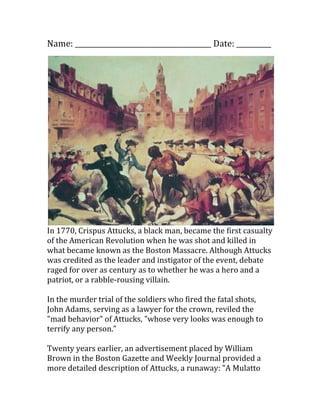
In 1770, Crispus Attucks, a black man, became the first casualty
of the American Revolution when he was shot and killed in
what became known as the Boston Massacre. Although Attucks
was credited as the leader and instigator of the event, debate
raged for over as century as to whether he was a hero and a
patriot, or a rabble-rousing villain.

In the murder trial of the soldiers who fired the fatal shots,
John Adams, serving as a lawyer for the crown, reviled the
"mad behavior" of Attucks, "whose very looks was enough to
terrify any person."

Twenty years earlier, an advertisement placed by William
Brown in the Boston Gazette and Weekly Journal provided a
more detailed description of Attucks, a runaway: "A Mulatto
fellow, about 27 Years of Age, named Crispus, 6 feet 2 inches
high, short cur'l hair, his knees nearer together than common."

Attucks father was said to be an African and his mother a
Natick or Nantucket Indian; in colonial America, the offspring
of black and Indian parents were considered black or mulatto.
As a slave in Framingham, he had been known for his skill in
buying and selling cattle.

Brown offered a reward for the man's return, and ended with
the following admonition: "And all Matters of Vessels and
others, are hereby cautioned against concealing or carrying off
said Servant on Penalty of Law. " Despite Brown's warning,
Attucks was carried off on a vessel many times over the next
twenty years; he became a sailor, working on a whaling crew
that sailed out of Boston harbor. At other times he worked as a
ropemaker in Boston.

Attucks' occupation made him particularly vulnerable to the
presence of the British. As a seaman, he felt the ever-present
danger of impressment into the British navy. As a laborer, he
felt the competition from British troops, who often took part-
time jobs during their off-duty hours and worked for lower
wages. A fight between Boston ropemakers and three British
soldiers on Friday, March 2, 1770 set the stage for a later
confrontation. That following Monday night, tensions escalated
when a soldier entered a pub to look for work, and instead
found a group of angry seamen that included Attucks.

That evening a group of about thirty, described by John Adams
as "a motley rabble of saucy boys, negroes and molattoes, Irish
teagues and outlandish jack tarrs," began taunting the guard at
the custom house with snowballs, sticks and insults. Seven
other redcoats came to the lone soldier's rescue, and Attucks
was one of five men killed when they opened fire.

Patriots, pamphleteers and propagandists immediately dubbed
the event the "Boston Massacre," and its victims became
instant martyrs and symbols of liberty. Despite laws and
customs regulating the burial of blacks, Attucks was buried in
the Park Street cemetery along with the other honored dead.

Adams, who became the second American president, defended
the soldiers in court against the charge of murder. Building on
eyewitness testimony that Attucks had struck the first blow,
Adams described him as the self-appointed leader of "the
dreadful carnage." In Adams' closing argument, Attucks
became larger than life, with "hardiness enough to fall in upon
them, and with one hand took hold of a bayonet, and with the
other knocked the man down." The officer in charge and five of
his men were acquitted, which further inflamed the public.

The citizens of Boston observed the anniversary of the Boston
Massacre in each of the following years leading up to the war.
In ceremonies designed to stir revolutionary fervor, they
summoned the "discontented ghosts" of the victims."

A "Crispus Attucks Day" was inaugurated by black abolitionists
in 1858, and in 1888, the Crispus Attucks Monument was
erected on the Boston Common, despite the opposition of the
Massachusetts Historical Society and the New England Historic
Genealogical Society, which regarded Attucks as a villain.

The debate notwithstanding, Attucks, immortalized as "the
first to defy, the first to die," has been lauded as a true martyr,
"the first to pour out his blood as a precious libation on the
altar of a people's rights."

Crispus attucks

  • 1.
    Name: _______________________________________ Date:__________ In 1770, Crispus Attucks, a black man, became the first casualty of the American Revolution when he was shot and killed in what became known as the Boston Massacre. Although Attucks was credited as the leader and instigator of the event, debate raged for over as century as to whether he was a hero and a patriot, or a rabble-rousing villain. In the murder trial of the soldiers who fired the fatal shots, John Adams, serving as a lawyer for the crown, reviled the "mad behavior" of Attucks, "whose very looks was enough to terrify any person." Twenty years earlier, an advertisement placed by William Brown in the Boston Gazette and Weekly Journal provided a more detailed description of Attucks, a runaway: "A Mulatto
  • 2.
    fellow, about 27Years of Age, named Crispus, 6 feet 2 inches high, short cur'l hair, his knees nearer together than common." Attucks father was said to be an African and his mother a Natick or Nantucket Indian; in colonial America, the offspring of black and Indian parents were considered black or mulatto. As a slave in Framingham, he had been known for his skill in buying and selling cattle. Brown offered a reward for the man's return, and ended with the following admonition: "And all Matters of Vessels and others, are hereby cautioned against concealing or carrying off said Servant on Penalty of Law. " Despite Brown's warning, Attucks was carried off on a vessel many times over the next twenty years; he became a sailor, working on a whaling crew that sailed out of Boston harbor. At other times he worked as a ropemaker in Boston. Attucks' occupation made him particularly vulnerable to the presence of the British. As a seaman, he felt the ever-present danger of impressment into the British navy. As a laborer, he felt the competition from British troops, who often took part- time jobs during their off-duty hours and worked for lower wages. A fight between Boston ropemakers and three British soldiers on Friday, March 2, 1770 set the stage for a later confrontation. That following Monday night, tensions escalated when a soldier entered a pub to look for work, and instead found a group of angry seamen that included Attucks. That evening a group of about thirty, described by John Adams as "a motley rabble of saucy boys, negroes and molattoes, Irish teagues and outlandish jack tarrs," began taunting the guard at the custom house with snowballs, sticks and insults. Seven other redcoats came to the lone soldier's rescue, and Attucks
  • 3.
    was one offive men killed when they opened fire. Patriots, pamphleteers and propagandists immediately dubbed the event the "Boston Massacre," and its victims became instant martyrs and symbols of liberty. Despite laws and customs regulating the burial of blacks, Attucks was buried in the Park Street cemetery along with the other honored dead. Adams, who became the second American president, defended the soldiers in court against the charge of murder. Building on eyewitness testimony that Attucks had struck the first blow, Adams described him as the self-appointed leader of "the dreadful carnage." In Adams' closing argument, Attucks became larger than life, with "hardiness enough to fall in upon them, and with one hand took hold of a bayonet, and with the other knocked the man down." The officer in charge and five of his men were acquitted, which further inflamed the public. The citizens of Boston observed the anniversary of the Boston Massacre in each of the following years leading up to the war. In ceremonies designed to stir revolutionary fervor, they summoned the "discontented ghosts" of the victims." A "Crispus Attucks Day" was inaugurated by black abolitionists in 1858, and in 1888, the Crispus Attucks Monument was erected on the Boston Common, despite the opposition of the Massachusetts Historical Society and the New England Historic Genealogical Society, which regarded Attucks as a villain. The debate notwithstanding, Attucks, immortalized as "the first to defy, the first to die," has been lauded as a true martyr, "the first to pour out his blood as a precious libation on the altar of a people's rights."