BASET P. GUINAR, Rcrim
ORDER OF PRESENTATION
 Rule 110 = Prosecution of Offenses
 Rule 112 = Preliminary Investigation/Inquest
 Rule 113 = Arrest
 Rule 114 = Bail
 Rule 126 = Search and Seizure
Revised Rules of Criminal Procedure
PROSECUTION OF OFFENSES
Rule 110
RULE 110 - PROSECUTION OF OFFENSES
INSTITUTION OF CRIMINAL ACTIONS.
(a) For offenses where a preliminary investigation
is required pursuant to section 1 of Rule 112,
by filing the complaint with the proper officer
for the purpose of conducting the requisite
preliminary investigation.
(b) For all other offenses, by filing the complaint or
information directly with the Municipal Trial
Courts and Municipal Circuit Trial Courts, or the
complaint with the office of the prosecutor.
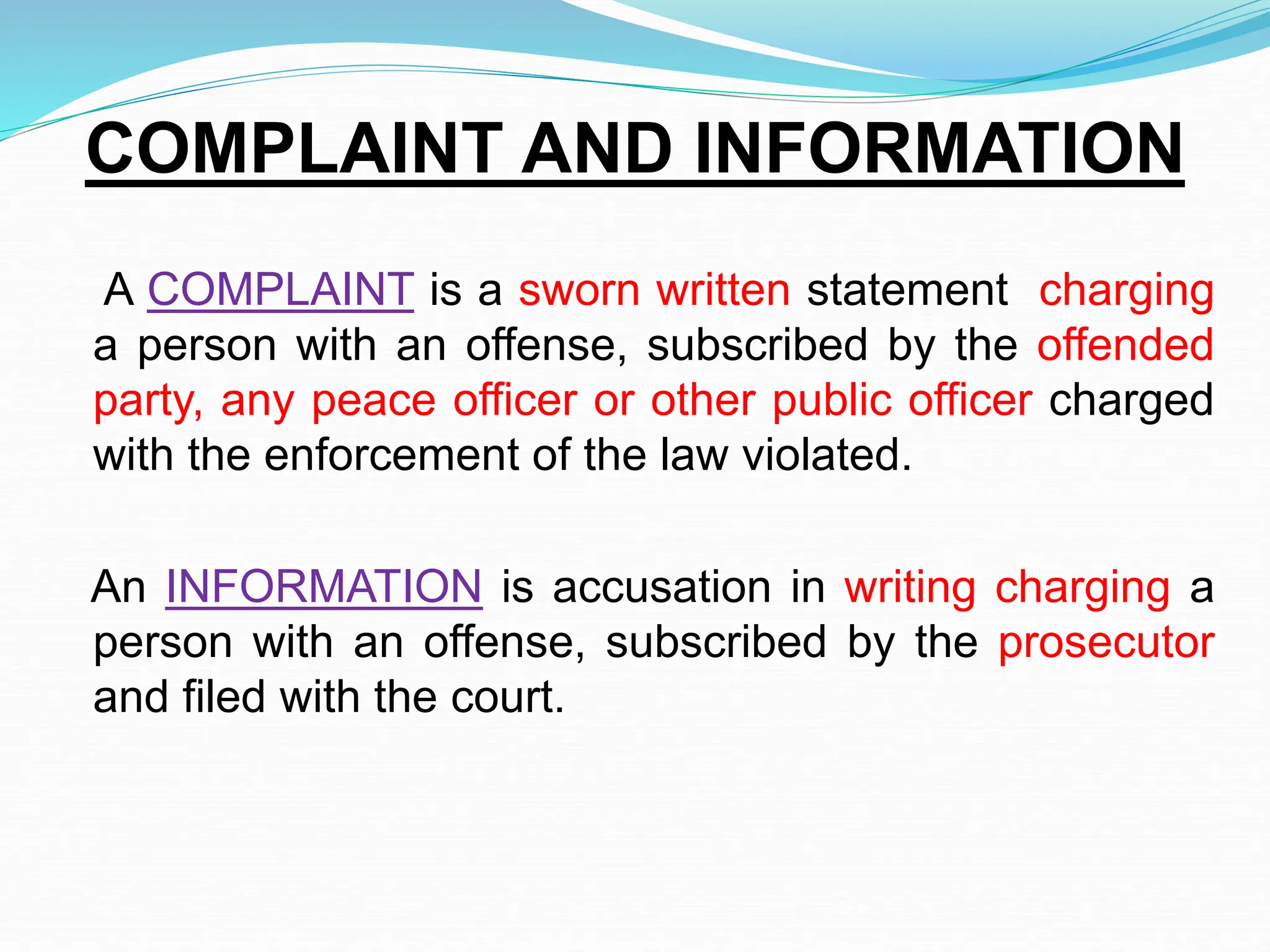
COMPLAINT AND INFORMATION
A COMPLAINT is a sworn written statement charging
a person with an offense, subscribed by the offended
party, any peace officer or other public officer charged
with the enforcement of the law violated.
An INFORMATION is accusation in writing charging a
person with an offense, subscribed by the prosecutor
and filed with the court.
COMPLAINT VS INFORMATION
INFORMATION COMPLAINT
Filed by the Prosecutor and other
Prosecuting Officers
Filed by the offended party, a peace
officer or public officer in charge of the
enforcement of the law violated
Need not be sworn by the Prosecutor
(but must comply with Sec 2, Rule 112
of Rules of Criminal Procedure)
Must be under oath
Could not initiate/commence
prosecution of all offenses, especially
private crimes(CASADA)
Could initiate/commence prosecution of
all offenses, including private crimes
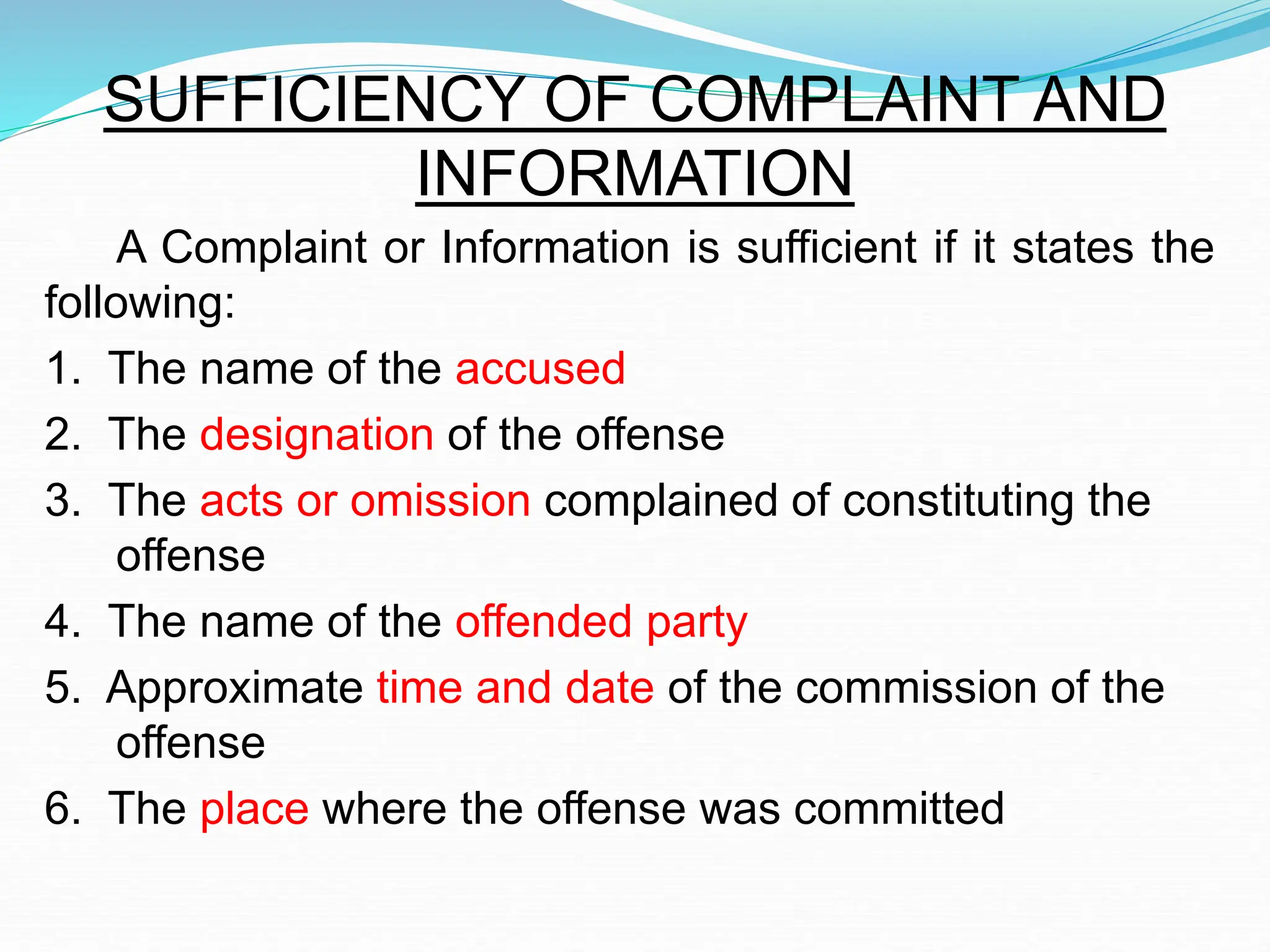
SUFFICIENCY OF COMPLAINT AND
INFORMATION
A Complaint or Information is sufficient if it states the
following:
1. The name of the accused
2. The designation of the offense
3. The acts or omission complained of constituting the
offense
4. The name of the offended party
5. Approximate time and date of the commission of the
offense
6. The place where the offense was committed
 Latest Amendments to Section 5, Rule 110 of the
Revised Rules of Criminal Procedure which
provides:
Who must prosecute criminal action. All criminal
actions either commenced by complaint or by
information shall be prosecuted under the
direction and control of a public prosecutor. In
case of heavy work schedule of the public
prosecutor or in the event of lack of public
prosecutors, the private prosecutor may be
authorized in writing by the Chief of the
Prosecution Office or the Regional State
Prosecutor to prosecute the case subject to the
approval of the court.
 Once so authorized to prosecute the criminal
action, the private prosecutor shall continue to
prosecute the case up to end of the trial even in
the absence of a public prosecutor, unless the
authority is revoked or otherwise withdrawn.
 x x x .").
Revised Rules of Criminal Procedure
PRELIMINARY INVESTIGATION
Rule 112
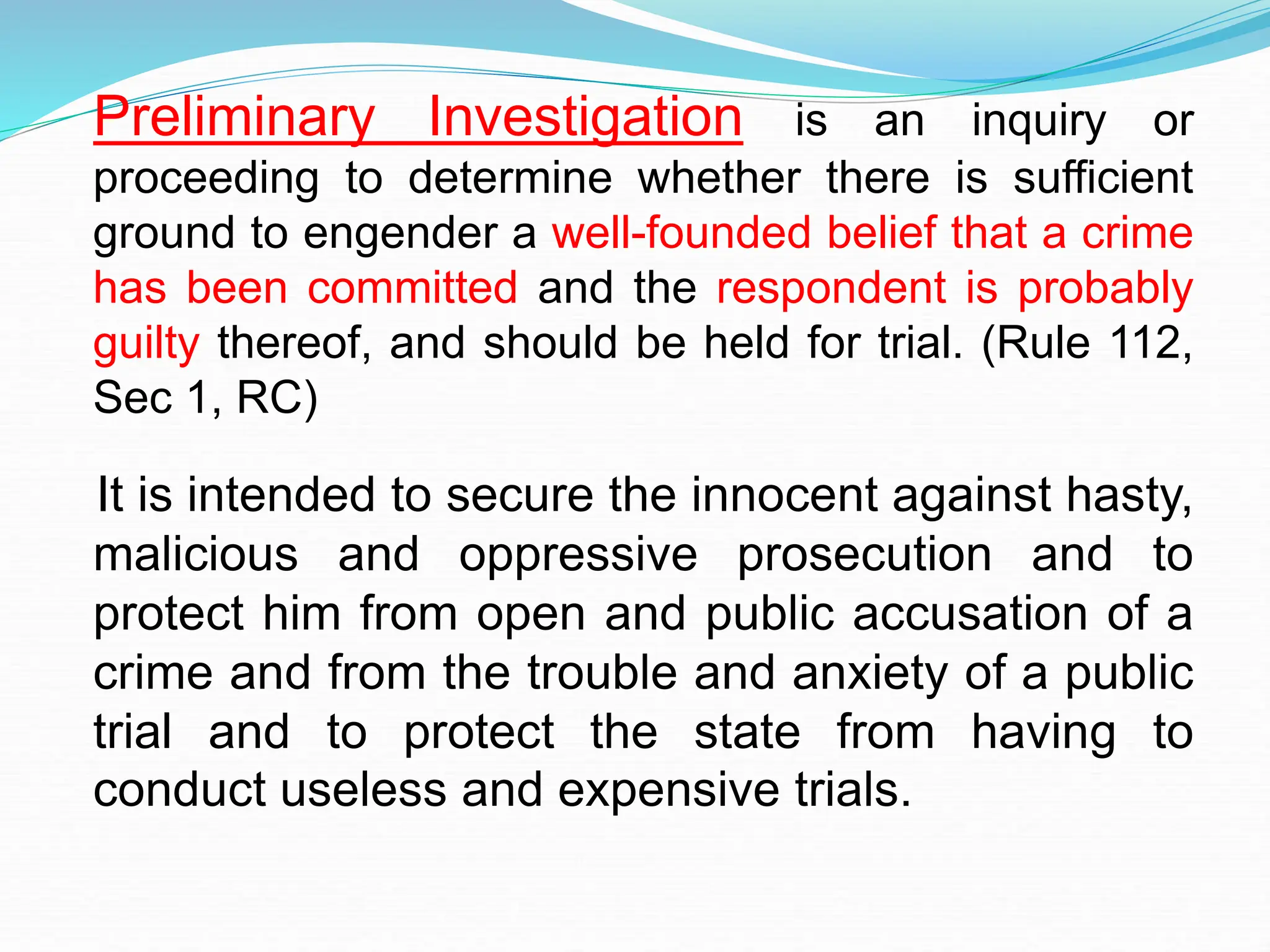
Preliminary Investigation is an inquiry or
proceeding to determine whether there is sufficient
ground to engender a well-founded belief that a crime
has been committed and the respondent is probably
guilty thereof, and should be held for trial. (Rule 112,
Sec 1, RC)
It is intended to secure the innocent against hasty,
malicious and oppressive prosecution and to
protect him from open and public accusation of a
crime and from the trouble and anxiety of a public
trial and to protect the state from having to
conduct useless and expensive trials.
CASES WHERE A PRELIMINARY
INVESTIGATION IS REQUIRED
A Preliminary Investigation is required to be
conducted before the filing of a Complaint or
information for an offense where the penalty
prescribed by law is at least four (4) years two
(2) months and one (1) day without regard to the
fine. (Rule 112, Sec 1)
OFFICERS AUTHORIZED TO CONDUCT
PRELIMINARY INVESTIGATION
The following may conduct Preliminary Investigations:
a. Provincial and City Prosecutors and their
assistants;
b. Judges of the MTC and MCTC;
c. National and Regional State Prosecutors;
d. Other officers authorized by law:
-The COMELEC
- The Office of the Ombudsman
- The PCGG
PROCEDURE FOR PRELIMINARY
INVESTIGATION
1. Commencement of the Preliminary Investigation.
2. Action on the Complaint by the Prosecutor.
3. Subpoena and Filing of Counter-Affidavit of the
Respondent.
4. Submission of the Case for Resolution.
5. Resolution on the Complaint.
COMMENCEMENT OF PRELIMINARY
INVESTIGATION
The Preliminary Investigation is commenced:
a. by filing of a Complaint by the complainant or any
competent person, directly with the office of the
investigating prosecutor;
b. by referral from or upon request of the law
enforcement agency that investigated the criminal
case;
c. upon request of the person arrested or detained
pursuant to a warrantless arrest;
d. by order or directive of the court or other competent
authority.
COMMENCEMENT OF PRELIMINARY
INVESTIGATION
The filing of the Complaint by the complainant,
together with the affidavits of witnesses, is the
simplest way of commencing a Preliminary
Investigation with the Provincial or City Prosecutor’s
office.
ACTION ON THE COMPLAINT
The Investigating Prosecutor has the following
courses of action:
1. Dismiss the Complaint if he finds there is no ground
to continue with the inquiry;
2. Issue a Subpoena to the respondent;
3. Refer the case to the Lupon ng Tagapamayapa for
mediation or conciliation.
OUTRIGHT DISMISSAL OF THE
COMPLAINT
The following constitute sufficient basis for outright
dismissal of the case:
1. The offense charged in the Complaint was
committed outside the territorial jurisdiction of the
Investigating Prosecutor.
For the Complaint to prosper, it must be filed
with the proper office of the prosecutor which has
territorial jurisdiction over the place of commission.
Venue in criminal cases is JURISDICTIONAL.
2. That at the time of the filing of the Complaint , the
offense charged had already prescribed.
3. That the complainant is not authorized under the
provision of pertinent laws to file the Complaint;
(Corp.Sec.Cert.)
A Complaint may be dismissed if the same was
not filed by the proper Complainant especially in
private cases (CASADA)
4. That the acts/omission alleged in the Complaint
and/or supporting affidavits does not sufficiently show
that a criminal offense or a violation of law has been
committed.
The Complaint must allege facts that show that a
crime has been committed.
5. That the Complaint and supporting affidavits are
unsigned and/or have not been duly subscribed and
sworn to as prescribed under the Rules of Criminal
Procedure.
SUBMISSION OF THE CASE FOR
RESOLUTION
If the Investigating Prosecutor does NOT find
sufficient basis for the prosecution of the respondent,
he shall prepare the resolution recommending the
dismissal of the Complaint.
If, on the other hand, he finds that probable cause
exists, he shall prepare the Resolution and the
corresponding Information or complaint in the
appropriate cases.
Revised Rules of Criminal Procedure
INQUEST PROCEEDING
INQUEST PROCEEDING
Inquest - is an informal and summary investigation
conducted by the public prosecutor in criminal cases
involving persons arrested and detained without the
benefit of a warrant of arrest issued by the court for
the purpose of determining whether or not such
person should remain under custody and
correspondingly be charged in court.
INQUEST PROCEEDING
When a person is lawfully arrested without warrant
involving an offense which requires a Preliminary
investigation, the Complaint or Information may be
filed by a prosecutor without need of such
investigation provided an inquest has been
conducted in accordance with existing rules.
COMMENCEMENT OF INQUEST
The Inquest Proceeding shall be considered as
commenced upon receipt by the Inquest Officer from
the law enforcement authorities of the following:
1. The Affidavit of Arrest
2. The Investigation Report
3. The statement of the complainant and witnesses
4. Other supporting documents gathered by the police
in the course of its investigation.
PRESENCE OF THE DETAINED
PERSON
The detained person should be present during the
proceeding before the Inquest officer.
DUTY OF THE INQUEST OFFICER
The initial action of the Inquest Officer is to
determine whether the crime charged is punishable by
a penalty of four (4) years two (2) months and one (1)
day.
When the penalty imposed by law does not exceed
four (4) years two (2) months and one (1) day, the
case may be filed in court without an Inquest
Proceeding or Preliminary Investigation.
If the penalty imposed by law exceeds four (4)
years two (2) months and one (1) day., the Inquest
officer shall then determine if the arrest of the detained
person was properly made.
If the Inquest Officer shall find out that the arrest of
the detained person was not in accordance with the
rules, and there is no reasonable ground to continue
with the proceedings, he shall prepare an order
stating his findings and the recommendation for the
release of the detained person and the dismissal of
the case.
DUTY OF THE INQUEST OFFICER WHEN
ARREST IS NOT PROPER
If the Inquest Officer shall find that the arrest was
properly effected, the detained person shall be
asked if he desires to avail himself of a
PRELIMINARY INVESTIGATION, and if he does, he
shall be made to execute a waiver of the provisions
of Art 125 of the RPC (Arbitrary Detention)
DUTY OF THE INQUEST OFFICER WHEN
ARREST IS PROPERLY EFFECTED
RECOVERED ITEMS
GENERAL RULE
When items which were subject or are proceeds of,
the crime charged, or which were used in the
commission of the offense, are recovered by the police
when the suspect is duly arrested without warrant,
shall remain in custody.
RELEASE OF RECOVERED ITEMS
Subject to the following conditions:
1. There is a written request for release.
2. Person requesting is the lawful owner.
3. Person requesting undertakes an oath to produce
said articles when required.
4. Person requesting, if material witness, affirms his
statement and undertakes to appear and testify
before the court.
5. Articles are not instrument or tools in the
commission of the offense charged.
6. Photos of articles are first taken and certified by
the police evidence custodian.
Rule 113 ARREST
Section 1. Definition of arrest. Arrest is
the taking of a person into custody in
order that he may be bound to answer for
the commission of an offense.
Arrest, How Made.
Sec. 2. Arrest; how made. An arrest
is made by an actual restraint of a person
to be arrested, or by his submission to the
custody of the person making the arrest.
No violence or unnecessary force shall
be used in making an arrest. The person
arrested shall not be subject to a greater
restraint than is necessary for his
detention.
Sec. 3. Duty of arresting officer. It shall
be the duty of the officer executing the
warrant to arrest the accused and deliver
him to the nearest police station or jail
without unnecessary delay.
Sec. 4. Execution of warrant. The head
of the office to whom the warrant of arrest
was delivered for execution shall cause the
warrant to be executed within ten (10) days
from its receipt. Within ten (10) days after
the expiration of the period, the officer to
whom it was assigned for execution shall
make a report to the judge who issued the
warrant. In case of his failure to execute
the warrant, he shall state the reason
therefore.
WARRANTLESS ARREST
Sec. 5. Arrest without warrant; when
lawful. A peace officer or a private person
may, without a warrant, arrest a person:
(a) When, in his presence, the person to
be arrested has committed, is actually
committing, or is attempting to commit an
offense;
WARRANTLESS ARREST (CONTD)
(b) When an offense has just been
committed and he has probable cause to
believe based on personal knowledge of
facts or circumstances that the person to
be arrested has committed it; and
WARRANTLESS ARREST (CONTD)
(c) When the person to be arrested is
a prisoner who has escaped from a penal
establishment or place where he is
serving final judgment or is temporarily
confined while his case is pending, or
has escaped while being transferred from
one confinement to another.
Time of the Arrest
 Sec. 6. Time of making arrest. An arrest
may be made on any day and at any
time of the day or night.
METHOD OF ARREST
Sec. 7. Method of arrest by officer by
virtue of warrant.
The officer shall state the cause of the
arrest and the fact that a warrant has been
issued, except when he flees or forcibly
resists before the officer has opportunity to
so inform him, or when the giving of such
information will imperil the arrest.
Arrest With Warrant
The officer need not have the warrant
in his possession at the time of the arrest
but after the arrest, if the person arrested
so requires, the warrant shall be shown to
him as soon as practicable
METHOD OF ARREST
Sec. 8. Method of arrest by officer without
warrant. When making an arrest without a
warrant, the officer shall inform the person to be
arrested of his authority and the cause of the
arrest, unless the latter is either engaged in the
commission of an offense, is pursued
immediately after its commission, has escaped,
flees, or forcibly resists before the officer has
opportunity to so inform him, or when the giving
of such information will imperil the arrest.
METHOD OF ARREST
Sec. 9. Method of arrest by private person. When
making an arrest, a private person shall inform the
person to be arrested of the intention to arrest him
and the case of the arrest, unless the latter is either
engaged in the commission of an offense, is pursued
immediately after its commission, or has escaped,
flees, or forcibly resists before the person making the
arrest has opportunity to so inform him, or when the
giving of such information will imperil the arrest.
SUMMON F0R ASSISTANCE
Sec. 10. Officer may summon assistance. An
officer making a lawful arrest may orally summon as
many persons as he deems necessary to assist him in
effecting the arrest. Every person so summoned by an
officer shall assist him in effecting the arrest when he
can render such assistance without detriment to
himself.
BREAKING INTO A BLDG.
Sec. 11. Right of officer to break into building or
enclosure. An officer, in order to make an arrest either
by virtue of a warrant, or without a warrant as provided
in section 5, may break into any building or enclosure
where the person to be arrested is or is reasonably
believed to be, if he is refused admittance thereto, after
announcing his authority and purpose.
BREAKOUT FROM BUILDING
Sec. 12. Right to break out from building or
enclosure. Whenever an officer has entered the
building or enclosure in accordance with the
preceding section, he may break out there from
when necessary to liberate himself.
ESCAPED PRISONER
Sec. 13. Arrest after escape or rescue. If a
person lawfully arrested escapes or is
rescued, any person may immediately pursue
or retake him without a warrant at any time
and in any place within the Philippines.
VISITATION BY ATTORNEY
Any lawyer, at the request of the person arrested
or of another acting in his behalf, have the right
to visit and confer privately with such person in
the jail or any other place of custody at any hour
of the day or night. Subject to reasonable
regulations, a relative of the person arrested can
also exercise the same right.
 RULE 114 – BAIL
 Section 1. Bail defined. – Bail is the security
given for the release of a person in custody of
the law, furnished by him or a bondsman, to
guarantee his appearance before any court as
required under the conditions hereinafter
specified. Bail may be given in the form of
corporate surety, property bond, cash deposit, or
recognizance.
 Section. 2. Conditions of the bail;
requirements. – All kinds of bail are subject to
the following conditions:
 (a) The undertaking shall be effective upon
approval, and unless cancelled, shall remain in
force at all stages of the case until promulgation
of the judgment of the Regional Trial Court,
irrespective of whether the case was originally
filed in or appealed to it;
 (b) The accused shall appear before the proper
court whenever required by the court of these
Rules;
 (c) The failure of the accused to appear at the
trial without justification and despite due notice
shall be deemed a waiver of his right to be
present thereat. In such case, the trial may
proceed in absentia; and
 (d) The bondsman shall surrender the accused to
the court for execution of the final judgment.
 The original papers shall state the full name and
address of the accused, the amount of the
undertaking and the conditions required by this
section. Photographs (passport size) taken
within the last six (6) months showing the face,
left and right profiles of the accused must be
attached to the bail.

 Section. 3. No release or transfer except on court
order or bail. –
 No person under detention by legal process shall
be released or transferred except upon order of
the court or when he is admitted to bail.

 Section. 4. Bail, a matter of right; exception. –
 All persons in custody shall be admitted to bail
as a matter of right, with sufficient sureties, or
released on recognizance as prescribed by law
or this Rule (a) before or after conviction by the
Metropolitan Trial Court, Municipal Trial Court,
Municipal Trial Court in Cities, or Municipal
Circuit Trial Court, and (b) before conviction by
the Regional Trial court of an offense not
punishable by death, reclusion perpetua, or life
imprisonment.
 Sec. 5. Bail, when discretionary. – Upon
conviction by the Regional Trial Court of an
offense not punishable by death, reclusion
perpetua, or life imprisonment, admission to bail
is discretionary. The application for bail may be
filed and acted upon by the trial court despite the
filing of a notice of appeal, provided it has not
transmitted the original record to the appellate
court. However, if the decision of the trial court
conviction the accused changed the nature of
the offense from non-bailable to bailable, the
application for bail can only be filed with and
resolved by the appellate court.
 If the penalty imposed by the trial court is
imprisonment exceeding six (6) years, the
accused shall be denied bail, or his bail shall be
cancelled upon a showing by the prosecution,
with notice to the accuse, of the following or
other similar circumstances:
 (a) That he is a recidivist, quasi-recidivist, or
habitual delinquent, or has committed the crime
aggravated by the circumstance of reiteration;
 (b) That he has previously escaped from legal
confinement, evaded sentence, or violated the
conditions of his bail without valid justification;
 (c) That he committed the offense while under
probation, parole, or conditional pardon;
 (d) That the circumstances of his case indicate
the probability of flight if released on bail; or
 (e) That there is undue risk that he may commit
another crime during the pendency of the appeal.
 Sec. 7. Capital offense or an offense punishable
by reclusion perpetua or life imprisonment, not
bailable. –
 Sec. 9. Amount of bail; guidelines. – The judge
who issued the warrant or granted the
application shall fix a reasonable amount of bail
considering primarily, but not limited to, the
following factors:
 (a) Financial liability of the accused to give bail;
 (b) Nature and circumstance of the offense;
 (c) Penalty for the offense charged;
 (d) Character and reputation of the accused;
 (e) Age and health of the accused;
 (f) Weight of the evidence against the accused;
 (g) Probability of the accused appearing at the
trial;
 (h) Forfeiture of other bail;
 (i) The fact that the accused was a fugitive from
justice when arrested; and
 (j) Pendency of other cases where the accused is
on bail.

 Section. 10. Corporate surety. – Any domestic or
foreign corporation, licensed as a surety in
accordance with law and currently authorized to
act as such, may provide bail by a bond
subscribed jointly by the accused and an officer
of the corporation duly authorized by its board of
directors.
Section. 11. Property bond, how posted. – A
property bond is an undertaking constituted as
lien on the real property given as security for the
amount of the bail. Within ten (10) days after the
approval of the bond, the accused shall cause
the annotation of the lien on the certificate of title
on file with the Registry of Deeds if the land is
registered, or if unregistered, in the Registration
Book on the space provided therefore, in the
Registry of Deeds for the province or city where
the land lies, and on the corresponding tax
declaration in the office of the provincial, city
and municipal assessor concerned.
Section. 12. Qualifications of sureties in property
bond. – The qualifications of sureties in a
property bond shall be as follows:
 (a) Each must be a resident owner of real estate
within the Philippines;
 (b) Where there is only one surety, his real estate
must be worth at least the amount of
undertaking;
 (c) If there are two or more sureties, each may
justify in an amount less than that expressed in
the undertaking but the aggregate of the justified
sums must be equivalent to the whole amount of
the bail demanded.
 Sec. 14. Deposit of cash as bail. – The accused
or any person acting in his behalf may deposit in
cash with the nearest collector of internal
revenue or provincial, city, or municipal treasurer
the amount of bail fixed by the court, or
recommended by the prosecutor who
investigated or filed the case. Upon submission
of a proper certificate of deposit and a written
undertaking showing compliance with the
requirements of section 2 of this Rule, the
accused shall be discharged from custody. The
money deposited shall be considered as bail and
applied to the payment of fine and costs while
the excess, if any, shall be returned to the
accused or to whoever made the deposit.
 Sec. 17. Bail, where filed. – (a) Bail in the amount
fixed may be filed with the court where the case
is pending, or in the absence or unavailability of
the judge thereof, with any regional trial judge,
metropolitan trial judge, municipal trial judge, or
municipal circuit trial judge in the province, city
or municipality. If the accused is arrested in a
province, city, or municipality other than where
the case is pending, bail may also be filed with
any regional trial court of said place, of if no
judge thereof is available, with any metropolitan
trial judge, municipal trial judge, or municipal
circuit trial judge therein.
 (b) Where the grant of bail is a matter of
discretion, or the accused seeks to be released on
recognizance, the application may only be filed in
the court where the case is pending, whether on
preliminary investigation, trial, or appeal.
* Any person in custody who is not yet charged in
court may apply for bail with any court in the
province, city, or municipality where he is held.
 Section. 20. Increase or reduction of bail. –
After the accused is admitted to bail, the court
may, upon good cause, either increase or reduce
its amount. When increased, the accused may be
committed to custody if he does not give bail in
the increased amount within a reasonable period.
An accused held to answer a criminal charge,
who is released without bail upon filing of the
complaint or information, may, at any
subsequent stage of the proceedings and
whenever a strong showing of guilt appears to
the court, be required to give bail in the amount
fixed, or in lieu thereof, committed to custody.
 Sec. 21. Forfeiture of bail. – When the presence
of the accused is required by the court or these
Rules, his bondsmen shall be notified to produce
him before the court on a given date and time. If
the accused fails to appear in person as
required, his bail shall be declared forfeited and
the bondsmen given thirty (30) days within which
to produce their principal and to show why no
judgment should be rendered against them for
the amount of their bail. Within the said period,
the bondsmen must:
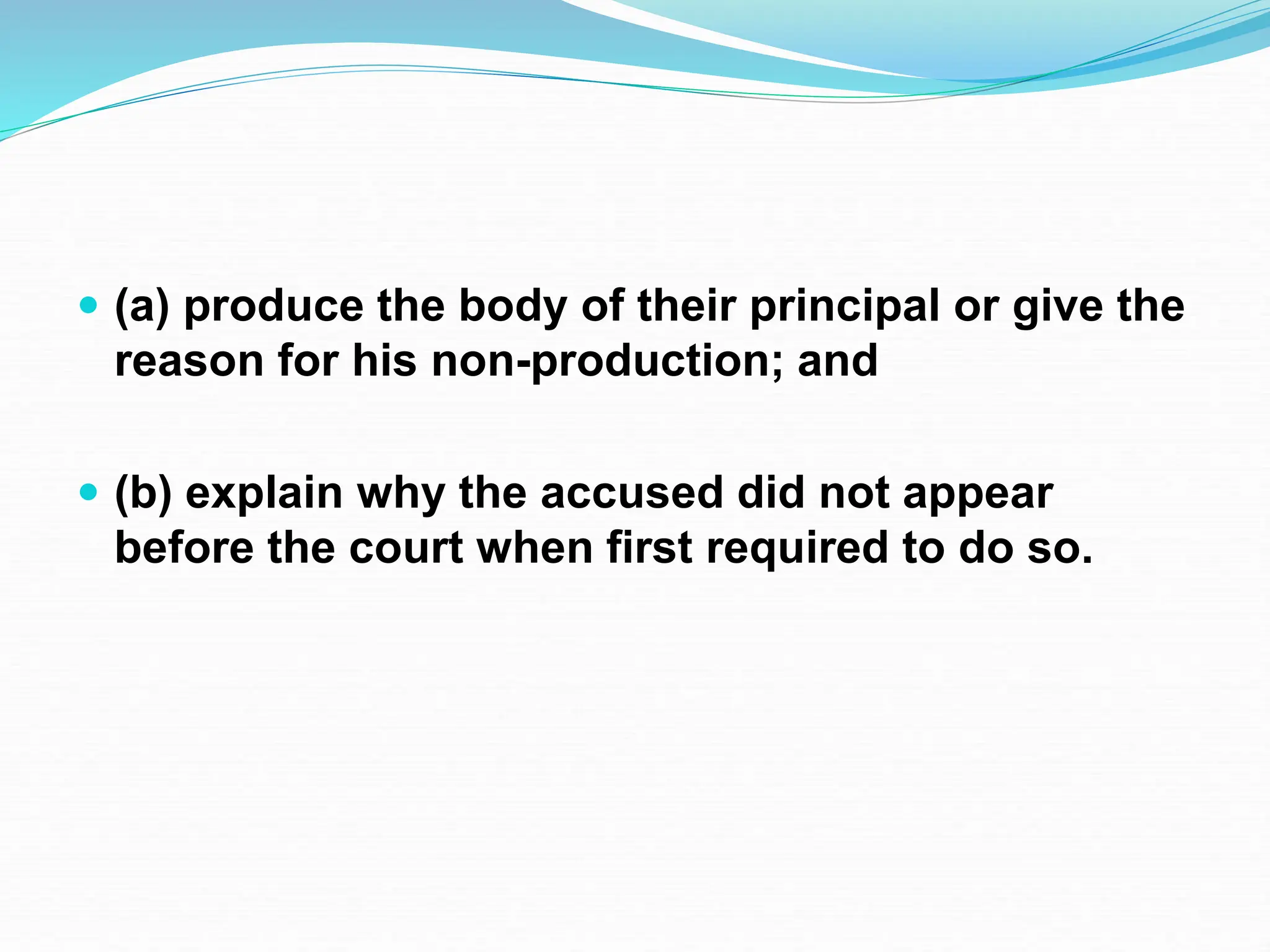
 (a) produce the body of their principal or give the
reason for his non-production; and
 (b) explain why the accused did not appear
before the court when first required to do so.

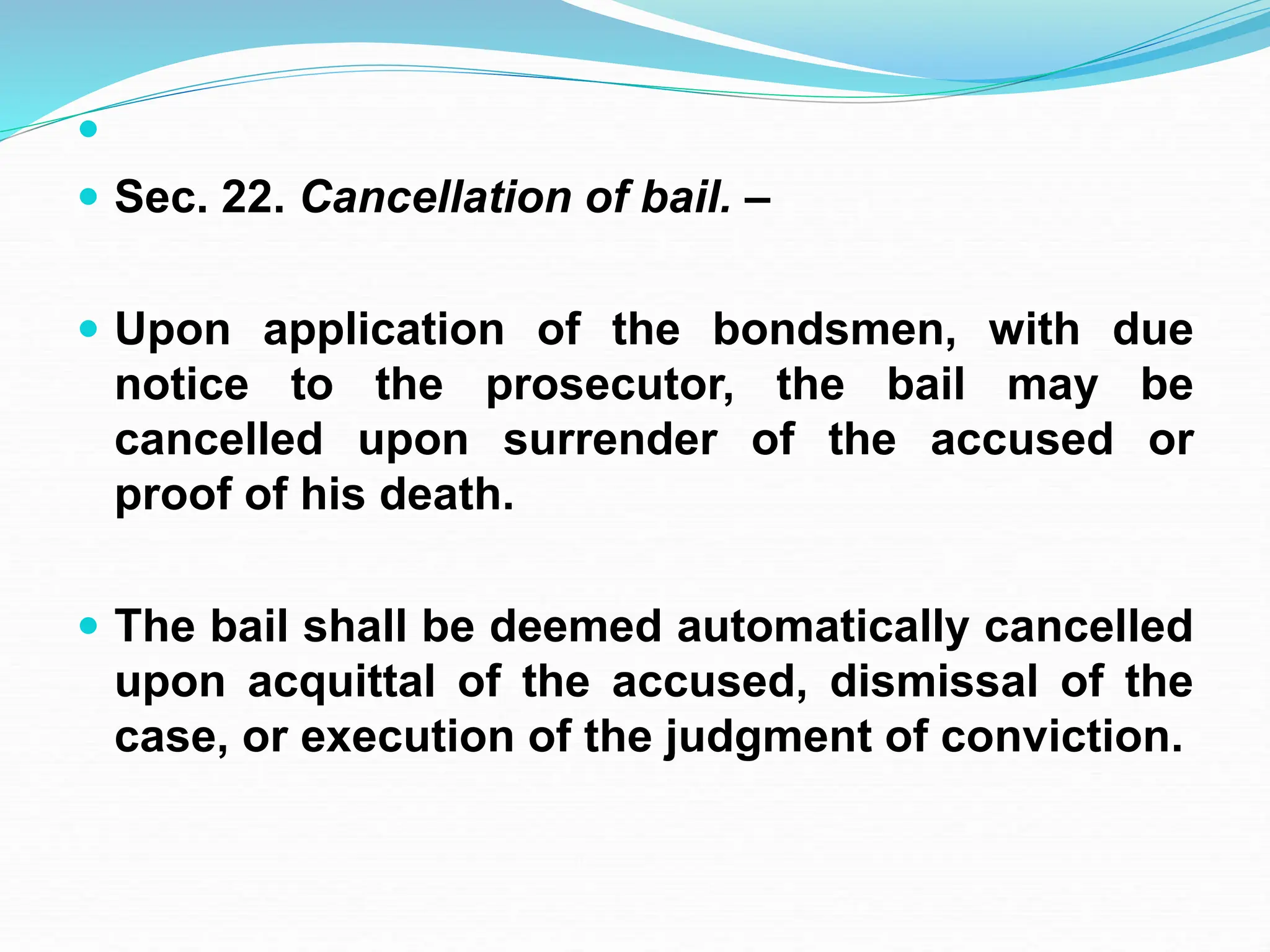
 Sec. 22. Cancellation of bail. –
 Upon application of the bondsmen, with due
notice to the prosecutor, the bail may be
cancelled upon surrender of the accused or
proof of his death.
 The bail shall be deemed automatically cancelled
upon acquittal of the accused, dismissal of the
case, or execution of the judgment of conviction.

 Sec. 23. Arrest of accused out on bail. – For the
purpose of surrendering the accused, the
bondsmen may arrest him or, upon written
authority endorsed on a certified copy of the
undertaking, cause him to be arrested by a police
officer or any other person of suitable age and
discretion.
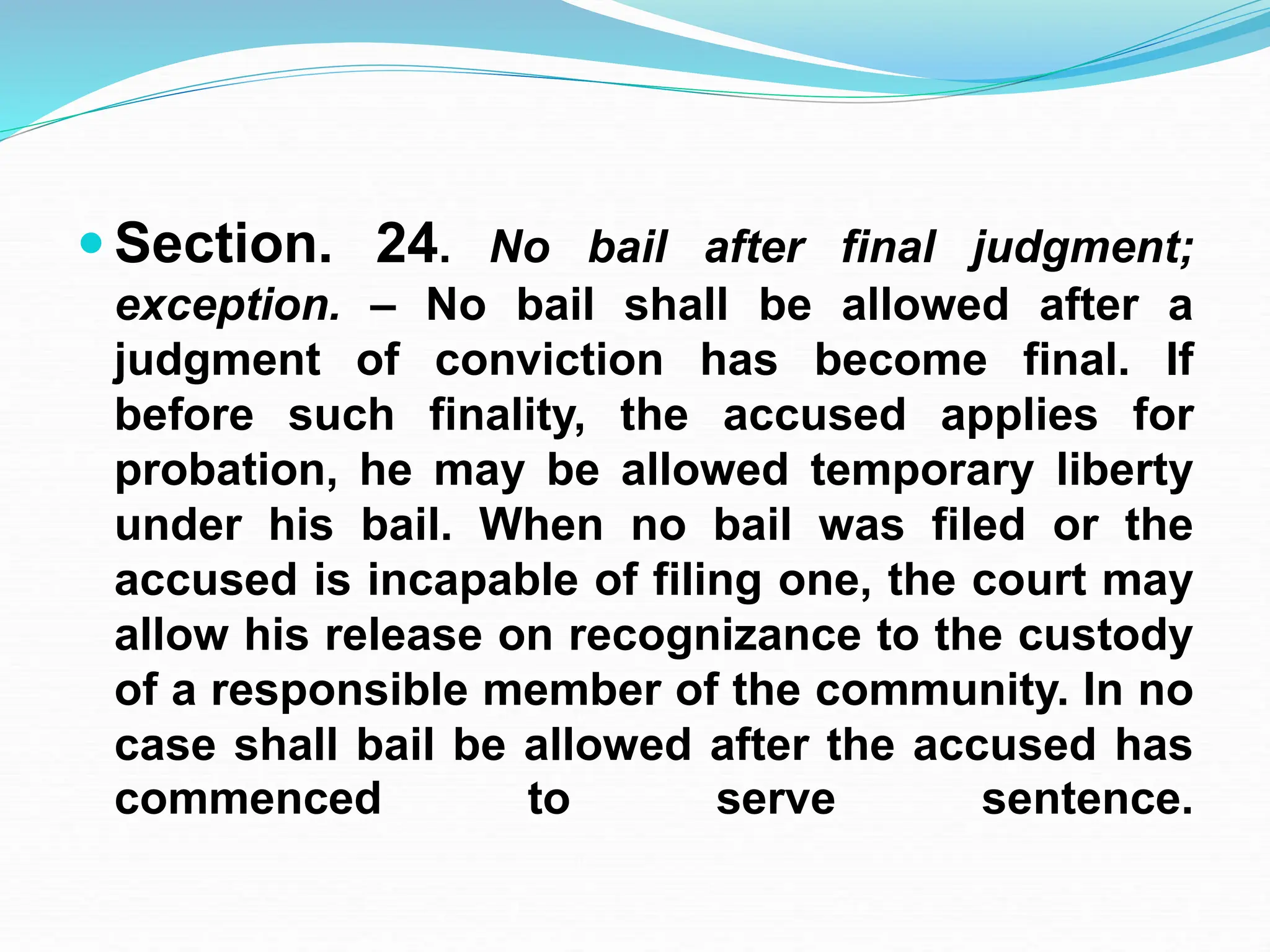
 Section. 24. No bail after final judgment;
exception. – No bail shall be allowed after a
judgment of conviction has become final. If
before such finality, the accused applies for
probation, he may be allowed temporary liberty
under his bail. When no bail was filed or the
accused is incapable of filing one, the court may
allow his release on recognizance to the custody
of a responsible member of the community. In no
case shall bail be allowed after the accused has
commenced to serve sentence.
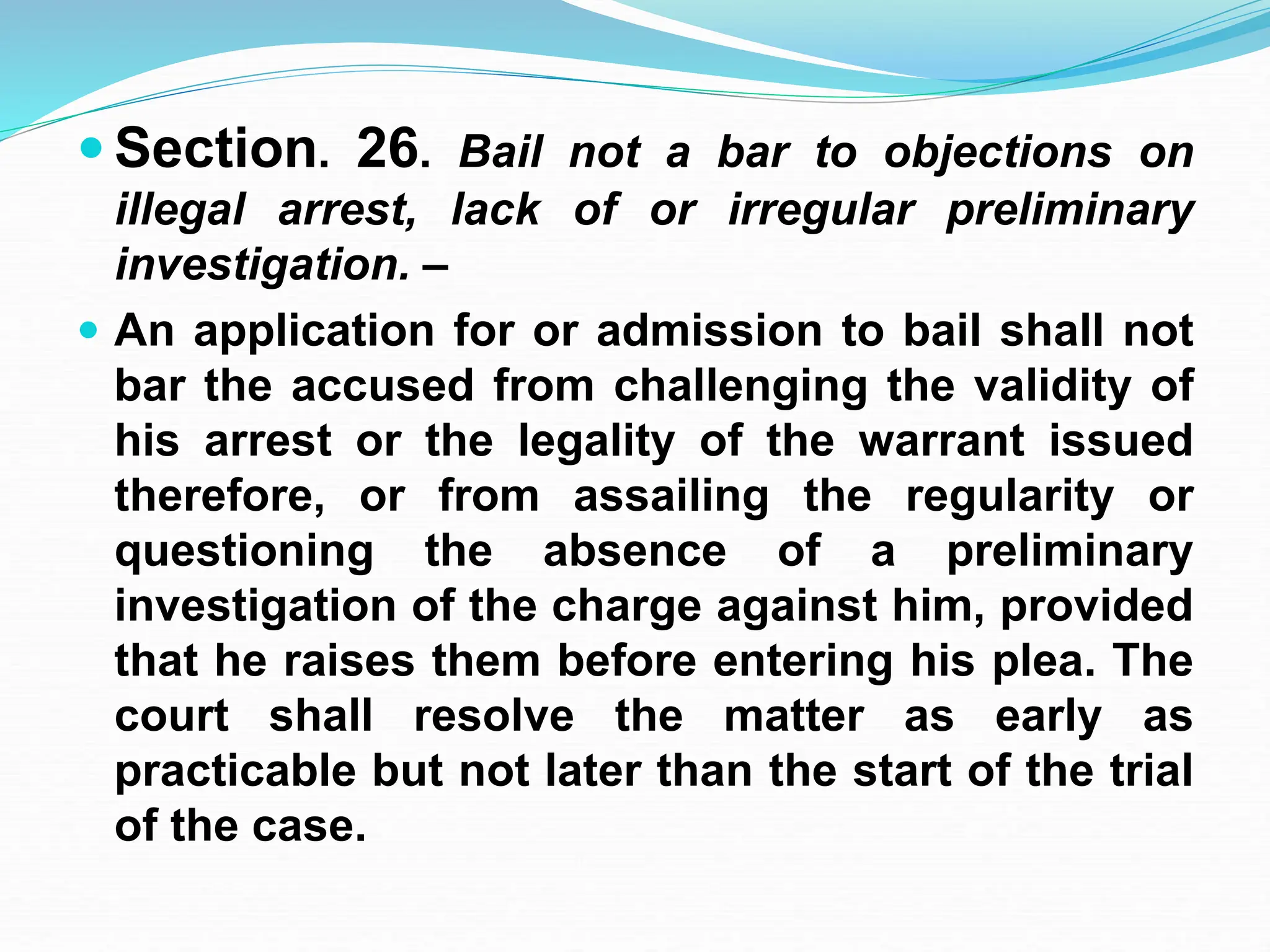
 Section. 26. Bail not a bar to objections on
illegal arrest, lack of or irregular preliminary
investigation. –
 An application for or admission to bail shall not
bar the accused from challenging the validity of
his arrest or the legality of the warrant issued
therefore, or from assailing the regularity or
questioning the absence of a preliminary
investigation of the charge against him, provided
that he raises them before entering his plea. The
court shall resolve the matter as early as
practicable but not later than the start of the trial
of the case.
Rule 126 – Search & Seizure
SEARCH WARRANT - is an order in writing issued in
the name of the People of the Philippines, signed by a
judge and directed to a peace officer, commanding him
to search for personal property described therein and
bring it before the court.
WHERE TO APPLY
(a) Any court within whose territorial
jurisdiction a crime was committed.
(b) For compelling reasons stated in the
application, any court within the judicial region
where the crime was committed, or any court
within the judicial region where the warrant
shall be enforced.
(c) In the court where the criminal action is
pending.
PERSONAL PROPERTY TO BE SEIZED
(a) Subject of the offense;
(b) Stolen or embezzled and other proceeds, or fruits of
the offense; or
(c) Used or intended to be used as the means of
committing an offense.
REQUISITES FOR ISSUANCE
A search warrant shall not issue except upon
probable cause in connection with one specific
offense to be determined personally by the
judge after examination under oath or affirmation
of the complainant and the witness he may
produce, and particularly describing the place to
be searched and the things to be seized which
may be anywhere in the Philippines
EXAMINATION OF COMPLAINANT
The judge must, before issuing the warrant,
personally examine in the form of searching questions
and answers, in writing and under oath, the
complainant and the witnesses he may produce on
facts personally known to them and attach to the
record their sworn statements, together with the
affidavits submitted.
ISSUANCE & FORM OF SW
If the judge is satisfied of the
existence of facts upon which the
application is based or that there is
probable cause to believe that they
exist, he shall issue the warrant, which
must be substantially in the form
prescribed by these Rules.
BREAKING INTO BUILDING
The officer, if refused admittance to
the place of directed search after giving
notice of his purpose and authority,
may break open any outer or inner door
or window of a house or any part of a
house or anything therein to execute
the warrant to liberate himself or any
person lawfully aiding him when
unlawfully detained therein.
Witnesses to the Search
No search of a house, room, or any
other premises shall be made except in the
presence of the lawful occupant thereof or
any member of his family or in the absence
of the latter, two witnesses of sufficient
age and discretion residing in the same
locality.
TIME OF MAKING SEARCH
The warrant must direct that it be
served in the day time, unless the
affidavit asserts that the property is
on the person or in the place ordered
to be searched, in which case a
direction may be inserted that it be
served at any time of the day or night.
VALIDITY OF SW
A search warrant shall be valid for ten
(10) days from its date. Thereafter, it shall be
void.
RECEIPT FOR PROPERTY SEIZED
The officer seizing the property under the
warrant must give a detailed receipt for the same to
the lawful occupant of the premises in whose
presence the search and seizure were made, or in
the absence of such occupant, must, in the
presence of at least two witnesses of sufficient age
and discretion residing in the same locality, leave a
receipt in the place in which he found the seized
property.
Delivery of the Property Seized
(a) The officer must forthwith deliver the
property seized to the judge who issued the warrant,
together with a true inventory thereof duly verified
under oath.
Delivery of the Property Seized (contd.)
(b) Ten (10) days after issuance of the search
warrant, the issuing judge shall ascertain if the
return has been made, and if none, shall summon
the person to whom the warrant was issued and
require him to explain why no return was made. If
the return has been made, the judge shall ascertain
whether section 11 of this Rule has been complied
with and shall require that the property seized be
delivered to him. The judge shall see to it that
subsection (a) hereof has been complied with.
Delivery of the Property Seized (contd.)
(c) The return on the search
warrant shall be filed and kept by the
custodian of the log book on search
warrants who shall enter therein the
date of the return, the result, and
other actions of the judge.
Search incident to lawful arrest
A person lawfully arrested may be
searched for dangerous weapons or
anything which may have been used
or constitute proof in the commission
of an offense without a search warrant
Motion to quash a search warrant
A motion to quash a search warrant and/or to
suppress evidence obtained thereby may be filed
in and acted upon only by the court where the
action has been instituted. If no criminal action
has been instituted, the motion may be filed in
and resolved by the court that issued search
warrant. However, if such court failed to resolve
the motion and a criminal case is subsequently
filed in another court, the motion shall be resolved
by the latter court.
WHEN SEARCH WITHOUT WARRANT IS
VALID
(1) Search of Moving vehicles –
the reason for this is that the person
may escape easily if the warrant had
to be applied for.
WHEN SEARCH WITHOUT WARRANT IS
VALID (contd.)
(2) Search is incidental to a
lawful arrest – A person arrested may
be searched for dangerous weapons or
anything that proves the commission of
the offense. The search can only be
made within the area of control of the
arrested person and within the time of
the arrest.
WHEN SEARCH WITHOUT WARRANT IS
VALID (contd.)
(3) When things seized are within PLAIN VIEW of
the searching party. (Plain View Doctrine) – plain
view means “open to the eye and hand” and may be
searched without warrant.
WHEN SEARCH WITHOUT WARRANT IS VALID
(contd.)
(4) Stop and Frisk Rule – a police
officer may, in an appropriate circumstance
and in an appropriate manner, approach a
person for the purpose of investigating
possible criminal behaviour even though
there is no probable cause to make an arrest.
Stop and Frisk is used to determine the
identity of suspicious individuals or
maintain the status quo.
WHEN SEARCH WITHOUT WARRANT IS VALID
(contd.)
(5) When there is valid waiver –
the person consented to the search
without intimidation or coercion from
the searching party.
WHEN SEARCH WITHOUT WARRANT
IS VALID (contd.)
(6) Search of Vessels and Aircraft for
violation of immigration, customs, fisheries and
dangerous drugs law- because vessels and aircraft can
easily elude pursuit.
WHEN SEARCH WITHOUT WARRANT IS
VALID (contd.)
(7) Inspection of buildings and other
premises for the enforcement of sanitary and
building regulations.
(8) Saturation drives, Checkpoints
and “areal target zoning” -
END OF LECTURE

CriminalProcedureRule110to127-210303-211002.ppt

  • 1.
  • 2.
    ORDER OF PRESENTATION Rule 110 = Prosecution of Offenses  Rule 112 = Preliminary Investigation/Inquest  Rule 113 = Arrest  Rule 114 = Bail  Rule 126 = Search and Seizure
  • 3.
    Revised Rules ofCriminal Procedure PROSECUTION OF OFFENSES Rule 110
  • 4.
    RULE 110 -PROSECUTION OF OFFENSES INSTITUTION OF CRIMINAL ACTIONS. (a) For offenses where a preliminary investigation is required pursuant to section 1 of Rule 112, by filing the complaint with the proper officer for the purpose of conducting the requisite preliminary investigation. (b) For all other offenses, by filing the complaint or information directly with the Municipal Trial Courts and Municipal Circuit Trial Courts, or the complaint with the office of the prosecutor.
  • 5.
    COMPLAINT AND INFORMATION ACOMPLAINT is a sworn written statement charging a person with an offense, subscribed by the offended party, any peace officer or other public officer charged with the enforcement of the law violated. An INFORMATION is accusation in writing charging a person with an offense, subscribed by the prosecutor and filed with the court.
  • 6.
    COMPLAINT VS INFORMATION INFORMATIONCOMPLAINT Filed by the Prosecutor and other Prosecuting Officers Filed by the offended party, a peace officer or public officer in charge of the enforcement of the law violated Need not be sworn by the Prosecutor (but must comply with Sec 2, Rule 112 of Rules of Criminal Procedure) Must be under oath Could not initiate/commence prosecution of all offenses, especially private crimes(CASADA) Could initiate/commence prosecution of all offenses, including private crimes
  • 7.
    SUFFICIENCY OF COMPLAINTAND INFORMATION A Complaint or Information is sufficient if it states the following: 1. The name of the accused 2. The designation of the offense 3. The acts or omission complained of constituting the offense 4. The name of the offended party 5. Approximate time and date of the commission of the offense 6. The place where the offense was committed
  • 8.
     Latest Amendmentsto Section 5, Rule 110 of the Revised Rules of Criminal Procedure which provides: Who must prosecute criminal action. All criminal actions either commenced by complaint or by information shall be prosecuted under the direction and control of a public prosecutor. In case of heavy work schedule of the public prosecutor or in the event of lack of public prosecutors, the private prosecutor may be authorized in writing by the Chief of the Prosecution Office or the Regional State Prosecutor to prosecute the case subject to the approval of the court.
  • 9.
     Once soauthorized to prosecute the criminal action, the private prosecutor shall continue to prosecute the case up to end of the trial even in the absence of a public prosecutor, unless the authority is revoked or otherwise withdrawn.  x x x .").
  • 10.
    Revised Rules ofCriminal Procedure PRELIMINARY INVESTIGATION Rule 112
  • 11.
    Preliminary Investigation isan inquiry or proceeding to determine whether there is sufficient ground to engender a well-founded belief that a crime has been committed and the respondent is probably guilty thereof, and should be held for trial. (Rule 112, Sec 1, RC) It is intended to secure the innocent against hasty, malicious and oppressive prosecution and to protect him from open and public accusation of a crime and from the trouble and anxiety of a public trial and to protect the state from having to conduct useless and expensive trials.
  • 12.
    CASES WHERE APRELIMINARY INVESTIGATION IS REQUIRED A Preliminary Investigation is required to be conducted before the filing of a Complaint or information for an offense where the penalty prescribed by law is at least four (4) years two (2) months and one (1) day without regard to the fine. (Rule 112, Sec 1)
  • 13.
    OFFICERS AUTHORIZED TOCONDUCT PRELIMINARY INVESTIGATION The following may conduct Preliminary Investigations: a. Provincial and City Prosecutors and their assistants; b. Judges of the MTC and MCTC; c. National and Regional State Prosecutors; d. Other officers authorized by law: -The COMELEC - The Office of the Ombudsman - The PCGG
  • 14.
    PROCEDURE FOR PRELIMINARY INVESTIGATION 1.Commencement of the Preliminary Investigation. 2. Action on the Complaint by the Prosecutor. 3. Subpoena and Filing of Counter-Affidavit of the Respondent. 4. Submission of the Case for Resolution. 5. Resolution on the Complaint.
  • 15.
    COMMENCEMENT OF PRELIMINARY INVESTIGATION ThePreliminary Investigation is commenced: a. by filing of a Complaint by the complainant or any competent person, directly with the office of the investigating prosecutor; b. by referral from or upon request of the law enforcement agency that investigated the criminal case; c. upon request of the person arrested or detained pursuant to a warrantless arrest; d. by order or directive of the court or other competent authority.
  • 16.
    COMMENCEMENT OF PRELIMINARY INVESTIGATION Thefiling of the Complaint by the complainant, together with the affidavits of witnesses, is the simplest way of commencing a Preliminary Investigation with the Provincial or City Prosecutor’s office.
  • 17.
    ACTION ON THECOMPLAINT The Investigating Prosecutor has the following courses of action: 1. Dismiss the Complaint if he finds there is no ground to continue with the inquiry; 2. Issue a Subpoena to the respondent; 3. Refer the case to the Lupon ng Tagapamayapa for mediation or conciliation.
  • 18.
    OUTRIGHT DISMISSAL OFTHE COMPLAINT The following constitute sufficient basis for outright dismissal of the case: 1. The offense charged in the Complaint was committed outside the territorial jurisdiction of the Investigating Prosecutor. For the Complaint to prosper, it must be filed with the proper office of the prosecutor which has territorial jurisdiction over the place of commission. Venue in criminal cases is JURISDICTIONAL.
  • 19.
    2. That atthe time of the filing of the Complaint , the offense charged had already prescribed. 3. That the complainant is not authorized under the provision of pertinent laws to file the Complaint; (Corp.Sec.Cert.) A Complaint may be dismissed if the same was not filed by the proper Complainant especially in private cases (CASADA)
  • 20.
    4. That theacts/omission alleged in the Complaint and/or supporting affidavits does not sufficiently show that a criminal offense or a violation of law has been committed. The Complaint must allege facts that show that a crime has been committed. 5. That the Complaint and supporting affidavits are unsigned and/or have not been duly subscribed and sworn to as prescribed under the Rules of Criminal Procedure.
  • 21.
    SUBMISSION OF THECASE FOR RESOLUTION If the Investigating Prosecutor does NOT find sufficient basis for the prosecution of the respondent, he shall prepare the resolution recommending the dismissal of the Complaint. If, on the other hand, he finds that probable cause exists, he shall prepare the Resolution and the corresponding Information or complaint in the appropriate cases.
  • 22.
    Revised Rules ofCriminal Procedure INQUEST PROCEEDING
  • 23.
    INQUEST PROCEEDING Inquest -is an informal and summary investigation conducted by the public prosecutor in criminal cases involving persons arrested and detained without the benefit of a warrant of arrest issued by the court for the purpose of determining whether or not such person should remain under custody and correspondingly be charged in court.
  • 24.
    INQUEST PROCEEDING When aperson is lawfully arrested without warrant involving an offense which requires a Preliminary investigation, the Complaint or Information may be filed by a prosecutor without need of such investigation provided an inquest has been conducted in accordance with existing rules.
  • 25.
    COMMENCEMENT OF INQUEST TheInquest Proceeding shall be considered as commenced upon receipt by the Inquest Officer from the law enforcement authorities of the following: 1. The Affidavit of Arrest 2. The Investigation Report 3. The statement of the complainant and witnesses 4. Other supporting documents gathered by the police in the course of its investigation.
  • 26.
    PRESENCE OF THEDETAINED PERSON The detained person should be present during the proceeding before the Inquest officer.
  • 27.
    DUTY OF THEINQUEST OFFICER The initial action of the Inquest Officer is to determine whether the crime charged is punishable by a penalty of four (4) years two (2) months and one (1) day. When the penalty imposed by law does not exceed four (4) years two (2) months and one (1) day, the case may be filed in court without an Inquest Proceeding or Preliminary Investigation. If the penalty imposed by law exceeds four (4) years two (2) months and one (1) day., the Inquest officer shall then determine if the arrest of the detained person was properly made.
  • 28.
    If the InquestOfficer shall find out that the arrest of the detained person was not in accordance with the rules, and there is no reasonable ground to continue with the proceedings, he shall prepare an order stating his findings and the recommendation for the release of the detained person and the dismissal of the case. DUTY OF THE INQUEST OFFICER WHEN ARREST IS NOT PROPER
  • 29.
    If the InquestOfficer shall find that the arrest was properly effected, the detained person shall be asked if he desires to avail himself of a PRELIMINARY INVESTIGATION, and if he does, he shall be made to execute a waiver of the provisions of Art 125 of the RPC (Arbitrary Detention) DUTY OF THE INQUEST OFFICER WHEN ARREST IS PROPERLY EFFECTED
  • 30.
    RECOVERED ITEMS GENERAL RULE Whenitems which were subject or are proceeds of, the crime charged, or which were used in the commission of the offense, are recovered by the police when the suspect is duly arrested without warrant, shall remain in custody.
  • 31.
    RELEASE OF RECOVEREDITEMS Subject to the following conditions: 1. There is a written request for release. 2. Person requesting is the lawful owner. 3. Person requesting undertakes an oath to produce said articles when required. 4. Person requesting, if material witness, affirms his statement and undertakes to appear and testify before the court. 5. Articles are not instrument or tools in the commission of the offense charged. 6. Photos of articles are first taken and certified by the police evidence custodian.
  • 32.
    Rule 113 ARREST Section1. Definition of arrest. Arrest is the taking of a person into custody in order that he may be bound to answer for the commission of an offense.
  • 33.
    Arrest, How Made. Sec.2. Arrest; how made. An arrest is made by an actual restraint of a person to be arrested, or by his submission to the custody of the person making the arrest. No violence or unnecessary force shall be used in making an arrest. The person arrested shall not be subject to a greater restraint than is necessary for his detention.
  • 34.
    Sec. 3. Dutyof arresting officer. It shall be the duty of the officer executing the warrant to arrest the accused and deliver him to the nearest police station or jail without unnecessary delay.
  • 35.
    Sec. 4. Executionof warrant. The head of the office to whom the warrant of arrest was delivered for execution shall cause the warrant to be executed within ten (10) days from its receipt. Within ten (10) days after the expiration of the period, the officer to whom it was assigned for execution shall make a report to the judge who issued the warrant. In case of his failure to execute the warrant, he shall state the reason therefore.
  • 36.
    WARRANTLESS ARREST Sec. 5.Arrest without warrant; when lawful. A peace officer or a private person may, without a warrant, arrest a person: (a) When, in his presence, the person to be arrested has committed, is actually committing, or is attempting to commit an offense;
  • 37.
    WARRANTLESS ARREST (CONTD) (b)When an offense has just been committed and he has probable cause to believe based on personal knowledge of facts or circumstances that the person to be arrested has committed it; and
  • 38.
    WARRANTLESS ARREST (CONTD) (c)When the person to be arrested is a prisoner who has escaped from a penal establishment or place where he is serving final judgment or is temporarily confined while his case is pending, or has escaped while being transferred from one confinement to another.
  • 39.
    Time of theArrest  Sec. 6. Time of making arrest. An arrest may be made on any day and at any time of the day or night.
  • 40.
    METHOD OF ARREST Sec.7. Method of arrest by officer by virtue of warrant. The officer shall state the cause of the arrest and the fact that a warrant has been issued, except when he flees or forcibly resists before the officer has opportunity to so inform him, or when the giving of such information will imperil the arrest.
  • 41.
    Arrest With Warrant Theofficer need not have the warrant in his possession at the time of the arrest but after the arrest, if the person arrested so requires, the warrant shall be shown to him as soon as practicable
  • 42.
    METHOD OF ARREST Sec.8. Method of arrest by officer without warrant. When making an arrest without a warrant, the officer shall inform the person to be arrested of his authority and the cause of the arrest, unless the latter is either engaged in the commission of an offense, is pursued immediately after its commission, has escaped, flees, or forcibly resists before the officer has opportunity to so inform him, or when the giving of such information will imperil the arrest.
  • 43.
    METHOD OF ARREST Sec.9. Method of arrest by private person. When making an arrest, a private person shall inform the person to be arrested of the intention to arrest him and the case of the arrest, unless the latter is either engaged in the commission of an offense, is pursued immediately after its commission, or has escaped, flees, or forcibly resists before the person making the arrest has opportunity to so inform him, or when the giving of such information will imperil the arrest.
  • 44.
    SUMMON F0R ASSISTANCE Sec.10. Officer may summon assistance. An officer making a lawful arrest may orally summon as many persons as he deems necessary to assist him in effecting the arrest. Every person so summoned by an officer shall assist him in effecting the arrest when he can render such assistance without detriment to himself.
  • 45.
    BREAKING INTO ABLDG. Sec. 11. Right of officer to break into building or enclosure. An officer, in order to make an arrest either by virtue of a warrant, or without a warrant as provided in section 5, may break into any building or enclosure where the person to be arrested is or is reasonably believed to be, if he is refused admittance thereto, after announcing his authority and purpose.
  • 46.
    BREAKOUT FROM BUILDING Sec.12. Right to break out from building or enclosure. Whenever an officer has entered the building or enclosure in accordance with the preceding section, he may break out there from when necessary to liberate himself.
  • 47.
    ESCAPED PRISONER Sec. 13.Arrest after escape or rescue. If a person lawfully arrested escapes or is rescued, any person may immediately pursue or retake him without a warrant at any time and in any place within the Philippines.
  • 48.
    VISITATION BY ATTORNEY Anylawyer, at the request of the person arrested or of another acting in his behalf, have the right to visit and confer privately with such person in the jail or any other place of custody at any hour of the day or night. Subject to reasonable regulations, a relative of the person arrested can also exercise the same right.
  • 49.
     RULE 114– BAIL  Section 1. Bail defined. – Bail is the security given for the release of a person in custody of the law, furnished by him or a bondsman, to guarantee his appearance before any court as required under the conditions hereinafter specified. Bail may be given in the form of corporate surety, property bond, cash deposit, or recognizance.
  • 50.
     Section. 2.Conditions of the bail; requirements. – All kinds of bail are subject to the following conditions:  (a) The undertaking shall be effective upon approval, and unless cancelled, shall remain in force at all stages of the case until promulgation of the judgment of the Regional Trial Court, irrespective of whether the case was originally filed in or appealed to it;
  • 51.
     (b) Theaccused shall appear before the proper court whenever required by the court of these Rules;  (c) The failure of the accused to appear at the trial without justification and despite due notice shall be deemed a waiver of his right to be present thereat. In such case, the trial may proceed in absentia; and  (d) The bondsman shall surrender the accused to the court for execution of the final judgment.
  • 52.
     The originalpapers shall state the full name and address of the accused, the amount of the undertaking and the conditions required by this section. Photographs (passport size) taken within the last six (6) months showing the face, left and right profiles of the accused must be attached to the bail.
  • 53.
      Section. 3.No release or transfer except on court order or bail. –  No person under detention by legal process shall be released or transferred except upon order of the court or when he is admitted to bail. 
  • 54.
     Section. 4.Bail, a matter of right; exception. –  All persons in custody shall be admitted to bail as a matter of right, with sufficient sureties, or released on recognizance as prescribed by law or this Rule (a) before or after conviction by the Metropolitan Trial Court, Municipal Trial Court, Municipal Trial Court in Cities, or Municipal Circuit Trial Court, and (b) before conviction by the Regional Trial court of an offense not punishable by death, reclusion perpetua, or life imprisonment.
  • 55.
     Sec. 5.Bail, when discretionary. – Upon conviction by the Regional Trial Court of an offense not punishable by death, reclusion perpetua, or life imprisonment, admission to bail is discretionary. The application for bail may be filed and acted upon by the trial court despite the filing of a notice of appeal, provided it has not transmitted the original record to the appellate court. However, if the decision of the trial court conviction the accused changed the nature of the offense from non-bailable to bailable, the application for bail can only be filed with and resolved by the appellate court.
  • 56.
     If thepenalty imposed by the trial court is imprisonment exceeding six (6) years, the accused shall be denied bail, or his bail shall be cancelled upon a showing by the prosecution, with notice to the accuse, of the following or other similar circumstances:  (a) That he is a recidivist, quasi-recidivist, or habitual delinquent, or has committed the crime aggravated by the circumstance of reiteration;  (b) That he has previously escaped from legal confinement, evaded sentence, or violated the conditions of his bail without valid justification;
  • 57.
     (c) Thathe committed the offense while under probation, parole, or conditional pardon;  (d) That the circumstances of his case indicate the probability of flight if released on bail; or  (e) That there is undue risk that he may commit another crime during the pendency of the appeal.
  • 58.
     Sec. 7.Capital offense or an offense punishable by reclusion perpetua or life imprisonment, not bailable. –  Sec. 9. Amount of bail; guidelines. – The judge who issued the warrant or granted the application shall fix a reasonable amount of bail considering primarily, but not limited to, the following factors:  (a) Financial liability of the accused to give bail;  (b) Nature and circumstance of the offense;  (c) Penalty for the offense charged;  (d) Character and reputation of the accused;  (e) Age and health of the accused;
  • 59.
     (f) Weightof the evidence against the accused;  (g) Probability of the accused appearing at the trial;  (h) Forfeiture of other bail;  (i) The fact that the accused was a fugitive from justice when arrested; and  (j) Pendency of other cases where the accused is on bail.
  • 60.
      Section. 10.Corporate surety. – Any domestic or foreign corporation, licensed as a surety in accordance with law and currently authorized to act as such, may provide bail by a bond subscribed jointly by the accused and an officer of the corporation duly authorized by its board of directors.
  • 61.
    Section. 11. Propertybond, how posted. – A property bond is an undertaking constituted as lien on the real property given as security for the amount of the bail. Within ten (10) days after the approval of the bond, the accused shall cause the annotation of the lien on the certificate of title on file with the Registry of Deeds if the land is registered, or if unregistered, in the Registration Book on the space provided therefore, in the Registry of Deeds for the province or city where the land lies, and on the corresponding tax declaration in the office of the provincial, city and municipal assessor concerned.
  • 62.
    Section. 12. Qualificationsof sureties in property bond. – The qualifications of sureties in a property bond shall be as follows:  (a) Each must be a resident owner of real estate within the Philippines;  (b) Where there is only one surety, his real estate must be worth at least the amount of undertaking;  (c) If there are two or more sureties, each may justify in an amount less than that expressed in the undertaking but the aggregate of the justified sums must be equivalent to the whole amount of the bail demanded.
  • 63.
     Sec. 14.Deposit of cash as bail. – The accused or any person acting in his behalf may deposit in cash with the nearest collector of internal revenue or provincial, city, or municipal treasurer the amount of bail fixed by the court, or recommended by the prosecutor who investigated or filed the case. Upon submission of a proper certificate of deposit and a written undertaking showing compliance with the requirements of section 2 of this Rule, the accused shall be discharged from custody. The money deposited shall be considered as bail and applied to the payment of fine and costs while the excess, if any, shall be returned to the accused or to whoever made the deposit.
  • 64.
     Sec. 17.Bail, where filed. – (a) Bail in the amount fixed may be filed with the court where the case is pending, or in the absence or unavailability of the judge thereof, with any regional trial judge, metropolitan trial judge, municipal trial judge, or municipal circuit trial judge in the province, city or municipality. If the accused is arrested in a province, city, or municipality other than where the case is pending, bail may also be filed with any regional trial court of said place, of if no judge thereof is available, with any metropolitan trial judge, municipal trial judge, or municipal circuit trial judge therein.
  • 65.
     (b) Wherethe grant of bail is a matter of discretion, or the accused seeks to be released on recognizance, the application may only be filed in the court where the case is pending, whether on preliminary investigation, trial, or appeal. * Any person in custody who is not yet charged in court may apply for bail with any court in the province, city, or municipality where he is held.
  • 66.
     Section. 20.Increase or reduction of bail. – After the accused is admitted to bail, the court may, upon good cause, either increase or reduce its amount. When increased, the accused may be committed to custody if he does not give bail in the increased amount within a reasonable period. An accused held to answer a criminal charge, who is released without bail upon filing of the complaint or information, may, at any subsequent stage of the proceedings and whenever a strong showing of guilt appears to the court, be required to give bail in the amount fixed, or in lieu thereof, committed to custody.
  • 67.
     Sec. 21.Forfeiture of bail. – When the presence of the accused is required by the court or these Rules, his bondsmen shall be notified to produce him before the court on a given date and time. If the accused fails to appear in person as required, his bail shall be declared forfeited and the bondsmen given thirty (30) days within which to produce their principal and to show why no judgment should be rendered against them for the amount of their bail. Within the said period, the bondsmen must:
  • 68.
     (a) producethe body of their principal or give the reason for his non-production; and  (b) explain why the accused did not appear before the court when first required to do so.
  • 69.
      Sec. 22.Cancellation of bail. –  Upon application of the bondsmen, with due notice to the prosecutor, the bail may be cancelled upon surrender of the accused or proof of his death.  The bail shall be deemed automatically cancelled upon acquittal of the accused, dismissal of the case, or execution of the judgment of conviction.
  • 70.
      Sec. 23.Arrest of accused out on bail. – For the purpose of surrendering the accused, the bondsmen may arrest him or, upon written authority endorsed on a certified copy of the undertaking, cause him to be arrested by a police officer or any other person of suitable age and discretion.
  • 71.
     Section. 24.No bail after final judgment; exception. – No bail shall be allowed after a judgment of conviction has become final. If before such finality, the accused applies for probation, he may be allowed temporary liberty under his bail. When no bail was filed or the accused is incapable of filing one, the court may allow his release on recognizance to the custody of a responsible member of the community. In no case shall bail be allowed after the accused has commenced to serve sentence.
  • 72.
     Section. 26.Bail not a bar to objections on illegal arrest, lack of or irregular preliminary investigation. –  An application for or admission to bail shall not bar the accused from challenging the validity of his arrest or the legality of the warrant issued therefore, or from assailing the regularity or questioning the absence of a preliminary investigation of the charge against him, provided that he raises them before entering his plea. The court shall resolve the matter as early as practicable but not later than the start of the trial of the case.
  • 73.
    Rule 126 –Search & Seizure SEARCH WARRANT - is an order in writing issued in the name of the People of the Philippines, signed by a judge and directed to a peace officer, commanding him to search for personal property described therein and bring it before the court.
  • 74.
    WHERE TO APPLY (a)Any court within whose territorial jurisdiction a crime was committed. (b) For compelling reasons stated in the application, any court within the judicial region where the crime was committed, or any court within the judicial region where the warrant shall be enforced. (c) In the court where the criminal action is pending.
  • 75.
    PERSONAL PROPERTY TOBE SEIZED (a) Subject of the offense; (b) Stolen or embezzled and other proceeds, or fruits of the offense; or (c) Used or intended to be used as the means of committing an offense.
  • 76.
    REQUISITES FOR ISSUANCE Asearch warrant shall not issue except upon probable cause in connection with one specific offense to be determined personally by the judge after examination under oath or affirmation of the complainant and the witness he may produce, and particularly describing the place to be searched and the things to be seized which may be anywhere in the Philippines
  • 77.
    EXAMINATION OF COMPLAINANT Thejudge must, before issuing the warrant, personally examine in the form of searching questions and answers, in writing and under oath, the complainant and the witnesses he may produce on facts personally known to them and attach to the record their sworn statements, together with the affidavits submitted.
  • 78.
    ISSUANCE & FORMOF SW If the judge is satisfied of the existence of facts upon which the application is based or that there is probable cause to believe that they exist, he shall issue the warrant, which must be substantially in the form prescribed by these Rules.
  • 79.
    BREAKING INTO BUILDING Theofficer, if refused admittance to the place of directed search after giving notice of his purpose and authority, may break open any outer or inner door or window of a house or any part of a house or anything therein to execute the warrant to liberate himself or any person lawfully aiding him when unlawfully detained therein.
  • 80.
    Witnesses to theSearch No search of a house, room, or any other premises shall be made except in the presence of the lawful occupant thereof or any member of his family or in the absence of the latter, two witnesses of sufficient age and discretion residing in the same locality.
  • 81.
    TIME OF MAKINGSEARCH The warrant must direct that it be served in the day time, unless the affidavit asserts that the property is on the person or in the place ordered to be searched, in which case a direction may be inserted that it be served at any time of the day or night.
  • 82.
    VALIDITY OF SW Asearch warrant shall be valid for ten (10) days from its date. Thereafter, it shall be void.
  • 83.
    RECEIPT FOR PROPERTYSEIZED The officer seizing the property under the warrant must give a detailed receipt for the same to the lawful occupant of the premises in whose presence the search and seizure were made, or in the absence of such occupant, must, in the presence of at least two witnesses of sufficient age and discretion residing in the same locality, leave a receipt in the place in which he found the seized property.
  • 84.
    Delivery of theProperty Seized (a) The officer must forthwith deliver the property seized to the judge who issued the warrant, together with a true inventory thereof duly verified under oath.
  • 85.
    Delivery of theProperty Seized (contd.) (b) Ten (10) days after issuance of the search warrant, the issuing judge shall ascertain if the return has been made, and if none, shall summon the person to whom the warrant was issued and require him to explain why no return was made. If the return has been made, the judge shall ascertain whether section 11 of this Rule has been complied with and shall require that the property seized be delivered to him. The judge shall see to it that subsection (a) hereof has been complied with.
  • 86.
    Delivery of theProperty Seized (contd.) (c) The return on the search warrant shall be filed and kept by the custodian of the log book on search warrants who shall enter therein the date of the return, the result, and other actions of the judge.
  • 87.
    Search incident tolawful arrest A person lawfully arrested may be searched for dangerous weapons or anything which may have been used or constitute proof in the commission of an offense without a search warrant
  • 88.
    Motion to quasha search warrant A motion to quash a search warrant and/or to suppress evidence obtained thereby may be filed in and acted upon only by the court where the action has been instituted. If no criminal action has been instituted, the motion may be filed in and resolved by the court that issued search warrant. However, if such court failed to resolve the motion and a criminal case is subsequently filed in another court, the motion shall be resolved by the latter court.
  • 89.
    WHEN SEARCH WITHOUTWARRANT IS VALID (1) Search of Moving vehicles – the reason for this is that the person may escape easily if the warrant had to be applied for.
  • 90.
    WHEN SEARCH WITHOUTWARRANT IS VALID (contd.) (2) Search is incidental to a lawful arrest – A person arrested may be searched for dangerous weapons or anything that proves the commission of the offense. The search can only be made within the area of control of the arrested person and within the time of the arrest.
  • 91.
    WHEN SEARCH WITHOUTWARRANT IS VALID (contd.) (3) When things seized are within PLAIN VIEW of the searching party. (Plain View Doctrine) – plain view means “open to the eye and hand” and may be searched without warrant.
  • 92.
    WHEN SEARCH WITHOUTWARRANT IS VALID (contd.) (4) Stop and Frisk Rule – a police officer may, in an appropriate circumstance and in an appropriate manner, approach a person for the purpose of investigating possible criminal behaviour even though there is no probable cause to make an arrest. Stop and Frisk is used to determine the identity of suspicious individuals or maintain the status quo.
  • 93.
    WHEN SEARCH WITHOUTWARRANT IS VALID (contd.) (5) When there is valid waiver – the person consented to the search without intimidation or coercion from the searching party.
  • 94.
    WHEN SEARCH WITHOUTWARRANT IS VALID (contd.) (6) Search of Vessels and Aircraft for violation of immigration, customs, fisheries and dangerous drugs law- because vessels and aircraft can easily elude pursuit.
  • 95.
    WHEN SEARCH WITHOUTWARRANT IS VALID (contd.) (7) Inspection of buildings and other premises for the enforcement of sanitary and building regulations. (8) Saturation drives, Checkpoints and “areal target zoning” -
  • 96.