Mercedes Smart
“The Unexpected Test Drive”
BBDO
BBDO – Ownership
• BBDO (Batten, Bardon, Durstine and Osborn) is a worldwide advertising agency
network, it's headquarters based in New York City.
• The company is owned by the 'parent' organisation, Omnicon Group Inc., who are an
American marketing and corporate communications holding company.
• BBDO was established in 1891 with George Batten's 'Batten Company', and later on
(September 21 1928), merged with BDO (Barton, Durstine and Osborn) to become
BBDO.
• Bruce Barton was made the chairman of the board, and William H. Johns (president of
the Batten Co.) became president of BBDO.
• The new agency had over 600 employees, with branch offices in Chicago, Boston and
Buffalo. In 1986, BBDO merged with Doyle Dane Bernbach and Needham Harper
(Omnicom).
BBDO – Operating Model
• Today, BBDO has 289 offices in 80 countries, serving world wide. There are a total of
15,000 employees, with a client list including AT&T, PepsiCo, FedEx, Mars,
Campbell's, Hewlett-Packard, Olympus, Emirates and Starbucks.
• The departments within the advertising agency include:
• Agency Management (a management team including the chief executive
(Andrew Robertson being the worldwide executive officer) and finance director)
• Account Services
• Account Planning
• Media
• Creative Services
• Production
BBDO – Products
• BBDO creates a wide range of products, from print to screen, and has worked with
a variety of companies:
• The Economist
• Visa Inc.
• FedEx
• Mercedes
• Wrigley
• AT&T
• Mars
• Monster.com
• Pinnacle Foods
• Starbucks
• Hewlett-Packard
• Emirates
• Olympus
• Wells Fargo
BBDO – Market Position
• BBDO is a global player in the advertising industry, with an annual revenue of
$1,310.2 million and securing approximately $750 million in published new business
wins (including Mercedes, Fiat, Capital One, Starbucks and Sony).
• HP named BBDO the global agency for Digital Imaging and Printing Business in at
least 50 markets, and Tag Heuer and Hyatt named it the global agency of record.
BBDO – Competitors
• Even though BBDO is the world's most awarded advertising agency, it still has
competitors (it’s three main competitors being):
• J. Walter Thompson Company (JWT)
• Leo Burnett Company Inc.
• McCann Worldgroup
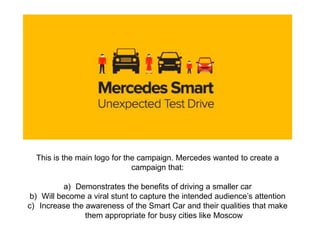
This is the main logo for the campaign. Mercedes wanted to create a
campaign that:
a) Demonstrates the benefits of driving a smaller car
b) Will become a viral stunt to capture the intended audience’s attention
c) Increase the awareness of the Smart Car and their qualities that make
them appropriate for busy cities like Moscow
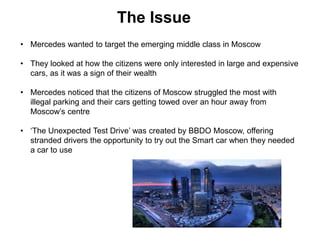
• Mercedes wanted to target the emerging middle class in Moscow
• They looked at how the citizens were only interested in large and expensive
cars, as it was a sign of their wealth
• Mercedes noticed that the citizens of Moscow struggled the most with
illegal parking and their cars getting towed over an hour away from
Moscow’s centre
• ‘The Unexpected Test Drive’ was created by BBDO Moscow, offering
stranded drivers the opportunity to try out the Smart car when they needed
a car to use
The Issue
The Solution
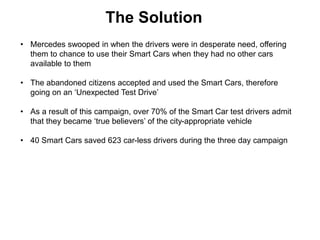
• Mercedes swooped in when the drivers were in desperate need, offering
them to chance to use their Smart Cars when they had no other cars
available to them
• The abandoned citizens accepted and used the Smart Cars, therefore
going on an ‘Unexpected Test Drive’
• As a result of this campaign, over 70% of the Smart Car test drivers admit
that they became ‘true believers’ of the city-appropriate vehicle
• 40 Smart Cars saved 623 car-less drivers during the three day campaign
Print Case Study
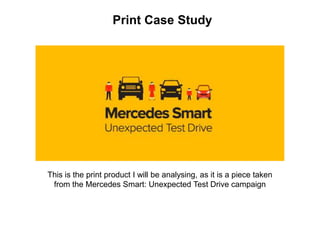
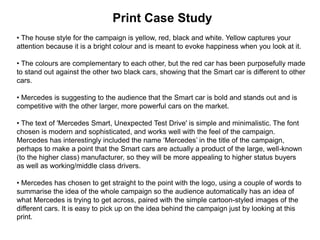
This is the print product I will be analysing, as it is a piece taken
from the Mercedes Smart: Unexpected Test Drive campaign
• The house style for the campaign is yellow, red, black and white. Yellow captures your
attention because it is a bright colour and is meant to evoke happiness when you look at it.
• The colours are complementary to each other, but the red car has been purposefully made
to stand out against the other two black cars, showing that the Smart car is different to other
cars.
• Mercedes is suggesting to the audience that the Smart car is bold and stands out and is
competitive with the other larger, more powerful cars on the market.
• The text of 'Mercedes Smart, Unexpected Test Drive' is simple and minimalistic. The font
chosen is modern and sophisticated, and works well with the feel of the campaign.
Mercedes has interestingly included the name ‘Mercedes’ in the title of the campaign,
perhaps to make a point that the Smart cars are actually a product of the large, well-known
(to the higher class) manufacturer, so they will be more appealing to higher status buyers
as well as working/middle class drivers.
• Mercedes has chosen to get straight to the point with the logo, using a couple of words to
summarise the idea of the whole campaign so the audience automatically has an idea of
what Mercedes is trying to get across, paired with the simple cartoon-styled images of the
different cars. It is easy to pick up on the idea behind the campaign just by looking at this
print.
Print Case Study
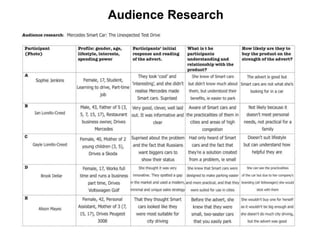
Audience Research
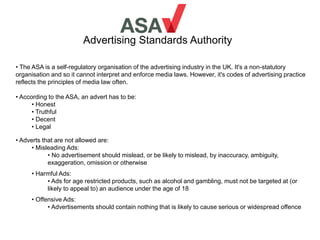
Advertising Standards Authority
• The ASA is a self-regulatory organisation of the advertising industry in the UK. It's a non-statutory
organisation and so it cannot interpret and enforce media laws. However, it's codes of advertising practice
reflects the principles of media law often.
• According to the ASA, an advert has to be:
• Honest
• Truthful
• Decent
• Legal
• Adverts that are not allowed are:
• Misleading Ads:
• No advertisement should mislead, or be likely to mislead, by inaccuracy, ambiguity,
exaggeration, omission or otherwise
• Harmful Ads:
• Ads for age restricted products, such as alcohol and gambling, must not be targeted at (or
likely to appeal to) an audience under the age of 18
• Offensive Ads:
• Advertisements should contain nothing that is likely to cause serious or widespread offence
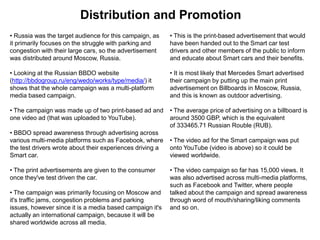
Distribution and Promotion
• Russia was the target audience for this campaign, as
it primarily focuses on the struggle with parking and
congestion with their large cars, so the advertisement
was distributed around Moscow, Russia.
• Looking at the Russian BBDO website
(http://bbdogroup.ru/eng/wedo/works/type/media/) it
shows that the whole campaign was a multi-platform
media based campaign.
• The campaign was made up of two print-based ad and
one video ad (that was uploaded to YouTube).
• BBDO spread awareness through advertising across
various multi-media platforms such as Facebook, where
the test drivers wrote about their experiences driving a
Smart car.
• The print advertisements are given to the consumer
once they've test driven the car.
• The campaign was primarily focusing on Moscow and
it's traffic jams, congestion problems and parking
issues, however since it is a media based campaign it's
actually an international campaign, because it will be
shared worldwide across all media.
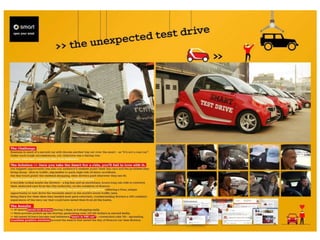
• This is the print-based advertisement that would
have been handed out to the Smart car test
drivers and other members of the public to inform
and educate about Smart cars and their benefits.
• It is most likely that Mercedes Smart advertised
their campaign by putting up the main print
advertisement on Billboards in Moscow, Russia,
and this is known as outdoor advertising.
• The average price of advertising on a billboard is
around 3500 GBP, which is the equivalent
of 333465.71 Russian Rouble (RUB).
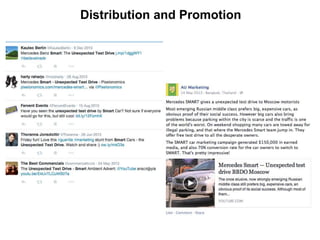
• The video ad for the Smart campaign was put
onto YouTube (video is above) so it could be
viewed worldwide.
• The video campaign so far has 15,000 views. It
was also advertised across multi-media platforms,
such as Facebook and Twitter, where people
talked about the campaign and spread awareness
through word of mouth/sharing/liking comments
and so on.
Distribution and Promotion
Ethical and Legal Issues
• My research shows that the advertising campaign made the audience more aware of the issues
surrounding parking and high congestion in overcrowded cities, and appreciated the benefits people
who live in the city would get out of having a smaller car.
• Some evidence shows that small cars are just not practical for the individual for personal reasons, ie.
it's too small for a family. By carrying out further research in areas such as London, I feel that Smart
cars would be of more interest.
• The advert represents issues surrounding parking in Russia, representing the situation of not being
able to park in large cities. BBDO focused on Russia because they appeared to be having the most
problems with high congestion charges, parking, and getting their large cars towed away.
• There are no current ethical or legal issues regarding this campaign. However, one thing to consider
is the opinions of the drivers. What could be questioned is whether they were the true opinions of the
drivers, or whether they have been encouraged to add positive reviews by BBDO to further push the
idea of Smart cars being the best cars, and to make the audience believe that they are.
• Legally, when a company makes a claim about their product, they have to be backed up with scientific
evidence:
• The Consumer Protection from Unfair Trading Regulations means that you (as a company) can't
mislead or harass consumers, in this case by including false or deceptive messages.
• BBDO have made sure to include scientific evidence to back up their claims, saying that there
was a 70% conversion rate. But with the Facebook comments, there is no way to provide solid
proof that the drivers who tested the Smart cars actually are true believers of the cars.

Creed maiaunit1

  • 1.
  • 2.
    BBDO – Ownership •BBDO (Batten, Bardon, Durstine and Osborn) is a worldwide advertising agency network, it's headquarters based in New York City. • The company is owned by the 'parent' organisation, Omnicon Group Inc., who are an American marketing and corporate communications holding company. • BBDO was established in 1891 with George Batten's 'Batten Company', and later on (September 21 1928), merged with BDO (Barton, Durstine and Osborn) to become BBDO. • Bruce Barton was made the chairman of the board, and William H. Johns (president of the Batten Co.) became president of BBDO. • The new agency had over 600 employees, with branch offices in Chicago, Boston and Buffalo. In 1986, BBDO merged with Doyle Dane Bernbach and Needham Harper (Omnicom).
  • 3.
    BBDO – OperatingModel • Today, BBDO has 289 offices in 80 countries, serving world wide. There are a total of 15,000 employees, with a client list including AT&T, PepsiCo, FedEx, Mars, Campbell's, Hewlett-Packard, Olympus, Emirates and Starbucks. • The departments within the advertising agency include: • Agency Management (a management team including the chief executive (Andrew Robertson being the worldwide executive officer) and finance director) • Account Services • Account Planning • Media • Creative Services • Production
  • 4.
    BBDO – Products •BBDO creates a wide range of products, from print to screen, and has worked with a variety of companies: • The Economist • Visa Inc. • FedEx • Mercedes • Wrigley • AT&T • Mars • Monster.com • Pinnacle Foods • Starbucks • Hewlett-Packard • Emirates • Olympus • Wells Fargo
  • 5.
    BBDO – MarketPosition • BBDO is a global player in the advertising industry, with an annual revenue of $1,310.2 million and securing approximately $750 million in published new business wins (including Mercedes, Fiat, Capital One, Starbucks and Sony). • HP named BBDO the global agency for Digital Imaging and Printing Business in at least 50 markets, and Tag Heuer and Hyatt named it the global agency of record.
  • 6.
    BBDO – Competitors •Even though BBDO is the world's most awarded advertising agency, it still has competitors (it’s three main competitors being): • J. Walter Thompson Company (JWT) • Leo Burnett Company Inc. • McCann Worldgroup
  • 7.
    This is themain logo for the campaign. Mercedes wanted to create a campaign that: a) Demonstrates the benefits of driving a smaller car b) Will become a viral stunt to capture the intended audience’s attention c) Increase the awareness of the Smart Car and their qualities that make them appropriate for busy cities like Moscow
  • 9.
    • Mercedes wantedto target the emerging middle class in Moscow • They looked at how the citizens were only interested in large and expensive cars, as it was a sign of their wealth • Mercedes noticed that the citizens of Moscow struggled the most with illegal parking and their cars getting towed over an hour away from Moscow’s centre • ‘The Unexpected Test Drive’ was created by BBDO Moscow, offering stranded drivers the opportunity to try out the Smart car when they needed a car to use The Issue
  • 10.
    The Solution • Mercedesswooped in when the drivers were in desperate need, offering them to chance to use their Smart Cars when they had no other cars available to them • The abandoned citizens accepted and used the Smart Cars, therefore going on an ‘Unexpected Test Drive’ • As a result of this campaign, over 70% of the Smart Car test drivers admit that they became ‘true believers’ of the city-appropriate vehicle • 40 Smart Cars saved 623 car-less drivers during the three day campaign
  • 11.
    Print Case Study Thisis the print product I will be analysing, as it is a piece taken from the Mercedes Smart: Unexpected Test Drive campaign
  • 12.
    • The housestyle for the campaign is yellow, red, black and white. Yellow captures your attention because it is a bright colour and is meant to evoke happiness when you look at it. • The colours are complementary to each other, but the red car has been purposefully made to stand out against the other two black cars, showing that the Smart car is different to other cars. • Mercedes is suggesting to the audience that the Smart car is bold and stands out and is competitive with the other larger, more powerful cars on the market. • The text of 'Mercedes Smart, Unexpected Test Drive' is simple and minimalistic. The font chosen is modern and sophisticated, and works well with the feel of the campaign. Mercedes has interestingly included the name ‘Mercedes’ in the title of the campaign, perhaps to make a point that the Smart cars are actually a product of the large, well-known (to the higher class) manufacturer, so they will be more appealing to higher status buyers as well as working/middle class drivers. • Mercedes has chosen to get straight to the point with the logo, using a couple of words to summarise the idea of the whole campaign so the audience automatically has an idea of what Mercedes is trying to get across, paired with the simple cartoon-styled images of the different cars. It is easy to pick up on the idea behind the campaign just by looking at this print. Print Case Study
  • 13.
  • 14.
    Advertising Standards Authority •The ASA is a self-regulatory organisation of the advertising industry in the UK. It's a non-statutory organisation and so it cannot interpret and enforce media laws. However, it's codes of advertising practice reflects the principles of media law often. • According to the ASA, an advert has to be: • Honest • Truthful • Decent • Legal • Adverts that are not allowed are: • Misleading Ads: • No advertisement should mislead, or be likely to mislead, by inaccuracy, ambiguity, exaggeration, omission or otherwise • Harmful Ads: • Ads for age restricted products, such as alcohol and gambling, must not be targeted at (or likely to appeal to) an audience under the age of 18 • Offensive Ads: • Advertisements should contain nothing that is likely to cause serious or widespread offence
  • 15.
    Distribution and Promotion •Russia was the target audience for this campaign, as it primarily focuses on the struggle with parking and congestion with their large cars, so the advertisement was distributed around Moscow, Russia. • Looking at the Russian BBDO website (http://bbdogroup.ru/eng/wedo/works/type/media/) it shows that the whole campaign was a multi-platform media based campaign. • The campaign was made up of two print-based ad and one video ad (that was uploaded to YouTube). • BBDO spread awareness through advertising across various multi-media platforms such as Facebook, where the test drivers wrote about their experiences driving a Smart car. • The print advertisements are given to the consumer once they've test driven the car. • The campaign was primarily focusing on Moscow and it's traffic jams, congestion problems and parking issues, however since it is a media based campaign it's actually an international campaign, because it will be shared worldwide across all media. • This is the print-based advertisement that would have been handed out to the Smart car test drivers and other members of the public to inform and educate about Smart cars and their benefits. • It is most likely that Mercedes Smart advertised their campaign by putting up the main print advertisement on Billboards in Moscow, Russia, and this is known as outdoor advertising. • The average price of advertising on a billboard is around 3500 GBP, which is the equivalent of 333465.71 Russian Rouble (RUB). • The video ad for the Smart campaign was put onto YouTube (video is above) so it could be viewed worldwide. • The video campaign so far has 15,000 views. It was also advertised across multi-media platforms, such as Facebook and Twitter, where people talked about the campaign and spread awareness through word of mouth/sharing/liking comments and so on.
  • 16.
  • 17.
    Ethical and LegalIssues • My research shows that the advertising campaign made the audience more aware of the issues surrounding parking and high congestion in overcrowded cities, and appreciated the benefits people who live in the city would get out of having a smaller car. • Some evidence shows that small cars are just not practical for the individual for personal reasons, ie. it's too small for a family. By carrying out further research in areas such as London, I feel that Smart cars would be of more interest. • The advert represents issues surrounding parking in Russia, representing the situation of not being able to park in large cities. BBDO focused on Russia because they appeared to be having the most problems with high congestion charges, parking, and getting their large cars towed away. • There are no current ethical or legal issues regarding this campaign. However, one thing to consider is the opinions of the drivers. What could be questioned is whether they were the true opinions of the drivers, or whether they have been encouraged to add positive reviews by BBDO to further push the idea of Smart cars being the best cars, and to make the audience believe that they are. • Legally, when a company makes a claim about their product, they have to be backed up with scientific evidence: • The Consumer Protection from Unfair Trading Regulations means that you (as a company) can't mislead or harass consumers, in this case by including false or deceptive messages. • BBDO have made sure to include scientific evidence to back up their claims, saying that there was a 70% conversion rate. But with the Facebook comments, there is no way to provide solid proof that the drivers who tested the Smart cars actually are true believers of the cars.

Editor's Notes

  • #3 BBDO (Batten, Bardon, Durstine and Osborn) is a worldwide advertising agency network, it's headquarters based in New York City. The company is owned by the 'parent' organisation, Omnicon Group Inc., who are an American marketing and corporate communications holding company. BBDO was established in 1891 with George Batten's 'Batten Company', and later on (September 21 1928), merged with BDO (Barton, Durstine and Osborn) to become BBDO. Bruce Barton was made the chairman of the board, and William H. Johns (president of the Batten Co.) became president of BBDO. The new agency had over 600 employees, with branch offices in Chicago, Boston and Buffalo. In 1986, BBDO merged with Doyle Dane Bernbach and Needham Harper (Omnicom).
  • #4 Today, BBDO has 289 offices in 80 countries, serving world wide. There are a total of 15,000 employees, with a client list including AT&T, PepsiCo, FedEx, Mars, Campbell's, Hewlett-Packard, Olympus, Emirates and Starbucks. The departments within the advertising agency include: Agency Management (a management team including the chief executive (Andrew Robertson being the worldwide executive officer) and finance director), Account Services (dealing with clients and coordinating the work of the agency's creative and media teams), Account Planning (researching the needs and preferences of the target market for the product or service), Media (planning where and when the advertisements will appear and buying the space/time in a magazine, television etc), Creative Services (consisting of copywriters and designers who work together developing the advertising concepts) and Production (a production department responsible for managing the advertising campaigns).
  • #6 BBDO is a global player in the advertising industry, with an annual revenue of $1,310.2 million and securing approximately $750 million in published new business wins (including Mercedes, Fiat, Capital One, Starbucks and Sony). HP named BBDO the global agency for Digital Imaging and Printing Business in at least 50 markets, and Tag Heuer and Hyatt named it the global agency of record.
  • #7 Even though BBDO is the world's most awarded advertising agency, it still has competitors, three local competitors being: J. Walter Thompson Company, Leo Burnett Company Inc., and McCann Worldgroup.
  • #10 Mercedes wanted to create a campaign that targeted the middle class people of Russia, who own and drive large, expensive cars (such as Range Rovers). BBDO Moscow planned and launced the 'The Unexpected Test Drive' campaign after Mercedes realised that this middle class group showed no interest in Smart Cars, however they were struggling the most with their large cars being towed after parking illegally near the centre of Moscow. BBDO offered stranded drivers the opportunity to try out the Smart car when they most needed one. In Moscow, illegal parking is a big issue, one that leads to having many drivers have their car towed to a location an hour away from the city centre. In response to this, the Unexpected Test Drive campaign evolved, where Mercedes offered the chance for drivers with large towed cars to try out the Smart cars; to try and encourage them to switch from the larger cars that they're used to, to a smaller car that would be significantly easier to park (exploiting their issue of having their cars towed after failing to find a space to park their larger cars).
  • #11 In conclusion, 40 Smart cars helped 623 car-less drivers over three days. 400 saved drivers became true believers of Smart cards, and Mercedes say that the conversion rate was 70% alongside countless positive reactions from the drivers. Overall, Smart car sales increased by 300% in the last two weeks of the event.
  • #12 The colours that are used across the campaign are yellow, red, black and white. The colour yellow is used to evoke happiness and pleasant feelings, and it captures your attention because it is a bright colour. All of the colours used are complementary to each other, but the red car especially contrasts with the other two black cars, symbolising the fact that it is different to other cards. At first glance, you think that red symbolises danger, but you soon realise that what Mercedes is actually trying to suggest is that the Smart car is bold and stands out, and is as much as a competitor in the car industry as any of the other larger cars. The text of 'Mercedes Smart, Unexpected Test Drive' is simple and to the point. The font chosen is modern and sophisticated, and works well with the minimalistic feel of the campaign. Mercedes has chosen to get straight to the point with this logo, using a couple of words to summarise the idea of the whole campaign so the audience automatically has an idea of what Mercedes is trying to get across, paired with the simple cartoon-styled images of the different cars.
  • #14 As part of my audience research, I asked five members of the public to read and watch all elements of the Mercedes Smart Car: The Unexpected Test Drive campaign. Following that, I asked for the opinions about the advert and the car, and whether the advert has changed their opinions.
  • #15 All advertising is regulated by the ASA - Advertising Standards Authority The ASA is a self-regulatory organisation of the advertising industry in the UK. It's a non-statutory organisation and so it cannot interpret and enforce media laws. However, it's codes of advertising practice reflects the principles of media law often. The advert has to be: -Legal Backing up claims with scientific evidence -Honest -Decent IE no nudity in adverts, eg shower gels -Truthful "The UK's Independent Advertising Retailer" -Advertising is affected by the changing concerns of society -Growth amongst multimedia platforms Campaigns that go across a multiple number of platforms (Twitter, Facebook, Radio, Television) -Sophisticated and visually literate audience Aware of the line drawn between truth and fiction -Ad Bank: Non-broadcast ads Misleading Ads -No advertisement should mislead, or be likely to mislead, by inaccuracy, ambiguity, exaggeration, omission or otherwise -Marketers must hold documentary evidence to prove all claims, whether direct or implied that are capable of objective substantiation -Marketing communications must be obviously identifiable as such Harmful Ads -Ads must be prepared with a sense of responsibility to consumers and society -Ads for age restricted products like alcohol and gambling must not be targeted at or likely to appeal to an audience under the age of 18 Offensive Ads -Advertisements should contain nothing that is likely to cause serious or widespread offence. -Particular care should be take to avoid causing offense on the grounds of race, sexuality, gender and disability.
  • #16 Where and how my print advertising campaign was distributed Russia was the target audience for this campaign, as it primarily focuses on the struggle with parking and congestion with their large cars, so the advertisement was distributed around Moscow, Russia. This way, BBDO would be targeting directly the area where most people would benefit from seeing the advertisement. Looking at the Russian BBDO website (http://bbdogroup.ru/eng/wedo/works/type/media/) it shows that the whole campaign was a multi-platform media based campaign. By using a video and two print-based ads, this made up the main bulk of the campaign. However, BBDO further spread awareness through advertising across various multi-media platforms such as Facebook, where the test drivers wrote about their experiences driving a Smart car. The print advertisements would have been given to the consumer once they've test driven the car, so they can look at the reasoning behind the campaign. The campaign was primarily focusing on Moscow and it's traffic jams, congestion problems and parking issues, however since it is a media based campaign it's actually an international campaign, because it will be shared worldwide across all media. These issues are also present in cities such a London, so this campaign will also be appropriate for large congested cities outside of Moscow. This is the print-based advertisement that would have been handed out to the Smart car test drivers and other members of the public to inform them about the reasoning behind the campaign and to educate potential buyers about the issues surrounding Moscow's parking and congestion problems. http://www.pixelonomics.com/mercedes-smart-unexpected-test-drive/ - This link shows how the campaign's awareness has been spread online, by 'sharing' and talking about the campaign. http://www.thedrum.com/news/2013/05/15/mercedes-unveils-campaign-let-drivers-test-out-smart-car-after-their-own-was-towed - This is a news article on the campaign, which is a form of advertising as the word is being spread about Mercedes' campaign, and the added benefit of being mentioned on 'The Drum' is that it is the UK's largest marketing website. Although there no solid evidence, it is most likely that Mercedes Smart advertised their campaign by putting up the main print advertisement on Billboards in Moscow, Russia, and this is known as outdoor advertising. The average price of advertising on a billboard is around 3500 GBP, which is the equivalent of 333465.71 Russian Rouble (RUB). 2) Can you find what cross media presence your campaign has had? How was social media and other platforms used to create community of develop the product/campaigns reach? The video ad for the Smart campaign was put onto YouTube (video is above) so it could be viewed worldwide. The video campaign so far has 15,000 views. It was also advertised across multi-media platforms, such as Facebook and Twitter, where people talked about the campaign and spread awareness through word of mouth/sharing/liking comments and so on.
  • #18 Legal and Ethical Issues:  BBDO - Mercedes Smart Car: The Unexpected Test Drive a) The advert's impact and effect on the audience My research shows that the advertising campaign made the audience more aware of the issues surrounding parking and high congestion in overcrowded cities, and appreciated the benefits people who live in the city would get out of having a substantially smaller car. However, the conclusive evidence shows that small cars are just not practical for the individual for personal reasons, ie. it's too small for a family. By carrying out further research in areas such as London, I feel that Smart cars would be of more interest. b) Relevant issues of representation The advert represents issues surrounding parking in Russia, representing the situation of not being able to park in large cities. BBDO focussed on Russia because they appeared to be having the most problems with high congestion charges, parking, and getting their large cars towed away. The audience will generally all interpret the campaign in the same way, as BBDO has made it clear that they are using Russia as an example because they are facing particularly bad problems with parking etc, and that Russia represents all cities. c) Relevant legal and/or ethical issues There are no current ethical or legal issues regarding this campaign. However, one thing to consider is the opinions of the drivers. In the advert, for example, BBDO shows some reactions and buzz surrounding their campaign, and how the word spread via social media. In the video ad, it says that the campaign created $150,000 of earned media. The test drivers also claimed to all be very satisfied and posted about their experience on Facebook. Would could be questioned is whether they were the true opinions of the drivers, or whether they have been encouraged to add positive reviews, by BBDO to further push the idea of Smart cars being the best cars, and to make the audience believe that they are. Legally, when a company makes a claim about their product, they have to be backed up with scientific evidence. The Consumer Protection from Unfair Trading Regulations means that you (as a company) can't mislead or harass consumers, in this case by including false or deceptive messages. BBDO have made sure to include scientific evidence to back up their claims, saying that there was a 70% conversion rate. Whereas with the comments on Facebook, there is no way to provide solid proof that the drivers who tested the Smart cars actually are true believers of the cars, which could raise possible issues.