

CREATIVITY
DEFINITION
• Creativity is the act of turning new and imaginative ideas into reality
• Coming up with improved solutions to problems
• Succeeding in moving customer to action
CREATIVE STRATEGY
• The number and variety of adverts (Ads) appears to be infinite.
• There are a number of distinctive creative strategies that have
evolved over the years. Some ads fall into more than one of
these categories.
• There are Seven categories of creative strategies include the
following
7 CATEGORIES OF CREATIVE STRATEGIES
• GENERIC STRATEGY
Here the organizations make no attempt to differentiate its brand from its competitors e.g OMO and surf ads
PRE – EMPTIVE STRATEGY
Here an organization attempts to take ownership of an ordinary claim, thereby making it difficult for other
competitors to highlight the attribute in question Such as this Adidas TV commercial, the slogan is “Impossible is
Nothing”. In fact this can be used for every sports brand, but Adidas creative it at first, and mix it with their brand
image and products performance. It is successful.
•UNIQUE-SELLING-PROPOSITION STRATEGY
• The advertiser makes a superiority claim based on a unique
product attribute that represents a distinct meaningful consumer
benefit e.g bulbs (neon styled) produced by Philips have longer
life span than traditional light bulbs.
• BRAND-IMAGE STRATEGY
• This is about highlighting psychological differences between
products e.g the Mercedes Benz star
•POSITIONING STRATEGY
• Has a direct effort at comparison with competitive products e.g
Duracell lasting six times longer than any other batteries
•RESONANCE STRATEGY
• Here the ad will attempt to strike a chord with customers
e.g Castle larger (Inqaba) ads being associated with the
sportsperson (Castle Larger and the Proteas)
•EMOTIONAL STRATEGY
• These ads play on emotions such as fear, romance,
disgust and so on e.g
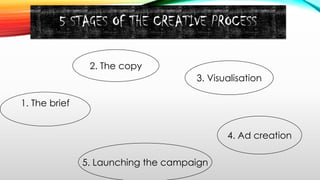
2. The copy
3. Visualisation
4. Ad creation
1. The brief
5. Launching the campaign
5 STAGES OF THE CREATIVE PROCESS
The Brief
• Is an encapsulation of what the core message is that the organization wants to carry
across to their target audience, but it is also likely to include some of the following
elements
A description of the product/service to be advertised
A condensed profile of the target audience
The medium/media to be used
The type of advertisement required (informative, argumentative, humorous, etc.)
The key proposition (deprived from the core message)
Reasons behind the key proposition
THE BRIEF (CONTND)
Any supporting benefits
Existing target audience perceptions
Desired outcome in terms of target audience
Desired outcome in terms of target audience action
Any constraints
Inclusions required in ad
THE COPY
• The copy-writing process has to do with finding the right words to gain the Attention,
Interest, Desire, Conviction, Action, and Satisfaction (AIDCAS) of the target audience
• Process involves:
Undertaking research to determine what words or phrases will motivate the target
audience
Establish a copy structure that depicts where the text will be positioned and what
elements the copy will comprise
The actual copy itself (contents of the ad)
The copy style (manner in which words are presented)
VISUALIZATION
• Visual message is embodied in drawings, photographs, illustrations,
animations, video clips and or sound segments.
• It is important that the visual elements support the copy of the ad
• Visualization also has A.I.D.C.A.S, because humans are influenced to a large
extent by what they see, rather than what they read.
• Recall of a visual ad is much higher than in the case of copy only.
AD CREATION
• Here the ad gets produced.
• This is where the graphic artists, illustrators, photographers, video producers
and audio engineers come into play.
LAUNCHING THE CAMPAIGN
• Finally the ad campaign is launched.
• Usually comprises a roll-out over a period of time
• An advertising schedule will be necessary to pin-point when
and where ads will be run
EVALUATION AND FEEDBACK
• You receive feedback on whether you are on track and whether your efforts
have been worthwhile.

Creativity in Advertising

  • 1.
  • 2.
    DEFINITION • Creativity isthe act of turning new and imaginative ideas into reality • Coming up with improved solutions to problems • Succeeding in moving customer to action
  • 3.
    CREATIVE STRATEGY • Thenumber and variety of adverts (Ads) appears to be infinite. • There are a number of distinctive creative strategies that have evolved over the years. Some ads fall into more than one of these categories. • There are Seven categories of creative strategies include the following
  • 4.
    7 CATEGORIES OFCREATIVE STRATEGIES • GENERIC STRATEGY Here the organizations make no attempt to differentiate its brand from its competitors e.g OMO and surf ads PRE – EMPTIVE STRATEGY Here an organization attempts to take ownership of an ordinary claim, thereby making it difficult for other competitors to highlight the attribute in question Such as this Adidas TV commercial, the slogan is “Impossible is Nothing”. In fact this can be used for every sports brand, but Adidas creative it at first, and mix it with their brand image and products performance. It is successful.
  • 5.
    •UNIQUE-SELLING-PROPOSITION STRATEGY • Theadvertiser makes a superiority claim based on a unique product attribute that represents a distinct meaningful consumer benefit e.g bulbs (neon styled) produced by Philips have longer life span than traditional light bulbs. • BRAND-IMAGE STRATEGY • This is about highlighting psychological differences between products e.g the Mercedes Benz star
  • 6.
    •POSITIONING STRATEGY • Hasa direct effort at comparison with competitive products e.g Duracell lasting six times longer than any other batteries •RESONANCE STRATEGY • Here the ad will attempt to strike a chord with customers e.g Castle larger (Inqaba) ads being associated with the sportsperson (Castle Larger and the Proteas)
  • 7.
    •EMOTIONAL STRATEGY • Theseads play on emotions such as fear, romance, disgust and so on e.g
  • 8.
    2. The copy 3.Visualisation 4. Ad creation 1. The brief 5. Launching the campaign
  • 9.
    5 STAGES OFTHE CREATIVE PROCESS The Brief • Is an encapsulation of what the core message is that the organization wants to carry across to their target audience, but it is also likely to include some of the following elements A description of the product/service to be advertised A condensed profile of the target audience The medium/media to be used The type of advertisement required (informative, argumentative, humorous, etc.) The key proposition (deprived from the core message) Reasons behind the key proposition
  • 10.
    THE BRIEF (CONTND) Anysupporting benefits Existing target audience perceptions Desired outcome in terms of target audience Desired outcome in terms of target audience action Any constraints Inclusions required in ad
  • 11.
    THE COPY • Thecopy-writing process has to do with finding the right words to gain the Attention, Interest, Desire, Conviction, Action, and Satisfaction (AIDCAS) of the target audience • Process involves: Undertaking research to determine what words or phrases will motivate the target audience Establish a copy structure that depicts where the text will be positioned and what elements the copy will comprise The actual copy itself (contents of the ad) The copy style (manner in which words are presented)
  • 12.
    VISUALIZATION • Visual messageis embodied in drawings, photographs, illustrations, animations, video clips and or sound segments. • It is important that the visual elements support the copy of the ad • Visualization also has A.I.D.C.A.S, because humans are influenced to a large extent by what they see, rather than what they read. • Recall of a visual ad is much higher than in the case of copy only.
  • 13.
    AD CREATION • Herethe ad gets produced. • This is where the graphic artists, illustrators, photographers, video producers and audio engineers come into play.
  • 14.
    LAUNCHING THE CAMPAIGN •Finally the ad campaign is launched. • Usually comprises a roll-out over a period of time • An advertising schedule will be necessary to pin-point when and where ads will be run
  • 15.
    EVALUATION AND FEEDBACK •You receive feedback on whether you are on track and whether your efforts have been worthwhile.