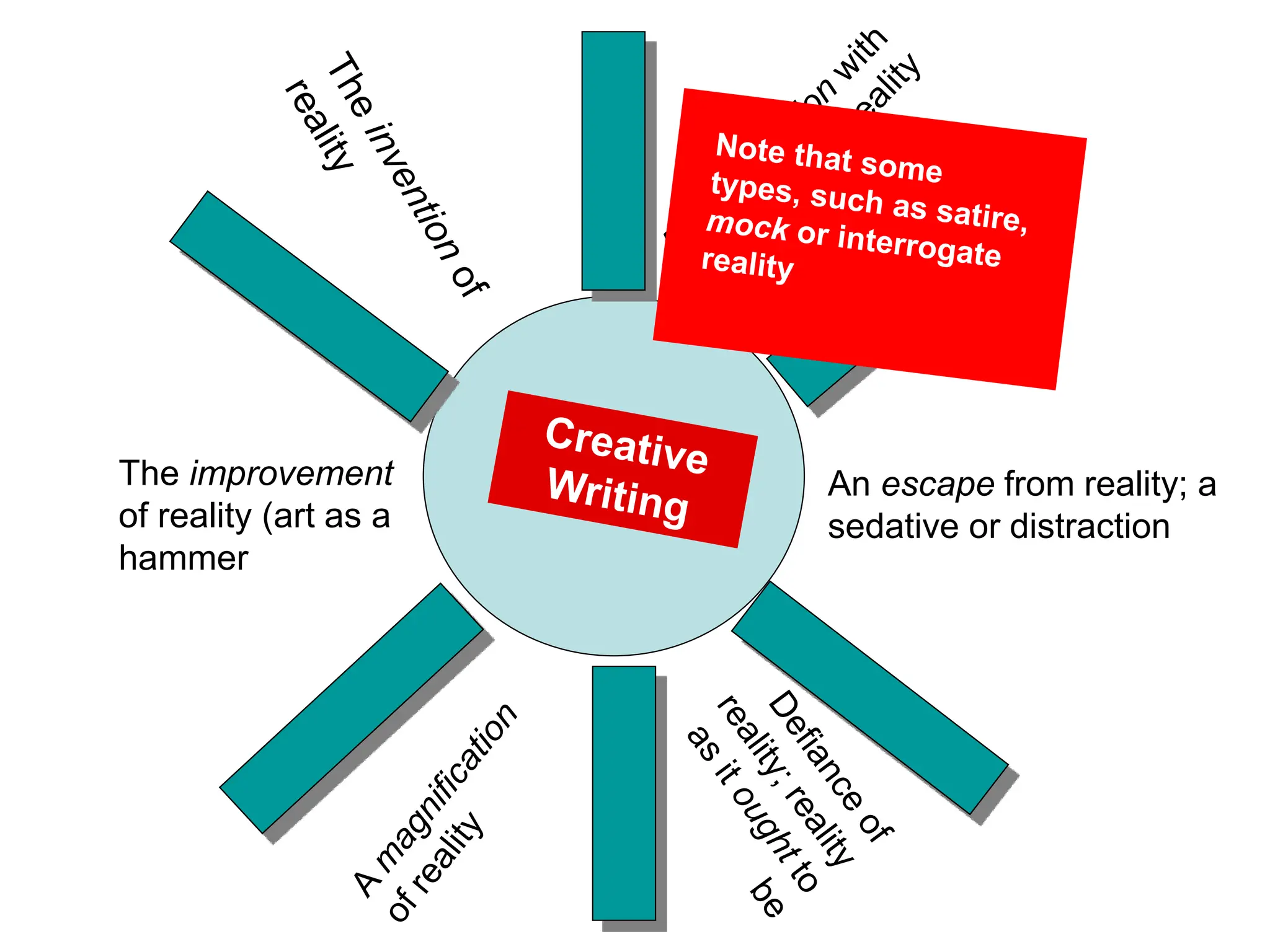
An escape from reality; a
sedative or distraction
Formalist
The improvement
of reality (art as a
hammer
Formalist
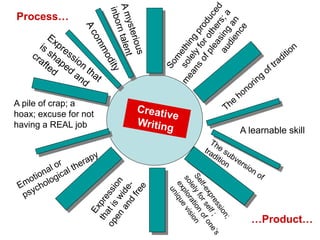
A pile of crap; a
hoax; excuse for not
having a REAL job
Process…
…Product…
A learnable skill
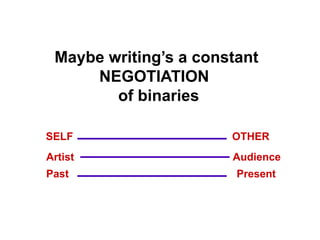
SELF OTHER
Maybe writing’s a constant
NEGOTIATION
of binaries
Artist Audience
Past Present
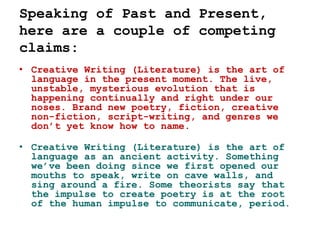
Speaking of Past and Present,
here are a couple of competing
claims:
• Creative Writing (Literature) is the art of
language in the present moment. The live,
unstable, mysterious evolution that is
happening continually and right under our
noses. Brand new poetry, fiction, creative
non-fiction, script-writing, and genres we
don’t yet know how to name.
• Creative Writing (Literature) is the art of
language as an ancient activity. Something
we’ve been doing since we first opened our
mouths to speak, write on cave walls, and
sing around a fire. Some theorists say that
the impulse to create poetry is at the root
of the human impulse to communicate, period.
What is “Creative Writing”
with a capital C and W?
= the branch of English Studies that
involves teaching and learning how to
write creatively, right?
Yeah, but…
Did you know…
In some of its earliest appearances in higher
ed, Creative Writing was offered to help
students understand literature better. I.e., it
was in the service of literature studies.
The idea was that by writing some fiction,
poetry, or drama themselves, students would
better understand the masterpieces of
literature.
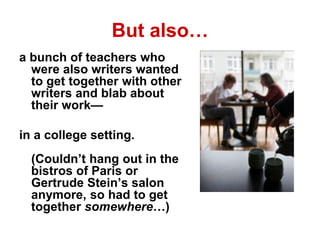
But also…
a bunch of teachers who
were also writers wanted
to get together with other
writers and blab about
their work—
in a college setting.
(Couldn’t hang out in the
bistros of Paris or
Gertrude Stein’s salon
anymore, so had to get
together somewhere…)
• I teach genres. Poetry, fiction. Creative
nonfiction. Some script writing.
• I encourage wide-open, glorious self-
expression. Go for it.
• I encourage self-denial and disciplined
attention to the needs of audience. Craft.
• I encourage demented new ways of thinking
about the world.
• I encourage thoughtful appreciation of very
old traditions.
• I try to do everything.
• That’s why I’m burning out.
• That’s why I’m insane.
• Don’t tell my boss.
Poetry
Poetry
Going Back to The Very Beginning
• Playing with language: Kenneth Koch, The
Luminous Object
• Surrealism
• Worst High School Metaphors
• Harmonious Confusion
Maybe it starts with just
loving words.
What’s figurative language?
How do you say that someone is drunk?
How many animal metaphors do we use
everyday?
Where did most worn-out metaphors
come from, and how do we keep the
language alive? Look at Lorrie Moore…
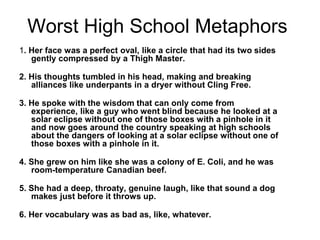
Worst High School Metaphors
1. Her face was a perfect oval, like a circle that had its two sides
gently compressed by a Thigh Master.
2. His thoughts tumbled in his head, making and breaking
alliances like underpants in a dryer without Cling Free.
3. He spoke with the wisdom that can only come from
experience, like a guy who went blind because he looked at a
solar eclipse without one of those boxes with a pinhole in it
and now goes around the country speaking at high schools
about the dangers of looking at a solar eclipse without one of
those boxes with a pinhole in it.
4. She grew on him like she was a colony of E. Coli, and he was
room-temperature Canadian beef.
5. She had a deep, throaty, genuine laugh, like that sound a dog
makes just before it throws up.
6. Her vocabulary was as bad as, like, whatever.
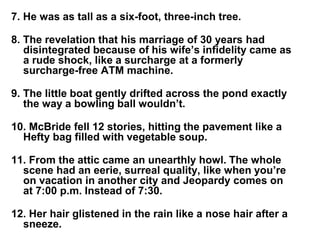
7. He was as tall as a six-foot, three-inch tree.
8. The revelation that his marriage of 30 years had
disintegrated because of his wife’s infidelity came as
a rude shock, like a surcharge at a formerly
surcharge-free ATM machine.
9. The little boat gently drifted across the pond exactly
the way a bowling ball wouldn’t.
10. McBride fell 12 stories, hitting the pavement like a
Hefty bag filled with vegetable soup.
11. From the attic came an unearthly howl. The whole
scene had an eerie, surreal quality, like when you’re
on vacation in another city and Jeopardy comes on
at 7:00 p.m. Instead of 7:30.
12. Her hair glistened in the rain like a nose hair after a
sneeze.
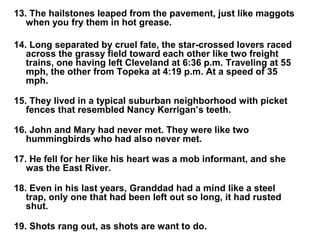
13. The hailstones leaped from the pavement, just like maggots
when you fry them in hot grease.
14. Long separated by cruel fate, the star-crossed lovers raced
across the grassy field toward each other like two freight
trains, one having left Cleveland at 6:36 p.m. Traveling at 55
mph, the other from Topeka at 4:19 p.m. At a speed of 35
mph.
15. They lived in a typical suburban neighborhood with picket
fences that resembled Nancy Kerrigan’s teeth.
16. John and Mary had never met. They were like two
hummingbirds who had also never met.
17. He fell for her like his heart was a mob informant, and she
was the East River.
18. Even in his last years, Granddad had a mind like a steel
trap, only one that had been left out so long, it had rusted
shut.
19. Shots rang out, as shots are want to do.
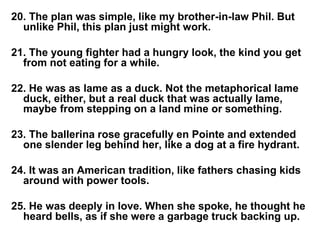
20. The plan was simple, like my brother-in-law Phil. But
unlike Phil, this plan just might work.
21. The young fighter had a hungry look, the kind you get
from not eating for a while.
22. He was as lame as a duck. Not the metaphorical lame
duck, either, but a real duck that was actually lame,
maybe from stepping on a land mine or something.
23. The ballerina rose gracefully en Pointe and extended
one slender leg behind her, like a dog at a fire hydrant.
24. It was an American tradition, like fathers chasing kids
around with power tools.
25. He was deeply in love. When she spoke, he thought he
heard bells, as if she were a garbage truck backing up.
Sometimes it helps to take a really
unusual perspective…say, that of an
animal.
Once a student wrote a piece from the
point of view of a deer. It described a
hunter’s gun as “a branch that barks.”
Poetry
Focusing on particular traditions:
• The private, inward-directed lyric
poet.
• The community bard.
• The craftsman or maker.
• The mad or divinely inspired
visionary.
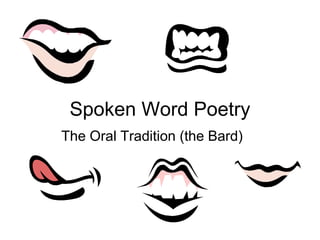
Spoken Word Poetry
The Oral Tradition (the Bard)
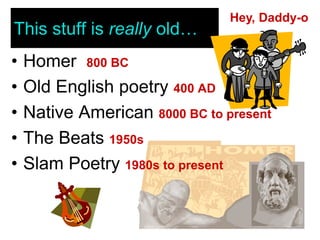
This stuff is really old…
Hey, Daddy-o
• Homer 800 BC
• Old English poetry 400 AD
• Native American 8000 BC to present
• The Beats 1950s
• Slam Poetry 1980s to present
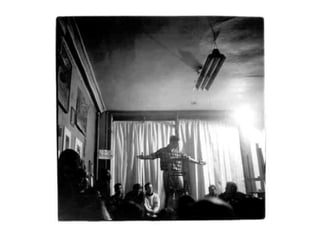
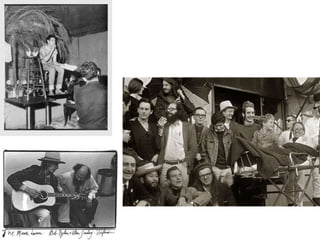
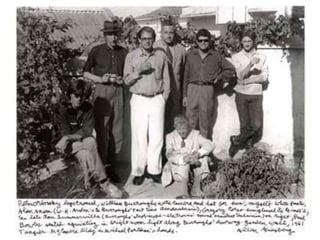
The Beats (1950s,60s)
• Getting poetry
out of the
classroom
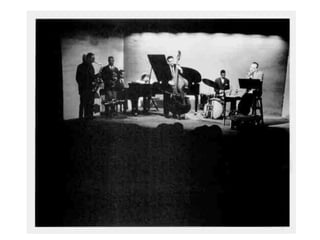
• Poetry read to
jazz
accompaniment
Ferlinghetti:
http://www.ndsu.edu/instruct/cinichol/CreativeWr
iting/323/MiscPoemsFerlinghetti.htm
Ginsberg:
http://www.ndsu.edu/instruct/cinichol/CreativeWriti
ng/323/MiscpoemsGinsbergHowl.htm
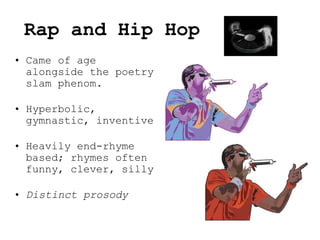
Rap and Hip Hop
• Came of age
alongside the poetry
slam phenom.
• Hyperbolic,
gymnastic, inventive
• Heavily end-rhyme
based; rhymes often
funny, clever, silly
• Distinct prosody
The Poetry Slam
and Open-Mike Coffee House Reading
• Harks back to the Beats
• Again, desire to get poetry out of
the classroom
• Emphasis on anyone can write
poetry
• Tends to be political
• Theatrical, sometimes mixed-media
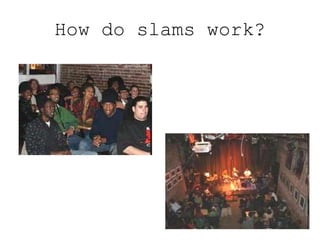
How do slams work?
check
these
out!
www.nuyorican.org/
www.poetryslam.com/
AND
Listen to Spoken Word selections,
plus Beat poems with jazz accompaniment
• Blurring the line between poetry and theater; performances
are like one-person, one-act plays.
• Aggressive, clever, sometimes funny rhyme, not in any
strict pattern (triple rhymes, internal rhymes, slant rhymes,
repeated words, etc. In video, “Lazarus, Lazie, Lazy”).
• Projection! Loud broadcast.
• Number of unstressed syllables don’t matter, maybe.
Success depends on how cleverly you get the four stresses
in (rap).
• Getting into a groove.
• Memorizing the material adds interest.
• Mixing genres: insert singing, use accompanying sound,
etc.
• Ritual presence of performer.
Ok. So.
Describe what you see on the table. REALLY
LOOK. The thing. The thing itself.
Make the object…
Are you being dull?
Are you being predictable?
Are you thinking too much?
Try a thesaurus…
Try Being Surreal
Surrealism
1924: Andre Breton:
The Surrealist Manifesto
“I believe in the future resolution of these
two states, dream and reality, which are
seemingly so contradictory, into a kind of
absolute reality, a sur-reality.”
“The idea of surrealism aims quite simply
at the total recovery of our psychic force
by a means which is nothing other than
the dizzying descent into ourselves, the
systematic illumination of hidden places
and the progressive darkening of other
places, the perpetual excursion into the
midst of forbidden territory” (Breton).
Between WWI and WWII
Surrealism:
the principles, ideals, or practice of producing
fantastic or incongruous imagery or effects in
art, literature, film, or theater by means of
unnatural juxtapositions and combinations. An
attempt, through these random, irrational
juxtapositions and combinations, to make make
a new reality or a new whole.
Instead of:
I saw the rabbit, as soft as cotton, his eyes bright,
munching the grass.
you get:
I saw the rabbit, ripe as a hammer, his eyes boiled,
baptizing the grass.
(random words from carpentry, religion, cooking)
or:
I saw the rabbit, as Monday as Van Gogh’s ear, eyes in
search of Harvard, document the grass.
(random words from stuff on my desk)
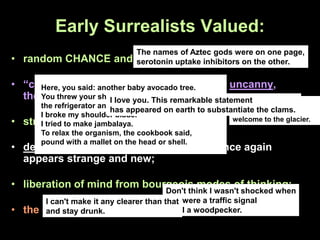
Early Surrealists Valued:
• random CHANCE and the seizing of accident;
• “convulsive beauty,” the marvelous, the uncanny,
the disruptive, and the unexpected;
• strange and unexpected juxtapositions;
• defamiliarizing the everyday so that it once again
appears strange and new;
• liberation of mind from bourgeois modes of thinking;
• the oblivion ha-ha silly brain brillo stain
Here's your fire
extinguisher,
welcome to the glacier.
The names of Aztec gods were on one page,
serotonin uptake inhibitors on the other.
Here, you said: another baby avocado tree.
You threw your shoe. I broke
the refrigerator and the fossil fish.
I broke my shoulder blade.
I tried to make jambalaya.
To relax the organism, the cookbook said,
pound with a mallet on the head or shell.
Don't think I wasn't shocked when
you were a traffic signal
and I a woodpecker.
I can't make it any clearer than that
and stay drunk.
I love you. This remarkable statement
has appeared on earth to substantiate the clams.
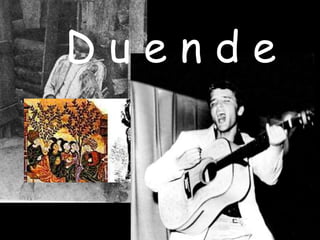
D u e n d e
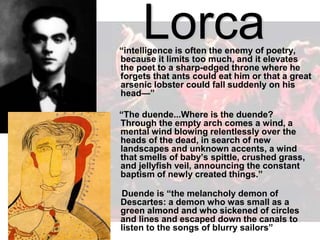
Lorca
“intelligence is often the enemy of poetry,
because it limits too much, and it elevates
the poet to a sharp-edged throne where he
forgets that ants could eat him or that a great
arsenic lobster could fall suddenly on his
head—”
“The duende...Where is the duende?
Through the empty arch comes a wind, a
mental wind blowing relentlessly over the
heads of the dead, in search of new
landscapes and unknown accents, a wind
that smells of baby’s spittle, crushed grass,
and jellyfish veil, announcing the constant
baptism of newly created things.”
Duende is “the melancholy demon of
Descartes: a demon who was small as a
green almond and who sickened of circles
and lines and escaped down the canals to
listen to the songs of blurry sailors”
• "The Guitar“
• "Lament for Ignacio Sánchez Mejías":
#1, 2, 4
• "Casida of the Lament," p. 91
Elvis
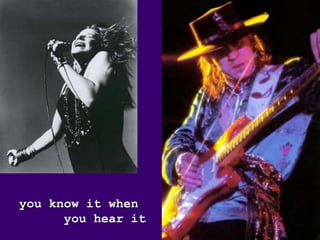
you know it when
you hear it
Some responses to Skittish Libations by previous students…
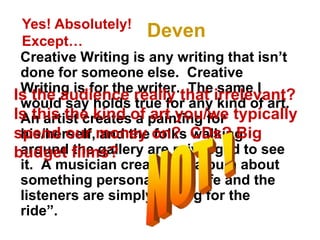
Deven
Creative Writing is any writing that isn’t
done for someone else. Creative
Writing is for the writer. The same I
would say holds true for any kind of art.
An artist creates a painting for
his/herself, and the folks walking
around the gallery are privileged to see
it. A musician creates an album about
something personal in his life and the
listeners are simply “along for the
ride”.
Yes! Absolutely!
Except…
Is the audience really that irrelevant?
Is this the kind of art you/we typically
spend our money on? CDs? Big
budget films?
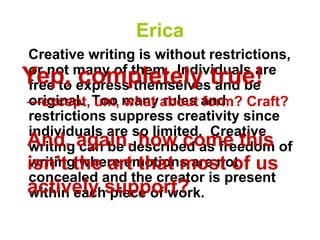
Erica
Creative writing is without restrictions,
or not many of them. Individuals are
free to express themselves and be
original. Too many rules and
restrictions suppress creativity since
individuals are so limited. Creative
writing can be described as freedom of
writing where emotions are not
concealed and the creator is present
within each piece of work.
Yep, completely true!
And, again, how come this
isn’t the art that most of us
actively support?
—except, um, what about form? Craft?
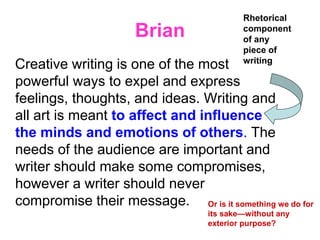
Brian
Creative writing is one of the most
powerful ways to expel and express
feelings, thoughts, and ideas. Writing and
all art is meant to affect and influence
the minds and emotions of others. The
needs of the audience are important and
writer should make some compromises,
however a writer should never
compromise their message.
Rhetorical
component
of any
piece of
writing
Or is it something we do for
its sake—without any
exterior purpose?
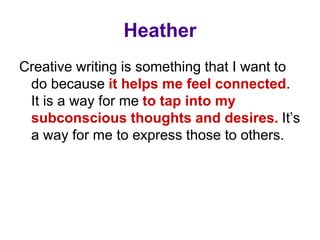
Creative writing is something that I want to
do because it helps me feel connected.
It is a way for me to tap into my
subconscious thoughts and desires. It’s
a way for me to express those to others.
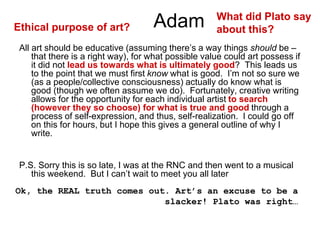
Heather
Adam
All art should be educative (assuming there’s a way things should be –
that there is a right way), for what possible value could art possess if
it did not lead us towards what is ultimately good? This leads us
to the point that we must first know what is good. I’m not so sure we
(as a people/collective consciousness) actually do know what is
good (though we often assume we do). Fortunately, creative writing
allows for the opportunity for each individual artist to search
(however they so choose) for what is true and good through a
process of self-expression, and thus, self-realization. I could go off
on this for hours, but I hope this gives a general outline of why I
write.
P.S. Sorry this is so late, I was at the RNC and then went to a musical
this weekend. But I can’t wait to meet you all later
Ok, the REAL truth comes out. Art’s an excuse to be a
slacker! Plato was right…
Ethical purpose of art?
What did Plato say
about this?
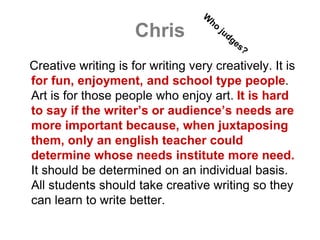
Chris
Creative writing is for writing very creatively. It is
for fun, enjoyment, and school type people.
Art is for those people who enjoy art. It is hard
to say if the writer’s or audience’s needs are
more important because, when juxtaposing
them, only an english teacher could
determine whose needs institute more need.
It should be determined on an individual basis.
All students should take creative writing so they
can learn to write better.
The extraction and amplification of ancient DNA (aDNA) is a
recent discovery in the history of science. The concept of ancient
DNA has eluded scientists …within the Cretaceous epoch,
reportedly also yielded authentic DNA (Cano et al. 1993). DNA
retrieval was also not limited to y and epidemiology. The field of
ancient DNA is constantly growing with the advent of new
techniques concerning extraction and amplification in conjunction
with individuals such as Savante Pääbo and Russ Higuchi. There
have been numerous tissues that have been subjected to aDNA
research including Neanderthal remains, King Tut, and Otzi.
Ancient DNA is genetic material that is recovered from historical
and pre-historical specimens. Ancient DNA can be obtained from
archaeologically or preserved in a museum environment. Ancient
DNA can be retrieved from skeletal material, mummified tissues,
and hair. Viable samples can be obtained from dry, wet, and
frozen specimens. Samples of ancient DNA can be extracted
from plants, animals and insects […]
Ancient DNA: a History
Lacey L. Locket (Sam Schanhaar)
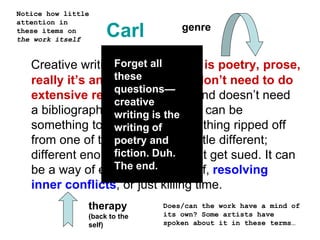
Carl
Creative writing, in my opinion, is poetry, prose,
really it’s anything that you don’t need to do
extensive research to write and doesn’t need
a bibliography. Creative writing can be
something totally new, or something ripped off
from one of the greats, just a little different;
different enough, at least, to not get sued. It can
be a way of expressing yourself, resolving
inner conflicts, or just killing time.
genre
therapy
(back to the
self)
Notice how little
attention in
these items on
the work itself
Does/can the work have a mind of
its own? Some artists have
spoken about it in these terms…
Forget all
these
questions—
creative
writing is the
writing of
poetry and
fiction. Duh.
The end.
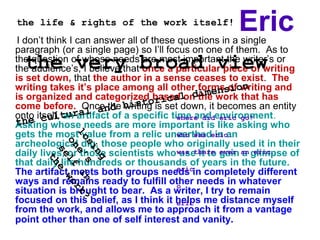
Eric
I don’t think I can answer all of these questions in a single
paragraph (or a single page) so I’ll focus on one of them. As to
the question of whose needs are most important the writer’s or
the audience’s, I believe that once a particular piece of writing
is set down, that the author in a sense ceases to exist. The
writing takes it’s place among all other forms of writing and
is organized and categorized based on the work that has
come before. Once the writing is set down, it becomes an entity
onto itself, an artifact of a specific time and environment.
Asking whose needs are more important is like asking who
gets the most value from a relic unearthed in an
archeological dig, those people who originally used it in their
daily lives, or those scientists who use it to gain a glimpse of
that daily life hundreds or thousands of years in the future.
The artifact meets both groups needs in completely different
ways and remains ready to fulfill other needs in whatever
situation is brought to bear. As a writer, I try to remain
focused on this belief, as I think it helps me distance myself
from the work, and allows me to approach it from a vantage
point other than one of self interest and vanity.
the life & rights of the work itself!
the very broad view
where did eric go?
who was eric…
was there ever an eric…
eric
o
eric
By the end of GS, we’d like you to submit
work for our local buses!
Creative Writing For Grade English Writing

Creative Writing For Grade English Writing

  • 1.
    An escape fromreality; a sedative or distraction Formalist The improvement of reality (art as a hammer
  • 2.
    Formalist A pile ofcrap; a hoax; excuse for not having a REAL job Process… …Product… A learnable skill
  • 3.
    SELF OTHER Maybe writing’sa constant NEGOTIATION of binaries Artist Audience Past Present
  • 4.
    Speaking of Pastand Present, here are a couple of competing claims: • Creative Writing (Literature) is the art of language in the present moment. The live, unstable, mysterious evolution that is happening continually and right under our noses. Brand new poetry, fiction, creative non-fiction, script-writing, and genres we don’t yet know how to name. • Creative Writing (Literature) is the art of language as an ancient activity. Something we’ve been doing since we first opened our mouths to speak, write on cave walls, and sing around a fire. Some theorists say that the impulse to create poetry is at the root of the human impulse to communicate, period.
  • 5.
    What is “CreativeWriting” with a capital C and W? = the branch of English Studies that involves teaching and learning how to write creatively, right? Yeah, but…
  • 6.
    Did you know… Insome of its earliest appearances in higher ed, Creative Writing was offered to help students understand literature better. I.e., it was in the service of literature studies. The idea was that by writing some fiction, poetry, or drama themselves, students would better understand the masterpieces of literature.
  • 7.
    But also… a bunchof teachers who were also writers wanted to get together with other writers and blab about their work— in a college setting. (Couldn’t hang out in the bistros of Paris or Gertrude Stein’s salon anymore, so had to get together somewhere…)
  • 8.
    • I teachgenres. Poetry, fiction. Creative nonfiction. Some script writing. • I encourage wide-open, glorious self- expression. Go for it. • I encourage self-denial and disciplined attention to the needs of audience. Craft. • I encourage demented new ways of thinking about the world. • I encourage thoughtful appreciation of very old traditions. • I try to do everything. • That’s why I’m burning out. • That’s why I’m insane. • Don’t tell my boss.
  • 9.
  • 10.
    Poetry Going Back toThe Very Beginning • Playing with language: Kenneth Koch, The Luminous Object • Surrealism • Worst High School Metaphors • Harmonious Confusion
  • 11.
    Maybe it startswith just loving words.
  • 12.
    What’s figurative language? Howdo you say that someone is drunk? How many animal metaphors do we use everyday? Where did most worn-out metaphors come from, and how do we keep the language alive? Look at Lorrie Moore…
  • 13.
    Worst High SchoolMetaphors 1. Her face was a perfect oval, like a circle that had its two sides gently compressed by a Thigh Master. 2. His thoughts tumbled in his head, making and breaking alliances like underpants in a dryer without Cling Free. 3. He spoke with the wisdom that can only come from experience, like a guy who went blind because he looked at a solar eclipse without one of those boxes with a pinhole in it and now goes around the country speaking at high schools about the dangers of looking at a solar eclipse without one of those boxes with a pinhole in it. 4. She grew on him like she was a colony of E. Coli, and he was room-temperature Canadian beef. 5. She had a deep, throaty, genuine laugh, like that sound a dog makes just before it throws up. 6. Her vocabulary was as bad as, like, whatever.
  • 14.
    7. He wasas tall as a six-foot, three-inch tree. 8. The revelation that his marriage of 30 years had disintegrated because of his wife’s infidelity came as a rude shock, like a surcharge at a formerly surcharge-free ATM machine. 9. The little boat gently drifted across the pond exactly the way a bowling ball wouldn’t. 10. McBride fell 12 stories, hitting the pavement like a Hefty bag filled with vegetable soup. 11. From the attic came an unearthly howl. The whole scene had an eerie, surreal quality, like when you’re on vacation in another city and Jeopardy comes on at 7:00 p.m. Instead of 7:30. 12. Her hair glistened in the rain like a nose hair after a sneeze.
  • 15.
    13. The hailstonesleaped from the pavement, just like maggots when you fry them in hot grease. 14. Long separated by cruel fate, the star-crossed lovers raced across the grassy field toward each other like two freight trains, one having left Cleveland at 6:36 p.m. Traveling at 55 mph, the other from Topeka at 4:19 p.m. At a speed of 35 mph. 15. They lived in a typical suburban neighborhood with picket fences that resembled Nancy Kerrigan’s teeth. 16. John and Mary had never met. They were like two hummingbirds who had also never met. 17. He fell for her like his heart was a mob informant, and she was the East River. 18. Even in his last years, Granddad had a mind like a steel trap, only one that had been left out so long, it had rusted shut. 19. Shots rang out, as shots are want to do.
  • 16.
    20. The planwas simple, like my brother-in-law Phil. But unlike Phil, this plan just might work. 21. The young fighter had a hungry look, the kind you get from not eating for a while. 22. He was as lame as a duck. Not the metaphorical lame duck, either, but a real duck that was actually lame, maybe from stepping on a land mine or something. 23. The ballerina rose gracefully en Pointe and extended one slender leg behind her, like a dog at a fire hydrant. 24. It was an American tradition, like fathers chasing kids around with power tools. 25. He was deeply in love. When she spoke, he thought he heard bells, as if she were a garbage truck backing up.
  • 17.
    Sometimes it helpsto take a really unusual perspective…say, that of an animal. Once a student wrote a piece from the point of view of a deer. It described a hunter’s gun as “a branch that barks.”
  • 18.
    Poetry Focusing on particulartraditions: • The private, inward-directed lyric poet. • The community bard. • The craftsman or maker. • The mad or divinely inspired visionary.
  • 19.
    Spoken Word Poetry TheOral Tradition (the Bard)
  • 20.
    This stuff isreally old… Hey, Daddy-o • Homer 800 BC • Old English poetry 400 AD • Native American 8000 BC to present • The Beats 1950s • Slam Poetry 1980s to present
  • 21.
    The Beats (1950s,60s) •Getting poetry out of the classroom • Poetry read to jazz accompaniment
  • 26.
  • 27.
    Rap and HipHop • Came of age alongside the poetry slam phenom. • Hyperbolic, gymnastic, inventive • Heavily end-rhyme based; rhymes often funny, clever, silly • Distinct prosody
  • 28.
    The Poetry Slam andOpen-Mike Coffee House Reading • Harks back to the Beats • Again, desire to get poetry out of the classroom • Emphasis on anyone can write poetry • Tends to be political • Theatrical, sometimes mixed-media
  • 29.
  • 30.
  • 31.
    Listen to SpokenWord selections, plus Beat poems with jazz accompaniment
  • 32.
    • Blurring theline between poetry and theater; performances are like one-person, one-act plays. • Aggressive, clever, sometimes funny rhyme, not in any strict pattern (triple rhymes, internal rhymes, slant rhymes, repeated words, etc. In video, “Lazarus, Lazie, Lazy”). • Projection! Loud broadcast. • Number of unstressed syllables don’t matter, maybe. Success depends on how cleverly you get the four stresses in (rap). • Getting into a groove. • Memorizing the material adds interest. • Mixing genres: insert singing, use accompanying sound, etc. • Ritual presence of performer.
  • 33.
    Ok. So. Describe whatyou see on the table. REALLY LOOK. The thing. The thing itself. Make the object…
  • 34.
    Are you beingdull? Are you being predictable? Are you thinking too much? Try a thesaurus…
  • 35.
  • 36.
  • 37.
    1924: Andre Breton: TheSurrealist Manifesto “I believe in the future resolution of these two states, dream and reality, which are seemingly so contradictory, into a kind of absolute reality, a sur-reality.”
  • 38.
    “The idea ofsurrealism aims quite simply at the total recovery of our psychic force by a means which is nothing other than the dizzying descent into ourselves, the systematic illumination of hidden places and the progressive darkening of other places, the perpetual excursion into the midst of forbidden territory” (Breton).
  • 39.
    Between WWI andWWII Surrealism: the principles, ideals, or practice of producing fantastic or incongruous imagery or effects in art, literature, film, or theater by means of unnatural juxtapositions and combinations. An attempt, through these random, irrational juxtapositions and combinations, to make make a new reality or a new whole.
  • 40.
    Instead of: I sawthe rabbit, as soft as cotton, his eyes bright, munching the grass. you get: I saw the rabbit, ripe as a hammer, his eyes boiled, baptizing the grass. (random words from carpentry, religion, cooking) or: I saw the rabbit, as Monday as Van Gogh’s ear, eyes in search of Harvard, document the grass. (random words from stuff on my desk)
  • 41.
    Early Surrealists Valued: •random CHANCE and the seizing of accident; • “convulsive beauty,” the marvelous, the uncanny, the disruptive, and the unexpected; • strange and unexpected juxtapositions; • defamiliarizing the everyday so that it once again appears strange and new; • liberation of mind from bourgeois modes of thinking; • the oblivion ha-ha silly brain brillo stain Here's your fire extinguisher, welcome to the glacier. The names of Aztec gods were on one page, serotonin uptake inhibitors on the other. Here, you said: another baby avocado tree. You threw your shoe. I broke the refrigerator and the fossil fish. I broke my shoulder blade. I tried to make jambalaya. To relax the organism, the cookbook said, pound with a mallet on the head or shell. Don't think I wasn't shocked when you were a traffic signal and I a woodpecker. I can't make it any clearer than that and stay drunk. I love you. This remarkable statement has appeared on earth to substantiate the clams.
  • 42.
    D u en d e
  • 43.
    Lorca “intelligence is oftenthe enemy of poetry, because it limits too much, and it elevates the poet to a sharp-edged throne where he forgets that ants could eat him or that a great arsenic lobster could fall suddenly on his head—” “The duende...Where is the duende? Through the empty arch comes a wind, a mental wind blowing relentlessly over the heads of the dead, in search of new landscapes and unknown accents, a wind that smells of baby’s spittle, crushed grass, and jellyfish veil, announcing the constant baptism of newly created things.” Duende is “the melancholy demon of Descartes: a demon who was small as a green almond and who sickened of circles and lines and escaped down the canals to listen to the songs of blurry sailors”
  • 44.
    • "The Guitar“ •"Lament for Ignacio Sánchez Mejías": #1, 2, 4 • "Casida of the Lament," p. 91
  • 45.
  • 46.
    you know itwhen you hear it
  • 48.
    Some responses toSkittish Libations by previous students…
  • 49.
    Deven Creative Writing isany writing that isn’t done for someone else. Creative Writing is for the writer. The same I would say holds true for any kind of art. An artist creates a painting for his/herself, and the folks walking around the gallery are privileged to see it. A musician creates an album about something personal in his life and the listeners are simply “along for the ride”. Yes! Absolutely! Except… Is the audience really that irrelevant? Is this the kind of art you/we typically spend our money on? CDs? Big budget films?
  • 50.
    Erica Creative writing iswithout restrictions, or not many of them. Individuals are free to express themselves and be original. Too many rules and restrictions suppress creativity since individuals are so limited. Creative writing can be described as freedom of writing where emotions are not concealed and the creator is present within each piece of work. Yep, completely true! And, again, how come this isn’t the art that most of us actively support? —except, um, what about form? Craft?
  • 51.
    Brian Creative writing isone of the most powerful ways to expel and express feelings, thoughts, and ideas. Writing and all art is meant to affect and influence the minds and emotions of others. The needs of the audience are important and writer should make some compromises, however a writer should never compromise their message. Rhetorical component of any piece of writing Or is it something we do for its sake—without any exterior purpose?
  • 52.
    Creative writing issomething that I want to do because it helps me feel connected. It is a way for me to tap into my subconscious thoughts and desires. It’s a way for me to express those to others. Heather
  • 53.
    Adam All art shouldbe educative (assuming there’s a way things should be – that there is a right way), for what possible value could art possess if it did not lead us towards what is ultimately good? This leads us to the point that we must first know what is good. I’m not so sure we (as a people/collective consciousness) actually do know what is good (though we often assume we do). Fortunately, creative writing allows for the opportunity for each individual artist to search (however they so choose) for what is true and good through a process of self-expression, and thus, self-realization. I could go off on this for hours, but I hope this gives a general outline of why I write. P.S. Sorry this is so late, I was at the RNC and then went to a musical this weekend. But I can’t wait to meet you all later Ok, the REAL truth comes out. Art’s an excuse to be a slacker! Plato was right… Ethical purpose of art? What did Plato say about this?
  • 54.
    Chris Creative writing isfor writing very creatively. It is for fun, enjoyment, and school type people. Art is for those people who enjoy art. It is hard to say if the writer’s or audience’s needs are more important because, when juxtaposing them, only an english teacher could determine whose needs institute more need. It should be determined on an individual basis. All students should take creative writing so they can learn to write better.
  • 55.
    The extraction andamplification of ancient DNA (aDNA) is a recent discovery in the history of science. The concept of ancient DNA has eluded scientists …within the Cretaceous epoch, reportedly also yielded authentic DNA (Cano et al. 1993). DNA retrieval was also not limited to y and epidemiology. The field of ancient DNA is constantly growing with the advent of new techniques concerning extraction and amplification in conjunction with individuals such as Savante Pääbo and Russ Higuchi. There have been numerous tissues that have been subjected to aDNA research including Neanderthal remains, King Tut, and Otzi. Ancient DNA is genetic material that is recovered from historical and pre-historical specimens. Ancient DNA can be obtained from archaeologically or preserved in a museum environment. Ancient DNA can be retrieved from skeletal material, mummified tissues, and hair. Viable samples can be obtained from dry, wet, and frozen specimens. Samples of ancient DNA can be extracted from plants, animals and insects […] Ancient DNA: a History Lacey L. Locket (Sam Schanhaar)
  • 56.
    Carl Creative writing, inmy opinion, is poetry, prose, really it’s anything that you don’t need to do extensive research to write and doesn’t need a bibliography. Creative writing can be something totally new, or something ripped off from one of the greats, just a little different; different enough, at least, to not get sued. It can be a way of expressing yourself, resolving inner conflicts, or just killing time. genre therapy (back to the self) Notice how little attention in these items on the work itself Does/can the work have a mind of its own? Some artists have spoken about it in these terms… Forget all these questions— creative writing is the writing of poetry and fiction. Duh. The end.
  • 57.
    Eric I don’t thinkI can answer all of these questions in a single paragraph (or a single page) so I’ll focus on one of them. As to the question of whose needs are most important the writer’s or the audience’s, I believe that once a particular piece of writing is set down, that the author in a sense ceases to exist. The writing takes it’s place among all other forms of writing and is organized and categorized based on the work that has come before. Once the writing is set down, it becomes an entity onto itself, an artifact of a specific time and environment. Asking whose needs are more important is like asking who gets the most value from a relic unearthed in an archeological dig, those people who originally used it in their daily lives, or those scientists who use it to gain a glimpse of that daily life hundreds or thousands of years in the future. The artifact meets both groups needs in completely different ways and remains ready to fulfill other needs in whatever situation is brought to bear. As a writer, I try to remain focused on this belief, as I think it helps me distance myself from the work, and allows me to approach it from a vantage point other than one of self interest and vanity. the life & rights of the work itself! the very broad view where did eric go? who was eric… was there ever an eric… eric o eric
  • 58.
    By the endof GS, we’d like you to submit work for our local buses!