Creating Value in Your Business
Presented by
Rob Slee, CM&AA, MA, MBA
© 2015 Robert T. Slee. All Rights Reserved.
Building America One Business at a TimeCreating Value in a Business
 Value Relativity
• Think of a value for your business
• Who else agrees with this value?
• Without an active trading market, how are private
values determined?
• The reason you need to know the value leads to a
value world
• Every private company has dozens of correct values at
one point in time (because there are dozens of reasons
/ value worlds)
• Why? Not because I say so – but because Authorities
say it is so (perspectives matter in the private markets)
2
Slee
Building America One Business at a TimeCreating Value in a Business
3
 A Few Value Worlds
• Market Value – what the open market says the
business is worth (Asset, Financial, and Synergy
Subworlds)
• Fair Market Value – what the IRS/Courts say it is worth
• Owner Value – what the owner says it is worth
• Investor Value – what an investor says it is worth
• Collateral Value – what the bank says it is worth
• Incremental Business Value – returns greater than
investment
• 30 second rule…
Slee
Building America One Business at a TimeCreating Value in a Business
4
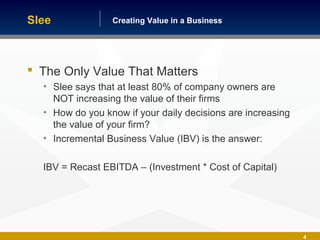
 The Only Value That Matters
• Slee says that at least 80% of company owners are
NOT increasing the value of their firms
• How do you know if your daily decisions are increasing
the value of your firm?
• Incremental Business Value (IBV) is the answer:
IBV = Recast EBITDA – (Investment * Cost of Capital)
Slee
Building America One Business at a TimeCreating Value in a Business
5
 Recast EBITDA as the Return
• Reported EBITDA is adjusted for owner discretionary
expenses and one-time expenses
• Why recast EBITDA?
• Let’s agree that: Accounting=Cost; Finance=Value
Slee
Building America One Business at a TimeCreating Value in a Business
6
 Investment in Your Business
• Is “book value” meaningful as a metric for judging
investment in your business?
• What is Investment then?
Investment = comprises all expenditures in a project or
business that have a long-term impact. The concept of
Investment is much more expansive than accounting
terms such as book value. For example, Investment
incorporates spending on “nouns” – people, places and
things.
Slee
Building America One Business at a TimeCreating Value in a Business
7
 Private Cost of Capital
• Every type of capital has a cost
• What are you demanding as a return on the Investment
in your business?
• Until now we didn’t have empirical evidence of private
cost of capital
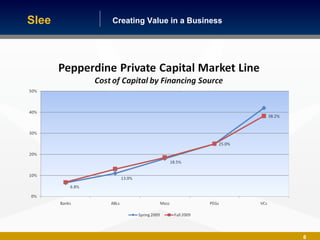
• So Slee/Pepperdine teamed-up in 2009 to create the
Pepperdine Cost of Capital surveys
Slee
Building America One Business at a TimeCreating Value in a Business
8
Slee
Building America One Business at a TimeCreating Value in a Business
9
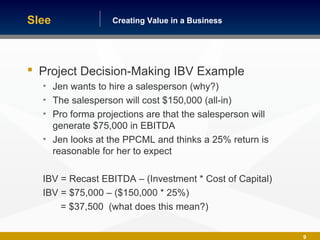
 Project Decision-Making IBV Example
• Jen wants to hire a salesperson (why?)
• The salesperson will cost $150,000 (all-in)
• Pro forma projections are that the salesperson will
generate $75,000 in EBITDA
• Jen looks at the PPCML and thinks a 25% return is
reasonable for her to expect
IBV = Recast EBITDA – (Investment * Cost of Capital)
IBV = $75,000 – ($150,000 * 25%)
= $37,500 (what does this mean?)
Slee
Building America One Business at a TimeCreating Value in a Business
10
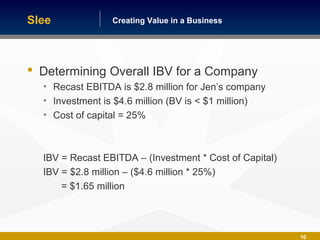
 Determining Overall IBV for a Company
• Recast EBITDA is $2.8 million for Jen’s company
• Investment is $4.6 million (BV is < $1 million)
• Cost of capital = 25%
IBV = Recast EBITDA – (Investment * Cost of Capital)
IBV = $2.8 million – ($4.6 million * 25%)
= $1.65 million
Slee

Creating Value in a Business

  • 1.
    Creating Value inYour Business Presented by Rob Slee, CM&AA, MA, MBA © 2015 Robert T. Slee. All Rights Reserved.
  • 2.
    Building America OneBusiness at a TimeCreating Value in a Business  Value Relativity • Think of a value for your business • Who else agrees with this value? • Without an active trading market, how are private values determined? • The reason you need to know the value leads to a value world • Every private company has dozens of correct values at one point in time (because there are dozens of reasons / value worlds) • Why? Not because I say so – but because Authorities say it is so (perspectives matter in the private markets) 2 Slee
  • 3.
    Building America OneBusiness at a TimeCreating Value in a Business 3  A Few Value Worlds • Market Value – what the open market says the business is worth (Asset, Financial, and Synergy Subworlds) • Fair Market Value – what the IRS/Courts say it is worth • Owner Value – what the owner says it is worth • Investor Value – what an investor says it is worth • Collateral Value – what the bank says it is worth • Incremental Business Value – returns greater than investment • 30 second rule… Slee
  • 4.
    Building America OneBusiness at a TimeCreating Value in a Business 4  The Only Value That Matters • Slee says that at least 80% of company owners are NOT increasing the value of their firms • How do you know if your daily decisions are increasing the value of your firm? • Incremental Business Value (IBV) is the answer: IBV = Recast EBITDA – (Investment * Cost of Capital) Slee
  • 5.
    Building America OneBusiness at a TimeCreating Value in a Business 5  Recast EBITDA as the Return • Reported EBITDA is adjusted for owner discretionary expenses and one-time expenses • Why recast EBITDA? • Let’s agree that: Accounting=Cost; Finance=Value Slee
  • 6.
    Building America OneBusiness at a TimeCreating Value in a Business 6  Investment in Your Business • Is “book value” meaningful as a metric for judging investment in your business? • What is Investment then? Investment = comprises all expenditures in a project or business that have a long-term impact. The concept of Investment is much more expansive than accounting terms such as book value. For example, Investment incorporates spending on “nouns” – people, places and things. Slee
  • 7.
    Building America OneBusiness at a TimeCreating Value in a Business 7  Private Cost of Capital • Every type of capital has a cost • What are you demanding as a return on the Investment in your business? • Until now we didn’t have empirical evidence of private cost of capital • So Slee/Pepperdine teamed-up in 2009 to create the Pepperdine Cost of Capital surveys Slee
  • 8.
    Building America OneBusiness at a TimeCreating Value in a Business 8 Slee
  • 9.
    Building America OneBusiness at a TimeCreating Value in a Business 9  Project Decision-Making IBV Example • Jen wants to hire a salesperson (why?) • The salesperson will cost $150,000 (all-in) • Pro forma projections are that the salesperson will generate $75,000 in EBITDA • Jen looks at the PPCML and thinks a 25% return is reasonable for her to expect IBV = Recast EBITDA – (Investment * Cost of Capital) IBV = $75,000 – ($150,000 * 25%) = $37,500 (what does this mean?) Slee
  • 10.
    Building America OneBusiness at a TimeCreating Value in a Business 10  Determining Overall IBV for a Company • Recast EBITDA is $2.8 million for Jen’s company • Investment is $4.6 million (BV is < $1 million) • Cost of capital = 25% IBV = Recast EBITDA – (Investment * Cost of Capital) IBV = $2.8 million – ($4.6 million * 25%) = $1.65 million Slee