Creating a Successful MFI in a
Small Remote Low Income Nation
South Pacific Business Development
Foundation (SPBD)
Samoa
Greg Casagrande
What is SPBD?
 SPBD is a Samoan based NGO dedicated to
eliminating poverty in the South Pacific.
 SPBD provides micro credit to the poor for the
purpose of starting a small business.
 SPBD follows the Grameen Bank methodology to
micro finance.
 SPBD currently serves the island nation of Samoa.
 www.spbd.ws
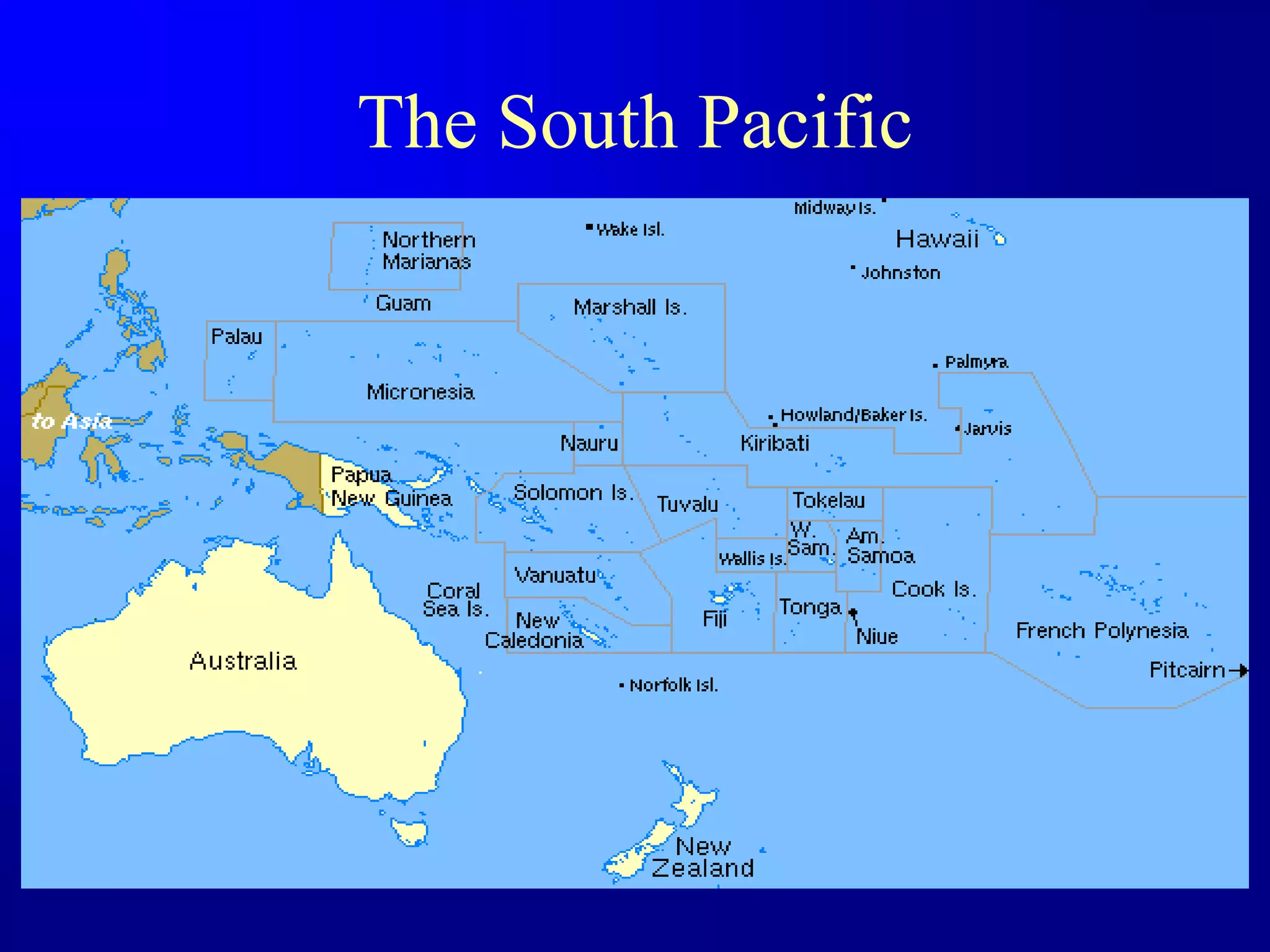
The South Pacific
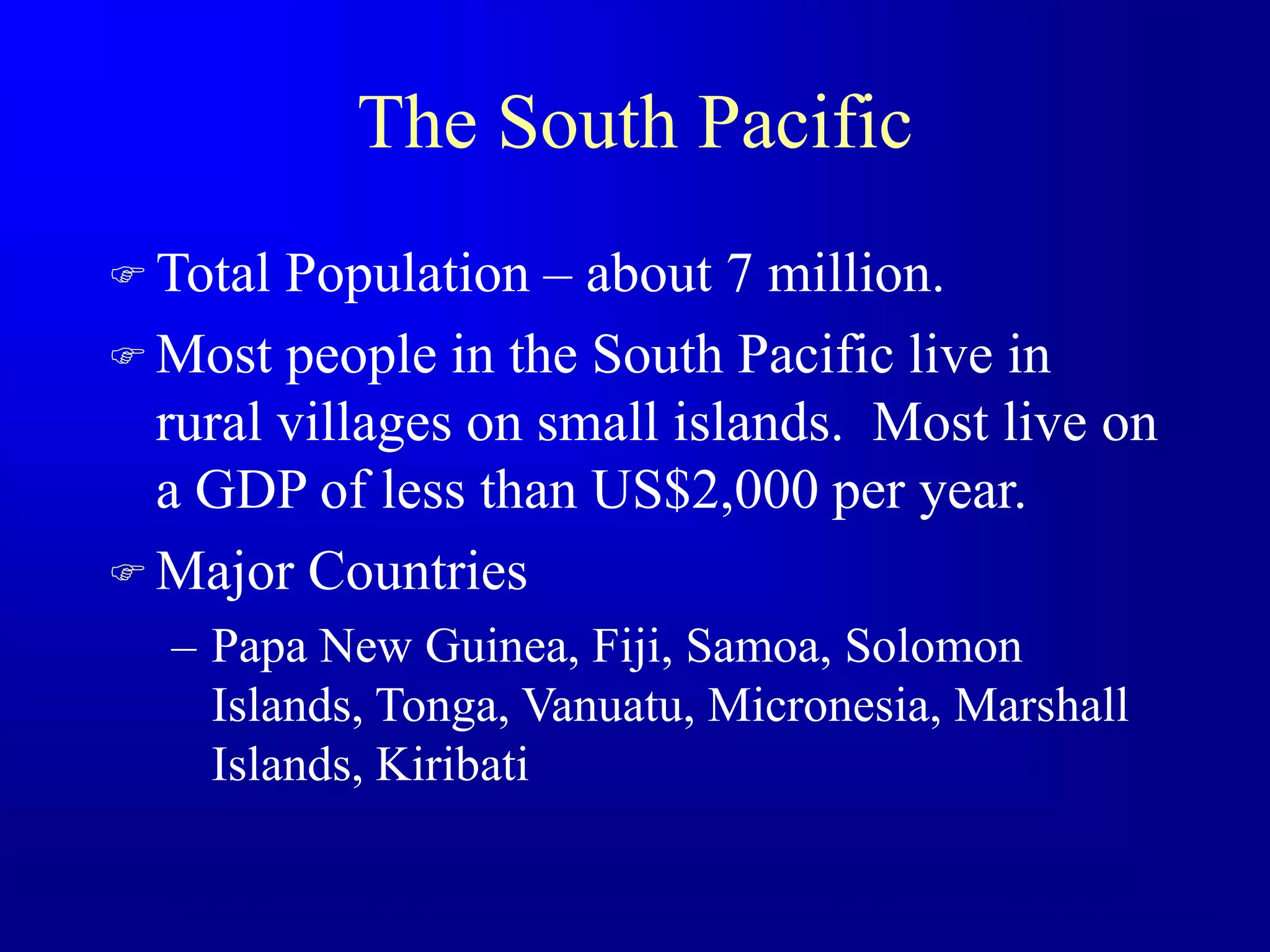
 Total Population – about 7 million.
 Most people in the South Pacific live in
rural villages on small islands. Most live on
a GDP of less than US$2,000 per year.
 Major Countries
– Papa New Guinea, Fiji, Samoa, Solomon
Islands, Tonga, Vanuatu, Micronesia, Marshall
Islands, Kiribati
The South Pacific
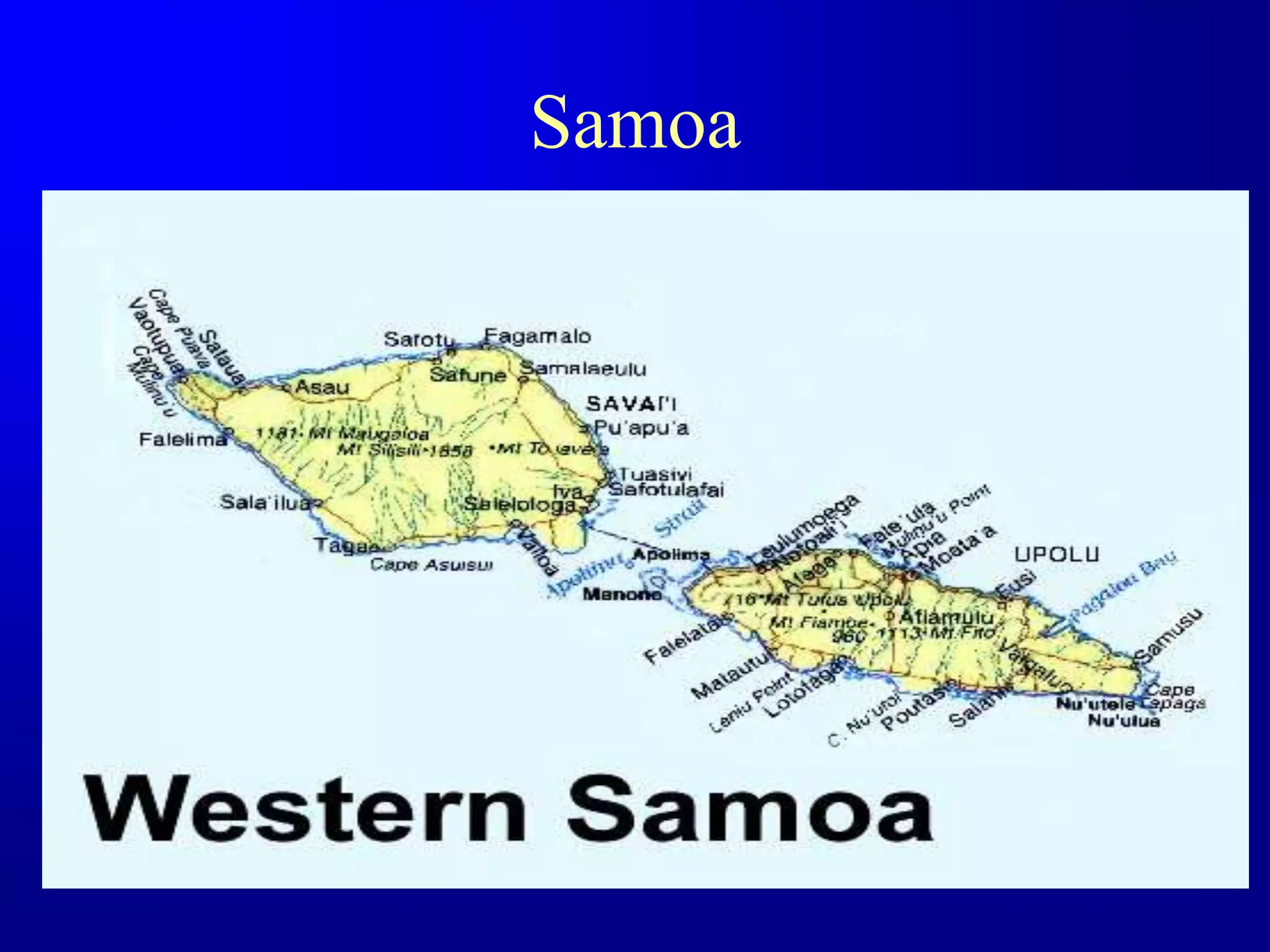
Samoa
Samoa
 Samoa has been an independent nation since 1962
and is governed by an elected parliament.
 Samoa consists of two main islands, Upolu and
Savaii, and covers 1,100 square miles.
 Samoa has a population of 204,000 people.
 Samoa is very rural. Apia, the capital, is the only
town of any significance in Samoa.
 Samoa is considered the cultural heart of
Polynesia.
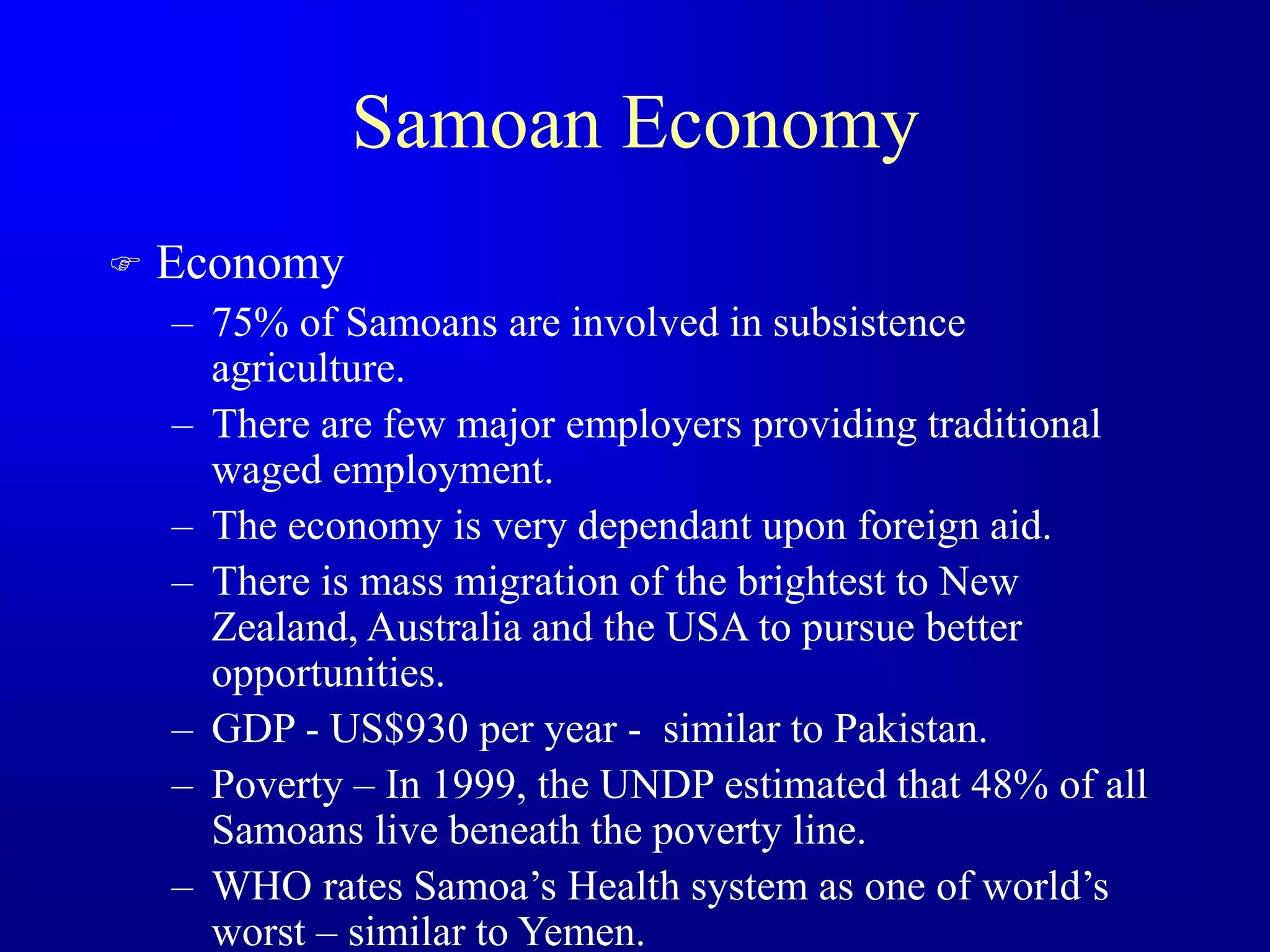
Samoan Economy
 Economy
– 75% of Samoans are involved in subsistence
agriculture.
– There are few major employers providing traditional
waged employment.
– The economy is very dependant upon foreign aid.
– There is mass migration of the brightest to New
Zealand, Australia and the USA to pursue better
opportunities.
– GDP - US$930 per year - similar to Pakistan.
– Poverty – In 1999, the UNDP estimated that 48% of all
Samoans live beneath the poverty line.
– WHO rates Samoa’s Health system as one of world’s
worst – similar to Yemen.
Typical Lives in
Samoa and the South Pacific
 Poverty of Opportunity
– No jobs (75% of families not in waged sector)
– No Credit available for the poor
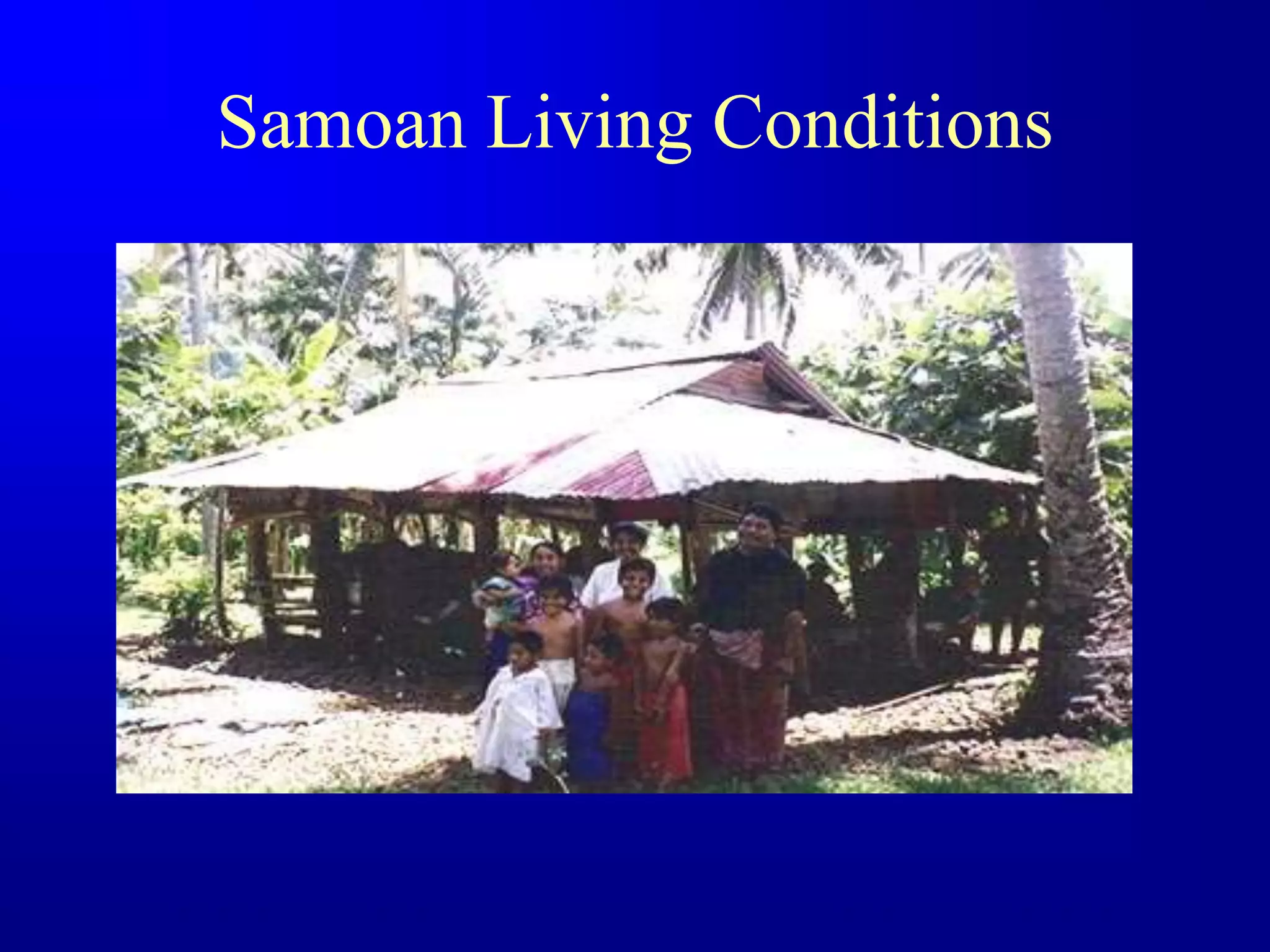
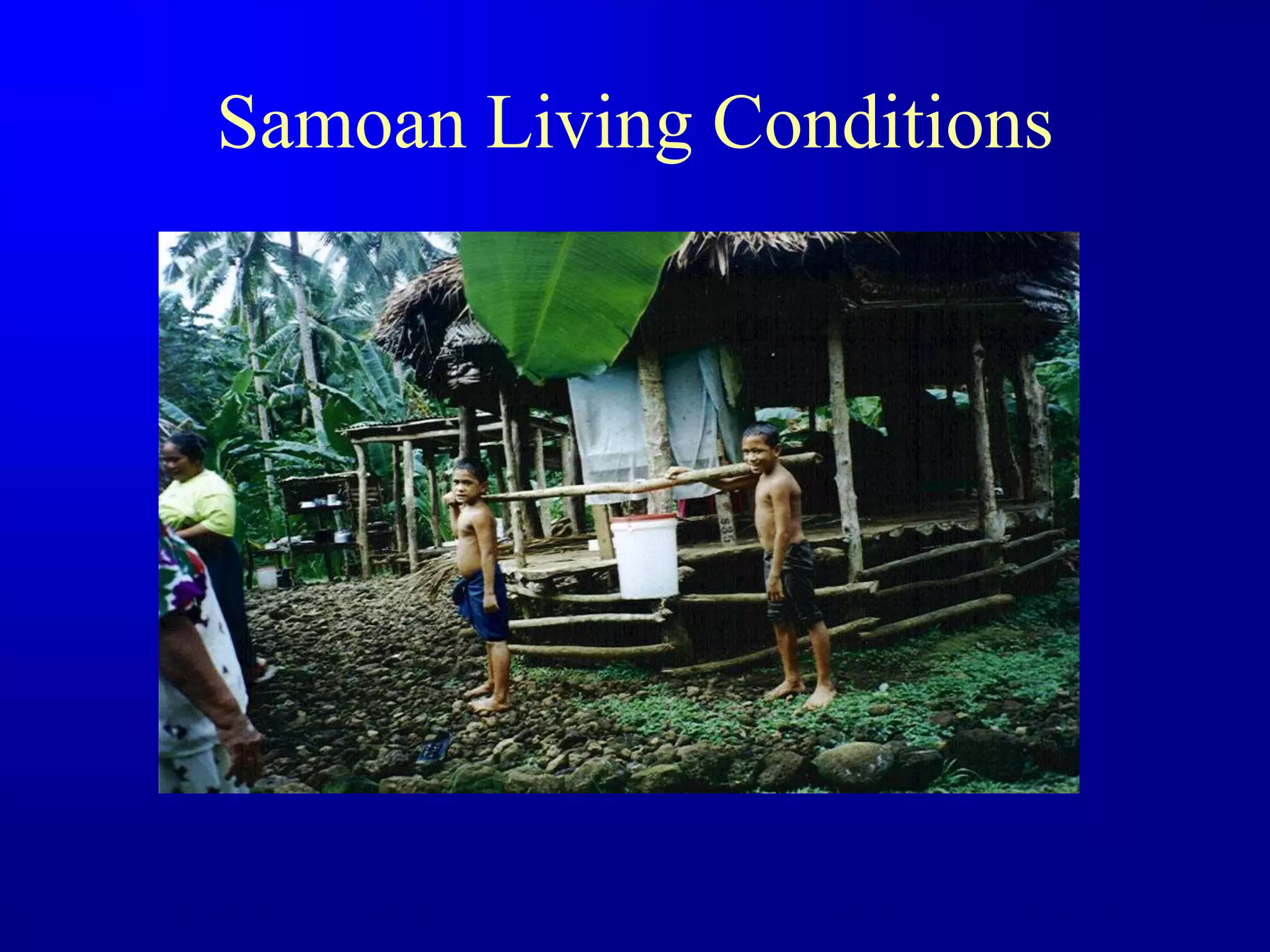
 Typical living condition
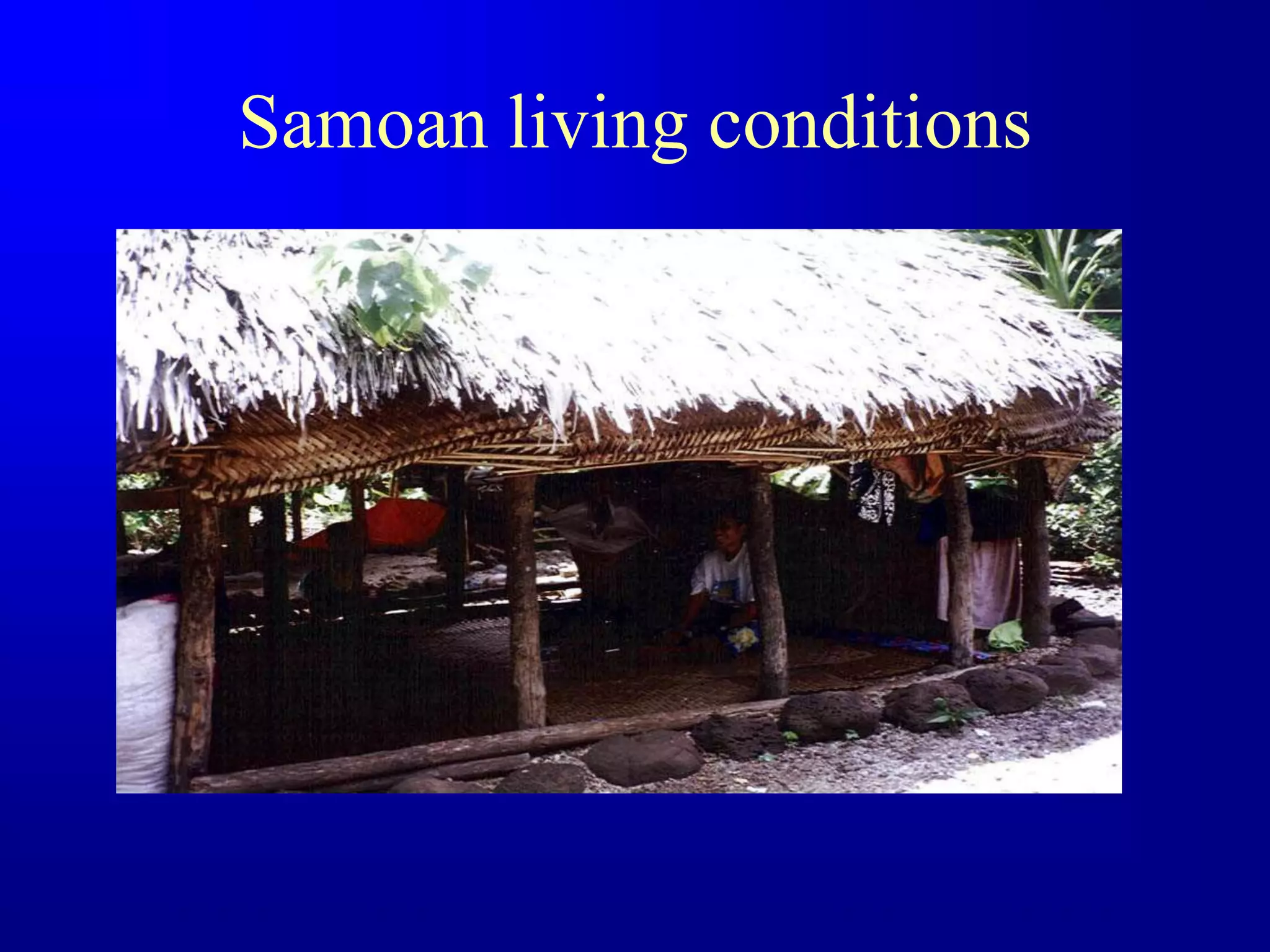
– Grass roof
– Pebble floor
– Poor sanitation
– Poor access to running piped water and electricity
 Childhood education is not free
 Unsophisticated, little experience with banks
Samoan living conditions
Samoan Living Conditions
History of Microfinance in the
Pacific
 The Pacific is littered with failures
 Samoa has had several failures
– UNDP, SPC, MoWA
– Church run
– Government run
– Volunteer run
 Continuing Failures
– Fiji
– Samoa – WIB
 Bee keeping
 Handouts
 Forced solutions
Competition
 SPBD has no direct competition in Samoa.
 The three commercial banks and the Development
Bank each require collateral or steady income for
loans. They do not serve the poor.
 SPBD Advantage:
– SPBD is the only financial institution in Samoa able to
DELIVER credit throughout Samoa.
– SPBD is the only financial institution in Samoa able to
provide on a large scale completely unsecured credit to
the poor.
SPBD - Business Practices
 Target poor women.
 Provide unsecured credit for :
– micro entrepreneurial purposes,
– home improvements and
– childhood education.
 Businesses are based on existing livelihood skills.
 Encourage and train self-formed groups of five.
 Organize groups into village based centers.
 Members guarantee one another within a group.
 Deliver credit directly to the villages.
 Charge market rates of interest.
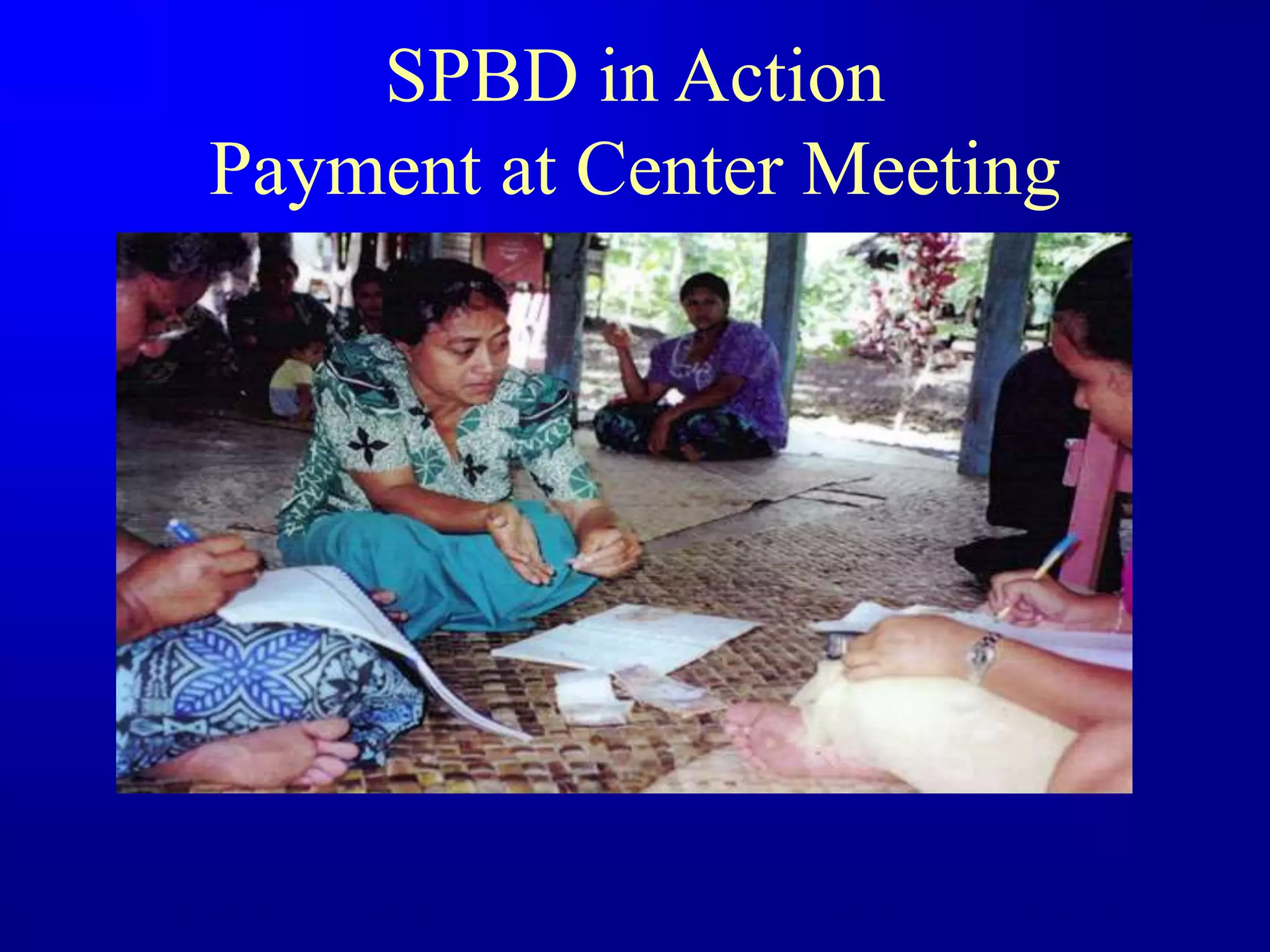
 Collect small repayments at weekly center meetings in the villages.
 Strive to achieve financial self-sufficiency via strong financial
planning and effective use of technology.
SPBD Business Practices
 Very structured program with clear rules
 Helps counter:
1. A very laid back culture
2. Low levels of education
3. No experience with financial institutions
 Train staff and motivate them
– Huge task because skill levels are low
 Have strong local government support
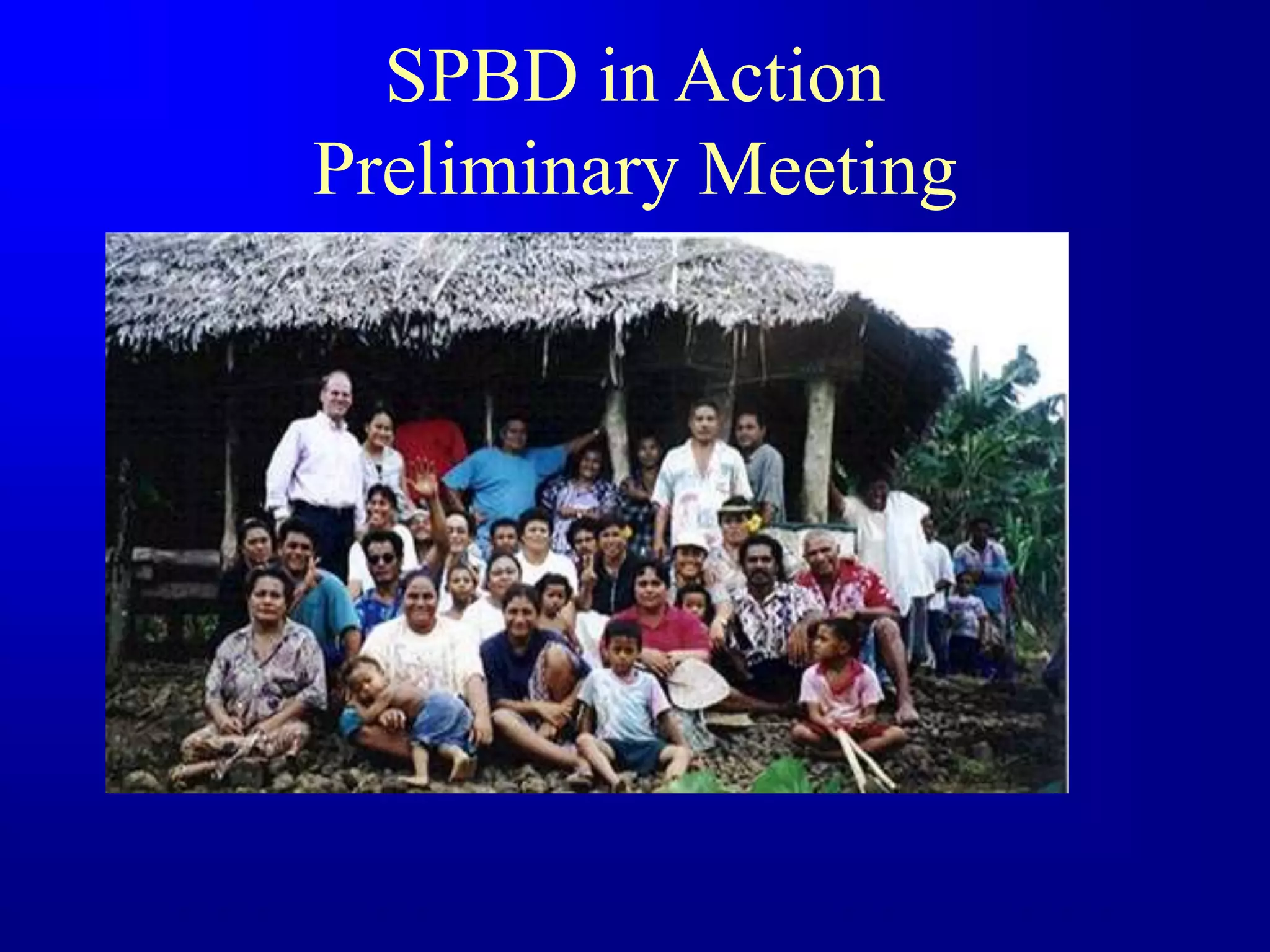
SPBD in Action
Preliminary Meeting
SPBD in Action
Payment at Center Meeting
SPBD has a Business / Banking
Mentality
 Privately and commercially funded
 Started and maintained on commercial
enterprise principals
 Trustee, management and staff have
business and banking backgrounds.
 Funders – we speak your language
Cost Structure
 Very low
 Lean organization
 CM’s to reach 500-800 clients each
 Yet very competitive and comprehensive
compensation and benefits structure
SPBD Methodology &
Innovation
 Created a Culture of Continuous
Improvement
 Client Identification
– Formal invitation into the villages from local
matai (chiefs)
– Poverty assessment tool
 Identify the poor
 Measure impact
SPBD Methodology &
Innovation
 Product/Service Design
– Variable loan sizes
– Variable repayments
– Flexible loans
– Housing improvement loans
– Childhood education loans
SPBD Methodology &
Innovation
 Delivery Methodology
– CM’s support >400 clients each
– In-house training program
– In house loan utilization forms
– Individualized weekly center reports
– Center secretaries have professional
bookkeeping
– Ongoing business education
SPBD Methodology &
Innovation
 In the pipeline
– Process
 Move from weekly to fortnightly meetings
 Group sizes to become flexible 4-7 members
– New Services
 Health Education series
 Improved Business Training Modules
 Savings
 Insurance
 Money Transfer
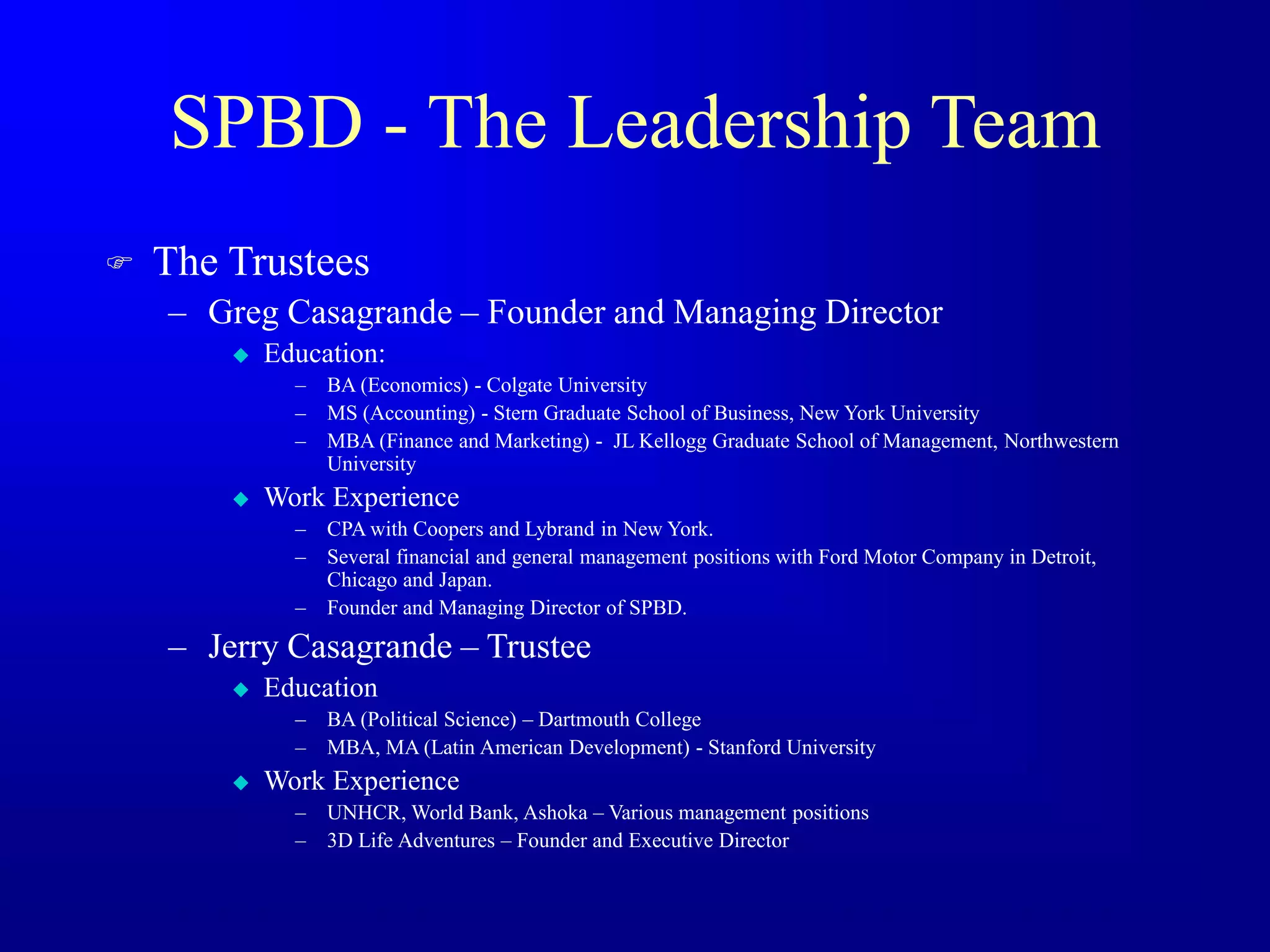
SPBD - The Leadership Team
 The Trustees
– Greg Casagrande – Founder and Managing Director
 Education:
– BA (Economics) - Colgate University
– MS (Accounting) - Stern Graduate School of Business, New York University
– MBA (Finance and Marketing) - JL Kellogg Graduate School of Management, Northwestern
University
 Work Experience
– CPA with Coopers and Lybrand in New York.
– Several financial and general management positions with Ford Motor Company in Detroit,
Chicago and Japan.
– Founder and Managing Director of SPBD.
– Jerry Casagrande – Trustee
 Education
– BA (Political Science) – Dartmouth College
– MBA, MA (Latin American Development) - Stanford University
 Work Experience
– UNHCR, World Bank, Ashoka – Various management positions
– 3D Life Adventures – Founder and Executive Director
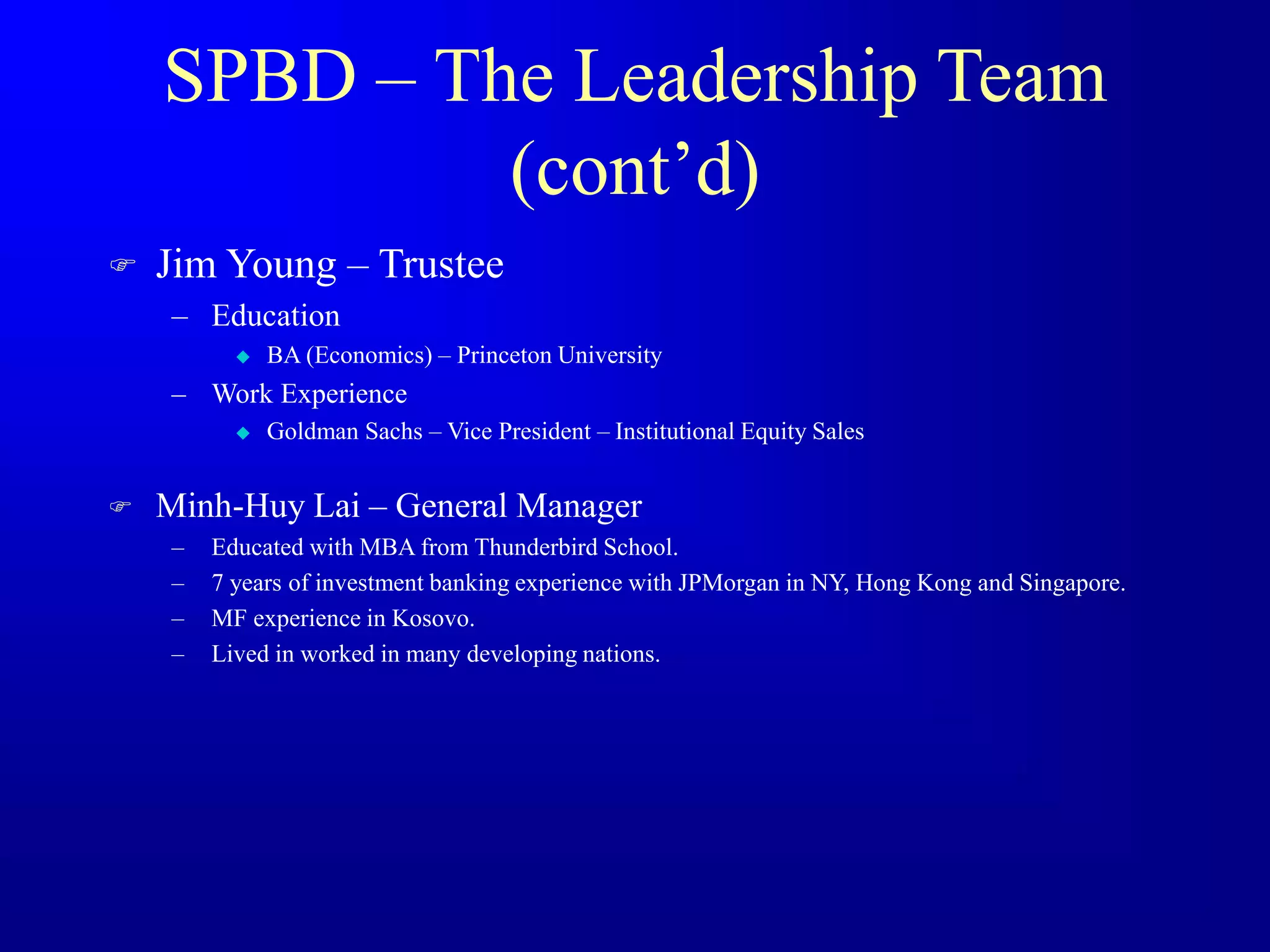
SPBD – The Leadership Team
(cont’d)
 Jim Young – Trustee
– Education
 BA (Economics) – Princeton University
– Work Experience
 Goldman Sachs – Vice President – Institutional Equity Sales
 Minh-Huy Lai – General Manager
– Educated with MBA from Thunderbird School.
– 7 years of investment banking experience with JPMorgan in NY, Hong Kong and Singapore.
– MF experience in Kosovo.
– Lived in worked in many developing nations.
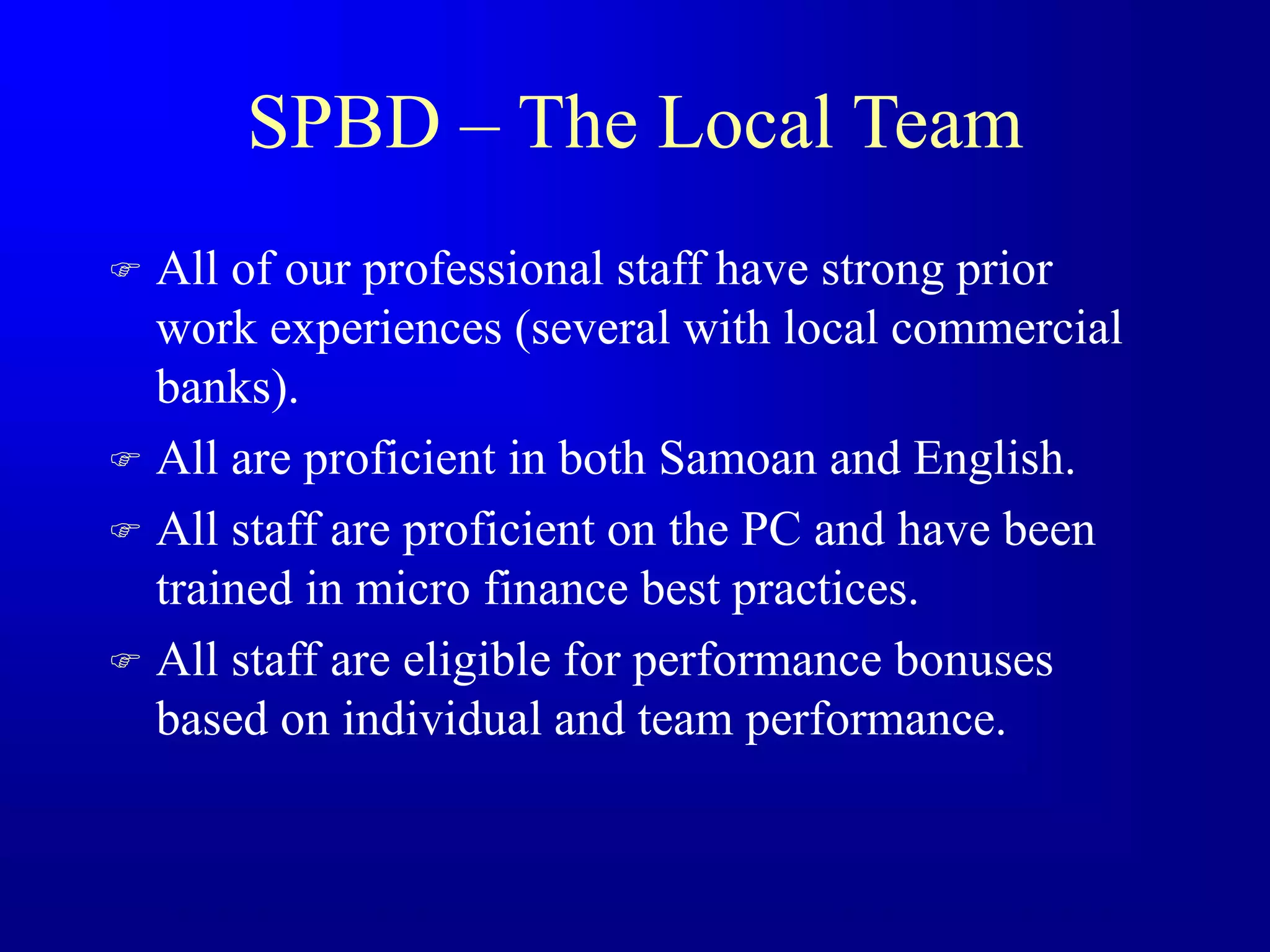
SPBD – The Local Team
 All of our professional staff have strong prior
work experiences (several with local commercial
banks).
 All are proficient in both Samoan and English.
 All staff are proficient on the PC and have been
trained in micro finance best practices.
 All staff are eligible for performance bonuses
based on individual and team performance.
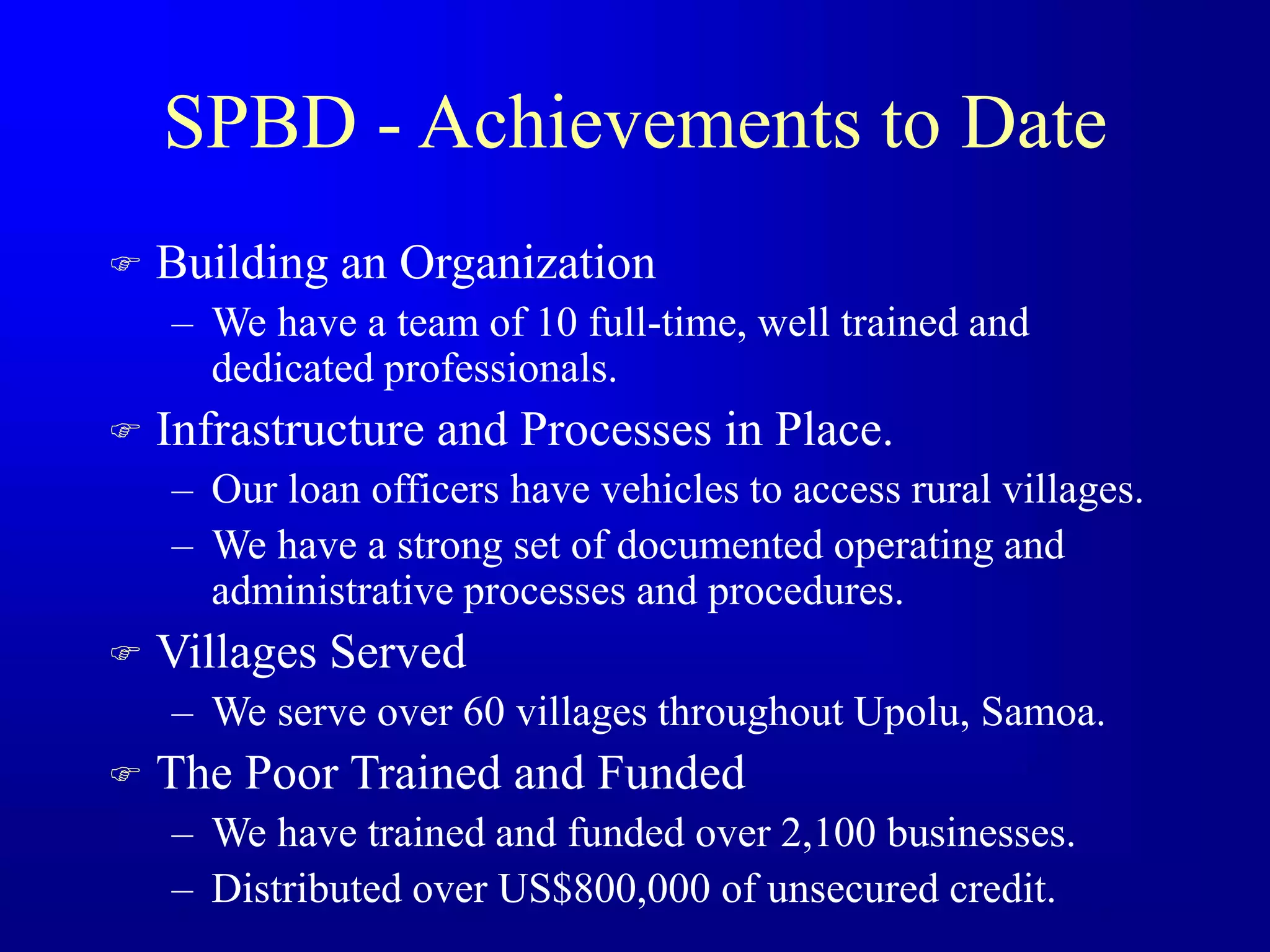
SPBD - Achievements to Date
 Building an Organization
– We have a team of 10 full-time, well trained and
dedicated professionals.
 Infrastructure and Processes in Place.
– Our loan officers have vehicles to access rural villages.
– We have a strong set of documented operating and
administrative processes and procedures.
 Villages Served
– We serve over 60 villages throughout Upolu, Samoa.
 The Poor Trained and Funded
– We have trained and funded over 2,100 businesses.
– Distributed over US$800,000 of unsecured credit.
Achievements
 SPBD has demonstrated that:
– Poor Samoans are creditworthy
– They are receptive to financial products
– Capable of starting and sustaining small
businesses
 Leading academic opinion in the region said
contrary.
Measurements of Success.
 Successful businesses for all of our micro
entrepreneurs.
– Food preparation
– Clothing production
– Copra (coconut oil) production
– Vegetable farms, Plantations
– Chicken and pig farms
– General Stores, Roadside stands, market place trading
– Weaving
– Traditional arts and crafts
– Tourist operators
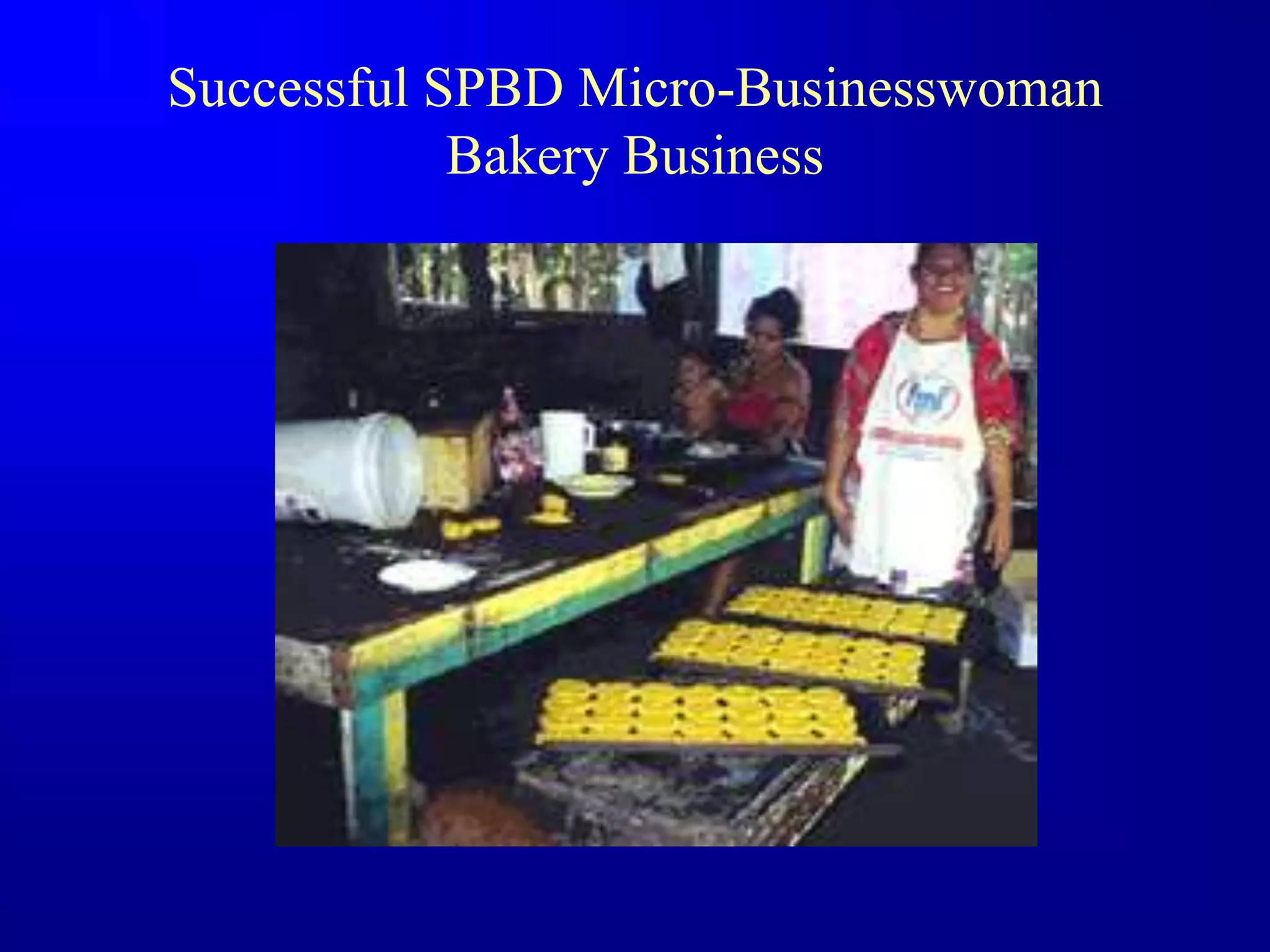
Successful SPBD Micro-Businesswoman
Bakery Business
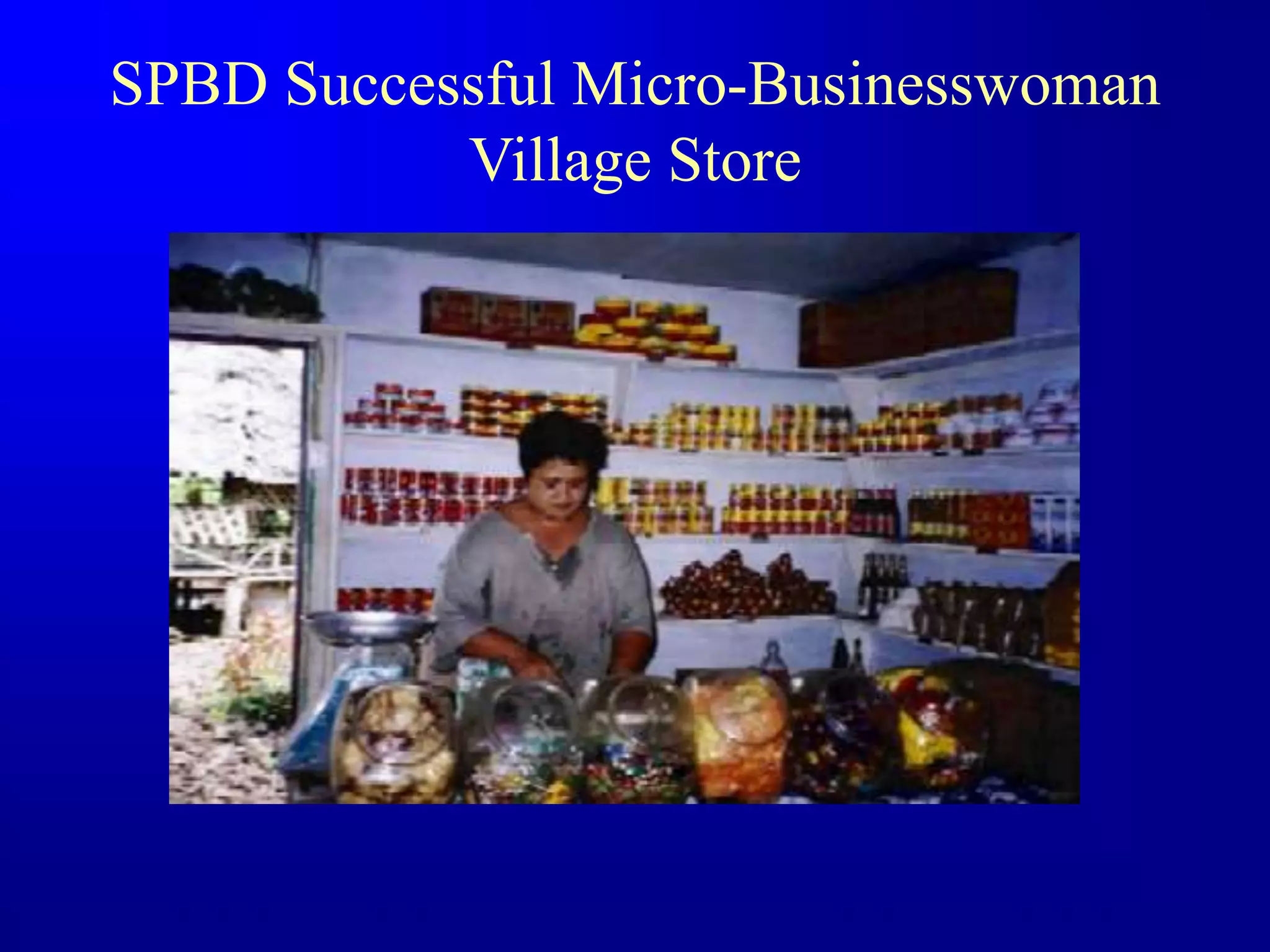
SPBD Successful Micro-Businesswoman
Village Store
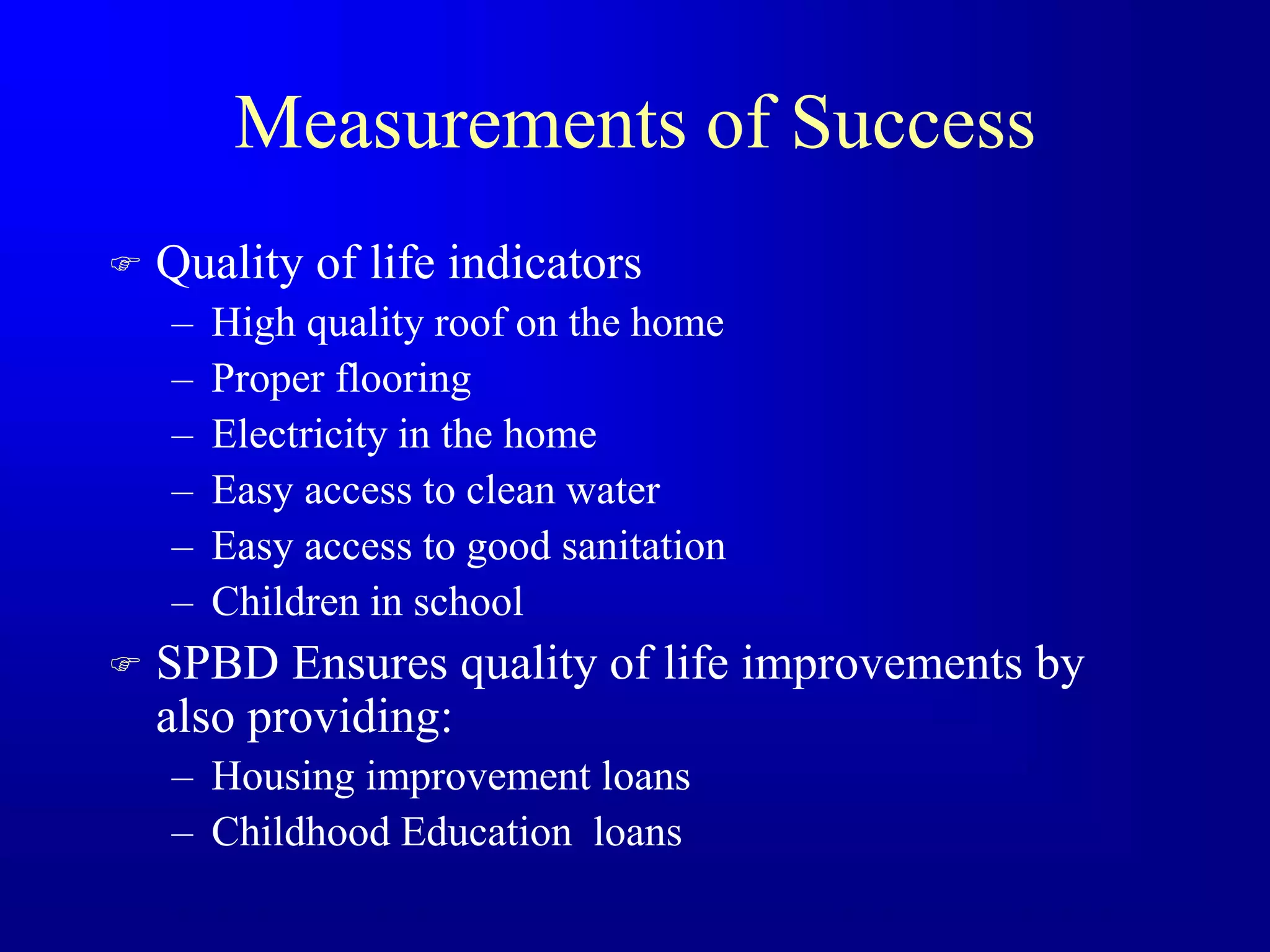
Measurements of Success
 Quality of life indicators
– High quality roof on the home
– Proper flooring
– Electricity in the home
– Easy access to clean water
– Easy access to good sanitation
– Children in school
 SPBD Ensures quality of life improvements by
also providing:
– Housing improvement loans
– Childhood Education loans
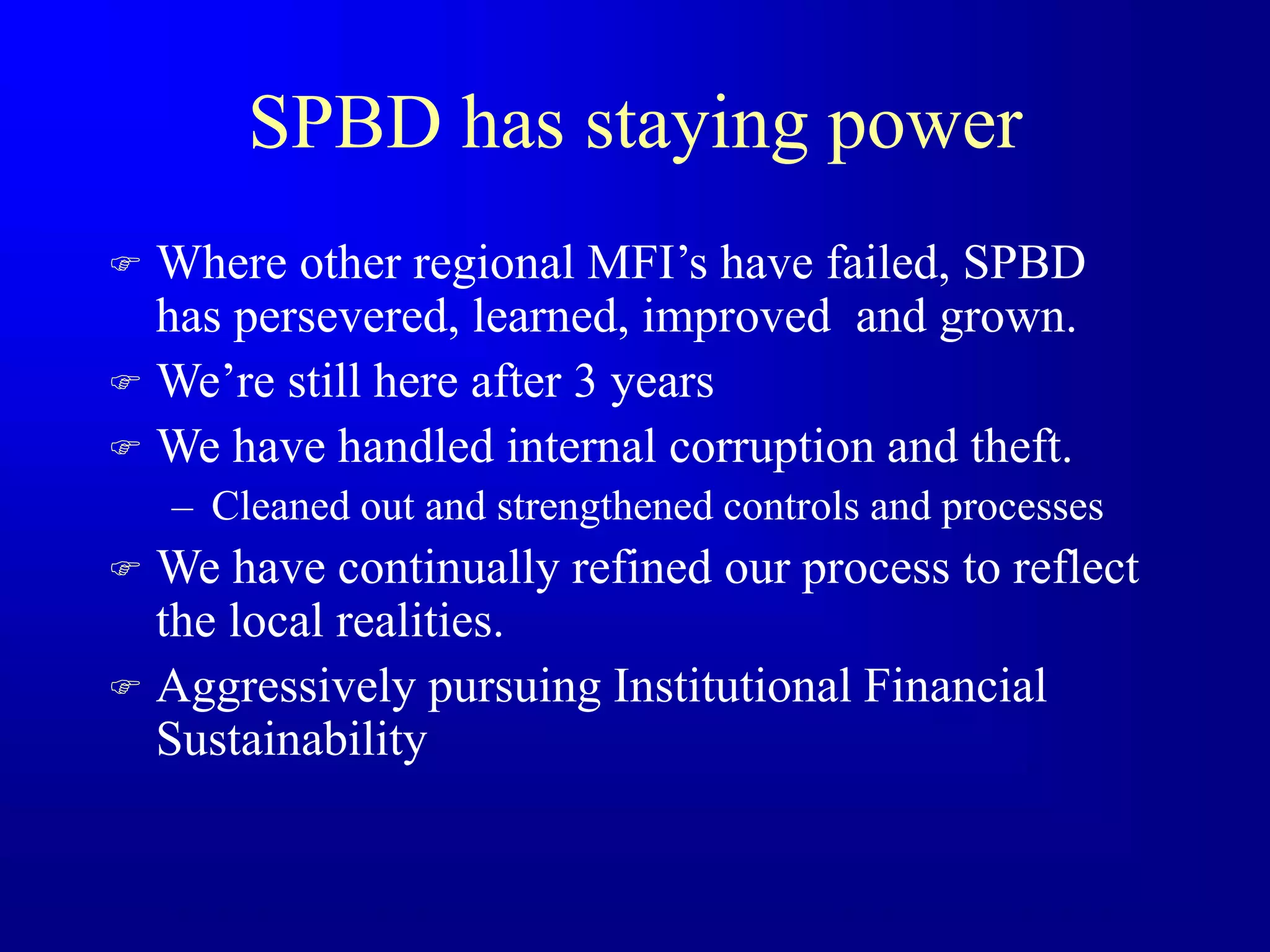
SPBD has staying power
 Where other regional MFI’s have failed, SPBD
has persevered, learned, improved and grown.
 We’re still here after 3 years
 We have handled internal corruption and theft.
– Cleaned out and strengthened controls and processes
 We have continually refined our process to reflect
the local realities.
 Aggressively pursuing Institutional Financial
Sustainability
SPBD Complaints
 The South Pacific is not on the world’s radar
screen
– Too small
– Too remote
– Obscure cultures
– Difficult to administer
 The voice of the poor is not heard
– Region is misunderstood
 No Funds for MFI in regions
– UNDP, USAID, IFC, SPPF, Major MFI corporate and
other donors are not interested in MF in the region.
Current State of Development in
the South Pacific
 Most development agencies have abandoned the
region. (e.g. USAID has left the region due to
difficulties in serving a remote population).
 The need for economic development remains.
Most of the population lives in rural poverty.
 South Pacific nations are small and remote. None
are currently served by a world class micro
finance organization.
 SPBD is now the largest micro finance
organization in the region, despite the fact that it
only serves Samoa.
Opportunities
 There is now an excellent opportunity to create a:
– well-managed,
– large
– efficient,
– region-wide micro finance organization in the South
Pacific
 A region-wide, micro finance organization could
leverage a larger base of talent and financial
resources and could thus help more people than
could several struggling small organizations.
Major Constraints
 Ongoing violence and instability in Papua New
Guinea and the Solomon Islands is a major
constraint in those nations. SPBD will initiate
efforts first in stable nations.
 Due to the small populations on each island, a
successful organization must be exceptionally well
managed and efficiently run. This is a key item
for SPBD.
 Funding is also a major constraint since most
international funding organizations do not operate
in the region.
Plans for the Future
 Growth in Samoa
– Expand to the island of Savaii
 Growth in the region
– Tonga
– Vanuatu
– Micronesia
 Outreach
– Could grow to 50,000+ long term
 Capital is the key constraint
Concerns of Funders
 SPBD is too small
– We can breakeven with less than 5000 active clients
and an average loan size <US$300
 Area is too small
– Samoa is small but the region is big
– Many LDC’s in the region, totally neglected by world
class MFI’s
– We have developed a replicable model that can be
replicated throughout the region and reach out to over
50,000 people
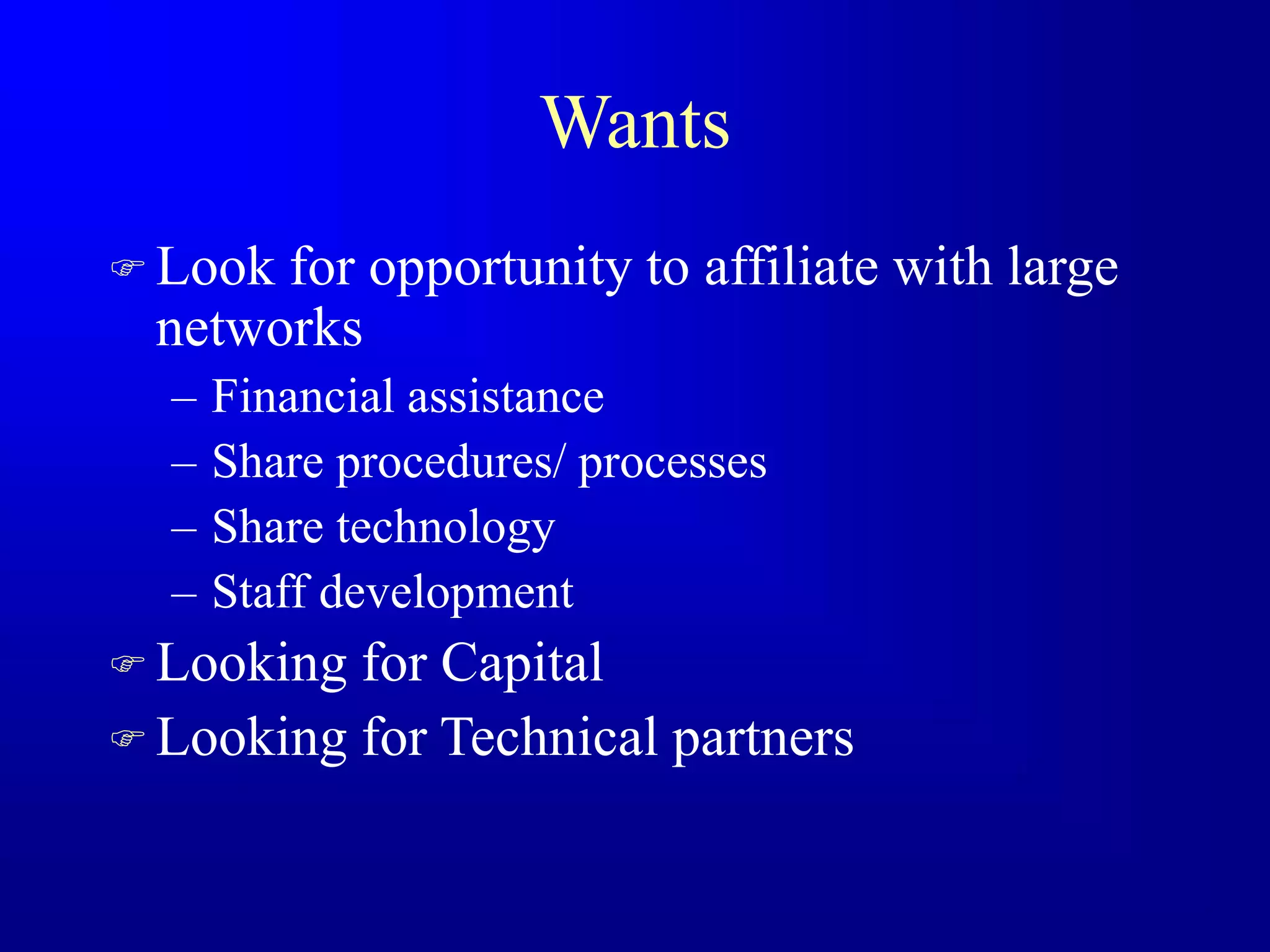
Wants
 Look for opportunity to affiliate with large
networks
– Financial assistance
– Share procedures/ processes
– Share technology
– Staff development
 Looking for Capital
 Looking for Technical partners
Thank you
 South Pacific Business Development
Foundation
– PO Box 1614
– Saleufi, Apia, Samoa
– Phone: 011-(685)-20189
– Email: greg@spbd.ws
– Web: www.spbd.ws

creating MFI.ppt

  • 1.
    Creating a SuccessfulMFI in a Small Remote Low Income Nation South Pacific Business Development Foundation (SPBD) Samoa Greg Casagrande
  • 2.
    What is SPBD? SPBD is a Samoan based NGO dedicated to eliminating poverty in the South Pacific.  SPBD provides micro credit to the poor for the purpose of starting a small business.  SPBD follows the Grameen Bank methodology to micro finance.  SPBD currently serves the island nation of Samoa.  www.spbd.ws
  • 3.
    The South Pacific Total Population – about 7 million.  Most people in the South Pacific live in rural villages on small islands. Most live on a GDP of less than US$2,000 per year.  Major Countries – Papa New Guinea, Fiji, Samoa, Solomon Islands, Tonga, Vanuatu, Micronesia, Marshall Islands, Kiribati
  • 4.
  • 5.
  • 6.
    Samoa  Samoa hasbeen an independent nation since 1962 and is governed by an elected parliament.  Samoa consists of two main islands, Upolu and Savaii, and covers 1,100 square miles.  Samoa has a population of 204,000 people.  Samoa is very rural. Apia, the capital, is the only town of any significance in Samoa.  Samoa is considered the cultural heart of Polynesia.
  • 7.
    Samoan Economy  Economy –75% of Samoans are involved in subsistence agriculture. – There are few major employers providing traditional waged employment. – The economy is very dependant upon foreign aid. – There is mass migration of the brightest to New Zealand, Australia and the USA to pursue better opportunities. – GDP - US$930 per year - similar to Pakistan. – Poverty – In 1999, the UNDP estimated that 48% of all Samoans live beneath the poverty line. – WHO rates Samoa’s Health system as one of world’s worst – similar to Yemen.
  • 8.
    Typical Lives in Samoaand the South Pacific  Poverty of Opportunity – No jobs (75% of families not in waged sector) – No Credit available for the poor  Typical living condition – Grass roof – Pebble floor – Poor sanitation – Poor access to running piped water and electricity  Childhood education is not free  Unsophisticated, little experience with banks
  • 9.
  • 10.
  • 11.
  • 12.
    History of Microfinancein the Pacific  The Pacific is littered with failures  Samoa has had several failures – UNDP, SPC, MoWA – Church run – Government run – Volunteer run  Continuing Failures – Fiji – Samoa – WIB  Bee keeping  Handouts  Forced solutions
  • 13.
    Competition  SPBD hasno direct competition in Samoa.  The three commercial banks and the Development Bank each require collateral or steady income for loans. They do not serve the poor.  SPBD Advantage: – SPBD is the only financial institution in Samoa able to DELIVER credit throughout Samoa. – SPBD is the only financial institution in Samoa able to provide on a large scale completely unsecured credit to the poor.
  • 14.
    SPBD - BusinessPractices  Target poor women.  Provide unsecured credit for : – micro entrepreneurial purposes, – home improvements and – childhood education.  Businesses are based on existing livelihood skills.  Encourage and train self-formed groups of five.  Organize groups into village based centers.  Members guarantee one another within a group.  Deliver credit directly to the villages.  Charge market rates of interest.  Collect small repayments at weekly center meetings in the villages.  Strive to achieve financial self-sufficiency via strong financial planning and effective use of technology.
  • 15.
    SPBD Business Practices Very structured program with clear rules  Helps counter: 1. A very laid back culture 2. Low levels of education 3. No experience with financial institutions  Train staff and motivate them – Huge task because skill levels are low  Have strong local government support
  • 16.
  • 17.
    SPBD in Action Paymentat Center Meeting
  • 18.
    SPBD has aBusiness / Banking Mentality  Privately and commercially funded  Started and maintained on commercial enterprise principals  Trustee, management and staff have business and banking backgrounds.  Funders – we speak your language
  • 19.
    Cost Structure  Verylow  Lean organization  CM’s to reach 500-800 clients each  Yet very competitive and comprehensive compensation and benefits structure
  • 20.
    SPBD Methodology & Innovation Created a Culture of Continuous Improvement  Client Identification – Formal invitation into the villages from local matai (chiefs) – Poverty assessment tool  Identify the poor  Measure impact
  • 21.
    SPBD Methodology & Innovation Product/Service Design – Variable loan sizes – Variable repayments – Flexible loans – Housing improvement loans – Childhood education loans
  • 22.
    SPBD Methodology & Innovation Delivery Methodology – CM’s support >400 clients each – In-house training program – In house loan utilization forms – Individualized weekly center reports – Center secretaries have professional bookkeeping – Ongoing business education
  • 23.
    SPBD Methodology & Innovation In the pipeline – Process  Move from weekly to fortnightly meetings  Group sizes to become flexible 4-7 members – New Services  Health Education series  Improved Business Training Modules  Savings  Insurance  Money Transfer
  • 24.
    SPBD - TheLeadership Team  The Trustees – Greg Casagrande – Founder and Managing Director  Education: – BA (Economics) - Colgate University – MS (Accounting) - Stern Graduate School of Business, New York University – MBA (Finance and Marketing) - JL Kellogg Graduate School of Management, Northwestern University  Work Experience – CPA with Coopers and Lybrand in New York. – Several financial and general management positions with Ford Motor Company in Detroit, Chicago and Japan. – Founder and Managing Director of SPBD. – Jerry Casagrande – Trustee  Education – BA (Political Science) – Dartmouth College – MBA, MA (Latin American Development) - Stanford University  Work Experience – UNHCR, World Bank, Ashoka – Various management positions – 3D Life Adventures – Founder and Executive Director
  • 25.
    SPBD – TheLeadership Team (cont’d)  Jim Young – Trustee – Education  BA (Economics) – Princeton University – Work Experience  Goldman Sachs – Vice President – Institutional Equity Sales  Minh-Huy Lai – General Manager – Educated with MBA from Thunderbird School. – 7 years of investment banking experience with JPMorgan in NY, Hong Kong and Singapore. – MF experience in Kosovo. – Lived in worked in many developing nations.
  • 26.
    SPBD – TheLocal Team  All of our professional staff have strong prior work experiences (several with local commercial banks).  All are proficient in both Samoan and English.  All staff are proficient on the PC and have been trained in micro finance best practices.  All staff are eligible for performance bonuses based on individual and team performance.
  • 27.
    SPBD - Achievementsto Date  Building an Organization – We have a team of 10 full-time, well trained and dedicated professionals.  Infrastructure and Processes in Place. – Our loan officers have vehicles to access rural villages. – We have a strong set of documented operating and administrative processes and procedures.  Villages Served – We serve over 60 villages throughout Upolu, Samoa.  The Poor Trained and Funded – We have trained and funded over 2,100 businesses. – Distributed over US$800,000 of unsecured credit.
  • 28.
    Achievements  SPBD hasdemonstrated that: – Poor Samoans are creditworthy – They are receptive to financial products – Capable of starting and sustaining small businesses  Leading academic opinion in the region said contrary.
  • 29.
    Measurements of Success. Successful businesses for all of our micro entrepreneurs. – Food preparation – Clothing production – Copra (coconut oil) production – Vegetable farms, Plantations – Chicken and pig farms – General Stores, Roadside stands, market place trading – Weaving – Traditional arts and crafts – Tourist operators
  • 30.
  • 31.
  • 32.
    Measurements of Success Quality of life indicators – High quality roof on the home – Proper flooring – Electricity in the home – Easy access to clean water – Easy access to good sanitation – Children in school  SPBD Ensures quality of life improvements by also providing: – Housing improvement loans – Childhood Education loans
  • 33.
    SPBD has stayingpower  Where other regional MFI’s have failed, SPBD has persevered, learned, improved and grown.  We’re still here after 3 years  We have handled internal corruption and theft. – Cleaned out and strengthened controls and processes  We have continually refined our process to reflect the local realities.  Aggressively pursuing Institutional Financial Sustainability
  • 34.
    SPBD Complaints  TheSouth Pacific is not on the world’s radar screen – Too small – Too remote – Obscure cultures – Difficult to administer  The voice of the poor is not heard – Region is misunderstood  No Funds for MFI in regions – UNDP, USAID, IFC, SPPF, Major MFI corporate and other donors are not interested in MF in the region.
  • 35.
    Current State ofDevelopment in the South Pacific  Most development agencies have abandoned the region. (e.g. USAID has left the region due to difficulties in serving a remote population).  The need for economic development remains. Most of the population lives in rural poverty.  South Pacific nations are small and remote. None are currently served by a world class micro finance organization.  SPBD is now the largest micro finance organization in the region, despite the fact that it only serves Samoa.
  • 36.
    Opportunities  There isnow an excellent opportunity to create a: – well-managed, – large – efficient, – region-wide micro finance organization in the South Pacific  A region-wide, micro finance organization could leverage a larger base of talent and financial resources and could thus help more people than could several struggling small organizations.
  • 37.
    Major Constraints  Ongoingviolence and instability in Papua New Guinea and the Solomon Islands is a major constraint in those nations. SPBD will initiate efforts first in stable nations.  Due to the small populations on each island, a successful organization must be exceptionally well managed and efficiently run. This is a key item for SPBD.  Funding is also a major constraint since most international funding organizations do not operate in the region.
  • 38.
    Plans for theFuture  Growth in Samoa – Expand to the island of Savaii  Growth in the region – Tonga – Vanuatu – Micronesia  Outreach – Could grow to 50,000+ long term  Capital is the key constraint
  • 39.
    Concerns of Funders SPBD is too small – We can breakeven with less than 5000 active clients and an average loan size <US$300  Area is too small – Samoa is small but the region is big – Many LDC’s in the region, totally neglected by world class MFI’s – We have developed a replicable model that can be replicated throughout the region and reach out to over 50,000 people
  • 40.
    Wants  Look foropportunity to affiliate with large networks – Financial assistance – Share procedures/ processes – Share technology – Staff development  Looking for Capital  Looking for Technical partners
  • 41.
    Thank you  SouthPacific Business Development Foundation – PO Box 1614 – Saleufi, Apia, Samoa – Phone: 011-(685)-20189 – Email: greg@spbd.ws – Web: www.spbd.ws