© 2012 The McGraw-Hill Companies, Inc. All rights reserved.
McGraw-Hill/Irwin Copyright © 2012 by The McGraw-Hill Companies, Inc. All rights reserved.
Making
Decisions
Chapter Ten
10-2
After reading the material in this chapter,
you should be able to:
LO10.1 Compare and contrast the rational model of decision
making, Simon’s normative model, and the garbage
can model
LO10.2 Review the eight decision-making biases.
LO10.3 Discuss the thrust of evidence-based decision making and
its implementation principles.
LO10.4 Describe the model of decision-making styles, the role of
intuition in decision-making and the stages of the creative
process.
LO10.5 Summarize the pros and cons of involving groups in
the decision-making process.
LO10.6 Contrast brainstorming, the nominal group technique,
the Delphi technique, and computer-aided decision
making.
10-3
Models of Decision Making
Decision making
 identifying and
choosing solutions
that lead to a desired
state of affairs
10-4
Models of Decision Making
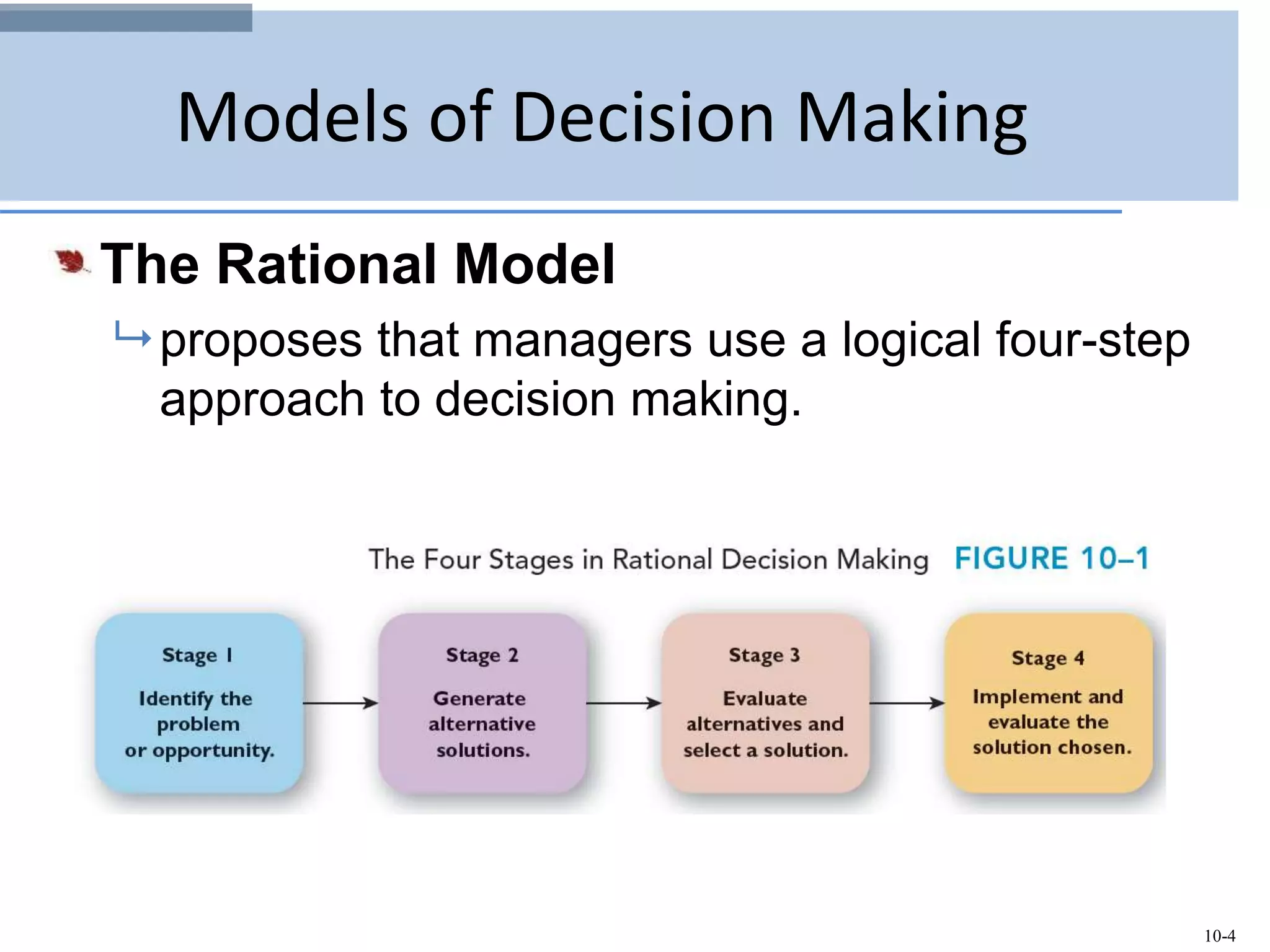
The Rational Model
 proposes that managers use a logical four-step
approach to decision making.
10-5
Rational Model
Identifying the Problem
 Problem – exists when the actual situation and
the desired situation differ
 Opportunity - represents a situation in which
there are possibilities to do things that lead to
results that exceed goals and expectations
Generating Solutions
 For routine decisions alternatives are readily
available through decision rules
10-6
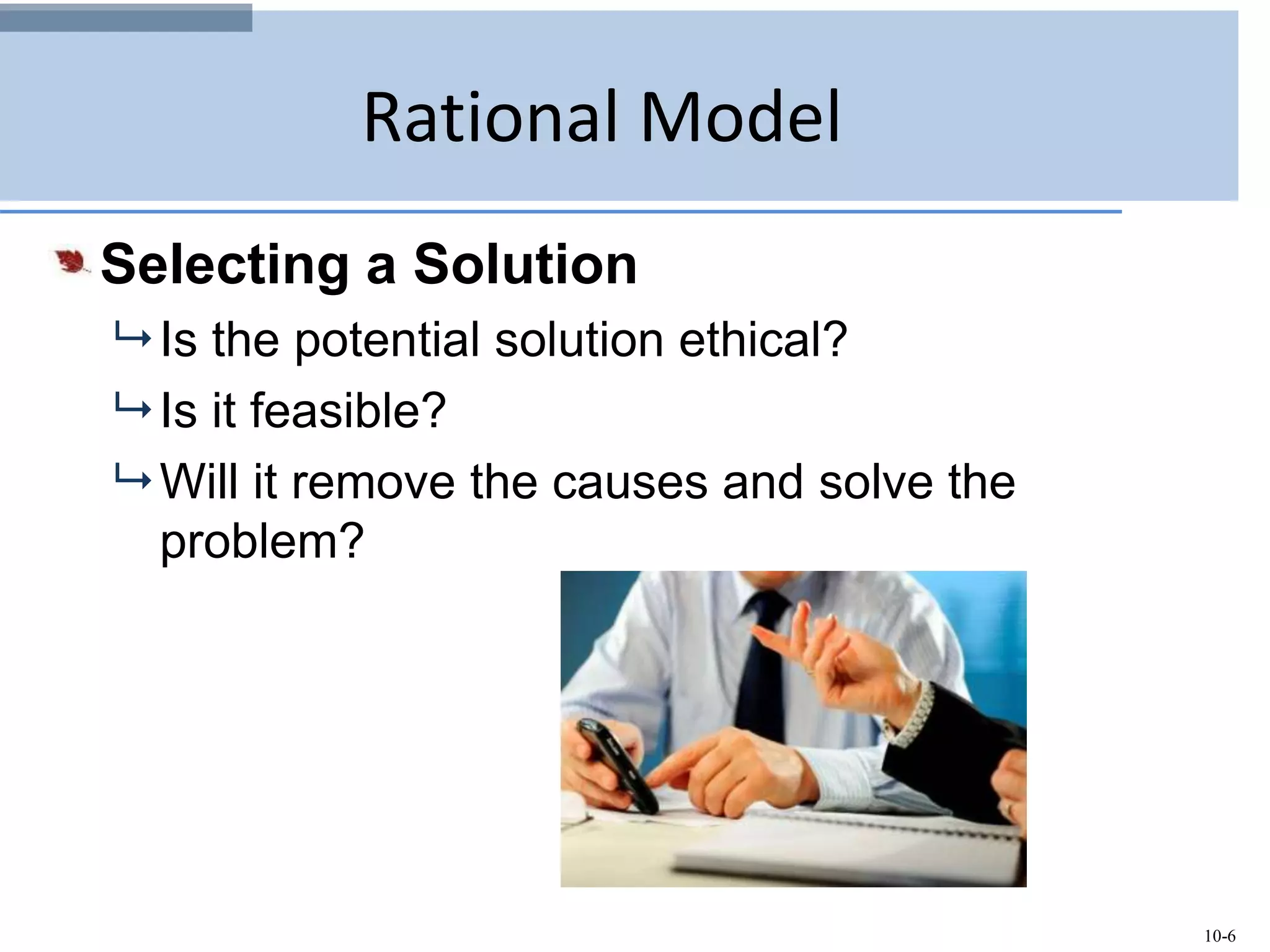
Rational Model
Selecting a Solution
 Is the potential solution ethical?
 Is it feasible?
 Will it remove the causes and solve the
problem?
10-7
Rational Model
Implementing and Evaluating the
Solution
 After solution is implemented, the evaluation
phase is used to evaluate its effectiveness
 Optimizing – producing the best possible
solution
10-8
Question?
Gloria is never happy with "good enough"
solutions. She is determined to find the
best possible solution in solving her
problems. What Gloria is doing is described
as
A.Optimizing
B.Brainstorming
C.Rationalizing
D.Satisfying
10-9
Summarizing the Rational Model
1. The quality of decisions may be enhanced
2. It makes the reasoning behind a decision
transparent
3. If made public, it discourages the decider
from acting on suspect considerations
10-10
Nonrational Models of Decision
Making
Nonrational models
 Attempt to explain how decisions are actually
made
1.Decision making is uncertain
2.Decision makers do not possess complete
information
3.Difficult for managers to make optimal
decisions
10-11
Simon’s Normative Model
Bounded rationality
 represents the notion that decision makers are
“bounded” or restricted by a variety of
constraints when making decisions
Satisficing
 choosing a solution that meets some minimum
qualifications, one that is “good enough.”
10-12
Simon’s Normative Model
Most frequent causes of poor decision
making
Poorly defined processes and practices
Unclear company vision, mission, and goals
Unwillingness of leaders to take responsibility
Lack of reliable, timely information
10-13
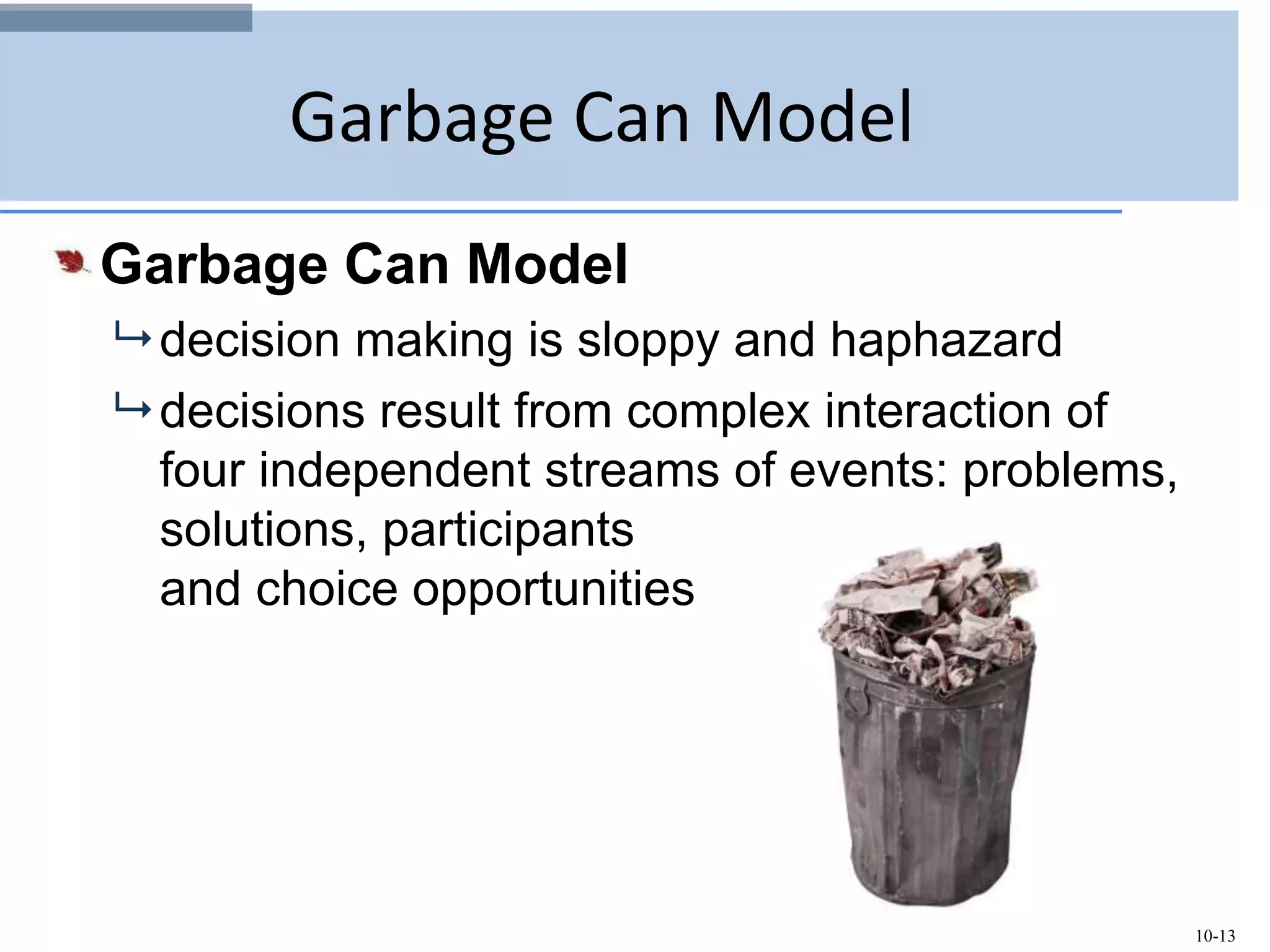
Garbage Can Model
Garbage Can Model
 decision making is sloppy and haphazard
 decisions result from complex interaction of
four independent streams of events: problems,
solutions, participants
and choice opportunities
10-14
Implications of the Garbage Can
Model
1. More pronounced in industries that rely on
science-based innovations
2. Many decisions are made by oversight
3. Political motives frequently influence
decision makers
4. Important decisions are more likely to be
solved
10-15
Integrating Rational and
Nonrational Models
A simple context is stable, and clear cause-
and-effect relationships can be discerned,
so the best answer can be agreed on
In a complicated context, there is a clear
relationship between cause and effect, but
some people may not see it, and more than
one solution may be effective
10-16
Integrating Rational and
Nonrational Models
In a complex context, there is one right
answer, but there are so many unknowns
that decision makers don’t understand
cause-and-effect relationships.
In a chaotic context, cause-and-effect
relationships are changing so fast that no
pattern emerges.
10-17
Decision-Making Biases
Judgmental
heuristics
 rules of thumb or
shortcuts that people
use to reduce
information
processing demands.
10-18
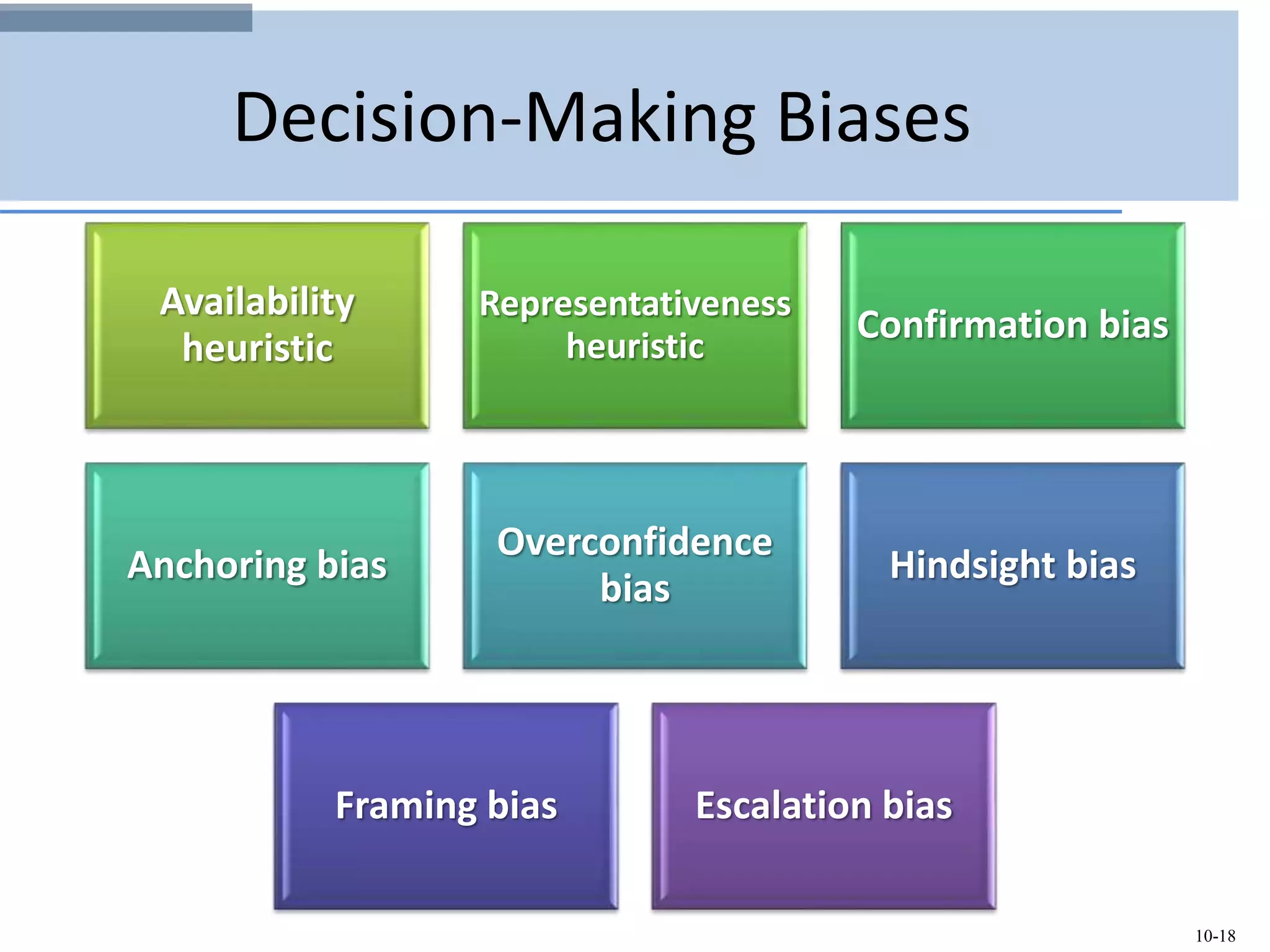
Decision-Making Biases
Availability
heuristic
Representativeness
heuristic
Confirmation bias
Anchoring bias
Overconfidence
bias
Hindsight bias
Framing bias Escalation bias
10-19
Evidence-Based Decision Making
Evidence-based decision making
(EBDM)
 represents a process of conscientiously using
the best available data and evidence when
making managerial decisions
10-20
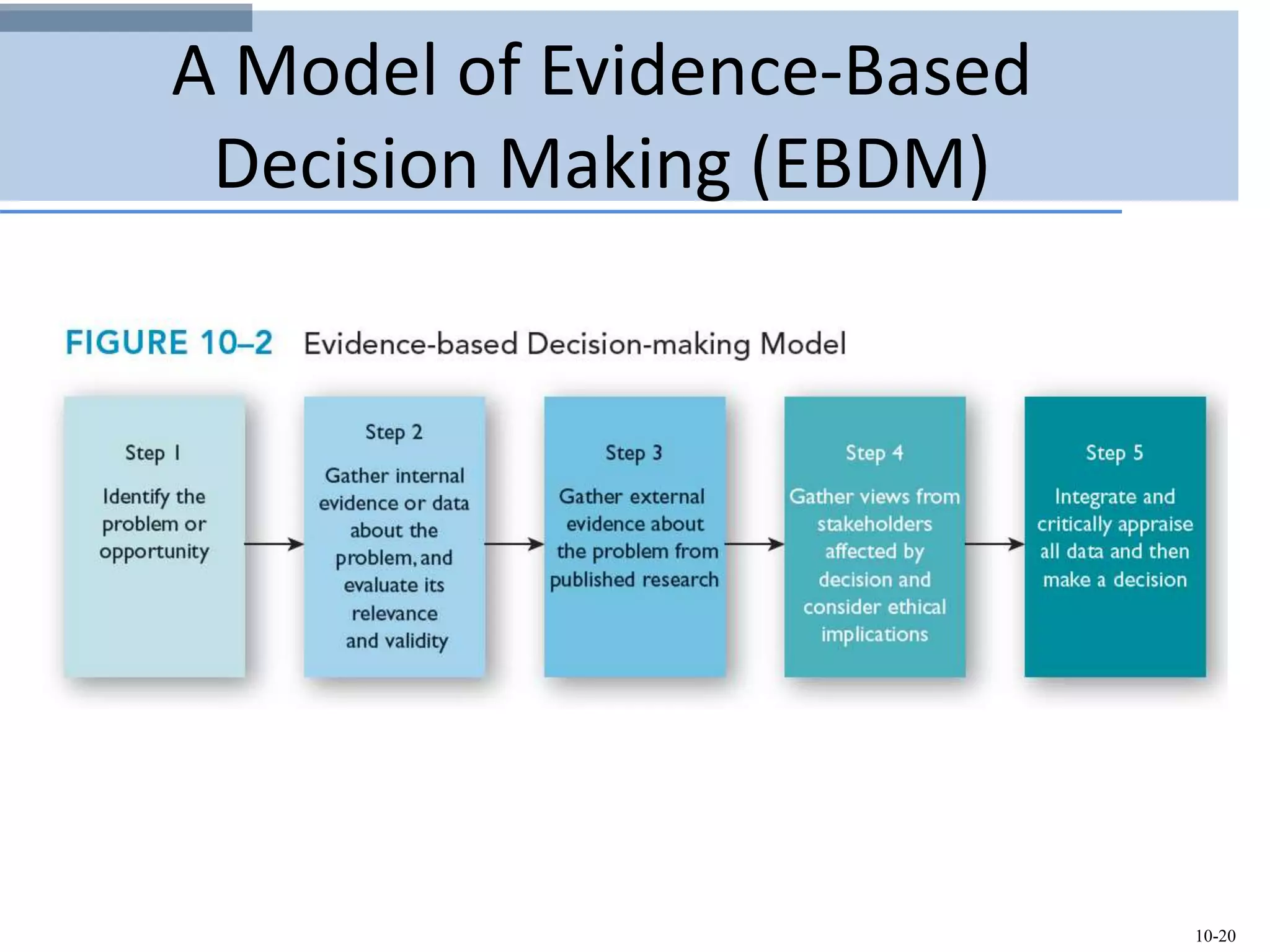
A Model of Evidence-Based
Decision Making (EBDM)
10-21
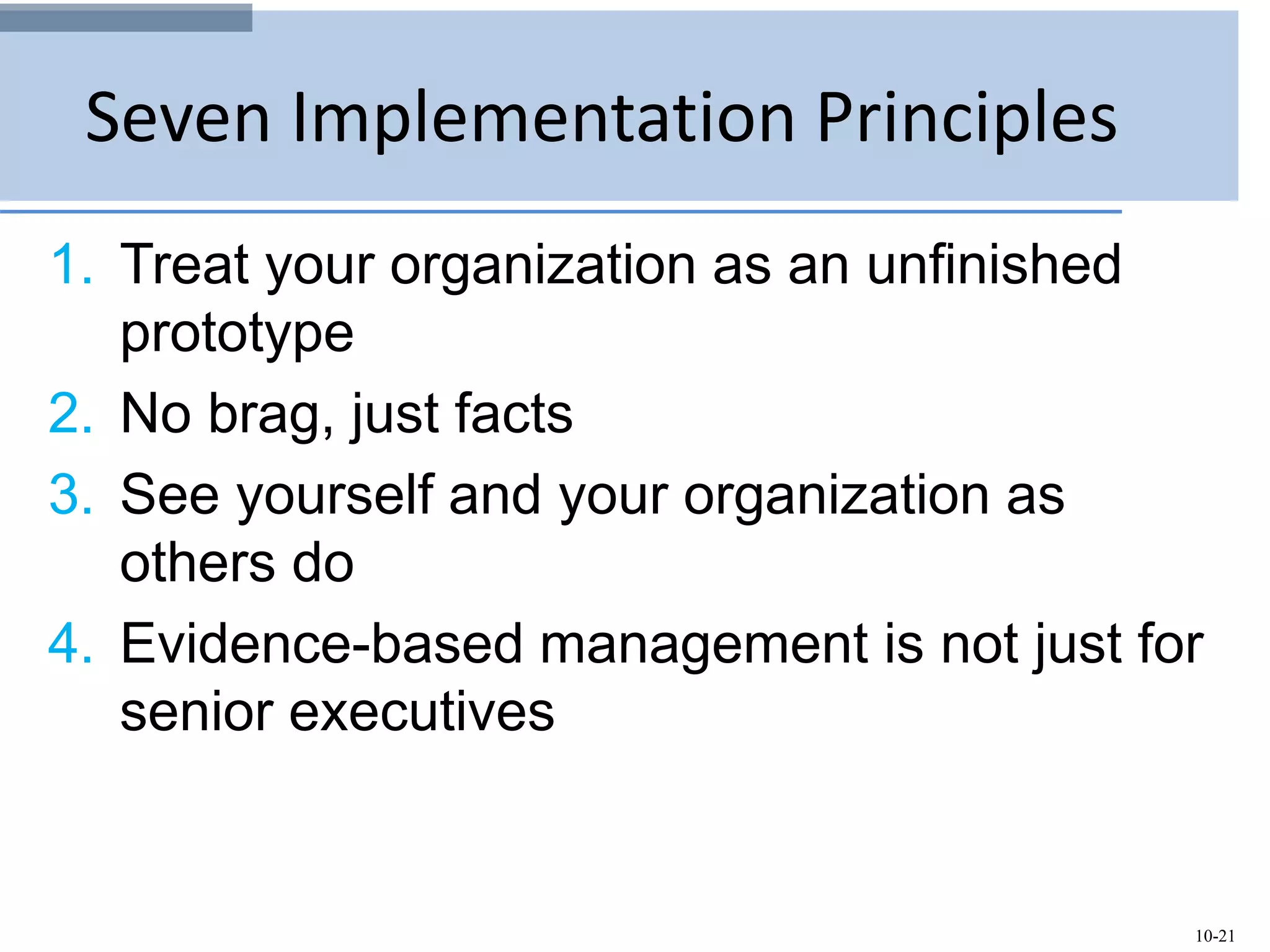
Seven Implementation Principles
1. Treat your organization as an unfinished
prototype
2. No brag, just facts
3. See yourself and your organization as
others do
4. Evidence-based management is not just for
senior executives
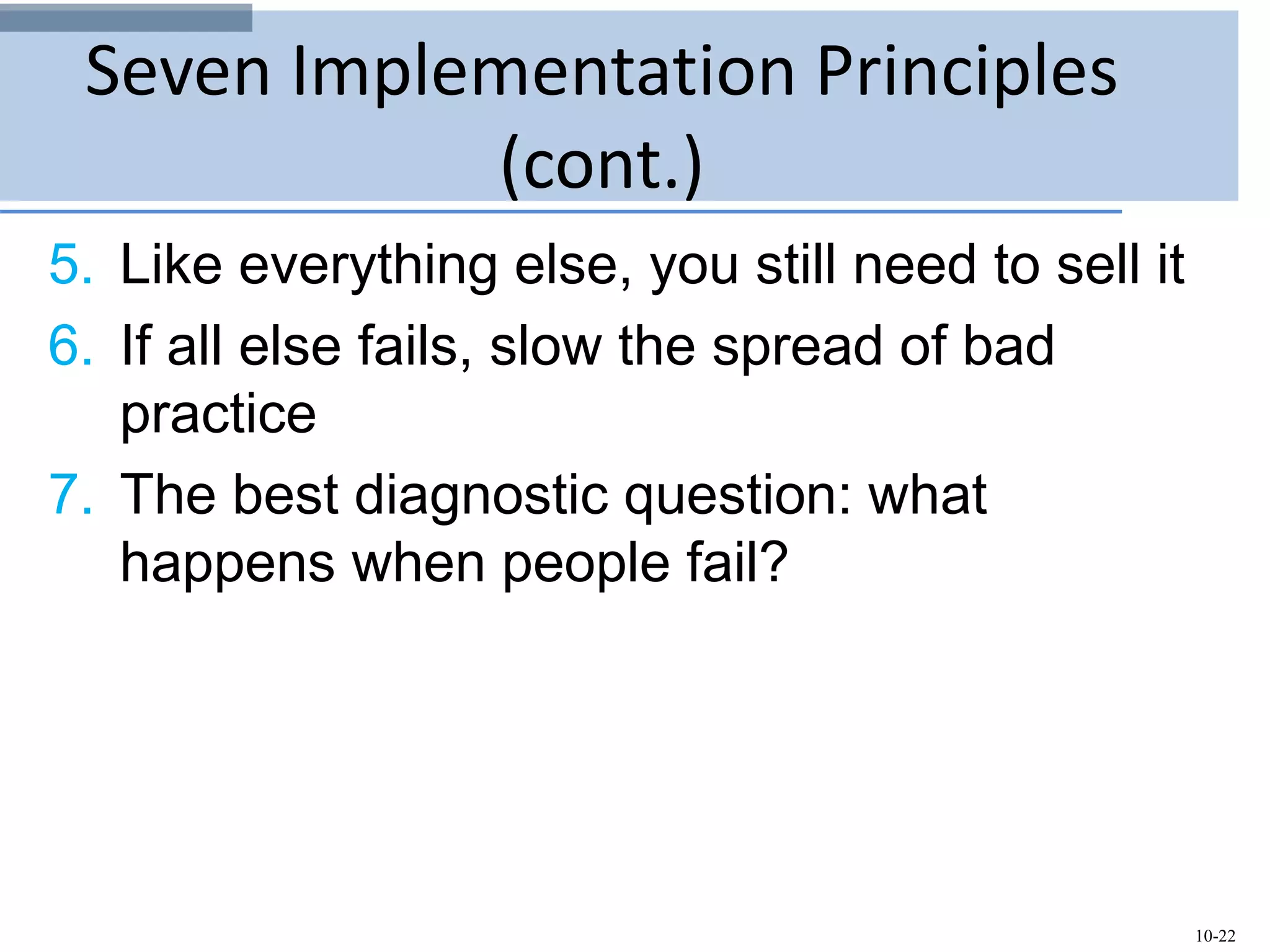
10-22
Seven Implementation Principles
(cont.)
5. Like everything else, you still need to sell it
6. If all else fails, slow the spread of bad
practice
7. The best diagnostic question: what
happens when people fail?
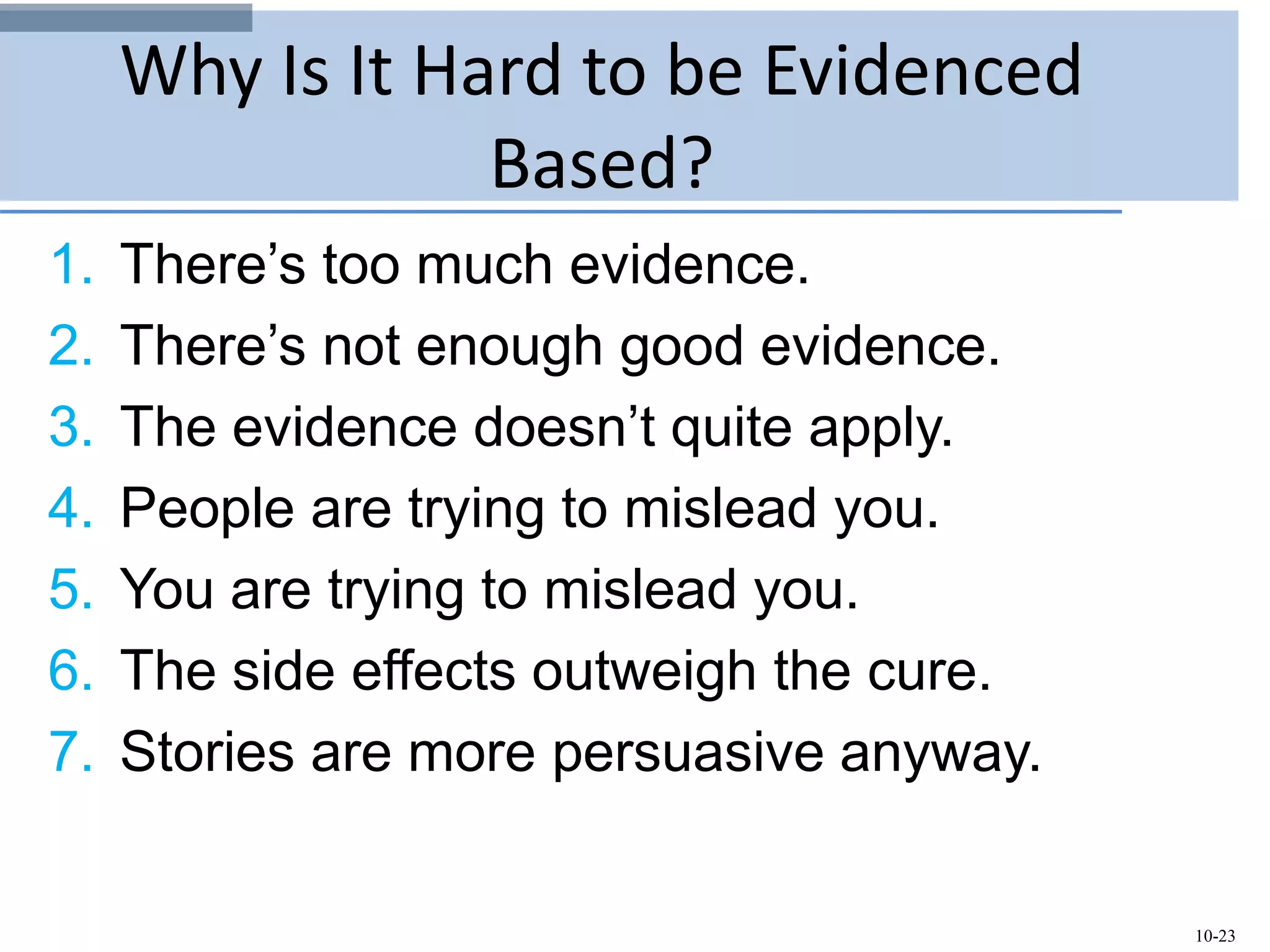
10-23
Why Is It Hard to be Evidenced
Based?
1. There’s too much evidence.
2. There’s not enough good evidence.
3. The evidence doesn’t quite apply.
4. People are trying to mislead you.
5. You are trying to mislead you.
6. The side effects outweigh the cure.
7. Stories are more persuasive anyway.
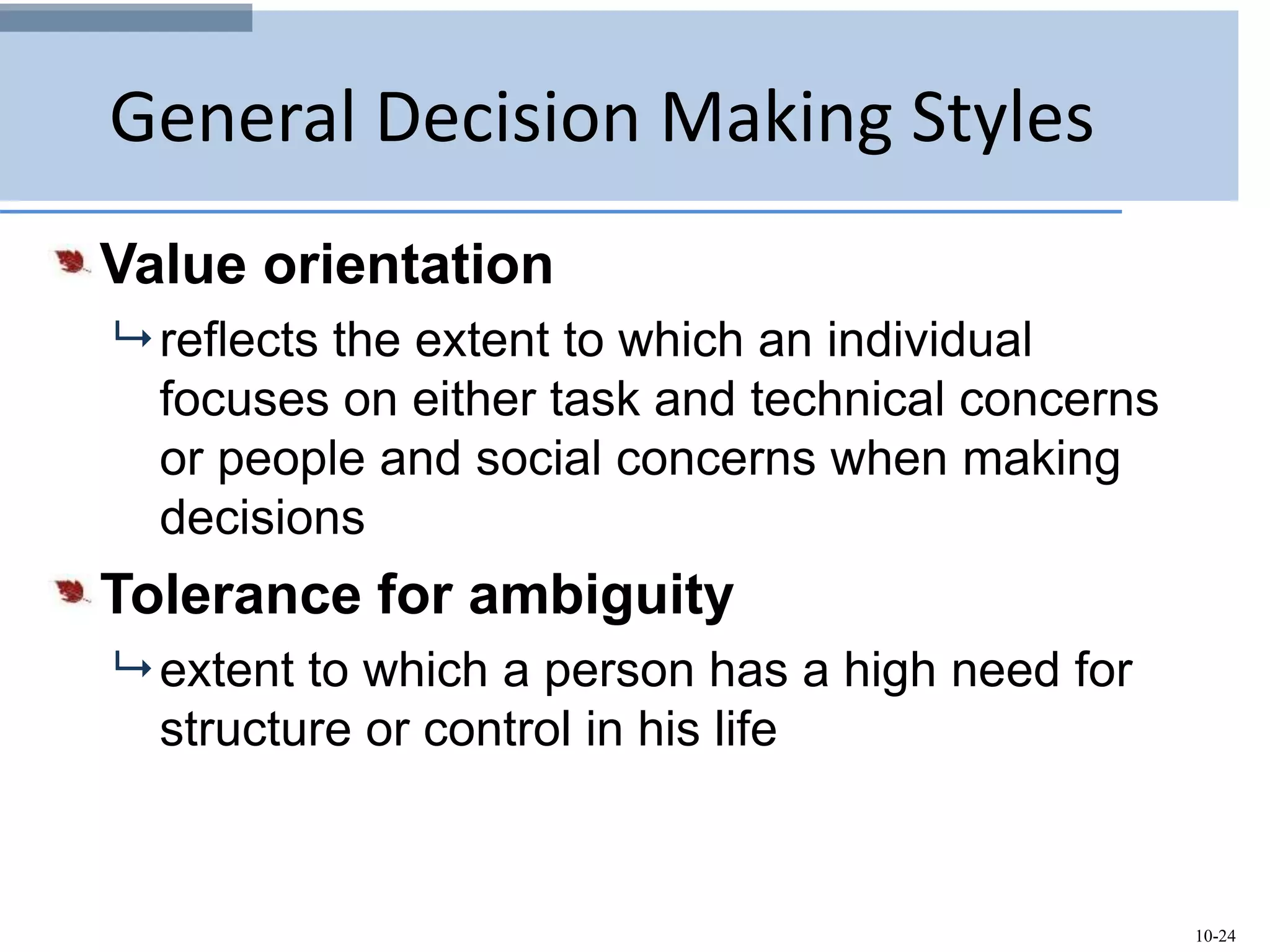
10-24
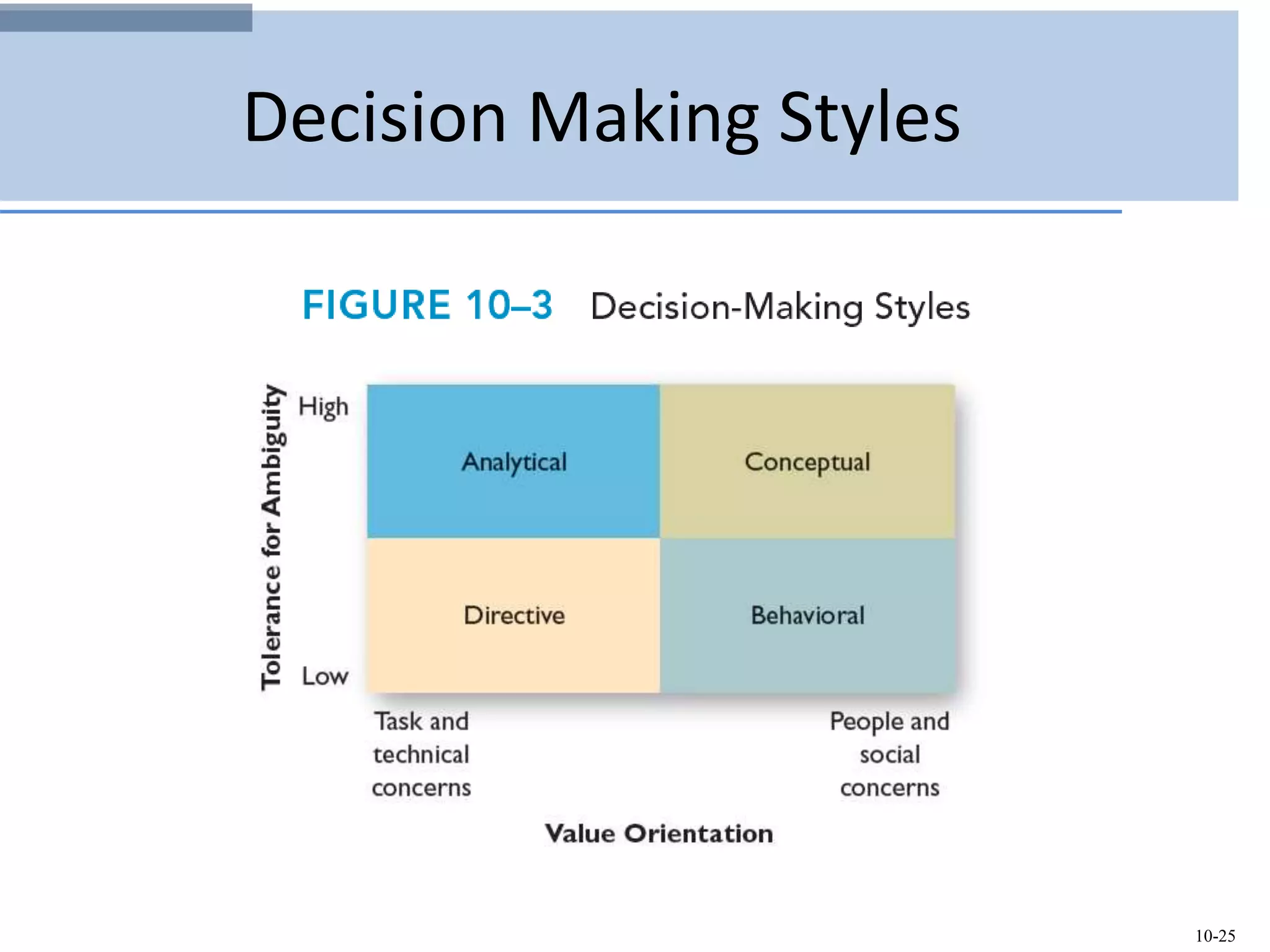
General Decision Making Styles
Value orientation
 reflects the extent to which an individual
focuses on either task and technical concerns
or people and social concerns when making
decisions
Tolerance for ambiguity
 extent to which a person has a high need for
structure or control in his life
10-25
Decision Making Styles
10-26
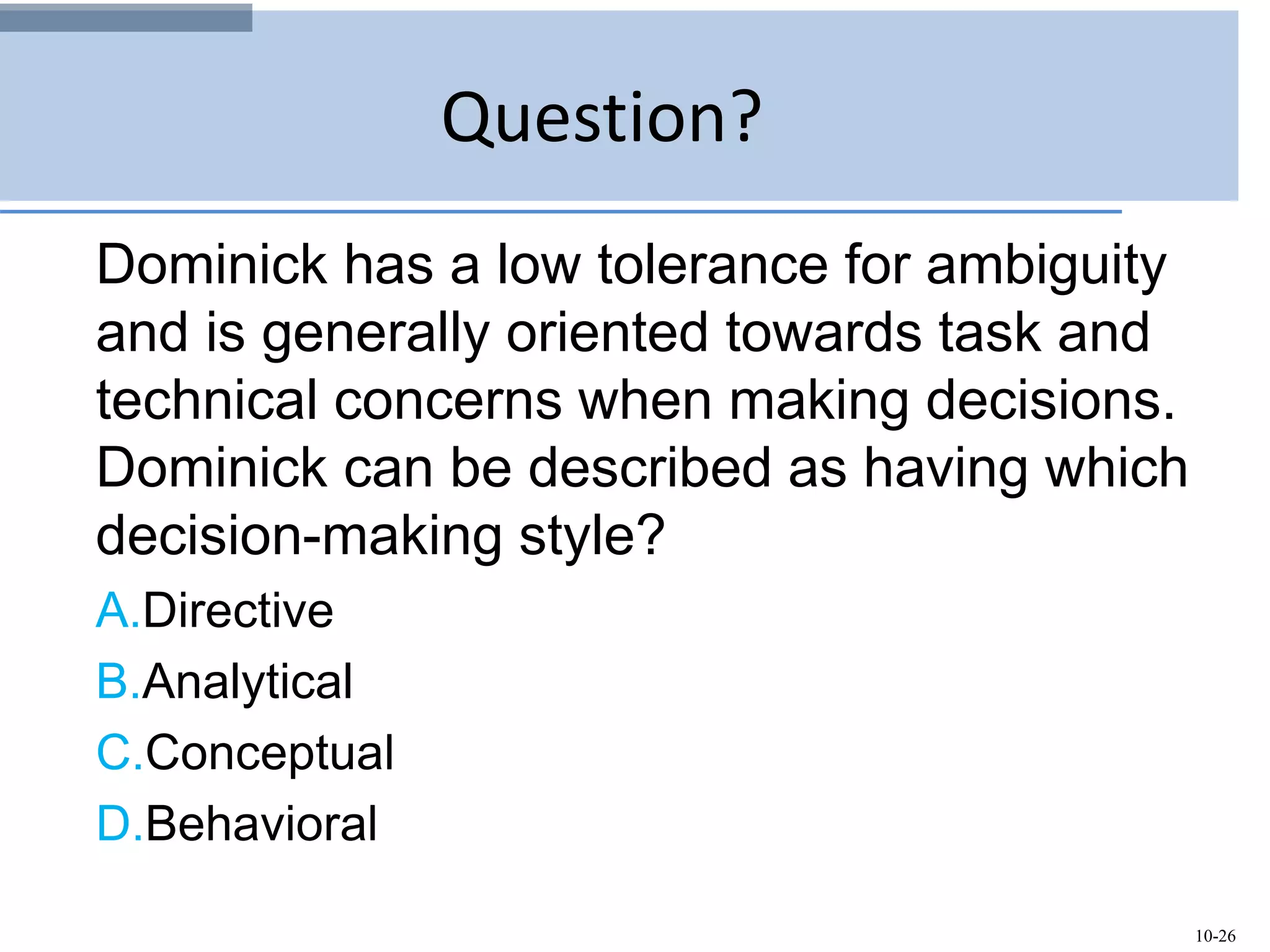
Question?
Dominick has a low tolerance for ambiguity
and is generally oriented towards task and
technical concerns when making decisions.
Dominick can be described as having which
decision-making style?
A.Directive
B.Analytical
C.Conceptual
D.Behavioral
10-27
Intuition in Decision Making
Intuition
 represents judgments, insights, or decisions
that “come to mind on their own, without explicit
awareness of the evoking cues and of course
without explicit evaluation of the validity of
these cues.”
10-28
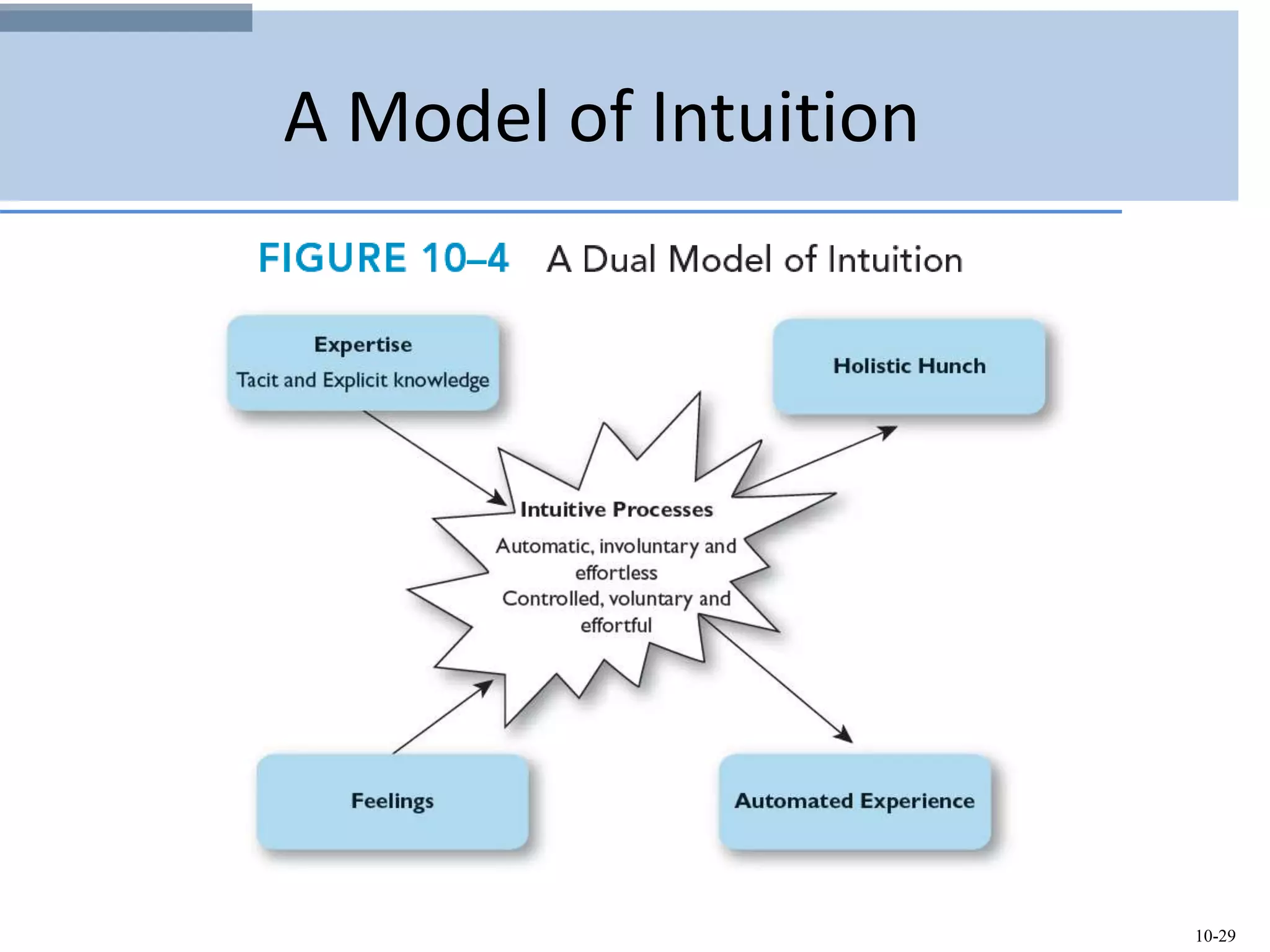
A Model of Intuition
Holistic hunch
 judgment that is based on a subconscious
integration of information stored in memory
Automated experiences
 choice based on a familiar situation and a
partially subconscious application of previously
learned information related to that situation
10-29
A Model of Intuition
10-30
Creativity
Creativity
 process of using intelligence, imagination, and
skill to develop a new or novel product, object,
process, or thought
10-31
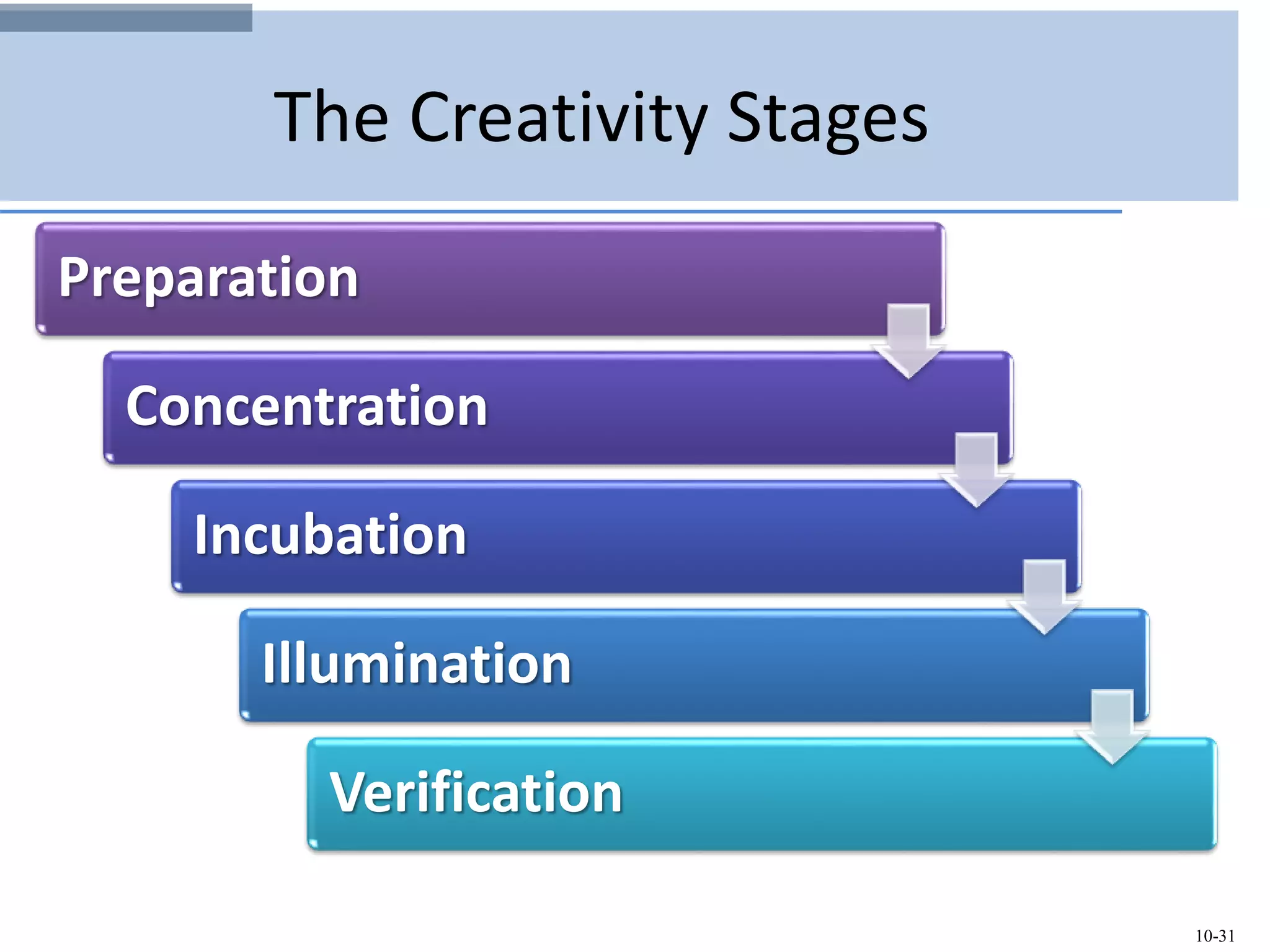
The Creativity Stages
Preparation
Concentration
Incubation
Illumination
Verification
10-32
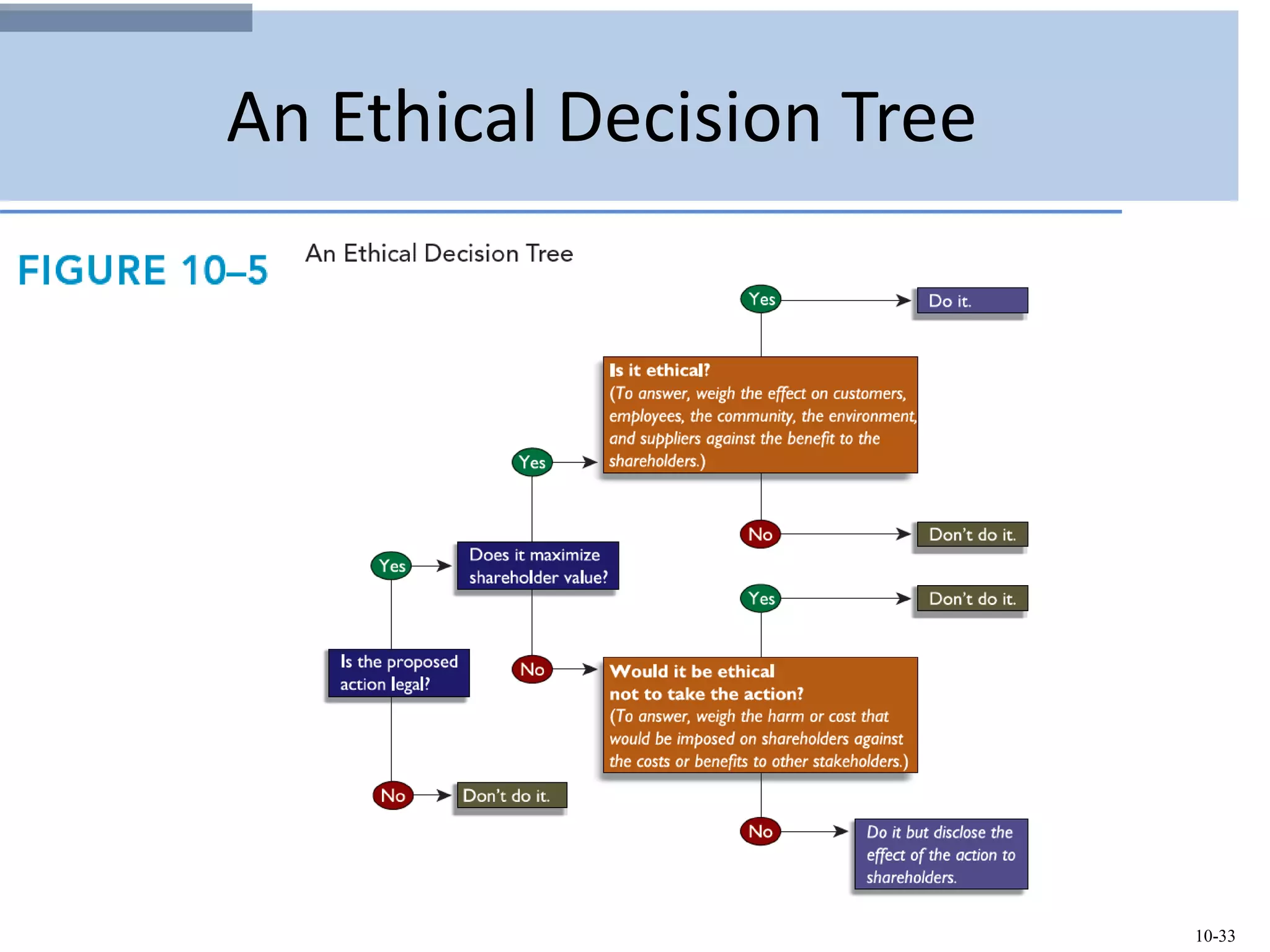
Road Map to Ethical Decision
Making: A Decision Tree
Decision tree
 graphical representation of the process
underlying decisions and it shows the resulting
consequences of making various choices
10-33
An Ethical Decision Tree
10-34
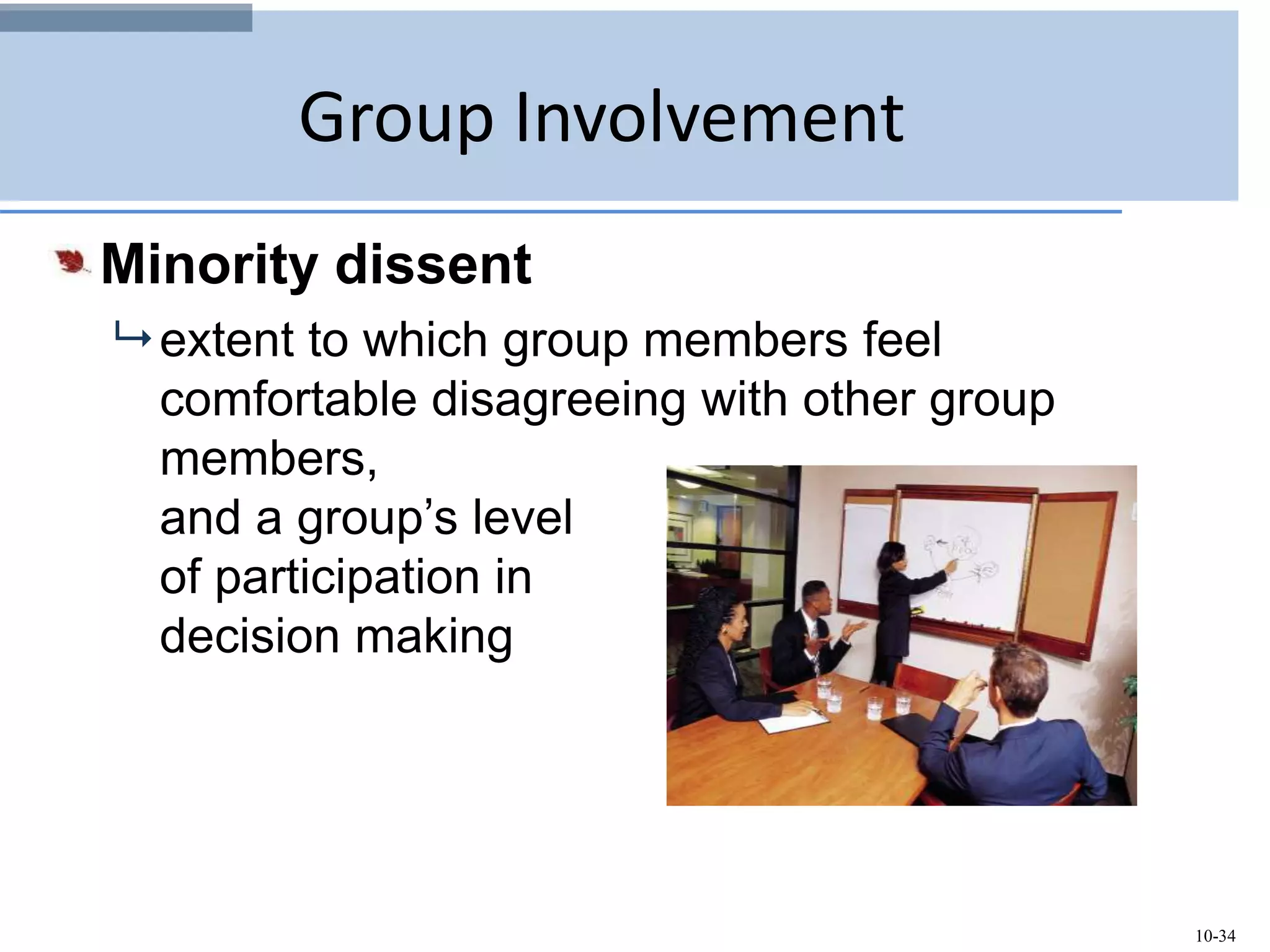
Group Involvement
Minority dissent
 extent to which group members feel
comfortable disagreeing with other group
members,
and a group’s level
of participation in
decision making
10-35
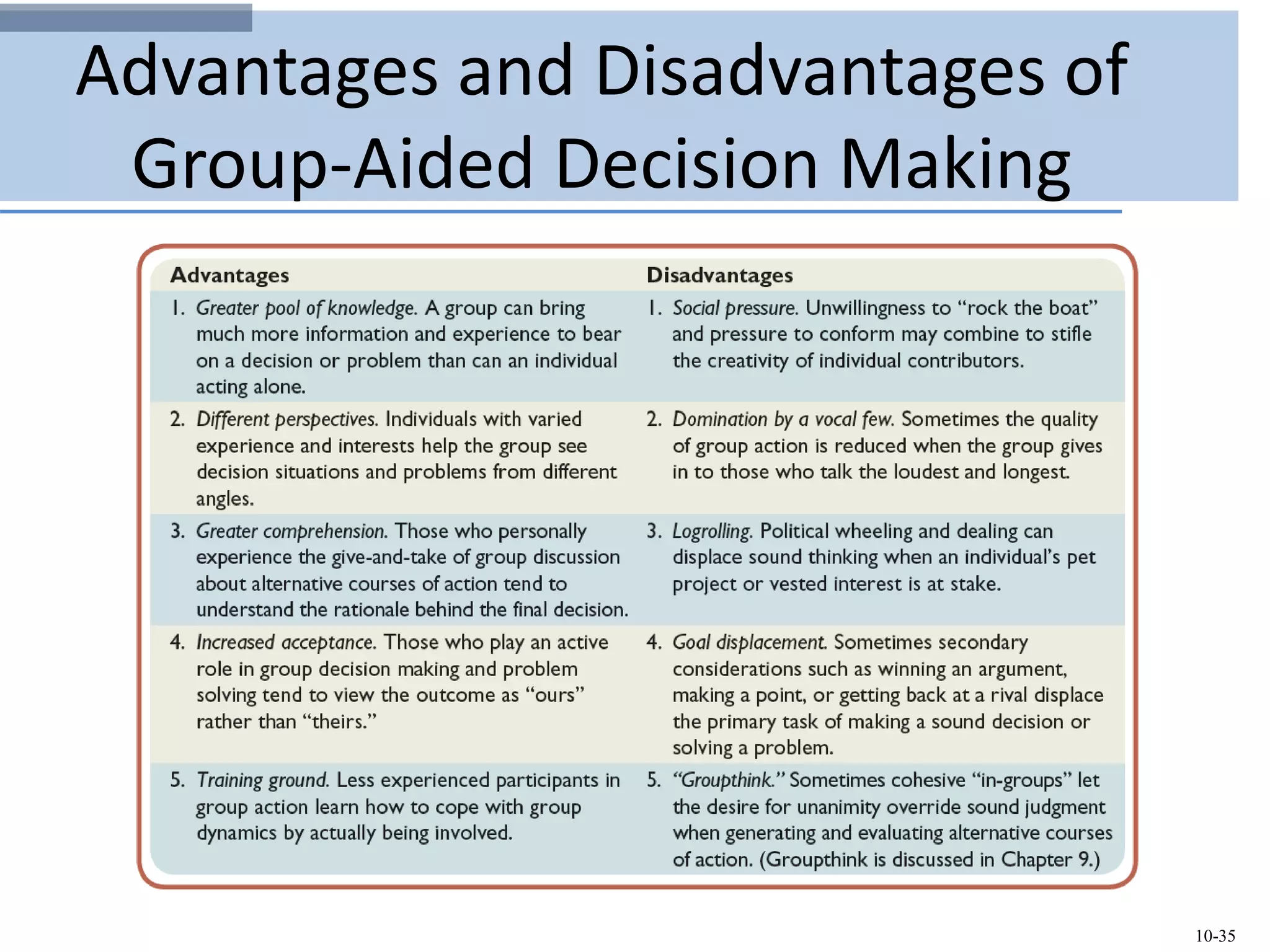
Advantages and Disadvantages of
Group-Aided Decision Making
10-36
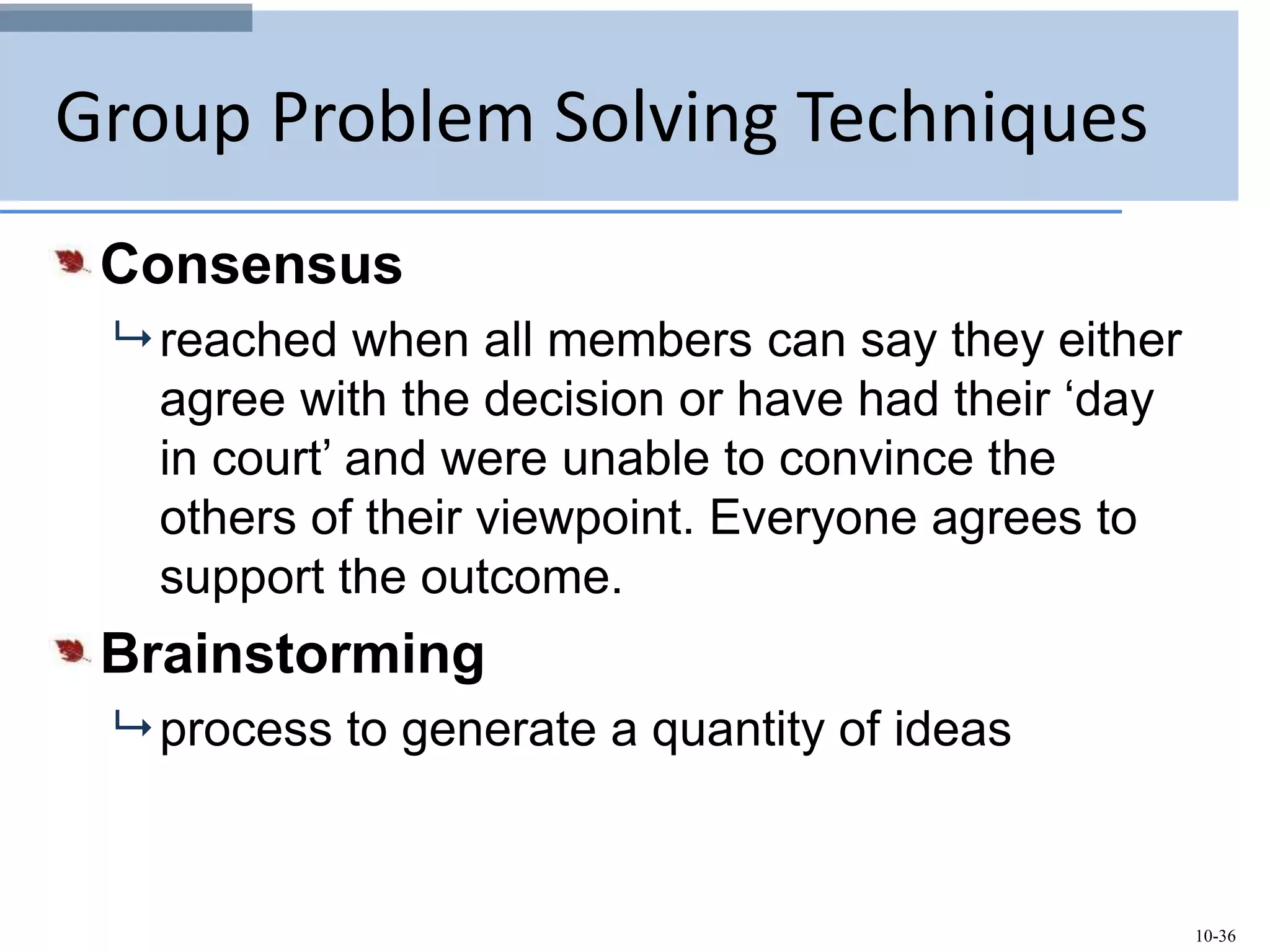
Group Problem Solving Techniques
Consensus
 reached when all members can say they either
agree with the decision or have had their ‘day
in court’ and were unable to convince the
others of their viewpoint. Everyone agrees to
support the outcome.
Brainstorming
 process to generate a quantity of ideas
10-37
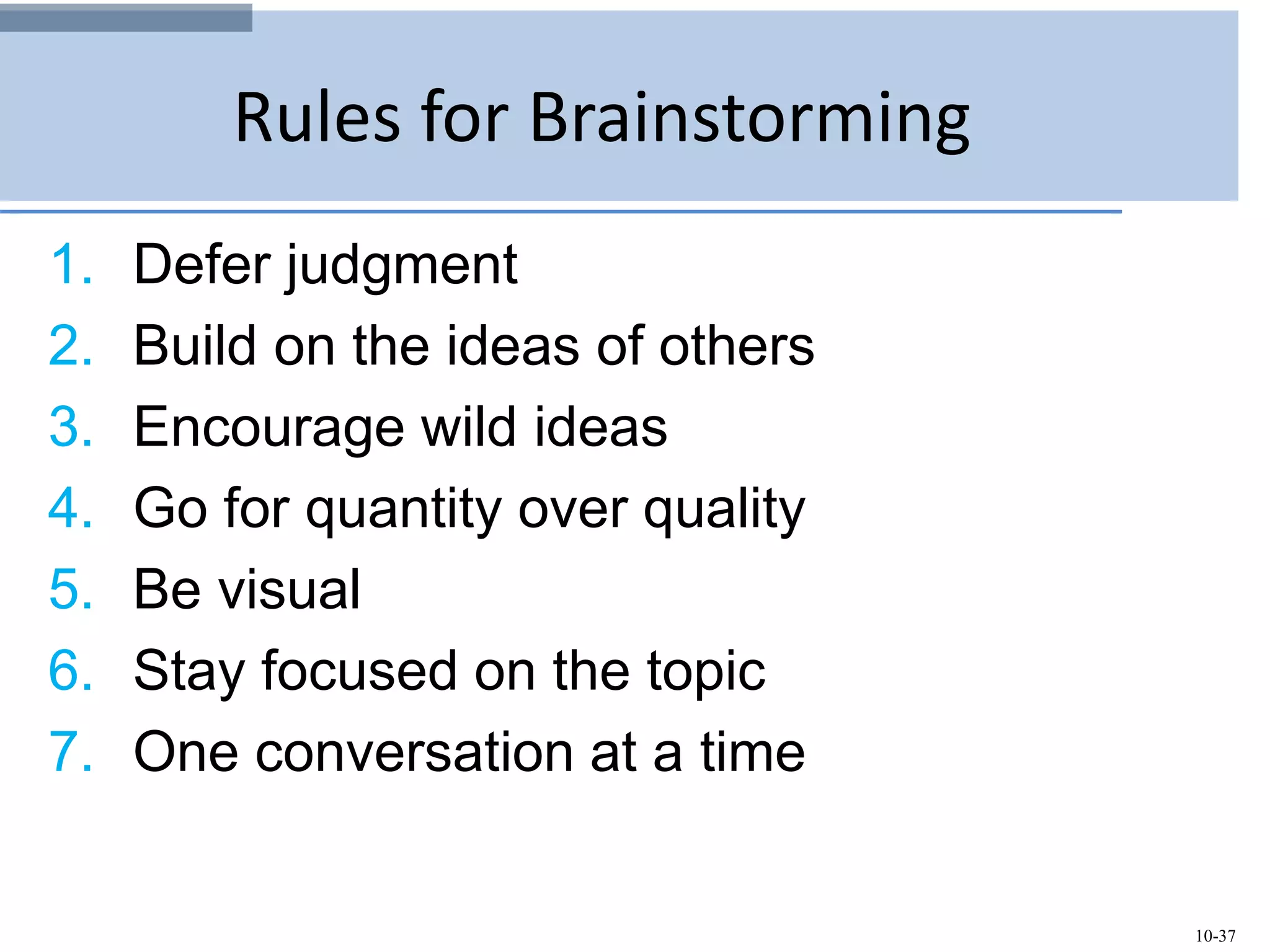
Rules for Brainstorming
1. Defer judgment
2. Build on the ideas of others
3. Encourage wild ideas
4. Go for quantity over quality
5. Be visual
6. Stay focused on the topic
7. One conversation at a time
10-38
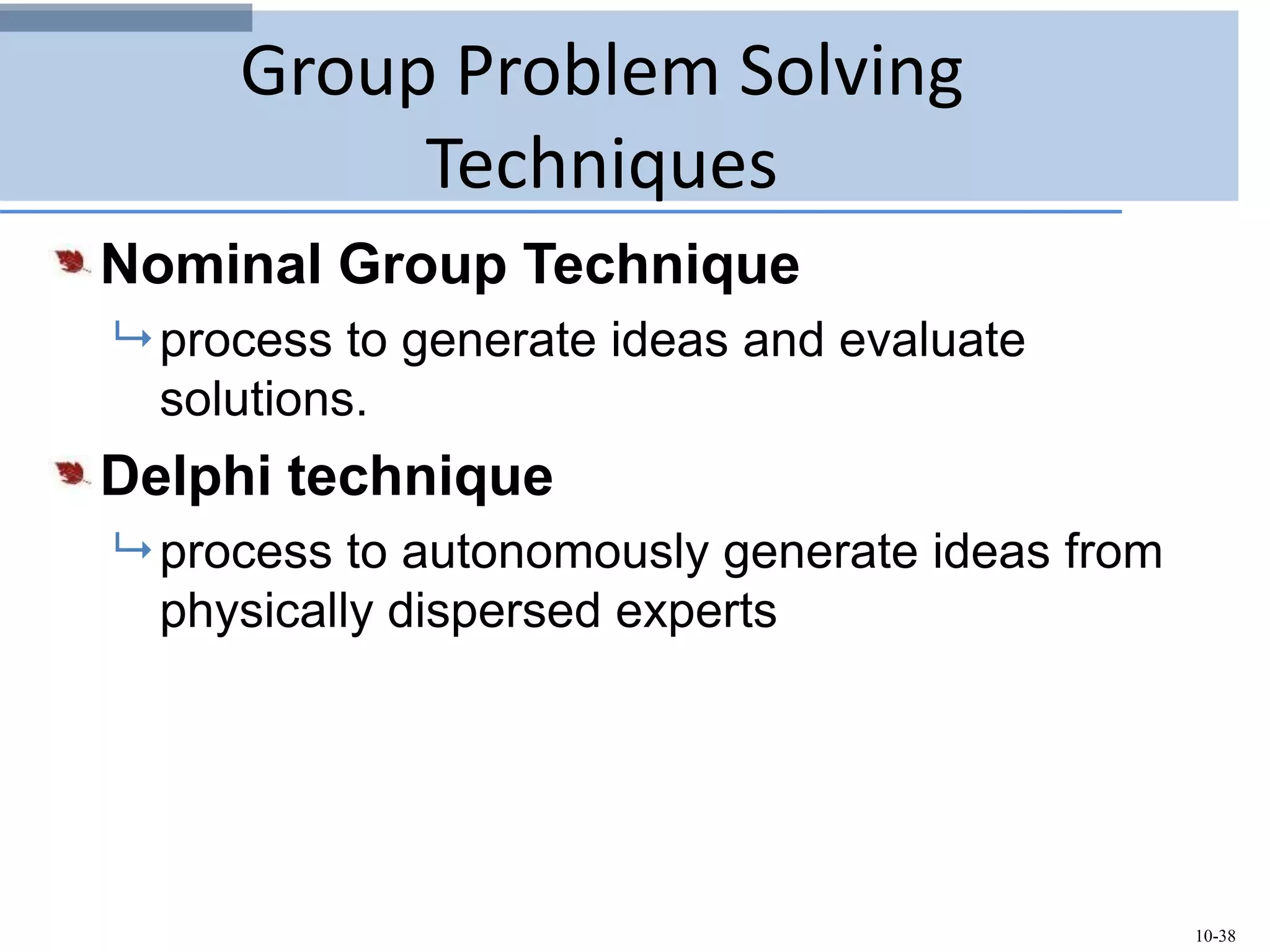
Group Problem Solving
Techniques
Nominal Group Technique
 process to generate ideas and evaluate
solutions.
Delphi technique
 process to autonomously generate ideas from
physically dispersed experts
10-39
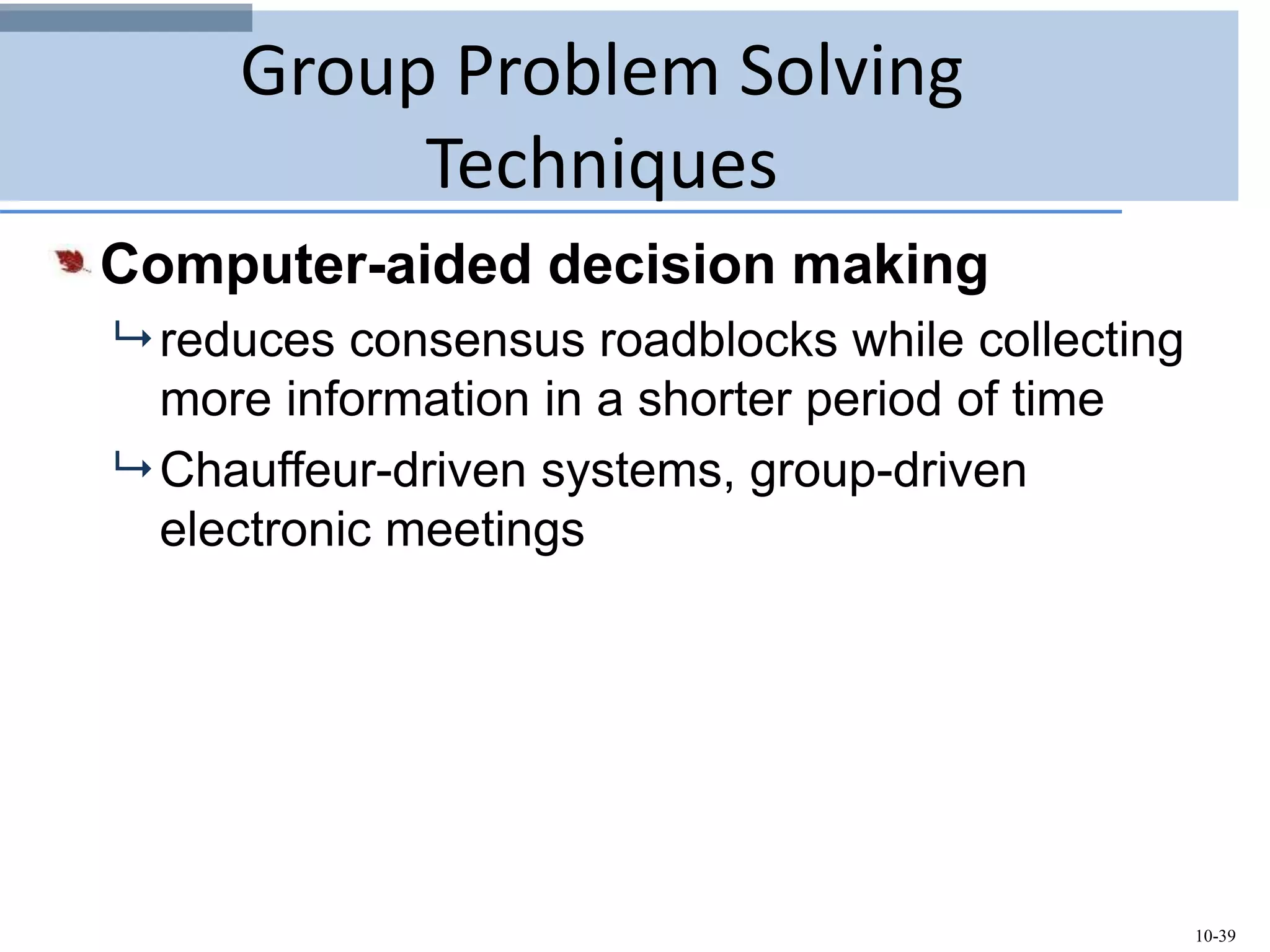
Group Problem Solving
Techniques
Computer-aided decision making
 reduces consensus roadblocks while collecting
more information in a shorter period of time
 Chauffeur-driven systems, group-driven
electronic meetings
10-40
Video: Leadership: Making
Decisions During Hurricane Katrina
What roadblocks to using a rational decision making model
were placed before the Sister’s in this case? Could
anything have been done to make their decisions easier?
Identify how intuition and creativity helped the Sisters in
the decisions they had to make.
Without the ability to communicate or have the resources
they normally had at their disposal, what did the Sister’s
rely on in making the decisions they needed to make?
Why was timely decision making so essential in this case?

Chap010KF.ppt

  • 1.
    © 2012 TheMcGraw-Hill Companies, Inc. All rights reserved. McGraw-Hill/Irwin Copyright © 2012 by The McGraw-Hill Companies, Inc. All rights reserved. Making Decisions Chapter Ten
  • 2.
    10-2 After reading thematerial in this chapter, you should be able to: LO10.1 Compare and contrast the rational model of decision making, Simon’s normative model, and the garbage can model LO10.2 Review the eight decision-making biases. LO10.3 Discuss the thrust of evidence-based decision making and its implementation principles. LO10.4 Describe the model of decision-making styles, the role of intuition in decision-making and the stages of the creative process. LO10.5 Summarize the pros and cons of involving groups in the decision-making process. LO10.6 Contrast brainstorming, the nominal group technique, the Delphi technique, and computer-aided decision making.
  • 3.
    10-3 Models of DecisionMaking Decision making  identifying and choosing solutions that lead to a desired state of affairs
  • 4.
    10-4 Models of DecisionMaking The Rational Model  proposes that managers use a logical four-step approach to decision making.
  • 5.
    10-5 Rational Model Identifying theProblem  Problem – exists when the actual situation and the desired situation differ  Opportunity - represents a situation in which there are possibilities to do things that lead to results that exceed goals and expectations Generating Solutions  For routine decisions alternatives are readily available through decision rules
  • 6.
    10-6 Rational Model Selecting aSolution  Is the potential solution ethical?  Is it feasible?  Will it remove the causes and solve the problem?
  • 7.
    10-7 Rational Model Implementing andEvaluating the Solution  After solution is implemented, the evaluation phase is used to evaluate its effectiveness  Optimizing – producing the best possible solution
  • 8.
    10-8 Question? Gloria is neverhappy with "good enough" solutions. She is determined to find the best possible solution in solving her problems. What Gloria is doing is described as A.Optimizing B.Brainstorming C.Rationalizing D.Satisfying
  • 9.
    10-9 Summarizing the RationalModel 1. The quality of decisions may be enhanced 2. It makes the reasoning behind a decision transparent 3. If made public, it discourages the decider from acting on suspect considerations
  • 10.
    10-10 Nonrational Models ofDecision Making Nonrational models  Attempt to explain how decisions are actually made 1.Decision making is uncertain 2.Decision makers do not possess complete information 3.Difficult for managers to make optimal decisions
  • 11.
    10-11 Simon’s Normative Model Boundedrationality  represents the notion that decision makers are “bounded” or restricted by a variety of constraints when making decisions Satisficing  choosing a solution that meets some minimum qualifications, one that is “good enough.”
  • 12.
    10-12 Simon’s Normative Model Mostfrequent causes of poor decision making Poorly defined processes and practices Unclear company vision, mission, and goals Unwillingness of leaders to take responsibility Lack of reliable, timely information
  • 13.
    10-13 Garbage Can Model GarbageCan Model  decision making is sloppy and haphazard  decisions result from complex interaction of four independent streams of events: problems, solutions, participants and choice opportunities
  • 14.
    10-14 Implications of theGarbage Can Model 1. More pronounced in industries that rely on science-based innovations 2. Many decisions are made by oversight 3. Political motives frequently influence decision makers 4. Important decisions are more likely to be solved
  • 15.
    10-15 Integrating Rational and NonrationalModels A simple context is stable, and clear cause- and-effect relationships can be discerned, so the best answer can be agreed on In a complicated context, there is a clear relationship between cause and effect, but some people may not see it, and more than one solution may be effective
  • 16.
    10-16 Integrating Rational and NonrationalModels In a complex context, there is one right answer, but there are so many unknowns that decision makers don’t understand cause-and-effect relationships. In a chaotic context, cause-and-effect relationships are changing so fast that no pattern emerges.
  • 17.
    10-17 Decision-Making Biases Judgmental heuristics  rulesof thumb or shortcuts that people use to reduce information processing demands.
  • 18.
  • 19.
    10-19 Evidence-Based Decision Making Evidence-baseddecision making (EBDM)  represents a process of conscientiously using the best available data and evidence when making managerial decisions
  • 20.
    10-20 A Model ofEvidence-Based Decision Making (EBDM)
  • 21.
    10-21 Seven Implementation Principles 1.Treat your organization as an unfinished prototype 2. No brag, just facts 3. See yourself and your organization as others do 4. Evidence-based management is not just for senior executives
  • 22.
    10-22 Seven Implementation Principles (cont.) 5.Like everything else, you still need to sell it 6. If all else fails, slow the spread of bad practice 7. The best diagnostic question: what happens when people fail?
  • 23.
    10-23 Why Is ItHard to be Evidenced Based? 1. There’s too much evidence. 2. There’s not enough good evidence. 3. The evidence doesn’t quite apply. 4. People are trying to mislead you. 5. You are trying to mislead you. 6. The side effects outweigh the cure. 7. Stories are more persuasive anyway.
  • 24.
    10-24 General Decision MakingStyles Value orientation  reflects the extent to which an individual focuses on either task and technical concerns or people and social concerns when making decisions Tolerance for ambiguity  extent to which a person has a high need for structure or control in his life
  • 25.
  • 26.
    10-26 Question? Dominick has alow tolerance for ambiguity and is generally oriented towards task and technical concerns when making decisions. Dominick can be described as having which decision-making style? A.Directive B.Analytical C.Conceptual D.Behavioral
  • 27.
    10-27 Intuition in DecisionMaking Intuition  represents judgments, insights, or decisions that “come to mind on their own, without explicit awareness of the evoking cues and of course without explicit evaluation of the validity of these cues.”
  • 28.
    10-28 A Model ofIntuition Holistic hunch  judgment that is based on a subconscious integration of information stored in memory Automated experiences  choice based on a familiar situation and a partially subconscious application of previously learned information related to that situation
  • 29.
  • 30.
    10-30 Creativity Creativity  process ofusing intelligence, imagination, and skill to develop a new or novel product, object, process, or thought
  • 31.
  • 32.
    10-32 Road Map toEthical Decision Making: A Decision Tree Decision tree  graphical representation of the process underlying decisions and it shows the resulting consequences of making various choices
  • 33.
  • 34.
    10-34 Group Involvement Minority dissent extent to which group members feel comfortable disagreeing with other group members, and a group’s level of participation in decision making
  • 35.
    10-35 Advantages and Disadvantagesof Group-Aided Decision Making
  • 36.
    10-36 Group Problem SolvingTechniques Consensus  reached when all members can say they either agree with the decision or have had their ‘day in court’ and were unable to convince the others of their viewpoint. Everyone agrees to support the outcome. Brainstorming  process to generate a quantity of ideas
  • 37.
    10-37 Rules for Brainstorming 1.Defer judgment 2. Build on the ideas of others 3. Encourage wild ideas 4. Go for quantity over quality 5. Be visual 6. Stay focused on the topic 7. One conversation at a time
  • 38.
    10-38 Group Problem Solving Techniques NominalGroup Technique  process to generate ideas and evaluate solutions. Delphi technique  process to autonomously generate ideas from physically dispersed experts
  • 39.
    10-39 Group Problem Solving Techniques Computer-aideddecision making  reduces consensus roadblocks while collecting more information in a shorter period of time  Chauffeur-driven systems, group-driven electronic meetings
  • 40.
    10-40 Video: Leadership: Making DecisionsDuring Hurricane Katrina What roadblocks to using a rational decision making model were placed before the Sister’s in this case? Could anything have been done to make their decisions easier? Identify how intuition and creativity helped the Sisters in the decisions they had to make. Without the ability to communicate or have the resources they normally had at their disposal, what did the Sister’s rely on in making the decisions they needed to make? Why was timely decision making so essential in this case?