Topics Covered in Today’s Workshop
• What is metadata?
• Metadata in the virtual marketplace
• Metadata for books
• Who decides which metadata elements are needed?
• Core metadata elements
• Metadata in the publishing workflow
• Distributing metadata
• The metadata lifecycle
• Metadata in ONIX
• Content analysis and metadata creation
• What makes metadata work in the virtual marketplace?
What is metadata?
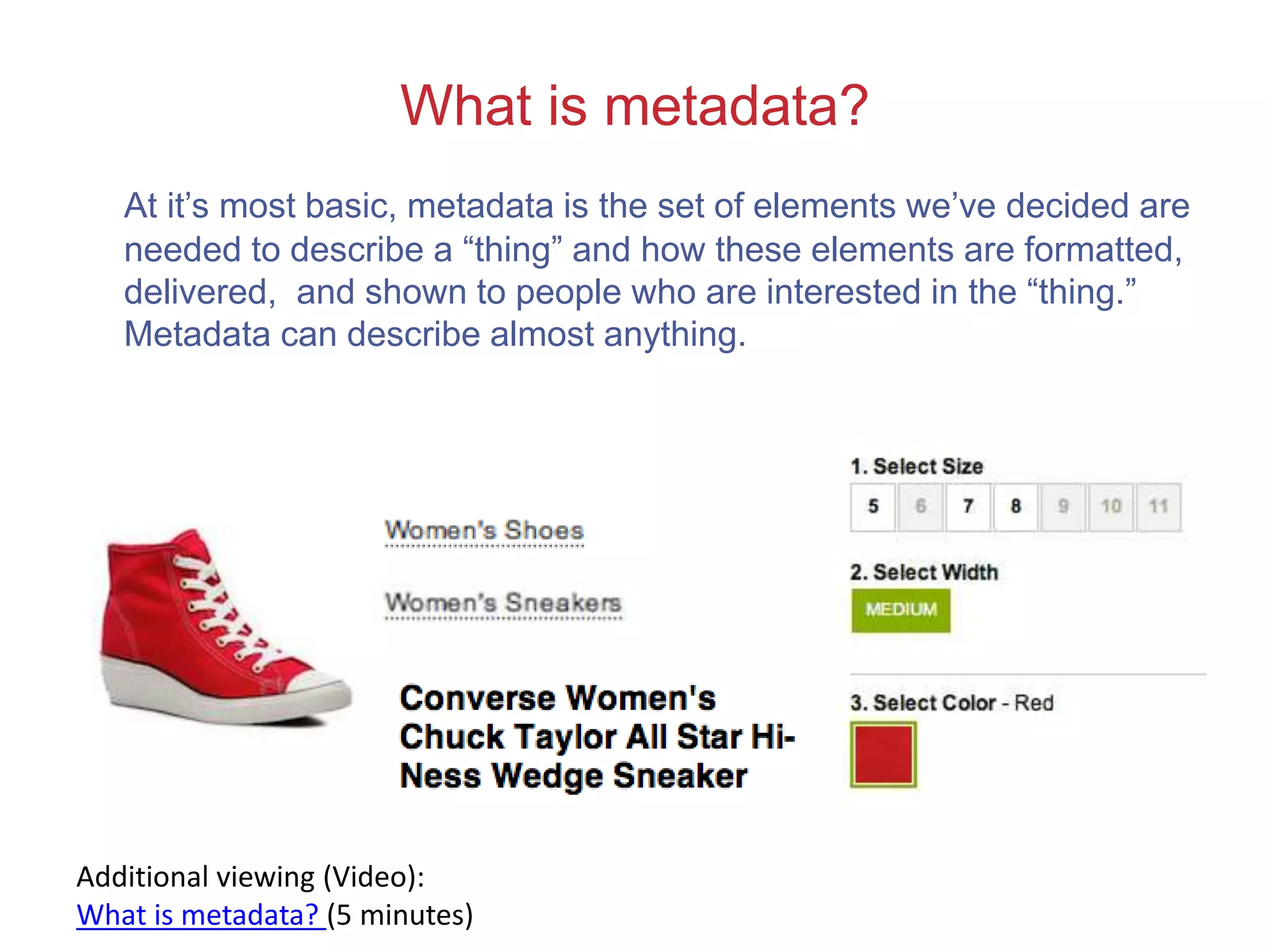
At it’s most basic, metadata is the set of elements we’ve decided are
needed to describe a “thing” and how these elements are formatted,
delivered, and shown to people who are interested in the “thing.”
Metadata can describe almost anything.
Additional viewing (Video):
What is metadata? (5 minutes)
What is metadata?
Metadata describes a product or a piece of content.
It is the “language” used to communicate
information needed for commerce.
Every industry uses metadata and it’s especially
important in today’s virtual marketplace.
You use it every day, most of the time without
realizing it.
Once you start looking for it, you see it everywhere!
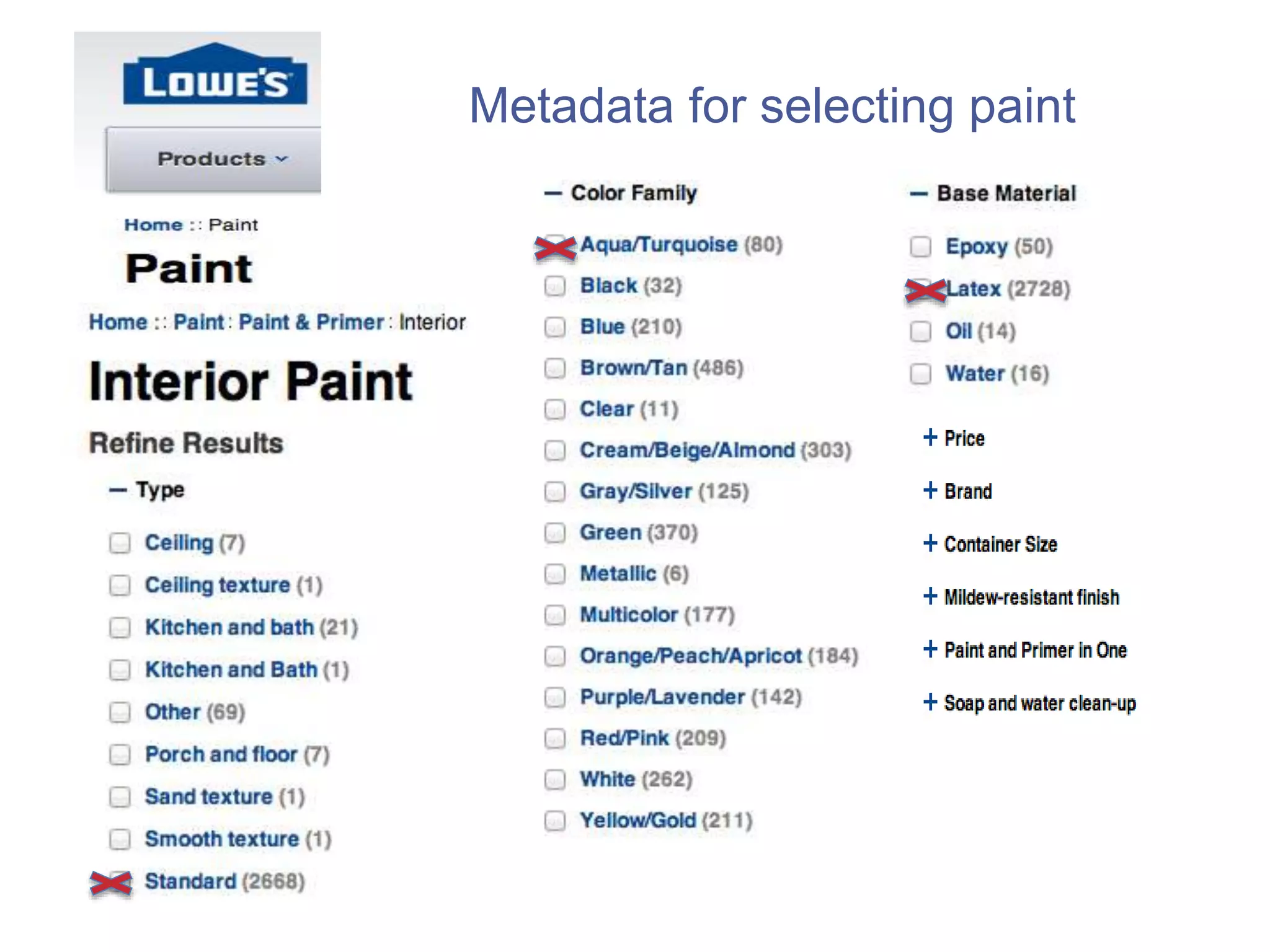
Metadata for selecting paint
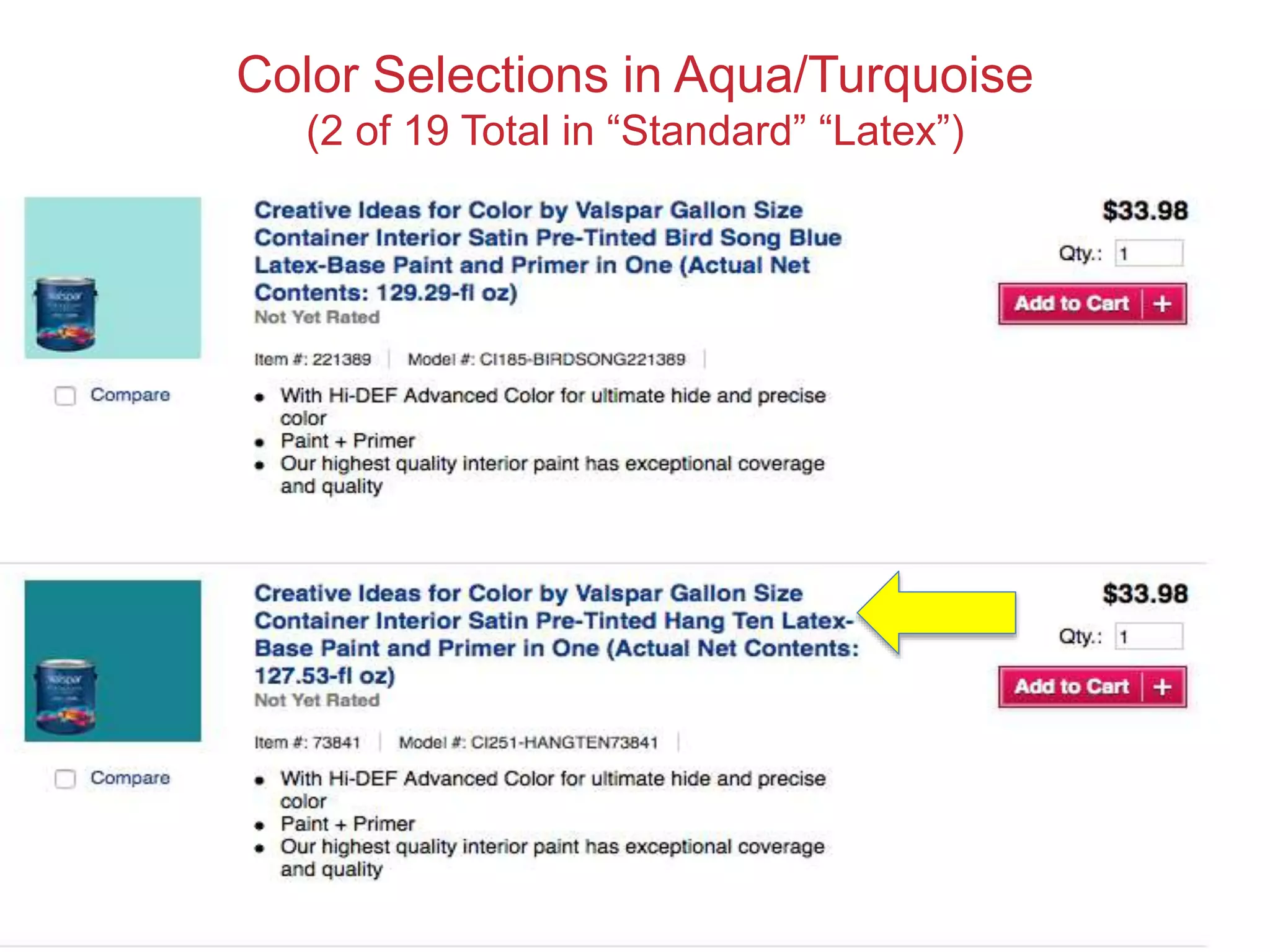
Color Selections in Aqua/Turquoise
(2 of 19 Total in “Standard” “Latex”)
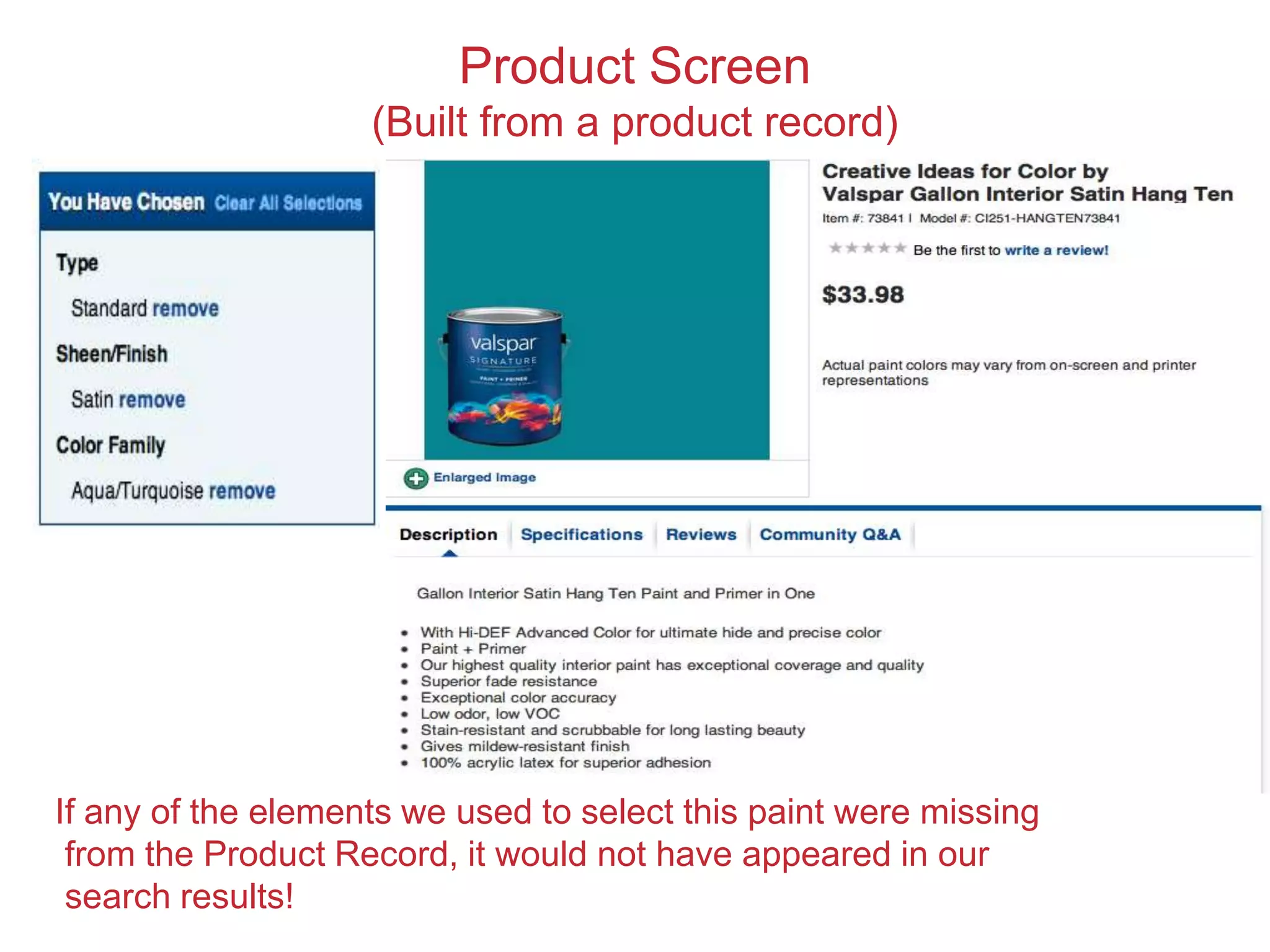
Product Screen
(Built from a product record)
If any of the elements we used to select this paint were missing
from the Product Record, it would not have appeared in our
search results!
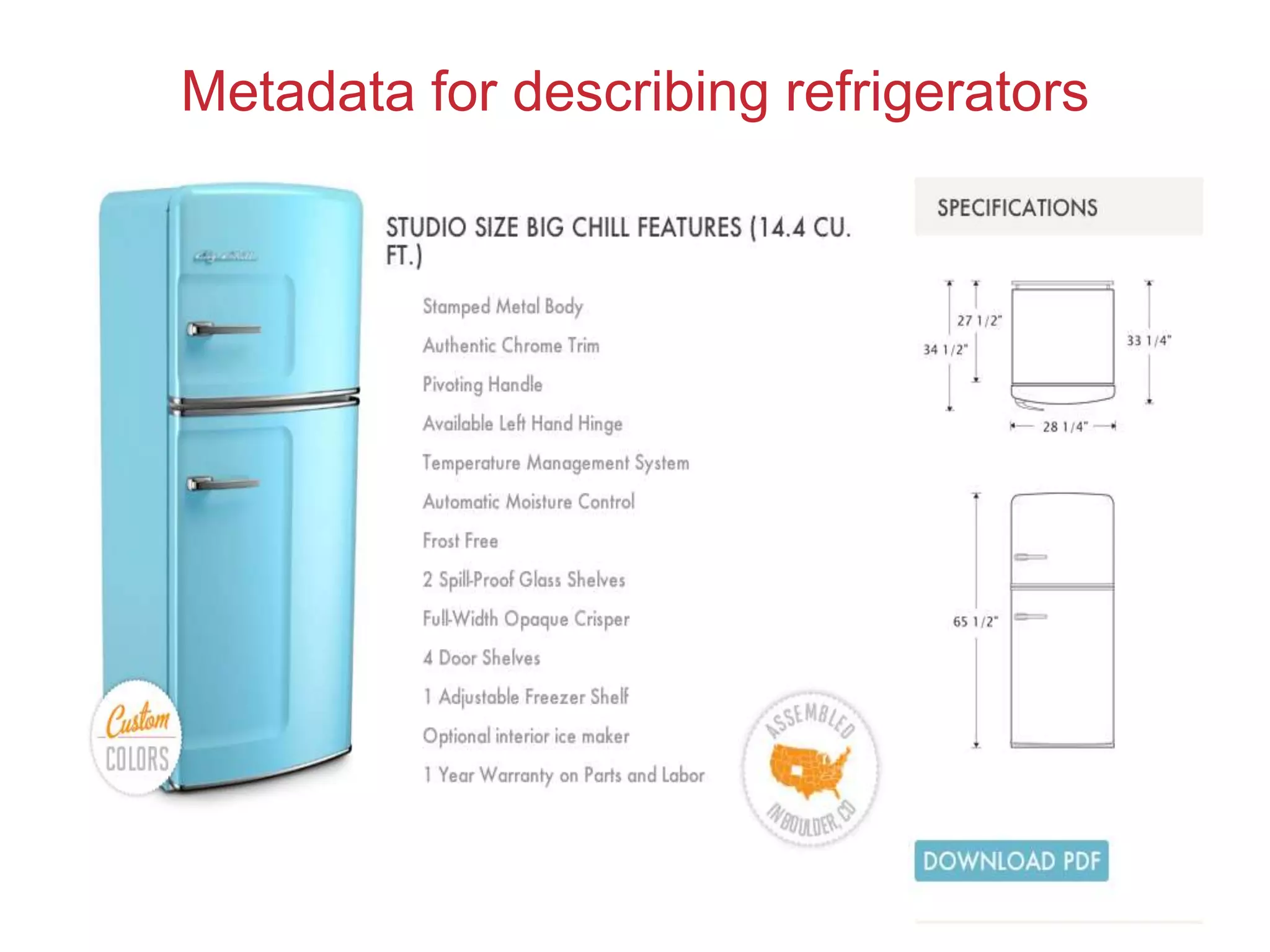
Metadata for describing refrigerators
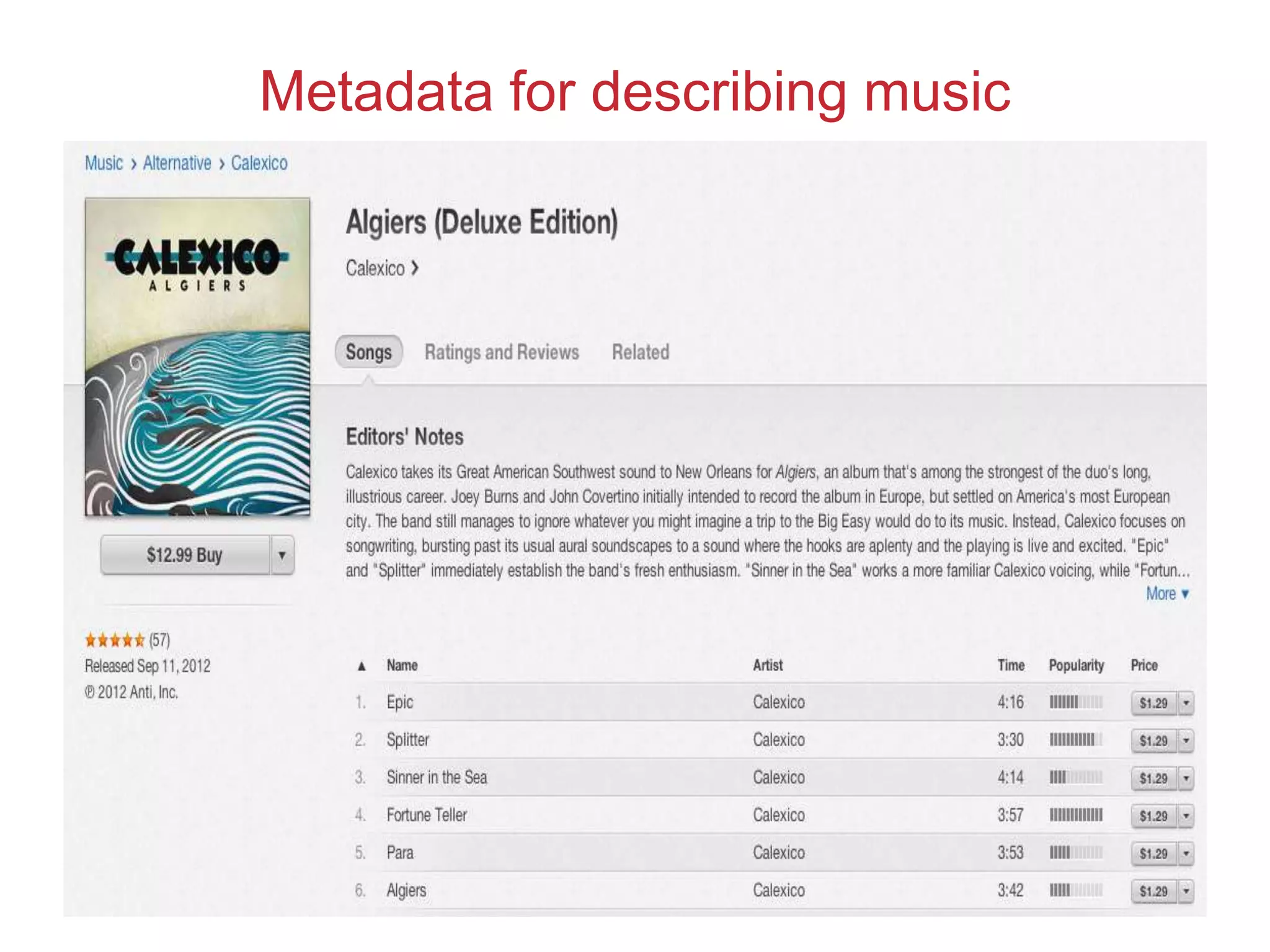
Metadata for describing music
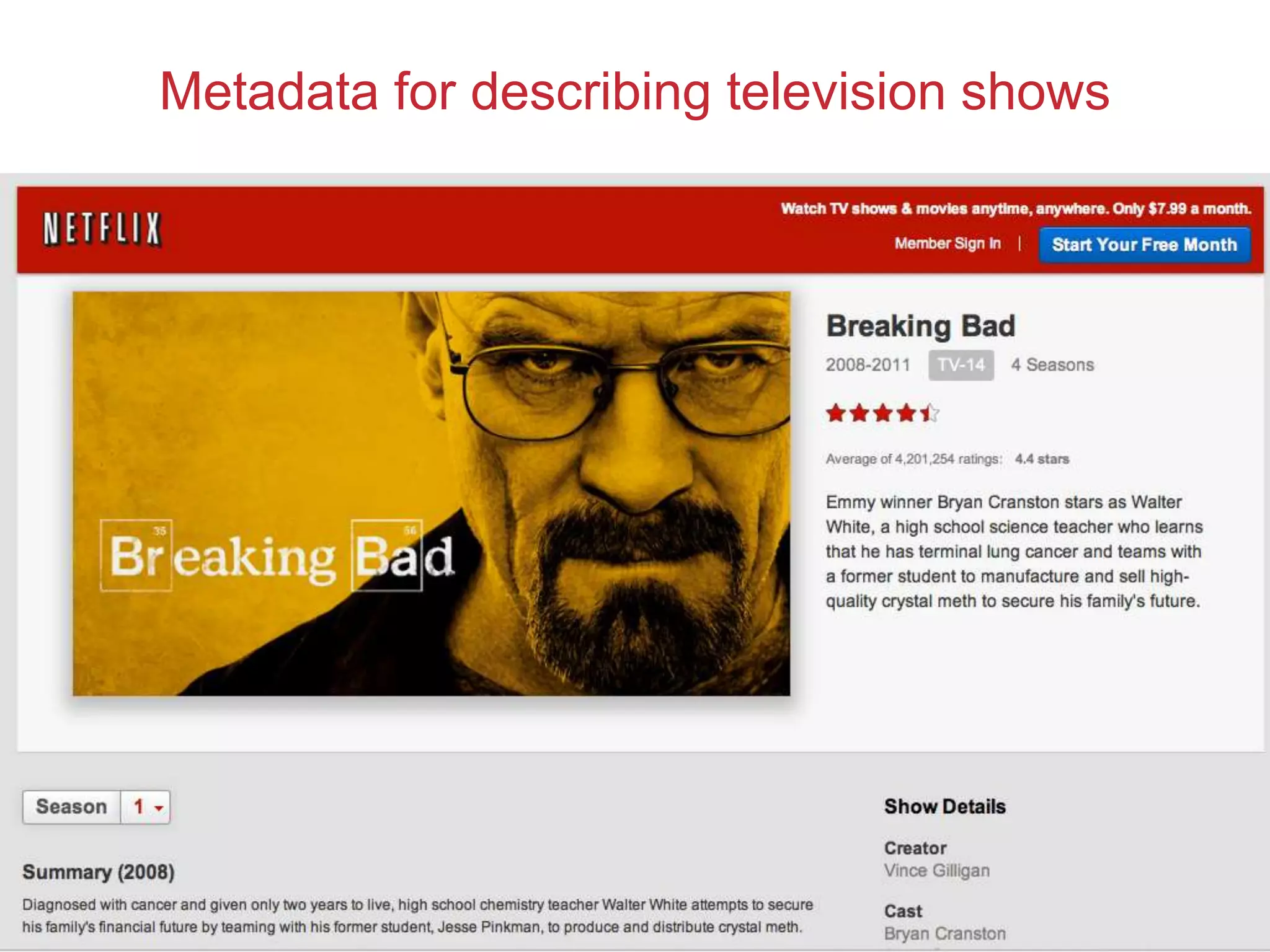
Metadata for describing television shows
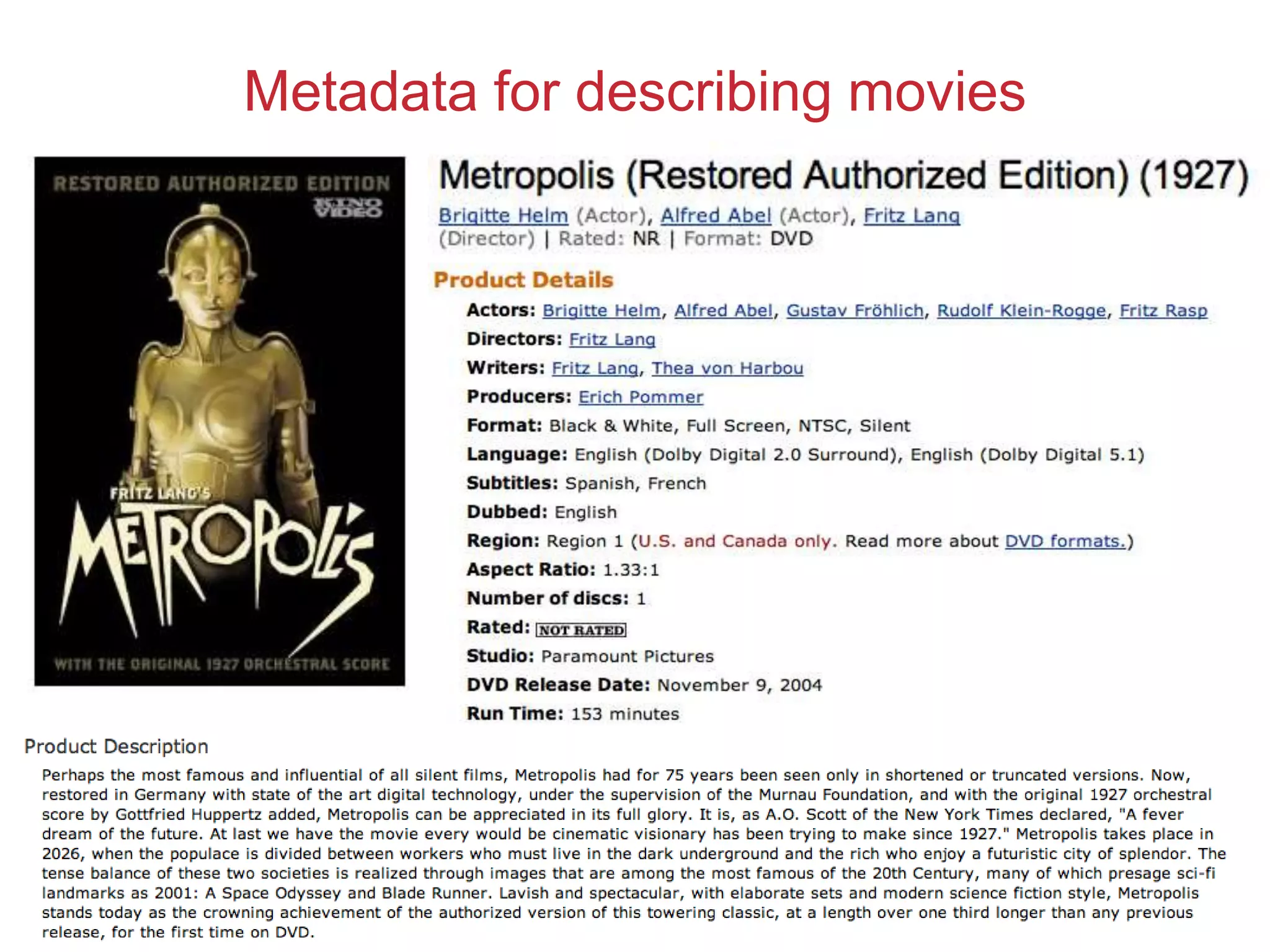
Metadata for describing movies
Take about five minutes to search for a non-book
item on the website of your choice.
Make a list of the metadata elements you identify as
you search.
Exercise
Metadata for Books Should Include:
• Information about the book as a product −
format, packaging, etc.
• Identify some elements that describe
format, packaging, and other product
details
• Information about the book’s content
• Identify some elements that describe a
book’s content
• Information needed to buy and sell the
book
• Identify some elements needed to buy
and sell books
Book Metadata That Works
Supports search, discovery, and commerce
• Accurately describes the product (format, number of items, etc.
• Fully describes the content (Title, Author, Summary, Subjects …)
• Provides all information needed for commerce (ISBN, Price, On-Sale
Date, Territorial Rights …)
Helps a book stand out in the marketplace
• Supplies evaluative metadata (Reviews, Awards …)
• Provides information about the author (Author biographies, Author
Awards ...)
• Adds any other information that adds value or supports search (Videos,
Book Tour Information, Interviews, Tables of content, etc.)
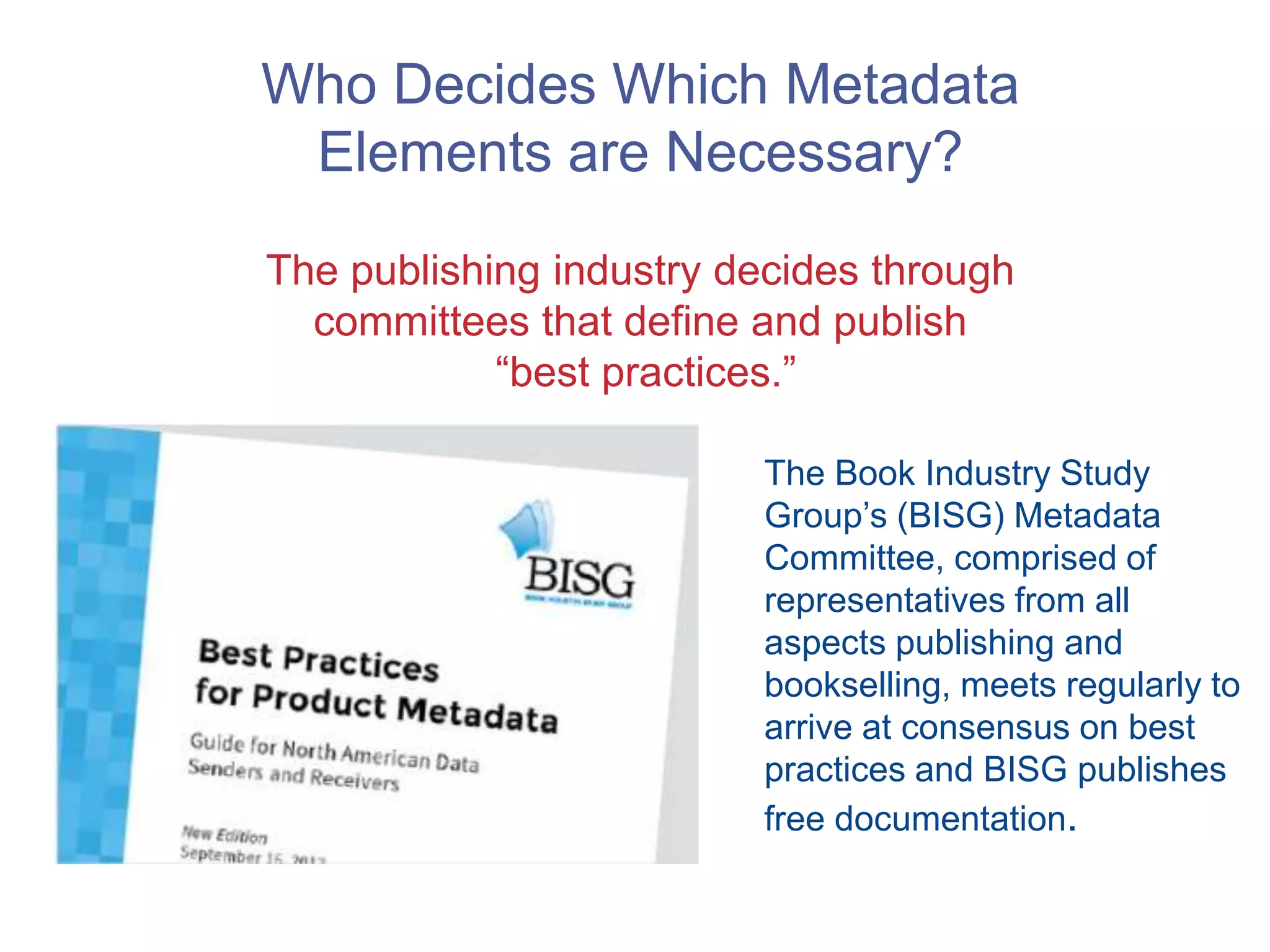
Who Decides Which Metadata
Elements are Necessary?
The publishing industry decides through
committees that define and publish
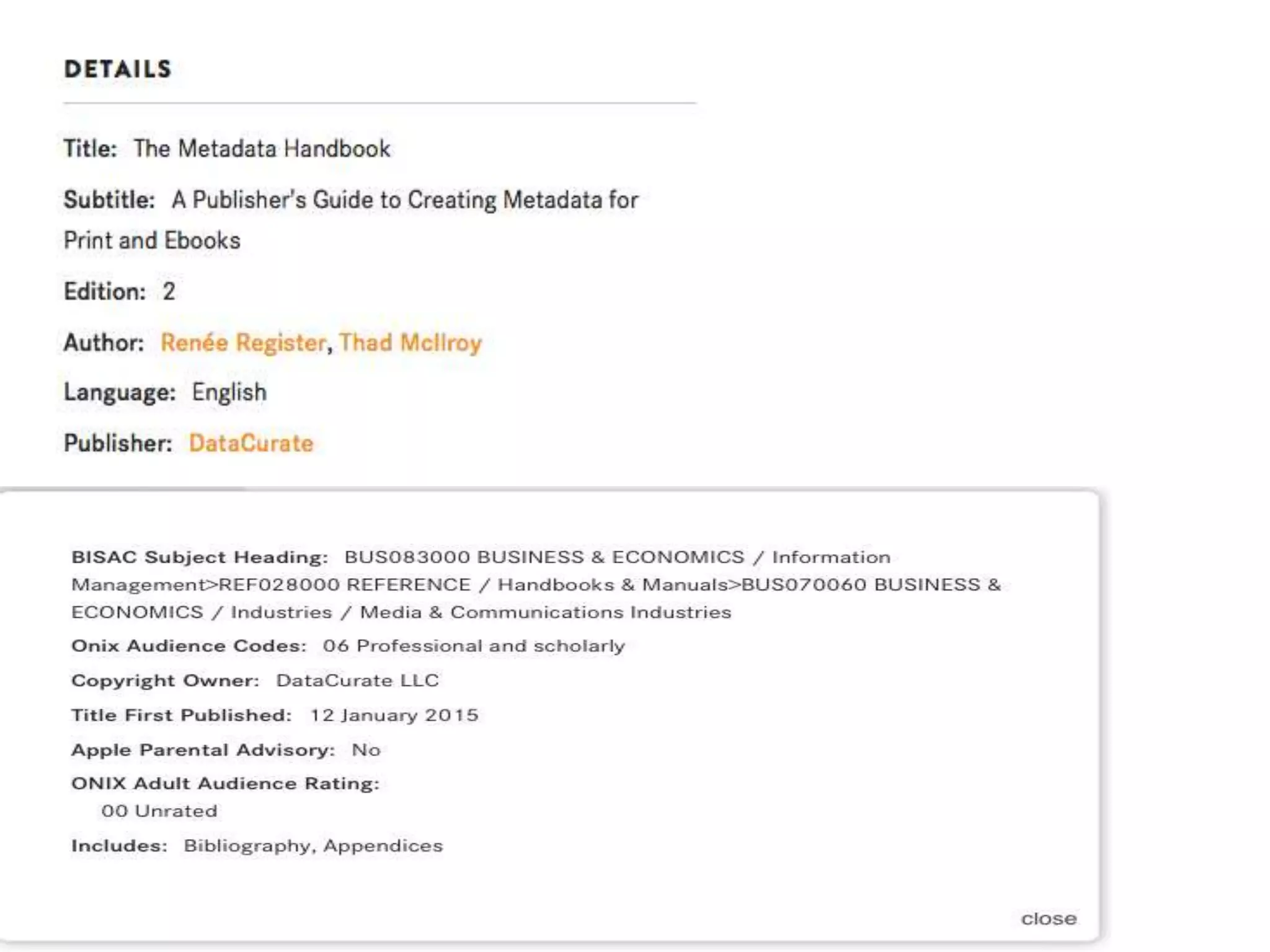
“best practices.”
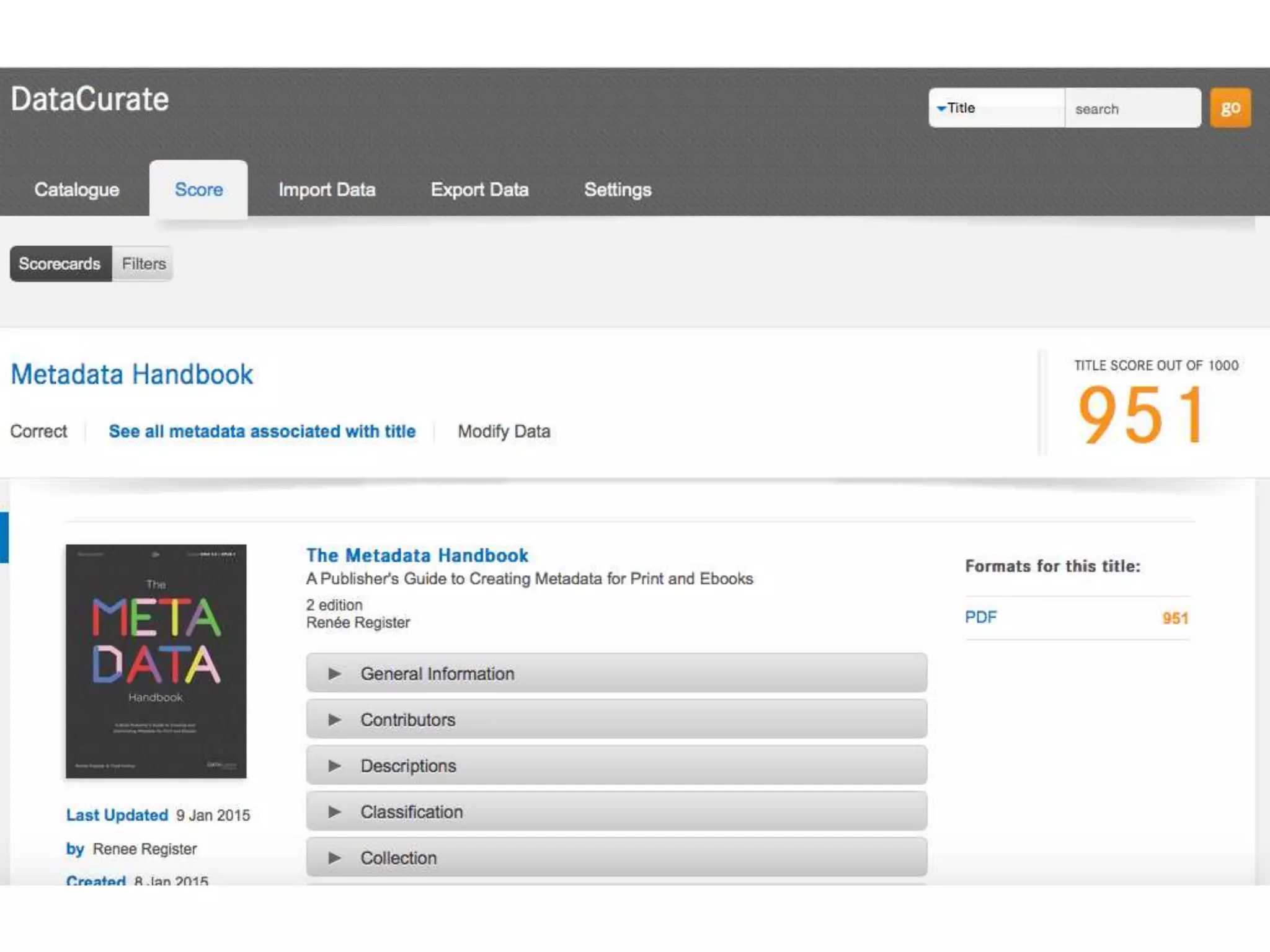
The Book Industry Study
Group’s (BISG) Metadata
Committee, comprised of
representatives from all
aspects publishing and
bookselling, meets regularly to
arrive at consensus on best
practices and BISG publishes
free documentation.
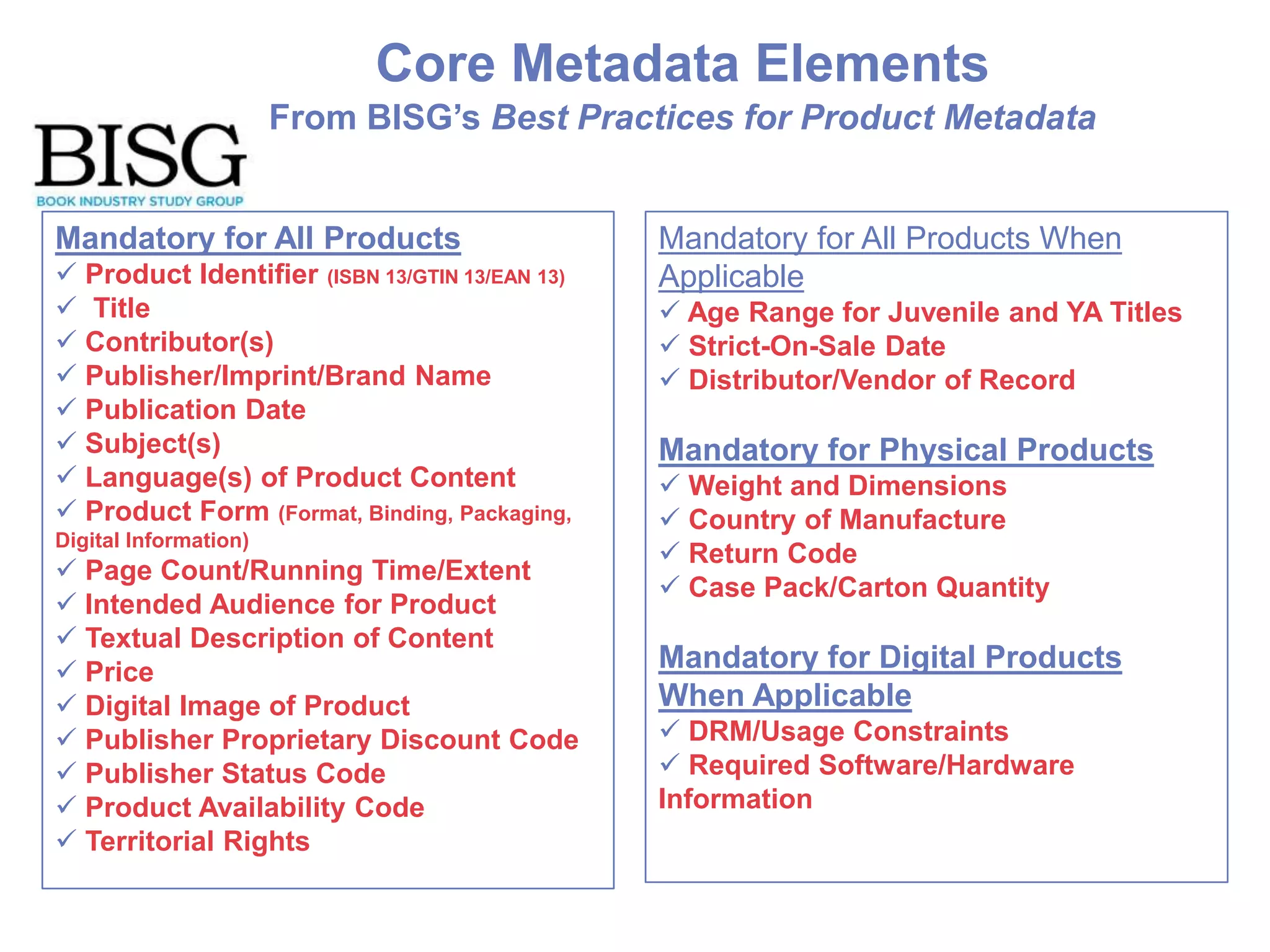
Core Metadata Elements
From BISG’s Best Practices for Product Metadata
Mandatory for All Products
 Product Identifier (ISBN 13/GTIN 13/EAN 13)
 Title
 Contributor(s)
 Publisher/Imprint/Brand Name
 Publication Date
 Subject(s)
 Language(s) of Product Content
 Product Form (Format, Binding, Packaging,
Digital Information)
 Page Count/Running Time/Extent
 Intended Audience for Product
 Textual Description of Content
 Price
 Digital Image of Product
 Publisher Proprietary Discount Code
 Publisher Status Code
 Product Availability Code
 Territorial Rights
Mandatory for All Products When
Applicable
 Age Range for Juvenile and YA Titles
 Strict-On-Sale Date
 Distributor/Vendor of Record
Mandatory for Physical Products
 Weight and Dimensions
 Country of Manufacture
 Return Code
 Case Pack/Carton Quantity
Mandatory for Digital Products
When Applicable
 DRM/Usage Constraints
 Required Software/Hardware
Information
Highly Recommended Metadata Elements
From BISG’s Best Practices for Product Metadata
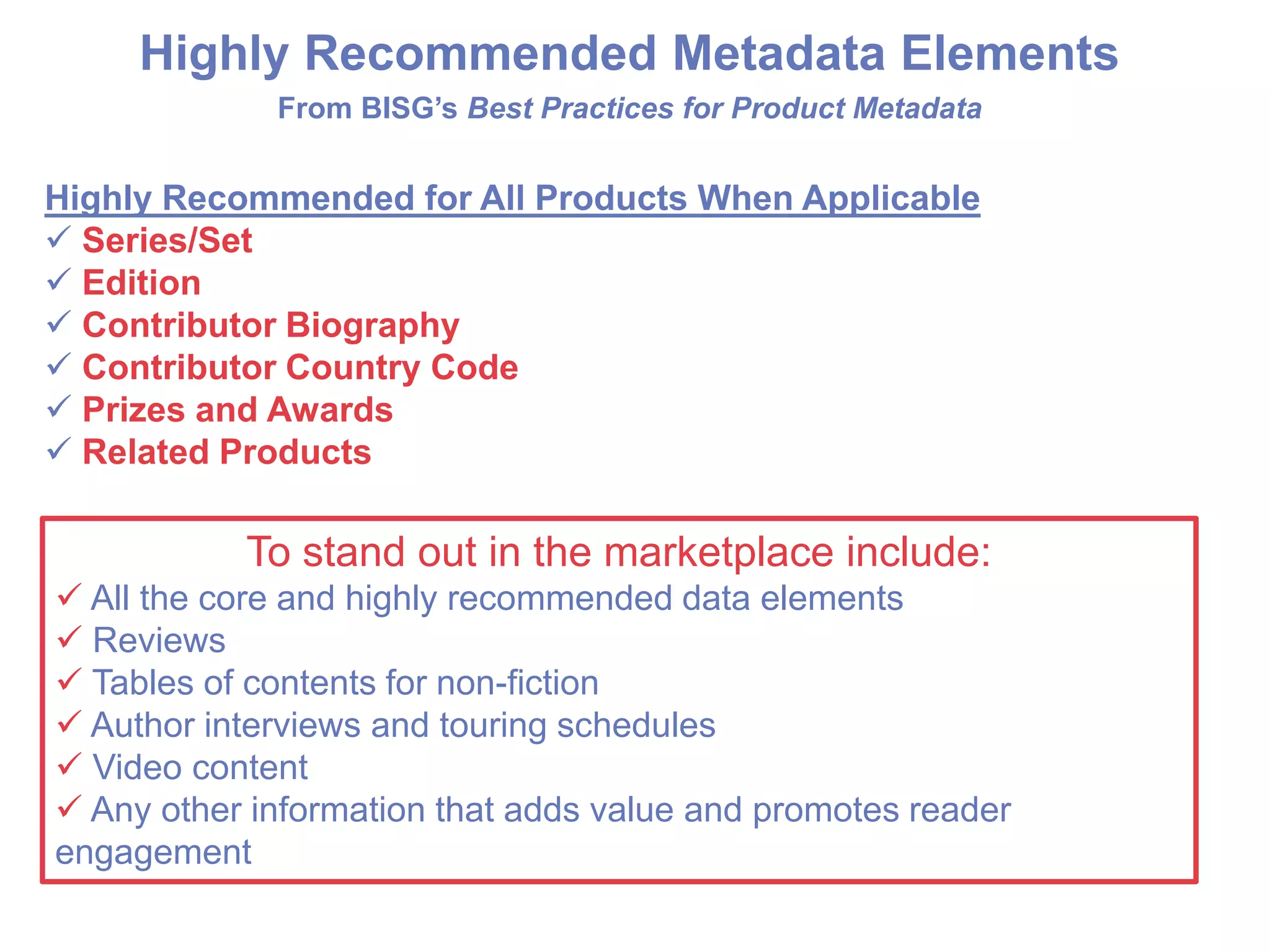
Highly Recommended for All Products When Applicable
 Series/Set
 Edition
 Contributor Biography
 Contributor Country Code
 Prizes and Awards
 Related Products
To stand out in the marketplace include:
 All the core and highly recommended data elements
 Reviews
 Tables of contents for non-fiction
 Author interviews and touring schedules
 Video content
 Any other information that adds value and promotes reader
engagement
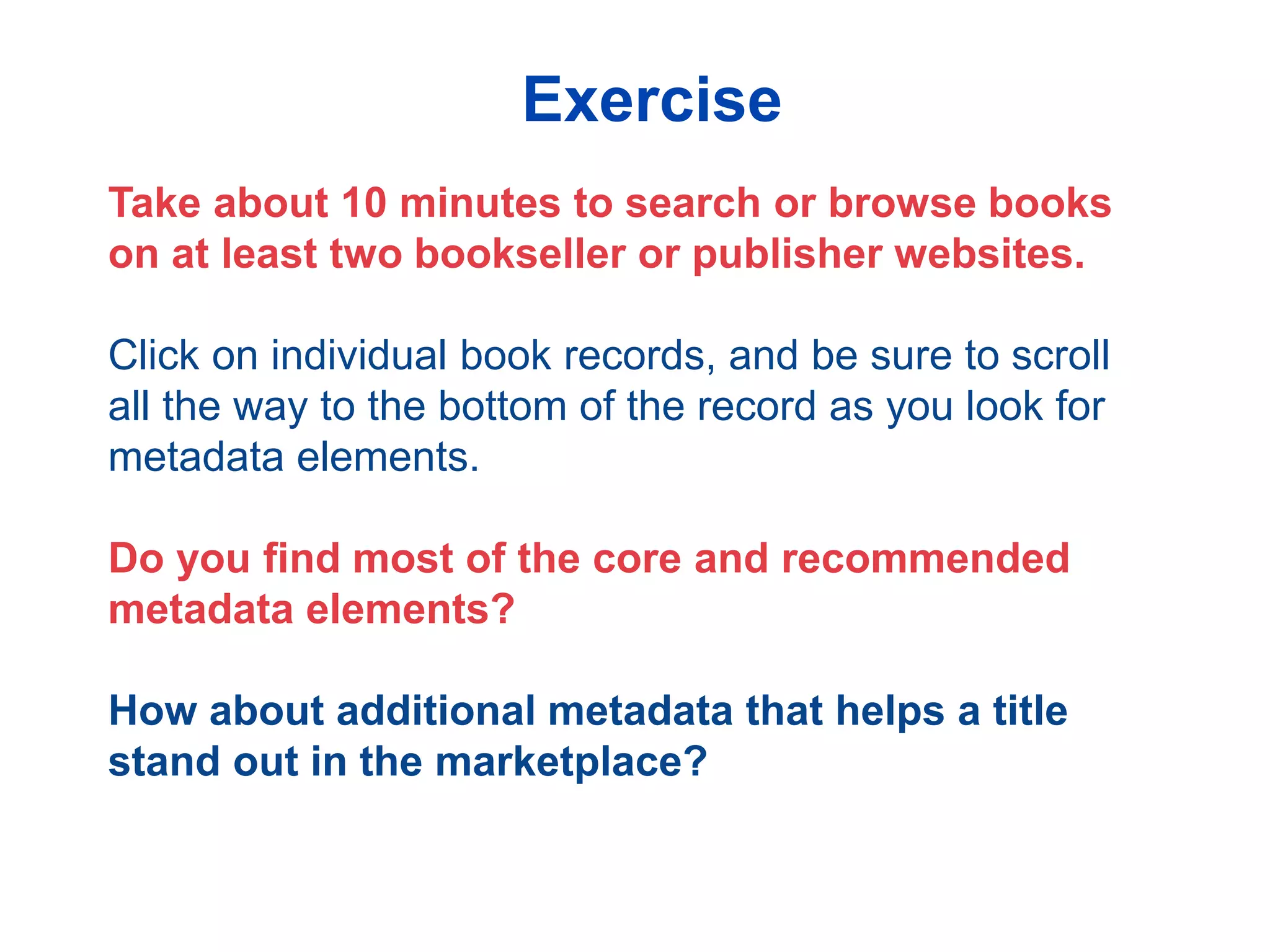
Take about 10 minutes to search or browse books
on at least two bookseller or publisher websites.
Click on individual book records, and be sure to scroll
all the way to the bottom of the record as you look for
metadata elements.
Do you find most of the core and recommended
metadata elements?
How about additional metadata that helps a title
stand out in the marketplace?
Exercise
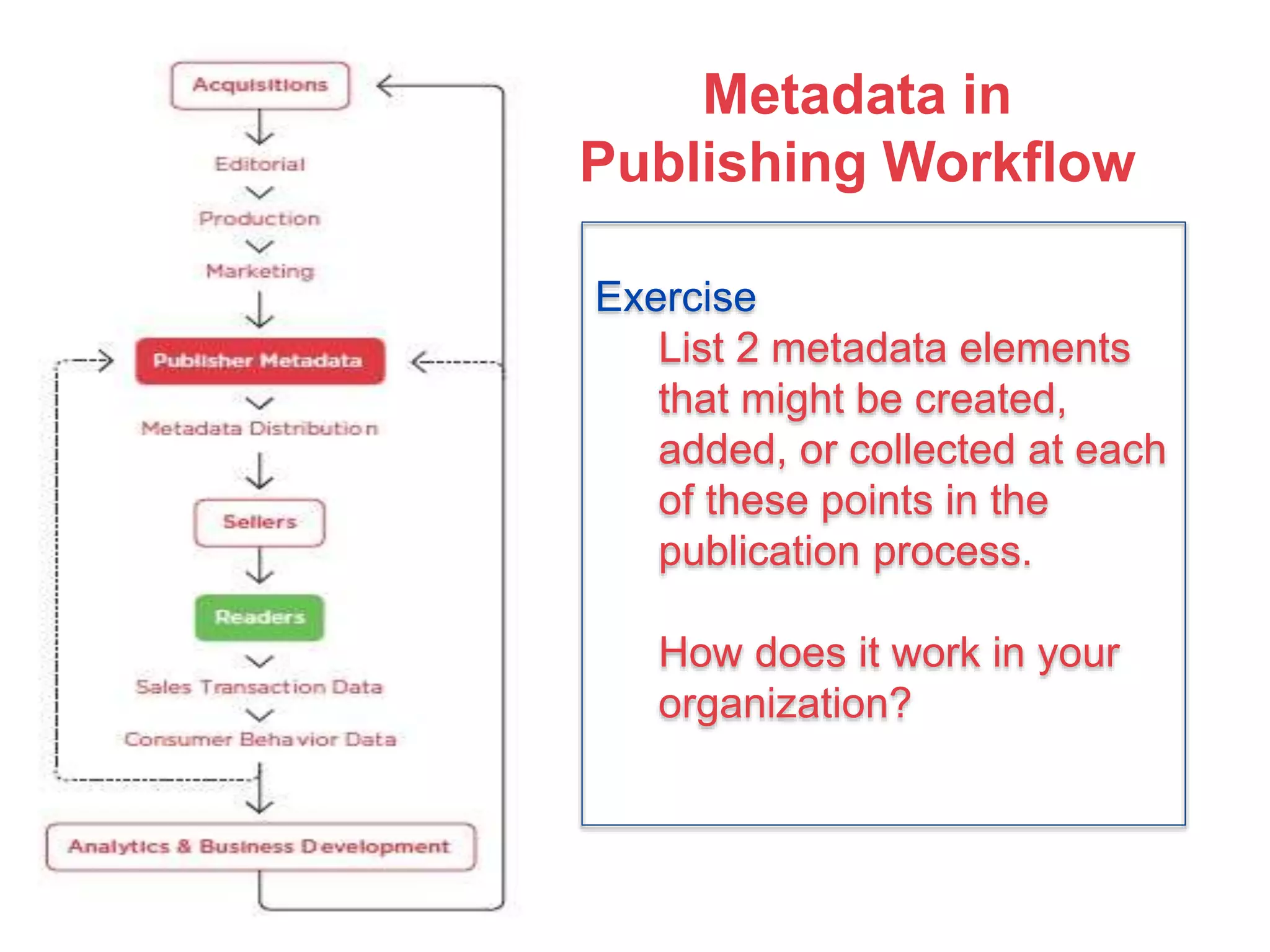
Metadata in
Publishing Workflow
Exercise
List 2 metadata elements
that might be created,
added, or collected at each
of these points in the
publication process.
How does it work in your
organization?
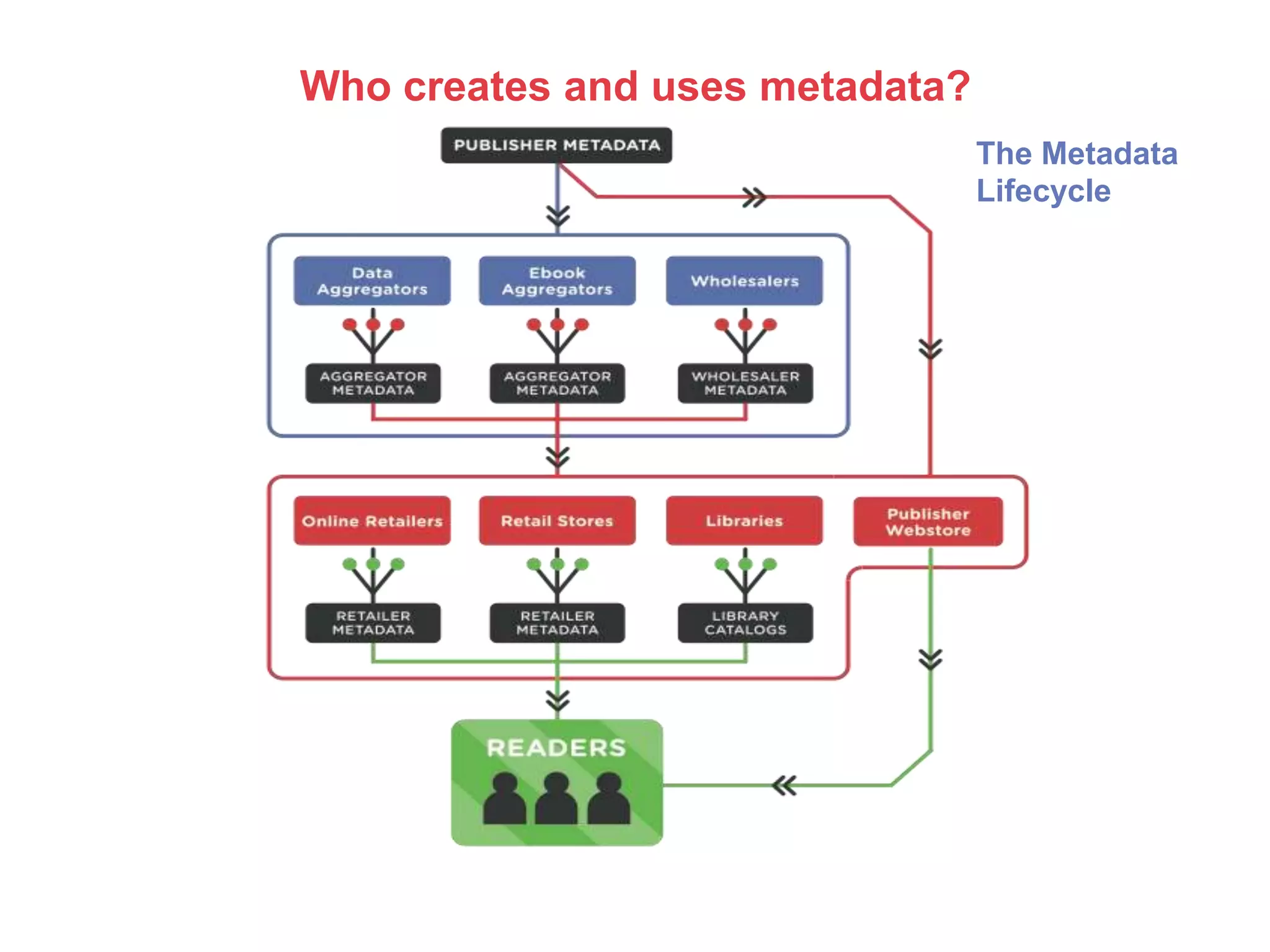
Distributing Metadata
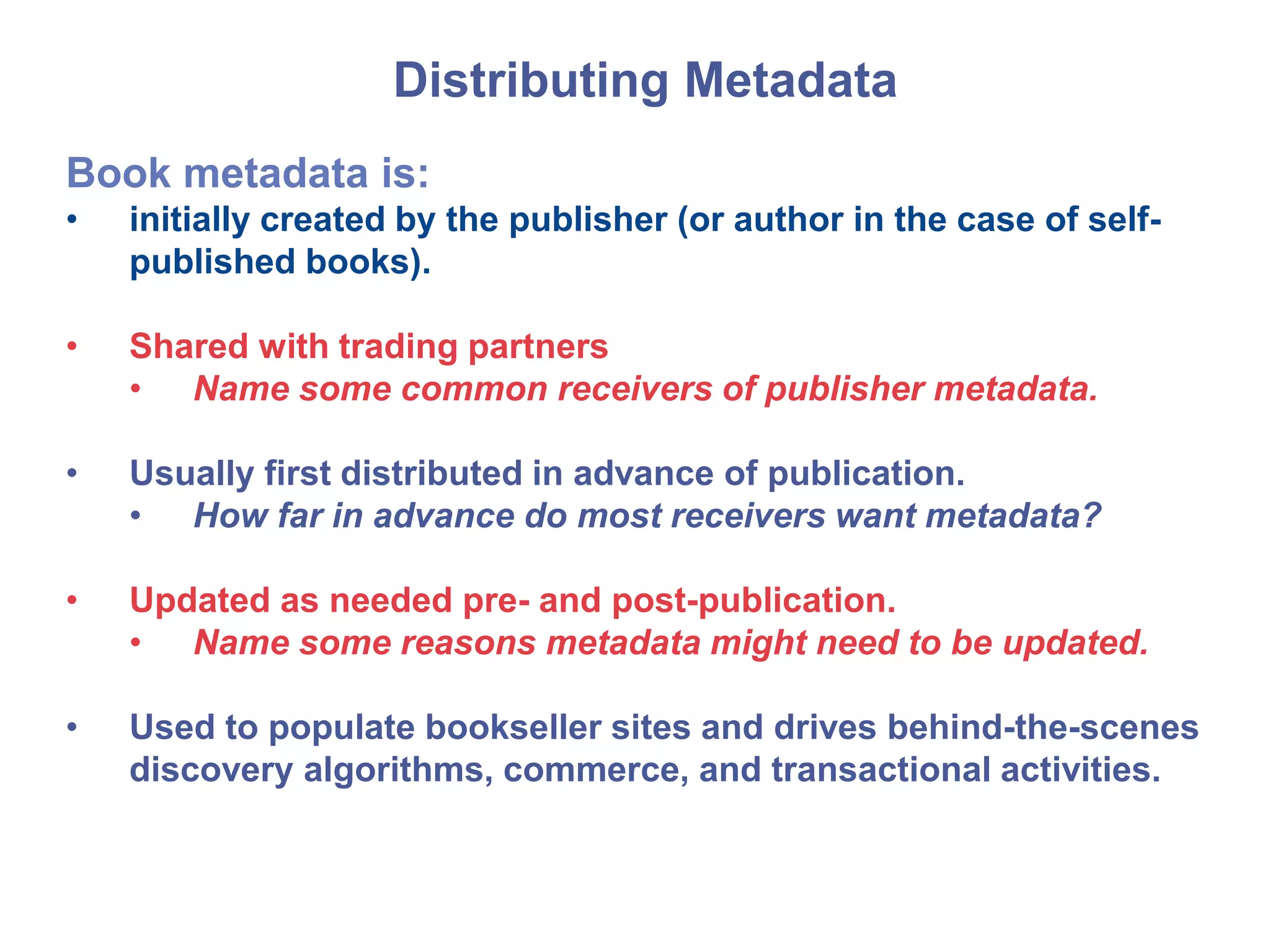
Book metadata is:
• initially created by the publisher (or author in the case of self-
published books).
• Shared with trading partners
• Name some common receivers of publisher metadata.
• Usually first distributed in advance of publication.
• How far in advance do most receivers want metadata?
• Updated as needed pre- and post-publication.
• Name some reasons metadata might need to be updated.
• Used to populate bookseller sites and drives behind-the-scenes
discovery algorithms, commerce, and transactional activities.
Who creates and uses metadata?
The Metadata
Lifecycle
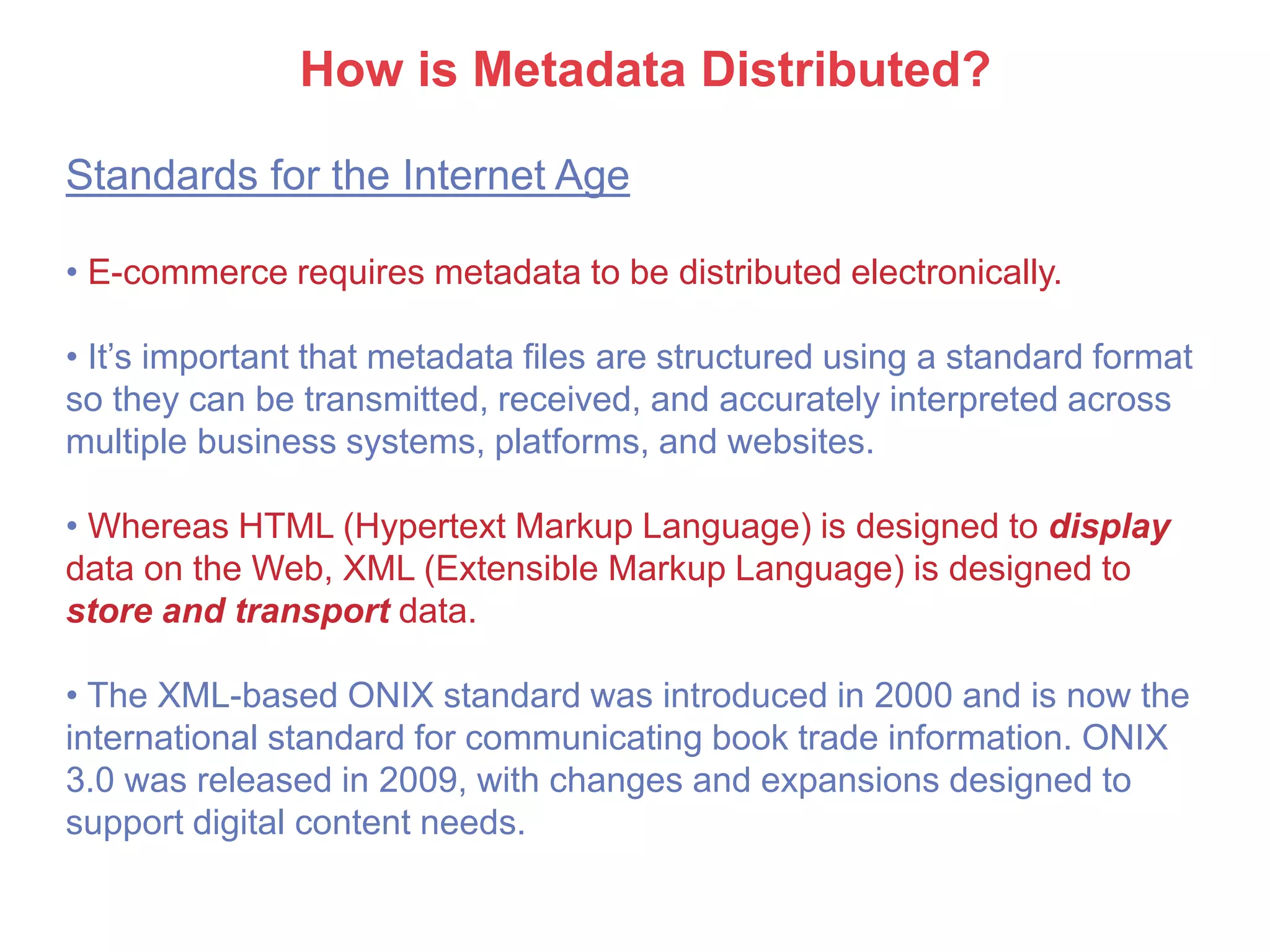
How is Metadata Distributed?
Standards for the Internet Age
• E-commerce requires metadata to be distributed electronically.
• It’s important that metadata files are structured using a standard format
so they can be transmitted, received, and accurately interpreted across
multiple business systems, platforms, and websites.
• Whereas HTML (Hypertext Markup Language) is designed to display
data on the Web, XML (Extensible Markup Language) is designed to
store and transport data.
• The XML-based ONIX standard was introduced in 2000 and is now the
international standard for communicating book trade information. ONIX
3.0 was released in 2009, with changes and expansions designed to
support digital content needs.
Creating Metadata in ONIX
ONIX isn’t metadata − it’s a structured carrier for
metadata. Metadata (information about the book – content,
product, and commerce information) can be contained and
distributed in the ONIX format.
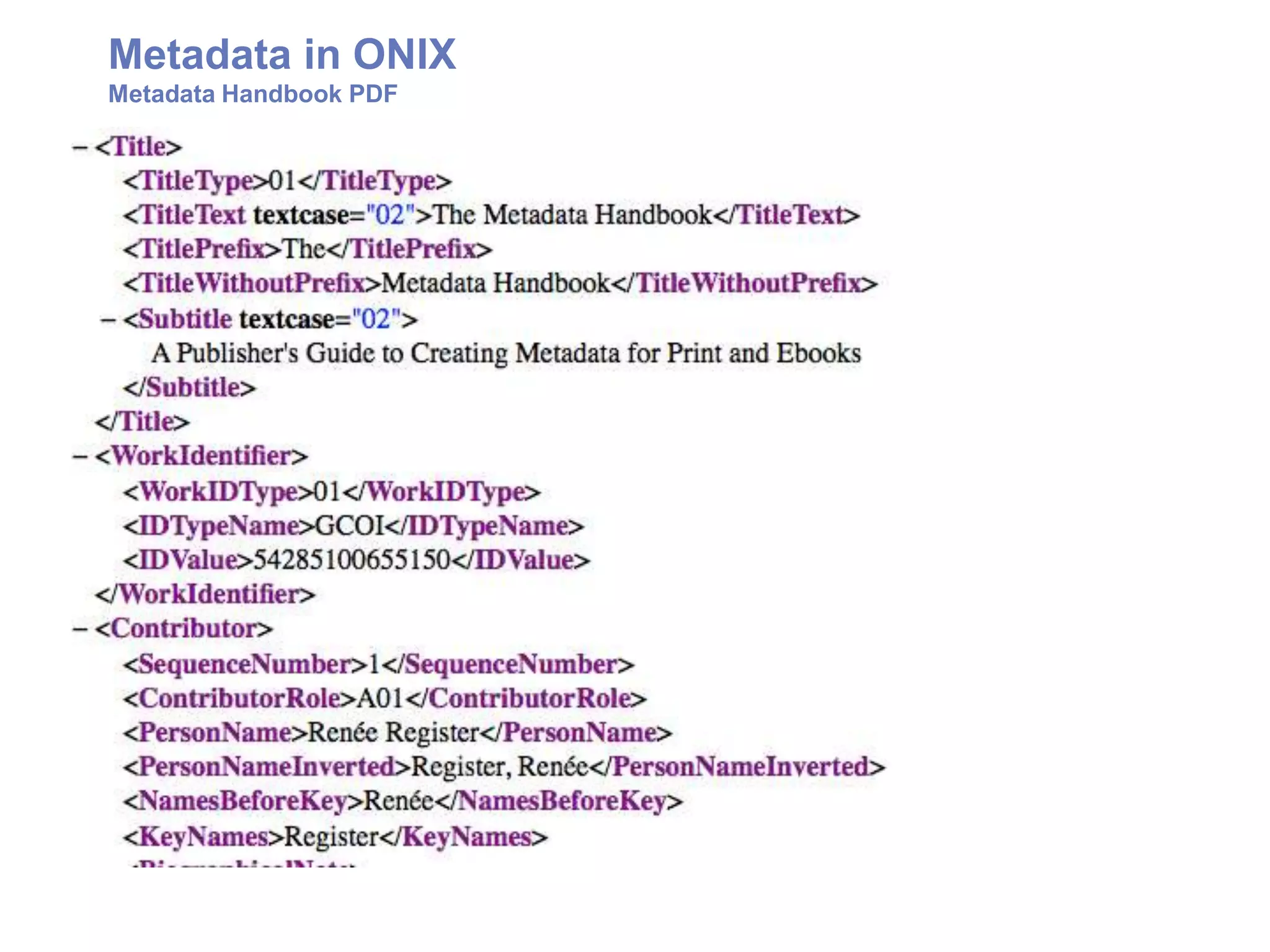
Using XML, ONIX provides standard names (tags) for
metadata elements and codes to stand in for some
elements, allowing us to share metadata in a way that can
be correctly interpreted and displayed to users by multiple
systems.
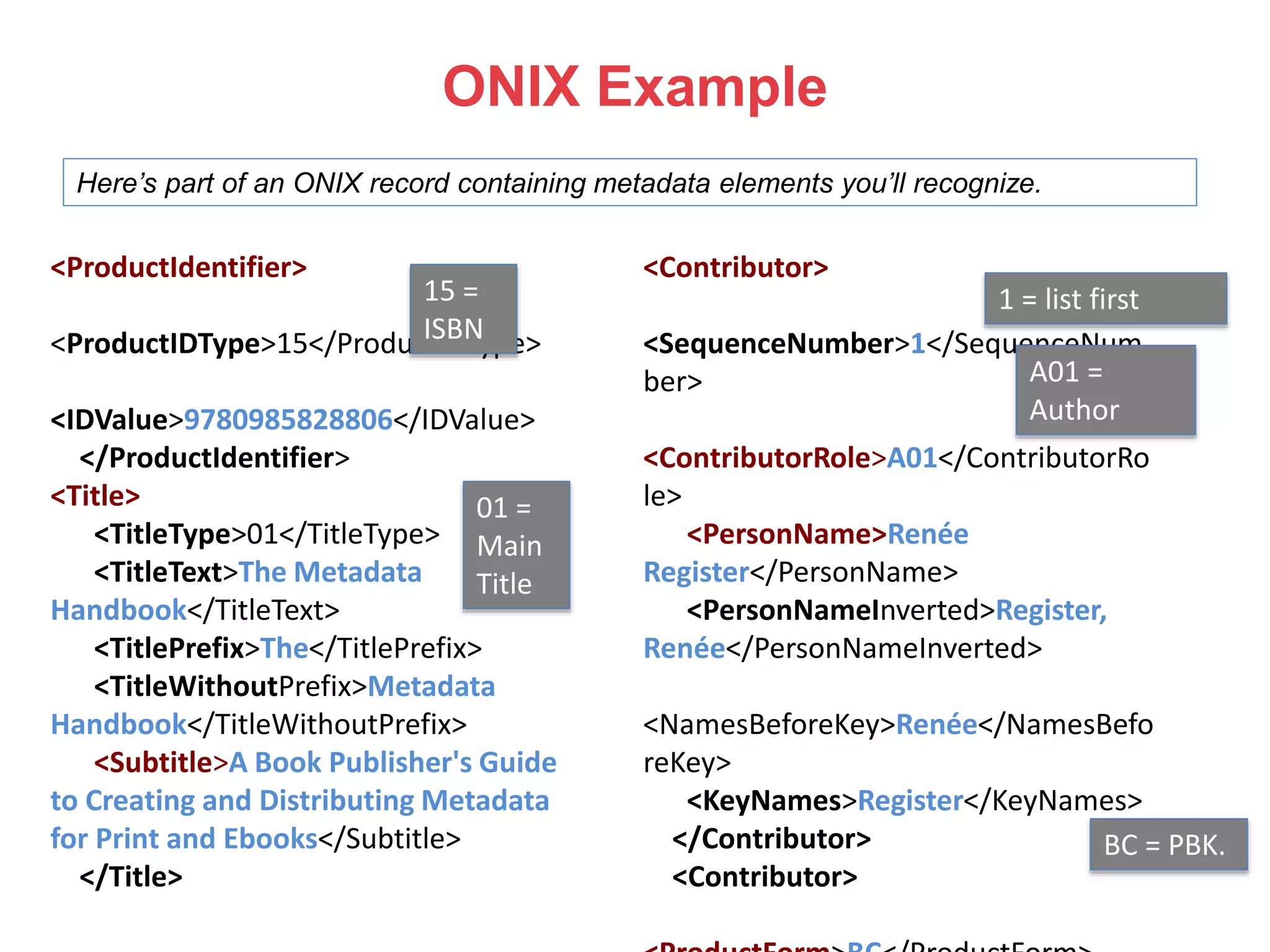
ONIX Example
Here’s part of an ONIX record containing metadata elements you’ll recognize.
<ProductIdentifier>
<ProductIDType>15</ProductIDType>
<IDValue>9780985828806</IDValue>
</ProductIdentifier>
<Title>
<TitleType>01</TitleType>
<TitleText>The Metadata
Handbook</TitleText>
<TitlePrefix>The</TitlePrefix>
<TitleWithoutPrefix>Metadata
Handbook</TitleWithoutPrefix>
<Subtitle>A Book Publisher's Guide
to Creating and Distributing Metadata
for Print and Ebooks</Subtitle>
</Title>
<Contributor>
<SequenceNumber>1</SequenceNum
ber>
<ContributorRole>A01</ContributorRo
le>
<PersonName>Renée
Register</PersonName>
<PersonNameInverted>Register,
Renée</PersonNameInverted>
<NamesBeforeKey>Renée</NamesBefo
reKey>
<KeyNames>Register</KeyNames>
</Contributor>
<Contributor>
15 =
ISBN
BC = PBK.
A01 =
Author
1 = list first
01 =
Main
Title
ONIX Example
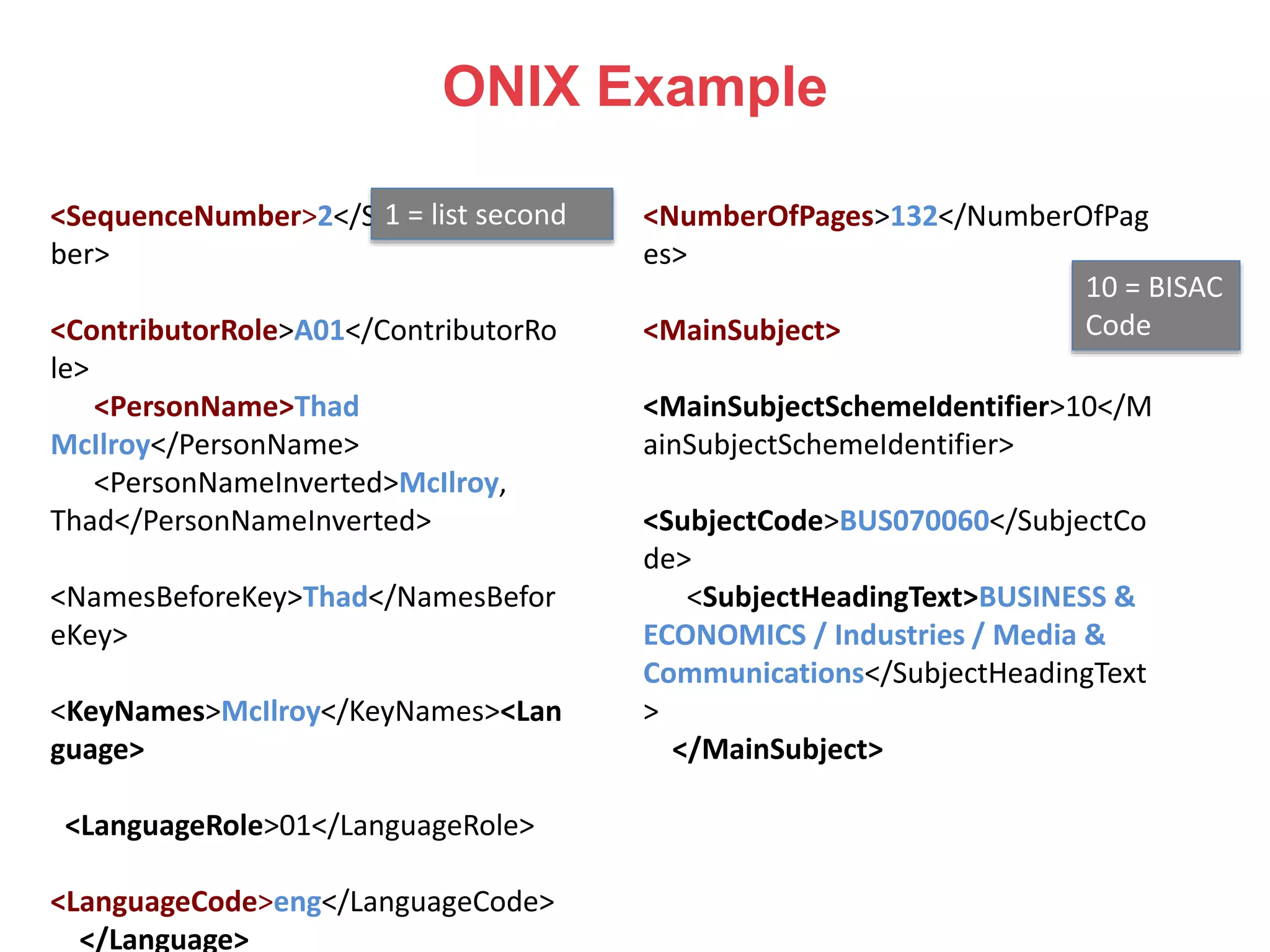
<SequenceNumber>2</SequenceNum
ber>
<ContributorRole>A01</ContributorRo
le>
<PersonName>Thad
McIlroy</PersonName>
<PersonNameInverted>McIlroy,
Thad</PersonNameInverted>
<NamesBeforeKey>Thad</NamesBefor
eKey>
<KeyNames>McIlroy</KeyNames><Lan
guage>
<LanguageRole>01</LanguageRole>
<LanguageCode>eng</LanguageCode>
</Language>
<NumberOfPages>132</NumberOfPag
es>
<MainSubject>
<MainSubjectSchemeIdentifier>10</M
ainSubjectSchemeIdentifier>
<SubjectCode>BUS070060</SubjectCo
de>
<SubjectHeadingText>BUSINESS &
ECONOMICS / Industries / Media &
Communications</SubjectHeadingText
>
</MainSubject>
10 = BISAC
Code
1 = list second
ONIX Example
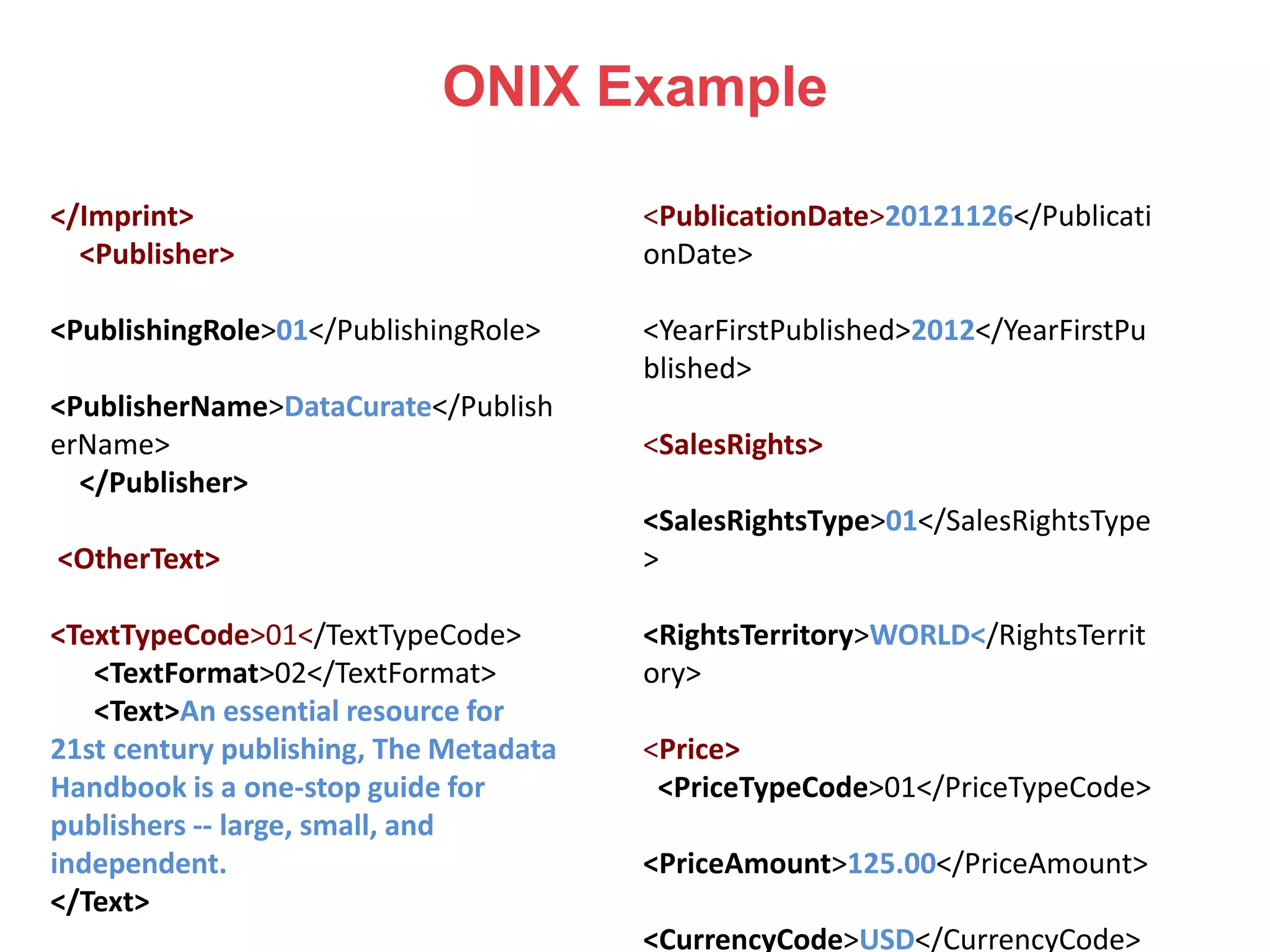
</Imprint>
<Publisher>
<PublishingRole>01</PublishingRole>
<PublisherName>DataCurate</Publish
erName>
</Publisher>
<OtherText>
<TextTypeCode>01</TextTypeCode>
<TextFormat>02</TextFormat>
<Text>An essential resource for
21st century publishing, The Metadata
Handbook is a one-stop guide for
publishers -- large, small, and
independent.
</Text>
<PublicationDate>20121126</Publicati
onDate>
<YearFirstPublished>2012</YearFirstPu
blished>
<SalesRights>
<SalesRightsType>01</SalesRightsType
>
<RightsTerritory>WORLD</RightsTerrit
ory>
<Price>
<PriceTypeCode>01</PriceTypeCode>
<PriceAmount>125.00</PriceAmount>
<CurrencyCode>USD</CurrencyCode>
Break
15 Minutes
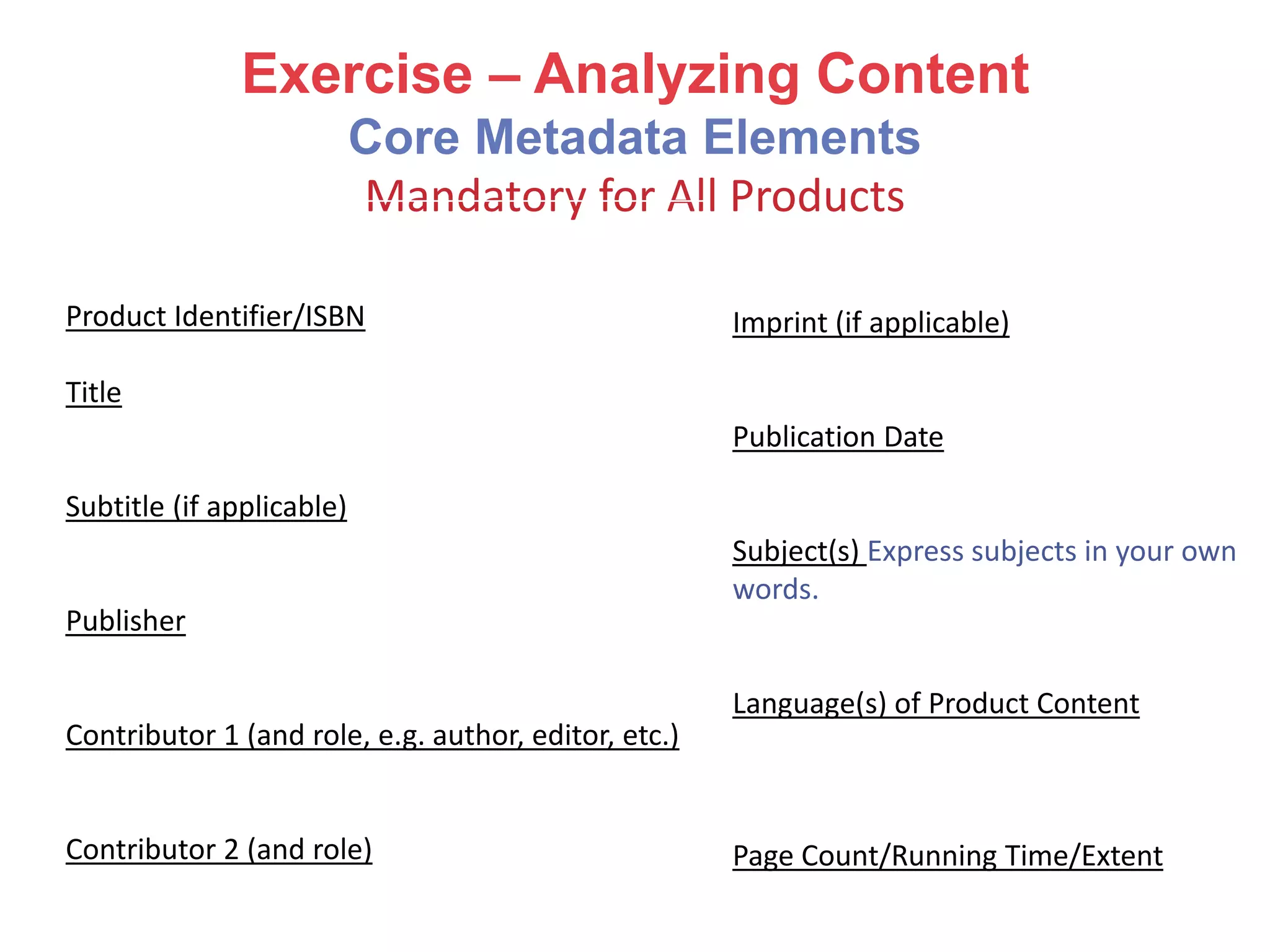
Exercise – Analyzing Content
Core Metadata Elements
Mandatory for All Products
Product Identifier/ISBN
Title
Subtitle (if applicable)
Publisher
Contributor 1 (and role, e.g. author, editor, etc.)
Contributor 2 (and role)
Imprint (if applicable)
Publication Date
Subject(s) Express subjects in your own
words.
Language(s) of Product Content
Page Count/Running Time/Extent
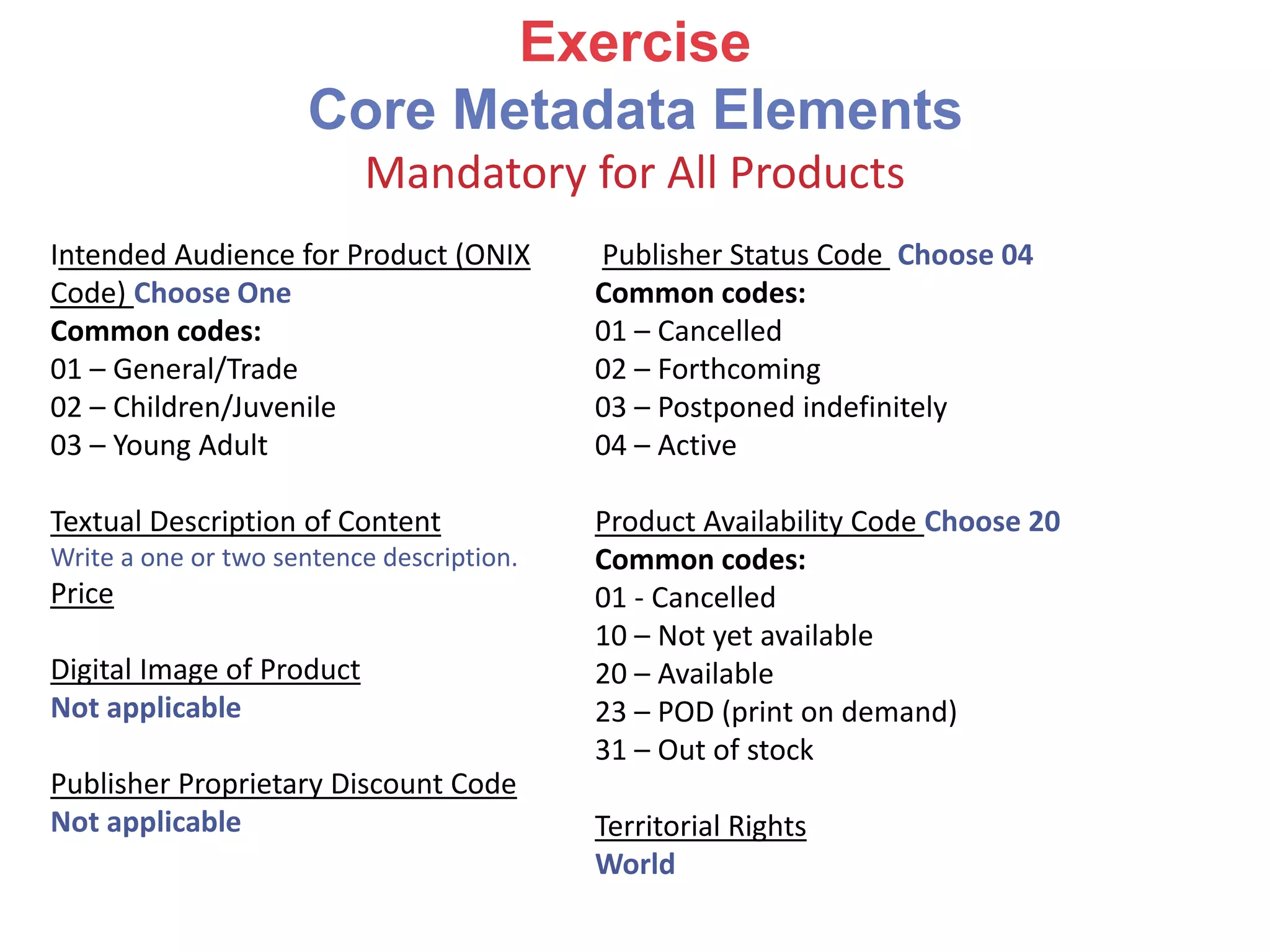
Intended Audience for Product (ONIX
Code) Choose One
Common codes:
01 – General/Trade
02 – Children/Juvenile
03 – Young Adult
Textual Description of Content
Write a one or two sentence description.
Price
Digital Image of Product
Not applicable
Publisher Proprietary Discount Code
Not applicable
Publisher Status Code Choose 04
Common codes:
01 – Cancelled
02 – Forthcoming
03 – Postponed indefinitely
04 – Active
Product Availability Code Choose 20
Common codes:
01 - Cancelled
10 – Not yet available
20 – Available
23 – POD (print on demand)
31 – Out of stock
Territorial Rights
World
Exercise
Core Metadata Elements
Mandatory for All Products
Exercise
Core Metadata Elements
Mandatory for All Products When
Applicable
Age Range for Juvenile and Young Adult
Titles
If the title is juvenile or young adult,
use your best judgment to select an
age range, e.g. 4-8.
Strict-On-Sale Date
Not applicable
Distributor/Vendor of Record
Not applicable
Mandatory for Physical Products
Weight and Dimensions
Country of Manufacture Choose US
Return Code Choose Y
Case Pack/Carton Quantity
Not applicable
Exercise
Highly Recommended Elements
Series/Set/Collection Information
(Series Title, Series Number)
Edition
Contributor Biography
Contributor Country Code
Prizes and Awards
Related Products
Not applicable
Highly Recommended for All Products When Applicable
Enter if information is available and applicable
About Onixsuite
Ace Heinle
Onixsuite is a metadata creation, correction and optimization
platform. Many publishers and distributors believe that as long
as their data is accepted by Amazon or other retailers, the data
is “good enough,” but with Onixsuite you create excellent
metadata that improves not only your sales but also your
margins. It also improves user experience across your systems
and the web, and minimizes your internal costs.
About Onixsuite
Ace Heinle
Onixsuite is available as a stand-alone tool for creating and
sending out ONIX, but if you already have a solution you can use
Onixsuite as a cleaning filter on top of other systems and use our
services to clean your data and backlist. Onixsuite comes with a
free website and also has custom website and eCommerce
capabilities.
See Ace after the workshop for more information.
Exercise
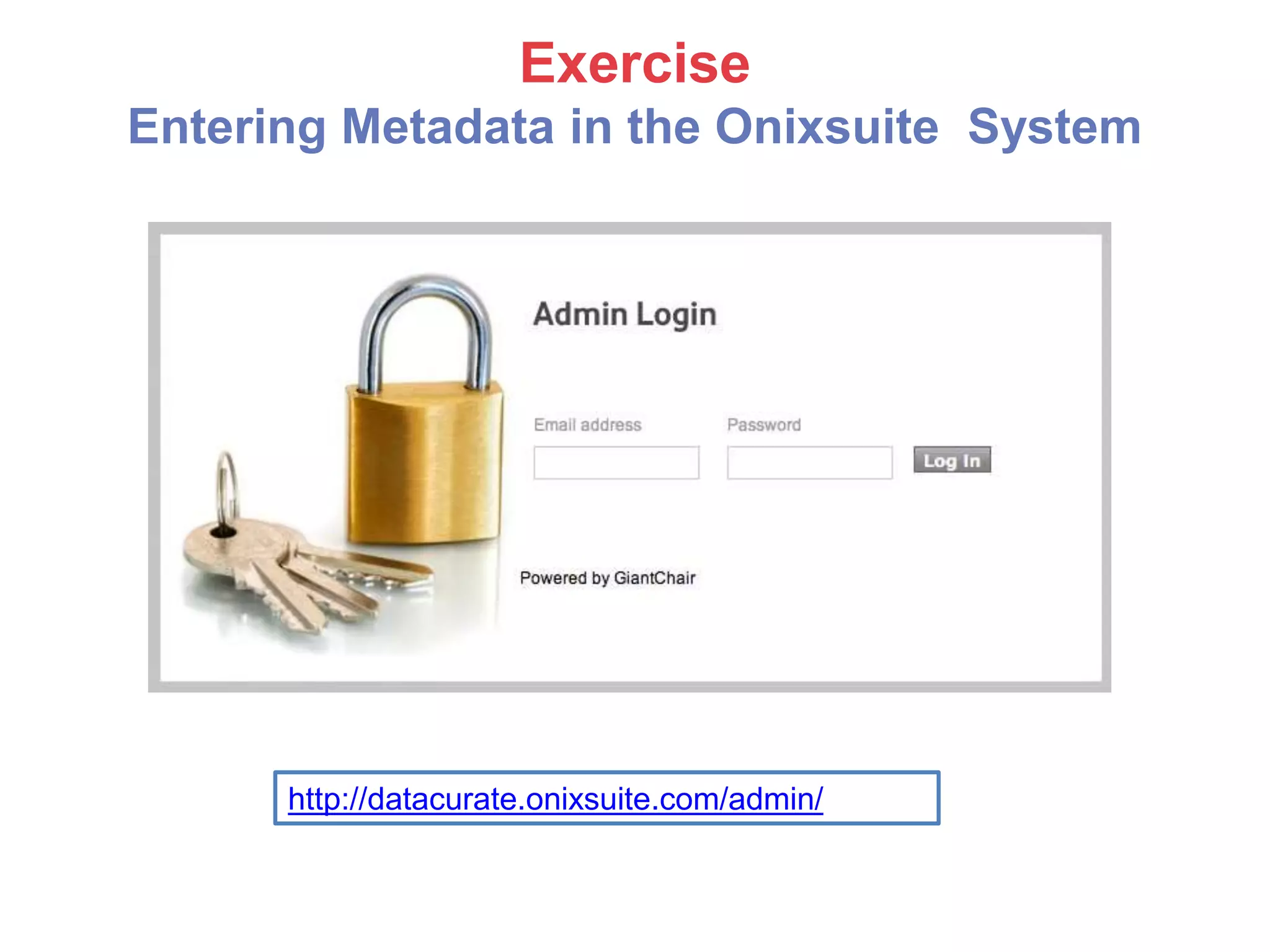
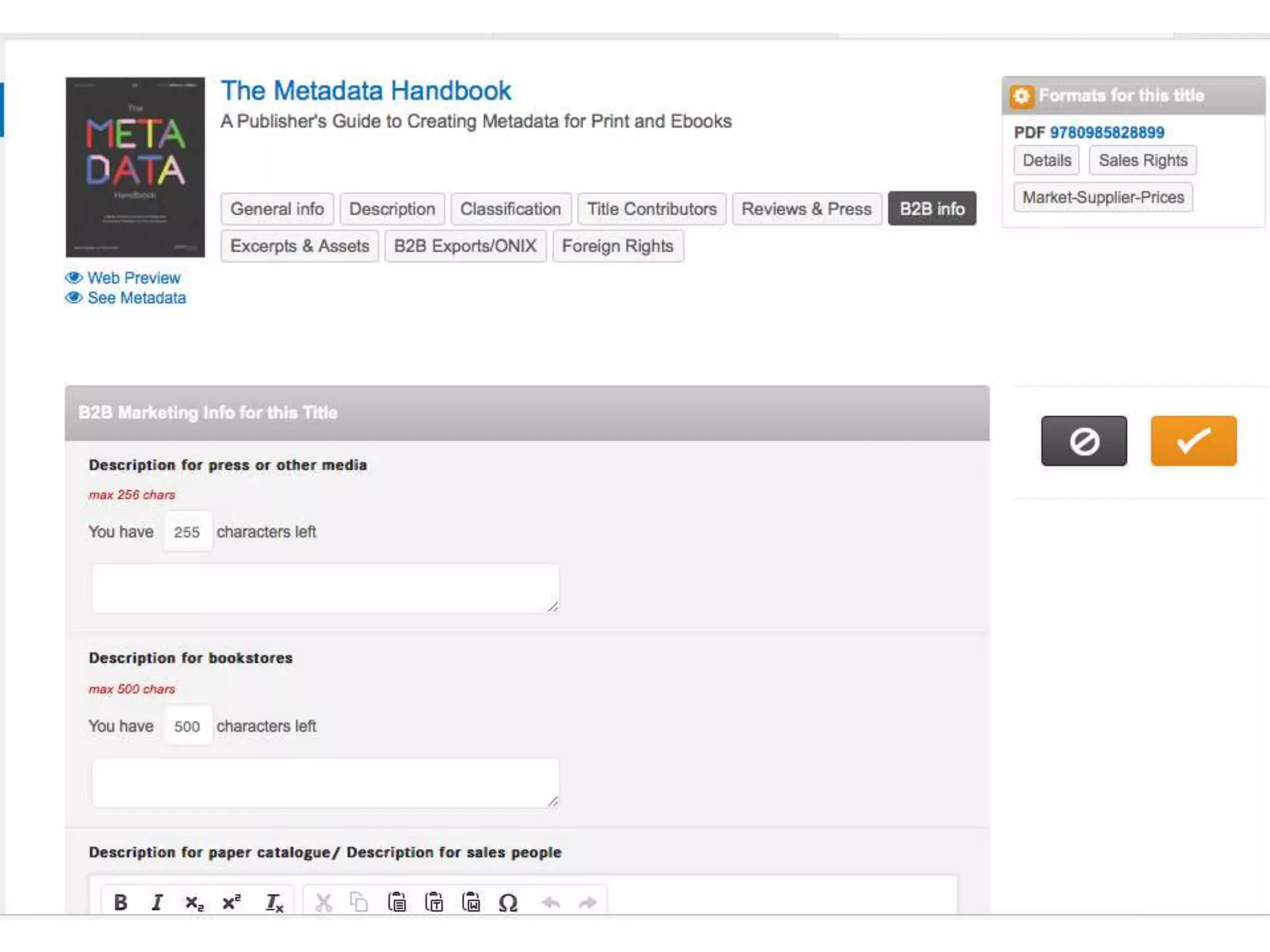
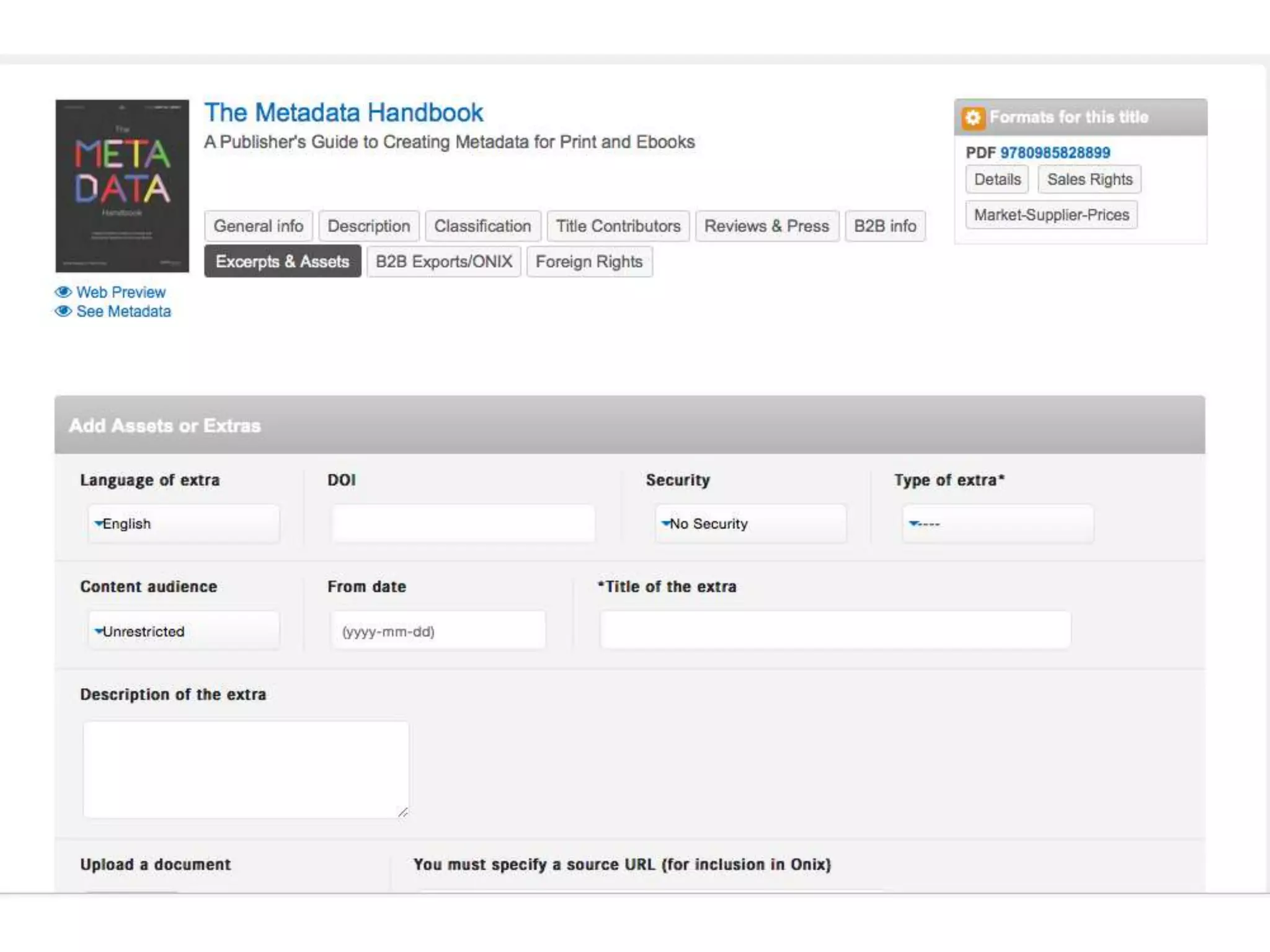
Entering Metadata in the Onixsuite System
http://datacurate.onixsuite.com/admin/
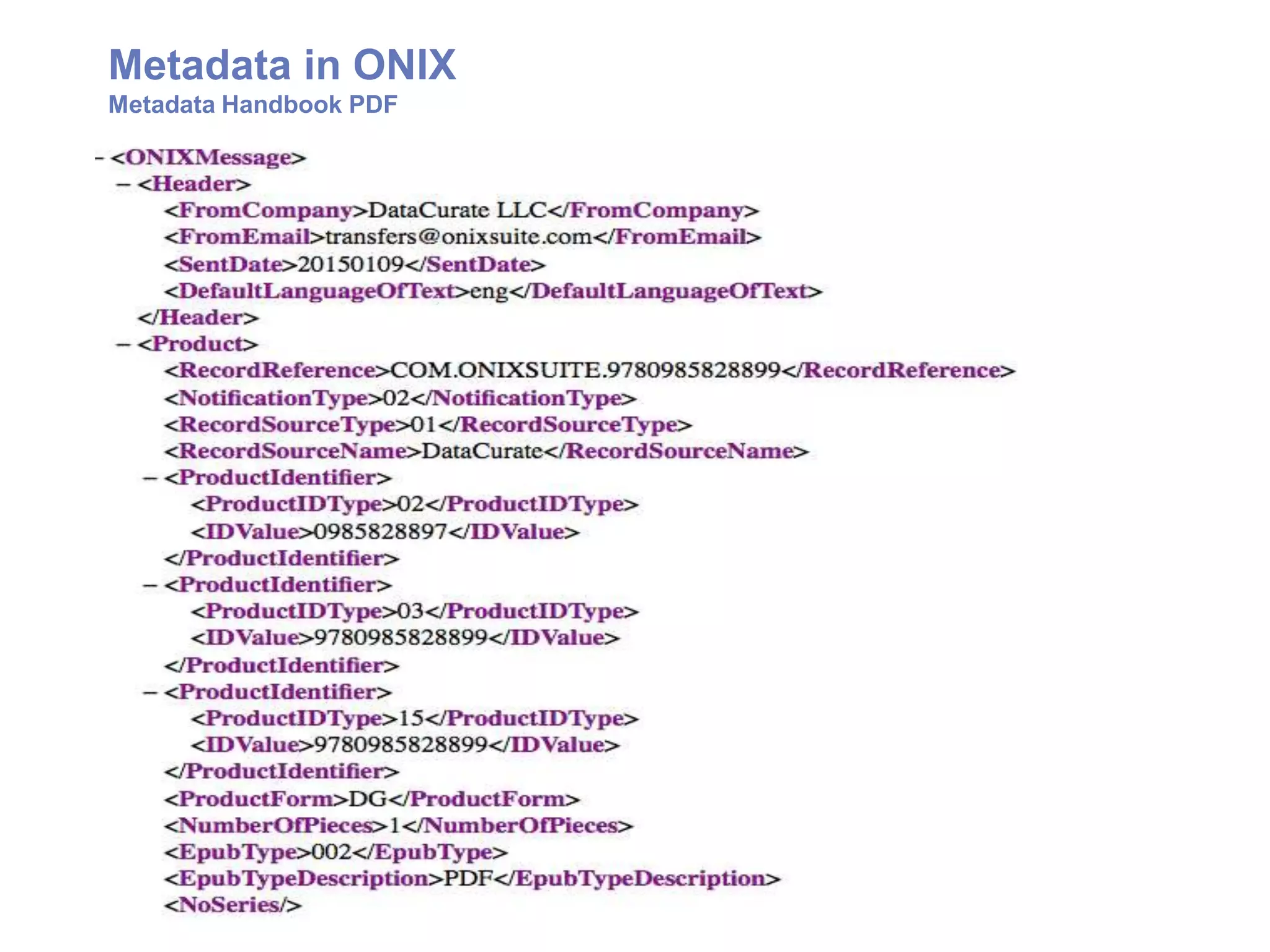
Metadata in ONIX
Metadata Handbook PDF
Metadata in ONIX
Metadata Handbook PDF
What makes metadata work?
Powerful metadata provides a rich description of the product and
meets business needs.
Metadata that works supports what readers need:
• A compelling and successful search and discovery
experience
• Content-rich information that engages readers and supports
reader evaluation and selection of books
• Effective and useful recommendation algorithms and website
sort options (by subject, genre, audience, age level, format,
etc.)
What makes metadata work?
Powerful metadata provides a rich description of the product and
meets business needs.
Metadata that works supports the business needs
of publishers and their trading partners:
• A compelling search and discovery experience for customers
that leads to more sales
• Effective and communication between publishers and
booksellers
• Efficient and accurate business transactions
• Support for publicity and marketing activities
• Useful sales tracking and market analysis
• Powerful business intelligence
Metadata, Search Engines, and
Search Engine Optimization
Bookseller search engines
(Publisher websites, Amazon, Barnes & Noble ...)
These search engines are directed at bookseller databases
populated by product metadata. Publishers contribute directly
to this data.
General search engines
(Google, Yahoo, Bing …)
General search engines websites over the entire Web. The
completeness and quality of metadata sent to bookseller sites
contributes to search results but so do many other factors
relating to the website.
Search Engine Optimization
What’s within your control?
• Some things are beyond your control but the quality of your
metadata shouldn’t be one of them.
• Make sure that metadata supplied to all trading partners is as rich,
complete, and accurate as possible.
• While there’s no guarantee that quality metadata will result in a
best seller, its absence will almost certainly guarantee its obscurity.
SEO and Keywords
• Good descriptive metadata is the best way to optimize for search.
This includes controlled vocabularies like BISAC.
• Keyword stuffing and other tricks and routinely discovered and
punished by search engines.
• Keywords and phrases are still important but don’t write
marketing content around them.
• Write with the intended audience in mind, considering the most
compelling way to describe the book
The Metadata Handbook:
A Book Publisher’s Guide
to Creating And Distributing Metadata
for Print and Ebooks
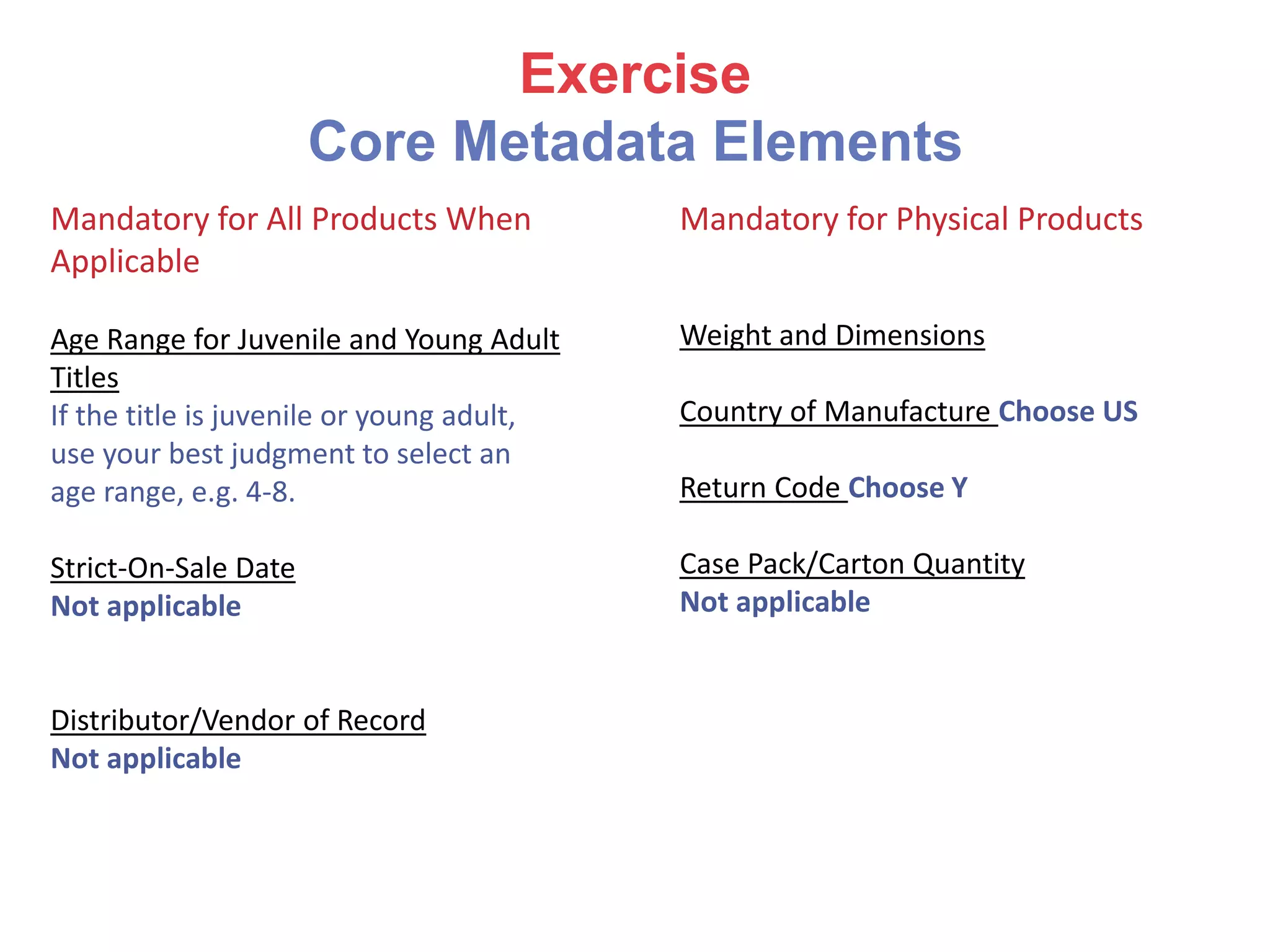
The 2nd edition of The
Metadata Handbook Is
coming February 1!
See me for a discount
code for the new book
and for DBW-U Metadata
Courses.
Thanks for attending!
If you think of questions later, you can reach me at
reneeregister@datacurate.com.

Creating Metadata That Works

  • 2.
    Topics Covered inToday’s Workshop • What is metadata? • Metadata in the virtual marketplace • Metadata for books • Who decides which metadata elements are needed? • Core metadata elements • Metadata in the publishing workflow • Distributing metadata • The metadata lifecycle • Metadata in ONIX • Content analysis and metadata creation • What makes metadata work in the virtual marketplace?
  • 3.
    What is metadata? Atit’s most basic, metadata is the set of elements we’ve decided are needed to describe a “thing” and how these elements are formatted, delivered, and shown to people who are interested in the “thing.” Metadata can describe almost anything. Additional viewing (Video): What is metadata? (5 minutes)
  • 4.
    What is metadata? Metadatadescribes a product or a piece of content. It is the “language” used to communicate information needed for commerce. Every industry uses metadata and it’s especially important in today’s virtual marketplace. You use it every day, most of the time without realizing it. Once you start looking for it, you see it everywhere!
  • 5.
  • 6.
    Color Selections inAqua/Turquoise (2 of 19 Total in “Standard” “Latex”)
  • 7.
    Product Screen (Built froma product record) If any of the elements we used to select this paint were missing from the Product Record, it would not have appeared in our search results!
  • 8.
  • 9.
  • 10.
    Metadata for describingtelevision shows
  • 11.
  • 12.
    Take about fiveminutes to search for a non-book item on the website of your choice. Make a list of the metadata elements you identify as you search. Exercise
  • 13.
    Metadata for BooksShould Include: • Information about the book as a product − format, packaging, etc. • Identify some elements that describe format, packaging, and other product details • Information about the book’s content • Identify some elements that describe a book’s content • Information needed to buy and sell the book • Identify some elements needed to buy and sell books
  • 14.
    Book Metadata ThatWorks Supports search, discovery, and commerce • Accurately describes the product (format, number of items, etc. • Fully describes the content (Title, Author, Summary, Subjects …) • Provides all information needed for commerce (ISBN, Price, On-Sale Date, Territorial Rights …) Helps a book stand out in the marketplace • Supplies evaluative metadata (Reviews, Awards …) • Provides information about the author (Author biographies, Author Awards ...) • Adds any other information that adds value or supports search (Videos, Book Tour Information, Interviews, Tables of content, etc.)
  • 15.
    Who Decides WhichMetadata Elements are Necessary? The publishing industry decides through committees that define and publish “best practices.” The Book Industry Study Group’s (BISG) Metadata Committee, comprised of representatives from all aspects publishing and bookselling, meets regularly to arrive at consensus on best practices and BISG publishes free documentation.
  • 16.
    Core Metadata Elements FromBISG’s Best Practices for Product Metadata Mandatory for All Products  Product Identifier (ISBN 13/GTIN 13/EAN 13)  Title  Contributor(s)  Publisher/Imprint/Brand Name  Publication Date  Subject(s)  Language(s) of Product Content  Product Form (Format, Binding, Packaging, Digital Information)  Page Count/Running Time/Extent  Intended Audience for Product  Textual Description of Content  Price  Digital Image of Product  Publisher Proprietary Discount Code  Publisher Status Code  Product Availability Code  Territorial Rights Mandatory for All Products When Applicable  Age Range for Juvenile and YA Titles  Strict-On-Sale Date  Distributor/Vendor of Record Mandatory for Physical Products  Weight and Dimensions  Country of Manufacture  Return Code  Case Pack/Carton Quantity Mandatory for Digital Products When Applicable  DRM/Usage Constraints  Required Software/Hardware Information
  • 17.
    Highly Recommended MetadataElements From BISG’s Best Practices for Product Metadata Highly Recommended for All Products When Applicable  Series/Set  Edition  Contributor Biography  Contributor Country Code  Prizes and Awards  Related Products To stand out in the marketplace include:  All the core and highly recommended data elements  Reviews  Tables of contents for non-fiction  Author interviews and touring schedules  Video content  Any other information that adds value and promotes reader engagement
  • 18.
    Take about 10minutes to search or browse books on at least two bookseller or publisher websites. Click on individual book records, and be sure to scroll all the way to the bottom of the record as you look for metadata elements. Do you find most of the core and recommended metadata elements? How about additional metadata that helps a title stand out in the marketplace? Exercise
  • 19.
    Metadata in Publishing Workflow Exercise List2 metadata elements that might be created, added, or collected at each of these points in the publication process. How does it work in your organization?
  • 20.
    Distributing Metadata Book metadatais: • initially created by the publisher (or author in the case of self- published books). • Shared with trading partners • Name some common receivers of publisher metadata. • Usually first distributed in advance of publication. • How far in advance do most receivers want metadata? • Updated as needed pre- and post-publication. • Name some reasons metadata might need to be updated. • Used to populate bookseller sites and drives behind-the-scenes discovery algorithms, commerce, and transactional activities.
  • 21.
    Who creates anduses metadata? The Metadata Lifecycle
  • 22.
    How is MetadataDistributed? Standards for the Internet Age • E-commerce requires metadata to be distributed electronically. • It’s important that metadata files are structured using a standard format so they can be transmitted, received, and accurately interpreted across multiple business systems, platforms, and websites. • Whereas HTML (Hypertext Markup Language) is designed to display data on the Web, XML (Extensible Markup Language) is designed to store and transport data. • The XML-based ONIX standard was introduced in 2000 and is now the international standard for communicating book trade information. ONIX 3.0 was released in 2009, with changes and expansions designed to support digital content needs.
  • 23.
    Creating Metadata inONIX ONIX isn’t metadata − it’s a structured carrier for metadata. Metadata (information about the book – content, product, and commerce information) can be contained and distributed in the ONIX format. Using XML, ONIX provides standard names (tags) for metadata elements and codes to stand in for some elements, allowing us to share metadata in a way that can be correctly interpreted and displayed to users by multiple systems.
  • 24.
    ONIX Example Here’s partof an ONIX record containing metadata elements you’ll recognize. <ProductIdentifier> <ProductIDType>15</ProductIDType> <IDValue>9780985828806</IDValue> </ProductIdentifier> <Title> <TitleType>01</TitleType> <TitleText>The Metadata Handbook</TitleText> <TitlePrefix>The</TitlePrefix> <TitleWithoutPrefix>Metadata Handbook</TitleWithoutPrefix> <Subtitle>A Book Publisher's Guide to Creating and Distributing Metadata for Print and Ebooks</Subtitle> </Title> <Contributor> <SequenceNumber>1</SequenceNum ber> <ContributorRole>A01</ContributorRo le> <PersonName>Renée Register</PersonName> <PersonNameInverted>Register, Renée</PersonNameInverted> <NamesBeforeKey>Renée</NamesBefo reKey> <KeyNames>Register</KeyNames> </Contributor> <Contributor> 15 = ISBN BC = PBK. A01 = Author 1 = list first 01 = Main Title
  • 25.
  • 26.
    ONIX Example </Imprint> <Publisher> <PublishingRole>01</PublishingRole> <PublisherName>DataCurate</Publish erName> </Publisher> <OtherText> <TextTypeCode>01</TextTypeCode> <TextFormat>02</TextFormat> <Text>An essentialresource for 21st century publishing, The Metadata Handbook is a one-stop guide for publishers -- large, small, and independent. </Text> <PublicationDate>20121126</Publicati onDate> <YearFirstPublished>2012</YearFirstPu blished> <SalesRights> <SalesRightsType>01</SalesRightsType > <RightsTerritory>WORLD</RightsTerrit ory> <Price> <PriceTypeCode>01</PriceTypeCode> <PriceAmount>125.00</PriceAmount> <CurrencyCode>USD</CurrencyCode>
  • 27.
  • 28.
    Exercise – AnalyzingContent Core Metadata Elements Mandatory for All Products Product Identifier/ISBN Title Subtitle (if applicable) Publisher Contributor 1 (and role, e.g. author, editor, etc.) Contributor 2 (and role) Imprint (if applicable) Publication Date Subject(s) Express subjects in your own words. Language(s) of Product Content Page Count/Running Time/Extent
  • 29.
    Intended Audience forProduct (ONIX Code) Choose One Common codes: 01 – General/Trade 02 – Children/Juvenile 03 – Young Adult Textual Description of Content Write a one or two sentence description. Price Digital Image of Product Not applicable Publisher Proprietary Discount Code Not applicable Publisher Status Code Choose 04 Common codes: 01 – Cancelled 02 – Forthcoming 03 – Postponed indefinitely 04 – Active Product Availability Code Choose 20 Common codes: 01 - Cancelled 10 – Not yet available 20 – Available 23 – POD (print on demand) 31 – Out of stock Territorial Rights World Exercise Core Metadata Elements Mandatory for All Products
  • 30.
    Exercise Core Metadata Elements Mandatoryfor All Products When Applicable Age Range for Juvenile and Young Adult Titles If the title is juvenile or young adult, use your best judgment to select an age range, e.g. 4-8. Strict-On-Sale Date Not applicable Distributor/Vendor of Record Not applicable Mandatory for Physical Products Weight and Dimensions Country of Manufacture Choose US Return Code Choose Y Case Pack/Carton Quantity Not applicable
  • 31.
    Exercise Highly Recommended Elements Series/Set/CollectionInformation (Series Title, Series Number) Edition Contributor Biography Contributor Country Code Prizes and Awards Related Products Not applicable Highly Recommended for All Products When Applicable Enter if information is available and applicable
  • 32.
    About Onixsuite Ace Heinle Onixsuiteis a metadata creation, correction and optimization platform. Many publishers and distributors believe that as long as their data is accepted by Amazon or other retailers, the data is “good enough,” but with Onixsuite you create excellent metadata that improves not only your sales but also your margins. It also improves user experience across your systems and the web, and minimizes your internal costs.
  • 33.
    About Onixsuite Ace Heinle Onixsuiteis available as a stand-alone tool for creating and sending out ONIX, but if you already have a solution you can use Onixsuite as a cleaning filter on top of other systems and use our services to clean your data and backlist. Onixsuite comes with a free website and also has custom website and eCommerce capabilities. See Ace after the workshop for more information.
  • 34.
    Exercise Entering Metadata inthe Onixsuite System http://datacurate.onixsuite.com/admin/
  • 76.
  • 77.
  • 78.
    What makes metadatawork? Powerful metadata provides a rich description of the product and meets business needs. Metadata that works supports what readers need: • A compelling and successful search and discovery experience • Content-rich information that engages readers and supports reader evaluation and selection of books • Effective and useful recommendation algorithms and website sort options (by subject, genre, audience, age level, format, etc.)
  • 79.
    What makes metadatawork? Powerful metadata provides a rich description of the product and meets business needs. Metadata that works supports the business needs of publishers and their trading partners: • A compelling search and discovery experience for customers that leads to more sales • Effective and communication between publishers and booksellers • Efficient and accurate business transactions • Support for publicity and marketing activities • Useful sales tracking and market analysis • Powerful business intelligence
  • 80.
    Metadata, Search Engines,and Search Engine Optimization Bookseller search engines (Publisher websites, Amazon, Barnes & Noble ...) These search engines are directed at bookseller databases populated by product metadata. Publishers contribute directly to this data. General search engines (Google, Yahoo, Bing …) General search engines websites over the entire Web. The completeness and quality of metadata sent to bookseller sites contributes to search results but so do many other factors relating to the website.
  • 81.
    Search Engine Optimization What’swithin your control? • Some things are beyond your control but the quality of your metadata shouldn’t be one of them. • Make sure that metadata supplied to all trading partners is as rich, complete, and accurate as possible. • While there’s no guarantee that quality metadata will result in a best seller, its absence will almost certainly guarantee its obscurity. SEO and Keywords • Good descriptive metadata is the best way to optimize for search. This includes controlled vocabularies like BISAC. • Keyword stuffing and other tricks and routinely discovered and punished by search engines. • Keywords and phrases are still important but don’t write marketing content around them. • Write with the intended audience in mind, considering the most compelling way to describe the book
  • 82.
    The Metadata Handbook: ABook Publisher’s Guide to Creating And Distributing Metadata for Print and Ebooks The 2nd edition of The Metadata Handbook Is coming February 1! See me for a discount code for the new book and for DBW-U Metadata Courses.
  • 83.
    Thanks for attending! Ifyou think of questions later, you can reach me at reneeregister@datacurate.com.

Editor's Notes

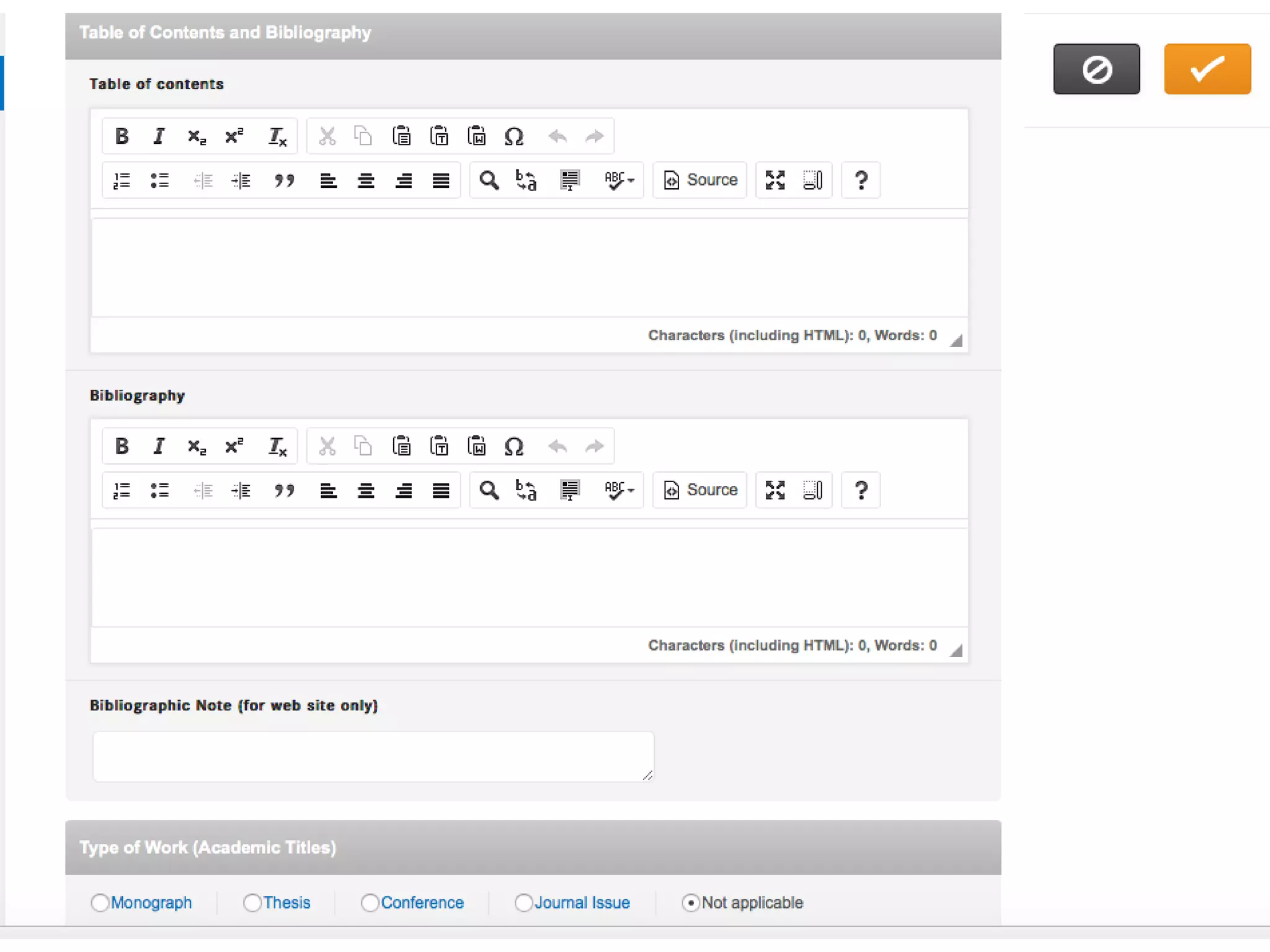
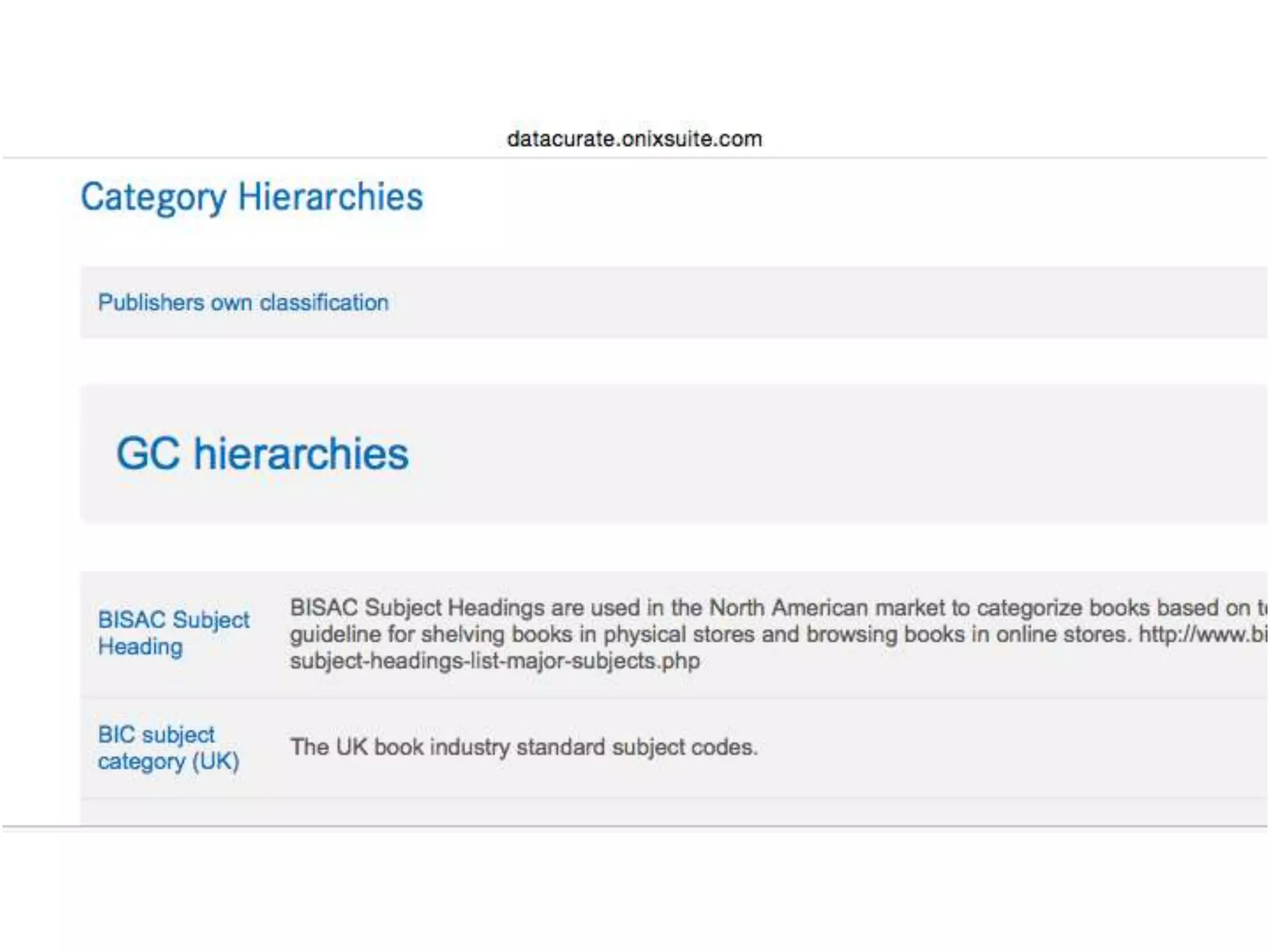
  • #6 We’ve already “drilled down” quite a bit to get to this point. We’ve chosen Shopping, Paint, Paint and Primer, Interior. These are some of the metadata elements used to describe paint. You can see that there are additional categories that could be expanded to show more metadata elements.
  • #7 What are some of the data elements here? I’ll click on the second one – Hang Ten.
  • #8 Not all may be displayed for the consumer. Some are in metadata behind the scenes to allow different types of search and drilling down. The business decides what will be displayed on the product screen.
  • #9 One more example of metadata for non-content products.
  • #12 Note the metadata elements here that are “clickable.” Again, any product record that fails to include correctly tagged elements won’t show up in the results of clicking on that element. In addition to names, the metadata behind the scenes associates a “role” with the name so that it will display correctly on website.
  • #16 Documentation was recently fully revised to reflect the need to better describe digital content. In the United States, the Book Industry Study Group (BISG) coordinates the development of best practices for the publishing community. Best Practices documentation was recently revised by the BISG Metadata Committee, comprised of representatives from all aspects of publishing and bookselling. Best Practices for Product Metadata: Guide for North American Data Senders and Receivers was published in 2014 by the Book Industry Study Group in Coordination with BookNet Canada, and is available on the BISG website.
  • #17 On your screen are the metadata elements deemed important by the industry. Many data receivers won’t accept files that don’t include the elements listed as mandatory and many are required for a valid ONIX file.
  • #18 The heart of metadata is describing our books so that readers can find them in a virtual shopping environment but also, perhaps even more importantly, so that they can engage with the book once they’re on the product page.
  • #25 Notice the codes that are used for some data elements. These are defined in ONIX and help ensure that the metadata is interpreted correctly. It’s much more reliable and efficient that using text for things like contributor role and product form since different people might express these ideas differently. On the other end, receivers can decide what visible text that want to use for the code. For example, author might be translated simply as “by,” editor as “edited by” etc.
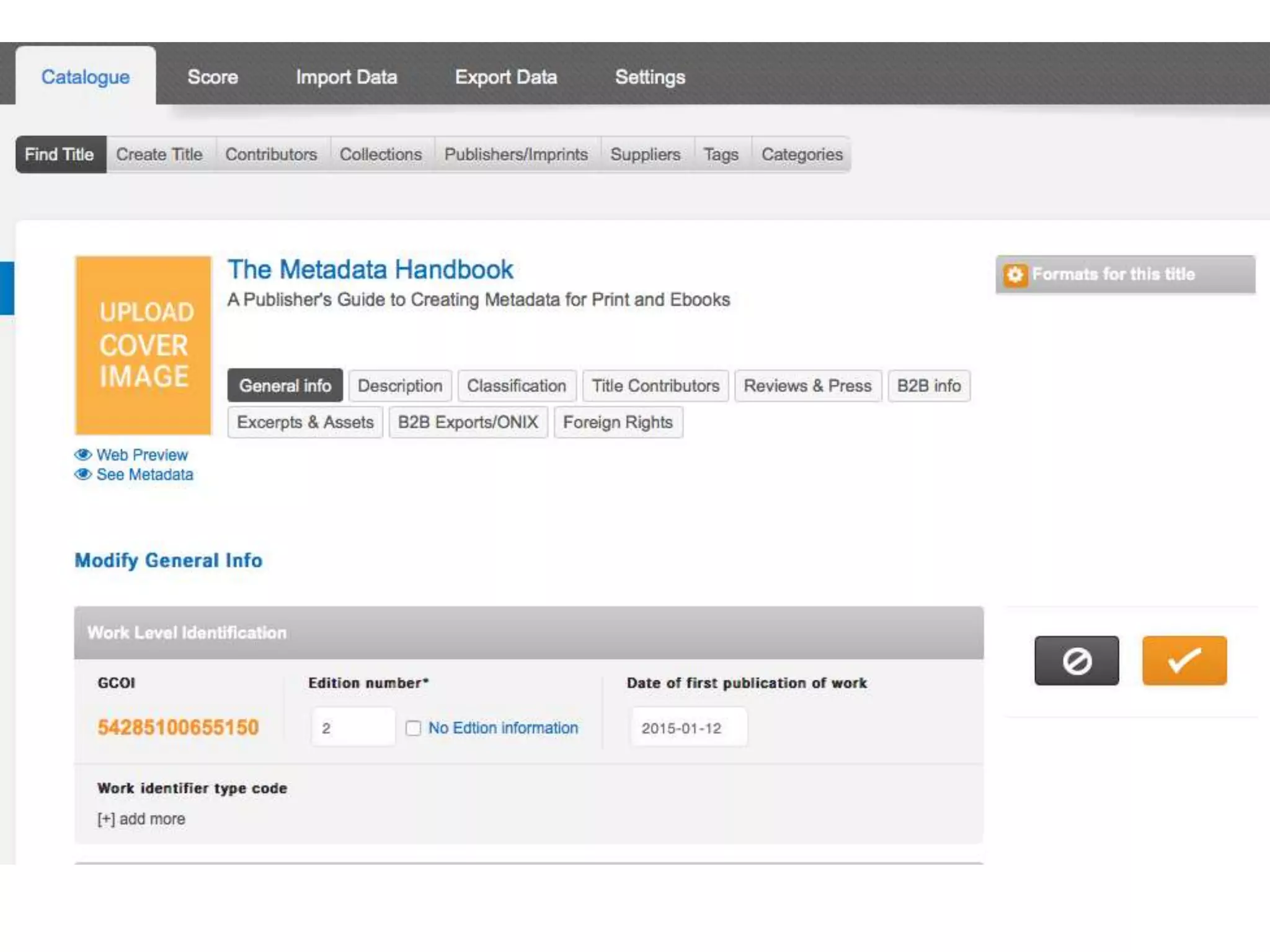
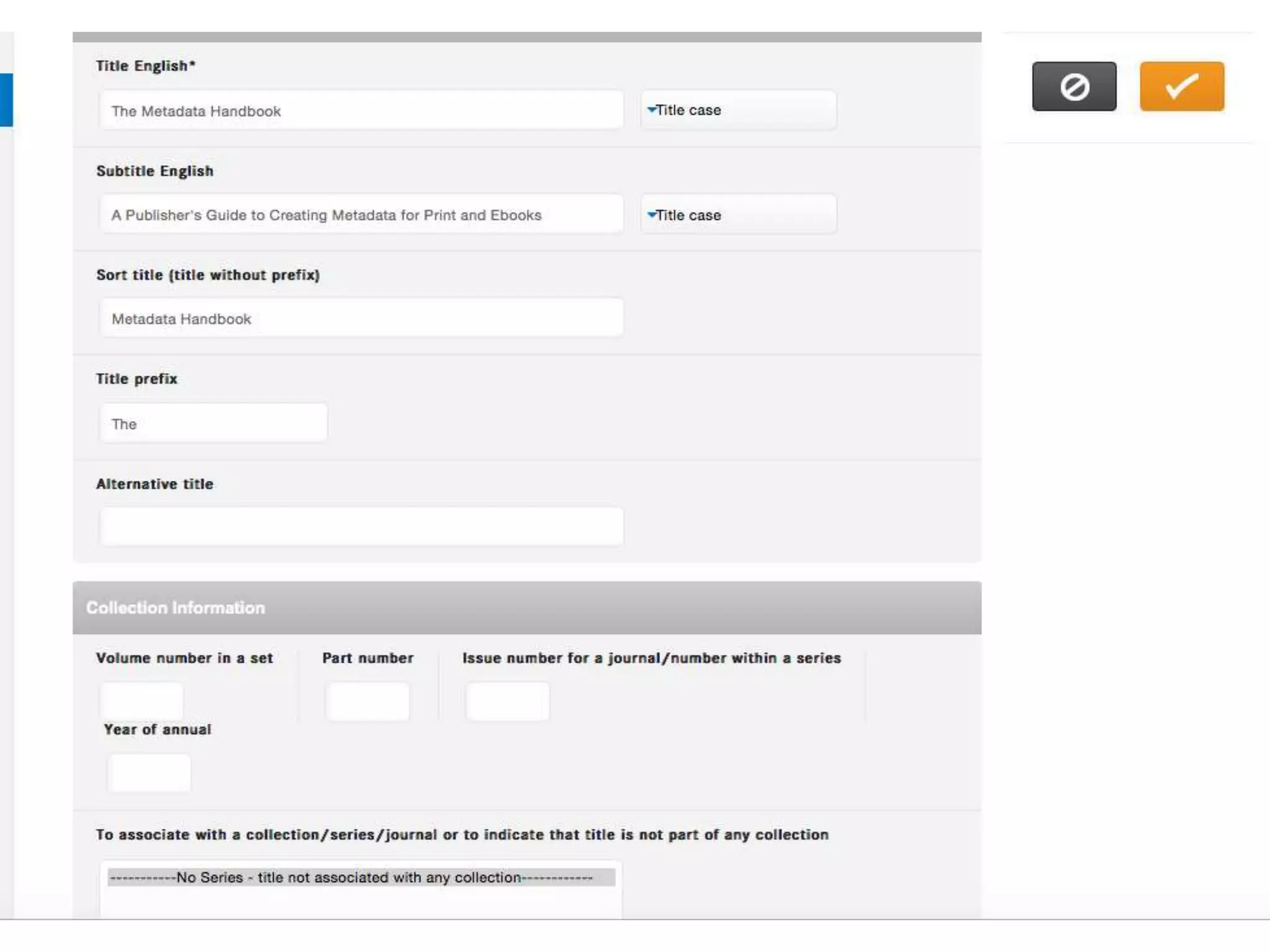
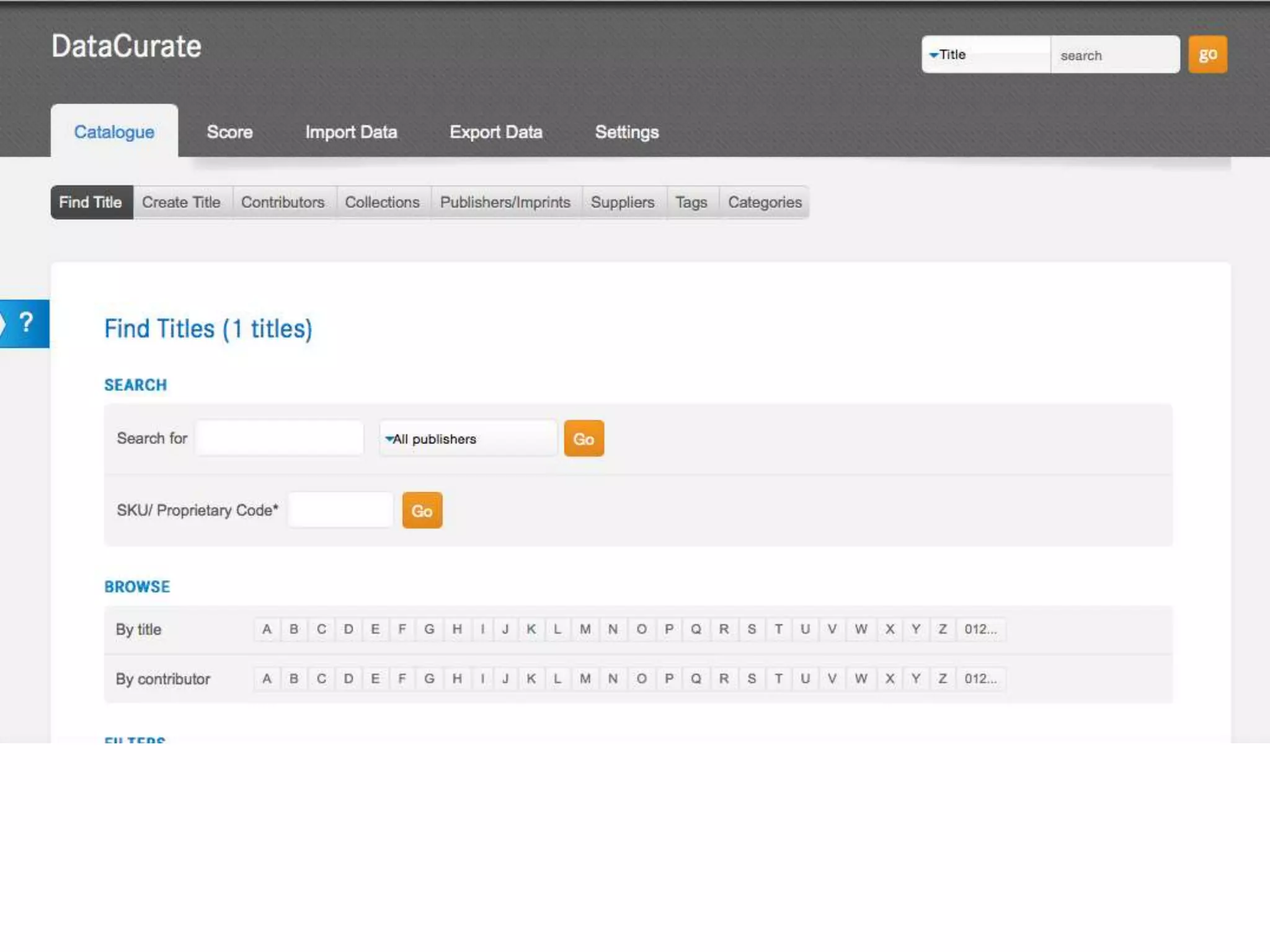
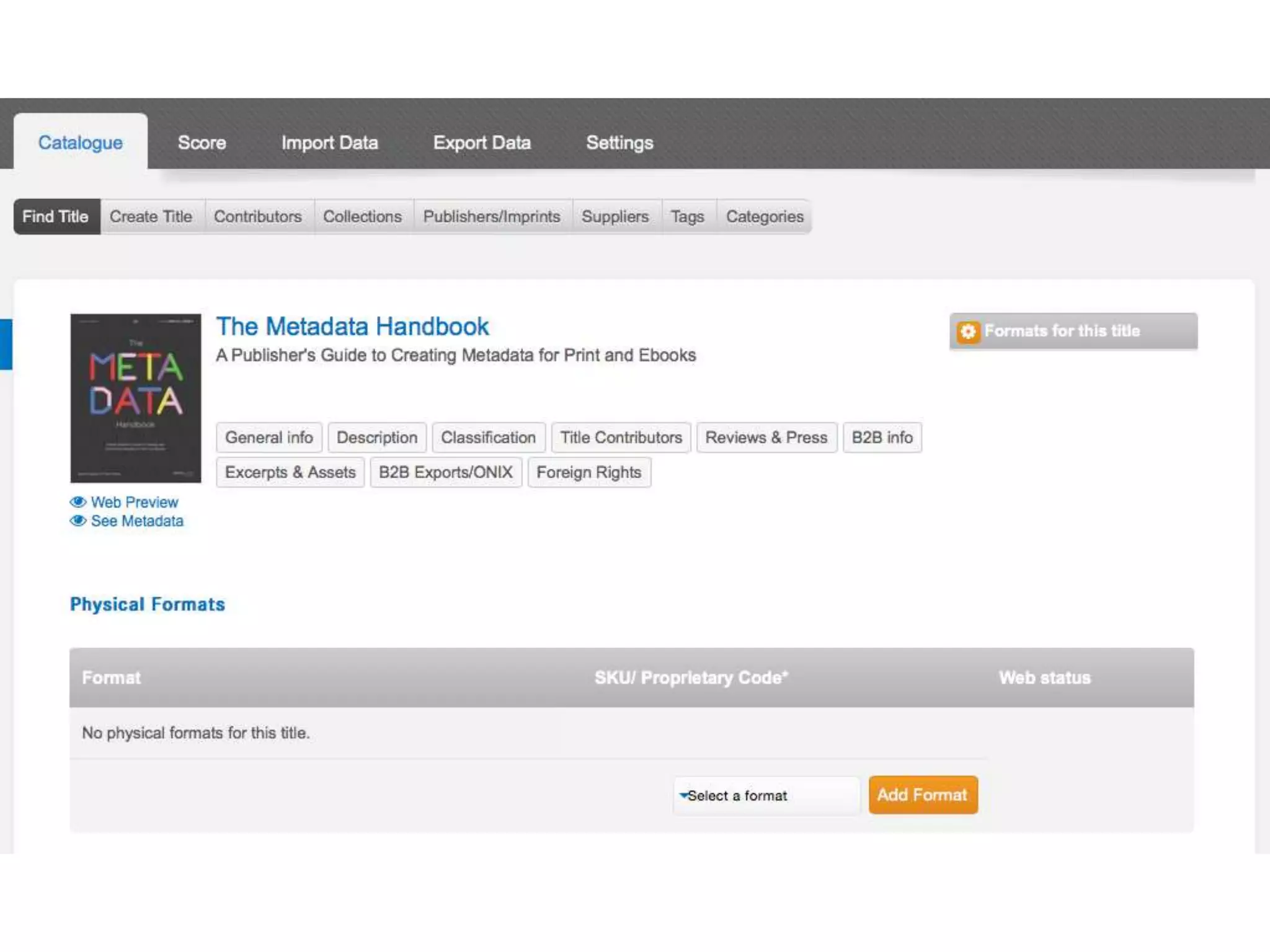
  • #36 You’ll see the “Catalogue” screen.
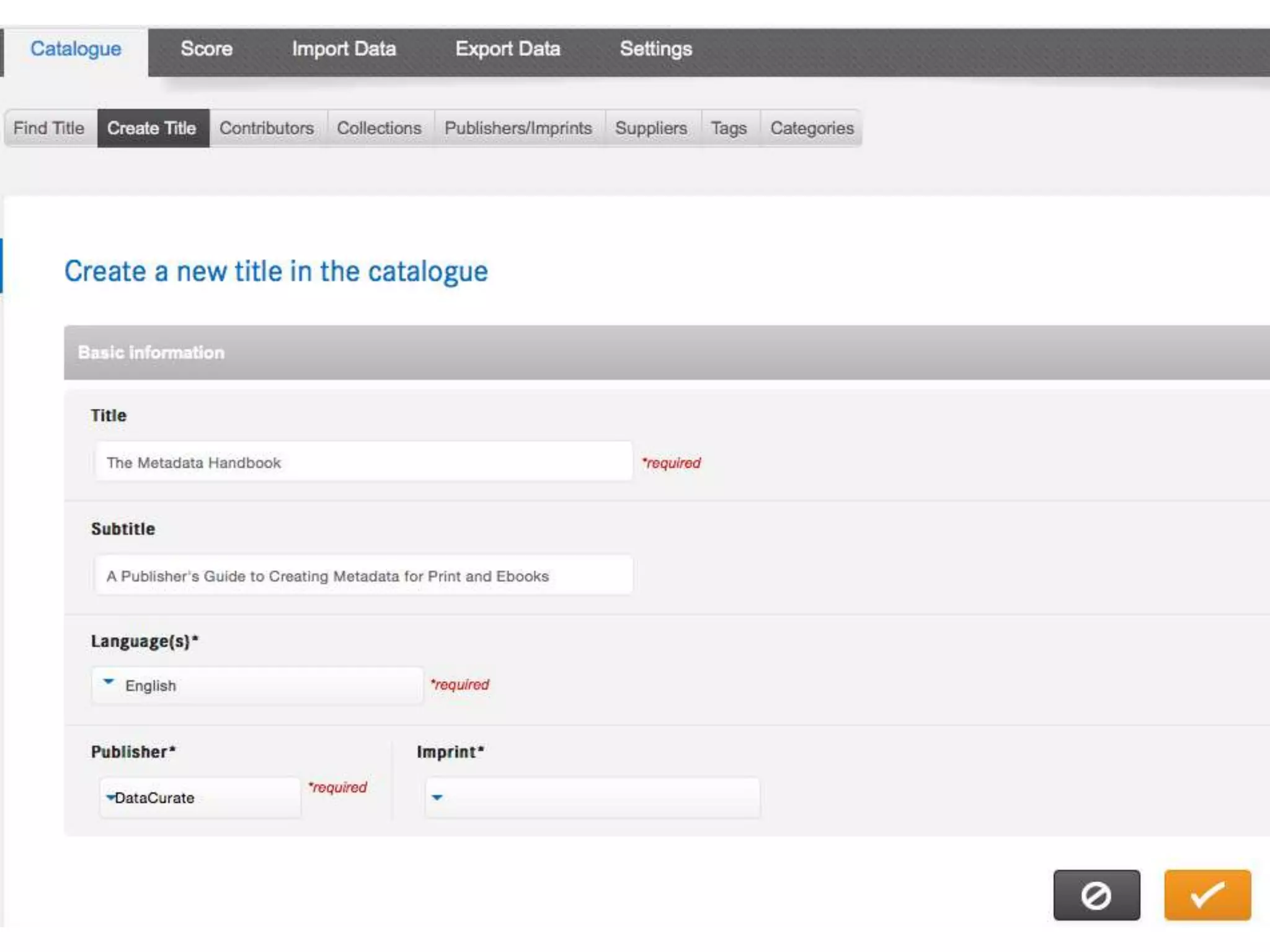
  • #37 Choose Create Title and enter the required information. Click the check box when you’re finished.
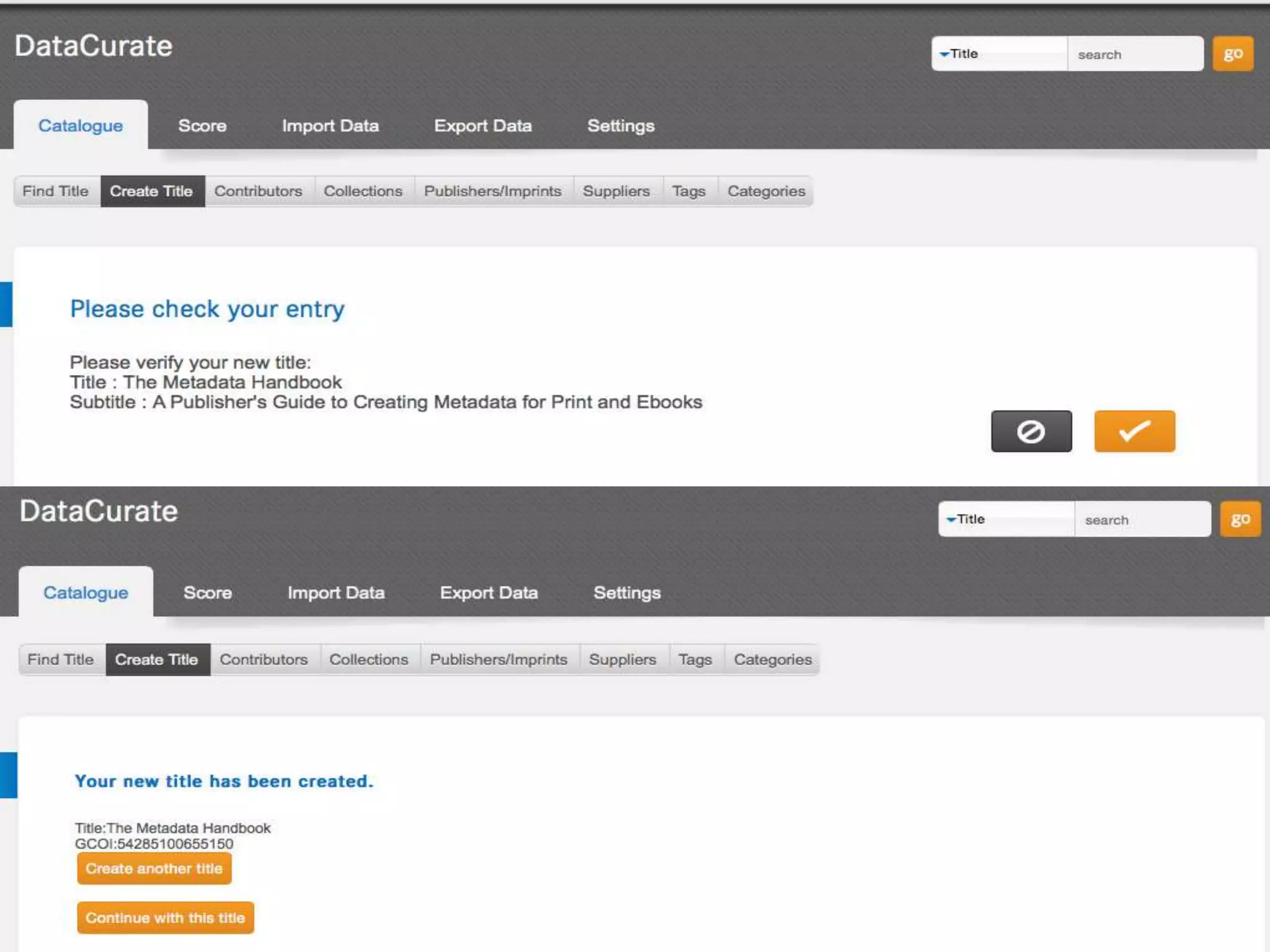
  • #38 Click Check Box if correct.
  • #39 Go to General Info
  • #40 Enter Collection (Series) Information if applicable. Series titles should be available for selection. Highlight “No series” if not applicable. You can wait to click the Checkbox until you’re done with all items in this section.
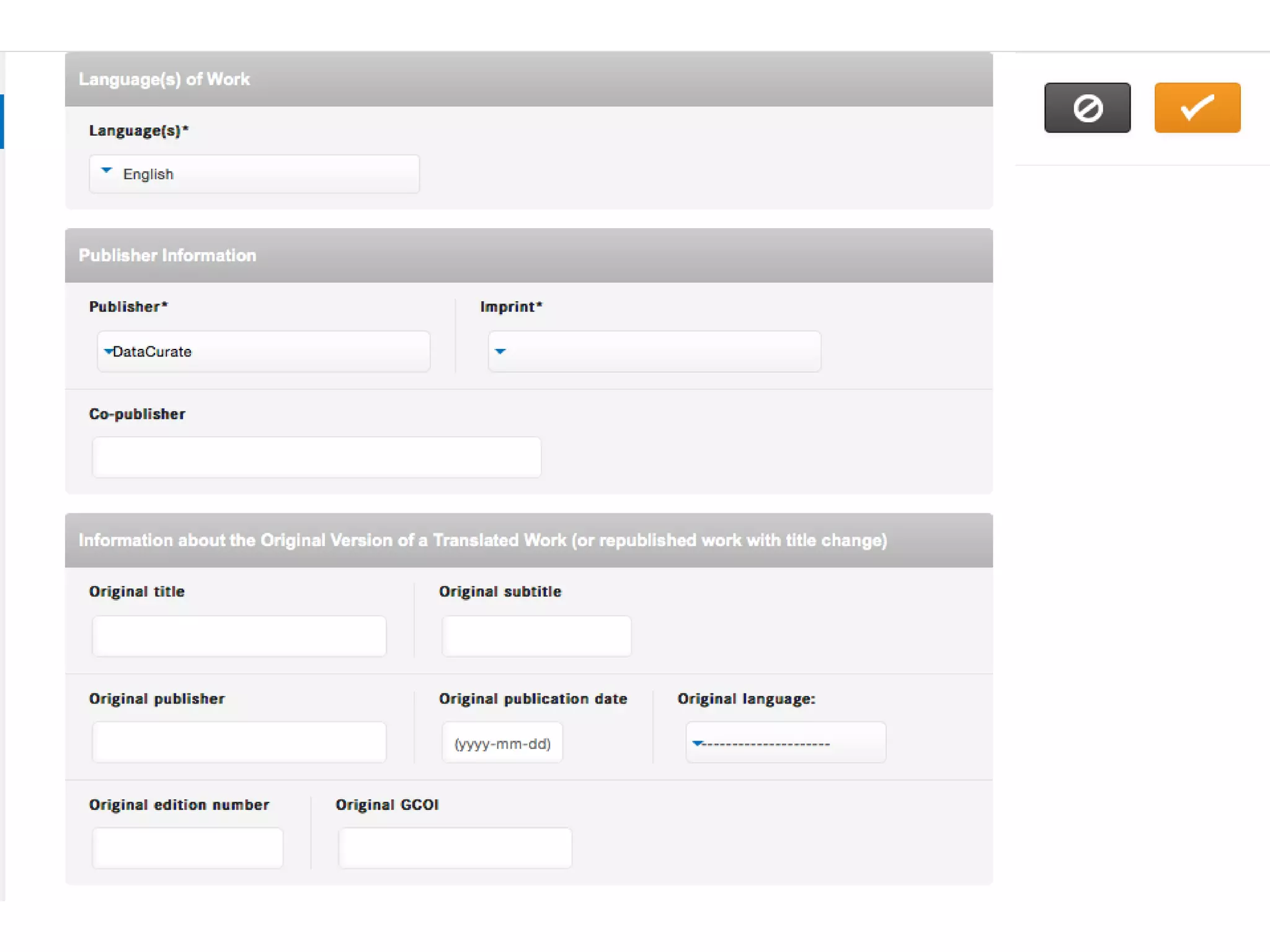
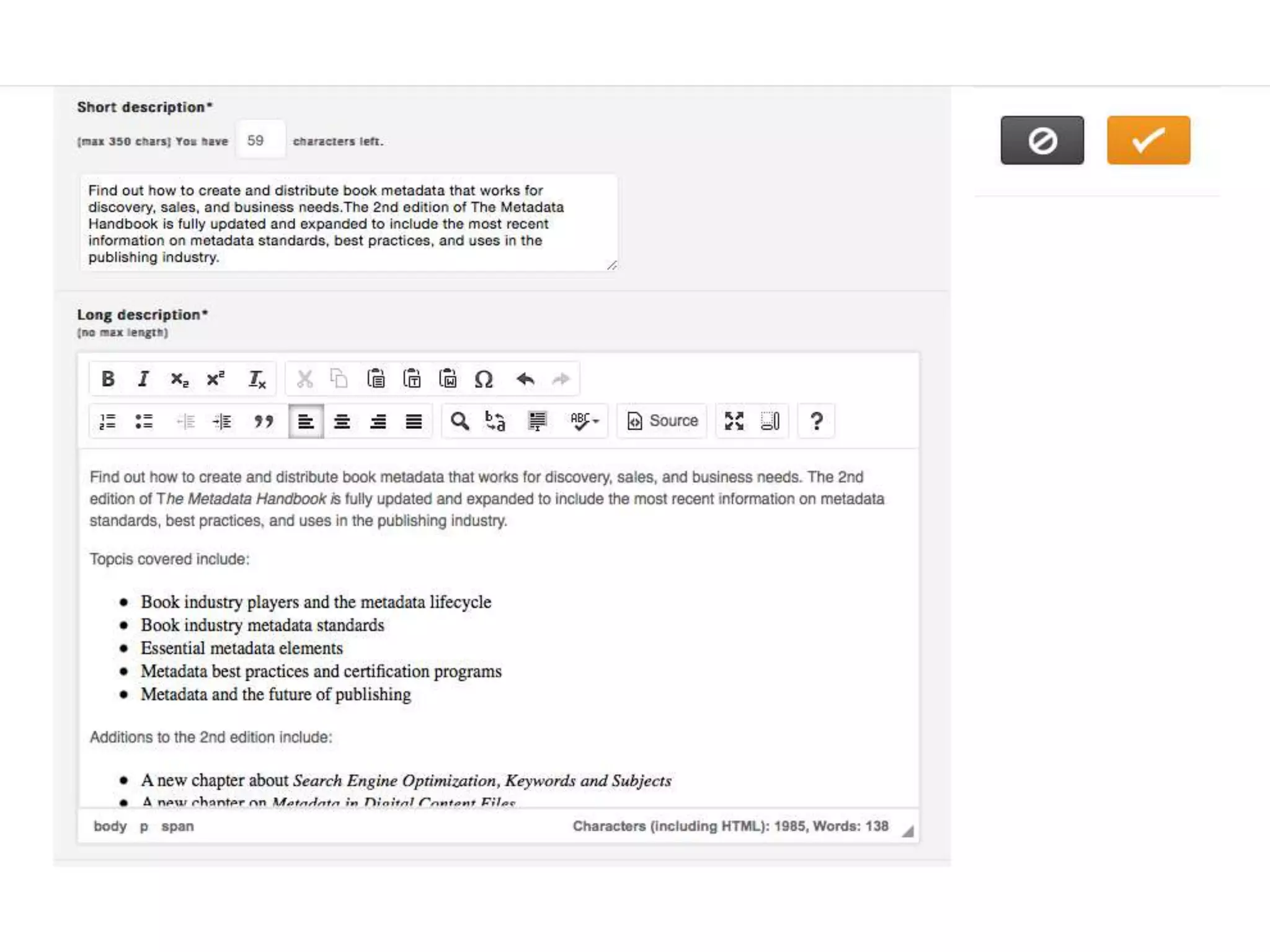
  • #41 This is already populated and none of our books need original title.
  • #42 You don’t have to enter anything here.
  • #43 Enter a brief description.
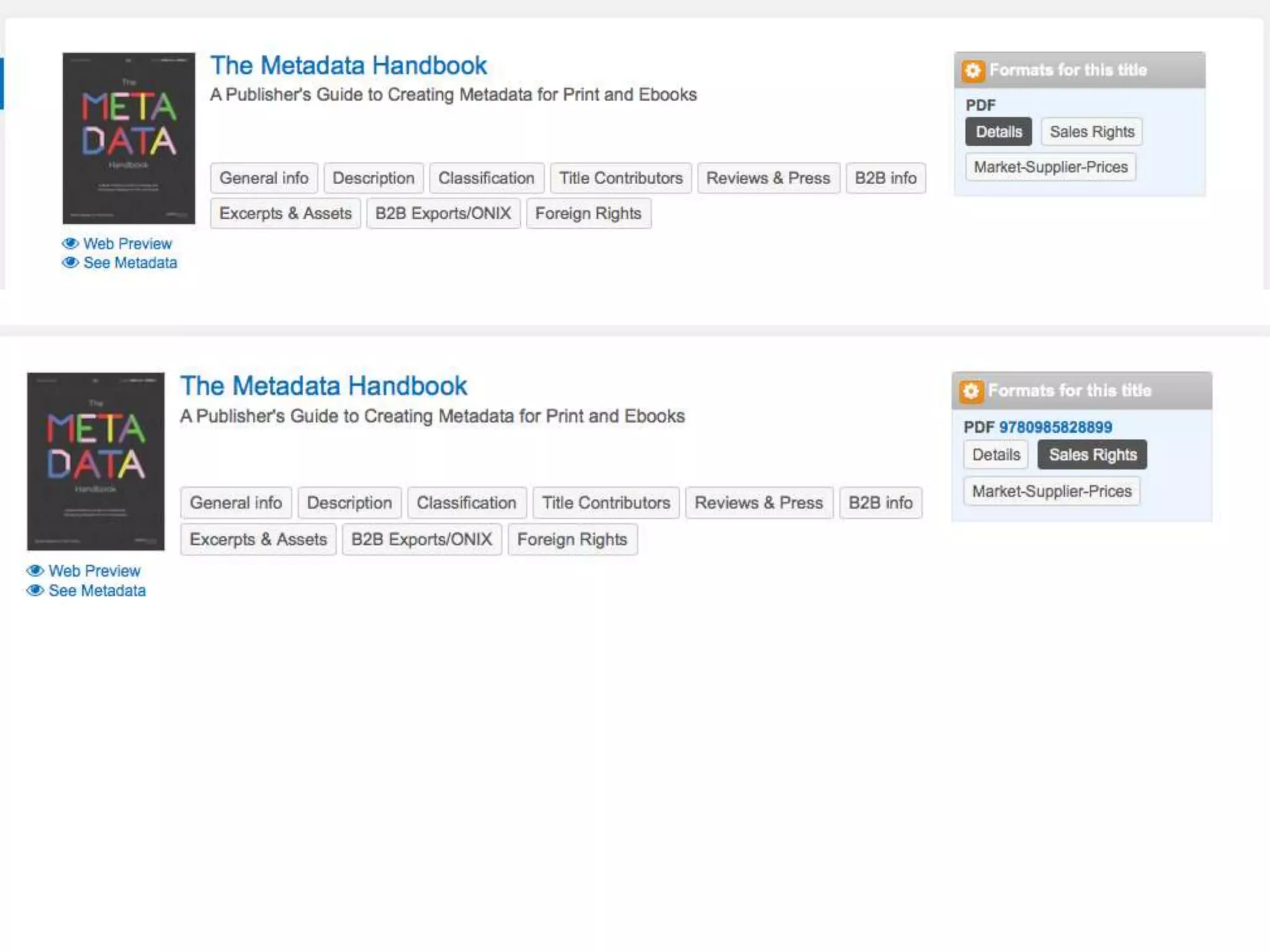
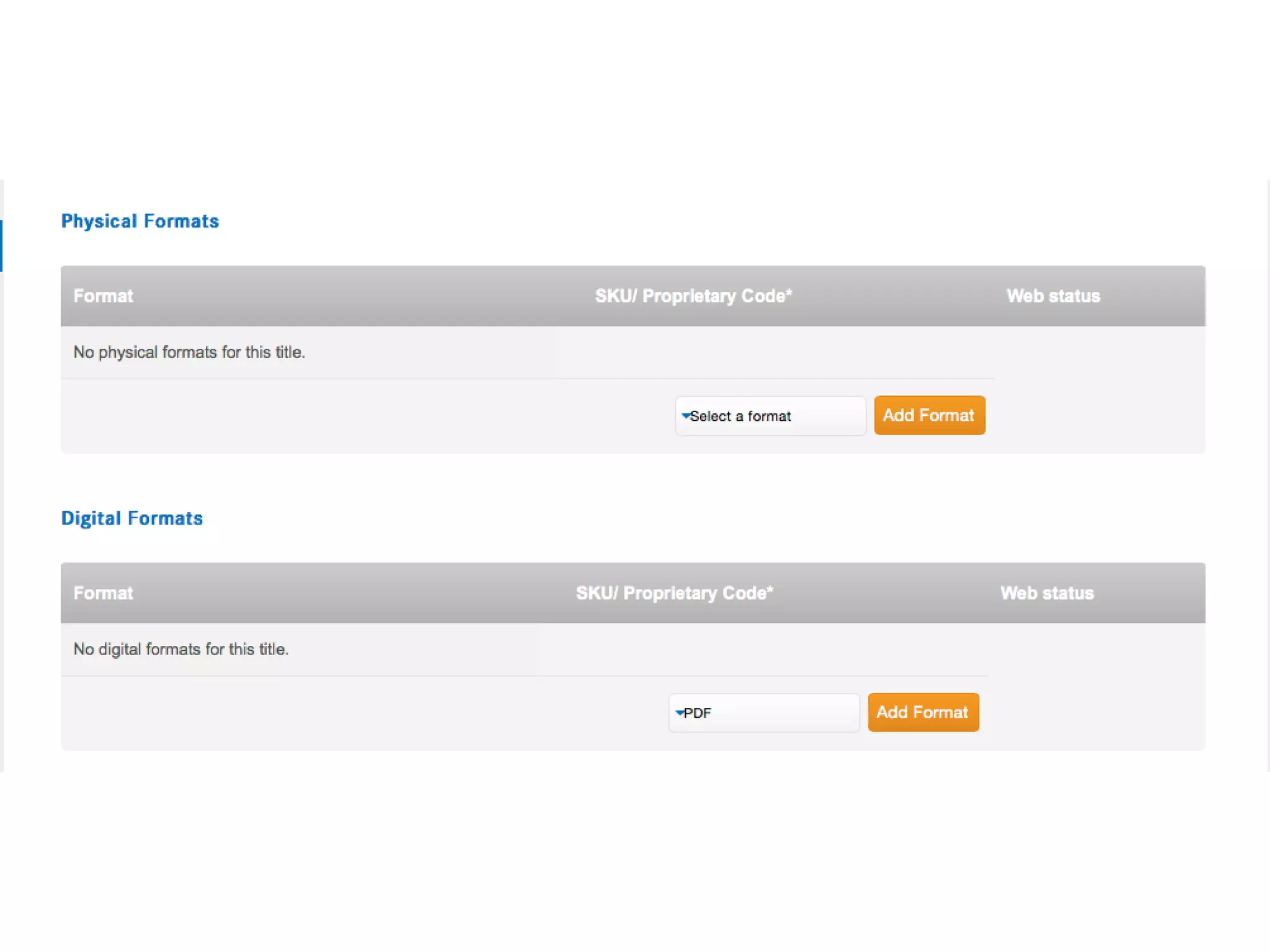
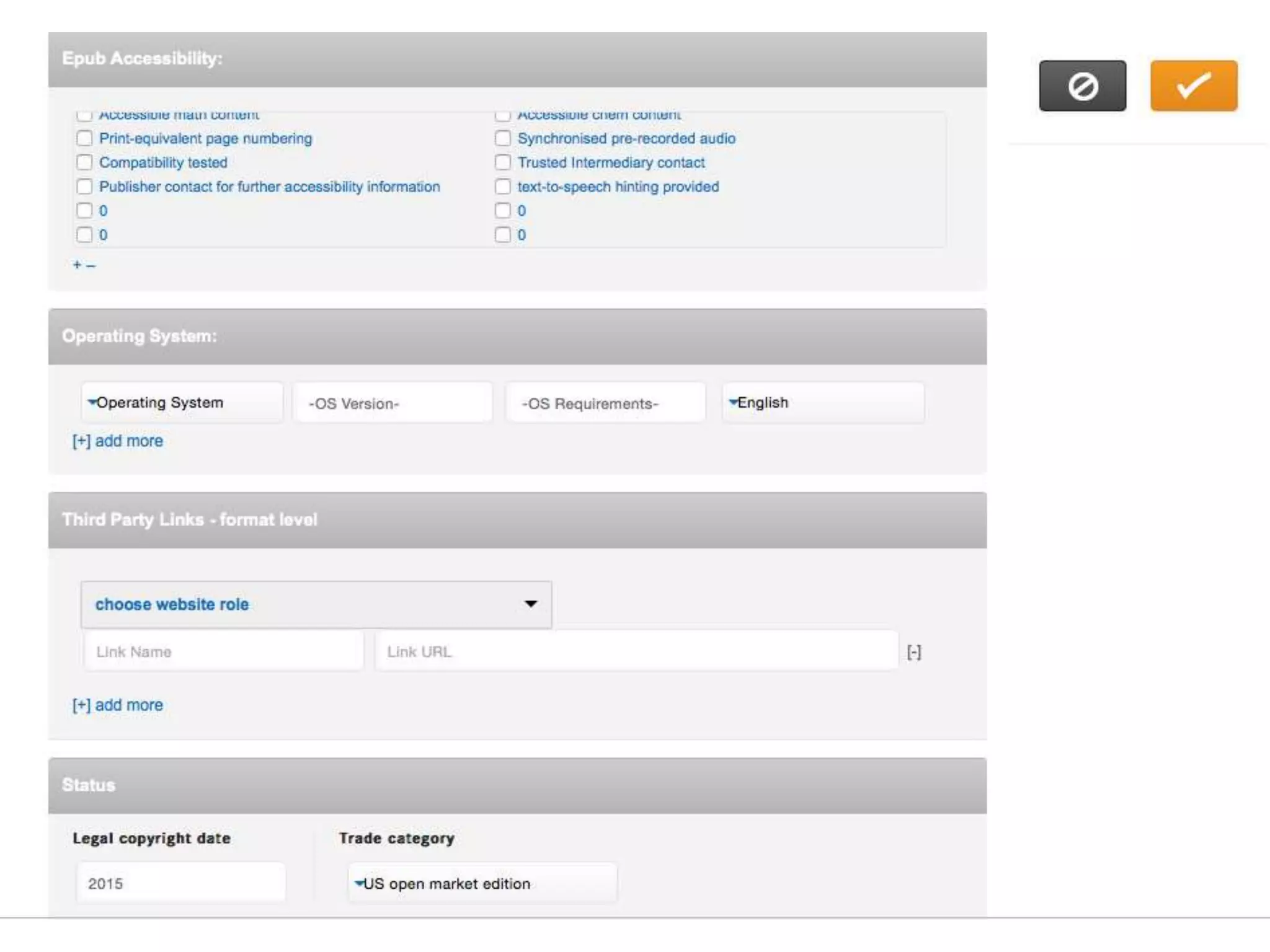
  • #45 Once you’ve finished Description, Click “Formats for this Title”. If it’s a physical book, select a format here. You’ll also notice that I added a cover image. I just uploaded from a file on my computer. You can also us a URL.
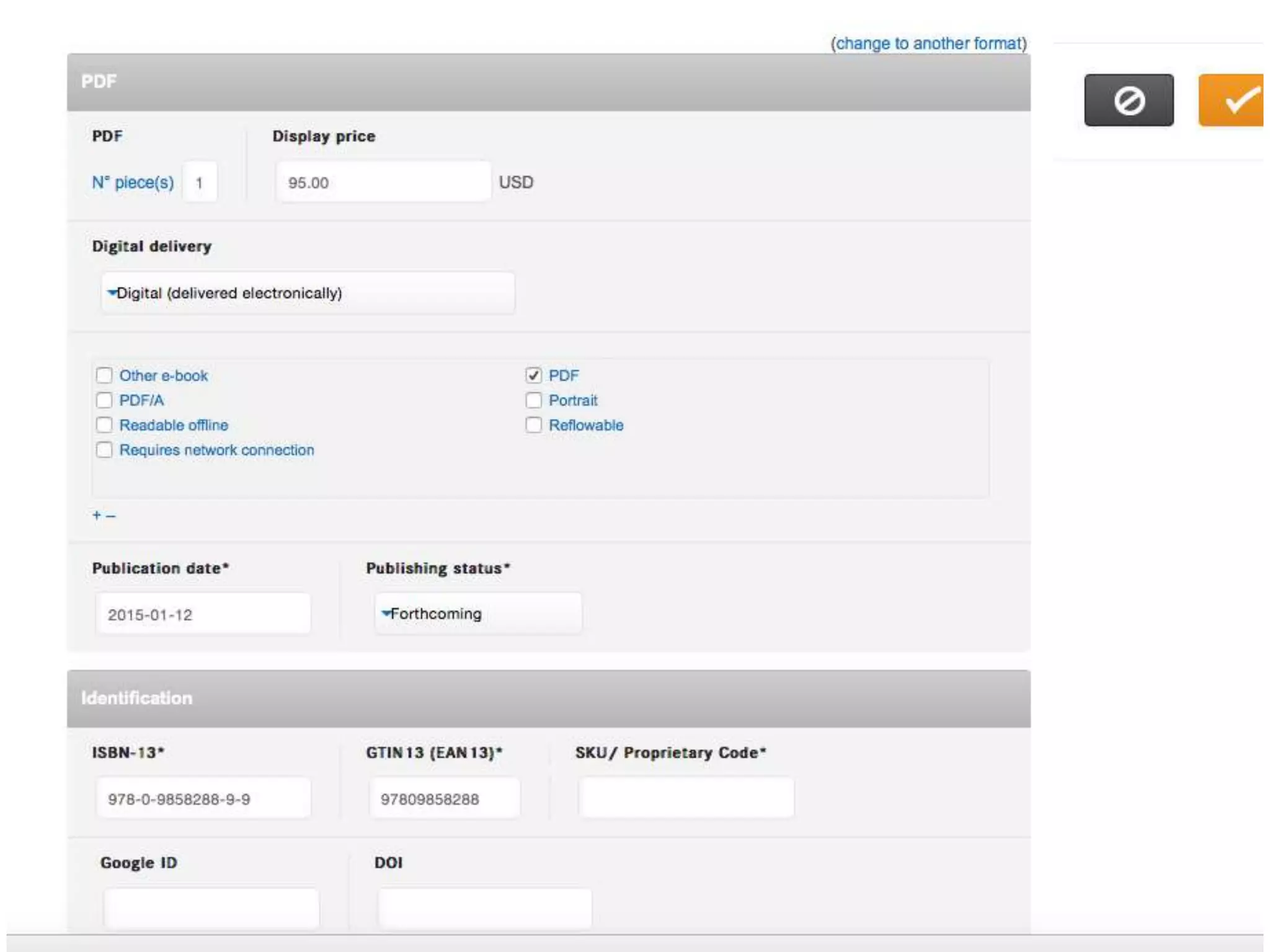
  • #46 If it’s digital, select as format. PDF is here.
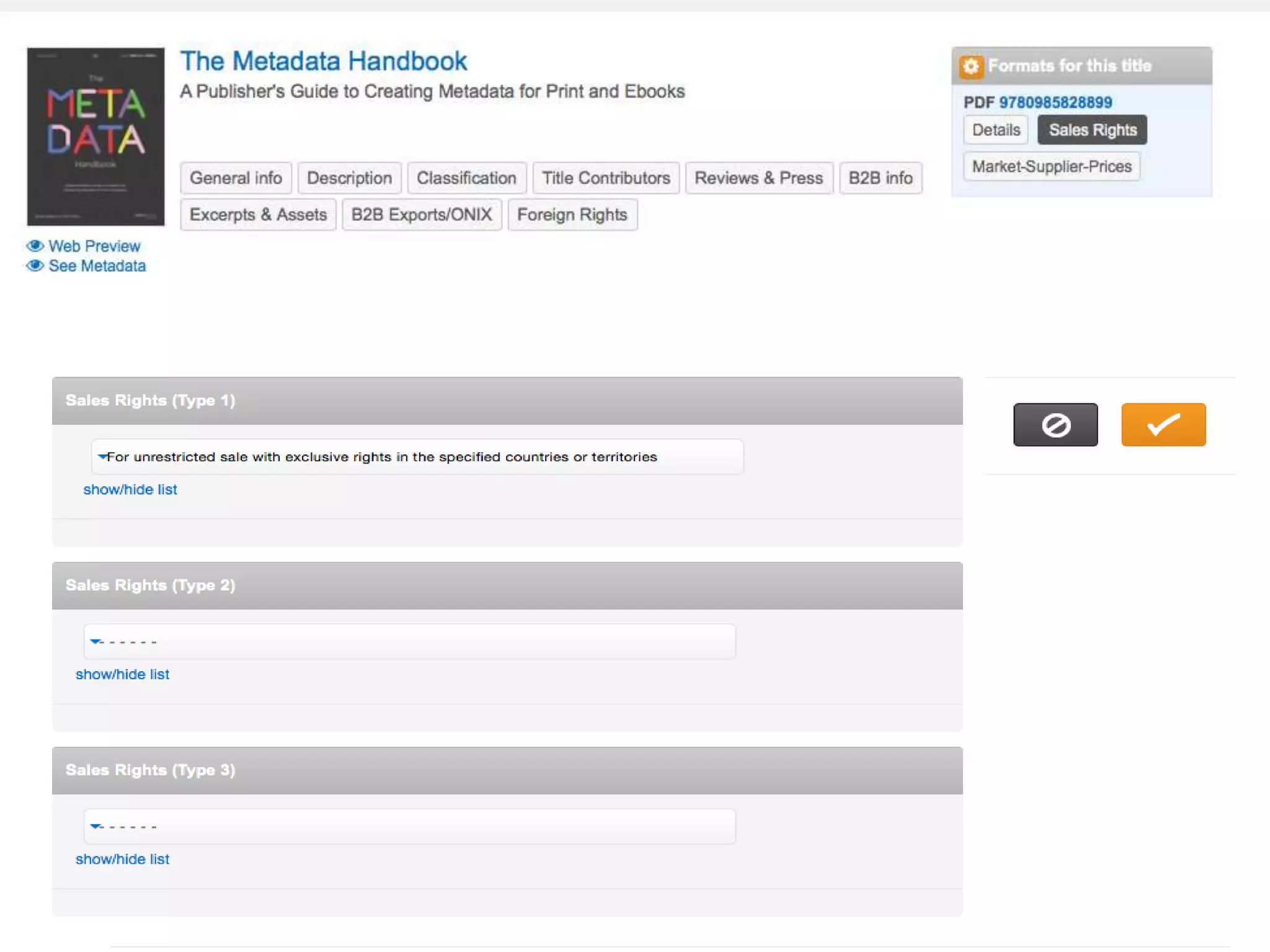
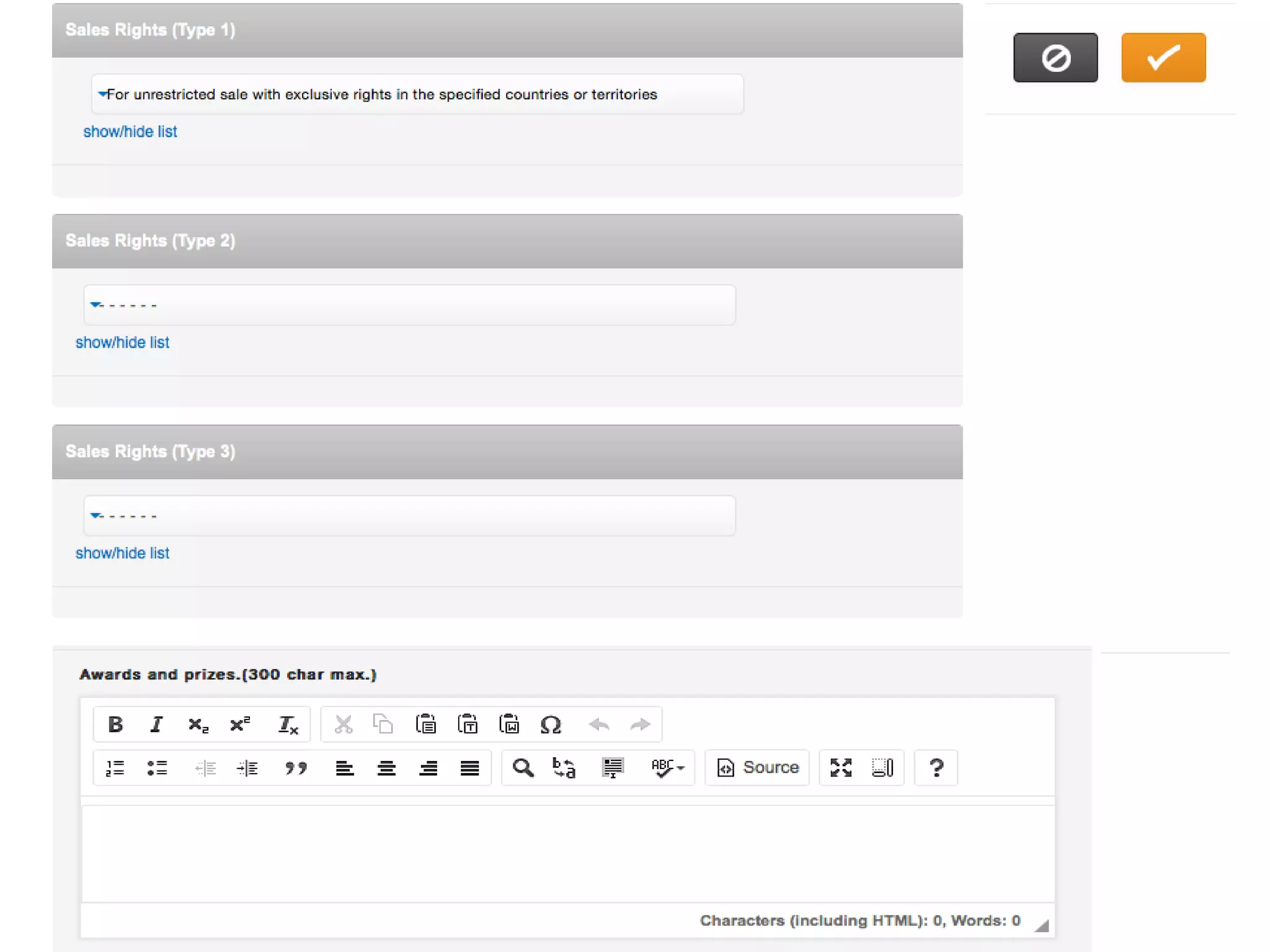
  • #51 This is the Sales Rights section under Formats for this title.
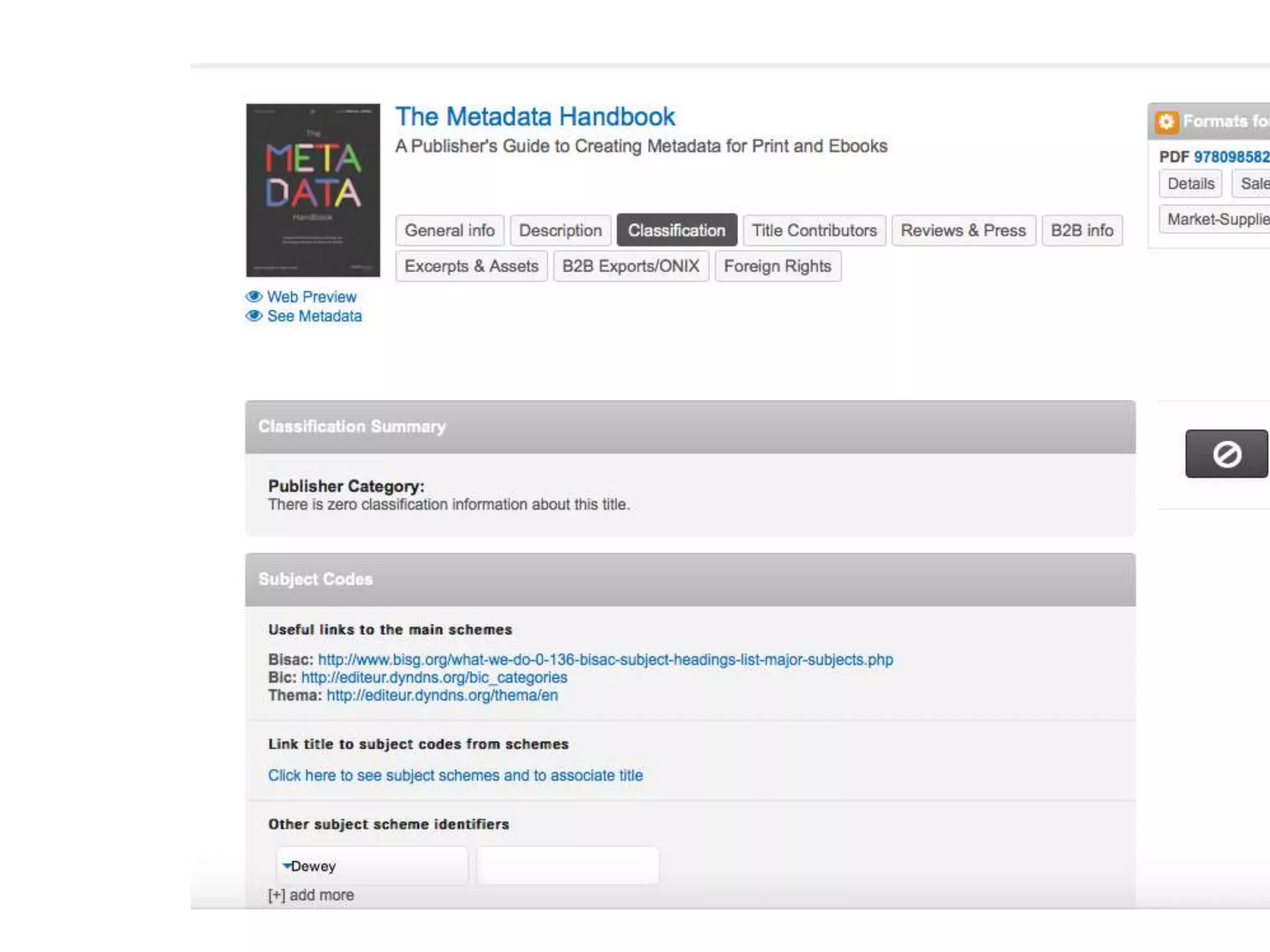
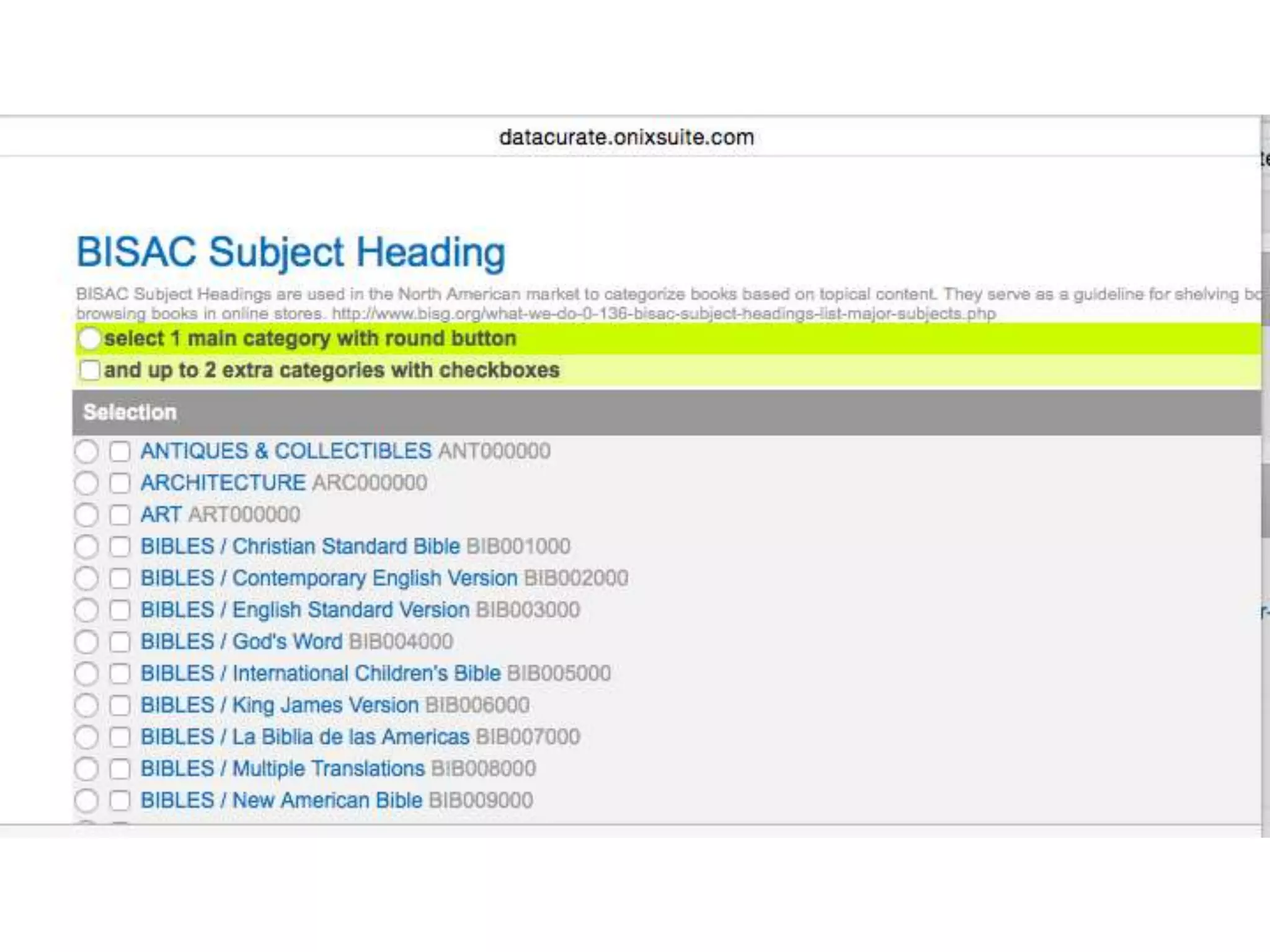
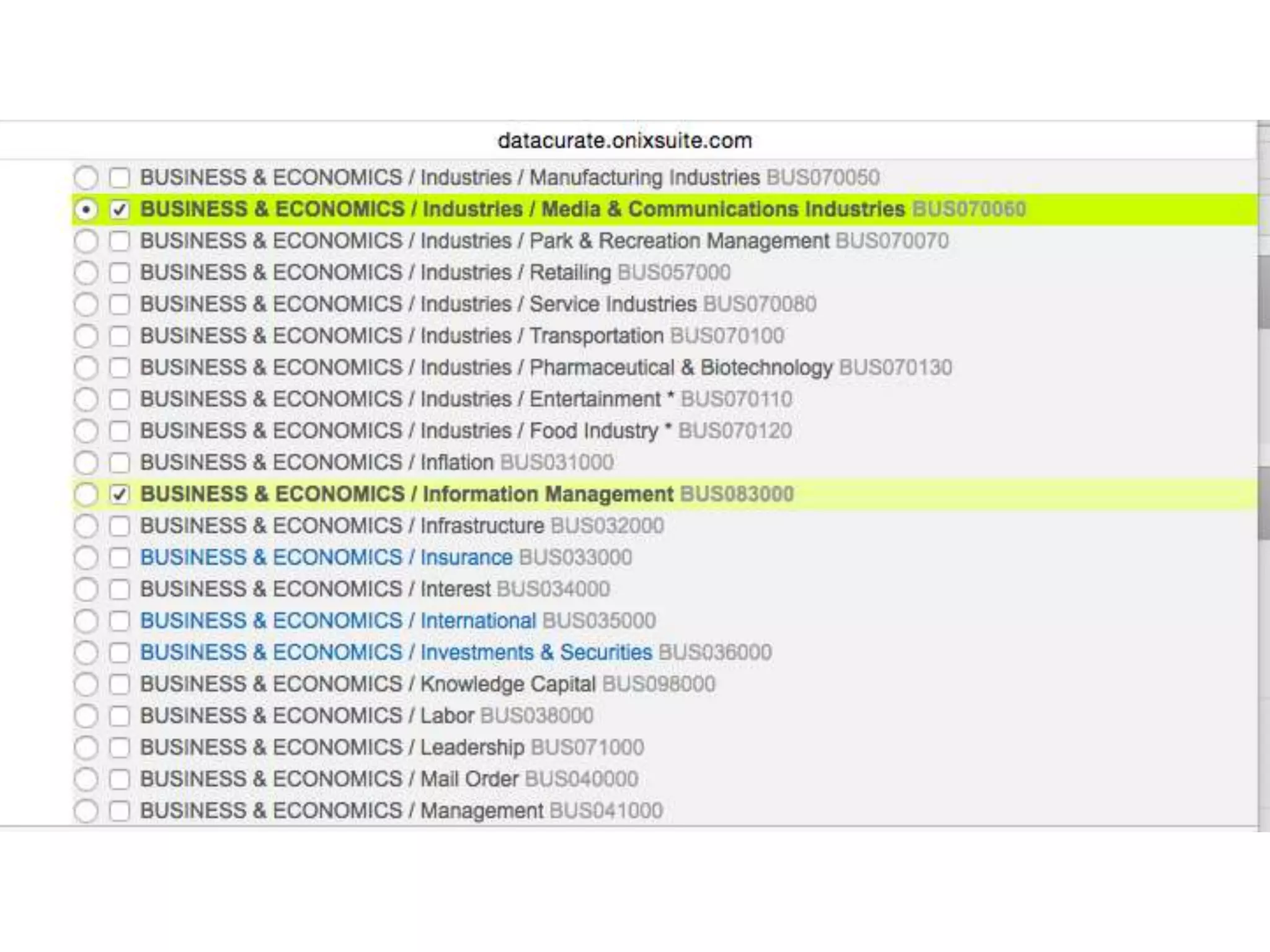
  • #53 Now click on Classification
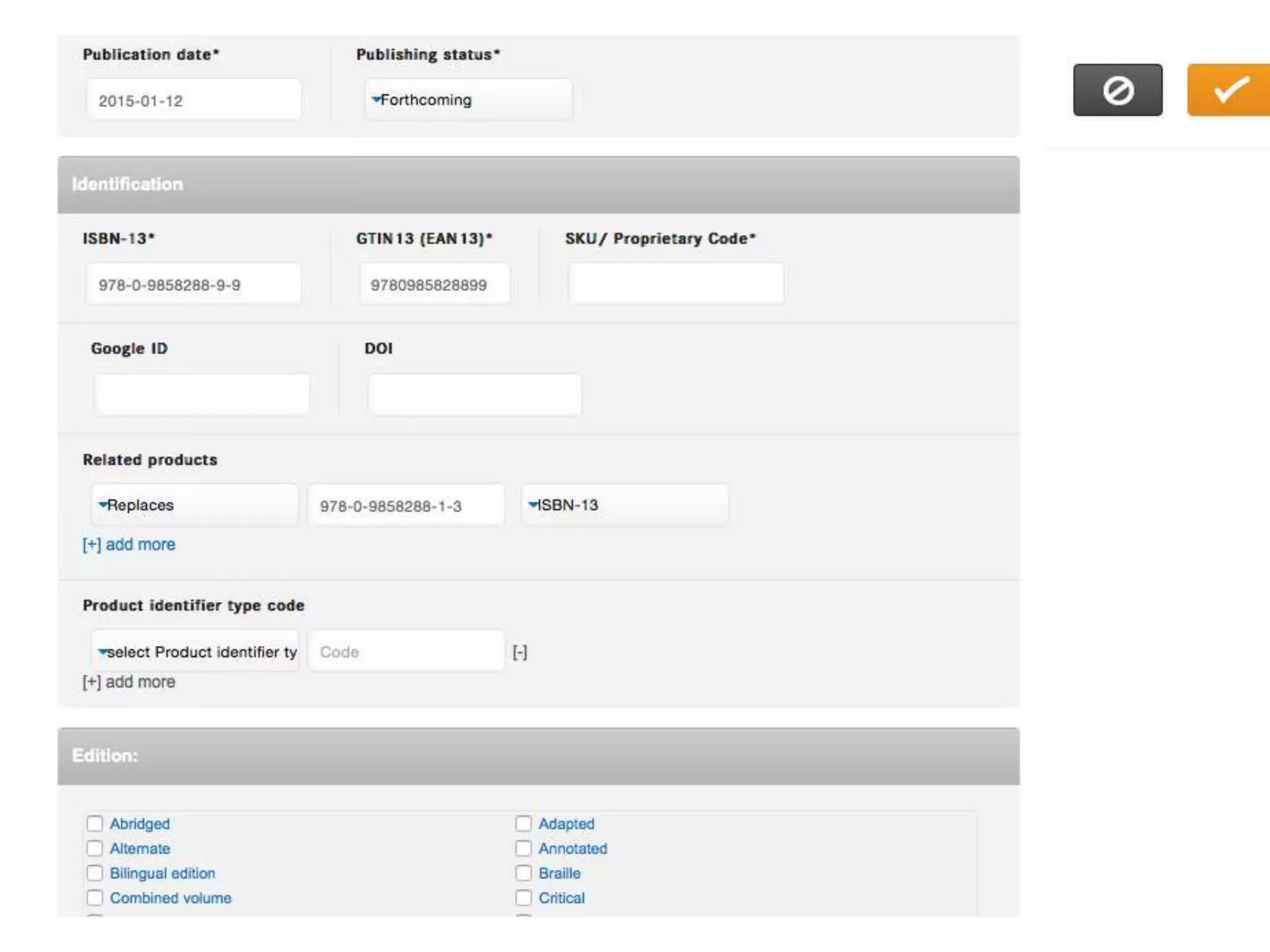
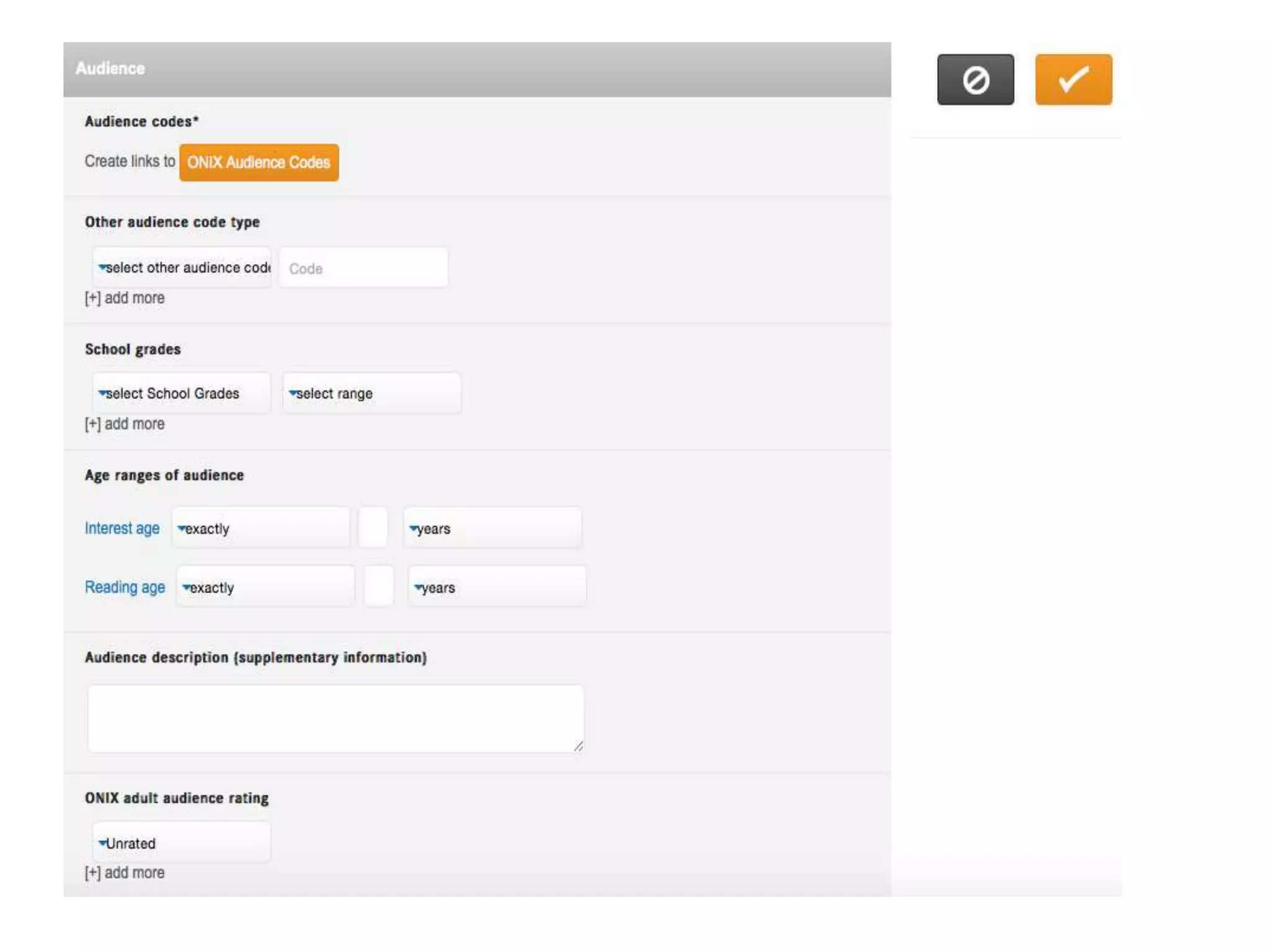
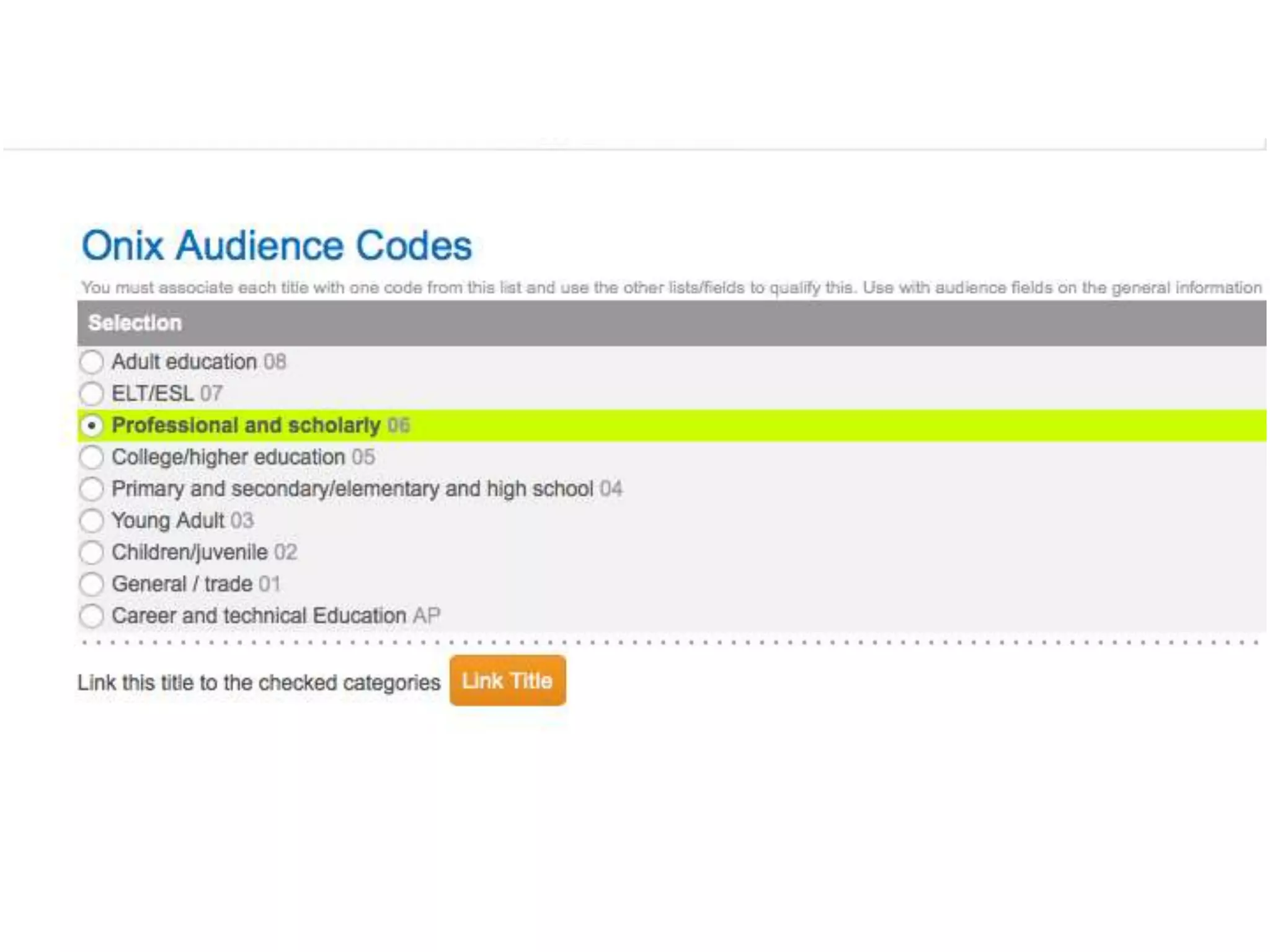
  • #58 Create link to audience code
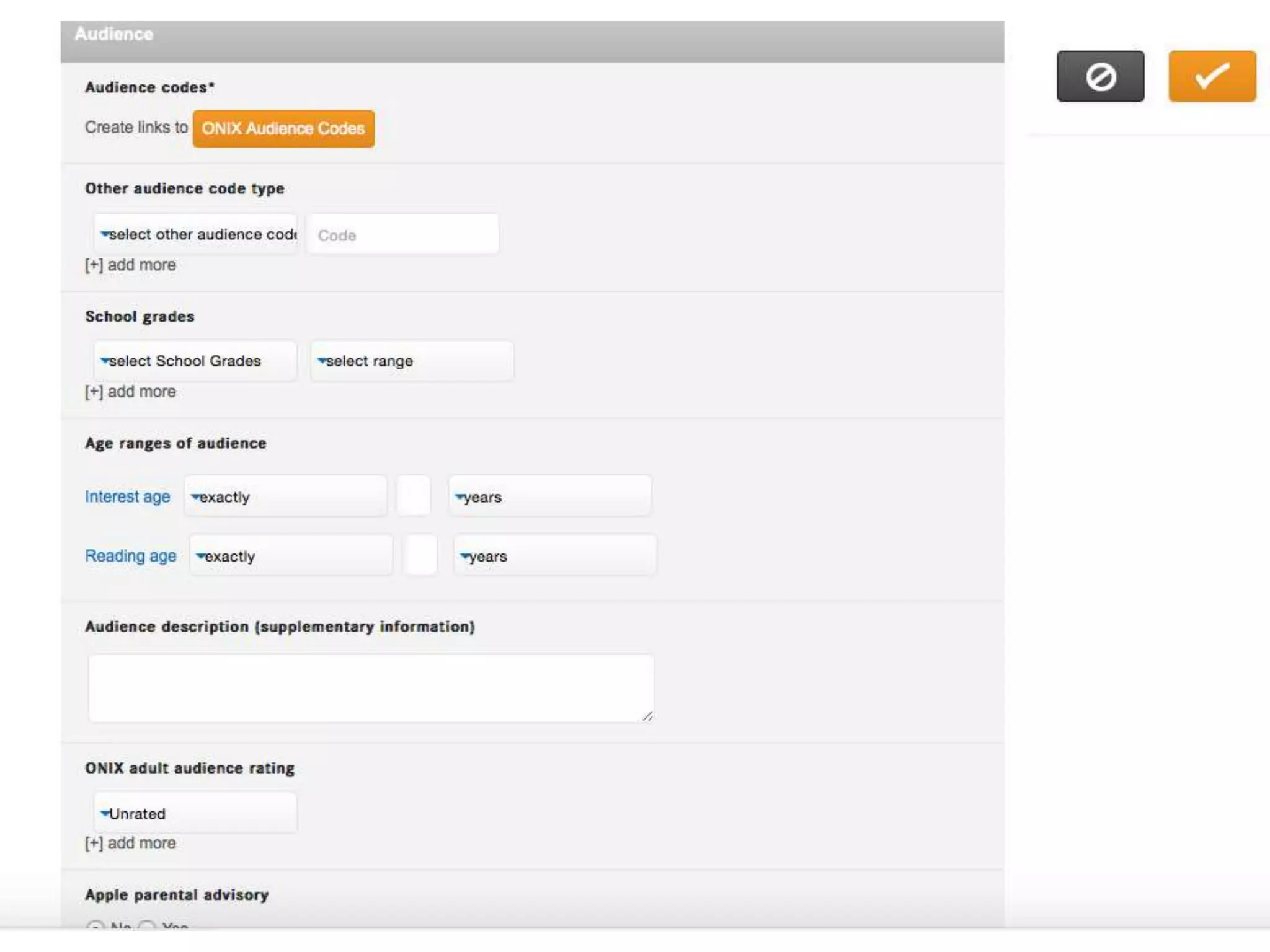
  • #60 Add age range for juvenile titles
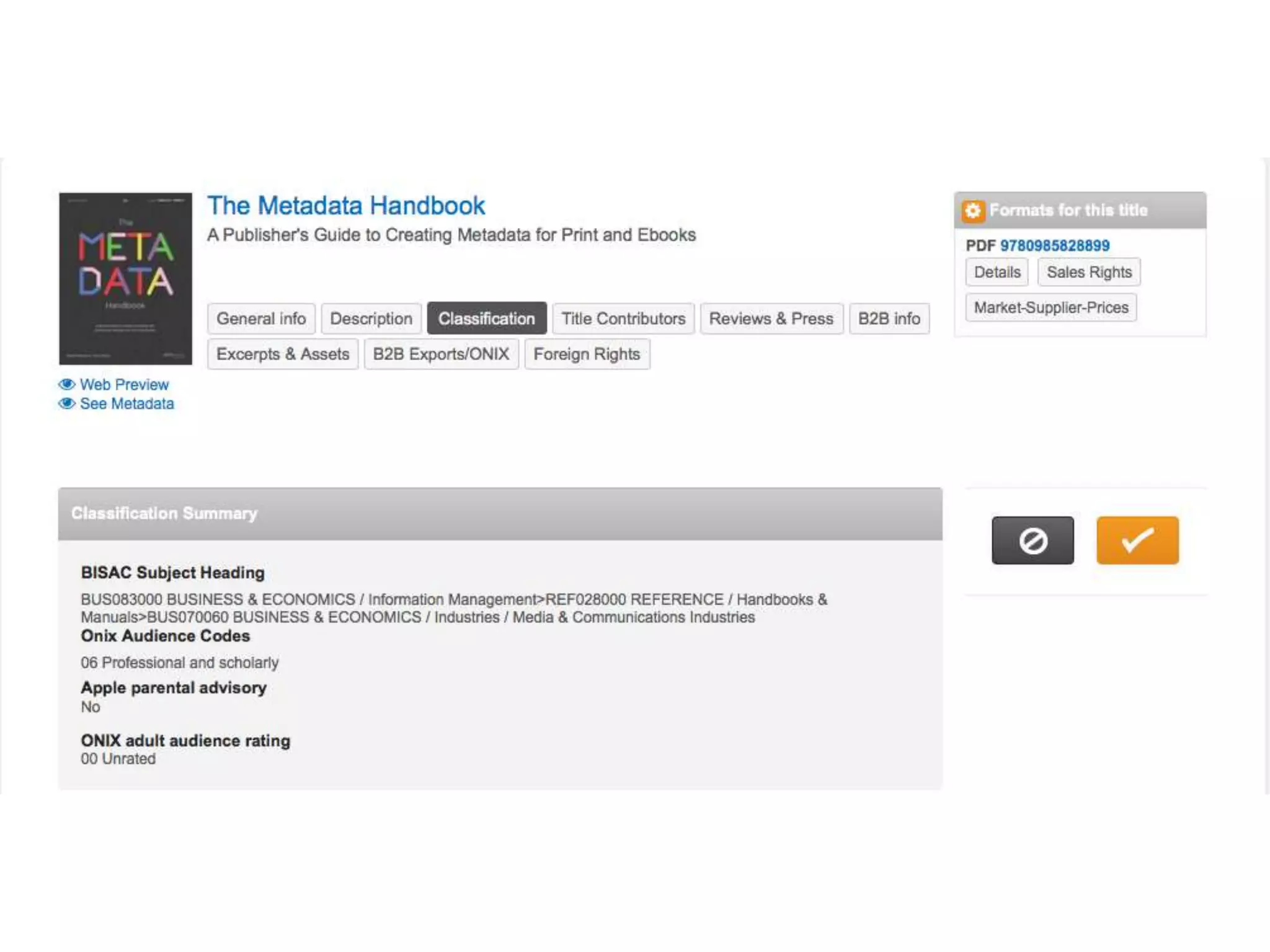
  • #61 Now you can see what you added
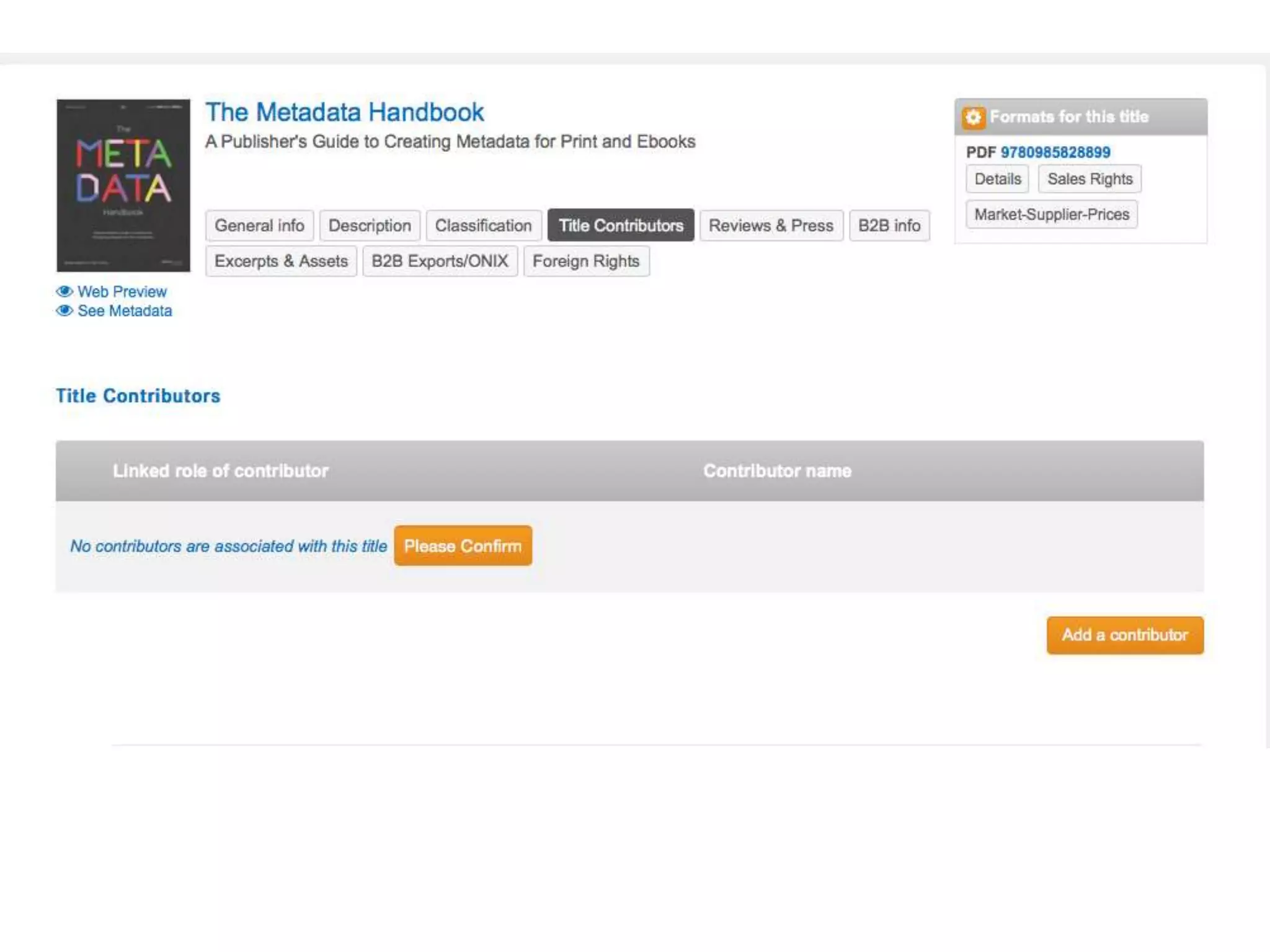
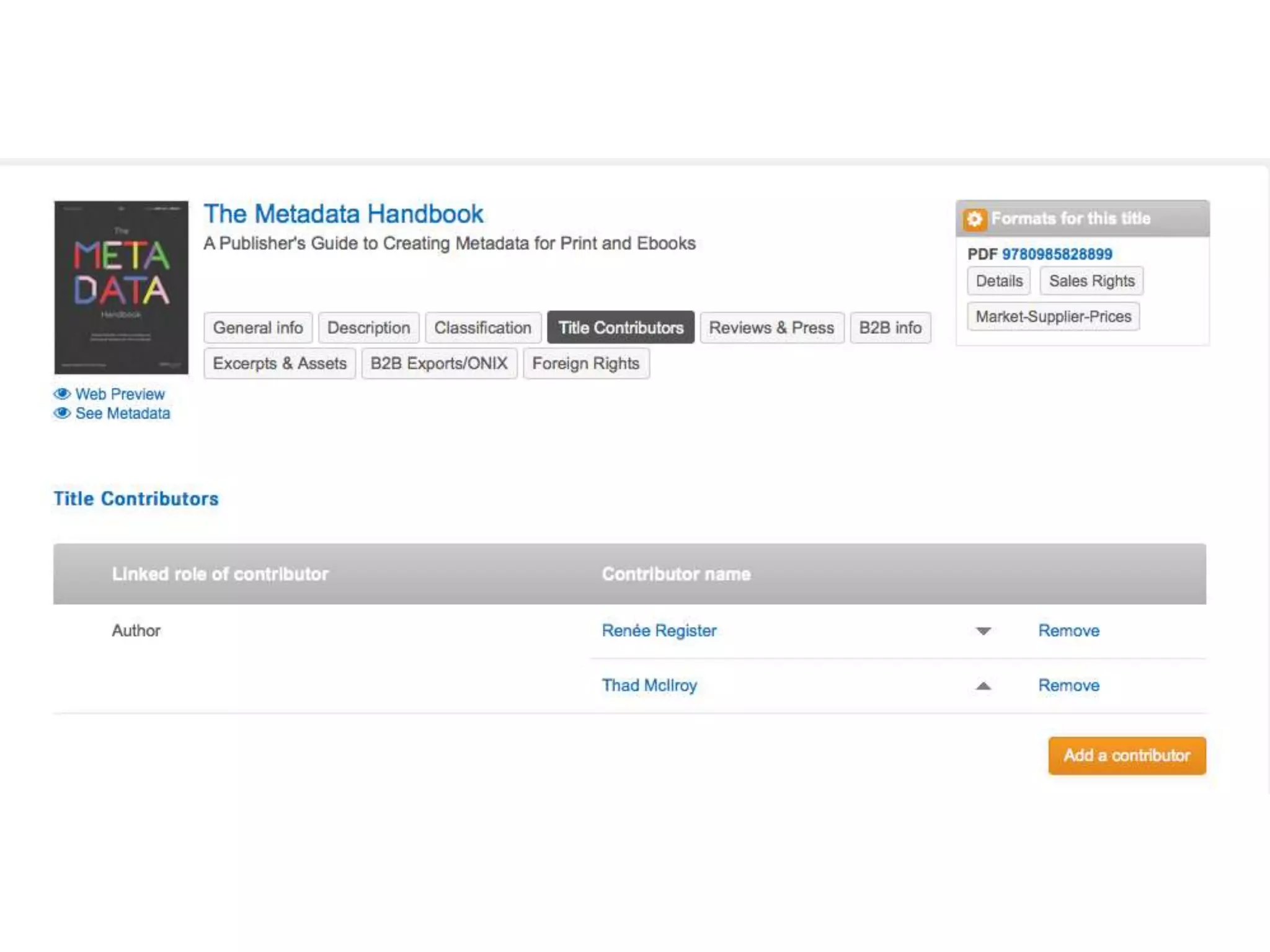
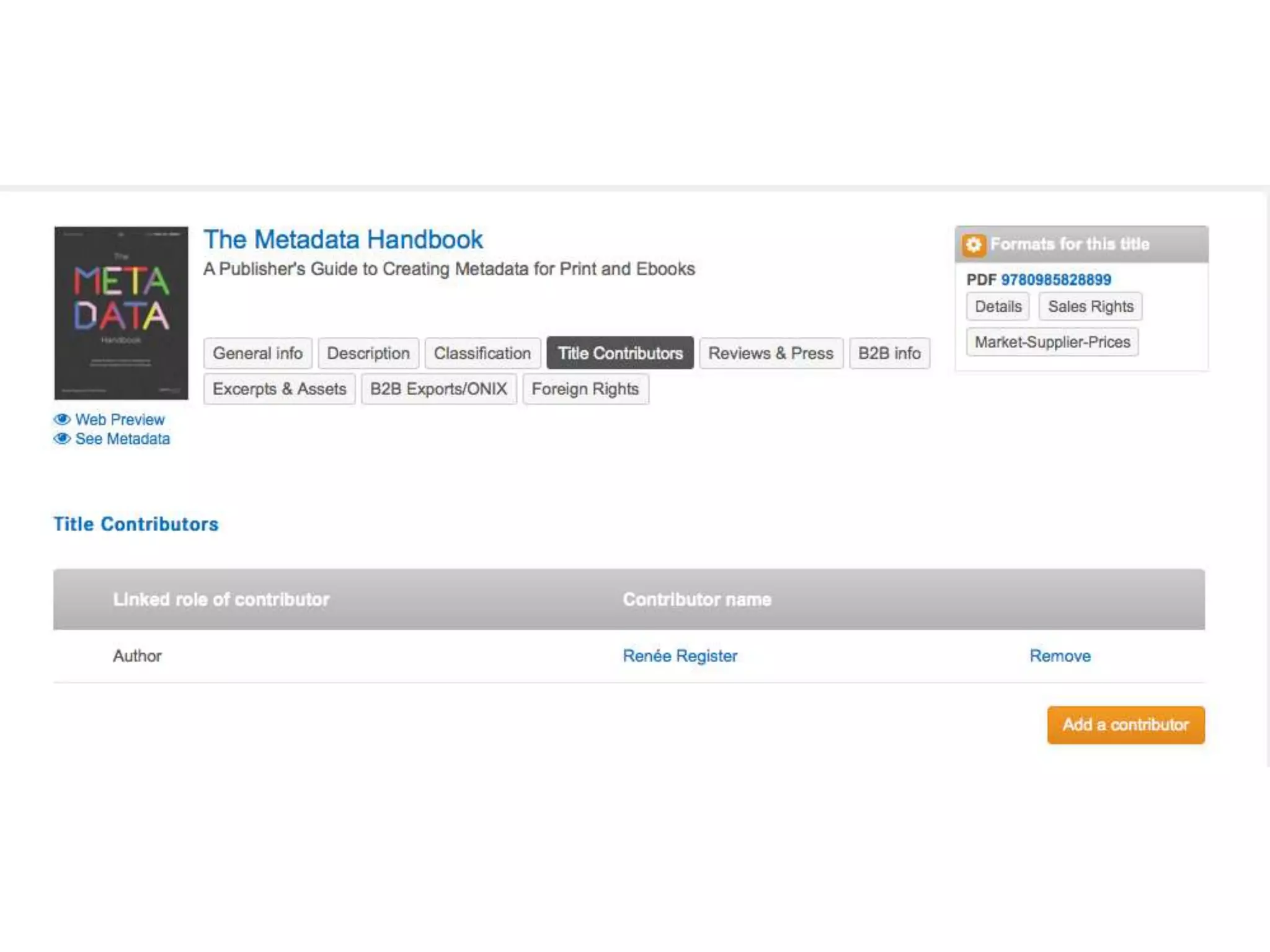
  • #62 Go to Contributors and click Add a contributor
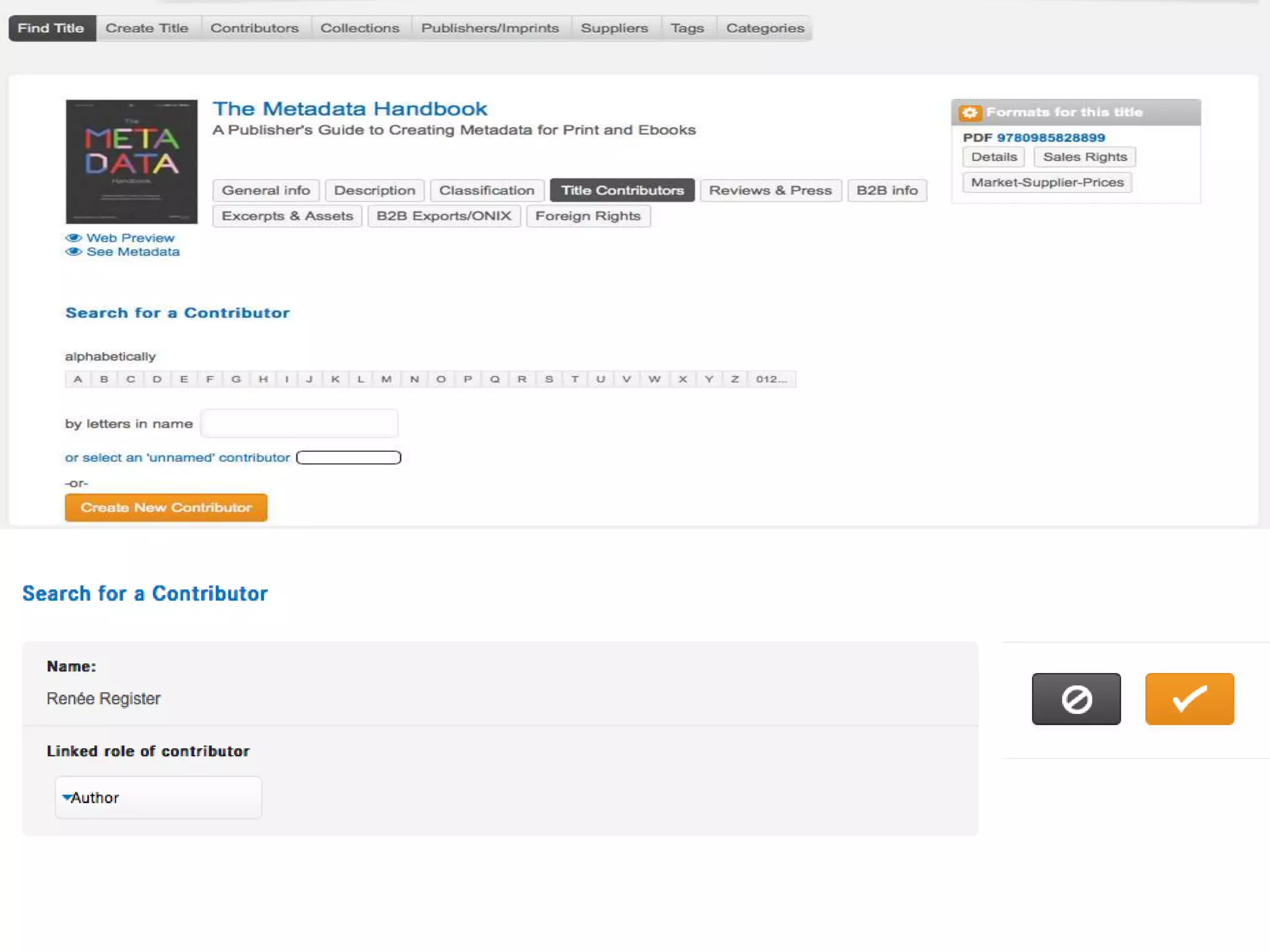
  • #63 You can search to see if the contributor is already set up
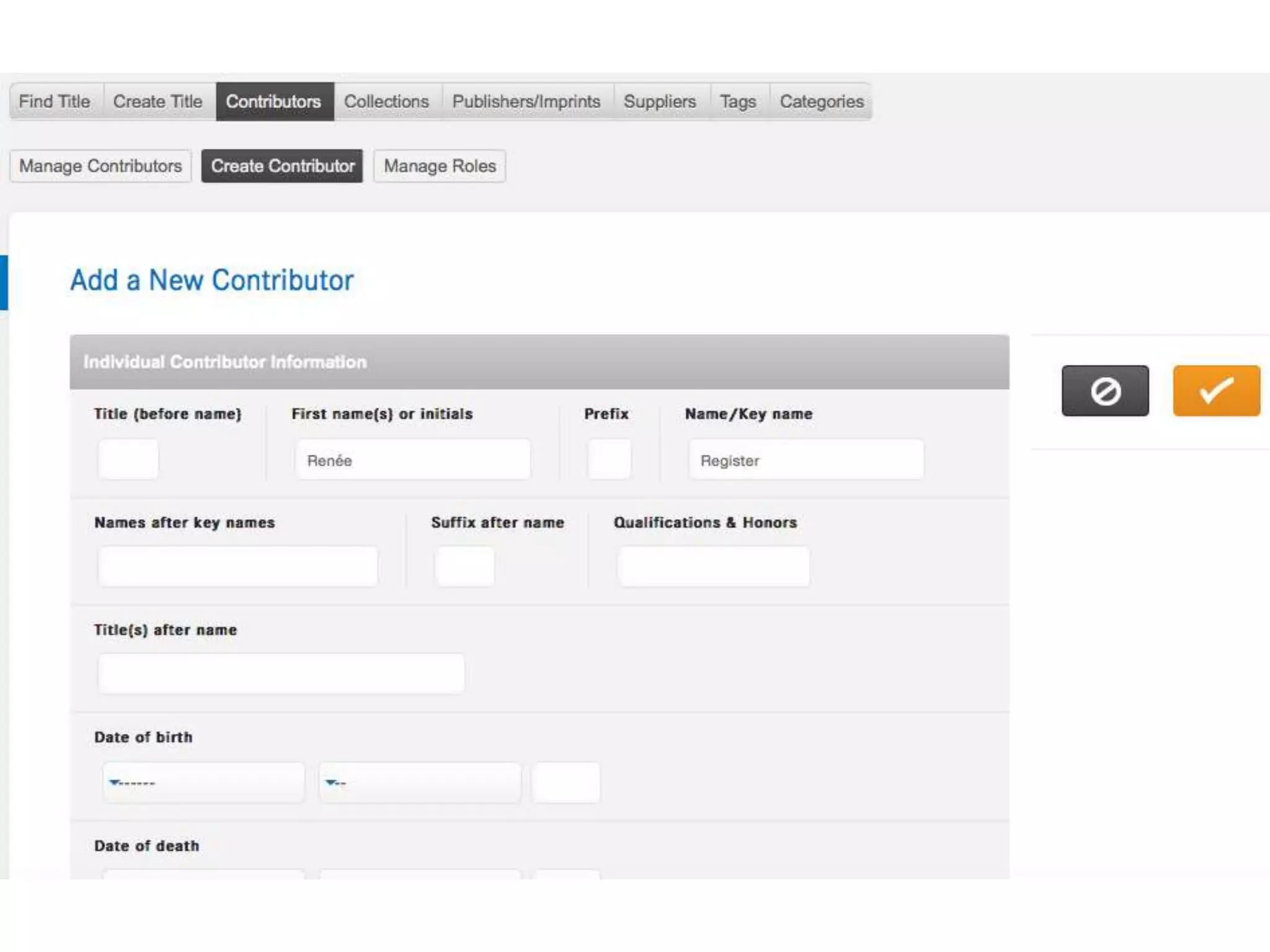
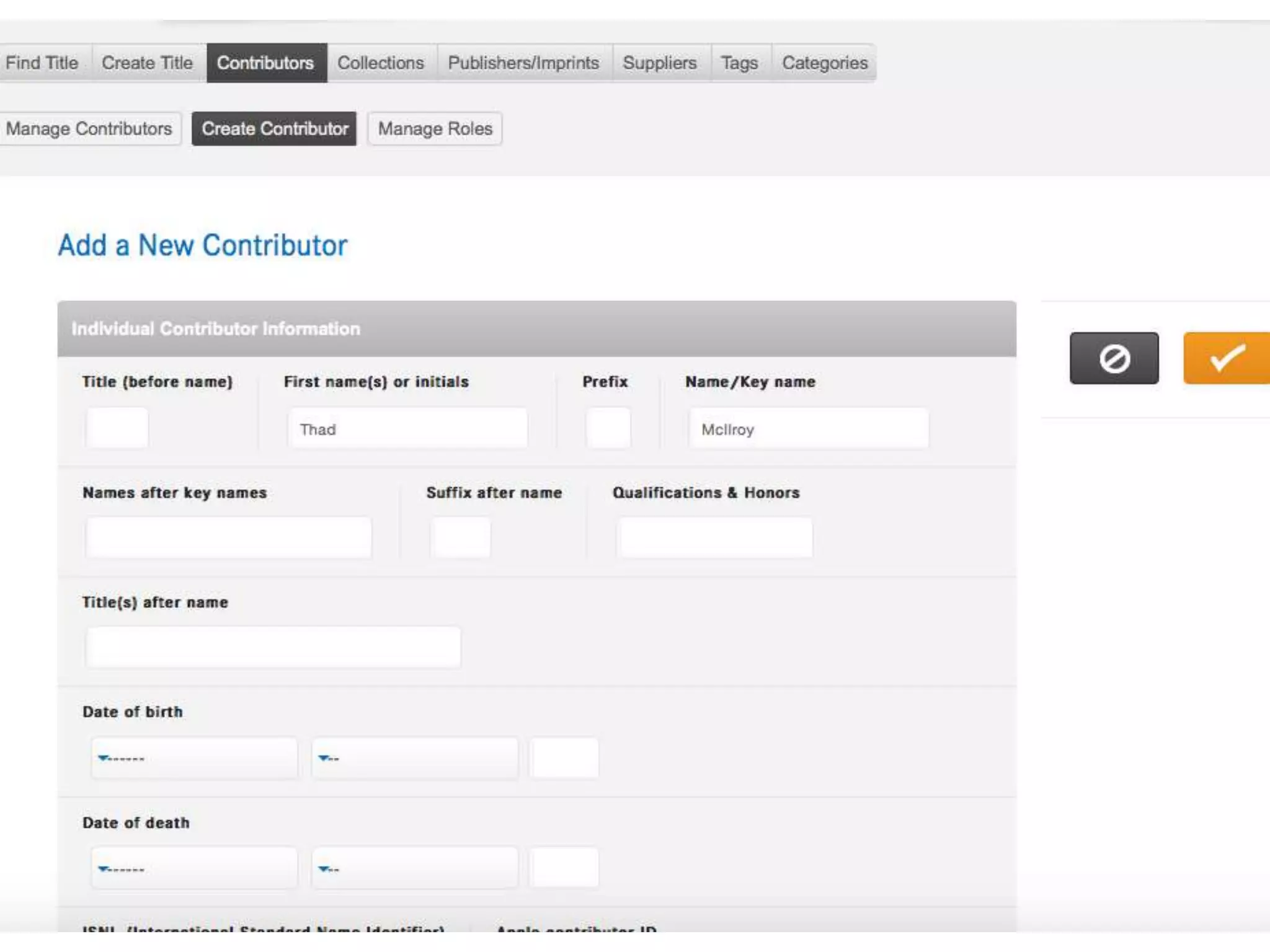
  • #64 If not, you can add a new contributor
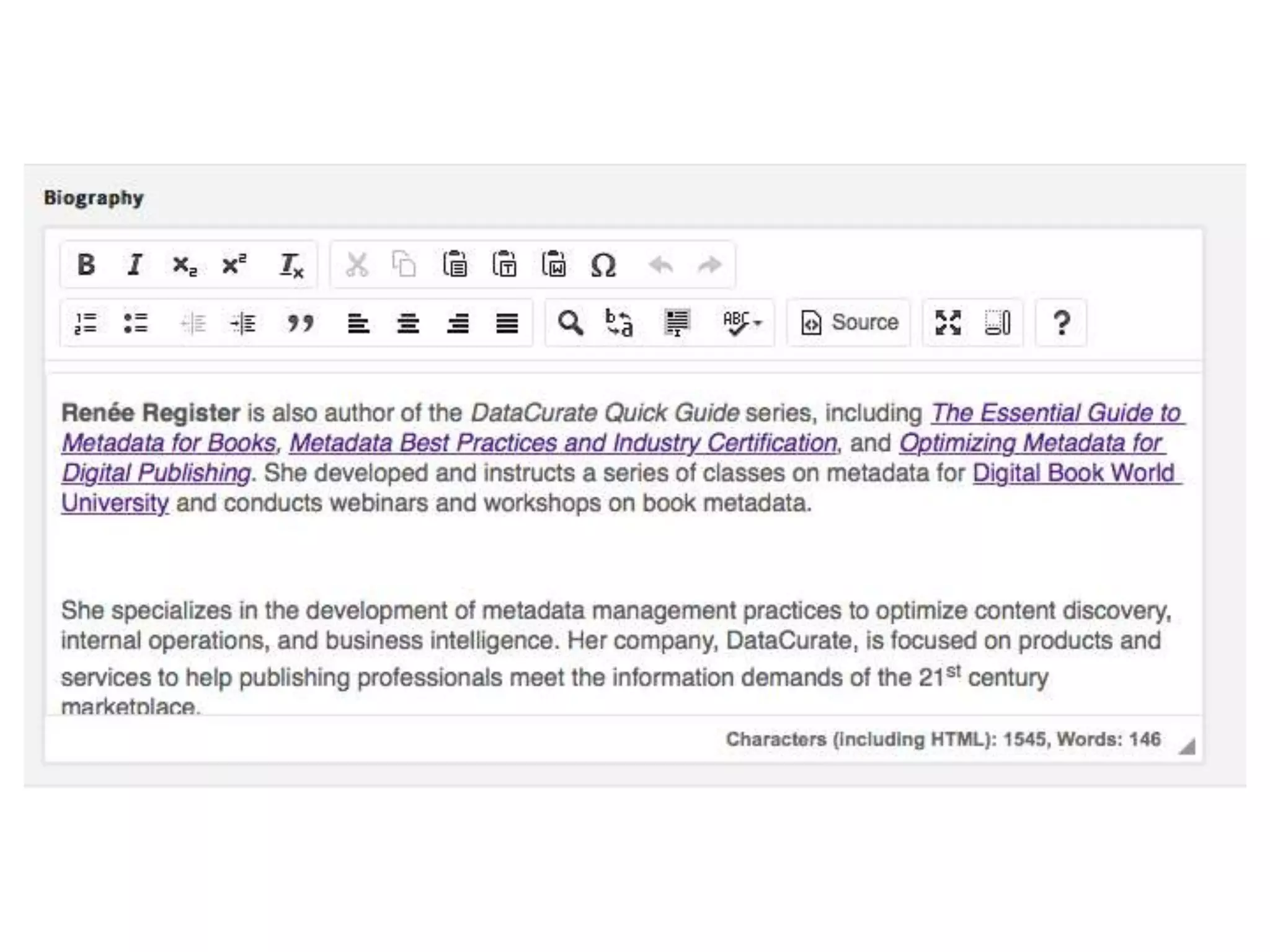
  • #66 You can also add a bio. One of the Highly Recommended elements.
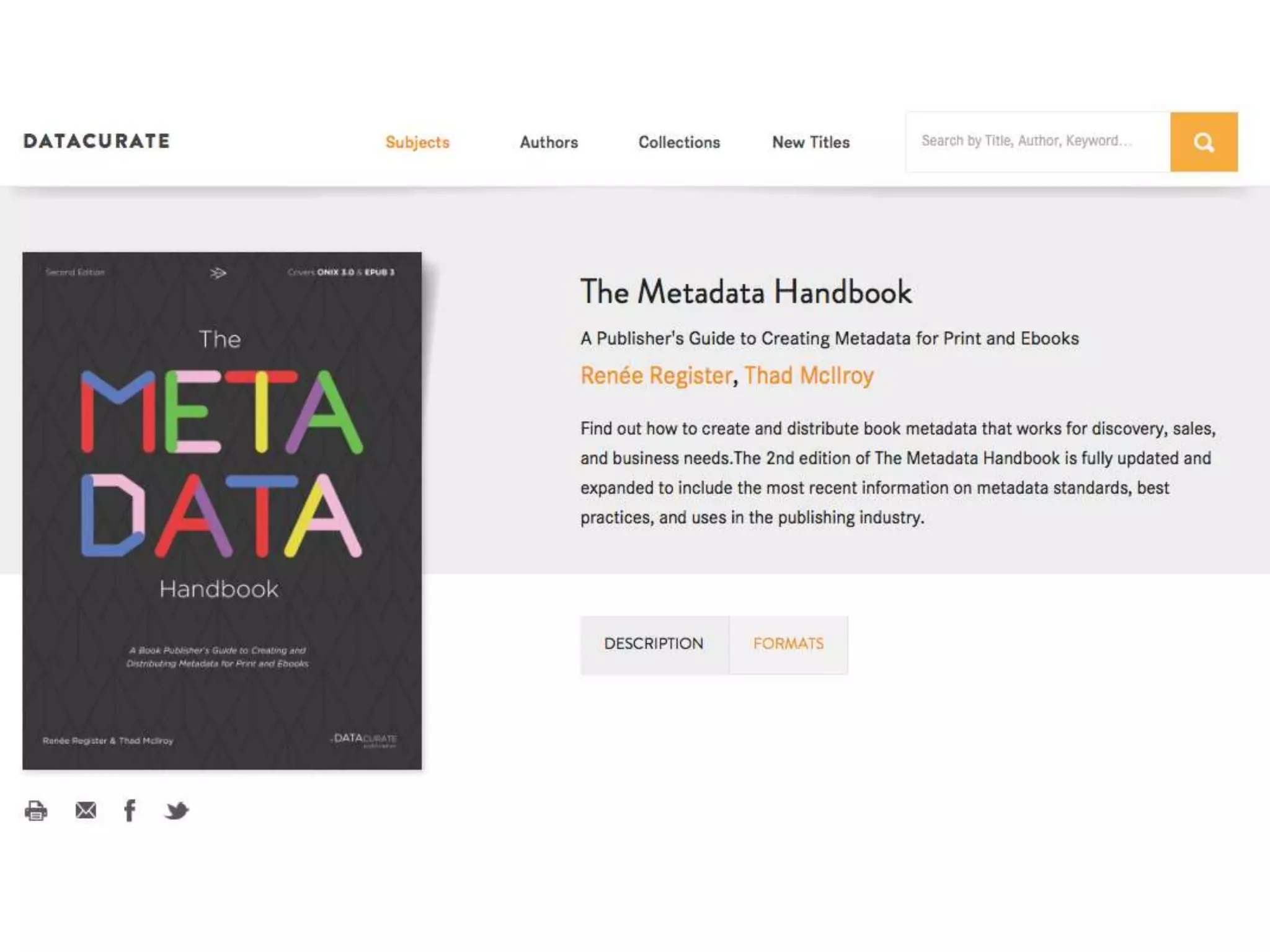
  • #72 Web display
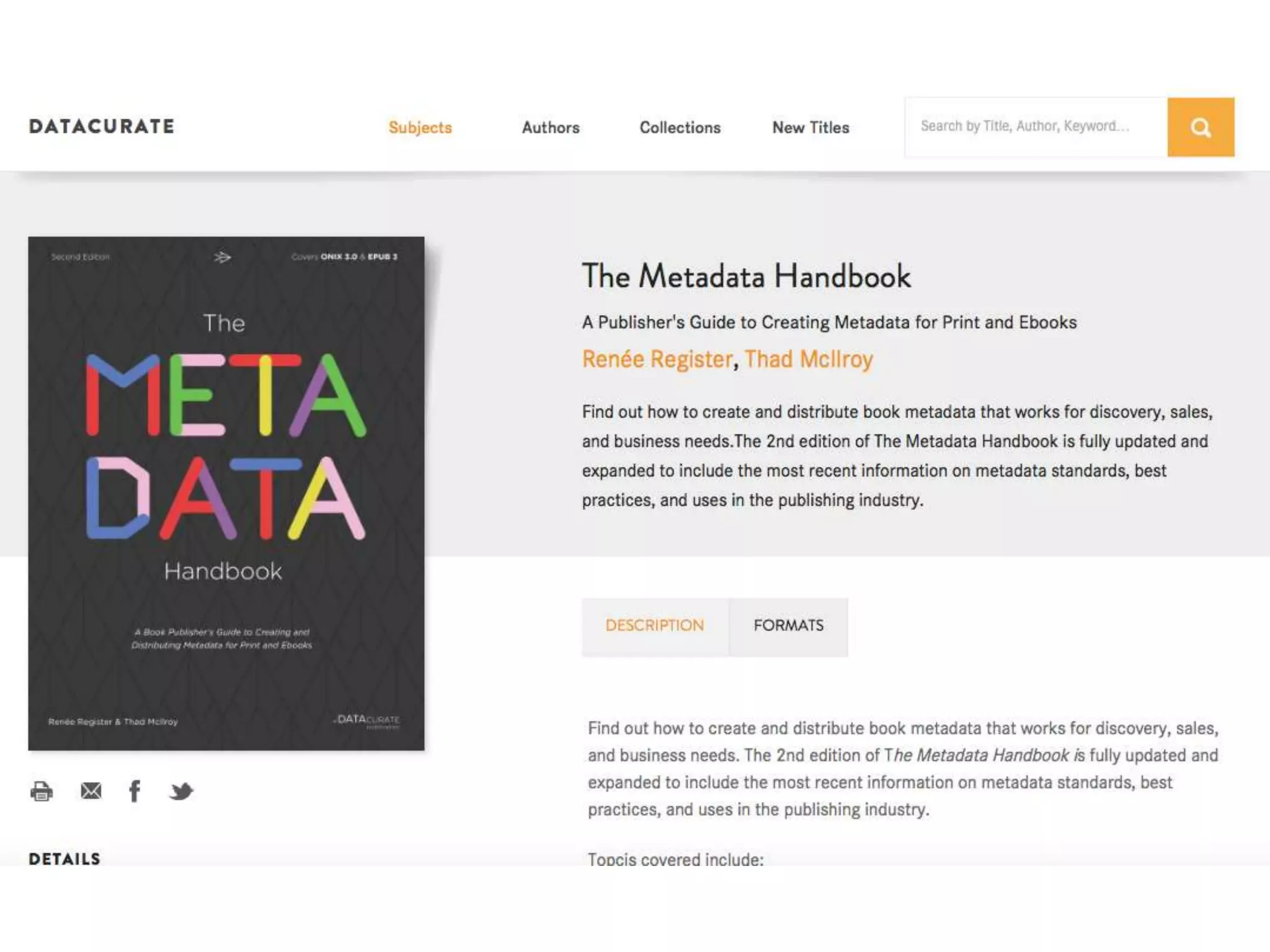
  • #73 Web display with long description.
  • #74 Details on web page
  • #75 See all metadata associated with title