Creating & Maintaining a
Successful Employer Brand
Presented to GBRSHRM
June 20, 2013
© James T Stodd, 2013
1
What is a “Brand”?
A company’s unique “brand” is the tapestry of:
• Words,
• Feelings,
• Associations and
• Images
that pop into mind when they hear a company’s name!
- Debra S Valle; Marketing U, Inc.
© James T Stodd, 2013 2
Characteristics of “Great” Brands
Great brands are intended to generate…
 Trust
 Loyalty
 Passion
 Pride
A great brand must communicate:
1. Trusted/Innovative Products &
Services
2. Great Customer Service
3. Price Points that the Market is Willing
to Pay
4. Reputation for Quality
- Debra S Valle; Marketing U, Inc.
© James T Stodd, 2013 3
Practical Branding Principles
1. There is no such thing as a great “employer brand”…there are
only great “company brands”
2. Small, regional, niche market or even nonprofit organizations
can have just as powerful of a “brand identity” as big
international companies
3. All great brands start with the “customer experience”
© James T Stodd, 2013 4
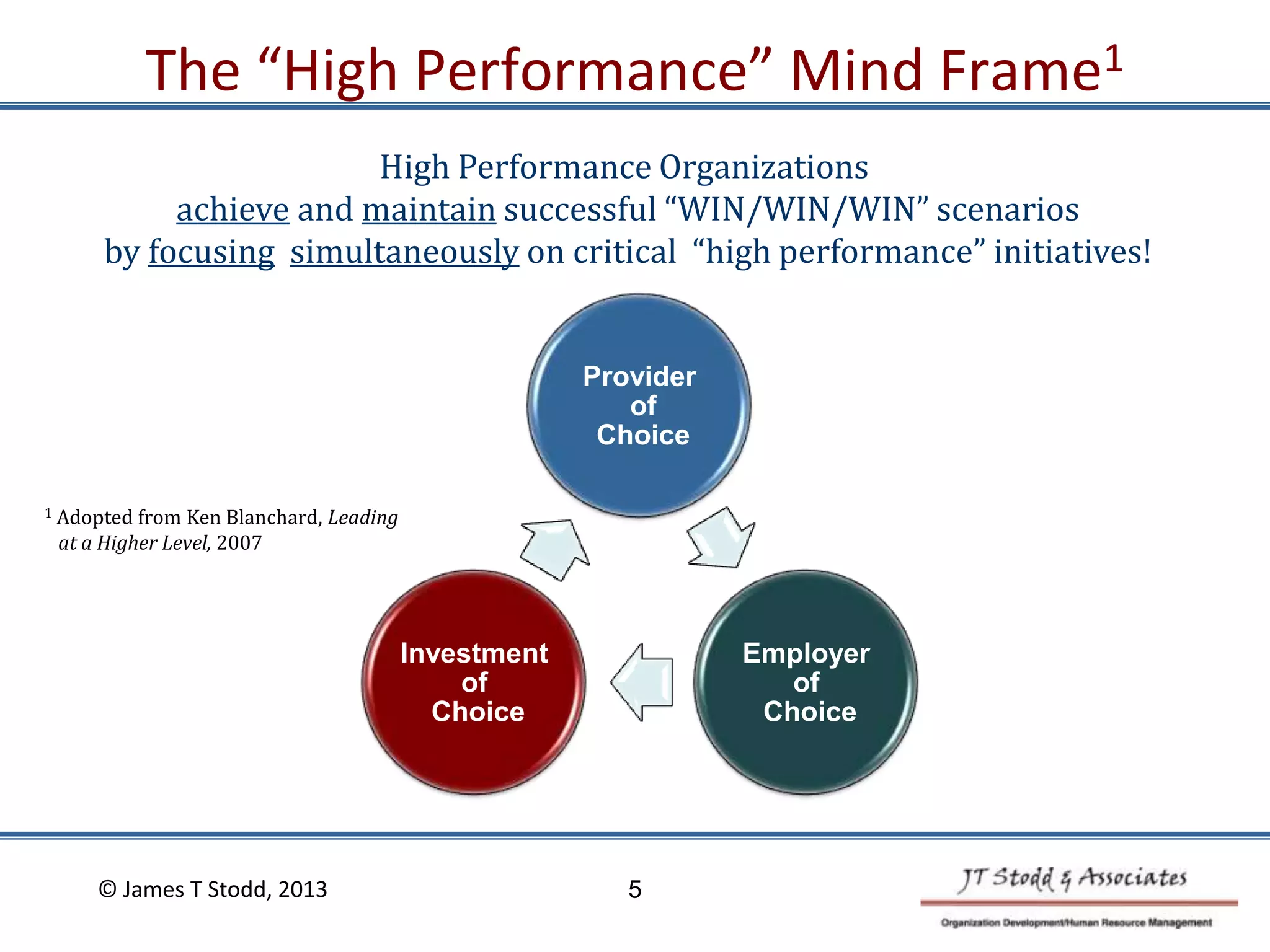
The “High Performance” Mind Frame1
Provider
of
Choice
Employer
of
Choice
Investment
of
Choice
High Performance Organizations
achieve and maintain successful “WIN/WIN/WIN” scenarios
by focusing simultaneously on critical “high performance” initiatives!
1 Adopted from Ken Blanchard, Leading
at a Higher Level, 2007
© James T Stodd, 2013 5
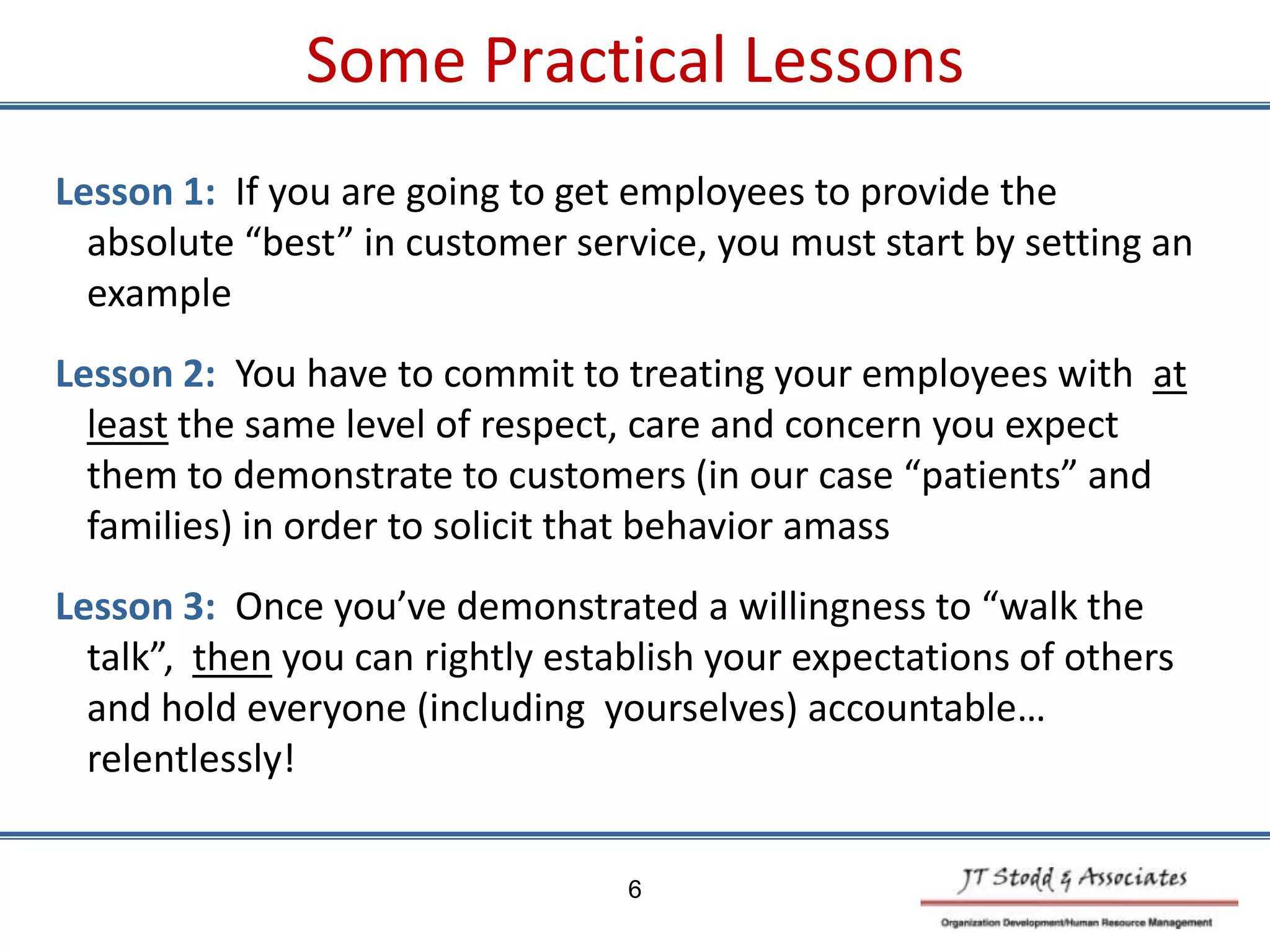
Some Practical Lessons
6
Lesson 1: If you are going to get employees to provide the
absolute “best” in customer service, you must start by setting an
example
Lesson 2: You have to commit to treating your employees with at
least the same level of respect, care and concern you expect
them to demonstrate to customers (in our case “patients” and
families) in order to solicit that behavior amass
Lesson 3: Once you’ve demonstrated a willingness to “walk the
talk”, then you can rightly establish your expectations of others
and hold everyone (including yourselves) accountable…
relentlessly!
4. Employees are the key to an awesome “customer experience”,
and they must have that experience “modeled” by how they
themselves are treated
5. Investors cannot be treated frivolously…they must be brought
into agreement with the program and realize success.
© James T Stodd, 2013
1. There is no such thing as a great “employer brand”…there are
only great “company brands”
2. Small, regional, niche market or even nonprofit organizations
can have just as powerful of a “brand identity” as big
international companies
3. All great brands start with the “customer experience”
7
Practical Branding Principles
10 Steps to Building a Great Brand
1. Start by articulating your mission, vision and values…on paper!
2. Get the “buzz” on you…
• Why do people associate with you (WIIFM)?
• What are their expectations?
• How do they perceive your “brand promise”?
• Why do some people hesitate to associate with you? Is that
“OK”?
3. Identify the strengths that can be leveraged as well as the
weaknesses that are holding you back (Note: for HR this also means
understanding both your accessibility as well as your processes for hiring, on-
boarding, coaching/developing and termination, references etc.)
© James T Stodd, 2013 8
5. Know your competition! Assess their strengths and weakness
from the viewpoint of those who might associate with you (or
them)
6. Establish your “brand objective”, that is how you want your
organization to be positioned in the minds of customers and
employees (Note: this may be different for different employee groups , types of
customers or product/service lines)
7. Craft , re-craft and communicate your “brand promise”, that is the
expectations you want customers /employees to have of you
(Note: Remember to leverage strengths and shore-up weaknesses)
10 Steps to Building a Great Brand
© James T Stodd, 2013 9
7. Sell your “brand promise” internally first, and ensure commitment,
before extending it to the outside world (customers and investors)
8. Execute flawlessly and expect others to do so as well (Note: that means
“walking the talk” and leading by example)
9. Use your branding efforts as an ongoing emotional dialogue
between your organization and your customers/employees
(through conversation, surveys, focus groups)
10. Tie behaviors measured in performance evaluations , incentive
plans and other reward programs to your “brand promise”
10 Steps to Building a Great Brand
10
Your Speaker
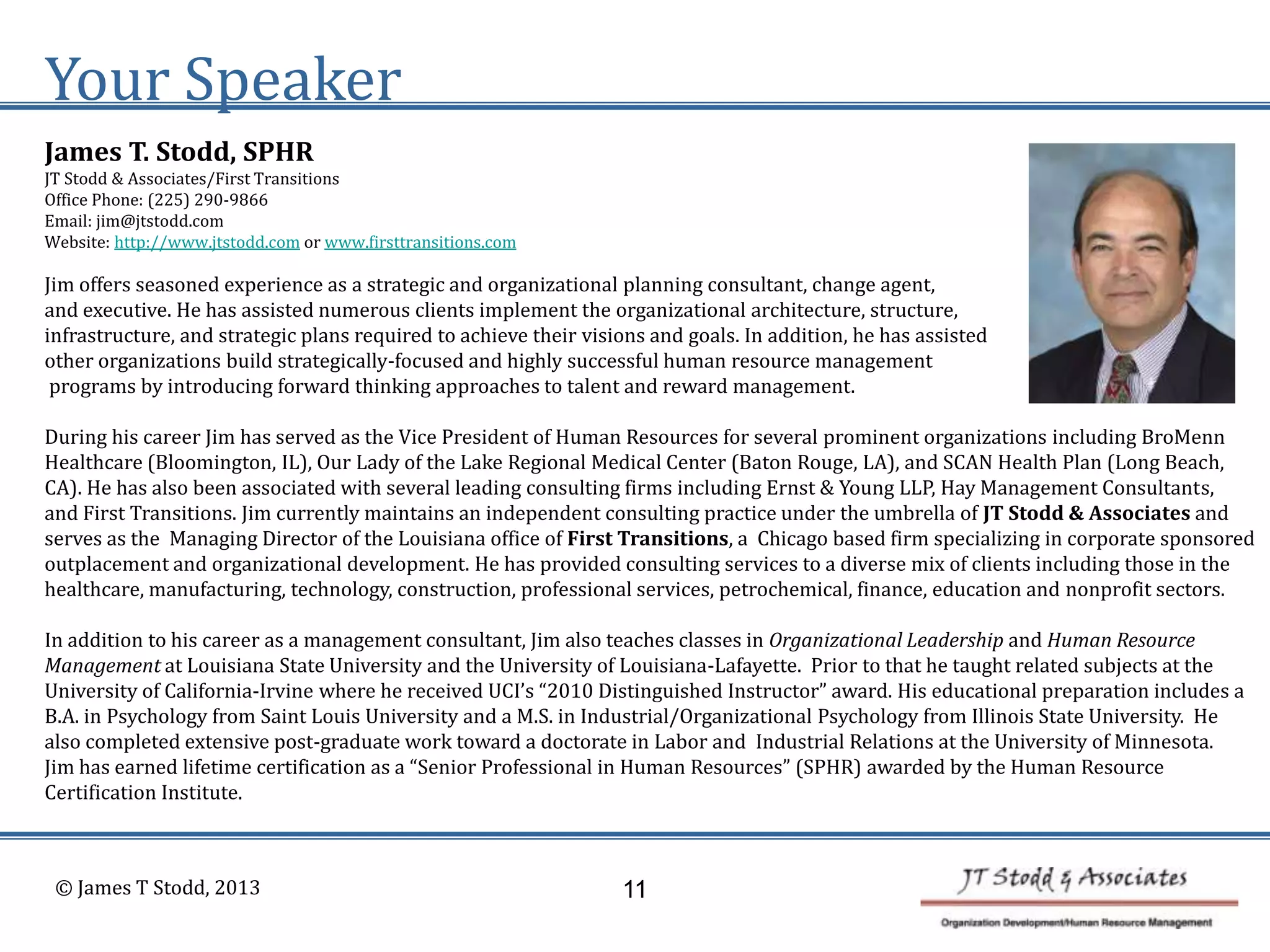
James T. Stodd, SPHR
JT Stodd & Associates/First Transitions
Office Phone: (225) 290-9866
Email: jim@jtstodd.com
Website: http://www.jtstodd.com or www.firsttransitions.com
Jim offers seasoned experience as a strategic and organizational planning consultant, change agent,
and executive. He has assisted numerous clients implement the organizational architecture, structure,
infrastructure, and strategic plans required to achieve their visions and goals. In addition, he has assisted
other organizations build strategically-focused and highly successful human resource management
programs by introducing forward thinking approaches to talent and reward management.
During his career Jim has served as the Vice President of Human Resources for several prominent organizations including BroMenn
Healthcare (Bloomington, IL), Our Lady of the Lake Regional Medical Center (Baton Rouge, LA), and SCAN Health Plan (Long Beach,
CA). He has also been associated with several leading consulting firms including Ernst & Young LLP, Hay Management Consultants,
and First Transitions. Jim currently maintains an independent consulting practice under the umbrella of JT Stodd & Associates and
serves as the Managing Director of the Louisiana office of First Transitions, a Chicago based firm specializing in corporate sponsored
outplacement and organizational development. He has provided consulting services to a diverse mix of clients including those in the
healthcare, manufacturing, technology, construction, professional services, petrochemical, finance, education and nonprofit sectors.
In addition to his career as a management consultant, Jim also teaches classes in Organizational Leadership and Human Resource
Management at Louisiana State University and the University of Louisiana-Lafayette. Prior to that he taught related subjects at the
University of California-Irvine where he received UCI’s “2010 Distinguished Instructor” award. His educational preparation includes a
B.A. in Psychology from Saint Louis University and a M.S. in Industrial/Organizational Psychology from Illinois State University. He
also completed extensive post-graduate work toward a doctorate in Labor and Industrial Relations at the University of Minnesota.
Jim has earned lifetime certification as a “Senior Professional in Human Resources” (SPHR) awarded by the Human Resource
Certification Institute.
© James T Stodd, 2013 11
References
Blanchard, Ken; Leading at a Higher Level, Upper Saddle River NJ: FT Press, 2007.
Valle, Debra S., Selling the Brand When It’s You: An Intuitive Guide to Your Distinctive
Brand Story; Los Alamitos, CA: Marketing U, Inc., 2003.
© James T Stodd, 2013 12

Creating & maintaining a successful employer brand

  • 1.
    Creating & Maintaininga Successful Employer Brand Presented to GBRSHRM June 20, 2013 © James T Stodd, 2013 1
  • 2.
    What is a“Brand”? A company’s unique “brand” is the tapestry of: • Words, • Feelings, • Associations and • Images that pop into mind when they hear a company’s name! - Debra S Valle; Marketing U, Inc. © James T Stodd, 2013 2
  • 3.
    Characteristics of “Great”Brands Great brands are intended to generate…  Trust  Loyalty  Passion  Pride A great brand must communicate: 1. Trusted/Innovative Products & Services 2. Great Customer Service 3. Price Points that the Market is Willing to Pay 4. Reputation for Quality - Debra S Valle; Marketing U, Inc. © James T Stodd, 2013 3
  • 4.
    Practical Branding Principles 1.There is no such thing as a great “employer brand”…there are only great “company brands” 2. Small, regional, niche market or even nonprofit organizations can have just as powerful of a “brand identity” as big international companies 3. All great brands start with the “customer experience” © James T Stodd, 2013 4
  • 5.
    The “High Performance”Mind Frame1 Provider of Choice Employer of Choice Investment of Choice High Performance Organizations achieve and maintain successful “WIN/WIN/WIN” scenarios by focusing simultaneously on critical “high performance” initiatives! 1 Adopted from Ken Blanchard, Leading at a Higher Level, 2007 © James T Stodd, 2013 5
  • 6.
    Some Practical Lessons 6 Lesson1: If you are going to get employees to provide the absolute “best” in customer service, you must start by setting an example Lesson 2: You have to commit to treating your employees with at least the same level of respect, care and concern you expect them to demonstrate to customers (in our case “patients” and families) in order to solicit that behavior amass Lesson 3: Once you’ve demonstrated a willingness to “walk the talk”, then you can rightly establish your expectations of others and hold everyone (including yourselves) accountable… relentlessly!
  • 7.
    4. Employees arethe key to an awesome “customer experience”, and they must have that experience “modeled” by how they themselves are treated 5. Investors cannot be treated frivolously…they must be brought into agreement with the program and realize success. © James T Stodd, 2013 1. There is no such thing as a great “employer brand”…there are only great “company brands” 2. Small, regional, niche market or even nonprofit organizations can have just as powerful of a “brand identity” as big international companies 3. All great brands start with the “customer experience” 7 Practical Branding Principles
  • 8.
    10 Steps toBuilding a Great Brand 1. Start by articulating your mission, vision and values…on paper! 2. Get the “buzz” on you… • Why do people associate with you (WIIFM)? • What are their expectations? • How do they perceive your “brand promise”? • Why do some people hesitate to associate with you? Is that “OK”? 3. Identify the strengths that can be leveraged as well as the weaknesses that are holding you back (Note: for HR this also means understanding both your accessibility as well as your processes for hiring, on- boarding, coaching/developing and termination, references etc.) © James T Stodd, 2013 8
  • 9.
    5. Know yourcompetition! Assess their strengths and weakness from the viewpoint of those who might associate with you (or them) 6. Establish your “brand objective”, that is how you want your organization to be positioned in the minds of customers and employees (Note: this may be different for different employee groups , types of customers or product/service lines) 7. Craft , re-craft and communicate your “brand promise”, that is the expectations you want customers /employees to have of you (Note: Remember to leverage strengths and shore-up weaknesses) 10 Steps to Building a Great Brand © James T Stodd, 2013 9
  • 10.
    7. Sell your“brand promise” internally first, and ensure commitment, before extending it to the outside world (customers and investors) 8. Execute flawlessly and expect others to do so as well (Note: that means “walking the talk” and leading by example) 9. Use your branding efforts as an ongoing emotional dialogue between your organization and your customers/employees (through conversation, surveys, focus groups) 10. Tie behaviors measured in performance evaluations , incentive plans and other reward programs to your “brand promise” 10 Steps to Building a Great Brand 10
  • 11.
    Your Speaker James T.Stodd, SPHR JT Stodd & Associates/First Transitions Office Phone: (225) 290-9866 Email: jim@jtstodd.com Website: http://www.jtstodd.com or www.firsttransitions.com Jim offers seasoned experience as a strategic and organizational planning consultant, change agent, and executive. He has assisted numerous clients implement the organizational architecture, structure, infrastructure, and strategic plans required to achieve their visions and goals. In addition, he has assisted other organizations build strategically-focused and highly successful human resource management programs by introducing forward thinking approaches to talent and reward management. During his career Jim has served as the Vice President of Human Resources for several prominent organizations including BroMenn Healthcare (Bloomington, IL), Our Lady of the Lake Regional Medical Center (Baton Rouge, LA), and SCAN Health Plan (Long Beach, CA). He has also been associated with several leading consulting firms including Ernst & Young LLP, Hay Management Consultants, and First Transitions. Jim currently maintains an independent consulting practice under the umbrella of JT Stodd & Associates and serves as the Managing Director of the Louisiana office of First Transitions, a Chicago based firm specializing in corporate sponsored outplacement and organizational development. He has provided consulting services to a diverse mix of clients including those in the healthcare, manufacturing, technology, construction, professional services, petrochemical, finance, education and nonprofit sectors. In addition to his career as a management consultant, Jim also teaches classes in Organizational Leadership and Human Resource Management at Louisiana State University and the University of Louisiana-Lafayette. Prior to that he taught related subjects at the University of California-Irvine where he received UCI’s “2010 Distinguished Instructor” award. His educational preparation includes a B.A. in Psychology from Saint Louis University and a M.S. in Industrial/Organizational Psychology from Illinois State University. He also completed extensive post-graduate work toward a doctorate in Labor and Industrial Relations at the University of Minnesota. Jim has earned lifetime certification as a “Senior Professional in Human Resources” (SPHR) awarded by the Human Resource Certification Institute. © James T Stodd, 2013 11
  • 12.
    References Blanchard, Ken; Leadingat a Higher Level, Upper Saddle River NJ: FT Press, 2007. Valle, Debra S., Selling the Brand When It’s You: An Intuitive Guide to Your Distinctive Brand Story; Los Alamitos, CA: Marketing U, Inc., 2003. © James T Stodd, 2013 12

Editor's Notes

  • #3 “Brands” are all about “emotions”…and the guttural response we have associated with the name (logo, image, jingle, etc.). While the emotions may be linked to what we see on TV or online, most of that comes from the “experience” we have with that company (or representatives of that company).Brands are generally not about “specifics”, but general experiences with a name or image. They are based upon “classical conditioning” where a name, logo, jingle or other identifier hopefully elicits the “right” response.Great brands produce positive emotions and positive images of all things associated with the brand. Bad brands (e.g., Enron or IRS) do just the opposite.
  • #4 Examples: GE: We make “good things for living” Allstate Insurance: Your in “good hands” with Allstate Prudential: The “Rock” OLOLRMC: The relentless pursuit of “better” LSU: Don… Don… Don…dunt
  • #5 Our Car Buying ExperiencePoor Tuttle-Click ExperienceHad done our homework on new car and trade in (Kelly Blue Book)Dealer asked for significant after-market markups above list price & wouldn’t provide alternative vehicle Dealer offered several thousand short on the trade-inWhen presented the Kelly Blue Book information, they completely discounted that info arguing their “experience” was much superior and treated us as fools for relying upon such informationOur unwillingness to “’take the deal” was responded to by questions and innuendo about our “financial condition”…aka “it’s our fault”We ultimately walked out and never called back!OC Hyundai ExperiencePrior experience with service department demonstrated strong “customer service” orientationSalesmen much more interested in understanding our needs and helping us make a good decision than “selling the car”Introduced to both the General Manager and Owner as though we were really important peopleThey actually drove 40 down the road and “bought” a car in order to make sure my wife could get the make, model and color she wanted (without our knowing that they had to “buy the car” to make it available)No argument on the blue book presentation…they worked to adjust their numbersWhen the monthly note became an obstacle, the finance guy work feverishly calling banks etc to get the most favorable interest rate so we could buy the car at the monthly payment we had budgeted (without them further discounting the price)After purchase they told us about the 3 year free service as well as unlimited free car washes (keeping car in “showroom” condition)We had a tremendous customer service and highly recommended the dealershipHigh Performance OrganizationExperienced sales staff spoke very highly of their owner, the mission and values of the dealership as well as their interest in staying with the organization long-term given their experience with other dealersA number of the sales staff worked for the first dealer and remarked that they had a history of treating their employees with the same “win-loose” approach that we had experienced as customersBefore we knew he was the dealer, we saw the owner demonstrate “servant leadership” in spades by a) running to the distant storage lot to ensure sales staff had the right inventory (in the rain), b) making sure that sales staff had umbrellas to protect themselves and customers from the rain, and c) ensured the noon BBQ was well stocked and manned. Only after watching him for some time we later found out he was the “owner”Over the months we watched them grow their business significantly through “word of month” (no TV or radio advertising) from happy, happy, happy customers (like us) all sporting the OC symbol on their always “glistening” new vehicles.
  • #6 Being an “organizational behaviorist” at heart, I’ve noticed that…Organizations that maintain successful company brands also meet the requirements of “high performing organizations” much like OC HyundaiThey balance concern for customers, employees and investors and create “win/win” relationships with all threeInvestors ultimately prosper because of the organization’s success in the market placeMy BroMenn ExperienceMerger between three competing community hospitals that were highly competitive and replicated servicesMerger required infusing new mission, vision and identity within the workforce…and they were resistant!Merger made us the second largest health system in the region…we still had a bigger and formable competitorStrategy was to leverage the HPO conceptsParking was a major practical issue with new construction, and we gave preferential parking in this orderPatients, family and visitorsPhysiciansNurses, therapists, technicians and support staff,Department heads and managersAdministrative staff/senior management (we had “assigned” parking well over 3 blocks from the nearest entrance)During employee meeting, a supervisor was challenging one of the hospital administrators when Jeff Schaub (the CEO) walked in late (red-faced with fogged over glasses and covered with snow, slush and mud). The complaints died in the room right then!The key was leading by example…not expecting of others what you don’t expect from yourself…and this circumstance made a clear statement concerning “what” and “who” the priorities were…it demonstrated a willingness to “walk the talk”.
  • #7  Lesson 1…if you are going to get employees to provide the absolute best in customer service, you must start by setting an example Lesson 2: You have to commit to treating your employees with at least the same level of care and concern you expect them to demonstrate to customers (in our case “patients” and families). Lesson 3: Once you’ve demonstrated a willingness to “walk the talk”, then you can establish your expectations of others and hold everyone accountable (including yourselves)…relentlessly!
  • #8 OC Hyundai ExperiencePoor Tuttle-Click ExperienceHad done our homework on new car and trade in (Kelly Blue Book)Dealer asked for significant after-market markups, wouldn’t provide alternativeDealer offered several thousand short on the trade-inWhen presented the Kelly Blue Book information, they completely discounted arguing their “experience” was stronger and treated us as fools for relying upon such informationUnwillingness to “’take the deal” was responded to by questions and inuendo about our “financial condition”We ultimately walked out and never called backOC Hyundai ExperiencePrior experience was demonstrated strong “customer service” orientationSalesmen much more interested in understanding our needs and helping us make a good decision than “selling the car”Introduced to both the General Manager and Owner as though we were really important peopleActually went down the road and “bought” a car in order to make sure my wife could get the make, model and color she wanted (without our knowing that they had to “buy the car” to make it available)No argument on the blue book presentation…they worked to adjust their numbersFinancial guy work feverishly calling banks etc to get the most favorable interest rate so we could buy the car at the monthly payment we had budgetedAfter purchase we learned of the 3 year free service as well as unlimited free car washes (keeping car in “showroom” condition)We had tremendous customer service and highly recommended the dealershipHigh Performance OrganizationExperience sales staff spoke very highly of their owner, the mission and values of the dealership and their interest in staying with the organization long-term given their experience with other dealersSame sales staff all worked for the first dealer and remarked that they had a history of treating their employees with the same “win-loose” approach that we had experienced as customersBefore we knew he was the dealer, we saw the owner demonstrate “servant leadership” in spades by a) running to the distant storage lot to ensure sales staff had the right inventory (in the rain), b) making sure that sales staff had umbrellas to protect themselves and customers from the rain, and c) ensured the noon BBQ was well stocked and manned. Only after watching him for some time we later found out he was the ownerOver the months we watched them grow their business significantly through “word of month” (no TV or radio) from happy, happy, happy customers (like us) all sporting the OC symbol on their glistening new vehicles.
  • #9 Mission/Vision/Values: these are the hallmarks of great leadership. They need to be spelled out on paper, completely and succinctly before you try to communicate to employees, investors and ultimately customers. Then do so liberally!Getting the buzz…From an HR perspective, this generally means taking the pulse of the workforce through conversation, employee meetings, morale surveys, focus groups, exit interviews and the like. All are good techniques for learning how you are perceived, and how well they believe you fullfill the “brand promise”.
  • #10 Knowing your competition…You want to study them and what they do (well and otherwise). Talk with your trusted employees to get the scoop (they generally have friends and colleagues who are flirting with the competitionCrafting and re-crafting…I’ve learned this is not a “one time deal” but actually on ongoing process or refining and incorporating “change” as time goes along and warrants that change.
  • #11 Sell internally…You never want to go out and make a promise, or create a market expectation, that your own staff doesn’t believe we deserve. If we are having “quality” of “performance” issues in their minds, those issues need to be resolved first. Only state what your employees will gladly “back up”.