Dynamic Dunes 2015 – 7 October 2015
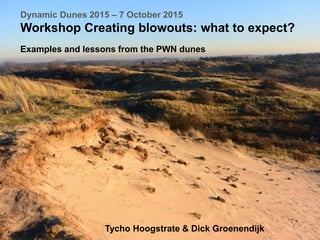
Workshop Creating blowouts: what to expect?
Examples and lessons from the PWN dunes
Tycho Hoogstrate & Dick Groenendijk
Dunes at Heemskerk; 1952 en 2008
Nitrogen deposition; declining grazing populations; grass and scrub encroachment.
Less open sand and mosaic with scrub and dune grassland is more homogeneous.
A few PWN-statistics…….
2003; North Holland Dune Reserve (5200 ha); counting visible blowouts on aerial photos.
Circa 80% of the blowouts within the
first 1000 meters from the beach.
Circa 60% of the blowouts 10-100 m2
Not only small scale blowouts
Reactivating rather large blowout at Heemskerk
(+25% compared with blowout from 1952 foto).
Size of blowout depends on the local situation (like distance from the
sea, geomorphological characters, presence/absence of other blowouts,
etcetera) as well as the goal of the project (reset of a grassland system
or small scale restauration of mosaic in grasslands).
Does size matter?
Last parts of dynamic blowouts at lime rich dunes at Castricum;
Valuable refugia of insects and plant species > be careful with
rejuvenation of these type of blowouts.
Small blowout near Castricum (5 km inland);
Still active partly due to recreation. More blow outs?
Rejuvenation? Better to handle scrub to prevent overgrowing
instead of managing the blowout itself.
Natural blowout near Bergen in lime poor dunes.
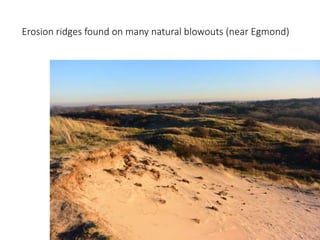
Erosion ridges
Erosion ridges found on many natural blowouts (near Egmond)
• Erosion ridges very important > home for many
insects
• Most erosion down the plant roots
• Plant material dying
• ‘Balcony structure’ > keeping dry sand > erosive
Artificial erosion ridges can be created easily.
Circa 20-30 cm high.
Southern slope of a large-sized blowout.
Creating erosion ridges
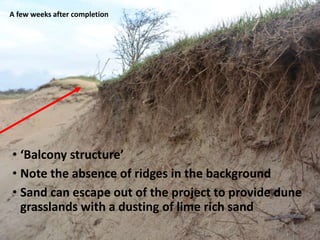
A few weeks after completion
• ‘Balcony structure’
• Note the absence of ridges in the background
• Sand can escape out of the project to provide dune
grasslands with a dusting of lime rich sand
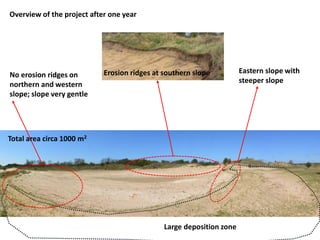
No erosion ridges on
northern and western
slope; slope very gentle
Eastern slope with
steeper slope
Overview of the project after one year
Total area circa 1000 m2
Erosion ridges at southern slope
Large deposition zone
Art in the PWN-dunes………………
Sculpture garden
How to create small scale blowouts?
Just place art in the dunes!
Discussion topics
Is small scale eolean activity a cure for deteriorated Grey dunes?
Do we understand the process of small scale eolean activity
enough to make them?
When are blowouts successful?
Stabilization of blowouts: failure or success?
In which dune zones to create blowouts?
Which size and density of blowouts?
Which time scale for ‘planning’ blowouts?
How to create blowouts?
What are the clues to create successful blowouts?

Creating blowouts

  • 1.
    Dynamic Dunes 2015– 7 October 2015 Workshop Creating blowouts: what to expect? Examples and lessons from the PWN dunes Tycho Hoogstrate & Dick Groenendijk
  • 2.
    Dunes at Heemskerk;1952 en 2008 Nitrogen deposition; declining grazing populations; grass and scrub encroachment. Less open sand and mosaic with scrub and dune grassland is more homogeneous.
  • 3.
    A few PWN-statistics……. 2003;North Holland Dune Reserve (5200 ha); counting visible blowouts on aerial photos. Circa 80% of the blowouts within the first 1000 meters from the beach.
  • 4.
    Circa 60% ofthe blowouts 10-100 m2
  • 6.
    Not only smallscale blowouts Reactivating rather large blowout at Heemskerk (+25% compared with blowout from 1952 foto).
  • 7.
    Size of blowoutdepends on the local situation (like distance from the sea, geomorphological characters, presence/absence of other blowouts, etcetera) as well as the goal of the project (reset of a grassland system or small scale restauration of mosaic in grasslands). Does size matter?
  • 8.
    Last parts ofdynamic blowouts at lime rich dunes at Castricum; Valuable refugia of insects and plant species > be careful with rejuvenation of these type of blowouts.
  • 9.
    Small blowout nearCastricum (5 km inland); Still active partly due to recreation. More blow outs? Rejuvenation? Better to handle scrub to prevent overgrowing instead of managing the blowout itself.
  • 10.
    Natural blowout nearBergen in lime poor dunes. Erosion ridges
  • 11.
    Erosion ridges foundon many natural blowouts (near Egmond)
  • 12.
    • Erosion ridgesvery important > home for many insects • Most erosion down the plant roots • Plant material dying • ‘Balcony structure’ > keeping dry sand > erosive
  • 13.
    Artificial erosion ridgescan be created easily. Circa 20-30 cm high. Southern slope of a large-sized blowout. Creating erosion ridges
  • 14.
    A few weeksafter completion • ‘Balcony structure’ • Note the absence of ridges in the background • Sand can escape out of the project to provide dune grasslands with a dusting of lime rich sand
  • 15.
    No erosion ridgeson northern and western slope; slope very gentle Eastern slope with steeper slope Overview of the project after one year Total area circa 1000 m2 Erosion ridges at southern slope Large deposition zone
  • 16.
    Art in thePWN-dunes………………
  • 17.
    Sculpture garden How tocreate small scale blowouts? Just place art in the dunes!
  • 18.
    Discussion topics Is smallscale eolean activity a cure for deteriorated Grey dunes? Do we understand the process of small scale eolean activity enough to make them? When are blowouts successful? Stabilization of blowouts: failure or success? In which dune zones to create blowouts? Which size and density of blowouts? Which time scale for ‘planning’ blowouts? How to create blowouts? What are the clues to create successful blowouts?