BalancedBalanced
LiteracyLiteracy
and the CCSS
and the CCSS
July 2014
Patty McGee
Outcomes for TodayOutcomes for Today
0 Research-
supported
Literacy Practices
0 Writing
Instructional
Components
0 Reading
Instructional
Components
• Engage
fully
• Inquire
and dig
deeply
into
challen
ges
• Respect
the
knowled
ge and
Tenets
0 Practice: Pencil to paper, eyes on print
0 Learning is messy, teaching must be flexible
0 Formative Assessment
0 Feedback
0 Approximation
0 Transfer is the Key
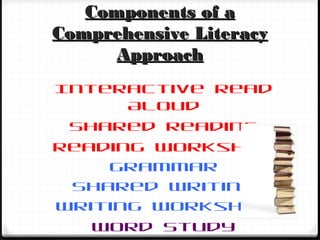
Components of aComponents of a
Comprehensive LiteracyComprehensive Literacy
ApproachApproach
Interactive Read
Aloud
Shared Reading
Reading Workshop
Grammar
Shared Writing
Writing Workshop
Word Study
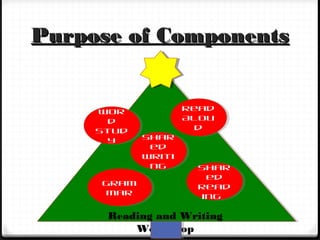
Purpose of ComponentsPurpose of Components
Wor
d
Stud
y
Wor
d
Stud
y
Reading and Writing
Workshop
Shar
ed
Writi
ng
Shar
ed
Writi
ng
Gram
mar
Gram
mar
Shar
ed
Read
ing
Shar
ed
Read
ing
Read
Alou
d
Read
Alou
d
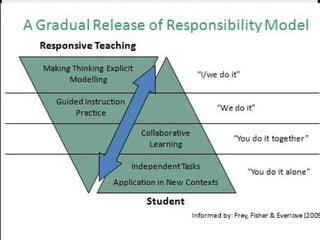
Gradual Release of
Responsibility
Explicitly
Taught
Demonstrated
Shared and
Guided
Collaborative
Independent
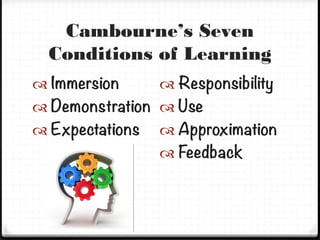
Cambourne’s Seven
Conditions of Learning
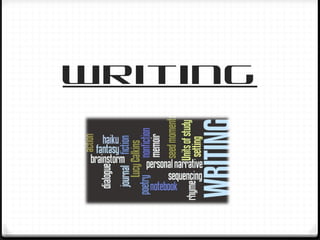
Writing
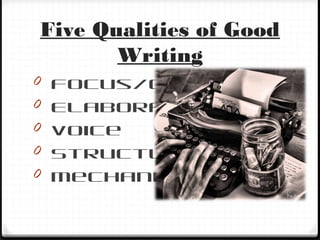
Five Qualities of Good
Writing
0 Focus/Content
0 Elaboration
0 Voice
0 Structure
0 Mechanics
Shared WritingShared Writing
0 Separate from Writing
Workshop, rarely used in
a minilesson
0 Share– create it
together, teacher does
the writing
0 Preparation and skill
introduction and practice
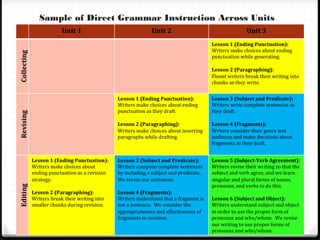
Sample of Direct Grammar Instruction Across Units
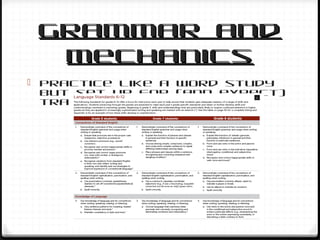
Grammar andGrammar and
MechanicsMechanics
 Practice like a word study
but set up for (and expect)
transfer
Grammar andGrammar and
MechanicsMechanics0 The difference between
conventions and grammar:
Grammar refers to the structure
of a language: the parts of speech
and their functions, their
relationship to each other, word
order in sentences, the parts of a
sentence and how they are put
together, e.g., subject, predicate,
objects, etc. Mechanics refers to
the conventions of written
language: punctuation,
capitalization, spelling, etc.
0 Language of literacy
0 Students along the way are
going to understand, and
then mess it up again. This
students’ writing, or
tell them to be
correct, then they
may revert to
simpler vocabulary
and sentence
structure that they
are sure how to
punctuate.
Mentor Sentences
One Technique for Teaching Grammar for Usage
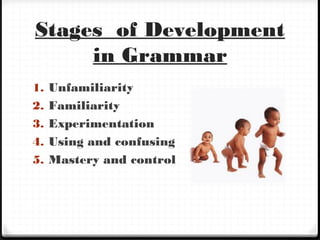
Stages of Development
in Grammar
1. Unfamiliarity
2. Familiarity
3. Experimentation
4. Using and confusing
5. Mastery and control
The Writing Workshop
A place for feedback, transfer, and lots and lots of
writing!
Writers Need
0 Time
0 Choice
0 A variety of strategies to access
learning
Minilesson
Writing Workshop
Structures and Routines
0 Minilesson
0 Independent
Writing and Small
Group Teaching
0 Conferring
0 Small Group
Strategy Work
0 Mid Workshop
Teaching Point
Writers Need
0 Time
0 Choice
0 A variety of strategies to access
learning
0 Models
0 Modeling
Nothing a teacher can
do can have a greater
effect than this
combination—
giving students crystal
clear goals,
opportunities for
engaged work, and the
feedback that includes
compliments and steps
for more progress.
Teachers must also ensure that children have
access to reading materials that are relevant to the
kind of writer they are interested in becoming at
that particular moment. Teachers must also
recruit the authors who will become the children’s
unwitting collaborators.
Frank Smith on Mentor Texts
Writers Need
0 Time
0 Choice
0 A variety of strategies to access
learning
0 Models
0 Modeling
0 A Writer’s Notebook
A Writer’s Notebook:
Building a Writing Life
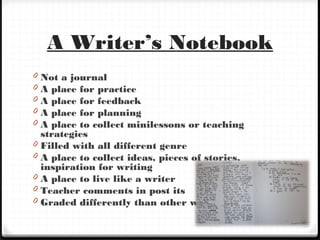
A Writer’s Notebook
0 Not a journal
0 A place for practice
0 A place for feedback
0 A place for planning
0 A place to collect minilessons or teaching
strategies
0 Filled with all different genre
0 A place to collect ideas, pieces of stories,
inspiration for writing
0 A place to live like a writer
0 Teacher comments in post its
0 Graded differently than other writing
#PWI12
#PWI12
#PWI12
#PWI12
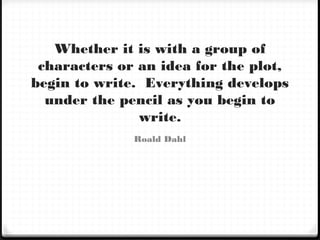
Whether it is with a group of
characters or an idea for the plot,
begin to write. Everything develops
under the pencil as you begin to
write.
Roald Dahl
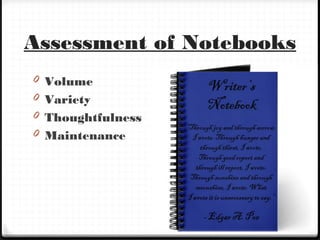
Assessment of Notebooks
0 Volume
0 Variety
0 Thoughtfulness
0 Maintenance
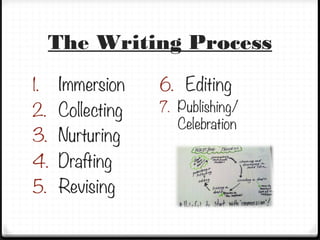
The Writing Process
Assessment
0 Assessment for
Learning: This
is what you did
well, here are
my questions,
here are my
suggestions to
improve your
writing
0 Assessment of
Learning:
Process, content,
conventions
grades
Reading
Reading Requires…
0 Decoding
0 Comprehension
0 Fluency
EssentialsEssentials
0 Read-ability
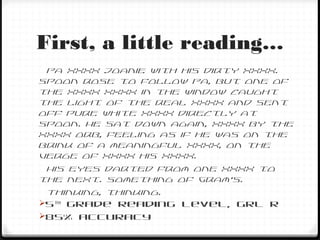
First, a little reading…
Pa XXXX Joanie with his dirty XXXX.
Spoon rose to follow Pa, but one of
the XXXX XXXX in the window caught
the light of the real XXXX and sent
off pure white XXXX directly at
Spoon. He sat down again, XXXX by the
XXXX orb, feeling as if he was on the
brink of a meaningful XXXX, on the
verge of XXXX his XXXX.
His eyes darted from one XXXX to
the next. Something of Gram’s.
Thinking, thinking.
5th
grade reading level, GRL R
85% accuracy
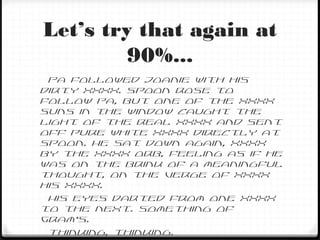
Let’s try that again at
90%...
Pa followed Joanie with his
dirty XXXX. Spoon rose to
follow Pa, but one of the XXXX
suns in the window caught the
light of the real XXXX and sent
off pure white XXXX directly at
Spoon. He sat down again, XXXX
by the XXXX orb, feeling as if he
was on the brink of a meaningful
thought, on the verge of XXXX
his XXXX.
His eyes darted from one XXXX
to the next. Something of
Gram’s.
Thinking, thinking.
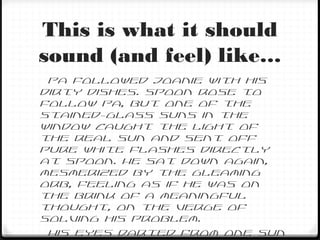
This is what it should
sound (and feel) like…
Pa followed Joanie with his
dirty dishes. Spoon rose to
follow Pa, but one of the
stained-glass suns in the
window caught the light of
the real sun and sent off
pure white flashes directly
at Spoon. He sat down again,
mesmerized by the gleaming
orb, feeling as if he was on
the brink of a meaningful
thought, on the verge of
solving his problem.
His eyes darted from one sun
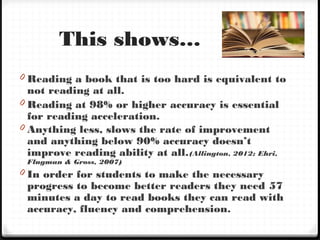
This shows…
0 Reading a book that is too hard is equivalent to
not reading at all.
0 Reading at 98% or higher accuracy is essential
for reading acceleration.
0 Anything less, slows the rate of improvement
and anything below 90% accuracy doesn’t
improve reading ability at all.(Allington, 2012; Ehri,
Flugman & Gross, 2007)
0 In order for students to make the necessary
progress to become better readers they need 57
minutes a day to read books they can read with
accuracy, fluency and comprehension.
EssentialsEssentials
0 Read-ability
0 Volume
0 Choice
0 Timely, Explicit, Strategy
Instruction
0 Literate Talk
Reading
Workshop
0 Minilesson
0 Independent Reading with
Small Group Teaching
0 Conferring
0 Small Group Strategy
Work
0 Mid Workshop Teaching
Point
0 Share
Guided ReadingGuided Reading
0 Powerful vehicle to
differentiate instruction
0 Features vs. Comprehension
Skills– balance changes as
levels become more
difficult
0 Text considerations
(Independent,
Frustrational,
Instructional)
0 Guided reading can
strengthen strengths as
well as help move levels
0 Should be viewed as a
support to transfer
“A child's reading level
doesn't catch up to his
listening level until eighth
grade. You can and should be
reading seventh-grade books
to fifth-grade kids.”
“You have to hear it
before you can speak it,
and you have to speak it
before you can read it.
Reading at this level
happens through the ear.”
“The single most important
activity for building the
knowledge required for
eventual success in reading is
reading aloud to children.”
~ Becoming a Nation of Readers, 1985
Read Aloud
Instructional Read Aloud
with Accountable Talk
0 Practice strategies
learned in other reading
modalities
0 Practice talking about
reading
0 Removes the decoding to
allow for comprehension
work
SharedShared
ReadingReading0 Chance to
practice
skills and
strategies
together
in a
shared
text
0 All
students
can see
the words
0 Link to
Word Study
0 Word patterns (Letter-
sound, Affixes, Common
Greek and Latin roots)
0 Vocabulary (inside and
outside)
0 Sight Words (High
frequency words)
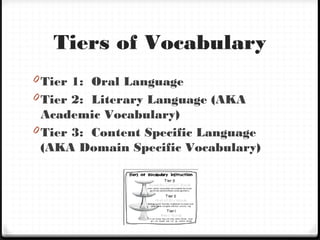
Tiers of Vocabulary
0 Tier 1: Oral Language
0 Tier 2: Literary Language (AKA
Academic Vocabulary)
0 Tier 3: Content Specific Language
(AKA Domain Specific Vocabulary)
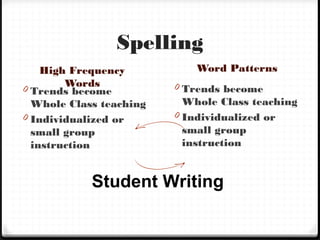
Spelling
High Frequency
Words
0 Trends become
Whole Class teaching
0 Individualized or
small group
instruction
Word Patterns
0 Trends become
Whole Class teaching
0 Individualized or
small group
instruction
Student Writing
Instructional Moves
0Assessments
0Word Walls
0Personal Word Walls
0Sorts/games
0Chart Chanting and Writing
Application
Balanced literacy bergenfield ii

Balanced literacy bergenfield ii

  • 1.
  • 2.
    Outcomes for TodayOutcomesfor Today 0 Research- supported Literacy Practices 0 Writing Instructional Components 0 Reading Instructional Components
  • 3.
    • Engage fully • Inquire anddig deeply into challen ges • Respect the knowled ge and
  • 4.
    Tenets 0 Practice: Pencilto paper, eyes on print 0 Learning is messy, teaching must be flexible 0 Formative Assessment 0 Feedback 0 Approximation 0 Transfer is the Key
  • 5.
    Components of aComponentsof a Comprehensive LiteracyComprehensive Literacy ApproachApproach Interactive Read Aloud Shared Reading Reading Workshop Grammar Shared Writing Writing Workshop Word Study
  • 6.
    Purpose of ComponentsPurposeof Components Wor d Stud y Wor d Stud y Reading and Writing Workshop Shar ed Writi ng Shar ed Writi ng Gram mar Gram mar Shar ed Read ing Shar ed Read ing Read Alou d Read Alou d
  • 7.
  • 8.
  • 9.
  • 10.
    Five Qualities ofGood Writing 0 Focus/Content 0 Elaboration 0 Voice 0 Structure 0 Mechanics
  • 11.
    Shared WritingShared Writing 0Separate from Writing Workshop, rarely used in a minilesson 0 Share– create it together, teacher does the writing 0 Preparation and skill introduction and practice
  • 12.
    Sample of DirectGrammar Instruction Across Units
  • 13.
    Grammar andGrammar and MechanicsMechanics Practice like a word study but set up for (and expect) transfer
  • 14.
    Grammar andGrammar and MechanicsMechanics0The difference between conventions and grammar: Grammar refers to the structure of a language: the parts of speech and their functions, their relationship to each other, word order in sentences, the parts of a sentence and how they are put together, e.g., subject, predicate, objects, etc. Mechanics refers to the conventions of written language: punctuation, capitalization, spelling, etc. 0 Language of literacy 0 Students along the way are going to understand, and then mess it up again. This
  • 15.
    students’ writing, or tellthem to be correct, then they may revert to simpler vocabulary and sentence structure that they are sure how to punctuate.
  • 16.
    Mentor Sentences One Techniquefor Teaching Grammar for Usage
  • 17.
    Stages of Development inGrammar 1. Unfamiliarity 2. Familiarity 3. Experimentation 4. Using and confusing 5. Mastery and control
  • 18.
    The Writing Workshop Aplace for feedback, transfer, and lots and lots of writing!
  • 19.
    Writers Need 0 Time 0Choice 0 A variety of strategies to access learning
  • 20.
  • 21.
    Writing Workshop Structures andRoutines 0 Minilesson 0 Independent Writing and Small Group Teaching 0 Conferring 0 Small Group Strategy Work 0 Mid Workshop Teaching Point
  • 22.
    Writers Need 0 Time 0Choice 0 A variety of strategies to access learning 0 Models 0 Modeling
  • 23.
    Nothing a teachercan do can have a greater effect than this combination— giving students crystal clear goals, opportunities for engaged work, and the feedback that includes compliments and steps for more progress.
  • 24.
    Teachers must alsoensure that children have access to reading materials that are relevant to the kind of writer they are interested in becoming at that particular moment. Teachers must also recruit the authors who will become the children’s unwitting collaborators. Frank Smith on Mentor Texts
  • 25.
    Writers Need 0 Time 0Choice 0 A variety of strategies to access learning 0 Models 0 Modeling 0 A Writer’s Notebook
  • 26.
  • 27.
    A Writer’s Notebook 0Not a journal 0 A place for practice 0 A place for feedback 0 A place for planning 0 A place to collect minilessons or teaching strategies 0 Filled with all different genre 0 A place to collect ideas, pieces of stories, inspiration for writing 0 A place to live like a writer 0 Teacher comments in post its 0 Graded differently than other writing
  • 28.
  • 29.
  • 30.
  • 31.
  • 33.
    Whether it iswith a group of characters or an idea for the plot, begin to write. Everything develops under the pencil as you begin to write. Roald Dahl
  • 34.
    Assessment of Notebooks 0Volume 0 Variety 0 Thoughtfulness 0 Maintenance
  • 35.
  • 36.
    Assessment 0 Assessment for Learning:This is what you did well, here are my questions, here are my suggestions to improve your writing 0 Assessment of Learning: Process, content, conventions grades
  • 37.
  • 38.
    Reading Requires… 0 Decoding 0Comprehension 0 Fluency
  • 39.
  • 40.
    First, a littlereading… Pa XXXX Joanie with his dirty XXXX. Spoon rose to follow Pa, but one of the XXXX XXXX in the window caught the light of the real XXXX and sent off pure white XXXX directly at Spoon. He sat down again, XXXX by the XXXX orb, feeling as if he was on the brink of a meaningful XXXX, on the verge of XXXX his XXXX. His eyes darted from one XXXX to the next. Something of Gram’s. Thinking, thinking. 5th grade reading level, GRL R 85% accuracy
  • 41.
    Let’s try thatagain at 90%... Pa followed Joanie with his dirty XXXX. Spoon rose to follow Pa, but one of the XXXX suns in the window caught the light of the real XXXX and sent off pure white XXXX directly at Spoon. He sat down again, XXXX by the XXXX orb, feeling as if he was on the brink of a meaningful thought, on the verge of XXXX his XXXX. His eyes darted from one XXXX to the next. Something of Gram’s. Thinking, thinking.
  • 42.
    This is whatit should sound (and feel) like… Pa followed Joanie with his dirty dishes. Spoon rose to follow Pa, but one of the stained-glass suns in the window caught the light of the real sun and sent off pure white flashes directly at Spoon. He sat down again, mesmerized by the gleaming orb, feeling as if he was on the brink of a meaningful thought, on the verge of solving his problem. His eyes darted from one sun
  • 43.
    This shows… 0 Readinga book that is too hard is equivalent to not reading at all. 0 Reading at 98% or higher accuracy is essential for reading acceleration. 0 Anything less, slows the rate of improvement and anything below 90% accuracy doesn’t improve reading ability at all.(Allington, 2012; Ehri, Flugman & Gross, 2007) 0 In order for students to make the necessary progress to become better readers they need 57 minutes a day to read books they can read with accuracy, fluency and comprehension.
  • 44.
    EssentialsEssentials 0 Read-ability 0 Volume 0Choice 0 Timely, Explicit, Strategy Instruction 0 Literate Talk
  • 45.
    Reading Workshop 0 Minilesson 0 IndependentReading with Small Group Teaching 0 Conferring 0 Small Group Strategy Work 0 Mid Workshop Teaching Point 0 Share
  • 46.
    Guided ReadingGuided Reading 0Powerful vehicle to differentiate instruction 0 Features vs. Comprehension Skills– balance changes as levels become more difficult 0 Text considerations (Independent, Frustrational, Instructional) 0 Guided reading can strengthen strengths as well as help move levels 0 Should be viewed as a support to transfer
  • 47.
    “A child's readinglevel doesn't catch up to his listening level until eighth grade. You can and should be reading seventh-grade books to fifth-grade kids.” “You have to hear it before you can speak it, and you have to speak it before you can read it. Reading at this level happens through the ear.” “The single most important activity for building the knowledge required for eventual success in reading is reading aloud to children.” ~ Becoming a Nation of Readers, 1985 Read Aloud
  • 49.
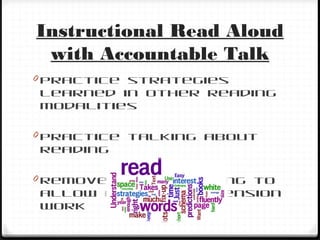
    Instructional Read Aloud withAccountable Talk 0 Practice strategies learned in other reading modalities 0 Practice talking about reading 0 Removes the decoding to allow for comprehension work
  • 50.
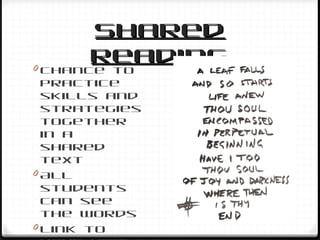
    SharedShared ReadingReading0 Chance to practice skillsand strategies together in a shared text 0 All students can see the words 0 Link to
  • 51.
    Word Study 0 Wordpatterns (Letter- sound, Affixes, Common Greek and Latin roots) 0 Vocabulary (inside and outside) 0 Sight Words (High frequency words)
  • 52.
    Tiers of Vocabulary 0Tier 1: Oral Language 0 Tier 2: Literary Language (AKA Academic Vocabulary) 0 Tier 3: Content Specific Language (AKA Domain Specific Vocabulary)
  • 53.
    Spelling High Frequency Words 0 Trendsbecome Whole Class teaching 0 Individualized or small group instruction Word Patterns 0 Trends become Whole Class teaching 0 Individualized or small group instruction Student Writing
  • 54.
    Instructional Moves 0Assessments 0Word Walls 0PersonalWord Walls 0Sorts/games 0Chart Chanting and Writing Application

Editor's Notes

  • #6 Quick overview of the components of the comprehensive approach
  • #7 All aspects of literacy should have an end goal in mind: student achievement. We design our instruction so it is all focusing on a particular area we want our students to succeed.
  • #8 Talk this through
  • #9 Notecatcher about each. Start with something each person has learned and what they needed in place.
  • #11 Talk about each and processing time for all T’s
  • #12 Article Share
  • #13 Study a notebook entry and name these qualities, thinking about which quality needs more support
  • #14 Shared Writing plan for a week
  • #15 I visualize an ongoing running list/anchor chart – continuously adding new skills – serves as a reminder
  • #16 Get it all out on the table!
  • #17 Name our values around Grammar
  • #20 Page 8
  • #22 Same for adult learners– adult learning, Categorize and explain briefly the parts of the
  • #25 Example of minilessons: Big change Minilesson using Ish
  • #28 Overview of mentor texts and how to use them– how they connect directly to the common core standards
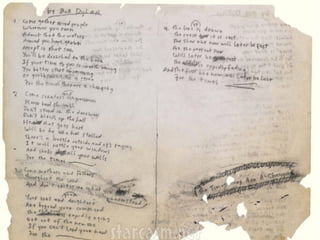
  • #32 Bob Dylan
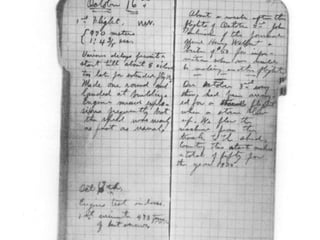
  • #33 Orville and Wilbur Wright
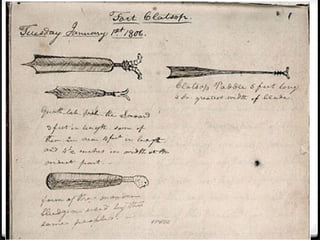
  • #34 Louis and Clark
  • #35 Click on Louis and clark notebook to get to Sharing Our Notebook website: http://www.sharingournotebooks.amylv.com/ Louis and Clark Share Jack’s Notebook Roald Dahl Processing: How would you build a notebook?
  • #36 Jane Austen’s plan for a book
  • #37 Share roald dahl chapter
  • #38 Volume-two pages in class, two at home 20 pages per week Write the Weird– the odd, original part, push to tell the truth, wholly and fully without, uncover those things that make writing real, collecting moments that matter, then tell them more honestly, precisely, dig farther inside things that were already written, (p. 25) Dig deeper, thinking, what does this story say about…? Make plans for that evening’s writing before ending the workshop
  • #40 After discussing assessments, start to talk about the units. Create a pacing guide of units.
  • #42 Define each, share the hierarchy of comprehension
  • #43 Knowing the level, matching books to kids,
  • #44 Before we can do any work with text, we need to be sure kids are reading texts at their level!
  • #48 Read high interest books with 99% accuracy Volume reading is the goal Writing about reading, not instead of reading Conferring with record keeping
  • #49 Example of minilessons: Big change Minilesson using Ish
  • #54 Video of dad who read to his daughter through college
  • #55 Quick demo
  • #56 Define shared reading and then try it out with the poem. Share the plan for shared reading.
  • #57 Refer to CCSS
  • #60 20 minutes per day on Word Study Differentiate into three groups, teach them games and/or centers to practice 1st grade enters with about 30-40 sight words, 2nd grade 150 words, Make a ring of words that students know and almost know, K-1 name study in the first month
  • #61 Important qualities of word walls