Beyond the Grid:A Green
Energy Economy
Anya Kamenetz
Fast Company Magazine
What Makes Them Sexy?
• Business Models that give us more Creative
Jobs
• Good, high-paying, fulfilling work
• Hard to outsource
• These jobs also grow more anchored jobs
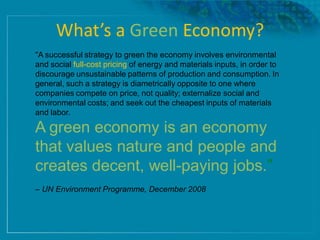
What’s a Green Economy?
"A successful strategy to green the economy involves environmental
and social full-cost pricing of energy and materials inputs, in order to
discourage unsustainable patterns of production and consumption. In
general, such a strategy is diametrically opposite to one where
companies compete on price, not quality; externalize social and
environmental costs; and seek out the cheapest inputs of materials
and labor.
A green economy is an economy
that values nature and people and
creates decent, well-paying jobs.‖
– UN Environment Programme, December 2008
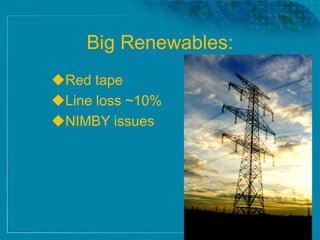
Big Renewables:
Red tape
Line loss ~10%
NIMBY issues
Big Renewables:
BLM has received 400 applications for large
solar and wind plants covering 2.3 million
rural acres. Only a few have undergone
environmental assessments—step 1 in a
multiyear process.
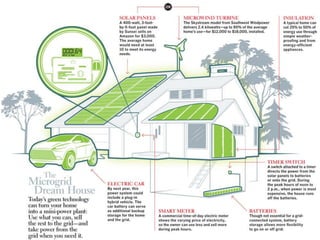
The microgrid is all about
consumer control -- aligning $
incentives, with the help of IT,
to make renewables and
efficiency pay off for the
average homeowner,
commercial developer, or
even a town.
Smart Grid
Cisco, Google, GE, and IBM are investing
billions in the software and appliances to let
consumers and producers make intelligent,
efficient electric-power decisions.
The killer app comes when you, the
consumer, can actually profit by using power
intelligently.
Distributed Energy
Energy produced near point of
use. ―1000 points of light.‖
Because the scale lowers
capital risk, the economic
benefits of a dollar invested in
distributed renewables can be
an order of magnitude (factor
of 10) greater than the same
dollar invested in conventional
power plants.
Amory Lovins, Small is Profitable
Net Metering
The right to sell your power back
to the grid at retail price.
Feed-In Tariff
Feed-in tariffs offer a premium over
retail price--the same financing deal
to citizens at large that utilities get
on any power plant they build.
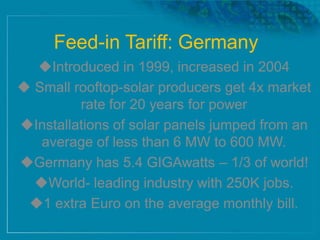
Feed-in Tariff: Germany
Introduced in 1999, increased in 2004
 Small rooftop-solar producers get 4x market
rate for 20 years for power
Installations of solar panels jumped from an
average of less than 6 MW to 600 MW.
Germany has 5.4 GIGAwatts – 1/3 of world!
World- leading industry with 250K jobs.
1 extra Euro on the average monthly bill.
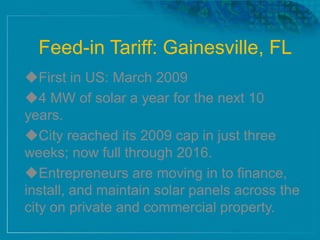
Feed-in Tariff: Gainesville, FL
First in US: March 2009
4 MW of solar a year for the next 10
years.
City reached its 2009 cap in just three
weeks; now full through 2016.
Entrepreneurs are moving in to finance,
install, and maintain solar panels across the
city on private and commercial property.
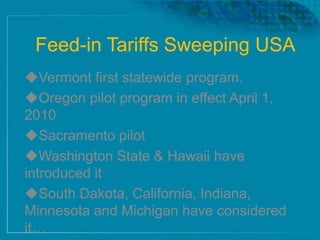
Feed-in Tariffs Sweeping USA
Vermont first statewide program.
Oregon pilot program in effect April 1,
2010
Sacramento pilot
Washington State & Hawaii have
introduced it
South Dakota, California, Indiana,
Minnesota and Michigan have considered
it…
Replace resources with
intelligence.
Local Businesses
Stand up for sustainable
growth…
"It's inevitable that consumers will
continue to want to exercise more
involvement in energy decisions,"
says Allan Schurr at IBM. "Our
research shows that only 30% of
consumers are satisfied with the
passive ratepayer role...The force
is very strong."
―The charm of the feed-in tariff
is solid, take-it-to-the-bank
security and confidence for
the investing community.‖
--Rep. Jay Inslee (New York
Times 08/03/09)
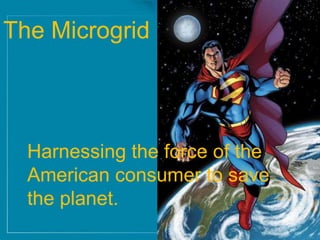
Harnessing the force of the
American consumer to save
the planet.
The Microgrid

CreateWV Kamenetz Keynote 2009

  • 1.
    Beyond the Grid:AGreen Energy Economy Anya Kamenetz Fast Company Magazine
  • 2.
    What Makes ThemSexy? • Business Models that give us more Creative Jobs • Good, high-paying, fulfilling work • Hard to outsource • These jobs also grow more anchored jobs
  • 7.
    What’s a GreenEconomy? "A successful strategy to green the economy involves environmental and social full-cost pricing of energy and materials inputs, in order to discourage unsustainable patterns of production and consumption. In general, such a strategy is diametrically opposite to one where companies compete on price, not quality; externalize social and environmental costs; and seek out the cheapest inputs of materials and labor. A green economy is an economy that values nature and people and creates decent, well-paying jobs.‖ – UN Environment Programme, December 2008
  • 9.
    Big Renewables: Red tape Lineloss ~10% NIMBY issues
  • 10.
    Big Renewables: BLM hasreceived 400 applications for large solar and wind plants covering 2.3 million rural acres. Only a few have undergone environmental assessments—step 1 in a multiyear process.
  • 11.
    The microgrid isall about consumer control -- aligning $ incentives, with the help of IT, to make renewables and efficiency pay off for the average homeowner, commercial developer, or even a town.
  • 12.
    Smart Grid Cisco, Google,GE, and IBM are investing billions in the software and appliances to let consumers and producers make intelligent, efficient electric-power decisions. The killer app comes when you, the consumer, can actually profit by using power intelligently.
  • 13.
    Distributed Energy Energy producednear point of use. ―1000 points of light.‖
  • 14.
    Because the scalelowers capital risk, the economic benefits of a dollar invested in distributed renewables can be an order of magnitude (factor of 10) greater than the same dollar invested in conventional power plants. Amory Lovins, Small is Profitable
  • 15.
    Net Metering The rightto sell your power back to the grid at retail price.
  • 16.
    Feed-In Tariff Feed-in tariffsoffer a premium over retail price--the same financing deal to citizens at large that utilities get on any power plant they build.
  • 17.
    Feed-in Tariff: Germany Introducedin 1999, increased in 2004  Small rooftop-solar producers get 4x market rate for 20 years for power Installations of solar panels jumped from an average of less than 6 MW to 600 MW. Germany has 5.4 GIGAwatts – 1/3 of world! World- leading industry with 250K jobs. 1 extra Euro on the average monthly bill.
  • 18.
    Feed-in Tariff: Gainesville,FL First in US: March 2009 4 MW of solar a year for the next 10 years. City reached its 2009 cap in just three weeks; now full through 2016. Entrepreneurs are moving in to finance, install, and maintain solar panels across the city on private and commercial property.
  • 19.
    Feed-in Tariffs SweepingUSA Vermont first statewide program. Oregon pilot program in effect April 1, 2010 Sacramento pilot Washington State & Hawaii have introduced it South Dakota, California, Indiana, Minnesota and Michigan have considered it…
  • 20.
  • 26.
  • 27.
    Stand up forsustainable growth…
  • 28.
    "It's inevitable thatconsumers will continue to want to exercise more involvement in energy decisions," says Allan Schurr at IBM. "Our research shows that only 30% of consumers are satisfied with the passive ratepayer role...The force is very strong."
  • 29.
    ―The charm ofthe feed-in tariff is solid, take-it-to-the-bank security and confidence for the investing community.‖ --Rep. Jay Inslee (New York Times 08/03/09)
  • 30.
    Harnessing the forceof the American consumer to save the planet. The Microgrid