You don’t have to hit to hurt…. 
Weapon of Choice Project 
Richard Johnson 
hurtwords.com
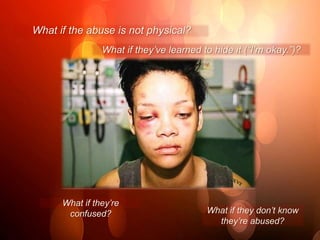
If this was your client, your altruism and compassion 
would be triggered by the visible affects of physical 
abuse….
What if the 
abuse is not 
physical? 
What if they’ve 
learned to hide 
it? 
(“I’m okay.”) 
What if 
they’re 
confused? 
What if 
they don’t 
know 
they’re 
being 
abused?
Some who are emotionally abused present as 
incongruent. It can be as simple as a “haggard” look 
that is not accompanied by anything that gives a 
visible or clear indication of why that person is fearful, 
confused, angry, apprehensive, etcetera…. There are 
no scars.
Sadness, frustration, confusion…. 
With experience 
you can easily 
recognize the 
emotionally abused 
client because 
there’s something 
perceptibly visible 
in their 
appearance. The 
diagnostic 
interview will 
explain their 
emotionally 
defeated 
demeanor.
Comorbidity 
The purpose of this 
presentation is to 
point out emotional 
or qualitative (e.g., 
typical thoughts or 
thought patterns) 
characteristics of 
this population so 
that we may better 
identify and serve 
them.
What is “Crazy Glue”? 
The Betrayal Bond by Patrick J. Carnes, Ph.D., CAS 
Stockholm Syndrome: A deep, inexplicable bond with someone who has 
continually distressed or critically hurt the client. This phenomenon is 
caused when the abused person feels/holds a strong bond to their abuser. 
This abuse can be physical, psychological, emotional, verbal, or any 
combination of these. Regardless, the abused person develops a sense of 
compassion and loyalty to their abusers. There is a tendency to see a lack 
of abuse or the honeymoon periods between abuse as kindness or as proof 
of their abuser’s humanity. 
A “trauma” or “betrayal” bond develops when there are continually intense, 
traumatic experiences or betrayals of trust taking place between intermittent 
periods of reconciliation. Much like physical abuse, these cycles form an 
intense and abusive relationship/bond with the perpetrator where emotional 
manipulation or hypercriticism are acceptable forms of communication.
A key characteristic for both the clinician and the 
abused is confusion. “If he’s such a great guy or 
she’s such a good wife, why are clients 
experiencing problems?” 
• The Abused experiences…. 
• Confusion and/or is easily confused. 
• Anger, frustration, or irritation without being able to give a 
plausible reason/cause. 
• Reluctance to communicate with their partner, so it 
seems like they’re the ‘stonewaller’. This person is 
actually trying not to get caught in the turning of tables 
that often happens with emotionally manipulative 
arguments because the fault is ‘magically’ (frustratingly) 
placed back on them. 
• e.g., Couple is longer arguing about the original point, which 
is sometimes the abused person’s perception of being hurt 
or abused.
• Atypical depression because of being confused 
about why there are problems. This is a different 
kind of mental exhaustion. 
• The “defeated” look. 
• Atypical anxiety because they don’t know why 
they’re anxious. 
• Being with their partner/spouse is oddly 
disconcerting/dissonant (e.g., wanting to be with them but 
walking on eggshells). 
• Anxious to be understood (i.e., as safe, loving, caring). 
• Unspoken fear because they cannot mentally/physically 
justify or explain why they’re fearful.
• A ‘lost’ sense of self: 
• The abused has spent a significant amount of time trying to 
figure out their partner and has forgotten about their own 
wants, needs, habits, etc. 
• Can’t see/understand what’s wrong in the relationship but 
knows “something” is wrong. 
• PTMSD = posttraumatic marital stress disorder
The Abuser 
• Scapegoating: Angry at person abused for 
EVERYTHING. All problems seem to be the 
abused person’s fault or responsibility. 
• Abuser may be arrogant. Also note angry 
arrogance may manifest when the abuser realizes 
that you as therapist aren’t buying into his/her 
dysfunctional line of reasoning. 
• Does not see his/her abusive/manipulative 
tendencies as a fault. It’s “helping” or 
“misunderstanding ” his/her actions. However, can 
easily point out abused person’s faults to the point 
that the abused him/herself can rattle of “the list” 
by rote memory.
• Well practiced in twisting the story to fit the 
abuser’s justification. 
• e.g., “When you come in I hear you fussing at the kids 
to clean. You never give me a chance to parent!” Well, 
he has to be in the home first to hear her come in so 
why didn’t he use the time before she was there to 
parent? Why wait until she comes home to show 
action? 
• Secret controller; Dr. Jekyll/Mr. Hyde 
• To act out public would be rude and could blemish how 
people “see” the abuser. 
• Prince charming in public; Devil’s advocate in private or 
with others seen as a threat. The latter may be 
especially prevalent if the outside person perceived as 
forming an allegiance with the abused.
• Personality traits/characteristics may reflect: 
• Personality disorder, NOS 
• Narcissistic disorder 
• Antisocial disorder 
• Abuse may actually be cover for: 
• Insecurity 
• Low self-esteem 
• Anger issues 
• F.O.O./‘Generational curses/cycles’
Clue #1: Relationship Dynamics 
• Control/Coercion? 
• Manipulation? 
• Verbally abuses spouse/partner and/or children? 
• Abused kept from family and friends? 
• Abuser easily/randomly insulted/offended by innocent statements? 
• Abuser pouts or has sudden outbursts of anger that are 
disproportionate to the circumstances? 
• Abuser often behaves coercively or becomes overly jealous? 
• Abuser easily angry when spouse/partner wants/needs to spend 
time away? 
• Abuser destroys personal property or sentimental items? 
• Abuser controls spending and makes spouse/partner accountable 
for money spent? (This is not reciprocated.) 
• Abuser uses insinuated threats, intimidation, or manipulation for 
control? 
• Abuser often humiliates spouse/partner in front of others? (…in jest) 
• Abuser turns minor incidents into major arguments? 
• Abuser refuses affection and sympathy, or implies weakness when 
spouse/partner feels hurt or in need or nurture? 
• Abuses pets?
Clue #2: Therapy Dynamics 
• In therapy because it’s the abused person’s “fault”. 
• Therapy needed because of the abused person’s “problems”. 
• The abuser is often a “hostile” witness. 
• Relationship has cycles of break ups or separation. Both are equally at fault for 
renewing this dysfunctional relationship cycle. The abused because they’ve 
often left impulsively. The abuser may leave because the abused 
leaving/rejection has injured the abuser’s psyche. 
• In therapy the abuser is unusually cool (over confident) or has sporadic anger 
outbursts (low frustration tolerance). Visibly runs warm and cold. 
• The abused isn’t afraid of the abuser but doesn’t like abuser either. 
• The abused doesn’t trust abuser but can’t tell you why. 
• Abused feels “crazy” because they’re caught in trying to solve a problem that 
doesn’t exist or a situation that’s been manipulated to look like they’re the cause 
(gas lighting/“not your crutches” confusion). 
• Abused caught in the abuse cycle and cannot give an exact reason why they 
should leave but they want to leave nevertheless. 
• The abuser is not confused AT ALL. No responsibility taken for their 
dysfunctional behavior and if you’d just “fix” the abused person to listen and do 
whatever the abuser says, everything would be MUCH better. Again, he/she may 
even appear confident or cocky.
Questions to ask… 
• Examine both for self-esteem deficits that can be amended or 
restructured…. 
• Examine F.O.O. for a history of dysfunction both know to be 
“comfortable” or familiar…. 
• Do either have history of abuse that has been normalized? 
• How far is the abuser psychologically enmeshed in the abused 
person’s psyche? 
• Who is speaking when the abused speaks? e.g., “Tom told me I 
was making too much of him yelling at me.” 
• Does one/both come from an “abusive” home? 
• Note: Don’t use the term abuse because each may not consider 
their childhood normal despite outside reactions that it was not. 
Abuser may even justify the abuse of their past as necessary for 
making them the “good/great” person that they currently are.
Should I stay or go? Can I “fix” this? 
• Despite the abused person’s complaints many are in a position, as 
with any abusive controlling relationship, where they cannot easily 
leave. Also remember, the abused person cannot connect 
disparaging feelings to any tangible reason/cause for leaving. 
Therefore many are convinced that things will work out. Despite 
multiple attempts to leave, the cycle, and professional opinions, they 
stay bound by crazy glue. 
• Community resources for those in imminent danger (Escape Plan): 
For those ready to leave, an emergency plan should be developed, just as if 
person was in a physically abusive relationship. Emotional/verbal abuse can 
be the gateway for physical violence. Actually leaving can be the catalyst 
that triggers violent acts in addition to emotional abuse. 
• Abused may need coping skills to deal with the abuser’s behaviors 
while they are beginning to transition to independence or leaving. 
• Caveat for the person who willingly chooses to stay without 
requiring change within their own paradigm or requiring change from 
the abuser. They should no longer complain about something they 
willingly and knowingly accept or allow. 
• Of course if the abuser TRULY chooses to change, this is also an 
option (Possible & rare).
We’re still talking 
about abuse. It 
becomes insidious 
because it’s 
intangible. Have 
you ever considered 
you can’t file a 
protective order for 
emotional abuse?
Suggested Reading 
• The Betrayal Bond: Breaking Free of Exploitive Relationships by Patrick 
Carnes 
• Why Does He Do That?: Inside the Minds of Angry and Controlling Men by 
Lundy Bancroft 
• The Gaslight Effect: How to Spot and Survive the Hidden Manipulation 
Others Use to Control Your Life by Robin Stern 
• Too Good to Leave, Too Bad to Stay: A Step-by-Step Guide to Help You 
Decide Whether to Stay In or Get Out of Your Relationship by Mira 
Kirshenbaum 
• The Emotionally Destructive Relationship: Seeing It, Stopping It, Surviving It 
by Leslie Vernick 
• The Emotionally Abused Woman: Overcoming Destructive Patterns and 
Reclaiming Yourself by Beverly Engel 
• Not to People Like Us - Hidden Abuse In Upscale Marriages by Susan 
Weitzman
Journal Articles 
• Foa, E. B., Cascardi, M., Zoellner, L. A., & Feeny, N. C. (2000). Psychological and 
environmental factors associated with partner violence. Trauma, Violence, & Abuse, 
1(1), 67-91. 
• Gavin, H. (2011). Sticks and stones may break my bones: The effects of emotional 
abuse. Journal of Aggression, Maltreatment, & Trauma, 20, 503-529. 
• Haeseler, L. A. (2013). Women’s coping experiences in the spectrum of domestic 
violence abuse. Journal of Evidence-Based Social Work, 10, 33-43. 
• Lachkar, Joan (2000). Emotional abuse of high-functioning professional women: A 
psychodynamic perspective. Journal of Emotional Abuse, 2(1), 73-91. 
• Sackett, L. A. & Saunders, D. G. (1999). The impact of different forms of psychological 
abuse on battered women. Violence and Victims, 14(1), 1-13. 
• Sims, C. L. (2008). Psychological victimization and maltreatment. Journal of Emotional 
Abuse, 8 (4), 375-402. 
• Queen, J. and Brackley, M.H. (2009). Being emotionally abused: A phenomenological 
study of adult women’s experiences of emotionally abusive intimate Partner 
Relationships. Issues in Mental Health Nursing, 30, 237-245.
Sticks & stones will break my bones; 
mean words can also hurt me. 
Proverbs 15:1

Crazy Glue: Recognizing the Emotionally Abused Client

  • 1.
    You don’t haveto hit to hurt…. Weapon of Choice Project Richard Johnson hurtwords.com
  • 3.
    If this wasyour client, your altruism and compassion would be triggered by the visible affects of physical abuse….
  • 4.
    What if the abuse is not physical? What if they’ve learned to hide it? (“I’m okay.”) What if they’re confused? What if they don’t know they’re being abused?
  • 5.
    Some who areemotionally abused present as incongruent. It can be as simple as a “haggard” look that is not accompanied by anything that gives a visible or clear indication of why that person is fearful, confused, angry, apprehensive, etcetera…. There are no scars.
  • 6.
    Sadness, frustration, confusion…. With experience you can easily recognize the emotionally abused client because there’s something perceptibly visible in their appearance. The diagnostic interview will explain their emotionally defeated demeanor.
  • 7.
    Comorbidity The purposeof this presentation is to point out emotional or qualitative (e.g., typical thoughts or thought patterns) characteristics of this population so that we may better identify and serve them.
  • 8.
    What is “CrazyGlue”? The Betrayal Bond by Patrick J. Carnes, Ph.D., CAS Stockholm Syndrome: A deep, inexplicable bond with someone who has continually distressed or critically hurt the client. This phenomenon is caused when the abused person feels/holds a strong bond to their abuser. This abuse can be physical, psychological, emotional, verbal, or any combination of these. Regardless, the abused person develops a sense of compassion and loyalty to their abusers. There is a tendency to see a lack of abuse or the honeymoon periods between abuse as kindness or as proof of their abuser’s humanity. A “trauma” or “betrayal” bond develops when there are continually intense, traumatic experiences or betrayals of trust taking place between intermittent periods of reconciliation. Much like physical abuse, these cycles form an intense and abusive relationship/bond with the perpetrator where emotional manipulation or hypercriticism are acceptable forms of communication.
  • 9.
    A key characteristicfor both the clinician and the abused is confusion. “If he’s such a great guy or she’s such a good wife, why are clients experiencing problems?” • The Abused experiences…. • Confusion and/or is easily confused. • Anger, frustration, or irritation without being able to give a plausible reason/cause. • Reluctance to communicate with their partner, so it seems like they’re the ‘stonewaller’. This person is actually trying not to get caught in the turning of tables that often happens with emotionally manipulative arguments because the fault is ‘magically’ (frustratingly) placed back on them. • e.g., Couple is longer arguing about the original point, which is sometimes the abused person’s perception of being hurt or abused.
  • 10.
    • Atypical depressionbecause of being confused about why there are problems. This is a different kind of mental exhaustion. • The “defeated” look. • Atypical anxiety because they don’t know why they’re anxious. • Being with their partner/spouse is oddly disconcerting/dissonant (e.g., wanting to be with them but walking on eggshells). • Anxious to be understood (i.e., as safe, loving, caring). • Unspoken fear because they cannot mentally/physically justify or explain why they’re fearful.
  • 11.
    • A ‘lost’sense of self: • The abused has spent a significant amount of time trying to figure out their partner and has forgotten about their own wants, needs, habits, etc. • Can’t see/understand what’s wrong in the relationship but knows “something” is wrong. • PTMSD = posttraumatic marital stress disorder
  • 12.
    The Abuser •Scapegoating: Angry at person abused for EVERYTHING. All problems seem to be the abused person’s fault or responsibility. • Abuser may be arrogant. Also note angry arrogance may manifest when the abuser realizes that you as therapist aren’t buying into his/her dysfunctional line of reasoning. • Does not see his/her abusive/manipulative tendencies as a fault. It’s “helping” or “misunderstanding ” his/her actions. However, can easily point out abused person’s faults to the point that the abused him/herself can rattle of “the list” by rote memory.
  • 13.
    • Well practicedin twisting the story to fit the abuser’s justification. • e.g., “When you come in I hear you fussing at the kids to clean. You never give me a chance to parent!” Well, he has to be in the home first to hear her come in so why didn’t he use the time before she was there to parent? Why wait until she comes home to show action? • Secret controller; Dr. Jekyll/Mr. Hyde • To act out public would be rude and could blemish how people “see” the abuser. • Prince charming in public; Devil’s advocate in private or with others seen as a threat. The latter may be especially prevalent if the outside person perceived as forming an allegiance with the abused.
  • 14.
    • Personality traits/characteristicsmay reflect: • Personality disorder, NOS • Narcissistic disorder • Antisocial disorder • Abuse may actually be cover for: • Insecurity • Low self-esteem • Anger issues • F.O.O./‘Generational curses/cycles’
  • 15.
    Clue #1: RelationshipDynamics • Control/Coercion? • Manipulation? • Verbally abuses spouse/partner and/or children? • Abused kept from family and friends? • Abuser easily/randomly insulted/offended by innocent statements? • Abuser pouts or has sudden outbursts of anger that are disproportionate to the circumstances? • Abuser often behaves coercively or becomes overly jealous? • Abuser easily angry when spouse/partner wants/needs to spend time away? • Abuser destroys personal property or sentimental items? • Abuser controls spending and makes spouse/partner accountable for money spent? (This is not reciprocated.) • Abuser uses insinuated threats, intimidation, or manipulation for control? • Abuser often humiliates spouse/partner in front of others? (…in jest) • Abuser turns minor incidents into major arguments? • Abuser refuses affection and sympathy, or implies weakness when spouse/partner feels hurt or in need or nurture? • Abuses pets?
  • 16.
    Clue #2: TherapyDynamics • In therapy because it’s the abused person’s “fault”. • Therapy needed because of the abused person’s “problems”. • The abuser is often a “hostile” witness. • Relationship has cycles of break ups or separation. Both are equally at fault for renewing this dysfunctional relationship cycle. The abused because they’ve often left impulsively. The abuser may leave because the abused leaving/rejection has injured the abuser’s psyche. • In therapy the abuser is unusually cool (over confident) or has sporadic anger outbursts (low frustration tolerance). Visibly runs warm and cold. • The abused isn’t afraid of the abuser but doesn’t like abuser either. • The abused doesn’t trust abuser but can’t tell you why. • Abused feels “crazy” because they’re caught in trying to solve a problem that doesn’t exist or a situation that’s been manipulated to look like they’re the cause (gas lighting/“not your crutches” confusion). • Abused caught in the abuse cycle and cannot give an exact reason why they should leave but they want to leave nevertheless. • The abuser is not confused AT ALL. No responsibility taken for their dysfunctional behavior and if you’d just “fix” the abused person to listen and do whatever the abuser says, everything would be MUCH better. Again, he/she may even appear confident or cocky.
  • 17.
    Questions to ask… • Examine both for self-esteem deficits that can be amended or restructured…. • Examine F.O.O. for a history of dysfunction both know to be “comfortable” or familiar…. • Do either have history of abuse that has been normalized? • How far is the abuser psychologically enmeshed in the abused person’s psyche? • Who is speaking when the abused speaks? e.g., “Tom told me I was making too much of him yelling at me.” • Does one/both come from an “abusive” home? • Note: Don’t use the term abuse because each may not consider their childhood normal despite outside reactions that it was not. Abuser may even justify the abuse of their past as necessary for making them the “good/great” person that they currently are.
  • 18.
    Should I stayor go? Can I “fix” this? • Despite the abused person’s complaints many are in a position, as with any abusive controlling relationship, where they cannot easily leave. Also remember, the abused person cannot connect disparaging feelings to any tangible reason/cause for leaving. Therefore many are convinced that things will work out. Despite multiple attempts to leave, the cycle, and professional opinions, they stay bound by crazy glue. • Community resources for those in imminent danger (Escape Plan): For those ready to leave, an emergency plan should be developed, just as if person was in a physically abusive relationship. Emotional/verbal abuse can be the gateway for physical violence. Actually leaving can be the catalyst that triggers violent acts in addition to emotional abuse. • Abused may need coping skills to deal with the abuser’s behaviors while they are beginning to transition to independence or leaving. • Caveat for the person who willingly chooses to stay without requiring change within their own paradigm or requiring change from the abuser. They should no longer complain about something they willingly and knowingly accept or allow. • Of course if the abuser TRULY chooses to change, this is also an option (Possible & rare).
  • 19.
    We’re still talking about abuse. It becomes insidious because it’s intangible. Have you ever considered you can’t file a protective order for emotional abuse?
  • 20.
    Suggested Reading •The Betrayal Bond: Breaking Free of Exploitive Relationships by Patrick Carnes • Why Does He Do That?: Inside the Minds of Angry and Controlling Men by Lundy Bancroft • The Gaslight Effect: How to Spot and Survive the Hidden Manipulation Others Use to Control Your Life by Robin Stern • Too Good to Leave, Too Bad to Stay: A Step-by-Step Guide to Help You Decide Whether to Stay In or Get Out of Your Relationship by Mira Kirshenbaum • The Emotionally Destructive Relationship: Seeing It, Stopping It, Surviving It by Leslie Vernick • The Emotionally Abused Woman: Overcoming Destructive Patterns and Reclaiming Yourself by Beverly Engel • Not to People Like Us - Hidden Abuse In Upscale Marriages by Susan Weitzman
  • 21.
    Journal Articles •Foa, E. B., Cascardi, M., Zoellner, L. A., & Feeny, N. C. (2000). Psychological and environmental factors associated with partner violence. Trauma, Violence, & Abuse, 1(1), 67-91. • Gavin, H. (2011). Sticks and stones may break my bones: The effects of emotional abuse. Journal of Aggression, Maltreatment, & Trauma, 20, 503-529. • Haeseler, L. A. (2013). Women’s coping experiences in the spectrum of domestic violence abuse. Journal of Evidence-Based Social Work, 10, 33-43. • Lachkar, Joan (2000). Emotional abuse of high-functioning professional women: A psychodynamic perspective. Journal of Emotional Abuse, 2(1), 73-91. • Sackett, L. A. & Saunders, D. G. (1999). The impact of different forms of psychological abuse on battered women. Violence and Victims, 14(1), 1-13. • Sims, C. L. (2008). Psychological victimization and maltreatment. Journal of Emotional Abuse, 8 (4), 375-402. • Queen, J. and Brackley, M.H. (2009). Being emotionally abused: A phenomenological study of adult women’s experiences of emotionally abusive intimate Partner Relationships. Issues in Mental Health Nursing, 30, 237-245.
  • 22.
    Sticks & stoneswill break my bones; mean words can also hurt me. Proverbs 15:1

Editor's Notes

  • #7 Imagine a mother screaming at her baby as she fed or diapered them. Hateful love….
  • #10 Stepped on my toe example.
  • #17 gas lighting: a form of mental abuse in which false information is presented with the intent of making a victim doubt his or her own memory, perception and sanity.[1] Instances may range simply from the denial by an abuser that previous abusive incidents ever occurred, up to the staging of bizarre events by the abuser with the intention of disorienting the victim.
  • #18 Note that I don’t use the word “victim” because victims don’t have a choice. The abused here in some way don’t realize the choices they’re making.
  • #20 In the emotional abuse chart, NONE of the offenses will leave evidence for law enforcement to take as a serious matter. Esp., for women who are stereotypically considered “emotional” or “sensitive”.
  • #21 In no particular order.
  • #22 In no particular order.
  • #23 I find it interesting that only those who have been verbally or emotionally abused understand this clip. Those outside of this spectrum of abuse don’t get the allegory.