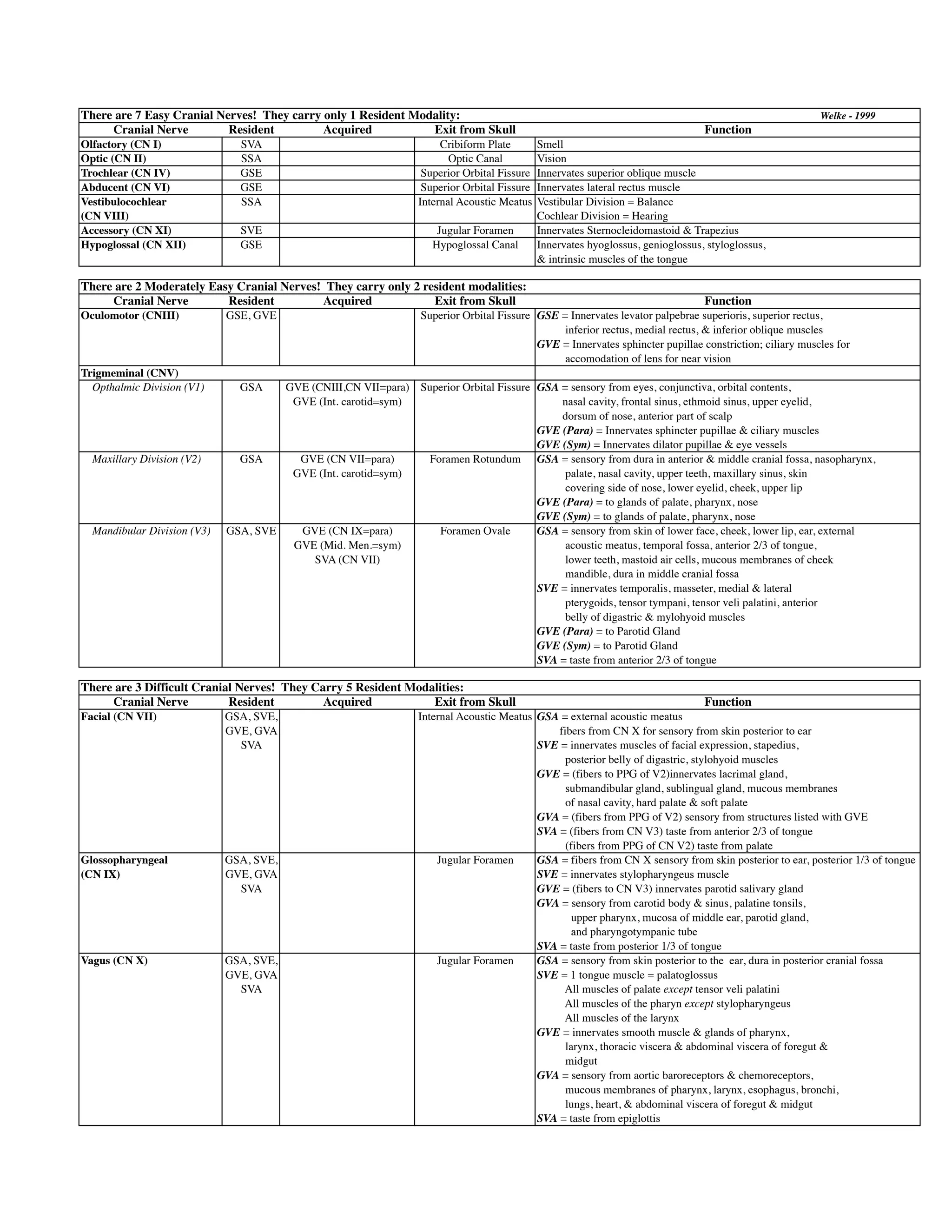
There are 7 Easy Cranial Nerves! They carry only 1 Resident Modality:                                                                                     Welke - 1999
     Cranial Nerve         Resident         Acquired           Exit from Skull                                                    Function
Olfactory (CN I)               SVA                                     Cribiform Plate        Smell
Optic (CN II)                  SSA                                       Optic Canal          Vision
Trochlear (CN IV)              GSE                                 Superior Orbital Fissure   Innervates superior oblique muscle
Abducent (CN VI)               GSE                                 Superior Orbital Fissure   Innervates lateral rectus muscle
Vestibulocochlear              SSA                                Internal Acoustic Meatus    Vestibular Division = Balance
(CN VIII)                                                                                     Cochlear Division = Hearing
Accessory (CN XI)              SVE                                    Jugular Foramen         Innervates Sternocleidomastoid & Trapezius
Hypoglossal (CN XII)           GSE                                   Hypoglossal Canal        Innervates hyoglossus, genioglossus, styloglossus,
                                                                                              & intrinsic muscles of the tongue

There are 2 Moderately Easy Cranial Nerves! They carry only 2 resident modalities:
     Cranial Nerve        Resident         Acquired             Exit from Skull                                                   Function
Oculomotor (CNIII)           GSE, GVE                              Superior Orbital Fissure GSE = Innervates levator palpebrae superioris, superior rectus,
                                                                                                 inferior rectus, medial rectus, & inferior oblique muscles
                                                                                            GVE = Innervates sphincter pupillae constriction; ciliary muscles for
                                                                                                 accomodation of lens for near vision
Trigmeminal (CNV)
  Opthalmic Division (V1)      GSA    GVE (CNIII,CN VII=para) Superior Orbital Fissure GSA = sensory from eyes, conjunctiva, orbital contents,
                                       GVE (Int. carotid=sym)                              nasal cavity, frontal sinus, ethmoid sinus, upper eyelid,
                                                                                           dorsum of nose, anterior part of scalp
                                                                                       GVE (Para) = Innervates sphincter pupillae & ciliary muscles
                                                                                       GVE (Sym) = Innervates dilator pupillae & eye vessels
  Maxillary Division (V2)      GSA      GVE (CN VII=para)       Foramen Rotundum GSA = sensory from dura in anterior & middle cranial fossa, nasopharynx,
                                       GVE (Int. carotid=sym)                               palate, nasal cavity, upper teeth, maxillary sinus, skin
                                                                                            covering side of nose, lower eyelid, cheek, upper lip
                                                                                       GVE (Para) = to glands of palate, pharynx, nose
                                                                                       GVE (Sym) = to glands of palate, pharynx, nose
  Mandibular Division (V3)   GSA, SVE   GVE (CN IX=para)          Foramen Ovale        GSA = sensory from skin of lower face, cheek, lower lip, ear, external
                                       GVE (Mid. Men.=sym)                                  acoustic meatus, temporal fossa, anterior 2/3 of tongue,
                                           SVA (CN VII)                                     lower teeth, mastoid air cells, mucous membranes of cheek
                                                                                            mandible, dura in middle cranial fossa
                                                                                       SVE = innervates temporalis, masseter, medial & lateral
                                                                                            pterygoids, tensor tympani, tensor veli palatini, anterior
                                                                                            belly of digastric & mylohyoid muscles
                                                                                       GVE (Para) = to Parotid Gland
                                                                                       GVE (Sym) = to Parotid Gland
                                                                                       SVA = taste from anterior 2/3 of tongue

There are 3 Difficult Cranial Nerves! They Carry 5 Resident Modalities:
     Cranial Nerve          Resident         Acquired           Exit from Skull                                                   Function
Facial (CN VII)              GSA, SVE,                            Internal Acoustic Meatus GSA = external acoustic meatus
                             GVE, GVA                                                          fibers from CN X for sensory from skin posterior to ear
                               SVA                                                         SVE = innervates muscles of facial expression, stapedius,
                                                                                                 posterior belly of digastric, stylohyoid muscles
                                                                                           GVE = (fibers to PPG of V2)innervates lacrimal gland,
                                                                                                 submandibular gland, sublingual gland, mucous membranes
                                                                                                 of nasal cavity, hard palate & soft palate
                                                                                           GVA = (fibers from PPG of V2) sensory from structures listed with GVE
                                                                                           SVA = (fibers from CN V3) taste from anterior 2/3 of tongue
                                                                                                 (fibers from PPG of CN V2) taste from palate
Glossopharyngeal             GSA, SVE,                                Jugular Foramen      GSA = fibers from CN X sensory from skin posterior to ear, posterior 1/3 of tongue
(CN IX)                      GVE, GVA                                                      SVE = innervates stylopharyngeus muscle
                               SVA                                                         GVE = (fibers to CN V3) innervates parotid salivary gland
                                                                                           GVA = sensory from carotid body & sinus, palatine tonsils,
                                                                                                   upper pharynx, mucosa of middle ear, parotid gland,
                                                                                                   and pharyngotympanic tube
                                                                                           SVA = taste from posterior 1/3 of tongue
Vagus (CN X)                 GSA, SVE,                                Jugular Foramen      GSA = sensory from skin posterior to the ear, dura in posterior cranial fossa
                             GVE, GVA                                                      SVE = 1 tongue muscle = palatoglossus
                               SVA                                                              All muscles of palate except tensor veli palatini
                                                                                                All muscles of the pharyn except stylopharyngeus
                                                                                                All muscles of the larynx
                                                                                           GVE = innervates smooth muscle & glands of pharynx,
                                                                                                 larynx, thoracic viscera & abdominal viscera of foregut &
                                                                                                 midgut
                                                                                           GVA = sensory from aortic baroreceptors & chemoreceptors,
                                                                                                 mucous membranes of pharynx, larynx, esophagus, bronchi,
                                                                                                 lungs, heart, & abdominal viscera of foregut & midgut
                                                                                           SVA = taste from epiglottis

Cranial nerves spreadsheet cn's

  • 1.
    There are 7Easy Cranial Nerves! They carry only 1 Resident Modality: Welke - 1999 Cranial Nerve Resident Acquired Exit from Skull Function Olfactory (CN I) SVA Cribiform Plate Smell Optic (CN II) SSA Optic Canal Vision Trochlear (CN IV) GSE Superior Orbital Fissure Innervates superior oblique muscle Abducent (CN VI) GSE Superior Orbital Fissure Innervates lateral rectus muscle Vestibulocochlear SSA Internal Acoustic Meatus Vestibular Division = Balance (CN VIII) Cochlear Division = Hearing Accessory (CN XI) SVE Jugular Foramen Innervates Sternocleidomastoid & Trapezius Hypoglossal (CN XII) GSE Hypoglossal Canal Innervates hyoglossus, genioglossus, styloglossus, & intrinsic muscles of the tongue There are 2 Moderately Easy Cranial Nerves! They carry only 2 resident modalities: Cranial Nerve Resident Acquired Exit from Skull Function Oculomotor (CNIII) GSE, GVE Superior Orbital Fissure GSE = Innervates levator palpebrae superioris, superior rectus, inferior rectus, medial rectus, & inferior oblique muscles GVE = Innervates sphincter pupillae constriction; ciliary muscles for accomodation of lens for near vision Trigmeminal (CNV) Opthalmic Division (V1) GSA GVE (CNIII,CN VII=para) Superior Orbital Fissure GSA = sensory from eyes, conjunctiva, orbital contents, GVE (Int. carotid=sym) nasal cavity, frontal sinus, ethmoid sinus, upper eyelid, dorsum of nose, anterior part of scalp GVE (Para) = Innervates sphincter pupillae & ciliary muscles GVE (Sym) = Innervates dilator pupillae & eye vessels Maxillary Division (V2) GSA GVE (CN VII=para) Foramen Rotundum GSA = sensory from dura in anterior & middle cranial fossa, nasopharynx, GVE (Int. carotid=sym) palate, nasal cavity, upper teeth, maxillary sinus, skin covering side of nose, lower eyelid, cheek, upper lip GVE (Para) = to glands of palate, pharynx, nose GVE (Sym) = to glands of palate, pharynx, nose Mandibular Division (V3) GSA, SVE GVE (CN IX=para) Foramen Ovale GSA = sensory from skin of lower face, cheek, lower lip, ear, external GVE (Mid. Men.=sym) acoustic meatus, temporal fossa, anterior 2/3 of tongue, SVA (CN VII) lower teeth, mastoid air cells, mucous membranes of cheek mandible, dura in middle cranial fossa SVE = innervates temporalis, masseter, medial & lateral pterygoids, tensor tympani, tensor veli palatini, anterior belly of digastric & mylohyoid muscles GVE (Para) = to Parotid Gland GVE (Sym) = to Parotid Gland SVA = taste from anterior 2/3 of tongue There are 3 Difficult Cranial Nerves! They Carry 5 Resident Modalities: Cranial Nerve Resident Acquired Exit from Skull Function Facial (CN VII) GSA, SVE, Internal Acoustic Meatus GSA = external acoustic meatus GVE, GVA fibers from CN X for sensory from skin posterior to ear SVA SVE = innervates muscles of facial expression, stapedius, posterior belly of digastric, stylohyoid muscles GVE = (fibers to PPG of V2)innervates lacrimal gland, submandibular gland, sublingual gland, mucous membranes of nasal cavity, hard palate & soft palate GVA = (fibers from PPG of V2) sensory from structures listed with GVE SVA = (fibers from CN V3) taste from anterior 2/3 of tongue (fibers from PPG of CN V2) taste from palate Glossopharyngeal GSA, SVE, Jugular Foramen GSA = fibers from CN X sensory from skin posterior to ear, posterior 1/3 of tongue (CN IX) GVE, GVA SVE = innervates stylopharyngeus muscle SVA GVE = (fibers to CN V3) innervates parotid salivary gland GVA = sensory from carotid body & sinus, palatine tonsils, upper pharynx, mucosa of middle ear, parotid gland, and pharyngotympanic tube SVA = taste from posterior 1/3 of tongue Vagus (CN X) GSA, SVE, Jugular Foramen GSA = sensory from skin posterior to the ear, dura in posterior cranial fossa GVE, GVA SVE = 1 tongue muscle = palatoglossus SVA All muscles of palate except tensor veli palatini All muscles of the pharyn except stylopharyngeus All muscles of the larynx GVE = innervates smooth muscle & glands of pharynx, larynx, thoracic viscera & abdominal viscera of foregut & midgut GVA = sensory from aortic baroreceptors & chemoreceptors, mucous membranes of pharynx, larynx, esophagus, bronchi, lungs, heart, & abdominal viscera of foregut & midgut SVA = taste from epiglottis