2
รายชื่อคณะอนุกรรมการผูจัดทํา
ที่ปรึกษา ศ.คลินิก พญ.วินัดดาปยะศิลป
ผศ.นพ.พนม เกตุมาน
ประธาน รศ.นพ.วิฐารณ บุญสิทธิ
กรรมการ รศ.นพ.ศิริไชย หงษสงวนศรี
ผศ.นพ.ปราโมทย สุคนิชย
อ.นพ.ทัศนวัต สมบุญธรรม
อ.นพ.พิสาสน เตชะเกษม
อ.นพ.ณัทธร พิทยรัตนเสถียร
นพ.จอม ชุมชวย
พญ.ปราณี เมืองนอย
กรรมการและเลขานุการ รศ.นพ.ชาญวิทย พรนภดล
กระบวนการจัดทํา
คณะอนุกรรมการผูจัดทําแนวทางเวชปฏิบัติการดูแลรักษาโรคสมาธิสั้นระดับโรงพยาบาลจังหวัด
สําหรับกุมารแพทยนี้ ประกอบดวยจิตแพทยเด็กและวัยรุน กุมารแพทยผูเชี่ยวชาญดานพัฒนาการและ
พฤติกรรม และกุมารแพทยผูเชี่ยวชาญดานประสาทวิทยา ดังรายชื่อขางตน คณะอนุกรรมการฯ ไดมีการ
ประชุมรวมกันเพื่อกําหนดรูปแบบการเขียน และไดทบทวนวรรณกรรม (review literatures) ระหวางป
คศ.1996-2010 โดยใชคําสําคัญ ไดแก“attention deficit hyperactivity disorder” ในการคนหาจาก
Medline นอกจากนี้คณะอนุกรรมการฯไดทบทวนแนวทางการดูแลรักษาผูปวยโรคสมาธิสั้น (Clinical
Practice Guideline: ADHD) ของ American Academy of Pediatrics (AAP), Practice Parameter ของ
American Academy of Child and Adolescent Psychiatry (AACAP), Health Care Guideline ของ Institute
for Clinical Systems Improvement (ICSI) และ Canadian ADHD Practice Guidelines เพื่อประกอบการ
เขียนแนวทางฯ และไดนําเสนอแนวทางที่ไดจัดทําขึ้นในการประชุมวิชาการประจําปของสมาคมกุมาร
แพทยแหงประเทศไทยครั้งที่ 69 เมื่อวันที่ 22 เมษายน 2553
3.
3
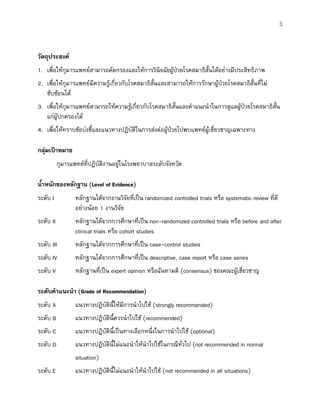
วัตถุประสงค
1. เพื่อใหกุมารแพทยสามารถคัดกรองและใหการวินิจฉัยผูปวยโรคสมาธิสั้นไดอยางมีประสิทธิภาพ
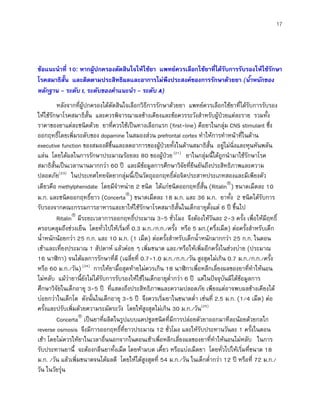
2. เพื่อใหกุมารแพทยมีความรูเกี่ยวกับโรคสมาธิสั้นและสามารถใหการรักษาผูปวยโรคสมาธิสั้นที่ไม
ซับซอนได
3.เพื่อใหกุมารแพทยสามารถใหความรูเกี่ยวกับโรคสมาธิสั้นและคําแนะนําในการดูแลผูปวยโรคสมาธิสั้น
แกผูปกครองได
4. เพื่อใหทราบขอบงชี้และแนวทางปฏิบัติในการสงตอผูปวยไปพบแพทยผูเชี่ยวชาญเฉพาะทาง
กลุมเปาหมาย
กุมารแพทยที่ปฏิบัติงานอยูในโรงพยาบาลระดับจังหวัด
น้ําหนักของหลักฐาน (Level of Evidence)
ระดับ I หลักฐานไดจากงานวิจัยที่เปน randomized controlled trials หรือ systematic review ที่ดี
อยางนอย 1 งานวิจัย
ระดับ II หลักฐานไดจากการศึกษาที่เปน non-randomized controlled trials หรือ before and after
clinical trials หรือ cohort studies
ระดับ III หลักฐานไดจากการศึกษาที่เปน case-control studies
ระดับ IV หลักฐานไดจากการศึกษาที่เปน descriptive, case report หรือ case series
ระดับ V หลักฐานที่เปน expert opinion หรือฉันทามติ (consensus) ของคณะผูเชี่ยวชาญ
ระดับคําแนะนํา (Grade of Recommendation)
ระดับ A แนวทางปฏิบัตินี้ใหมีการนําไปใช (strongly recommended)
ระดับ B แนวทางปฏิบัตินี้ควรนําไปใช (recommended)
ระดับ C แนวทางปฏิบัตินี้เปนทางเลือกหนึ่งในการนําไปใช (optional)
ระดับ D แนวทางปฏิบัตินี้ไมแนะนําใหนําไปใชในกรณีทั่วไป (not recommended in normal
situation)
ระดับ E แนวทางปฏิบัตินี้ไมแนะนําใหนําไปใช (not recommended in all situations)
21
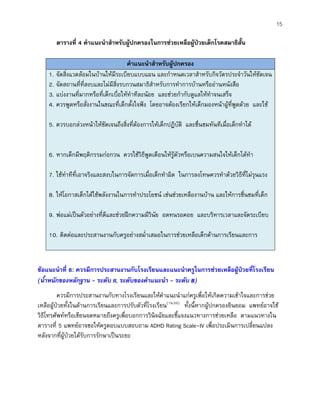
ขอแนะนําที่ 12: หากผูปวยไมตอบสนองตอการรักษาดวยดีควรมีการทบทวนแผนการรักษา แกไข
ปญหาที่พบรวม หรือพิจารณาสงตอผูเชี่ยวชาญ (น้ําหนักของหลักฐานระดับ II, ระดับของคําแนะนํา
- ระดับ B)
หากผูปวยไมมีการตอบสนองดวยดีจากการรักษาดวยยารวมกับการใหคําแนะนําตามแนวทาง
ขางตน ควรมีการประเมินผูปวยซ้ําและพิจารณาใหการรักษาเพิ่มเติม(15)
เชนการรักษาโรคที่พบรวม
การรักษาดวยพฤติกรรมบําบัดหรือครอบครัวบําบัด (อยูนอกเหนือแนวปฏิบัตินี้) หรือสงตอผูเชี่ยวชาญ
สรุป
โรคสมาธิสั้นเปนโรคที่เกิดจากความผิดปกติในการทํางานของสมองที่ทําใหผูปวยมีความบกพรอง
ในการควบคุมสมาธิและการแสดงออกทางพฤติกรรม โดยเริ่มแสดงอาการตั้งแตในวัยเด็ก และสวนใหญมัก
เปนตอเนื่องไปจนถึงวัยรุนหรือวัยผูใหญ อาการของโรคสมาธิสั้นจะเปลี่ยนแปลงไปตามวัย โดยอาการ
พฤติกรรมอยูไมนิ่งจะลดลงเมื่อผูปวยโตขึ้น หากไมไดรับการรักษาชวยเหลือที่ดีอาการความผิดปกติที่เปน
จะทําใหเกิดผลกระทบตอผูปวยทั้งในดานการเรียน อาชีพ ครอบครัว และสังคม การรักษาผูปวยโรคสมาธิ
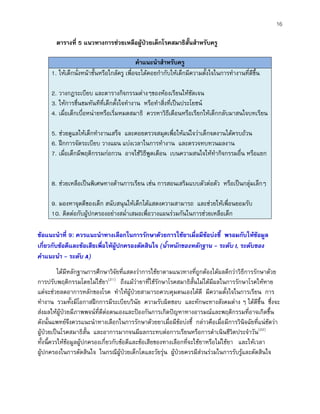
สั้นตองอาศัยการชวยเหลือหลายวิธีรวมกัน ที่สําคัญไดแกการใหความรูเกี่ยวกับโรคแกผูปกครอง การให
คําแนะนําในการจัดสิ่งแวดลอมเพื่อชวยเหลือผูปวย การประสานงานกับทางโรงเรียนเพื่อใหการชวยเหลือ
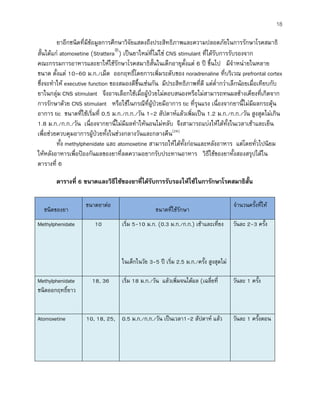
ในชั้นเรียน และการใชยาเพื่อลดอาการดานพฤติกรรมที่เปนปญหา เพื่อชวยใหผูปวยสามารถควบคุม
ตนเองและปรับตัวไดดีขึ้น
เอกสารอางอิง
1. American Psychiatric Association. Diagnostic and Statistical Manual of Mental Disorders, 4th
edition Text rev. (DSM-IV-TR). Washington, DC: American Psychiatric Association, 2000.
2. Polanczyk G, Silva de Lima M, Horta BL, Biederman J, Rohde LA. The Worldwide Prevalence of
ADHD: A Systematic Review and Metaregression Analysis. Am J Psychiatry 2007; 164:942–
948.
3. Wacharasindhu A, Panyayong B. Psychiatric Disorder in Thai School-Aged Children : I
Prevalence. J Med Assoc Thai 2002;85(suppl1):S125-S136.
4. Faraone SV, Perlis RH, Doyle AE et al. Molecular genetics of attention-deficit/hyperactivity
disorder. Biol Psychiatry 2005;57:1313-1323.
22.
22
5. Mick E,Biederman J, Faraone SV, Sayer J, Kleinman S. Case-control study of attention-deficit
hyperactivity disorder and maternal smoking, alcohol use, and drug use during pregnancy. J Am
Acad Child Adolesc Psychiatry 2002;41:378-385.
6. Mick E, Biederman J, Prince J, Fischer MJ, Faraone SV. Impact of low birth weight on attention-
deficit hyperactivity disorder. J Dev Behav Pediatr 2002;23:16-22.
7. Nigg JT, Nikolas M, Mark Knottnerus G, Cavanagh K, Friderici K. Confirmation and extension of
association of blood lead with attention-deficit/hyperactivity disorder (ADHD) and ADHD
symptom domains at population-typical exposure levels. J Child Psychol Psychiatry
2010;51:58-65.
8. Sowell ER, Thompson PM, Welcome SE, Henkenius AL, Toga AW, Peterson BS. Cortical
abnormalities in children and adolescents with attention-deficit hyperactivity disorder. Lancet
2003;362:1699-1707.
9. Krain AL, Castellanos FX. Brain development and ADHD. Clinical Psychology Review 2006;26:
433–444.
10.Dougherty DD, Bonab AA, Spencer TJ, Rauch SL, Madras BK, Fischman AJ. Dopamine
transporter density in patients with attention deficit hyperactivity disorder. Lancet 1999;354:
2132–-33.
11.American Academy of Pediatrics, Clinical practice guideline: diagnosis and evaluation of the child
with attention-deficit /hyperactivity disorder. Pediatrics 2000;105:1158-1170.
12.Green M, Wong M, Atkins D, et al. Diagnosis of Attention Deficit/Hyperactivity Disorder:
Technical Review 3. Rockville, MD: US Department of Health and Human Services, Agency for
Health Care Policy and Research; 1999. Agency for Health Care Policy and Research publication
99-0050.
13.DuPaul GJ, PowerT J, Anastopoulos AD, Reid R. ADHD Rating Scales-IV: Checklists, Norms and
Clinical Interpretation. New York: Guilford 1998.
14.Hechtman L. Assessment and diagnosis of attention deficit/hyperactivity disorder. Child Adolesc
Psychiatr Clin N Am 2000;9:481-498.
15.American Academy of Child and Adolescent Psychiatry. Practice parameters for the assessment
and treatment of children and adolescents with attention-deficit/hyperactivity disorder. J Am
Acad Child Adolesc Psychiatry 2007; 46: 894-921.
23.
23
16.Cantwell DP. Attentiondeficit disorder: a review of the past 10 years. J Am Acad Child Adolesc
Psychiatry 1996;35:978-987.
17.Pliszka SR. Patterns of psychiatric comorbidity with attention deficit/hyperactivity disorder. Child
Adolesc Psychiatr Clin N Am 2000;9:520-540.
18.American Academy of Pediatrics, Clinical practice guideline: treatment of the school-aged child
with attention-deficit/hyperactivity disorder. Pediatrics 2001;108:1033-1044.
19.Institute for Clinical Systems Improvement. Health Care Guideline: Diagnosis and Management
of Attention Deficit Hyperactivity Disorder in Primary Care for School-Age Children and
Adolescents. 8th
edition, 2010.
20.The Canadian Attention Deficit Hyperactivity Disorder Resource Alliance. Canadian ADHD
Practice Guidelines 2008.
21.MTA Cooperative Group.14 month randomized clinical trial of treatment strategies for children
with attention deficit hyperactivity disorder. Arch Gen Psychiatry 1999;56:1073–1086.
22.Taylor E, Dopfner M, Sergeant J, et al. European clinical guidelines for hyperkinetic disorder-first
upgrade. Eur Child Adolesc Psychiatry 2004; 13 Suppl 1: 1/7-1/30.
23.Harpin VA. Medication options when treating children and adolescents with ADHD: interpreting
the NICE guidance 2006. Arch Dis Child Educ Pract Ed 2008;93:58–65.
24.American Academy of Child and Adolescent Psychiatry. Practice parameter for the use of
stimulant medications in the treatment of children, adolescents, and adults. J Am Acad Child
Adolesc Psychiatry 2002;41:26S-49S.
25.McGough J, McCracken J, Swanson J, et al. Pharmacogenetics of methylphenidate response in
preschoolers with ADHD. J Am Acad Child Adolesc Psychiatry 2006;45:1314-1322.
26.Barton J. Atomoxetine: a new pharmacotherapeutic approach in the management of attention
deficit/hyperactivity disorder. Arch Dis Child 2005; 90 Suppl 1: i26-9.
27.Kramer JR, Loney J, Ponto LB, Roberts MA, Grossman S. Predictors of adult height and weight in
boys treated with methylphenidate for childhood behavior problems. J Am Acad Child Adolesc
Psychiatry 2000;39:517-524.
28.Pliszka SR, Crismon ML, Hughes CW, et al. The Texas Children’s Medication Algorithm Project:
revision of the algorithm for pharmacotherapy of attention-deficit/hyperactivity disorder. J Am
Acad Child Adolesc Psychiatry 2006;45:642-657.
24.
24
29.Wilens TE, FaraoneSV, Biederman J, Gunawardene S. Does stimulant therapy of attention-
deficit/hyperactivity disorder beget later substance abuse? A meta-analytic review of the
literature. Pediatrics 2003;111:179-185.
30.Hemmer SA. Pasternak JF, Zecker SG, Trommer BL. Stimulant therapy and seizure risk in
children with ADHD. Pedtr Neurol 2001;24:99-102.
31.Gadow KD, Sverd J. Stimulants for ADHD in child patients with Tourette’s syndrome: the issue of
relative risk. J Dev Behav Pediatr 1990;11:269-271.
32.Lim JR, Faught PR, Chalasani NP, Molleston JP. Severe liver injury after initiating therapy with
atomoxetine in two children. J Pediatr 2006;148:831-834.


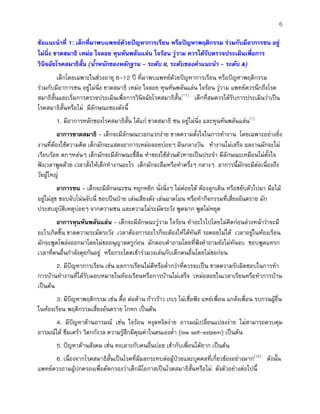
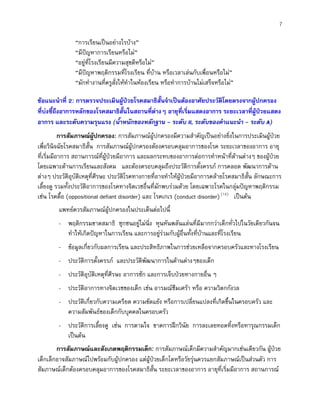
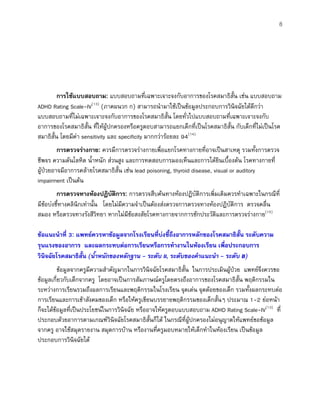
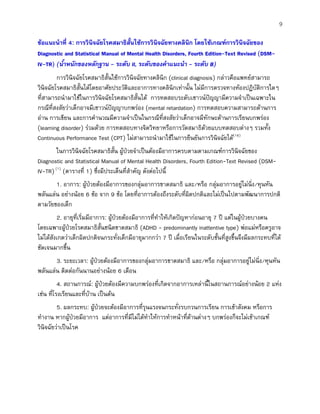
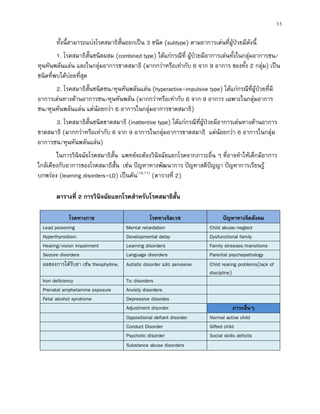
![10
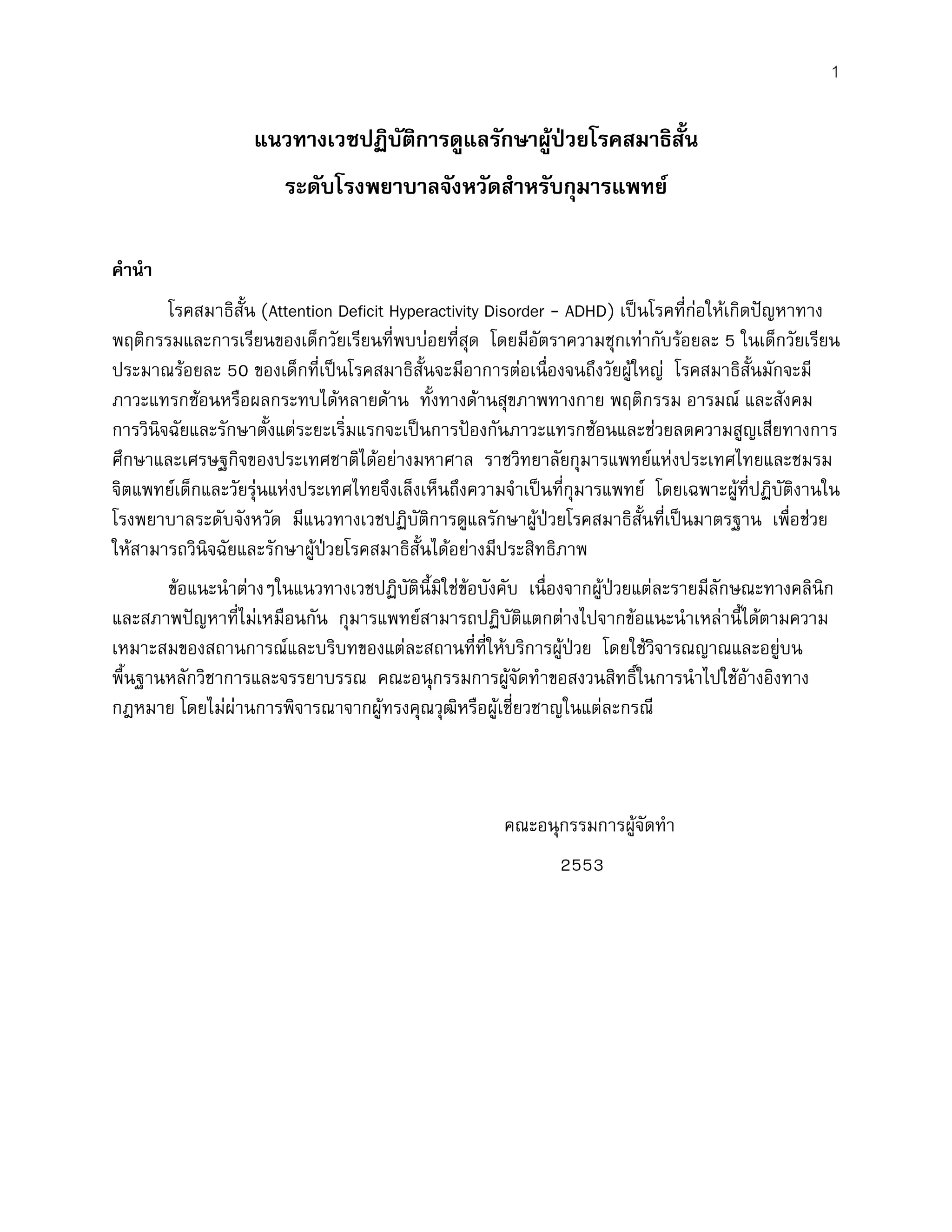
ตารางที่ 1 เกณฑในการวินิจฉัยโรคสมาธิสั้นตาม DSM-IV-TR(1)
C. พบความบกพรองที่เกิดจากอาการเหลานี้ในสถานการณอยางนอย 2 แหง (เชนที่โรงเรียน [หรือที่ทํางาน] หรือที่บาน)
D. อาการตองมีความรุนแรงจนกระทั่งรบกวนการเรียน การเขาสังคม หรือการทํางานอยางชัดเจน
E. อาการไมไดเกิดขึ้นระหวางที่ผูปวยไดรับการวินิจฉัยเปน pervasive developmental disorder, schizophrenia หรือ psychotic disorder
อื่นๆ และไมอาการตองไมเขาไดกับอาการของโรคทางจิตเวชอื่นๆ (เชน mood disorder, anxiety disorder, dissociative disorder หรือ
personality disorder)
2.8 มักไมชอบการเขาคิว หรือการรอคอย
2.9 มักขัดจังหวะ หรือสอดแทรกผูอื่น (ระหวางการสนทนาหรือการเลน)
B. อาการอยูไมนิ่ง หุนหันพลันแลน หรือขาดสมาธิ ที่ทําใหเกิดปญหา ตองเกิดขึ้นกอนอายุ 7 ป
อาการหุนหันพลันแลน
2.7 มักโพลงคําตอบ โดยที่ยังฟงคําถามไมจบ
2.4
2.5
2.6
มักไมสามารถเลน หรือทํากิจกรรมอยางเงียบๆ ได
มัก “พรอมที่จะวิ่งไป” หรือทําเหมือนเครื่องยนตที่เดินเครื่องอยูตลอดเวลา
มักพูดมาก พูดไมหยุด
1.7 มักทําของที่จําเปนในการเรียน หรือการทํากิจกรรมหาย (เชน ของเลน สมุดจดการบาน ดินสอ หนังสือ หรืออุปกรณตางๆ)
1.8 มักวอกแวกไปสนใจสิ่งเราภายนอกไดงาย
1.9มักหลงลืมทํากิจวัตรประจําวันที่ตองทําเปนประจํา
(2) ตองมี 6 ขอ (หรือมากกวา) ของ อาการอยูไมนิ่ง-หุนหันพลันแลน นานติดตอกันอยางนอย 6 เดือน โดยที่อาการตองถึงระดับที่
ผิดปกติและไมเปนไปตามพัฒนาการตามวัยของเด็กไดแก
อาการอยูไมนิ่ง
2.1 หยุกหยิก อยูไมสุข ชอบขยับมือและเทาไปมา หรือนั่งนิ่งๆไมได
2.2 มักลุกจากที่นั่งในหองเรียน หรือในสถานการณอื่นที่เด็กจําเปนตองนั่งอยูกับที่
2.3 มักวิ่งไปมา หรือปนปายสิ่งตางๆในที่ที่ไมสมควรกระทํา (ในวัยรุนหรือผูใหญ อาการอาจเปนเพียงความรูสึกกระวนกระวายใจ)
(1) ตองมี 6 ขอ (หรือมากกวา) ของ อาการขาดสมาธิ นานติดตอกันอยางนอย 6 เดือน โดยที่อาการตองถึงระดับที่ผิดปกติและไม
เปนไปตามพัฒนาการตามวัยของเด็กไดแก
1.1 มักไมสามารถจดจอกับรายละเอียดหรือไมรอบคอบเวลาทํางานที่โรงเรียน หรือทํากิจกรรมอื่น
1.2 มักไมมีสมาธิในการทํางาน หรือการเลน
1.3 มักดูเหมือนไมไดฟงสิ่งที่คนอื่นพูดกับตนอยู
1.4 มักทําตามคําสั่งไดไมครบ ทําใหทํางานในหองเรียน งานบาน หรืองานในที่ทํางานไมเสร็จ (โดยไมไดเกิดจากพฤติกรรมตอตาน
หรือไมเขาใจคําสั่ง)
1.5 มักมีปญหาในการจัดระบบงานหรือกิจกรรม ทํางานไมเปนระเบียบ
1.6มักเลี่ยง ไมชอบ หรือไมเต็มใจในการทํางานที่ตองใชความคิด (เชน ทํางานที่โรงเรียน หรือทําการบาน)
A. อาจมี (1) หรือ (2)](https://image.slidesharecdn.com/cpgadha-170724122310/85/Cpg-ADHD-10-320.jpg)