Origins in ECR
In early 1990s, P&G and Wal-Mart developed a joint logistics process .The steps involved were:
•Information sharing
•Joint demand forecasting
•Coordinated shipments.
•This partnership laid the foundation for ECR.
What is CPFR?
CPFR is a business practice that combines the intelligence of multiple trading partners in the planning and fulfilment of customer
demand.
•Links sales and marketing best practices to supply chain planning and execution processes
•Objective is to increase availability to the customer while reducing inventory, transportation and logistics costs
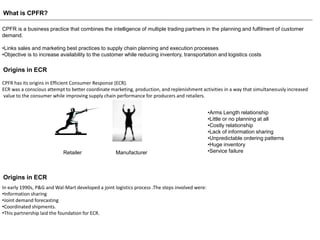
Retailer Manufacturer
•Arms Length relationship
•Little or no planning at all
•Costly relationship
•Lack of information sharing
•Unpredictable ordering patterns
•Huge inventory
•Service failure
Origins in ECR
CPFR has its origins in Efficient Consumer Response (ECR).
ECR was a conscious attempt to better coordinate marketing, production, and replenishment activities in a way that simultaneously increased
value to the consumer while improving supply chain performance for producers and retailers.
Difference between ECR and CPFR
CPFR includes following things
•Information systems for capturing and transferring POS, inventory, and other demand & supply information between trading partners
•Formalized sales forecasting and order forecasting processes
•Formalized exception handling processes
•Feedback systems to monitor and improve supply chain performance
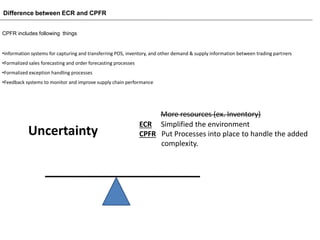
Uncertainty
More resources (ex. Inventory)
ECR Simplified the environment
CPFR Put Processes into place to handle the added
complexity.
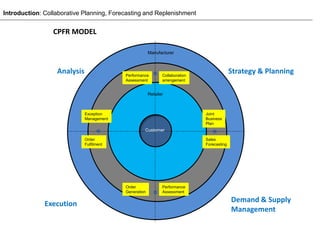
Analysis Strategy & Planning
Demand & Supply
Management
Execution
Collaboration
arrengement
Joint
Business
Plan
Customer
Performance
Assessment
Sales
Forecasting
Exception
Management
Order
Fulfilment
Performance
Assessment
Order
Generation
Manufacturer
Retailer
Introduction: Collaborative Planning, Forecasting and Replenishment
CPFR MODEL
Introduction: Collaborative Planning, Forecasting and Replenishment
Vendor Management Collaboration arrangement Account Planning
Category Management Joint Business Plan Market Planning
POS Forcasting Sales Forcasting Market Data Analysis
Replanishment Planning
Order Planning/
Forcasting Demand Planning
Buying/Re-Buying Order Generation
Production and
Supply Planning
Logistics/Distribution Order Fulfillment Logistics/Distribution
Store Execution Exception Management Execution Monitoring
Supplier Scorecard Performance Management Customer Score Card
Analysis
Retailer Task Collaboration Tasks Manufacturer Tasks
Strategy and Planning
Demand and Supply Management
Execution

CPFR

  • 1.
    Origins in ECR Inearly 1990s, P&G and Wal-Mart developed a joint logistics process .The steps involved were: •Information sharing •Joint demand forecasting •Coordinated shipments. •This partnership laid the foundation for ECR. What is CPFR? CPFR is a business practice that combines the intelligence of multiple trading partners in the planning and fulfilment of customer demand. •Links sales and marketing best practices to supply chain planning and execution processes •Objective is to increase availability to the customer while reducing inventory, transportation and logistics costs Retailer Manufacturer •Arms Length relationship •Little or no planning at all •Costly relationship •Lack of information sharing •Unpredictable ordering patterns •Huge inventory •Service failure Origins in ECR CPFR has its origins in Efficient Consumer Response (ECR). ECR was a conscious attempt to better coordinate marketing, production, and replenishment activities in a way that simultaneously increased value to the consumer while improving supply chain performance for producers and retailers.
  • 2.
    Difference between ECRand CPFR CPFR includes following things •Information systems for capturing and transferring POS, inventory, and other demand & supply information between trading partners •Formalized sales forecasting and order forecasting processes •Formalized exception handling processes •Feedback systems to monitor and improve supply chain performance Uncertainty More resources (ex. Inventory) ECR Simplified the environment CPFR Put Processes into place to handle the added complexity.
  • 3.
    Analysis Strategy &Planning Demand & Supply Management Execution Collaboration arrengement Joint Business Plan Customer Performance Assessment Sales Forecasting Exception Management Order Fulfilment Performance Assessment Order Generation Manufacturer Retailer Introduction: Collaborative Planning, Forecasting and Replenishment CPFR MODEL
  • 4.
    Introduction: Collaborative Planning,Forecasting and Replenishment Vendor Management Collaboration arrangement Account Planning Category Management Joint Business Plan Market Planning POS Forcasting Sales Forcasting Market Data Analysis Replanishment Planning Order Planning/ Forcasting Demand Planning Buying/Re-Buying Order Generation Production and Supply Planning Logistics/Distribution Order Fulfillment Logistics/Distribution Store Execution Exception Management Execution Monitoring Supplier Scorecard Performance Management Customer Score Card Analysis Retailer Task Collaboration Tasks Manufacturer Tasks Strategy and Planning Demand and Supply Management Execution