1
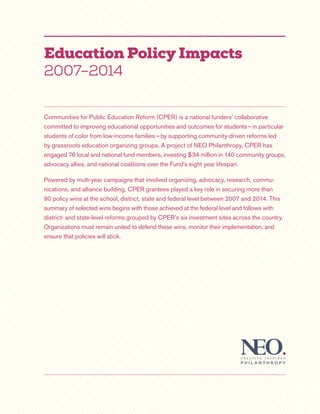
Communities for Public Education Reform (CPER) is a national funders’ collaborative
committed to improving educational opportunities and outcomes for students — in particular
students of color from low-income families — by supporting community-driven reforms led
by grassroots education organizing groups. A project of NEO Philanthropy, CPER has
engaged 76 local and national fund members, investing $34 million in 140 community groups,
advocacy allies, and national coalitions over the Fund’s eight year lifespan.
Powered by multi-year campaigns that involved organizing, advocacy, research, commu-
nications, and alliance building, CPER grantees played a key role in securing more than
90 policy wins at the school, district, state and federal level between 2007 and 2014. This
summary of selected wins begins with those achieved at the federal level and follows with
district- and state-level reforms grouped by CPER’s six investment sites across the country.
Organizations must remain united to defend these wins, monitor their implementation, and
ensure that policies will stick.
Education Policy Impacts
2007–2014
2
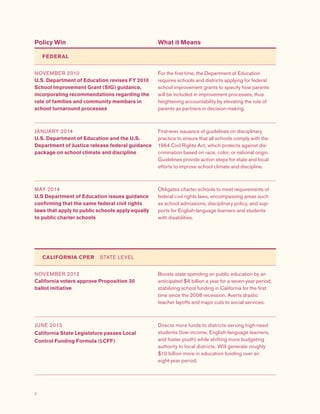
Policy Win What it Means
FEDERAL
NOVEMBER 2010
U.S. Department of Education revises FY 2010
School Improvement Grant (SIG) guidance,
incorporating recommendations regarding the
role of families and community members in
school turnaround processes
For the first time, the Department of Education
requires schools and districts applying for federal
school improvement grants to specify how parents
will be included in improvement processes, thus
heightening accountability by elevating the role of
parents as partners in decision-making.
JANUARY 2014
U.S. Department of Education and the U.S.
Department of Justice release federal guidance
package on school climate and discipline
First-ever issuance of guidelines on disciplinary
practice to ensure that all schools comply with the
1964 Civil Rights Act, which protects against dis-
crimination based on race, color, or national origin.
Guidelines provide action steps for state and local
efforts to improve school climate and discipline.
MAY 2014
U.S Department of Education issues guidance
confirming that the same federal civil rights
laws that apply to public schools apply equally
to public charter schools
Obligates charter schools to meet requirements of
federal civil rights laws, encompassing areas such
as school admissions, disciplinary policy, and sup-
ports for English-language learners and students
with disabilities.
CALIFORNIA CPER  STATE LEVEL
NOVEMBER 2012
California voters approve Proposition 30
ballot initiative
Boosts state spending on public education by an
anticipated $6 billion a year for a seven-year period,
stabilizing school funding in California for the first
time since the 2008 recession. Averts drastic
teacher layoffs and major cuts to social services.
JUNE 2013
California State Legislature passes Local
Control Funding Formula (LCFF)
Directs more funds to districts serving high-need
students (low-income, English-language learners,
and foster youth) while shifting more budgeting
authority to local districts. Will generate roughly
$10 billion more in education funding over an
eight-year period.
3
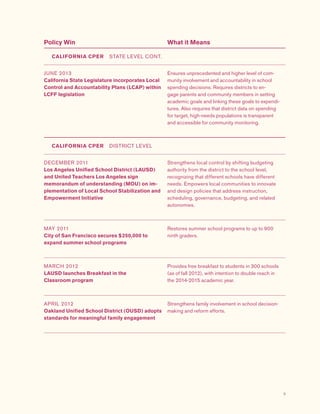
Policy Win What it Means
CALIFORNIA CPER  STATE LEVEL CONT.
JUNE 2013
California State Legislature incorporates Local
Control and Accountability Plans (LCAP) within
LCFF legislation
Ensures unprecedented and higher level of com-
munity involvement and accountability in school
spending decisions. Requires districts to en-
gage parents and community members in setting
academic goals and linking these goals to expendi-
tures. Also requires that district data on spending
for target, high-needs populations is transparent
and accessible for community monitoring.
CALIFORNIA CPER  DISTRICT LEVEL
DECEMBER 2011
Los Angeles Unified School District (LAUSD)
and United Teachers Los Angeles sign
memorandum of understanding (MOU) on im-
plementation of Local School Stabilization and
Empowerment Initiative
Strengthens local control by shifting budgeting
authority from the district to the school level,
recognizing that different schools have different
needs. Empowers local communities to innovate
and design policies that address instruction,
scheduling, governance, budgeting, and related
autonomies.
MAY 2011
City of San Francisco secures $250,000 to
expand summer school programs
Restores summer school programs to up to 900
ninth graders.
MARCH 2012
LAUSD launches Breakfast in the
Classroom program
Provides free breakfast to students in 300 schools
(as of fall 2012), with intention to double reach in
the 2014-2015 academic year.
APRIL 2012
Oakland Unified School District (OUSD) adopts
standards for meaningful family engagement
Strengthens family involvement in school decision-
making and reform efforts.
4
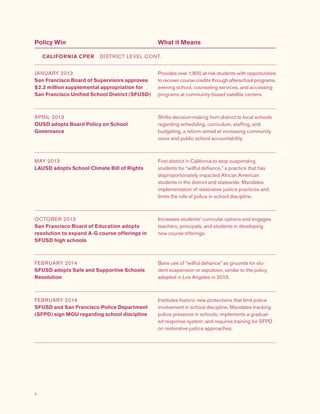
Policy Win What it Means
JANUARY 2013
San Francisco Board of Supervisors approves
$2.3 million supplemental appropriation for
San Francisco Unified School District (SFUSD)
Provides over 1,800 at-risk students with opportunities
to recover course credits through afterschool programs,
evening school, counseling services, and accessing
programs at community-based satellite centers.
APRIL 2013
OUSD adopts Board Policy on School
Governance
Shifts decision-making from district to local schools
regarding scheduling, curriculum, staffing, and
budgeting, a reform aimed at increasing community
voice and public school accountability.
MAY 2013
LAUSD adopts School Climate Bill of Rights
First district in California to stop suspending
students for “willful defiance,” a practice that has
disproportionately impacted African American
students in the district and statewide. Mandates
implementation of restorative justice practices and
limits the role of police in school discipline.
OCTOBER 2013
San Francisco Board of Education adopts
resolution to expand A-G course offerings in
SFUSD high schools
Increases students’ curricular options and engages
teachers, principals, and students in developing
new course offerings.
FEBRUARY 2014
SFUSD adopts Safe and Supportive Schools
Resolution
Bans use of “willful defiance” as grounds for stu-
dent suspension or expulsion, similar to the policy
adopted in Los Angeles in 2013.
FEBRUARY 2014
SFUSD and San Francisco Police Department
(SFPD) sign MOU regarding school discipline
Institutes historic new protections that limit police
involvement in school discipline. Mandates tracking
police presence in schools; implements a graduat-
ed response system; and requires training for SFPD
on restorative justice approaches.
CALIFORNIA CPER  DISTRICT LEVEL CONT.
5
Policy Win What it Means
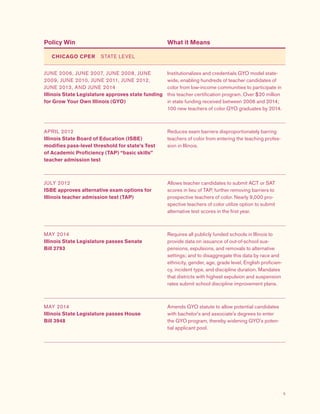
CHICAGO CPER  STATE LEVEL
JUNE 2006, JUNE 2007, JUNE 2008, JUNE
2009, JUNE 2010, JUNE 2011, JUNE 2012,
JUNE 2013, AND JUNE 2014
Illinois State Legislature approves state funding
for Grow Your Own Illinois (GYO)
Institutionalizes and credentials GYO model state-
wide, enabling hundreds of teacher candidates of
color from low-income communities to participate in
this teacher certification program. Over $20 million
in state funding received between 2006 and 2014;
100 new teachers of color GYO graduates by 2014.
APRIL 2012
Illinois State Board of Education (ISBE)
modifies pass-level threshold for state’s Test
of Academic Proficiency (TAP) “basic skills”
teacher admission test
Reduces exam barriers disproportionately barring
teachers of color from entering the teaching profes-
sion in Illinois.
JULY 2012
ISBE approves alternative exam options for
Illinois teacher admission test (TAP)
Allows teacher candidates to submit ACT or SAT
scores in lieu of TAP, further removing barriers to
prospective teachers of color. Nearly 9,000 pro-
spective teachers of color utilize option to submit
alternative test scores in the first year.
MAY 2014
Illinois State Legislature passes Senate
Bill 2793
Requires all publicly funded schools in Illinois to
provide data on issuance of out-of-school sus-
pensions, expulsions, and removals to alternative
settings; and to disaggregate this data by race and
ethnicity, gender, age, grade level, English proficien-
cy, incident type, and discipline duration. Mandates
that districts with highest expulsion and suspension
rates submit school discipline improvement plans.
MAY 2014
Illinois State Legislature passes House
Bill 3948
Amends GYO statute to allow potential candidates
with bachelor's and associate's degrees to enter
the GYO program, thereby widening GYO's poten-
tial applicant pool.
6
Policy Win What it Means
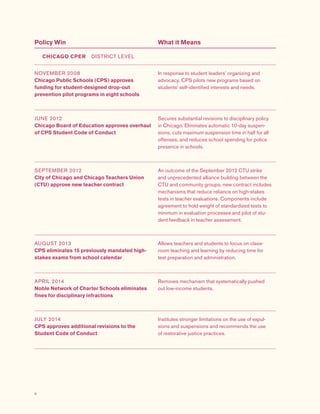
CHICAGO CPER  DISTRICT LEVEL
NOVEMBER 2008
Chicago Public Schools (CPS) approves
funding for student-designed drop-out
prevention pilot programs in eight schools
In response to student leaders’ organizing and
advocacy, CPS pilots new programs based on
students' self-identified interests and needs.
JUNE 2012
Chicago Board of Education approves overhaul
of CPS Student Code of Conduct
Secures substantial revisions to disciplinary policy
in Chicago. Eliminates automatic 10-day suspen-
sions, cuts maximum suspension time in half for all
offenses, and reduces school spending for police
presence in schools.
SEPTEMBER 2012
City of Chicago and Chicago Teachers Union
(CTU) approve new teacher contract
An outcome of the September 2012 CTU strike
and unprecedented alliance building between the
CTU and community groups, new contract includes
mechanisms that reduce reliance on high-stakes
tests in teacher evaluations. Components include
agreement to hold weight of standardized tests to
minimum in evaluation processes and pilot of stu-
dent feedback in teacher assessment.
AUGUST 2013
CPS eliminates 15 previously mandated high-
stakes exams from school calendar
Allows teachers and students to focus on class-
room teaching and learning by reducing time for
test preparation and administration.
APRIL 2014
Noble Network of Charter Schools eliminates
fines for disciplinary infractions
Removes mechanism that systematically pushed
out low-income students.
JULY 2014
CPS approves additional revisions to the
Student Code of Conduct
Institutes stronger limitations on the use of expul-
sions and suspensions and recommends the use
of restorative justice practices.
7
Policy Win What it Means
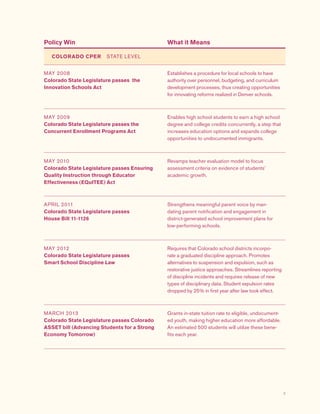
COLORADO CPER  STATE LEVEL
MAY 2008
Colorado State Legislature passes the
Innovation Schools Act
Establishes a procedure for local schools to have
authority over personnel, budgeting, and curriculum
development processes, thus creating opportunities
for innovating reforms realized in Denver schools.
MAY 2009
Colorado State Legislature passes the
Concurrent Enrollment Programs Act
Enables high school students to earn a high school
degree and college credits concurrently, a step that
increases education options and expands college
opportunities to undocumented immigrants.
MAY 2010
Colorado State Legislature passes Ensuring
Quality Instruction through Educator
Effectiveness (EQuITEE) Act
Revamps teacher evaluation model to focus
assessment criteria on evidence of students’
academic growth.
APRIL 2011
Colorado State Legislature passes
House Bill 11-1126
Strengthens meaningful parent voice by man-
dating parent notification and engagement in
district-generated school improvement plans for
low-performing schools.
MAY 2012
Colorado State Legislature passes
Smart School Discipline Law
Requires that Colorado school districts incorpo-
rate a graduated discipline approach. Promotes
alternatives to suspension and expulsion, such as
restorative justice approaches. Streamlines reporting
of discipline incidents and requires release of new
types of disciplinary data. Student expulsion rates
dropped by 25% in first year after law took effect.
MARCH 2013
Colorado State Legislature passes Colorado
ASSET bill (Advancing Students for a Strong
Economy Tomorrow)
Grants in-state tuition rate to eligible, undocument-
ed youth, making higher education more affordable.
An estimated 500 students will utilize these bene-
fits each year.
8
Policy Win What it Means
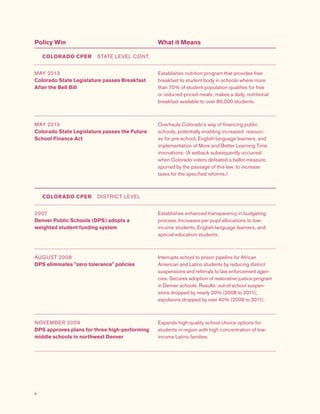
COLORADO CPER  STATE LEVEL CONT.
MAY 2013
Colorado State Legislature passes Breakfast
After the Bell Bill
Establishes nutrition program that provides free
breakfast to student body in schools where more
than 70% of student population qualifies for free
or reduced-priced meals; makes a daily, nutritional
breakfast available to over 80,000 students.
MAY 2013
Colorado State Legislature passes the Future
School Finance Act
Overhauls Colorado’s way of financing public
schools, potentially enabling increased resourc-
es for pre-school, English-language learners, and
implementation of More and Better Learning Time
innovations. (A setback subsequently occurred
when Colorado voters defeated a ballot measure,
spurred by the passage of this law, to increase
taxes for the specified reforms.)
COLORADO CPER  DISTRICT LEVEL
2007
Denver Public Schools (DPS) adopts a
weighted student funding system
Establishes enhanced transparency in budgeting
process. Increases per pupil allocations to low-
income students, English-language learners, and
special education students.
AUGUST 2008
DPS eliminates "zero tolerance" policies
Interrupts school to prison pipeline for African
American and Latino students by reducing district
suspensions and referrals to law enforcement agen-
cies. Secures adoption of restorative justice program
in Denver schools. Results: out-of-school suspen-
sions dropped by nearly 20% (2008 to 2011);
expulsions dropped by over 40% (2009 to 2011).
NOVEMBER 2009
DPS approves plans for three high-performing
middle schools in northwest Denver
Expands high-quality school choice options for
students in region with high concentration of low-
income Latino families.
9
Policy Win What it Means
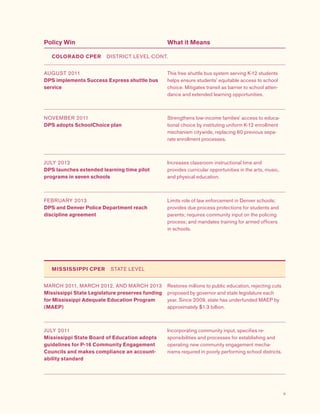
AUGUST 2011
DPS implements Success Express shuttle bus
service
This free shuttle bus system serving K-12 students
helps ensure students’ equitable access to school
choice. Mitigates transit as barrier to school atten-
dance and extended learning opportunities.
NOVEMBER 2011
DPS adopts SchoolChoice plan
Strengthens low-income families' access to educa-
tional choice by instituting uniform K-12 enrollment
mechanism citywide, replacing 60 previous sepa-
rate enrollment processes.
JULY 2012
DPS launches extended learning time pilot
programs in seven schools
Increases classroom instructional time and
provides curricular opportunities in the arts, music,
and physical education.
FEBRUARY 2013
DPS and Denver Police Department reach
discipline agreement
Limits role of law enforcement in Denver schools;
provides due process protections for students and
parents; requires community input on the policing
process; and mandates training for armed officers
in schools.
MISSISSIPPI CPER  STATE LEVEL
MARCH 2011, MARCH 2012, AND MARCH 2013
Mississippi State Legislature preserves funding
for Mississippi Adequate Education Program
(MAEP)
Restores millions to public education, rejecting cuts
proposed by governor and state legislature each
year. Since 2009, state has underfunded MAEP by
approximately $1.3 billion.
JULY 2011
Mississippi State Board of Education adopts
guidelines for P-16 Community Engagement
Councils and makes compliance an account-
ability standard
Incorporating community input, specifies re-
sponsibilities and processes for establishing and
operating new community engagement mecha-
nisms required in poorly performing school districts.
COLORADO CPER  DISTRICT LEVEL CONT.
10
Policy Win What it Means
MISSISSIPPI CPER  STATE LEVEL CONT.
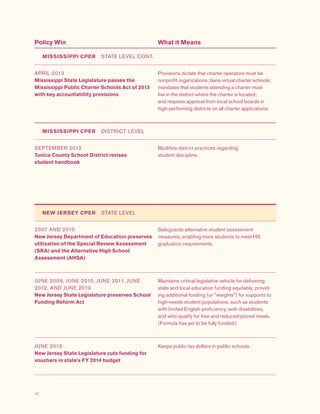
APRIL 2013
Mississippi State Legislature passes the
Mississippi Public Charter Schools Act of 2013
with key accountability provisions
Provisions dictate that charter operators must be
nonprofit organizations; bans virtual charter schools;
mandates that students attending a charter must
live in the district where the charter is located;
and requires approval from local school boards in
high-performing districts on all charter applications.
MISSISSIPPI CPER  DISTRICT LEVEL
SEPTEMBER 2012
Tunica County School District revises
student handbook
Modifies district practices regarding
student discipline.
NEW JERSEY CPER  STATE LEVEL
2007 AND 2010
New Jersey Department of Education preserves
utilization of the Special Review Assessment
(SRA) and the Alternative High School
Assessment (AHSA)
Safeguards alternative student assessment
measures, enabling more students to meet HS
graduation requirements.
JUNE 2009, JUNE 2010, JUNE 2011, JUNE
2012, AND JUNE 2013
New Jersey State Legislature preserves School
Funding Reform Act
Maintains critical legislative vehicle for delivering
state and local education funding equitably, provid-
ing additional funding (or "weights") for supports to
high-needs student populations, such as students
with limited English proficiency, with disabilities,
and who qualify for free and reduced-priced meals.
(Formula has yet to be fully funded.)
JUNE 2013
New Jersey State Legislature cuts funding for
vouchers in state's FY 2014 budget
Keeps public tax dollars in public schools.
11
Policy Win What it Means
NEW JERSEY CPER  STATE LEVEL CONT.
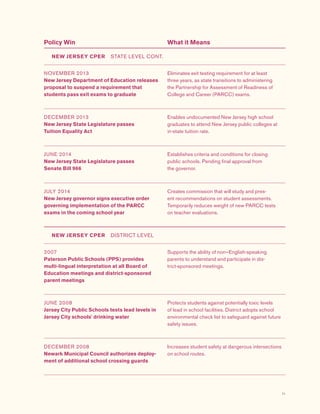
NOVEMBER 2013
New Jersey Department of Education releases
proposal to suspend a requirement that
students pass exit exams to graduate
Eliminates exit testing requirement for at least
three years, as state transitions to administering
the Partnership for Assessment of Readiness of
College and Career (PARCC) exams.
DECEMBER 2013
New Jersey State Legislature passes
Tuition Equality Act
Enables undocumented New Jersey high school
graduates to attend New Jersey public colleges at
in-state tuition rate.
JUNE 2014
New Jersey State Legislature passes
Senate Bill 966
Establishes criteria and conditions for closing
public schools. Pending final approval from
the governor.
JULY 2014
New Jersey governor signs executive order
governing implementation of the PARCC
exams in the coming school year
Creates commission that will study and pres-
ent recommendations on student assessments.
Temporarily reduces weight of new PARCC tests
on teacher evaluations.
NEW JERSEY CPER  DISTRICT LEVEL
2007
Paterson Public Schools (PPS) provides
multi-lingual interpretation at all Board of
Education meetings and district-sponsored
parent meetings
Supports the ability of non–English-speaking
parents to understand and participate in dis-
trict-sponsored meetings.
JUNE 2008
Jersey City Public Schools tests lead levels in
Jersey City schools' drinking water
Protects students against potentially toxic levels
of lead in school facilities. District adopts school
environmental check list to safeguard against future
safety issues.
DECEMBER 2008
Newark Municipal Council authorizes deploy-
ment of additional school crossing guards
Increases student safety at dangerous intersections
on school routes.
12
Policy Win What it Means
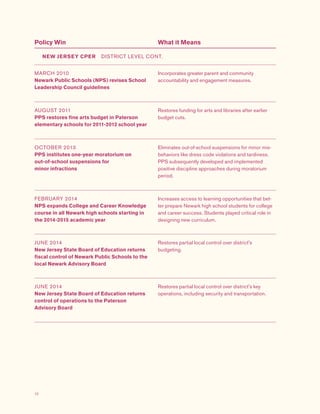
MARCH 2010
Newark Public Schools (NPS) revises School
Leadership Council guidelines
Incorporates greater parent and community
accountability and engagement measures.
AUGUST 2011
PPS restores fine arts budget in Paterson
elementary schools for 2011-2012 school year
Restores funding for arts and libraries after earlier
budget cuts.
OCTOBER 2013
PPS institutes one-year moratorium on
out-of-school suspensions for
minor infractions
Eliminates out-of-school suspensions for minor mis-
behaviors like dress code violations and tardiness.
PPS subsequently developed and implemented
positive discipline approaches during moratorium
period.
FEBRUARY 2014
NPS expands College and Career Knowledge
course in all Newark high schools starting in
the 2014-2015 academic year
Increases access to learning opportunities that bet-
ter prepare Newark high school students for college
and career success. Students played critical role in
designing new curriculum.
JUNE 2014
New Jersey State Board of Education returns
fiscal control of Newark Public Schools to the
local Newark Advisory Board
Restores partial local control over district's
budgeting.
JUNE 2014
New Jersey State Board of Education returns
control of operations to the Paterson
Advisory Board
Restores partial local control over district's key
operations, including security and transportation.
NEW JERSEY CPER  DISTRICT LEVEL CONT.
13
Policy Win What it Means
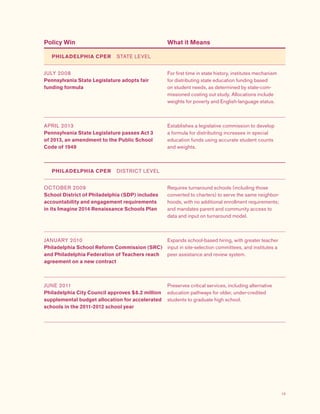
PHILADELPHIA CPER  STATE LEVEL
JULY 2008
Pennsylvania State Legislature adopts fair
funding formula
For first time in state history, institutes mechanism
for distributing state education funding based
on student needs, as determined by state-com-
missioned costing out study. Allocations include
weights for poverty and English-language status.
APRIL 2013
Pennsylvania State Legislature passes Act 3
of 2013, an amendment to the Public School
Code of 1949
Establishes a legislative commission to develop
a formula for distributing increases in special
education funds using accurate student counts
and weights.
PHILADELPHIA CPER  DISTRICT LEVEL
OCTOBER 2009
School District of Philadelphia (SDP) includes
accountability and engagement requirements
in its Imagine 2014 Renaissance Schools Plan
Requires turnaround schools (including those
converted to charters) to serve the same neighbor-
hoods, with no additional enrollment requirements;
and mandates parent and community access to
data and input on turnaround model.
JANUARY 2010
Philadelphia School Reform Commission (SRC)
and Philadelphia Federation of Teachers reach
agreement on a new contract
Expands school-based hiring, with greater teacher
input in site-selection committees, and institutes a
peer assistance and review system.
JUNE 2011
Philadelphia City Council approves $8.2 million
supplemental budget allocation for accelerated
schools in the 2011-2012 school year
Preserves critical services, including alternative
education pathways for older, under-credited
students to graduate high school.
14
Policy Win What it Means
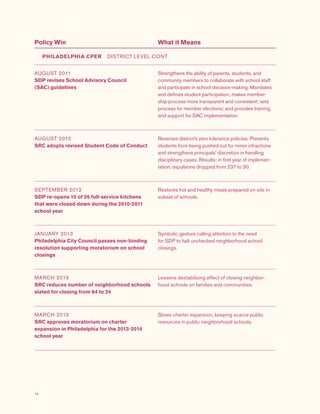
AUGUST 2011
SDP revises School Advisory Council
(SAC) guidelines
Strengthens the ability of parents, students, and
community members to collaborate with school staff
and participate in school decision-making. Mandates
and defines student participation; makes member-
ship process more transparent and consistent; sets
process for member elections; and provides training
and support for SAC implementation.
AUGUST 2012
SRC adopts revised Student Code of Conduct
Reverses district's zero tolerance policies. Prevents
students from being pushed out for minor infractions
and strengthens principals’ discretion in handling
disciplinary cases. Results: in first year of implemen-
tation, expulsions dropped from 237 to 30.
SEPTEMBER 2012
SDP re-opens 10 of 26 full-service kitchens
that were closed down during the 2010-2011
school year
Restores hot and healthy meals prepared on site in
subset of schools.
JANUARY 2013
Philadelphia City Council passes non-binding
resolution supporting moratorium on school
closings
Symbolic gesture calling attention to the need
for SDP to halt unchecked neighborhood school
closings.
MARCH 2013
SRC reduces number of neighborhood schools
slated for closing from 64 to 24
Lessens destabilizing effect of closing neighbor-
hood schools on families and communities.
MARCH 2013
SRC approves moratorium on charter
expansion in Philadelphia for the 2013-2014
school year
Slows charter expansion, keeping scarce public
resources in public neighborhood schools.
PHILADELPHIA CPER  DISTRICT LEVEL CONT.
15
Policy Win What it Means
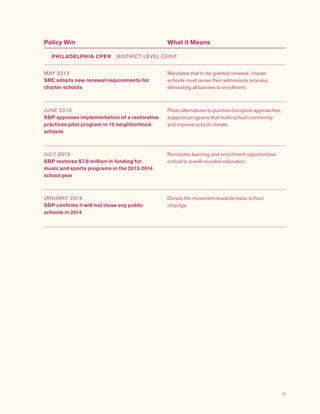
MAY 2013
SRC adopts new renewal requirements for
charter schools
Mandates that to be granted renewal, charter
schools must revise their admissions process,
eliminating all barriers to enrollment.
JUNE 2013
SDP approves implementation of a restorative
practices pilot program in 10 neighborhood
schools
Pilots alternatives to punitive discipline approaches;
supports programs that build school community
and improve school climate.
JULY 2013
SDP restores $7.6 million in funding for
music and sports programs in the 2013-2014
school year
Reinstates learning and enrichment opportunities
critical to a well-rounded education.
JANUARY 2014
SDP confirms it will not close any public
schools in 2014
Derails the movement towards mass school
closings.
PHILADELPHIA CPER  DISTRICT LEVEL CONT.
For more information about CPER’s grantmaking strategies and impacts,
the following reports can be downloaded at www.neophilanthropy.org:
Greater Power, Lasting Impact: Effective Grantmaker Strategies
from the Communities for Public Education Reform Fund
Addresses the value of community organizing for education reform and
strategies pursued to support growth in individual civic capacity, community
social capital, and policy change.
Strengthening Collaborations to Build Social Movements:
Ten Lessons from the Communities for Public Education Reform Fund
Explores effective grantmaker strategies to nurture collaboration between
field advocates and allies in order to advance social justice movements.
Building Capacity to Sustain Social Movements:
Ten Lessons from the Communities for Public Education Reform Fund
Explores effective grantmaker strategies to build organizational capacity
and networks to sustain social justice work.
CPER staff and consultant
Melinda Fine, Ed.D., Director
Ly Nguyen, Program Officer
Melissa Bernard, Program Assistant
Lauren Jacobs, Senior Consultant
Authors: Melinda Fine, Lauren Jacobs, and Ly Nguyen
About NEO Philanthropy
NEO Philanthropy is a leader in developing innovative philanthropic
strategies and partnerships that marshal the collective resources
of people passionate about driving positive social change. Launched
in 1983 as Public Interest Projects, a 501(c)(3) public charity, NEO
brings together diverse organizations driving cutting-edge social
change work, resulting in a movement for equality, fairness, and a
stronger participatory democracy.
45 W 36th St, 6th Floor
New York, NY 10018
Tel. (212) 378-2800
www.neophilanthropy.org Copyright © 2014 NEO Philanthropy. All rights reserved.

CPER Education Policy Wins

  • 1.
    1 Communities for PublicEducation Reform (CPER) is a national funders’ collaborative committed to improving educational opportunities and outcomes for students — in particular students of color from low-income families — by supporting community-driven reforms led by grassroots education organizing groups. A project of NEO Philanthropy, CPER has engaged 76 local and national fund members, investing $34 million in 140 community groups, advocacy allies, and national coalitions over the Fund’s eight year lifespan. Powered by multi-year campaigns that involved organizing, advocacy, research, commu- nications, and alliance building, CPER grantees played a key role in securing more than 90 policy wins at the school, district, state and federal level between 2007 and 2014. This summary of selected wins begins with those achieved at the federal level and follows with district- and state-level reforms grouped by CPER’s six investment sites across the country. Organizations must remain united to defend these wins, monitor their implementation, and ensure that policies will stick. Education Policy Impacts 2007–2014
  • 2.
    2 Policy Win Whatit Means FEDERAL NOVEMBER 2010 U.S. Department of Education revises FY 2010 School Improvement Grant (SIG) guidance, incorporating recommendations regarding the role of families and community members in school turnaround processes For the first time, the Department of Education requires schools and districts applying for federal school improvement grants to specify how parents will be included in improvement processes, thus heightening accountability by elevating the role of parents as partners in decision-making. JANUARY 2014 U.S. Department of Education and the U.S. Department of Justice release federal guidance package on school climate and discipline First-ever issuance of guidelines on disciplinary practice to ensure that all schools comply with the 1964 Civil Rights Act, which protects against dis- crimination based on race, color, or national origin. Guidelines provide action steps for state and local efforts to improve school climate and discipline. MAY 2014 U.S Department of Education issues guidance confirming that the same federal civil rights laws that apply to public schools apply equally to public charter schools Obligates charter schools to meet requirements of federal civil rights laws, encompassing areas such as school admissions, disciplinary policy, and sup- ports for English-language learners and students with disabilities. CALIFORNIA CPER  STATE LEVEL NOVEMBER 2012 California voters approve Proposition 30 ballot initiative Boosts state spending on public education by an anticipated $6 billion a year for a seven-year period, stabilizing school funding in California for the first time since the 2008 recession. Averts drastic teacher layoffs and major cuts to social services. JUNE 2013 California State Legislature passes Local Control Funding Formula (LCFF) Directs more funds to districts serving high-need students (low-income, English-language learners, and foster youth) while shifting more budgeting authority to local districts. Will generate roughly $10 billion more in education funding over an eight-year period.
  • 3.
    3 Policy Win Whatit Means CALIFORNIA CPER  STATE LEVEL CONT. JUNE 2013 California State Legislature incorporates Local Control and Accountability Plans (LCAP) within LCFF legislation Ensures unprecedented and higher level of com- munity involvement and accountability in school spending decisions. Requires districts to en- gage parents and community members in setting academic goals and linking these goals to expendi- tures. Also requires that district data on spending for target, high-needs populations is transparent and accessible for community monitoring. CALIFORNIA CPER  DISTRICT LEVEL DECEMBER 2011 Los Angeles Unified School District (LAUSD) and United Teachers Los Angeles sign memorandum of understanding (MOU) on im- plementation of Local School Stabilization and Empowerment Initiative Strengthens local control by shifting budgeting authority from the district to the school level, recognizing that different schools have different needs. Empowers local communities to innovate and design policies that address instruction, scheduling, governance, budgeting, and related autonomies. MAY 2011 City of San Francisco secures $250,000 to expand summer school programs Restores summer school programs to up to 900 ninth graders. MARCH 2012 LAUSD launches Breakfast in the Classroom program Provides free breakfast to students in 300 schools (as of fall 2012), with intention to double reach in the 2014-2015 academic year. APRIL 2012 Oakland Unified School District (OUSD) adopts standards for meaningful family engagement Strengthens family involvement in school decision- making and reform efforts.
  • 4.
    4 Policy Win Whatit Means JANUARY 2013 San Francisco Board of Supervisors approves $2.3 million supplemental appropriation for San Francisco Unified School District (SFUSD) Provides over 1,800 at-risk students with opportunities to recover course credits through afterschool programs, evening school, counseling services, and accessing programs at community-based satellite centers. APRIL 2013 OUSD adopts Board Policy on School Governance Shifts decision-making from district to local schools regarding scheduling, curriculum, staffing, and budgeting, a reform aimed at increasing community voice and public school accountability. MAY 2013 LAUSD adopts School Climate Bill of Rights First district in California to stop suspending students for “willful defiance,” a practice that has disproportionately impacted African American students in the district and statewide. Mandates implementation of restorative justice practices and limits the role of police in school discipline. OCTOBER 2013 San Francisco Board of Education adopts resolution to expand A-G course offerings in SFUSD high schools Increases students’ curricular options and engages teachers, principals, and students in developing new course offerings. FEBRUARY 2014 SFUSD adopts Safe and Supportive Schools Resolution Bans use of “willful defiance” as grounds for stu- dent suspension or expulsion, similar to the policy adopted in Los Angeles in 2013. FEBRUARY 2014 SFUSD and San Francisco Police Department (SFPD) sign MOU regarding school discipline Institutes historic new protections that limit police involvement in school discipline. Mandates tracking police presence in schools; implements a graduat- ed response system; and requires training for SFPD on restorative justice approaches. CALIFORNIA CPER  DISTRICT LEVEL CONT.
  • 5.
    5 Policy Win Whatit Means CHICAGO CPER  STATE LEVEL JUNE 2006, JUNE 2007, JUNE 2008, JUNE 2009, JUNE 2010, JUNE 2011, JUNE 2012, JUNE 2013, AND JUNE 2014 Illinois State Legislature approves state funding for Grow Your Own Illinois (GYO) Institutionalizes and credentials GYO model state- wide, enabling hundreds of teacher candidates of color from low-income communities to participate in this teacher certification program. Over $20 million in state funding received between 2006 and 2014; 100 new teachers of color GYO graduates by 2014. APRIL 2012 Illinois State Board of Education (ISBE) modifies pass-level threshold for state’s Test of Academic Proficiency (TAP) “basic skills” teacher admission test Reduces exam barriers disproportionately barring teachers of color from entering the teaching profes- sion in Illinois. JULY 2012 ISBE approves alternative exam options for Illinois teacher admission test (TAP) Allows teacher candidates to submit ACT or SAT scores in lieu of TAP, further removing barriers to prospective teachers of color. Nearly 9,000 pro- spective teachers of color utilize option to submit alternative test scores in the first year. MAY 2014 Illinois State Legislature passes Senate Bill 2793 Requires all publicly funded schools in Illinois to provide data on issuance of out-of-school sus- pensions, expulsions, and removals to alternative settings; and to disaggregate this data by race and ethnicity, gender, age, grade level, English proficien- cy, incident type, and discipline duration. Mandates that districts with highest expulsion and suspension rates submit school discipline improvement plans. MAY 2014 Illinois State Legislature passes House Bill 3948 Amends GYO statute to allow potential candidates with bachelor's and associate's degrees to enter the GYO program, thereby widening GYO's poten- tial applicant pool.
  • 6.
    6 Policy Win Whatit Means CHICAGO CPER  DISTRICT LEVEL NOVEMBER 2008 Chicago Public Schools (CPS) approves funding for student-designed drop-out prevention pilot programs in eight schools In response to student leaders’ organizing and advocacy, CPS pilots new programs based on students' self-identified interests and needs. JUNE 2012 Chicago Board of Education approves overhaul of CPS Student Code of Conduct Secures substantial revisions to disciplinary policy in Chicago. Eliminates automatic 10-day suspen- sions, cuts maximum suspension time in half for all offenses, and reduces school spending for police presence in schools. SEPTEMBER 2012 City of Chicago and Chicago Teachers Union (CTU) approve new teacher contract An outcome of the September 2012 CTU strike and unprecedented alliance building between the CTU and community groups, new contract includes mechanisms that reduce reliance on high-stakes tests in teacher evaluations. Components include agreement to hold weight of standardized tests to minimum in evaluation processes and pilot of stu- dent feedback in teacher assessment. AUGUST 2013 CPS eliminates 15 previously mandated high- stakes exams from school calendar Allows teachers and students to focus on class- room teaching and learning by reducing time for test preparation and administration. APRIL 2014 Noble Network of Charter Schools eliminates fines for disciplinary infractions Removes mechanism that systematically pushed out low-income students. JULY 2014 CPS approves additional revisions to the Student Code of Conduct Institutes stronger limitations on the use of expul- sions and suspensions and recommends the use of restorative justice practices.
  • 7.
    7 Policy Win Whatit Means COLORADO CPER  STATE LEVEL MAY 2008 Colorado State Legislature passes the Innovation Schools Act Establishes a procedure for local schools to have authority over personnel, budgeting, and curriculum development processes, thus creating opportunities for innovating reforms realized in Denver schools. MAY 2009 Colorado State Legislature passes the Concurrent Enrollment Programs Act Enables high school students to earn a high school degree and college credits concurrently, a step that increases education options and expands college opportunities to undocumented immigrants. MAY 2010 Colorado State Legislature passes Ensuring Quality Instruction through Educator Effectiveness (EQuITEE) Act Revamps teacher evaluation model to focus assessment criteria on evidence of students’ academic growth. APRIL 2011 Colorado State Legislature passes House Bill 11-1126 Strengthens meaningful parent voice by man- dating parent notification and engagement in district-generated school improvement plans for low-performing schools. MAY 2012 Colorado State Legislature passes Smart School Discipline Law Requires that Colorado school districts incorpo- rate a graduated discipline approach. Promotes alternatives to suspension and expulsion, such as restorative justice approaches. Streamlines reporting of discipline incidents and requires release of new types of disciplinary data. Student expulsion rates dropped by 25% in first year after law took effect. MARCH 2013 Colorado State Legislature passes Colorado ASSET bill (Advancing Students for a Strong Economy Tomorrow) Grants in-state tuition rate to eligible, undocument- ed youth, making higher education more affordable. An estimated 500 students will utilize these bene- fits each year.
  • 8.
    8 Policy Win Whatit Means COLORADO CPER  STATE LEVEL CONT. MAY 2013 Colorado State Legislature passes Breakfast After the Bell Bill Establishes nutrition program that provides free breakfast to student body in schools where more than 70% of student population qualifies for free or reduced-priced meals; makes a daily, nutritional breakfast available to over 80,000 students. MAY 2013 Colorado State Legislature passes the Future School Finance Act Overhauls Colorado’s way of financing public schools, potentially enabling increased resourc- es for pre-school, English-language learners, and implementation of More and Better Learning Time innovations. (A setback subsequently occurred when Colorado voters defeated a ballot measure, spurred by the passage of this law, to increase taxes for the specified reforms.) COLORADO CPER  DISTRICT LEVEL 2007 Denver Public Schools (DPS) adopts a weighted student funding system Establishes enhanced transparency in budgeting process. Increases per pupil allocations to low- income students, English-language learners, and special education students. AUGUST 2008 DPS eliminates "zero tolerance" policies Interrupts school to prison pipeline for African American and Latino students by reducing district suspensions and referrals to law enforcement agen- cies. Secures adoption of restorative justice program in Denver schools. Results: out-of-school suspen- sions dropped by nearly 20% (2008 to 2011); expulsions dropped by over 40% (2009 to 2011). NOVEMBER 2009 DPS approves plans for three high-performing middle schools in northwest Denver Expands high-quality school choice options for students in region with high concentration of low- income Latino families.
  • 9.
    9 Policy Win Whatit Means AUGUST 2011 DPS implements Success Express shuttle bus service This free shuttle bus system serving K-12 students helps ensure students’ equitable access to school choice. Mitigates transit as barrier to school atten- dance and extended learning opportunities. NOVEMBER 2011 DPS adopts SchoolChoice plan Strengthens low-income families' access to educa- tional choice by instituting uniform K-12 enrollment mechanism citywide, replacing 60 previous sepa- rate enrollment processes. JULY 2012 DPS launches extended learning time pilot programs in seven schools Increases classroom instructional time and provides curricular opportunities in the arts, music, and physical education. FEBRUARY 2013 DPS and Denver Police Department reach discipline agreement Limits role of law enforcement in Denver schools; provides due process protections for students and parents; requires community input on the policing process; and mandates training for armed officers in schools. MISSISSIPPI CPER  STATE LEVEL MARCH 2011, MARCH 2012, AND MARCH 2013 Mississippi State Legislature preserves funding for Mississippi Adequate Education Program (MAEP) Restores millions to public education, rejecting cuts proposed by governor and state legislature each year. Since 2009, state has underfunded MAEP by approximately $1.3 billion. JULY 2011 Mississippi State Board of Education adopts guidelines for P-16 Community Engagement Councils and makes compliance an account- ability standard Incorporating community input, specifies re- sponsibilities and processes for establishing and operating new community engagement mecha- nisms required in poorly performing school districts. COLORADO CPER  DISTRICT LEVEL CONT.
  • 10.
    10 Policy Win Whatit Means MISSISSIPPI CPER  STATE LEVEL CONT. APRIL 2013 Mississippi State Legislature passes the Mississippi Public Charter Schools Act of 2013 with key accountability provisions Provisions dictate that charter operators must be nonprofit organizations; bans virtual charter schools; mandates that students attending a charter must live in the district where the charter is located; and requires approval from local school boards in high-performing districts on all charter applications. MISSISSIPPI CPER  DISTRICT LEVEL SEPTEMBER 2012 Tunica County School District revises student handbook Modifies district practices regarding student discipline. NEW JERSEY CPER  STATE LEVEL 2007 AND 2010 New Jersey Department of Education preserves utilization of the Special Review Assessment (SRA) and the Alternative High School Assessment (AHSA) Safeguards alternative student assessment measures, enabling more students to meet HS graduation requirements. JUNE 2009, JUNE 2010, JUNE 2011, JUNE 2012, AND JUNE 2013 New Jersey State Legislature preserves School Funding Reform Act Maintains critical legislative vehicle for delivering state and local education funding equitably, provid- ing additional funding (or "weights") for supports to high-needs student populations, such as students with limited English proficiency, with disabilities, and who qualify for free and reduced-priced meals. (Formula has yet to be fully funded.) JUNE 2013 New Jersey State Legislature cuts funding for vouchers in state's FY 2014 budget Keeps public tax dollars in public schools.
  • 11.
    11 Policy Win Whatit Means NEW JERSEY CPER  STATE LEVEL CONT. NOVEMBER 2013 New Jersey Department of Education releases proposal to suspend a requirement that students pass exit exams to graduate Eliminates exit testing requirement for at least three years, as state transitions to administering the Partnership for Assessment of Readiness of College and Career (PARCC) exams. DECEMBER 2013 New Jersey State Legislature passes Tuition Equality Act Enables undocumented New Jersey high school graduates to attend New Jersey public colleges at in-state tuition rate. JUNE 2014 New Jersey State Legislature passes Senate Bill 966 Establishes criteria and conditions for closing public schools. Pending final approval from the governor. JULY 2014 New Jersey governor signs executive order governing implementation of the PARCC exams in the coming school year Creates commission that will study and pres- ent recommendations on student assessments. Temporarily reduces weight of new PARCC tests on teacher evaluations. NEW JERSEY CPER  DISTRICT LEVEL 2007 Paterson Public Schools (PPS) provides multi-lingual interpretation at all Board of Education meetings and district-sponsored parent meetings Supports the ability of non–English-speaking parents to understand and participate in dis- trict-sponsored meetings. JUNE 2008 Jersey City Public Schools tests lead levels in Jersey City schools' drinking water Protects students against potentially toxic levels of lead in school facilities. District adopts school environmental check list to safeguard against future safety issues. DECEMBER 2008 Newark Municipal Council authorizes deploy- ment of additional school crossing guards Increases student safety at dangerous intersections on school routes.
  • 12.
    12 Policy Win Whatit Means MARCH 2010 Newark Public Schools (NPS) revises School Leadership Council guidelines Incorporates greater parent and community accountability and engagement measures. AUGUST 2011 PPS restores fine arts budget in Paterson elementary schools for 2011-2012 school year Restores funding for arts and libraries after earlier budget cuts. OCTOBER 2013 PPS institutes one-year moratorium on out-of-school suspensions for minor infractions Eliminates out-of-school suspensions for minor mis- behaviors like dress code violations and tardiness. PPS subsequently developed and implemented positive discipline approaches during moratorium period. FEBRUARY 2014 NPS expands College and Career Knowledge course in all Newark high schools starting in the 2014-2015 academic year Increases access to learning opportunities that bet- ter prepare Newark high school students for college and career success. Students played critical role in designing new curriculum. JUNE 2014 New Jersey State Board of Education returns fiscal control of Newark Public Schools to the local Newark Advisory Board Restores partial local control over district's budgeting. JUNE 2014 New Jersey State Board of Education returns control of operations to the Paterson Advisory Board Restores partial local control over district's key operations, including security and transportation. NEW JERSEY CPER  DISTRICT LEVEL CONT.
  • 13.
    13 Policy Win Whatit Means PHILADELPHIA CPER  STATE LEVEL JULY 2008 Pennsylvania State Legislature adopts fair funding formula For first time in state history, institutes mechanism for distributing state education funding based on student needs, as determined by state-com- missioned costing out study. Allocations include weights for poverty and English-language status. APRIL 2013 Pennsylvania State Legislature passes Act 3 of 2013, an amendment to the Public School Code of 1949 Establishes a legislative commission to develop a formula for distributing increases in special education funds using accurate student counts and weights. PHILADELPHIA CPER  DISTRICT LEVEL OCTOBER 2009 School District of Philadelphia (SDP) includes accountability and engagement requirements in its Imagine 2014 Renaissance Schools Plan Requires turnaround schools (including those converted to charters) to serve the same neighbor- hoods, with no additional enrollment requirements; and mandates parent and community access to data and input on turnaround model. JANUARY 2010 Philadelphia School Reform Commission (SRC) and Philadelphia Federation of Teachers reach agreement on a new contract Expands school-based hiring, with greater teacher input in site-selection committees, and institutes a peer assistance and review system. JUNE 2011 Philadelphia City Council approves $8.2 million supplemental budget allocation for accelerated schools in the 2011-2012 school year Preserves critical services, including alternative education pathways for older, under-credited students to graduate high school.
  • 14.
    14 Policy Win Whatit Means AUGUST 2011 SDP revises School Advisory Council (SAC) guidelines Strengthens the ability of parents, students, and community members to collaborate with school staff and participate in school decision-making. Mandates and defines student participation; makes member- ship process more transparent and consistent; sets process for member elections; and provides training and support for SAC implementation. AUGUST 2012 SRC adopts revised Student Code of Conduct Reverses district's zero tolerance policies. Prevents students from being pushed out for minor infractions and strengthens principals’ discretion in handling disciplinary cases. Results: in first year of implemen- tation, expulsions dropped from 237 to 30. SEPTEMBER 2012 SDP re-opens 10 of 26 full-service kitchens that were closed down during the 2010-2011 school year Restores hot and healthy meals prepared on site in subset of schools. JANUARY 2013 Philadelphia City Council passes non-binding resolution supporting moratorium on school closings Symbolic gesture calling attention to the need for SDP to halt unchecked neighborhood school closings. MARCH 2013 SRC reduces number of neighborhood schools slated for closing from 64 to 24 Lessens destabilizing effect of closing neighbor- hood schools on families and communities. MARCH 2013 SRC approves moratorium on charter expansion in Philadelphia for the 2013-2014 school year Slows charter expansion, keeping scarce public resources in public neighborhood schools. PHILADELPHIA CPER  DISTRICT LEVEL CONT.
  • 15.
    15 Policy Win Whatit Means MAY 2013 SRC adopts new renewal requirements for charter schools Mandates that to be granted renewal, charter schools must revise their admissions process, eliminating all barriers to enrollment. JUNE 2013 SDP approves implementation of a restorative practices pilot program in 10 neighborhood schools Pilots alternatives to punitive discipline approaches; supports programs that build school community and improve school climate. JULY 2013 SDP restores $7.6 million in funding for music and sports programs in the 2013-2014 school year Reinstates learning and enrichment opportunities critical to a well-rounded education. JANUARY 2014 SDP confirms it will not close any public schools in 2014 Derails the movement towards mass school closings. PHILADELPHIA CPER  DISTRICT LEVEL CONT.
  • 16.
    For more informationabout CPER’s grantmaking strategies and impacts, the following reports can be downloaded at www.neophilanthropy.org: Greater Power, Lasting Impact: Effective Grantmaker Strategies from the Communities for Public Education Reform Fund Addresses the value of community organizing for education reform and strategies pursued to support growth in individual civic capacity, community social capital, and policy change. Strengthening Collaborations to Build Social Movements: Ten Lessons from the Communities for Public Education Reform Fund Explores effective grantmaker strategies to nurture collaboration between field advocates and allies in order to advance social justice movements. Building Capacity to Sustain Social Movements: Ten Lessons from the Communities for Public Education Reform Fund Explores effective grantmaker strategies to build organizational capacity and networks to sustain social justice work. CPER staff and consultant Melinda Fine, Ed.D., Director Ly Nguyen, Program Officer Melissa Bernard, Program Assistant Lauren Jacobs, Senior Consultant Authors: Melinda Fine, Lauren Jacobs, and Ly Nguyen About NEO Philanthropy NEO Philanthropy is a leader in developing innovative philanthropic strategies and partnerships that marshal the collective resources of people passionate about driving positive social change. Launched in 1983 as Public Interest Projects, a 501(c)(3) public charity, NEO brings together diverse organizations driving cutting-edge social change work, resulting in a movement for equality, fairness, and a stronger participatory democracy. 45 W 36th St, 6th Floor New York, NY 10018 Tel. (212) 378-2800 www.neophilanthropy.org Copyright © 2014 NEO Philanthropy. All rights reserved.