No Child Left Behind - Overview 
The No Child Left Behind Act of 2001 (NCLB) is the most recent iteration of the Elementary and 
Secondary Education Act of 1965 (ESEA), the major federal law authorizing federal spending on 
programs to support K-12 schooling. ESEA is the largest source of federal spending on elementary and 
secondary education. 
History 
ESEA was enacted in 1965 as part of the Johnson Administration’s War on Poverty campaign. The law’s 
original goal, which remains today, was to improve educational equity for students from lower income 
families by providing federal funds to school districts serving poor students. School districts serving 
lower income students often receive less state and local funding than those serving more affluent 
children. 
Since its initial passage in 1965, ESEA has been reauthorized seven times, most recently in January 2002 
as the No Child left Behind Act. Each reauthorization has brought changes to the program, but its central 
goal of improving the educational opportunities for children from lower income families remains. The 
1994 reauthorization, the Improving America’s Schools Act, put in place key standards and 
accountability elements for states and local school districts that receive funding under the law. These 
accountability provisions were further developed in the most recent reauthorization, the No Child Left 
Behind Act. 
NCLB and Accountability 
Although NCLB covers numerous federal education programs, the law’s requirements for testing, 
accountability, and school improvement receive the most attention. NCLB requires states to test 
students in reading and mathematics annually in grades 3-8 and once in grades 10-12. States must test 
students in science once in grades 3-5, 6-8, and 10-12. Individual schools, school districts and states 
must publicly report test results in the aggregate and for specific student subgroups, including low-income 
students, students with disabilities, English language learners, and major racial and ethnic 
groups. 
NCLB required states, school districts, and schools to ensure all students are proficient in grade -level 
math and reading by 2014. States define grade-level performance. Schools must make "adequate yearly 
progress" toward this goal, whereby proficiency rates increase in the years leading up to 2014. The rate 
of increase required is chosen by each state. In order for a school to make adequate yearly progress 
(AYP), it must meet its targets for student reading and math proficiency each year. A state’s total 
student proficiency rate and the rate achieved by student subgroups are all considered in the AYP 
determination. 
ESEA Flexibility and Waivers 
However, Wisconsin – along with 42 other states, Washington, D.C., a group of California school 
districts, Puerto Rico, and the Bureau of Indian Education – applied for a waiver from these targets and 
other NCLB requirements from the Department of Education. In September 2011, President Obama and 
Secretary of Education Arne Duncan announced that the administration would allow states to request 
flexibility in meeting some of the requirements under NCLB in the absence of the law’s reauthorization.
Requirements that the Department of Education offered to waive include states meeting AYP targets 
whereby students must reach 100 percent student proficiency by 2014 in reading and math, and 
mandated interventions, whereby districts must allow students to attend different schools and offer 
Supplemental Educational Services for Title I schools and school districts failing to meet the AYP targets. 
The waivers also allowed states to opt out of mandatory interventions for districts failing to meet 
requirements to staff only ‘Highly Qualified Teachers’ in their schools. (For more, read New America's 
recent report, "It's All Relative: How NCLB Waivers Did--and Did Not--Transform School Accountability.") 
In order to receive flexibility through a waiver, states needed to demonstrate that they had adopted or 
would implement a series of reforms to their academic standards, student assessments, and 
accountability systems for schools and educators. Specifically, the Department required states to 
implement 1) college- and career-ready standards and assessments that measure student achievement 
and growth; 2) a differentiated accountability system that both recognizes high-achieving, high progress 
schools (reward schools) and supports chronically low-achieving schools (priority and focus schools); and 
3) teacher and principal evaluation and support systems to improve instruction. A team of peer 
reviewers, along with Department staff, studied the proposals, commented on each request, and 
offered suggestions to states to help them win approval. 
Since February 2012, 43 states and Washington, D.C. have been granted waivers, most of which will be 
in effect until the end of the 2013-14 school year, when states will have the opportunity to extend their 
waivers for another two years. For states without waivers, NCLB remains in full effect. 
States have struggled with implementing the policies outlined in their waiver agreements with the 
Department of Education. Just like the provisions in NCLB that the waivers allow states to escape, 
reforms states set in motion using waivers have been controversial. Some constituencies have objected 
to the new policies. These include the new Common Core State Standards and assessments many states 
have adopted; the annual student achievement targets that states have set (which are often different 
for historically disadvantaged groups of students); states’ new systems for measuring school quality 
and/or identifying schools for improvement; and states’ plans to implement teacher and principal 
evaluations based in part on student test scores. Despite these difficulties, it appears likely that waivers 
will continue to serve as de facto federal policy until NCLB is reauthorized. 
School Improvement, Corrective Action, and Restructuring 
Schools that fail to make adequate yearly progress for two consecutive years are identified for " school 
improvement," and must draft a school improvement plan, devote at least 10 percent of federal funds 
provided under Title I of NCLB to teacher professional development. Schools that fail to make AYP f or a 
third year are identified for corrective action, and must institute interventions designed to improve 
school performance from a list specified in the legislation. Schools that fail to make AYP for a fourth year 
are identified for restructuring, which requires more significant interventions. If schools fail to make AYP 
for a fifth year, they much implement a restructuring plan that includes reconstituting school staff 
and/or leadership, changing the school’s governance arrangement, converting the school to a charter, 
turning it over to a private management company, or some other major change. 
School districts in which a high percentage of schools fail to make AYP for multiple years can also be 
identified for school improvement, corrective action, and restructuring.
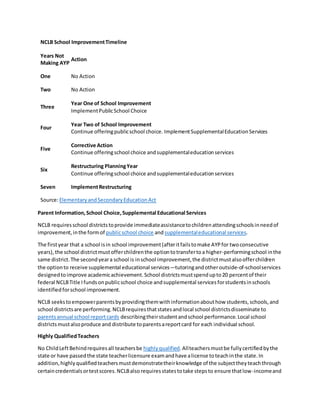
NCLB School Improvement Timeline 
Years Not 
Making AYP 
Action 
One No Action 
Two No Action 
Three 
Year One of School Improvement 
Implement Public School Choice 
Four 
Year Two of School Improvement 
Continue offering public school choice. Implement Supplemental Education Services 
Five 
Corrective Action 
Continue offering school choice and supplemental education services 
Six 
Restructuring Planning Year 
Continue offering school choice and supplemental education services 
Seven Implement Restructuring 
Source: Elementary and Secondary Education Act 
Parent Information, School Choice, Supplemental Educational Services 
NCLB requires school districts to provide immediate assistance to children attending schools in need of 
improvement, in the form of public school choice and supplemental educational services. 
The first year that a school is in school improvement (after it fails to make AYP for two consecutive 
years), the school district must offer children the option to transfer to a higher-performing school in the 
same district. The second year a school is in school improvement, the district must also offer children 
the option to receive supplemental educational services—tutoring and other outside-of-school services 
designed to improve academic achievement. School districts must spend up to 20 percent of their 
federal NCLB Title I funds on public school choice and supplemental services for students in schools 
identified for school improvement. 
NCLB seeks to empower parents by providing them with information about how students, schools, and 
school districts are performing. NCLB requires that states and local school districts disseminate to 
parents annual school report cards describing their student and school performance. Local school 
districts must also produce and distribute to parents a report card for each individual school. 
Highly Qualified Teachers 
No Child Left Behind requires all teachers be highly qualified. All teachers must be fully certified by the 
state or have passed the state teacher licensure exam and have a license to teach in the state. In 
addition, highly qualified teachers must demonstrate their knowledge of the subject they teach through 
certain credentials or test scores. NCLB also requires states to take steps to ensure that low-income and
minority students are not taught by teachers who are not highly qualified at higher rates than are non-minority 
and low-income students. 
NCLB gives parents the right to know about the qualifications of their child’s teacher. Specifically, 
parents have the right to know if their child’s teacher meets state licensure and other qualifications, if 
the teacher is teaching under an emergency license or other waiver, the teacher’s undergraduate major, 
and any graduate degrees he or she holds. Parents also have the right to know if their child is receiving 
educational services from paraprofessionals (i.e. teacher aides) and what qualifications those 
paraprofessionals have. School districts are obligated to inform parents in writing if a teacher who is not 
highly qualified teaches their child for more than four weeks. 
Other NCLB Programs 
Although public debate around NCLB tends to focus on the law’s testing, accountability, and teacher 
quality requirements, NCLB authorizes 45 programs, organized into ten sections, and funded at $25.7 
billion in fiscal year 2014. 
Title I 
The Title I program under NCLB provides funds to local school districts to improve the education of 
disadvantaged students from birth through the 12th grade. It is the largest federal program supporting 
elementary and secondary education and was funded at $14.4 billion in fiscal year 2014. Funds are 
distributed to school districts according to a set of formulas based on the size and characteristics of a 
school district’s student population. School districts have some discretion in how they distribute Title I 
funds among schools within the district, but the law requires them to prioritize the highest -poverty 
schools. More than 50,000 schools (almost half of all public schools) receive Title I funds annually. 
Because Title I is NCLB’s largest program and most school districts receive some funding from it, the 
law’s requirements for annual testing, accountability, school improvement, and highly-qualified teachers 
are all part of Title I. 
Published Apr 24 2014 
febp.newamerica.net/.../no-child-left-behind-o... 
New America Foundation 
December 2, 2014 Huffpost Education Karl Gude 
Instructor at Michigan State University's School of Journalism teaching infographics and creative 
problem solving. Previously infographics director at Newsweek and The Associated Press. 
Instead of focusing on the high performing, front-row kids and neglecting the lost, skid-row kids in the 
back of the room, teachers can turn their classrooms into fertile ground that nurtures all students. 
Here are some ideas that might help:
• Create a safe environment where all ideas are celebrated and "different" thinkers are embraced. 
• Make sure students evaluate ideas instead of judging them. 
• Look for opportunities for play and fun and get students moving. 
• Don't just lecture and show slides. Involve your students, have them collaborate, and let them 
discover for themselves. 
• Offer alternative ways for assessing the various kinds of thinkers in your classes. 
• Bring the real world into the classroom. Have experiential projects to drive home the relevance of the 
material. 
• Employ creative brainstorming techniques in group projects so that everyone's voice is heard. 
• Value questions, not answers. 
• Get students listening to understand, not to respond. 
• View problems from different perspectives and ask open-ended questions. "How can we...?" 
• Give second chances. Failure is a step toward success. 
• Find new ways to reward kids beyond the grades. 
• And finally, care about your students equally, and make sure they know that you care. As Benjamin 
Franklin once said, "Want of care does us more damage than want of knowledge." 
The system will be slow to change, and I hope that one day it will, but a single teacher can make a 
difference right now. 
Follow Karl Gude on Twitter: www.twitter.com/karlgude 
More: 
Teachers No Child Left Behind Distilled Perspective Fostering Creativity Teaching Schools K 12 Education 
K 12 Classroom Classrooms Classroom Management Disruptive Students High School

No child left behind

  • 1.
    No Child LeftBehind - Overview The No Child Left Behind Act of 2001 (NCLB) is the most recent iteration of the Elementary and Secondary Education Act of 1965 (ESEA), the major federal law authorizing federal spending on programs to support K-12 schooling. ESEA is the largest source of federal spending on elementary and secondary education. History ESEA was enacted in 1965 as part of the Johnson Administration’s War on Poverty campaign. The law’s original goal, which remains today, was to improve educational equity for students from lower income families by providing federal funds to school districts serving poor students. School districts serving lower income students often receive less state and local funding than those serving more affluent children. Since its initial passage in 1965, ESEA has been reauthorized seven times, most recently in January 2002 as the No Child left Behind Act. Each reauthorization has brought changes to the program, but its central goal of improving the educational opportunities for children from lower income families remains. The 1994 reauthorization, the Improving America’s Schools Act, put in place key standards and accountability elements for states and local school districts that receive funding under the law. These accountability provisions were further developed in the most recent reauthorization, the No Child Left Behind Act. NCLB and Accountability Although NCLB covers numerous federal education programs, the law’s requirements for testing, accountability, and school improvement receive the most attention. NCLB requires states to test students in reading and mathematics annually in grades 3-8 and once in grades 10-12. States must test students in science once in grades 3-5, 6-8, and 10-12. Individual schools, school districts and states must publicly report test results in the aggregate and for specific student subgroups, including low-income students, students with disabilities, English language learners, and major racial and ethnic groups. NCLB required states, school districts, and schools to ensure all students are proficient in grade -level math and reading by 2014. States define grade-level performance. Schools must make "adequate yearly progress" toward this goal, whereby proficiency rates increase in the years leading up to 2014. The rate of increase required is chosen by each state. In order for a school to make adequate yearly progress (AYP), it must meet its targets for student reading and math proficiency each year. A state’s total student proficiency rate and the rate achieved by student subgroups are all considered in the AYP determination. ESEA Flexibility and Waivers However, Wisconsin – along with 42 other states, Washington, D.C., a group of California school districts, Puerto Rico, and the Bureau of Indian Education – applied for a waiver from these targets and other NCLB requirements from the Department of Education. In September 2011, President Obama and Secretary of Education Arne Duncan announced that the administration would allow states to request flexibility in meeting some of the requirements under NCLB in the absence of the law’s reauthorization.
  • 2.
    Requirements that theDepartment of Education offered to waive include states meeting AYP targets whereby students must reach 100 percent student proficiency by 2014 in reading and math, and mandated interventions, whereby districts must allow students to attend different schools and offer Supplemental Educational Services for Title I schools and school districts failing to meet the AYP targets. The waivers also allowed states to opt out of mandatory interventions for districts failing to meet requirements to staff only ‘Highly Qualified Teachers’ in their schools. (For more, read New America's recent report, "It's All Relative: How NCLB Waivers Did--and Did Not--Transform School Accountability.") In order to receive flexibility through a waiver, states needed to demonstrate that they had adopted or would implement a series of reforms to their academic standards, student assessments, and accountability systems for schools and educators. Specifically, the Department required states to implement 1) college- and career-ready standards and assessments that measure student achievement and growth; 2) a differentiated accountability system that both recognizes high-achieving, high progress schools (reward schools) and supports chronically low-achieving schools (priority and focus schools); and 3) teacher and principal evaluation and support systems to improve instruction. A team of peer reviewers, along with Department staff, studied the proposals, commented on each request, and offered suggestions to states to help them win approval. Since February 2012, 43 states and Washington, D.C. have been granted waivers, most of which will be in effect until the end of the 2013-14 school year, when states will have the opportunity to extend their waivers for another two years. For states without waivers, NCLB remains in full effect. States have struggled with implementing the policies outlined in their waiver agreements with the Department of Education. Just like the provisions in NCLB that the waivers allow states to escape, reforms states set in motion using waivers have been controversial. Some constituencies have objected to the new policies. These include the new Common Core State Standards and assessments many states have adopted; the annual student achievement targets that states have set (which are often different for historically disadvantaged groups of students); states’ new systems for measuring school quality and/or identifying schools for improvement; and states’ plans to implement teacher and principal evaluations based in part on student test scores. Despite these difficulties, it appears likely that waivers will continue to serve as de facto federal policy until NCLB is reauthorized. School Improvement, Corrective Action, and Restructuring Schools that fail to make adequate yearly progress for two consecutive years are identified for " school improvement," and must draft a school improvement plan, devote at least 10 percent of federal funds provided under Title I of NCLB to teacher professional development. Schools that fail to make AYP f or a third year are identified for corrective action, and must institute interventions designed to improve school performance from a list specified in the legislation. Schools that fail to make AYP for a fourth year are identified for restructuring, which requires more significant interventions. If schools fail to make AYP for a fifth year, they much implement a restructuring plan that includes reconstituting school staff and/or leadership, changing the school’s governance arrangement, converting the school to a charter, turning it over to a private management company, or some other major change. School districts in which a high percentage of schools fail to make AYP for multiple years can also be identified for school improvement, corrective action, and restructuring.
  • 3.
    NCLB School ImprovementTimeline Years Not Making AYP Action One No Action Two No Action Three Year One of School Improvement Implement Public School Choice Four Year Two of School Improvement Continue offering public school choice. Implement Supplemental Education Services Five Corrective Action Continue offering school choice and supplemental education services Six Restructuring Planning Year Continue offering school choice and supplemental education services Seven Implement Restructuring Source: Elementary and Secondary Education Act Parent Information, School Choice, Supplemental Educational Services NCLB requires school districts to provide immediate assistance to children attending schools in need of improvement, in the form of public school choice and supplemental educational services. The first year that a school is in school improvement (after it fails to make AYP for two consecutive years), the school district must offer children the option to transfer to a higher-performing school in the same district. The second year a school is in school improvement, the district must also offer children the option to receive supplemental educational services—tutoring and other outside-of-school services designed to improve academic achievement. School districts must spend up to 20 percent of their federal NCLB Title I funds on public school choice and supplemental services for students in schools identified for school improvement. NCLB seeks to empower parents by providing them with information about how students, schools, and school districts are performing. NCLB requires that states and local school districts disseminate to parents annual school report cards describing their student and school performance. Local school districts must also produce and distribute to parents a report card for each individual school. Highly Qualified Teachers No Child Left Behind requires all teachers be highly qualified. All teachers must be fully certified by the state or have passed the state teacher licensure exam and have a license to teach in the state. In addition, highly qualified teachers must demonstrate their knowledge of the subject they teach through certain credentials or test scores. NCLB also requires states to take steps to ensure that low-income and
  • 4.
    minority students arenot taught by teachers who are not highly qualified at higher rates than are non-minority and low-income students. NCLB gives parents the right to know about the qualifications of their child’s teacher. Specifically, parents have the right to know if their child’s teacher meets state licensure and other qualifications, if the teacher is teaching under an emergency license or other waiver, the teacher’s undergraduate major, and any graduate degrees he or she holds. Parents also have the right to know if their child is receiving educational services from paraprofessionals (i.e. teacher aides) and what qualifications those paraprofessionals have. School districts are obligated to inform parents in writing if a teacher who is not highly qualified teaches their child for more than four weeks. Other NCLB Programs Although public debate around NCLB tends to focus on the law’s testing, accountability, and teacher quality requirements, NCLB authorizes 45 programs, organized into ten sections, and funded at $25.7 billion in fiscal year 2014. Title I The Title I program under NCLB provides funds to local school districts to improve the education of disadvantaged students from birth through the 12th grade. It is the largest federal program supporting elementary and secondary education and was funded at $14.4 billion in fiscal year 2014. Funds are distributed to school districts according to a set of formulas based on the size and characteristics of a school district’s student population. School districts have some discretion in how they distribute Title I funds among schools within the district, but the law requires them to prioritize the highest -poverty schools. More than 50,000 schools (almost half of all public schools) receive Title I funds annually. Because Title I is NCLB’s largest program and most school districts receive some funding from it, the law’s requirements for annual testing, accountability, school improvement, and highly-qualified teachers are all part of Title I. Published Apr 24 2014 febp.newamerica.net/.../no-child-left-behind-o... New America Foundation December 2, 2014 Huffpost Education Karl Gude Instructor at Michigan State University's School of Journalism teaching infographics and creative problem solving. Previously infographics director at Newsweek and The Associated Press. Instead of focusing on the high performing, front-row kids and neglecting the lost, skid-row kids in the back of the room, teachers can turn their classrooms into fertile ground that nurtures all students. Here are some ideas that might help:
  • 5.
    • Create asafe environment where all ideas are celebrated and "different" thinkers are embraced. • Make sure students evaluate ideas instead of judging them. • Look for opportunities for play and fun and get students moving. • Don't just lecture and show slides. Involve your students, have them collaborate, and let them discover for themselves. • Offer alternative ways for assessing the various kinds of thinkers in your classes. • Bring the real world into the classroom. Have experiential projects to drive home the relevance of the material. • Employ creative brainstorming techniques in group projects so that everyone's voice is heard. • Value questions, not answers. • Get students listening to understand, not to respond. • View problems from different perspectives and ask open-ended questions. "How can we...?" • Give second chances. Failure is a step toward success. • Find new ways to reward kids beyond the grades. • And finally, care about your students equally, and make sure they know that you care. As Benjamin Franklin once said, "Want of care does us more damage than want of knowledge." The system will be slow to change, and I hope that one day it will, but a single teacher can make a difference right now. Follow Karl Gude on Twitter: www.twitter.com/karlgude More: Teachers No Child Left Behind Distilled Perspective Fostering Creativity Teaching Schools K 12 Education K 12 Classroom Classrooms Classroom Management Disruptive Students High School