45 W 36th St, 6th Floor
New York, NY 10018
Tel. (212) 378-2800
www.neophilanthropy.org
Greater Power, Lasting Impact
EFFECTIVE GRANTMAKER STRATEGIES FROM THE
COMMUNITIES FOR PUBLIC EDUCATION REFORM FUND (CPER)
Greater Power, Lasting Impact
Effective Grantmaker Strategies from the
Communities for Public Education Reform Fund
(CPER)
By Melinda Fine, Lauren Jacobs, and Ly Nguyen
Fall 2014
2
Greater Power, Lasting Impact is one of several reports CPER prepared
to share lessons learned about Fund impacts and effective grantmaking
strategies. It can be downloaded at www.neophilanthropy.org, along
with these complementary reports:
Education Policy Impacts 2007-2014
Summarizes key policy wins at the school, district, state and federal level
achieved through multi-year campaigns led by CPER grantees.
Strengthening Collaborations to Build Social Movements:
Ten Lessons from the Communities for Public Education Reform Fund
Explores effective grantmaker strategies to nurture collaboration between
field advocates and allies in order to advance social justice movements.
Building Capacity to Sustain Social Movements:
Ten Lessons from the Communities for Public Education Reform Fund
Explores effective grantmaker strategies to build organizational capacity
and networks to sustain social justice work.
3
	5	 INTRODUCTION
	7	 SECTION ONE:
		 Supporting a Movement for Educational Justice
	7	 THE CPER GRANTMAKING MODEL
	10	 THE FUND’S CORE STRATEGY: EDUCATION ORGANIZING
	15	 SECTION TWO:
		 CPER Site Campaign Spotlights
	17	 California: Spotlight on education resources
	23	 Chicago: Spotlight on teaching quality
	29	 Colorado: Spotlight on access to higher education
	35	 Mississippi: Spotlight on education as a civil right
	41	 New Jersey: Spotlight on alliances
	45	 Philadelphia: Spotlight on school turnaround
	51	 SECTION THREE:
		 The Movement Moment
	51	 CONNECTING CAMPAIGNS ACROSS SITES
	52	 THE GROWTH AND CATCH OF DISCIPLINARY
		 POLICY CAMPAIGNS
	57	 CONCLUSION:
		 Sustaining the Work
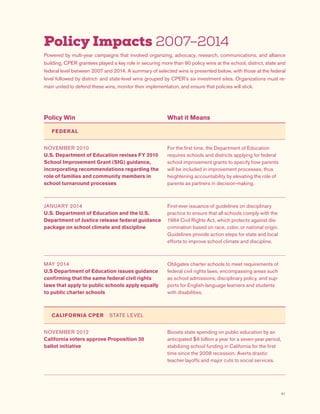
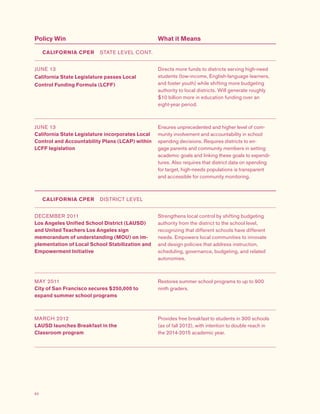
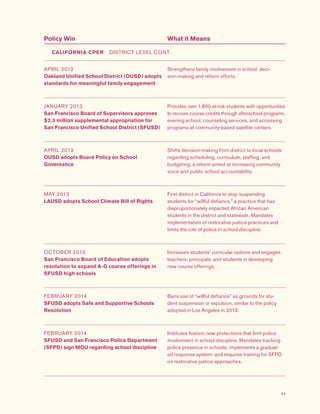
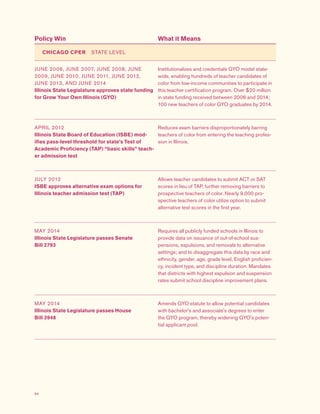
	61	 POLICY IMPACTS 2007-2014
	75	 Acknowledgements
4
5
INTRODUCTION
Communities for Public Education Reform (CPER)
was propelled by a simple but powerful idea:
the very people for whom school reform is
intended can and should be the architects of
their own reform agendas.
CPER (also referred to here on as the “Fund”) is a national funders’ collaborative committed to improving edu-
cational opportunities and outcomes for students — in particular students of color from low-income families — by
supporting community-driven reforms led by grassroots education organizing groups. CPER originated in
discussions among funders active in Grantmakers for Education’s Working Group on Education Organizing.
They launched the collaborative in 2007, in partnership with NEO Philanthropy (then Public Interest Projects),
the 501 (c)(3) public charity engaged to direct the Fund.
CPER’s founding funders saw that, in the education debates of the day, the perspectives of those closest
to the ground were often left out. These funders recognized that students and families have a crucial role to
play in identifying, embracing, and sustaining meaningful school reform. Students and families know their
own needs and see first-hand the inequities in schools. Organizing groups help them get a seat at the deci-
sion-making table and develop workable solutions, building on community assets that are vital to addressing
the cultural and political dimensions of reform. These grassroots groups are essential to creating the public
accountability and will needed to catalyze educational reforms and ensure they stick. They can be the antidote
to the ever-shifting political conditions and leadership turnover that plague reform efforts. At the same time,
they help community members develop leadership and a grassroots base, building individual civic capacity
and community power that strengthens our democratic infrastructure for the long term. Because educational
improvement requires tackling persistent inequities in race and income, supporting leaders in low-income
communities of color also helps build the social capital needed to solve integrally related social challenges.
CPER was initially conceived to run for a minimum of three years — a timeline consistent with most foundation
grants, but short for the transformative kinds of changes the Fund hoped to achieve. CPER’s lifespan eventu-
ally stretched to eight years because of the recognized power of its supported work. Over this period, NEO
6
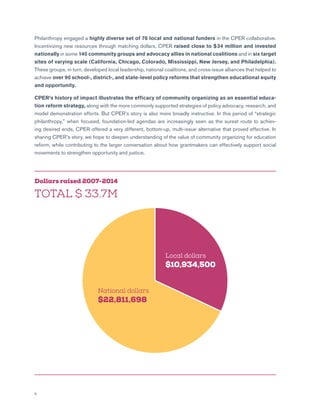
Dollars raised 2007-2014
TOTAL $ 33.7M
Philanthropy engaged a highly diverse set of 76 local and national funders in the CPER collaborative.
Incentivizing new resources through matching dollars, CPER raised close to $34 million and invested
nationally in some 140 community groups and advocacy allies in national coalitions and in six target
sites of varying scale (California, Chicago, Colorado, Mississippi, New Jersey, and Philadelphia).
These groups, in turn, developed local leadership, national coalitions, and cross-issue alliances that helped to
achieve over 90 school-, district-, and state-level policy reforms that strengthen educational equity
and opportunity.
CPER’s history of impact illustrates the efficacy of community organizing as an essential educa-
tion reform strategy, along with the more commonly supported strategies of policy advocacy, research, and
model demonstration efforts. But CPER’s story is also more broadly instructive. In this period of “strategic
philanthropy,” when focused, foundation-led agendas are increasingly seen as the surest route to achiev-
ing desired ends, CPER offered a very different, bottom-up, multi-issue alternative that proved effective. In
sharing CPER’s story, we hope to deepen understanding of the value of community organizing for education
reform, while contributing to the larger conversation about how grantmakers can effectively support social
movements to strengthen opportunity and justice.
National dollars
$22,811,698
Local dollars
$10,934,500
7
SECTION ONE:
Supporting a Movement
for Educational Justice
THE CPER GRANTMAKING MODEL
CPER’s founding funders had ambitious aims from the start. They sought specific education reforms that would
expand opportunities and improve student outcomes. Yet at the same time, they looked beyond individual pol-
icy targets to questions about how policy decisions are made: Whose interests drive decision-making? What
parties are considered to have relevant knowledge? Funders shaped CPER with the goal of transforming the
policymaking process and enabling diverse stakeholders in vulnerable communities to fully exercise their edu-
cational rights — as one essential component of realizing a broader opportunity and justice agenda.
In the decade before CPER’s founding, education organizing had emerged as a strategy for reform, with
community-based groups growing in number and sophistication. But resources for education organizing work
were still scant. Groups needed support to build organizational capacity and strengthen collaboration with
partners and allies.
Accordingly, CPER funders and staff identified strategies important to movements in their early stages of de-
velopment. They sought to build field infrastructure and to support groups in developing a shared identity and
vision. In an effort to increase field resources, they engaged a diverse set of donors whose portfolios spanned
an array of intersecting social issues: education reform, community development, racial equity, civic engage-
ment, and related areas. To encourage collective strategizing, message framing, and alliance building, the Fund
supported individual groups as well as their coordination, collaboration, and networks.
CPER’s particular grantmaking model was driven by the Fund’s central premise that those closest to the
ground should lead reforms in their best interest. CPER donor members coalesced around the broad princi-
ples of equity and excellence, but local organizing groups set the Fund’s more specific agenda in each
of the six investment sites. Parents and students identified specific reform priorities and shaped
collective policy campaigns as a means toward realizing a broader vision of educational justice.
CPER’s organizational infrastructure also reflected movement building principles by keeping the locus of
power close to the ground, facilitating collaboration among different parties, supporting an ecosystem of
8
strategies and partners, and mitigating traditional funder-grantee power dynamics through third-party leader-
ship. Key features included:
•	 local funder tables that partnered with third-party leadership, NEO Philanthropy, to make local grant
decisions;
•	 locally based grantees and regional and national coalitions that embraced a range of social issues
and change approaches, with grassroots organizing at the center;
•	 local coordinators who facilitated collaboration among groups within regions, conducted grant due
diligence with CPER’s national staff, and supported local donors in acquiring solid understanding of sup-
ported grantees’ work;
•	 governance authority shared between national and local funders through a Steering Committee responsi-
ble for the Fund’s overall strategy, budget approval, and fundraising support; and
•	 third-party leadership charged with honing strategies and running the Fund’s various field building pro-
grams, conducting all grantseeking and grantmaking, facilitating partnerships and governance processes
with funder members and other stakeholders, and supervising work across sites and coalitions to strength-
en collaborative impact.
CPER played a number of roles that are common to funders that support building social movements.1
These
roles are identified below, paired with the strategies associated with each of them.
INVESTOR: CPER invested in a broad range of community groups to develop leaders and build a sustain-
able, effective grassroots base. CPER secondarily supported advocacy and research partners that worked
hand-in-hand with grassroots groups to scale and strengthen organizing campaigns. CPER grantees includ-
ed youth-led, parent-led, and intergenerational community groups. Some focused squarely on education
reform; others focused on related issues, such as immigration reform, racial justice, and criminalization; and
still others were multi-issue networks and coalitions. This diverse, largely stable body of grantees received
flexible, annual grants over multiple years; quick turnaround grants to seize emerging opportunities; and ex-
tensive capacity building and technical assistance, driven by grantee-initiated pull for these supports.
BROKER: CPER cultivated the engagement of donor members that differed considerably in terms of size,
geographic reach, and investment priorities. The Fund leveraged new resources through 1:1 matching of na-
tional to local dollars. In the Fund’s last two years, national dollars eclipsed local investment to enable a gradual
transition for grantees during the spend down period.
CONNECTOR: CPER supported site-based clusters of groups with shared goals to advance campaigns for
district- and state-level reforms. Locally based staff facilitated relationship building and strategic coordination
of campaigns among groups. Annual convenings and cross-site peer learning communities strengthened
connections among sites, helping groups connect their local experience to the larger national narrative. The
emergence of national coalitions — fueled by partnerships among local groups — strengthened the education
organizing field’s national identity. CPER provided direct grants, networking, and facilitation support to these
national alliances.
1 See Grantmakers for Effective Organizations, Many Hands, More Impact: Philanthropy’s Role in Supporting Movements.
Washington, DC, 2013.
9
LEARNER: CPER supported evaluation and research to advance field knowledge. Grantees’ campaigns
were also enhanced by capacity building resources for applying policy research and strengthening strategic
messaging.
INFLUENCER: Through donor briefings and structured partnerships, CPER engaged funders, teachers
unions, education scholars, and others in order to build stakeholder demand for equity and excellence fo-
cused education reforms.
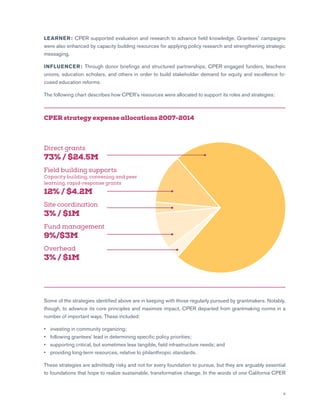
The following chart describes how CPER’s resources were allocated to support its roles and strategies:
Some of the strategies identified above are in keeping with those regularly pursued by grantmakers. Notably,
though, to advance its core principles and maximize impact, CPER departed from grantmaking norms in a
number of important ways. These included:
•	 investing in community organizing;
•	 following grantees’ lead in determining specific policy priorities;
•	 supporting critical, but sometimes less tangible, field infrastructure needs; and
•	 providing long-term resources, relative to philanthropic standards.
These strategies are admittedly risky and not for every foundation to pursue, but they are arguably essential
to foundations that hope to realize sustainable, transformative change. In the words of one California CPER
Direct grants
73% / $24.5M
Field building supports
Capacity building, convening and peer
learning, rapid-response grants
12% / $4.2M
Site coordination
3% / $1M
Fund management
9%/$3M
Overhead
3% / $1M
CPER strategy expense allocations 2007-2014
10
grantee: “CPER’s multi-year funding strategy enabled groups to plan and execute campaigns that extend be-
yond traditional grant cycles, and encouraged and facilitated the kind of long-term planning and strategizing
that is critical to not just winning individual campaigns, but to developing and executing a theory of change
that transforms systems at the local and state level.”
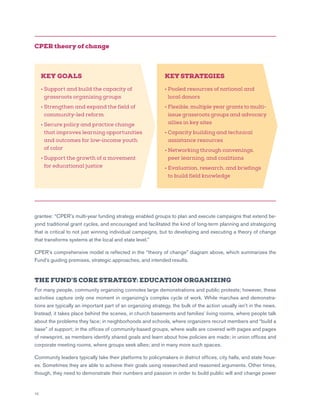
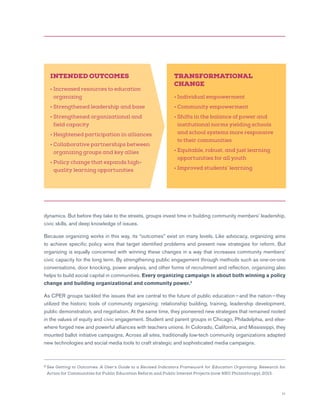
CPER’s comprehensive model is reflected in the “theory of change” diagram above, which summarizes the
Fund’s guiding premises, strategic approaches, and intended results.
THE FUND’S CORE STRATEGY: EDUCATION ORGANIZING
For many people, community organizing connotes large demonstrations and public protests; however, these
activities capture only one moment in organizing’s complex cycle of work. While marches and demonstra-
tions are typically an important part of an organizing strategy, the bulk of the action usually isn’t in the news.
Instead, it takes place behind the scenes, in church basements and families’ living rooms, where people talk
about the problems they face; in neighborhoods and schools, where organizers recruit members and “build a
base” of support; in the offices of community-based groups, where walls are covered with pages and pages
of newsprint, as members identify shared goals and learn about how policies are made; in union offices and
corporate meeting rooms, where groups seek allies; and in many more such spaces.
Community leaders typically take their platforms to policymakers in district offices, city halls, and state hous-
es. Sometimes they are able to achieve their goals using researched and reasoned arguments. Other times,
though, they need to demonstrate their numbers and passion in order to build public will and change power
CPER theory of change
KEY GOALS
• Support and build the capacity of
grassroots organizing groups
• Strengthen and expand the field of
community-led reform
• Secure policy and practice change
that improves learning opportunities
and outcomes for low-income youth
of color
• Support the growth of a movement
for educational justice
KEY STRATEGIES
• Pooled resources of national and
local donors
• Flexible, multiple year grants to multi-
issue grassroots groups and advocacy
allies in key sites
• Capacity building and technical
assistance resources
• Networking through convenings,
peer learning, and coalitions
• Evaluation, research, and briefings
to build field knowledge
11
2 See Getting to Outcomes: A User’s Guide to a Revised Indicators Framework for Education Organizing, Research for
Action for Communities for Public Education Reform and Public Interest Projects (now NEO Philanthropy), 2013.
dynamics. But before they take to the streets, groups invest time in building community members’ leadership,
civic skills, and deep knowledge of issues.
Because organizing works in this way, its “outcomes” exist on many levels. Like advocacy, organizing aims
to achieve specific policy wins that target identified problems and present new strategies for reform. But
organizing is equally concerned with winning these changes in a way that increases community members’
civic capacity for the long term. By strengthening public engagement through methods such as one-on-one
conversations, door knocking, power analysis, and other forms of recruitment and reflection, organizing also
helps to build social capital in communities. Every organizing campaign is about both winning a policy
change and building organizational and community power.2
As CPER groups tackled the issues that are central to the future of public education — and the nation — they
utilized the historic tools of community organizing: relationship building, training, leadership development,
public demonstration, and negotiation. At the same time, they pioneered new strategies that remained rooted
in the values of equity and civic engagement. Student and parent groups in Chicago, Philadelphia, and else-
where forged new and powerful alliances with teachers unions. In Colorado, California, and Mississippi, they
mounted ballot initiative campaigns. Across all sites, traditionally low-tech community organizations adapted
new technologies and social media tools to craft strategic and sophisticated media campaigns.
TRANSFORMATIONAL
CHANGE
• Individual empowerment
• Community empowerment
• Shifts in the balance of power and
institutional norms yielding schools
and school systems more responsive
to their communities
• Equitable, robust, and just learning
opportunities for all youth
• Improved students’ learning
INTENDED OUTCOMES
• Increased resources to education
organizing
• Strengthened leadership and base
• Strengthened organizational and
field capacity
• Heightened participation in alliances
• Collaborative partnerships between
organizing groups and key allies
• Policy change that expands high-
quality learning opportunities
12
United by a shared vision of achieving excellent and high-quality public education for all youth, grassroots
groups in cities across the country took leadership in identifying campaigns that had salience and traction
with parents and students in their schools. As Mike Kromrey from Together Colorado noted:
	One of the singularly unique characteristics of CPER was the willingness to respect and support a very
diverse set of strategies and theories of change across the country that emerged from disparate organizing
efforts. As the education funding world increasingly moves to supporting very specific slices of the reform
pie, it was immeasurably helpful to an organization like Together Colorado, whose members were interest-
ed in a wide array of reform platforms, from pre-school through college access, to have a funder that was
willing to support and encourage organizing campaigns that emerged from parent and student organizing,
even when some of those reforms were not supported by some of the philanthropic partners within CPER.
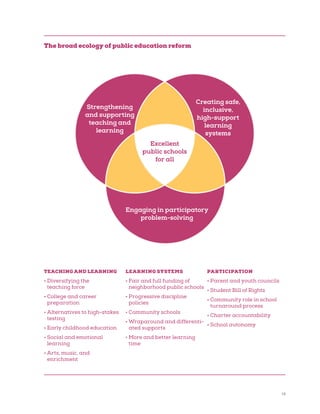
Campaigns embraced multiple issues while typically falling within three overarching areas: strengthening and
supporting teaching and learning; creating safe and inclusive learning systems; and engaging in participatory
problem-solving efforts. All three areas shared a common goal: creating excellent public schools for all.
Specific reform strategies advocated within this larger ecosystem included — but were not limited to — those
identified on page 13.
Jenny Arwade of the Chicago-based Voices of Youth in Chicago Education (VOYCE) reflected the perspec-
tive of many CPER grantees and funders in observing:
	 The reality is that there is no one silver-bullet reform that will magically
achieve education equity. Instead, we must work in coalitions and alliances
that recognize the complex role of structural inequities and the fundamental
interconnectedness of all education policy issues. For example, as we have
seen in Chicago with the push for a longer school day, neighborhood schools
need high-quality instruction, greater investment, and a shift away from over-
ly harsh discipline in order for the school day to be truly better. Successful
collaborations must embrace the fundamental broad ecology of public edu-
cation reform, and use their shared values as a central guide in shaping their
work and identifying opportunities.
13
TEACHING AND LEARNING
•	Diversifying the
teaching force
•	College and career
preparation
•	Alternatives to high-stakes
testing
•	Early childhood education
•	Social and emotional
learning
•	Arts, music, and
enrichment 	
LEARNING SYSTEMS
•	Fair and full funding of
neighborhood public schools
•	Progressive discipline
policies
•	Community schools
•	Wraparound and differenti-
ated supports
•	More and better learning
time
PARTICIPATION
•	Parent and youth councils
•	Student Bill of Rights
•	Community role in school
turnaround process
•	Charter accountability
•	School autonomy
Excellent
public schools
for all
Creating safe,
inclusive,
high-support
learning
systems
Strengthening
and supporting
teaching and
learning
Engaging in participatory
problem-solving
The broad ecology of public education reform
15
SECTION TWO:
CPER Site
Campaign Spotlights
In this section, we share some of the ways that groups within each of CPER’s six investment sites have en-
gaged with the “broad ecology” of reform, winning major policy changes while building the civic capacity of
their community members. The breadth of grantees’ collective work over time precludes our fully capturing
the diversity of campaigns pursued. We have chosen instead to spotlight a particular campaign focus within
each site, thereby illuminating how a cross-section of issues at the heart of today’s education reform debates
are experienced by students and families on the ground and across the country.
We hope these selective snapshots will help readers grasp the rich work that Communities for Public Education
Reform supported over an eight-year period, and — equally important — the grantmaker strategies that helped
groups connect across issues and regions to effectively move their work forward.
16
17
California:
Spotlight on education
resources
In the 35 years following the passage of Proposition 13 in 1978, California’s education spending per pupil
dropped from being in the top fifth to 50th in the nation. This trend finally began to reverse with a successful
2012 ballot initiative to raise revenue, followed by legislation in 2013 to establish a new school funding formu-
la. CPER helped to turn the ship around in the nation’s most populous state — an effort that took over a decade
of collaborative work, building strong community leadership, and broad coalitions.
CPER grantees and their allies won a huge victory in 2012 with passage of Proposition 30, which raised
income taxes on California’s wealthiest residents for a seven-year period. This historic win meant an additional
$3 billion for public education in FY 2013 alone.
Passing a ballot initiative in a state of over 38 million people was a daunting task. Many of CPER’s grantees
had been gearing up for years, conducting large-scale voter engagement campaigns including the following:3
•	Alliance of Californians for Community Empowerment (ACCE), InnerCity Struggle (ICS), and
Community Coalition (CoCo) were anchor groups in California Calls, a multi-issue alliance of 31
grassroots groups. California Calls sought to engage 500,000 new and infrequent voters, particularly
young people, people of color, and residents of poor and working class neighborhoods. Member groups
utilized new technologies, as well as the traditional door-knocking approach.
•	PICO California, ACCE, and California Calls were core members of Reclaim California’s Future,
which united community groups, faith-based organizations, unions, and educators supporting Proposition
30. PICO mounted the largest faith-based get-out-the-vote effort in California history, reaching nearly
145,000 eligible voters.
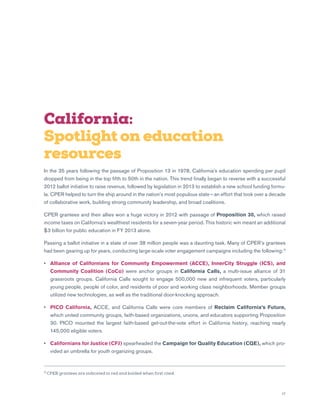
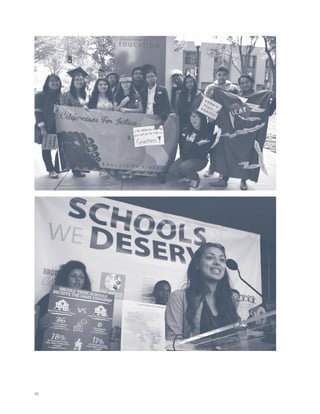
•	Californians for Justice (CFJ) spearheaded the Campaign for Quality Education (CQE), which pro-
vided an umbrella for youth organizing groups.
3 CPER grantees are indicated in red and bolded when first cited.
18
Other CPER-funded grassroots groups worked within these coalitions to organize parents and youth:
•	 Bay Area Parent Leadership Action Network (PLAN)
•	 Coleman Advocates for Children and Youth
•	 Community Asset Development Redefining Education (CADRE)
•	 Oakland Community Organizations (OCO)
•	 Youth Together
In addition, Public Advocates and UCLA’s Institute for Democracy, Education, and Access provided
policy and data analysis to help organizing groups strengthen strategic campaigns.
Strategic communications played a big part in the ballot box win. With CPER capacity building support,
groups worked with Lightbox Communications to shape compelling, succinct campaign messages that res-
onated with voters’ values. They honed their story-telling skills, learned techniques for pitching ideas to news
outlets, and expanded their social media work.
Proposition 30 passed with 55.4% of the vote, with young voters and people of color turning out in record
numbers to put it over the line. “I think the 2012 election in California may prove to be a turning point in
California politics,” Field Poll head Mark DiCamillo said in a November issue of the Sacramento Bee, ac-
knowledging the significance of Latino, Asian American, African American and other minority voters, who cast
about four of every ten ballots statewide.
The resulting increase in education revenue opened up new political space to tackle how state funding is
doled out. For years leading up to the Proposition 30 battle, CPER groups had advocated a state funding
system that would provide adequate funds to help all students reach state standards. At the same time, they
argued for allocating these funds differentially by providing increased resources to students with the greatest
needs.
CPER groups seized the opportunity in 2012 when Governor Jerry Brown proposed a Local Control
Funding Formula (LCFF) to do just that. Working again within a broad coalition, CPER groups took the
lead in educating and mobilizing low-income families and students to support passage of the LCFF. In so
doing, they countered opposition by school systems and built support among policymakers. CFJ and PICO
California coordinated CPER groups’ mobilization, with support from CPER’s California site coordinator.
The fast-moving LCFF campaign required deeper collaboration among organizing and advocacy groups. With
support from a CPER rapid-response grant, groups met frequently to strategize and coordinate their work.
Voted into law in June 2013 and quickly signed by the governor, the LCFF:
•	 raises the base general purpose grant for every school district in California;
•	allocates additional funding for each low-income, English-language learner (ELL), and foster care youth;
•	mandates Concentration Grants, which provide additional funds to districts that have more than 55%
low-income, ELL, and foster care youth; and
•	moves decision-making for school budgeting from the state to the local level, creating greater opportuni-
ties for community involvement.
19
•	Engagement of seven local funders through lo-
cal funder table that raised $1.4 million, advised
on grant awards, and leveraged $2.4 million from
CPER national funders, for total site invest-
ment of $3.8 million over four years
•	Direct grants over multiple years to 13 groups
totaling $3.4 million
•	Supplemental capacity resources and
rapid-response grants for strategic commu-
nications, campaign development, and meeting
facilitation; organization development trainings
and technical assistance on strategic planning,
fundraising, evaluation, and executive coaching
•	Grantee participation in three CPER Annual
Convenings; year-long peer learning communi-
ties on teaching quality, school district redesign,
and charter accountability; and learning oppor-
tunities with education scholars and researchers
•	Staffing support for coordinating grantee
activities across the San Francisco Bay Area
and Los Angeles, managing local donor table,
running grants, and implementing programs that
provide supplemental supports and learning
opportunities
How CPER helped power this work
One of many voices: Elizabeth Romero
Elizabeth Romero is one of many
California parents who took on new roles
and became heavily involved during the
LCFF campaign. A mother of six, Romero
saw the challenges facing low-income and
English-language learner students. As a
leader with Inland Congregations United
for Change, she organized dozens of fellow
parents in San Bernardino to work for dis-
trict-level changes.
Through her work, she became a power-
ful voice for equity and authentic parent
engagement. Romero testified before the
State Board of Education and shared her
story with local, county, and state offi-
cials. In her commentary on EdSource
Today, one of California’s most widely read
education blogs, she noted, “As long as
[parents] are not at the table, schools and
districts, and even the state, will continue
to make the same decisions over and over
again — decisions that have not supported
or benefited all children equally.”
20
21
Rolled out over an eight-year period, the LCFF will add billions of dollars to California’s poorest districts. In
2013-14 alone, the city of Oakland received an estimated additional $12 million.
Yet the LCFF implementation is complex, and CPER groups have necessarily continued collaborating to en-
sure that the new system directs funds to the neediest students and includes families in decision-making. In
November 2013, over 170 parents and youth testified on LCFF implementation at a State Board of Education
meeting in Sacramento — the most any state staff had ever seen at a single hearing.
At the same time, groups have continued to work for local policy change on other critical issues, such as
school discipline, parent engagement, and linked learning. In pursuing these campaigns, they draw on sophis-
ticated communication and voter engagement strategies acquired over the past eight years; on leaders who
better understand the connections between state and local policies; and on stronger relationships among
diverse constituencies. Roberta Furger of PICO California reflects on the progress made and the work still to
be done:
	California’s budget is stabilized, at least temporarily. School funding is increasing for the first time in
years and is now equity-based....The chief area of concern has to do with both the temporary nature of
Proposition 30 (seven years) and the reality that, despite the increase, we are a long way from achieving
funding adequacy. Our work on LCFF implementation will be critical to making the connection between
increased revenue and improved educational opportunities and outcomes — and to building the political
will and power necessary for long-term tax and fiscal reform in the state.
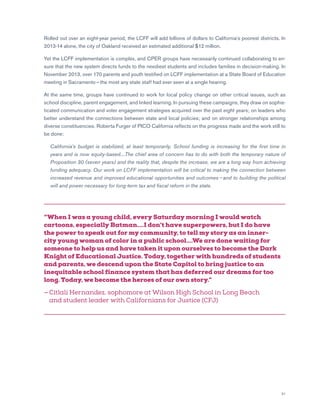
“When I was a young child, every Saturday morning I would watch
cartoons, especially Batman....I don’t have superpowers, but I do have
the power to speak out for my community, to tell my story as an inner-
city young woman of color in a public school....We are done waiting for
someone to help us and have taken it upon ourselves to become the Dark
Knight of Educational Justice. Today, together with hundreds of students
and parents, we descend upon the State Capitol to bring justice to an
inequitable school finance system that has deferred our dreams for too
long. Today, we become the heroes of our own story.”
— Citlali Hernandez, sophomore at Wilson High School in Long Beach
and student leader with Californians for Justice (CFJ)
22
23
Chicago:
Spotlight on teaching quality
What defines quality teaching? This question is increasingly at the heart of education reforms, and Chicago
CPER groups have tackled it from the on-the-ground perspectives of students and communities. Their answers
have led them to push back against political rhetoric that portrays students’ interests as being at odds with those
of their teachers. Instead, groups have collaborated with the Chicago Teachers Union (CTU) and with school
districts, higher education institutions, and the Illinois Board of Education.
Chicago CPER groups have advanced their vision in a city that has churned through education leaders. Over
CPER’s eight years, Chicago Public Schools (CPS) has had three chief education officers and five chief
executive officers. Amidst this flux, Chicago’s community organizing groups have given many students and
families a stable base from which to identify and work toward shared priorities.
Over its history in Chicago, CPER supported 17 community organizing groups in three coalitions, the follow-
ing two of which continue to advance their vision of racial justice and high-quality teaching for all.
Grow Your Own Illinois (GYO): valuing community roots and relationships
Organizing groups formed GYO out of concerns about high teacher turnover and low student achievement in
schools in their neighborhoods. After studying the problem, they realized that teachers coming from their own
communities would be more likely to stay in their schools. Moreover, teachers who shared students’ racial and
cultural backgrounds would have an advantage in establishing strong relationships with students and helping
them build from their current understanding of the world to a more complex one.
These groups looked at teaching quality from a systemic perspective. Although 90% of Chicago’s students
are of color, only 50% of its teachers are, and teachers of color accounted for only a third of new hires in
2010-12. GYO innovated a bold new plan: building a pipeline for community members to become teachers.
In the GYO model, consortia of community organizations, higher education institutions, and school districts
operate the GYO program collaboratively. Organizing groups recruit parents, paraprofessionals, and other
community members who receive forgivable loans and programmatic support to earn education degrees. At
the same time, these teacher candidates participate in leadership trainings and become agents of change.
In 2004, GYO won passage of the state GYO Teacher Education Act, providing a legal structure and a state
funding stream, which GYO has successfully defended year after year in state budget battles. CPER support
24
has enabled the GYO coalition both to sustain and refine its initial model (coordinating 12 consortia across
the state), and to plan for taking it to scale.
Voices of Youth in Chicago Education (VOYCE):
empowering students as civic actors
CPER grants enabled Chicago organizing groups (some of which were also active in GYO) to form VOYCE,
a youth organizing collaborative for education and racial justice. From the beginning, VOYCE youth leaders
have researched student perspectives on teaching quality and what works in neighborhood schools. As stu-
dents deepened their understanding of the impact of federal, state, and district policies on their classroom
experience, they came to two conclusions. First, as students, they had valuable insights to share on the
types of programs that could help students stay and succeed in school, and on what truly constitutes quality
teaching. Second, neither their learning nor their teachers’ performance was adequately represented by stan-
dardized test scores.
Standing with teachers against over-reliance on test scores
Two events in 2010 set the stage for an all-out fight about how Chicago defines teaching quality. Early in the
year, Illinois enacted a law requiring districts to implement new teacher evaluation systems, making teacher as-
sessment a major issue in negotiations for a new Chicago teachers contract. Six months later, the CTU elected
a slate of leaders from the Caucus of Rank-and-File Educators (CORE), which included several GYO gradu-
ates. CORE shifted the teachers union from a narrow focus on providing member services to a justice-oriented
focus on empowering educators and working with communities for equitable, high-quality schools.
VOYCE, GYO, and allies staked out their ground with a joint platform in 2011, A Neighborhoods Agenda
for Schools, which called for heightened investment in neighborhood schools and in school-community col-
laboration. They rejected “the over-reliance on standardized testing which is narrowing the curriculum and
disempowering both teachers and students.” In addition, VOYCE student leaders opposed the idea of judging
teaching based largely on students’ standardized test scores. They called for including students’ perspectives
on teaching quality into assessment mechanisms through student surveys. VOYCE leaders found common
ground with the CTU, which agreed to incorporate their call into contract negotiations with the district.
When contract negotiations failed, the CTU mounted the country’s largest teacher strike in two decades,
and GYO and VOYCE leaders stood alongside the union. In a citywide rally and in media interviews, VOYCE
students decried the fact that the 2012-13 school year was slated to become the most highly tested school
year in the history of Chicago Public Schools, with $13 million already spent on new “high-stakes” tests and
thousands of student learning hours lost to test preparation and administration. CPER groups and the CTU
won a major victory when the successful resolution of the strike led to a 2012 teachers contract that:
•	limited the weight of standardized tests in teacher evaluations to the minimum level required by
state law and refrained from using them as the basis for merit pay; and
•	 committed the district to piloting student surveys, to be used as part of the teacher assessment system.
Continuing to advance the vision
Building on the momentum of the victory in the new contract, a group of VOYCE student leaders convened a
new citywide coalition, Chicago Students Organizing to Save our Schools (CSOSOS), to protest the
misuse and overuse of standardized tests. Students argued that Chicago Public Schools was using schools’
25
•	Engagement of 20 local funders through local
funder table that raised $2.7 million, advised on
grant awards, and leveraged $3.9 million from
CPER national funders, for total site invest-
ment of $6 million over eight years
•	Direct grants over multiple years to 17 groups
in three regional coalitions totaling
$6.3 million
•	Supplemental capacity resources and
rapid-response grants for strategic communi-
cations, research, and campaign development;
organization development trainings and
technical assistance on business planning, fund-
raising, and evaluation
•	Grantee participation in five CPER Annual
Convenings; and in year-long peer learning
communities on teaching quality, charter ac-
countability, school transformation models, and
district redesign
•	Cross-site exchanges with Colorado CPER
and allied Boston-based youth organizing
groups
•	Staffing support for managing local donor
table, coordinating grantee activities, run-
ning grants, and implementing programs that
provide supplemental supports and learning
opportunities
How CPER helped power this work
One of many voices: Nancy Ballesteros
Nancy Ballesteros dropped out of college
when she had a child. In 2009, she became
a GYO teacher candidate. She went on to
pass the basic skills test, maintain a strong
GPA, and become a leader with Enlace
Chicago, a GYO member. After she had
been teaching for a year, Mike Rodriguez,
Enlace Chicago’s executive director, got
a call from Dr. Steven Shrike, chief area
coordinator for Chicago Public Schools,
asking, “Who is this Nancy Ballesteros?
Can you find more like her? Although she
is a first-year teacher, she is not over-
whelmed. She has strong relationships
with the kids, she is prepared and dedi-
cated, she knows the community, and she
knows the language and culture of her
students.”
26
poor performance on standardized tests, in part, to justify its proposal to close 50 schools, most of which
were in high-poverty, African American neighborhoods. Moreover, these high-stakes tests were having unin-
tended and indefensible consequences on students. In an effort to boost its test scores, for example, Gage
Park High School demoted 68 juniors to sophomore standing just a month before they would have taken the
state exam. One wrongfully demoted student reflected the views of many when he argued:
	This is not what school systems are supposed to do to students. They are supposed to provide extra
support to students like me who don’t do well on tests or who might fall behind. But instead, they tried to
make us disappear....We demand an end to testing-driven school closings, under-resourced schools, and
student push out. And we’re not going away.
	— Timothy Anderson, Gage Park High School student and leader with VOYCE and CSOSOS, in Catalyst
Chicago, May 2013
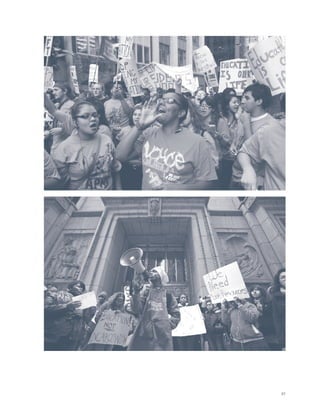
VOYCE used a CPER rapid-response grant to mobilize. On April 24, 2013, over 300 CSOSOS students from
18 schools boycotted school, protesting outside the Board of Education against school closings and student
push out; 60 of these students were juniors who also boycotted the state exam. The boycott garnered local and
national media coverage, including in The Nation, Huffington Post, Education Week, and Catalyst Chicago.
CSOSOS’s boycott and subsequent negotiations turned the tide on standardized testing in Chicago — though
it did not stop the school closings. Chicago Public Schools restored the standing of Gage Park High School’s
demoted juniors, eliminated value-added tests for pre-K through first grade students, and cut back
on high-stakes tests in high schools. After further negotiations, the school district eliminated 15 of the
25 tests it had administered, shifting substantial time from testing to teaching.
Working in close collaboration, GYO and VOYCE have interjected a more robust and holistic vision of teach-
ing quality into today’s education debates. Moreover, their member groups are making the connections among
teaching quality, high-stakes testing, school funding, racial inequity, and neighborhood school closings.
Using CPER rapid-response grants, Kenwood Oakland Community Organization (KOCO), a member of both
GYO and VOYCE, launched Journey for Justice (J4J), a national alliance working to stop neighborhood
school closings and to advance community-driven, sustainable school improvement. CPER has provided
core grants, convening, and facilitation support to this 21-city coalition of youth and community organizing
groups, enabling local CPER grantees in Chicago — and in other CPER sites – to link their continuing district-
and state-level campaigns to the larger, national conversation about educational justice.
27
28
29
Colorado:
Spotlight on access to
higher education
In 2003, undocumented Colorado students seeking to attend state colleges faced tuition bills four times
those of their documented classmates because they did not qualify for receiving in-state tuition rates. Amidst
a wave of anti-immigrant sentiment, legislators saw support for tuition equity as a career-ending move. With a
sustained 10-year effort, however, CPER groups changed the public perception of the rights of undocument-
ed students.
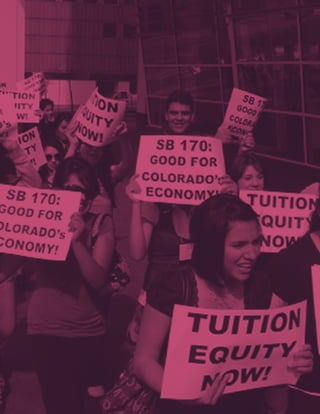
The result, in 2013: ASSET legislation, which allows undocumented students to pay an in-state tuition rate at
Colorado public colleges and universities, as long as they meet basic eligibility requirements (having attend-
ed a Colorado high school for three years and having graduated or earned a GED). ASSET, which stands
for Advancing Students for a Stronger Economy Tomorrow, also qualifies undocumented students to receive
stipends that cover a portion of their in-state tuition. CPER groups played a major role in creating the political
will to change the system through organizing, voter engagement, coalition building, and research, all support-
ed and driven by the courage of young people.
Three CPER grantees led the Colorado ASSET fight from the start:
•	Padres y Jóvenes Unidos (PJU), which organizes Denver parents and youth to challenge the root caus-
es of discrimination, racism, and inequity and to develop effective change strategies;
•	Together Colorado, an interfaith organizing group that unites congregations, schools, and youth commit-
tees in solving community issues; and
•	Colorado Immigrant Rights Coalition (CIRC), which convenes immigrant, faith-based, labor, youth,
community, and business groups to make Colorado a more immigrant-friendly state.
When these grassroots groups launched the tuition campaign in 2004, anti-immigrant attitudes were surging
across the nation. Colorado passed its own set of anti-immigrant measures in 2006; early battles conse-
quently had to focus on reversing them. Groups succeeded both in overturning the most restrictive of these
measures and in winning reforms that expanded opportunities, such as “concurrent enrollment” programs
30
that enable students to earn an associate’s degree and a high school diploma simultaneously. Students and
families grew stronger with each battle, whether campaigns were proactive or defensive.
Undocumented students spoke out at their own risk. One legislator reported several students to Immigration
and Customs Enforcement after hearing their testimony at a committee hearing. Their families had to relocate
in order to avoid deportation.
Two things changed between 2006 and 2008: Democrats took the majority of both legislative houses; and
Together Colorado, PJU, and CIRC formed the Higher Education Access Alliance (HEAA), with other
allies, to advance the campaign. Fueled in part by supplemental, quick turnaround CPER Colorado campaign
support, this new coalition melded large-scale student leadership with sophisticated strategies and broad
partnerships. With the help of a communications firm, HEAA ran focus groups and developed messages that
framed the need for in-state tuition in economic terms for the state, ultimately releasing two research reports
which made compelling education and economic arguments in favor of in-state tuition for undocumented youth.
It took six bills to win ASSET’s passage, but more than that, it took strong organizing, unwavering stamina,
and a willingness to critically assess campaign progress and setbacks and to adjust strategy along the way.
The campaign’s low point came in 2009, when hundreds of immigrant students and their allies gathered at the
state capitol expecting to celebrate ASSET’s passage, only to end up weeping as it failed: three Democratic
senators who had vowed their support reneged on their commitment.
That shocking loss prompted deep reflection among groups, aided by findings from CPER’s third-party eval-
uation of grantee-supported work across the country. Alliance members concluded that they needed to hold
each other more accountable; better accommodate differences between advocacy and organizing partners;
stay clearly on message; and broaden their roster of supporters beyond the “usual suspects.” These priorities
became HEAA’s “to-do list.”
Over the next four years, HEAA reached out to more business groups and higher education institutions, as
well as to evangelical, Catholic, and other religious congregations. The South Metro Chamber of Commerce,
which covers Denver and its southern suburbs, became a strong supporter after students shared their stories
with the chamber’s staff. Groups simultaneously ramped up their voter engagement and communications
work, particularly in rural areas; CIRC alone contacted over 15,000 rural voters. Students held massive walk-
outs for comprehensive immigration reform, engaged voters, and spoke to media. A new group joined the
fray, with new advocacy capacity: Stand for Children, founded in 2009 with the mission to ensure that all
children graduate from high school prepared for, and with access to, college.
By the time the ASSET bill came to a vote again in 2013, opposition testimony was almost nil. The bill passed
overwhelmingly, with bipartisan support. Colorado State Senator Mike Johnston acknowledged HEAA’s im-
pact when commenting, “I think for some of us in this building, it’s really helpful to have a powerful, committed,
deep coalition of supporters from every background who say, ‘It’s time for you to get out of the way.’”
Barely breaking speed to rest after victory, CPER groups launched a statewide outreach campaign targeting
undocumented students, high schools, and state colleges and universities. Within just seven months of the
bill’s passage, some 640 undocumented students seized the opportunity of higher education after being able
to pay in-state tuition rates when enrolling in public colleges and universities across the state.
31
•	Engagement of 12 local funders through local
funder table that raised $3.1 million, advised on
grant awards, and leveraged $3.6 million from
CPER national funders, for total site invest-
ment of $6.7 million over eight years
•	Direct grants over multiple years to eight
groups and one regional coalition totaling
$5.8 million
•	Dedicated local campaign pool, technical
assistance, and national capacity supports
for campaign development, data collection, stra-
tegic planning, and organizational development
•	Grantee participation in five CPER Annual
Convenings; and in year-long peer learning com-
munities on school transformation models and
school district redesign
•	Cross-site exchanges with CPER grantees in
Chicago and Philadelphia
•	Staffing support for coordinating grantee
activities, managing local donor table, running
grants, and implementing programs that provide
supplemental resource supports and learning
opportunities
How CPER helped power this work
One of many successes: Victor Galvan
One often under-looked and under-valued
result of CPER’s investment and success is
around leadership development and sup-
porting a leadership pipeline. There are
thousands of students and youth across
Colorado who were introduced to educa-
tion reform, organizing, advocacy, and
leadership through the ASSET campaign.
Many of these students not only got in-
volved and active, but went on to become
top-tier leaders in the campaign and in
organizations. Many were young teenag-
ers when they started, and today many
are staff and Board members of Colorado’s
strongest social justice and education re-
form groups.
One successful example is Victor Galvan.
Victor was 14 when he got involved
with the ASSET campaign and came up
through the ranks of Padres y Jóvenes
Unidos, Longmont Youth for Equality, and
CIRC. Victor was CIRC’s first undocument-
ed youth Board member in 2010. In 2012,
Victor came on CIRC’s staff as the civic en-
gagement coordinator, supervising youth
and student fellows in non-partisan voter
engagement in the 2012 elections. Those
elections, prior to which Victor helped
to engage thousands of immigrant and
Latino voters, culminated in a shift in pol-
itics and public opinion that helped push
ASSET over the finish line in 2013. Today,
Victor is CIRC’s full-time West Slope or-
ganizer and a rising star in both the state
and national movements.
32
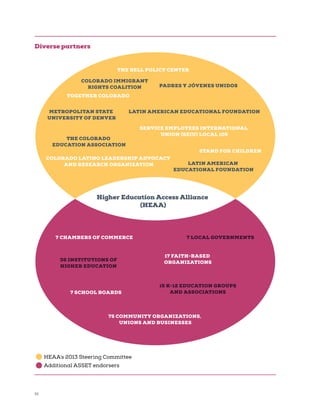
Diverse partners
Higher Education Access Alliance
(HEAA)
7 CHAMBERS OF COMMERCE
7 SCHOOL BOARDS
TOGETHER COLORADO
COLORADO IMMIGRANT
RIGHTS COALITION
LATIN AMERICAN EDUCATIONAL FOUNDATION
7 LOCAL GOVERNMENTS
PADRES Y JÓVENES UNIDOS
SERVICE EMPLOYEES INTERNATIONAL
UNION (SEIU) LOCAL 105
75 COMMUNITY ORGANIZATIONS,
UNIONS AND BUSINESSES
STAND FOR CHILDREN
LATIN AMERICAN
EDUCATIONAL FOUNDATION
THE BELL POLICY CENTER
THE COLORADO
EDUCATION ASSOCIATION
METROPOLITAN STATE
UNIVERSITY OF DENVER
COLORADO LATINO LEADERSHIP ADVOCACY
AND RESEARCH ORGANIZATION
HEAA’s 2013 Steering Committee
Additional ASSET endorsers
36 INSTITUTIONS OF
HIGHER EDUCATION
15 K-12 EDUCATION GROUPS
AND ASSOCIATIONS
17 FAITH-BASED
ORGANIZATIONS
33
The Colorado ASSET campaign didn’t take place in isolation. Colorado CPER’s four grantees were advanc-
ing other important reform campaigns throughout their battle for ASSET’s passage, achieving major wins in
areas such as disciplinary policy reform, extended learning time, district budgeting, and the more equitable
operation of Denver’s school choice system.
Significant shifts in organizational capacity underlie victories in all of these campaigns. Groups now have a
broader and stronger leadership base. Together Colorado, for example, has grown from 20 member groups,
mainly in Denver, to over 60 groups that reach far across the state. Groups have also strengthened their ability
to understand and integrate research, communications, and voter engagement into their work on education
as well as other issues. Finally, groups have gained the respect of policymakers, who see them as highly
knowledgeable strategic players as well as passionate self-advocates for their rights.
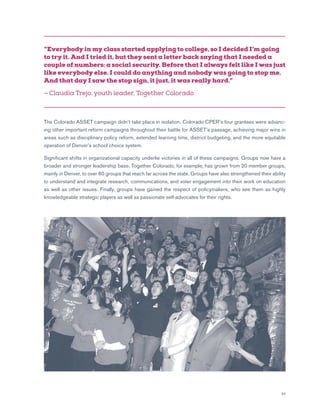
“Everybody in my class started applying to college, so I decided I’m going
to try it. And I tried it, but they sent a letter back saying that I needed a
couple of numbers: a social security. Before that I always felt like I was just
like everybody else. I could do anything and nobody was going to stop me.
And that day I saw the stop sign, it just, it was really hard.”
— Claudia Trejo, youth leader, Together Colorado
35
Mississippi:
Spotlight on education
as a civil right
Fifty years after Freedom Summer (1964), Mississippi residents still face racial injustice, voter suppression,
and educational inequity. Long the nation’s poorest state, Mississippi consistently ranks among the lowest of
the 50 in per-student expenditures and in student achievement. Students remain at risk for violence and the
threat of violence, even from their teachers: corporal punishment remains legal in Mississippi at all grade lev-
els, and has even been reinstated in some counties that once rescinded it.
With deep roots in the community, CPER’s Mississippi grantees have continued the tradition of organizing for
racial justice and educational equity, among the driving forces of Freedom Summer. They have identified new
opportunities for community voice, and have drawn on the historic tools of voter education and engagement
to address the substantial underfunding of their schools.
Building a new structure for community voice
CPER groups found a powerful vehicle for civic leadership, as well as school reform, in a provision of state law
that might have been forgotten were it not for their activism. In 2009, Mississippi had enacted the Children
First Act, which mandated the creation of community-based education councils in poorly performing
schools and school districts. A year later, though, the state’s Department of Education had done nothing to
move forward on instituting this new lever for reform.
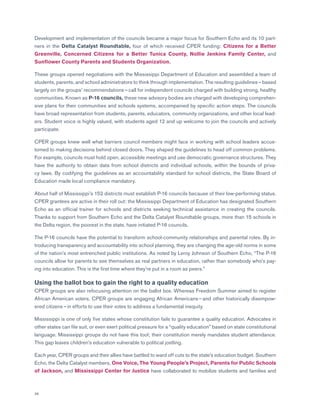
CPER grantee Southern Echo, which works to develop grassroots leadership in rural African American
communities, saw the mandate for such councils as an opportunity. Through them, community members
could ensure that school improvement efforts are better attuned to the history and culture of their communi-
ties and accountable to the families they serve. The need for community input and leadership was recognized
by policymakers such as State Rep. Cecil Brown:
	If we’ve got a failing district or a district that’s not succeeding, we can’t design it from Jackson or design it
from somewhere else and cram it down their throats. We can’t do that because it’s destined to fail. It’s only
going to succeed if the local community accepts those solutions and has input in designing those solutions.
36
Development and implementation of the councils became a major focus for Southern Echo and its 10 part-
ners in the Delta Catalyst Roundtable, four of which received CPER funding: Citizens for a Better
Greenville, Concerned Citizens for a Better Tunica County, Nollie Jenkins Family Center, and
Sunflower County Parents and Students Organization.
These groups opened negotiations with the Mississippi Department of Education and assembled a team of
students, parents, and school administrators to think through implementation. The resulting guidelines — based
largely on the groups’ recommendations — call for independent councils charged with building strong, healthy
communities. Known as P-16 councils, these new advisory bodies are charged with developing comprehen-
sive plans for their communities and schools systems, accompanied by specific action steps. The councils
have broad representation from students, parents, educators, community organizations, and other local lead-
ers. Student voice is highly valued, with students aged 12 and up welcome to join the councils and actively
participate.
CPER groups knew well what barriers council members might face in working with school leaders accus-
tomed to making decisions behind closed doors. They shaped the guidelines to head off common problems.
For example, councils must hold open, accessible meetings and use democratic governance structures. They
have the authority to obtain data from school districts and individual schools, within the bounds of priva-
cy laws. By codifying the guidelines as an accountability standard for school districts, the State Board of
Education made local compliance mandatory.
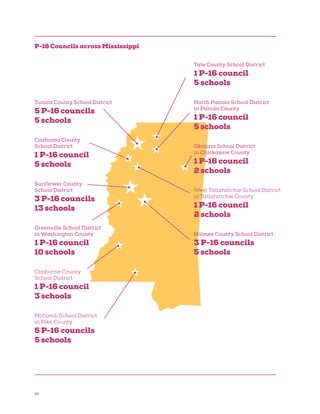
About half of Mississippi’s 152 districts must establish P-16 councils because of their low-performing status.
CPER grantees are active in their roll out: the Mississippi Department of Education has designated Southern
Echo as an official trainer for schools and districts seeking technical assistance in creating the councils.
Thanks to support from Southern Echo and the Delta Catalyst Roundtable groups, more than 15 schools in
the Delta region, the poorest in the state, have initiated P-16 councils.
The P-16 councils have the potential to transform school-community relationships and parental roles. By in-
troducing transparency and accountability into school planning, they are changing the age-old norms in some
of the nation’s most entrenched public institutions. As noted by Leroy Johnson of Southern Echo, “The P-16
councils allow for parents to see themselves as real partners in education, rather than somebody who’s pay-
ing into education. This is the first time where they’re put in a room as peers.”
Using the ballot box to gain the right to a quality education
CPER groups are also refocusing attention on the ballot box. Whereas Freedom Summer aimed to register
African American voters, CPER groups are engaging African Americans — and other historically disempow-
ered citizens — in efforts to use their votes to address a fundamental inequity.
Mississippi is one of only five states whose constitution fails to guarantee a quality education. Advocates in
other states can file suit, or even exert political pressure for a “quality education” based on state constitutional
language. Mississippi groups do not have this tool; their constitution merely mandates student attendance.
This gap leaves children’s education vulnerable to political jostling.
Each year, CPER groups and their allies have battled to ward off cuts to the state’s education budget. Southern
Echo, the Delta Catalyst members, One Voice, The Young People’s Project, Parents for Public Schools
of Jackson, and Mississippi Center for Justice have collaborated to mobilize students and families and
37
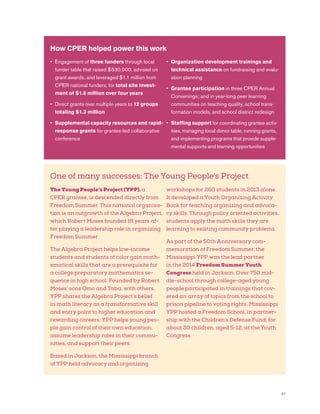
One of many successes: The Young People’s Project
The Young People’s Project (YPP), a
CPER grantee, is descended directly from
Freedom Summer. This national organiza-
tion is an outgrowth of the Algebra Project,
which Robert Moses founded 18 years af-
ter playing a leadership role in organizing
Freedom Summer.
The Algebra Project helps low-income
students and students of color gain math-
ematical skills that are a prerequisite for
a college preparatory mathematics se-
quence in high school. Founded by Robert
Moses’ sons Omo and Taba, with others,
YPP shares the Algebra Project’s belief
in math literacy as a transformative skill
and entry point to higher education and
rewarding careers. YPP helps young peo-
ple gain control of their own education,
assume leadership roles in their commu-
nities, and support their peers.
Based in Jackson, the Mississippi branch
of YPP held advocacy and organizing
workshops for 260 students in 2013 alone.
It developed a Youth Organizing Activity
Book for teaching organizing and advoca-
cy skills. Through policy oriented activities,
students apply the math skills they are
learning to existing community problems.
As part of the 50th Anniversary com-
memoration of Freedom Summer, the
Mississippi YPP was the lead partner
in the 2014 Freedom Summer Youth
Congress held in Jackson. Over 750 mid-
dle-school through college-aged young
people participated in trainings that cov-
ered an array of topics from the school to
prison pipeline to voting rights. Mississippi
YPP hosted a Freedom School, in partner-
ship with the Children’s Defense Fund, for
about 30 children, aged 5-12, at the Youth
Congress.
•	Engagement of three funders through local
funder table that raised $530,000, advised on
grant awards, and leveraged $1.1 million from
CPER national funders, for total site invest-
ment of $1.6 million over four years
•	Direct grants over multiple years to 12 groups
totaling $1.3 million
•	Supplemental capacity resources and rapid-
response grants for grantee-led collaborative
conference
•	Organization development trainings and
technical assistance on fundraising and evalu-
ation planning
•	Grantee participation in three CPER Annual
Convenings; and in year-long peer learning
communities on teaching quality, school trans-
formation models, and school district redesign
•	Staffing support for coordinating grantee activ-
ities, managing local donor table, running grants,
and implementing programs that provide supple-
mental supports and learning opportunities
How CPER helped power this work
38
Tate County School District
1 P-16 council
5 schools
North Panola School District
in Panola County
1 P-16 council
5 schools
Okolona School District
in Chickasaw County
1 P-16 council
2 schools
West Tallahatchie School District
in Tallahatchie County
1 P-16 council
2 schools
Holmes County School District
3 P-16 councils
5 schools
Tunica County School District
5 P-16 councils
5 schools
Coahoma County
School District
1 P-16 council
5 schools
Sunflower County
School District
3 P-16 councils
13 schools
Greenville School District
in Washington County
1 P-16 council
10 schools
Claiborne County
School District
1 P-16 council
3 schools
McComb School District
in Pike County
5 P-16 councils
5 schools
P-16 Councils across Mississippi
39
bring advocacy resources to bear, with positive results. In 2013, for example, activists successfully blocked
cuts and added $30 million to help local school districts pay for their teacher retirement obligations.
While these successes are important, annual battles drain organizational resources, and wins are typically
too partial given the enormity of the challenges faced. A case in point: the state’s formula for “adequately”
funding public education (the Mississippi Adequate Education Program, or MAEP) has received full funding
in only two out of the 17 years since it was enacted. Therefore, CPER grantee One Voice, an off-shoot of the
Mississippi State Conference of the National Association for the Advancement of Colored People (NAACP),
is co-leading a multi-racial coalition to make quality education a constitutional right in Mississippi — an
achievement that could greatly enhance efforts to hold officials accountable and to fully and equitably fund
Mississippi’s public schools.
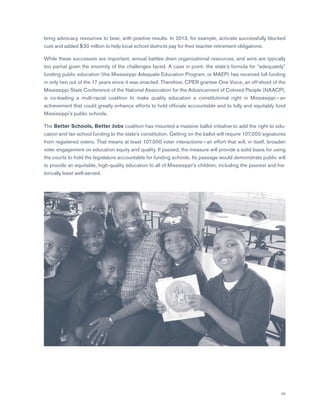
The Better Schools, Better Jobs coalition has mounted a massive ballot initiative to add the right to edu-
cation and fair school funding to the state’s constitution. Getting on the ballot will require 107,000 signatures
from registered voters. That means at least 107,000 voter interactions — an effort that will, in itself, broaden
voter engagement on education equity and quality. If passed, the measure will provide a solid basis for using
the courts to hold the legislature accountable for funding schools. Its passage would demonstrate public will
to provide an equitable, high-quality education to all of Mississippi’s children, including the poorest and his-
torically least well-served.
40
41
New Jersey:
Spotlight on alliances
CPER support has helped organizing and advocacy groups reshape New Jersey’s education reform land-
scape. By combining on-the-ground organizing with social media and mass email strategies, CPER groups
have bridged historical divides. For example, shared concerns about budget cuts, vouchers, local control,
and standardized testing have united families across urban/suburban boundaries and across the lines of race
and class.
Education Law Center (ELC) has vigorously advocated for greater equity and quality in New Jersey public
schools for decades (see sidebar on p. 43). The education organizing landscape, however, has been sparse.
From 2007-10, CPER funded a set of primarily urban organizing groups, as well as advocacy partners includ-
ing ELC. These early investments yielded some local policy impacts, such as restoring funding for libraries
and fine arts programs in Paterson elementary schools. However, the collective power of the groups was
limited, particularly at the state level. Ultimately, CPER recalibrated its grantmaking to support a complex
ecosystem of organizing, advocacy, and mass mobilization strategies, together with resources to support
coordination among these groups.
Save Our Schools NJ (SOS NJ) was born in 2010 when six parents organized around passing Princeton’s
school budget. In just two years it grew into a social media powerhouse, with 40 volunteer organizers on
weekly planning calls and 21,000 members getting email alerts. The group came to focus on issues that have
an impact on urban as well as suburban families: local control of charter school expansion, school funding,
and the explosion of high-stakes standardized tests. SOS NJ’s broad constituency building strategy pro-
vided an easy mechanism for parents to learn about issues, sign petitions, and contact policymakers. This
complemented the labor-intensive work of organizing groups building leadership and lasting civic capacity in
previously disenfranchised communities.
With CPER support, SOS NJ joined Our Children/Our Schools (OC/OS), a coalition of more than 45 ed-
ucation, labor, children’s rights, and civil rights groups. CPER also began investing directly in Education Law
Center’s coordination of this longstanding coalition. The following other CPER grantees brought urban and
regional organizing and advocacy to the table:
42
•	Abbott Leadership Institute (ALI) trains Newark parents, educators, and students to become informed
and effective advocates for public education reform;
•	Building One New Jersey (BONJ) connects cities and “outer ring” suburbs around shared economic
and social policy concerns;
•	New Jersey Communities United (NJCU) organizes low- and moderate-income people to exert their
power, predominantly in Newark; and
•	Paterson Education Fund (PEF) advocates for improved teaching and learning in New Jersey’s
third-most-populous city.
By uniting suburban and urban voices, CPER groups changed education politics in New Jersey. The OC/OS
coalition successfully protected the state’s school funding formula from annual gubernatorial attacks that
escalated with a new administration in 2010. Coalition members emphasized the impact of potential cuts on
all school districts. The 2013 budget battle illustrates the varying roles that CPER’s diverse grantees played,
to great effect. Education Law Center provided data analysis and testimony. SOS NJ generated 2,300 emails
to legislators. BONJ drew nearly 1,000 people to six public meetings. And NJCU partnered with the newly
formed Newark Student Union to organize a 1,000-strong student walkout that garnered coverage in the
Washington Post, Reuters, The Nation, and Al-Jazeera.
New Jersey groups have also used their broadened power base to defeat multiple voucher proposals intro-
duced by the governor. These wins have strengthened the groups for the long term, as indicated by SOS NJ’s
Julia Sass Rubin: “Once you can stop their bill, they know they have to deal with you. That gives you power for
the next round.”
For New Jersey CPER groups, this “next round” includes tackling high-stakes testing, an issue that has en-
ergized an even greater swath of the parent population. Along with 42 other states, New Jersey adopted the
Common Core in 2013 and is preparing to transition to a new set of high-stakes tests built around it. ELC,
SOS NJ, PEF, and allies have raised concerns about attaching huge consequences to performance on brand
new tests. They have drawn public and legislative attention to the costs and uses of standardized tests, with
SOS NJ alone generating over 10,000 emails urging legislators to put on the brakes. Bowing to pressure,
Governor Chris Christie issued an executive order in 2014 that reduced the weight of the new tests in teacher
evaluations for the first two years, and established a commission to study the “effectiveness” of standardized
testing statewide.
As New Jersey’s statewide groups led the campaigns for funding and other state policies, local groups add-
ed force by supporting state-focused efforts and by building momentum for local reforms on such issues as
school discipline, local control, and college readiness. As the CPER collaborative draws to a close, New
Jersey groups have developed a stronger collective infrastructure and statewide network from which to build.
Rosie Grant from Paterson Education Fund acknowledged the potential of this expanded capacity: “We’ve
gone from a state with little or no education organizing to one where several strong organizations and various
networks will continue to engage citizens well into the future.”
43
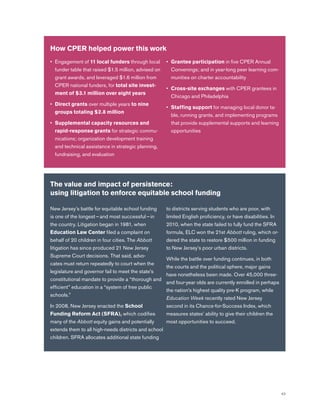
•	Engagement of 11 local funders through local
funder table that raised $1.5 million, advised on
grant awards, and leveraged $1.6 million from
CPER national funders, for total site invest-
ment of $3.1 million over eight years
•	Direct grants over multiple years to nine
groups totaling $2.8 million
•	Supplemental capacity resources and
rapid-response grants for strategic commu-
nications; organization development training
and technical assistance in strategic planning,
fundraising, and evaluation
New Jersey’s battle for equitable school funding
is one of the longest — and most successful — in
the country. Litigation began in 1981, when
Education Law Center filed a complaint on
behalf of 20 children in four cities. The Abbott
litigation has since produced 21 New Jersey
Supreme Court decisions. That said, advo-
cates must return repeatedly to court when the
legislature and governor fail to meet the state’s
constitutional mandate to provide a “thorough and
efficient” education in a “system of free public
schools.”
In 2008, New Jersey enacted the School
Funding Reform Act (SFRA), which codifies
many of the Abbott equity gains and potentially
extends them to all high-needs districts and school
children. SFRA allocates additional state funding
•	Grantee participation in five CPER Annual
Convenings; and in year-long peer learning com-
munities on charter accountability
•	Cross-site exchanges with CPER grantees in
Chicago and Philadelphia
•	Staffing support for managing local donor ta-
ble, running grants, and implementing programs
that provide supplemental supports and learning
opportunities
to districts serving students who are poor, with
limited English proficiency, or have disabilities. In
2010, when the state failed to fully fund the SFRA
formula, ELC won the 21st Abbott ruling, which or-
dered the state to restore $500 million in funding
to New Jersey’s poor urban districts.
While the battle over funding continues, in both
the courts and the political sphere, major gains
have nonetheless been made. Over 45,000 three-
and four-year olds are currently enrolled in perhaps
the nation’s highest quality pre-K program, while
Education Week recently rated New Jersey
second in its Chance-for-Success Index, which
measures states’ ability to give their children the
most opportunities to succeed.
How CPER helped power this work
The value and impact of persistence:
using litigation to enforce equitable school funding
44
45
Philadelphia:
Spotlight on school
turnaround
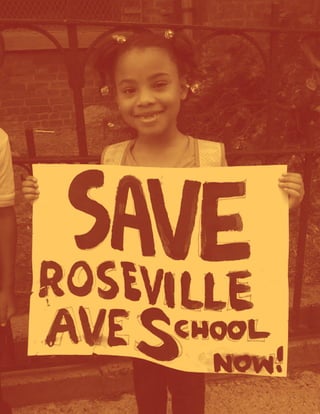
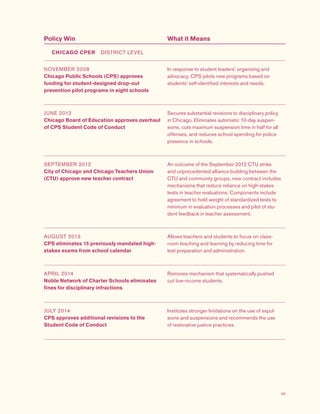
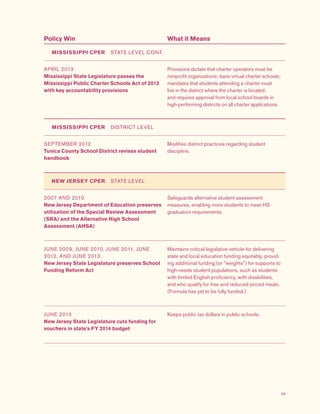
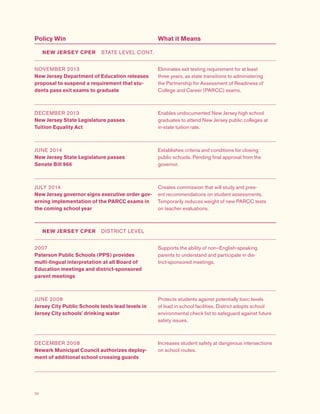
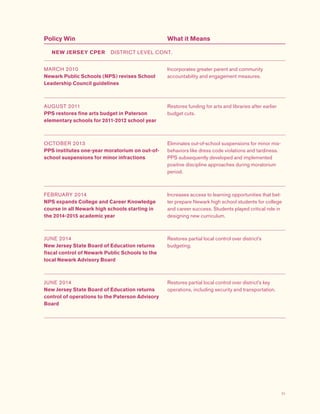
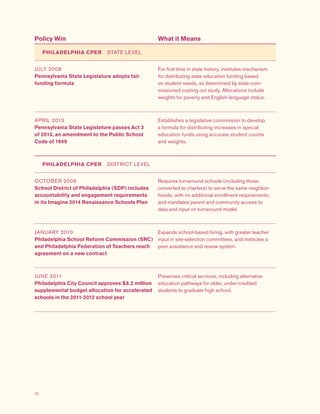
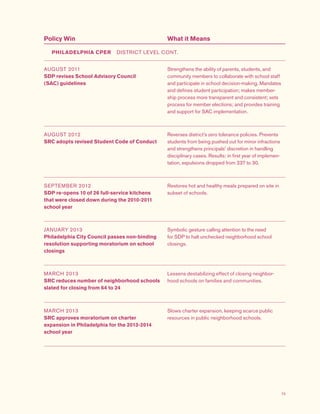
One of the most controversial questions in education circles is “What do you do with a failing school?”
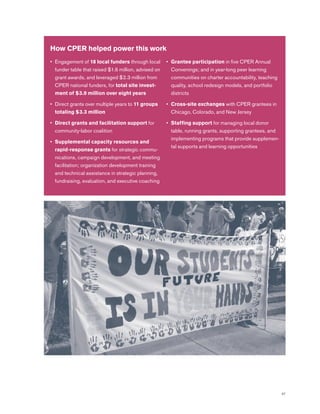
With more than its share of low-performing schools, Philadelphia has been ground zero for waves of “school
turnaround” strategies. In CPER’s eight years alone, six district leaders have, one after another, brought their
own strategic plans and promised quick fixes to the district’s long-standing problems — many of which are
rooted in its woefully inadequate funding.
CPER supported organizing groups in some of the city’s poorest neighborhoods, with some of its worst-per-
forming schools. These groups critiqued the constant flow of new reform proposals, examining whether the
reforms would equitably improve student experiences and outcomes; how schools would be held account-
able; and whether students and parents would have a voice in the changes. With these same criteria in mind,
CPER groups generated their own vision for effective reform.
Fighting for equity, accountability, and student/parent voice in all schools
At CPER’s outset in 2007, Philadelphia was in the midst of a failing reform initiative. The state had taken over
the School District of Philadelphia and handed control of 45 of its 250 schools to education management
organizations (EMOs), including for-profit companies such as Edison Schools (now called EdisonLearning).
An evaluation by CPER grantee Research for Action (RFA) and the Rand Corporation revealed that
EMO-operated schools were not outperforming those run by the district itself. CPER groups called for EMO
accountability. Groups coordinated their efforts within the CPER-supported Philadelphia Cross City
Campaign for School Reform, a coalition led by student and community organizing groups, with advocacy,
research, and media groups supporting their campaigns. In February 2008, the Cross City coalition’s “end
the sweetheart deals” protest earned front-page coverage; the school district began terminating EMO con-
tracts later that spring.
Over the next few years, the charter sector exploded. By 2010, over 60 free-standing charter schools
were established and operating across Philadelphia. At this time of massive charter expansion, the district
launched a new initiative which transferred control of some of the city’s low-performing schools to charter
46
school operators. As part of this process, the district also introduced a new mechanism designed to engage
stakeholders in school turnaround plans — School Advisory Councils (SACs) on which parents were to serve
as majority members. CPER groups worked to give teeth to these advisory bodies, which initially had little
power.
Working collaboratively through the Cross City Campaign, CPER grantees Action United, Philadelphia
Student Union (PSU), Youth United for Change (YUC), Juntos, and Education Law Center (ELC)
met with district and city leaders, protesting initial conversion plans that would have allowed charter operators
to hand-pick their students. CPER groups won an important battle when they convinced the district to require
that these converted schools — now operating as charters — continue to serve all neighborhood students, in-
cluding high-needs populations such as special education students and English-language learners.
By 2013, roughly 30% of Philadelphia’s public school students attended charter schools. Many of these char-
ters used enrollment barriers to ensure that they served students most likely to succeed — the very strategy
that was eventually prohibited in the district’s conversion initiative.
Supported through CPER capacity building resources, Public Citizens for Children and Youth (PCCY)
and Education Law Center participated in a year-long, multi-site CPER peer learning community on charter
accountability, learning about charter laws and campaigns across the country. Drawing on their experience to
challenge problematic practices in Philadelphia, PCCY released a charter school audit documenting en-
rollment barriers, such as 20-page applications used by some charter schools. The audit also demonstrated
that Philadelphia’s charter schools were serving fewer poor, African American, and English-language learn-
ers than their district school counterparts. Subsequently, the district’s School Reform Commission adopted
PCCY and ELC’s recommendations, forcing charter school operators to remove 111 student enrollment bar-
riers, and shutting down some of the city’s under-performing charter schools.
Shaping their own vision for school turnaround
Well aware that the Philadelphia school district’s series of reforms were failing to improve students’ learning
and achievement, CPER groups generated their own plans, grounded in community values, student experi-
ence, and sound education research about what works. For example, in line with reforms elsewhere in the
country, Philadelphia Student Union and Youth United for Change fought for breaking up large, poorly per-
forming high schools into small schools in which teachers could develop stronger relationships with their
students and collaborate with each other on engaging curricula. YUC and its allies’ efforts proved successful
when Kensington High School was converted into four small schools, almost immediately improving stu-
dent safety and attendance. The newly constructed building for Kensington High School for Creative and
Performing Arts (one of the four small schools created) constituted the largest public investment ever in its
low-income neighborhood.
In 2012, the stakes changed, as the district threatened to close up to 57 of its schools (more than 1 in 5),
most of which were in African American and Latino neighborhoods. PSU, YUC, and Action United joined
with the Philadelphia Federation of Teachers and other local unions to create the Philadelphia Coalition
Advocating for Public Schools (PCAPS). CPER provided a rapid-response grant that enabled PCAPS
to get up and running quickly, as well as essential seed funding for coordination and overall support from the
Annenberg Institute for School Reform’s Center for Education Organizing.
47
•	Engagement of 18 local funders through local
funder table that raised $1.6 million, advised on
grant awards, and leveraged $2.3 million from
CPER national funders, for total site invest-
ment of $3.9 million over eight years
•	Direct grants over multiple years to 11 groups
totaling $3.3 million
•	Direct grants and facilitation support for
community-labor coalition
•	Supplemental capacity resources and
rapid-response grants for strategic commu-
nications, campaign development, and meeting
facilitation; organization development training
and technical assistance in strategic planning,
fundraising, evaluation, and executive coaching
•	Grantee participation in five CPER Annual
Convenings; and in year-long peer learning
communities on charter accountability, teaching
quality, school redesign models, and portfolio
districts
•	Cross-site exchanges with CPER grantees in
Chicago, Colorado, and New Jersey
•	Staffing support for managing local donor
table, running grants, supporting grantees, and
implementing programs that provide supplemen-
tal supports and learning opportunities
How CPER helped power this work
48
Philadelphia education landscape and PCAPS time line
April 2012
School District of Philadelphia proposes closing
64 schools and dismantling central office.
Dec 2012
PCAPS releases its plan, Excellent Schools for
All Children, which urges community
collaboration and school improvement strategies
instead of closings.
June 2013
School Reform Commission votes to close 24 schools
(down from 64 proposed). Plans to dismantle central
office have been dropped.
March-June 2013
PCAPS organizes demonstrations and civil
disobedience protesting school closings,
including a 3,000-student walkout (the largest
school walkout since 1967).
May-Sept 2012
Unions and organizing groups form PCAPS and
engage parents, students, educators, and
community leaders in shaping an alternative
plan for the district.
Jan-April 2014
District announces that there will be no school closings in
2014, despite continuing budget crisis. District launches
School Redesign Initiative to support collaborative efforts to
turn around low-performing schools, consistent with PCAPS
recommendations.
49
PCAPS’ first order of business was to stave off the creation of “school deserts” that would have resulted from
massive neighborhood school closings. Overcoming historic differences and joining together in unprece-
dented action, organizing groups and unions held community meetings and demonstrations across the city.
The Philadelphia Public School Notebook, an independent news service and CPER grantee, covered
the protests, and the Notebook’s local and national media partnerships helped increase visibility and the im-
pact of local actions on national discourse. Concurrently, CPER grantee and PCAPS member Action United
filed a civil rights complaint protesting the disproportionate impact of proposed school closings on communi-
ties of color, as part of a national strategy mounted by the CPER-supported Journey for Justice Alliance (J4J).
With national attention focused on Philadelphia, the school district reduced the number of schools slated
for closure by more than half, ultimately shuttering 24 schools in the summer of 2013. Paul Socolar of the
Notebook reflected:
	While fighting a defensive action against school closings, the community set an important precedent
for future battles: that school closings must be vetted through an open, public process. They showed
that recommendations from the district can be reversed, and that high-performing neighborhood schools
should not be closed just because they are underutilized.
Mindful of the city’s continuing budget crisis and the repercussions of closing 24 of its schools, PCAPS
leaders set out to develop a realistic, effective plan to improve low-performing schools across the city. For the
first time in a generation, the Philadelphia Federation of Teachers sat down with student and parent groups to
jointly devise a comprehensive plan and shared vision. With CPER groups in the lead, the PCAPS coalition
sought community input through a day-long conference, community meetings, 26 student listening sessions,
and 1,500 community surveys. The resulting Excellent Schools for All Children: The Philadelphia
Community Education Plan, proposed creating community schools. Currently being implemented and
gaining traction in other cities, the community schools model integrates health, social, and educational sup-
ports and services, as well as before- and after-school programming for students and families, fostering deep
connections between classroom learning and the community.
With a combination of protests and proactive plans, CPER groups and their allies have succeeded in shifting
the school turnaround conversation in Philadelphia. In marked contrast to its previous plans, for example,
the school district’s spring 2014 school turnaround plan called for school-community teams collaborating
to redesign their neighborhood schools, citing community schools as a possible model. This approach got
another boost in August 2014, when the Philadelphia City Council held hearings on implementing commu-
nity schools, with that body’s president indicating strong support. And now four years in, School Advisory
Councils have withstood shifts in district leadership and acquired greater authority.
However promising, these turnaround efforts — and other strategies — remain severely hampered by a state ed-
ucation funding system that exacerbates inequity by starving urban (and rural) schools. CPER grantees ELC,
PCCY, and Education Voters are leading the campaign for increased state funds and a fair funding formula.
Within this context, all Philadelphia CPER groups are continuing to advance the conversation about meaning-
ful school turnaround strategies that engage community members in meeting the needs of all students.
50
51
SECTION THREE:
The Movement Moment
CONNECTING CAMPAIGNS ACROSS SITES
As the campaign spotlights indicate, CPER groups are tackling reform issues at the heart of today’s education
debates. Their varied campaigns address fundamental — and contested — strategies to expand high-quality
and equitable learning opportunities for all youth. Groups within investment sites coalesced around issues
that had traction in their specific locales. They achieved impressive results through using the tools of com-
munity organizing: reflecting on shared problems, determining policy goals, analyzing obstacles, identifying
change targets and allies, nurturing civic leadership, and building a sturdy base of support. The twists and
turns of their campaigns reflect the particularities of their locales; in education, much of the action takes place
at the local level. Notably, however, issues salient in one CPER site often emerged in other regions as well.
Not surprisingly, then, CPER groups across the country often pursued similar policy goals. This organic con-
fluence of policy campaigns across CPER’s six investment sites aligned with the Fund’s driving intention to
foster systemic reform by supporting a community-led movement for educational justice.
Over CPER’s eight-year history, one issue in particular acceded to national prominence, galvanizing youth
and their families in neighborhoods across the nation; generating powerful new constellations of advocacy,
organizing, and research partners; fueling new national alliances; drawing unprecedented federal attention;
and capturing the commitment of funders in areas as diverse yet interconnected as education, racial equity,
health, and LGBTQ rights. This is the issue of disciplinary policy reform.
Across the country, campaigns to end the “school to prison pipeline” gained momentum and gelled into what
social change scholars Barbara Masters and Torie Osborn have dubbed a “movement moment” — a “highly
visible time” that is both “transformative and collective,” during which “a profound shift in moral legitimacy”
occurs, “expand[ing] democratic terrain.” They note:
	Movements ebb and flow....Change comes in the form of alternating cycles of what we might colloquially
call “leaping and creeping.” During the “creeping” times, the infrastructure, organizations, relationships,
and leaders of a movement are built so that during the great “leaping” times — those so-called “movement
moments” — public engagement, attitudes, and policies rapidly move forward. How well the infrastructure
for the movement is built determines how high the leap will be when the ripe time comes.4
4 See Barbara Masters and Torie Osborn, “Social Movements and Philanthropy: How Foundations Can Support Movement
Building,” in The Foundation Review, 2 (2), 2010, p. 14. See also John D’Emilio, The World Turned: Essays on Gay History,
Politics, and Culture, p. 89, referenced in Masters and Osborn.
52
To illuminate how local campaigns in diverse sites built to such a movement moment, and to identify the
grantmaking strategies that helped accelerate this growth, we offer a final spotlight on the strategic savvy,
partnerships, and policy wins achieved by campaigns focused on school disciplinary policy reform.
THE GROWTH AND CATCH OF DISCIPLINARY POLICY CAMPAIGNS
In the early 2000’s, staggering dropout rates in urban school districts across the country were drawing na-
tional attention; in Philadelphia, for example, half of the students entering high school never graduated. As
districts began using a standard method to calculate graduation rates, the scale of the crisis became clear.
At the same time, a number of high-profile school violence incidents contributed to the rise of draconian
school disciplinary policies, as well as the increased presence of police in the schools. Research produced
by the Advancement Project, in partnership with youth organizing groups, revealed enormous racial dispar-
ities in school disciplinary practices, with students of color disproportionately targeted for suspension and
expulsion. The Council of State Governments’ landmark study of the nation’s second largest public school
system found that large numbers of middle and high school students in Texas were being suspended or ex-
pelled, and that those disciplined students were more likely to repeat a grade, drop out, and become involved
in the juvenile justice system.
Groups on the ground reported on their experience of arbitrary and disproportionate disciplinary responses
as well. For example, a 2009 report issued by a Colorado CPER grantee, Padres y Jóvenes Unidos, noted
that “17 students were suspended at a Denver K-8 school for celebrating the Cinco de Mayo holiday by run-
ning around the playground during recess with Mexican flags draped around their necks.”
Youth of color felt the impact of racially unjust and disproportionately harsh disciplinary practices first-hand.
Though punishments were initially billed as necessary to remove dangerous students from their classrooms,
students experienced a very different reality. They recounted being suspended for minor misbehaviors, like
laughing or popping gum in class — while seeing white students behave just as they had, without receiving
comparable punishments. They reported the widespread use of out-of-school suspensions as a consequence
for cutting class. In Pushed Out Youth, a report of Philadelphia CPER grantee Youth United for Change, one
student commented, “I was getting suspended for not being in class on time. I had to go from lunch in the
basement up to class on the fifth floor, and I couldn’t make it in five minutes.” Ironically, escalating “push out”
practices like suspensions and expulsions were exacerbating the drop out problem plaguing the nation.
Youth organizing groups have long seen harsh discipline policies as undermining the very purpose of public
education: to provide high quality education to all students, not just those who score well on standardized
tests or who are deemed model students in other ways. Accordingly, these groups played a leadership role
in drawing attention to the problem and taking action to achieve reforms. For example, they collaborated with
the Advancement Project, designing and leading School to Prison “Action Camps” for organizers and student
leaders, and co-authoring research reports which analyzed local push out data and identified more effective
approaches. They found natural allies in legal advocates, such as Philadelphia’s Education Law Center (ELC),
a CPER grantee that has represented waves of wrongfully disciplined students.
Groups also sought to connect with one another across regions, in order to amplify the voice of youth in na-
tional education debates. In 2008, youth of color leadership founded the Alliance for Educational Justice
(AEJ), a national youth-led collective focused on disciplinary policy reform and students’ rights, which has
53
• Direct grants to local groups leading
disciplinary policy campaigns within
sites: Multiple-year grants gave groups time
to research local practices, build partnerships,
reframe the problem, shift public understanding,
and achieve policy wins. Multi-issue support
gave groups space to situate discipline cam-
paigns within a broader school reform ecology.
• Direct grants, facilitation, and conven-
ing resources to the Alliance for Educational
Justice (AEJ), the Journey for Justice Alliance
(J4J), and Alliance to Reclaim our Schools
(AROS) helped local organizing groups con-
nect across regions; broker new partnerships;
build youth leadership; strengthen intersections
between social justice issues; and jointly plan
strategic action.
• Supplemental capacity resources, peer
learning, and rapid-response grants
supported partnerships with researchers
assessing local push out data; trainings in
strategic communications, fundraising, and
evaluation; and participation in year-long peer
learning communities on practices that often
exacerbate push out practices (like charter
expansion and high-stakes testing).
• Funder collaboration to leverage invest-
ments: CPER partnered with new funder
groups that coalesced to support disciplinary
reforms, like the Just and Fair Schools Fund
(JFSF), which grew in part out of the success
of the CPER model and is also a project of NEO
Philanthropy. JFSF and CPER shared grantees
and aligned capacity building, convening, and
knowledge resources to enable both grantees
and donor communities access to a wider array
of partners, strategies, and resources.
How CPER helped power this work
grown to include 30 youth organizing and intergenerational groups. Many groups also work within other na-
tional coalitions that have come together in recent years, challenging harsh disciplinary practices and linking
school push out to a web of connected reforms: stopping school closings, ensuring adequate and equitable
school funding, reducing high-stakes testing, and so on. These coalitions include the Journey for Justice
Alliance (J4J), the Dignity in Schools Campaign, and the National Alliance to Reclaim Our Schools.
With strategic communications savvy and national-level activism, groups were able to scaffold local and state
policy shifts into federal change. In January 2014, the U.S. Departments of Education and Justice issued
first-ever guidelines on school discipline practice that seek to ensure that all schools comply with the 1964
Civil Rights Act. Inspired by, and building on, momentum generated by community groups over many years,
these federal guidelines begin to set a more positive course for our nation’s schools.
The movement to challenge and eliminate harsh disciplinary policies and practices continues to gather steam
and to evolve. Organizers have always seen such reforms as a critical component of a more complex educa-
tion reform puzzle. Their reform platforms call for adequate and equitable resources; rigorous and engaging
curriculum and teaching; and a range of student health, guidance, and learning supports. Similarly, grant-
makers that support disciplinary policy change are increasingly framing this imperative within the context of
fostering a positive school climate that promotes students’ academic, health, social, and emotional devel-
opment. Moving forward, both funders and student activists will continue to build on the momentum of the
disciplinary policy movement as they work for comprehensive, holistic education reform.
54
Snapshots of action
A snapshot of action across CPER sites illuminates the momentum generated
by campaigns to end harsh disciplinary practices and policies.
Colorado
Padres y Jóvenes Unidos (PJU), has
been hard at work on this issue for
close to two decades. In 2008, PJU
won its first major discipline-related
victory when Denver Public Schools
eliminated “zero tolerance.” The
organization subsequently helped
win groundbreaking state-level
protections in 2012, when passage
of the Smart School Discipline law
required all Colorado school districts
to incorporate a graduated discipline
approach. By 2013, PJU had helped
broker an unprecedented agreement
between Denver Public Schools and
the Police Department, limiting the
role of law enforcement in schools.
San Francisco
In 2014, a discipline campaign led by
Coleman Advocates for Children and
Youth and allies resulted in major
victories. The school district followed
Los Angeles’s lead in banning student
suspension or expulsion for “willful
defiance” and in mandating full im-
plementation of restorative practices
and School-Wide Positive Behavior
Interventions and Supports at all
schools. San Francisco Unified School
District and the city’s Police Department
also instituted historic new protections,
limiting police involvement in school
discipline and requiring police training
on restorative justice approaches.
Los Angeles
Alliance of Californians for Community
Empowerment (ACCE), Community Asset
Development Redefining Education (CADRE),
Community Coalition (CoCo), and InnerCity
Struggle (ICS), led the organizing campaign
for a School Climate Bill of Rights. Adopted
by the district in 2013, the policy made Los
Angeles the first district in California to end
suspensions for “willful defiance.” Further, it
mandated implementation of restorative jus-
tice practices and limited the role of police in
school discipline.
55
Philadelphia
Youth United for Change (YUC), with
Philadelphia Student Union (PSU), Campaign
for Nonviolent Schools (CNS), and Education
Law Center (ELC), organized for reversal of
the district’s zero tolerance policies. The new
Student Code of Conduct, adopted in 2012,
prevents students from being pushed out
for minor infractions, strengthens principal
discretion in handling disciplinary cases, and
protects the rights of gender non-conforming
students.
New Jersey
Paterson Education Fund (PEF), success-
fully campaigned against exclusionary
discipline policies. In October 2013,
Paterson Public Schools instituted a
one-year moratorium on out-of-school sus-
pensions for minor infractions. The district
then used that time to develop and imple-
ment positive discipline approaches.
Chicago
In 2012, Voices of Youth in
Chicago Education (VOYCE),
won overhaul of the Chicago
Public School district’s
Student Code of Conduct,
eliminating automatic 10-day
suspensions and cutting all
suspension maximums in half.
Two years later, they succeed-
ed in building a statewide
coalition that was powerful
enough to win passage of
state legislation requiring all
publicly funded schools to
provide discipline data, and
to mandate that districts with
high exclusionary suspension
and expulsion rates submit
improvement plans.
56
57
CONCLUSION:
Sustaining the Work
Over its eight-year trajectory, CPER funders have supported low-income parents and students in achieving
over 90 policy wins on equity and excellence-focused reforms. These wins, achieved at the school, district,
state, and federal level, will serve the needs of the country’s most vulnerable students. These impressive poli-
cy achievements have been accomplished through groups building:
•	a base of support among communities united in advancing reforms that improve
and expand students’ educational opportunities;
•	heightened understanding, leadership, and civic skills among those engaged, as
well as more active participatory processes within their respective communities;
•	stronger strategic relationships among community groups, advocacy partners,
and critical allies like teachers unions, education scholars, and grantmakers;
•	a sense of collectivity among diverse communities across the country, which
allows these stakeholders to construct a shared narrative about national educa-
tion challenges and the imperative for change; and
•	greater public understanding of equitable access to high-quality public educa-
tion as a civil right.
These accomplishments are all the more impressive when considering that over the period of CPER’s op-
eration, the preponderance of public and private education dollars has supported a very different vision of
education reform, and it has been an uphill struggle for many CPER groups to sustain, much less grow, their
work in this challenging political and economic context.
As noted by the National Committee for Responsive Philanthropy (NCRP), “Since the recession began
in 2008, nonprofits have experienced shrinking budgets, government cuts, and greater demand for ser-
vices. Grassroots organizations have been particularly hard hit.” Furthermore, social justice grantmaking
“comprised [just] 12 percent of the grant dollars of the nation’s largest foundations in 2011,” according
58
to Foundation Center data, and the “median funder provides just 2 percent of [its] grant dollars for social
justice grantmaking.”
Over time, CPER’s commitment to a community-led agenda for educational justice presented investment
challenges to the Fund’s member donors, as their own foundations’ priorities became more tightly focused.
That said, many donors remain committed to lifting up the voices of parents and youth advancing a communi-
ty-driven agenda. Aware of the increasing tendency in philanthropy to create issue “silos,” these donors also
recognize the interdependence of discrete reforms in order to realize systemic educational change. Vital work
continues, with new alliances across regions poised to move forward.
For both groups on the ground and the philanthropic community, the opportunity — and the challenge — is to
build on this growing momentum, living up to the promise of democracy by ensuring that all youth secure their
right to high-quality public education.
Reflecting on CPER’s impact over years of receiving sustained grant support, Mike Kromrey of Together
Colorado observed:
	 We live in a time when the voices of low-income parents and students of color
are often muted or drowned out by the growing professional class (in educa-
tion circles) who are highly organized and highly funded. In any given week
in meetings across the state, these professional education interests meet
and struggle to figure out how to make our public schools better (especially
for lower-income students) and yet rarely have any community members in
the room. When there are these voices, they are the result of CPER-funded
organizations that have been bringing that voice to the table year after year,
superintendent after superintendent. They will be around for the next admin-
istration, and the one after that. That’s a pretty remarkable legacy!
60
61
Policy Impacts 2007–2014
Powered by multi-year campaigns that involved organizing, advocacy, research, communications, and alliance
building, CPER grantees played a key role in securing more than 90 policy wins at the school, district, state and
federal level between 2007 and 2014. A summary of selected wins is presented below, with those at the federal
level followed by district- and state-level wins grouped by CPER’s six investment sites. Organizations must re-
main united to defend these wins, monitor their implementation, and ensure that policies will stick.
Policy Win What it Means
FEDERAL
NOVEMBER 2010
U.S. Department of Education revises FY 2010
School Improvement Grant (SIG) guidance,
incorporating recommendations regarding the
role of families and community members in
school turnaround processes
For the first time, the Department of Education
requires schools and districts applying for federal
school improvement grants to specify how parents
will be included in improvement processes, thus
heightening accountability by elevating the role of
parents as partners in decision-making.
JANUARY 2014
U.S. Department of Education and the U.S.
Department of Justice release federal guidance
package on school climate and discipline
First-ever issuance of guidelines on disciplinary
practice to ensure that all schools comply with the
1964 Civil Rights Act, which protects against dis-
crimination based on race, color, or national origin.
Guidelines provide action steps for state and local
efforts to improve school climate and discipline.
MAY 2014
U.S Department of Education issues guidance
confirming that the same federal civil rights
laws that apply to public schools apply equally
to public charter schools
Obligates charter schools to meet requirements of
federal civil rights laws, encompassing areas such
as school admissions, disciplinary policy, and sup-
ports for English-language learners and students
with disabilities.
CALIFORNIA CPER  STATE LEVEL
NOVEMBER 2012
California voters approve Proposition 30
ballot initiative
Boosts state spending on public education by an
anticipated $6 billion a year for a seven-year period,
stabilizing school funding in California for the first
time since the 2008 recession. Averts drastic
teacher layoffs and major cuts to social services.
62
Policy Win What it Means
CALIFORNIA CPER  STATE LEVEL CONT.
JUNE 13
California State Legislature passes Local
Control Funding Formula (LCFF)
Directs more funds to districts serving high-need
students (low-income, English-language learners,
and foster youth) while shifting more budgeting
authority to local districts. Will generate roughly
$10 billion more in education funding over an
eight-year period.
JUNE 13
California State Legislature incorporates Local
Control and Accountability Plans (LCAP) within
LCFF legislation
Ensures unprecedented and higher level of com-
munity involvement and accountability in school
spending decisions. Requires districts to en-
gage parents and community members in setting
academic goals and linking these goals to expendi-
tures. Also requires that district data on spending
for target, high-needs populations is transparent
and accessible for community monitoring.
CALIFORNIA CPER  DISTRICT LEVEL
DECEMBER 2011
Los Angeles Unified School District (LAUSD)
and United Teachers Los Angeles sign
memorandum of understanding (MOU) on im-
plementation of Local School Stabilization and
Empowerment Initiative
Strengthens local control by shifting budgeting
authority from the district to the school level,
recognizing that different schools have different
needs. Empowers local communities to innovate
and design policies that address instruction,
scheduling, governance, budgeting, and related
autonomies.
MAY 2011
City of San Francisco secures $250,000 to
expand summer school programs
Restores summer school programs to up to 900
ninth graders.
MARCH 2012
LAUSD launches Breakfast in the
Classroom program
Provides free breakfast to students in 300 schools
(as of fall 2012), with intention to double reach in
the 2014-2015 academic year.
63
Policy Win What it Means
APRIL 2012
Oakland Unified School District (OUSD) adopts
standards for meaningful family engagement
Strengthens family involvement in school deci-
sion-making and reform efforts.
JANUARY 2013
San Francisco Board of Supervisors approves
$2.3 million supplemental appropriation for
San Francisco Unified School District (SFUSD)
Provides over 1,800 at-risk students with opportunities
to recover course credits through afterschool programs,
evening school, counseling services, and accessing
programs at community-based satellite centers.
APRIL 2013
OUSD adopts Board Policy on School
Governance
Shifts decision-making from district to local schools
regarding scheduling, curriculum, staffing, and
budgeting, a reform aimed at increasing community
voice and public school accountability.
MAY 2013
LAUSD adopts School Climate Bill of Rights
First district in California to stop suspending
students for “willful defiance,” a practice that has
disproportionately impacted African American
students in the district and statewide. Mandates
implementation of restorative justice practices and
limits the role of police in school discipline.
OCTOBER 2013
San Francisco Board of Education adopts
resolution to expand A-G course offerings in
SFUSD high schools
Increases students’ curricular options and engages
teachers, principals, and students in developing
new course offerings.
FEBRUARY 2014
SFUSD adopts Safe and Supportive Schools
Resolution
Bans use of “willful defiance” as grounds for stu-
dent suspension or expulsion, similar to the policy
adopted in Los Angeles in 2013.
FEBRUARY 2014
SFUSD and San Francisco Police Department
(SFPD) sign MOU regarding school discipline
Institutes historic new protections that limit police
involvement in school discipline. Mandates tracking
police presence in schools; implements a graduat-
ed response system; and requires training for SFPD
on restorative justice approaches.
CALIFORNIA CPER  DISTRICT LEVEL CONT.
64
Policy Win What it Means
CHICAGO CPER  STATE LEVEL
JUNE 2006, JUNE 2007, JUNE 2008, JUNE
2009, JUNE 2010, JUNE 2011, JUNE 2012,
JUNE 2013, AND JUNE 2014
Illinois State Legislature approves state funding
for Grow Your Own Illinois (GYO)
Institutionalizes and credentials GYO model state-
wide, enabling hundreds of teacher candidates of
color from low-income communities to participate in
this teacher certification program. Over $20 million
in state funding received between 2006 and 2014;
100 new teachers of color GYO graduates by 2014.
APRIL 2012
Illinois State Board of Education (ISBE) mod-
ifies pass-level threshold for state’s Test of
Academic Proficiency (TAP) “basic skills” teach-
er admission test
Reduces exam barriers disproportionately barring
teachers of color from entering the teaching profes-
sion in Illinois.
JULY 2012
ISBE approves alternative exam options for
Illinois teacher admission test (TAP)
Allows teacher candidates to submit ACT or SAT
scores in lieu of TAP, further removing barriers to
prospective teachers of color. Nearly 9,000 pro-
spective teachers of color utilize option to submit
alternative test scores in the first year.
MAY 2014
Illinois State Legislature passes Senate
Bill 2793
Requires all publicly funded schools in Illinois to
provide data on issuance of out-of-school sus-
pensions, expulsions, and removals to alternative
settings; and to disaggregate this data by race and
ethnicity, gender, age, grade level, English proficien-
cy, incident type, and discipline duration. Mandates
that districts with highest expulsion and suspension
rates submit school discipline improvement plans.
MAY 2014
Illinois State Legislature passes House
Bill 3948
Amends GYO statute to allow potential candidates
with bachelor's and associate's degrees to enter
the GYO program, thereby widening GYO's poten-
tial applicant pool.
65
Policy Win What it Means
CHICAGO CPER  DISTRICT LEVEL
NOVEMBER 2008
Chicago Public Schools (CPS) approves
funding for student-designed drop-out
prevention pilot programs in eight schools
In response to student leaders’ organizing and
advocacy, CPS pilots new programs based on
students' self-identified interests and needs.
JUNE 2012
Chicago Board of Education approves overhaul
of CPS Student Code of Conduct
Secures substantial revisions to disciplinary policy
in Chicago. Eliminates automatic 10-day suspen-
sions, cuts maximum suspension time in half for all
offenses, and reduces school spending for police
presence in schools.
SEPTEMBER 2012
City of Chicago and Chicago Teachers Union
(CTU) approve new teacher contract
An outcome of the September 2012 CTU strike
and unprecedented alliance building between the
CTU and community groups, new contract includes
mechanisms that reduce reliance on high-stakes
tests in teacher evaluations. Components include
agreement to hold weight of standardized tests to
minimum in evaluation processes and pilot of stu-
dent feedback in teacher assessment.
AUGUST 2013
CPS eliminates 15 previously mandated high-
stakes exams from school calendar
Allows teachers and students to focus on class-
room teaching and learning by reducing time for
test preparation and administration.
APRIL 2014
Noble Network of Charter Schools eliminates
fines for disciplinary infractions
Removes mechanism that systematically pushed
out low-income students.
JULY 2014
CPS approves additional revisions to the
Student Code of Conduct
Institutes stronger limitations on the use of expul-
sions and suspensions and recommends the use
of restorative justice practices.
66
Policy Win What it Means
COLORADO CPER  STATE LEVEL
MAY 2008
Colorado State Legislature passes the
Innovation Schools Act
Establishes a procedure for local schools to have
authority over personnel, budgeting, and curriculum
development processes, thus creating opportunities
for innovating reforms realized in Denver schools.
MAY 2009
Colorado State Legislature passes the
Concurrent Enrollment Programs Act
Enables high school students to earn a high school
degree and college credits concurrently, a step that
increases education options and expands college
opportunities to undocumented immigrants.
MAY 2010
Colorado State Legislature passes Ensuring
Quality Instruction through Educator
Effectiveness (EQuITEE) Act
Revamps teacher evaluation model to focus assess-
ment criteria on evidence of students’ academic
growth.
APRIL 2011
Colorado State Legislature passes
House Bill 11-1126
Strengthens meaningful parent voice by man-
dating parent notification and engagement in
district-generated school improvement plans for
low-performing schools.
MAY 2012
Colorado State Legislature passes
Smart School Discipline Law
Requires that Colorado school districts incorpo-
rate a graduated discipline approach. Promotes
alternatives to suspension and expulsion, such as
restorative justice approaches. Streamlines reporting
of discipline incidents and requires release of new
types of disciplinary data. Student expulsion rates
dropped by 25% in first year after law took effect.
MARCH 2013
Colorado State Legislature passes Colorado
ASSET bill (Advancing Students for a Strong
Economy Tomorrow)
Grants in-state tuition rate to eligible, undocument-
ed youth, making higher education more affordable.
An estimated 500 students will utilize these bene-
fits each year.
67
Policy Win What it Means
COLORADO CPER  STATE LEVEL CONT.
MAY 2013
Colorado State Legislature passes Breakfast
After the Bell Bill
Establishes nutrition program that provides free
breakfast to student body in schools where more
than 70% of student population qualifies for free
or reduced-priced meals; makes a daily, nutritional
breakfast available to over 80,000 students.
MAY 2013
Colorado State Legislature passes the Future
School Finance Act
Overhauls Colorado’s way of financing public
schools, potentially enabling increased resourc-
es for pre-school, English-language learners, and
implementation of More and Better Learning Time
innovations. (A setback subsequently occurred
when Colorado voters defeated a ballot measure,
spurred by the passage of this law, to increase
taxes for the specified reforms.)
COLORADO CPER  DISTRICT LEVEL
2007
Denver Public Schools (DPS) adopts a
weighted student funding system
Establishes enhanced transparency in budgeting
process. Increases per pupil allocations to low-in-
come students, English-language learners, and
special education students.
AUGUST 2008
DPS eliminates zero tolerance policies
Interrupts school to prison pipeline for African
American and Latino students by reducing district
suspensions and referrals to law enforcement agen-
cies. Secures adoption of restorative justice program
in Denver schools. Results: out-of-school suspen-
sions dropped by nearly 20% (2008 to 2011);
expulsions dropped by over 40% (2009 to 2011).
NOVEMBER 2009
DPS approves plans for three high-performing
middle schools in northwest Denver
Expands high-quality school choice options for
students in region with high concentration of low-in-
come Latino families.
68
Policy Win What it Means
AUGUST 2011
DPS implements Success Express shuttle bus
service
This free shuttle bus system serving K-12 students
helps ensure students’ equitable access to school
choice. Mitigates transit as barrier to school atten-
dance and extended learning opportunities.
NOVEMBER 2011
DPS adopts SchoolChoice plan
Strengthens low-income families' access to educa-
tional choice by instituting uniform K-12 enrollment
mechanism citywide, replacing 60 previous sepa-
rate enrollment processes.
JULY 2012
DPS launches extended learning time pilot
programs in seven schools
Increases classroom instructional time and pro-
vides curricular opportunities in the arts, music, and
physical education.
FEBRUARY 2013
DPS and Denver Police Department reach
discipline agreement
Limits role of law enforcement in Denver schools;
provides due process protections for students and
parents; requires community input on the policing
process; and mandates training for armed officers
in schools.
MISSISSIPPI CPER  STATE LEVEL
MARCH 2011, MARCH 2012, AND MARCH 2013
Mississippi State Legislature preserves funding
for Mississippi Adequate Education Program
(MAEP)
Restores millions to public education, rejecting cuts
proposed by governor and state legislature each
year. Since 2009, state has underfunded MAEP by
approximately $1.3 billion.
JULY 2011
Mississippi State Board of Education adopts
guidelines for P-16 Community Engagement
Councils and makes compliance an account-
ability standard
Incorporating community input, specifies re-
sponsibilities and processes for establishing and
operating new community engagement mecha-
nisms required in poorly performing school districts.
COLORADO CPER  DISTRICT LEVEL CONT.
69
Policy Win What it Means
MISSISSIPPI CPER  STATE LEVEL CONT.
APRIL 2013
Mississippi State Legislature passes the
Mississippi Public Charter Schools Act of 2013
with key accountability provisions
Provisions dictate that charter operators must be
nonprofit organizations; bans virtual charter schools;
mandates that students attending a charter must
live in the district where the charter is located;
and requires approval from local school boards in
high-performing districts on all charter applications.
MISSISSIPPI CPER  DISTRICT LEVEL
SEPTEMBER 2012
Tunica County School District revises student
handbook
Modifies district practices regarding student
discipline.
NEW JERSEY CPER  STATE LEVEL
2007 AND 2010
New Jersey Department of Education preserves
utilization of the Special Review Assessment
(SRA) and the Alternative High School
Assessment (AHSA)
Safeguards alternative student assessment
measures, enabling more students to meet HS
graduation requirements.
JUNE 2009, JUNE 2010, JUNE 2011, JUNE
2012, AND JUNE 2013
New Jersey State Legislature preserves School
Funding Reform Act
Maintains critical legislative vehicle for delivering
state and local education funding equitably, provid-
ing additional funding (or weights) for supports to
high-needs student populations, such as students
with limited English proficiency, with disabilities,
and who qualify for free and reduced-priced meals.
(Formula has yet to be fully funded.)
JUNE 2013
New Jersey State Legislature cuts funding for
vouchers in state's FY 2014 budget
Keeps public tax dollars in public schools.
70
Policy Win What it Means
NEW JERSEY CPER  STATE LEVEL CONT.
NOVEMBER 2013
New Jersey Department of Education releases
proposal to suspend a requirement that stu-
dents pass exit exams to graduate
Eliminates exit testing requirement for at least
three years, as state transitions to administering
the Partnership for Assessment of Readiness of
College and Career (PARCC) exams.
DECEMBER 2013
New Jersey State Legislature passes
Tuition Equality Act
Enables undocumented New Jersey high school
graduates to attend New Jersey public colleges at
in-state tuition rate.
JUNE 2014
New Jersey State Legislature passes
Senate Bill 966
Establishes criteria and conditions for closing
public schools. Pending final approval from the
governor.
JULY 2014
New Jersey governor signs executive order gov-
erning implementation of the PARCC exams in
the coming school year
Creates commission that will study and pres-
ent recommendations on student assessments.
Temporarily reduces weight of new PARCC tests
on teacher evaluations.
NEW JERSEY CPER  DISTRICT LEVEL
2007
Paterson Public Schools (PPS) provides
multi-lingual interpretation at all Board of
Education meetings and district-sponsored
parent meetings
Supports the ability of non–English-speaking
parents to understand and participate in dis-
trict-sponsored meetings.
JUNE 2008
Jersey City Public Schools tests lead levels in
Jersey City schools' drinking water
Protects students against potentially toxic levels
of lead in school facilities. District adopts school
environmental check list to safeguard against future
safety issues.
DECEMBER 2008
Newark Municipal Council authorizes deploy-
ment of additional school crossing guards
Increases student safety at dangerous intersections
on school routes.
71
Policy Win What it Means
MARCH 2010
Newark Public Schools (NPS) revises School
Leadership Council guidelines
Incorporates greater parent and community
accountability and engagement measures.
AUGUST 2011
PPS restores fine arts budget in Paterson
elementary schools for 2011-2012 school year
Restores funding for arts and libraries after earlier
budget cuts.
OCTOBER 2013
PPS institutes one-year moratorium on out-of-
school suspensions for minor infractions
Eliminates out-of-school suspensions for minor mis-
behaviors like dress code violations and tardiness.
PPS subsequently developed and implemented
positive discipline approaches during moratorium
period.
FEBRUARY 2014
NPS expands College and Career Knowledge
course in all Newark high schools starting in
the 2014-2015 academic year
Increases access to learning opportunities that bet-
ter prepare Newark high school students for college
and career success. Students played critical role in
designing new curriculum.
JUNE 2014
New Jersey State Board of Education returns
fiscal control of Newark Public Schools to the
local Newark Advisory Board
Restores partial local control over district's
budgeting.
JUNE 2014
New Jersey State Board of Education returns
control of operations to the Paterson Advisory
Board
Restores partial local control over district's key
operations, including security and transportation.
NEW JERSEY CPER  DISTRICT LEVEL CONT.
72
Policy Win What it Means
PHILADELPHIA CPER  STATE LEVEL
JULY 2008
Pennsylvania State Legislature adopts fair
funding formula
For first time in state history, institutes mechanism
for distributing state education funding based
on student needs, as determined by state-com-
missioned costing out study. Allocations include
weights for poverty and English-language status.
APRIL 2013
Pennsylvania State Legislature passes Act 3
of 2013, an amendment to the Public School
Code of 1949
Establishes a legislative commission to develop
a formula for distributing increases in special
education funds using accurate student counts
and weights.
PHILADELPHIA CPER  DISTRICT LEVEL
OCTOBER 2009
School District of Philadelphia (SDP) includes
accountability and engagement requirements
in its Imagine 2014 Renaissance Schools Plan
Requires turnaround schools (including those
converted to charters) to serve the same neighbor-
hoods, with no additional enrollment requirements;
and mandates parent and community access to
data and input on turnaround model.
JANUARY 2010
Philadelphia School Reform Commission (SRC)
and Philadelphia Federation of Teachers reach
agreement on a new contract
Expands school-based hiring, with greater teacher
input in site-selection committees, and institutes a
peer assistance and review system.
JUNE 2011
Philadelphia City Council approves $8.2 million
supplemental budget allocation for accelerated
schools in the 2011-2012 school year
Preserves critical services, including alternative
education pathways for older, under-credited
students to graduate high school.
73
Policy Win What it Means
AUGUST 2011
SDP revises School Advisory Council
(SAC) guidelines
Strengthens the ability of parents, students, and
community members to collaborate with school staff
and participate in school decision-making. Mandates
and defines student participation; makes member-
ship process more transparent and consistent; sets
process for member elections; and provides training
and support for SAC implementation.
AUGUST 2012
SRC adopts revised Student Code of Conduct
Reverses district's zero tolerance policies. Prevents
students from being pushed out for minor infractions
and strengthens principals’ discretion in handling
disciplinary cases. Results: in first year of implemen-
tation, expulsions dropped from 237 to 30.
SEPTEMBER 2012
SDP re-opens 10 of 26 full-service kitchens
that were closed down during the 2010-2011
school year
Restores hot and healthy meals prepared on site in
subset of schools.
JANUARY 2013
Philadelphia City Council passes non-binding
resolution supporting moratorium on school
closings
Symbolic gesture calling attention to the need
for SDP to halt unchecked neighborhood school
closings.
MARCH 2013
SRC reduces number of neighborhood schools
slated for closing from 64 to 24
Lessens destabilizing effect of closing neighbor-
hood schools on families and communities.
MARCH 2013
SRC approves moratorium on charter
expansion in Philadelphia for the 2013-2014
school year
Slows charter expansion, keeping scarce public
resources in public neighborhood schools.
PHILADELPHIA CPER  DISTRICT LEVEL CONT.
74
Policy Win What it Means
MAY 2013
SRC adopts new renewal requirements for
charter schools
Mandates that to be granted renewal, charter
schools must revise their admissions process,
eliminating all barriers to enrollment.
JUNE 2013
SDP approves implementation of a restorative
practices pilot program in 10 neighborhood
schools
Pilots alternatives to punitive discipline approaches;
supports programs that build school community
and improve school climate.
JULY 2013
SDP restores $7.6 million in funding for
music and sports programs in the 2013-2014
school year
Reinstates learning and enrichment opportunities
critical to a well-rounded education.
JANUARY 2014
SDP confirms it will not close any public
schools in 2014
Derails the movement towards mass school
closings.
PHILADELPHIA CPER  DISTRICT LEVEL CONT.
75
We wish to thank the grantmakers, grantees,
staff, and consultants who richly contributed
their time, talent, and wisdom to advance
CPER’s work.
Fund members 2007-2014
National funders
Bill  Melinda Gates Foundation
Carnegie Corporation of New York
Charles Stewart Mott Foundation
The Cricket Island Foundation
Edward W. Hazen Foundation
Ford Foundation
The George and Fay Young Foundation
Marguerite Casey Foundation
The NEA Foundation
NoVo Foundation
The Prudential Foundation
Schott Foundation for Public Education
Surdna Foundation
W.K. Kellogg Foundation
Local funder tables
CALIFORNIA
Akonadi Foundation
Evelyn  Walter Haas Jr. Fund
The James Irvine Foundation
Stuart Foundation
Walter  Elise Haas Fund
The William and Flora Hewlett Foundation
Zellerbach Family Foundation
CHICAGO
Bill  Melinda Gates Foundation
The Chicago Community Trust 			
	 Organizing Award
The Cricket Island Foundation
Crown Family Philanthropies
Field Foundation of Illinois
The George and Fay Young Foundation
Lloyd A. Fry Foundation
The Joyce Foundation
JPMorgan Chase Foundation
Local Initiatives Support Corporation
Marguerite Casey Foundation
The Mayer and Morris Kaplan Family 		
	Foundation
Polk Bros. Foundation
Prince Charitable Trusts
Robert R. McCormick Foundation
The Spencer Foundation
Steans Family Foundation
W. Clement  Jessie V. Stone Foundation
Wieboldt Foundation
Woods Fund of Chicago
COLORADO
The Annie E. Casey Foundation
City and County of Denver
The Cricket Island Foundation
The Denver Foundation
Donnell-Kay Foundation
Gates Family Foundation
Mile High United Way
Philanthropic Community Organizing 		
	Collaborative
PICO National Network
The Piton Foundation
Rose Community Foundation
Timothy and Bernadette Marquez Foundation
Acknowledgements
76
MISSISSIPPI
Foundation for the Mid South
The Phil Hardin Foundation
Schott Foundation for Public Education
NEW JERSEY
Community Foundation of New Jersey
The Geraldine R. Dodge Foundation
The Fund for New Jersey
The Henry and Marilyn Taub Foundation
JPMorgan Chase Foundation
The Prudential Foundation
The Sagner Family Foundation
The Schumann Fund for New Jersey
Turrell Fund
Victoria Foundation
William Penn Foundation
PHILADELPHIA
Advanta Foundation
The Alfred and Mary Douty Foundation
The Allen Hilles Fund
Andrea Anania Stewart
Annenberg Foundation
The Campbell-Oxholm Foundation
The CHG Charitable Trust
The Claneil Foundation
Dolfinger-McMahon Foundation
Genuardi Family Foundation
John S. and James L. Knight Foundation
	 Fund of The Philadelphia Foundation
Mazzotti/Kelly Fund of The Philadelphia 		
	Foundation
Nancy Lanham
The Philadelphia Foundation
Samuel S. Fels Fund
United Way of Greater Philadelphia 		
	 and Southern New Jersey
Western Association
William Penn Foundation
CPER Steering Committee
leadership 2007-2014
Terri Bailey, Candace Bell, Lori Bezahler,
Anu Greenlee Cairo, Rebecca Combs,
Christine Doby, Cyrus Driver, Charles
Fields, Shané Harris, Patrick Horvath,
Alice Ito, Kelly James, Valorie Johnson,
Geri Mannion, Jeannie Oakes, Jeff Pinzino,
Carmen Prieto, Sanjiv Rao, Barbara
Reisman, Cynthia Renfro, Angela Rudolph,
Elizabeth Sak, Harriet Sanford, Cassie
Schwerner, Christopher Shaw, Robert
Sherman, Kenji Treanor, Jorge Ruiz de
Velasco, Beatriz Vieira
CPER grantees 2007-2014
CALIFORNIA
Alliance of Californians for Community
Empowerment, Bay Area Parent
Leadership Action Network, Californians
for Justice, Coleman Advocates for Children
and Youth, Community Asset Development
Redefining Education, Community Coalition,
InnerCity Struggle, Oakland Community
Organizations, PICO California, Public
Advocates, San Francisco Organizing
Project, UCLA’s Institute for Democracy,
Education, and Access, Youth Together
CHICAGO
Grow Your Own Illinois, Parents and
Residents Invested in School and Education
Reform, Voices of Youth in Chicago
Education
COLORADO
Colorado Grassroots Alliance for Fiscal
Reform, Colorado Immigrant Rights
Coalition, Higher Education Access Alliance,
Padres y Jóvenes Unidos, Project VOYCE,
Stand for Children, Together Colorado
77
MISSISSIPPI
Activists With a Purpose, Citizens for a
Better Greenville, Concerned Citizens for
a Better Tunica County, Mississippi Center
for Justice, Mississippi First, Nollie Jenkins
Family Center, One Voice, Parents for
Public Schools of Jackson, Quitman County
Development Corporation, Southern Echo,
Sunflower County Parents and Students
Organization, The Young People’s Project
NEW JERSEY
Abbott Leadership Institute, Building One
New Jersey, Education Law Center, New
Jersey Communities United, New Jersey
Together, Paterson ACORN, Paterson
Education Fund, Save Our Schools NJ,
Statewide Education Organizing Committee
PHILADELPHIA
Action United, Eastern Pennsylvania
Organizing Project, Education Law Center,
Education Voters Pennsylvania, Good
Schools Pennsylvania, Juntos, Philadelphia
Coalition Advocating for Public Schools,
The Philadelphia Public School Notebook,
Philadelphia Student Union, Public Citizens
for Children and Youth, Research for Action,
Youth United for Change
NATIONAL COALITIONS
Alliance for Educational Justice,
Communities for Excellent Public Schools,
Journey for Justice Alliance
CPER staff and consultant
Melinda Fine, Ed.D., Director
Ly Nguyen, Program Officer
Melissa Bernard, Program Assistant
Lauren Jacobs, Senior Consultant
CPER STAFF AND SENIOR CONSULTANTS 2007-2013
Henry Allen, Ingrid Benedict, Amanda
Berger, Melissa Bernard, Melinda Fine,
Lauren Jacobs, Julie Kohler, Elizabeth Lee,
Ly Nguyen, Leslie Ramyk, Cynthia Thaler,
Lindsey Yoo
CPER LOCAL COORDINATORS 2007-2013
Terry Bailey, Amanda Berger, Lisa Cowan,
Marvin Haire, Lauren Jacobs, Stan Karp,
Hina Mahmood, Rosemary Ndubuizu, Leslie
Ramyk, Ceci Schickel, Lauren Wells, Mattie
Wilson Stoddard
REPORT CREDITS
Authors: Melinda Fine, Lauren Jacobs, Ly Nguyen
Research: Melissa Bernard
PHOTO CREDITS
Courtesy of: Jacques-Jean Tiziou Photography, p. 4;
Community Coalition, pg. 16; Californians for Justice,
pg. 20 (top); Community Coalition, pg. 20 (bottom); Voices
of Youth in Chicago Education, p. 22; Voices of Youth
in Chicago Education, p. 27 (top  bottom); Colorado
Immigrant Rights Coalition, p. 28; Colorado Immigrant
Rights Coalition, p. 33; Parents for Public Schools of
Jackson, p. 34; Parents for Public Schools of Jackson,
p. 39; New Jersey Communities United, p. 40; Jacques-
Jean Tiziou Photography, p. 44; Action United, p. 47;
Jacques-Jean Tiziou Photography, p. 50; Just and Fair
Schools Fund at NEO Philanthropy, p. 56; Just and Fair
Schools Fund at NEO Philanthropy, p. 60.
78
Copyright © 2014 NEO Philanthropy. All rights reserved.
About NEO Philanthropy
NEO Philanthropy is a leader in developing innovative philanthropic
strategies and partnerships that marshal the collective resources
of people passionate about driving positive social change. Launched
in 1983 as Public Interest Projects, a 501(c)(3) public charity, NEO
advances solutions to some of the most complex issues of our
time — from immigration to school reform. NEO’s unique, one-stop
giving platform includes collaborative funding networks, donor-
advised funds, policy and issue analysis, advocacy and networking
opportunities, technical assistance, and fiscal sponsorship services.
Through sustainable partnerships among donors, grantees, and
allied groups, NEO brings together diverse organizations driving
cutting-edge social change work, resulting in a movement for equality,
fairness, and a stronger participatory democracy.
45 W 36th St, 6th Floor
New York, NY 10018
Tel. (212) 378-2800
www.neophilanthropy.org
Greater Power, Lasting Impact
EFFECTIVE GRANTMAKER STRATEGIES FROM THE
COMMUNITIES FOR PUBLIC EDUCATION REFORM FUND (CPER)

Greater Power Lasting Impact - NEO Fall 2014

  • 1.
    45 W 36thSt, 6th Floor New York, NY 10018 Tel. (212) 378-2800 www.neophilanthropy.org Greater Power, Lasting Impact EFFECTIVE GRANTMAKER STRATEGIES FROM THE COMMUNITIES FOR PUBLIC EDUCATION REFORM FUND (CPER)
  • 2.
    Greater Power, LastingImpact Effective Grantmaker Strategies from the Communities for Public Education Reform Fund (CPER) By Melinda Fine, Lauren Jacobs, and Ly Nguyen Fall 2014
  • 3.
    2 Greater Power, LastingImpact is one of several reports CPER prepared to share lessons learned about Fund impacts and effective grantmaking strategies. It can be downloaded at www.neophilanthropy.org, along with these complementary reports: Education Policy Impacts 2007-2014 Summarizes key policy wins at the school, district, state and federal level achieved through multi-year campaigns led by CPER grantees. Strengthening Collaborations to Build Social Movements: Ten Lessons from the Communities for Public Education Reform Fund Explores effective grantmaker strategies to nurture collaboration between field advocates and allies in order to advance social justice movements. Building Capacity to Sustain Social Movements: Ten Lessons from the Communities for Public Education Reform Fund Explores effective grantmaker strategies to build organizational capacity and networks to sustain social justice work.
  • 4.
    3 5 INTRODUCTION 7 SECTIONONE: Supporting a Movement for Educational Justice 7 THE CPER GRANTMAKING MODEL 10 THE FUND’S CORE STRATEGY: EDUCATION ORGANIZING 15 SECTION TWO: CPER Site Campaign Spotlights 17 California: Spotlight on education resources 23 Chicago: Spotlight on teaching quality 29 Colorado: Spotlight on access to higher education 35 Mississippi: Spotlight on education as a civil right 41 New Jersey: Spotlight on alliances 45 Philadelphia: Spotlight on school turnaround 51 SECTION THREE: The Movement Moment 51 CONNECTING CAMPAIGNS ACROSS SITES 52 THE GROWTH AND CATCH OF DISCIPLINARY POLICY CAMPAIGNS 57 CONCLUSION: Sustaining the Work 61 POLICY IMPACTS 2007-2014 75 Acknowledgements
  • 5.
  • 6.
    5 INTRODUCTION Communities for PublicEducation Reform (CPER) was propelled by a simple but powerful idea: the very people for whom school reform is intended can and should be the architects of their own reform agendas. CPER (also referred to here on as the “Fund”) is a national funders’ collaborative committed to improving edu- cational opportunities and outcomes for students — in particular students of color from low-income families — by supporting community-driven reforms led by grassroots education organizing groups. CPER originated in discussions among funders active in Grantmakers for Education’s Working Group on Education Organizing. They launched the collaborative in 2007, in partnership with NEO Philanthropy (then Public Interest Projects), the 501 (c)(3) public charity engaged to direct the Fund. CPER’s founding funders saw that, in the education debates of the day, the perspectives of those closest to the ground were often left out. These funders recognized that students and families have a crucial role to play in identifying, embracing, and sustaining meaningful school reform. Students and families know their own needs and see first-hand the inequities in schools. Organizing groups help them get a seat at the deci- sion-making table and develop workable solutions, building on community assets that are vital to addressing the cultural and political dimensions of reform. These grassroots groups are essential to creating the public accountability and will needed to catalyze educational reforms and ensure they stick. They can be the antidote to the ever-shifting political conditions and leadership turnover that plague reform efforts. At the same time, they help community members develop leadership and a grassroots base, building individual civic capacity and community power that strengthens our democratic infrastructure for the long term. Because educational improvement requires tackling persistent inequities in race and income, supporting leaders in low-income communities of color also helps build the social capital needed to solve integrally related social challenges. CPER was initially conceived to run for a minimum of three years — a timeline consistent with most foundation grants, but short for the transformative kinds of changes the Fund hoped to achieve. CPER’s lifespan eventu- ally stretched to eight years because of the recognized power of its supported work. Over this period, NEO
  • 7.
    6 Dollars raised 2007-2014 TOTAL$ 33.7M Philanthropy engaged a highly diverse set of 76 local and national funders in the CPER collaborative. Incentivizing new resources through matching dollars, CPER raised close to $34 million and invested nationally in some 140 community groups and advocacy allies in national coalitions and in six target sites of varying scale (California, Chicago, Colorado, Mississippi, New Jersey, and Philadelphia). These groups, in turn, developed local leadership, national coalitions, and cross-issue alliances that helped to achieve over 90 school-, district-, and state-level policy reforms that strengthen educational equity and opportunity. CPER’s history of impact illustrates the efficacy of community organizing as an essential educa- tion reform strategy, along with the more commonly supported strategies of policy advocacy, research, and model demonstration efforts. But CPER’s story is also more broadly instructive. In this period of “strategic philanthropy,” when focused, foundation-led agendas are increasingly seen as the surest route to achiev- ing desired ends, CPER offered a very different, bottom-up, multi-issue alternative that proved effective. In sharing CPER’s story, we hope to deepen understanding of the value of community organizing for education reform, while contributing to the larger conversation about how grantmakers can effectively support social movements to strengthen opportunity and justice. National dollars $22,811,698 Local dollars $10,934,500
  • 8.
    7 SECTION ONE: Supporting aMovement for Educational Justice THE CPER GRANTMAKING MODEL CPER’s founding funders had ambitious aims from the start. They sought specific education reforms that would expand opportunities and improve student outcomes. Yet at the same time, they looked beyond individual pol- icy targets to questions about how policy decisions are made: Whose interests drive decision-making? What parties are considered to have relevant knowledge? Funders shaped CPER with the goal of transforming the policymaking process and enabling diverse stakeholders in vulnerable communities to fully exercise their edu- cational rights — as one essential component of realizing a broader opportunity and justice agenda. In the decade before CPER’s founding, education organizing had emerged as a strategy for reform, with community-based groups growing in number and sophistication. But resources for education organizing work were still scant. Groups needed support to build organizational capacity and strengthen collaboration with partners and allies. Accordingly, CPER funders and staff identified strategies important to movements in their early stages of de- velopment. They sought to build field infrastructure and to support groups in developing a shared identity and vision. In an effort to increase field resources, they engaged a diverse set of donors whose portfolios spanned an array of intersecting social issues: education reform, community development, racial equity, civic engage- ment, and related areas. To encourage collective strategizing, message framing, and alliance building, the Fund supported individual groups as well as their coordination, collaboration, and networks. CPER’s particular grantmaking model was driven by the Fund’s central premise that those closest to the ground should lead reforms in their best interest. CPER donor members coalesced around the broad princi- ples of equity and excellence, but local organizing groups set the Fund’s more specific agenda in each of the six investment sites. Parents and students identified specific reform priorities and shaped collective policy campaigns as a means toward realizing a broader vision of educational justice. CPER’s organizational infrastructure also reflected movement building principles by keeping the locus of power close to the ground, facilitating collaboration among different parties, supporting an ecosystem of
  • 9.
    8 strategies and partners,and mitigating traditional funder-grantee power dynamics through third-party leader- ship. Key features included: • local funder tables that partnered with third-party leadership, NEO Philanthropy, to make local grant decisions; • locally based grantees and regional and national coalitions that embraced a range of social issues and change approaches, with grassroots organizing at the center; • local coordinators who facilitated collaboration among groups within regions, conducted grant due diligence with CPER’s national staff, and supported local donors in acquiring solid understanding of sup- ported grantees’ work; • governance authority shared between national and local funders through a Steering Committee responsi- ble for the Fund’s overall strategy, budget approval, and fundraising support; and • third-party leadership charged with honing strategies and running the Fund’s various field building pro- grams, conducting all grantseeking and grantmaking, facilitating partnerships and governance processes with funder members and other stakeholders, and supervising work across sites and coalitions to strength- en collaborative impact. CPER played a number of roles that are common to funders that support building social movements.1 These roles are identified below, paired with the strategies associated with each of them. INVESTOR: CPER invested in a broad range of community groups to develop leaders and build a sustain- able, effective grassroots base. CPER secondarily supported advocacy and research partners that worked hand-in-hand with grassroots groups to scale and strengthen organizing campaigns. CPER grantees includ- ed youth-led, parent-led, and intergenerational community groups. Some focused squarely on education reform; others focused on related issues, such as immigration reform, racial justice, and criminalization; and still others were multi-issue networks and coalitions. This diverse, largely stable body of grantees received flexible, annual grants over multiple years; quick turnaround grants to seize emerging opportunities; and ex- tensive capacity building and technical assistance, driven by grantee-initiated pull for these supports. BROKER: CPER cultivated the engagement of donor members that differed considerably in terms of size, geographic reach, and investment priorities. The Fund leveraged new resources through 1:1 matching of na- tional to local dollars. In the Fund’s last two years, national dollars eclipsed local investment to enable a gradual transition for grantees during the spend down period. CONNECTOR: CPER supported site-based clusters of groups with shared goals to advance campaigns for district- and state-level reforms. Locally based staff facilitated relationship building and strategic coordination of campaigns among groups. Annual convenings and cross-site peer learning communities strengthened connections among sites, helping groups connect their local experience to the larger national narrative. The emergence of national coalitions — fueled by partnerships among local groups — strengthened the education organizing field’s national identity. CPER provided direct grants, networking, and facilitation support to these national alliances. 1 See Grantmakers for Effective Organizations, Many Hands, More Impact: Philanthropy’s Role in Supporting Movements. Washington, DC, 2013.
  • 10.
    9 LEARNER: CPER supportedevaluation and research to advance field knowledge. Grantees’ campaigns were also enhanced by capacity building resources for applying policy research and strengthening strategic messaging. INFLUENCER: Through donor briefings and structured partnerships, CPER engaged funders, teachers unions, education scholars, and others in order to build stakeholder demand for equity and excellence fo- cused education reforms. The following chart describes how CPER’s resources were allocated to support its roles and strategies: Some of the strategies identified above are in keeping with those regularly pursued by grantmakers. Notably, though, to advance its core principles and maximize impact, CPER departed from grantmaking norms in a number of important ways. These included: • investing in community organizing; • following grantees’ lead in determining specific policy priorities; • supporting critical, but sometimes less tangible, field infrastructure needs; and • providing long-term resources, relative to philanthropic standards. These strategies are admittedly risky and not for every foundation to pursue, but they are arguably essential to foundations that hope to realize sustainable, transformative change. In the words of one California CPER Direct grants 73% / $24.5M Field building supports Capacity building, convening and peer learning, rapid-response grants 12% / $4.2M Site coordination 3% / $1M Fund management 9%/$3M Overhead 3% / $1M CPER strategy expense allocations 2007-2014
  • 11.
    10 grantee: “CPER’s multi-yearfunding strategy enabled groups to plan and execute campaigns that extend be- yond traditional grant cycles, and encouraged and facilitated the kind of long-term planning and strategizing that is critical to not just winning individual campaigns, but to developing and executing a theory of change that transforms systems at the local and state level.” CPER’s comprehensive model is reflected in the “theory of change” diagram above, which summarizes the Fund’s guiding premises, strategic approaches, and intended results. THE FUND’S CORE STRATEGY: EDUCATION ORGANIZING For many people, community organizing connotes large demonstrations and public protests; however, these activities capture only one moment in organizing’s complex cycle of work. While marches and demonstra- tions are typically an important part of an organizing strategy, the bulk of the action usually isn’t in the news. Instead, it takes place behind the scenes, in church basements and families’ living rooms, where people talk about the problems they face; in neighborhoods and schools, where organizers recruit members and “build a base” of support; in the offices of community-based groups, where walls are covered with pages and pages of newsprint, as members identify shared goals and learn about how policies are made; in union offices and corporate meeting rooms, where groups seek allies; and in many more such spaces. Community leaders typically take their platforms to policymakers in district offices, city halls, and state hous- es. Sometimes they are able to achieve their goals using researched and reasoned arguments. Other times, though, they need to demonstrate their numbers and passion in order to build public will and change power CPER theory of change KEY GOALS • Support and build the capacity of grassroots organizing groups • Strengthen and expand the field of community-led reform • Secure policy and practice change that improves learning opportunities and outcomes for low-income youth of color • Support the growth of a movement for educational justice KEY STRATEGIES • Pooled resources of national and local donors • Flexible, multiple year grants to multi- issue grassroots groups and advocacy allies in key sites • Capacity building and technical assistance resources • Networking through convenings, peer learning, and coalitions • Evaluation, research, and briefings to build field knowledge
  • 12.
    11 2 See Gettingto Outcomes: A User’s Guide to a Revised Indicators Framework for Education Organizing, Research for Action for Communities for Public Education Reform and Public Interest Projects (now NEO Philanthropy), 2013. dynamics. But before they take to the streets, groups invest time in building community members’ leadership, civic skills, and deep knowledge of issues. Because organizing works in this way, its “outcomes” exist on many levels. Like advocacy, organizing aims to achieve specific policy wins that target identified problems and present new strategies for reform. But organizing is equally concerned with winning these changes in a way that increases community members’ civic capacity for the long term. By strengthening public engagement through methods such as one-on-one conversations, door knocking, power analysis, and other forms of recruitment and reflection, organizing also helps to build social capital in communities. Every organizing campaign is about both winning a policy change and building organizational and community power.2 As CPER groups tackled the issues that are central to the future of public education — and the nation — they utilized the historic tools of community organizing: relationship building, training, leadership development, public demonstration, and negotiation. At the same time, they pioneered new strategies that remained rooted in the values of equity and civic engagement. Student and parent groups in Chicago, Philadelphia, and else- where forged new and powerful alliances with teachers unions. In Colorado, California, and Mississippi, they mounted ballot initiative campaigns. Across all sites, traditionally low-tech community organizations adapted new technologies and social media tools to craft strategic and sophisticated media campaigns. TRANSFORMATIONAL CHANGE • Individual empowerment • Community empowerment • Shifts in the balance of power and institutional norms yielding schools and school systems more responsive to their communities • Equitable, robust, and just learning opportunities for all youth • Improved students’ learning INTENDED OUTCOMES • Increased resources to education organizing • Strengthened leadership and base • Strengthened organizational and field capacity • Heightened participation in alliances • Collaborative partnerships between organizing groups and key allies • Policy change that expands high- quality learning opportunities
  • 13.
    12 United by ashared vision of achieving excellent and high-quality public education for all youth, grassroots groups in cities across the country took leadership in identifying campaigns that had salience and traction with parents and students in their schools. As Mike Kromrey from Together Colorado noted: One of the singularly unique characteristics of CPER was the willingness to respect and support a very diverse set of strategies and theories of change across the country that emerged from disparate organizing efforts. As the education funding world increasingly moves to supporting very specific slices of the reform pie, it was immeasurably helpful to an organization like Together Colorado, whose members were interest- ed in a wide array of reform platforms, from pre-school through college access, to have a funder that was willing to support and encourage organizing campaigns that emerged from parent and student organizing, even when some of those reforms were not supported by some of the philanthropic partners within CPER. Campaigns embraced multiple issues while typically falling within three overarching areas: strengthening and supporting teaching and learning; creating safe and inclusive learning systems; and engaging in participatory problem-solving efforts. All three areas shared a common goal: creating excellent public schools for all. Specific reform strategies advocated within this larger ecosystem included — but were not limited to — those identified on page 13. Jenny Arwade of the Chicago-based Voices of Youth in Chicago Education (VOYCE) reflected the perspec- tive of many CPER grantees and funders in observing: The reality is that there is no one silver-bullet reform that will magically achieve education equity. Instead, we must work in coalitions and alliances that recognize the complex role of structural inequities and the fundamental interconnectedness of all education policy issues. For example, as we have seen in Chicago with the push for a longer school day, neighborhood schools need high-quality instruction, greater investment, and a shift away from over- ly harsh discipline in order for the school day to be truly better. Successful collaborations must embrace the fundamental broad ecology of public edu- cation reform, and use their shared values as a central guide in shaping their work and identifying opportunities.
  • 14.
    13 TEACHING AND LEARNING • Diversifyingthe teaching force • College and career preparation • Alternatives to high-stakes testing • Early childhood education • Social and emotional learning • Arts, music, and enrichment LEARNING SYSTEMS • Fair and full funding of neighborhood public schools • Progressive discipline policies • Community schools • Wraparound and differenti- ated supports • More and better learning time PARTICIPATION • Parent and youth councils • Student Bill of Rights • Community role in school turnaround process • Charter accountability • School autonomy Excellent public schools for all Creating safe, inclusive, high-support learning systems Strengthening and supporting teaching and learning Engaging in participatory problem-solving The broad ecology of public education reform
  • 15.
    15 SECTION TWO: CPER Site CampaignSpotlights In this section, we share some of the ways that groups within each of CPER’s six investment sites have en- gaged with the “broad ecology” of reform, winning major policy changes while building the civic capacity of their community members. The breadth of grantees’ collective work over time precludes our fully capturing the diversity of campaigns pursued. We have chosen instead to spotlight a particular campaign focus within each site, thereby illuminating how a cross-section of issues at the heart of today’s education reform debates are experienced by students and families on the ground and across the country. We hope these selective snapshots will help readers grasp the rich work that Communities for Public Education Reform supported over an eight-year period, and — equally important — the grantmaker strategies that helped groups connect across issues and regions to effectively move their work forward.
  • 16.
  • 17.
    17 California: Spotlight on education resources Inthe 35 years following the passage of Proposition 13 in 1978, California’s education spending per pupil dropped from being in the top fifth to 50th in the nation. This trend finally began to reverse with a successful 2012 ballot initiative to raise revenue, followed by legislation in 2013 to establish a new school funding formu- la. CPER helped to turn the ship around in the nation’s most populous state — an effort that took over a decade of collaborative work, building strong community leadership, and broad coalitions. CPER grantees and their allies won a huge victory in 2012 with passage of Proposition 30, which raised income taxes on California’s wealthiest residents for a seven-year period. This historic win meant an additional $3 billion for public education in FY 2013 alone. Passing a ballot initiative in a state of over 38 million people was a daunting task. Many of CPER’s grantees had been gearing up for years, conducting large-scale voter engagement campaigns including the following:3 • Alliance of Californians for Community Empowerment (ACCE), InnerCity Struggle (ICS), and Community Coalition (CoCo) were anchor groups in California Calls, a multi-issue alliance of 31 grassroots groups. California Calls sought to engage 500,000 new and infrequent voters, particularly young people, people of color, and residents of poor and working class neighborhoods. Member groups utilized new technologies, as well as the traditional door-knocking approach. • PICO California, ACCE, and California Calls were core members of Reclaim California’s Future, which united community groups, faith-based organizations, unions, and educators supporting Proposition 30. PICO mounted the largest faith-based get-out-the-vote effort in California history, reaching nearly 145,000 eligible voters. • Californians for Justice (CFJ) spearheaded the Campaign for Quality Education (CQE), which pro- vided an umbrella for youth organizing groups. 3 CPER grantees are indicated in red and bolded when first cited.
  • 18.
    18 Other CPER-funded grassrootsgroups worked within these coalitions to organize parents and youth: • Bay Area Parent Leadership Action Network (PLAN) • Coleman Advocates for Children and Youth • Community Asset Development Redefining Education (CADRE) • Oakland Community Organizations (OCO) • Youth Together In addition, Public Advocates and UCLA’s Institute for Democracy, Education, and Access provided policy and data analysis to help organizing groups strengthen strategic campaigns. Strategic communications played a big part in the ballot box win. With CPER capacity building support, groups worked with Lightbox Communications to shape compelling, succinct campaign messages that res- onated with voters’ values. They honed their story-telling skills, learned techniques for pitching ideas to news outlets, and expanded their social media work. Proposition 30 passed with 55.4% of the vote, with young voters and people of color turning out in record numbers to put it over the line. “I think the 2012 election in California may prove to be a turning point in California politics,” Field Poll head Mark DiCamillo said in a November issue of the Sacramento Bee, ac- knowledging the significance of Latino, Asian American, African American and other minority voters, who cast about four of every ten ballots statewide. The resulting increase in education revenue opened up new political space to tackle how state funding is doled out. For years leading up to the Proposition 30 battle, CPER groups had advocated a state funding system that would provide adequate funds to help all students reach state standards. At the same time, they argued for allocating these funds differentially by providing increased resources to students with the greatest needs. CPER groups seized the opportunity in 2012 when Governor Jerry Brown proposed a Local Control Funding Formula (LCFF) to do just that. Working again within a broad coalition, CPER groups took the lead in educating and mobilizing low-income families and students to support passage of the LCFF. In so doing, they countered opposition by school systems and built support among policymakers. CFJ and PICO California coordinated CPER groups’ mobilization, with support from CPER’s California site coordinator. The fast-moving LCFF campaign required deeper collaboration among organizing and advocacy groups. With support from a CPER rapid-response grant, groups met frequently to strategize and coordinate their work. Voted into law in June 2013 and quickly signed by the governor, the LCFF: • raises the base general purpose grant for every school district in California; • allocates additional funding for each low-income, English-language learner (ELL), and foster care youth; • mandates Concentration Grants, which provide additional funds to districts that have more than 55% low-income, ELL, and foster care youth; and • moves decision-making for school budgeting from the state to the local level, creating greater opportuni- ties for community involvement.
  • 19.
    19 • Engagement of sevenlocal funders through lo- cal funder table that raised $1.4 million, advised on grant awards, and leveraged $2.4 million from CPER national funders, for total site invest- ment of $3.8 million over four years • Direct grants over multiple years to 13 groups totaling $3.4 million • Supplemental capacity resources and rapid-response grants for strategic commu- nications, campaign development, and meeting facilitation; organization development trainings and technical assistance on strategic planning, fundraising, evaluation, and executive coaching • Grantee participation in three CPER Annual Convenings; year-long peer learning communi- ties on teaching quality, school district redesign, and charter accountability; and learning oppor- tunities with education scholars and researchers • Staffing support for coordinating grantee activities across the San Francisco Bay Area and Los Angeles, managing local donor table, running grants, and implementing programs that provide supplemental supports and learning opportunities How CPER helped power this work One of many voices: Elizabeth Romero Elizabeth Romero is one of many California parents who took on new roles and became heavily involved during the LCFF campaign. A mother of six, Romero saw the challenges facing low-income and English-language learner students. As a leader with Inland Congregations United for Change, she organized dozens of fellow parents in San Bernardino to work for dis- trict-level changes. Through her work, she became a power- ful voice for equity and authentic parent engagement. Romero testified before the State Board of Education and shared her story with local, county, and state offi- cials. In her commentary on EdSource Today, one of California’s most widely read education blogs, she noted, “As long as [parents] are not at the table, schools and districts, and even the state, will continue to make the same decisions over and over again — decisions that have not supported or benefited all children equally.”
  • 20.
  • 21.
    21 Rolled out overan eight-year period, the LCFF will add billions of dollars to California’s poorest districts. In 2013-14 alone, the city of Oakland received an estimated additional $12 million. Yet the LCFF implementation is complex, and CPER groups have necessarily continued collaborating to en- sure that the new system directs funds to the neediest students and includes families in decision-making. In November 2013, over 170 parents and youth testified on LCFF implementation at a State Board of Education meeting in Sacramento — the most any state staff had ever seen at a single hearing. At the same time, groups have continued to work for local policy change on other critical issues, such as school discipline, parent engagement, and linked learning. In pursuing these campaigns, they draw on sophis- ticated communication and voter engagement strategies acquired over the past eight years; on leaders who better understand the connections between state and local policies; and on stronger relationships among diverse constituencies. Roberta Furger of PICO California reflects on the progress made and the work still to be done: California’s budget is stabilized, at least temporarily. School funding is increasing for the first time in years and is now equity-based....The chief area of concern has to do with both the temporary nature of Proposition 30 (seven years) and the reality that, despite the increase, we are a long way from achieving funding adequacy. Our work on LCFF implementation will be critical to making the connection between increased revenue and improved educational opportunities and outcomes — and to building the political will and power necessary for long-term tax and fiscal reform in the state. “When I was a young child, every Saturday morning I would watch cartoons, especially Batman....I don’t have superpowers, but I do have the power to speak out for my community, to tell my story as an inner- city young woman of color in a public school....We are done waiting for someone to help us and have taken it upon ourselves to become the Dark Knight of Educational Justice. Today, together with hundreds of students and parents, we descend upon the State Capitol to bring justice to an inequitable school finance system that has deferred our dreams for too long. Today, we become the heroes of our own story.” — Citlali Hernandez, sophomore at Wilson High School in Long Beach and student leader with Californians for Justice (CFJ)
  • 22.
  • 23.
    23 Chicago: Spotlight on teachingquality What defines quality teaching? This question is increasingly at the heart of education reforms, and Chicago CPER groups have tackled it from the on-the-ground perspectives of students and communities. Their answers have led them to push back against political rhetoric that portrays students’ interests as being at odds with those of their teachers. Instead, groups have collaborated with the Chicago Teachers Union (CTU) and with school districts, higher education institutions, and the Illinois Board of Education. Chicago CPER groups have advanced their vision in a city that has churned through education leaders. Over CPER’s eight years, Chicago Public Schools (CPS) has had three chief education officers and five chief executive officers. Amidst this flux, Chicago’s community organizing groups have given many students and families a stable base from which to identify and work toward shared priorities. Over its history in Chicago, CPER supported 17 community organizing groups in three coalitions, the follow- ing two of which continue to advance their vision of racial justice and high-quality teaching for all. Grow Your Own Illinois (GYO): valuing community roots and relationships Organizing groups formed GYO out of concerns about high teacher turnover and low student achievement in schools in their neighborhoods. After studying the problem, they realized that teachers coming from their own communities would be more likely to stay in their schools. Moreover, teachers who shared students’ racial and cultural backgrounds would have an advantage in establishing strong relationships with students and helping them build from their current understanding of the world to a more complex one. These groups looked at teaching quality from a systemic perspective. Although 90% of Chicago’s students are of color, only 50% of its teachers are, and teachers of color accounted for only a third of new hires in 2010-12. GYO innovated a bold new plan: building a pipeline for community members to become teachers. In the GYO model, consortia of community organizations, higher education institutions, and school districts operate the GYO program collaboratively. Organizing groups recruit parents, paraprofessionals, and other community members who receive forgivable loans and programmatic support to earn education degrees. At the same time, these teacher candidates participate in leadership trainings and become agents of change. In 2004, GYO won passage of the state GYO Teacher Education Act, providing a legal structure and a state funding stream, which GYO has successfully defended year after year in state budget battles. CPER support
  • 24.
    24 has enabled theGYO coalition both to sustain and refine its initial model (coordinating 12 consortia across the state), and to plan for taking it to scale. Voices of Youth in Chicago Education (VOYCE): empowering students as civic actors CPER grants enabled Chicago organizing groups (some of which were also active in GYO) to form VOYCE, a youth organizing collaborative for education and racial justice. From the beginning, VOYCE youth leaders have researched student perspectives on teaching quality and what works in neighborhood schools. As stu- dents deepened their understanding of the impact of federal, state, and district policies on their classroom experience, they came to two conclusions. First, as students, they had valuable insights to share on the types of programs that could help students stay and succeed in school, and on what truly constitutes quality teaching. Second, neither their learning nor their teachers’ performance was adequately represented by stan- dardized test scores. Standing with teachers against over-reliance on test scores Two events in 2010 set the stage for an all-out fight about how Chicago defines teaching quality. Early in the year, Illinois enacted a law requiring districts to implement new teacher evaluation systems, making teacher as- sessment a major issue in negotiations for a new Chicago teachers contract. Six months later, the CTU elected a slate of leaders from the Caucus of Rank-and-File Educators (CORE), which included several GYO gradu- ates. CORE shifted the teachers union from a narrow focus on providing member services to a justice-oriented focus on empowering educators and working with communities for equitable, high-quality schools. VOYCE, GYO, and allies staked out their ground with a joint platform in 2011, A Neighborhoods Agenda for Schools, which called for heightened investment in neighborhood schools and in school-community col- laboration. They rejected “the over-reliance on standardized testing which is narrowing the curriculum and disempowering both teachers and students.” In addition, VOYCE student leaders opposed the idea of judging teaching based largely on students’ standardized test scores. They called for including students’ perspectives on teaching quality into assessment mechanisms through student surveys. VOYCE leaders found common ground with the CTU, which agreed to incorporate their call into contract negotiations with the district. When contract negotiations failed, the CTU mounted the country’s largest teacher strike in two decades, and GYO and VOYCE leaders stood alongside the union. In a citywide rally and in media interviews, VOYCE students decried the fact that the 2012-13 school year was slated to become the most highly tested school year in the history of Chicago Public Schools, with $13 million already spent on new “high-stakes” tests and thousands of student learning hours lost to test preparation and administration. CPER groups and the CTU won a major victory when the successful resolution of the strike led to a 2012 teachers contract that: • limited the weight of standardized tests in teacher evaluations to the minimum level required by state law and refrained from using them as the basis for merit pay; and • committed the district to piloting student surveys, to be used as part of the teacher assessment system. Continuing to advance the vision Building on the momentum of the victory in the new contract, a group of VOYCE student leaders convened a new citywide coalition, Chicago Students Organizing to Save our Schools (CSOSOS), to protest the misuse and overuse of standardized tests. Students argued that Chicago Public Schools was using schools’
  • 25.
    25 • Engagement of 20local funders through local funder table that raised $2.7 million, advised on grant awards, and leveraged $3.9 million from CPER national funders, for total site invest- ment of $6 million over eight years • Direct grants over multiple years to 17 groups in three regional coalitions totaling $6.3 million • Supplemental capacity resources and rapid-response grants for strategic communi- cations, research, and campaign development; organization development trainings and technical assistance on business planning, fund- raising, and evaluation • Grantee participation in five CPER Annual Convenings; and in year-long peer learning communities on teaching quality, charter ac- countability, school transformation models, and district redesign • Cross-site exchanges with Colorado CPER and allied Boston-based youth organizing groups • Staffing support for managing local donor table, coordinating grantee activities, run- ning grants, and implementing programs that provide supplemental supports and learning opportunities How CPER helped power this work One of many voices: Nancy Ballesteros Nancy Ballesteros dropped out of college when she had a child. In 2009, she became a GYO teacher candidate. She went on to pass the basic skills test, maintain a strong GPA, and become a leader with Enlace Chicago, a GYO member. After she had been teaching for a year, Mike Rodriguez, Enlace Chicago’s executive director, got a call from Dr. Steven Shrike, chief area coordinator for Chicago Public Schools, asking, “Who is this Nancy Ballesteros? Can you find more like her? Although she is a first-year teacher, she is not over- whelmed. She has strong relationships with the kids, she is prepared and dedi- cated, she knows the community, and she knows the language and culture of her students.”
  • 26.
    26 poor performance onstandardized tests, in part, to justify its proposal to close 50 schools, most of which were in high-poverty, African American neighborhoods. Moreover, these high-stakes tests were having unin- tended and indefensible consequences on students. In an effort to boost its test scores, for example, Gage Park High School demoted 68 juniors to sophomore standing just a month before they would have taken the state exam. One wrongfully demoted student reflected the views of many when he argued: This is not what school systems are supposed to do to students. They are supposed to provide extra support to students like me who don’t do well on tests or who might fall behind. But instead, they tried to make us disappear....We demand an end to testing-driven school closings, under-resourced schools, and student push out. And we’re not going away. — Timothy Anderson, Gage Park High School student and leader with VOYCE and CSOSOS, in Catalyst Chicago, May 2013 VOYCE used a CPER rapid-response grant to mobilize. On April 24, 2013, over 300 CSOSOS students from 18 schools boycotted school, protesting outside the Board of Education against school closings and student push out; 60 of these students were juniors who also boycotted the state exam. The boycott garnered local and national media coverage, including in The Nation, Huffington Post, Education Week, and Catalyst Chicago. CSOSOS’s boycott and subsequent negotiations turned the tide on standardized testing in Chicago — though it did not stop the school closings. Chicago Public Schools restored the standing of Gage Park High School’s demoted juniors, eliminated value-added tests for pre-K through first grade students, and cut back on high-stakes tests in high schools. After further negotiations, the school district eliminated 15 of the 25 tests it had administered, shifting substantial time from testing to teaching. Working in close collaboration, GYO and VOYCE have interjected a more robust and holistic vision of teach- ing quality into today’s education debates. Moreover, their member groups are making the connections among teaching quality, high-stakes testing, school funding, racial inequity, and neighborhood school closings. Using CPER rapid-response grants, Kenwood Oakland Community Organization (KOCO), a member of both GYO and VOYCE, launched Journey for Justice (J4J), a national alliance working to stop neighborhood school closings and to advance community-driven, sustainable school improvement. CPER has provided core grants, convening, and facilitation support to this 21-city coalition of youth and community organizing groups, enabling local CPER grantees in Chicago — and in other CPER sites – to link their continuing district- and state-level campaigns to the larger, national conversation about educational justice.
  • 27.
  • 28.
  • 29.
    29 Colorado: Spotlight on accessto higher education In 2003, undocumented Colorado students seeking to attend state colleges faced tuition bills four times those of their documented classmates because they did not qualify for receiving in-state tuition rates. Amidst a wave of anti-immigrant sentiment, legislators saw support for tuition equity as a career-ending move. With a sustained 10-year effort, however, CPER groups changed the public perception of the rights of undocument- ed students. The result, in 2013: ASSET legislation, which allows undocumented students to pay an in-state tuition rate at Colorado public colleges and universities, as long as they meet basic eligibility requirements (having attend- ed a Colorado high school for three years and having graduated or earned a GED). ASSET, which stands for Advancing Students for a Stronger Economy Tomorrow, also qualifies undocumented students to receive stipends that cover a portion of their in-state tuition. CPER groups played a major role in creating the political will to change the system through organizing, voter engagement, coalition building, and research, all support- ed and driven by the courage of young people. Three CPER grantees led the Colorado ASSET fight from the start: • Padres y Jóvenes Unidos (PJU), which organizes Denver parents and youth to challenge the root caus- es of discrimination, racism, and inequity and to develop effective change strategies; • Together Colorado, an interfaith organizing group that unites congregations, schools, and youth commit- tees in solving community issues; and • Colorado Immigrant Rights Coalition (CIRC), which convenes immigrant, faith-based, labor, youth, community, and business groups to make Colorado a more immigrant-friendly state. When these grassroots groups launched the tuition campaign in 2004, anti-immigrant attitudes were surging across the nation. Colorado passed its own set of anti-immigrant measures in 2006; early battles conse- quently had to focus on reversing them. Groups succeeded both in overturning the most restrictive of these measures and in winning reforms that expanded opportunities, such as “concurrent enrollment” programs
  • 30.
    30 that enable studentsto earn an associate’s degree and a high school diploma simultaneously. Students and families grew stronger with each battle, whether campaigns were proactive or defensive. Undocumented students spoke out at their own risk. One legislator reported several students to Immigration and Customs Enforcement after hearing their testimony at a committee hearing. Their families had to relocate in order to avoid deportation. Two things changed between 2006 and 2008: Democrats took the majority of both legislative houses; and Together Colorado, PJU, and CIRC formed the Higher Education Access Alliance (HEAA), with other allies, to advance the campaign. Fueled in part by supplemental, quick turnaround CPER Colorado campaign support, this new coalition melded large-scale student leadership with sophisticated strategies and broad partnerships. With the help of a communications firm, HEAA ran focus groups and developed messages that framed the need for in-state tuition in economic terms for the state, ultimately releasing two research reports which made compelling education and economic arguments in favor of in-state tuition for undocumented youth. It took six bills to win ASSET’s passage, but more than that, it took strong organizing, unwavering stamina, and a willingness to critically assess campaign progress and setbacks and to adjust strategy along the way. The campaign’s low point came in 2009, when hundreds of immigrant students and their allies gathered at the state capitol expecting to celebrate ASSET’s passage, only to end up weeping as it failed: three Democratic senators who had vowed their support reneged on their commitment. That shocking loss prompted deep reflection among groups, aided by findings from CPER’s third-party eval- uation of grantee-supported work across the country. Alliance members concluded that they needed to hold each other more accountable; better accommodate differences between advocacy and organizing partners; stay clearly on message; and broaden their roster of supporters beyond the “usual suspects.” These priorities became HEAA’s “to-do list.” Over the next four years, HEAA reached out to more business groups and higher education institutions, as well as to evangelical, Catholic, and other religious congregations. The South Metro Chamber of Commerce, which covers Denver and its southern suburbs, became a strong supporter after students shared their stories with the chamber’s staff. Groups simultaneously ramped up their voter engagement and communications work, particularly in rural areas; CIRC alone contacted over 15,000 rural voters. Students held massive walk- outs for comprehensive immigration reform, engaged voters, and spoke to media. A new group joined the fray, with new advocacy capacity: Stand for Children, founded in 2009 with the mission to ensure that all children graduate from high school prepared for, and with access to, college. By the time the ASSET bill came to a vote again in 2013, opposition testimony was almost nil. The bill passed overwhelmingly, with bipartisan support. Colorado State Senator Mike Johnston acknowledged HEAA’s im- pact when commenting, “I think for some of us in this building, it’s really helpful to have a powerful, committed, deep coalition of supporters from every background who say, ‘It’s time for you to get out of the way.’” Barely breaking speed to rest after victory, CPER groups launched a statewide outreach campaign targeting undocumented students, high schools, and state colleges and universities. Within just seven months of the bill’s passage, some 640 undocumented students seized the opportunity of higher education after being able to pay in-state tuition rates when enrolling in public colleges and universities across the state.
  • 31.
    31 • Engagement of 12local funders through local funder table that raised $3.1 million, advised on grant awards, and leveraged $3.6 million from CPER national funders, for total site invest- ment of $6.7 million over eight years • Direct grants over multiple years to eight groups and one regional coalition totaling $5.8 million • Dedicated local campaign pool, technical assistance, and national capacity supports for campaign development, data collection, stra- tegic planning, and organizational development • Grantee participation in five CPER Annual Convenings; and in year-long peer learning com- munities on school transformation models and school district redesign • Cross-site exchanges with CPER grantees in Chicago and Philadelphia • Staffing support for coordinating grantee activities, managing local donor table, running grants, and implementing programs that provide supplemental resource supports and learning opportunities How CPER helped power this work One of many successes: Victor Galvan One often under-looked and under-valued result of CPER’s investment and success is around leadership development and sup- porting a leadership pipeline. There are thousands of students and youth across Colorado who were introduced to educa- tion reform, organizing, advocacy, and leadership through the ASSET campaign. Many of these students not only got in- volved and active, but went on to become top-tier leaders in the campaign and in organizations. Many were young teenag- ers when they started, and today many are staff and Board members of Colorado’s strongest social justice and education re- form groups. One successful example is Victor Galvan. Victor was 14 when he got involved with the ASSET campaign and came up through the ranks of Padres y Jóvenes Unidos, Longmont Youth for Equality, and CIRC. Victor was CIRC’s first undocument- ed youth Board member in 2010. In 2012, Victor came on CIRC’s staff as the civic en- gagement coordinator, supervising youth and student fellows in non-partisan voter engagement in the 2012 elections. Those elections, prior to which Victor helped to engage thousands of immigrant and Latino voters, culminated in a shift in pol- itics and public opinion that helped push ASSET over the finish line in 2013. Today, Victor is CIRC’s full-time West Slope or- ganizer and a rising star in both the state and national movements.
  • 32.
    32 Diverse partners Higher EducationAccess Alliance (HEAA) 7 CHAMBERS OF COMMERCE 7 SCHOOL BOARDS TOGETHER COLORADO COLORADO IMMIGRANT RIGHTS COALITION LATIN AMERICAN EDUCATIONAL FOUNDATION 7 LOCAL GOVERNMENTS PADRES Y JÓVENES UNIDOS SERVICE EMPLOYEES INTERNATIONAL UNION (SEIU) LOCAL 105 75 COMMUNITY ORGANIZATIONS, UNIONS AND BUSINESSES STAND FOR CHILDREN LATIN AMERICAN EDUCATIONAL FOUNDATION THE BELL POLICY CENTER THE COLORADO EDUCATION ASSOCIATION METROPOLITAN STATE UNIVERSITY OF DENVER COLORADO LATINO LEADERSHIP ADVOCACY AND RESEARCH ORGANIZATION HEAA’s 2013 Steering Committee Additional ASSET endorsers 36 INSTITUTIONS OF HIGHER EDUCATION 15 K-12 EDUCATION GROUPS AND ASSOCIATIONS 17 FAITH-BASED ORGANIZATIONS
  • 33.
    33 The Colorado ASSETcampaign didn’t take place in isolation. Colorado CPER’s four grantees were advanc- ing other important reform campaigns throughout their battle for ASSET’s passage, achieving major wins in areas such as disciplinary policy reform, extended learning time, district budgeting, and the more equitable operation of Denver’s school choice system. Significant shifts in organizational capacity underlie victories in all of these campaigns. Groups now have a broader and stronger leadership base. Together Colorado, for example, has grown from 20 member groups, mainly in Denver, to over 60 groups that reach far across the state. Groups have also strengthened their ability to understand and integrate research, communications, and voter engagement into their work on education as well as other issues. Finally, groups have gained the respect of policymakers, who see them as highly knowledgeable strategic players as well as passionate self-advocates for their rights. “Everybody in my class started applying to college, so I decided I’m going to try it. And I tried it, but they sent a letter back saying that I needed a couple of numbers: a social security. Before that I always felt like I was just like everybody else. I could do anything and nobody was going to stop me. And that day I saw the stop sign, it just, it was really hard.” — Claudia Trejo, youth leader, Together Colorado
  • 35.
    35 Mississippi: Spotlight on education asa civil right Fifty years after Freedom Summer (1964), Mississippi residents still face racial injustice, voter suppression, and educational inequity. Long the nation’s poorest state, Mississippi consistently ranks among the lowest of the 50 in per-student expenditures and in student achievement. Students remain at risk for violence and the threat of violence, even from their teachers: corporal punishment remains legal in Mississippi at all grade lev- els, and has even been reinstated in some counties that once rescinded it. With deep roots in the community, CPER’s Mississippi grantees have continued the tradition of organizing for racial justice and educational equity, among the driving forces of Freedom Summer. They have identified new opportunities for community voice, and have drawn on the historic tools of voter education and engagement to address the substantial underfunding of their schools. Building a new structure for community voice CPER groups found a powerful vehicle for civic leadership, as well as school reform, in a provision of state law that might have been forgotten were it not for their activism. In 2009, Mississippi had enacted the Children First Act, which mandated the creation of community-based education councils in poorly performing schools and school districts. A year later, though, the state’s Department of Education had done nothing to move forward on instituting this new lever for reform. CPER grantee Southern Echo, which works to develop grassroots leadership in rural African American communities, saw the mandate for such councils as an opportunity. Through them, community members could ensure that school improvement efforts are better attuned to the history and culture of their communi- ties and accountable to the families they serve. The need for community input and leadership was recognized by policymakers such as State Rep. Cecil Brown: If we’ve got a failing district or a district that’s not succeeding, we can’t design it from Jackson or design it from somewhere else and cram it down their throats. We can’t do that because it’s destined to fail. It’s only going to succeed if the local community accepts those solutions and has input in designing those solutions.
  • 36.
    36 Development and implementationof the councils became a major focus for Southern Echo and its 10 part- ners in the Delta Catalyst Roundtable, four of which received CPER funding: Citizens for a Better Greenville, Concerned Citizens for a Better Tunica County, Nollie Jenkins Family Center, and Sunflower County Parents and Students Organization. These groups opened negotiations with the Mississippi Department of Education and assembled a team of students, parents, and school administrators to think through implementation. The resulting guidelines — based largely on the groups’ recommendations — call for independent councils charged with building strong, healthy communities. Known as P-16 councils, these new advisory bodies are charged with developing comprehen- sive plans for their communities and schools systems, accompanied by specific action steps. The councils have broad representation from students, parents, educators, community organizations, and other local lead- ers. Student voice is highly valued, with students aged 12 and up welcome to join the councils and actively participate. CPER groups knew well what barriers council members might face in working with school leaders accus- tomed to making decisions behind closed doors. They shaped the guidelines to head off common problems. For example, councils must hold open, accessible meetings and use democratic governance structures. They have the authority to obtain data from school districts and individual schools, within the bounds of priva- cy laws. By codifying the guidelines as an accountability standard for school districts, the State Board of Education made local compliance mandatory. About half of Mississippi’s 152 districts must establish P-16 councils because of their low-performing status. CPER grantees are active in their roll out: the Mississippi Department of Education has designated Southern Echo as an official trainer for schools and districts seeking technical assistance in creating the councils. Thanks to support from Southern Echo and the Delta Catalyst Roundtable groups, more than 15 schools in the Delta region, the poorest in the state, have initiated P-16 councils. The P-16 councils have the potential to transform school-community relationships and parental roles. By in- troducing transparency and accountability into school planning, they are changing the age-old norms in some of the nation’s most entrenched public institutions. As noted by Leroy Johnson of Southern Echo, “The P-16 councils allow for parents to see themselves as real partners in education, rather than somebody who’s pay- ing into education. This is the first time where they’re put in a room as peers.” Using the ballot box to gain the right to a quality education CPER groups are also refocusing attention on the ballot box. Whereas Freedom Summer aimed to register African American voters, CPER groups are engaging African Americans — and other historically disempow- ered citizens — in efforts to use their votes to address a fundamental inequity. Mississippi is one of only five states whose constitution fails to guarantee a quality education. Advocates in other states can file suit, or even exert political pressure for a “quality education” based on state constitutional language. Mississippi groups do not have this tool; their constitution merely mandates student attendance. This gap leaves children’s education vulnerable to political jostling. Each year, CPER groups and their allies have battled to ward off cuts to the state’s education budget. Southern Echo, the Delta Catalyst members, One Voice, The Young People’s Project, Parents for Public Schools of Jackson, and Mississippi Center for Justice have collaborated to mobilize students and families and
  • 37.
    37 One of manysuccesses: The Young People’s Project The Young People’s Project (YPP), a CPER grantee, is descended directly from Freedom Summer. This national organiza- tion is an outgrowth of the Algebra Project, which Robert Moses founded 18 years af- ter playing a leadership role in organizing Freedom Summer. The Algebra Project helps low-income students and students of color gain math- ematical skills that are a prerequisite for a college preparatory mathematics se- quence in high school. Founded by Robert Moses’ sons Omo and Taba, with others, YPP shares the Algebra Project’s belief in math literacy as a transformative skill and entry point to higher education and rewarding careers. YPP helps young peo- ple gain control of their own education, assume leadership roles in their commu- nities, and support their peers. Based in Jackson, the Mississippi branch of YPP held advocacy and organizing workshops for 260 students in 2013 alone. It developed a Youth Organizing Activity Book for teaching organizing and advoca- cy skills. Through policy oriented activities, students apply the math skills they are learning to existing community problems. As part of the 50th Anniversary com- memoration of Freedom Summer, the Mississippi YPP was the lead partner in the 2014 Freedom Summer Youth Congress held in Jackson. Over 750 mid- dle-school through college-aged young people participated in trainings that cov- ered an array of topics from the school to prison pipeline to voting rights. Mississippi YPP hosted a Freedom School, in partner- ship with the Children’s Defense Fund, for about 30 children, aged 5-12, at the Youth Congress. • Engagement of three funders through local funder table that raised $530,000, advised on grant awards, and leveraged $1.1 million from CPER national funders, for total site invest- ment of $1.6 million over four years • Direct grants over multiple years to 12 groups totaling $1.3 million • Supplemental capacity resources and rapid- response grants for grantee-led collaborative conference • Organization development trainings and technical assistance on fundraising and evalu- ation planning • Grantee participation in three CPER Annual Convenings; and in year-long peer learning communities on teaching quality, school trans- formation models, and school district redesign • Staffing support for coordinating grantee activ- ities, managing local donor table, running grants, and implementing programs that provide supple- mental supports and learning opportunities How CPER helped power this work
  • 38.
    38 Tate County SchoolDistrict 1 P-16 council 5 schools North Panola School District in Panola County 1 P-16 council 5 schools Okolona School District in Chickasaw County 1 P-16 council 2 schools West Tallahatchie School District in Tallahatchie County 1 P-16 council 2 schools Holmes County School District 3 P-16 councils 5 schools Tunica County School District 5 P-16 councils 5 schools Coahoma County School District 1 P-16 council 5 schools Sunflower County School District 3 P-16 councils 13 schools Greenville School District in Washington County 1 P-16 council 10 schools Claiborne County School District 1 P-16 council 3 schools McComb School District in Pike County 5 P-16 councils 5 schools P-16 Councils across Mississippi
  • 39.
    39 bring advocacy resourcesto bear, with positive results. In 2013, for example, activists successfully blocked cuts and added $30 million to help local school districts pay for their teacher retirement obligations. While these successes are important, annual battles drain organizational resources, and wins are typically too partial given the enormity of the challenges faced. A case in point: the state’s formula for “adequately” funding public education (the Mississippi Adequate Education Program, or MAEP) has received full funding in only two out of the 17 years since it was enacted. Therefore, CPER grantee One Voice, an off-shoot of the Mississippi State Conference of the National Association for the Advancement of Colored People (NAACP), is co-leading a multi-racial coalition to make quality education a constitutional right in Mississippi — an achievement that could greatly enhance efforts to hold officials accountable and to fully and equitably fund Mississippi’s public schools. The Better Schools, Better Jobs coalition has mounted a massive ballot initiative to add the right to edu- cation and fair school funding to the state’s constitution. Getting on the ballot will require 107,000 signatures from registered voters. That means at least 107,000 voter interactions — an effort that will, in itself, broaden voter engagement on education equity and quality. If passed, the measure will provide a solid basis for using the courts to hold the legislature accountable for funding schools. Its passage would demonstrate public will to provide an equitable, high-quality education to all of Mississippi’s children, including the poorest and his- torically least well-served.
  • 40.
  • 41.
    41 New Jersey: Spotlight onalliances CPER support has helped organizing and advocacy groups reshape New Jersey’s education reform land- scape. By combining on-the-ground organizing with social media and mass email strategies, CPER groups have bridged historical divides. For example, shared concerns about budget cuts, vouchers, local control, and standardized testing have united families across urban/suburban boundaries and across the lines of race and class. Education Law Center (ELC) has vigorously advocated for greater equity and quality in New Jersey public schools for decades (see sidebar on p. 43). The education organizing landscape, however, has been sparse. From 2007-10, CPER funded a set of primarily urban organizing groups, as well as advocacy partners includ- ing ELC. These early investments yielded some local policy impacts, such as restoring funding for libraries and fine arts programs in Paterson elementary schools. However, the collective power of the groups was limited, particularly at the state level. Ultimately, CPER recalibrated its grantmaking to support a complex ecosystem of organizing, advocacy, and mass mobilization strategies, together with resources to support coordination among these groups. Save Our Schools NJ (SOS NJ) was born in 2010 when six parents organized around passing Princeton’s school budget. In just two years it grew into a social media powerhouse, with 40 volunteer organizers on weekly planning calls and 21,000 members getting email alerts. The group came to focus on issues that have an impact on urban as well as suburban families: local control of charter school expansion, school funding, and the explosion of high-stakes standardized tests. SOS NJ’s broad constituency building strategy pro- vided an easy mechanism for parents to learn about issues, sign petitions, and contact policymakers. This complemented the labor-intensive work of organizing groups building leadership and lasting civic capacity in previously disenfranchised communities. With CPER support, SOS NJ joined Our Children/Our Schools (OC/OS), a coalition of more than 45 ed- ucation, labor, children’s rights, and civil rights groups. CPER also began investing directly in Education Law Center’s coordination of this longstanding coalition. The following other CPER grantees brought urban and regional organizing and advocacy to the table:
  • 42.
    42 • Abbott Leadership Institute(ALI) trains Newark parents, educators, and students to become informed and effective advocates for public education reform; • Building One New Jersey (BONJ) connects cities and “outer ring” suburbs around shared economic and social policy concerns; • New Jersey Communities United (NJCU) organizes low- and moderate-income people to exert their power, predominantly in Newark; and • Paterson Education Fund (PEF) advocates for improved teaching and learning in New Jersey’s third-most-populous city. By uniting suburban and urban voices, CPER groups changed education politics in New Jersey. The OC/OS coalition successfully protected the state’s school funding formula from annual gubernatorial attacks that escalated with a new administration in 2010. Coalition members emphasized the impact of potential cuts on all school districts. The 2013 budget battle illustrates the varying roles that CPER’s diverse grantees played, to great effect. Education Law Center provided data analysis and testimony. SOS NJ generated 2,300 emails to legislators. BONJ drew nearly 1,000 people to six public meetings. And NJCU partnered with the newly formed Newark Student Union to organize a 1,000-strong student walkout that garnered coverage in the Washington Post, Reuters, The Nation, and Al-Jazeera. New Jersey groups have also used their broadened power base to defeat multiple voucher proposals intro- duced by the governor. These wins have strengthened the groups for the long term, as indicated by SOS NJ’s Julia Sass Rubin: “Once you can stop their bill, they know they have to deal with you. That gives you power for the next round.” For New Jersey CPER groups, this “next round” includes tackling high-stakes testing, an issue that has en- ergized an even greater swath of the parent population. Along with 42 other states, New Jersey adopted the Common Core in 2013 and is preparing to transition to a new set of high-stakes tests built around it. ELC, SOS NJ, PEF, and allies have raised concerns about attaching huge consequences to performance on brand new tests. They have drawn public and legislative attention to the costs and uses of standardized tests, with SOS NJ alone generating over 10,000 emails urging legislators to put on the brakes. Bowing to pressure, Governor Chris Christie issued an executive order in 2014 that reduced the weight of the new tests in teacher evaluations for the first two years, and established a commission to study the “effectiveness” of standardized testing statewide. As New Jersey’s statewide groups led the campaigns for funding and other state policies, local groups add- ed force by supporting state-focused efforts and by building momentum for local reforms on such issues as school discipline, local control, and college readiness. As the CPER collaborative draws to a close, New Jersey groups have developed a stronger collective infrastructure and statewide network from which to build. Rosie Grant from Paterson Education Fund acknowledged the potential of this expanded capacity: “We’ve gone from a state with little or no education organizing to one where several strong organizations and various networks will continue to engage citizens well into the future.”
  • 43.
    43 • Engagement of 11local funders through local funder table that raised $1.5 million, advised on grant awards, and leveraged $1.6 million from CPER national funders, for total site invest- ment of $3.1 million over eight years • Direct grants over multiple years to nine groups totaling $2.8 million • Supplemental capacity resources and rapid-response grants for strategic commu- nications; organization development training and technical assistance in strategic planning, fundraising, and evaluation New Jersey’s battle for equitable school funding is one of the longest — and most successful — in the country. Litigation began in 1981, when Education Law Center filed a complaint on behalf of 20 children in four cities. The Abbott litigation has since produced 21 New Jersey Supreme Court decisions. That said, advo- cates must return repeatedly to court when the legislature and governor fail to meet the state’s constitutional mandate to provide a “thorough and efficient” education in a “system of free public schools.” In 2008, New Jersey enacted the School Funding Reform Act (SFRA), which codifies many of the Abbott equity gains and potentially extends them to all high-needs districts and school children. SFRA allocates additional state funding • Grantee participation in five CPER Annual Convenings; and in year-long peer learning com- munities on charter accountability • Cross-site exchanges with CPER grantees in Chicago and Philadelphia • Staffing support for managing local donor ta- ble, running grants, and implementing programs that provide supplemental supports and learning opportunities to districts serving students who are poor, with limited English proficiency, or have disabilities. In 2010, when the state failed to fully fund the SFRA formula, ELC won the 21st Abbott ruling, which or- dered the state to restore $500 million in funding to New Jersey’s poor urban districts. While the battle over funding continues, in both the courts and the political sphere, major gains have nonetheless been made. Over 45,000 three- and four-year olds are currently enrolled in perhaps the nation’s highest quality pre-K program, while Education Week recently rated New Jersey second in its Chance-for-Success Index, which measures states’ ability to give their children the most opportunities to succeed. How CPER helped power this work The value and impact of persistence: using litigation to enforce equitable school funding
  • 44.
  • 45.
    45 Philadelphia: Spotlight on school turnaround Oneof the most controversial questions in education circles is “What do you do with a failing school?” With more than its share of low-performing schools, Philadelphia has been ground zero for waves of “school turnaround” strategies. In CPER’s eight years alone, six district leaders have, one after another, brought their own strategic plans and promised quick fixes to the district’s long-standing problems — many of which are rooted in its woefully inadequate funding. CPER supported organizing groups in some of the city’s poorest neighborhoods, with some of its worst-per- forming schools. These groups critiqued the constant flow of new reform proposals, examining whether the reforms would equitably improve student experiences and outcomes; how schools would be held account- able; and whether students and parents would have a voice in the changes. With these same criteria in mind, CPER groups generated their own vision for effective reform. Fighting for equity, accountability, and student/parent voice in all schools At CPER’s outset in 2007, Philadelphia was in the midst of a failing reform initiative. The state had taken over the School District of Philadelphia and handed control of 45 of its 250 schools to education management organizations (EMOs), including for-profit companies such as Edison Schools (now called EdisonLearning). An evaluation by CPER grantee Research for Action (RFA) and the Rand Corporation revealed that EMO-operated schools were not outperforming those run by the district itself. CPER groups called for EMO accountability. Groups coordinated their efforts within the CPER-supported Philadelphia Cross City Campaign for School Reform, a coalition led by student and community organizing groups, with advocacy, research, and media groups supporting their campaigns. In February 2008, the Cross City coalition’s “end the sweetheart deals” protest earned front-page coverage; the school district began terminating EMO con- tracts later that spring. Over the next few years, the charter sector exploded. By 2010, over 60 free-standing charter schools were established and operating across Philadelphia. At this time of massive charter expansion, the district launched a new initiative which transferred control of some of the city’s low-performing schools to charter
  • 46.
    46 school operators. Aspart of this process, the district also introduced a new mechanism designed to engage stakeholders in school turnaround plans — School Advisory Councils (SACs) on which parents were to serve as majority members. CPER groups worked to give teeth to these advisory bodies, which initially had little power. Working collaboratively through the Cross City Campaign, CPER grantees Action United, Philadelphia Student Union (PSU), Youth United for Change (YUC), Juntos, and Education Law Center (ELC) met with district and city leaders, protesting initial conversion plans that would have allowed charter operators to hand-pick their students. CPER groups won an important battle when they convinced the district to require that these converted schools — now operating as charters — continue to serve all neighborhood students, in- cluding high-needs populations such as special education students and English-language learners. By 2013, roughly 30% of Philadelphia’s public school students attended charter schools. Many of these char- ters used enrollment barriers to ensure that they served students most likely to succeed — the very strategy that was eventually prohibited in the district’s conversion initiative. Supported through CPER capacity building resources, Public Citizens for Children and Youth (PCCY) and Education Law Center participated in a year-long, multi-site CPER peer learning community on charter accountability, learning about charter laws and campaigns across the country. Drawing on their experience to challenge problematic practices in Philadelphia, PCCY released a charter school audit documenting en- rollment barriers, such as 20-page applications used by some charter schools. The audit also demonstrated that Philadelphia’s charter schools were serving fewer poor, African American, and English-language learn- ers than their district school counterparts. Subsequently, the district’s School Reform Commission adopted PCCY and ELC’s recommendations, forcing charter school operators to remove 111 student enrollment bar- riers, and shutting down some of the city’s under-performing charter schools. Shaping their own vision for school turnaround Well aware that the Philadelphia school district’s series of reforms were failing to improve students’ learning and achievement, CPER groups generated their own plans, grounded in community values, student experi- ence, and sound education research about what works. For example, in line with reforms elsewhere in the country, Philadelphia Student Union and Youth United for Change fought for breaking up large, poorly per- forming high schools into small schools in which teachers could develop stronger relationships with their students and collaborate with each other on engaging curricula. YUC and its allies’ efforts proved successful when Kensington High School was converted into four small schools, almost immediately improving stu- dent safety and attendance. The newly constructed building for Kensington High School for Creative and Performing Arts (one of the four small schools created) constituted the largest public investment ever in its low-income neighborhood. In 2012, the stakes changed, as the district threatened to close up to 57 of its schools (more than 1 in 5), most of which were in African American and Latino neighborhoods. PSU, YUC, and Action United joined with the Philadelphia Federation of Teachers and other local unions to create the Philadelphia Coalition Advocating for Public Schools (PCAPS). CPER provided a rapid-response grant that enabled PCAPS to get up and running quickly, as well as essential seed funding for coordination and overall support from the Annenberg Institute for School Reform’s Center for Education Organizing.
  • 47.
    47 • Engagement of 18local funders through local funder table that raised $1.6 million, advised on grant awards, and leveraged $2.3 million from CPER national funders, for total site invest- ment of $3.9 million over eight years • Direct grants over multiple years to 11 groups totaling $3.3 million • Direct grants and facilitation support for community-labor coalition • Supplemental capacity resources and rapid-response grants for strategic commu- nications, campaign development, and meeting facilitation; organization development training and technical assistance in strategic planning, fundraising, evaluation, and executive coaching • Grantee participation in five CPER Annual Convenings; and in year-long peer learning communities on charter accountability, teaching quality, school redesign models, and portfolio districts • Cross-site exchanges with CPER grantees in Chicago, Colorado, and New Jersey • Staffing support for managing local donor table, running grants, supporting grantees, and implementing programs that provide supplemen- tal supports and learning opportunities How CPER helped power this work
  • 48.
    48 Philadelphia education landscapeand PCAPS time line April 2012 School District of Philadelphia proposes closing 64 schools and dismantling central office. Dec 2012 PCAPS releases its plan, Excellent Schools for All Children, which urges community collaboration and school improvement strategies instead of closings. June 2013 School Reform Commission votes to close 24 schools (down from 64 proposed). Plans to dismantle central office have been dropped. March-June 2013 PCAPS organizes demonstrations and civil disobedience protesting school closings, including a 3,000-student walkout (the largest school walkout since 1967). May-Sept 2012 Unions and organizing groups form PCAPS and engage parents, students, educators, and community leaders in shaping an alternative plan for the district. Jan-April 2014 District announces that there will be no school closings in 2014, despite continuing budget crisis. District launches School Redesign Initiative to support collaborative efforts to turn around low-performing schools, consistent with PCAPS recommendations.
  • 49.
    49 PCAPS’ first orderof business was to stave off the creation of “school deserts” that would have resulted from massive neighborhood school closings. Overcoming historic differences and joining together in unprece- dented action, organizing groups and unions held community meetings and demonstrations across the city. The Philadelphia Public School Notebook, an independent news service and CPER grantee, covered the protests, and the Notebook’s local and national media partnerships helped increase visibility and the im- pact of local actions on national discourse. Concurrently, CPER grantee and PCAPS member Action United filed a civil rights complaint protesting the disproportionate impact of proposed school closings on communi- ties of color, as part of a national strategy mounted by the CPER-supported Journey for Justice Alliance (J4J). With national attention focused on Philadelphia, the school district reduced the number of schools slated for closure by more than half, ultimately shuttering 24 schools in the summer of 2013. Paul Socolar of the Notebook reflected: While fighting a defensive action against school closings, the community set an important precedent for future battles: that school closings must be vetted through an open, public process. They showed that recommendations from the district can be reversed, and that high-performing neighborhood schools should not be closed just because they are underutilized. Mindful of the city’s continuing budget crisis and the repercussions of closing 24 of its schools, PCAPS leaders set out to develop a realistic, effective plan to improve low-performing schools across the city. For the first time in a generation, the Philadelphia Federation of Teachers sat down with student and parent groups to jointly devise a comprehensive plan and shared vision. With CPER groups in the lead, the PCAPS coalition sought community input through a day-long conference, community meetings, 26 student listening sessions, and 1,500 community surveys. The resulting Excellent Schools for All Children: The Philadelphia Community Education Plan, proposed creating community schools. Currently being implemented and gaining traction in other cities, the community schools model integrates health, social, and educational sup- ports and services, as well as before- and after-school programming for students and families, fostering deep connections between classroom learning and the community. With a combination of protests and proactive plans, CPER groups and their allies have succeeded in shifting the school turnaround conversation in Philadelphia. In marked contrast to its previous plans, for example, the school district’s spring 2014 school turnaround plan called for school-community teams collaborating to redesign their neighborhood schools, citing community schools as a possible model. This approach got another boost in August 2014, when the Philadelphia City Council held hearings on implementing commu- nity schools, with that body’s president indicating strong support. And now four years in, School Advisory Councils have withstood shifts in district leadership and acquired greater authority. However promising, these turnaround efforts — and other strategies — remain severely hampered by a state ed- ucation funding system that exacerbates inequity by starving urban (and rural) schools. CPER grantees ELC, PCCY, and Education Voters are leading the campaign for increased state funds and a fair funding formula. Within this context, all Philadelphia CPER groups are continuing to advance the conversation about meaning- ful school turnaround strategies that engage community members in meeting the needs of all students.
  • 50.
  • 51.
    51 SECTION THREE: The MovementMoment CONNECTING CAMPAIGNS ACROSS SITES As the campaign spotlights indicate, CPER groups are tackling reform issues at the heart of today’s education debates. Their varied campaigns address fundamental — and contested — strategies to expand high-quality and equitable learning opportunities for all youth. Groups within investment sites coalesced around issues that had traction in their specific locales. They achieved impressive results through using the tools of com- munity organizing: reflecting on shared problems, determining policy goals, analyzing obstacles, identifying change targets and allies, nurturing civic leadership, and building a sturdy base of support. The twists and turns of their campaigns reflect the particularities of their locales; in education, much of the action takes place at the local level. Notably, however, issues salient in one CPER site often emerged in other regions as well. Not surprisingly, then, CPER groups across the country often pursued similar policy goals. This organic con- fluence of policy campaigns across CPER’s six investment sites aligned with the Fund’s driving intention to foster systemic reform by supporting a community-led movement for educational justice. Over CPER’s eight-year history, one issue in particular acceded to national prominence, galvanizing youth and their families in neighborhoods across the nation; generating powerful new constellations of advocacy, organizing, and research partners; fueling new national alliances; drawing unprecedented federal attention; and capturing the commitment of funders in areas as diverse yet interconnected as education, racial equity, health, and LGBTQ rights. This is the issue of disciplinary policy reform. Across the country, campaigns to end the “school to prison pipeline” gained momentum and gelled into what social change scholars Barbara Masters and Torie Osborn have dubbed a “movement moment” — a “highly visible time” that is both “transformative and collective,” during which “a profound shift in moral legitimacy” occurs, “expand[ing] democratic terrain.” They note: Movements ebb and flow....Change comes in the form of alternating cycles of what we might colloquially call “leaping and creeping.” During the “creeping” times, the infrastructure, organizations, relationships, and leaders of a movement are built so that during the great “leaping” times — those so-called “movement moments” — public engagement, attitudes, and policies rapidly move forward. How well the infrastructure for the movement is built determines how high the leap will be when the ripe time comes.4 4 See Barbara Masters and Torie Osborn, “Social Movements and Philanthropy: How Foundations Can Support Movement Building,” in The Foundation Review, 2 (2), 2010, p. 14. See also John D’Emilio, The World Turned: Essays on Gay History, Politics, and Culture, p. 89, referenced in Masters and Osborn.
  • 52.
    52 To illuminate howlocal campaigns in diverse sites built to such a movement moment, and to identify the grantmaking strategies that helped accelerate this growth, we offer a final spotlight on the strategic savvy, partnerships, and policy wins achieved by campaigns focused on school disciplinary policy reform. THE GROWTH AND CATCH OF DISCIPLINARY POLICY CAMPAIGNS In the early 2000’s, staggering dropout rates in urban school districts across the country were drawing na- tional attention; in Philadelphia, for example, half of the students entering high school never graduated. As districts began using a standard method to calculate graduation rates, the scale of the crisis became clear. At the same time, a number of high-profile school violence incidents contributed to the rise of draconian school disciplinary policies, as well as the increased presence of police in the schools. Research produced by the Advancement Project, in partnership with youth organizing groups, revealed enormous racial dispar- ities in school disciplinary practices, with students of color disproportionately targeted for suspension and expulsion. The Council of State Governments’ landmark study of the nation’s second largest public school system found that large numbers of middle and high school students in Texas were being suspended or ex- pelled, and that those disciplined students were more likely to repeat a grade, drop out, and become involved in the juvenile justice system. Groups on the ground reported on their experience of arbitrary and disproportionate disciplinary responses as well. For example, a 2009 report issued by a Colorado CPER grantee, Padres y Jóvenes Unidos, noted that “17 students were suspended at a Denver K-8 school for celebrating the Cinco de Mayo holiday by run- ning around the playground during recess with Mexican flags draped around their necks.” Youth of color felt the impact of racially unjust and disproportionately harsh disciplinary practices first-hand. Though punishments were initially billed as necessary to remove dangerous students from their classrooms, students experienced a very different reality. They recounted being suspended for minor misbehaviors, like laughing or popping gum in class — while seeing white students behave just as they had, without receiving comparable punishments. They reported the widespread use of out-of-school suspensions as a consequence for cutting class. In Pushed Out Youth, a report of Philadelphia CPER grantee Youth United for Change, one student commented, “I was getting suspended for not being in class on time. I had to go from lunch in the basement up to class on the fifth floor, and I couldn’t make it in five minutes.” Ironically, escalating “push out” practices like suspensions and expulsions were exacerbating the drop out problem plaguing the nation. Youth organizing groups have long seen harsh discipline policies as undermining the very purpose of public education: to provide high quality education to all students, not just those who score well on standardized tests or who are deemed model students in other ways. Accordingly, these groups played a leadership role in drawing attention to the problem and taking action to achieve reforms. For example, they collaborated with the Advancement Project, designing and leading School to Prison “Action Camps” for organizers and student leaders, and co-authoring research reports which analyzed local push out data and identified more effective approaches. They found natural allies in legal advocates, such as Philadelphia’s Education Law Center (ELC), a CPER grantee that has represented waves of wrongfully disciplined students. Groups also sought to connect with one another across regions, in order to amplify the voice of youth in na- tional education debates. In 2008, youth of color leadership founded the Alliance for Educational Justice (AEJ), a national youth-led collective focused on disciplinary policy reform and students’ rights, which has
  • 53.
    53 • Direct grantsto local groups leading disciplinary policy campaigns within sites: Multiple-year grants gave groups time to research local practices, build partnerships, reframe the problem, shift public understanding, and achieve policy wins. Multi-issue support gave groups space to situate discipline cam- paigns within a broader school reform ecology. • Direct grants, facilitation, and conven- ing resources to the Alliance for Educational Justice (AEJ), the Journey for Justice Alliance (J4J), and Alliance to Reclaim our Schools (AROS) helped local organizing groups con- nect across regions; broker new partnerships; build youth leadership; strengthen intersections between social justice issues; and jointly plan strategic action. • Supplemental capacity resources, peer learning, and rapid-response grants supported partnerships with researchers assessing local push out data; trainings in strategic communications, fundraising, and evaluation; and participation in year-long peer learning communities on practices that often exacerbate push out practices (like charter expansion and high-stakes testing). • Funder collaboration to leverage invest- ments: CPER partnered with new funder groups that coalesced to support disciplinary reforms, like the Just and Fair Schools Fund (JFSF), which grew in part out of the success of the CPER model and is also a project of NEO Philanthropy. JFSF and CPER shared grantees and aligned capacity building, convening, and knowledge resources to enable both grantees and donor communities access to a wider array of partners, strategies, and resources. How CPER helped power this work grown to include 30 youth organizing and intergenerational groups. Many groups also work within other na- tional coalitions that have come together in recent years, challenging harsh disciplinary practices and linking school push out to a web of connected reforms: stopping school closings, ensuring adequate and equitable school funding, reducing high-stakes testing, and so on. These coalitions include the Journey for Justice Alliance (J4J), the Dignity in Schools Campaign, and the National Alliance to Reclaim Our Schools. With strategic communications savvy and national-level activism, groups were able to scaffold local and state policy shifts into federal change. In January 2014, the U.S. Departments of Education and Justice issued first-ever guidelines on school discipline practice that seek to ensure that all schools comply with the 1964 Civil Rights Act. Inspired by, and building on, momentum generated by community groups over many years, these federal guidelines begin to set a more positive course for our nation’s schools. The movement to challenge and eliminate harsh disciplinary policies and practices continues to gather steam and to evolve. Organizers have always seen such reforms as a critical component of a more complex educa- tion reform puzzle. Their reform platforms call for adequate and equitable resources; rigorous and engaging curriculum and teaching; and a range of student health, guidance, and learning supports. Similarly, grant- makers that support disciplinary policy change are increasingly framing this imperative within the context of fostering a positive school climate that promotes students’ academic, health, social, and emotional devel- opment. Moving forward, both funders and student activists will continue to build on the momentum of the disciplinary policy movement as they work for comprehensive, holistic education reform.
  • 54.
    54 Snapshots of action Asnapshot of action across CPER sites illuminates the momentum generated by campaigns to end harsh disciplinary practices and policies. Colorado Padres y Jóvenes Unidos (PJU), has been hard at work on this issue for close to two decades. In 2008, PJU won its first major discipline-related victory when Denver Public Schools eliminated “zero tolerance.” The organization subsequently helped win groundbreaking state-level protections in 2012, when passage of the Smart School Discipline law required all Colorado school districts to incorporate a graduated discipline approach. By 2013, PJU had helped broker an unprecedented agreement between Denver Public Schools and the Police Department, limiting the role of law enforcement in schools. San Francisco In 2014, a discipline campaign led by Coleman Advocates for Children and Youth and allies resulted in major victories. The school district followed Los Angeles’s lead in banning student suspension or expulsion for “willful defiance” and in mandating full im- plementation of restorative practices and School-Wide Positive Behavior Interventions and Supports at all schools. San Francisco Unified School District and the city’s Police Department also instituted historic new protections, limiting police involvement in school discipline and requiring police training on restorative justice approaches. Los Angeles Alliance of Californians for Community Empowerment (ACCE), Community Asset Development Redefining Education (CADRE), Community Coalition (CoCo), and InnerCity Struggle (ICS), led the organizing campaign for a School Climate Bill of Rights. Adopted by the district in 2013, the policy made Los Angeles the first district in California to end suspensions for “willful defiance.” Further, it mandated implementation of restorative jus- tice practices and limited the role of police in school discipline.
  • 55.
    55 Philadelphia Youth United forChange (YUC), with Philadelphia Student Union (PSU), Campaign for Nonviolent Schools (CNS), and Education Law Center (ELC), organized for reversal of the district’s zero tolerance policies. The new Student Code of Conduct, adopted in 2012, prevents students from being pushed out for minor infractions, strengthens principal discretion in handling disciplinary cases, and protects the rights of gender non-conforming students. New Jersey Paterson Education Fund (PEF), success- fully campaigned against exclusionary discipline policies. In October 2013, Paterson Public Schools instituted a one-year moratorium on out-of-school sus- pensions for minor infractions. The district then used that time to develop and imple- ment positive discipline approaches. Chicago In 2012, Voices of Youth in Chicago Education (VOYCE), won overhaul of the Chicago Public School district’s Student Code of Conduct, eliminating automatic 10-day suspensions and cutting all suspension maximums in half. Two years later, they succeed- ed in building a statewide coalition that was powerful enough to win passage of state legislation requiring all publicly funded schools to provide discipline data, and to mandate that districts with high exclusionary suspension and expulsion rates submit improvement plans.
  • 56.
  • 57.
    57 CONCLUSION: Sustaining the Work Overits eight-year trajectory, CPER funders have supported low-income parents and students in achieving over 90 policy wins on equity and excellence-focused reforms. These wins, achieved at the school, district, state, and federal level, will serve the needs of the country’s most vulnerable students. These impressive poli- cy achievements have been accomplished through groups building: • a base of support among communities united in advancing reforms that improve and expand students’ educational opportunities; • heightened understanding, leadership, and civic skills among those engaged, as well as more active participatory processes within their respective communities; • stronger strategic relationships among community groups, advocacy partners, and critical allies like teachers unions, education scholars, and grantmakers; • a sense of collectivity among diverse communities across the country, which allows these stakeholders to construct a shared narrative about national educa- tion challenges and the imperative for change; and • greater public understanding of equitable access to high-quality public educa- tion as a civil right. These accomplishments are all the more impressive when considering that over the period of CPER’s op- eration, the preponderance of public and private education dollars has supported a very different vision of education reform, and it has been an uphill struggle for many CPER groups to sustain, much less grow, their work in this challenging political and economic context. As noted by the National Committee for Responsive Philanthropy (NCRP), “Since the recession began in 2008, nonprofits have experienced shrinking budgets, government cuts, and greater demand for ser- vices. Grassroots organizations have been particularly hard hit.” Furthermore, social justice grantmaking “comprised [just] 12 percent of the grant dollars of the nation’s largest foundations in 2011,” according
  • 58.
    58 to Foundation Centerdata, and the “median funder provides just 2 percent of [its] grant dollars for social justice grantmaking.” Over time, CPER’s commitment to a community-led agenda for educational justice presented investment challenges to the Fund’s member donors, as their own foundations’ priorities became more tightly focused. That said, many donors remain committed to lifting up the voices of parents and youth advancing a communi- ty-driven agenda. Aware of the increasing tendency in philanthropy to create issue “silos,” these donors also recognize the interdependence of discrete reforms in order to realize systemic educational change. Vital work continues, with new alliances across regions poised to move forward. For both groups on the ground and the philanthropic community, the opportunity — and the challenge — is to build on this growing momentum, living up to the promise of democracy by ensuring that all youth secure their right to high-quality public education. Reflecting on CPER’s impact over years of receiving sustained grant support, Mike Kromrey of Together Colorado observed: We live in a time when the voices of low-income parents and students of color are often muted or drowned out by the growing professional class (in educa- tion circles) who are highly organized and highly funded. In any given week in meetings across the state, these professional education interests meet and struggle to figure out how to make our public schools better (especially for lower-income students) and yet rarely have any community members in the room. When there are these voices, they are the result of CPER-funded organizations that have been bringing that voice to the table year after year, superintendent after superintendent. They will be around for the next admin- istration, and the one after that. That’s a pretty remarkable legacy!
  • 59.
  • 60.
    61 Policy Impacts 2007–2014 Poweredby multi-year campaigns that involved organizing, advocacy, research, communications, and alliance building, CPER grantees played a key role in securing more than 90 policy wins at the school, district, state and federal level between 2007 and 2014. A summary of selected wins is presented below, with those at the federal level followed by district- and state-level wins grouped by CPER’s six investment sites. Organizations must re- main united to defend these wins, monitor their implementation, and ensure that policies will stick. Policy Win What it Means FEDERAL NOVEMBER 2010 U.S. Department of Education revises FY 2010 School Improvement Grant (SIG) guidance, incorporating recommendations regarding the role of families and community members in school turnaround processes For the first time, the Department of Education requires schools and districts applying for federal school improvement grants to specify how parents will be included in improvement processes, thus heightening accountability by elevating the role of parents as partners in decision-making. JANUARY 2014 U.S. Department of Education and the U.S. Department of Justice release federal guidance package on school climate and discipline First-ever issuance of guidelines on disciplinary practice to ensure that all schools comply with the 1964 Civil Rights Act, which protects against dis- crimination based on race, color, or national origin. Guidelines provide action steps for state and local efforts to improve school climate and discipline. MAY 2014 U.S Department of Education issues guidance confirming that the same federal civil rights laws that apply to public schools apply equally to public charter schools Obligates charter schools to meet requirements of federal civil rights laws, encompassing areas such as school admissions, disciplinary policy, and sup- ports for English-language learners and students with disabilities. CALIFORNIA CPER  STATE LEVEL NOVEMBER 2012 California voters approve Proposition 30 ballot initiative Boosts state spending on public education by an anticipated $6 billion a year for a seven-year period, stabilizing school funding in California for the first time since the 2008 recession. Averts drastic teacher layoffs and major cuts to social services.
  • 61.
    62 Policy Win Whatit Means CALIFORNIA CPER  STATE LEVEL CONT. JUNE 13 California State Legislature passes Local Control Funding Formula (LCFF) Directs more funds to districts serving high-need students (low-income, English-language learners, and foster youth) while shifting more budgeting authority to local districts. Will generate roughly $10 billion more in education funding over an eight-year period. JUNE 13 California State Legislature incorporates Local Control and Accountability Plans (LCAP) within LCFF legislation Ensures unprecedented and higher level of com- munity involvement and accountability in school spending decisions. Requires districts to en- gage parents and community members in setting academic goals and linking these goals to expendi- tures. Also requires that district data on spending for target, high-needs populations is transparent and accessible for community monitoring. CALIFORNIA CPER  DISTRICT LEVEL DECEMBER 2011 Los Angeles Unified School District (LAUSD) and United Teachers Los Angeles sign memorandum of understanding (MOU) on im- plementation of Local School Stabilization and Empowerment Initiative Strengthens local control by shifting budgeting authority from the district to the school level, recognizing that different schools have different needs. Empowers local communities to innovate and design policies that address instruction, scheduling, governance, budgeting, and related autonomies. MAY 2011 City of San Francisco secures $250,000 to expand summer school programs Restores summer school programs to up to 900 ninth graders. MARCH 2012 LAUSD launches Breakfast in the Classroom program Provides free breakfast to students in 300 schools (as of fall 2012), with intention to double reach in the 2014-2015 academic year.
  • 62.
    63 Policy Win Whatit Means APRIL 2012 Oakland Unified School District (OUSD) adopts standards for meaningful family engagement Strengthens family involvement in school deci- sion-making and reform efforts. JANUARY 2013 San Francisco Board of Supervisors approves $2.3 million supplemental appropriation for San Francisco Unified School District (SFUSD) Provides over 1,800 at-risk students with opportunities to recover course credits through afterschool programs, evening school, counseling services, and accessing programs at community-based satellite centers. APRIL 2013 OUSD adopts Board Policy on School Governance Shifts decision-making from district to local schools regarding scheduling, curriculum, staffing, and budgeting, a reform aimed at increasing community voice and public school accountability. MAY 2013 LAUSD adopts School Climate Bill of Rights First district in California to stop suspending students for “willful defiance,” a practice that has disproportionately impacted African American students in the district and statewide. Mandates implementation of restorative justice practices and limits the role of police in school discipline. OCTOBER 2013 San Francisco Board of Education adopts resolution to expand A-G course offerings in SFUSD high schools Increases students’ curricular options and engages teachers, principals, and students in developing new course offerings. FEBRUARY 2014 SFUSD adopts Safe and Supportive Schools Resolution Bans use of “willful defiance” as grounds for stu- dent suspension or expulsion, similar to the policy adopted in Los Angeles in 2013. FEBRUARY 2014 SFUSD and San Francisco Police Department (SFPD) sign MOU regarding school discipline Institutes historic new protections that limit police involvement in school discipline. Mandates tracking police presence in schools; implements a graduat- ed response system; and requires training for SFPD on restorative justice approaches. CALIFORNIA CPER  DISTRICT LEVEL CONT.
  • 63.
    64 Policy Win Whatit Means CHICAGO CPER  STATE LEVEL JUNE 2006, JUNE 2007, JUNE 2008, JUNE 2009, JUNE 2010, JUNE 2011, JUNE 2012, JUNE 2013, AND JUNE 2014 Illinois State Legislature approves state funding for Grow Your Own Illinois (GYO) Institutionalizes and credentials GYO model state- wide, enabling hundreds of teacher candidates of color from low-income communities to participate in this teacher certification program. Over $20 million in state funding received between 2006 and 2014; 100 new teachers of color GYO graduates by 2014. APRIL 2012 Illinois State Board of Education (ISBE) mod- ifies pass-level threshold for state’s Test of Academic Proficiency (TAP) “basic skills” teach- er admission test Reduces exam barriers disproportionately barring teachers of color from entering the teaching profes- sion in Illinois. JULY 2012 ISBE approves alternative exam options for Illinois teacher admission test (TAP) Allows teacher candidates to submit ACT or SAT scores in lieu of TAP, further removing barriers to prospective teachers of color. Nearly 9,000 pro- spective teachers of color utilize option to submit alternative test scores in the first year. MAY 2014 Illinois State Legislature passes Senate Bill 2793 Requires all publicly funded schools in Illinois to provide data on issuance of out-of-school sus- pensions, expulsions, and removals to alternative settings; and to disaggregate this data by race and ethnicity, gender, age, grade level, English proficien- cy, incident type, and discipline duration. Mandates that districts with highest expulsion and suspension rates submit school discipline improvement plans. MAY 2014 Illinois State Legislature passes House Bill 3948 Amends GYO statute to allow potential candidates with bachelor's and associate's degrees to enter the GYO program, thereby widening GYO's poten- tial applicant pool.
  • 64.
    65 Policy Win Whatit Means CHICAGO CPER  DISTRICT LEVEL NOVEMBER 2008 Chicago Public Schools (CPS) approves funding for student-designed drop-out prevention pilot programs in eight schools In response to student leaders’ organizing and advocacy, CPS pilots new programs based on students' self-identified interests and needs. JUNE 2012 Chicago Board of Education approves overhaul of CPS Student Code of Conduct Secures substantial revisions to disciplinary policy in Chicago. Eliminates automatic 10-day suspen- sions, cuts maximum suspension time in half for all offenses, and reduces school spending for police presence in schools. SEPTEMBER 2012 City of Chicago and Chicago Teachers Union (CTU) approve new teacher contract An outcome of the September 2012 CTU strike and unprecedented alliance building between the CTU and community groups, new contract includes mechanisms that reduce reliance on high-stakes tests in teacher evaluations. Components include agreement to hold weight of standardized tests to minimum in evaluation processes and pilot of stu- dent feedback in teacher assessment. AUGUST 2013 CPS eliminates 15 previously mandated high- stakes exams from school calendar Allows teachers and students to focus on class- room teaching and learning by reducing time for test preparation and administration. APRIL 2014 Noble Network of Charter Schools eliminates fines for disciplinary infractions Removes mechanism that systematically pushed out low-income students. JULY 2014 CPS approves additional revisions to the Student Code of Conduct Institutes stronger limitations on the use of expul- sions and suspensions and recommends the use of restorative justice practices.
  • 65.
    66 Policy Win Whatit Means COLORADO CPER  STATE LEVEL MAY 2008 Colorado State Legislature passes the Innovation Schools Act Establishes a procedure for local schools to have authority over personnel, budgeting, and curriculum development processes, thus creating opportunities for innovating reforms realized in Denver schools. MAY 2009 Colorado State Legislature passes the Concurrent Enrollment Programs Act Enables high school students to earn a high school degree and college credits concurrently, a step that increases education options and expands college opportunities to undocumented immigrants. MAY 2010 Colorado State Legislature passes Ensuring Quality Instruction through Educator Effectiveness (EQuITEE) Act Revamps teacher evaluation model to focus assess- ment criteria on evidence of students’ academic growth. APRIL 2011 Colorado State Legislature passes House Bill 11-1126 Strengthens meaningful parent voice by man- dating parent notification and engagement in district-generated school improvement plans for low-performing schools. MAY 2012 Colorado State Legislature passes Smart School Discipline Law Requires that Colorado school districts incorpo- rate a graduated discipline approach. Promotes alternatives to suspension and expulsion, such as restorative justice approaches. Streamlines reporting of discipline incidents and requires release of new types of disciplinary data. Student expulsion rates dropped by 25% in first year after law took effect. MARCH 2013 Colorado State Legislature passes Colorado ASSET bill (Advancing Students for a Strong Economy Tomorrow) Grants in-state tuition rate to eligible, undocument- ed youth, making higher education more affordable. An estimated 500 students will utilize these bene- fits each year.
  • 66.
    67 Policy Win Whatit Means COLORADO CPER  STATE LEVEL CONT. MAY 2013 Colorado State Legislature passes Breakfast After the Bell Bill Establishes nutrition program that provides free breakfast to student body in schools where more than 70% of student population qualifies for free or reduced-priced meals; makes a daily, nutritional breakfast available to over 80,000 students. MAY 2013 Colorado State Legislature passes the Future School Finance Act Overhauls Colorado’s way of financing public schools, potentially enabling increased resourc- es for pre-school, English-language learners, and implementation of More and Better Learning Time innovations. (A setback subsequently occurred when Colorado voters defeated a ballot measure, spurred by the passage of this law, to increase taxes for the specified reforms.) COLORADO CPER  DISTRICT LEVEL 2007 Denver Public Schools (DPS) adopts a weighted student funding system Establishes enhanced transparency in budgeting process. Increases per pupil allocations to low-in- come students, English-language learners, and special education students. AUGUST 2008 DPS eliminates zero tolerance policies Interrupts school to prison pipeline for African American and Latino students by reducing district suspensions and referrals to law enforcement agen- cies. Secures adoption of restorative justice program in Denver schools. Results: out-of-school suspen- sions dropped by nearly 20% (2008 to 2011); expulsions dropped by over 40% (2009 to 2011). NOVEMBER 2009 DPS approves plans for three high-performing middle schools in northwest Denver Expands high-quality school choice options for students in region with high concentration of low-in- come Latino families.
  • 67.
    68 Policy Win Whatit Means AUGUST 2011 DPS implements Success Express shuttle bus service This free shuttle bus system serving K-12 students helps ensure students’ equitable access to school choice. Mitigates transit as barrier to school atten- dance and extended learning opportunities. NOVEMBER 2011 DPS adopts SchoolChoice plan Strengthens low-income families' access to educa- tional choice by instituting uniform K-12 enrollment mechanism citywide, replacing 60 previous sepa- rate enrollment processes. JULY 2012 DPS launches extended learning time pilot programs in seven schools Increases classroom instructional time and pro- vides curricular opportunities in the arts, music, and physical education. FEBRUARY 2013 DPS and Denver Police Department reach discipline agreement Limits role of law enforcement in Denver schools; provides due process protections for students and parents; requires community input on the policing process; and mandates training for armed officers in schools. MISSISSIPPI CPER  STATE LEVEL MARCH 2011, MARCH 2012, AND MARCH 2013 Mississippi State Legislature preserves funding for Mississippi Adequate Education Program (MAEP) Restores millions to public education, rejecting cuts proposed by governor and state legislature each year. Since 2009, state has underfunded MAEP by approximately $1.3 billion. JULY 2011 Mississippi State Board of Education adopts guidelines for P-16 Community Engagement Councils and makes compliance an account- ability standard Incorporating community input, specifies re- sponsibilities and processes for establishing and operating new community engagement mecha- nisms required in poorly performing school districts. COLORADO CPER  DISTRICT LEVEL CONT.
  • 68.
    69 Policy Win Whatit Means MISSISSIPPI CPER  STATE LEVEL CONT. APRIL 2013 Mississippi State Legislature passes the Mississippi Public Charter Schools Act of 2013 with key accountability provisions Provisions dictate that charter operators must be nonprofit organizations; bans virtual charter schools; mandates that students attending a charter must live in the district where the charter is located; and requires approval from local school boards in high-performing districts on all charter applications. MISSISSIPPI CPER  DISTRICT LEVEL SEPTEMBER 2012 Tunica County School District revises student handbook Modifies district practices regarding student discipline. NEW JERSEY CPER  STATE LEVEL 2007 AND 2010 New Jersey Department of Education preserves utilization of the Special Review Assessment (SRA) and the Alternative High School Assessment (AHSA) Safeguards alternative student assessment measures, enabling more students to meet HS graduation requirements. JUNE 2009, JUNE 2010, JUNE 2011, JUNE 2012, AND JUNE 2013 New Jersey State Legislature preserves School Funding Reform Act Maintains critical legislative vehicle for delivering state and local education funding equitably, provid- ing additional funding (or weights) for supports to high-needs student populations, such as students with limited English proficiency, with disabilities, and who qualify for free and reduced-priced meals. (Formula has yet to be fully funded.) JUNE 2013 New Jersey State Legislature cuts funding for vouchers in state's FY 2014 budget Keeps public tax dollars in public schools.
  • 69.
    70 Policy Win Whatit Means NEW JERSEY CPER  STATE LEVEL CONT. NOVEMBER 2013 New Jersey Department of Education releases proposal to suspend a requirement that stu- dents pass exit exams to graduate Eliminates exit testing requirement for at least three years, as state transitions to administering the Partnership for Assessment of Readiness of College and Career (PARCC) exams. DECEMBER 2013 New Jersey State Legislature passes Tuition Equality Act Enables undocumented New Jersey high school graduates to attend New Jersey public colleges at in-state tuition rate. JUNE 2014 New Jersey State Legislature passes Senate Bill 966 Establishes criteria and conditions for closing public schools. Pending final approval from the governor. JULY 2014 New Jersey governor signs executive order gov- erning implementation of the PARCC exams in the coming school year Creates commission that will study and pres- ent recommendations on student assessments. Temporarily reduces weight of new PARCC tests on teacher evaluations. NEW JERSEY CPER  DISTRICT LEVEL 2007 Paterson Public Schools (PPS) provides multi-lingual interpretation at all Board of Education meetings and district-sponsored parent meetings Supports the ability of non–English-speaking parents to understand and participate in dis- trict-sponsored meetings. JUNE 2008 Jersey City Public Schools tests lead levels in Jersey City schools' drinking water Protects students against potentially toxic levels of lead in school facilities. District adopts school environmental check list to safeguard against future safety issues. DECEMBER 2008 Newark Municipal Council authorizes deploy- ment of additional school crossing guards Increases student safety at dangerous intersections on school routes.
  • 70.
    71 Policy Win Whatit Means MARCH 2010 Newark Public Schools (NPS) revises School Leadership Council guidelines Incorporates greater parent and community accountability and engagement measures. AUGUST 2011 PPS restores fine arts budget in Paterson elementary schools for 2011-2012 school year Restores funding for arts and libraries after earlier budget cuts. OCTOBER 2013 PPS institutes one-year moratorium on out-of- school suspensions for minor infractions Eliminates out-of-school suspensions for minor mis- behaviors like dress code violations and tardiness. PPS subsequently developed and implemented positive discipline approaches during moratorium period. FEBRUARY 2014 NPS expands College and Career Knowledge course in all Newark high schools starting in the 2014-2015 academic year Increases access to learning opportunities that bet- ter prepare Newark high school students for college and career success. Students played critical role in designing new curriculum. JUNE 2014 New Jersey State Board of Education returns fiscal control of Newark Public Schools to the local Newark Advisory Board Restores partial local control over district's budgeting. JUNE 2014 New Jersey State Board of Education returns control of operations to the Paterson Advisory Board Restores partial local control over district's key operations, including security and transportation. NEW JERSEY CPER  DISTRICT LEVEL CONT.
  • 71.
    72 Policy Win Whatit Means PHILADELPHIA CPER  STATE LEVEL JULY 2008 Pennsylvania State Legislature adopts fair funding formula For first time in state history, institutes mechanism for distributing state education funding based on student needs, as determined by state-com- missioned costing out study. Allocations include weights for poverty and English-language status. APRIL 2013 Pennsylvania State Legislature passes Act 3 of 2013, an amendment to the Public School Code of 1949 Establishes a legislative commission to develop a formula for distributing increases in special education funds using accurate student counts and weights. PHILADELPHIA CPER  DISTRICT LEVEL OCTOBER 2009 School District of Philadelphia (SDP) includes accountability and engagement requirements in its Imagine 2014 Renaissance Schools Plan Requires turnaround schools (including those converted to charters) to serve the same neighbor- hoods, with no additional enrollment requirements; and mandates parent and community access to data and input on turnaround model. JANUARY 2010 Philadelphia School Reform Commission (SRC) and Philadelphia Federation of Teachers reach agreement on a new contract Expands school-based hiring, with greater teacher input in site-selection committees, and institutes a peer assistance and review system. JUNE 2011 Philadelphia City Council approves $8.2 million supplemental budget allocation for accelerated schools in the 2011-2012 school year Preserves critical services, including alternative education pathways for older, under-credited students to graduate high school.
  • 72.
    73 Policy Win Whatit Means AUGUST 2011 SDP revises School Advisory Council (SAC) guidelines Strengthens the ability of parents, students, and community members to collaborate with school staff and participate in school decision-making. Mandates and defines student participation; makes member- ship process more transparent and consistent; sets process for member elections; and provides training and support for SAC implementation. AUGUST 2012 SRC adopts revised Student Code of Conduct Reverses district's zero tolerance policies. Prevents students from being pushed out for minor infractions and strengthens principals’ discretion in handling disciplinary cases. Results: in first year of implemen- tation, expulsions dropped from 237 to 30. SEPTEMBER 2012 SDP re-opens 10 of 26 full-service kitchens that were closed down during the 2010-2011 school year Restores hot and healthy meals prepared on site in subset of schools. JANUARY 2013 Philadelphia City Council passes non-binding resolution supporting moratorium on school closings Symbolic gesture calling attention to the need for SDP to halt unchecked neighborhood school closings. MARCH 2013 SRC reduces number of neighborhood schools slated for closing from 64 to 24 Lessens destabilizing effect of closing neighbor- hood schools on families and communities. MARCH 2013 SRC approves moratorium on charter expansion in Philadelphia for the 2013-2014 school year Slows charter expansion, keeping scarce public resources in public neighborhood schools. PHILADELPHIA CPER  DISTRICT LEVEL CONT.
  • 73.
    74 Policy Win Whatit Means MAY 2013 SRC adopts new renewal requirements for charter schools Mandates that to be granted renewal, charter schools must revise their admissions process, eliminating all barriers to enrollment. JUNE 2013 SDP approves implementation of a restorative practices pilot program in 10 neighborhood schools Pilots alternatives to punitive discipline approaches; supports programs that build school community and improve school climate. JULY 2013 SDP restores $7.6 million in funding for music and sports programs in the 2013-2014 school year Reinstates learning and enrichment opportunities critical to a well-rounded education. JANUARY 2014 SDP confirms it will not close any public schools in 2014 Derails the movement towards mass school closings. PHILADELPHIA CPER  DISTRICT LEVEL CONT.
  • 74.
    75 We wish tothank the grantmakers, grantees, staff, and consultants who richly contributed their time, talent, and wisdom to advance CPER’s work. Fund members 2007-2014 National funders Bill Melinda Gates Foundation Carnegie Corporation of New York Charles Stewart Mott Foundation The Cricket Island Foundation Edward W. Hazen Foundation Ford Foundation The George and Fay Young Foundation Marguerite Casey Foundation The NEA Foundation NoVo Foundation The Prudential Foundation Schott Foundation for Public Education Surdna Foundation W.K. Kellogg Foundation Local funder tables CALIFORNIA Akonadi Foundation Evelyn Walter Haas Jr. Fund The James Irvine Foundation Stuart Foundation Walter Elise Haas Fund The William and Flora Hewlett Foundation Zellerbach Family Foundation CHICAGO Bill Melinda Gates Foundation The Chicago Community Trust Organizing Award The Cricket Island Foundation Crown Family Philanthropies Field Foundation of Illinois The George and Fay Young Foundation Lloyd A. Fry Foundation The Joyce Foundation JPMorgan Chase Foundation Local Initiatives Support Corporation Marguerite Casey Foundation The Mayer and Morris Kaplan Family Foundation Polk Bros. Foundation Prince Charitable Trusts Robert R. McCormick Foundation The Spencer Foundation Steans Family Foundation W. Clement Jessie V. Stone Foundation Wieboldt Foundation Woods Fund of Chicago COLORADO The Annie E. Casey Foundation City and County of Denver The Cricket Island Foundation The Denver Foundation Donnell-Kay Foundation Gates Family Foundation Mile High United Way Philanthropic Community Organizing Collaborative PICO National Network The Piton Foundation Rose Community Foundation Timothy and Bernadette Marquez Foundation Acknowledgements
  • 75.
    76 MISSISSIPPI Foundation for theMid South The Phil Hardin Foundation Schott Foundation for Public Education NEW JERSEY Community Foundation of New Jersey The Geraldine R. Dodge Foundation The Fund for New Jersey The Henry and Marilyn Taub Foundation JPMorgan Chase Foundation The Prudential Foundation The Sagner Family Foundation The Schumann Fund for New Jersey Turrell Fund Victoria Foundation William Penn Foundation PHILADELPHIA Advanta Foundation The Alfred and Mary Douty Foundation The Allen Hilles Fund Andrea Anania Stewart Annenberg Foundation The Campbell-Oxholm Foundation The CHG Charitable Trust The Claneil Foundation Dolfinger-McMahon Foundation Genuardi Family Foundation John S. and James L. Knight Foundation Fund of The Philadelphia Foundation Mazzotti/Kelly Fund of The Philadelphia Foundation Nancy Lanham The Philadelphia Foundation Samuel S. Fels Fund United Way of Greater Philadelphia and Southern New Jersey Western Association William Penn Foundation CPER Steering Committee leadership 2007-2014 Terri Bailey, Candace Bell, Lori Bezahler, Anu Greenlee Cairo, Rebecca Combs, Christine Doby, Cyrus Driver, Charles Fields, Shané Harris, Patrick Horvath, Alice Ito, Kelly James, Valorie Johnson, Geri Mannion, Jeannie Oakes, Jeff Pinzino, Carmen Prieto, Sanjiv Rao, Barbara Reisman, Cynthia Renfro, Angela Rudolph, Elizabeth Sak, Harriet Sanford, Cassie Schwerner, Christopher Shaw, Robert Sherman, Kenji Treanor, Jorge Ruiz de Velasco, Beatriz Vieira CPER grantees 2007-2014 CALIFORNIA Alliance of Californians for Community Empowerment, Bay Area Parent Leadership Action Network, Californians for Justice, Coleman Advocates for Children and Youth, Community Asset Development Redefining Education, Community Coalition, InnerCity Struggle, Oakland Community Organizations, PICO California, Public Advocates, San Francisco Organizing Project, UCLA’s Institute for Democracy, Education, and Access, Youth Together CHICAGO Grow Your Own Illinois, Parents and Residents Invested in School and Education Reform, Voices of Youth in Chicago Education COLORADO Colorado Grassroots Alliance for Fiscal Reform, Colorado Immigrant Rights Coalition, Higher Education Access Alliance, Padres y Jóvenes Unidos, Project VOYCE, Stand for Children, Together Colorado
  • 76.
    77 MISSISSIPPI Activists With aPurpose, Citizens for a Better Greenville, Concerned Citizens for a Better Tunica County, Mississippi Center for Justice, Mississippi First, Nollie Jenkins Family Center, One Voice, Parents for Public Schools of Jackson, Quitman County Development Corporation, Southern Echo, Sunflower County Parents and Students Organization, The Young People’s Project NEW JERSEY Abbott Leadership Institute, Building One New Jersey, Education Law Center, New Jersey Communities United, New Jersey Together, Paterson ACORN, Paterson Education Fund, Save Our Schools NJ, Statewide Education Organizing Committee PHILADELPHIA Action United, Eastern Pennsylvania Organizing Project, Education Law Center, Education Voters Pennsylvania, Good Schools Pennsylvania, Juntos, Philadelphia Coalition Advocating for Public Schools, The Philadelphia Public School Notebook, Philadelphia Student Union, Public Citizens for Children and Youth, Research for Action, Youth United for Change NATIONAL COALITIONS Alliance for Educational Justice, Communities for Excellent Public Schools, Journey for Justice Alliance CPER staff and consultant Melinda Fine, Ed.D., Director Ly Nguyen, Program Officer Melissa Bernard, Program Assistant Lauren Jacobs, Senior Consultant CPER STAFF AND SENIOR CONSULTANTS 2007-2013 Henry Allen, Ingrid Benedict, Amanda Berger, Melissa Bernard, Melinda Fine, Lauren Jacobs, Julie Kohler, Elizabeth Lee, Ly Nguyen, Leslie Ramyk, Cynthia Thaler, Lindsey Yoo CPER LOCAL COORDINATORS 2007-2013 Terry Bailey, Amanda Berger, Lisa Cowan, Marvin Haire, Lauren Jacobs, Stan Karp, Hina Mahmood, Rosemary Ndubuizu, Leslie Ramyk, Ceci Schickel, Lauren Wells, Mattie Wilson Stoddard REPORT CREDITS Authors: Melinda Fine, Lauren Jacobs, Ly Nguyen Research: Melissa Bernard PHOTO CREDITS Courtesy of: Jacques-Jean Tiziou Photography, p. 4; Community Coalition, pg. 16; Californians for Justice, pg. 20 (top); Community Coalition, pg. 20 (bottom); Voices of Youth in Chicago Education, p. 22; Voices of Youth in Chicago Education, p. 27 (top bottom); Colorado Immigrant Rights Coalition, p. 28; Colorado Immigrant Rights Coalition, p. 33; Parents for Public Schools of Jackson, p. 34; Parents for Public Schools of Jackson, p. 39; New Jersey Communities United, p. 40; Jacques- Jean Tiziou Photography, p. 44; Action United, p. 47; Jacques-Jean Tiziou Photography, p. 50; Just and Fair Schools Fund at NEO Philanthropy, p. 56; Just and Fair Schools Fund at NEO Philanthropy, p. 60.
  • 77.
    78 Copyright © 2014NEO Philanthropy. All rights reserved. About NEO Philanthropy NEO Philanthropy is a leader in developing innovative philanthropic strategies and partnerships that marshal the collective resources of people passionate about driving positive social change. Launched in 1983 as Public Interest Projects, a 501(c)(3) public charity, NEO advances solutions to some of the most complex issues of our time — from immigration to school reform. NEO’s unique, one-stop giving platform includes collaborative funding networks, donor- advised funds, policy and issue analysis, advocacy and networking opportunities, technical assistance, and fiscal sponsorship services. Through sustainable partnerships among donors, grantees, and allied groups, NEO brings together diverse organizations driving cutting-edge social change work, resulting in a movement for equality, fairness, and a stronger participatory democracy.
  • 78.
    45 W 36thSt, 6th Floor New York, NY 10018 Tel. (212) 378-2800 www.neophilanthropy.org Greater Power, Lasting Impact EFFECTIVE GRANTMAKER STRATEGIES FROM THE COMMUNITIES FOR PUBLIC EDUCATION REFORM FUND (CPER)