Part I.
DIRECTION:
Understanding the Philosophies.
Answer each with a YES or NO. If your
answer is NO, explain your answer in a
sentence.
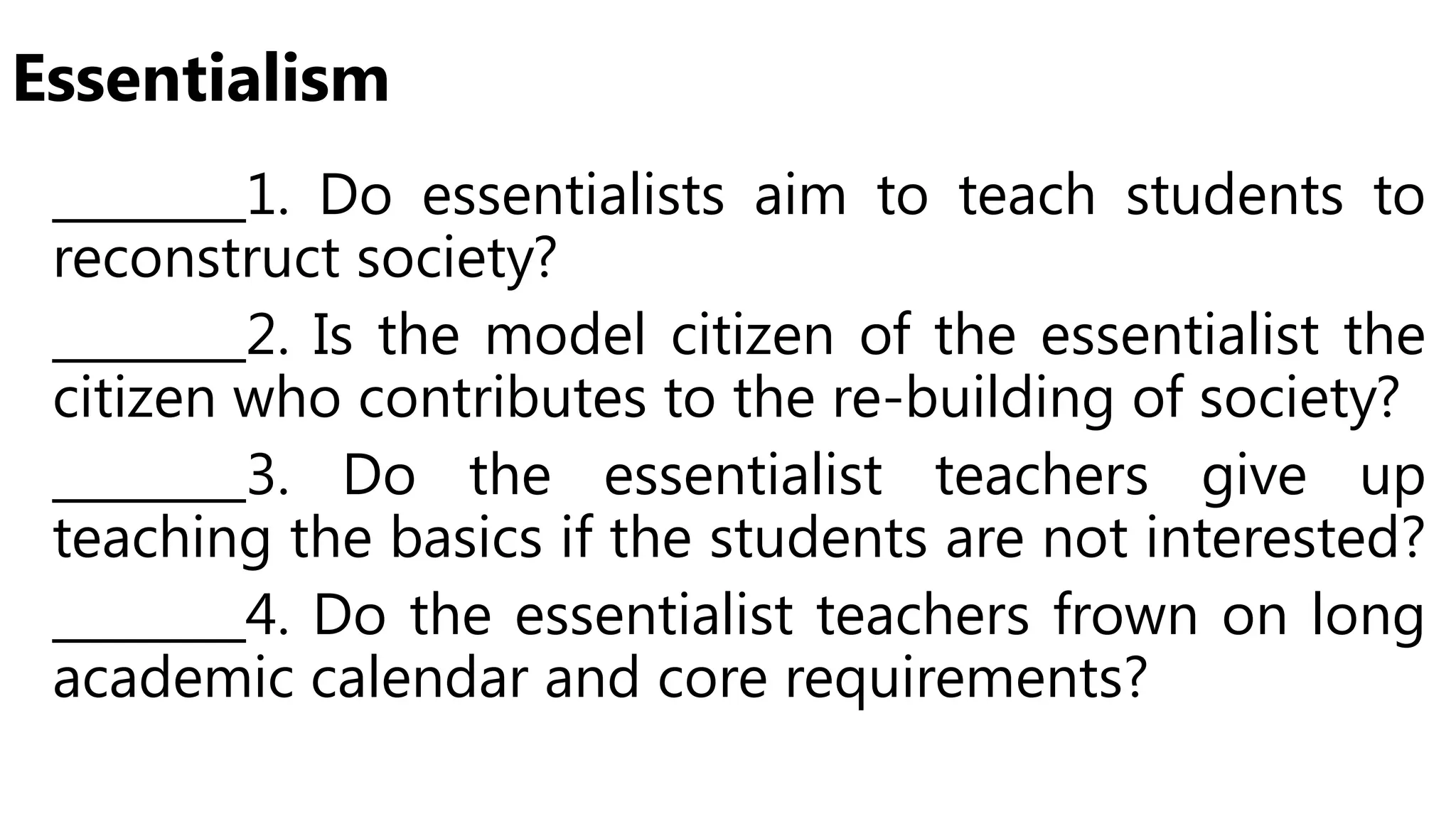
Essentialism
________1. Do essentialists aim to teach students to
reconstruct society?
________2. Is the model citizen of the essentialist the
citizen who contributes to the re-building of society?
________3. Do the essentialist teachers give up
teaching the basics if the students are not interested?
________4. Do the essentialist teachers frown on long
academic calendar and core requirements?
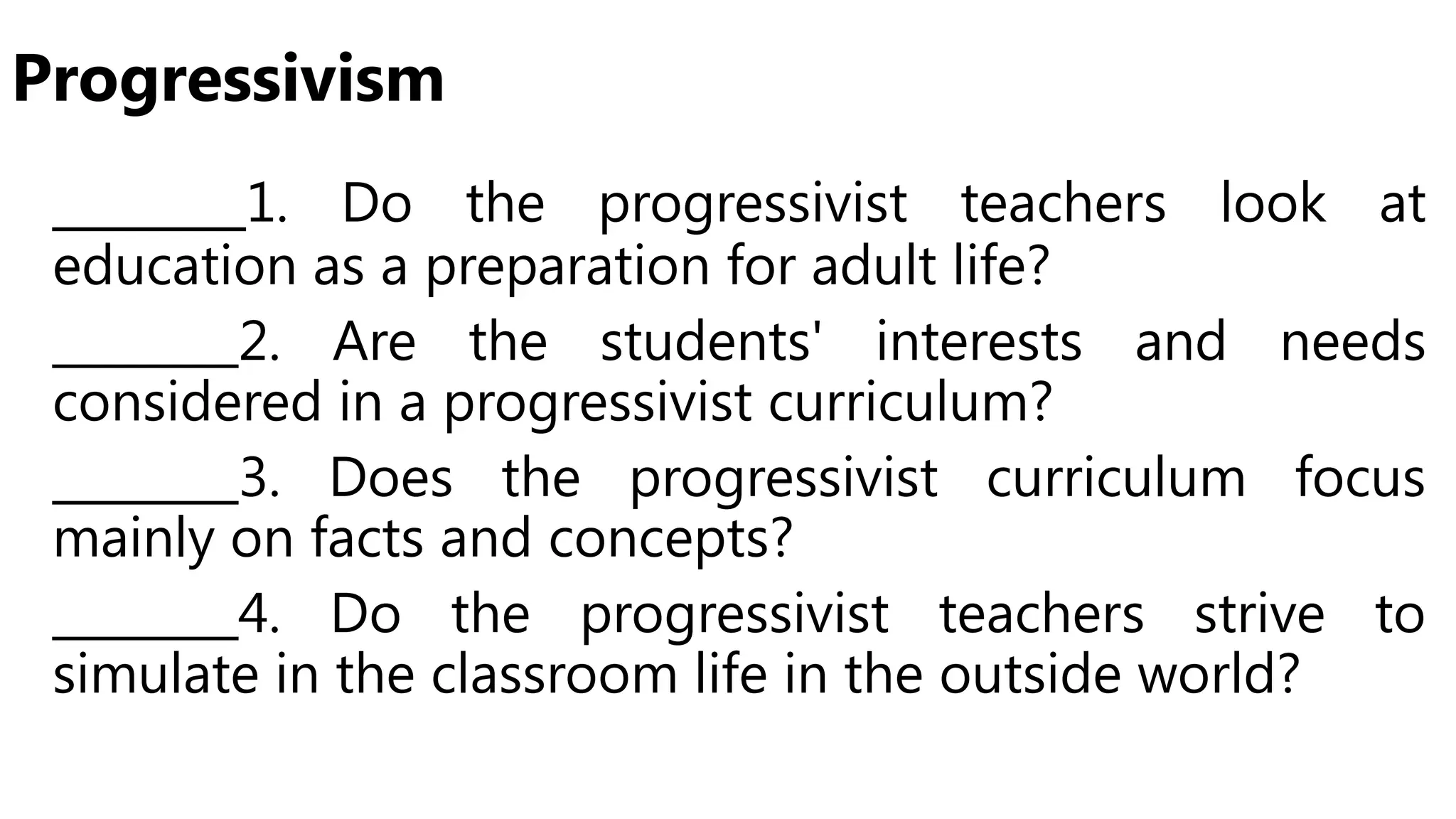
Progressivism
_______1. Do the progressivist teachers look at
education as a preparation for adult life?
________2. Are the students' interests and needs
considered in a progressivist curriculum?
________3. Does the progressivist curriculum focus
mainly on facts and concepts?
________4. Do the progressivist teachers strive to
simulate in the classroom life in the outside world?
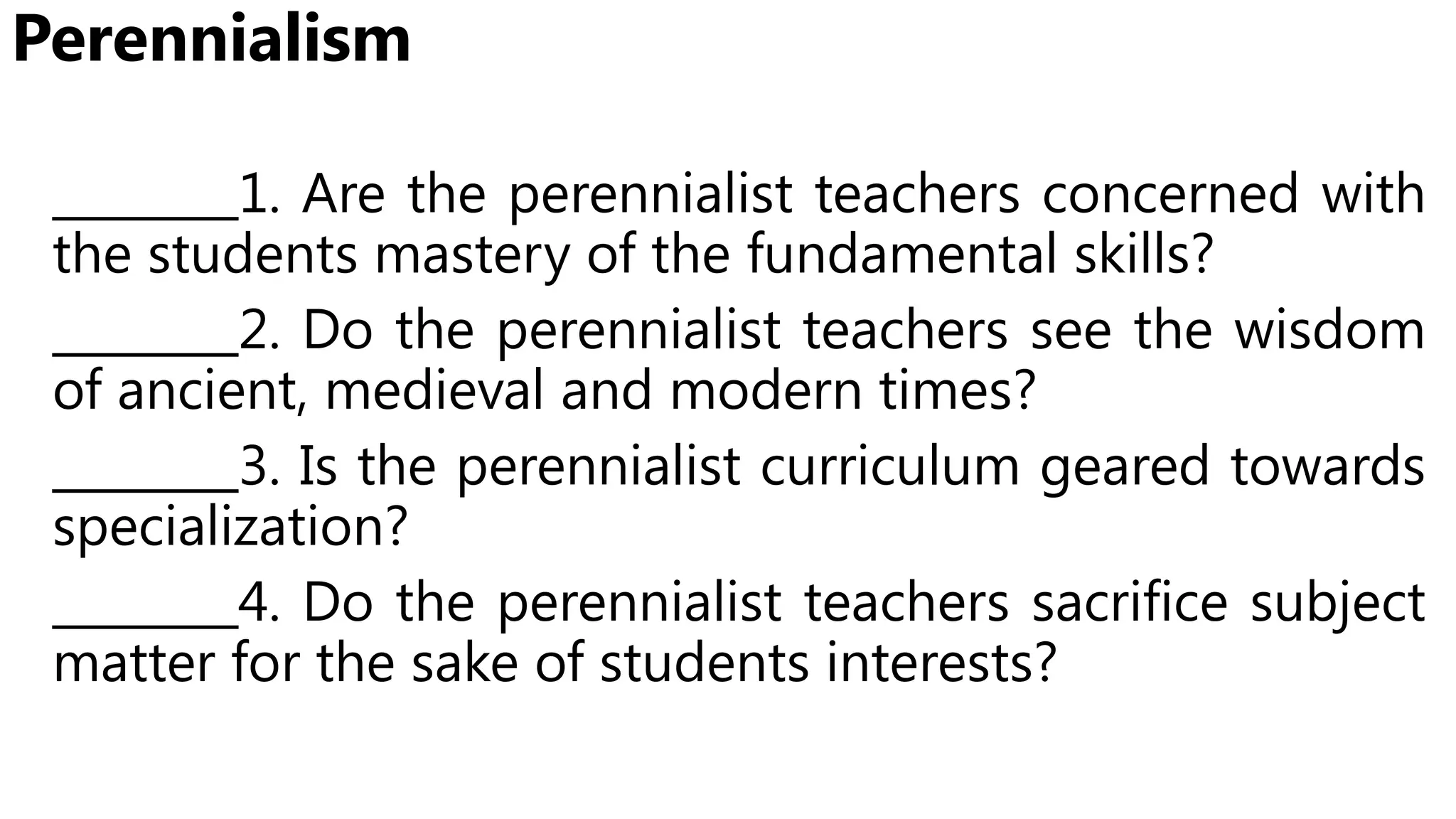
Perennialism
________1. Are the perennialist teachers concerned with
the students mastery of the fundamental skills?
________2. Do the perennialist teachers see the wisdom
of ancient, medieval and modern times?
________3. Is the perennialist curriculum geared towards
specialization?
________4. Do the perennialist teachers sacrifice subject
matter for the sake of students interests?
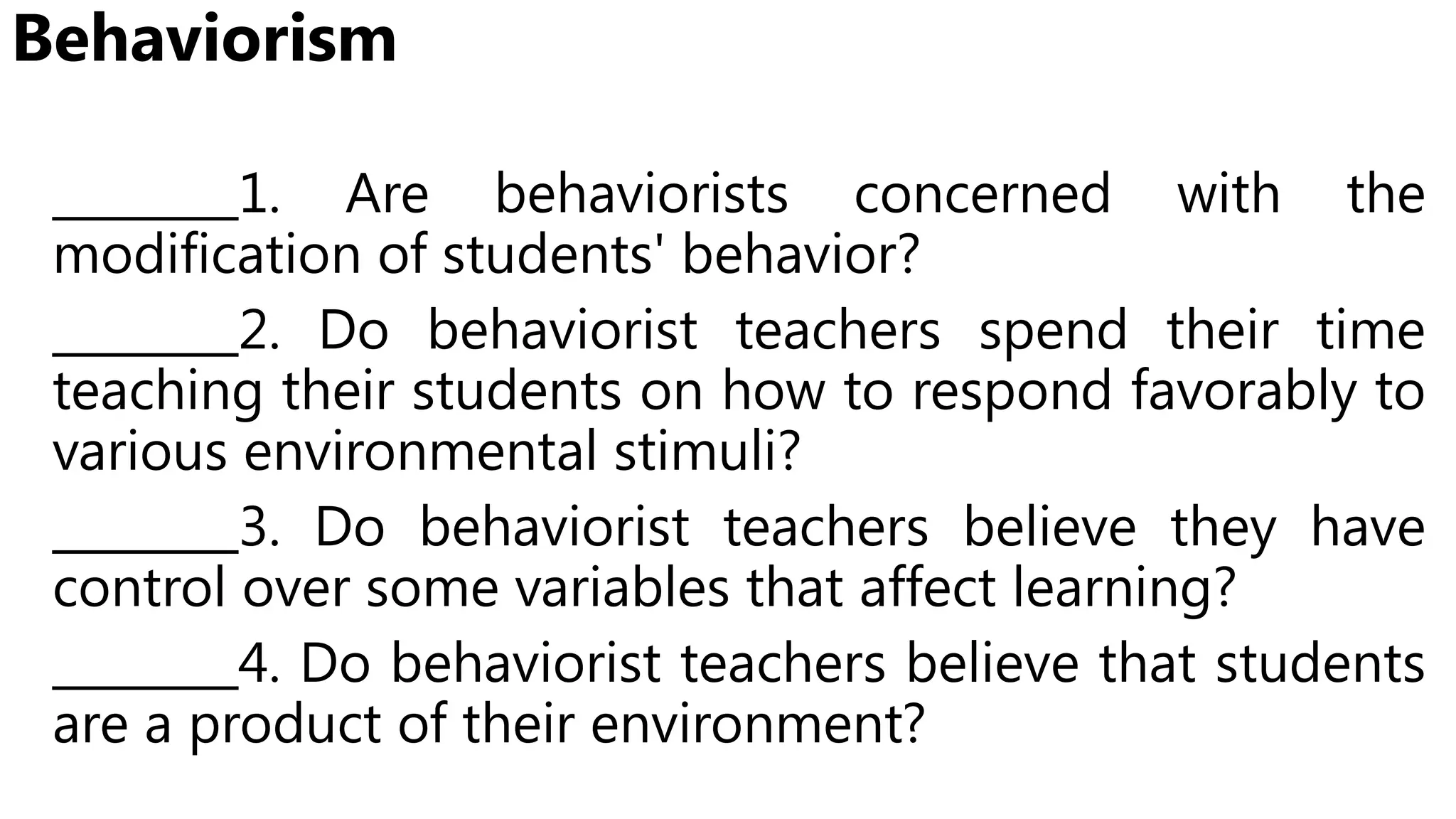
Behaviorism
________1. Are behaviorists concerned with the
modification of students' behavior?
________2. Do behaviorist teachers spend their time
teaching their students on how to respond favorably to
various environmental stimuli?
________3. Do behaviorist teachers believe they have
control over some variables that affect learning?
________4. Do behaviorist teachers believe that students
are a product of their environment?
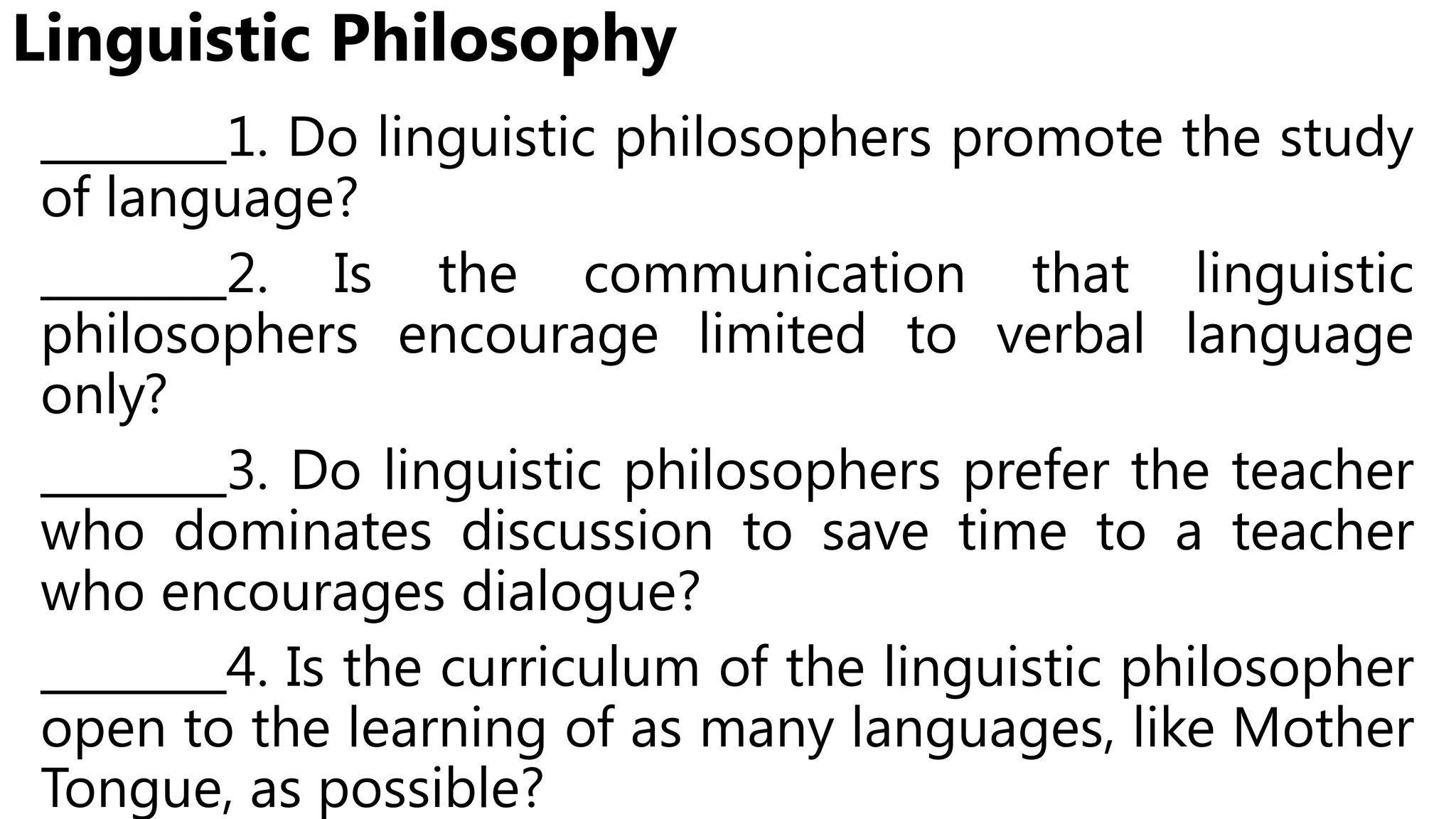
Linguistic Philosophy
________1. Do linguistic philosophers promote the study
of language?
________2. Is the communication that linguistic
philosophers encourage limited to verbal language
only?
________3. Do linguistic philosophers prefer the teacher
who dominates discussion to save time to a teacher
who encourages dialogue?
________4. Is the curriculum of the linguistic philosopher
open to the learning of as many languages, like Mother
Tongue, as possible?
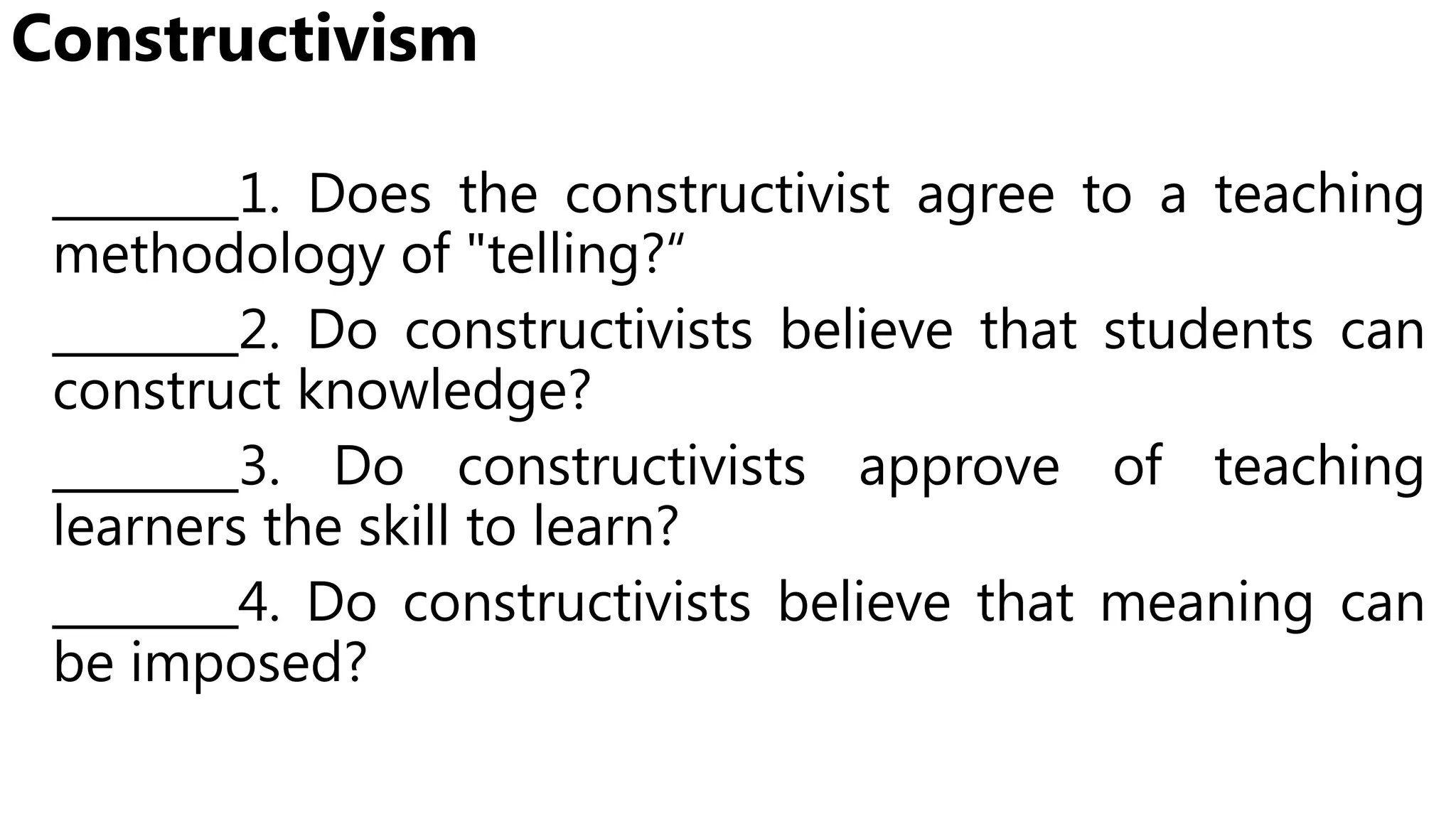
Constructivism
________1. Does the constructivist agree to a teaching
methodology of "telling?“
________2. Do constructivists believe that students can
construct knowledge?
________3. Do constructivists approve of teaching
learners the skill to learn?
________4. Do constructivists believe that meaning can
be imposed?
Part II.
DIRECTION:
To which philosophy does each theory
of man belong?
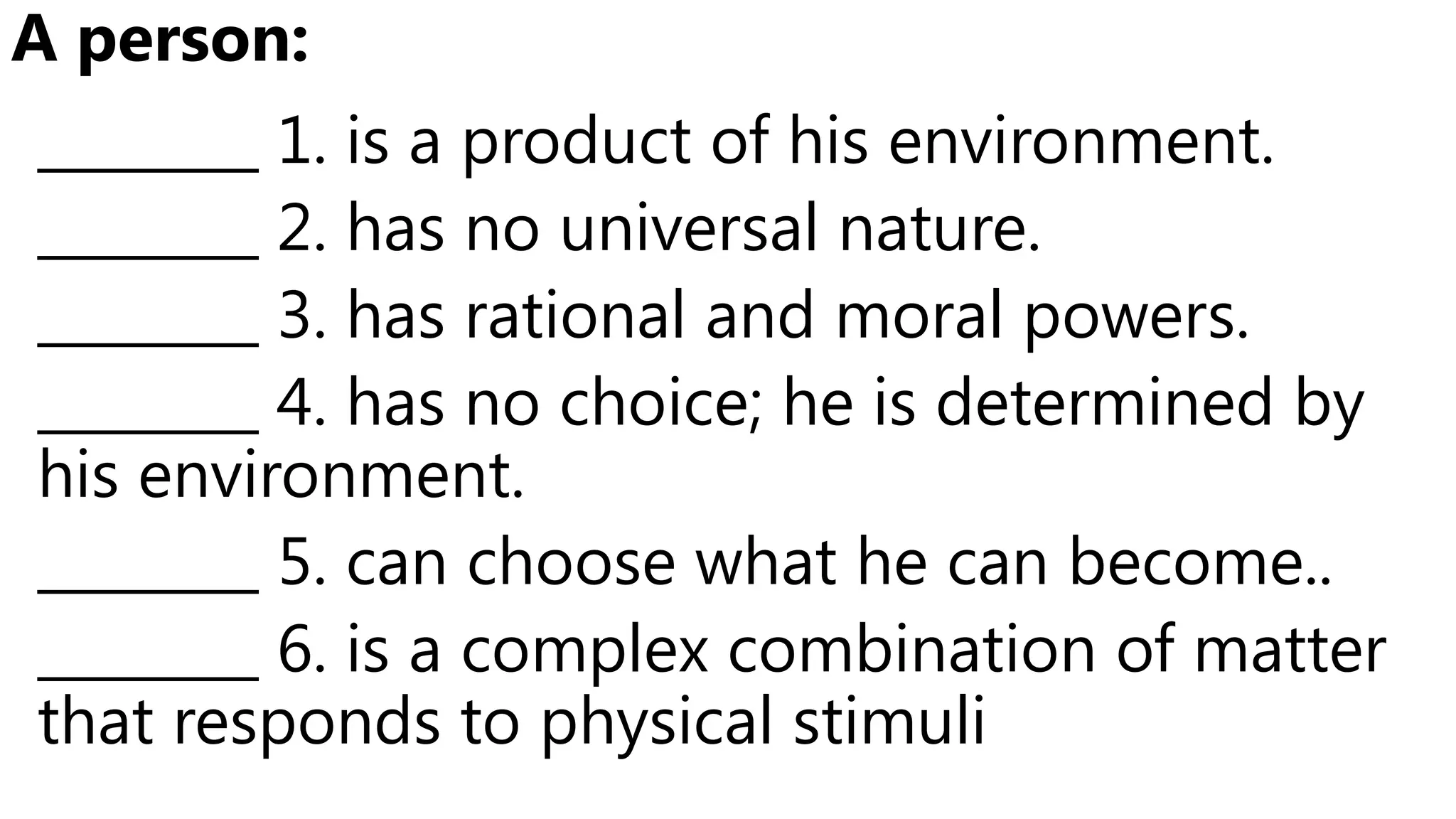
________ 1. is a product of his environment.
________ 2. has no universal nature.
________ 3. has rational and moral powers.
________ 4. has no choice; he is determined by
his environment.
________ 5. can choose what he can become..
________ 6. is a complex combination of matter
that responds to physical stimuli
A person:
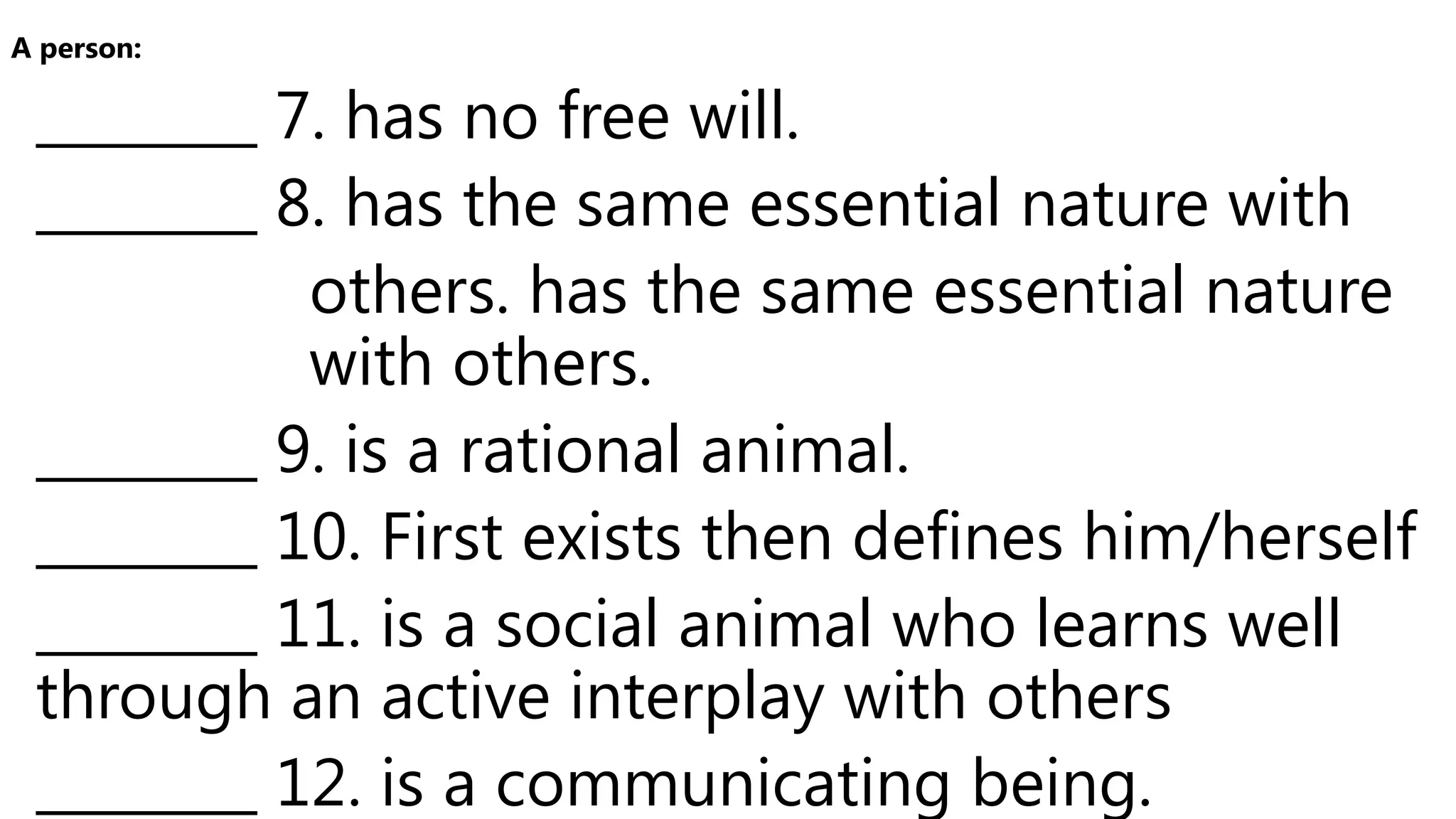
________ 7. has no free will.
________ 8. has the same essential nature with
others. has the same essential nature
with others.
________ 9. is a rational animal.
________ 10. First exists then defines him/herself
________ 11. is a social animal who learns well
through an active interplay with others
________ 12. is a communicating being.
A person:
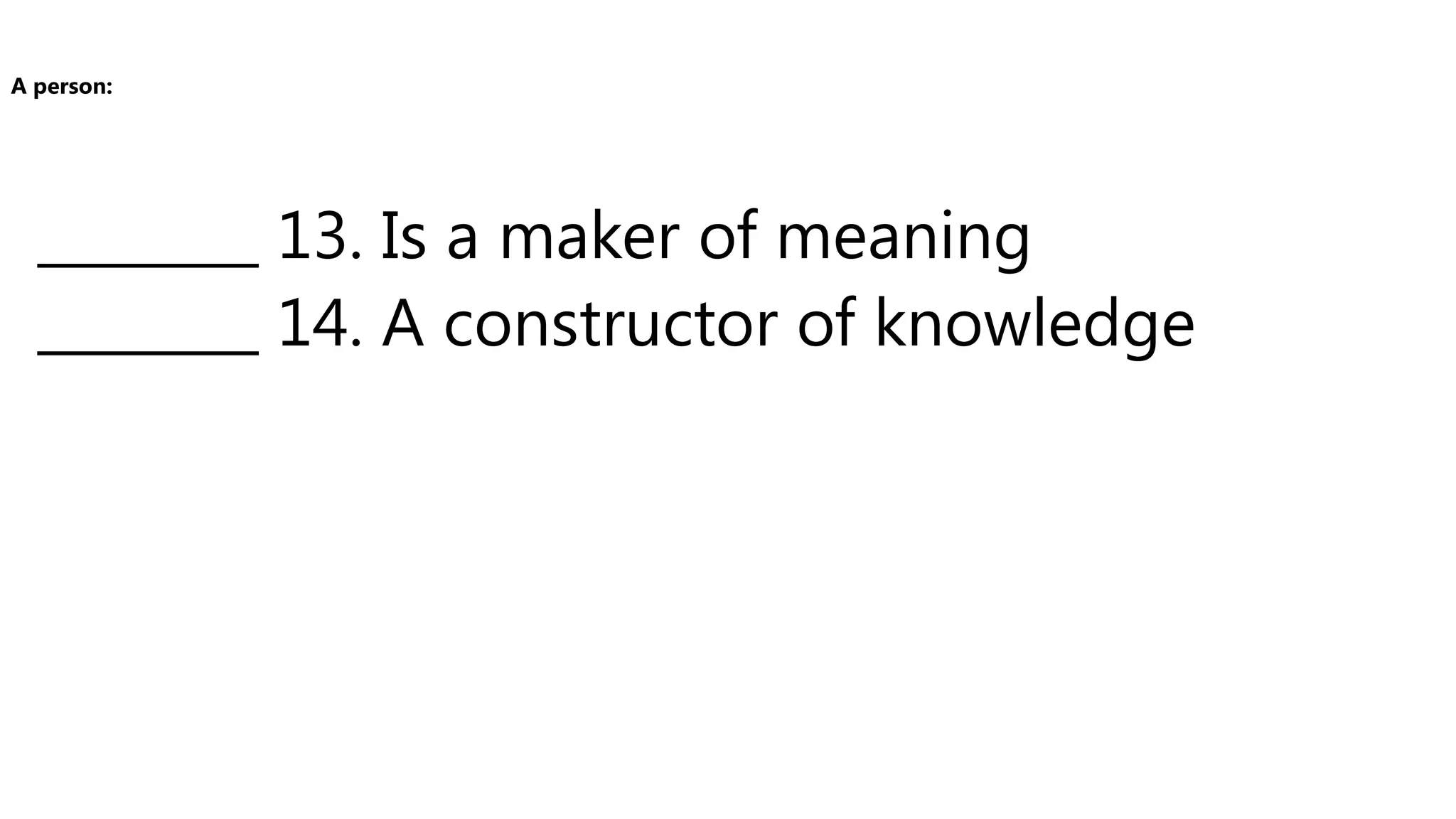
________ 13. Is a maker of meaning
________ 14. A constructor of knowledge
A person:
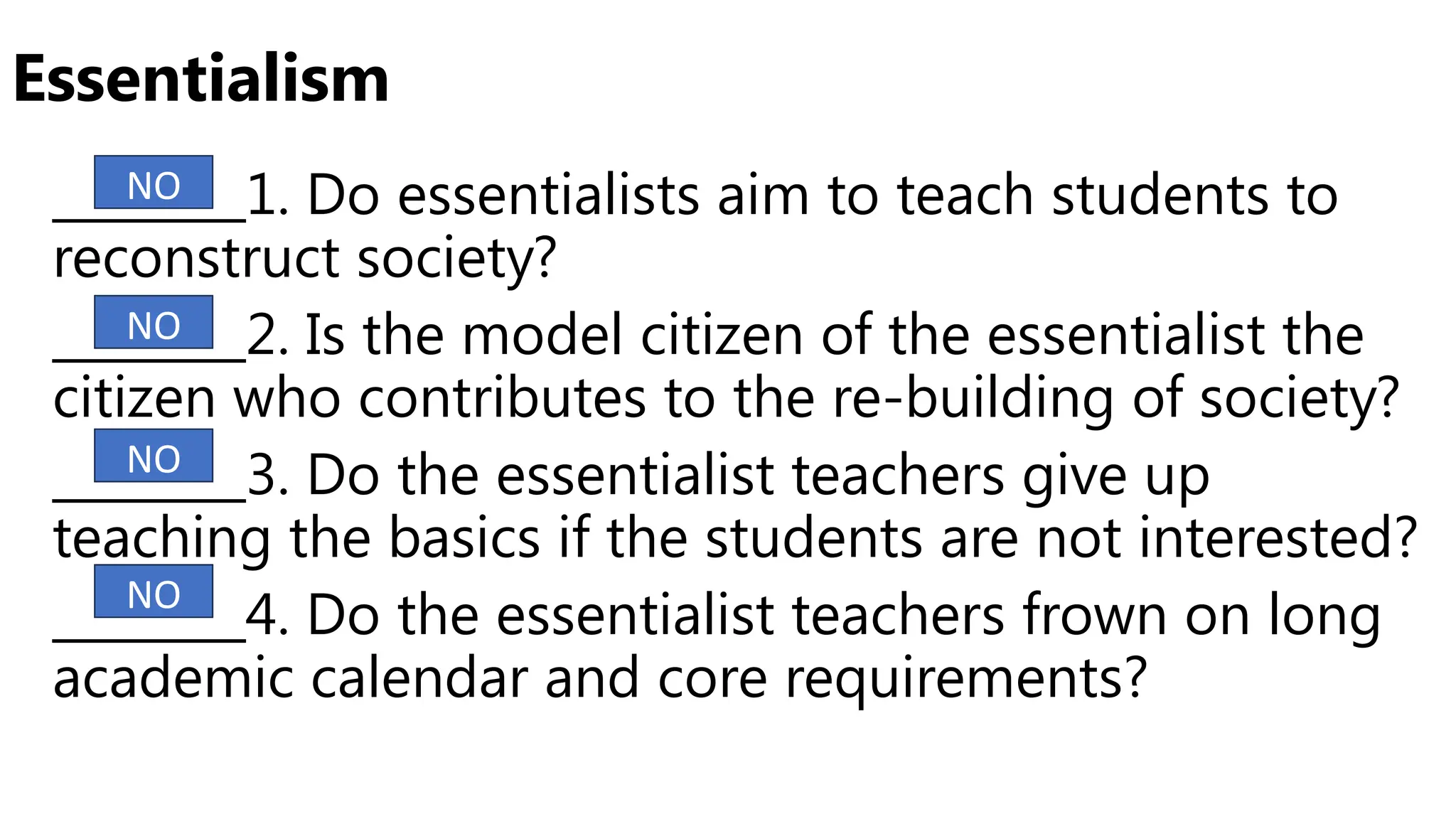
Essentialism
________1. Do essentialists aim to teach students to
reconstruct society?
________2. Is the model citizen of the essentialist the
citizen who contributes to the re-building of society?
________3. Do the essentialist teachers give up
teaching the basics if the students are not interested?
________4. Do the essentialist teachers frown on long
academic calendar and core requirements?
NO
NO
NO
NO
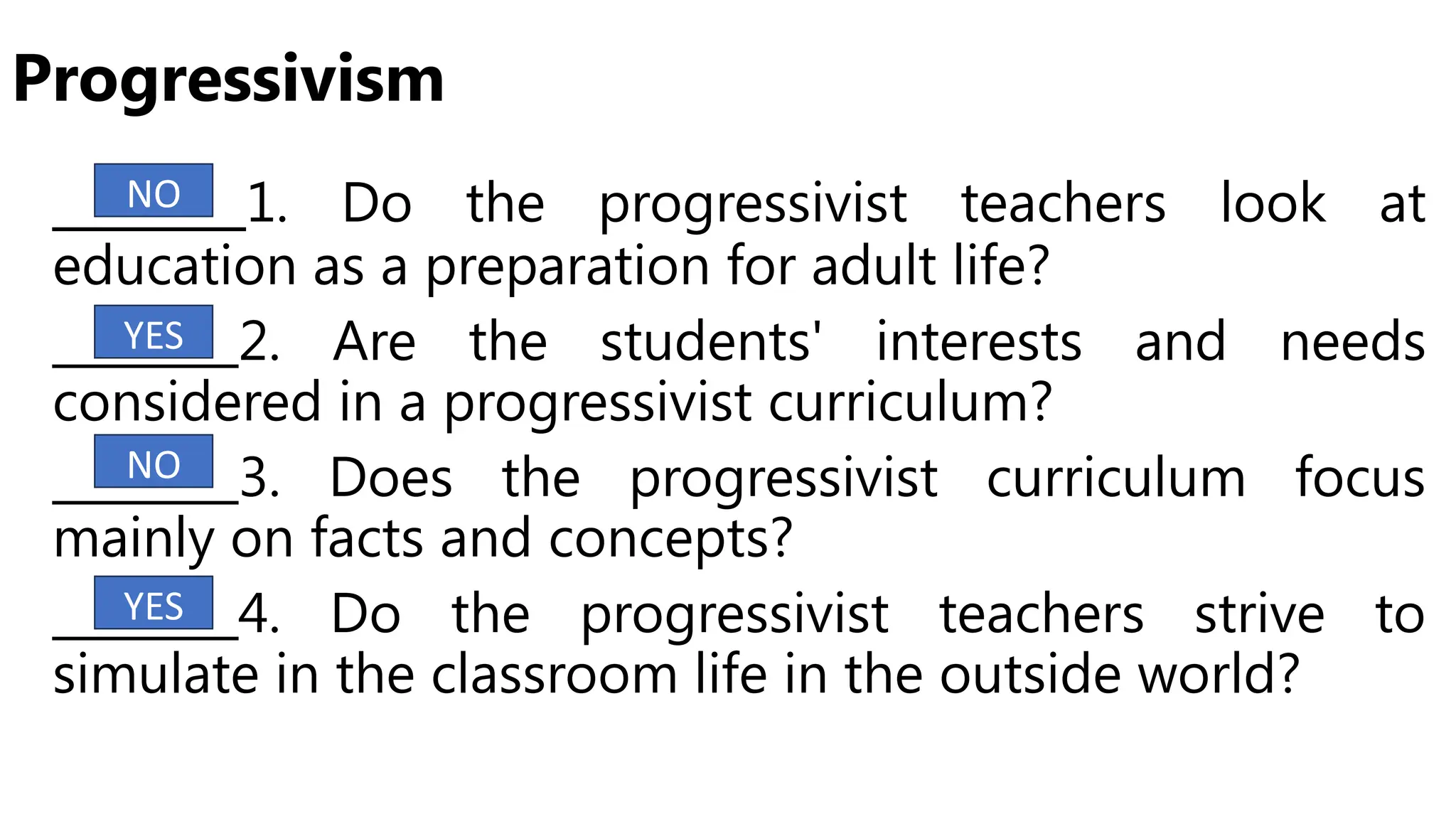
Progressivism
_______1. Do the progressivist teachers look at
education as a preparation for adult life?
________2. Are the students' interests and needs
considered in a progressivist curriculum?
________3. Does the progressivist curriculum focus
mainly on facts and concepts?
________4. Do the progressivist teachers strive to
simulate in the classroom life in the outside world?
NO
YES
NO
YES
Perennialism
________1. Are the perennialist teachers concerned with
the students mastery of the fundamental skills?
________2. Do the perennialist teachers see the wisdom
of ancient, medieval and modern times?
________3. Is the perennialist curriculum geared towards
specialization?
________4. Do the perennialist teachers sacrifice subject
matter for the sake of students interests?
NO
YES
NO
NO
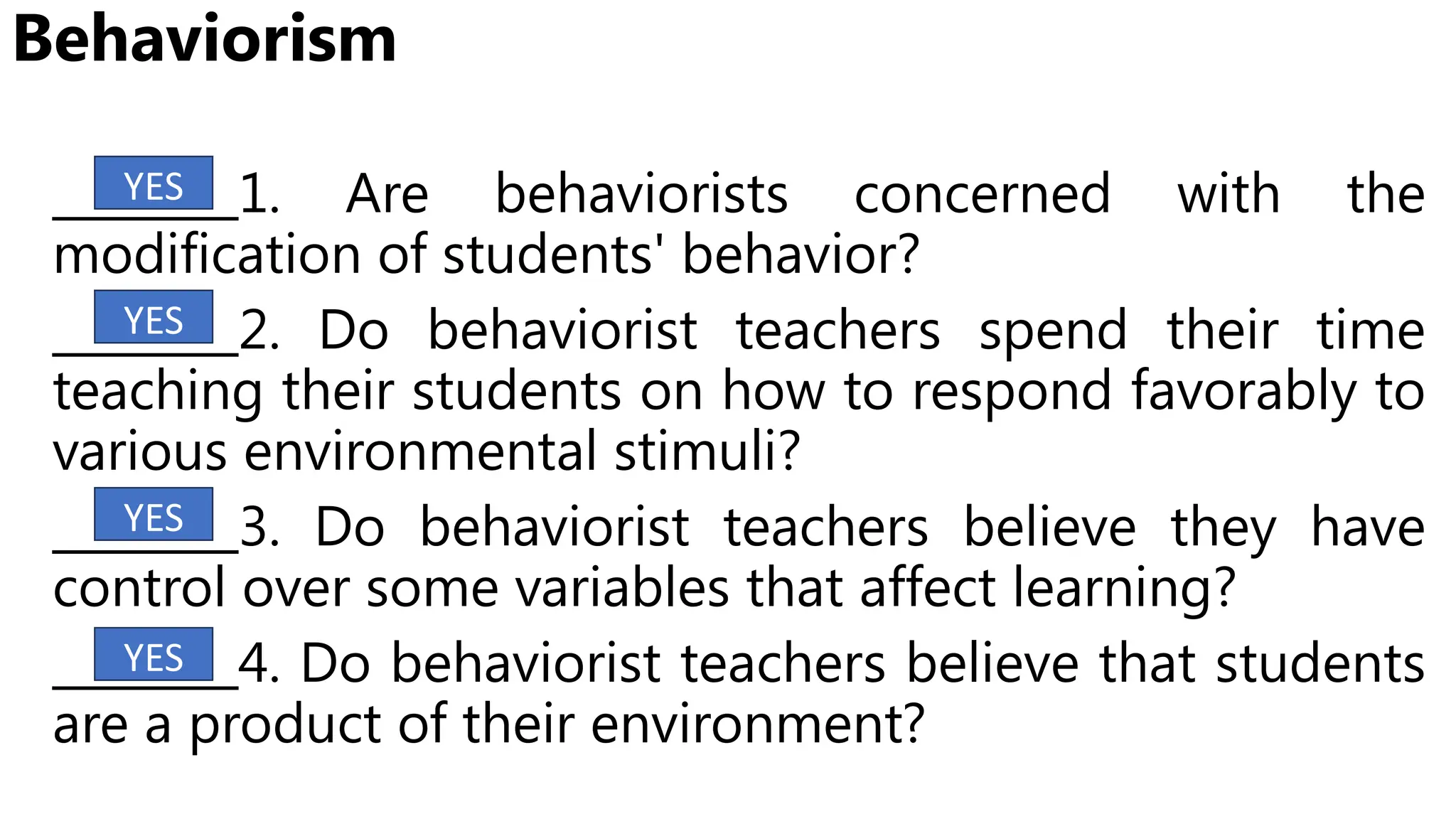
Behaviorism
________1. Are behaviorists concerned with the
modification of students' behavior?
________2. Do behaviorist teachers spend their time
teaching their students on how to respond favorably to
various environmental stimuli?
________3. Do behaviorist teachers believe they have
control over some variables that affect learning?
________4. Do behaviorist teachers believe that students
are a product of their environment?
YES
YES
YES
YES
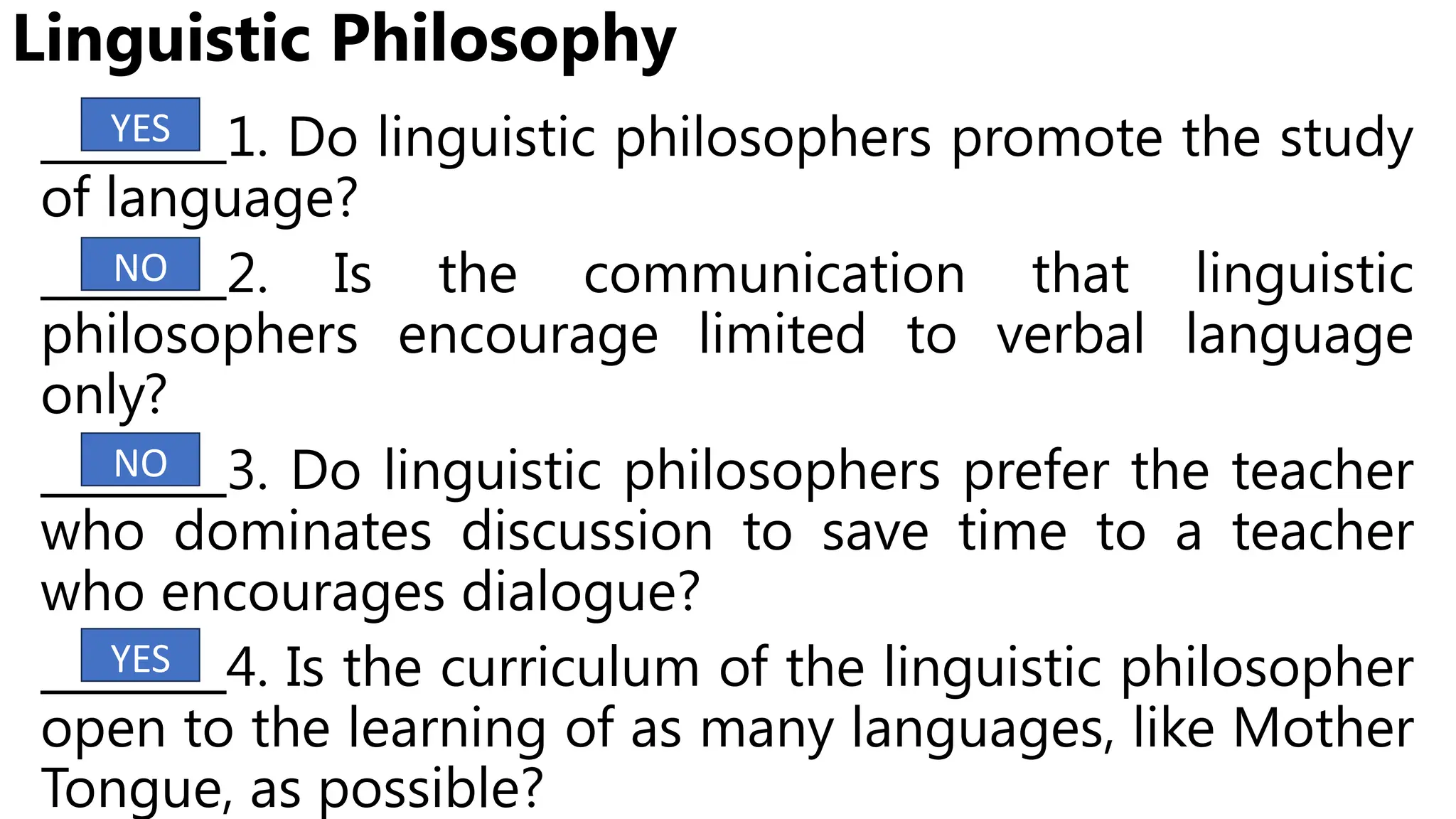
Linguistic Philosophy
________1. Do linguistic philosophers promote the study
of language?
________2. Is the communication that linguistic
philosophers encourage limited to verbal language
only?
________3. Do linguistic philosophers prefer the teacher
who dominates discussion to save time to a teacher
who encourages dialogue?
________4. Is the curriculum of the linguistic philosopher
open to the learning of as many languages, like Mother
Tongue, as possible?
YES
NO
NO
YES
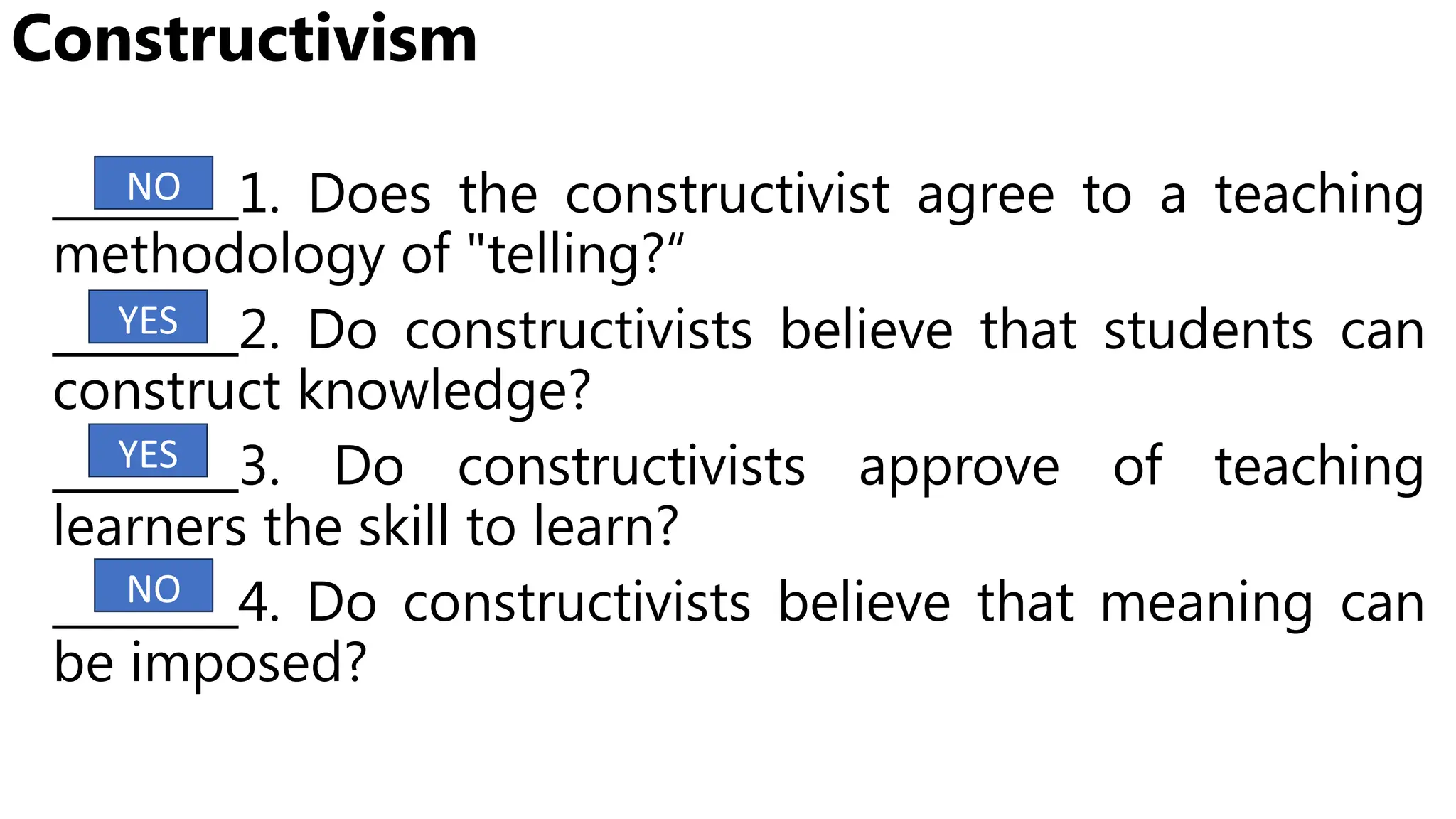
Constructivism
________1. Does the constructivist agree to a teaching
methodology of "telling?“
________2. Do constructivists believe that students can
construct knowledge?
________3. Do constructivists approve of teaching
learners the skill to learn?
________4. Do constructivists believe that meaning can
be imposed?
YES
YES
NO
NO
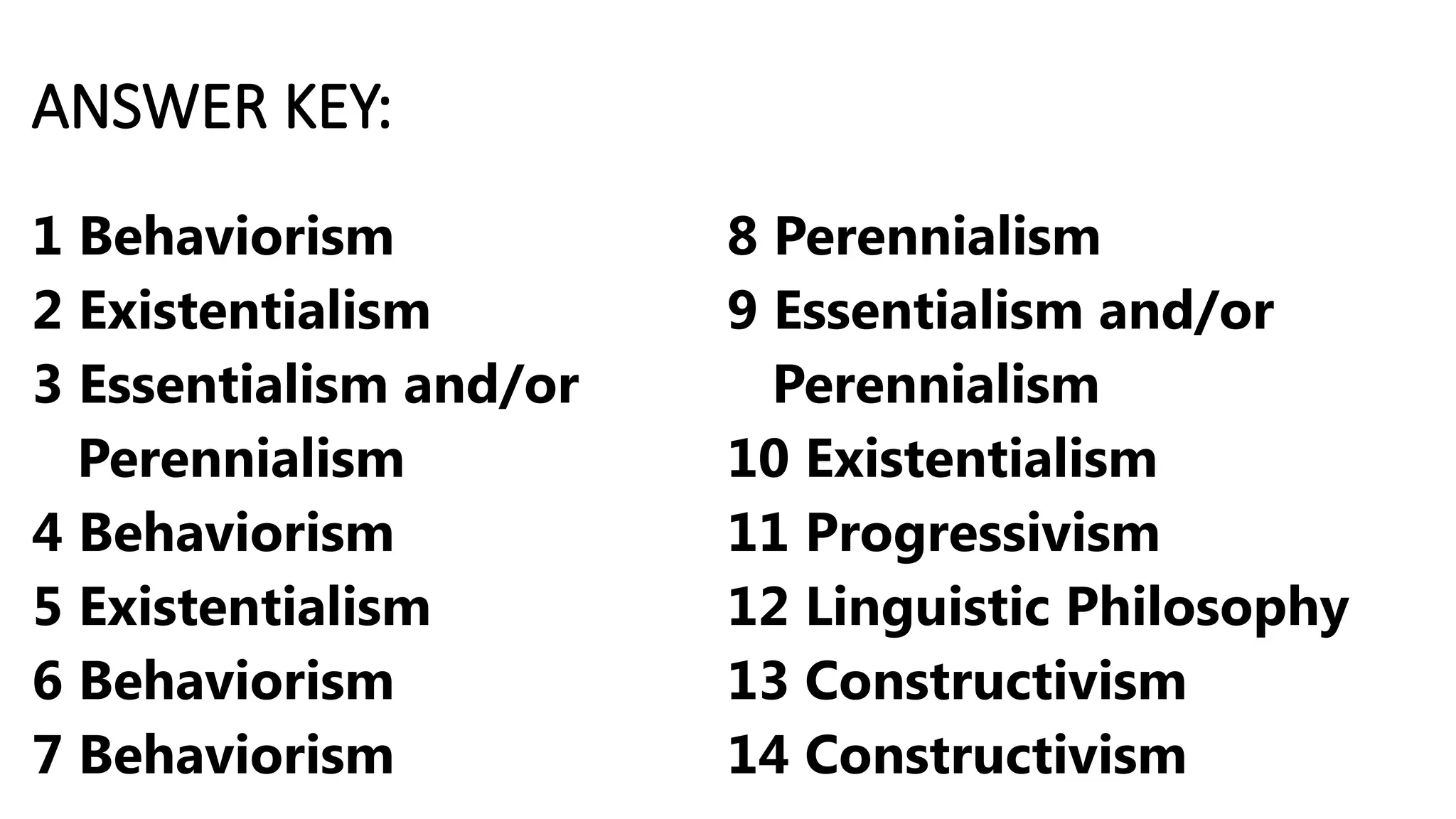
ANSWER KEY:
1 Behaviorism
2 Existentialism
3 Essentialism and/or
Perennialism
4 Behaviorism
5 Existentialism
6 Behaviorism
7 Behaviorism
8 Perennialism
9 Essentialism and/or
Perennialism
10 Existentialism
11 Progressivism
12 Linguistic Philosophy
13 Constructivism
14 Constructivism

CPE101-Quiz-4.pptxTeaching Professionsss

  • 1.
    Part I. DIRECTION: Understanding thePhilosophies. Answer each with a YES or NO. If your answer is NO, explain your answer in a sentence.
  • 2.
    Essentialism ________1. Do essentialistsaim to teach students to reconstruct society? ________2. Is the model citizen of the essentialist the citizen who contributes to the re-building of society? ________3. Do the essentialist teachers give up teaching the basics if the students are not interested? ________4. Do the essentialist teachers frown on long academic calendar and core requirements?
  • 3.
    Progressivism _______1. Do theprogressivist teachers look at education as a preparation for adult life? ________2. Are the students' interests and needs considered in a progressivist curriculum? ________3. Does the progressivist curriculum focus mainly on facts and concepts? ________4. Do the progressivist teachers strive to simulate in the classroom life in the outside world?
  • 4.
    Perennialism ________1. Are theperennialist teachers concerned with the students mastery of the fundamental skills? ________2. Do the perennialist teachers see the wisdom of ancient, medieval and modern times? ________3. Is the perennialist curriculum geared towards specialization? ________4. Do the perennialist teachers sacrifice subject matter for the sake of students interests?
  • 5.
    Behaviorism ________1. Are behavioristsconcerned with the modification of students' behavior? ________2. Do behaviorist teachers spend their time teaching their students on how to respond favorably to various environmental stimuli? ________3. Do behaviorist teachers believe they have control over some variables that affect learning? ________4. Do behaviorist teachers believe that students are a product of their environment?
  • 6.
    Linguistic Philosophy ________1. Dolinguistic philosophers promote the study of language? ________2. Is the communication that linguistic philosophers encourage limited to verbal language only? ________3. Do linguistic philosophers prefer the teacher who dominates discussion to save time to a teacher who encourages dialogue? ________4. Is the curriculum of the linguistic philosopher open to the learning of as many languages, like Mother Tongue, as possible?
  • 7.
    Constructivism ________1. Does theconstructivist agree to a teaching methodology of "telling?“ ________2. Do constructivists believe that students can construct knowledge? ________3. Do constructivists approve of teaching learners the skill to learn? ________4. Do constructivists believe that meaning can be imposed?
  • 8.
    Part II. DIRECTION: To whichphilosophy does each theory of man belong?
  • 9.
    ________ 1. isa product of his environment. ________ 2. has no universal nature. ________ 3. has rational and moral powers. ________ 4. has no choice; he is determined by his environment. ________ 5. can choose what he can become.. ________ 6. is a complex combination of matter that responds to physical stimuli A person:
  • 10.
    ________ 7. hasno free will. ________ 8. has the same essential nature with others. has the same essential nature with others. ________ 9. is a rational animal. ________ 10. First exists then defines him/herself ________ 11. is a social animal who learns well through an active interplay with others ________ 12. is a communicating being. A person:
  • 11.
    ________ 13. Isa maker of meaning ________ 14. A constructor of knowledge A person:
  • 12.
    Essentialism ________1. Do essentialistsaim to teach students to reconstruct society? ________2. Is the model citizen of the essentialist the citizen who contributes to the re-building of society? ________3. Do the essentialist teachers give up teaching the basics if the students are not interested? ________4. Do the essentialist teachers frown on long academic calendar and core requirements? NO NO NO NO
  • 13.
    Progressivism _______1. Do theprogressivist teachers look at education as a preparation for adult life? ________2. Are the students' interests and needs considered in a progressivist curriculum? ________3. Does the progressivist curriculum focus mainly on facts and concepts? ________4. Do the progressivist teachers strive to simulate in the classroom life in the outside world? NO YES NO YES
  • 14.
    Perennialism ________1. Are theperennialist teachers concerned with the students mastery of the fundamental skills? ________2. Do the perennialist teachers see the wisdom of ancient, medieval and modern times? ________3. Is the perennialist curriculum geared towards specialization? ________4. Do the perennialist teachers sacrifice subject matter for the sake of students interests? NO YES NO NO
  • 15.
    Behaviorism ________1. Are behavioristsconcerned with the modification of students' behavior? ________2. Do behaviorist teachers spend their time teaching their students on how to respond favorably to various environmental stimuli? ________3. Do behaviorist teachers believe they have control over some variables that affect learning? ________4. Do behaviorist teachers believe that students are a product of their environment? YES YES YES YES
  • 16.
    Linguistic Philosophy ________1. Dolinguistic philosophers promote the study of language? ________2. Is the communication that linguistic philosophers encourage limited to verbal language only? ________3. Do linguistic philosophers prefer the teacher who dominates discussion to save time to a teacher who encourages dialogue? ________4. Is the curriculum of the linguistic philosopher open to the learning of as many languages, like Mother Tongue, as possible? YES NO NO YES
  • 17.
    Constructivism ________1. Does theconstructivist agree to a teaching methodology of "telling?“ ________2. Do constructivists believe that students can construct knowledge? ________3. Do constructivists approve of teaching learners the skill to learn? ________4. Do constructivists believe that meaning can be imposed? YES YES NO NO
  • 18.
    ANSWER KEY: 1 Behaviorism 2Existentialism 3 Essentialism and/or Perennialism 4 Behaviorism 5 Existentialism 6 Behaviorism 7 Behaviorism 8 Perennialism 9 Essentialism and/or Perennialism 10 Existentialism 11 Progressivism 12 Linguistic Philosophy 13 Constructivism 14 Constructivism