বাাংলাদেদের উন্নয়দের স্বাধীে পর্যাদলাচো
An Analysis of the
National Budget for FY2020-21
Dhaka: 12 June 2020
www.cpd.org.bd
CPD IRBD 2020 Team
CPD (2020): An Analysis of the National Budget for FY2020-21 2
Lead contributions were provided by Dr Fahmida Khatun, Executive Director; Professor
Mustafizur Rahman, Distinguished Fellow; Dr Khondaker Golam Moazzem, Research Director;
and Mr Towfiqul Islam Khan, Senior Research Fellow, CPD.
Excellent research support was received from
Mr Towfiqul Islam Khan was the Coordinator of the CPD IRBD 2020 Team.
The CPD IRBD 2020 Team would like to register its profound gratitude to Professor Rehman
Sobhan, Chairman, CPD and Dr Debapriya Bhattacharya, Distinguished Fellow, CPD for their
support and guidance.
Senior Research Associates
Mr Md Zafar Sadique Mr Mostafa Amir Sabbih
Mr Muntaseer Kamal Mr Md. Al-Hasan
Mr Syed Yusuf Saadat
Programme Associates
Mr Abu Saleh Md. Shamim Alam Shibly Ms Nawshin Nawar
Mr Tamim Ahmed Mr Md Jahurul Islam
Ms Iqra Labiba Qamari
Research Interns
Ms Fariha Islam Munia Ms Taslima Taznur
Acknowledgements
The Team gratefully acknowledges the valuable support received from the Dialogue and
Communication Division and the Administration and Finance Division in preparing this report.
Assistance of Mr A H M Ashrafuzzaman, Deputy Director, Mr Md Irtaza Mahbub Akhond,
Programme Associate, and Ms Projna Dasgupta, Intern, CPD is particularly appreciated.
Concerned officials belonging to a number of institutions have extended valuable support to the
CPD IRBD 2020 Team members, for which the Team would like to register its sincere thanks.
The CPD IRBD 2020 Team alone remains responsible for the analyses, interpretations and
conclusions presented in this report.
CPD (2020): An Analysis of the National Budget for FY2020-21 3
Finance Team Dialogue & Communication
Team
Administration Team
Mr M Shafiqul Islam Mr Avra Bhattacharjee Mr A H M Ashrafuzzaman
Mr Uttam Kumar Paul Ms Nazmatun Noor Mr Md Mamun-ur-Rashid
Mr Md Iqbal Mr Md. Sarwar Jahan Ms Tahsin Sadia
Ms Shakila Sultana Mr Sazzad Mahmud Shuvo Ms Rezwana Rashid Antora
Mr Md Samiul Mannan Ms Asmaul Husna
Mr Md Irtaza Mahbub Akhond
Ms Projna Dasgupta
Contents
I. INTRODUCTION
II. MACROECONOMIC PERSPECTIVES
III. FISCAL FRAMEWORK
IV. ANNUAL DEVELOPMENT PROGRAMME
V. FISCAL MEASURES
VI. FOUR PRIORITY SECTORS
VII. SOME OTHER SELECTED ISSUES
VIII. CONCLUDING REMARKS
CPD (2020): An Analysis of the National Budget for FY2020-21 4
CPD (2020): An Analysis of the National Budget for FY2020-21 5
I. INTRODUCTION
I. INTRODUCTION
 The Centre for Policy Dialogue (CPD) would like to congratulate the
Hon’ble Finance Minister for presenting his second budget under difficult
and trying circumstances
The national budget for fiscal year (FY) 21 has been announced at a time
when the economy has been worst hit by the novel coronavirus (COVID-19)
pandemic ever in the history of Bangladesh
Even before COVID-19 attack in Bangladesh during Jul – Feb of FY20,
except for the remittance flow, major economic indicators of Bangladesh
economy exhibited some worrying signals; these include negative export
and import growth, low FDI growth, subdued domestic resource
mobilisation and low utilisation of allocated development expenditure and
weak balance of payment situation
COVID-19 has aggravated the performance of the economy which was
already under pressure
CPD (2020): An Analysis of the National Budget for FY2020-21 6
I. INTRODUCTION
 CPD feels that risk mitigation and economic recovery in the backdrop of
COVID-19 should be the twin overarching objectives of FY2020-21 budget –
the COVID Budget.
 Because the Health-Humanitarian-Economic risks originating from
the ongoing COVID pandemic make FY2020-21 Budget a budget with
a distinction.
 Therefore, the budget for FY21 has to be looked at not only through the
economic lens, but also health, humanitarian and social lens.
 In this context, CPD has examined the assumptions informing the
budget, fiscal budgetary framework, fiscal space and resource
mobilization targets, allocation of resources, deficit financing and
budget implementation challenges with the lens of the above twin
objectives.
CPD (2020): An Analysis of the National Budget for FY2020-21 7
I. INTRODUCTION
 In pursuit of the above, CPD has tracked the relevant correlates as they
stand in FY2020 and has analysed the FY2021 budgetary proposals and
reform initiatives (or lack of those) to assess the feasibility of achieving
budgetary targets
 The presentation on CPD’s budget analysis has been structured as follows:
 Macroeconomic scenario
 Fiscal framework
 Annual Development Programme (ADP)
 Fiscal measures
 Sectoral issues
 Concluding remarks
 The analysis of this presentation is based on data from relevant government
publications
CPD (2020): An Analysis of the National Budget for FY2020-21 8
CPD (2020): An Analysis of the National Budget for FY2020-21 9
II. MACROECONOMIC
PERSPECTIVES
II. MACROECONOMIC PERSPECTIVES
The Bangladesh economy, from the very beginning of the ongoing fiscal year, has
been grappling with formidable challenges which have been exacerbated by the
outbreak of COVID-19
CPD (2020): An Analysis of the National Budget for FY2020-21 10
Large shortfall in revenue
mobilisation
Disrupted implementation
of public investment
projects
Escalated budget deficit
and bank borrowing
Decelerated export
growth
Negative import growth
Stable inflationary trend
Steady remittance inflow
Comfortable balance of
payments
Steady exchange rate
Increased foreign
exchange reserve
II. MACROECONOMIC PERSPECTIVES
For FY21, GDP growth target has been set at 8.2%
The budgetary framework of MoF considered a 5.2% GDP growth in FY20
 Provisional estimates from BBS for FY20 are not yet available
CPD estimated that the GDP growth rate will not be more than 2.5% in
FY20
Apparently, the impacts of the COVID-19 pandemic have been
largely ignored!
CPD (2020): An Analysis of the National Budget for FY2020-21 11
Indicator
Actual Budget Revised
budget
Projection
FY19 FY20 FY20 FY21 FY22 FY23
GDP growth (%) 8.15 8.2 5.2 8.2 8.3 8.4
Gross investment (as % of GDP) 31.6 32.8 20.8 33.5 34.5 35.6
Private investment (as % of GDP) 23.5 24.2 12.7 25.3 26.6 27.7
Public investment (as % of GDP) 8.0 8.6 8.1 8.1 7.9 7.9
ICOR 3.9 4.0 4.0 4.1 4.2 4.2
Source: MTMPS
GDP and investment
II. MACROECONOMIC PERSPECTIVES
Public investment-GDP ratio in FY21 has been assumed to be same
as FY20 (8.1%)
Private investment has been estimated to be 25.3% of GDP in FY21: a
whopping 12.6 percentage point increase from the MoF estimate for FY20
 In FY21, a staggering Tk. 446,000 crore (approx.) will be additionally required
for private investment (125.2% increase in nominal terms!) based on the MoF
estimate for FY20 (Tk. 356,330 crore)
ICOR is expected to be 4.1 in FY21 – productivity of capital to decline (4.0
in FY20, 3.9 in FY19)
CPD (2020): An Analysis of the National Budget for FY2020-21 12
II. MACROECONOMIC PERSPECTIVES
 Growth of credit to private sector has been set at 16.7% for FY21, which is
projected to reach 16.8% in FY23
 As of April 2020, private sector credit growth was 8.8% - lowest since July
2011!
 It is envisaged that a 125.2% increase in private investment will be
attained in FY21 via a private sector credit growth of 16.7%!!
 Inflation is assumed to be stable at 5.4% in FY21
 Inflationary trends have broadly remained stable in the closing months of
FY20 (5.4 % in May, 2020)
CPD (2020): An Analysis of the National Budget for FY2020-21 13
Indicator
Actual Budget Revised
budget
Projection
FY19 FY20 FY20 FY21 FY22 FY23
CPI inflation (%) 5.5 5.5 5.5 5.4 5.3 5.2
Private sector credit growth (%) 11.3 16.6 14.8 16.7 16.8 16.8
Source: MTMPS
Monetary sector and inflation
II. MACROECONOMIC PERSPECTIVES
Growth target for export has been set at 15.0% in FY21
 Up to May FY20, total export growth was a dismal (-)18.0% with both RMG
[(-)19.0% growth] and non-RMG [(-)12.7% growth] export in hot waters
Growth target for import has been set at 10.0% in FY21
 Up to Apr FY20, total import growth was negative (-)8.8%. Particularly alarming
is the slowdown in capital machineries import [(-)33.5%]
 Up to Feb FY20, total L/C opening exhibited a growth of negative (-)1.0% while
that of capital machineries recorded a decrease by 0.6%
CPD (2020): An Analysis of the National Budget for FY2020-21 14
Indicator
Actual Budget Revised
budget
Projection
FY19 FY20 FY20 FY21 FY22 FY23
Export (growth in %) 10.5 12.0 -10.0 15.0 10.8 11.0
Import (growth in %) 1.8 10.0 -10.0 10.0 8.0 7.0
Remittance (growth in %) 9.6 13.0 5.0 15.0 10.0 10.0
Source: MTMPS
External sector
II. MACROECONOMIC PERSPECTIVES
 Remittance growth target for FY21 has been set at 15.0%. However, overall
outlook on outward migration was somewhat bleak in the MTMPS [outward
migration growth was negative (-)11.6% during Jul-May FY20 as per MTMPS]
 Up to May FY20, remittance inflow posted a rise of 8.7% over corresponding figure.
However, this dynamic might soon change due to job losses in the host countries,
lower outbound remittance from GCC countries due to COVID-19 and oil price slump,
various restrictive measures and stringent health related conditionalities in host
countries
 Exchange rate is expected to be stable – reaching Tk. 84.0/USD on an average
in FY21, but pressure on Taka may increase if current account falters
 It appears that the disquieting trends in external sector are either not
recognised or projected to recover
 Currently Tk. 84.95/USD – the budgetary framework predicted BDT to appreciate
against USD – CPD proposed a gradual depreciation to aid export and remittance
inflow!
CPD (2020): An Analysis of the National Budget for FY2020-21 15
II. MACROECONOMIC PERSPECTIVES
Public debt
 Public debt as share of GDP is at a reasonable state for Bangladesh (33.2%
in FY19, 35.6% in the revised target of FY20)
 May increase to some extent in FY21 (36.8%) – driven by higher domestic and
external borrowing in view of the COVID-19 pandemic
 Currently, about 62.4% of the public debt is attributable to domestic debt
 This composition is expected to decline (62.0% in FY23)
 Govt. needs to utilise low-cost foreign borrowings – which has not been the
case in recent years
 Interest payments for domestic debt has already risen considerably
 As will be evinced later, 18.3% of total revenue expenditure will be spent for
debt servicing in FY21 of which 91.3% is for domestic debt
 In future, debt servicing for foreign-financed large infrastructure projects
financing may put additional pressure – debt sustainability may become
an issue
CPD (2020): An Analysis of the National Budget for FY2020-21 16
II. MACROECONOMIC PERSPECTIVES
Overall observations
 The reliability of the macroeconomic framework for FY21 and its relevance in the
present context should come under rigorous scrutiny
 One notes that a “V-shaped” recovery path has been envisaged as regards GDP
growth and that the economy will bounce back to pre COVID-19 level within a year
of the pandemic and the associated disruptions
 However, the underlying trends of private investment, productivity, private
sector credit, export, import and remittances pose serious questions as regards
the predicted recovery path
 CPD had repeatedly stressed that GDP growth rate should not be the anchor
outcome variable for economic policies, including the national budget, in the
current context. Instead, focus should be on saving lives of people of the
country and reduce the vulnerabilities of the marginalised groups,
particularly in the backdrop of the ongoing COVID-19 pandemic
CPD (2020): An Analysis of the National Budget for FY2020-21 17
II. MACROECONOMIC PERSPECTIVES
 An assessment of impact of the ongoing pandemic on poverty, inequality and
employment should be the primary area of policy interest and policy focus
 CPD has conducted an analysis to explore short-term implications of COVID-19 on
poverty and inequality of Bangladesh, using the unit-level data of the Household
Income and Expenditure Survey (HIES) 2016
 The analysis has applied negative shocks on household consumption in the range
of 9-25%, which lead to an increase of national (upper) poverty rate to
35.0% in 2020 from 24.3% in 2016
 At the same time, consumption inequality, measured by the gini coefficient,
is expected to rise from 0.32 in 2016 to 0.35 in 2020
 A similar analysis with a disaggregated income shock results in an increase of
the income gini coefficient from 0.48 in 2016 to 0.52 in 2020
 The budget did not try get out of ‘GDP growth’ centric philosophy, to
focus more on poverty, inequality and employment
CPD (2020): An Analysis of the National Budget for FY2020-21 18
CPD (2020): An Analysis of the National Budget for FY2020-21 19
III. FISCAL
FRAMEWORK
III. FISCAL FRAMEWORK
Broad fiscal framework for FY21
 Public expenditure (13.2%) projected to grow faster than revenue
mobilisation (8.6%)
 Total budget expenditure is set at 17.9% of GDP (same as RBFY20)
 Revenue income will be 11.9% of GDP (12.4% in RBFY20)
 Operating expenditure (17.9%) programmed to grow faster than
Development expenditure (6.3%)
 ADP: 36.1 % of total public expenditure (38.5% in the RBFY20)
 Budget deficit has been projected at 6.0%of GDP (5.5% in RBFY20)
 The envisaged deficit is likely to be financed by significant increase in foreign
borrowing and high bank borrowing
The targets set in the proposed fiscal framework are far from
reality!
CPD (2020): An Analysis of the National Budget for FY2020-21 20
III. FISCAL FRAMEWORK
 Budget FY21 targets a 8.6% growth over RBFY20
 CPD projection: 49.5% - approx. an additional
about Tk. 125,000 crore may need to mobilised
 NBR to grow by 9.8% and deliver almost entire
amount of incremental revenue (98.6%)
 To be primarily delivered by VAT (51.2% of total
incremental revenue) followed by supplementary
duty 35.7%
 Taxes on Income, Profits and Capital Gains is
expected to provide on 3.5% of incremental
revenue (about Tk. 1,051 crore)
 About Tk. 2,000 crore lower revenue is expected
from the non-tax revenue sources
CPD (2020): An Analysis of the National Budget for FY2020-21 21
Share of revenue FY21
Incremental share of revenue FY21
Revenue mobilisation
FY21 (Crore Tk.) 378,000
FY20(Revised Budget) (Crore Tk.) 348,069
FY20 (CPD Projection) (Crore Tk.) 252,811
Target Growth (%) FY21 (Budget) 8.6
Target Growth (%) FY21 (CPD Projection) 49.5
III. FISCAL FRAMEWORK
CPD (2020): An Analysis of the National Budget for FY2020-21 22
Total Public Expenditure
 Public services sector alone account for 49.3% of total incremental expenditure; followed by
education, and technology (thanks to Rooppur Power Plant)
Sector
Share in
BFY21
Share in
RBFY20
Change in FY21B
over FY20R
Incremental
Share
% Crore Tk % %
Public Service 19.9 16.0 32756.0 40.7 49.3
Education and Technology 15.1 15.4 8724.0 11.3 13.1
Transport and Communication 11.4 11.7 6093.0 10.4 9.2
Interest 11.2 11.5 6137.0 10.6 9.2
LGRD 7.0 8.1 -901.0 -2.2 -1.4
Defence Services 6.1 6.5 1777.0 5.4 2.7
Social Security and Welfare 5.6 6.1 1155.0 3.8 1.7
Agriculture 5.3 5.4 2963.0 11.0 4.5
Health 5.1 4.7 5555.0 23.4 8.4
Public Order and Safety 5.0 5.5 1229.0 4.5 1.9
Energy and Power 4.7 5.2 604.0 2.3 0.9
Housing 1.2 1.5 -509.0 -6.8 -0.8
Recreation, Culture and Religious
Affairs 0.8 0.9 52.0 1.1 0.1
Industrial and Economic Services 0.7 0.8 -41.0 -1.0 -0.1
Others (Memorandum Item) 0.8 0.8 829.0 21.0 1.2
Total Expenditure 100.0 100.0 66423.0 13.2 100.0
III. FISCAL FRAMEWORK
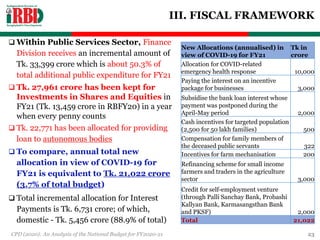
 Within Public Services Sector, Finance
Division receives an incremental amount of
Tk. 33,399 crore which is about 50.3% of
total additional public expenditure for FY21
 Tk. 27,961 crore has been kept for
Investments in Shares and Equities in
FY21 (Tk. 13,459 crore in RBFY20) in a year
when every penny counts
 Tk. 22,771 has been allocated for providing
loan to autonomous bodies
 To compare, annual total new
allocation in view of COVID-19 for
FY21 is equivalent to Tk. 21,022 crore
(3.7% of total budget)
 Total incremental allocation for Interest
Payments is Tk. 6,731 crore; of which,
domestic - Tk. 5,456 crore (88.9% of total)
CPD (2020): An Analysis of the National Budget for FY2020-21 23
New Allocations (annualised) in
view of COVID-19 for FY21
Tk in
crore
Allocation for COVID-related
emergency health response 10,000
Paying the interest on an incentive
package for businesses 3,000
Subsidise the bank loan interest whose
payment was postponed during the
April-May period 2,000
Cash incentives for targeted population
(2,500 for 50 lakh families) 500
Compensation for family members of
the deceased public servants 322
Incentives for farm mechanisation 200
Refinancing scheme for small income
farmers and traders in the agriculture
sector 3,000
Credit for self-employment venture
(through Palli Sanchay Bank, Probashi
Kallyan Bank, Karmasangsthan Bank
and PKSF) 2,000
Total 21,022
III. FISCAL FRAMEWORK
Contingent Liability
Government’s guarantee (contingent liability) has increased over the last
one year – a negative development!
Power and energy sector is currently the leading sector in terms of
receiving guarantee from the government
CPD (2020): An Analysis of the National Budget for FY2020-21 24
Sector
Amount (Crore Tk.) Growth (%) Share (%)
FY19 FY20 FY21 FY20 FY21 FY19 FY20 FY21
Agricultural Credit 9,155 3,143 3,681 -65.7 17.1 12.8 5.4 6.1
Biman 6,552 4,937 10,279 -24.6 108.2 9.2 8.5 16.9
Energy 1,680 3,381 1,199 101.3 -64.6 2.3 5.8 2.0
Power 44,744 33,777 33,742 -24.5 -0.1 62.6 58.4 55.6
Telecom 1,344 1,315 1,169 -2.2 -11.1 1.9 2.3 1.9
Miscellaneous 8,017 11,272 10,584 40.6 -6.1 11.2 19.5 17.4
Total 71,493 57,826 60,653 -19.1 4.9 100.0 100.0 100.0
List of Government Guarantees (Contingent Liability)
III. FISCAL FRAMEWORK
CPD (2020): An Analysis of the National Budget for FY2020-21 25
Budget Deficit and Financing
 Critical element will be utilisation of foreign aid through faster-paced
ADP project implementation without corruption
 Share of domestic financing
57.6% in FY21 (63.4% in RBFY20)
 Tk 86,980 crore (44.7% of total)
will come from the bank
borrowing; while only Tk. 20,000
crore from net sale of NSD
certificates
 Gross foreign aid requirement will
be around USD 11.1 bln (USD 8
bln in RBFY20) – current
commitments in view of COVID-19
may not be enough
CPD (2020): An Analysis of the National Budget for FY2020-21 26
IV. ANNUAL
DEVELOPMENT
PROGRAMME
IV. ANNUAL DEVELOPMENT PROGRAMME
CPD (2020): An Analysis of the National Budget for FY2020-21 27
ADP FY2021 has regrettably pursued a business as usual framework
 ADP of Tk. 205,145 crore has been proposed for FY21
 6.5% of GDP in FY21 (5.8% in FY19 Actual and 6.9% in FY20 RADP)
 1.2% higher than ADP and 6.3% higher than
RADP for FY20
 The rate of implementation of original ADP in
FY20 is likely to be not more than 60% even in
best case scenario in view of COVID-19
 Project Aid implementation (74.3%) has always
been lower than Taka component (95.3%) on an
average in the last 10 fiscal years
 Project Aid to finance 34.4% of total ADP in FY21
(32.1% in RADP of FY20) – no high ambition
 Rooppur Power Plant accounts for 18.4%
of total project aid in ADP for FY21
ADP Financing Structure (% of total)
 Revenue surplus as a share of financing ADP is declining in terms of
allocation; but in terms of actual expenditure there may be no surplus
 Revenue surplus to finance only 3.7% (Tk. 7,660 crore) of total ADP in
FY21, 17.4% in RADP of FY20, -1.8% in FY19 (Actual), 7.3 in FY18 (Actual)
29.9 32.1 34.4
70.1 67.9 65.6
Actual FY19 Revised FY20 ADP FY21
P.A Taka
CPD (2020): An Analysis of the National Budget for FY2020-21 28
Sector
No of
Projects
ADP FY21
Share (%)
ADP FY21
Share (%)
RADP FY20
Share (%)
ADP FY20
Growth (%) ADP
FY21 over RADP
FY20
Total Five Sectors 842 70.5 70.0 70.1 7.1
Transport 298 25.4 24.6 26.0 9.8
Physical Planning, Water Supply &Housing 270 12.6 13.7 12.0 -2.7
Power 88 12.1 12.3 12.8 4.5
Education & Religious Affairs 136 11.4 10.6 10.5 14.5
Science, Information & communication
Technology
50 9.0 8.7 8.7 9.8
Other 12 Sectors 742 27.8 28.4 28.2 3.9
Health, Nutrition, Population & Family Welfare 74 6.4 5.5 6.4 23.9
Development Assistance NA 1.7 1.6 1.7 16.4
Total 1,584 100.0 100.0 100.0 6.3
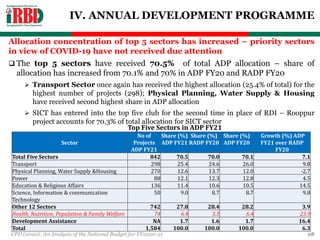
Allocation concentration of top 5 sectors has increased – priority sectors
in view of COVID-19 have not received due attention
 The top 5 sectors have received 70.5% of total ADP allocation – share of
allocation has increased from 70.1% and 70% in ADP FY20 and RADP FY20
 Transport Sector once again has received the highest allocation (25.4% of total) for the
highest number of projects (298); Physical Planning, Water Supply & Housing
have received second highest share in ADP allocation
 SICT has entered into the top five club for the second time in place of RDI – Rooppur
project accounts for 70.3% of total allocation for SICT sector
IV. ANNUAL DEVELOPMENT PROGRAMME
Top Five Sectors in ADP FY21
CPD (2020): An Analysis of the National Budget for FY2020-21 29
Allocation concentration of top 5 sectors has increased –
priority sectors in view of COVID-19 have not received due
attention
 Surprisingly share of Health, Nutrition, Population & Family Welfare in
ADP FY21 (6.4%) remained same as in FY20 despite this being the most
important sector in view of COVID-19
 It includes only one new project related to COVID-19 titled “COVID-19
emergency response and pandemic preparedness” co-financed by World
Bank
 Also, no COVID-related project was found in the list of ‘Unapproved projects
without allocation’
 Shares have risen marginally for Agriculture (from 3.8% to 4.1%), Social
Welfare, Women Affairs & Youth Development (from 0.4% to 0.5%) and
Labour & Employment sectors (from 0.2% to 0.3%) compared to FY20
IV. ANNUAL DEVELOPMENT PROGRAMME
 The ADP for FY21 contains 1,584 projects (1,475 for ADP of FY20)
CPD (2020): An Analysis of the National Budget for FY2020-21 30
Share of Allocation in FY20 Share of Allocation in FY21
 Share of allocation for concluding projects has declined while
increased for carryover projects
 Share of concluding projects declined to 26% in FY21 from 29% in FY20
 46 new projects are included in FY21 (41 in FY20): 1% of total ADP allocation
(0.4% in FY20)
 161 new projects were included in the RADP for FY20
 50% of allocation is provided to 430 continuing projects
IV. ANNUAL DEVELOPMENT PROGRAMME
New
0%
Continuing
57%
Concluding
29%
Carryover
8%
Unapproved
4%
Development Assistance
2%
New
1%
Continuing
50%
Concluding
26%
Carryover
18%
Unapproved
3%
Development Assistance
2%
 However, a total of 552 projects are scheduled to be concluded in FY21, according to
project completion timeline
 556 ‘carryover’ projects account for 18.7% of the total allocation (7.9% in FY20, 7.6%
in FY19 – highest since at least FY13)
 Physical Planning, Water Supply & Housing sector has 120 of these projects, followed by
Transport (116), Education (59), Agriculture (34), and Power (26)
 Thus, total number of projects which should be concluded: 1108
 Planning Commission has identified 380 projects which may be completed in FY21
 Many of these are unlikely to be completed by FY21
 61 projects were included in the separate PPP list in FY21 (62 in FY20) – They are
mainly Transport (82%) and Physical Planning (18%) sector projects
 1,347 projects are listed without allocation (in a separate list) in FY21 – Highest since at
least FY09!
CPD (2020): An Analysis of the National Budget for FY2020-21 31
Project Status FY12 FY13 FY14 FY15 FY16 FY17 FY18 FY19 FY20 FY21
Unapproved projects without
Allocation
702 720 662 624 857 1,172 1,315 1,338 1,045 1347
Projects listed to seek Foreign Funds 259 327 346 338 382 349 360 326 242 96
Total Number of Projects in the
ADP
1,039 1,037 1,046 1,034 999 1,141 1,192 1,347 1,475 1,584
PPP 16 13 44 40 40 32 36 78 62 61
Possible Completion (PC identified) 305 330 305 324 324 354 411 446 355 380
IV. ANNUAL DEVELOPMENT PROGRAMME
CPD (2020): An Analysis of the National Budget for FY2020-21 32
 It is observed that the share of projects with symbolic allocation
(the minimum to keep these projects in the ADP list) is on the
rise and majority of these are carryover projects
 64 projects (4%) under ADP received only Tk. 1 lakh for FY20; 62
projects received such allocation in FY19
 Inclusion of projects under Tk. 1 lakh have been a perpetual practice (64
projects in FY19)
 55 (86%) of those are carried over from ADP FY20
 11 of the 64 projects are in Physical Planning, Water Supply & Housing sector
(14 in FY20)
IV. ANNUAL DEVELOPMENT PROGRAMME
Ageing projects (the Zombies!) on the march!
 Average age of 1,387 investment projects are 4 years
 211 (15.2%) of these 1,387 projects are more than 6 years old (this is because
of repeated extension of projects)
 39 of these 1,387 projects are 10-17.5 years old while 3 of them are more than
15 years old
 Tannery Industrial Estate, Dhaka (17.5 years), Third Local Government Support
Project (LGSP-3) (15 years), and Construction of Bangladesh Chancery Complex in
Islamabad, Pakistan (15 years) – revised more than once
 Average implementation rate of these three projects was about 67% up to Feb 2020
 20.2% of such projects have already been revised between 1-4 times
 Number of revisions of projects: once (201), twice (68), three times (9), four
times (2)
 Revised unapproved projects: 66
CPD (2020): An Analysis of the National Budget for FY2020-21 33
IV. ANNUAL DEVELOPMENT PROGRAMME
Projects with expected foreign aid both in terms of allocation
and number are declining since FY17
 96 projects have been listed with expected foreign aid financing
 The estimated cost of all of these projects was USD 34.1 billion
 Estimated Project Aid to be obtained from different sources was USD 24.8
billion
 Highest share of Project Aid to be obtained is in Transport (47.3% for 36
projects) and Power (23.6% for 21 projects) – emphasis on infrastructure to
continue!
 Labour and Employment are expected to receive the third highest share
(18.6%) of project aid – mainly for one single project “To Support the
Returnee Migrant Workers and Incentives for Expatriates” (accounting for
16.3% of total project aid expected) from GEF – will help returnee migrants
to cope with COVID-19 if can be successfully implemented
CPD (2020): An Analysis of the National Budget for FY2020-21 34
IV. ANNUAL DEVELOPMENT PROGRAMME
CPD (2020): An Analysis of the National Budget for FY2020-21 35
Mega Projects: Allocations have risen, but not the pace of
implementation
Project Name Project Cost
(Tk.cr.)
Progress till
Feb, 2020
(%)
Possible
Progress till
June, 2021 (%)
End date
Construction of Rooppur Nuclear Power Plant 113,093 22.8 44.8 30/12/25
Padma Bridge Rail Link 39,247 30.4 47.6 30/06/24
Matarbari 2x600 MW Ultra-Super Critical Coal-Fired Power
Project
35,984 32.4 46.1 30/06/23
Padma multipurpose Bridge project 30,193 71.4 94.2 30/06/21
Dhaka Mass Rapid Transit Development Project (Metro Rail) 21,985 39.9 74.1 30/06/24
Construction of Single Line Dual Gauge Track from Dohazari-
Ramu-Cox’s Bazar and Ramu to Ghundum near Myanmar
Border
18,034 25.1 36.2 30/06/22
Construction of Dhaka-Ashulia Elevated Expressway 16,901 0.0 8.4 30/06/22
SASEC Road Connectivity: Improvement of Elenga-
Hatikumrul-Rangpur-Highway into 4-Lane Highway
11,899 13.2 28.6 31/08/21
Ghorasal Polash Urea Fertilizer Project (GPUFP) 10,461 20.8 68.1 30/06/22
Construction of Multilane Road Tunnel under River karnaphuli 10,374 43.5 66.5 30/06/20
Rupsha 800-Megawatt Combined Cycle Power Plant 8,499 7.0 10.6 30/06/22
Installation of Single Point Mooring (SPM) with Double Pipe
Line
6,568 14.0 42.9 30/06/22
SASEC Road Connectivity: Improvement of Joydebpur-
Chandra-Tangail-Elenga Road (N-4) to 4-Lane Highway
5,593 68.8 87.7 30/06/20
Developing Port Infrastructure/Support Facilities of Payra Port
for Commencing Port Operations
3,506 61.2 85.5 30/06/20
IV. ANNUAL DEVELOPMENT PROGRAMME
CPD (2020): An Analysis of the National Budget for FY2020-21 36
Mega Projects: Allocations have been raised, but pace of
implementation remain slow
 Tk. 41,382 crore is allocated for 14 projects (all infrastructure including
fast-track and based on project size) which is 20.2% of total ADP of
FY21
 Tk. 40,225 crore and 20.9% in RADP FY20
 4 out of 14 projects are scheduled to be completed by FY21
 Given the progress of work, it would not be possible to complete
any of these projects including the PMB project
 Shockingly, the ‘Installation of Single Point Mooring (SPM) with
Double Pipe Line’ project will progress by a maximum 42.9% even
if it spends all its allocated funds for FY21 – carried over from FY19!
 China is co-financing 4 out of these 14 projects, and progress of
implementation of these projects are very poor
IV. ANNUAL DEVELOPMENT PROGRAMME
Five important observations can be made for ADP FY2021 in view
of COVID-19
 The ADP for FY2021 did not follow required allocative priorities in view of the
need to respond to the ongoing COVID-19 pandemic
 Allocation for HNPFW remained unchanged; has risen only marginally for
Agriculture, Social Welfare and Labour & Employment sectors
compared to FY20
 Limited effort towards exploring new projects to address COVID-19 emergencies
 Only one COVID-related project was included in Health sector
 No high ambition in financing ADP from foreign aid. Indeed, foreign aid
expectation in terms both allocation and number of projects decreased drastically
in FY21. Financing from revenue surplus is also on a declining trend
 GoB could not restrain itself from including and allocating funds for the
‘carryover’ and ‘ageing’ projects in FY21 – in fact both of them have increased!
 The government could avoid taking populist projects (e.g. ‘symbolic projects’ for
transport and physical planning sectors)
CPD (2020): An Analysis of the National Budget for FY2020-21 37
CPD (2020): An Analysis of the National Budget for FY2020-21 38
V. FISCAL MEASURES
V. FISCAL MEASURES
Personal Income Tax (PIT)
Major revisions in the income tax structure
 Annual tax-free income threshold for personal income has been raised to Tk. 3.0
lakh from Tk. 2.5 lakh
 For female taxpayers and elderly taxpayers : To Tk. 3.5 lakh from Tk. 3 lakh
Tax-free income threshold remains the same at Tk. 4 lakh and Tk. 4.5 lakh
for specially abled and freedom fighters
Earlier CPD had proposed to raise the threshold to Tk. 3.5 lakh and reduce
the first three slabs of tax rates by 5 per centage points
CPD (2020): An Analysis of the National Budget for FY2020-21 39
Current provision Proposed provision
Total income Tax rate Total income Tax rate
First 2,50,000 Tax free First 3,00,000 Tax free
2,50,001 to next 4,00,000 10% 3,00,001 to next 1 lakh 5%
6,50,001 to next 5,00,000 15% 4,00,001 to next 3 lakh 10%
11,50,001 to next 6,00,000 20% 7,00,001 to next 4 lakh 15%
17,50,001 to next 30,00,000 25% 11,00,001 to next 5 lakh 20%
Over 47,50,000 30% 16,00,001 and above 25%
V. FISCAL MEASURES
 CPD feels the changes to be welcome in view of the adverse affects of
COVID-19 pandemic
 Following the change, the lowest segment of income earners will gain the most
(about 28-67%) i.e. whose monthly income is between Tk.30,000 and Tk.
60,000
 However, benefit will start to increase again for monthly income earners of 4
lakh and above – not promoting tax justice
CPD (2020): An Analysis of the National Budget for FY2020-21 40
Annual taxable
income (Tk.)
Monthly taxable
income (Tk.)
Tax relief
(Tk.)
Tax relief as (%)
amount of tax (old
rate)
2.5 lakh 20,833 0
3 lakh 25,000 -5,000 -100
4 lakh 33,333 -10,000 -67
6.5 lakh 54,167 -10,000 -25
7 lakh 58,333 -12,500 -26
11 lakh 91,667 -12,500 -12
11.5 lakh 95,833 -10,000 -9
16 lakh 1,33,333 -10,000 -5
17.5 lakh 1,45,833 -2,500 -1
48 lakh 4 lakh -2,500 0
60 lakh 5 lakh -62,500 -5
1 crore 20 lakh 10 lakh -3,62,500 -11
48 crore 4 crore -2,37,62,500 -17
First online return submission will receive rebate of Tk. 2,000 –will
encourage digital transformation of tax department
Ease of tax return
 One page Tax Return form has been proposed for small taxpayers –
simplification of tax return form may incentivize more individuals to submit
return
 E-TIN has been made compulsory for Zilla Parishad Chairman and Vice
Chairman - will improve transparency as regards income of these elected
people
CPD (2020): An Analysis of the National Budget for FY2020-21 41
V. FISCAL MEASURES
V. FISCAL MEASURES
Corporate Tax
 2.5% reduction in tax rate of non-publicly traded companies to fix it at
32.5% from 35% -the tax differential between listed and non-listed companies
to reduce; listing of companies to be discouraged
 Tax rates for publicly traded companies, publicly traded banks, insurance and
financial institutions, and merchant bank will remain unchanged
 For RMGs, the present provision of 12% (10% for green industry) has been
extended for another two years - will help reduce environmental degradation
by limiting negative externality
Withholding Tax
 Reduced at 0.5% from 1% on all types of export proceeds including that
of RMG
 However RMG has been currently enjoying the further reduced rates through an SRO,
which will continue to be in force till 30th June 2020. The current rate may be
continued for one more year in view of the pandemic
CPD (2020): An Analysis of the National Budget for FY2020-21 42
V. FISCAL MEASURES
Advanced income tax
AIT has been raised by 50-67% for private cars, jeeps and microbus - CPD
welcome the rise in tax on motor car/jeep.
 Tax on micro bus will likely be shifted to consumers
Untaxed/undisclosed money provision
Individual taxpayers are allowed to disclose any type of undisclosed house
property including land, building, flat and apartment on paying tax at a
particular rate on per square meter
 CPD has along argued against this move on grounds of moral hazard, disincentive
for honest taxpayers and not having been effective in the past
Individual taxpayers can invest money in the capital market and show it in
their tax returns on paying tax at a rate of 10% on the value of the investment
subject to satisfying certain conditions including a lock-in period of three
years – such moves undermine the cause of transparency and good governance
CPD (2020): An Analysis of the National Budget for FY2020-21 43
V. FISCAL MEASURES
Untaxed/undisclosed money provision (contd.)
 Individuals can disclose undisclosed cash, bank deposits, savings certificates
(Sanchayapatra), shares, bonds or any other securities on paying taxes at a rate of
10% on the value of the said declaration – if this type of provisions are to be at all
allowed, the rate should be applicable tax rate plus penalty – will discourage the
honest taxpayers
 These facilities will be available only for FY21
Money-laundering Prevention
 Introduction of a new section in the Income Tax Ordinance to prevent money-
laundering
 50% tax will be levied on the proven amount of over- or under-invoicing, or on the
proven amount of false declaration of investment
 CPD calls for heightened forensic capacity of the Transfer Pricing Cell. At the same
time, they should be able to access to international trade database
 Good initiative to discourage illicit financial outflows through over and under
invoicing. Coordination among the concerned various agencies (NBR,
dealing banks) is required. NBR’s Transfer Pricing cell should take the lead
CPD (2020): An Analysis of the National Budget for FY2020-21 44
V. FISCAL MEASURES
Tax deducted at source
 TDS reduced to 2% from existing 5% on import of garlic and sugar
 May impact the local producers of garlic and sugar adversely
 TDS reduced to 2% from existing 5% on import of raw material for poultry feed
 Will promote the domestic poultry industry
Tax Holiday – good rationalisation
 Existing 26 sectors to continue enjoying the facility
 Inclusion of 8 more potential manufacturing sectors under the facility – Electrical
transformer, Artificial fiber or manmade fiber manufacturing, Automobile parts
and components manufacturing, Automation and Robotics design, manufacturing
including parts and components thereof, Artificial Intelligence based system design
and/or manufacturing, Nanotechnology based products manufacturing, Aircraft
heavy maintenance services including parts manufacturing – will provide
support to domestic enterprises to grow. However, misuse of the
facility should be checked
CPD (2020): An Analysis of the National Budget for FY2020-21 45
V. FISCAL MEASURES
Changes in VAT and SD Rules
 VAT and SD Rules 2016 have been amended
 time limit for input tax credit has been proposed to extend up to 4 tax periods
from existing 2 tax periods
 80% expenditure incurred in the transportation services will be eligible for
input credit claim
 partial input tax credit mechanism has been made effective and easier
 multiple withholding of VAT has been avoided by simplification of rules
 Will provide flexibility to businesses
 VAT-free annual turnover threshold stands at Tk. 50 lakh; turnover tax ceiling has
not changed either (upto Tk. 3 crore); 4% turnover tax also remained unchanged
 CPD proposed an upward revision for VAT-free annual turnover threshold to
Tk. 1 crore
 Online-based new VAT law requires mandatory record keeping of VAT
challan/invoice during sales/supply through Electronic Fiscal Device (EFD)
and Sales Data Controller (SDC)
 Government is yet to distribute EFD among the businesses
CPD (2020): An Analysis of the National Budget for FY2020-21 46
V. FISCAL MEASURES
Changes in tax and duty structure at local level
COVID-19 emergency response
 VAT exempted at import, manufacturing and trading stage for 17 types of medical
equipment including soapy alcohol, COVID-19 testing kits, PPE, 3-ply surgical
masks, protective spectacles, goggles, and raw materials for hand sanitisers,
surgical masks, and disinfectants – welcome decision
 Continues exemption on meditation service for one more year in view of the
adverse affect of pandemic on mental health
Development of agro-based industries
 VAT reduced from 15% to 5% for manufacturing of potato flakes made of locally
produced potatoes – will help promote agro-related investment
 Reduction of VAT from 15% to 5% for manufacturing maize starch – will help boost
domestic maize production
 VAT exemption on locally produced mustard oil – will encourage mustard oil
production
 VAT exempted on agricultural machineries such as Power Ripper, Power Tiller
operated Seeder, Combined Harvester, Rotary Tiller, etc. at the trading stage – will
encourage mechanization of agriculture
CPD (2020): An Analysis of the National Budget for FY2020-21 47
V. FISCAL MEASURES
Development of domestic industrialisation
 Reduced Advance Tax (AT) on imported raw materials for manufacturing
industries from existing 5% to 4%- will encourage local manufacturing
industries
 Only 5% VAT rate on domestic production of Loaded PCB (Printed Circuit
Board), Unloaded PCB and Router have been proposed – will encourage
growth of local ICT sector
 Imposed fixed VAT at the rate of 6 taka per kg from the existing 5% ad valorem
VAT on Polyester, Rayon and all other synthetic yarn, and at the rate of 3 taka
per kg from the existing 4 taka per kg on all kinds of Cotton Yarn – expected to
promote the cause of local textile development
Promoting clean energy
 VAT exemption on up to 60 amp solar battery production for partner
organisations of Infrastructure Development Company Ltd (IDCOL) – will
support environment-friendly clean energy growth
CPD (2020): An Analysis of the National Budget for FY2020-21 48
V. FISCAL MEASURES
Priority on big project implementation
 VAT exemption facility in cases of government's priority and fast track projects, such as
Rooppur Nuclear Power plant Project, High Tech Parks, Economic Zones and the Public-
Private Partnership (PPP) projects – will have adverse impact on revenue mobilisation and
induce demonstration effect for future projects
Tobacco tax sees new height
 Both base price and SD increased for different categories of bidi, cigarettes, gul and zarda –
will discourage consumption of health hazardous products and also generate higher revenue
Taxes on luxury products and services taxed
 SD increased to 30% from 25% for chartered aircrafts and helicopters – welcome move
 SD increased to 10% from 5% on locally manufactured cosmetics – No mention about
imported products
Toll on Furniture industries and ceramics
 Raised VAT to 7.5% from the existing 5% on the showroom prices of furniture to adjust with
factory price
 SD imposed at 10% on Ceramic Sink, Basin, etc. at the manufacturing stage – additional
fiscal burden for the concerned sectors
CPD (2020): An Analysis of the National Budget for FY2020-21 49
V. FISCAL MEASURES
Additional cost on mobile phone use and for registration of private
vehicles
 SD raised to 15% from 10% on services provided through mobile phone SIM/RIM –
will generate additional revenue; no significant impact on the consumer base
 SD increased to 15% from 10% for all types of services provided by the BRTA for car
and jeep registration and related services – revenue generating measure; will have
adverse impact for private car owners
CPD (2020): An Analysis of the National Budget for FY2020-21 50
V. FISCAL MEASURES
Changes in duties at import stage
Existing (six) slabs of Customs Duty (0%, 1%, 5%, 10%, 15%, and 25%) will
remain unchanged
12 slabs (10%, 20%, 30%, 45%, 60%, 100%, 150%, 200%, 250%, 300%,
350%, and 500%) of SD to also continue
There are two broad rationales as regards duty changes:
 A wide range of tariff reduction at import stage has been proposed –
particularly for import of raw materials and for almost all potential
sectors
 Some duties have been raised to protect local industry
Existing provisions of bonded warehouse licensing rules will be
rationalised in order to ensure proper utilisation of bond facilities
CPD (2020): An Analysis of the National Budget for FY2020-21 51
V. FISCAL MEASURES
Changes in duties of selected items
 Zero rated customs duty will remain unchanged for import of essential commodities,
fertilisers, seeds, lifesaving drugs and raw cotton along with raw materials for some
industries. Incentives and exemptions will be extended to imports of agricultural
equipment and spare parts – welcome move
 5% CD has been imposed on imported onion – will protect local onion producers
to get fair market price
 Reduced tax rate on import of SME product-related raw materials. At the
same time, to protect SMEs, duty and taxes have been raised on some other products
(e.g. nails, screws, small machinery parts, etc.)
 CD reduced on import of refractory cement for steel industry – will promote
expansion of steel industry
 CD reduced to 15% from 25% on import of photographic plates of plastic – will
help support growth of plastic and packaging industry
CPD (2020): An Analysis of the National Budget for FY2020-21 52
V. FISCAL MEASURES
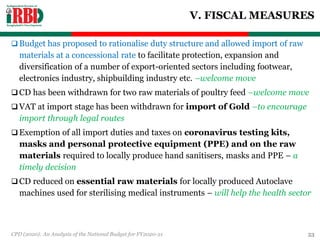
 Budget has proposed to rationalise duty structure and allowed import of raw
materials at a concessional rate to facilitate protection, expansion and
diversification of a number of export-oriented sectors including footwear,
electronics industry, shipbuilding industry etc. –welcome move
 CD has been withdrawn for two raw materials of poultry feed –welcome move
 VAT at import stage has been withdrawn for import of Gold –to encourage
import through legal routes
 Exemption of all import duties and taxes on coronavirus testing kits,
masks and personal protective equipment (PPE) and on the raw
materials required to locally produce hand sanitisers, masks and PPE – a
timely decision
 CD reduced on essential raw materials for locally produced Autoclave
machines used for sterilising medical instruments – will help the health sector
CPD (2020): An Analysis of the National Budget for FY2020-21 53
V. FISCAL MEASURES
Rationalisation of existing import tax concessions for manufacturing of
cellphones– will encourage cellular phone manufacturing at local level
Withdrawal of exemption benefit on import of furnace oil – will
discourage installation of furnace oil-based power plants
CD reduced on import of electrical signaling equipment, one of the
main components of deep sea fishing – will encourage fishing sector and
help tap the potential of the blue economy
Shrimp production has been disrupted severely due to Amphan cyclone.
However, the sector has received only limited support in terms of duty
benefits. CD remains 5-25% for all major feed and aqua inputs used in
shrimp sector – impact on shrimp sector should be revisited and acted
upon accordingly
Rationalisation of duties are often administered on an ad-hoc basis.
However, these need to be based on revenue rationale and economic return
CPD (2020): An Analysis of the National Budget for FY2020-21 54
V. FISCAL MEASURES
Reform initiatives
 Modernisation of the Income Tax Ordinance – No concrete deadline
proposed
 Government has taken initiatives to establish the Bangladesh Single Window
Commissionerate – in this context amendments of Customs Act, 1969 is
necessary
 CPD has been persistently advocating in favour of speedy passing of Customs Act
and Direct Tax Act 1969
 Expansion of the tax net and implementation of the BITAX project
 Government is going to make income tax returns mandatory for every TIN
holder
 At the same time, online filing of return has been introduced and tax payment
process is much easier than before
 CPD urges the need for broader use of technology to boost revenue mobilisation
efficiency: Introduction of an e-TDS system will make tax evasion difficult
CPD (2020): An Analysis of the National Budget for FY2020-21 55
CPD (2020): An Analysis of the National Budget for FY2020-21 56
VI. FOUR PRIORITY SECTOR
SELECTED BY CPD
CPD (2020): An Analysis of the National Budget for FY2020-21 57
Health
Health
 Total budget allocation for health increased
only by 14%, from BDT 25,733 crore in FY20 to
BDT 29,247 in FY21
 Development budget allocation increased by
only 1.90%, whereas non-development
budget allocation increased 24.37%
 Share of development budget allocation
in total budget allocation decreased from 48%
in FY20 to 43% in FY21
 Average annual change in total budget
allocation for health between FY11 and FY21
was also 14%
 Increase in total budget allocation for health in
FY21 followed a linear trend line, indicating that
the rise was business-as-usual and nothing
out of the ordinary, despite the fact that the
healthcare sector is reeling from the shocks of
COVID-19
 Share of revised development budget
allocation in total budget allocation
decreased from 45% in FY19 to 39% in
FY20
CPD (2020): An Analysis of the National Budget for FY2020-21 58
8129
29247
0
10
20
30
40
50
60
0
5000
10000
15000
20000
25000
30000
35000
FY10 FY11 FY12 FY13 FY14 FY15 FY16 FY17 FY18 FY19 FY20 FY21
Percentage
BDTincrore
Non-development Development Total Development as % of total
Budget allocation
6833
23692
0
5
10
15
20
25
30
35
40
45
50
0
5000
10000
15000
20000
25000
FY10 FY11 FY12 FY13 FY14 FY15 FY16 FY17 FY18 FY19 FY20
Percentage
BDTincrore
Non-development Development Total Development as % of total
Revised budget allocation
Health
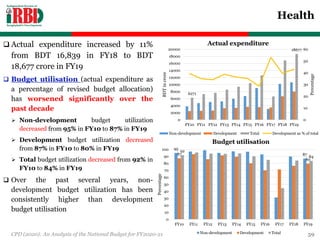
 Actual expenditure increased by 11%
from BDT 16,839 in FY18 to BDT
18,677 crore in FY19
 Budget utilisation (actual expenditure as
a percentage of revised budget allocation)
has worsened significantly over the
past decade
 Non-development budget utilization
decreased from 95% in FY10 to 87% in FY19
 Development budget utilization decreased
from 87% in FY10 to 80% in FY19
 Total budget utilization decreased from 92% in
FY10 to 84% in FY19
 Over the past several years, non-
development budget utilization has been
consistently higher than development
budget utilisation
CPD (2020): An Analysis of the National Budget for FY2020-21 59
Actual expenditure
Budget utilisation
6271
18677
0
10
20
30
40
50
60
0
2000
4000
6000
8000
10000
12000
14000
16000
18000
20000
FY10 FY11 FY12 FY13 FY14 FY15 FY16 FY17 FY18 FY19
Percentage
BDTincrore
Non-development Development Total Development as % of total
95
8787
80
92
84
0
10
20
30
40
50
60
70
80
90
100
FY10 FY11 FY12 FY13 FY14 FY15 FY16 FY17 FY18 FY19
Percentage
Non-development Development Total
Health
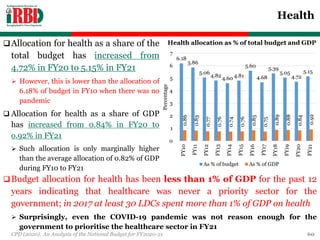
Allocation for health as a share of the
total budget has increased from
4.72% in FY20 to 5.15% in FY21
 However, this is lower than the allocation of
6.18% of budget in FY10 when there was no
pandemic
 Allocation for health as a share of GDP
has increased from 0.84% in FY20 to
o.92% in FY21
 Such allocation is only marginally higher
than the average allocation of 0.82% of GDP
during FY10 to FY21
CPD (2020): An Analysis of the National Budget for FY2020-21 60
Health allocation as % of total budget and GDP
6.18
5.86
5.06
4.82
4.60 4.81
5.60
4.68
5.39
5.05
4.72
5.15
0.86
0.83
0.77
0.76
0.74
0.76
0.85
0.75
0.89
0.88
0.84
0.92
0
1
2
3
4
5
6
7
FY10
FY11
FY12
FY13
FY14
FY15
FY16
FY17
FY18
FY19
FY20
FY21
Percentage As % of budget As % of GDP
Budget allocation for health has been less than 1% of GDP for the past 12
years indicating that healthcare was never a priority sector for the
government; in 2017 at least 30 LDCs spent more than 1% of GDP on health
 Surprisingly, even the COVID-19 pandemic was not reason enough for the
government to prioritise the healthcare sector in FY21
Health
CPD (2020): An Analysis of the National Budget for FY2020-21 61
If the government spends BDT 1 on health
from the budget allocation
Then the average Bangladeshi spends
BDT 4.42 on health from their own pocket
Year Bangladesh Bhutan India Nepal Pakistan Sri Lanka
2001 65.14 7.93 74.11 51.27 60.11 41.09
2003 62.39 19.01 73.42 53.81 65.53 37.61
2005 64.85 16.79 73.15 49.22 71.02 40.50
2007 65.82 14.34 70.82 60.96 72.43 44.85
2009 67.24 16.58 66.76 57.62 72.34 53.29
2011 67.37 16.34 62.22 58.38 67.14 51.22
2013 68.51 20.31 69.07 63.53 65.17 48.93
2015 71.82 19.79 64.66 59.44 66.18 48.93
2017 73.88 13.31 62.40 57.80 60.24 49.76
Table: Out-of-pocket expenditure (% of relevant health expenditure)
 High out-of-pocket expenditure on health will push many people into poverty during
the COVID-19 pandemic, as they struggle to bear health-related expenses on their own
Source: World Health Organization Global Health Expenditure database (http://apps.who.int/nha/database).
CPD (2020): An Analysis of the National Budget for FY2020-21 62
Social Safety Net Programmes
 Allocation for social safety nets has been increased from BDT 81,865 crore in
revised budget for FY2019-20 to BDT 95,574 crore in budget for FY2020-21
 This represents an increase of only 17% which is lower than the average rate
of increase of 18% between FY10 and FY21
 Allocation for pension of government officials has decreased in FY21 by BDT 10
crore
 This is only the second time in the last 13 years that the allocation for
pension of government officials has decreased in the budget
63
Social protection allocation and pension allocation (in crore BDT)
CPD (2020): An Analysis of the National Budget for FY2020-21
13845
16706
20894
21975
23098
26654
30636
35975
40857
48524
64404
81865
95574
3617
3761
4003
5041
5533
6816
8607
11144
12667
10018
22449
23010
23000
0
20000
40000
60000
80000
100000
120000
RBFY2008-09
RBFY2009-10
RBFY2010-11
RBFY2011-12
RBFY2012-13
RBFY2013-14
RBFY2014-15
RBFY2015-16
RBFY2016-17
RBFY2017-18
RBFY2018-19
RBFY2019-20
BFY2020-21
CroreBDT
Social protection allocation (in crore BDT) Pension allocation (in crore BDT)
Social Safety Net Programmes
Overall social safety net budget has increased as a percentage of budget
and as a percentage of GDP
Social safety net budget excluding pension has also increased, both as
percentage of budget and as percentage of GDP
 Most of this increase has been allocated to COVID-19 related
programmes, loans, interest payments and subsidies
64
Social protection allocation and pension allocation
(as % of GDP)
Social protection allocation and pension allocation
(as % of budget)
CPD (2020): An Analysis of the National Budget for FY2020-21
15 15
16
14
12 12 13 14 13 13
15
16 17
11
12
13
11
9 9 9 9 9
10
9
12
13
0
2
4
6
8
10
12
14
16
18
RBFY2008-09
RBFY2009-10
RBFY2010-11
RBFY2011-12
RBFY2012-13
RBFY2013-14
RBFY2014-15
RBFY2015-16
RBFY2016-17
RBFY2017-18
RBFY2018-19
RBFY2019-20
BFY2020-21
%
Social protection allocation (as percentage of budget)
Social protection allocation excluding pension (as percentage of total budget)
2
2
3
2
2 2
2 2 2 2
3
3 3
1.66
1.87
2.14
1.85 1.69 1.68
1.46 1.44 1.44
1.72 1.65
2.10
2.29
0
1
1
2
2
3
3
4
RBFY2008-09
RBFY2009-10
RBFY2010-11
RBFY2011-12
RBFY2012-13
RBFY2013-14
RBFY2014-15
RBFY2015-16
RBFY2016-17
RBFY2017-18
RBFY2018-19
RBFY2019-20
BFY2020-21
%
Social protection allocation (as percentage of GDP)
Social protection allocation excluding pension (as percentage of GDP)
Social Safety Net Programmes
65CPD (2020): An Analysis of the National Budget for FY2020-21
Houses for the
homeless
10%
Distributing
cash among
the target-
based
communities
2%
Agricultural
subsidy
9%
Employment
Generation
Programme
through Palli
Sanchay Bank,
Karmasangsth
an Bank,
Probashi
Kalyan Bank
and PKSF
10%
Refinance
scheme for
the low-
income
professionals,
farmers and
marginalised
businesses
14%
Interest
subsidy for
loans to
CMSME sector
14%
Interest
subsidy to
commercial
banks
10%
Interest
payment on
national
savings
certificates
31%
Distribution of new additions to safety net budget
Always present,
but never shown
under safety net
budget
Interest subsidies on two
liquidity support packages
announced previously
Loans bearing
interest,
conditional on
stringent
regulations
Social Safety Net Programmes
The budget speech for FY21 has mentioned:
 “We are providing direct cash transfers of Tk. 2,500 each to 50 lakh selected
families nationwide.”
66
Table: Minimum cost of essential food items for a family of 4 persons for 1 month
Source: CPD calculations using data from TCB and BBS
CPD (2020): An Analysis of the National Budget for FY2020-21
Item Unit
Minimum price per unit in BDT
(as of 11 June 2020) Average per capita per day intake Minimum total cost (in BDT)
Rice (coarse) kilogram 36 0.3672 1,586
Soyabean oil
(loose) litre 88 0.0252 266
Lentils (local) kilogram 70 0.0157 132
Potato kilogram 26 0.0648 202
Onions (local) kilogram 40 0.0311 149
Garlic (local) kilogram 90 0.0301 325
Chilli (powder) kilogram 250 0.0129 387
Tumeric (local) kilogram 130 0.0301 470
Ginger (local) kilogram 100 0.0301 361
Sugar kilogram 60 0.0064 46
Eggs (farm)
20 eggs
(roughly 1 kilogram) 150 0.0136 245
Fish (Rui) kilogram 300 0.0626 2,254
Chicken (broiler) kilogram 140 0.0171 287
Total minimum cost per household (4 individuals) per month
6,710
Social Safety Net Programmes
 The budget speech for FY20, just like the
budget speech for FY19, had mentioned
the intention of the government to
introduce a Universal Pension
Scheme.
 Unfortunately, no budget allocation was
made for such a scheme in the budget for
FY21, although it was mentioned that the
target is to provide universal health coverage
by 2030.
 According to CPD’s preliminary cost
estimation,
 the cost of providing unemployment support,
equal to 100 per cent of the national poverty
line for 100 days per year for 1 person at
working age per vulnerable household would
be 2.14% of GDP
 providing USD 2 at PPP per day for 100 days
per year for one person at working age per
vulnerable household would cost only 1.27%
of GDP
67CPD (2020): An Analysis of the National Budget for FY2020-21
Agriculture
CPD (2020): An Analysis of the National Budget for FY2020-21 68
Agriculture
 The National Budget for F2021 has echoed one of CPD’s budget proposals.
‘Agriculture sector’ was identified as one of the priority sectors for FY2021 in
view of COVID pandemic
 Various studies have tried to assess level of damage caused by COVID-19, followed by
cyclone ‘Amphan’ on agriculture sector. This is estimated to be as high as $633 mill. (ADB,
2020)
 Poultry, dairy, fishery and livestock sub-sectors have been affected at varying degrees. This
called for special attention in the national budget for FY2021 (CPD, 2020)
 CPD made a number of monetary, fiscal and sectoral proposals in order to
increase acreage of cultivation and attain higher level of food production. The
idea was to create additional employment in agriculture and improve food and
nutrition security for the marginalised
 Allocation for Agriculture and Allied Sectors (AAS) is to increase by 5.7% in BFY21 (from Tk. 27,018 crore in
FY20 to Tk.29,981 crore in FY21) compared to that in RBFY20
 Despite this, the share of AAS in total budget has experienced a declining trend over the recent past years
– from 6.03% (AFY19) to 5.38% (RB20) to 5.27% (BFY21)
 MoA received the highest share of allocation within the AAS (51.5% which has significantly increased from
RFY20, 47.9%). The share of MoFL has also increased
 The rise in share in allocation is well-appreciated considering the important role of these sub-sectors
during the crisis period
 MoWR, on the other hand, has received a reduced budget allocation in BFY2021 perhaps due to
reprioritizing other activities in BFY21 in view of COVID-crisisCPD (2020): An Analysis of the National Budget for FY2020-21 69
Agriculture
 ADP allocation under the MoA in BFY21 has
increased by 10% (Tk.8382 crore). The comparable
figure for RFY20 was 6.8%
 Despite the higher allocation of budget, poor budget
utilisation capacity of the MoA remains a major concern
 MoA had actually utilized only 67.9% of its allocated
budget during FY18. The utilization rate has increased
in FY19 (87.5%)
 Subsidy & incentives in agriculture sector will be increased
by 18.7% in BFY21 (Tk.9500 crore) compared to RFY20
 A large amount of unutilised subsidy in past years make
it difficult to justify a further rise in subsidy. However,
there may be higher demand for additional allocation in
view of COVID-19
 Agriculture sector needs to ensure full and proper
utilization of subsidy during FY2020‐21
 The agriculture sector would have been able to better
handle the COVID crisis/cyclone Amphan if the FY20
budget commitments made had been implemented as per
timeline -
 E.g. commitment to undertake a project on ‘crop
insurance scheme’ 70
10,400 11,087
12,893
1,774 1,866 2,544
12,174 12,953
15,437
0
5,000
10,000
15,000
20,000
AFY18-19 RFY19-20 BFY20-21
Allocation for MoA (Tk. crore)
Operating Development Total
6.4
52.4
31.2
21.3
16.119.2
26.2
15.9 19.4
-7.8-20.0
0.0
20.0
40.0
60.0
MoA MoFL MoEF MoL MoWA
% Change in Allocation in Different
Ministries of AAS (%)
RFY19-20 BFY20-21
Allocation Revised Utilised Unustisiled
FY17-18 9,000 6,000 5,268 3732
FY18-19 9,000 8,070 7,763 1237
FY19-20 9,001 8,001
FY20-21 9501
Subsidy in Agriculture (Tk crore)
CPD (2020): An Analysis of the National Budget for FY2020-21
Agriculture
71
 As many as 33 projects are reported in the ‘probable list of completion in FY21’. These are
related to production of non-crop, livestock, food stock, fisheries, dairy and information system
development
 13 new projects have been included in BFY21
 Some of the projects demand special attention in view of COVID-19 but are behind schedule in
terms of completion. These projects need additional allocation for timely completion
 Modern food storage project (6/FY20: 66.5%); Increase fish production through reservoir
reform (6/2020: 85.9%); strengthening flower marketing (6/2020:50.6)
Project Name
Completion
rate (by
6/2021)
Nutrition development through year-round fruit
production
69.8
Strengthening the flower marketing system
through market infrastructure, storage and
transportation facilities
50.6
Cultivation of high value spices in the Chittagong
Hill Tracts
88.3
Fisheries development in Cumilla division 88.1
Development and expansion of Black Bengal breed
goats
66.3
Dairy Development Research 100.0
Red Chittagon Cattle Breed Development and
Storage
81.9
National Agricultural Technology Program-Phase II 102.1
Sustainable Small Water Resources Development 31.8
List of Projects Supposed to be Completed in FY2021 The stimulus packages for agriculture sector which
were announced earlier were reiterated in the budget
document
 Tk.200 crore as incentive for farm mechanisation;
procurement of 2 lakh ton of rice to ensure fair price
for farmers; Tk.5000 crore for refinance scheme to
provide agriculture credit
 CPD (2020) proposed that farmers’ list should be
publicly disclosed; procurement should be done in
open places; paddy procurement should be given
priority over rice
 Timely disbursement of credit among affected
farmers, vegetable producers, small dairy & livestock
farmers, fruit growers and shrimp farmers are
urgently neededCPD (2020): An Analysis of the National Budget for FY2020-21
Employment Generation
CPD (2020): An Analysis of the National Budget for FY2020-21 72
Employment Generation
 The National Budget for F2021 has echoed one of CPD’s budget proposal by announcing
‘employment generation’ as one of the priority areas for FY2021 in view of COVID pandemic
 Various studies have identified pandemic-induced losses in terms of reduced economic
activities, working hours and employment – this could be 0.14-0.33% in agriculture, 0.09-
0.21% in business and trade sector and 0.08-0.2% in hotel and restaurants (ADB,2020)
 MTBS (2021-23) estimated a decline in private investment by 12.7% of GDP in RFY20 if
24.2% of GDP in AFY19 is taken as reference points
 The strategy for employment generation should focus on employment for recently
unemployed workers in formal and informal domestic economic activities, for recently
repatriated migrant workers and new entrants in the job market
 In this backdrop, projection made as regards private investment for FY2021 (25.3% of GDP) was
unrealistically high compared to that in FY2020 at a time when the economy is burdened with
significant un/underutilised production capacity
 To achieve the projected private investment in FY21, an amount of Tk.445142 crore additional
investment would be required (at a growth rate of 125% p.a.)
 Among the four ministries related to employment generation and human resource development,
MoI received the highest allocation of Tk.1615 crore (decline by -8%) followed by MoY with an
allocation of Tk.1478 crore (increase by 1.2%)
 MoEOE received an allocation of Tk.641 crore with a growth rate of 9.4%; on the other hand,
MoLE received a meagre amount of Tk.350 crore (decline by -4.6%)
 None of the ministries have received an allocation which could be indicative of prioritization
of employment in the national budget
CPD (2020): An Analysis of the National Budget for FY2020-21 73
Employment Generation
 However, ensuring employment is one of the four areas of focus of the stimulus packages
which are largely being implemented by commercial banks through subsidized credit line
facility. There is limited budgetary allocation for employment related activities
 FM’s budget speech has reiterated Stimulus Packages for different sectors/economic activities
 BDT 5,000 crore for the export industry, BDT 20,000 crore for SMEs, BDT 30,000 crore for
large industries and services, and BDT 5,000 crore for agriculture sector
 Given the huge demand from enteprises, such allocation is not likely to be adequate. Enterprises
with shortages of working capital, which in turn could force them to go for downward adjustment
and operating with fewer people
 CPD (2020) suggested that the government consider additional allocation of subsidised credit
for the SMEs
 Introduction of credit guarantee scheme for new entrepreneurs and risky borrowers will
encourage banks to invest in CMSMEs. Government could extend budgetary support to
introduce such a scheme
74
50.3
-13.0
9.0
-13.1
-4.3
14.0 9.8 13.4
1.5
-4.6
9.4
-8.0
Ministry of Youth and Sports Ministry of Labour and
Employment
Ministry of Expatriates' and
Overseas Employment
Ministry of Industries
% Changes in Allocation in FY 2021 Vis-à-vis RBFY 2020 (%)
Development Non Development Total
CPD (2020): An Analysis of the National Budget for FY2020-21
 Selected projects which have been targeted to be completed in FY 2021: Positive impact on emp.
 Selected projects which are likely to complete in FY 2021: Potentials on employment generation
 Selected projects which can be completed by increasing allocation in FY 2021: Potentials on emp
 Selected projects with lowest implementation progress: Will miss creating emp. opportunity
Employment Generation
Project Name Max Completion by FY21
Establishment of Three handloom service centers (July 2013- June 2020) 99.1
Making muslin yarn and cloth (July 2018- June 2021) 53.9
Training for helpless women in Faridpur and Rajbari (July 2019-June 2021) 73.5
Driving training for the poor, widows and orphans (Jan 2020- Dec 2021) 44.5
Employment Guarantee Program for the Poor (April 2014-Jun 2021) 100.0
CPD (2020): An Analysis of the National Budget for FY2020-21 75
Project Name Max Completion by FY21
Establishment of Economic Zone in Jamalpur (Jan 2016- Dec 2020) 103.5
Development of capacity of youth development department (Jul 2016-Jun 2021) 100.0
Creating employment and self-employment opportunities in 7 districts (Jan 2018- Dec 2020) 100.0
Project Name Max Completion by FY21
API Shilpa Park (Jan 2008-Jun 2020) 74.8
Establishment of 4 multi-storey factories in Chattagram EPZ (Jul 2017-Dec 2019) 94.6
Extension of Small Holding Tea Cultivation in Northern Bangladesh (Sep 2015- Jun 2021) 94.0
Will Do E- Business, Will build my own business (July 2018-June 2021) 92.3
BSCIC Shilpa Nagari Tangail (July 2015- June2020) 73.4
BSCIC Shilpa Nagari Chuadanga (1st Revised) (July 2014- Jun 2020) 82.2
Project Name Max Completion by FY21
Establishment of leather training Center for Self-Employment Youth (Jan 2018-Jun 2021) 1.3
Establishment of Indian Economic Zone in Mirsharai (Apr 2019-Jun 2021) 4.4
Modernization of three mills under Bangladesh Jute Mills Corporation (Jul 2018-Jun 2020) 10.6
Employment Generation
 CPD welcomes the initiative of tax holiday facility for 7 sectors which could have positive
impact on investment and employment
 Misuse of the facility should be checked
 Continuation of additional 1% export incentive for RMG sector, reduction of import duties
of some of the raw materials of SME products and 1% reduction of AT on imported raw
materials for manufacturing industries: will contribute to higher production and
employment
 A range of sectoral measures for industries such as footwear, electronics, detergent,
sanitary napkin & diaper, steel, plastic & packaging, paper and lube-blending: will
hopefully contribute to employment generation
 Creation of BDT 2,000 crore fund for returned expatriate workers, unemployed youths and
village farmers: will hopefully encourage self-employment activities
 In this context, timely implementation of insurance scheme for expatriate workers (as
was announced in last year’s budget) will benefit them at this time of forced repatriation
due to COVID
CPD (2020): An Analysis of the National Budget for FY2020-21 76
CPD (2020): An Analysis of the National Budget for FY2020-21 77
VII. SOME OTHER
SELECTED ISSUES
Education
CPD (2020): An Analysis of the National Budget for FY2020-21 78
Education
CPD (2020): An Analysis of the National Budget for FY2020-21 79
Budget utilisation (actual expenditure as a % of revised budget)
Education Budget as share of total budget and GDP
 Total Allocation for education sector in BFY 2021 is BDT 66401 crore, an increase of 8.6%
compared with RBFY2020 (in BDT 61118 crore)
 As a share of total budget, education budget decreased from 14% in FY10 to 11.7% in FY21
 Education budget as a share of GDP remained stagnant during recent fiscal years. The
Education Budget of Government as a share of GDP decreased to 2.09% in FY21 from 2.12%
in RBFY20
 This is also significantly lower than the respective 7th FYP targets of 2.5% and UNESCO
targets (of 4-6%)
 Budget utilisation (as % of revised budget) has been decreasing over the years, specially for
the development expenditure, except for FY19 (actual) which stood at 95%. Operating budget
accounted for major portion of allocation each year
100
95
99
96 9595
99
96 95 96 95
93
90
84
95
98 99
95
98 98
93
95
75
80
85
90
95
100
FY10 FY11 FY12 FY13 FY14 FY15 FY16 FY17 FY18 FY19
Non-development expenditure Development expenditure
Total expenditure
0.0
0.5
1.0
1.5
2.0
2.5
0.0
2.0
4.0
6.0
8.0
10.0
12.0
14.0
16.0
Percent
InPercent
Total expenditure as % of budget Total expenditure as % of GDP
Education
CPD (2020): An Analysis of the National Budget for FY2020-21 80
Revised budget allocation
Actual expenditure Development expenditure as percentage of total actual
expenditure in the education sector remained steady
during recent fiscal years. This trend is similar both for
revised and proposed budget allocation. However, the
amount expended gets reduced in the case of the revised
and actual expenditure
 There was a jump in growth in terms of the allocation of
education budget in FY17 (8.18% in FY16 to 55% in FY17),
which then observed a sharp decline in the following FY
0
5
10
15
20
25
30
35
0
10000
20000
30000
40000
50000
60000
Percentage
BDTincrore
Non-development expenditure
Development expenditure
Total expenditure
Development expenditure as % of total expenditure
0
10
20
30
40
0
20000
40000
60000
80000
Percentage
BDTincrore
Non-development expenditure
Development expenditure
Total expenditure
Development expenditure as % of total
expenditure
0.0
20.0
40.0
60.0
80.0
100.0
120.0
0
10000
20000
30000
40000
50000
60000
70000
FY10 FY11 FY12 FY13 FY14 FY15 FY16 FY17 FY18 FY19 FY20 FY21
Percent
Allocation/ExpenditureinBDT
crore
Total Allocation in Budget Total (Actual) Expenditure
Implementation Rate Growth in total (Actual) expenditure
Growth in total allocation
Discrepancy between Budget Allocation and Expenditure
Education
CPD (2020): An Analysis of the National Budget for FY2020-21 81
Development and non-development Expenditure
0 10000 20000 30000 40000 50000 60000 70000
AFY10
AFY11
AFY12
AFY13
AFY14
AFY15
AFY16
AFY17
AFY18
AFY19
RBFY20
BFY21
BDT in Crore
Non-Development (Primary) Development (Primary)
Non-Development (Secondary & Higher) Development (Secondary & Higher)
Non-Development (Tech. & Madrasah) Development (Tech. & Madrasah)
 Primary Education: There is an insignificant rise in the budget of FY21 for the Ministry of
Primary & Mass Education compared to that of the RBFY20. However, there is decrease in
growth rate of development (16.7% to 4.3%) and non-development (24.5% to 5.80%)
expenditure from FY11 to FY21
 Secondary & Higher Education: At the secondary level, the growth rate of non-
development expenditure decreased from 15.23% (FY11) to 10.40% (FY21). However, for the
development expenditure, growth increased from 18.20% (FY11) to 29.67% (FY21)
 This reduced expenditure further raises the concern of addressing the issues such as low
quality teachers, poor infrastructural management, chances of dropouts etc.
Education
CPD (2020): An Analysis of the National Budget for FY2020-21 82
Commitment made in Previous
Budget (FY2019-20) Achievement/ Status
The Fourth Primary Education
Development Project (PEDP-4) to continue,
geared to expansion and quality
enhancement of primary education.
 Quality of primary education still matters
 Access and participation in primary education
enhanced
 Governance and management of primary
education system needs more improvement
A pilot project titled ‘Digital Primary
Education’ will be undertaken to facilitate
qualitative improvement in education
 E-classes have been started in majority of
primary schools
 The program has not shown any significant
results as teachers are either not skilled or not
willing enough; internet speed is also very slow
A five year Secondary Education
Development Programme will be
implemented.
SEDP covers grades 6-12, annually supporting
more than 12 million students and 357,000
teachers from more than 20,300 general schools,
9,400 madrasahs, and 1190 general schools with
SSC vocational stream programmes; this is an
welcome move.
Science Research & Development Fund BDT 50 crore were allocated for research
Proposed Initiatives on Education Sector in BFY21
Budget
 Due to the outbreak of COVID, Govt. had to discontinue all regular academic activities of
around 4 crore students across the country. The finance minister stated that they have
devised various plans in the education sector keeping in mind science and technology based
education and especially needs of fourth industrial revolution
 The Cabinet approved the National School Meal Policy 2019. Under this policy, mid-day
meals will be introduced in all primary schools across the country
 Work is underway (mandated in previous budget FY20) to establish interactive classrooms in
503 schools. Soon internet connectivity will be provided to all primary schools, including two
laptops and two multimedia projectors
 Some exceptional initiatives, such as special school feeding in poverty stricken areas,
preparing profile of each student, setting up of ICT labs in schools and expanding cub
scouting, which will be initiated in the next fiscal year (FY21)
 For improving quality of higher education, Govt. has allocated Tk. 3,200 crore in fiscal year
2019-20 to implement 42 projects for improving and expanding physical infrastructure and
other facilities of public universities. Out of these, 5 projects are being completed and the
remaining 37 ongoing projects will be implemented to improve physical infrastructure and
provide scientific equipments to various public universities
 A ‘Skills Competition’ will be organised nationwide. This type of competition is expected to
play a positive role in helping expand science-based education in future
CPD (2020): An Analysis of the National Budget for FY2020-21 83
Gender
CPD (2020): An Analysis of the National Budget for FY2020-21 84
Gender Budget (43 Ministries and Divisions)
 Allocation for Gender Budget in FY21 (Tk 169,083 crore) has been
increased by 9% against RBFY20.
CPD (2020): An Analysis of the National Budget for FY2020-21 85
Trend of Gender Budget
3.42%
3.74%
3.99%
4.53% 4.45%
4.23% 4.15%
4.70%
4.98%
5.42% 5.52%
6.00%
24.65
26.32 26.15
28.68
27.64
26.74 27.17
29.25
30.15
31.13
30.06
30.98
0.00%
1.00%
2.00%
3.00%
4.00%
5.00%
6.00%
7.00%
8.00%
-
5.00
10.00
15.00
20.00
25.00
30.00
35.00
RBFY10
RBFY11
RBFY12
RBFY13
RBFY14
RBFY15
RBFY16
RBFY17
RBFY18
RBFY19
RBFY20
BFY21
Allocation for Women compared to GDP (%)
Allocation for Women compared to total budget (%)
 Growth rate of gender
allocation was 12% in FY 2019-
20
 Gender budget as a percentage
of total budget has increased
slightly from 30.06% in
RBFY20 to 30.98% in BFY21
 Allocation for gender budget of
FY 2020-21 accounts for nearly
6% of total GDP
 The budget proposal also saw
an increase in the allocation for
Ministry of Women and
Children Affairs to Tk3860
crore for FY2020-21, from Tk
3789 crore (revised) in the last
fiscal year
 Poor inter-ministry
coordination and lack of
transparency are the two
burning issues
Gender Budget (43 Ministries and Divisions)
CPD (2020): An Analysis of the National Budget for FY2020-21 86
Rank Ministry/Division
Budget
2020-21
(BDT Crore)
Gender Budget
(BDT Crore)
Percentage of
Total Gender
Budget
Percentage of
Ministry Budget
on Gender
Programs
1 Finance Division 156077 38081 23% 24%
3 Ministry of Primary and Mass Education 24937 14627 9% 59%
2 Local Government Division 36103 15353 9% 43%
4 Road Transport and Highways Division 29442 12501 7% 42%
5 Power Division 24853 12487 7% 50%
Top 5 Ministries/ Divisions contributing 55% of the Total Gender Budget in FY 2020-21
Impact of COVID-19 on Women Gender Projects and Programs mentioned in Budget Speech FY
2020-21
Gender based wage discrimination No Measures Taken
Insecurity in jobs for engaging mostly in low
paying, informal sectors
No Measures Taken
Burden of unpaid care work at home A plan to set up “The Department for Children” and build children
complexes in all districts and child day care centers in all upazillas
Increase in Gender based violence Initiatives to establish a “National Forensic DNA Profiling Laboratory
Management Directorate” to ensure speedy and fair justice for abused
women and children
More susceptible to health risks No Measures Taken
Local Government and Rural Development
CPD (2020): An Analysis of the National Budget for FY2020-21 87
Local Government and Rural Development
 The COVID-19 has once again reemphasised the need for local government capable of
addressing challenges caused by disasters such as the ongoing pandemic. Addressing he
challenges at grass roots level through effective local government institutions has emerged as
an urgency in view of rising poverty in times of pandemic (from 22% to 35%: CPD, 2020)
 An additional 22.9% population have become ‘new poor’ and 77.2% of the vulnerable non-
poor fell below the poverty line due to income shock (PPRC and BIGD, 2020). Income of
74% of total families has reduced (BRAC, 2020)
 LGRD’s activities could effectively contribute by addressing poverty reduction, rural
infrastructure development, rural level direct and indirect employment generation etc
 Allocation for LGRD will be decreased by 2.2% in BFY21 compared to that in RBFY20. Among
the three divisions, MCHTA will experience a rise in allocation (3.3%) followed by RDCD
(0.31%)
 Allocation for LGD in BFY21 , which accounts for a share of 91.2%, will be decreased by
2.6%. This marginal reduction is expected not to undermine its important role in
efficient management of local level relief and other support activities
 In this period of demand for time-bound public distribution, efficient, transparent and
accountable local government institutions cannot be overemphasised
CPD (2020): An Analysis of the National Budget for FY2020-21 88
0
20000
40000
Non-dev
dev
total
non-dev
dev
total
non-dev
dev
total
LGD RDCD MCHTA
Budget Allocation for LGRD
AFY19 RBFY20 BFY21
7.2
4.9
5.6
2.9
3.8
2.6 2.7
2.2 2.0 1.7 1.7
0.0
2.0
4.0
6.0
8.0
BFY11 BFY12 BFY13 BFY14 BFY15 BFY16 BFY17 BFY18 BFY19 BFY20 BFY21
Development Assistance as % of ADP
Local Government and Rural Development
 Development assistance, which is highly demanding
at present, have not increased in comparison to rise
in total outlay of the budget
 Share of development assistance in ADP has been
declining over the years (BFY18-BFY21) including
in the areas of zilla parishad, hill tracts etc.
 Selected ADP projects which are expected to be
completed within FY21 include-
 Rural infrastructure development projects
(06/2020: 99.2%); My home My farm
(06/2020: 97.4%)
 One project is not expected to be completed
within due time (Rural Development Project in
Chittagong Hill Tracts (06/2020: 50.0%)
 A number of projects demand additional allocation
for early completion. This is important for creating
employment, improving rural supply chain & social
infrastructure and improving living standard of
marginalised group and food security of rural
households
 Proposed LGRD progarmmes for BFY21 expected to
generate 12 crore person-hours of direct jobs in rural
and urban areas. This is of crucial importance at
present 89
Project Name Completio
n by FY21
Public social infrastructure development project
(01/07/2017- 30/06/2020)
100
Important rural infrastructure development projects
on priority basis (1st Amendment) –
(01/07/2015- 30/06/2020)
99.2%
My home My farm (3rd amendment)
(01/07/2009- 30/06/2020)
97.4%
Haor Region Infrastructure and Quality of Life
Development Project (1st Amendment) –
(01/07/2012- 30/06/2020 )
94.0%
Rural Infrastructure Development in Greater
Mymensingh (2nd Amendment) (01/01/2014-
30/06/2020)
92.1
Rural infrastructure development in Barishal Division
(2nd Amendment) (01/07/2013- 30/06/2021)
81.3
Providing sustainable social services in the Chittagong
Hill Tracts area (1st Amendment) (01/04/2018-
30/06/2021)
63.3%
Rural Infrastructure Development in Khulna division
(01/01/2017- 31/12/2021)
42.2%
Rural Development Project in Chittagong Hill Tracts
(Phase 2) (2nd Amendment) –
(01/07/2011- 30/06/2020)
50.0%
Income Support for the Poorest – (01/04/2015-
30/06/2020)
24.4%
Construction of important bridges on rural roads –
(01/01/2017- 30/06/2021)
20.7%
Selected LGRD related Projects
CPD (2020): An Analysis of the National Budget for FY2020-21
Power and Energy
CPD (2020): An Analysis of the National Budget for FY2020-21 90
Power and Energy
 The issue of budgetary allocation for the power sector
in FY2021 received a lot of attention during pre-
budget discussion
 Huge unutilized capacity and inefficient energy-
mix based on imported petroleum, LNG and coal
led to significant misallocation of limited resources
as also economic losses (e.g. subsidy, capacity
charges, import payment). The resources could be
redirected to other important activities
 Given the state of demand for electricity during
COVID and post-COVID period, much lower than
generation capacity, there are scopes for
rationalization of energy-mix in power generation.
Renewable energy should be given heightened
attention in this backdrop
 Budget allocation for the energy and power sector has
increased by 2.3% in BFY2021 (Tk.24853 crore)
compared to that in RFY2020 (Tk.26154)
 Allocation for the power division has increased by
4.9% in FY21
 On the other hand, allocation for the energy and
mineral resources division has decreased by 23.2%
91
Non-development, development & total
allocation for Energy and Mineral
Resources Division
2,575
2,163
4,738
63
2,417 2,480
69
1,836 1,905
0
1,000
2,000
3,000
4,000
5,000
Operating Development Total
AFY18-19 RFY19-20 BFY20-21
8,096
24,354
32,450
42
23,632 23,674
49
24,804 24,853
0
5,000
10,000
15,000
20,000
25,000
30,000
35,000
Operating Development Total
AFY18-19 RFY19-20 BFY20-21
Non-development, development and total
allocation for Power Division
CPD (2020): An Analysis of the National Budget for FY2020-21
Power and Energy
 Despite the rise in overall outlay, both energy and power divisions have a lower share in
the total budget in BFY21 (4.71% & 0.33%) compared to that in RFY2020 (5.21% & 0.49%)
respectively
 CPD plans to undertake a detailed analysis of the budgetary allocations for the power
sector
CPD (2020): An Analysis of the National Budget for FY2020-21 92
Climate Change
CPD (2020): An Analysis of the National Budget for FY2020-21 93
Climate Change
CPD (2020): An Analysis of the National Budget for FY2020-21 94
Climate relevant allocation as share of total budget
and GDP (%)
Climate change
budget allocation for
FY2020-21
The cumulative budget allocations
for the 25 Ministries/Divisions
accounts for 56.69% of which 7.52%
is climate relevant. The climate
relevant allocation has reduced this
time has by 0.29% of the initial
budget announced in FY2019-20.
In absolute figures, from FY2016-17
to FY2020-21, this allocation for the
25 Ministries/ Divisions has increased
from BDT 14323.06 crore to BDT
24,225.68 crore (almost O.8 % of
the GDP)
Maximum CC allocation, in
accordance to six thematic areas, was
made to Food Security and Social
Security and Health at 41.25%
followed by Infrastructure at 26.0 %.
 Operating budget has increase by 18
%, while development budget rose
by around 146 % since FY2016-17.
70.20
62.14
46.45 43.72
29.80
37.86
53.55 56.28
0.00
10.00
20.00
30.00
40.00
50.00
60.00
70.00
80.00
AFY17 AFY18 AFY19 RBFY20
Non-development expenditure as % of total
expenditure
Development expenditure as % of total
expenditure
Operational and development
expenditure as % of total expenditure
95.60
75.95
87.77
96.13
91.53 89.49
76.83
93.70
94.02
82.21 81.55
94.75
0.00
20.00
40.00
60.00
80.00
100.00
120.00
FY16 FY17 FY18 FY19
Budget Utilisation
Non-development expenditure
Development expenditure
Total expenditure
The CC relevant allocation as % of
total budget of 25 Ministries/Divisions
for FY2020-21 has declined to
7.52% as compared to last year’s
allocation of 7.81%.
Notably, there were minimum
differences among the CC allocations
between revised and actual
expenditure in FY2018-19.
Climate Change
 Climate Change in the time
of COVID-19
 Bangladesh has taken over the presidency of
Climate Vulnerable Forum (CVF) for the
term of 2020-22 and has pledged to take bold
steps to tackle climate change despite the
economic setback caused by the pandemic.
 The decrease in the climate relevant
allocation as % of total budget of 25
Ministries/Divisions rom 7.81% of FY 2019-
2020 to this year’s 7.52% can be attributed to
other sectoral allocations made for the
preparedness against COVID-19.
 A imposed lockdown caused a drop in daily
carbon emission by 24%
 The adverse effects of climate change fell heavy
on vulnerable communities during the
pandemic—Bangladesh faced the super-
cyclone Amphan which caused at least 20
fatalities and almost BDT 1,100 crore worth of
damage with The Sundarbans bearing the
brunt of it.
 Focus had to be shifted towards humanitarian
relief due to COVID-19, however, mitigation
of climate related adversaries is still a high
government priority.
CPD (2020): An Analysis of the National Budget for FY2020-21 95
Notable Climate Relevant Funds, Plans and Projects
Bangladesh Delta Plan
2100
A long-term holistic plan for mitigating
climate change that annually requires 2.5% of
total income by 2030. At present, it is
granted (0.8-1.0)% of total income.
Bangladesh Climate
Change Trust Fund
(BCCTF)
BDT 3,800 crore has been allocated from
FY2009-10 to FY2019-20..
Green Climate Fund GCF has till now granted USD 94.7 million for
4 climate change related projects. However,
the public-sector entities will not get
anymore grant if they cannot meet the
grant accessing criteria.
Nationally Determined
Contribution (NDC)
A long term project to ensure the country
becomes climate change resilient. For
FY2020-21, the allocation will be
BDT 23192.12 crore.
Country Investment Plan
for Environment,
Forestry and Climate
Change (EFCC-CIP)
Allocation against CC criteria accounts for
approximately 95 % of the resources
allocated for the implementation of EFCC-
CIP programmes in FY2020-21.
To protect and preserve forestry and wildlife, a target
has been set to create mangrove forestry in 18000
hectors of land during 2020-21 to 2022-23.
CPD (2020): An Analysis of the National Budget for FY2020-21 96
Defence Services
Defence Services
FY18
(A)
FY19
(A)
FY20
(RB)
FY21
(B)
Ministry of Defence-Defence
Services
Non-
Development
20,253 28,467 29,659 31,274
Development 42 38 1,550 1,672
Total 20,295 28,505 31,209 32,946
Ministry of Defence-Other Services
Non-
Development
827 1,450 1,310 1,440
Total 827 1,450 1,310 1,440
Armed Forces Division
Non-
Development
24 34 131 41
Total 24 34 131 41
Total-Defence
Services
21,146 29,989 32,650 34,427
Growth -10.5 41.8 6.3 7.2
% of Total
Budget
Allocation
6.6 7.7 6.5 6.1
CPD (2020): An Analysis of the National Budget for FY2020-21 97
 The budget allocation for Defence Services
for FY21 is Tk. 34,427 crore, which is 7.2%
higher than the revised allocation for FY20
 Overall, share of defence services in the
budget has decreased (from 6.5% in
RBFY20 to 6.1 % in FY21 budget)
 The share of non-development
component in the overall defence
budget has always been more than 95%
 The share of development component
has increased to 4.9% in FY21 which has
been the highest since FY06
Defence Allocation and Expenditure in
Recent Years (In crore Tk.)
Share, % (Non-Development vs. Development)
97.5
99.8 99.9
95.3 95.1
2.5
0.2 0.1
4.7 4.9
FY17A FY18A FY19A FY20 (RB) FY21 (B)
Non-Development Development
Public Order and Safety
CPD (2020): An Analysis of the National Budget for FY2020-21 98
Public Order and Safety
 The allocation for Public Order and Safety
for FY21 is Tk. 28,670 crore, which is 3.7%
higher than the revised allocation for FY20
 Overall, share of the sector in total
budget has been declining (from 6.2% in
FY17 to 5.0% in FY21)
 The share of operating expenditure
within the budget for the sector has
always been higher – both in terms of
allocation and actual expenditure
 Following the usual trend, Ministry of
Home Affairs (MoHA) has taken the lion’s
share of the total allocation for POS in
FY21
 From 91.5% in FY17 to 92.5% in FY21
 Within the budget of MoHA, operating
expenditure has taken the lead
CPD (2020): An Analysis of the National Budget for FY2020-21 99
92.1 91.1 89.7
85.8 86.5 87.3
7.9 8.9 10.3
14.2 13.5 12.7
FY16A FY17A FY18A FY19A FY20
(RB)
FY21 (B)
Operating Development
1739
223
26518
150
40
Law and
Justice Division
Supreme
Court
Ministry of
Home Affairs
Anti Corruption
Commission
Legislative and Parliament
Affairs Division
Allocation for FY21 (Crore Tk.)
CPD (2020): An Analysis of the National Budget for FY2020-21 100
VIII. CONCLUDING
REMARKS
VIII. CONCLUDING REMARKS
 The government has mostly opted for a business as usual budget
 COVID-19 induced health, economic, humanitarian and social crises are
unprecedented, and the budget for FY21 needed to be more innovative to
address this multidimensional crisis
 The government appears to have prepared the budget under the
assumption that the fallout from COVID-19 will be managed in a very
short period, and the economy will bounce back in FY21
 However, COVID-19 situation is an evolving one; there are significant
uncertainties regarding its duration and extent of impact
 CPD, in its budget recommendations, had urged to give priority to four
sectors: health, social safety net, agriculture and employment generation
 The government has rightly put emphasis on these sectors. However, its
promises and priorities have not been translated into actions (through
innovative approaches and allocation of adequate resources)
CPD (2020): An Analysis of the National Budget for FY2020-21 101
VIII. CONCLUDING REMARKS
 COVID-19 has exposed the high cost of weak implementation capacity
which CPD has drawn attention to over successive budget
presentations
 Recent incidences as regards procurement and management in the
health ministry itself are a stark example of this
 Government’s inability to undertake the much needed reforms, which
it had announced earlier in FY2020 budget (e.g. direct tax, customs
duty, banking commission, Shashya Bima) has constrained its ability
to cope with adverse impacts of the pandemics and implementation of
budgetary measures
 Rising number of new poors, and increasing income and consumption
inequality, require differentiated measures which the budget have not
adequately addressed
CPD (2020): An Analysis of the National Budget for FY2020-21 102
VIII. CONCLUDING REMARKS
 Macroeconomic framework of the budget does not reflect the realities on
the ground
 During a crisis such as the COVID-19 pandemic the main objective should
be supporting the poor and affected people, instead of being too much
concerned with GDP growth. Several countries have been facing negative
growth which is natural during a pandemic. The focus should be on
coping, adjustment and mitigation with a view to subsequently get on the
recovery track
 A realistic estimate on our economic performance is also necessary
because Bangladesh needs to access COVID-19 related funds from
international organisations, particularly when the government is expecting
to underwrite a large part of the budget deficit from foreign borrowing
 Perhaps the government did not want to depart from the MTBF, which was
prepared before COVID-19
 In view of the evolving COVID-19 scenario the government should be ready, if
required, to revisit the budget and undertake necessary corrective measures
in view of realities on the ground
CPD (2020): An Analysis of the National Budget for FY2020-21 103
CPD (2020): An Analysis of the National Budget for FY2020-21
Stay Well, Stay Safe

CPD Budget Analysis FY2021

  • 1.
    বাাংলাদেদের উন্নয়দের স্বাধীেপর্যাদলাচো An Analysis of the National Budget for FY2020-21 Dhaka: 12 June 2020 www.cpd.org.bd
  • 2.
    CPD IRBD 2020Team CPD (2020): An Analysis of the National Budget for FY2020-21 2 Lead contributions were provided by Dr Fahmida Khatun, Executive Director; Professor Mustafizur Rahman, Distinguished Fellow; Dr Khondaker Golam Moazzem, Research Director; and Mr Towfiqul Islam Khan, Senior Research Fellow, CPD. Excellent research support was received from Mr Towfiqul Islam Khan was the Coordinator of the CPD IRBD 2020 Team. The CPD IRBD 2020 Team would like to register its profound gratitude to Professor Rehman Sobhan, Chairman, CPD and Dr Debapriya Bhattacharya, Distinguished Fellow, CPD for their support and guidance. Senior Research Associates Mr Md Zafar Sadique Mr Mostafa Amir Sabbih Mr Muntaseer Kamal Mr Md. Al-Hasan Mr Syed Yusuf Saadat Programme Associates Mr Abu Saleh Md. Shamim Alam Shibly Ms Nawshin Nawar Mr Tamim Ahmed Mr Md Jahurul Islam Ms Iqra Labiba Qamari Research Interns Ms Fariha Islam Munia Ms Taslima Taznur
  • 3.
    Acknowledgements The Team gratefullyacknowledges the valuable support received from the Dialogue and Communication Division and the Administration and Finance Division in preparing this report. Assistance of Mr A H M Ashrafuzzaman, Deputy Director, Mr Md Irtaza Mahbub Akhond, Programme Associate, and Ms Projna Dasgupta, Intern, CPD is particularly appreciated. Concerned officials belonging to a number of institutions have extended valuable support to the CPD IRBD 2020 Team members, for which the Team would like to register its sincere thanks. The CPD IRBD 2020 Team alone remains responsible for the analyses, interpretations and conclusions presented in this report. CPD (2020): An Analysis of the National Budget for FY2020-21 3 Finance Team Dialogue & Communication Team Administration Team Mr M Shafiqul Islam Mr Avra Bhattacharjee Mr A H M Ashrafuzzaman Mr Uttam Kumar Paul Ms Nazmatun Noor Mr Md Mamun-ur-Rashid Mr Md Iqbal Mr Md. Sarwar Jahan Ms Tahsin Sadia Ms Shakila Sultana Mr Sazzad Mahmud Shuvo Ms Rezwana Rashid Antora Mr Md Samiul Mannan Ms Asmaul Husna Mr Md Irtaza Mahbub Akhond Ms Projna Dasgupta
  • 4.
    Contents I. INTRODUCTION II. MACROECONOMICPERSPECTIVES III. FISCAL FRAMEWORK IV. ANNUAL DEVELOPMENT PROGRAMME V. FISCAL MEASURES VI. FOUR PRIORITY SECTORS VII. SOME OTHER SELECTED ISSUES VIII. CONCLUDING REMARKS CPD (2020): An Analysis of the National Budget for FY2020-21 4
  • 5.
    CPD (2020): AnAnalysis of the National Budget for FY2020-21 5 I. INTRODUCTION
  • 6.
    I. INTRODUCTION  TheCentre for Policy Dialogue (CPD) would like to congratulate the Hon’ble Finance Minister for presenting his second budget under difficult and trying circumstances The national budget for fiscal year (FY) 21 has been announced at a time when the economy has been worst hit by the novel coronavirus (COVID-19) pandemic ever in the history of Bangladesh Even before COVID-19 attack in Bangladesh during Jul – Feb of FY20, except for the remittance flow, major economic indicators of Bangladesh economy exhibited some worrying signals; these include negative export and import growth, low FDI growth, subdued domestic resource mobilisation and low utilisation of allocated development expenditure and weak balance of payment situation COVID-19 has aggravated the performance of the economy which was already under pressure CPD (2020): An Analysis of the National Budget for FY2020-21 6
  • 7.
    I. INTRODUCTION  CPDfeels that risk mitigation and economic recovery in the backdrop of COVID-19 should be the twin overarching objectives of FY2020-21 budget – the COVID Budget.  Because the Health-Humanitarian-Economic risks originating from the ongoing COVID pandemic make FY2020-21 Budget a budget with a distinction.  Therefore, the budget for FY21 has to be looked at not only through the economic lens, but also health, humanitarian and social lens.  In this context, CPD has examined the assumptions informing the budget, fiscal budgetary framework, fiscal space and resource mobilization targets, allocation of resources, deficit financing and budget implementation challenges with the lens of the above twin objectives. CPD (2020): An Analysis of the National Budget for FY2020-21 7
  • 8.
    I. INTRODUCTION  Inpursuit of the above, CPD has tracked the relevant correlates as they stand in FY2020 and has analysed the FY2021 budgetary proposals and reform initiatives (or lack of those) to assess the feasibility of achieving budgetary targets  The presentation on CPD’s budget analysis has been structured as follows:  Macroeconomic scenario  Fiscal framework  Annual Development Programme (ADP)  Fiscal measures  Sectoral issues  Concluding remarks  The analysis of this presentation is based on data from relevant government publications CPD (2020): An Analysis of the National Budget for FY2020-21 8
  • 9.
    CPD (2020): AnAnalysis of the National Budget for FY2020-21 9 II. MACROECONOMIC PERSPECTIVES
  • 10.
    II. MACROECONOMIC PERSPECTIVES TheBangladesh economy, from the very beginning of the ongoing fiscal year, has been grappling with formidable challenges which have been exacerbated by the outbreak of COVID-19 CPD (2020): An Analysis of the National Budget for FY2020-21 10 Large shortfall in revenue mobilisation Disrupted implementation of public investment projects Escalated budget deficit and bank borrowing Decelerated export growth Negative import growth Stable inflationary trend Steady remittance inflow Comfortable balance of payments Steady exchange rate Increased foreign exchange reserve
  • 11.
    II. MACROECONOMIC PERSPECTIVES ForFY21, GDP growth target has been set at 8.2% The budgetary framework of MoF considered a 5.2% GDP growth in FY20  Provisional estimates from BBS for FY20 are not yet available CPD estimated that the GDP growth rate will not be more than 2.5% in FY20 Apparently, the impacts of the COVID-19 pandemic have been largely ignored! CPD (2020): An Analysis of the National Budget for FY2020-21 11 Indicator Actual Budget Revised budget Projection FY19 FY20 FY20 FY21 FY22 FY23 GDP growth (%) 8.15 8.2 5.2 8.2 8.3 8.4 Gross investment (as % of GDP) 31.6 32.8 20.8 33.5 34.5 35.6 Private investment (as % of GDP) 23.5 24.2 12.7 25.3 26.6 27.7 Public investment (as % of GDP) 8.0 8.6 8.1 8.1 7.9 7.9 ICOR 3.9 4.0 4.0 4.1 4.2 4.2 Source: MTMPS GDP and investment
  • 12.
    II. MACROECONOMIC PERSPECTIVES Publicinvestment-GDP ratio in FY21 has been assumed to be same as FY20 (8.1%) Private investment has been estimated to be 25.3% of GDP in FY21: a whopping 12.6 percentage point increase from the MoF estimate for FY20  In FY21, a staggering Tk. 446,000 crore (approx.) will be additionally required for private investment (125.2% increase in nominal terms!) based on the MoF estimate for FY20 (Tk. 356,330 crore) ICOR is expected to be 4.1 in FY21 – productivity of capital to decline (4.0 in FY20, 3.9 in FY19) CPD (2020): An Analysis of the National Budget for FY2020-21 12
  • 13.
    II. MACROECONOMIC PERSPECTIVES Growth of credit to private sector has been set at 16.7% for FY21, which is projected to reach 16.8% in FY23  As of April 2020, private sector credit growth was 8.8% - lowest since July 2011!  It is envisaged that a 125.2% increase in private investment will be attained in FY21 via a private sector credit growth of 16.7%!!  Inflation is assumed to be stable at 5.4% in FY21  Inflationary trends have broadly remained stable in the closing months of FY20 (5.4 % in May, 2020) CPD (2020): An Analysis of the National Budget for FY2020-21 13 Indicator Actual Budget Revised budget Projection FY19 FY20 FY20 FY21 FY22 FY23 CPI inflation (%) 5.5 5.5 5.5 5.4 5.3 5.2 Private sector credit growth (%) 11.3 16.6 14.8 16.7 16.8 16.8 Source: MTMPS Monetary sector and inflation
  • 14.
    II. MACROECONOMIC PERSPECTIVES Growthtarget for export has been set at 15.0% in FY21  Up to May FY20, total export growth was a dismal (-)18.0% with both RMG [(-)19.0% growth] and non-RMG [(-)12.7% growth] export in hot waters Growth target for import has been set at 10.0% in FY21  Up to Apr FY20, total import growth was negative (-)8.8%. Particularly alarming is the slowdown in capital machineries import [(-)33.5%]  Up to Feb FY20, total L/C opening exhibited a growth of negative (-)1.0% while that of capital machineries recorded a decrease by 0.6% CPD (2020): An Analysis of the National Budget for FY2020-21 14 Indicator Actual Budget Revised budget Projection FY19 FY20 FY20 FY21 FY22 FY23 Export (growth in %) 10.5 12.0 -10.0 15.0 10.8 11.0 Import (growth in %) 1.8 10.0 -10.0 10.0 8.0 7.0 Remittance (growth in %) 9.6 13.0 5.0 15.0 10.0 10.0 Source: MTMPS External sector
  • 15.
    II. MACROECONOMIC PERSPECTIVES Remittance growth target for FY21 has been set at 15.0%. However, overall outlook on outward migration was somewhat bleak in the MTMPS [outward migration growth was negative (-)11.6% during Jul-May FY20 as per MTMPS]  Up to May FY20, remittance inflow posted a rise of 8.7% over corresponding figure. However, this dynamic might soon change due to job losses in the host countries, lower outbound remittance from GCC countries due to COVID-19 and oil price slump, various restrictive measures and stringent health related conditionalities in host countries  Exchange rate is expected to be stable – reaching Tk. 84.0/USD on an average in FY21, but pressure on Taka may increase if current account falters  It appears that the disquieting trends in external sector are either not recognised or projected to recover  Currently Tk. 84.95/USD – the budgetary framework predicted BDT to appreciate against USD – CPD proposed a gradual depreciation to aid export and remittance inflow! CPD (2020): An Analysis of the National Budget for FY2020-21 15
  • 16.
    II. MACROECONOMIC PERSPECTIVES Publicdebt  Public debt as share of GDP is at a reasonable state for Bangladesh (33.2% in FY19, 35.6% in the revised target of FY20)  May increase to some extent in FY21 (36.8%) – driven by higher domestic and external borrowing in view of the COVID-19 pandemic  Currently, about 62.4% of the public debt is attributable to domestic debt  This composition is expected to decline (62.0% in FY23)  Govt. needs to utilise low-cost foreign borrowings – which has not been the case in recent years  Interest payments for domestic debt has already risen considerably  As will be evinced later, 18.3% of total revenue expenditure will be spent for debt servicing in FY21 of which 91.3% is for domestic debt  In future, debt servicing for foreign-financed large infrastructure projects financing may put additional pressure – debt sustainability may become an issue CPD (2020): An Analysis of the National Budget for FY2020-21 16
  • 17.
    II. MACROECONOMIC PERSPECTIVES Overallobservations  The reliability of the macroeconomic framework for FY21 and its relevance in the present context should come under rigorous scrutiny  One notes that a “V-shaped” recovery path has been envisaged as regards GDP growth and that the economy will bounce back to pre COVID-19 level within a year of the pandemic and the associated disruptions  However, the underlying trends of private investment, productivity, private sector credit, export, import and remittances pose serious questions as regards the predicted recovery path  CPD had repeatedly stressed that GDP growth rate should not be the anchor outcome variable for economic policies, including the national budget, in the current context. Instead, focus should be on saving lives of people of the country and reduce the vulnerabilities of the marginalised groups, particularly in the backdrop of the ongoing COVID-19 pandemic CPD (2020): An Analysis of the National Budget for FY2020-21 17
  • 18.
    II. MACROECONOMIC PERSPECTIVES An assessment of impact of the ongoing pandemic on poverty, inequality and employment should be the primary area of policy interest and policy focus  CPD has conducted an analysis to explore short-term implications of COVID-19 on poverty and inequality of Bangladesh, using the unit-level data of the Household Income and Expenditure Survey (HIES) 2016  The analysis has applied negative shocks on household consumption in the range of 9-25%, which lead to an increase of national (upper) poverty rate to 35.0% in 2020 from 24.3% in 2016  At the same time, consumption inequality, measured by the gini coefficient, is expected to rise from 0.32 in 2016 to 0.35 in 2020  A similar analysis with a disaggregated income shock results in an increase of the income gini coefficient from 0.48 in 2016 to 0.52 in 2020  The budget did not try get out of ‘GDP growth’ centric philosophy, to focus more on poverty, inequality and employment CPD (2020): An Analysis of the National Budget for FY2020-21 18
  • 19.
    CPD (2020): AnAnalysis of the National Budget for FY2020-21 19 III. FISCAL FRAMEWORK
  • 20.
    III. FISCAL FRAMEWORK Broadfiscal framework for FY21  Public expenditure (13.2%) projected to grow faster than revenue mobilisation (8.6%)  Total budget expenditure is set at 17.9% of GDP (same as RBFY20)  Revenue income will be 11.9% of GDP (12.4% in RBFY20)  Operating expenditure (17.9%) programmed to grow faster than Development expenditure (6.3%)  ADP: 36.1 % of total public expenditure (38.5% in the RBFY20)  Budget deficit has been projected at 6.0%of GDP (5.5% in RBFY20)  The envisaged deficit is likely to be financed by significant increase in foreign borrowing and high bank borrowing The targets set in the proposed fiscal framework are far from reality! CPD (2020): An Analysis of the National Budget for FY2020-21 20
  • 21.
    III. FISCAL FRAMEWORK Budget FY21 targets a 8.6% growth over RBFY20  CPD projection: 49.5% - approx. an additional about Tk. 125,000 crore may need to mobilised  NBR to grow by 9.8% and deliver almost entire amount of incremental revenue (98.6%)  To be primarily delivered by VAT (51.2% of total incremental revenue) followed by supplementary duty 35.7%  Taxes on Income, Profits and Capital Gains is expected to provide on 3.5% of incremental revenue (about Tk. 1,051 crore)  About Tk. 2,000 crore lower revenue is expected from the non-tax revenue sources CPD (2020): An Analysis of the National Budget for FY2020-21 21 Share of revenue FY21 Incremental share of revenue FY21 Revenue mobilisation FY21 (Crore Tk.) 378,000 FY20(Revised Budget) (Crore Tk.) 348,069 FY20 (CPD Projection) (Crore Tk.) 252,811 Target Growth (%) FY21 (Budget) 8.6 Target Growth (%) FY21 (CPD Projection) 49.5
  • 22.
    III. FISCAL FRAMEWORK CPD(2020): An Analysis of the National Budget for FY2020-21 22 Total Public Expenditure  Public services sector alone account for 49.3% of total incremental expenditure; followed by education, and technology (thanks to Rooppur Power Plant) Sector Share in BFY21 Share in RBFY20 Change in FY21B over FY20R Incremental Share % Crore Tk % % Public Service 19.9 16.0 32756.0 40.7 49.3 Education and Technology 15.1 15.4 8724.0 11.3 13.1 Transport and Communication 11.4 11.7 6093.0 10.4 9.2 Interest 11.2 11.5 6137.0 10.6 9.2 LGRD 7.0 8.1 -901.0 -2.2 -1.4 Defence Services 6.1 6.5 1777.0 5.4 2.7 Social Security and Welfare 5.6 6.1 1155.0 3.8 1.7 Agriculture 5.3 5.4 2963.0 11.0 4.5 Health 5.1 4.7 5555.0 23.4 8.4 Public Order and Safety 5.0 5.5 1229.0 4.5 1.9 Energy and Power 4.7 5.2 604.0 2.3 0.9 Housing 1.2 1.5 -509.0 -6.8 -0.8 Recreation, Culture and Religious Affairs 0.8 0.9 52.0 1.1 0.1 Industrial and Economic Services 0.7 0.8 -41.0 -1.0 -0.1 Others (Memorandum Item) 0.8 0.8 829.0 21.0 1.2 Total Expenditure 100.0 100.0 66423.0 13.2 100.0
  • 23.
    III. FISCAL FRAMEWORK Within Public Services Sector, Finance Division receives an incremental amount of Tk. 33,399 crore which is about 50.3% of total additional public expenditure for FY21  Tk. 27,961 crore has been kept for Investments in Shares and Equities in FY21 (Tk. 13,459 crore in RBFY20) in a year when every penny counts  Tk. 22,771 has been allocated for providing loan to autonomous bodies  To compare, annual total new allocation in view of COVID-19 for FY21 is equivalent to Tk. 21,022 crore (3.7% of total budget)  Total incremental allocation for Interest Payments is Tk. 6,731 crore; of which, domestic - Tk. 5,456 crore (88.9% of total) CPD (2020): An Analysis of the National Budget for FY2020-21 23 New Allocations (annualised) in view of COVID-19 for FY21 Tk in crore Allocation for COVID-related emergency health response 10,000 Paying the interest on an incentive package for businesses 3,000 Subsidise the bank loan interest whose payment was postponed during the April-May period 2,000 Cash incentives for targeted population (2,500 for 50 lakh families) 500 Compensation for family members of the deceased public servants 322 Incentives for farm mechanisation 200 Refinancing scheme for small income farmers and traders in the agriculture sector 3,000 Credit for self-employment venture (through Palli Sanchay Bank, Probashi Kallyan Bank, Karmasangsthan Bank and PKSF) 2,000 Total 21,022
  • 24.
    III. FISCAL FRAMEWORK ContingentLiability Government’s guarantee (contingent liability) has increased over the last one year – a negative development! Power and energy sector is currently the leading sector in terms of receiving guarantee from the government CPD (2020): An Analysis of the National Budget for FY2020-21 24 Sector Amount (Crore Tk.) Growth (%) Share (%) FY19 FY20 FY21 FY20 FY21 FY19 FY20 FY21 Agricultural Credit 9,155 3,143 3,681 -65.7 17.1 12.8 5.4 6.1 Biman 6,552 4,937 10,279 -24.6 108.2 9.2 8.5 16.9 Energy 1,680 3,381 1,199 101.3 -64.6 2.3 5.8 2.0 Power 44,744 33,777 33,742 -24.5 -0.1 62.6 58.4 55.6 Telecom 1,344 1,315 1,169 -2.2 -11.1 1.9 2.3 1.9 Miscellaneous 8,017 11,272 10,584 40.6 -6.1 11.2 19.5 17.4 Total 71,493 57,826 60,653 -19.1 4.9 100.0 100.0 100.0 List of Government Guarantees (Contingent Liability)
  • 25.
    III. FISCAL FRAMEWORK CPD(2020): An Analysis of the National Budget for FY2020-21 25 Budget Deficit and Financing  Critical element will be utilisation of foreign aid through faster-paced ADP project implementation without corruption  Share of domestic financing 57.6% in FY21 (63.4% in RBFY20)  Tk 86,980 crore (44.7% of total) will come from the bank borrowing; while only Tk. 20,000 crore from net sale of NSD certificates  Gross foreign aid requirement will be around USD 11.1 bln (USD 8 bln in RBFY20) – current commitments in view of COVID-19 may not be enough
  • 26.
    CPD (2020): AnAnalysis of the National Budget for FY2020-21 26 IV. ANNUAL DEVELOPMENT PROGRAMME
  • 27.
    IV. ANNUAL DEVELOPMENTPROGRAMME CPD (2020): An Analysis of the National Budget for FY2020-21 27 ADP FY2021 has regrettably pursued a business as usual framework  ADP of Tk. 205,145 crore has been proposed for FY21  6.5% of GDP in FY21 (5.8% in FY19 Actual and 6.9% in FY20 RADP)  1.2% higher than ADP and 6.3% higher than RADP for FY20  The rate of implementation of original ADP in FY20 is likely to be not more than 60% even in best case scenario in view of COVID-19  Project Aid implementation (74.3%) has always been lower than Taka component (95.3%) on an average in the last 10 fiscal years  Project Aid to finance 34.4% of total ADP in FY21 (32.1% in RADP of FY20) – no high ambition  Rooppur Power Plant accounts for 18.4% of total project aid in ADP for FY21 ADP Financing Structure (% of total)  Revenue surplus as a share of financing ADP is declining in terms of allocation; but in terms of actual expenditure there may be no surplus  Revenue surplus to finance only 3.7% (Tk. 7,660 crore) of total ADP in FY21, 17.4% in RADP of FY20, -1.8% in FY19 (Actual), 7.3 in FY18 (Actual) 29.9 32.1 34.4 70.1 67.9 65.6 Actual FY19 Revised FY20 ADP FY21 P.A Taka
  • 28.
    CPD (2020): AnAnalysis of the National Budget for FY2020-21 28 Sector No of Projects ADP FY21 Share (%) ADP FY21 Share (%) RADP FY20 Share (%) ADP FY20 Growth (%) ADP FY21 over RADP FY20 Total Five Sectors 842 70.5 70.0 70.1 7.1 Transport 298 25.4 24.6 26.0 9.8 Physical Planning, Water Supply &Housing 270 12.6 13.7 12.0 -2.7 Power 88 12.1 12.3 12.8 4.5 Education & Religious Affairs 136 11.4 10.6 10.5 14.5 Science, Information & communication Technology 50 9.0 8.7 8.7 9.8 Other 12 Sectors 742 27.8 28.4 28.2 3.9 Health, Nutrition, Population & Family Welfare 74 6.4 5.5 6.4 23.9 Development Assistance NA 1.7 1.6 1.7 16.4 Total 1,584 100.0 100.0 100.0 6.3 Allocation concentration of top 5 sectors has increased – priority sectors in view of COVID-19 have not received due attention  The top 5 sectors have received 70.5% of total ADP allocation – share of allocation has increased from 70.1% and 70% in ADP FY20 and RADP FY20  Transport Sector once again has received the highest allocation (25.4% of total) for the highest number of projects (298); Physical Planning, Water Supply & Housing have received second highest share in ADP allocation  SICT has entered into the top five club for the second time in place of RDI – Rooppur project accounts for 70.3% of total allocation for SICT sector IV. ANNUAL DEVELOPMENT PROGRAMME Top Five Sectors in ADP FY21
  • 29.
    CPD (2020): AnAnalysis of the National Budget for FY2020-21 29 Allocation concentration of top 5 sectors has increased – priority sectors in view of COVID-19 have not received due attention  Surprisingly share of Health, Nutrition, Population & Family Welfare in ADP FY21 (6.4%) remained same as in FY20 despite this being the most important sector in view of COVID-19  It includes only one new project related to COVID-19 titled “COVID-19 emergency response and pandemic preparedness” co-financed by World Bank  Also, no COVID-related project was found in the list of ‘Unapproved projects without allocation’  Shares have risen marginally for Agriculture (from 3.8% to 4.1%), Social Welfare, Women Affairs & Youth Development (from 0.4% to 0.5%) and Labour & Employment sectors (from 0.2% to 0.3%) compared to FY20 IV. ANNUAL DEVELOPMENT PROGRAMME
  • 30.
     The ADPfor FY21 contains 1,584 projects (1,475 for ADP of FY20) CPD (2020): An Analysis of the National Budget for FY2020-21 30 Share of Allocation in FY20 Share of Allocation in FY21  Share of allocation for concluding projects has declined while increased for carryover projects  Share of concluding projects declined to 26% in FY21 from 29% in FY20  46 new projects are included in FY21 (41 in FY20): 1% of total ADP allocation (0.4% in FY20)  161 new projects were included in the RADP for FY20  50% of allocation is provided to 430 continuing projects IV. ANNUAL DEVELOPMENT PROGRAMME New 0% Continuing 57% Concluding 29% Carryover 8% Unapproved 4% Development Assistance 2% New 1% Continuing 50% Concluding 26% Carryover 18% Unapproved 3% Development Assistance 2%
  • 31.
     However, atotal of 552 projects are scheduled to be concluded in FY21, according to project completion timeline  556 ‘carryover’ projects account for 18.7% of the total allocation (7.9% in FY20, 7.6% in FY19 – highest since at least FY13)  Physical Planning, Water Supply & Housing sector has 120 of these projects, followed by Transport (116), Education (59), Agriculture (34), and Power (26)  Thus, total number of projects which should be concluded: 1108  Planning Commission has identified 380 projects which may be completed in FY21  Many of these are unlikely to be completed by FY21  61 projects were included in the separate PPP list in FY21 (62 in FY20) – They are mainly Transport (82%) and Physical Planning (18%) sector projects  1,347 projects are listed without allocation (in a separate list) in FY21 – Highest since at least FY09! CPD (2020): An Analysis of the National Budget for FY2020-21 31 Project Status FY12 FY13 FY14 FY15 FY16 FY17 FY18 FY19 FY20 FY21 Unapproved projects without Allocation 702 720 662 624 857 1,172 1,315 1,338 1,045 1347 Projects listed to seek Foreign Funds 259 327 346 338 382 349 360 326 242 96 Total Number of Projects in the ADP 1,039 1,037 1,046 1,034 999 1,141 1,192 1,347 1,475 1,584 PPP 16 13 44 40 40 32 36 78 62 61 Possible Completion (PC identified) 305 330 305 324 324 354 411 446 355 380 IV. ANNUAL DEVELOPMENT PROGRAMME
  • 32.
    CPD (2020): AnAnalysis of the National Budget for FY2020-21 32  It is observed that the share of projects with symbolic allocation (the minimum to keep these projects in the ADP list) is on the rise and majority of these are carryover projects  64 projects (4%) under ADP received only Tk. 1 lakh for FY20; 62 projects received such allocation in FY19  Inclusion of projects under Tk. 1 lakh have been a perpetual practice (64 projects in FY19)  55 (86%) of those are carried over from ADP FY20  11 of the 64 projects are in Physical Planning, Water Supply & Housing sector (14 in FY20) IV. ANNUAL DEVELOPMENT PROGRAMME
  • 33.
    Ageing projects (theZombies!) on the march!  Average age of 1,387 investment projects are 4 years  211 (15.2%) of these 1,387 projects are more than 6 years old (this is because of repeated extension of projects)  39 of these 1,387 projects are 10-17.5 years old while 3 of them are more than 15 years old  Tannery Industrial Estate, Dhaka (17.5 years), Third Local Government Support Project (LGSP-3) (15 years), and Construction of Bangladesh Chancery Complex in Islamabad, Pakistan (15 years) – revised more than once  Average implementation rate of these three projects was about 67% up to Feb 2020  20.2% of such projects have already been revised between 1-4 times  Number of revisions of projects: once (201), twice (68), three times (9), four times (2)  Revised unapproved projects: 66 CPD (2020): An Analysis of the National Budget for FY2020-21 33 IV. ANNUAL DEVELOPMENT PROGRAMME
  • 34.
    Projects with expectedforeign aid both in terms of allocation and number are declining since FY17  96 projects have been listed with expected foreign aid financing  The estimated cost of all of these projects was USD 34.1 billion  Estimated Project Aid to be obtained from different sources was USD 24.8 billion  Highest share of Project Aid to be obtained is in Transport (47.3% for 36 projects) and Power (23.6% for 21 projects) – emphasis on infrastructure to continue!  Labour and Employment are expected to receive the third highest share (18.6%) of project aid – mainly for one single project “To Support the Returnee Migrant Workers and Incentives for Expatriates” (accounting for 16.3% of total project aid expected) from GEF – will help returnee migrants to cope with COVID-19 if can be successfully implemented CPD (2020): An Analysis of the National Budget for FY2020-21 34 IV. ANNUAL DEVELOPMENT PROGRAMME
  • 35.
    IV. ANNUAL DEVELOPMENTPROGRAMME CPD (2020): An Analysis of the National Budget for FY2020-21 35 Mega Projects: Allocations have risen, but not the pace of implementation Project Name Project Cost (Tk.cr.) Progress till Feb, 2020 (%) Possible Progress till June, 2021 (%) End date Construction of Rooppur Nuclear Power Plant 113,093 22.8 44.8 30/12/25 Padma Bridge Rail Link 39,247 30.4 47.6 30/06/24 Matarbari 2x600 MW Ultra-Super Critical Coal-Fired Power Project 35,984 32.4 46.1 30/06/23 Padma multipurpose Bridge project 30,193 71.4 94.2 30/06/21 Dhaka Mass Rapid Transit Development Project (Metro Rail) 21,985 39.9 74.1 30/06/24 Construction of Single Line Dual Gauge Track from Dohazari- Ramu-Cox’s Bazar and Ramu to Ghundum near Myanmar Border 18,034 25.1 36.2 30/06/22 Construction of Dhaka-Ashulia Elevated Expressway 16,901 0.0 8.4 30/06/22 SASEC Road Connectivity: Improvement of Elenga- Hatikumrul-Rangpur-Highway into 4-Lane Highway 11,899 13.2 28.6 31/08/21 Ghorasal Polash Urea Fertilizer Project (GPUFP) 10,461 20.8 68.1 30/06/22 Construction of Multilane Road Tunnel under River karnaphuli 10,374 43.5 66.5 30/06/20 Rupsha 800-Megawatt Combined Cycle Power Plant 8,499 7.0 10.6 30/06/22 Installation of Single Point Mooring (SPM) with Double Pipe Line 6,568 14.0 42.9 30/06/22 SASEC Road Connectivity: Improvement of Joydebpur- Chandra-Tangail-Elenga Road (N-4) to 4-Lane Highway 5,593 68.8 87.7 30/06/20 Developing Port Infrastructure/Support Facilities of Payra Port for Commencing Port Operations 3,506 61.2 85.5 30/06/20
  • 36.
    IV. ANNUAL DEVELOPMENTPROGRAMME CPD (2020): An Analysis of the National Budget for FY2020-21 36 Mega Projects: Allocations have been raised, but pace of implementation remain slow  Tk. 41,382 crore is allocated for 14 projects (all infrastructure including fast-track and based on project size) which is 20.2% of total ADP of FY21  Tk. 40,225 crore and 20.9% in RADP FY20  4 out of 14 projects are scheduled to be completed by FY21  Given the progress of work, it would not be possible to complete any of these projects including the PMB project  Shockingly, the ‘Installation of Single Point Mooring (SPM) with Double Pipe Line’ project will progress by a maximum 42.9% even if it spends all its allocated funds for FY21 – carried over from FY19!  China is co-financing 4 out of these 14 projects, and progress of implementation of these projects are very poor
  • 37.
    IV. ANNUAL DEVELOPMENTPROGRAMME Five important observations can be made for ADP FY2021 in view of COVID-19  The ADP for FY2021 did not follow required allocative priorities in view of the need to respond to the ongoing COVID-19 pandemic  Allocation for HNPFW remained unchanged; has risen only marginally for Agriculture, Social Welfare and Labour & Employment sectors compared to FY20  Limited effort towards exploring new projects to address COVID-19 emergencies  Only one COVID-related project was included in Health sector  No high ambition in financing ADP from foreign aid. Indeed, foreign aid expectation in terms both allocation and number of projects decreased drastically in FY21. Financing from revenue surplus is also on a declining trend  GoB could not restrain itself from including and allocating funds for the ‘carryover’ and ‘ageing’ projects in FY21 – in fact both of them have increased!  The government could avoid taking populist projects (e.g. ‘symbolic projects’ for transport and physical planning sectors) CPD (2020): An Analysis of the National Budget for FY2020-21 37
  • 38.
    CPD (2020): AnAnalysis of the National Budget for FY2020-21 38 V. FISCAL MEASURES
  • 39.
    V. FISCAL MEASURES PersonalIncome Tax (PIT) Major revisions in the income tax structure  Annual tax-free income threshold for personal income has been raised to Tk. 3.0 lakh from Tk. 2.5 lakh  For female taxpayers and elderly taxpayers : To Tk. 3.5 lakh from Tk. 3 lakh Tax-free income threshold remains the same at Tk. 4 lakh and Tk. 4.5 lakh for specially abled and freedom fighters Earlier CPD had proposed to raise the threshold to Tk. 3.5 lakh and reduce the first three slabs of tax rates by 5 per centage points CPD (2020): An Analysis of the National Budget for FY2020-21 39 Current provision Proposed provision Total income Tax rate Total income Tax rate First 2,50,000 Tax free First 3,00,000 Tax free 2,50,001 to next 4,00,000 10% 3,00,001 to next 1 lakh 5% 6,50,001 to next 5,00,000 15% 4,00,001 to next 3 lakh 10% 11,50,001 to next 6,00,000 20% 7,00,001 to next 4 lakh 15% 17,50,001 to next 30,00,000 25% 11,00,001 to next 5 lakh 20% Over 47,50,000 30% 16,00,001 and above 25%
  • 40.
    V. FISCAL MEASURES CPD feels the changes to be welcome in view of the adverse affects of COVID-19 pandemic  Following the change, the lowest segment of income earners will gain the most (about 28-67%) i.e. whose monthly income is between Tk.30,000 and Tk. 60,000  However, benefit will start to increase again for monthly income earners of 4 lakh and above – not promoting tax justice CPD (2020): An Analysis of the National Budget for FY2020-21 40 Annual taxable income (Tk.) Monthly taxable income (Tk.) Tax relief (Tk.) Tax relief as (%) amount of tax (old rate) 2.5 lakh 20,833 0 3 lakh 25,000 -5,000 -100 4 lakh 33,333 -10,000 -67 6.5 lakh 54,167 -10,000 -25 7 lakh 58,333 -12,500 -26 11 lakh 91,667 -12,500 -12 11.5 lakh 95,833 -10,000 -9 16 lakh 1,33,333 -10,000 -5 17.5 lakh 1,45,833 -2,500 -1 48 lakh 4 lakh -2,500 0 60 lakh 5 lakh -62,500 -5 1 crore 20 lakh 10 lakh -3,62,500 -11 48 crore 4 crore -2,37,62,500 -17
  • 41.
    First online returnsubmission will receive rebate of Tk. 2,000 –will encourage digital transformation of tax department Ease of tax return  One page Tax Return form has been proposed for small taxpayers – simplification of tax return form may incentivize more individuals to submit return  E-TIN has been made compulsory for Zilla Parishad Chairman and Vice Chairman - will improve transparency as regards income of these elected people CPD (2020): An Analysis of the National Budget for FY2020-21 41 V. FISCAL MEASURES
  • 42.
    V. FISCAL MEASURES CorporateTax  2.5% reduction in tax rate of non-publicly traded companies to fix it at 32.5% from 35% -the tax differential between listed and non-listed companies to reduce; listing of companies to be discouraged  Tax rates for publicly traded companies, publicly traded banks, insurance and financial institutions, and merchant bank will remain unchanged  For RMGs, the present provision of 12% (10% for green industry) has been extended for another two years - will help reduce environmental degradation by limiting negative externality Withholding Tax  Reduced at 0.5% from 1% on all types of export proceeds including that of RMG  However RMG has been currently enjoying the further reduced rates through an SRO, which will continue to be in force till 30th June 2020. The current rate may be continued for one more year in view of the pandemic CPD (2020): An Analysis of the National Budget for FY2020-21 42
  • 43.
    V. FISCAL MEASURES Advancedincome tax AIT has been raised by 50-67% for private cars, jeeps and microbus - CPD welcome the rise in tax on motor car/jeep.  Tax on micro bus will likely be shifted to consumers Untaxed/undisclosed money provision Individual taxpayers are allowed to disclose any type of undisclosed house property including land, building, flat and apartment on paying tax at a particular rate on per square meter  CPD has along argued against this move on grounds of moral hazard, disincentive for honest taxpayers and not having been effective in the past Individual taxpayers can invest money in the capital market and show it in their tax returns on paying tax at a rate of 10% on the value of the investment subject to satisfying certain conditions including a lock-in period of three years – such moves undermine the cause of transparency and good governance CPD (2020): An Analysis of the National Budget for FY2020-21 43
  • 44.
    V. FISCAL MEASURES Untaxed/undisclosedmoney provision (contd.)  Individuals can disclose undisclosed cash, bank deposits, savings certificates (Sanchayapatra), shares, bonds or any other securities on paying taxes at a rate of 10% on the value of the said declaration – if this type of provisions are to be at all allowed, the rate should be applicable tax rate plus penalty – will discourage the honest taxpayers  These facilities will be available only for FY21 Money-laundering Prevention  Introduction of a new section in the Income Tax Ordinance to prevent money- laundering  50% tax will be levied on the proven amount of over- or under-invoicing, or on the proven amount of false declaration of investment  CPD calls for heightened forensic capacity of the Transfer Pricing Cell. At the same time, they should be able to access to international trade database  Good initiative to discourage illicit financial outflows through over and under invoicing. Coordination among the concerned various agencies (NBR, dealing banks) is required. NBR’s Transfer Pricing cell should take the lead CPD (2020): An Analysis of the National Budget for FY2020-21 44
  • 45.
    V. FISCAL MEASURES Taxdeducted at source  TDS reduced to 2% from existing 5% on import of garlic and sugar  May impact the local producers of garlic and sugar adversely  TDS reduced to 2% from existing 5% on import of raw material for poultry feed  Will promote the domestic poultry industry Tax Holiday – good rationalisation  Existing 26 sectors to continue enjoying the facility  Inclusion of 8 more potential manufacturing sectors under the facility – Electrical transformer, Artificial fiber or manmade fiber manufacturing, Automobile parts and components manufacturing, Automation and Robotics design, manufacturing including parts and components thereof, Artificial Intelligence based system design and/or manufacturing, Nanotechnology based products manufacturing, Aircraft heavy maintenance services including parts manufacturing – will provide support to domestic enterprises to grow. However, misuse of the facility should be checked CPD (2020): An Analysis of the National Budget for FY2020-21 45
  • 46.
    V. FISCAL MEASURES Changesin VAT and SD Rules  VAT and SD Rules 2016 have been amended  time limit for input tax credit has been proposed to extend up to 4 tax periods from existing 2 tax periods  80% expenditure incurred in the transportation services will be eligible for input credit claim  partial input tax credit mechanism has been made effective and easier  multiple withholding of VAT has been avoided by simplification of rules  Will provide flexibility to businesses  VAT-free annual turnover threshold stands at Tk. 50 lakh; turnover tax ceiling has not changed either (upto Tk. 3 crore); 4% turnover tax also remained unchanged  CPD proposed an upward revision for VAT-free annual turnover threshold to Tk. 1 crore  Online-based new VAT law requires mandatory record keeping of VAT challan/invoice during sales/supply through Electronic Fiscal Device (EFD) and Sales Data Controller (SDC)  Government is yet to distribute EFD among the businesses CPD (2020): An Analysis of the National Budget for FY2020-21 46
  • 47.
    V. FISCAL MEASURES Changesin tax and duty structure at local level COVID-19 emergency response  VAT exempted at import, manufacturing and trading stage for 17 types of medical equipment including soapy alcohol, COVID-19 testing kits, PPE, 3-ply surgical masks, protective spectacles, goggles, and raw materials for hand sanitisers, surgical masks, and disinfectants – welcome decision  Continues exemption on meditation service for one more year in view of the adverse affect of pandemic on mental health Development of agro-based industries  VAT reduced from 15% to 5% for manufacturing of potato flakes made of locally produced potatoes – will help promote agro-related investment  Reduction of VAT from 15% to 5% for manufacturing maize starch – will help boost domestic maize production  VAT exemption on locally produced mustard oil – will encourage mustard oil production  VAT exempted on agricultural machineries such as Power Ripper, Power Tiller operated Seeder, Combined Harvester, Rotary Tiller, etc. at the trading stage – will encourage mechanization of agriculture CPD (2020): An Analysis of the National Budget for FY2020-21 47
  • 48.
    V. FISCAL MEASURES Developmentof domestic industrialisation  Reduced Advance Tax (AT) on imported raw materials for manufacturing industries from existing 5% to 4%- will encourage local manufacturing industries  Only 5% VAT rate on domestic production of Loaded PCB (Printed Circuit Board), Unloaded PCB and Router have been proposed – will encourage growth of local ICT sector  Imposed fixed VAT at the rate of 6 taka per kg from the existing 5% ad valorem VAT on Polyester, Rayon and all other synthetic yarn, and at the rate of 3 taka per kg from the existing 4 taka per kg on all kinds of Cotton Yarn – expected to promote the cause of local textile development Promoting clean energy  VAT exemption on up to 60 amp solar battery production for partner organisations of Infrastructure Development Company Ltd (IDCOL) – will support environment-friendly clean energy growth CPD (2020): An Analysis of the National Budget for FY2020-21 48
  • 49.
    V. FISCAL MEASURES Priorityon big project implementation  VAT exemption facility in cases of government's priority and fast track projects, such as Rooppur Nuclear Power plant Project, High Tech Parks, Economic Zones and the Public- Private Partnership (PPP) projects – will have adverse impact on revenue mobilisation and induce demonstration effect for future projects Tobacco tax sees new height  Both base price and SD increased for different categories of bidi, cigarettes, gul and zarda – will discourage consumption of health hazardous products and also generate higher revenue Taxes on luxury products and services taxed  SD increased to 30% from 25% for chartered aircrafts and helicopters – welcome move  SD increased to 10% from 5% on locally manufactured cosmetics – No mention about imported products Toll on Furniture industries and ceramics  Raised VAT to 7.5% from the existing 5% on the showroom prices of furniture to adjust with factory price  SD imposed at 10% on Ceramic Sink, Basin, etc. at the manufacturing stage – additional fiscal burden for the concerned sectors CPD (2020): An Analysis of the National Budget for FY2020-21 49
  • 50.
    V. FISCAL MEASURES Additionalcost on mobile phone use and for registration of private vehicles  SD raised to 15% from 10% on services provided through mobile phone SIM/RIM – will generate additional revenue; no significant impact on the consumer base  SD increased to 15% from 10% for all types of services provided by the BRTA for car and jeep registration and related services – revenue generating measure; will have adverse impact for private car owners CPD (2020): An Analysis of the National Budget for FY2020-21 50
  • 51.
    V. FISCAL MEASURES Changesin duties at import stage Existing (six) slabs of Customs Duty (0%, 1%, 5%, 10%, 15%, and 25%) will remain unchanged 12 slabs (10%, 20%, 30%, 45%, 60%, 100%, 150%, 200%, 250%, 300%, 350%, and 500%) of SD to also continue There are two broad rationales as regards duty changes:  A wide range of tariff reduction at import stage has been proposed – particularly for import of raw materials and for almost all potential sectors  Some duties have been raised to protect local industry Existing provisions of bonded warehouse licensing rules will be rationalised in order to ensure proper utilisation of bond facilities CPD (2020): An Analysis of the National Budget for FY2020-21 51
  • 52.
    V. FISCAL MEASURES Changesin duties of selected items  Zero rated customs duty will remain unchanged for import of essential commodities, fertilisers, seeds, lifesaving drugs and raw cotton along with raw materials for some industries. Incentives and exemptions will be extended to imports of agricultural equipment and spare parts – welcome move  5% CD has been imposed on imported onion – will protect local onion producers to get fair market price  Reduced tax rate on import of SME product-related raw materials. At the same time, to protect SMEs, duty and taxes have been raised on some other products (e.g. nails, screws, small machinery parts, etc.)  CD reduced on import of refractory cement for steel industry – will promote expansion of steel industry  CD reduced to 15% from 25% on import of photographic plates of plastic – will help support growth of plastic and packaging industry CPD (2020): An Analysis of the National Budget for FY2020-21 52
  • 53.
    V. FISCAL MEASURES Budget has proposed to rationalise duty structure and allowed import of raw materials at a concessional rate to facilitate protection, expansion and diversification of a number of export-oriented sectors including footwear, electronics industry, shipbuilding industry etc. –welcome move  CD has been withdrawn for two raw materials of poultry feed –welcome move  VAT at import stage has been withdrawn for import of Gold –to encourage import through legal routes  Exemption of all import duties and taxes on coronavirus testing kits, masks and personal protective equipment (PPE) and on the raw materials required to locally produce hand sanitisers, masks and PPE – a timely decision  CD reduced on essential raw materials for locally produced Autoclave machines used for sterilising medical instruments – will help the health sector CPD (2020): An Analysis of the National Budget for FY2020-21 53
  • 54.
    V. FISCAL MEASURES Rationalisationof existing import tax concessions for manufacturing of cellphones– will encourage cellular phone manufacturing at local level Withdrawal of exemption benefit on import of furnace oil – will discourage installation of furnace oil-based power plants CD reduced on import of electrical signaling equipment, one of the main components of deep sea fishing – will encourage fishing sector and help tap the potential of the blue economy Shrimp production has been disrupted severely due to Amphan cyclone. However, the sector has received only limited support in terms of duty benefits. CD remains 5-25% for all major feed and aqua inputs used in shrimp sector – impact on shrimp sector should be revisited and acted upon accordingly Rationalisation of duties are often administered on an ad-hoc basis. However, these need to be based on revenue rationale and economic return CPD (2020): An Analysis of the National Budget for FY2020-21 54
  • 55.
    V. FISCAL MEASURES Reforminitiatives  Modernisation of the Income Tax Ordinance – No concrete deadline proposed  Government has taken initiatives to establish the Bangladesh Single Window Commissionerate – in this context amendments of Customs Act, 1969 is necessary  CPD has been persistently advocating in favour of speedy passing of Customs Act and Direct Tax Act 1969  Expansion of the tax net and implementation of the BITAX project  Government is going to make income tax returns mandatory for every TIN holder  At the same time, online filing of return has been introduced and tax payment process is much easier than before  CPD urges the need for broader use of technology to boost revenue mobilisation efficiency: Introduction of an e-TDS system will make tax evasion difficult CPD (2020): An Analysis of the National Budget for FY2020-21 55
  • 56.
    CPD (2020): AnAnalysis of the National Budget for FY2020-21 56 VI. FOUR PRIORITY SECTOR SELECTED BY CPD
  • 57.
    CPD (2020): AnAnalysis of the National Budget for FY2020-21 57 Health
  • 58.
    Health  Total budgetallocation for health increased only by 14%, from BDT 25,733 crore in FY20 to BDT 29,247 in FY21  Development budget allocation increased by only 1.90%, whereas non-development budget allocation increased 24.37%  Share of development budget allocation in total budget allocation decreased from 48% in FY20 to 43% in FY21  Average annual change in total budget allocation for health between FY11 and FY21 was also 14%  Increase in total budget allocation for health in FY21 followed a linear trend line, indicating that the rise was business-as-usual and nothing out of the ordinary, despite the fact that the healthcare sector is reeling from the shocks of COVID-19  Share of revised development budget allocation in total budget allocation decreased from 45% in FY19 to 39% in FY20 CPD (2020): An Analysis of the National Budget for FY2020-21 58 8129 29247 0 10 20 30 40 50 60 0 5000 10000 15000 20000 25000 30000 35000 FY10 FY11 FY12 FY13 FY14 FY15 FY16 FY17 FY18 FY19 FY20 FY21 Percentage BDTincrore Non-development Development Total Development as % of total Budget allocation 6833 23692 0 5 10 15 20 25 30 35 40 45 50 0 5000 10000 15000 20000 25000 FY10 FY11 FY12 FY13 FY14 FY15 FY16 FY17 FY18 FY19 FY20 Percentage BDTincrore Non-development Development Total Development as % of total Revised budget allocation
  • 59.
    Health  Actual expenditureincreased by 11% from BDT 16,839 in FY18 to BDT 18,677 crore in FY19  Budget utilisation (actual expenditure as a percentage of revised budget allocation) has worsened significantly over the past decade  Non-development budget utilization decreased from 95% in FY10 to 87% in FY19  Development budget utilization decreased from 87% in FY10 to 80% in FY19  Total budget utilization decreased from 92% in FY10 to 84% in FY19  Over the past several years, non- development budget utilization has been consistently higher than development budget utilisation CPD (2020): An Analysis of the National Budget for FY2020-21 59 Actual expenditure Budget utilisation 6271 18677 0 10 20 30 40 50 60 0 2000 4000 6000 8000 10000 12000 14000 16000 18000 20000 FY10 FY11 FY12 FY13 FY14 FY15 FY16 FY17 FY18 FY19 Percentage BDTincrore Non-development Development Total Development as % of total 95 8787 80 92 84 0 10 20 30 40 50 60 70 80 90 100 FY10 FY11 FY12 FY13 FY14 FY15 FY16 FY17 FY18 FY19 Percentage Non-development Development Total
  • 60.
    Health Allocation for healthas a share of the total budget has increased from 4.72% in FY20 to 5.15% in FY21  However, this is lower than the allocation of 6.18% of budget in FY10 when there was no pandemic  Allocation for health as a share of GDP has increased from 0.84% in FY20 to o.92% in FY21  Such allocation is only marginally higher than the average allocation of 0.82% of GDP during FY10 to FY21 CPD (2020): An Analysis of the National Budget for FY2020-21 60 Health allocation as % of total budget and GDP 6.18 5.86 5.06 4.82 4.60 4.81 5.60 4.68 5.39 5.05 4.72 5.15 0.86 0.83 0.77 0.76 0.74 0.76 0.85 0.75 0.89 0.88 0.84 0.92 0 1 2 3 4 5 6 7 FY10 FY11 FY12 FY13 FY14 FY15 FY16 FY17 FY18 FY19 FY20 FY21 Percentage As % of budget As % of GDP Budget allocation for health has been less than 1% of GDP for the past 12 years indicating that healthcare was never a priority sector for the government; in 2017 at least 30 LDCs spent more than 1% of GDP on health  Surprisingly, even the COVID-19 pandemic was not reason enough for the government to prioritise the healthcare sector in FY21
  • 61.
    Health CPD (2020): AnAnalysis of the National Budget for FY2020-21 61 If the government spends BDT 1 on health from the budget allocation Then the average Bangladeshi spends BDT 4.42 on health from their own pocket Year Bangladesh Bhutan India Nepal Pakistan Sri Lanka 2001 65.14 7.93 74.11 51.27 60.11 41.09 2003 62.39 19.01 73.42 53.81 65.53 37.61 2005 64.85 16.79 73.15 49.22 71.02 40.50 2007 65.82 14.34 70.82 60.96 72.43 44.85 2009 67.24 16.58 66.76 57.62 72.34 53.29 2011 67.37 16.34 62.22 58.38 67.14 51.22 2013 68.51 20.31 69.07 63.53 65.17 48.93 2015 71.82 19.79 64.66 59.44 66.18 48.93 2017 73.88 13.31 62.40 57.80 60.24 49.76 Table: Out-of-pocket expenditure (% of relevant health expenditure)  High out-of-pocket expenditure on health will push many people into poverty during the COVID-19 pandemic, as they struggle to bear health-related expenses on their own Source: World Health Organization Global Health Expenditure database (http://apps.who.int/nha/database). Source: World Health Organization Global Health Expenditure database (http://apps.who.int/nha/database).
  • 62.
    CPD (2020): AnAnalysis of the National Budget for FY2020-21 62 Social Safety Net Programmes
  • 63.
    Social Safety NetProgrammes  Allocation for social safety nets has been increased from BDT 81,865 crore in revised budget for FY2019-20 to BDT 95,574 crore in budget for FY2020-21  This represents an increase of only 17% which is lower than the average rate of increase of 18% between FY10 and FY21  Allocation for pension of government officials has decreased in FY21 by BDT 10 crore  This is only the second time in the last 13 years that the allocation for pension of government officials has decreased in the budget 63 Social protection allocation and pension allocation (in crore BDT) CPD (2020): An Analysis of the National Budget for FY2020-21 13845 16706 20894 21975 23098 26654 30636 35975 40857 48524 64404 81865 95574 3617 3761 4003 5041 5533 6816 8607 11144 12667 10018 22449 23010 23000 0 20000 40000 60000 80000 100000 120000 RBFY2008-09 RBFY2009-10 RBFY2010-11 RBFY2011-12 RBFY2012-13 RBFY2013-14 RBFY2014-15 RBFY2015-16 RBFY2016-17 RBFY2017-18 RBFY2018-19 RBFY2019-20 BFY2020-21 CroreBDT Social protection allocation (in crore BDT) Pension allocation (in crore BDT)
  • 64.
    Social Safety NetProgrammes Overall social safety net budget has increased as a percentage of budget and as a percentage of GDP Social safety net budget excluding pension has also increased, both as percentage of budget and as percentage of GDP  Most of this increase has been allocated to COVID-19 related programmes, loans, interest payments and subsidies 64 Social protection allocation and pension allocation (as % of GDP) Social protection allocation and pension allocation (as % of budget) CPD (2020): An Analysis of the National Budget for FY2020-21 15 15 16 14 12 12 13 14 13 13 15 16 17 11 12 13 11 9 9 9 9 9 10 9 12 13 0 2 4 6 8 10 12 14 16 18 RBFY2008-09 RBFY2009-10 RBFY2010-11 RBFY2011-12 RBFY2012-13 RBFY2013-14 RBFY2014-15 RBFY2015-16 RBFY2016-17 RBFY2017-18 RBFY2018-19 RBFY2019-20 BFY2020-21 % Social protection allocation (as percentage of budget) Social protection allocation excluding pension (as percentage of total budget) 2 2 3 2 2 2 2 2 2 2 3 3 3 1.66 1.87 2.14 1.85 1.69 1.68 1.46 1.44 1.44 1.72 1.65 2.10 2.29 0 1 1 2 2 3 3 4 RBFY2008-09 RBFY2009-10 RBFY2010-11 RBFY2011-12 RBFY2012-13 RBFY2013-14 RBFY2014-15 RBFY2015-16 RBFY2016-17 RBFY2017-18 RBFY2018-19 RBFY2019-20 BFY2020-21 % Social protection allocation (as percentage of GDP) Social protection allocation excluding pension (as percentage of GDP)
  • 65.
    Social Safety NetProgrammes 65CPD (2020): An Analysis of the National Budget for FY2020-21 Houses for the homeless 10% Distributing cash among the target- based communities 2% Agricultural subsidy 9% Employment Generation Programme through Palli Sanchay Bank, Karmasangsth an Bank, Probashi Kalyan Bank and PKSF 10% Refinance scheme for the low- income professionals, farmers and marginalised businesses 14% Interest subsidy for loans to CMSME sector 14% Interest subsidy to commercial banks 10% Interest payment on national savings certificates 31% Distribution of new additions to safety net budget Always present, but never shown under safety net budget Interest subsidies on two liquidity support packages announced previously Loans bearing interest, conditional on stringent regulations
  • 66.
    Social Safety NetProgrammes The budget speech for FY21 has mentioned:  “We are providing direct cash transfers of Tk. 2,500 each to 50 lakh selected families nationwide.” 66 Table: Minimum cost of essential food items for a family of 4 persons for 1 month Source: CPD calculations using data from TCB and BBS CPD (2020): An Analysis of the National Budget for FY2020-21 Item Unit Minimum price per unit in BDT (as of 11 June 2020) Average per capita per day intake Minimum total cost (in BDT) Rice (coarse) kilogram 36 0.3672 1,586 Soyabean oil (loose) litre 88 0.0252 266 Lentils (local) kilogram 70 0.0157 132 Potato kilogram 26 0.0648 202 Onions (local) kilogram 40 0.0311 149 Garlic (local) kilogram 90 0.0301 325 Chilli (powder) kilogram 250 0.0129 387 Tumeric (local) kilogram 130 0.0301 470 Ginger (local) kilogram 100 0.0301 361 Sugar kilogram 60 0.0064 46 Eggs (farm) 20 eggs (roughly 1 kilogram) 150 0.0136 245 Fish (Rui) kilogram 300 0.0626 2,254 Chicken (broiler) kilogram 140 0.0171 287 Total minimum cost per household (4 individuals) per month 6,710
  • 67.
    Social Safety NetProgrammes  The budget speech for FY20, just like the budget speech for FY19, had mentioned the intention of the government to introduce a Universal Pension Scheme.  Unfortunately, no budget allocation was made for such a scheme in the budget for FY21, although it was mentioned that the target is to provide universal health coverage by 2030.  According to CPD’s preliminary cost estimation,  the cost of providing unemployment support, equal to 100 per cent of the national poverty line for 100 days per year for 1 person at working age per vulnerable household would be 2.14% of GDP  providing USD 2 at PPP per day for 100 days per year for one person at working age per vulnerable household would cost only 1.27% of GDP 67CPD (2020): An Analysis of the National Budget for FY2020-21
  • 68.
    Agriculture CPD (2020): AnAnalysis of the National Budget for FY2020-21 68
  • 69.
    Agriculture  The NationalBudget for F2021 has echoed one of CPD’s budget proposals. ‘Agriculture sector’ was identified as one of the priority sectors for FY2021 in view of COVID pandemic  Various studies have tried to assess level of damage caused by COVID-19, followed by cyclone ‘Amphan’ on agriculture sector. This is estimated to be as high as $633 mill. (ADB, 2020)  Poultry, dairy, fishery and livestock sub-sectors have been affected at varying degrees. This called for special attention in the national budget for FY2021 (CPD, 2020)  CPD made a number of monetary, fiscal and sectoral proposals in order to increase acreage of cultivation and attain higher level of food production. The idea was to create additional employment in agriculture and improve food and nutrition security for the marginalised  Allocation for Agriculture and Allied Sectors (AAS) is to increase by 5.7% in BFY21 (from Tk. 27,018 crore in FY20 to Tk.29,981 crore in FY21) compared to that in RBFY20  Despite this, the share of AAS in total budget has experienced a declining trend over the recent past years – from 6.03% (AFY19) to 5.38% (RB20) to 5.27% (BFY21)  MoA received the highest share of allocation within the AAS (51.5% which has significantly increased from RFY20, 47.9%). The share of MoFL has also increased  The rise in share in allocation is well-appreciated considering the important role of these sub-sectors during the crisis period  MoWR, on the other hand, has received a reduced budget allocation in BFY2021 perhaps due to reprioritizing other activities in BFY21 in view of COVID-crisisCPD (2020): An Analysis of the National Budget for FY2020-21 69
  • 70.
    Agriculture  ADP allocationunder the MoA in BFY21 has increased by 10% (Tk.8382 crore). The comparable figure for RFY20 was 6.8%  Despite the higher allocation of budget, poor budget utilisation capacity of the MoA remains a major concern  MoA had actually utilized only 67.9% of its allocated budget during FY18. The utilization rate has increased in FY19 (87.5%)  Subsidy & incentives in agriculture sector will be increased by 18.7% in BFY21 (Tk.9500 crore) compared to RFY20  A large amount of unutilised subsidy in past years make it difficult to justify a further rise in subsidy. However, there may be higher demand for additional allocation in view of COVID-19  Agriculture sector needs to ensure full and proper utilization of subsidy during FY2020‐21  The agriculture sector would have been able to better handle the COVID crisis/cyclone Amphan if the FY20 budget commitments made had been implemented as per timeline -  E.g. commitment to undertake a project on ‘crop insurance scheme’ 70 10,400 11,087 12,893 1,774 1,866 2,544 12,174 12,953 15,437 0 5,000 10,000 15,000 20,000 AFY18-19 RFY19-20 BFY20-21 Allocation for MoA (Tk. crore) Operating Development Total 6.4 52.4 31.2 21.3 16.119.2 26.2 15.9 19.4 -7.8-20.0 0.0 20.0 40.0 60.0 MoA MoFL MoEF MoL MoWA % Change in Allocation in Different Ministries of AAS (%) RFY19-20 BFY20-21 Allocation Revised Utilised Unustisiled FY17-18 9,000 6,000 5,268 3732 FY18-19 9,000 8,070 7,763 1237 FY19-20 9,001 8,001 FY20-21 9501 Subsidy in Agriculture (Tk crore) CPD (2020): An Analysis of the National Budget for FY2020-21
  • 71.
    Agriculture 71  As manyas 33 projects are reported in the ‘probable list of completion in FY21’. These are related to production of non-crop, livestock, food stock, fisheries, dairy and information system development  13 new projects have been included in BFY21  Some of the projects demand special attention in view of COVID-19 but are behind schedule in terms of completion. These projects need additional allocation for timely completion  Modern food storage project (6/FY20: 66.5%); Increase fish production through reservoir reform (6/2020: 85.9%); strengthening flower marketing (6/2020:50.6) Project Name Completion rate (by 6/2021) Nutrition development through year-round fruit production 69.8 Strengthening the flower marketing system through market infrastructure, storage and transportation facilities 50.6 Cultivation of high value spices in the Chittagong Hill Tracts 88.3 Fisheries development in Cumilla division 88.1 Development and expansion of Black Bengal breed goats 66.3 Dairy Development Research 100.0 Red Chittagon Cattle Breed Development and Storage 81.9 National Agricultural Technology Program-Phase II 102.1 Sustainable Small Water Resources Development 31.8 List of Projects Supposed to be Completed in FY2021 The stimulus packages for agriculture sector which were announced earlier were reiterated in the budget document  Tk.200 crore as incentive for farm mechanisation; procurement of 2 lakh ton of rice to ensure fair price for farmers; Tk.5000 crore for refinance scheme to provide agriculture credit  CPD (2020) proposed that farmers’ list should be publicly disclosed; procurement should be done in open places; paddy procurement should be given priority over rice  Timely disbursement of credit among affected farmers, vegetable producers, small dairy & livestock farmers, fruit growers and shrimp farmers are urgently neededCPD (2020): An Analysis of the National Budget for FY2020-21
  • 72.
    Employment Generation CPD (2020):An Analysis of the National Budget for FY2020-21 72
  • 73.
    Employment Generation  TheNational Budget for F2021 has echoed one of CPD’s budget proposal by announcing ‘employment generation’ as one of the priority areas for FY2021 in view of COVID pandemic  Various studies have identified pandemic-induced losses in terms of reduced economic activities, working hours and employment – this could be 0.14-0.33% in agriculture, 0.09- 0.21% in business and trade sector and 0.08-0.2% in hotel and restaurants (ADB,2020)  MTBS (2021-23) estimated a decline in private investment by 12.7% of GDP in RFY20 if 24.2% of GDP in AFY19 is taken as reference points  The strategy for employment generation should focus on employment for recently unemployed workers in formal and informal domestic economic activities, for recently repatriated migrant workers and new entrants in the job market  In this backdrop, projection made as regards private investment for FY2021 (25.3% of GDP) was unrealistically high compared to that in FY2020 at a time when the economy is burdened with significant un/underutilised production capacity  To achieve the projected private investment in FY21, an amount of Tk.445142 crore additional investment would be required (at a growth rate of 125% p.a.)  Among the four ministries related to employment generation and human resource development, MoI received the highest allocation of Tk.1615 crore (decline by -8%) followed by MoY with an allocation of Tk.1478 crore (increase by 1.2%)  MoEOE received an allocation of Tk.641 crore with a growth rate of 9.4%; on the other hand, MoLE received a meagre amount of Tk.350 crore (decline by -4.6%)  None of the ministries have received an allocation which could be indicative of prioritization of employment in the national budget CPD (2020): An Analysis of the National Budget for FY2020-21 73
  • 74.
    Employment Generation  However,ensuring employment is one of the four areas of focus of the stimulus packages which are largely being implemented by commercial banks through subsidized credit line facility. There is limited budgetary allocation for employment related activities  FM’s budget speech has reiterated Stimulus Packages for different sectors/economic activities  BDT 5,000 crore for the export industry, BDT 20,000 crore for SMEs, BDT 30,000 crore for large industries and services, and BDT 5,000 crore for agriculture sector  Given the huge demand from enteprises, such allocation is not likely to be adequate. Enterprises with shortages of working capital, which in turn could force them to go for downward adjustment and operating with fewer people  CPD (2020) suggested that the government consider additional allocation of subsidised credit for the SMEs  Introduction of credit guarantee scheme for new entrepreneurs and risky borrowers will encourage banks to invest in CMSMEs. Government could extend budgetary support to introduce such a scheme 74 50.3 -13.0 9.0 -13.1 -4.3 14.0 9.8 13.4 1.5 -4.6 9.4 -8.0 Ministry of Youth and Sports Ministry of Labour and Employment Ministry of Expatriates' and Overseas Employment Ministry of Industries % Changes in Allocation in FY 2021 Vis-à-vis RBFY 2020 (%) Development Non Development Total CPD (2020): An Analysis of the National Budget for FY2020-21
  • 75.
     Selected projectswhich have been targeted to be completed in FY 2021: Positive impact on emp.  Selected projects which are likely to complete in FY 2021: Potentials on employment generation  Selected projects which can be completed by increasing allocation in FY 2021: Potentials on emp  Selected projects with lowest implementation progress: Will miss creating emp. opportunity Employment Generation Project Name Max Completion by FY21 Establishment of Three handloom service centers (July 2013- June 2020) 99.1 Making muslin yarn and cloth (July 2018- June 2021) 53.9 Training for helpless women in Faridpur and Rajbari (July 2019-June 2021) 73.5 Driving training for the poor, widows and orphans (Jan 2020- Dec 2021) 44.5 Employment Guarantee Program for the Poor (April 2014-Jun 2021) 100.0 CPD (2020): An Analysis of the National Budget for FY2020-21 75 Project Name Max Completion by FY21 Establishment of Economic Zone in Jamalpur (Jan 2016- Dec 2020) 103.5 Development of capacity of youth development department (Jul 2016-Jun 2021) 100.0 Creating employment and self-employment opportunities in 7 districts (Jan 2018- Dec 2020) 100.0 Project Name Max Completion by FY21 API Shilpa Park (Jan 2008-Jun 2020) 74.8 Establishment of 4 multi-storey factories in Chattagram EPZ (Jul 2017-Dec 2019) 94.6 Extension of Small Holding Tea Cultivation in Northern Bangladesh (Sep 2015- Jun 2021) 94.0 Will Do E- Business, Will build my own business (July 2018-June 2021) 92.3 BSCIC Shilpa Nagari Tangail (July 2015- June2020) 73.4 BSCIC Shilpa Nagari Chuadanga (1st Revised) (July 2014- Jun 2020) 82.2 Project Name Max Completion by FY21 Establishment of leather training Center for Self-Employment Youth (Jan 2018-Jun 2021) 1.3 Establishment of Indian Economic Zone in Mirsharai (Apr 2019-Jun 2021) 4.4 Modernization of three mills under Bangladesh Jute Mills Corporation (Jul 2018-Jun 2020) 10.6
  • 76.
    Employment Generation  CPDwelcomes the initiative of tax holiday facility for 7 sectors which could have positive impact on investment and employment  Misuse of the facility should be checked  Continuation of additional 1% export incentive for RMG sector, reduction of import duties of some of the raw materials of SME products and 1% reduction of AT on imported raw materials for manufacturing industries: will contribute to higher production and employment  A range of sectoral measures for industries such as footwear, electronics, detergent, sanitary napkin & diaper, steel, plastic & packaging, paper and lube-blending: will hopefully contribute to employment generation  Creation of BDT 2,000 crore fund for returned expatriate workers, unemployed youths and village farmers: will hopefully encourage self-employment activities  In this context, timely implementation of insurance scheme for expatriate workers (as was announced in last year’s budget) will benefit them at this time of forced repatriation due to COVID CPD (2020): An Analysis of the National Budget for FY2020-21 76
  • 77.
    CPD (2020): AnAnalysis of the National Budget for FY2020-21 77 VII. SOME OTHER SELECTED ISSUES
  • 78.
    Education CPD (2020): AnAnalysis of the National Budget for FY2020-21 78
  • 79.
    Education CPD (2020): AnAnalysis of the National Budget for FY2020-21 79 Budget utilisation (actual expenditure as a % of revised budget) Education Budget as share of total budget and GDP  Total Allocation for education sector in BFY 2021 is BDT 66401 crore, an increase of 8.6% compared with RBFY2020 (in BDT 61118 crore)  As a share of total budget, education budget decreased from 14% in FY10 to 11.7% in FY21  Education budget as a share of GDP remained stagnant during recent fiscal years. The Education Budget of Government as a share of GDP decreased to 2.09% in FY21 from 2.12% in RBFY20  This is also significantly lower than the respective 7th FYP targets of 2.5% and UNESCO targets (of 4-6%)  Budget utilisation (as % of revised budget) has been decreasing over the years, specially for the development expenditure, except for FY19 (actual) which stood at 95%. Operating budget accounted for major portion of allocation each year 100 95 99 96 9595 99 96 95 96 95 93 90 84 95 98 99 95 98 98 93 95 75 80 85 90 95 100 FY10 FY11 FY12 FY13 FY14 FY15 FY16 FY17 FY18 FY19 Non-development expenditure Development expenditure Total expenditure 0.0 0.5 1.0 1.5 2.0 2.5 0.0 2.0 4.0 6.0 8.0 10.0 12.0 14.0 16.0 Percent InPercent Total expenditure as % of budget Total expenditure as % of GDP
  • 80.
    Education CPD (2020): AnAnalysis of the National Budget for FY2020-21 80 Revised budget allocation Actual expenditure Development expenditure as percentage of total actual expenditure in the education sector remained steady during recent fiscal years. This trend is similar both for revised and proposed budget allocation. However, the amount expended gets reduced in the case of the revised and actual expenditure  There was a jump in growth in terms of the allocation of education budget in FY17 (8.18% in FY16 to 55% in FY17), which then observed a sharp decline in the following FY 0 5 10 15 20 25 30 35 0 10000 20000 30000 40000 50000 60000 Percentage BDTincrore Non-development expenditure Development expenditure Total expenditure Development expenditure as % of total expenditure 0 10 20 30 40 0 20000 40000 60000 80000 Percentage BDTincrore Non-development expenditure Development expenditure Total expenditure Development expenditure as % of total expenditure 0.0 20.0 40.0 60.0 80.0 100.0 120.0 0 10000 20000 30000 40000 50000 60000 70000 FY10 FY11 FY12 FY13 FY14 FY15 FY16 FY17 FY18 FY19 FY20 FY21 Percent Allocation/ExpenditureinBDT crore Total Allocation in Budget Total (Actual) Expenditure Implementation Rate Growth in total (Actual) expenditure Growth in total allocation Discrepancy between Budget Allocation and Expenditure
  • 81.
    Education CPD (2020): AnAnalysis of the National Budget for FY2020-21 81 Development and non-development Expenditure 0 10000 20000 30000 40000 50000 60000 70000 AFY10 AFY11 AFY12 AFY13 AFY14 AFY15 AFY16 AFY17 AFY18 AFY19 RBFY20 BFY21 BDT in Crore Non-Development (Primary) Development (Primary) Non-Development (Secondary & Higher) Development (Secondary & Higher) Non-Development (Tech. & Madrasah) Development (Tech. & Madrasah)  Primary Education: There is an insignificant rise in the budget of FY21 for the Ministry of Primary & Mass Education compared to that of the RBFY20. However, there is decrease in growth rate of development (16.7% to 4.3%) and non-development (24.5% to 5.80%) expenditure from FY11 to FY21  Secondary & Higher Education: At the secondary level, the growth rate of non- development expenditure decreased from 15.23% (FY11) to 10.40% (FY21). However, for the development expenditure, growth increased from 18.20% (FY11) to 29.67% (FY21)  This reduced expenditure further raises the concern of addressing the issues such as low quality teachers, poor infrastructural management, chances of dropouts etc.
  • 82.
    Education CPD (2020): AnAnalysis of the National Budget for FY2020-21 82 Commitment made in Previous Budget (FY2019-20) Achievement/ Status The Fourth Primary Education Development Project (PEDP-4) to continue, geared to expansion and quality enhancement of primary education.  Quality of primary education still matters  Access and participation in primary education enhanced  Governance and management of primary education system needs more improvement A pilot project titled ‘Digital Primary Education’ will be undertaken to facilitate qualitative improvement in education  E-classes have been started in majority of primary schools  The program has not shown any significant results as teachers are either not skilled or not willing enough; internet speed is also very slow A five year Secondary Education Development Programme will be implemented. SEDP covers grades 6-12, annually supporting more than 12 million students and 357,000 teachers from more than 20,300 general schools, 9,400 madrasahs, and 1190 general schools with SSC vocational stream programmes; this is an welcome move. Science Research & Development Fund BDT 50 crore were allocated for research
  • 83.
    Proposed Initiatives onEducation Sector in BFY21 Budget  Due to the outbreak of COVID, Govt. had to discontinue all regular academic activities of around 4 crore students across the country. The finance minister stated that they have devised various plans in the education sector keeping in mind science and technology based education and especially needs of fourth industrial revolution  The Cabinet approved the National School Meal Policy 2019. Under this policy, mid-day meals will be introduced in all primary schools across the country  Work is underway (mandated in previous budget FY20) to establish interactive classrooms in 503 schools. Soon internet connectivity will be provided to all primary schools, including two laptops and two multimedia projectors  Some exceptional initiatives, such as special school feeding in poverty stricken areas, preparing profile of each student, setting up of ICT labs in schools and expanding cub scouting, which will be initiated in the next fiscal year (FY21)  For improving quality of higher education, Govt. has allocated Tk. 3,200 crore in fiscal year 2019-20 to implement 42 projects for improving and expanding physical infrastructure and other facilities of public universities. Out of these, 5 projects are being completed and the remaining 37 ongoing projects will be implemented to improve physical infrastructure and provide scientific equipments to various public universities  A ‘Skills Competition’ will be organised nationwide. This type of competition is expected to play a positive role in helping expand science-based education in future CPD (2020): An Analysis of the National Budget for FY2020-21 83
  • 84.
    Gender CPD (2020): AnAnalysis of the National Budget for FY2020-21 84
  • 85.
    Gender Budget (43Ministries and Divisions)  Allocation for Gender Budget in FY21 (Tk 169,083 crore) has been increased by 9% against RBFY20. CPD (2020): An Analysis of the National Budget for FY2020-21 85 Trend of Gender Budget 3.42% 3.74% 3.99% 4.53% 4.45% 4.23% 4.15% 4.70% 4.98% 5.42% 5.52% 6.00% 24.65 26.32 26.15 28.68 27.64 26.74 27.17 29.25 30.15 31.13 30.06 30.98 0.00% 1.00% 2.00% 3.00% 4.00% 5.00% 6.00% 7.00% 8.00% - 5.00 10.00 15.00 20.00 25.00 30.00 35.00 RBFY10 RBFY11 RBFY12 RBFY13 RBFY14 RBFY15 RBFY16 RBFY17 RBFY18 RBFY19 RBFY20 BFY21 Allocation for Women compared to GDP (%) Allocation for Women compared to total budget (%)  Growth rate of gender allocation was 12% in FY 2019- 20  Gender budget as a percentage of total budget has increased slightly from 30.06% in RBFY20 to 30.98% in BFY21  Allocation for gender budget of FY 2020-21 accounts for nearly 6% of total GDP  The budget proposal also saw an increase in the allocation for Ministry of Women and Children Affairs to Tk3860 crore for FY2020-21, from Tk 3789 crore (revised) in the last fiscal year  Poor inter-ministry coordination and lack of transparency are the two burning issues
  • 86.
    Gender Budget (43Ministries and Divisions) CPD (2020): An Analysis of the National Budget for FY2020-21 86 Rank Ministry/Division Budget 2020-21 (BDT Crore) Gender Budget (BDT Crore) Percentage of Total Gender Budget Percentage of Ministry Budget on Gender Programs 1 Finance Division 156077 38081 23% 24% 3 Ministry of Primary and Mass Education 24937 14627 9% 59% 2 Local Government Division 36103 15353 9% 43% 4 Road Transport and Highways Division 29442 12501 7% 42% 5 Power Division 24853 12487 7% 50% Top 5 Ministries/ Divisions contributing 55% of the Total Gender Budget in FY 2020-21 Impact of COVID-19 on Women Gender Projects and Programs mentioned in Budget Speech FY 2020-21 Gender based wage discrimination No Measures Taken Insecurity in jobs for engaging mostly in low paying, informal sectors No Measures Taken Burden of unpaid care work at home A plan to set up “The Department for Children” and build children complexes in all districts and child day care centers in all upazillas Increase in Gender based violence Initiatives to establish a “National Forensic DNA Profiling Laboratory Management Directorate” to ensure speedy and fair justice for abused women and children More susceptible to health risks No Measures Taken
  • 87.
    Local Government andRural Development CPD (2020): An Analysis of the National Budget for FY2020-21 87
  • 88.
    Local Government andRural Development  The COVID-19 has once again reemphasised the need for local government capable of addressing challenges caused by disasters such as the ongoing pandemic. Addressing he challenges at grass roots level through effective local government institutions has emerged as an urgency in view of rising poverty in times of pandemic (from 22% to 35%: CPD, 2020)  An additional 22.9% population have become ‘new poor’ and 77.2% of the vulnerable non- poor fell below the poverty line due to income shock (PPRC and BIGD, 2020). Income of 74% of total families has reduced (BRAC, 2020)  LGRD’s activities could effectively contribute by addressing poverty reduction, rural infrastructure development, rural level direct and indirect employment generation etc  Allocation for LGRD will be decreased by 2.2% in BFY21 compared to that in RBFY20. Among the three divisions, MCHTA will experience a rise in allocation (3.3%) followed by RDCD (0.31%)  Allocation for LGD in BFY21 , which accounts for a share of 91.2%, will be decreased by 2.6%. This marginal reduction is expected not to undermine its important role in efficient management of local level relief and other support activities  In this period of demand for time-bound public distribution, efficient, transparent and accountable local government institutions cannot be overemphasised CPD (2020): An Analysis of the National Budget for FY2020-21 88 0 20000 40000 Non-dev dev total non-dev dev total non-dev dev total LGD RDCD MCHTA Budget Allocation for LGRD AFY19 RBFY20 BFY21 7.2 4.9 5.6 2.9 3.8 2.6 2.7 2.2 2.0 1.7 1.7 0.0 2.0 4.0 6.0 8.0 BFY11 BFY12 BFY13 BFY14 BFY15 BFY16 BFY17 BFY18 BFY19 BFY20 BFY21 Development Assistance as % of ADP
  • 89.
    Local Government andRural Development  Development assistance, which is highly demanding at present, have not increased in comparison to rise in total outlay of the budget  Share of development assistance in ADP has been declining over the years (BFY18-BFY21) including in the areas of zilla parishad, hill tracts etc.  Selected ADP projects which are expected to be completed within FY21 include-  Rural infrastructure development projects (06/2020: 99.2%); My home My farm (06/2020: 97.4%)  One project is not expected to be completed within due time (Rural Development Project in Chittagong Hill Tracts (06/2020: 50.0%)  A number of projects demand additional allocation for early completion. This is important for creating employment, improving rural supply chain & social infrastructure and improving living standard of marginalised group and food security of rural households  Proposed LGRD progarmmes for BFY21 expected to generate 12 crore person-hours of direct jobs in rural and urban areas. This is of crucial importance at present 89 Project Name Completio n by FY21 Public social infrastructure development project (01/07/2017- 30/06/2020) 100 Important rural infrastructure development projects on priority basis (1st Amendment) – (01/07/2015- 30/06/2020) 99.2% My home My farm (3rd amendment) (01/07/2009- 30/06/2020) 97.4% Haor Region Infrastructure and Quality of Life Development Project (1st Amendment) – (01/07/2012- 30/06/2020 ) 94.0% Rural Infrastructure Development in Greater Mymensingh (2nd Amendment) (01/01/2014- 30/06/2020) 92.1 Rural infrastructure development in Barishal Division (2nd Amendment) (01/07/2013- 30/06/2021) 81.3 Providing sustainable social services in the Chittagong Hill Tracts area (1st Amendment) (01/04/2018- 30/06/2021) 63.3% Rural Infrastructure Development in Khulna division (01/01/2017- 31/12/2021) 42.2% Rural Development Project in Chittagong Hill Tracts (Phase 2) (2nd Amendment) – (01/07/2011- 30/06/2020) 50.0% Income Support for the Poorest – (01/04/2015- 30/06/2020) 24.4% Construction of important bridges on rural roads – (01/01/2017- 30/06/2021) 20.7% Selected LGRD related Projects CPD (2020): An Analysis of the National Budget for FY2020-21
  • 90.
    Power and Energy CPD(2020): An Analysis of the National Budget for FY2020-21 90
  • 91.
    Power and Energy The issue of budgetary allocation for the power sector in FY2021 received a lot of attention during pre- budget discussion  Huge unutilized capacity and inefficient energy- mix based on imported petroleum, LNG and coal led to significant misallocation of limited resources as also economic losses (e.g. subsidy, capacity charges, import payment). The resources could be redirected to other important activities  Given the state of demand for electricity during COVID and post-COVID period, much lower than generation capacity, there are scopes for rationalization of energy-mix in power generation. Renewable energy should be given heightened attention in this backdrop  Budget allocation for the energy and power sector has increased by 2.3% in BFY2021 (Tk.24853 crore) compared to that in RFY2020 (Tk.26154)  Allocation for the power division has increased by 4.9% in FY21  On the other hand, allocation for the energy and mineral resources division has decreased by 23.2% 91 Non-development, development & total allocation for Energy and Mineral Resources Division 2,575 2,163 4,738 63 2,417 2,480 69 1,836 1,905 0 1,000 2,000 3,000 4,000 5,000 Operating Development Total AFY18-19 RFY19-20 BFY20-21 8,096 24,354 32,450 42 23,632 23,674 49 24,804 24,853 0 5,000 10,000 15,000 20,000 25,000 30,000 35,000 Operating Development Total AFY18-19 RFY19-20 BFY20-21 Non-development, development and total allocation for Power Division CPD (2020): An Analysis of the National Budget for FY2020-21
  • 92.
    Power and Energy Despite the rise in overall outlay, both energy and power divisions have a lower share in the total budget in BFY21 (4.71% & 0.33%) compared to that in RFY2020 (5.21% & 0.49%) respectively  CPD plans to undertake a detailed analysis of the budgetary allocations for the power sector CPD (2020): An Analysis of the National Budget for FY2020-21 92
  • 93.
    Climate Change CPD (2020):An Analysis of the National Budget for FY2020-21 93
  • 94.
    Climate Change CPD (2020):An Analysis of the National Budget for FY2020-21 94 Climate relevant allocation as share of total budget and GDP (%) Climate change budget allocation for FY2020-21 The cumulative budget allocations for the 25 Ministries/Divisions accounts for 56.69% of which 7.52% is climate relevant. The climate relevant allocation has reduced this time has by 0.29% of the initial budget announced in FY2019-20. In absolute figures, from FY2016-17 to FY2020-21, this allocation for the 25 Ministries/ Divisions has increased from BDT 14323.06 crore to BDT 24,225.68 crore (almost O.8 % of the GDP) Maximum CC allocation, in accordance to six thematic areas, was made to Food Security and Social Security and Health at 41.25% followed by Infrastructure at 26.0 %.  Operating budget has increase by 18 %, while development budget rose by around 146 % since FY2016-17. 70.20 62.14 46.45 43.72 29.80 37.86 53.55 56.28 0.00 10.00 20.00 30.00 40.00 50.00 60.00 70.00 80.00 AFY17 AFY18 AFY19 RBFY20 Non-development expenditure as % of total expenditure Development expenditure as % of total expenditure Operational and development expenditure as % of total expenditure 95.60 75.95 87.77 96.13 91.53 89.49 76.83 93.70 94.02 82.21 81.55 94.75 0.00 20.00 40.00 60.00 80.00 100.00 120.00 FY16 FY17 FY18 FY19 Budget Utilisation Non-development expenditure Development expenditure Total expenditure The CC relevant allocation as % of total budget of 25 Ministries/Divisions for FY2020-21 has declined to 7.52% as compared to last year’s allocation of 7.81%. Notably, there were minimum differences among the CC allocations between revised and actual expenditure in FY2018-19.
  • 95.
    Climate Change  ClimateChange in the time of COVID-19  Bangladesh has taken over the presidency of Climate Vulnerable Forum (CVF) for the term of 2020-22 and has pledged to take bold steps to tackle climate change despite the economic setback caused by the pandemic.  The decrease in the climate relevant allocation as % of total budget of 25 Ministries/Divisions rom 7.81% of FY 2019- 2020 to this year’s 7.52% can be attributed to other sectoral allocations made for the preparedness against COVID-19.  A imposed lockdown caused a drop in daily carbon emission by 24%  The adverse effects of climate change fell heavy on vulnerable communities during the pandemic—Bangladesh faced the super- cyclone Amphan which caused at least 20 fatalities and almost BDT 1,100 crore worth of damage with The Sundarbans bearing the brunt of it.  Focus had to be shifted towards humanitarian relief due to COVID-19, however, mitigation of climate related adversaries is still a high government priority. CPD (2020): An Analysis of the National Budget for FY2020-21 95 Notable Climate Relevant Funds, Plans and Projects Bangladesh Delta Plan 2100 A long-term holistic plan for mitigating climate change that annually requires 2.5% of total income by 2030. At present, it is granted (0.8-1.0)% of total income. Bangladesh Climate Change Trust Fund (BCCTF) BDT 3,800 crore has been allocated from FY2009-10 to FY2019-20.. Green Climate Fund GCF has till now granted USD 94.7 million for 4 climate change related projects. However, the public-sector entities will not get anymore grant if they cannot meet the grant accessing criteria. Nationally Determined Contribution (NDC) A long term project to ensure the country becomes climate change resilient. For FY2020-21, the allocation will be BDT 23192.12 crore. Country Investment Plan for Environment, Forestry and Climate Change (EFCC-CIP) Allocation against CC criteria accounts for approximately 95 % of the resources allocated for the implementation of EFCC- CIP programmes in FY2020-21. To protect and preserve forestry and wildlife, a target has been set to create mangrove forestry in 18000 hectors of land during 2020-21 to 2022-23.
  • 96.
    CPD (2020): AnAnalysis of the National Budget for FY2020-21 96 Defence Services
  • 97.
    Defence Services FY18 (A) FY19 (A) FY20 (RB) FY21 (B) Ministry ofDefence-Defence Services Non- Development 20,253 28,467 29,659 31,274 Development 42 38 1,550 1,672 Total 20,295 28,505 31,209 32,946 Ministry of Defence-Other Services Non- Development 827 1,450 1,310 1,440 Total 827 1,450 1,310 1,440 Armed Forces Division Non- Development 24 34 131 41 Total 24 34 131 41 Total-Defence Services 21,146 29,989 32,650 34,427 Growth -10.5 41.8 6.3 7.2 % of Total Budget Allocation 6.6 7.7 6.5 6.1 CPD (2020): An Analysis of the National Budget for FY2020-21 97  The budget allocation for Defence Services for FY21 is Tk. 34,427 crore, which is 7.2% higher than the revised allocation for FY20  Overall, share of defence services in the budget has decreased (from 6.5% in RBFY20 to 6.1 % in FY21 budget)  The share of non-development component in the overall defence budget has always been more than 95%  The share of development component has increased to 4.9% in FY21 which has been the highest since FY06 Defence Allocation and Expenditure in Recent Years (In crore Tk.) Share, % (Non-Development vs. Development) 97.5 99.8 99.9 95.3 95.1 2.5 0.2 0.1 4.7 4.9 FY17A FY18A FY19A FY20 (RB) FY21 (B) Non-Development Development
  • 98.
    Public Order andSafety CPD (2020): An Analysis of the National Budget for FY2020-21 98
  • 99.
    Public Order andSafety  The allocation for Public Order and Safety for FY21 is Tk. 28,670 crore, which is 3.7% higher than the revised allocation for FY20  Overall, share of the sector in total budget has been declining (from 6.2% in FY17 to 5.0% in FY21)  The share of operating expenditure within the budget for the sector has always been higher – both in terms of allocation and actual expenditure  Following the usual trend, Ministry of Home Affairs (MoHA) has taken the lion’s share of the total allocation for POS in FY21  From 91.5% in FY17 to 92.5% in FY21  Within the budget of MoHA, operating expenditure has taken the lead CPD (2020): An Analysis of the National Budget for FY2020-21 99 92.1 91.1 89.7 85.8 86.5 87.3 7.9 8.9 10.3 14.2 13.5 12.7 FY16A FY17A FY18A FY19A FY20 (RB) FY21 (B) Operating Development 1739 223 26518 150 40 Law and Justice Division Supreme Court Ministry of Home Affairs Anti Corruption Commission Legislative and Parliament Affairs Division Allocation for FY21 (Crore Tk.)
  • 100.
    CPD (2020): AnAnalysis of the National Budget for FY2020-21 100 VIII. CONCLUDING REMARKS
  • 101.
    VIII. CONCLUDING REMARKS The government has mostly opted for a business as usual budget  COVID-19 induced health, economic, humanitarian and social crises are unprecedented, and the budget for FY21 needed to be more innovative to address this multidimensional crisis  The government appears to have prepared the budget under the assumption that the fallout from COVID-19 will be managed in a very short period, and the economy will bounce back in FY21  However, COVID-19 situation is an evolving one; there are significant uncertainties regarding its duration and extent of impact  CPD, in its budget recommendations, had urged to give priority to four sectors: health, social safety net, agriculture and employment generation  The government has rightly put emphasis on these sectors. However, its promises and priorities have not been translated into actions (through innovative approaches and allocation of adequate resources) CPD (2020): An Analysis of the National Budget for FY2020-21 101
  • 102.
    VIII. CONCLUDING REMARKS COVID-19 has exposed the high cost of weak implementation capacity which CPD has drawn attention to over successive budget presentations  Recent incidences as regards procurement and management in the health ministry itself are a stark example of this  Government’s inability to undertake the much needed reforms, which it had announced earlier in FY2020 budget (e.g. direct tax, customs duty, banking commission, Shashya Bima) has constrained its ability to cope with adverse impacts of the pandemics and implementation of budgetary measures  Rising number of new poors, and increasing income and consumption inequality, require differentiated measures which the budget have not adequately addressed CPD (2020): An Analysis of the National Budget for FY2020-21 102
  • 103.
    VIII. CONCLUDING REMARKS Macroeconomic framework of the budget does not reflect the realities on the ground  During a crisis such as the COVID-19 pandemic the main objective should be supporting the poor and affected people, instead of being too much concerned with GDP growth. Several countries have been facing negative growth which is natural during a pandemic. The focus should be on coping, adjustment and mitigation with a view to subsequently get on the recovery track  A realistic estimate on our economic performance is also necessary because Bangladesh needs to access COVID-19 related funds from international organisations, particularly when the government is expecting to underwrite a large part of the budget deficit from foreign borrowing  Perhaps the government did not want to depart from the MTBF, which was prepared before COVID-19  In view of the evolving COVID-19 scenario the government should be ready, if required, to revisit the budget and undertake necessary corrective measures in view of realities on the ground CPD (2020): An Analysis of the National Budget for FY2020-21 103
  • 104.
    CPD (2020): AnAnalysis of the National Budget for FY2020-21 Stay Well, Stay Safe