Islamic Republic of Afghanistan
Against a background of worsening security and a thriving opium economy, nondrug GDP growth
rebounded strongly on postdrought recovery in agricultural production. Inflation moved into double digits,
driven by higher prices for imported fuel and food. The Government continues to face severe human and
institutional constraints as well as weak governance. The obstacles ahead remain daunting—strengthening
security, reducing the opium economy, improving policy management and aid effectiveness, rehabilitating
basic infrastructure (especially power), and fostering the private sector.
Economic performance
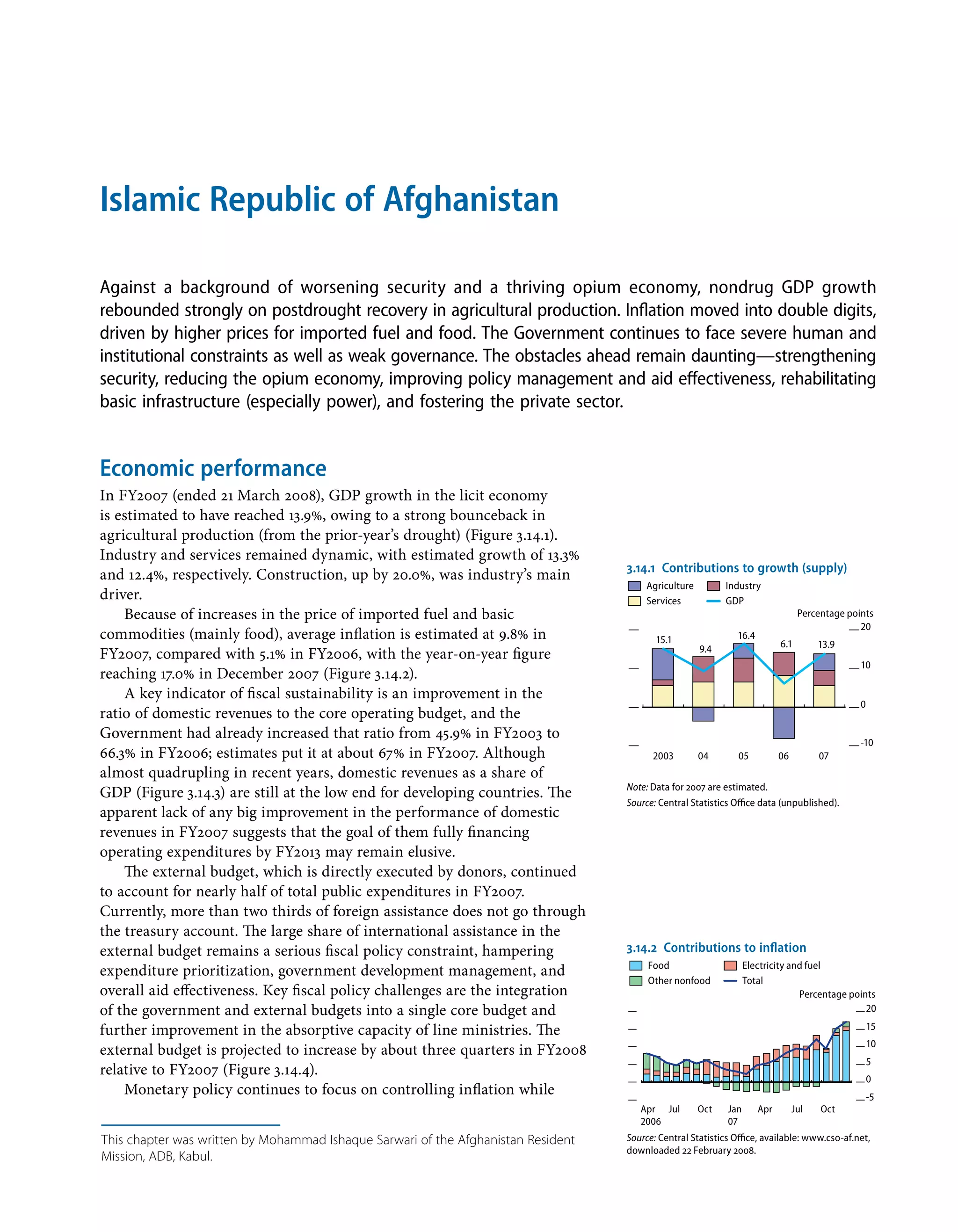
In FY2007 (ended 21 March 2008), GDP growth in the licit economy
is estimated to have reached 13.9%, owing to a strong bounceback in
agricultural production (from the prior-year’s drought) (Figure 3.14.1).
Industry and services remained dynamic, with estimated growth of 13.3%
and 12.4%, respectively. Construction, up by 20.0%, was industry’s main
driver.
Because of increases in the price of imported fuel and basic
commodities (mainly food), average inflation is estimated at 9.8% in
FY2007, compared with 5.1% in FY2006, with the year-on-year figure
reaching 17.0% in December 2007 (Figure 3.14.2).
A key indicator of fiscal sustainability is an improvement in the
ratio of domestic revenues to the core operating budget, and the
Government had already increased that ratio from 45.9% in FY2003 to
66.3% in FY2006; estimates put it at about 67% in FY2007. Although
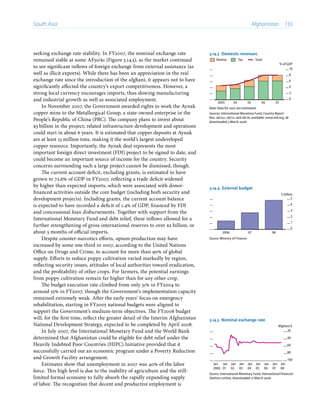
almost quadrupling in recent years, domestic revenues as a share of
GDP (Figure 3.14.3) are still at the low end for developing countries. The
apparent lack of any big improvement in the performance of domestic
revenues in FY2007 suggests that the goal of them fully financing
operating expenditures by FY2013 may remain elusive.
The external budget, which is directly executed by donors, continued
to account for nearly half of total public expenditures in FY2007.
Currently, more than two thirds of foreign assistance does not go through
the treasury account. The large share of international assistance in the
external budget remains a serious fiscal policy constraint, hampering
expenditure prioritization, government development management, and
overall aid effectiveness. Key fiscal policy challenges are the integration
of the government and external budgets into a single core budget and
further improvement in the absorptive capacity of line ministries. The
external budget is projected to increase by about three quarters in FY2008
relative to FY2007 (Figure 3.14.4).
Monetary policy continues to focus on controlling inflation while
3.14.1  Contributions to growth (supply)
13.96.1
16.4
9.4
15.1
2003 04 05 06 07
-10
0
10
20
Percentage points
Services
IndustryAgriculture
GDP
Note: Data for 2007 are estimated.
Source: Central Statistics Office data (unpublished).
3.14.2  Contributions to inflation
Apr
2006
Jul Oct Jan
07
Apr Jul Oct
Percentage points
-5
0
5
10
15
20
Food Electricity and fuel
Other nonfood Total
Source: Central Statistics Office, available: www.cso-af.net,
downloaded 22 February 2008.
This chapter was written by Mohammad Ishaque Sarwari of the Afghanistan Resident
Mission, ADB, Kabul.
South Asia	 Afghanistan   155
seeking exchange rate stability. In FY2007, the nominal exchange rate
remained stable at some AF50/$1 (Figure 3.14.5), as the market continued
to see significant inflows of foreign exchange from external assistance (as
well as illicit exports). While there has been an appreciation in the real
exchange rate since the introduction of the afghani, it appears not to have
significantly affected the country’s export competitiveness. However, a
strong local currency encourages imports, thus slowing manufacturing
and industrial growth as well as associated employment.
In November 2007, the Government awarded rights to work the Aynak
copper mine to the Metallurgical Group, a state-owned enterprise in the
People’s Republic of China (PRC). The company plans to invest about
$3 billion in the project; related infrastructure development and operations
could start in about 6 years. It is estimated that copper deposits at Aynak
are at least 13 million tons, making it the world’s largest undeveloped
copper resource. Importantly, the Aynak deal represents the most
important foreign direct investment (FDI) project to be signed to date, and
could become an important source of income for the country. Security
concerns surrounding such a large project cannot be dismissed, though.
The current account deficit, excluding grants, is estimated to have
grown to 72.6% of GDP in FY2007, reflecting a trade deficit widened
by higher than expected imports, which were associated with donor-
financed activities outside the core budget (including both security and
development projects). Including grants, the current account balance
is expected to have recorded a deficit of 1.4% of GDP, financed by FDI
and concessional loan disbursements. Together with support from the
International Monetary Fund and debt relief, these inflows allowed for a
further strengthening of gross international reserves to over $2 billion, or
about 5 months of official imports.
Despite counter-narcotics efforts, opium production may have
increased by some one third in 2007, according to the United Nations
Office on Drugs and Crime, to account for more than 90% of global
supply. Efforts to reduce poppy cultivation varied markedly by region,
reflecting security issues, attitudes of local authorities toward eradication,
and the profitability of other crops. For farmers, the potential earnings
from poppy cultivation remain far higher than for any other crop.
The budget execution rate climbed from only 31% in FY2004 to
around 55% in FY2007, though the Government’s implementation capacity
remained extremely weak. After the early years’ focus on emergency
rehabilitation, starting in FY2005 national budgets were aligned to
support the Government’s medium-term objectives. The FY2008 budget
will, for the first time, reflect the greater detail of the Interim Afghanistan
National Development Strategy, expected to be completed by April 2008.
In July 2007, the International Monetary Fund and the World Bank
determined that Afghanistan could be eligible for debt relief under the
Heavily Indebted Poor Countries (HIPC) Initiative provided that it
successfully carried out an economic program under a Poverty Reduction
and Growth Facility arrangement.
Estimates show that unemployment in 2007 was 40% of the labor
force. This high level is due to the inability of agriculture and the still-
limited formal economy to fully absorb the rapidly expanding supply
of labor. The recognition that decent and productive employment is
3.14.3  Domestic revenues
0
2
4
6
8
10
Nontax Tax Total
070605042003
% of GDP
Note: Data for 2007 are estimated.
Sources: International Monetary Fund, Country Report
Nos. 06/251, 08/72, and 08/76, available: www.imf.org, all
downloaded 3 March 2008.
3.14.4  External budget
$ billion
0
1
2
3
4
5
08072006
Source: Ministry of Finance.
3.14.5  Nominal exchange rate
20
40
60
80
100
Jan
2000
Jan
01
Jan
02
Jan
03
Jan
04
Jan
05
Jan
06
Jan
07
Jan
08
Afghani/$
Source: International Monetary Fund, International Financial
Statistics online, downloaded 17 March 2008.
156   Asian Development Outlook 2008
crucial to further development—as well as to security—has led to greater
recognition of the importance of a pro-employment development strategy.
Economic prospects
Recent growth in the licit economy has derived largely from externally
financed development efforts. Performance over the medium term
will depend heavily on government success in combating corruption,
overcoming infrastructure bottlenecks, and implementing further
structural reforms, all of which are needed to stimulate private sector
investment. Continued high growth rates will be attainable only if
structural reforms are implemented decisively and public investment is
targeted at key areas of infrastructure, notably transport and electricity.
Further growth in services and construction is expected, mainly
reflecting donor support. On the assumption that such largesse is
maintained and that no drought or other factors affect agricultural
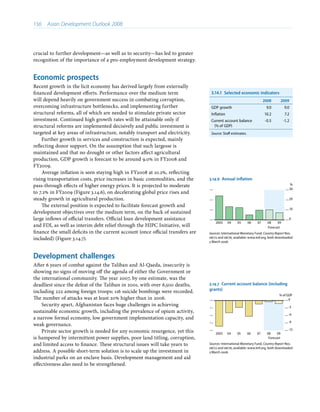
production, GDP growth is forecast to be around 9.0% in FY2008 and
FY2009.
Average inflation is seen staying high in FY2008 at 10.2%, reflecting
rising transportation costs, price increases in basic commodities, and the
pass-through effects of higher energy prices. It is projected to moderate
to 7.2% in FY2009 (Figure 3.14.6), on decelerating global price rises and
steady growth in agricultural production.
The external position is expected to facilitate forecast growth and
development objectives over the medium term, on the back of sustained
large inflows of official transfers. Official loan development assistance
and FDI, as well as interim debt relief through the HIPC Initiative, will
finance the small deficits in the current account (once official transfers are
included) (Figure 3.14.7).
Development challenges
After 6 years of combat against the Taliban and Al-Qaeda, insecurity is
showing no signs of moving off the agenda of either the Government or
the international community. The year 2007, by one estimate, was the
deadliest since the defeat of the Taliban in 2001, with over 6,500 deaths,
including 222 among foreign troops; 116 suicide bombings were recorded.
The number of attacks was at least 20% higher than in 2006.
Security apart, Afghanistan faces huge challenges in achieving
sustainable economic growth, including the prevalence of opium activity,
a narrow formal economy, low government implementation capacity, and
weak governance.
Private sector growth is needed for any economic resurgence, yet this
is hampered by intermittent power supplies, poor land titling, corruption,
and limited access to finance. These structural issues will take years to
address. A possible short-term solution is to scale up the investment in
industrial parks on an enclave basis. Development management and aid
effectiveness also need to be strengthened.
3.14.1  Selected economic indicators
2008 2009
GDP growth 9.0 9.0
Inflation 10.2 7.2
Current account balance
(% of GDP)
-0.5 -1.2
Source: Staff estimates.
3.14.6  Annual inflation
0
10
20
30
0908070605042003
%
Forecast
Sources: International Monetary Fund, Country Report Nos.
08/72 and 08/76, available: www.imf.org, both downloaded
3 March 2008.
3.14.7  Current account balance (including
grants)
-12
-9
-6
-3
0
0908070605042003
% of GDP
Forecast
Sources: International Monetary Fund, Country Report Nos.
08/72 and 08/76, available: www.imf.org, both downloaded
3 March 2008.

ado 2008

  • 1.
    Islamic Republic ofAfghanistan Against a background of worsening security and a thriving opium economy, nondrug GDP growth rebounded strongly on postdrought recovery in agricultural production. Inflation moved into double digits, driven by higher prices for imported fuel and food. The Government continues to face severe human and institutional constraints as well as weak governance. The obstacles ahead remain daunting—strengthening security, reducing the opium economy, improving policy management and aid effectiveness, rehabilitating basic infrastructure (especially power), and fostering the private sector. Economic performance In FY2007 (ended 21 March 2008), GDP growth in the licit economy is estimated to have reached 13.9%, owing to a strong bounceback in agricultural production (from the prior-year’s drought) (Figure 3.14.1). Industry and services remained dynamic, with estimated growth of 13.3% and 12.4%, respectively. Construction, up by 20.0%, was industry’s main driver. Because of increases in the price of imported fuel and basic commodities (mainly food), average inflation is estimated at 9.8% in FY2007, compared with 5.1% in FY2006, with the year-on-year figure reaching 17.0% in December 2007 (Figure 3.14.2). A key indicator of fiscal sustainability is an improvement in the ratio of domestic revenues to the core operating budget, and the Government had already increased that ratio from 45.9% in FY2003 to 66.3% in FY2006; estimates put it at about 67% in FY2007. Although almost quadrupling in recent years, domestic revenues as a share of GDP (Figure 3.14.3) are still at the low end for developing countries. The apparent lack of any big improvement in the performance of domestic revenues in FY2007 suggests that the goal of them fully financing operating expenditures by FY2013 may remain elusive. The external budget, which is directly executed by donors, continued to account for nearly half of total public expenditures in FY2007. Currently, more than two thirds of foreign assistance does not go through the treasury account. The large share of international assistance in the external budget remains a serious fiscal policy constraint, hampering expenditure prioritization, government development management, and overall aid effectiveness. Key fiscal policy challenges are the integration of the government and external budgets into a single core budget and further improvement in the absorptive capacity of line ministries. The external budget is projected to increase by about three quarters in FY2008 relative to FY2007 (Figure 3.14.4). Monetary policy continues to focus on controlling inflation while 3.14.1  Contributions to growth (supply) 13.96.1 16.4 9.4 15.1 2003 04 05 06 07 -10 0 10 20 Percentage points Services IndustryAgriculture GDP Note: Data for 2007 are estimated. Source: Central Statistics Office data (unpublished). 3.14.2  Contributions to inflation Apr 2006 Jul Oct Jan 07 Apr Jul Oct Percentage points -5 0 5 10 15 20 Food Electricity and fuel Other nonfood Total Source: Central Statistics Office, available: www.cso-af.net, downloaded 22 February 2008. This chapter was written by Mohammad Ishaque Sarwari of the Afghanistan Resident Mission, ADB, Kabul.
  • 2.
    South Asia Afghanistan  155 seeking exchange rate stability. In FY2007, the nominal exchange rate remained stable at some AF50/$1 (Figure 3.14.5), as the market continued to see significant inflows of foreign exchange from external assistance (as well as illicit exports). While there has been an appreciation in the real exchange rate since the introduction of the afghani, it appears not to have significantly affected the country’s export competitiveness. However, a strong local currency encourages imports, thus slowing manufacturing and industrial growth as well as associated employment. In November 2007, the Government awarded rights to work the Aynak copper mine to the Metallurgical Group, a state-owned enterprise in the People’s Republic of China (PRC). The company plans to invest about $3 billion in the project; related infrastructure development and operations could start in about 6 years. It is estimated that copper deposits at Aynak are at least 13 million tons, making it the world’s largest undeveloped copper resource. Importantly, the Aynak deal represents the most important foreign direct investment (FDI) project to be signed to date, and could become an important source of income for the country. Security concerns surrounding such a large project cannot be dismissed, though. The current account deficit, excluding grants, is estimated to have grown to 72.6% of GDP in FY2007, reflecting a trade deficit widened by higher than expected imports, which were associated with donor- financed activities outside the core budget (including both security and development projects). Including grants, the current account balance is expected to have recorded a deficit of 1.4% of GDP, financed by FDI and concessional loan disbursements. Together with support from the International Monetary Fund and debt relief, these inflows allowed for a further strengthening of gross international reserves to over $2 billion, or about 5 months of official imports. Despite counter-narcotics efforts, opium production may have increased by some one third in 2007, according to the United Nations Office on Drugs and Crime, to account for more than 90% of global supply. Efforts to reduce poppy cultivation varied markedly by region, reflecting security issues, attitudes of local authorities toward eradication, and the profitability of other crops. For farmers, the potential earnings from poppy cultivation remain far higher than for any other crop. The budget execution rate climbed from only 31% in FY2004 to around 55% in FY2007, though the Government’s implementation capacity remained extremely weak. After the early years’ focus on emergency rehabilitation, starting in FY2005 national budgets were aligned to support the Government’s medium-term objectives. The FY2008 budget will, for the first time, reflect the greater detail of the Interim Afghanistan National Development Strategy, expected to be completed by April 2008. In July 2007, the International Monetary Fund and the World Bank determined that Afghanistan could be eligible for debt relief under the Heavily Indebted Poor Countries (HIPC) Initiative provided that it successfully carried out an economic program under a Poverty Reduction and Growth Facility arrangement. Estimates show that unemployment in 2007 was 40% of the labor force. This high level is due to the inability of agriculture and the still- limited formal economy to fully absorb the rapidly expanding supply of labor. The recognition that decent and productive employment is 3.14.3  Domestic revenues 0 2 4 6 8 10 Nontax Tax Total 070605042003 % of GDP Note: Data for 2007 are estimated. Sources: International Monetary Fund, Country Report Nos. 06/251, 08/72, and 08/76, available: www.imf.org, all downloaded 3 March 2008. 3.14.4  External budget $ billion 0 1 2 3 4 5 08072006 Source: Ministry of Finance. 3.14.5  Nominal exchange rate 20 40 60 80 100 Jan 2000 Jan 01 Jan 02 Jan 03 Jan 04 Jan 05 Jan 06 Jan 07 Jan 08 Afghani/$ Source: International Monetary Fund, International Financial Statistics online, downloaded 17 March 2008.
  • 3.
    156   Asian DevelopmentOutlook 2008 crucial to further development—as well as to security—has led to greater recognition of the importance of a pro-employment development strategy. Economic prospects Recent growth in the licit economy has derived largely from externally financed development efforts. Performance over the medium term will depend heavily on government success in combating corruption, overcoming infrastructure bottlenecks, and implementing further structural reforms, all of which are needed to stimulate private sector investment. Continued high growth rates will be attainable only if structural reforms are implemented decisively and public investment is targeted at key areas of infrastructure, notably transport and electricity. Further growth in services and construction is expected, mainly reflecting donor support. On the assumption that such largesse is maintained and that no drought or other factors affect agricultural production, GDP growth is forecast to be around 9.0% in FY2008 and FY2009. Average inflation is seen staying high in FY2008 at 10.2%, reflecting rising transportation costs, price increases in basic commodities, and the pass-through effects of higher energy prices. It is projected to moderate to 7.2% in FY2009 (Figure 3.14.6), on decelerating global price rises and steady growth in agricultural production. The external position is expected to facilitate forecast growth and development objectives over the medium term, on the back of sustained large inflows of official transfers. Official loan development assistance and FDI, as well as interim debt relief through the HIPC Initiative, will finance the small deficits in the current account (once official transfers are included) (Figure 3.14.7). Development challenges After 6 years of combat against the Taliban and Al-Qaeda, insecurity is showing no signs of moving off the agenda of either the Government or the international community. The year 2007, by one estimate, was the deadliest since the defeat of the Taliban in 2001, with over 6,500 deaths, including 222 among foreign troops; 116 suicide bombings were recorded. The number of attacks was at least 20% higher than in 2006. Security apart, Afghanistan faces huge challenges in achieving sustainable economic growth, including the prevalence of opium activity, a narrow formal economy, low government implementation capacity, and weak governance. Private sector growth is needed for any economic resurgence, yet this is hampered by intermittent power supplies, poor land titling, corruption, and limited access to finance. These structural issues will take years to address. A possible short-term solution is to scale up the investment in industrial parks on an enclave basis. Development management and aid effectiveness also need to be strengthened. 3.14.1  Selected economic indicators 2008 2009 GDP growth 9.0 9.0 Inflation 10.2 7.2 Current account balance (% of GDP) -0.5 -1.2 Source: Staff estimates. 3.14.6  Annual inflation 0 10 20 30 0908070605042003 % Forecast Sources: International Monetary Fund, Country Report Nos. 08/72 and 08/76, available: www.imf.org, both downloaded 3 March 2008. 3.14.7  Current account balance (including grants) -12 -9 -6 -3 0 0908070605042003 % of GDP Forecast Sources: International Monetary Fund, Country Report Nos. 08/72 and 08/76, available: www.imf.org, both downloaded 3 March 2008.