

Hands For Coverage
What should we include in each section of our yearbook?   What is the Magic Formula? Do you have ideas for more creative coverage? Do you have examples of Creative Coverage? Do you have ideas on how to find new angles for coverage? Creative Coverage
Part 1: Student Life   Focus on students, what they do both at school and at home. Concentrate on dramatic photos. Add some extra pages here, so that appropriate topics can be added without having to omit anything crucial. Have fun with this section; cover some lighter topics. Keep it fresh by changing the topics from year to year. Include coverage of events that are non-academic or  non-sport such as prom, graduation, homecoming, etc.
Organizations   All groups should be included and covered fairly/equally. Link similar groups and continue to design in spreads rather than allocating single pages to this individual groups. Copy should avoid listing officers, goals and other mundane information and should attempt to capture the highlights of major events. Include action photos from a variety of club activities rather than taking all shots of a few people on the same day.
People   Portraits should be vertical in shape, not square. Faculty and other staff portraits should not be larger than the student mug shots. One point rule (rather than a full pica) separates portraits, allowing the staff to create a panel that serves as the dominant element. Every spread should include a feature that is developed with candid photos, captions, copy, headlines.
Academics   Readers assume it will be boring; prove them wrong. Place emphasis on what happens in the classroom, not which courses are taught. Avoid cliché photos (teachers at chalkboard, kids reading) and photos of mob scenes or the tops or backs of students’ heads while at work. Use quotes to demonstrate both teachers’ and students’ views .
Sports   Include all boys’ and girls’ sports on all levels; include team photos for all sports and keep the photo identifications consistent; use first and last names of all players. Give each varsity sport one spread for the boys’ and one spread for the girls’ teams; you can combine JV sports on the same spread. Don’t overemphasize any one sport or diminish others; i.e. coverage for football and for golf should be equal. Run a complete scoreboard; avoid rehashing that info in copy. Include other sports-related spreads: fans, managers, coaches, trainers, intramurals, club sports, non-school sports, weekend athletes .
Ads and Index   Include all students, faculty, staff and organizations in the index; i.e. index items such as French Club, Girls’ Soccer, Homecoming. Break up the monotony of this section with feature stories showing students’ roles in the community (as workers, consumers, volunteers, etc.) or quotes relating to events that occurred during the school year. Include candid photos with captains. Include annual events as well as spot news coverage
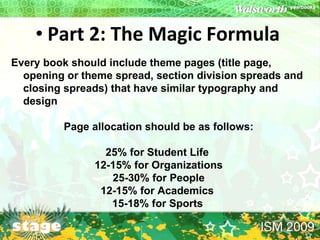
Part 2: The Magic Formula   Every book should include theme pages (title page, opening or theme spread, section division spreads and closing spreads) that have similar typography and design Page allocation should be as follows: 25% for Student Life  12-15% for Organizations 25-30% for People 12-15% for Academics  15-18% for Sports
Part 3: Thirteen Ideas of Creative Coverage   Side Bars Create More Reader Appeal and Are Easy and Fun to Read Include these items in your sidebars:  1. Lists   Top ten lists, Top five lists, Popular movies, Songs, Television Shows, Hangouts, etc.  2. Side bars   Pull the reader’s attention to special stories, bios, important info  3. Q & A  Interviews and photos with students not pictured elsewhere  4. First-person narratives Stories contributed by students who are not on the yearbook staff  5. Info-graphics A graphical presentation of information; polls and results
Part 3: Ideas of Creative Coverage   Side Bars Create More Reader Appeal and Are Easy and Fun to Read Include these items in your sidebars:  6. Bio Boxes Q & A’s, interviews, mini-features, stories that are self-contained  7. Timelines  Historical record of events and people during a given time  8. Quote collections  A series of quotes on a given topic  9. Quizzes  An excellent way of making your yearbook more interactive for the entire student body
Part 3: Ideas of Creative Coverage   Side Bars Create More Reader Appeal and Are Easy and Fun to Read Include these items in your sidebars:  10. Tables  Charts, graphics; an artistic presentation of information  11. Public opinion polls Polls or surveys of students with results  12. Story captions Captions on a given spread tell the story of that event or topic  13. Fill-in-the-blank  An excellent way for students to customize their yearbook
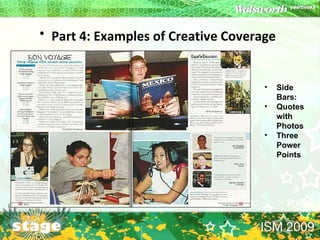
Part 4: Examples of Creative Coverage   Side Bars: Quotes with Photos Three Power Points
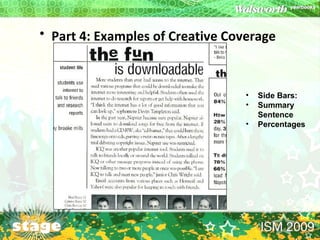
Part 4: Examples of Creative Coverage   Side Bars: Summary Sentence Percentages
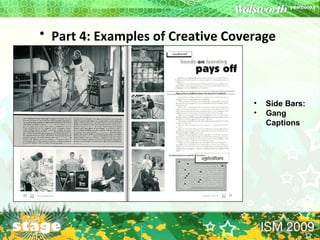
Part 4: Examples of Creative Coverage   Side Bars: Gang Captions
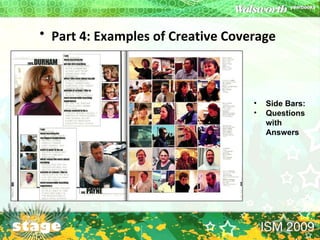
Part 4: Examples of Creative Coverage   Side Bars: Questions with Answers
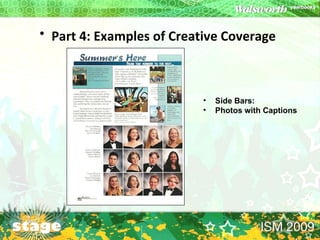
Part 4: Examples of Creative Coverage   Side Bars: Photos with Captions
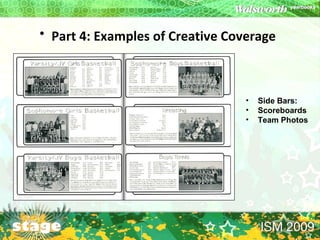
Part 4: Examples of Creative Coverage   Side Bars: Scoreboards Team Photos
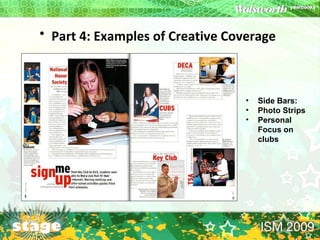
Part 4: Examples of Creative Coverage   Side Bars: Photo Strips Personal Focus on clubs
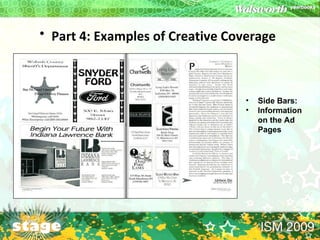
Part 4: Examples of Creative Coverage   Side Bars: Information on the Ad Pages
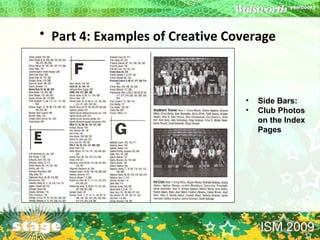
Part 4: Examples of Creative Coverage   Side Bars: Club Photos on the Index Pages
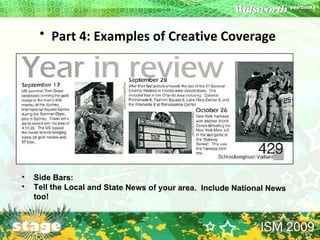
Part 4: Examples of Creative Coverage   Side Bars: Tell the Local and State News of your area.  Include National News too!
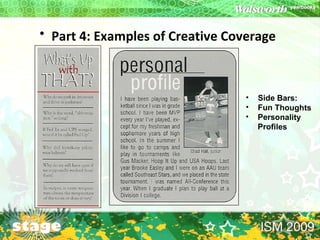
Part 4: Examples of Creative Coverage   Side Bars: Fun Thoughts Personality Profiles
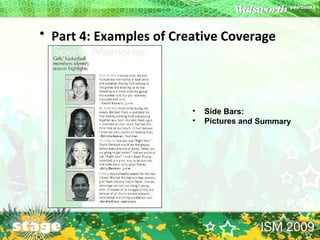
Part 4: Examples of Creative Coverage   Side Bars: Pictures and Summary
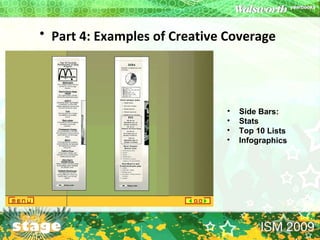
Part 4: Examples of Creative Coverage   Side Bars: Stats Top 10 Lists Infographics
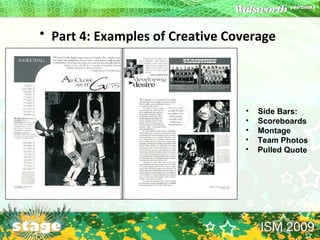
Part 4: Examples of Creative Coverage   Side Bars: Scoreboards Montage Team Photos Pulled Quote
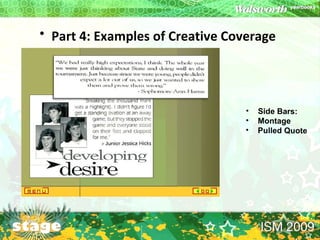
Part 4: Examples of Creative Coverage   Side Bars: Montage Pulled Quote
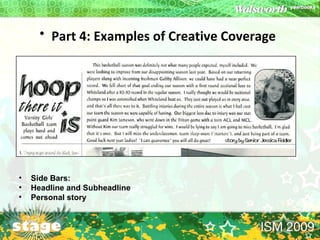
Part 4: Examples of Creative Coverage   Side Bars: Headline and Subheadline Personal story
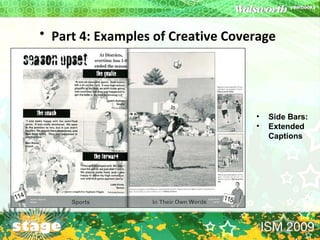
Part 4: Examples of Creative Coverage   Side Bars: Extended Captions
Part 5: Ideas to Find New Angles for Coverage   Analyze each activity for the pieces that make up the entire picture. For instance, homecoming is not just about the last play of the football game or the five-minute coronation of the queen and her court. There is the planning, the execution and the clean-up. Find new angles in all of the traditional, seasonal activities that are part of every school year.
Part 5: Ideas to Find New Angles for Coverage   Summer's (or Vacation's) End Consider how students get ready to go back to school: the last week, the last weekend, the last night before the first day of school 2. Casual pre-school gatherings with friends  3. Cranking up those summer job hours for a few extra dollars  4. Football scrimmages  5. Drill team and band practice  6. Orientation
Part 5: Ideas to Find New Angles for Coverage   School Play Whether it is a musical or a drama, contemporary or historical, the school play requires tremendous energy from its cast and usually attracts a significant audience from the student body and the community. Coverage limited to stars as they perform will limit the appeal of the spread. Branch out from the obvious by looking at these possibilities:
Part 5: Ideas to Find New Angles for Coverage   Hands For Coverage Try It
Part 5: Ideas to Find New Angles for Coverage   School Play Trying outs  Rehearsals  Set construction, costume design Lighting design  Stage crew members in action Selling tickets, preparing programs  Behind the scenes — make-up, costume fittings  Reactions from audience members  Cast retreat or cast party
Summary   Capture the events, issues and activities important to the students. The People section is usually the largest section of the yearbook and student life is a close second. A topic is a subject such as homecoming or track.  You should focus on stories such as students who did not attend the homecoming dance or the injury to a track team member. A story in the yearbook should focus on a person or people and their experiences related to the subject, event or activity. On your ladder, please include all eight items: Section-Student Life Topic-Homecoming Story Idea-Banned Floats Deadline Date People Assigned Color Information Design template Status of Spread-Completed or Not

Coverage

  • 1.
  • 2.
    What should weinclude in each section of our yearbook? What is the Magic Formula? Do you have ideas for more creative coverage? Do you have examples of Creative Coverage? Do you have ideas on how to find new angles for coverage? Creative Coverage
  • 3.
    Part 1: StudentLife Focus on students, what they do both at school and at home. Concentrate on dramatic photos. Add some extra pages here, so that appropriate topics can be added without having to omit anything crucial. Have fun with this section; cover some lighter topics. Keep it fresh by changing the topics from year to year. Include coverage of events that are non-academic or non-sport such as prom, graduation, homecoming, etc.
  • 4.
    Organizations All groups should be included and covered fairly/equally. Link similar groups and continue to design in spreads rather than allocating single pages to this individual groups. Copy should avoid listing officers, goals and other mundane information and should attempt to capture the highlights of major events. Include action photos from a variety of club activities rather than taking all shots of a few people on the same day.
  • 5.
    People Portraits should be vertical in shape, not square. Faculty and other staff portraits should not be larger than the student mug shots. One point rule (rather than a full pica) separates portraits, allowing the staff to create a panel that serves as the dominant element. Every spread should include a feature that is developed with candid photos, captions, copy, headlines.
  • 6.
    Academics Readers assume it will be boring; prove them wrong. Place emphasis on what happens in the classroom, not which courses are taught. Avoid cliché photos (teachers at chalkboard, kids reading) and photos of mob scenes or the tops or backs of students’ heads while at work. Use quotes to demonstrate both teachers’ and students’ views .
  • 7.
    Sports Include all boys’ and girls’ sports on all levels; include team photos for all sports and keep the photo identifications consistent; use first and last names of all players. Give each varsity sport one spread for the boys’ and one spread for the girls’ teams; you can combine JV sports on the same spread. Don’t overemphasize any one sport or diminish others; i.e. coverage for football and for golf should be equal. Run a complete scoreboard; avoid rehashing that info in copy. Include other sports-related spreads: fans, managers, coaches, trainers, intramurals, club sports, non-school sports, weekend athletes .
  • 8.
    Ads and Index Include all students, faculty, staff and organizations in the index; i.e. index items such as French Club, Girls’ Soccer, Homecoming. Break up the monotony of this section with feature stories showing students’ roles in the community (as workers, consumers, volunteers, etc.) or quotes relating to events that occurred during the school year. Include candid photos with captains. Include annual events as well as spot news coverage
  • 9.
    Part 2: TheMagic Formula Every book should include theme pages (title page, opening or theme spread, section division spreads and closing spreads) that have similar typography and design Page allocation should be as follows: 25% for Student Life 12-15% for Organizations 25-30% for People 12-15% for Academics 15-18% for Sports
  • 10.
    Part 3: ThirteenIdeas of Creative Coverage Side Bars Create More Reader Appeal and Are Easy and Fun to Read Include these items in your sidebars: 1. Lists Top ten lists, Top five lists, Popular movies, Songs, Television Shows, Hangouts, etc. 2. Side bars Pull the reader’s attention to special stories, bios, important info 3. Q & A Interviews and photos with students not pictured elsewhere 4. First-person narratives Stories contributed by students who are not on the yearbook staff 5. Info-graphics A graphical presentation of information; polls and results
  • 11.
    Part 3: Ideasof Creative Coverage Side Bars Create More Reader Appeal and Are Easy and Fun to Read Include these items in your sidebars: 6. Bio Boxes Q & A’s, interviews, mini-features, stories that are self-contained 7. Timelines Historical record of events and people during a given time 8. Quote collections A series of quotes on a given topic 9. Quizzes An excellent way of making your yearbook more interactive for the entire student body
  • 12.
    Part 3: Ideasof Creative Coverage Side Bars Create More Reader Appeal and Are Easy and Fun to Read Include these items in your sidebars: 10. Tables Charts, graphics; an artistic presentation of information 11. Public opinion polls Polls or surveys of students with results 12. Story captions Captions on a given spread tell the story of that event or topic 13. Fill-in-the-blank An excellent way for students to customize their yearbook
  • 13.
    Part 4: Examplesof Creative Coverage Side Bars: Quotes with Photos Three Power Points
  • 14.
    Part 4: Examplesof Creative Coverage Side Bars: Summary Sentence Percentages
  • 15.
    Part 4: Examplesof Creative Coverage Side Bars: Gang Captions
  • 16.
    Part 4: Examplesof Creative Coverage Side Bars: Questions with Answers
  • 17.
    Part 4: Examplesof Creative Coverage Side Bars: Photos with Captions
  • 18.
    Part 4: Examplesof Creative Coverage Side Bars: Scoreboards Team Photos
  • 19.
    Part 4: Examplesof Creative Coverage Side Bars: Photo Strips Personal Focus on clubs
  • 20.
    Part 4: Examplesof Creative Coverage Side Bars: Information on the Ad Pages
  • 21.
    Part 4: Examplesof Creative Coverage Side Bars: Club Photos on the Index Pages
  • 22.
    Part 4: Examplesof Creative Coverage Side Bars: Tell the Local and State News of your area. Include National News too!
  • 23.
    Part 4: Examplesof Creative Coverage Side Bars: Fun Thoughts Personality Profiles
  • 24.
    Part 4: Examplesof Creative Coverage Side Bars: Pictures and Summary
  • 25.
    Part 4: Examplesof Creative Coverage Side Bars: Stats Top 10 Lists Infographics
  • 26.
    Part 4: Examplesof Creative Coverage Side Bars: Scoreboards Montage Team Photos Pulled Quote
  • 27.
    Part 4: Examplesof Creative Coverage Side Bars: Montage Pulled Quote
  • 28.
    Part 4: Examplesof Creative Coverage Side Bars: Headline and Subheadline Personal story
  • 29.
    Part 4: Examplesof Creative Coverage Side Bars: Extended Captions
  • 30.
    Part 5: Ideasto Find New Angles for Coverage Analyze each activity for the pieces that make up the entire picture. For instance, homecoming is not just about the last play of the football game or the five-minute coronation of the queen and her court. There is the planning, the execution and the clean-up. Find new angles in all of the traditional, seasonal activities that are part of every school year.
  • 31.
    Part 5: Ideasto Find New Angles for Coverage Summer's (or Vacation's) End Consider how students get ready to go back to school: the last week, the last weekend, the last night before the first day of school 2. Casual pre-school gatherings with friends 3. Cranking up those summer job hours for a few extra dollars 4. Football scrimmages 5. Drill team and band practice 6. Orientation
  • 32.
    Part 5: Ideasto Find New Angles for Coverage School Play Whether it is a musical or a drama, contemporary or historical, the school play requires tremendous energy from its cast and usually attracts a significant audience from the student body and the community. Coverage limited to stars as they perform will limit the appeal of the spread. Branch out from the obvious by looking at these possibilities:
  • 33.
    Part 5: Ideasto Find New Angles for Coverage Hands For Coverage Try It
  • 34.
    Part 5: Ideasto Find New Angles for Coverage School Play Trying outs Rehearsals Set construction, costume design Lighting design Stage crew members in action Selling tickets, preparing programs Behind the scenes — make-up, costume fittings Reactions from audience members Cast retreat or cast party
  • 35.
    Summary Capture the events, issues and activities important to the students. The People section is usually the largest section of the yearbook and student life is a close second. A topic is a subject such as homecoming or track. You should focus on stories such as students who did not attend the homecoming dance or the injury to a track team member. A story in the yearbook should focus on a person or people and their experiences related to the subject, event or activity. On your ladder, please include all eight items: Section-Student Life Topic-Homecoming Story Idea-Banned Floats Deadline Date People Assigned Color Information Design template Status of Spread-Completed or Not