HOW YOU CAN BE A LAY 
MAGISTRATE. 
Aroosa Shabir
WHO ARE LAY MAGISTRATES AND WHAT 
DO THEY DO? 
 Magistrates are volunteers who work in the magistrates court of 
their own will. 
 It’s their responsibility to listen to cases, and decide on a verdict. 
 There are 3 magistrates on a bench, one of them is a chair 
magistrate and the other 2 are his/hers colleagues. 
 If 2 of the magistrates can’t decide on the same verdict then the 
chair magistrate will decide. 
 They require no legal background or qualifications. 
 To help them decide on a verdict, they will be advised by a legal 
advisor/clerk, but the legal advisor/clerk cannot participate in the 
decision making process.
THE LAYOUT OF A MAGISTRATES COURT 
Magistrates Court Family Court Youth Court
WHAT QUALITIES ARE EXPECTED FROM A LAY 
MAGISTRATE. 
 To attend training courses, which are made to give new magistrates an 
understanding of the functions and the powers of the bench, and what 
needs to be considered when sentencing. 
 Sometimes compulsory training will have to be taken, which consists of 
reading material and distance learning exercises which will cover the duties 
of a magistrate. 
 Team working skills and communication skills are important as you have to 
be able to get along with each other, and be able to work as part of a 
team. 
 If the law changes then magistrates will have to go on a training course, so 
they have knowledge on the change, also if the law on sentencing has 
changed then it is important for them to find out information about it.
 You must be able to understand the framework of the Criminal Justice System 
(CJS), and the work and responsibilities of the police, Crown Prosecution Service 
(CPS) and the jurisdiction of criminal courts. 
 Having knowledge in common offences e.g. driving offences, theft etc., is 
useful. 
 Magistrates are required to keep an open mind and listen to the facts and base 
their verdict on the evidence provided.
TIME AND MONEY 
 Magistrates need to be able to commit for a minimum of 26 half-days 
per year to sit in court. 
 Employers are required by the law to grant time of work for 
magistrates. 
 If you suffer loss of earnings you may claim a loss allowance at a 
set rate. You can also claim allowances for travel, fuel and 
subsistence.
THEIR SENTENCING POWERS 
When sentencing lay magistrates will take the following factors into 
account: 
 The facts of the offence which have been given in court 
 The offenders circumstances 
 The defendants explanation of the offence and any other 
information in the defendants favour. 
When someone has pleaded or been found guilty the magistrates will 
proceed to sentencing, where they have to follow a structured 
decision making process and sentencing guidelines which informs 
them of the expected penalty for typical offences. They will also 
have to take note of case law and any other practice decisions from 
the higher courts.
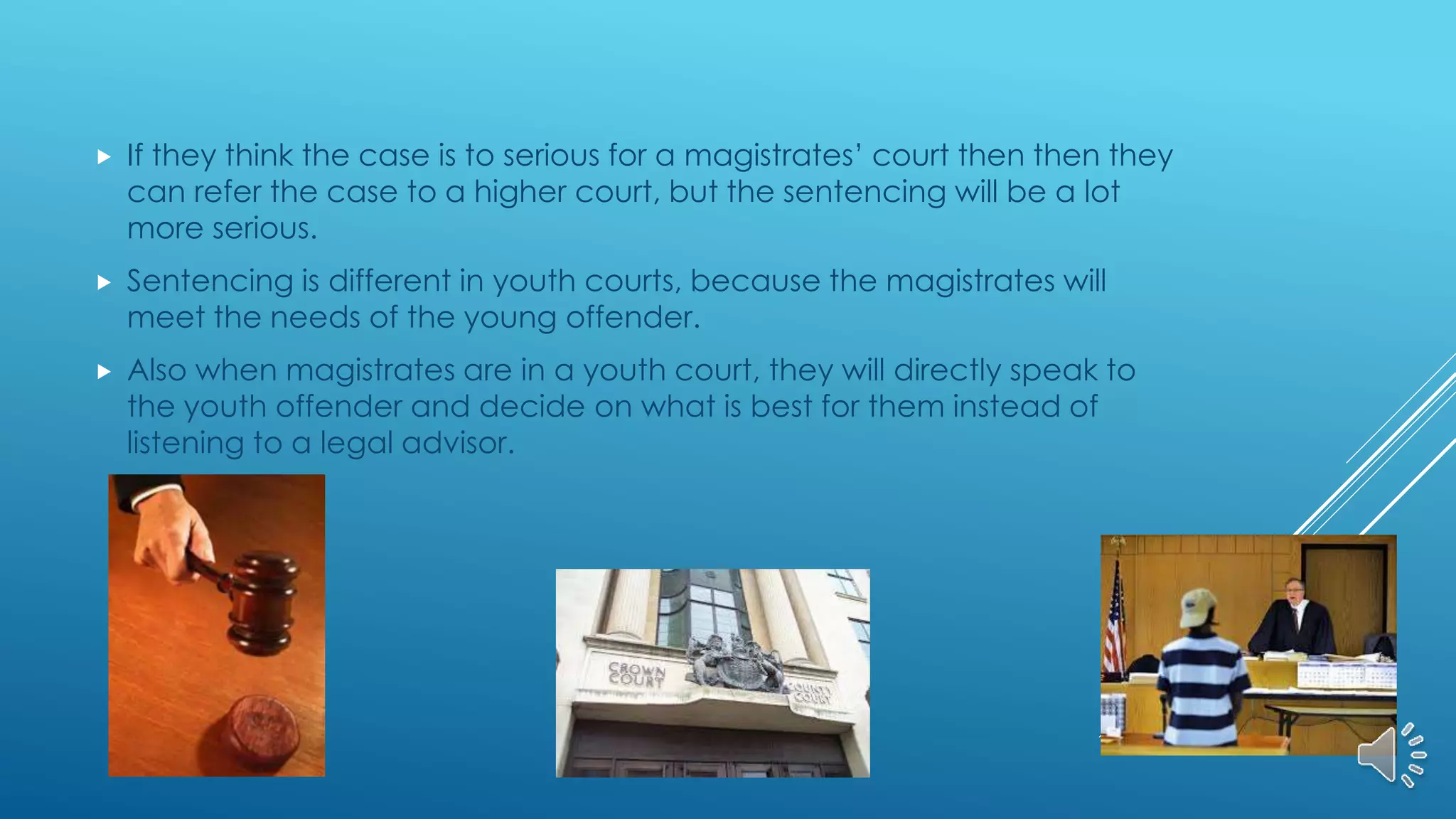
 If they think the case is to serious for a magistrates’ court then then they 
can refer the case to a higher court, but the sentencing will be a lot 
more serious. 
 Sentencing is different in youth courts, because the magistrates will 
meet the needs of the young offender. 
 Also when magistrates are in a youth court, they will directly speak to 
the youth offender and decide on what is best for them instead of 
listening to a legal advisor.
WHAT KIND OF SENTENCES CAN MAGISTRATES 
GIVE? 
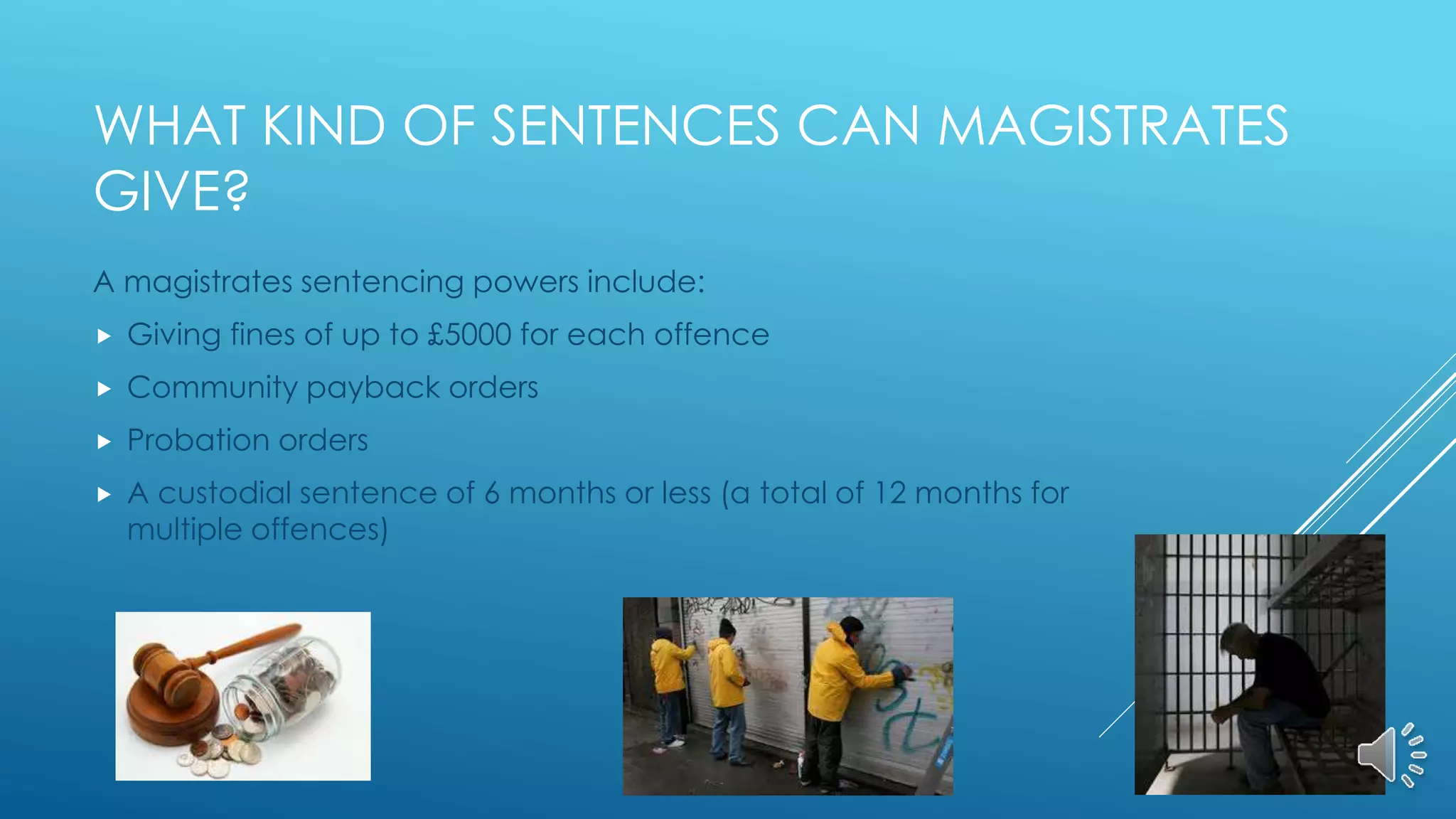
A magistrates sentencing powers include: 
 Giving fines of up to £5000 for each offence 
 Community payback orders 
 Probation orders 
 A custodial sentence of 6 months or less (a total of 12 months for 
multiple offences)
THEIR DEMOGRAPHIC FEATURES 
 You can be a magistrate if you are aged 18-70, but you must be in 
good health and be able to hear clearly so you know what is 
going on in cases. If you are blind you are allowed to be a 
magistrate as long as you can hear clearly, and deaf people are 
not eligible to be magistrates. 
 Magistrates do not have to be British and can be of any 
nationality, but all magistrates have to take an oath of allegiance 
and asylum seekers will not be appointed. 
 You do not have to be from a certain social class or ethnic 
background to become a magistrate, as it is a voluntary position. 
 Females and males can become a magistrate as long as they 
meet the guidelines that are mentioned above.
WHAT KIND OF CASES DO MAGISTRATES DEAL WITH? 
Magistrates deal with 3 kinds of cases: 
 Summary offences - are minor crimes e.g. motoring offences, minor 
assaults etc. 
 Either – way offences – are offences dealt with either the magistrates 
court or before a judge and jury at the crown court, e.g. theft; if petty 
theft has been committed the magistrates court will deal with it, if the 
theft is serious then it will be dealt with in the crown court in front of a 
judge and jury. 
 Indictable offences – are crimes such as murder, rape, manslaughter, 
robbery etc. Magistrates do not have a major influence in indictable 
offences, and these serious crimes must be dealt with in a crown 
court. If indictable offences are dealt with by magistrates in the 
magistrates court they have to decide whether to grant bail. Other 
legal issues such as reporting restrictions will also be considered, and 
then the case will be passed to the crown court.
 Magistrates also work in family courts where they will have to make a decision 
about a child’s future. They will be advised by social workers so that they can 
make a decision that will benefit the child. 
 They also work in youth courts, where they deal directly with the youth 
offender. They do this so that they can meet with the offenders needs and do 
what is best for them instead of listening to their legal advisor. E.g. if a young 
person is in court for assaulting someone and the magistrates find out that 
they have anger issues because of a lot problems at home. Then they will 
advise the young person to take anger management sessions and maybe 
speak to counsellor about their home issues, and they may also get social 
services involved depending on what has gone on in the youth offenders life.
Do you have 
what it takes to 
be a lay 
magistrate?
Lay magistrates powerpoint

Lay magistrates powerpoint

  • 1.
    HOW YOU CANBE A LAY MAGISTRATE. Aroosa Shabir
  • 2.
    WHO ARE LAYMAGISTRATES AND WHAT DO THEY DO?  Magistrates are volunteers who work in the magistrates court of their own will.  It’s their responsibility to listen to cases, and decide on a verdict.  There are 3 magistrates on a bench, one of them is a chair magistrate and the other 2 are his/hers colleagues.  If 2 of the magistrates can’t decide on the same verdict then the chair magistrate will decide.  They require no legal background or qualifications.  To help them decide on a verdict, they will be advised by a legal advisor/clerk, but the legal advisor/clerk cannot participate in the decision making process.
  • 3.
    THE LAYOUT OFA MAGISTRATES COURT Magistrates Court Family Court Youth Court
  • 4.
    WHAT QUALITIES AREEXPECTED FROM A LAY MAGISTRATE.  To attend training courses, which are made to give new magistrates an understanding of the functions and the powers of the bench, and what needs to be considered when sentencing.  Sometimes compulsory training will have to be taken, which consists of reading material and distance learning exercises which will cover the duties of a magistrate.  Team working skills and communication skills are important as you have to be able to get along with each other, and be able to work as part of a team.  If the law changes then magistrates will have to go on a training course, so they have knowledge on the change, also if the law on sentencing has changed then it is important for them to find out information about it.
  • 5.
     You mustbe able to understand the framework of the Criminal Justice System (CJS), and the work and responsibilities of the police, Crown Prosecution Service (CPS) and the jurisdiction of criminal courts.  Having knowledge in common offences e.g. driving offences, theft etc., is useful.  Magistrates are required to keep an open mind and listen to the facts and base their verdict on the evidence provided.
  • 6.
    TIME AND MONEY  Magistrates need to be able to commit for a minimum of 26 half-days per year to sit in court.  Employers are required by the law to grant time of work for magistrates.  If you suffer loss of earnings you may claim a loss allowance at a set rate. You can also claim allowances for travel, fuel and subsistence.
  • 7.
    THEIR SENTENCING POWERS When sentencing lay magistrates will take the following factors into account:  The facts of the offence which have been given in court  The offenders circumstances  The defendants explanation of the offence and any other information in the defendants favour. When someone has pleaded or been found guilty the magistrates will proceed to sentencing, where they have to follow a structured decision making process and sentencing guidelines which informs them of the expected penalty for typical offences. They will also have to take note of case law and any other practice decisions from the higher courts.
  • 8.
     If theythink the case is to serious for a magistrates’ court then then they can refer the case to a higher court, but the sentencing will be a lot more serious.  Sentencing is different in youth courts, because the magistrates will meet the needs of the young offender.  Also when magistrates are in a youth court, they will directly speak to the youth offender and decide on what is best for them instead of listening to a legal advisor.
  • 9.
    WHAT KIND OFSENTENCES CAN MAGISTRATES GIVE? A magistrates sentencing powers include:  Giving fines of up to £5000 for each offence  Community payback orders  Probation orders  A custodial sentence of 6 months or less (a total of 12 months for multiple offences)
  • 10.
    THEIR DEMOGRAPHIC FEATURES  You can be a magistrate if you are aged 18-70, but you must be in good health and be able to hear clearly so you know what is going on in cases. If you are blind you are allowed to be a magistrate as long as you can hear clearly, and deaf people are not eligible to be magistrates.  Magistrates do not have to be British and can be of any nationality, but all magistrates have to take an oath of allegiance and asylum seekers will not be appointed.  You do not have to be from a certain social class or ethnic background to become a magistrate, as it is a voluntary position.  Females and males can become a magistrate as long as they meet the guidelines that are mentioned above.
  • 11.
    WHAT KIND OFCASES DO MAGISTRATES DEAL WITH? Magistrates deal with 3 kinds of cases:  Summary offences - are minor crimes e.g. motoring offences, minor assaults etc.  Either – way offences – are offences dealt with either the magistrates court or before a judge and jury at the crown court, e.g. theft; if petty theft has been committed the magistrates court will deal with it, if the theft is serious then it will be dealt with in the crown court in front of a judge and jury.  Indictable offences – are crimes such as murder, rape, manslaughter, robbery etc. Magistrates do not have a major influence in indictable offences, and these serious crimes must be dealt with in a crown court. If indictable offences are dealt with by magistrates in the magistrates court they have to decide whether to grant bail. Other legal issues such as reporting restrictions will also be considered, and then the case will be passed to the crown court.
  • 12.
     Magistrates alsowork in family courts where they will have to make a decision about a child’s future. They will be advised by social workers so that they can make a decision that will benefit the child.  They also work in youth courts, where they deal directly with the youth offender. They do this so that they can meet with the offenders needs and do what is best for them instead of listening to their legal advisor. E.g. if a young person is in court for assaulting someone and the magistrates find out that they have anger issues because of a lot problems at home. Then they will advise the young person to take anger management sessions and maybe speak to counsellor about their home issues, and they may also get social services involved depending on what has gone on in the youth offenders life.
  • 13.
    Do you have what it takes to be a lay magistrate?