Cost Segregation Studies www.costsegregation.com
What Is A Cost Segregation Study? A formal engineering process acceptable to the IRS that accelerates tax depreciation on buildings and  considerably increases cash flow . Identifies building component costs and land improvements – commonly depreciated over 27.5 or 39 years.  Re-allocates a significant portion of these costs to asset classes with  shorter depreciable lives .
Cost Segregation Buckets Before After 39-year or 27.5-year Soft Costs 5-year 39-year or 27.5-year 7-year 15-year Cost Seg
Re-Allocation to Shorter Tax Lives Per Revenue Procedure 87-56, qualifying construction costs from the property should be depreciated over 5, 7, and 15 years. A re-allocation of assets results in: Accelerated depreciation deductions Reduced tax liability Increase in cash flow
Benefit:  Accelerated Depreciation Deductions
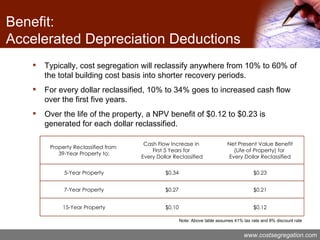
Benefit:  Accelerated Depreciation Deductions  Typically, cost segregation will reclassify anywhere from 10% to 60% of the total building cost basis into shorter recovery periods. For every dollar reclassified, 10% to 34% goes to increased cash flow over the first five years. Over the life of the property, a NPV benefit of $0.12 to $0.23 is generated for each dollar reclassified. Note: Above table assumes 41% tax rate and 8% discount rate Property Reclassified from  39-Year Property to: Cash Flow Increase in  First 5 Years for  Every Dollar Reclassified Net Present Value Benefit (Life of Property) for  Every Dollar Reclassified 5-Year Property $0.34 $0.23 7-Year Property $0.27 $0.21 15-Year Property $0.10 $0.12
Summary of Benefits Tax savings assumes 41% tax rate and 8% discount rate Sample Auto Dealership Dealership placed in service two years prior to study CS moves 8% of cost basis into 5-year and 12% into 15-year property Depreciation expense increases $745,000 over next 5 years Generates  $305,000 in deferred taxes Total deferral has a $257,000 NPV   Without Cost Segregation With Cost Segregation Total Net Increase in Benefits   39 Year 5 Year 7 Year 15 Year 39 Year Depreciable cost basis $7,000,000  $560,000  $  -  $840,000  $5,600,000    First 7 years depreciation $1,166,667  $560,000  $  -  $418,396  $  933,333  $  745,062  First 7 years income tax deferral     $  305,475  Net present value over the life of the project       $  257,467
Questions… KBKG, INC. COST SEGREGATION SPECIALISTS Contact Information Mitchell Lardner Director, Business Development  626.449.4225 x506 [email_address] www.kbkg.com www.costsegregation.com

Cost Segregation Studies

  • 1.
    Cost Segregation Studieswww.costsegregation.com
  • 2.
    What Is ACost Segregation Study? A formal engineering process acceptable to the IRS that accelerates tax depreciation on buildings and considerably increases cash flow . Identifies building component costs and land improvements – commonly depreciated over 27.5 or 39 years. Re-allocates a significant portion of these costs to asset classes with shorter depreciable lives .
  • 3.
    Cost Segregation BucketsBefore After 39-year or 27.5-year Soft Costs 5-year 39-year or 27.5-year 7-year 15-year Cost Seg
  • 4.
    Re-Allocation to ShorterTax Lives Per Revenue Procedure 87-56, qualifying construction costs from the property should be depreciated over 5, 7, and 15 years. A re-allocation of assets results in: Accelerated depreciation deductions Reduced tax liability Increase in cash flow
  • 5.
    Benefit: AcceleratedDepreciation Deductions
  • 6.
    Benefit: AcceleratedDepreciation Deductions Typically, cost segregation will reclassify anywhere from 10% to 60% of the total building cost basis into shorter recovery periods. For every dollar reclassified, 10% to 34% goes to increased cash flow over the first five years. Over the life of the property, a NPV benefit of $0.12 to $0.23 is generated for each dollar reclassified. Note: Above table assumes 41% tax rate and 8% discount rate Property Reclassified from 39-Year Property to: Cash Flow Increase in First 5 Years for Every Dollar Reclassified Net Present Value Benefit (Life of Property) for Every Dollar Reclassified 5-Year Property $0.34 $0.23 7-Year Property $0.27 $0.21 15-Year Property $0.10 $0.12
  • 7.
    Summary of BenefitsTax savings assumes 41% tax rate and 8% discount rate Sample Auto Dealership Dealership placed in service two years prior to study CS moves 8% of cost basis into 5-year and 12% into 15-year property Depreciation expense increases $745,000 over next 5 years Generates $305,000 in deferred taxes Total deferral has a $257,000 NPV   Without Cost Segregation With Cost Segregation Total Net Increase in Benefits   39 Year 5 Year 7 Year 15 Year 39 Year Depreciable cost basis $7,000,000 $560,000 $ - $840,000 $5,600,000   First 7 years depreciation $1,166,667 $560,000 $ - $418,396 $ 933,333 $ 745,062 First 7 years income tax deferral     $ 305,475 Net present value over the life of the project       $ 257,467
  • 8.
    Questions… KBKG, INC.COST SEGREGATION SPECIALISTS Contact Information Mitchell Lardner Director, Business Development 626.449.4225 x506 [email_address] www.kbkg.com www.costsegregation.com

Editor's Notes

  • #2 Note: The presentation has started. If you don't hear any sound...try loggin out and back in. You will need to have speakers on your computer. Please click yes to verify that you are in attendance and to ensure full CPE credit. (you must answer at least 6 of the 8 polling questions asked throughout this presentation) PPTS Good morning everyone! Thank you very much for joining us. My name is Scott Zarret and I’d like to welcome you to CS 201, which is a 2 hour discussion of case law, history and engineering , as it relates to costs segregation. Hopefully, all of you have had a chance to download and print the course materials so you can take notes as we move along. If you haven’t had a chance to download the materials, you can do so at any time during or after the class. If you check your chat box now, I’ll go ahead and paste in that link for you. https://kbkg.webex.com/kbkg/k2/e.php?AT=RINF&recordingID=3654807