Cosmic Ray Detection
Thomas Adams, Cory Oppenheiner
December 5, 2014
Abstract
We measured the operation values of each PMT
using tube characterization scans that allowed
us to read, record, and measure particles passing
through our two scintillators, which allows us to
measure the energy levels of cosmic ray muons
at ground level by setting up and optimizing a
simple Data Acquisition System. Our data is
consistent with our findings and other scientists’
data and experiments
1 Introduction
Cosmic rays are energetic particles that originate
from outside earth’s atmosphere. Being mostly
light, atomic nuclei, cosmic rays are thought
to originate from supernova explosions although
this fact has not been observationally confirmed.
The world’s largest high energy cosmic ray detec-
tor, coving manysquare kilometers in Argentina,
is the Pierre-Auger observatory. Recently, that
telescope has hinted at the possibility that cos-
mic rays originate from highly energetic extra-
galactic sources, not necessarily just supernovae
The main purpose of the Cosmic Ray Detec-
tion experiment was to setup a simple cosmic
ray detection system. We achieved this by us-
ing two scintillating paddles. These two paddles
have Photo Multiplier Tubes or (PMT)s which
are sensors that can sense when light is given
off, due to a high energy particle passing within
the scintillators. These two scintillating paddles
are hooked up to a Data Acquisition System or
(DAQ). However, the main task of our experi-
mental group was to find the best set up of this
system for the collection of cosmic data. Which
includes adjusting threshold levels and the level
of high voltage (HV) applied to each PMT.
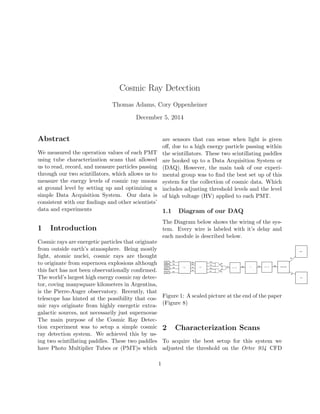
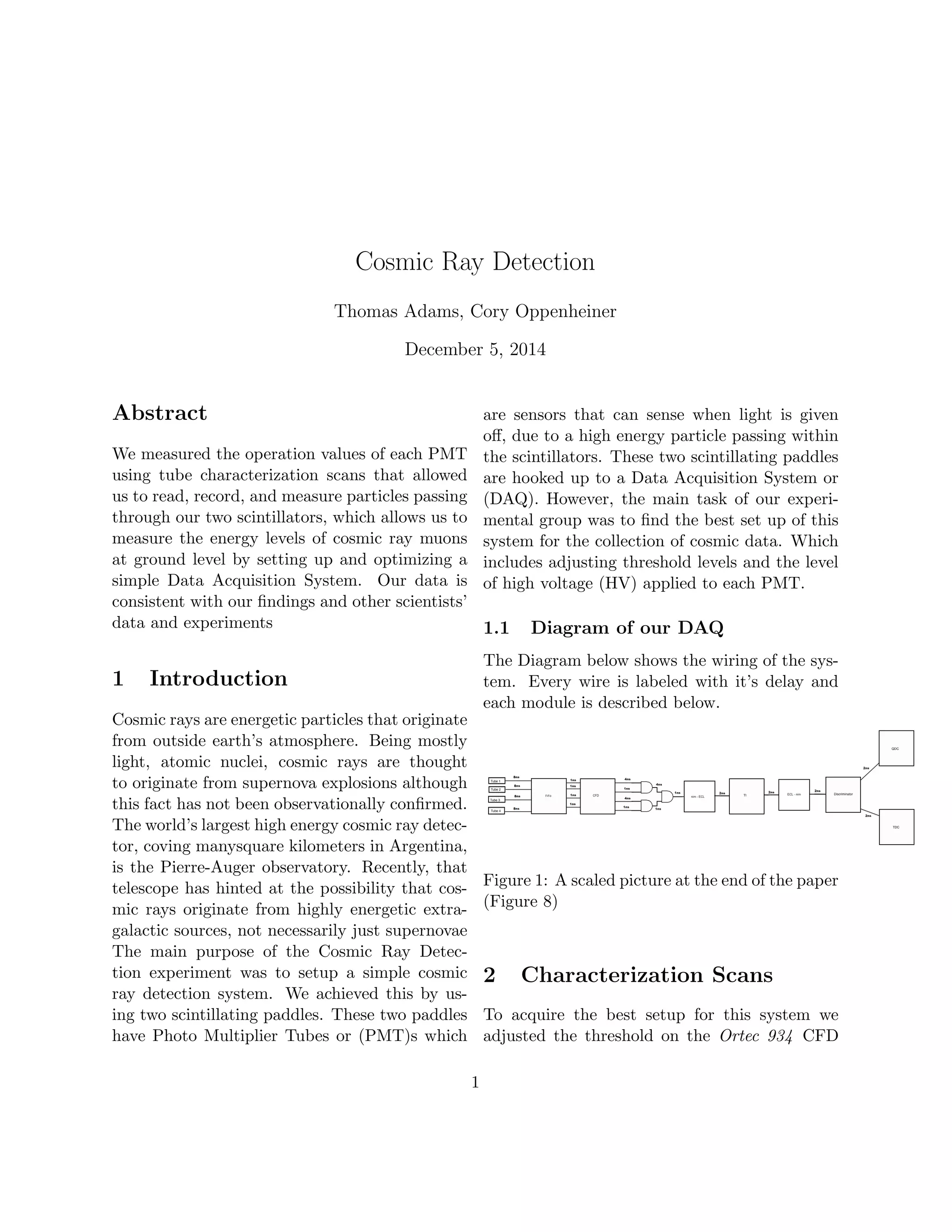
1.1 Diagram of our DAQ
The Diagram below shows the wiring of the sys-
tem. Every wire is labeled with it’s delay and
each module is described below.
Figure 1: A scaled picture at the end of the paper
(Figure 8)
2 Characterization Scans
To acquire the best setup for this system we
adjusted the threshold on the Ortec 934 CFD
1
card and the amount of HV to the PMT using
the CAEN 1470. To figure out what quantities
these two levels must be set at we had to perform
some tube characterization scans. Once a scan
was completed we knew there would be a double
exponential pattern and that the first plateau
would be the appropriate operational levels of
our scan target PMT.
2.1 Rate vs. Threshold
Threshold: the magnitude or intensity that must
be exceeded for a certain reaction, phenomenon,
result, or condition to occur or be manifested. In
this first graph(Figure 2) which plots Rate with
respect to the voltage you can see that at 50[mV]
the threshold is too low and we are simply ob-
serving noise. At 100[mV] we see a linear trend
that maintains all the way up to 500[mV]. We
decided to not go to any higher thresholds, but
to fill in some of the gaps and took more data
points from 150[mV] - 450[mV] By plotting the
log(Rate) vs. Threshold we were able to see a
plot that has a linearly decreasing slope, roughly
picking where the line crosses the y=0 we chose
a threshold of about 250[mV]. See Figure 2 and
Figure 3. We observed that the threshold values
should be measured and characterized for each
tube.
2.2 Rate vs. Voltage
After finding the proper threshold we decided
to do the voltage scans. We started at -1300[V]
to -2000[V] in 50[V] increments. To control the
amount of time we collected data we used the
CAEN N1145. We set the CAEN N1145 to
count events at 600s per each run. This gave
us a nice double plateau, which will give us the
appropriate operation levels As you can see in
Figure 2: Threshold Plot for tube3.
Figure 3: Threshold Plot for tube4.
2
Figure 4, Figure 5, Figure 6 and Figure 7, each
PMT has a different voltage operation level
Figure 4: Voltage Plot for tube1 showing that
tube1 should be set at a voltage of 1700[V].
3 Statistical Uncertainty
During these scans there is always some uncer-
tainty that comes along with it. We used the
Variance Formula to calculate the propagation
of uncertainty of the Log which is the number
of events divided by the total amount of time.
Here is the Variance Formula,
sf =
∂f
∂x
2
s2
x +
∂f
∂t
2
s2
t
Where sx is the error in the number of events
counted, and st is the error in the time. The
variable x is the number of events counted, and
t is the variable for time.
f(x, t) = log
x
t
Figure 5: Voltage Plot for tube2 showing that
tube2 should be set at a voltage of 1790[V].
After plugging in our conditions the equation be-
comes.
sf =
1
xln(10)
2
0 +
−1
600[s]ln(10)
2
0.00052[s]
We assume that there is no error in the events
since there is either an event or not an event.
The error in time we used was half of the smallest
time scale of the CAEN N1145 which is 0.5 [ms].
So, our final uncertainty is equal to:
sf = 3.61912 × 10⁻⁷
3.1 Error in Threshold values
The error in the threshold measurements was
dominated by the error in the multimeter mea-
surement. The meter used is a HT39.
Error in DC Voltage Measurment = +/-
(%0.5 of Readback + 2 of the least signifigant
digit)
3
Figure 6: Voltage Plot for tube3 showing that
tube3 should be set at a voltage of 1825[V].
3.2 Error in the Readback Voltage vs.
Measured Voltage
The error in the voltage is clearly and solely from
the CAEN 1470 voltage.
Error in the Readback Voltage vs. Mea-
sured Voltage = +/-( %0.02 of Readback +/-
2[Volts] )
4 Analyzer/Reading Data
Words
The data taken appears in the following order:
a run count word that tells the run number of
the file, a header word of the QDC to tell hwo
many data words follow (always 16 words) the
data words of the QDC, a header word for the
TDC, the TDC data words, and a closing word
that tells the analyzer to stop parsing.
Figure 7: Voltage Plot for tube4 showing that
tube4 should be set at a voltage of 1720[V].
4.1 Hex to Binary Conversion
The words first appear in hexadecimal, so they
are then converted to binary in order to be read
digitally.On a computer, a word is just a number,
so for the computer it is simply converting one
number to another.
4.2 The Word Make-up
The run count word recalls the run number of
the data. This is used primarily for labeling pur-
poses.
Starting from the left, the first five bits are the
geographical location. This will always be 11111
for this part because our location is constant.
The next three bits denote the kind of word.
A header word will read 010 and a data word
will read 000. For the header word, the next
eight bits denote the crate being used. Both the
TDC and QDC are operating out of crate zero,
so those should be expected to be all 0’s as well.
These are followed by 2 constant zero bits. Fi-
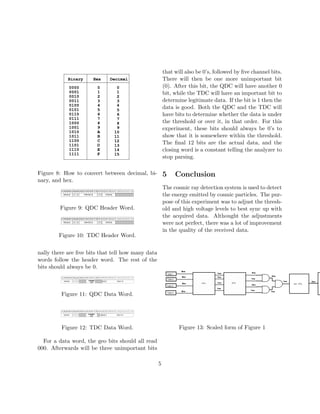
4
Figure 8: How to convert between decimal, bi-
nary, and hex.
Figure 9: QDC Header Word.
Figure 10: TDC Header Word.
nally there are five bits that tell how many data
words follow the header word. The rest of the
bits should always be 0.
Figure 11: QDC Data Word.
Figure 12: TDC Data Word.
For a data word, the geo bits should all read
000. Afterwards will be three unimportant bits
that will also be 0’s, followed by five channel bits.
There will then be one more unimportant bit
(0). After this bit, the QDC will have another 0
bit, while the TDC will have an important bit to
determine legitimate data. If the bit is 1 then the
data is good. Both the QDC and the TDC will
have bits to determine whether the data is under
the threshold or over it, in that order. For this
experiment, these bits should always be 0’s to
show that it is somewhere within the threshold.
The final 12 bits are the actual data, and the
closing word is a constant telling the analyzer to
stop parsing.
5 Conclusion
The cosmic ray detection system is used to detect
the energy emitted by cosmic particles. The pur-
pose of this experiment was to adjust the thresh-
old and high voltage levels to best sync up with
the acquired data. Althought the adjustments
were not perfect, there was a lot of improvement
in the quality of the received data.
Figure 13: Scaled form of Figure 1
5

cosmic-ray-detection(2)

  • 1.
    Cosmic Ray Detection ThomasAdams, Cory Oppenheiner December 5, 2014 Abstract We measured the operation values of each PMT using tube characterization scans that allowed us to read, record, and measure particles passing through our two scintillators, which allows us to measure the energy levels of cosmic ray muons at ground level by setting up and optimizing a simple Data Acquisition System. Our data is consistent with our findings and other scientists’ data and experiments 1 Introduction Cosmic rays are energetic particles that originate from outside earth’s atmosphere. Being mostly light, atomic nuclei, cosmic rays are thought to originate from supernova explosions although this fact has not been observationally confirmed. The world’s largest high energy cosmic ray detec- tor, coving manysquare kilometers in Argentina, is the Pierre-Auger observatory. Recently, that telescope has hinted at the possibility that cos- mic rays originate from highly energetic extra- galactic sources, not necessarily just supernovae The main purpose of the Cosmic Ray Detec- tion experiment was to setup a simple cosmic ray detection system. We achieved this by us- ing two scintillating paddles. These two paddles have Photo Multiplier Tubes or (PMT)s which are sensors that can sense when light is given off, due to a high energy particle passing within the scintillators. These two scintillating paddles are hooked up to a Data Acquisition System or (DAQ). However, the main task of our experi- mental group was to find the best set up of this system for the collection of cosmic data. Which includes adjusting threshold levels and the level of high voltage (HV) applied to each PMT. 1.1 Diagram of our DAQ The Diagram below shows the wiring of the sys- tem. Every wire is labeled with it’s delay and each module is described below. Figure 1: A scaled picture at the end of the paper (Figure 8) 2 Characterization Scans To acquire the best setup for this system we adjusted the threshold on the Ortec 934 CFD 1
  • 2.
    card and theamount of HV to the PMT using the CAEN 1470. To figure out what quantities these two levels must be set at we had to perform some tube characterization scans. Once a scan was completed we knew there would be a double exponential pattern and that the first plateau would be the appropriate operational levels of our scan target PMT. 2.1 Rate vs. Threshold Threshold: the magnitude or intensity that must be exceeded for a certain reaction, phenomenon, result, or condition to occur or be manifested. In this first graph(Figure 2) which plots Rate with respect to the voltage you can see that at 50[mV] the threshold is too low and we are simply ob- serving noise. At 100[mV] we see a linear trend that maintains all the way up to 500[mV]. We decided to not go to any higher thresholds, but to fill in some of the gaps and took more data points from 150[mV] - 450[mV] By plotting the log(Rate) vs. Threshold we were able to see a plot that has a linearly decreasing slope, roughly picking where the line crosses the y=0 we chose a threshold of about 250[mV]. See Figure 2 and Figure 3. We observed that the threshold values should be measured and characterized for each tube. 2.2 Rate vs. Voltage After finding the proper threshold we decided to do the voltage scans. We started at -1300[V] to -2000[V] in 50[V] increments. To control the amount of time we collected data we used the CAEN N1145. We set the CAEN N1145 to count events at 600s per each run. This gave us a nice double plateau, which will give us the appropriate operation levels As you can see in Figure 2: Threshold Plot for tube3. Figure 3: Threshold Plot for tube4. 2
  • 3.
    Figure 4, Figure5, Figure 6 and Figure 7, each PMT has a different voltage operation level Figure 4: Voltage Plot for tube1 showing that tube1 should be set at a voltage of 1700[V]. 3 Statistical Uncertainty During these scans there is always some uncer- tainty that comes along with it. We used the Variance Formula to calculate the propagation of uncertainty of the Log which is the number of events divided by the total amount of time. Here is the Variance Formula, sf = ∂f ∂x 2 s2 x + ∂f ∂t 2 s2 t Where sx is the error in the number of events counted, and st is the error in the time. The variable x is the number of events counted, and t is the variable for time. f(x, t) = log x t Figure 5: Voltage Plot for tube2 showing that tube2 should be set at a voltage of 1790[V]. After plugging in our conditions the equation be- comes. sf = 1 xln(10) 2 0 + −1 600[s]ln(10) 2 0.00052[s] We assume that there is no error in the events since there is either an event or not an event. The error in time we used was half of the smallest time scale of the CAEN N1145 which is 0.5 [ms]. So, our final uncertainty is equal to: sf = 3.61912 × 10⁻⁷ 3.1 Error in Threshold values The error in the threshold measurements was dominated by the error in the multimeter mea- surement. The meter used is a HT39. Error in DC Voltage Measurment = +/- (%0.5 of Readback + 2 of the least signifigant digit) 3
  • 4.
    Figure 6: VoltagePlot for tube3 showing that tube3 should be set at a voltage of 1825[V]. 3.2 Error in the Readback Voltage vs. Measured Voltage The error in the voltage is clearly and solely from the CAEN 1470 voltage. Error in the Readback Voltage vs. Mea- sured Voltage = +/-( %0.02 of Readback +/- 2[Volts] ) 4 Analyzer/Reading Data Words The data taken appears in the following order: a run count word that tells the run number of the file, a header word of the QDC to tell hwo many data words follow (always 16 words) the data words of the QDC, a header word for the TDC, the TDC data words, and a closing word that tells the analyzer to stop parsing. Figure 7: Voltage Plot for tube4 showing that tube4 should be set at a voltage of 1720[V]. 4.1 Hex to Binary Conversion The words first appear in hexadecimal, so they are then converted to binary in order to be read digitally.On a computer, a word is just a number, so for the computer it is simply converting one number to another. 4.2 The Word Make-up The run count word recalls the run number of the data. This is used primarily for labeling pur- poses. Starting from the left, the first five bits are the geographical location. This will always be 11111 for this part because our location is constant. The next three bits denote the kind of word. A header word will read 010 and a data word will read 000. For the header word, the next eight bits denote the crate being used. Both the TDC and QDC are operating out of crate zero, so those should be expected to be all 0’s as well. These are followed by 2 constant zero bits. Fi- 4
  • 5.
    Figure 8: Howto convert between decimal, bi- nary, and hex. Figure 9: QDC Header Word. Figure 10: TDC Header Word. nally there are five bits that tell how many data words follow the header word. The rest of the bits should always be 0. Figure 11: QDC Data Word. Figure 12: TDC Data Word. For a data word, the geo bits should all read 000. Afterwards will be three unimportant bits that will also be 0’s, followed by five channel bits. There will then be one more unimportant bit (0). After this bit, the QDC will have another 0 bit, while the TDC will have an important bit to determine legitimate data. If the bit is 1 then the data is good. Both the QDC and the TDC will have bits to determine whether the data is under the threshold or over it, in that order. For this experiment, these bits should always be 0’s to show that it is somewhere within the threshold. The final 12 bits are the actual data, and the closing word is a constant telling the analyzer to stop parsing. 5 Conclusion The cosmic ray detection system is used to detect the energy emitted by cosmic particles. The pur- pose of this experiment was to adjust the thresh- old and high voltage levels to best sync up with the acquired data. Althought the adjustments were not perfect, there was a lot of improvement in the quality of the received data. Figure 13: Scaled form of Figure 1 5