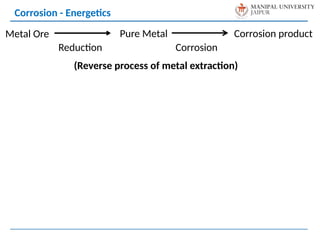
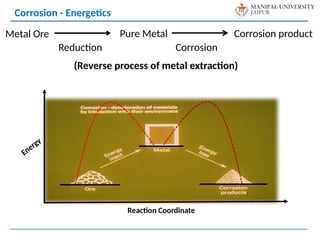
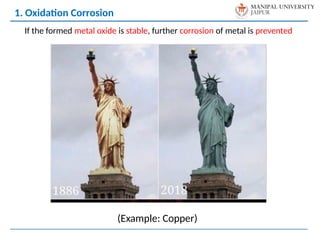
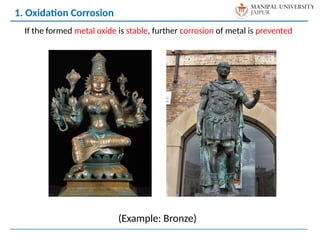
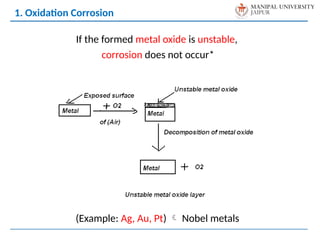
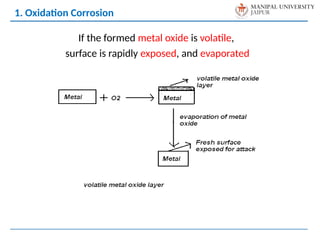
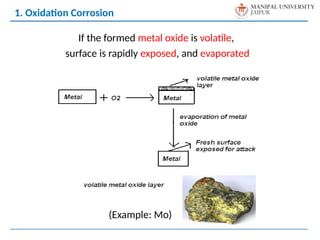
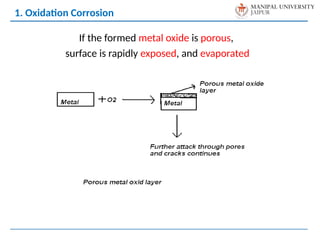
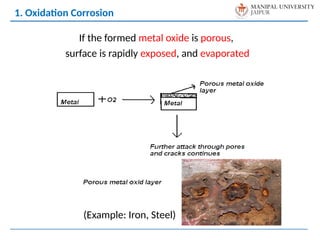
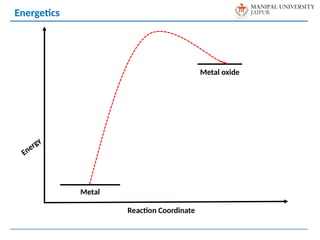
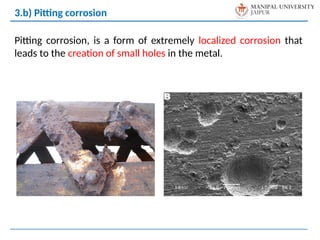
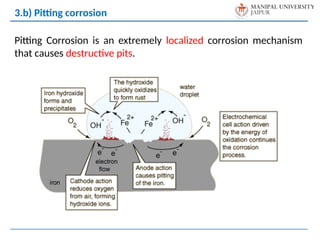
Corrosion - Energetics
MetalOre
Reduction
Pure Metal Corrosion product
Corrosion
(Reverse process of metal extraction)
7.
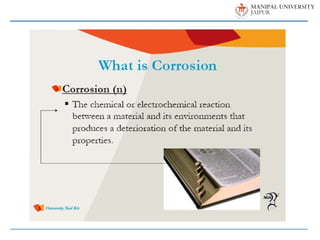
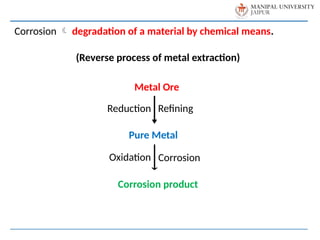
Corrosion degradationof a material by chemical means.
Metal Ore
Reduction
Pure Metal
Corrosion product
Corrosion
Oxidation
Refining
(Reverse process of metal extraction)
8.
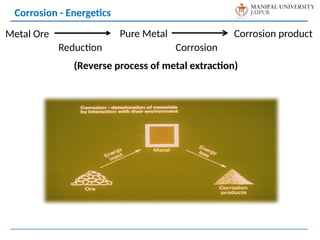
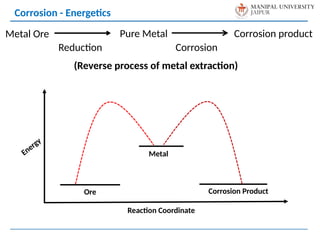
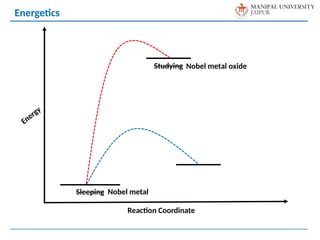
Corrosion - Energetics
MetalOre
Reduction
Pure Metal Corrosion product
Corrosion
(Reverse process of metal extraction)
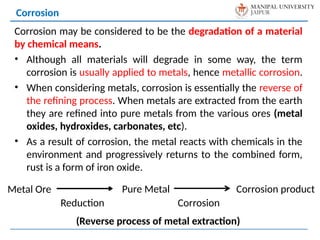
Corrosion may beconsidered to be the degradation of a material
by chemical means.
• Although all materials will degrade in some way, the term
corrosion is usually applied to metals, hence metallic corrosion.
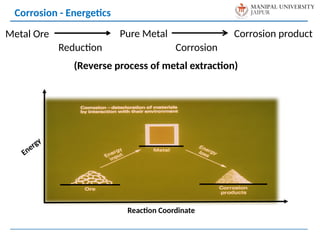
• When considering metals, corrosion is essentially the reverse of
the refining process. When metals are extracted from the earth
they are refined into pure metals from the various ores (metal
oxides, hydroxides, carbonates, etc).
• As a result of corrosion, the metal reacts with chemicals in the
environment and progressively returns to the combined form,
rust is a form of iron oxide.
Corrosion
Metal Ore
Reduction
Pure Metal Corrosion product
Corrosion
(Reverse process of metal extraction)
13.
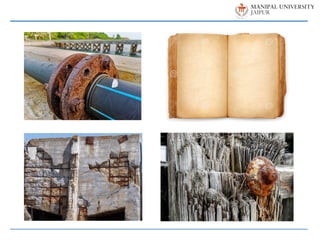
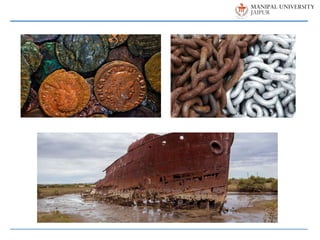
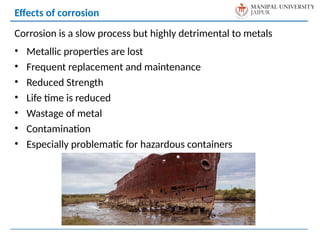
Corrosion is aslow process but highly detrimental to metals
• Metallic properties are lost
• Frequent replacement and maintenance
• Reduced Strength
• Life time is reduced
• Wastage of metal
• Contamination
• Especially problematic for hazardous containers
Effects of corrosion
14.
Corrosion is aslow process but highly detrimental to metals
• Metallic properties are lost
• Frequent replacement and maintenance
• Reduced Strength
• Life time is reduced
• Wastage of metal
• Contamination
• Especially problematic for hazardous containers
25% of the annual production of iron is wasted because of
corrosion
Effects of corrosion
15.
1. Acid theory:
•The presence of acid is essential.
• Example: rusting of iron.
2. Direct chemical attack: This theory explains the so-called
chemical or dry corrosion. Example: direct chemical attack by
dry gases
3. The electrochemical theory: This theory explains the indirect
or wet corrosion. The modern electrochemical theory is based
on Nernst theory.
Theories of corrosion
16.
Acid theory:
• Thistheory suggests that the presence of acid (such as carbonic
acid) is essential for corrosion.
• This theory is particularly applicable to rusting of iron in the
atmosphere.
• The rusting is due to continued action of oxygen, carbon
dioxide and moisture, converting the metal into soluble ferrous
bicarbonate which is further oxidized to basic ferric carbonate
and finally to hydrated ferric oxide.
Theories of corrosion
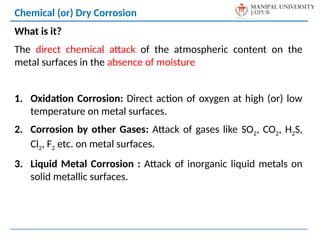
What is it?
Thedirect chemical attack of the atmospheric content on the
metal surfaces in the absence of moisture
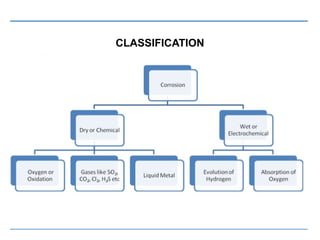
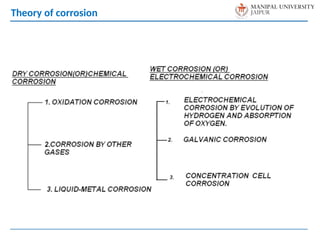
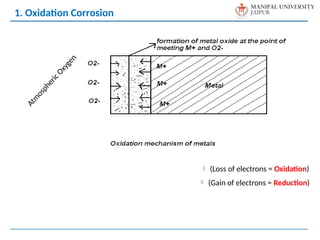
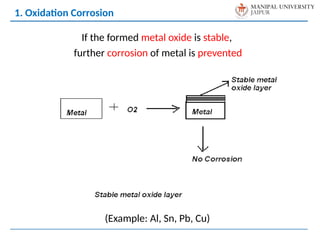
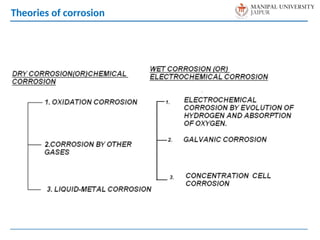
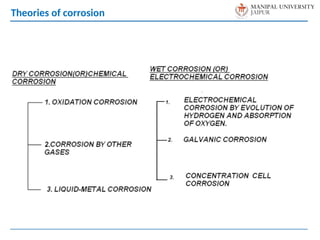
1. Oxidation Corrosion: Direct action of oxygen at high (or) low
temperature on metal surfaces.
2. Corrosion by other Gases: Attack of gases like SO2, CO2, H2S,
Cl2, F2 etc. on metal surfaces.
3. Liquid Metal Corrosion : Attack of inorganic liquid metals on
solid metallic surfaces.
Chemical (or) Dry Corrosion
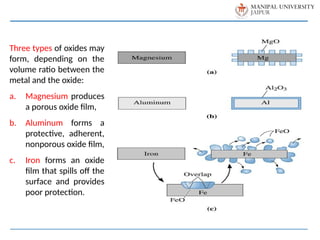
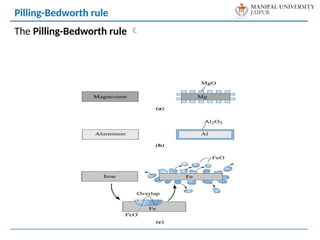
Three types ofoxides may
form, depending on the
volume ratio between the
metal and the oxide:
a. Magnesium produces
a porous oxide film,
b. Aluminum forms a
protective, adherent,
nonporous oxide film,
c. Iron forms an oxide
film that spills off the
surface and provides
poor protection.
36.
The gases suchas SO2, CO2, H2S, Cl2, F2 etc., when come in direct
contact with metal surface corrosion occurs.
• The extent of corrosion depends on the chemical affinity
between the metal and the gas concerned.
• The prevention of metal corrosion can be known from the
nature of corrosion product.
Whether the layer of corrosion product is protecting or non-
protecting in nature.
• If the formed corrosion product is protecting (or) non porous metal is
prevented. Ex: AgCl layer on metallic silver by the action of Cl2 gas.
• If the formed corrosion product is non protecting (or) porous , the corrosion
of metals occurs non stop. Ex: H2S gas attacks on steel at high temperature
forming FeS , a corrosion product which is porous.
2. Corrosion by gases
37.
The chemical actionof the flowing liquid metal at high
temperature, on a solid metal or alloy produces liquid metal
corrosion.
There are two reasons for this corrosion –
• Dissolution of the solid metal by liquid metal
• Internal penetration of the liquid metal into the solid phase,
weakening the solid metal.
Example: liquid Na used as a coolant in a nuclear plants, these
causes cadmium corrosion.
3. Liquid metal corrosion
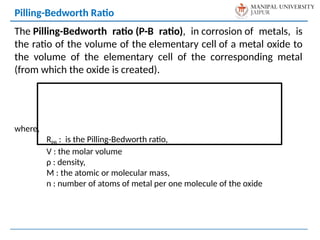
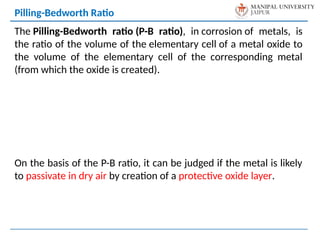
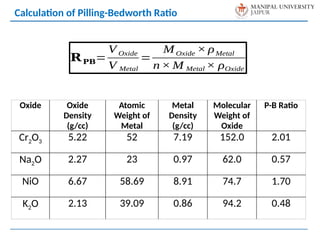
The Pilling-Bedworth ratio(P-B ratio), in corrosion of metals, is
the ratio of the volume of the elementary cell of a metal oxide to
the volume of the elementary cell of the corresponding metal
(from which the oxide is created).
where,
RPB : is the Pilling-Bedworth ratio,
V : the molar volume
ρ : density,
M : the atomic or molecular mass,
n : number of atoms of metal per one molecule of the oxide
Pilling-Bedworth Ratio
40.
The Pilling-Bedworth rule
Pilling-Bedworth rule
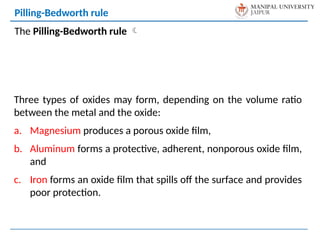
Three types of oxides may form, depending on the volume ratio
between the metal and the oxide:
a. Magnesium produces a porous oxide film,
b. Aluminum forms a protective, adherent, nonporous oxide film,
and
c. Iron forms an oxide film that spills off the surface and provides
poor protection.
The Pilling-Bedworth ratio(P-B ratio), in corrosion of metals, is
the ratio of the volume of the elementary cell of a metal oxide to
the volume of the elementary cell of the corresponding metal
(from which the oxide is created).
On the basis of the P-B ratio, it can be judged if the metal is likely
to passivate in dry air by creation of a protective oxide layer.
Pilling-Bedworth Ratio
43.
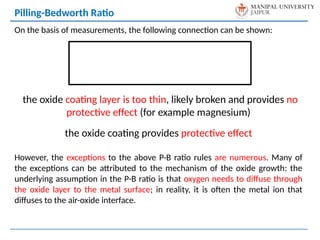
On the basisof measurements, the following connection can be shown:
the oxide coating layer is too thin, likely broken and provides no
protective effect (for example magnesium)
the oxide coating provides protective effect
However, the exceptions to the above P-B ratio rules are numerous. Many of
the exceptions can be attributed to the mechanism of the oxide growth: the
underlying assumption in the P-B ratio is that oxygen needs to diffuse through
the oxide layer to the metal surface; in reality, it is often the metal ion that
diffuses to the air-oxide interface.
Pilling-Bedworth Ratio
44.
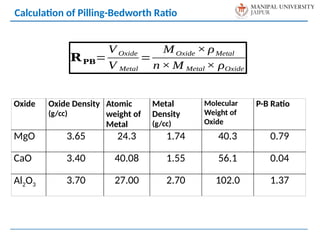
Calculation of Pilling-BedworthRatio
Oxide Oxide Density
(g/cc)
Atomic
weight of
Metal
Metal
Density
(g/cc)
Molecular
Weight of
Oxide
P-B Ratio
MgO 3.65 24.3 1.74 40.3 0.79
CaO 3.40 40.08 1.55 56.1 0.04
Al2O3 3.70 27.00 2.70 102.0 1.37
𝐑𝐏𝐁=
V Oxide
V Metal
=
MOxide × ρMetal
n × M Metal × ρOxide
45.
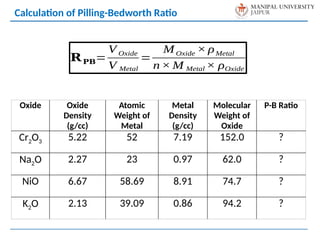
Calculation of Pilling-BedworthRatio
𝐑𝐏𝐁=
V Oxide
V Metal
=
MOxide × ρMetal
n × M Metal × ρOxide
Oxide Oxide
Density
(g/cc)
Atomic
Weight of
Metal
Metal
Density
(g/cc)
Molecular
Weight of
Oxide
P-B Ratio
Cr2O3 5.22 52 7.19 152.0 ?
Na2O 2.27 23 0.97 62.0 ?
NiO 6.67 58.69 8.91 74.7 ?
K2O 2.13 39.09 0.86 94.2 ?
46.
Calculation of Pilling-BedworthRatio
𝐑𝐏𝐁=
V Oxide
V Metal
=
MOxide × ρMetal
n × M Metal × ρOxide
Oxide Oxide
Density
(g/cc)
Atomic
Weight of
Metal
Metal
Density
(g/cc)
Molecular
Weight of
Oxide
P-B Ratio
Cr2O3 5.22 52 7.19 152.0 2.01
Na2O 2.27 23 0.97 62.0 0.57
NiO 6.67 58.69 8.91 74.7 1.70
K2O 2.13 39.09 0.86 94.2 0.48
47.
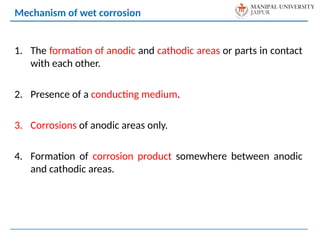
1. The formationof anodic and cathodic areas or parts in contact
with each other.
2. Presence of a conducting medium.
3. Corrosions of anodic areas only.
4. Formation of corrosion product somewhere between anodic
and cathodic areas.
Mechanism of wet corrosion
48.
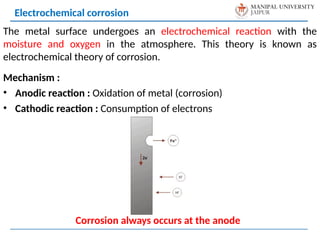
The metal surfaceundergoes an electrochemical reaction with the
moisture and oxygen in the atmosphere. This theory is known as
electrochemical theory of corrosion.
Mechanism :
• Anodic reaction : Oxidation of metal (corrosion)
• Cathodic reaction : Consumption of electrons
Electrochemical corrosion
Corrosion always occurs at the anode
49.
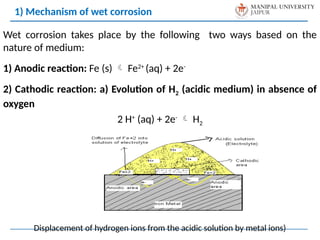
Wet corrosion takesplace by the following two ways based on the
nature of medium:
1) Anodic reaction: Fe (s) Fe2+
(aq) + 2e-
2) Cathodic reaction: a) Evolution of H2 (acidic medium) in absence of
oxygen
2 H+
(aq) + 2e-
H2
Displacement of hydrogen ions from the acidic solution by metal ions)
1) Mechanism of wet corrosion
50.
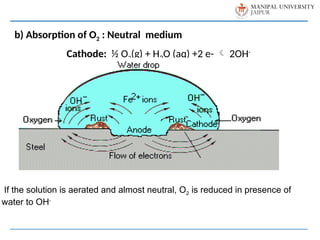
b) Absorption ofO2 : Neutral medium
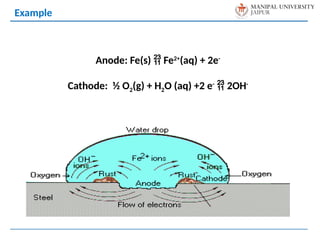
Cathode: ½ O2(g) + H2O (aq) +2 e- 2OH-
If the solution is aerated and almost neutral, O2 is reduced in presence of
water to OH-
51.
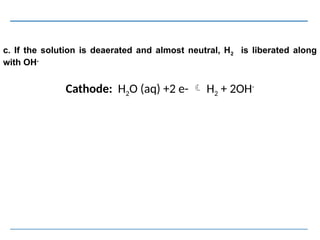
Cathode: H2O (aq)+2 e- H2 + 2OH-
c. If the solution is deaerated and almost neutral, H2 is liberated along
with OH-
52.
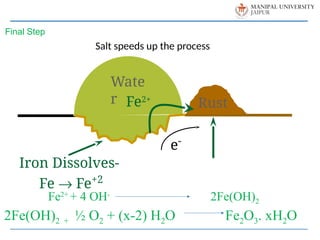
Wate
r Rust
Iron Dissolves-
Fe® Fe+2
e-
Salt speeds up the process
Fe2+
Fe2+
+ 4 OH-
2Fe(OH)2
2Fe(OH)2 + ½ O2 + (x-2) H2O Fe2O3. xH2O
Final Step
53.
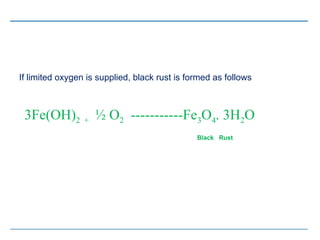
If limited oxygenis supplied, black rust is formed as follows
3Fe(OH)2 + ½ O2 -----------Fe3O4. 3H2O
Black Rust
54.
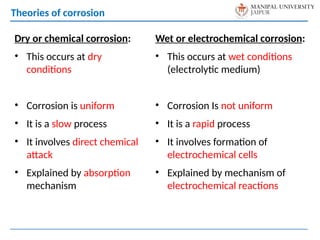
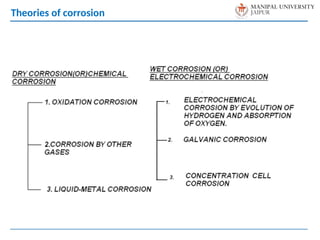
Theories of corrosion
Dryor chemical corrosion:
• This occurs at dry
conditions
• Corrosion is uniform
• It is a slow process
• It involves direct chemical
attack
• Explained by absorption
mechanism
Wet or electrochemical corrosion:
• This occurs at wet conditions
(electrolytic medium)
• Corrosion Is not uniform
• It is a rapid process
• It involves formation of
electrochemical cells
• Explained by mechanism of
electrochemical reactions
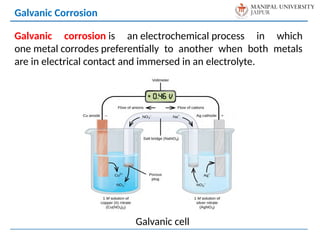
Galvanic cell
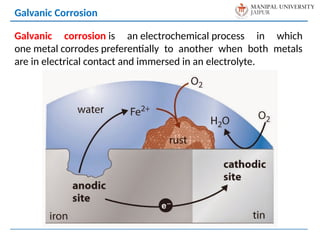
Galvanic Corrosion
Galvaniccorrosion is an electrochemical process in which
one metal corrodes preferentially to another when both metals
are in electrical contact and immersed in an electrolyte.
57.
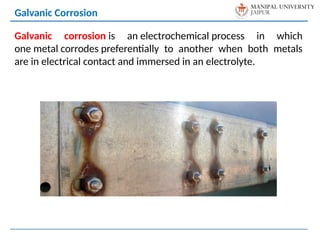
Galvanic Corrosion
Galvanic corrosionis an electrochemical process in which
one metal corrodes preferentially to another when both metals
are in electrical contact and immersed in an electrolyte.
58.
Galvanic Corrosion
Galvanic corrosionis an electrochemical process in which
one metal corrodes preferentially to another when both metals
are in electrical contact and immersed in an electrolyte.
59.
• Possibility whentwo dissimilar metals are electrically
connected in an electrolyte.
• Results from a difference in oxidation potentials of metallic ions
between two or more metals. The greater the difference in
oxidation potential, the greater the galvanic corrosion.
• Galvanic coupling is a galvanic cell in which the anode is the
less corrosion resistant metal than the cathode
• The less noble metal will corrode (i.e. will act as the anode) and
the more noble metal will not corrode (acts as cathode).
• Perhaps the best known of all corrosion types is galvanic
corrosion, which occurs at the contact point of two metals or
alloys with different electrode potentials.
Galvanic Corrosion
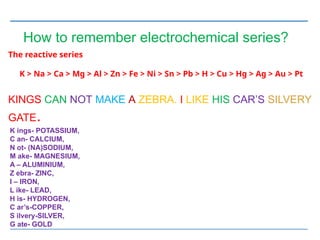
How to rememberelectrochemical series?
The reactive series
K > Na > Ca > Mg > Al > Zn > Fe > Ni > Sn > Pb > H > Cu > Hg > Ag > Au > Pt
KINGS CAN NOT MAKE A ZEBRA. I LIKE HIS CAR’S SILVERY
GATE.
K ings- POTASSIUM,
C an- CALCIUM,
N ot- (NA)SODIUM,
M ake- MAGNESIUM,
A – ALUMINIUM,
Z ebra- ZINC,
I – IRON,
L ike- LEAD,
H is- HYDROGEN,
C ar’s-COPPER,
S ilvery-SILVER,
G ate- GOLD
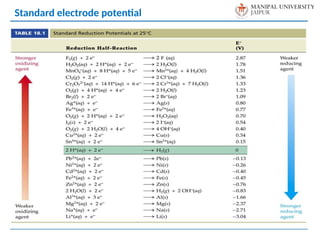
62.
In the electrochemicalseries, the reduction potential of an element is taken in reference
to the hydrogen scale where Eo = zero. As per the definition, the standard reduction
potential of an element is described as the measure of the tendency of an element to
undergo reduction.
The greater the reduction potential of an element, the more easily it will be reduced.
Meanwhile, elements that have low reduction potential will get oxidized more quickly
and easily.
Alternatively, elements that give up electrons without any difficulty have negative or
lower reduction potential. Elements that do not give up electrons easily accept electrons
effortlessly and have positive or higher reduction potential.
Stronger reducing agents that have negative standard reduction potential are usually
situated below the hydrogen in the electrochemical series. On the other hand, weaker
reducing agents with positive standard reduction potential are found above the
hydrogen in the series.
As we move down in the group, the reducing agent’s strength increases while the
oxidizing agents’ strength decreases.
Likewise, as we move from top to bottom in the series, the electro-positivity and activity
of metals amplify or intensify. In the case of non-metals, it decreases.
Electrochemical Series Important Points
63.
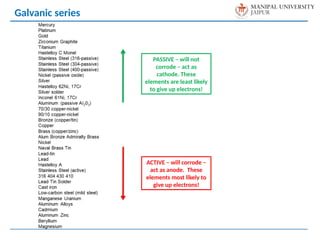
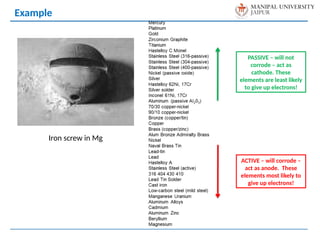
Galvanic series
PASSIVE –will not
corrode – act as
cathode. These
elements are least likely
to give up electrons!
ACTIVE – will corrode –
act as anode. These
elements most likely to
give up electrons!
64.
The galvanic series(or electro-potential series) determines the
nobility of metals and semi-metals.
When two metals are submerged in an electrolyte, while
electrically connected, the less noble (base) will experience
galvanic corrosion.
The rate of corrosion is determined by
• the electrolyte and
• the difference in nobility.
The difference can be measured as a difference in voltage
potential.
Galvanic reaction is the principle upon which batteries are based.
The Galvanic series
65.
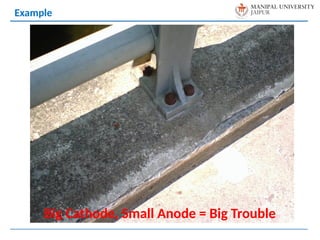
Severity of Galvaniccorrosion depends on:
• Amount of separation in the galvanic series
• Relative surface areas of the two. Severe corrosion if anode area
(area eaten away) is smaller than the cathode area.
It does NOT depend upon:
• Amount of contact
• Volume
• Mass
Design for Galvanic Corrosion
66.
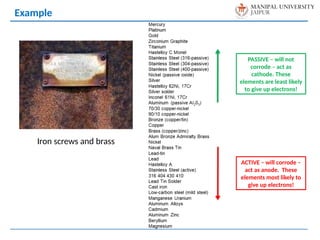
Example
Iron screws andbrass
PASSIVE – will not
corrode – act as
cathode. These
elements are least likely
to give up electrons!
ACTIVE – will corrode –
act as anode. These
elements most likely to
give up electrons!
67.
Example
Iron screw inMg
PASSIVE – will not
corrode – act as
cathode. These
elements are least likely
to give up electrons!
ACTIVE – will corrode –
act as anode. These
elements most likely to
give up electrons!
68.
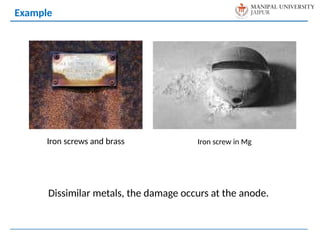
Example
Iron screws andbrass Iron screw in Mg
Dissimilar metals, the damage occurs at the anode.
69.
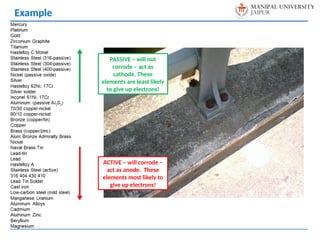
Example
PASSIVE – willnot
corrode – act as
cathode. These
elements are least likely
to give up electrons!
ACTIVE – will corrode –
act as anode. These
elements most likely to
give up electrons!
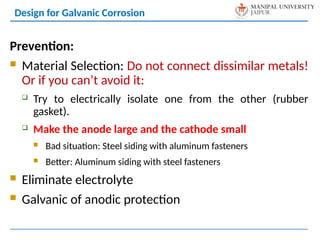
Design for GalvanicCorrosion
Prevention:
Material Selection: Do not connect dissimilar metals!
Or if you can’t avoid it:
Try to electrically isolate one from the other (rubber
gasket).
Make the anode large and the cathode small
Bad situation: Steel siding with aluminum fasteners
Better: Aluminum siding with steel fasteners
Eliminate electrolyte
Galvanic of anodic protection
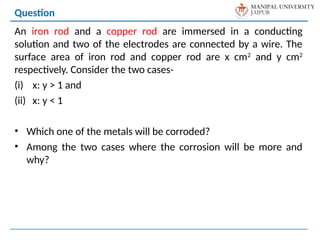
An iron rodand a copper rod are immersed in a conducting
solution and two of the electrodes are connected by a wire. The
surface area of iron rod and copper rod are x cm2
and y cm2
respectively. Consider the two cases-
(i) x: y > 1 and
(ii) x: y < 1
• Which one of the metals will be corroded?
• Among the two cases where the corrosion will be more and
why?
Question
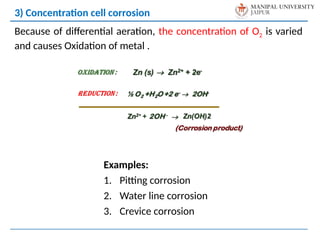
Because of differentialaeration, the concentration of O2 is varied
and causes Oxidation of metal .
3) Concentration cell corrosion
Examples:
1. Pitting corrosion
2. Water line corrosion
3. Crevice corrosion
76.
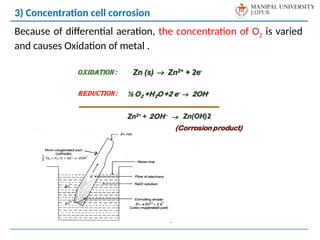
Because of differentialaeration, the concentration of O2 is varied
and causes Oxidation of metal .
3) Concentration cell corrosion
77.
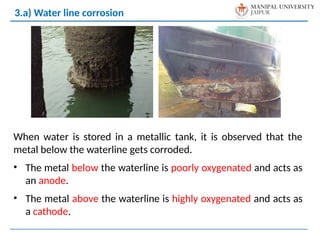
When water isstored in a metallic tank, it is observed that the
metal below the waterline gets corroded.
• The metal below the waterline is poorly oxygenated and acts as
an anode.
• The metal above the waterline is highly oxygenated and acts as
a cathode.
3.a) Water line corrosion
78.
• Corrosion maybe accelerated in apparently inaccessible places,
because the oxygen deficient areas serve as anode, therefore,
cracks serve as foci for corrosion.
• Corrosion is accelerated under accumulation of dirt sand, scale
and other contamination. This is because accumulation of rust
and scale restricts the access of oxygen and establish an anode to
promote greater accumulation.
• Metal exposed to aqueous media under blocks of wood or piece
of glass, which screen that portion of metal from oxygen.
General facts about differential aeration corrosion
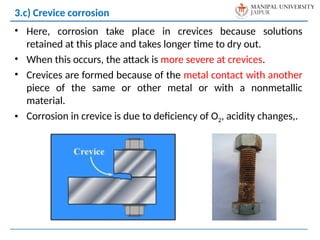
• Here, corrosiontake place in crevices because solutions
retained at this place and takes longer time to dry out.
• When this occurs, the attack is more severe at crevices.
• Crevices are formed because of the metal contact with another
piece of the same or other metal or with a nonmetallic
material.
• Corrosion in crevice is due to deficiency of O2, acidity changes,.
3.c) Crevice corrosion
83.
• Fully understandthe environment.
• Control the environment to low chloride content and low
temperature if possible.
• Use alloys sufficiently high in chromium, molybdenum and/or
nitrogen to ensure resistance.
• Prepare surfaces to best possible finish. Mirror-finish resists
pitting best.
• Remove all contaminants, especially free-iron, by passivation.
• Design and fabricate to avoid crevices.
• Design and fabricate to avoid trapped and pooled liquids.
• Weld with correct consumables and practices and inspect to
check for inadvertent crevices.
Measures to Reduce Pitting and Crevice Corrosion
84.
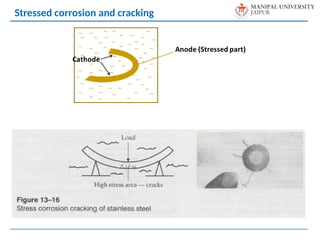
Stress corrosion iscombined effects of static tensile stress and the
corrosive environments on a metal.
It is characterized by the highly localized corrosion. For stress
corrosion to occurs:
1. Presence of tensile stress
2. A specific corrosive environments
For e.g. caustic alkali and strong nitrate solution for mild steel,
traces of ammonia for brass, acids chloride solution for stainless
steel
3.d) Stress corrosion
85.
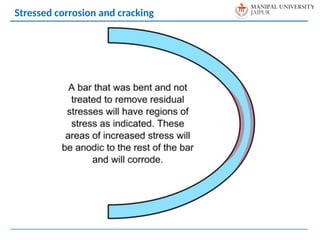
Stress corrosion iscombined effects of static tensile stress and the
corrosive environments on a metal.
Tensile stress is caused by:
• Deformation during fabrication
• Unequal rate of cooling from high temp.
• Internal stress rearrangement involving volume changes
• Stress induced by rivets, bolts and shrink fits.
• Eliminating high stress areas prevent this type of corrosion.
Stress corrosion
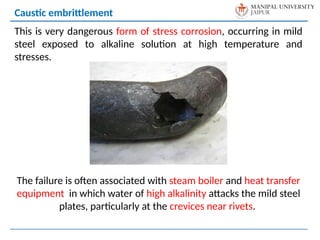
This is verydangerous form of stress corrosion, occurring in mild
steel exposed to alkaline solution at high temperature and
stresses.
The failure is often associated with steam boiler and heat transfer
equipment in which water of high alkalinity attacks the mild steel
plates, particularly at the crevices near rivets.
Caustic embrittlement
90.
Boiler water, usuallycontains a certain portion of sodium
carbonate, added for water softening purposes. In high pressure
boilers
• Sodium hydroxide makes water alkaline in nature.
• Dilute alkaline boiler water flow into the minute hair-cracks and crevices by
capillary action.
• Water evaporates and the concentration of caustic soda builds up.
• The concentrated alkali dissolve iron as sodium ferroate (Na2FeO2) in cracks
and crevices (where the metal is stresses and the concentration of alkali is
much higher than that in the body of the liquid)
• The sodium ferroate (Na2FeO2) decomposes, a short distances from its point
of formation.
Caustic embrittlement
91.
• Material selectionfor a given environment.
• Reduce applied or residual stress – Stress relieve to eliminate
residual stress (i.e. stress relieve after heat treat).
• Introduce residual compressive stress in the service.
• Use corrosion alloy inhibitors.
• Apply protective coatings.
Design for Stress Corrosion Cracking
92.
1. Nature ofmetal
2. Nature of the corroding environment
3. Solution pH
4. Oxidizing agent
5. Temperature
6. Velocity
7. Surface films
8. Other factors
Factors affecting the rate of corrosion
93.
• Position inthe Galvanic series
• Relative areas of the cathodic and anodic parts
• Purity of metal (tiny electrochemical cells)
• Physical state of the metal (grain size, crystal faces)
• Nature of the surface film
• Passive character of the metal
• Volatility of the corrosion product
• Solubility of the corrosion product
1. Nature of the metal
Factors affecting the rate of corrosion
94.
• Temperature
• Humidityof air
• Presence of impurities in atmosphere
• Nature of ions present in environment
• Conductance of corroding medium
• Amount of oxygen in atmosphere
• Velocity of ions which flow in the medium
• pH value of the medium
• Suspended impurities
2. Nature of the corroding environment
Factors affecting the rate of corrosion
95.
• Metals suchas Fe dissolve rapidly in acidic solution. In the middle pH
range the concentration of H+
ions is low. Hence, the corrosion rate is
controlled by the rate of transport of oxygen.
• Certain amphoteric metals dissolve rapidly in either acidic or basic
solution. e.g. Al and Zn.
• Noble metals are not affected by pH e.g. Au and Pt.
• H+
ions capture electrons and promote anodic corrosion.
3. Solution pH
Factors affecting the rate of corrosion
96.
• Oxidizing agentsaccelerate the corrosion of one class of materials,
whereas retard another class.
• Oxidizing agent retard corrosion due to formation of surface oxide
films, which makes the surface more resistant to chemical attack.
• Thus a balance between the power of oxidizing agent to preserve the
protective layer and their tendency to destroy the protective film
determine the corrosion of metal.
4. Oxidizing agents
Factors affecting the rate of corrosion
97.
• Rise intemp increase rate of corrosion.
• Increase in temp reduce the solubility of oxygen or air. The
released oxygen enhances the corrosion.
• Increase in temp induces phase change, which enhance the
rate of corrosion.
5. Temperature
Factors affecting the rate of corrosion
98.
• High velocityof corrosive medium increases corrosion.
• Corrosion products are formed rapidly, because chemicals are
brought to the surface at a high rate.
• The accumulation of insoluble film on the metallic surface is
prevented. So corrosion resistance of these films decreases.
• The corrosion products are easily stifled and carried away, thereby
exposing the new surfaces for corrosion.
6. Velocity
Factors affecting the rate of corrosion
99.
• The oxidefilms are formed on the surface of S.S. these films absorb
moisture, which delay time of drying and hence increases the
extent of corrosion.
• Insoluble slats such as carbonates and sulphates may be
precipitated from hot solution on the metal surfaces. These
protects the metal surfaces.
• If the film is porous (e.g. ZnO) corrosion continues. Nonporous films
(CrO on iron) prevents further corrosion.
• Oil and grease films may occur on the surface either intentionally
or naturally. These films protect surface from direct contact with
corrosive substance. e.g. metals submerged in sewage .
7. Surface Films
Factors affecting the rate of corrosion
100.
• Selection ofmetals
• Proper design
• Use pure metal
• Modifying the environment
• Sacrificial anodic protection
• Corrosion inhibitors
• Surface coatings (Paints, Electroplating, etc.)
Corrosion control methods
101.
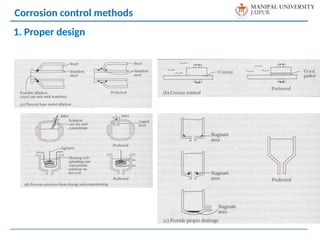
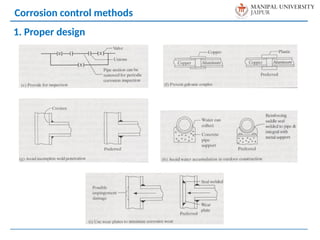
• Minimal contactwith medium
• Prevention from moisture
• Adequate ventilation and drainage
• Welding
• Avoid cervices between adjacent parts
• Bend should be smooth
• Bimetallic contacts should be avoided
• Paint cathodic portion
• Prevent uneven stress
Corrosion control methods
1. Proper design
102.
The corrosive natureof the environment can be reduced either
1. By the removal of harmful constituents
2. By the addition of specific substances which neutralize the effects of
corrosive constituents of the environments
Deactivation involves the addition of chemicals, capable of
combining with the oxygen in aqueous solution by using
• Sodium sulphite
• Hydrazine hydrate
Also,
• Dehumidification: Silica gel, Alumina
• Alkaline neutralization: NH3, NaOH
Corrosion control methods
2. Modifying the environment
103.
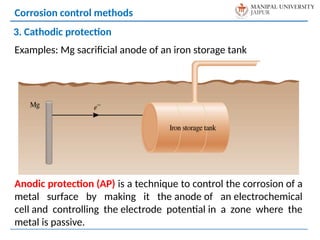
The method ofprotection given to a metal by forcibly making it to
behave like a cathode
Two methods –
1. Sacrificial anodic protection
2. Impressed current cathodic protection
Corrosion control methods
3. Cathodic protection
105.
The method ofprotection given to a metal by forcibly making it to
behave like a cathode
1. Sacrificial anodic protection:
In this method of protection , the metallic structure to be
protected called “base metal” is connected to more anodic
metal through a wire.
2. Impressed current cathodic protection:
In this method an impressed current is applied in the
opposite direction to nullify the corrosion current, thus the anodic
corroding metal becomes cathodic and protected from corrosion.
Corrosion control methods
3. Cathodic protection
106.
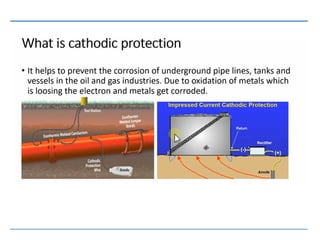
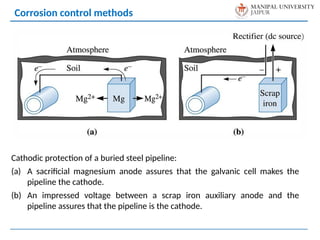
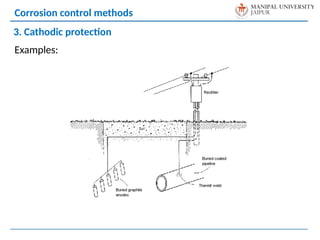
Cathodic protection ofa buried steel pipeline:
(a) A sacrificial magnesium anode assures that the galvanic cell makes the
pipeline the cathode.
(b) An impressed voltage between a scrap iron auxiliary anode and the
pipeline assures that the pipeline is the cathode.
Corrosion control methods
107.
Examples: Mg sacrificialanode of an iron storage tank
Anodic protection (AP) is a technique to control the corrosion of a
metal surface by making it the anode of an electrochemical
cell and controlling the electrode potential in a zone where the
metal is passive.
Corrosion control methods
3. Cathodic protection
108.
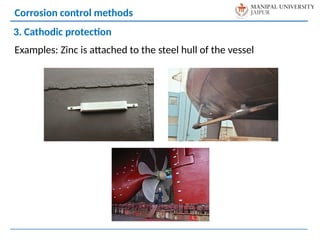
Examples: Zinc isattached to the steel hull of the vessel
Corrosion control methods
3. Cathodic protection
109.
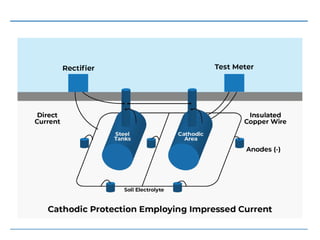
Impressed current cathodicprotection (ICCP) is a corrosion protection system consisting of
sacrificial anodes connected to an external power source. The external power source, often a DC
power supply, provides the current necessary to drive the electrochemical reaction required for
cathodic protection to occur.
In the absence of a DC power source, a transformer-rectifier connected to AC power can be used.
Alternative sources may also be used to power the electrochemical cell, including wind, solar or
gas-powered thermoelectric generators.
Impressed current cathodic protection systems are typically used in relatively large structures,
where passive cathodic protection methods are ineffective or impractical. For example, passive
cathodic protection is suitable for protecting individual structural members and appurtenances.
However, this method generates minimal current, making it ineffective for protecting larger
structures such as oil and gas pipelines and storage tanks. Rather than depend on the natural
potential difference between the anode and cathode material, ICCP systems use external sources
to provide the necessary current. This increased current makes it possible for the cathodic
protection to span a wider effective area.
While ICCP systems are more effective than their passive counterparts, they require more
equipment and are also costlier to maintain.
A substance whichwhen added in small quantities to the
aqueous corrosive environment, effectively decrease the corrosion
of a metal.
Corrosion control methods
Corrosion inhibitors
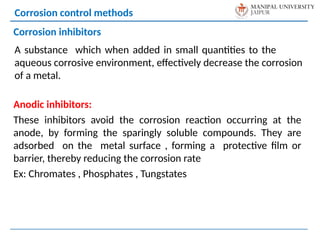
Anodic inhibitors:
These inhibitors avoid the corrosion reaction occurring at the
anode, by forming the sparingly soluble compounds. They are
adsorbed on the metal surface , forming a protective film or
barrier, thereby reducing the corrosion rate
Ex: Chromates , Phosphates , Tungstates
113.
Corrosion control methods
Corrosioninhibitors
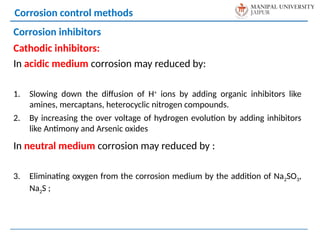
Cathodic inhibitors:
In acidic medium corrosion may reduced by:
1. Slowing down the diffusion of H+
ions by adding organic inhibitors like
amines, mercaptans, heterocyclic nitrogen compounds.
2. By increasing the over voltage of hydrogen evolution by adding inhibitors
like Antimony and Arsenic oxides
In neutral medium corrosion may reduced by :
3. Eliminating oxygen from the corrosion medium by the addition of Na2SO3,
Na2S ;
115.
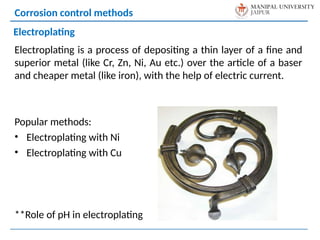
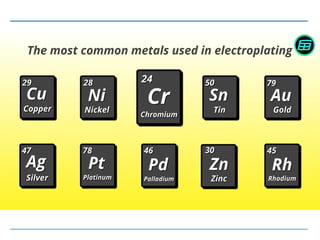
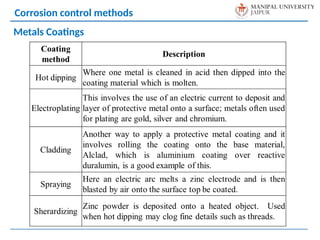
Electroplating is aprocess of depositing a thin layer of a fine and
superior metal (like Cr, Zn, Ni, Au etc.) over the article of a baser
and cheaper metal (like iron), with the help of electric current.
Popular methods:
• Electroplating with Ni
• Electroplating with Cu
**Role of pH in electroplating
Corrosion control methods
Electroplating
116.
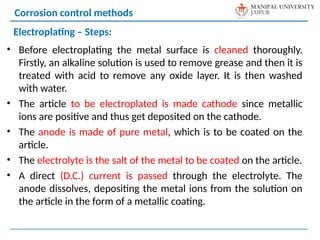
• Before electroplatingthe metal surface is cleaned thoroughly.
Firstly, an alkaline solution is used to remove grease and then it is
treated with acid to remove any oxide layer. It is then washed
with water.
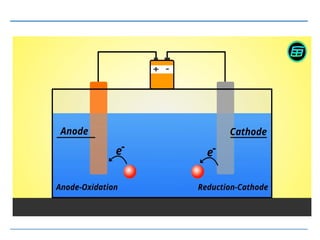
• The article to be electroplated is made cathode since metallic
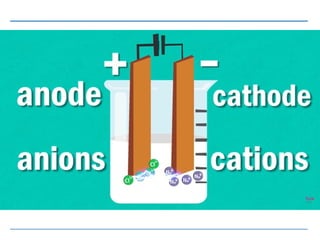
ions are positive and thus get deposited on the cathode.
• The anode is made of pure metal, which is to be coated on the
article.
• The electrolyte is the salt of the metal to be coated on the article.
• A direct (D.C.) current is passed through the electrolyte. The
anode dissolves, depositing the metal ions from the solution on
the article in the form of a metallic coating.
Corrosion control methods
Electroplating – Steps:
120.
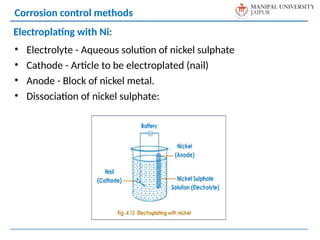
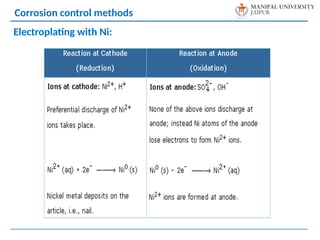
• Electrolyte -Aqueous solution of nickel sulphate
• Cathode - Article to be electroplated (nail)
• Anode - Block of nickel metal.
• Dissociation of nickel sulphate:
Corrosion control methods
Electroplating with Ni:
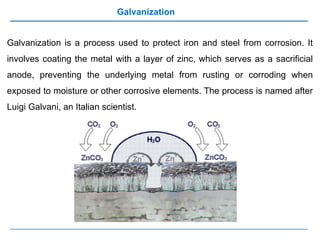
Galvanization is aprocess used to protect iron and steel from corrosion. It
involves coating the metal with a layer of zinc, which serves as a sacrificial
anode, preventing the underlying metal from rusting or corroding when
exposed to moisture or other corrosive elements. The process is named after
Luigi Galvani, an Italian scientist.
Galvanization
123.
The zinc coatingprovides excellent corrosion protection to the underlying
metal because zinc is more reactive than iron or steel. When the galvanized
metal is exposed to moisture or corrosive substances, the zinc corrodes
sacrificially, meaning it reacts with the corrosive elements instead of the iron or
steel beneath it. This sacrificial protection extends the life of the metal and is
commonly used in a variety of applications, such as construction materials,
automotive parts, and outdoor structures like fences and street lamps.
Applications
124.
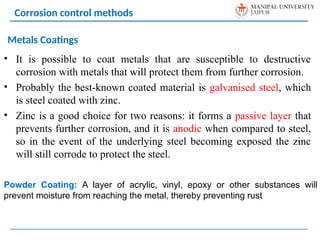
• It ispossible to coat metals that are susceptible to destructive
corrosion with metals that will protect them from further corrosion.
• Probably the best-known coated material is galvanised steel, which
is steel coated with zinc.
• Zinc is a good choice for two reasons: it forms a passive layer that
prevents further corrosion, and it is anodic when compared to steel,
so in the event of the underlying steel becoming exposed the zinc
will still corrode to protect the steel.
Corrosion control methods
Metals Coatings
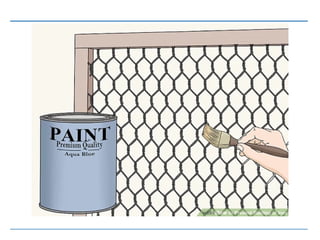
Powder Coating: A layer of acrylic, vinyl, epoxy or other substances will
prevent moisture from reaching the metal, thereby preventing rust
125.
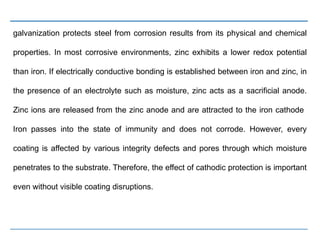
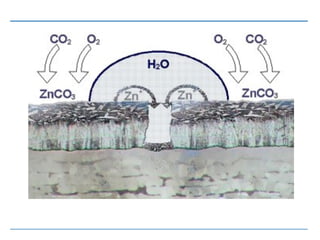
galvanization protects steelfrom corrosion results from its physical and chemical
properties. In most corrosive environments, zinc exhibits a lower redox potential
than iron. If electrically conductive bonding is established between iron and zinc, in
the presence of an electrolyte such as moisture, zinc acts as a sacrificial anode.
Zinc ions are released from the zinc anode and are attracted to the iron cathode
Iron passes into the state of immunity and does not corrode. However, every
coating is affected by various integrity defects and pores through which moisture
penetrates to the substrate. Therefore, the effect of cathodic protection is important
even without visible coating disruptions.
The potential differencedeveloped when an electrode of an
element is placed in a solution containing ions of that element.
The potential difference between an anode and a cathode can be
measured with a voltage measuring device. The absolute potential
of the anode and cathode cannot be measured directly. Defining a
standard electrode, all other potential measurements can be
made against this standard electrode. If the standard electrode
potential is set to zero, the potential difference measured can be
considered as the absolute potential.
Electrode potential