

Analyzing Social Media Conversations in Agriculture
Jay Harrison
Maritz Holdings, Inc.
Jay.Harrison@Maritz.com
About evolve24

www.evolve24.com

evolve24 is an audience understanding company
affiliated with Maritz Research in St. Louis, MO.
We provide integrated traditional and social media
intelligence solutions and consumer insights.

YEARS
Experience turning
social data into
ACTIONABLE INSIGHT

2

Backed by a worldrenowned leader in
MARKET RESEARCH
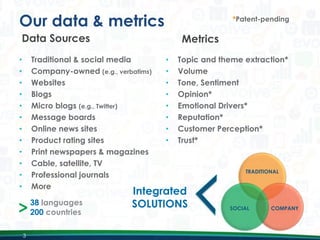
Our data & metrics

*Patent-pending

Data Sources

Metrics

•
•
•
•
•
•
•
•
•
•
•
•

Traditional & social media
Company-owned (e.g., verbatims)
Websites
Blogs
Micro blogs (e.g., Twitter)
Message boards
Online news sites
Product rating sites
Print newspapers & magazines
Cable, satellite, TV
Professional journals
More

>

38 languages
200 countries

3

•
•
•
•
•
•
•
•

Topic and theme extraction*
Volume
Tone, Sentiment
Opinion*
Emotional Drivers*
Reputation*
Customer Perception*
Trust*

Integrated
SOLUTIONS

TRADITIONAL

SOCIAL

COMPANY

3
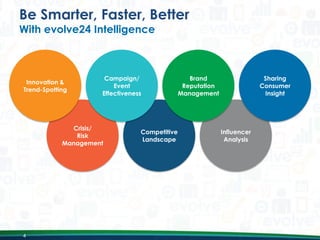
Be Smarter, Faster, Better
With evolve24 Intelligence

Innovation &
Trend-Spotting

Campaign/
Event
Effectiveness

Crisis/
Risk
Management

4

Competitive
Landscape

Brand
Reputation
Management

Sharing
Consumer
Insight

Influencer
Analysis
Trusted advisor to executive teams
“The depth of insights still has
people around here buzzing.
Where next?”
– Social Media Manager, Purina

“Thank you for the immediate
support. We don’t get that quality
of service from just anyone.”
– Corporate Communications, BMW

“The perfect chart for a
presentation I’m doing. Thanks for
the new capability!”
– Director of Social Media, Cargill

“This is excellent work. Let’s
expand.

– Communications Director, GE

5
Social media issues in agriculture,
2013-14
GMO labeling legislation
GMO wheat found in Oregon
Section 735, H. R. 933 (“Monsanto Protection Act”)
Seralini rat study
GMO-free Cheerios

6
How can we cope?
evolve24, a Maritz Research company, uses the
following approaches for analyzing comments on
agribusiness in social and traditional media:
• Measuring the emotional drivers in order to advise
clients on appropriate responses
• Detect “combustible” issues early and advise
companies to prepare for them or take advantage of
them
• Measuring changes in the trust that people place in a
brand and make recommendations on building trust

7
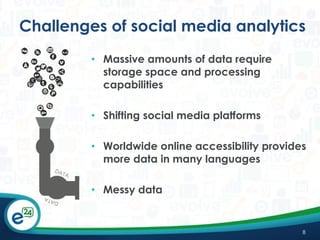
Challenges of social media analytics
• Massive amounts of data require
storage space and processing
capabilities

• Shifting social media platforms
• Worldwide online accessibility provides
more data in many languages
• Messy data

8
Emotional drivers
evolve24 has developed some proprietary methods for
measuring emotional drivers in text from social media.
These are potential risks for an industry because they
compel people to take action.
Examples include:
• Human origin
• Memory
• Poor communication

9
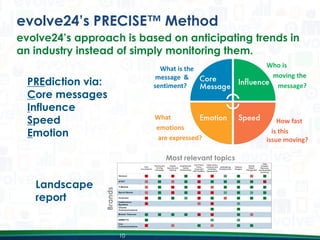
evolve24’s PRECISE™ Method
evolve24’s approach is based on anticipating trends in
an industry instead of simply monitoring them.
What is the
message &
sentiment?

What
emotions
are expressed?

PREdiction via:
Core messages
Influence
Speed
Emotion

Who is
moving the
message?

How fast
is this
issue moving?

Landscape
report

Brands

Most relevant topics

10
Putting it all together with social media
intelligence
evolve24 applied PRECISETM methodology in April 2013
to find the most pressing concerns in social media that
were likely to affect the agribusiness industry in the
near future.
The analysis involved 2.1 million articles collected from
the large-scale agribusiness industry over 6 months.

11
Putting it all together
We identified the most important issues involving
agriculture in social media at that time as:
1.
2.
3.
4.
5.

Food safety
GMO labeling
Food access / scarcity
Farm bill
Animal rights

Conversations about the #1 topic of food safety
included:
Seralini publication concerning glyphosate and GMOs
Recalls of meat products
Outbreaks of foodborne illnesses
12
Putting it all together
The main emotion concerning food safety was
vulnerability.
Issues that are perceived to affect vulnerable
populations, such as children or pets, have more risk
than those that affect the population at large or a
population that can cope with the issue.
Other prevalent emotions were dread (fear, terror, or
anxiety) and irreversibility.

13
Putting it all together
For the second-most important topic, GMO labeling,
the main emotional driver expressed was fairness.
Issues in which assets are perceived to be unevenly
or inequitably shared are riskier than those where
the perception is that everyone has the same
benefits and disadvantages.

14
As time passes, things change
evolve24 updated the findings with social media
articles collected between February and July 2013.
This analysis included 2.2 million observations from
social and traditional media. At that time, the most
important issues in social media in agribusiness were:
1. Food safety - previously #1
2. Food access/scarcity - previously #3
3. Section 735, H. R. 933 (“Monsanto Protection Act”) –
previously unranked
4. Animal rights – previously #5
5. Nutrition – previously #7
15
Downstream: Consumer packaged goods
evolve24 also researched the consumer packaged
goods industry.
This analysis included over 750,000 observations from
social and traditional media for 31 days in June-July 2013.
The most important issues in social media, from a
communications perspective for industry-wide risks, were:
1. Poor health from processed food
2. Affordability of healthy food
3. Perceived dangers of GMOs in food

16
Downstream: Consumer packaged goods
evolve24 also researched consumer packaged goods
for marketing opportunities.
The top issues in social media were:
1. Using social media for weight loss support
2. Convenient and healthy breakfast options
3. Avoiding artificial ingredients

17
GMO-Free Cheerios
In January 2014, General Mills announced that regular
Cheerios would no longer be made with ingredients
sourced from genetically modified organisms (GMOs).
This affected two ingredients: sugar and cornstarch.
Other flavors of Cheerios will continue to use GMOsourced ingredients.

18
What led to this decision?
evolve24 analyzed over 825,000 articles from social
media from October 1, 2012 to January 16, 2014.
Sources of articles included Twitter, Facebook, blogs,
boards, and web news.

19
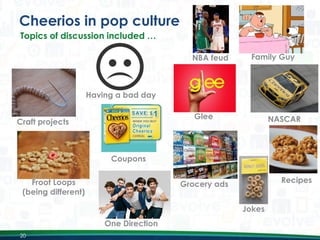
Cheerios in pop culture
Topics of discussion included …
NBA feud

Family Guy

Having a bad day
Glee

Craft projects

NASCAR

Coupons
Froot Loops
(being different)

Recipes

Grocery ads
Jokes
One Direction

20
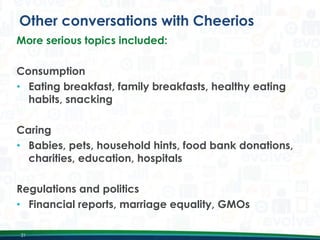
Other conversations with Cheerios
More serious topics included:

Consumption
• Eating breakfast, family breakfasts, healthy eating
habits, snacking
Caring
• Babies, pets, household hints, food bank donations,
charities, education, hospitals
Regulations and politics
• Financial reports, marriage equality, GMOs
21
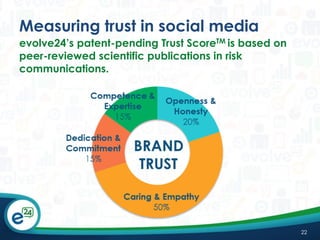
Measuring trust in social media
evolve24’s patent-pending Trust ScoreTM is based on
peer-reviewed scientific publications in risk
communications.

22
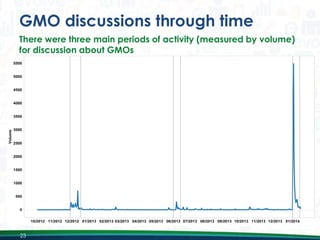
GMO discussions through time
There were three main periods of activity (measured by volume)
for discussion about GMOs

23
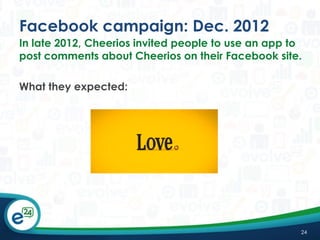
Facebook campaign: Dec. 2012
In late 2012, Cheerios invited people to use an app to
post comments about Cheerios on their Facebook site.
What they expected:

24
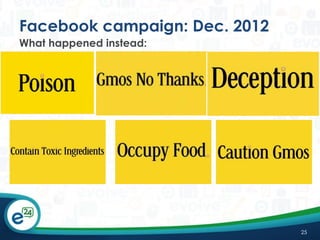
Facebook campaign: Dec. 2012
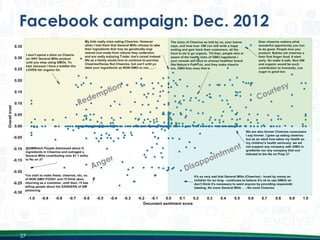
What happened instead:

25
Facebook campaign: Dec. 2012
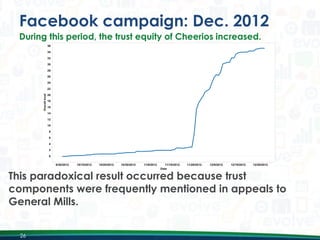
During this period, the trust equity of Cheerios increased.

This paradoxical result occurred because trust
components were frequently mentioned in appeals to
General Mills.
26
Facebook campaign: Dec. 2012

27
Subsequent changes in other topics
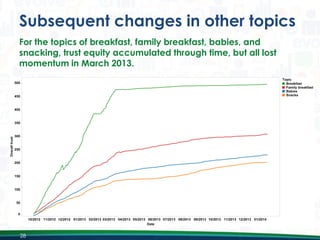
For the topics of breakfast, family breakfast, babies, and
snacking, trust equity accumulated through time, but all lost
momentum in March 2013.

28
Multiracial family ad: June 2013

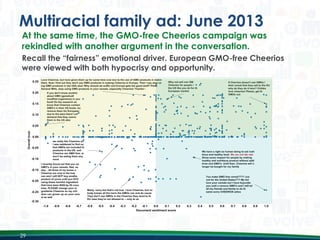
At the same time, the GMO-free Cheerios campaign was
rekindled with another argument in the conversation.
Recall the “fairness” emotional driver. European GMO-free Cheerios
were viewed with both hypocrisy and opportunity.

29
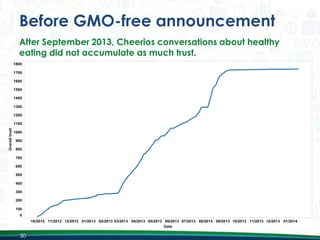
Before GMO-free announcement
After September 2013, Cheerios conversations about healthy
eating did not accumulate as much trust.

30
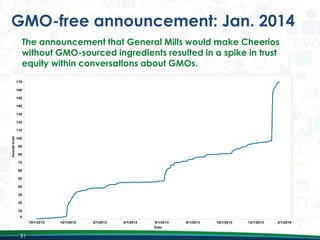
GMO-free announcement: Jan. 2014
The announcement that General Mills would make Cheerios
without GMO-sourced ingredients resulted in a spike in trust
equity within conversations about GMOs.

31
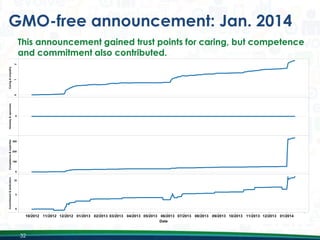
GMO-free announcement: Jan. 2014
This announcement gained trust points for caring, but competence
and commitment also contributed.

32
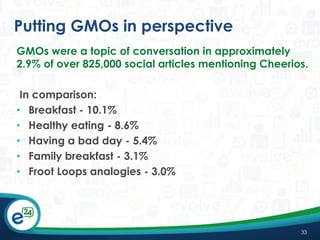
Putting GMOs in perspective
GMOs were a topic of conversation in approximately
2.9% of over 825,000 social articles mentioning Cheerios.
In comparison:
• Breakfast - 10.1%
• Healthy eating - 8.6%
• Having a bad day - 5.4%
• Family breakfast - 3.1%
• Froot Loops analogies - 3.0%

33
Conclusions
Cheerios cereal is a staple food for every age group
and an iconic brand that permeates our culture, so any
change in Cheerios will impact the CPG industry as a
whole.

34
Conclusions
Consumers may be satisfied with this switch, or, feeling
emboldened, they will demand more changes
(independent GMO verification, making all General Mills
cereals GMO-free, aiming for Post and Kellogg’s).

35
Conclusions
Potential drawbacks to the decision to go GMO-free
were largely absent from social conversation.
• Potential price increases for ingredients
• Impact on farm family incomes
• Reliability of supply of GMO-free corn and sugar
• Energy needed to transport these ingredients
• Environmental effects of sugar cane production
• Human rights of sugar cane workers
• Safety of foreign ingredients
These topics could have been used for a more
balanced discussion and to emphasize that there are
no easy answers.
36
Conclusions
By investing in another commercial with the multiracial
family during the Super Bowl, despite the controversy
with the first commercial, General Mills made a social
statement beyond selling more cereal into advocacy.
The GMO-free announcement occurred just before the
second commercial with the multiracial family, so the
individual effects of each strategy on sales will be
difficult to separate.

37
Conclusions
The decision of General Mills to make GMO-free
Cheerios appealed to trust components.
By doing so, General Mills won an immediate dividend
in trust.
By analyzing social media, we can find early indicators
that change is imminent.

38
Acknowledgements
evolve24
• Noah Krusell
• Tony Hinrichs
• Carrie Lu
• Heather Bartel

Maritz
• Tracie Gildehaus
• Michael Bryars

39
Thank You!
Jay.Harrison@Maritz.com
@GoAntelopes
www.linkedin.com/pub/jay-harrison/64/29/833

40

Analyzing Social Media Conversations in Agriculture

  • 1.
    Analyzing Social MediaConversations in Agriculture Jay Harrison Maritz Holdings, Inc. Jay.Harrison@Maritz.com
  • 2.
    About evolve24 www.evolve24.com evolve24 isan audience understanding company affiliated with Maritz Research in St. Louis, MO. We provide integrated traditional and social media intelligence solutions and consumer insights. YEARS Experience turning social data into ACTIONABLE INSIGHT 2 Backed by a worldrenowned leader in MARKET RESEARCH
  • 3.
    Our data &metrics *Patent-pending Data Sources Metrics • • • • • • • • • • • • Traditional & social media Company-owned (e.g., verbatims) Websites Blogs Micro blogs (e.g., Twitter) Message boards Online news sites Product rating sites Print newspapers & magazines Cable, satellite, TV Professional journals More > 38 languages 200 countries 3 • • • • • • • • Topic and theme extraction* Volume Tone, Sentiment Opinion* Emotional Drivers* Reputation* Customer Perception* Trust* Integrated SOLUTIONS TRADITIONAL SOCIAL COMPANY 3
  • 4.
    Be Smarter, Faster,Better With evolve24 Intelligence Innovation & Trend-Spotting Campaign/ Event Effectiveness Crisis/ Risk Management 4 Competitive Landscape Brand Reputation Management Sharing Consumer Insight Influencer Analysis
  • 5.
    Trusted advisor toexecutive teams “The depth of insights still has people around here buzzing. Where next?” – Social Media Manager, Purina “Thank you for the immediate support. We don’t get that quality of service from just anyone.” – Corporate Communications, BMW “The perfect chart for a presentation I’m doing. Thanks for the new capability!” – Director of Social Media, Cargill “This is excellent work. Let’s expand. – Communications Director, GE 5
  • 6.
    Social media issuesin agriculture, 2013-14 GMO labeling legislation GMO wheat found in Oregon Section 735, H. R. 933 (“Monsanto Protection Act”) Seralini rat study GMO-free Cheerios 6
  • 7.
    How can wecope? evolve24, a Maritz Research company, uses the following approaches for analyzing comments on agribusiness in social and traditional media: • Measuring the emotional drivers in order to advise clients on appropriate responses • Detect “combustible” issues early and advise companies to prepare for them or take advantage of them • Measuring changes in the trust that people place in a brand and make recommendations on building trust 7
  • 8.
    Challenges of socialmedia analytics • Massive amounts of data require storage space and processing capabilities • Shifting social media platforms • Worldwide online accessibility provides more data in many languages • Messy data 8
  • 9.
    Emotional drivers evolve24 hasdeveloped some proprietary methods for measuring emotional drivers in text from social media. These are potential risks for an industry because they compel people to take action. Examples include: • Human origin • Memory • Poor communication 9
  • 10.
    evolve24’s PRECISE™ Method evolve24’sapproach is based on anticipating trends in an industry instead of simply monitoring them. What is the message & sentiment? What emotions are expressed? PREdiction via: Core messages Influence Speed Emotion Who is moving the message? How fast is this issue moving? Landscape report Brands Most relevant topics 10
  • 11.
    Putting it alltogether with social media intelligence evolve24 applied PRECISETM methodology in April 2013 to find the most pressing concerns in social media that were likely to affect the agribusiness industry in the near future. The analysis involved 2.1 million articles collected from the large-scale agribusiness industry over 6 months. 11
  • 12.
    Putting it alltogether We identified the most important issues involving agriculture in social media at that time as: 1. 2. 3. 4. 5. Food safety GMO labeling Food access / scarcity Farm bill Animal rights Conversations about the #1 topic of food safety included: Seralini publication concerning glyphosate and GMOs Recalls of meat products Outbreaks of foodborne illnesses 12
  • 13.
    Putting it alltogether The main emotion concerning food safety was vulnerability. Issues that are perceived to affect vulnerable populations, such as children or pets, have more risk than those that affect the population at large or a population that can cope with the issue. Other prevalent emotions were dread (fear, terror, or anxiety) and irreversibility. 13
  • 14.
    Putting it alltogether For the second-most important topic, GMO labeling, the main emotional driver expressed was fairness. Issues in which assets are perceived to be unevenly or inequitably shared are riskier than those where the perception is that everyone has the same benefits and disadvantages. 14
  • 15.
    As time passes,things change evolve24 updated the findings with social media articles collected between February and July 2013. This analysis included 2.2 million observations from social and traditional media. At that time, the most important issues in social media in agribusiness were: 1. Food safety - previously #1 2. Food access/scarcity - previously #3 3. Section 735, H. R. 933 (“Monsanto Protection Act”) – previously unranked 4. Animal rights – previously #5 5. Nutrition – previously #7 15
  • 16.
    Downstream: Consumer packagedgoods evolve24 also researched the consumer packaged goods industry. This analysis included over 750,000 observations from social and traditional media for 31 days in June-July 2013. The most important issues in social media, from a communications perspective for industry-wide risks, were: 1. Poor health from processed food 2. Affordability of healthy food 3. Perceived dangers of GMOs in food 16
  • 17.
    Downstream: Consumer packagedgoods evolve24 also researched consumer packaged goods for marketing opportunities. The top issues in social media were: 1. Using social media for weight loss support 2. Convenient and healthy breakfast options 3. Avoiding artificial ingredients 17
  • 18.
    GMO-Free Cheerios In January2014, General Mills announced that regular Cheerios would no longer be made with ingredients sourced from genetically modified organisms (GMOs). This affected two ingredients: sugar and cornstarch. Other flavors of Cheerios will continue to use GMOsourced ingredients. 18
  • 19.
    What led tothis decision? evolve24 analyzed over 825,000 articles from social media from October 1, 2012 to January 16, 2014. Sources of articles included Twitter, Facebook, blogs, boards, and web news. 19
  • 20.
    Cheerios in popculture Topics of discussion included … NBA feud Family Guy Having a bad day Glee Craft projects NASCAR Coupons Froot Loops (being different) Recipes Grocery ads Jokes One Direction 20
  • 21.
    Other conversations withCheerios More serious topics included: Consumption • Eating breakfast, family breakfasts, healthy eating habits, snacking Caring • Babies, pets, household hints, food bank donations, charities, education, hospitals Regulations and politics • Financial reports, marriage equality, GMOs 21
  • 22.
    Measuring trust insocial media evolve24’s patent-pending Trust ScoreTM is based on peer-reviewed scientific publications in risk communications. 22
  • 23.
    GMO discussions throughtime There were three main periods of activity (measured by volume) for discussion about GMOs 23
  • 24.
    Facebook campaign: Dec.2012 In late 2012, Cheerios invited people to use an app to post comments about Cheerios on their Facebook site. What they expected: 24
  • 25.
    Facebook campaign: Dec.2012 What happened instead: 25
  • 26.
    Facebook campaign: Dec.2012 During this period, the trust equity of Cheerios increased. This paradoxical result occurred because trust components were frequently mentioned in appeals to General Mills. 26
  • 27.
  • 28.
    Subsequent changes inother topics For the topics of breakfast, family breakfast, babies, and snacking, trust equity accumulated through time, but all lost momentum in March 2013. 28
  • 29.
    Multiracial family ad:June 2013 At the same time, the GMO-free Cheerios campaign was rekindled with another argument in the conversation. Recall the “fairness” emotional driver. European GMO-free Cheerios were viewed with both hypocrisy and opportunity. 29
  • 30.
    Before GMO-free announcement AfterSeptember 2013, Cheerios conversations about healthy eating did not accumulate as much trust. 30
  • 31.
    GMO-free announcement: Jan.2014 The announcement that General Mills would make Cheerios without GMO-sourced ingredients resulted in a spike in trust equity within conversations about GMOs. 31
  • 32.
    GMO-free announcement: Jan.2014 This announcement gained trust points for caring, but competence and commitment also contributed. 32
  • 33.
    Putting GMOs inperspective GMOs were a topic of conversation in approximately 2.9% of over 825,000 social articles mentioning Cheerios. In comparison: • Breakfast - 10.1% • Healthy eating - 8.6% • Having a bad day - 5.4% • Family breakfast - 3.1% • Froot Loops analogies - 3.0% 33
  • 34.
    Conclusions Cheerios cereal isa staple food for every age group and an iconic brand that permeates our culture, so any change in Cheerios will impact the CPG industry as a whole. 34
  • 35.
    Conclusions Consumers may besatisfied with this switch, or, feeling emboldened, they will demand more changes (independent GMO verification, making all General Mills cereals GMO-free, aiming for Post and Kellogg’s). 35
  • 36.
    Conclusions Potential drawbacks tothe decision to go GMO-free were largely absent from social conversation. • Potential price increases for ingredients • Impact on farm family incomes • Reliability of supply of GMO-free corn and sugar • Energy needed to transport these ingredients • Environmental effects of sugar cane production • Human rights of sugar cane workers • Safety of foreign ingredients These topics could have been used for a more balanced discussion and to emphasize that there are no easy answers. 36
  • 37.
    Conclusions By investing inanother commercial with the multiracial family during the Super Bowl, despite the controversy with the first commercial, General Mills made a social statement beyond selling more cereal into advocacy. The GMO-free announcement occurred just before the second commercial with the multiracial family, so the individual effects of each strategy on sales will be difficult to separate. 37
  • 38.
    Conclusions The decision ofGeneral Mills to make GMO-free Cheerios appealed to trust components. By doing so, General Mills won an immediate dividend in trust. By analyzing social media, we can find early indicators that change is imminent. 38
  • 39.
    Acknowledgements evolve24 • Noah Krusell •Tony Hinrichs • Carrie Lu • Heather Bartel Maritz • Tracie Gildehaus • Michael Bryars 39
  • 40.