Core Java: Basics
toAdvanced
Understanding the Foundations of Java Programming
Your
Logo
MM/DD/20XX
2.
Introduction
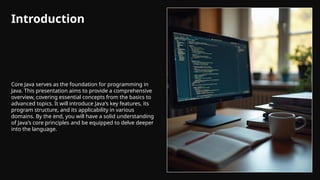
Core Java servesas the foundation for programming in
Java. This presentation aims to provide a comprehensive
overview, covering essential concepts from the basics to
advanced topics. It will introduce Java's key features, its
program structure, and its applicability in various
domains. By the end, you will have a solid understanding
of Java's core principles and be equipped to delve deeper
into the language.
Subtopic 1: JavaOverview
Java was developed by Sun Microsystems in 1995. It is an object-oriented
programming language that is platform-independent, allowing developers to write
code that can run on any device. The philosophy of "Write Once, Run Anywhere"
(WORA) underscores Java's versatility, making it a popular choice for various
applications, including Android apps and web development.
5.
Subtopic 2: KeyFeatures
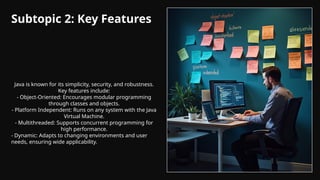
Java is known for its simplicity, security, and robustness.
Key features include:
- Object-Oriented: Encourages modular programming
through classes and objects.
- Platform Independent: Runs on any system with the Java
Virtual Machine.
- Multithreaded: Supports concurrent programming for
high performance.
- Dynamic: Adapts to changing environments and user
needs, ensuring wide applicability.
6.
Subtopic 3: JavaApplication Domains
Java is utilized across various sectors, demonstrating its versatility and power. Key application domains
include:
- Android App Development: Java is a primary language for creating Android applications, leveraging libraries
that enhance development.
- Web Development: Constructing dynamic websites and applications using technologies like JSP and
Servlets.
- Enterprise Applications: Leveraging frameworks such as Spring and Hibernate for large-scale business
solutions, promoting scalability and efficiency.
- Big Data: Java forms the basis for many big data tools and frameworks, notably Hadoop.
- Game Development: Utilizing libraries like LibGDX for creating cross-platform games.
Subtopic 1: Program
Structure
Atypical Java program begins with a class definition. The
entry point is the `main` method, which the Java Virtual
Machine executes. For example, a simple Java program
may include:
```java
public class HelloWorld {
public static void main(String[] args) {
System.out.println("Hello, World!");
}
}
```
This structure encapsulates the core components
necessary for execution, showcasing Java's approach to
object-oriented programming.
9.
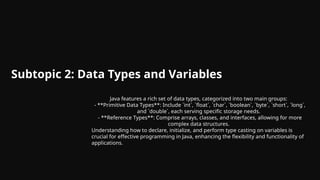
Subtopic 2: DataTypes and Variables
Java features a rich set of data types, categorized into two main groups:
- **Primitive Data Types**: Include `int`, `float`, `char`, `boolean`, `byte`, `short`, `long`,
and `double`, each serving specific storage needs.
- **Reference Types**: Comprise arrays, classes, and interfaces, allowing for more
complex data structures.
Understanding how to declare, initialize, and perform type casting on variables is
crucial for effective programming in Java, enhancing the flexibility and functionality of
applications.
10.
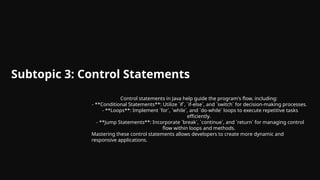
Subtopic 3: ControlStatements
Control statements in Java help guide the program's flow, including:
- **Conditional Statements**: Utilize `if`, `if-else`, and `switch` for decision-making processes.
- **Loops**: Implement `for`, `while`, and `do-while` loops to execute repetitive tasks
efficiently.
- **Jump Statements**: Incorporate `break`, `continue`, and `return` for managing control
flow within loops and methods.
Mastering these control statements allows developers to create more dynamic and
responsive applications.
11.
Conclusions
Java stands outas a robust, versatile programming
language with a strong foundation in object-oriented
principles. Its adaptability across various domains,
including enterprise applications and mobile
development, makes it an invaluable skill in today's job
market. Continuous practice with mini projects and
advanced frameworks will deepen your understanding
and proficiency in Java, preparing you for future
challenges in software development.
12.
CREDITS: This presentation
templatewas created by
Slidesgo, and includes icons,
infographics & images by
Freepik
Thank you!
Do you have any
questions?
+00 000 000 000
![Subtopic 1: Program
Structure
A typical Java program begins with a class definition. The
entry point is the `main` method, which the Java Virtual
Machine executes. For example, a simple Java program
may include:
```java
public class HelloWorld {
public static void main(String[] args) {
System.out.println("Hello, World!");
}
}
```
This structure encapsulates the core components
necessary for execution, showcasing Java's approach to
object-oriented programming.](https://image.slidesharecdn.com/corejavabasicstoadvanced-250726101550-70c9065b/85/Core-Java_-Basics-to-Advanced-pptx-8-320.jpg)