Introduction to Java
Java is a powerful and versatile programming language that is widely used
for a variety of applications, from web development to mobile app creation.
Its simplicity, portability, and strong object-oriented features make it an
excellent choice for beginners and experienced developers alike. Explore the
world of Java Programming with comprehensive tutorials, examples, and
best practices.
Java Syntax and Basic Programming
Concepts
1 Syntax
Java has a straightforward and
consistent syntax, making it easy to
read and write code.
2 Variables and Data Types
Java supports a wide range of data
types, allowing you to store and
manipulate different types of data.
3 Operators and Expressions
Java provides a comprehensive set of operators, including arithmetic, logical, and
assignment operators, to perform various operations on data.
Data Types and Variables in Java
Primitive Data Types
Java has eight primitive data
types, including integers,
floating-point numbers,
characters, and boolean values.
Reference Data Types
Java also supports reference
data types, such as strings,
arrays, and objects, which
provide more complex
functionality.
Variables and
Declarations
Variables in Java are used to
store data, and are declared
with a specific data type and
name.
Control Structures (Conditional
Statements and Loops)
1 Conditional Statements
Java provides several conditional statements, such as if-else and switch, to
control the flow of your program based on specific conditions.
2 Looping Structures
Java supports various loop structures, including for, while, and do-while, to
repeatedly execute a block of code.
3 Nested Structures
You can combine conditional statements and loops to create more complex
control structures, allowing for powerful and flexible program logic.
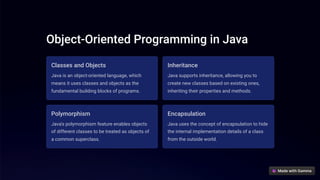
Object-Oriented Programming in Java
Classes and Objects
Java is an object-oriented language, which
means it uses classes and objects as the
fundamental building blocks of programs.
Inheritance
Java supports inheritance, allowing you to
create new classes based on existing ones,
inheriting their properties and methods.
Polymorphism
Java's polymorphism feature enables objects
of different classes to be treated as objects of
a common superclass.
Encapsulation
Java uses the concept of encapsulation to hide
the internal implementation details of a class
from the outside world.
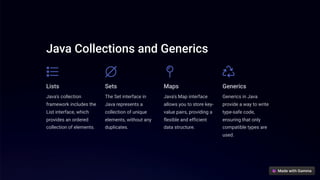
Java Collections and Generics
Lists
Java's collection
framework includes the
List interface, which
provides an ordered
collection of elements.
Sets
The Set interface in
Java represents a
collection of unique
elements, without any
duplicates.
Maps
Java's Map interface
allows you to store key-
value pairs, providing a
flexible and efficient
data structure.
Generics
Generics in Java
provide a way to write
type-safe code,
ensuring that only
compatible types are
used.
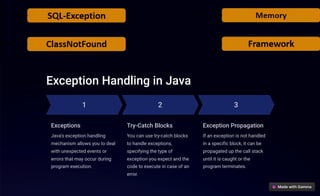
Exception Handling in Java
1
Exceptions
Java's exception handling
mechanism allows you to deal
with unexpected events or
errors that may occur during
program execution.
2
Try-Catch Blocks
You can use try-catch blocks
to handle exceptions,
specifying the type of
exception you expect and the
code to execute in case of an
error.
3
Exception Propagation
If an exception is not handled
in a specific block, it can be
propagated up the call stack
until it is caught or the
program terminates.
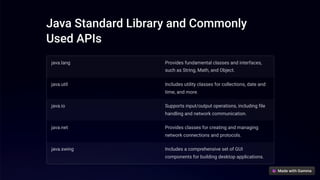
Java Standard Library and Commonly
Used APIs
java.lang Provides fundamental classes and interfaces,
such as String, Math, and Object.
java.util Includes utility classes for collections, date and
time, and more.
java.io Supports input/output operations, including file
handling and network communication.
java.net Provides classes for creating and managing
network connections and protocols.
java.swing Includes a comprehensive set of GUI
components for building desktop applications.

Master Java Programming: Tips, Tutorials, and Best Practices

  • 1.
    Introduction to Java Javais a powerful and versatile programming language that is widely used for a variety of applications, from web development to mobile app creation. Its simplicity, portability, and strong object-oriented features make it an excellent choice for beginners and experienced developers alike. Explore the world of Java Programming with comprehensive tutorials, examples, and best practices.
  • 2.
    Java Syntax andBasic Programming Concepts 1 Syntax Java has a straightforward and consistent syntax, making it easy to read and write code. 2 Variables and Data Types Java supports a wide range of data types, allowing you to store and manipulate different types of data. 3 Operators and Expressions Java provides a comprehensive set of operators, including arithmetic, logical, and assignment operators, to perform various operations on data.
  • 3.
    Data Types andVariables in Java Primitive Data Types Java has eight primitive data types, including integers, floating-point numbers, characters, and boolean values. Reference Data Types Java also supports reference data types, such as strings, arrays, and objects, which provide more complex functionality. Variables and Declarations Variables in Java are used to store data, and are declared with a specific data type and name.
  • 4.
    Control Structures (Conditional Statementsand Loops) 1 Conditional Statements Java provides several conditional statements, such as if-else and switch, to control the flow of your program based on specific conditions. 2 Looping Structures Java supports various loop structures, including for, while, and do-while, to repeatedly execute a block of code. 3 Nested Structures You can combine conditional statements and loops to create more complex control structures, allowing for powerful and flexible program logic.
  • 5.
    Object-Oriented Programming inJava Classes and Objects Java is an object-oriented language, which means it uses classes and objects as the fundamental building blocks of programs. Inheritance Java supports inheritance, allowing you to create new classes based on existing ones, inheriting their properties and methods. Polymorphism Java's polymorphism feature enables objects of different classes to be treated as objects of a common superclass. Encapsulation Java uses the concept of encapsulation to hide the internal implementation details of a class from the outside world.
  • 6.
    Java Collections andGenerics Lists Java's collection framework includes the List interface, which provides an ordered collection of elements. Sets The Set interface in Java represents a collection of unique elements, without any duplicates. Maps Java's Map interface allows you to store key- value pairs, providing a flexible and efficient data structure. Generics Generics in Java provide a way to write type-safe code, ensuring that only compatible types are used.
  • 7.
    Exception Handling inJava 1 Exceptions Java's exception handling mechanism allows you to deal with unexpected events or errors that may occur during program execution. 2 Try-Catch Blocks You can use try-catch blocks to handle exceptions, specifying the type of exception you expect and the code to execute in case of an error. 3 Exception Propagation If an exception is not handled in a specific block, it can be propagated up the call stack until it is caught or the program terminates.
  • 8.
    Java Standard Libraryand Commonly Used APIs java.lang Provides fundamental classes and interfaces, such as String, Math, and Object. java.util Includes utility classes for collections, date and time, and more. java.io Supports input/output operations, including file handling and network communication. java.net Provides classes for creating and managing network connections and protocols. java.swing Includes a comprehensive set of GUI components for building desktop applications.