Government Engineering
College, Arthua, Aurangabad.
Internshala
Training pvt.
Summer Internship – II
On
Submitted By :
Core
Java
Name : Syed Ali Azhar
Branch : Electronic Communication Engineering
Semester : 5th
Reg no : 21104147002
Submitted To :
G.E.C Aurangabad
Department of E.C.E
Principal - Dr. Prashant Mani
H.O.D - Prof. K. K. Chaubey
Table of Content :
 What is java.
 Overview of Core Java.
 Difference between Core Java & Advance Java.
 Advantages & disadvantages of java.
 Java Fundamentals
o Hello World Program
o Variables and Data Types
o Operators
o Conditional Statements
 OOPs Concepts
o Inheritance
o Polymorphism
o Abstraction
o Encapsulation
What is java
• Java is a general – purpose , object-oriented programming
language developed by sun Microsoft of USA in 1991.
• Java was developed by team led by james gosling.
• Java is a first programming language which provide which
provide the concept of writing programs that can be
executed using the web.
• Originally called Oak by james gosling,one of the inventors
of the language.
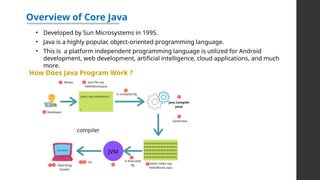
Overview of Core Java
• Developed by Sun Microsystems in 1995.
• Java is a highly popular, object-oriented programming language.
• This is a platform independent programming language is utilized for Android
development, web development, artificial intelligence, cloud applications, and much
more.
How Does Java Program Work ?
According to the sun ,3billion devices run java.
• DESKTOP APPLICATIONS.
• WEB APPLICAATIONS.
• ENTERPRISES APPLICATIONS.
• MOBILE.
• EMBEDDED SYSTEM.
• GAMES.
• ROBOTICS.
Where is java used
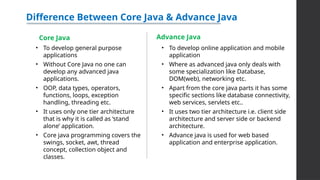
Difference Between Core Java & Advance Java
• To develop general purpose
applications
• Without Core Java no one can
develop any advanced java
applications.
• OOP, data types, operators,
functions, loops, exception
handling, threading etc.
• It uses only one tier architecture
that is why it is called as ‘stand
alone’ application.
• Core java programming covers the
swings, socket, awt, thread
concept, collection object and
classes.
• To develop online application and mobile
application
• Where as advanced java only deals with
some specialization like Database,
DOM(web), networking etc.
• Apart from the core java parts it has some
specific sections like database connectivity,
web services, servlets etc..
• It uses two tier architecture i.e. client side
architecture and server side or backend
architecture.
• Advance java is used for web based
application and enterprise application.
Core Java Advance Java
Advantages & disadvantages of java
Advantages of java
• java is simple language
• Java does not support POINTERS.
• Java is first language in which
programs can be executed using
web.
• Write once run
anywhere(WORA).
Disadvantages of java
• Slow performance
• No support for low level
programming
• Poor features in java
• No control over Garbage
collection
Java virtual machine
•Java virtual machine is the like usual
computer which translate high level
language into machine language.
•Just like that java virtual machine also
translate Bytecode into machine language.
•JVM are available for many hardware and
software plateform.
Hello World Program in Java
class HelloWorld
{
public static void main(String []args)
{
System.out.println(“Hello World!!! ”);
}
};
• Compiling the program :
To compile the program, we must run the Java compiler (javac), with the name
of the source file on “command prompt” like as follows
javac HelloWorld.java
If everything is OK, the “javac” compiler creates a file called
“Test.class”
• Running the program :
java HelloWorld
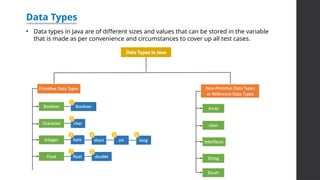
Data Types
• Data types in Java are of different sizes and values that can be stored in the variable
that is made as per convenience and circumstances to cover up all test cases.
Data Types
1. Boolean Data Type
Boolean data type represents only
one bit of information either true or
false
Syntax:
boolean varName;
2. Char Data Type
The char data type is a single 16-bit
Unicode character with the size of 2
bytes
Syntax:
char varName;
3. Integer Data Type
Integer data type represents integer
values in the different range
Syntax:
int varName;
4. Float Data Type
Float data type represents floating
types value. Its size is 8 bits
Syntax:
float varName;
Operators
• Operators are used to perform operations on variables and values.
Example: int x = 100+50;
Java divides the operators into the following groups:
• Arithmetic operators
• Assignment operators
• Comparison operators
• Logical operators
• Bitwise operators
• In the example below, we use the + operator to
add together two values:
Conditional statement
Conditional statements are one of the significant parts of "Control Structure"
in Java. Conditional statements are based on certain conditions and generate
decisions accordingly. These statements are a bunch of codes that can be
executed by "decisions statements". These conditions have some specific
"boolean expressions". The boolean expression of these conditional
statements generates "Boolean Value" which could be either true or false.
Types of Conditional Statements in Java:-
• If..statement in Java
• If..else statement in Java
• If else...if statement in Java
• Switch Statement in Java
Oops
Organizing the program in the terms of a collection of
objects is a way of object-oriented programming.
The four main concepts of Object-Oriented programming are:
• Abstraction
• Encapsulation
• Inheritance
• Polymorphism
Abstraction
Data abstraction is the process of hiding certain details and showing
only essential information to the user.
Abstraction can be achieved with either abstract
classes or interfaces
• Abstract class: is a restricted class that cannot be used to
create objects (to access it, it must be inherited from another
class).
•
Abstract method: can only be used in an abstract class, and
it does not have a body. The body is provided by the subclass
(inherited from).
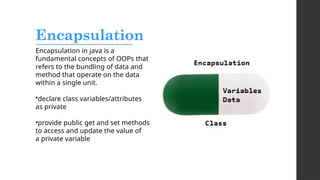
Encapsulation
Encapsulation in java is a
fundamental concepts of OOPs that
refers to the bundling of data and
method that operate on the data
within a single unit.
•declare class variables/attributes
as private
•provide public get and set methods
to access and update the value of
a private variable
Inheritance
• The property to inherite one class from another class is called inheritance.
• sub class/child class:- it is a class which inherits the other
class. it is also called a derived class/extended class.
• super class/parent class:- it is class from where a subclass
inherites. it is also called a base class or a parent class.
Polymerphism
we can perform a single action in
different ways. There are two
types of polymorphism in java:
compile-time polymorphism and
run-time polymorphism.
• Method overriding Is called Run
time polymorphism
• Method Overloading is called
compile-time polymorphism
Conclusion
• java is object oriented programming language. it is a
general purpose programmming language, mainly
designed to run developed java code on all plateforms.
As we all know, java is one of the most popular high level
programmining . java helps programmer to develope
real world project to use their skills. java was designed
to be easy to use, easy to write, compile,debug and
reusable code than other programming language. it is
used for creating mobile, and web apps, enterprise
software, internet of things devices, gaming
The end

Power Point Presentation on Core Java For the Beginers

  • 1.
    Government Engineering College, Arthua,Aurangabad. Internshala Training pvt. Summer Internship – II On Submitted By : Core Java Name : Syed Ali Azhar Branch : Electronic Communication Engineering Semester : 5th Reg no : 21104147002 Submitted To : G.E.C Aurangabad Department of E.C.E Principal - Dr. Prashant Mani H.O.D - Prof. K. K. Chaubey
  • 2.
    Table of Content:  What is java.  Overview of Core Java.  Difference between Core Java & Advance Java.  Advantages & disadvantages of java.  Java Fundamentals o Hello World Program o Variables and Data Types o Operators o Conditional Statements  OOPs Concepts o Inheritance o Polymorphism o Abstraction o Encapsulation
  • 3.
    What is java •Java is a general – purpose , object-oriented programming language developed by sun Microsoft of USA in 1991. • Java was developed by team led by james gosling. • Java is a first programming language which provide which provide the concept of writing programs that can be executed using the web. • Originally called Oak by james gosling,one of the inventors of the language.
  • 4.
    Overview of CoreJava • Developed by Sun Microsystems in 1995. • Java is a highly popular, object-oriented programming language. • This is a platform independent programming language is utilized for Android development, web development, artificial intelligence, cloud applications, and much more. How Does Java Program Work ?
  • 5.
    According to thesun ,3billion devices run java. • DESKTOP APPLICATIONS. • WEB APPLICAATIONS. • ENTERPRISES APPLICATIONS. • MOBILE. • EMBEDDED SYSTEM. • GAMES. • ROBOTICS. Where is java used
  • 6.
    Difference Between CoreJava & Advance Java • To develop general purpose applications • Without Core Java no one can develop any advanced java applications. • OOP, data types, operators, functions, loops, exception handling, threading etc. • It uses only one tier architecture that is why it is called as ‘stand alone’ application. • Core java programming covers the swings, socket, awt, thread concept, collection object and classes. • To develop online application and mobile application • Where as advanced java only deals with some specialization like Database, DOM(web), networking etc. • Apart from the core java parts it has some specific sections like database connectivity, web services, servlets etc.. • It uses two tier architecture i.e. client side architecture and server side or backend architecture. • Advance java is used for web based application and enterprise application. Core Java Advance Java
  • 7.
    Advantages & disadvantagesof java Advantages of java • java is simple language • Java does not support POINTERS. • Java is first language in which programs can be executed using web. • Write once run anywhere(WORA). Disadvantages of java • Slow performance • No support for low level programming • Poor features in java • No control over Garbage collection
  • 8.
    Java virtual machine •Javavirtual machine is the like usual computer which translate high level language into machine language. •Just like that java virtual machine also translate Bytecode into machine language. •JVM are available for many hardware and software plateform.
  • 9.
    Hello World Programin Java class HelloWorld { public static void main(String []args) { System.out.println(“Hello World!!! ”); } }; • Compiling the program : To compile the program, we must run the Java compiler (javac), with the name of the source file on “command prompt” like as follows javac HelloWorld.java If everything is OK, the “javac” compiler creates a file called “Test.class” • Running the program : java HelloWorld
  • 10.
    Data Types • Datatypes in Java are of different sizes and values that can be stored in the variable that is made as per convenience and circumstances to cover up all test cases.
  • 11.
    Data Types 1. BooleanData Type Boolean data type represents only one bit of information either true or false Syntax: boolean varName; 2. Char Data Type The char data type is a single 16-bit Unicode character with the size of 2 bytes Syntax: char varName; 3. Integer Data Type Integer data type represents integer values in the different range Syntax: int varName; 4. Float Data Type Float data type represents floating types value. Its size is 8 bits Syntax: float varName;
  • 12.
    Operators • Operators areused to perform operations on variables and values. Example: int x = 100+50; Java divides the operators into the following groups: • Arithmetic operators • Assignment operators • Comparison operators • Logical operators • Bitwise operators • In the example below, we use the + operator to add together two values:
  • 13.
    Conditional statement Conditional statementsare one of the significant parts of "Control Structure" in Java. Conditional statements are based on certain conditions and generate decisions accordingly. These statements are a bunch of codes that can be executed by "decisions statements". These conditions have some specific "boolean expressions". The boolean expression of these conditional statements generates "Boolean Value" which could be either true or false. Types of Conditional Statements in Java:- • If..statement in Java • If..else statement in Java • If else...if statement in Java • Switch Statement in Java
  • 14.
    Oops Organizing the programin the terms of a collection of objects is a way of object-oriented programming. The four main concepts of Object-Oriented programming are: • Abstraction • Encapsulation • Inheritance • Polymorphism
  • 15.
    Abstraction Data abstraction isthe process of hiding certain details and showing only essential information to the user. Abstraction can be achieved with either abstract classes or interfaces • Abstract class: is a restricted class that cannot be used to create objects (to access it, it must be inherited from another class). • Abstract method: can only be used in an abstract class, and it does not have a body. The body is provided by the subclass (inherited from).
  • 16.
    Encapsulation Encapsulation in javais a fundamental concepts of OOPs that refers to the bundling of data and method that operate on the data within a single unit. •declare class variables/attributes as private •provide public get and set methods to access and update the value of a private variable
  • 17.
    Inheritance • The propertyto inherite one class from another class is called inheritance. • sub class/child class:- it is a class which inherits the other class. it is also called a derived class/extended class. • super class/parent class:- it is class from where a subclass inherites. it is also called a base class or a parent class.
  • 18.
    Polymerphism we can performa single action in different ways. There are two types of polymorphism in java: compile-time polymorphism and run-time polymorphism. • Method overriding Is called Run time polymorphism • Method Overloading is called compile-time polymorphism
  • 19.
    Conclusion • java isobject oriented programming language. it is a general purpose programmming language, mainly designed to run developed java code on all plateforms. As we all know, java is one of the most popular high level programmining . java helps programmer to develope real world project to use their skills. java was designed to be easy to use, easy to write, compile,debug and reusable code than other programming language. it is used for creating mobile, and web apps, enterprise software, internet of things devices, gaming
  • 20.