GOOD
GOOD
1
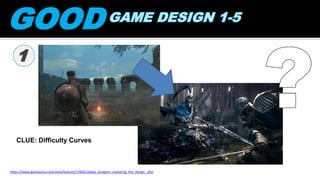
https://www.gamasutra.com/view/feature/178262/deep_dungeon_exploring_the_design_.php
CLUE: Difficulty Curves
GOOD
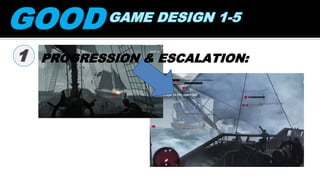
1 PROGRESSION & ESCALATION:
GOOD
1
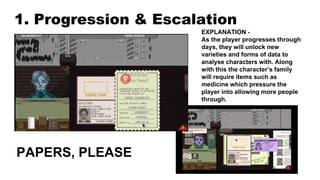
EXPLANATION -
As the player progresses through
days, they will unlock new
varieties and forms of data to
analyse characters with. Along
with this the character’s family
will require items such as
medicine which pressure the
player into allowing more people
through.
1. Progression & Escalation
PAPERS, PLEASE
1. Progression & Escalation
World of Warcraft
GOOD
2
CLUE:”Juiciness”
GOOD
2 OBJECTIVES & CONSTANT FEEDBACK
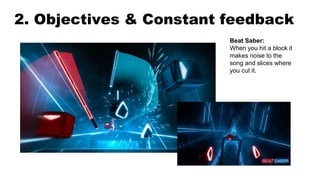
2. Objectives & Constant feedback
Beat Saber:
When you hit a block it
makes noise to the
song and slices where
you cut it.
GOOD
3
GOOD
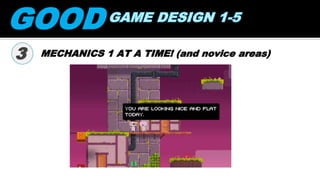
3 MECHANICS 1 AT A TIME! (and novice areas)
GOOD
3 MECHANICS 1 AT A TIME! (and novice areas)
GOOD
3 MECHANICS 1 AT A TIME! (and novice areas)
In the Legend of Zelda: Ocarina of Time (3D)
during the start of the game the player is
gradually shown the mechanics.
You start of with nothing but cannot progress
without a sword and shield, so before even
showing you how to use a sword and shield
the player is shown how to do things such as
move, use the camera, collect rupees, swim
and jump over gaps (with autojump), as well
as using the in-game shopping system.
Once obtained the sword and shield the game
takes the player through a very easy dungeon
that shows them how to do combat and solve
the basic puzzles found throughout the game.
5. Mechanics one at a time-
the Legend of Zelda: Ocarina of
Time
GOOD
3 MECHANICS 1 AT A TIME! (and novice areas)
Big games can get away with throwing hundreds of complex mechanics at you early
in the game because often you’ve just shelled out big bucks…
Smaller, indie or F2P, it’s a no-no.
use the novice-intermediate system – introduce a mechanic in a safe environment,
and ideally gate them in that area so they’re unable to leave it until you KNOW as a
designer that they’ve learnt it.
GOOD
3 MECHANICS 1 AT A TIME! (and novice areas)
Simplicity- less is more
Start with simple games rules that are tested and work and you’re always
able to add complex systems later.
Start with a complex set of systems and then build the house around them
and you can’t take out the ones that don’t work without the whole structure
falling down around your ears.
GOOD
1
2
3
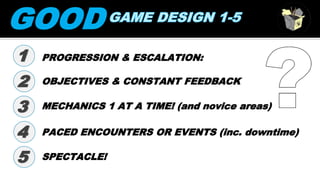
PROGRESSION & ESCALATION:
OBJECTIVES & CONSTANT FEEDBACK
MECHANICS 1 AT A TIME! (and novice areas)
GOOD
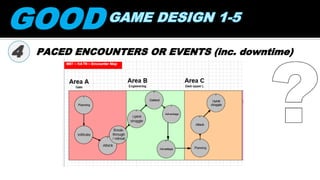
4 PACED ENCOUNTERS OR EVENTS (inc. downtime)
In Far Cry 5 there is a
resistance points
meter which is filled
by completing
missions etc. Filling
the meter will
progress the story
giving the player their
own time to explore
after intense
moments and
gameplay.
4. Paced Encounters or events
GOOD
5
GOOD
5 SPECTACLE!
GOOD
5 SPECTACLE!
The Wow factor. This intangible unit of measurement simply refers
to the biggest point of impact in your level. It could be some kind
of impressive architecture or landscaping. It could be a complex
and impressive scripted event involving dozens of NPCs launching
a coordinated attack on the player. It could even be a challenging
mechanic or puzzle so ingenious that the player can’t help but tell
his friends about the next day.
GOOD
5 SPECTACLE!
• Design around framing vistas and reveals
• Orientation - Navigation and landscape points,
• Work closely with scriptwriter to design big events that fit the plot
‘water cooler moments’
GOOD
5 SPECTACLE!
Spend some time developing a spectacular view. Maybe a
grand entrance, a detailed outer building, or even a super
advanced control center. Make players turn a corner for the
first time and say to themselves, "Wow."
It stays with the players, and they remember the level long
after they completed it if they were impressed by something
cool-looking.
This isn't so important in DM maps, mainly because once you
run past it no one cares what it looks like time after time. Don't
spend too much time on something visually stunning in DM;
spend more time on flow.
5. Spectacle - Bioshock
4:15
In this scene you are
first introduced to
Rapture and it has the
“Wow!” factor with all
the neon lighting and
unique imagery not
seen before in games.
12. Spectacle
Shadow of the
Colossus: The game
is constantly
throwing impressive
looking enemies at
the player.
Macorov
detonated a
nuke and
destroys
everything in
sight
5. Spectacle
Modern warfare 2
GOOD
1
2
3
4
5
PROGRESSION & ESCALATION:
OBJECTIVES & CONSTANT FEEDBACK
SPECTACLE!
MECHANICS 1 AT A TIME! (and novice areas)
PACED ENCOUNTERS OR EVENTS (inc. downtime)
See you in the lab!
(You’ll start building a game!)

CORE Game Design Techniques.pptx

  • 1.
  • 2.
  • 3.
  • 4.
  • 5.
    EXPLANATION - As theplayer progresses through days, they will unlock new varieties and forms of data to analyse characters with. Along with this the character’s family will require items such as medicine which pressure the player into allowing more people through. 1. Progression & Escalation PAPERS, PLEASE
  • 6.
    1. Progression &Escalation World of Warcraft
  • 7.
  • 8.
    GOOD 2 OBJECTIVES &CONSTANT FEEDBACK
  • 9.
    2. Objectives &Constant feedback Beat Saber: When you hit a block it makes noise to the song and slices where you cut it.
  • 10.
  • 11.
    GOOD 3 MECHANICS 1AT A TIME! (and novice areas)
  • 12.
    GOOD 3 MECHANICS 1AT A TIME! (and novice areas)
  • 13.
    GOOD 3 MECHANICS 1AT A TIME! (and novice areas)
  • 14.
    In the Legendof Zelda: Ocarina of Time (3D) during the start of the game the player is gradually shown the mechanics. You start of with nothing but cannot progress without a sword and shield, so before even showing you how to use a sword and shield the player is shown how to do things such as move, use the camera, collect rupees, swim and jump over gaps (with autojump), as well as using the in-game shopping system. Once obtained the sword and shield the game takes the player through a very easy dungeon that shows them how to do combat and solve the basic puzzles found throughout the game. 5. Mechanics one at a time- the Legend of Zelda: Ocarina of Time
  • 15.
    GOOD 3 MECHANICS 1AT A TIME! (and novice areas) Big games can get away with throwing hundreds of complex mechanics at you early in the game because often you’ve just shelled out big bucks… Smaller, indie or F2P, it’s a no-no. use the novice-intermediate system – introduce a mechanic in a safe environment, and ideally gate them in that area so they’re unable to leave it until you KNOW as a designer that they’ve learnt it.
  • 16.
    GOOD 3 MECHANICS 1AT A TIME! (and novice areas) Simplicity- less is more Start with simple games rules that are tested and work and you’re always able to add complex systems later. Start with a complex set of systems and then build the house around them and you can’t take out the ones that don’t work without the whole structure falling down around your ears.
  • 17.
    GOOD 1 2 3 PROGRESSION & ESCALATION: OBJECTIVES& CONSTANT FEEDBACK MECHANICS 1 AT A TIME! (and novice areas)
  • 18.
    GOOD 4 PACED ENCOUNTERSOR EVENTS (inc. downtime)
  • 19.
    In Far Cry5 there is a resistance points meter which is filled by completing missions etc. Filling the meter will progress the story giving the player their own time to explore after intense moments and gameplay. 4. Paced Encounters or events
  • 20.
  • 21.
  • 22.
    GOOD 5 SPECTACLE! The Wowfactor. This intangible unit of measurement simply refers to the biggest point of impact in your level. It could be some kind of impressive architecture or landscaping. It could be a complex and impressive scripted event involving dozens of NPCs launching a coordinated attack on the player. It could even be a challenging mechanic or puzzle so ingenious that the player can’t help but tell his friends about the next day.
  • 23.
    GOOD 5 SPECTACLE! • Designaround framing vistas and reveals • Orientation - Navigation and landscape points, • Work closely with scriptwriter to design big events that fit the plot ‘water cooler moments’
  • 24.
    GOOD 5 SPECTACLE! Spend sometime developing a spectacular view. Maybe a grand entrance, a detailed outer building, or even a super advanced control center. Make players turn a corner for the first time and say to themselves, "Wow." It stays with the players, and they remember the level long after they completed it if they were impressed by something cool-looking. This isn't so important in DM maps, mainly because once you run past it no one cares what it looks like time after time. Don't spend too much time on something visually stunning in DM; spend more time on flow.
  • 25.
    5. Spectacle -Bioshock 4:15 In this scene you are first introduced to Rapture and it has the “Wow!” factor with all the neon lighting and unique imagery not seen before in games.
  • 26.
    12. Spectacle Shadow ofthe Colossus: The game is constantly throwing impressive looking enemies at the player.
  • 27.
    Macorov detonated a nuke and destroys everythingin sight 5. Spectacle Modern warfare 2
  • 28.
    GOOD 1 2 3 4 5 PROGRESSION & ESCALATION: OBJECTIVES& CONSTANT FEEDBACK SPECTACLE! MECHANICS 1 AT A TIME! (and novice areas) PACED ENCOUNTERS OR EVENTS (inc. downtime)
  • 29.
    See you inthe lab! (You’ll start building a game!)

Editor's Notes

  • #2 Good game design almanac   Progression and escalation Objectives and constant feedback Mechanics 1 at a time Paced encounters or events (inc downtime) Spectacle Safe experimentation Consistency and readability Replayablility 3 times rule Foreshadowing Signposting and objectives Orientation and planning points Downtime Risk reward hooks
  • #3 This is called
  • #4 This is called
  • #5 This is called
  • #8 This is called
  • #9 This is called
  • #11 This is called
  • #12 This is called
  • #13 This is called
  • #14 This is called
  • #16 This is called
  • #17 This is called
  • #18 This is called
  • #19 This is called
  • #21 This is called
  • #22 This is called
  • #23 This is called
  • #24 This is called
  • #25 This is called
  • #29 This is called