Virginia Cord Blood Bank
Initiative
HB 413
Virginia Cord Blood Bank Initiative
“…a public resource for Virginians for the
treatment of patients with life-
threatening diseases or debilitating
conditions, for use in advancing basic
and clinical research, and, in the event of
a terrorist attack, to be used in the
treatment of the injured citizens of the
Commonwealth.”
The “Initiative”
Nonprofit entity to collect, screen for
infectious and genetic diseases, perform
tissue typing on, cryopreserve and store
umbilical cord blood.
Develop a collaborative consortium
The “Initiative”
Consortium consists of membership from:
Academic medical centers;
Hospitals and hospital systems;
Biotechnology companies;
Regional blood banks;
Laboratories;
Medical researchers; and
Other health care providers.
The “Initiative”
Commissioner of Health to coordinate
procedures for the Initiative including
patient donation information and
consent, length of storage time, and
processes for recycling the blood at the
end of storage.
The “Initiative”
Commissioner of Health to disseminate
information about the Initiative.
Initiative participants responsible for
community outreach.
DMAS to include information about the
Initiative to enrollees.
All birthing facilities to provide women
the opportunity to donate.
Currently in Virginia
Only 5% of umbilical cord blood is now
being banked in Virginia;
Primary use is by pediatric oncologists for
childhood cancers; and
Most stored cord blood is being deposited
in private storage facilities.
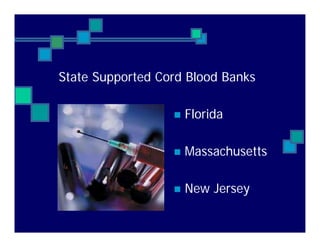
State Supported Cord Blood Banks
Florida
Massachusetts
New Jersey
Florida’s Program
Legislation established the “Public Cord
Blood Tissue Bank”.
Collaborative consortium of Univ. of
Florida, Univ. of Southern Florida, Univ.
of Miami, and the Jacksonville Mayo
Clinic.
Consortium may charge reasonable fees
to recipients.
Massachusetts’ Program
Legislation established and maintains a
public cord blood bank.
Established in partnership with the Univ.
of Massachusetts Medical School.
Also established a Biomedical Research
Advisory Council.
New Jersey’s Program
The state provided a $5 mil. loan to
Coriell Institute for Medical Research to
establish the Cord Blood Bank.
Repayment of the loan is conditioned on
the release of cord blood for therapy
purposes.
Coriell Institute is a nonprofit biomedical
research institution with a history of cell
banking and cryogenic storage.
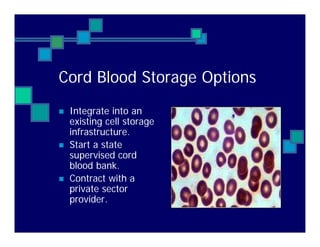
Cord Blood Storage Options
Integrate into an
existing cell storage
infrastructure.
Start a state
supervised cord
blood bank.
Contract with a
private sector
provider.
The “Initiative” Work Plan
$200,000 allocated in SFY 07 & 08.
Fall of 06, convene statewide team of
medical experts to explore options and
develop a statewide consortium.
Involve representation from emergency
preparedness agencies.
VDH to develop database of existing cord
blood supplies.
Questions

Cord blood

  • 1.
    Virginia Cord BloodBank Initiative HB 413
  • 2.
    Virginia Cord BloodBank Initiative “…a public resource for Virginians for the treatment of patients with life- threatening diseases or debilitating conditions, for use in advancing basic and clinical research, and, in the event of a terrorist attack, to be used in the treatment of the injured citizens of the Commonwealth.”
  • 3.
    The “Initiative” Nonprofit entityto collect, screen for infectious and genetic diseases, perform tissue typing on, cryopreserve and store umbilical cord blood. Develop a collaborative consortium
  • 4.
    The “Initiative” Consortium consistsof membership from: Academic medical centers; Hospitals and hospital systems; Biotechnology companies; Regional blood banks; Laboratories; Medical researchers; and Other health care providers.
  • 5.
    The “Initiative” Commissioner ofHealth to coordinate procedures for the Initiative including patient donation information and consent, length of storage time, and processes for recycling the blood at the end of storage.
  • 6.
    The “Initiative” Commissioner ofHealth to disseminate information about the Initiative. Initiative participants responsible for community outreach. DMAS to include information about the Initiative to enrollees. All birthing facilities to provide women the opportunity to donate.
  • 7.
    Currently in Virginia Only5% of umbilical cord blood is now being banked in Virginia; Primary use is by pediatric oncologists for childhood cancers; and Most stored cord blood is being deposited in private storage facilities.
  • 8.
    State Supported CordBlood Banks Florida Massachusetts New Jersey
  • 9.
    Florida’s Program Legislation establishedthe “Public Cord Blood Tissue Bank”. Collaborative consortium of Univ. of Florida, Univ. of Southern Florida, Univ. of Miami, and the Jacksonville Mayo Clinic. Consortium may charge reasonable fees to recipients.
  • 10.
    Massachusetts’ Program Legislation establishedand maintains a public cord blood bank. Established in partnership with the Univ. of Massachusetts Medical School. Also established a Biomedical Research Advisory Council.
  • 11.
    New Jersey’s Program Thestate provided a $5 mil. loan to Coriell Institute for Medical Research to establish the Cord Blood Bank. Repayment of the loan is conditioned on the release of cord blood for therapy purposes. Coriell Institute is a nonprofit biomedical research institution with a history of cell banking and cryogenic storage.
  • 12.
    Cord Blood StorageOptions Integrate into an existing cell storage infrastructure. Start a state supervised cord blood bank. Contract with a private sector provider.
  • 13.
    The “Initiative” WorkPlan $200,000 allocated in SFY 07 & 08. Fall of 06, convene statewide team of medical experts to explore options and develop a statewide consortium. Involve representation from emergency preparedness agencies. VDH to develop database of existing cord blood supplies.
  • 14.