FAIR USE
      & YOU
USING COPYRIGHTED WORK THE RIGHT WAY!

   Fair Use Workshop For New Teachers
             by: Gina Mestl
How Are WE ABLE TO USE
 COPYRIGHTED WORK AS
     EDUCATORS?


  Fair Use
 …IF YOU WORK AT A NON-PROFIT
   EDUCATIONAL INSTITUTIONAL
                           Fair use harbor
WHAT IS FAIR USE?
  It is NOT A LAW-they are guidelines!
                        Presentation-Fair Use of Copyrighted Materials


To foster the advancement of the arts and
    sciences, there must be a free flow
         of information and ideas.

If no one could quote from a protected work
      without the author’s permission
   (which could be withheld or given only
     upon payment of a permission fee), the
 free flow of ideas would be stopped dead.
                                              Fishman, 2008, p. 8,9
four criteria
   used to Determine Fair use
1. The purpose and character of the use, including
   whether such use is of a commercial nature or is for
   non-profit educational purposes.

2. The nature of the copyrighted work.

3. The amount and substantiality of the portion used in
   relation to the copyrighted work as a whole.

4. The effect of the use upon the potential market for
   or value of the copyrighted work.
                                              Fair use harbor
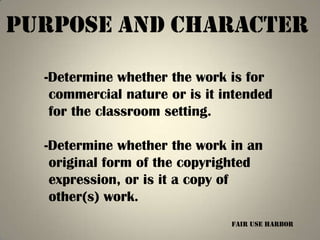
Purpose and Character

  -Determine whether the work is for
   commercial nature or is it intended
   for the classroom setting.

  -Determine whether the work in an
   original form of the copyrighted
   expression, or is it a copy of
   other(s) work.
                               Fair use Harbor
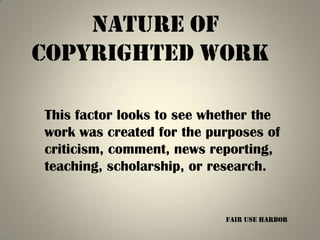
Nature of
copyrighted work

This factor looks to see whether the
work was created for the purposes of
criticism, comment, news reporting,
teaching, scholarship, or research.


                           Fair Use Harbor
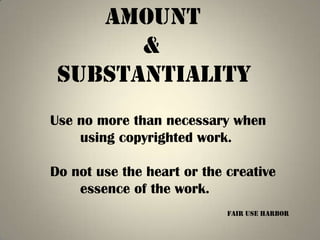
Amount
       &
 Substantiality
Use no more than necessary when
    using copyrighted work.

Do not use the heart or the creative
    essence of the work.
                            Fair Use harbor
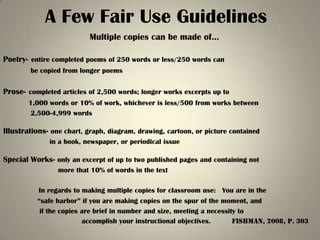
A Few Fair Use Guidelines
                          Multiple copies can be made of…

Poetry- entire completed poems of 250 words or less/250 words can
        be copied from longer poems


Prose- completed articles of 2,500 words; longer works excerpts up to
       1,000 words or 10% of work, whichever is less/500 from works between
       2,500-4,999 words

Illustrations- one chart, graph, diagram, drawing, cartoon, or picture contained
              in a book, newspaper, or periodical issue

Special Works- only an excerpt of up to two published pages and containing not
                 more that 10% of words in the text

          In regards to making multiple copies for classroom use: You are in the
          “safe harbor” if you are making copies on the spur of the moment, and
           if the copies are brief in number and size, meeting a necessity to
                         accomplish your instructional objectives.       Fishman, 2008, p. 303
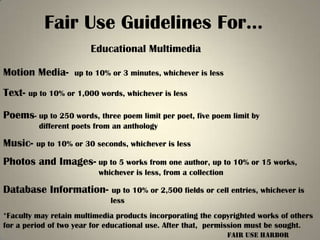
Fair Use Guidelines For…
                        Educational Multimedia

Motion Media-      up to 10% or 3 minutes, whichever is less

Text- up to 10% or 1,000 words, whichever is less

Poems- up to 250 words, three poem limit per poet, five poem limit by
         different poets from an anthology

Music-   up to 10% or 30 seconds, whichever is less

Photos and Images- up to 5 works from one author, up to 10% or 15 works,
                          whichever is less, from a collection

Database Information-        up to 10% or 2,500 fields or cell entries, whichever is
                             less
*Faculty may retain multimedia products incorporating the copyrighted works of others
for a period of two year for educational use. After that, permission must be sought.
                                                                 Fair Use Harbor
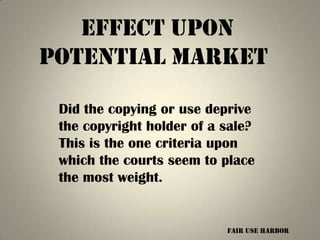
Effect upon
potential market

 Did the copying or use deprive
 the copyright holder of a sale?
 This is the one criteria upon
 which the courts seem to place
 the most weight.


                           Fair Use harbor
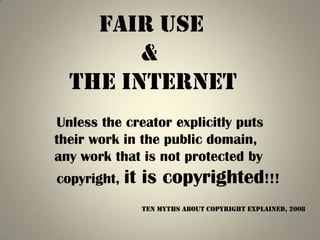
Fair use
        &
  the internet
Unless the creator explicitly puts
their work in the public domain,
any work that is not protected by
copyright,   it is copyrighted!!!
               Ten Myths About Copyright Explained, 2008
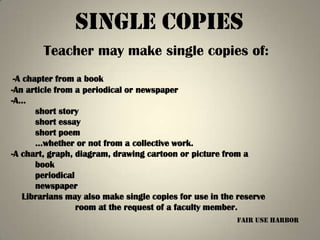
single Copies
        Teacher may make single copies of:
 -A chapter from a book
-An article from a periodical or newspaper
-A…
       short story
       short essay
       short poem
       …whether or not from a collective work.
-A chart, graph, diagram, drawing cartoon or picture from a
       book
       periodical
       newspaper
    Librarians may also make single copies for use in the reserve
                  room at the request of a faculty member.
                                                         fair use harbor
Single copies continued…
Teachers may select books, magazine or
journal articles, or other documents
 to be placed in the library’s reserve room,
which functions as an extension of the
classroom.

Students can borrow these materials and
make single copies on machines that are
marked with a copyright notice.
                                 fair use harbor
Why do we have the
fair use guidelines!

“The fair use doctrine is rooted in the
truth that we sometimes must use the
   expression of another to express
        ourselves effectively.”
         Michael Carroll, Associate Professor of Law,
             Villanova University School of Law


                       Presentation-Fair use of copyrighted material
RemembeR…

  Only courts can answer
       if it is fair use.

      Get permission
and you don’t have to worry!!!
                      fair use harbor
Sources:

The Copyright Handbook, Stephen Fishman, 2008

Fair Use Harbor

Presentation-Fair Use of Copyrighted Material

Ten Myths of Copyright Explained by Brad Templeton 2008

Copyright, Fair Use & You!

  • 1.
    FAIR USE & YOU USING COPYRIGHTED WORK THE RIGHT WAY! Fair Use Workshop For New Teachers by: Gina Mestl
  • 2.
    How Are WEABLE TO USE COPYRIGHTED WORK AS EDUCATORS? Fair Use …IF YOU WORK AT A NON-PROFIT EDUCATIONAL INSTITUTIONAL Fair use harbor
  • 3.
    WHAT IS FAIRUSE? It is NOT A LAW-they are guidelines! Presentation-Fair Use of Copyrighted Materials To foster the advancement of the arts and sciences, there must be a free flow of information and ideas. If no one could quote from a protected work without the author’s permission (which could be withheld or given only upon payment of a permission fee), the free flow of ideas would be stopped dead. Fishman, 2008, p. 8,9
  • 4.
    four criteria used to Determine Fair use 1. The purpose and character of the use, including whether such use is of a commercial nature or is for non-profit educational purposes. 2. The nature of the copyrighted work. 3. The amount and substantiality of the portion used in relation to the copyrighted work as a whole. 4. The effect of the use upon the potential market for or value of the copyrighted work. Fair use harbor
  • 5.
    Purpose and Character -Determine whether the work is for commercial nature or is it intended for the classroom setting. -Determine whether the work in an original form of the copyrighted expression, or is it a copy of other(s) work. Fair use Harbor
  • 6.
    Nature of copyrighted work Thisfactor looks to see whether the work was created for the purposes of criticism, comment, news reporting, teaching, scholarship, or research. Fair Use Harbor
  • 7.
    Amount & Substantiality Use no more than necessary when using copyrighted work. Do not use the heart or the creative essence of the work. Fair Use harbor
  • 8.
    A Few FairUse Guidelines Multiple copies can be made of… Poetry- entire completed poems of 250 words or less/250 words can be copied from longer poems Prose- completed articles of 2,500 words; longer works excerpts up to 1,000 words or 10% of work, whichever is less/500 from works between 2,500-4,999 words Illustrations- one chart, graph, diagram, drawing, cartoon, or picture contained in a book, newspaper, or periodical issue Special Works- only an excerpt of up to two published pages and containing not more that 10% of words in the text In regards to making multiple copies for classroom use: You are in the “safe harbor” if you are making copies on the spur of the moment, and if the copies are brief in number and size, meeting a necessity to accomplish your instructional objectives. Fishman, 2008, p. 303
  • 9.
    Fair Use GuidelinesFor… Educational Multimedia Motion Media- up to 10% or 3 minutes, whichever is less Text- up to 10% or 1,000 words, whichever is less Poems- up to 250 words, three poem limit per poet, five poem limit by different poets from an anthology Music- up to 10% or 30 seconds, whichever is less Photos and Images- up to 5 works from one author, up to 10% or 15 works, whichever is less, from a collection Database Information- up to 10% or 2,500 fields or cell entries, whichever is less *Faculty may retain multimedia products incorporating the copyrighted works of others for a period of two year for educational use. After that, permission must be sought. Fair Use Harbor
  • 10.
    Effect upon potential market Did the copying or use deprive the copyright holder of a sale? This is the one criteria upon which the courts seem to place the most weight. Fair Use harbor
  • 11.
    Fair use & the internet Unless the creator explicitly puts their work in the public domain, any work that is not protected by copyright, it is copyrighted!!! Ten Myths About Copyright Explained, 2008
  • 12.
    single Copies Teacher may make single copies of: -A chapter from a book -An article from a periodical or newspaper -A… short story short essay short poem …whether or not from a collective work. -A chart, graph, diagram, drawing cartoon or picture from a book periodical newspaper Librarians may also make single copies for use in the reserve room at the request of a faculty member. fair use harbor
  • 13.
    Single copies continued… Teachersmay select books, magazine or journal articles, or other documents to be placed in the library’s reserve room, which functions as an extension of the classroom. Students can borrow these materials and make single copies on machines that are marked with a copyright notice. fair use harbor
  • 14.
    Why do wehave the fair use guidelines! “The fair use doctrine is rooted in the truth that we sometimes must use the expression of another to express ourselves effectively.” Michael Carroll, Associate Professor of Law, Villanova University School of Law Presentation-Fair use of copyrighted material
  • 15.
    RemembeR… Onlycourts can answer if it is fair use. Get permission and you don’t have to worry!!! fair use harbor
  • 16.
    Sources: The Copyright Handbook,Stephen Fishman, 2008 Fair Use Harbor Presentation-Fair Use of Copyrighted Material Ten Myths of Copyright Explained by Brad Templeton 2008