• INTRODUCTION
• EPIDEMIOLOGY
• RISK FACTORS
Abisha Gautam
Ashmita Dhital
Ayush Labh
Jagriti Khanal
Raju Raj Shakya
Sajina Nepal
Suhana Sigdel
Introduction
• COPD is a disease characterized by persistent airflow limitation
• It is usually progressive, and associated with an enhanced chronic
inflammatory response in the airways and the lung to noxious particles
or gases
• COPD is defined as a preventable and treatable disease characterised
by persistent airflow obstruction that is usually progressive and
associated with an enhanced chronic inflammatory response in the
airways and the lung to the noxious particles or gases.
- Davidson’s Principles and Practice of Medicine (22nd
edition)
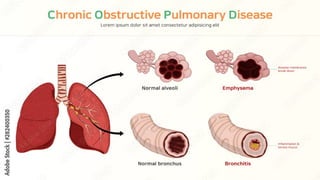
• It includes Chronic bronchitis and emphysema
Introduction
• COPD is preventable and treatable disease.
Epidemiology
• In 2005, COPD contributed to more than 3 Million deaths (5% of
deaths globally)
• In 2020, it is the third most important cause of death worldwide
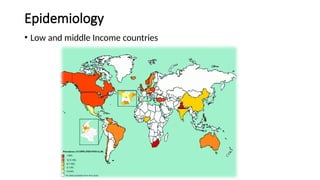
• The World Health Organization (WHO) reports that 90% of COPD-
accounted deaths occur in low- and middle-income countries
Epidemiology
• Low and middle Income countries
Epidemiology
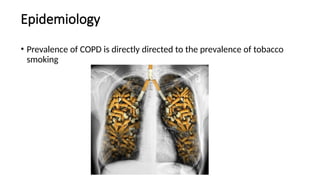
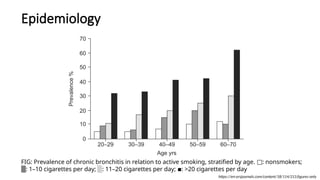
• Prevalence of COPD is directly directed to the prevalence of tobacco
smoking
Epidemiology
FIG: Prevalence of chronic bronchitis in relation to active smoking, stratified by age. : nonsmokers;
□
: 1–10 cigarettes per day; : 11–20 cigarettes per day; : >20 cigarettes per day
▒ ░ ▪
https://err.ersjournals.com/content/18/114/213.figures-only
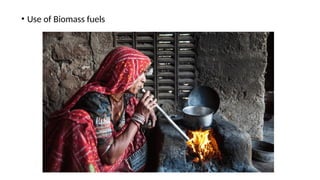
• Use of Biomass fuels
Epidemiology In Nepal
• In Nepal, COPD bears the patient load of 43% of all non-
communicable diseases and also accounts for 2.56% of total
hospitalization.
• This situation is aggravated in the case of Nepal, since almost 85% of
households still rely upon biofuels such as wood and others to cook
for their meal, thus making Nepalese women more prone to the
development of COPD due to indoor air pollution.
• The situation is made worse by the fact that health literacy among our
people is not so high as compared to the developed western
countries.
https://www.clinicone.com.np/copd-cases-in-nepal/
Epidemiology in Nepal
https://www.ncbi.nlm.nih.gov/pmc/articles/PMC5810531/
Epidemiology in Nepal
https://www.ncbi.nlm.nih.gov/pmc/articles/PMC5810531/
Risk Factors
• Environmental Factors
‐ Tobacco Smoking: accounts for 95% cases.
‐ Ambient air pollution: eg: cooking with biomass fuels.
‐ Occupational exposure: coal dust , silica, cadmium etc.
‐ Premature birth: low birth weight increases risk of COPD.
‐ Infections: exacerbates the inflammation.
‐ Passive smoking: exposure of children to maternal smoking
reduces lung growth.
Risk Factors
• Host Factors
‐ Genetic susceptibility: α1-antitrypsin deficiency and
alterations in other genes like : HHIP, FAM13A, and IREB2.
‐ Airway Hyper-reactivity: many asthma patients are seen to
develop COPD.

COPD: Causes, Diagnosis & Care (27 characters)

  • 2.
    • INTRODUCTION • EPIDEMIOLOGY •RISK FACTORS Abisha Gautam Ashmita Dhital Ayush Labh Jagriti Khanal Raju Raj Shakya Sajina Nepal Suhana Sigdel
  • 3.
    Introduction • COPD isa disease characterized by persistent airflow limitation • It is usually progressive, and associated with an enhanced chronic inflammatory response in the airways and the lung to noxious particles or gases • COPD is defined as a preventable and treatable disease characterised by persistent airflow obstruction that is usually progressive and associated with an enhanced chronic inflammatory response in the airways and the lung to the noxious particles or gases. - Davidson’s Principles and Practice of Medicine (22nd edition) • It includes Chronic bronchitis and emphysema
  • 5.
    Introduction • COPD ispreventable and treatable disease.
  • 6.
    Epidemiology • In 2005,COPD contributed to more than 3 Million deaths (5% of deaths globally) • In 2020, it is the third most important cause of death worldwide • The World Health Organization (WHO) reports that 90% of COPD- accounted deaths occur in low- and middle-income countries
  • 7.
    Epidemiology • Low andmiddle Income countries
  • 8.
    Epidemiology • Prevalence ofCOPD is directly directed to the prevalence of tobacco smoking
  • 9.
    Epidemiology FIG: Prevalence ofchronic bronchitis in relation to active smoking, stratified by age. : nonsmokers; □ : 1–10 cigarettes per day; : 11–20 cigarettes per day; : >20 cigarettes per day ▒ ░ ▪ https://err.ersjournals.com/content/18/114/213.figures-only
  • 10.
    • Use ofBiomass fuels
  • 11.
    Epidemiology In Nepal •In Nepal, COPD bears the patient load of 43% of all non- communicable diseases and also accounts for 2.56% of total hospitalization. • This situation is aggravated in the case of Nepal, since almost 85% of households still rely upon biofuels such as wood and others to cook for their meal, thus making Nepalese women more prone to the development of COPD due to indoor air pollution. • The situation is made worse by the fact that health literacy among our people is not so high as compared to the developed western countries. https://www.clinicone.com.np/copd-cases-in-nepal/
  • 12.
  • 13.
  • 14.
    Risk Factors • EnvironmentalFactors ‐ Tobacco Smoking: accounts for 95% cases. ‐ Ambient air pollution: eg: cooking with biomass fuels. ‐ Occupational exposure: coal dust , silica, cadmium etc. ‐ Premature birth: low birth weight increases risk of COPD. ‐ Infections: exacerbates the inflammation. ‐ Passive smoking: exposure of children to maternal smoking reduces lung growth.
  • 15.
    Risk Factors • HostFactors ‐ Genetic susceptibility: α1-antitrypsin deficiency and alterations in other genes like : HHIP, FAM13A, and IREB2. ‐ Airway Hyper-reactivity: many asthma patients are seen to develop COPD.

Editor's Notes

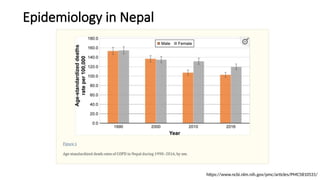
  • #12 In 2016, an estimated 16,302 people (95% UI: 12,941.4–19,290.7) died from COPD in Nepal. Between 1990 and 2016, the mortality rate due to COPD was decreasing for both genders, but the decline was much higher among males when compared with females. Thus, by 2016, the age-standardized death rate due to COPD for the females was 119.7 per 100,000 people (95% UI: 85.4–154.4), while for the males it was 102.6 per 100,000 people (95% UI: 69.8–131.7
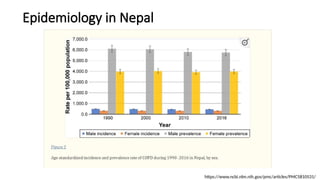
  • #13 ikewise, 960,737 Nepalese suffered from COPD in 2016, which is twice the number of sufferers in 1990. The age-standardized prevalence rate of COPD has remained almost stagnant (4,899.1 per 100,000 population in 1990 vs 4,810.3 per 100,000 in 2016) over 26 years, with continued higher prevalence among Nepalese males than females (Figure 2). During the same period, the age-standardized incidence rate did not change significantly (398.5 per 100,000 population in 1990 to 382.1 per 100,000 population in 2016) (Figure 2). However, the incidence continued to remain higher among males than females throughout the period. In 2016, the age-standardized incidence rate of COPD for males was 30.8% higher than that for Nepalese females. The age-standardized prevalence and incidence of COPD remained almost stagnant over the years, but still very high,