COMMUNITY DIAGNOSIS
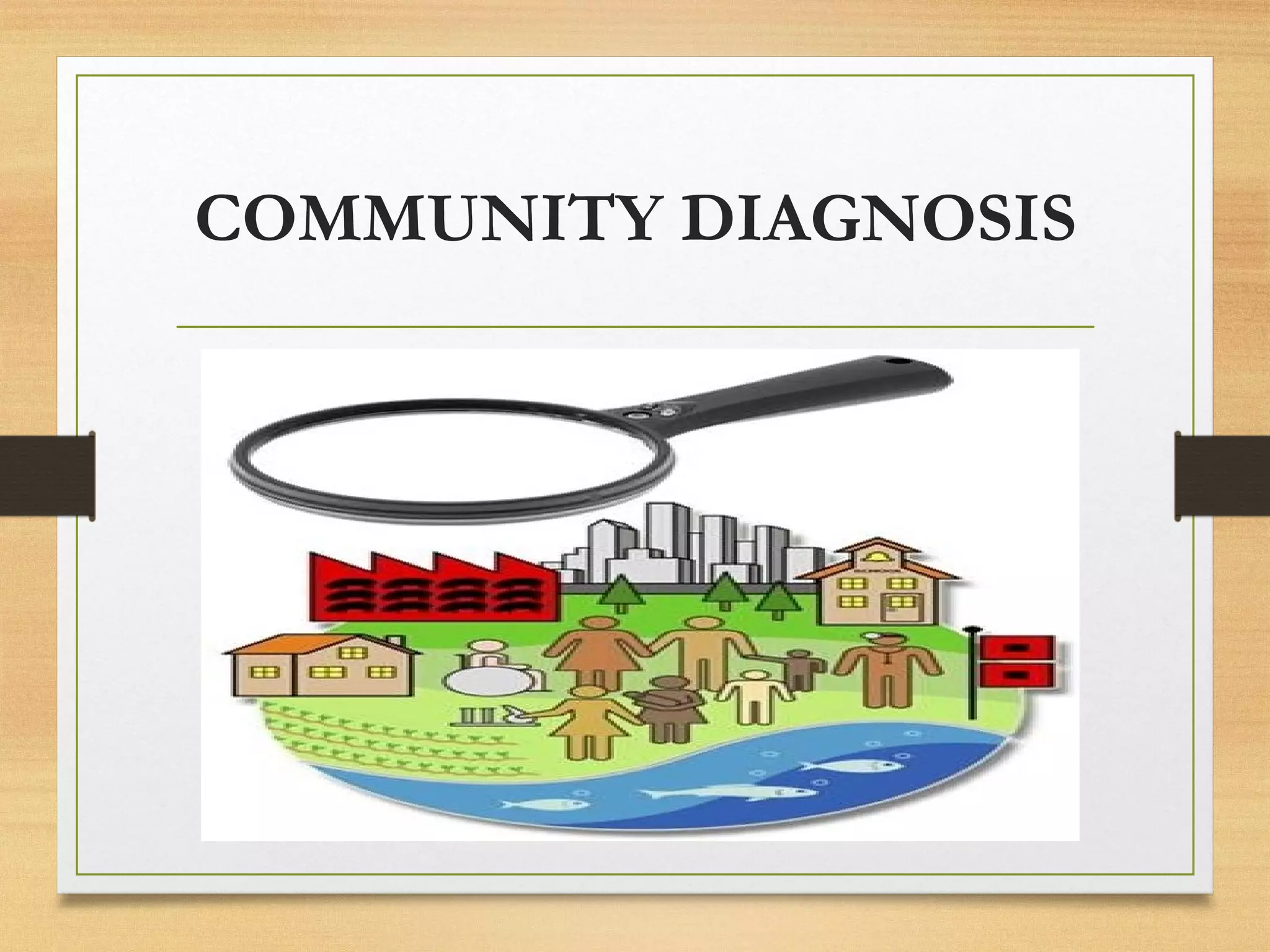
COMMUNITY DIAGNOSIS
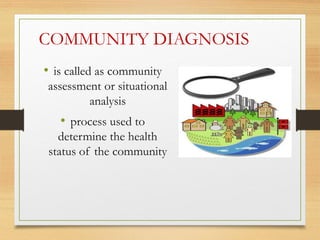
• is called as community
assessment or situational
analysis
• process used to
determine the health
status of the community
Types of Community Diagnosis
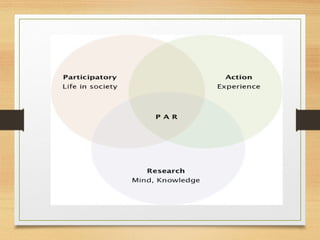
Participatory action research (PAR)
• is an approach to research in communities that emphasizes
participation and action.
• It seeks to understand the world by trying to change it,
collaboratively and following reflection.
• objective:
>>to encourage consciousness of the suffering & develop
competence for changing one’s situation
• Essential element: PARTICIPATION
Participatory Action Research
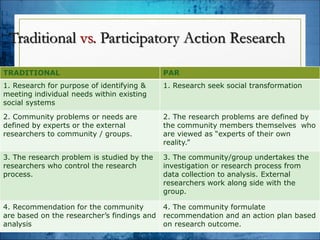
Traditional vs. Participatory Action Research
TRADITIONAL PAR
1. Research for purpose of identifying &
meeting individual needs within existing
social systems
1. Research seek social transformation
2. Community problems or needs are
defined by experts or the external
researchers to community / groups.
2. The research problems are defined by
the community members themselves who
are viewed as “experts of their own
reality.”
3. The research problem is studied by the
researchers who control the research
process.
3. The community/group undertakes the
investigation or research process from
data collection to analysis. External
researchers work along side with the
group.
4. Recommendation for the community
are based on the researcher’s findings and
analysis
4. The community formulate
recommendation and an action plan based
on research outcome.
Planning Community Health
Interventions
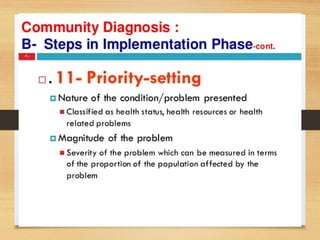
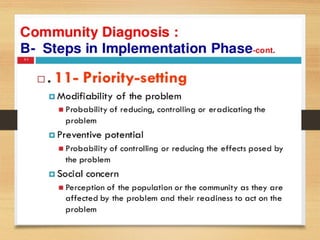
PRIORITY SETTING
• This step provides the health team with a logical means of
establishing priority among the identified health concerns
Criteria in Deciding Community
Health Concern for Interventions
• Significance of the problem
• Community Awareness
• Ability to reduce risk
• Cost of reducing risk
• Ability to identify the target
population
• Availability of resources
1. Significance of the Problem
• Is based on the number of people in the community
affected by the problem or condition.
• Disease condition /Potential problem
2. Community Awareness
• Related to the priority that the community gives to the
health concern
3. Ability to reduce risk
• Is related to the availability of expertise among the health
team and the community itself.
4. Cost of reducing risk
• The nurse has to consider economic, social, and ethical
requisites and consequences of planned action
C
R
I
T
E
R
I
A
4. Ability to identify the target
population
• Matter of availability of data sources
such as FHSIS, census, survey reports,
and /or case finding or screening tools
5. Availability of Resources
• To intervene in the reduction of risk
entails technological, financial, and
other material resources of the
community, nurse ,and the health
agency.
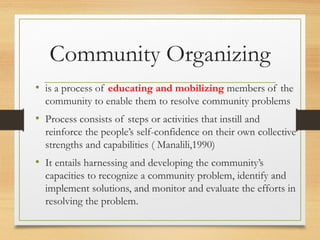
Community Organizing
• is a process of educating and mobilizing members of the
community to enable them to resolve community problems
• Process consists of steps or activities that instill and
reinforce the people’s self-confidence on their own collective
strengths and capabilities ( Manalili,1990)
• It entails harnessing and developing the community’s
capacities to recognize a community problem, identify and
implement solutions, and monitor and evaluate the efforts in
resolving the problem.
Core Principles in Community Organizing
1. Community Organizing is People-centered
- with emphasis on the development of human
resources necessitating education
2. Community Organizing is Participative
- Is evident in the involvement of many people in
the community activities.
3. Community Organizing is Developmental
- Should be directed towards changing current
undesirable conditions
4. Community Organizing is Process-oriented
5. Community organizing is Democratic
Community Organizing Participatory
Action Research
COPAR
• a social development approach that aims to:
• Transform participatory and politically responsive
community
Importance of COPAR
• tool for community development and people empowerment
• prepares people/client to eventually take over the
management of a development program(s) in the future
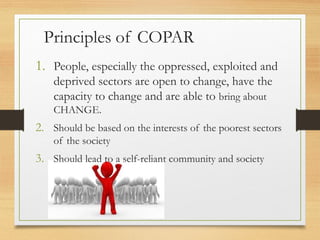
Principles of COPAR
1. People, especially the oppressed, exploited and
deprived sectors are open to change, have the
capacity to change and are able to bring about
CHANGE.
2. Should be based on the interests of the poorest sectors
of the society
3. Should lead to a self-reliant community and society
PROCESS/METHODS USE IN
COPAR
A Progressive Cycle of ACTION –REFLECTION –ACTION
- which begins in small , local and concrete issues identified
by the people and the evaluation and reflection of and on the
action taken by them
Principles…
COPAR is Participatory and
Mass- Based
•Because it is primarily
directed towards and
biased in favor of the
poor, the powerless and
the oppressed
Principles….
COPAR is Group Centered
• And not leader centered. Leaders are identified ,
emerged and are tested through action rather than
appointed or selected by some external force or entity.
PHASES of COPAR
PRE –ENTRY PHASE
• The initial phase of the organizing process where the
community organizer looks for communities to serve / help.
RECOMMENDED
ACTIVITIES
• Statement of objectives, realization of CIP
• Laying out the site criteria
• Site selection
• Develop survey tools
• Meeting and courtesy call to the local
government unit of the selected site
• Courtesy call to the barangay level
• Meeting with the “will be”
foster parents of the health
care students
• Setting the target date of
immersion, Exposure and
Departure
Criteria for site selection
• The area must be Economical.
• Must have a relative Concentration of poor families
• Must have a population of Ten thousand and above
• As much as possible no Hospital but with RHU and BHS
• Accessibility of transportation must be considered
• No Strong resistance from the community
• Peace and order problem must be considered
• Rural community will be a top priority
• Preferably With adjacent barangays
• (S-H-A-R-P-C-E-W-T)
OCULAR SURVEY
1. Community meet the ‘GIDA” criterion of DOH ( hard
to reach, unserved or underserved, and economilcally
depressed.
2. Members of the community perceive the need for
assistance
3. Community show signs of willingness or hostility
towards the organizer
4. No obvious threat to the safety of community organizer
5. Identify other individuals or group or agencies working
in the area
6. Is the partnership among all potential stakeholders
possible and feasible?
ENTRY PHASE
Immersion
• Sensitization of the people on the
critical events in their life, motivating
them to share their concerns and
eventually mobilizing them to make
collective action on these.
• this phase signals the actual entry of the
CO/ Community Worker into the
community
• sometimes called as SOCIAL
PREPARATION PHASE
Recommended Activities
• Inform/ Update local government leader/ barangay
officials of the selected site
• meeting with the foster parents
• appreciating the environment
• meeting with community officials and residents
• general assembly
• Actual survey
• Analysis of data
• Core group formation
• Self-awareness and leadership training/ Action
planning
• this phase signals the actual entry of the
CO/ Community Worker into the
community
• sometimes called as SOCIAL
PREPARATION PHASE
• most crucial phase since project site
varies from each other, no single strategy
is best employed
Community Integration
• “ PAKIKIPAMUHAY” is the phase when the CO may
usually live in the community in an effort to understand
the community better and imbibe community life.
• Establishing Rapport
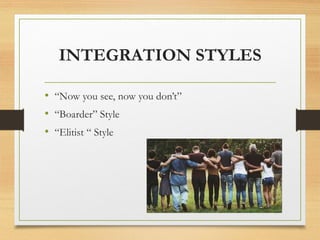
INTEGRATION STYLES
• “Now you see, now you don’t”
• “Boarder” Style
• “Elitist “ Style
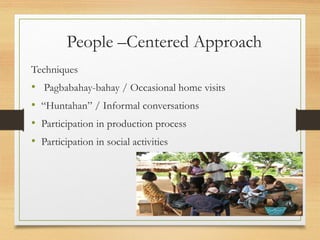
People –Centered Approach
Techniques
• Pagbabahay-bahay / Occasional home visits
• “Huntahan” / Informal conversations
• Participation in production process
• Participation in social activities
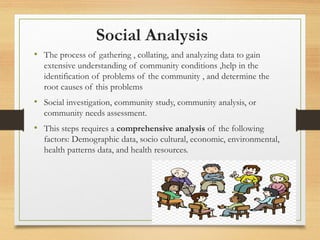
Social Analysis
• The process of gathering , collating, and analyzing data to gain
extensive understanding of community conditions ,help in the
identification of problems of the community , and determine the
root causes of this problems
• Social investigation, community study, community analysis, or
community needs assessment.
• This steps requires a comprehensive analysis of the following
factors: Demographic data, socio cultural, economic, environmental,
health patterns data, and health resources.
Identifying potential Leaders
Desirable Characteristics
1. They represent the target group community
2. They possess or display leadership qualities
3. They have the trust and confidence of the community
4. They express belief in the need to change the current
undesirable situation in the community
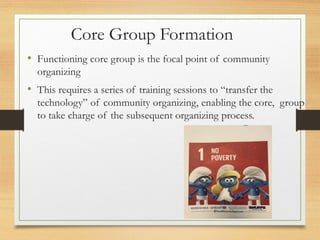
Core Group Formation
• Functioning core group is the focal point of community
organizing
• This requires a series of training sessions to “transfer the
technology” of community organizing, enabling the core, group
to take charge of the subsequent organizing process.
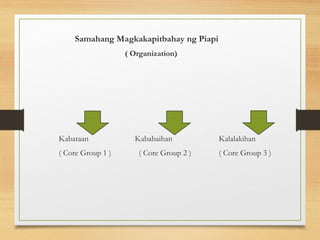
Samahang Magkakapitbahay ng Piapi
( Organization)
Kabataan Kababaihan Kalalakihan
( Core Group 1 ) ( Core Group 2 ) ( Core Group 3 )
success
> depends on how much the project implementers have
integrated with the community people;
• their understanding of the place & events; and
• their willingness & readiness to commit oneself
towards the program
• general assembly
• Actual survey
• Analysis of data
• Core group formation
• Self-awareness and leadership training/
Action planning
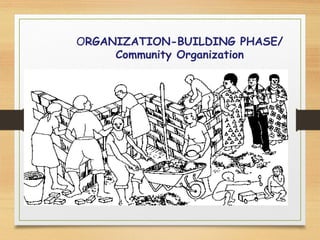
ORGANIZATION-BUILDING PHASE/
Community Organization
Characteristics
• An organization name and structure
• A set of officers recognized by the members of the
community
• Constitution and bylaws stating the vision , mission, and
goals (VMG), rules and regulations of the organization ,
and duties and responsibilities of its officers and members
Recommended Activities
• meeting with officials
• identifying problems
• spreading awareness and soliciting solution or
suggestions
• analysis of the presented solution
• planning of the activities
• organizing the people to build their own organization
(election of officers)
• Registration of the organization (legality purposes)
• Link with LGU’s or NGO’s for financial & technical
assistance
• Evaluation
SUSTENANCE &
STRENGTHENING PHASE/
ACTION PHASE
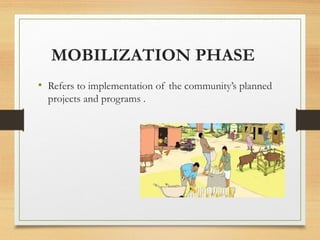
MOBILIZATION PHASE
• Refers to implementation of the community’s planned
projects and programs .
Important Considerations
1. Allow the community to determine the pace and
scope of project implementation.
2. The process is as important as the output
3. Regular monitoring and continuing community
formation program are essential.
4. Regular monitoring and continuing community
formation program are essential
EVALUATION
• Is a systematic ,critical analysis of the current state of the
organization and /or projects compared to desired or planned
goals or objectives.
• It should be done periodically during mobilization to allow
revision of the strategies .
• 2 areas of evaluation Program based Evaluation,
Organizational Evaluation
Areas of Evaluation
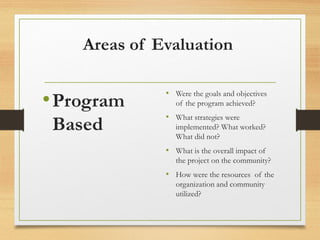
•Program
Based
• Were the goals and objectives
of the program achieved?
• What strategies were
implemented? What worked?
What did not?
• What is the overall impact of
the project on the community?
• How were the resources of the
organization and community
utilized?
Areas of Evaluation
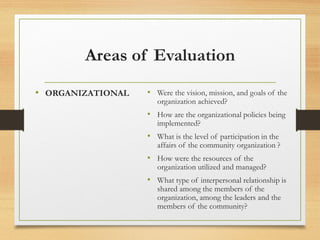
• ORGANIZATIONAL • Were the vision, mission, and goals of the
organization achieved?
• How are the organizational policies being
implemented?
• What is the level of participation in the
affairs of the community organization ?
• How were the resources of the
organization utilized and managed?
• What type of interpersonal relationship is
shared among the members of the
organization, among the leaders and the
members of the community?
Recommended Activities
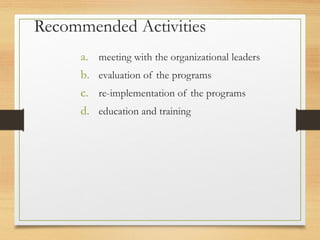
a. meeting with the organizational leaders
b. evaluation of the programs
c. re-implementation of the programs
d. education and training
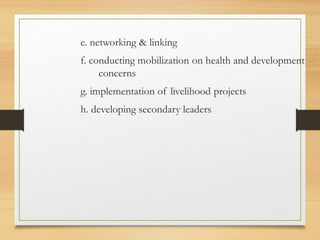
e. networking & linking
f. conducting mobilization on health and development
concerns
g. implementation of livelihood projects
h. developing secondary leaders
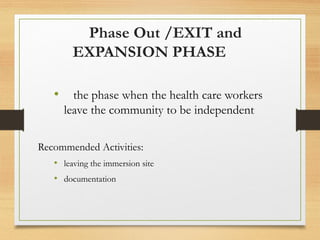
Phase Out /EXIT and
EXPANSION PHASE
• the phase when the health care workers
leave the community to be independent
Recommended Activities:
• leaving the immersion site
• documentation
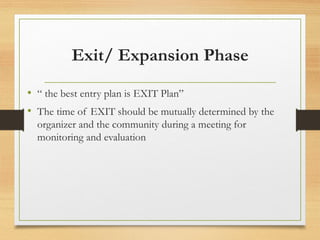
Exit/ Expansion Phase
• “ the best entry plan is EXIT Plan”
• The time of EXIT should be mutually determined by the
organizer and the community during a meeting for
monitoring and evaluation
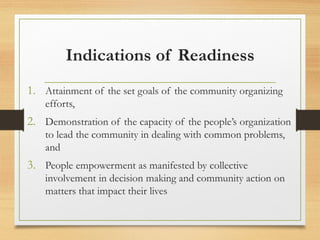
Indications of Readiness
1. Attainment of the set goals of the community organizing
efforts,
2. Demonstration of the capacity of the people’s organization
to lead the community in dealing with common problems,
and
3. People empowerment as manifested by collective
involvement in decision making and community action on
matters that impact their lives
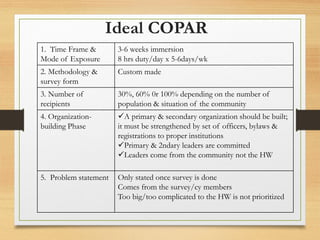
Ideal COPAR
1. Time Frame &
Mode of Exposure
3-6 weeks immersion
8 hrs duty/day x 5-6days/wk
2. Methodology &
survey form
Custom made
3. Number of
recipients
30%, 60% 0r 100% depending on the number of
population & situation of the community
4. Organization-
building Phase
A primary & secondary organization should be built;
it must be strengthened by set of officers, bylaws &
registrations to proper institutions
Primary & 2ndary leaders are committed
Leaders come from the community not the HW
5. Problem statement Only stated once survey is done
Comes from the survey/cy members
Too big/too complicated to the HW is not prioritized
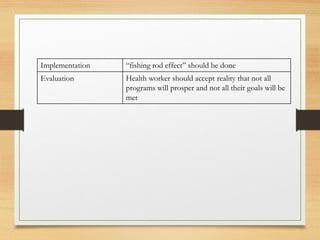
Implementation “fishing rod effect” should be done
Evaluation Health worker should accept reality that not all
programs will prosper and not all their goals will be
met
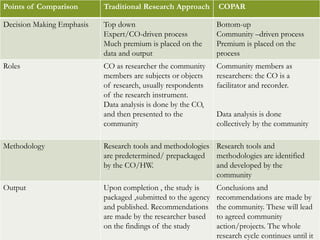
Points of Comparison Traditional Research Approach COPAR
Decision Making Emphasis Top down
Expert/CO-driven process
Much premium is placed on the
data and output
Bottom-up
Community –driven process
Premium is placed on the
process
Roles CO as researcher the community
members are subjects or objects
of research, usually respondents
of the research instrument.
Data analysis is done by the CO,
and then presented to the
community
Community members as
researchers: the CO is a
facilitator and recorder.
Data analysis is done
collectively by the community
Methodology Research tools and methodologies
are predetermined/ prepackaged
by the CO/HW.
Research tools and
methodologies are identified
and developed by the
community
Output Upon completion , the study is
packaged ,submitted to the agency
and published. Recommendations
are made by the researcher based
on the findings of the study
Conclusions and
recommendations are made by
the community. These will lead
to agreed community
action/projects. The whole
research cycle continues until it
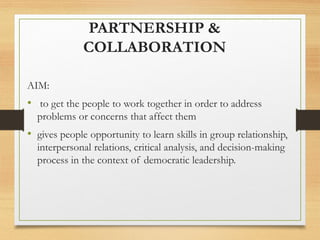
PARTNERSHIP &
COLLABORATION
AIM:
• to get the people to work together in order to address
problems or concerns that affect them
• gives people opportunity to learn skills in group relationship,
interpersonal relations, critical analysis, and decision-making
process in the context of democratic leadership.
SOCIAL
MOBILIZATION
Social Mobilization
- is an approach and tool that enables
people to organize for collective, by pooling
resources and building solidarity required to
resolve common problems and work towards
community advancement.
KEY ELEMENTS OF
SOCIAL MOBILIZATION
1. ORGANIZATIONAL DEVELOPMENT
- A process in which community members,
especially the poor form their own groups
or organization based on common
development interests and needs that are
best served by organizing themselves as a
group (Pandey, 2002).
2. CAPITAL FORMATION FOR DEVELOPMENT
THROUGH COMMUNITY SAVINGS
Enhances a community organization’s
to realize its full power
- Savings generated by individual members
are the potential assets of the community
organization and are the first step towards
their self-reliance (Pandey, 2002).
3. TRAINING FOR HUMAN
RESOURCE DEVELOPMENT
• Community members can maximize their
potential not only by organizing themselves
but also by upgrading their existing skills to
better manage new inputs-business and
community initiatives and establish effective
link with local government and other
agencies.
• Local human resources development can
best be promoted when trained individuals
take up the responsibilities to train other
community members.
4. SOCIO-ECONOMIC DEVELOPMENT
- socio-economic initiative are a great
incentive for community members to organize
themselves.
- The process of identifying community
priorities, participatory planning, implementing
and monitoring of actions help not only to
improve local conditions but also empower
people and their organizations.
The process can result in increased
institutional capacity, enhanced social
status and voice (esp. for disadvantaged
people)
- These results in turn motivate people to
remain organize as they begin to enjoy the
benefits of collective action and recognize its
potential to create or influence changes in
their communities.
Give one key element of social mobilization
BELIEVEYOUCANANDYOU’RE
HALFWAYTHERE
TheodoreRoosevelt
Activities Involved in P &C:
A. Networking
-described as the relationship among
organizations that consists of exchanging
information about each other’s goals &
objectives, services or facilities.
-benefits:
1. the org will become aware of each other’s worth &
capabilities & how each can contribute to the
accomplishment of the network’s goals &
objectives
2. requires small amount of time yet has great
potential in terms of joint action
WAYS:
B. Coordination
- described as a relationship where the org
modify their activities in order to provide
better service to the target beneficiary
C. Cooperation
-described as a relationship where
organizations share information & resources
and make adjustments in one’s own agenda to
accommodate the other org’s agenda
WAYS:
D. Collaboration
- is the level of org relationship where organizations help
each other enhance their capabilities in performing their
tasks as well as in the provision of services
E. Coalition or Multi-sector Collaboration
- is the level of relationship where organizations and
citizens form a partnership
PROJECT PROPOSAL
A. Project Title
(state the main point/purpose for which the
funds are sought)
B. Project Identification
C. Type of Project
 Indicate the specific project (Type of toilet-
Water sealed)
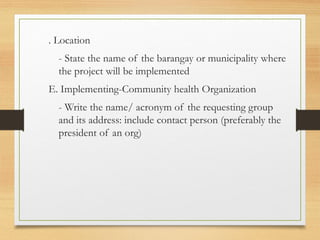
. Location
- State the name of the barangay or municipality where
the project will be implemented
E. Implementing-Community health Organization
- Write the name/ acronym of the requesting group
and its address: include contact person (preferably the
president of an org)
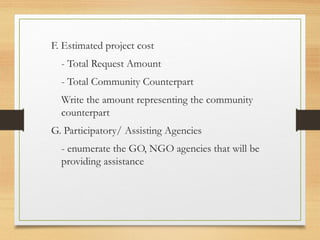
F. Estimated project cost
- Total Request Amount
- Total Community Counterpart
Write the amount representing the community
counterpart
G. Participatory/ Assisting Agencies
- enumerate the GO, NGO agencies that will be
providing assistance
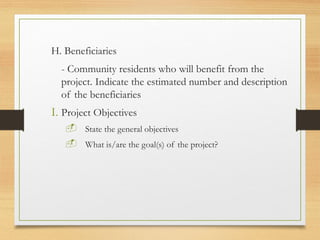
H. Beneficiaries
- Community residents who will benefit from the
project. Indicate the estimated number and description
of the beneficiaries
I. Project Objectives
 State the general objectives
 What is/are the goal(s) of the project?
Thank You for
Listening

COPAR-1.pdf

  • 1.
  • 2.
    COMMUNITY DIAGNOSIS • iscalled as community assessment or situational analysis • process used to determine the health status of the community
  • 3.
    Types of CommunityDiagnosis Participatory action research (PAR) • is an approach to research in communities that emphasizes participation and action. • It seeks to understand the world by trying to change it, collaboratively and following reflection.
  • 4.
    • objective: >>to encourageconsciousness of the suffering & develop competence for changing one’s situation • Essential element: PARTICIPATION Participatory Action Research
  • 5.
    Traditional vs. ParticipatoryAction Research TRADITIONAL PAR 1. Research for purpose of identifying & meeting individual needs within existing social systems 1. Research seek social transformation 2. Community problems or needs are defined by experts or the external researchers to community / groups. 2. The research problems are defined by the community members themselves who are viewed as “experts of their own reality.” 3. The research problem is studied by the researchers who control the research process. 3. The community/group undertakes the investigation or research process from data collection to analysis. External researchers work along side with the group. 4. Recommendation for the community are based on the researcher’s findings and analysis 4. The community formulate recommendation and an action plan based on research outcome.
  • 8.
    Planning Community Health Interventions PRIORITYSETTING • This step provides the health team with a logical means of establishing priority among the identified health concerns
  • 9.
    Criteria in DecidingCommunity Health Concern for Interventions • Significance of the problem • Community Awareness • Ability to reduce risk • Cost of reducing risk • Ability to identify the target population • Availability of resources
  • 10.
    1. Significance ofthe Problem • Is based on the number of people in the community affected by the problem or condition. • Disease condition /Potential problem 2. Community Awareness • Related to the priority that the community gives to the health concern 3. Ability to reduce risk • Is related to the availability of expertise among the health team and the community itself. 4. Cost of reducing risk • The nurse has to consider economic, social, and ethical requisites and consequences of planned action C R I T E R I A
  • 11.
    4. Ability toidentify the target population • Matter of availability of data sources such as FHSIS, census, survey reports, and /or case finding or screening tools 5. Availability of Resources • To intervene in the reduction of risk entails technological, financial, and other material resources of the community, nurse ,and the health agency.
  • 15.
    Community Organizing • isa process of educating and mobilizing members of the community to enable them to resolve community problems • Process consists of steps or activities that instill and reinforce the people’s self-confidence on their own collective strengths and capabilities ( Manalili,1990) • It entails harnessing and developing the community’s capacities to recognize a community problem, identify and implement solutions, and monitor and evaluate the efforts in resolving the problem.
  • 16.
    Core Principles inCommunity Organizing 1. Community Organizing is People-centered - with emphasis on the development of human resources necessitating education 2. Community Organizing is Participative - Is evident in the involvement of many people in the community activities. 3. Community Organizing is Developmental - Should be directed towards changing current undesirable conditions
  • 17.
    4. Community Organizingis Process-oriented 5. Community organizing is Democratic
  • 18.
    Community Organizing Participatory ActionResearch COPAR • a social development approach that aims to: • Transform participatory and politically responsive community
  • 19.
    Importance of COPAR •tool for community development and people empowerment • prepares people/client to eventually take over the management of a development program(s) in the future
  • 20.
    Principles of COPAR 1.People, especially the oppressed, exploited and deprived sectors are open to change, have the capacity to change and are able to bring about CHANGE. 2. Should be based on the interests of the poorest sectors of the society 3. Should lead to a self-reliant community and society
  • 21.
    PROCESS/METHODS USE IN COPAR AProgressive Cycle of ACTION –REFLECTION –ACTION - which begins in small , local and concrete issues identified by the people and the evaluation and reflection of and on the action taken by them
  • 22.
    Principles… COPAR is Participatoryand Mass- Based •Because it is primarily directed towards and biased in favor of the poor, the powerless and the oppressed
  • 23.
    Principles…. COPAR is GroupCentered • And not leader centered. Leaders are identified , emerged and are tested through action rather than appointed or selected by some external force or entity.
  • 24.
  • 25.
    PRE –ENTRY PHASE •The initial phase of the organizing process where the community organizer looks for communities to serve / help.
  • 26.
    RECOMMENDED ACTIVITIES • Statement ofobjectives, realization of CIP • Laying out the site criteria • Site selection • Develop survey tools • Meeting and courtesy call to the local government unit of the selected site • Courtesy call to the barangay level
  • 27.
    • Meeting withthe “will be” foster parents of the health care students • Setting the target date of immersion, Exposure and Departure
  • 28.
    Criteria for siteselection • The area must be Economical. • Must have a relative Concentration of poor families • Must have a population of Ten thousand and above • As much as possible no Hospital but with RHU and BHS • Accessibility of transportation must be considered • No Strong resistance from the community • Peace and order problem must be considered • Rural community will be a top priority • Preferably With adjacent barangays • (S-H-A-R-P-C-E-W-T)
  • 29.
    OCULAR SURVEY 1. Communitymeet the ‘GIDA” criterion of DOH ( hard to reach, unserved or underserved, and economilcally depressed. 2. Members of the community perceive the need for assistance 3. Community show signs of willingness or hostility towards the organizer 4. No obvious threat to the safety of community organizer 5. Identify other individuals or group or agencies working in the area 6. Is the partnership among all potential stakeholders possible and feasible?
  • 30.
  • 31.
    Immersion • Sensitization ofthe people on the critical events in their life, motivating them to share their concerns and eventually mobilizing them to make collective action on these. • this phase signals the actual entry of the CO/ Community Worker into the community • sometimes called as SOCIAL PREPARATION PHASE
  • 32.
    Recommended Activities • Inform/Update local government leader/ barangay officials of the selected site • meeting with the foster parents • appreciating the environment • meeting with community officials and residents • general assembly • Actual survey • Analysis of data • Core group formation • Self-awareness and leadership training/ Action planning
  • 33.
    • this phasesignals the actual entry of the CO/ Community Worker into the community • sometimes called as SOCIAL PREPARATION PHASE • most crucial phase since project site varies from each other, no single strategy is best employed
  • 34.
    Community Integration • “PAKIKIPAMUHAY” is the phase when the CO may usually live in the community in an effort to understand the community better and imbibe community life. • Establishing Rapport
  • 35.
    INTEGRATION STYLES • “Nowyou see, now you don’t” • “Boarder” Style • “Elitist “ Style
  • 36.
    People –Centered Approach Techniques •Pagbabahay-bahay / Occasional home visits • “Huntahan” / Informal conversations • Participation in production process • Participation in social activities
  • 37.
    Social Analysis • Theprocess of gathering , collating, and analyzing data to gain extensive understanding of community conditions ,help in the identification of problems of the community , and determine the root causes of this problems • Social investigation, community study, community analysis, or community needs assessment. • This steps requires a comprehensive analysis of the following factors: Demographic data, socio cultural, economic, environmental, health patterns data, and health resources.
  • 38.
    Identifying potential Leaders DesirableCharacteristics 1. They represent the target group community 2. They possess or display leadership qualities 3. They have the trust and confidence of the community 4. They express belief in the need to change the current undesirable situation in the community
  • 39.
    Core Group Formation •Functioning core group is the focal point of community organizing • This requires a series of training sessions to “transfer the technology” of community organizing, enabling the core, group to take charge of the subsequent organizing process.
  • 40.
    Samahang Magkakapitbahay ngPiapi ( Organization) Kabataan Kababaihan Kalalakihan ( Core Group 1 ) ( Core Group 2 ) ( Core Group 3 )
  • 41.
    success > depends onhow much the project implementers have integrated with the community people; • their understanding of the place & events; and • their willingness & readiness to commit oneself towards the program
  • 42.
    • general assembly •Actual survey • Analysis of data • Core group formation • Self-awareness and leadership training/ Action planning
  • 43.
  • 44.
    Community Organization Characteristics • Anorganization name and structure • A set of officers recognized by the members of the community • Constitution and bylaws stating the vision , mission, and goals (VMG), rules and regulations of the organization , and duties and responsibilities of its officers and members
  • 45.
    Recommended Activities • meetingwith officials • identifying problems • spreading awareness and soliciting solution or suggestions • analysis of the presented solution • planning of the activities
  • 46.
    • organizing thepeople to build their own organization (election of officers) • Registration of the organization (legality purposes) • Link with LGU’s or NGO’s for financial & technical assistance • Evaluation
  • 47.
  • 48.
    MOBILIZATION PHASE • Refersto implementation of the community’s planned projects and programs .
  • 49.
    Important Considerations 1. Allowthe community to determine the pace and scope of project implementation. 2. The process is as important as the output 3. Regular monitoring and continuing community formation program are essential. 4. Regular monitoring and continuing community formation program are essential
  • 50.
    EVALUATION • Is asystematic ,critical analysis of the current state of the organization and /or projects compared to desired or planned goals or objectives. • It should be done periodically during mobilization to allow revision of the strategies . • 2 areas of evaluation Program based Evaluation, Organizational Evaluation
  • 51.
    Areas of Evaluation •Program Based •Were the goals and objectives of the program achieved? • What strategies were implemented? What worked? What did not? • What is the overall impact of the project on the community? • How were the resources of the organization and community utilized?
  • 52.
    Areas of Evaluation •ORGANIZATIONAL • Were the vision, mission, and goals of the organization achieved? • How are the organizational policies being implemented? • What is the level of participation in the affairs of the community organization ? • How were the resources of the organization utilized and managed? • What type of interpersonal relationship is shared among the members of the organization, among the leaders and the members of the community?
  • 53.
    Recommended Activities a. meetingwith the organizational leaders b. evaluation of the programs c. re-implementation of the programs d. education and training
  • 54.
    e. networking &linking f. conducting mobilization on health and development concerns g. implementation of livelihood projects h. developing secondary leaders
  • 55.
    Phase Out /EXITand EXPANSION PHASE • the phase when the health care workers leave the community to be independent Recommended Activities: • leaving the immersion site • documentation
  • 56.
    Exit/ Expansion Phase •“ the best entry plan is EXIT Plan” • The time of EXIT should be mutually determined by the organizer and the community during a meeting for monitoring and evaluation
  • 57.
    Indications of Readiness 1.Attainment of the set goals of the community organizing efforts, 2. Demonstration of the capacity of the people’s organization to lead the community in dealing with common problems, and 3. People empowerment as manifested by collective involvement in decision making and community action on matters that impact their lives
  • 58.
    Ideal COPAR 1. TimeFrame & Mode of Exposure 3-6 weeks immersion 8 hrs duty/day x 5-6days/wk 2. Methodology & survey form Custom made 3. Number of recipients 30%, 60% 0r 100% depending on the number of population & situation of the community 4. Organization- building Phase A primary & secondary organization should be built; it must be strengthened by set of officers, bylaws & registrations to proper institutions Primary & 2ndary leaders are committed Leaders come from the community not the HW 5. Problem statement Only stated once survey is done Comes from the survey/cy members Too big/too complicated to the HW is not prioritized
  • 59.
    Implementation “fishing rodeffect” should be done Evaluation Health worker should accept reality that not all programs will prosper and not all their goals will be met
  • 60.
    Points of ComparisonTraditional Research Approach COPAR Decision Making Emphasis Top down Expert/CO-driven process Much premium is placed on the data and output Bottom-up Community –driven process Premium is placed on the process Roles CO as researcher the community members are subjects or objects of research, usually respondents of the research instrument. Data analysis is done by the CO, and then presented to the community Community members as researchers: the CO is a facilitator and recorder. Data analysis is done collectively by the community Methodology Research tools and methodologies are predetermined/ prepackaged by the CO/HW. Research tools and methodologies are identified and developed by the community Output Upon completion , the study is packaged ,submitted to the agency and published. Recommendations are made by the researcher based on the findings of the study Conclusions and recommendations are made by the community. These will lead to agreed community action/projects. The whole research cycle continues until it
  • 61.
    PARTNERSHIP & COLLABORATION AIM: • toget the people to work together in order to address problems or concerns that affect them • gives people opportunity to learn skills in group relationship, interpersonal relations, critical analysis, and decision-making process in the context of democratic leadership.
  • 62.
  • 63.
    Social Mobilization - isan approach and tool that enables people to organize for collective, by pooling resources and building solidarity required to resolve common problems and work towards community advancement.
  • 64.
    KEY ELEMENTS OF SOCIALMOBILIZATION 1. ORGANIZATIONAL DEVELOPMENT - A process in which community members, especially the poor form their own groups or organization based on common development interests and needs that are best served by organizing themselves as a group (Pandey, 2002).
  • 65.
    2. CAPITAL FORMATIONFOR DEVELOPMENT THROUGH COMMUNITY SAVINGS Enhances a community organization’s to realize its full power - Savings generated by individual members are the potential assets of the community organization and are the first step towards their self-reliance (Pandey, 2002).
  • 66.
    3. TRAINING FORHUMAN RESOURCE DEVELOPMENT • Community members can maximize their potential not only by organizing themselves but also by upgrading their existing skills to better manage new inputs-business and community initiatives and establish effective link with local government and other agencies.
  • 67.
    • Local humanresources development can best be promoted when trained individuals take up the responsibilities to train other community members.
  • 68.
    4. SOCIO-ECONOMIC DEVELOPMENT -socio-economic initiative are a great incentive for community members to organize themselves. - The process of identifying community priorities, participatory planning, implementing and monitoring of actions help not only to improve local conditions but also empower people and their organizations.
  • 69.
    The process canresult in increased institutional capacity, enhanced social status and voice (esp. for disadvantaged people) - These results in turn motivate people to remain organize as they begin to enjoy the benefits of collective action and recognize its potential to create or influence changes in their communities.
  • 70.
    Give one keyelement of social mobilization
  • 71.
  • 72.
    Activities Involved inP &C: A. Networking -described as the relationship among organizations that consists of exchanging information about each other’s goals & objectives, services or facilities.
  • 73.
    -benefits: 1. the orgwill become aware of each other’s worth & capabilities & how each can contribute to the accomplishment of the network’s goals & objectives 2. requires small amount of time yet has great potential in terms of joint action
  • 74.
    WAYS: B. Coordination - describedas a relationship where the org modify their activities in order to provide better service to the target beneficiary C. Cooperation -described as a relationship where organizations share information & resources and make adjustments in one’s own agenda to accommodate the other org’s agenda
  • 75.
    WAYS: D. Collaboration - isthe level of org relationship where organizations help each other enhance their capabilities in performing their tasks as well as in the provision of services E. Coalition or Multi-sector Collaboration - is the level of relationship where organizations and citizens form a partnership
  • 76.
    PROJECT PROPOSAL A. ProjectTitle (state the main point/purpose for which the funds are sought) B. Project Identification C. Type of Project  Indicate the specific project (Type of toilet- Water sealed)
  • 77.
    . Location - Statethe name of the barangay or municipality where the project will be implemented E. Implementing-Community health Organization - Write the name/ acronym of the requesting group and its address: include contact person (preferably the president of an org)
  • 78.
    F. Estimated projectcost - Total Request Amount - Total Community Counterpart Write the amount representing the community counterpart G. Participatory/ Assisting Agencies - enumerate the GO, NGO agencies that will be providing assistance
  • 79.
    H. Beneficiaries - Communityresidents who will benefit from the project. Indicate the estimated number and description of the beneficiaries I. Project Objectives  State the general objectives  What is/are the goal(s) of the project?
  • 80.