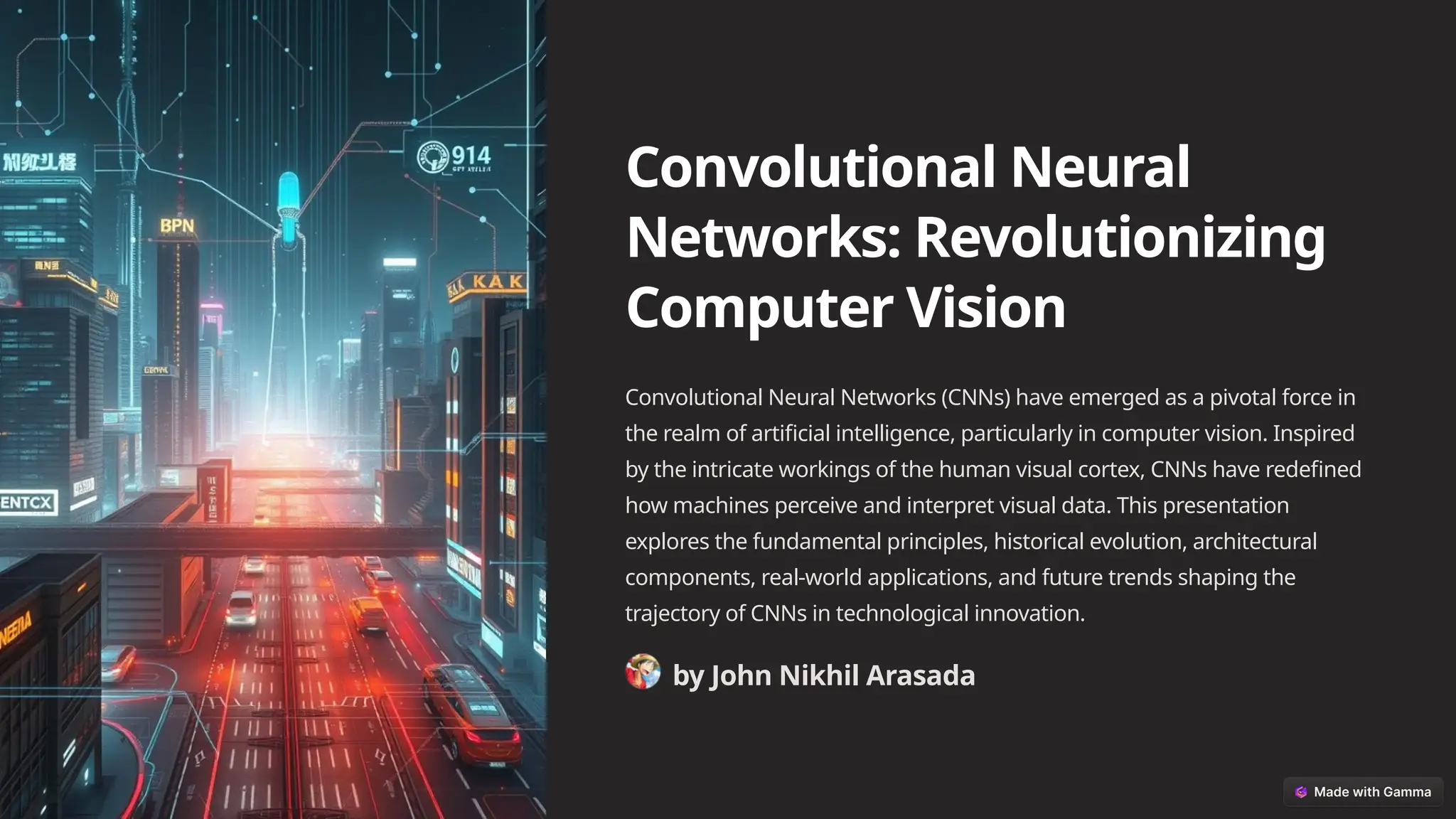
Convolutional Neural
Networks: Revolutionizing
Computer Vision
Convolutional Neural Networks (CNNs) have emerged as a pivotal force in
the realm of artificial intelligence, particularly in computer vision. Inspired
by the intricate workings of the human visual cortex, CNNs have redefined
how machines perceive and interpret visual data. This presentation
explores the fundamental principles, historical evolution, architectural
components, real-world applications, and future trends shaping the
trajectory of CNNs in technological innovation.
by John Nikhil Arasada
Understanding Convolutional Neural Networks
Convolutional Neural Networks are deep learning algorithms modeled after the human visual cortex, specializing in the processing of grid-like
data such as images and videos. CNNs stand as a breakthrough technology in machine learning and AI, showcasing over 87% accuracy in
image recognition tasks. Their ability to automatically learn hierarchical features sets them apart from traditional algorithms.
Human Visual Cortex Inspired
Mirrors the organizational structure of
the visual cortex for advanced pattern
recognition.
Specialized Data Processing
Excels in processing grid-like data,
including images and videos.
High Accuracy Rates
Demonstrates accuracy rates
exceeding 87% in image recognition
tasks.
Historical Context and Evolution
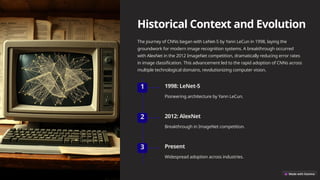
The journey of CNNs began with LeNet-5 by Yann LeCun in 1998, laying the
groundwork for modern image recognition systems. A breakthrough occurred
with AlexNet in the 2012 ImageNet competition, dramatically reducing error rates
in image classification. This advancement led to the rapid adoption of CNNs across
multiple technological domains, revolutionizing computer vision.
1 1998: LeNet-5
Pioneering architecture by Yann LeCun.
2 2012: AlexNet
Breakthrough in ImageNet competition.
3 Present
Widespread adoption across industries.
CNN Architecture: Key Components
CNN architecture consists of several key components working together to process and interpret images effectively. Convolutional
layers extract features by convolving filters over the input image. Pooling layers reduce dimensionality, simplifying the feature
maps. Fully connected layers perform final classification, assigning labels to the processed images. Activation functions and
backpropagation facilitate learning.
Convolutional Layers
Feature extraction using filters/kernels.
Pooling Layers
Dimensionality reduction for
simplification.
Fully Connected Layers
Final classification and labeling.
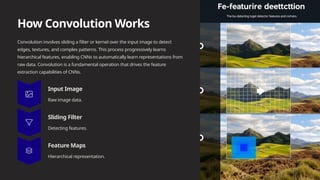
How Convolution Works
Convolution involves sliding a filter or kernel over the input image to detect
edges, textures, and complex patterns. This process progressively learns
hierarchical features, enabling CNNs to automatically learn representations from
raw data. Convolution is a fundamental operation that drives the feature
extraction capabilities of CNNs.
Input Image
Raw image data.
Sliding Filter
Detecting features.
Feature Maps
Hierarchical representation.
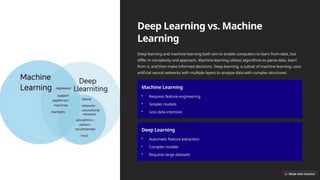
Deep Learning vs. Machine
Learning
Deep learning and machine learning both aim to enable computers to learn from data, but
differ in complexity and approach. Machine learning utilizes algorithms to parse data, learn
from it, and then make informed decisions. Deep learning, a subset of machine learning, uses
artificial neural networks with multiple layers to analyze data with complex structures.
Machine Learning
• Requires feature engineering
• Simpler models
• Less data intensive
Deep Learning
• Automatic feature extraction
• Complex models
• Requires large datasets
Real-World Applications of
CNNs
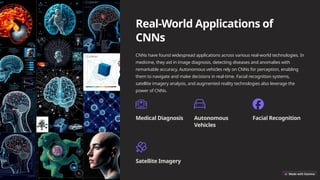
CNNs have found widespread applications across various real-world technologies. In
medicine, they aid in image diagnosis, detecting diseases and anomalies with
remarkable accuracy. Autonomous vehicles rely on CNNs for perception, enabling
them to navigate and make decisions in real-time. Facial recognition systems,
satellite imagery analysis, and augmented reality technologies also leverage the
power of CNNs.
Medical Diagnosis Autonomous
Vehicles
Facial Recognition
Satellite Imagery
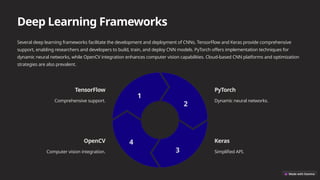
Deep Learning Frameworks
Several deep learning frameworks facilitate the development and deployment of CNNs. TensorFlow and Keras provide comprehensive
support, enabling researchers and developers to build, train, and deploy CNN models. PyTorch offers implementation techniques for
dynamic neural networks, while OpenCV integration enhances computer vision capabilities. Cloud-based CNN platforms and optimization
strategies are also prevalent.
TensorFlow
Comprehensive support.
1
PyTorch
Dynamic neural networks.
2
Keras
Simplified API.
3
OpenCV
Computer vision integration.
4
Challenges and Limitations
Despite their immense potential, CNNs face several challenges and limitations. Computational complexity demands significant
processing power and resources. CNNs require massive training datasets to generalize effectively and avoid overfitting.
Interpretability concerns arise due to the black-box nature of deep learning models. Overcoming these hurdles is crucial for
advancing CNN technology.
Computational Complexity
Data Requirements
Interpretability
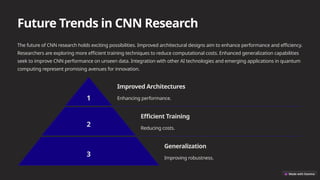
Future Trends in CNN Research
The future of CNN research holds exciting possibilities. Improved architectural designs aim to enhance performance and efficiency.
Researchers are exploring more efficient training techniques to reduce computational costs. Enhanced generalization capabilities
seek to improve CNN performance on unseen data. Integration with other AI technologies and emerging applications in quantum
computing represent promising avenues for innovation.
1
Improved Architectures
Enhancing performance.
2
Efficient Training
Reducing costs.
3
Generalization
Improving robustness.

Convolutional-Neural-Networks-Revolutionizing-Computer-Vision (1).pptx

  • 1.
    Convolutional Neural Networks: Revolutionizing ComputerVision Convolutional Neural Networks (CNNs) have emerged as a pivotal force in the realm of artificial intelligence, particularly in computer vision. Inspired by the intricate workings of the human visual cortex, CNNs have redefined how machines perceive and interpret visual data. This presentation explores the fundamental principles, historical evolution, architectural components, real-world applications, and future trends shaping the trajectory of CNNs in technological innovation. by John Nikhil Arasada
  • 2.
    Understanding Convolutional NeuralNetworks Convolutional Neural Networks are deep learning algorithms modeled after the human visual cortex, specializing in the processing of grid-like data such as images and videos. CNNs stand as a breakthrough technology in machine learning and AI, showcasing over 87% accuracy in image recognition tasks. Their ability to automatically learn hierarchical features sets them apart from traditional algorithms. Human Visual Cortex Inspired Mirrors the organizational structure of the visual cortex for advanced pattern recognition. Specialized Data Processing Excels in processing grid-like data, including images and videos. High Accuracy Rates Demonstrates accuracy rates exceeding 87% in image recognition tasks.
  • 3.
    Historical Context andEvolution The journey of CNNs began with LeNet-5 by Yann LeCun in 1998, laying the groundwork for modern image recognition systems. A breakthrough occurred with AlexNet in the 2012 ImageNet competition, dramatically reducing error rates in image classification. This advancement led to the rapid adoption of CNNs across multiple technological domains, revolutionizing computer vision. 1 1998: LeNet-5 Pioneering architecture by Yann LeCun. 2 2012: AlexNet Breakthrough in ImageNet competition. 3 Present Widespread adoption across industries.
  • 4.
    CNN Architecture: KeyComponents CNN architecture consists of several key components working together to process and interpret images effectively. Convolutional layers extract features by convolving filters over the input image. Pooling layers reduce dimensionality, simplifying the feature maps. Fully connected layers perform final classification, assigning labels to the processed images. Activation functions and backpropagation facilitate learning. Convolutional Layers Feature extraction using filters/kernels. Pooling Layers Dimensionality reduction for simplification. Fully Connected Layers Final classification and labeling.
  • 5.
    How Convolution Works Convolutioninvolves sliding a filter or kernel over the input image to detect edges, textures, and complex patterns. This process progressively learns hierarchical features, enabling CNNs to automatically learn representations from raw data. Convolution is a fundamental operation that drives the feature extraction capabilities of CNNs. Input Image Raw image data. Sliding Filter Detecting features. Feature Maps Hierarchical representation.
  • 6.
    Deep Learning vs.Machine Learning Deep learning and machine learning both aim to enable computers to learn from data, but differ in complexity and approach. Machine learning utilizes algorithms to parse data, learn from it, and then make informed decisions. Deep learning, a subset of machine learning, uses artificial neural networks with multiple layers to analyze data with complex structures. Machine Learning • Requires feature engineering • Simpler models • Less data intensive Deep Learning • Automatic feature extraction • Complex models • Requires large datasets
  • 7.
    Real-World Applications of CNNs CNNshave found widespread applications across various real-world technologies. In medicine, they aid in image diagnosis, detecting diseases and anomalies with remarkable accuracy. Autonomous vehicles rely on CNNs for perception, enabling them to navigate and make decisions in real-time. Facial recognition systems, satellite imagery analysis, and augmented reality technologies also leverage the power of CNNs. Medical Diagnosis Autonomous Vehicles Facial Recognition Satellite Imagery
  • 8.
    Deep Learning Frameworks Severaldeep learning frameworks facilitate the development and deployment of CNNs. TensorFlow and Keras provide comprehensive support, enabling researchers and developers to build, train, and deploy CNN models. PyTorch offers implementation techniques for dynamic neural networks, while OpenCV integration enhances computer vision capabilities. Cloud-based CNN platforms and optimization strategies are also prevalent. TensorFlow Comprehensive support. 1 PyTorch Dynamic neural networks. 2 Keras Simplified API. 3 OpenCV Computer vision integration. 4
  • 9.
    Challenges and Limitations Despitetheir immense potential, CNNs face several challenges and limitations. Computational complexity demands significant processing power and resources. CNNs require massive training datasets to generalize effectively and avoid overfitting. Interpretability concerns arise due to the black-box nature of deep learning models. Overcoming these hurdles is crucial for advancing CNN technology. Computational Complexity Data Requirements Interpretability
  • 10.
    Future Trends inCNN Research The future of CNN research holds exciting possibilities. Improved architectural designs aim to enhance performance and efficiency. Researchers are exploring more efficient training techniques to reduce computational costs. Enhanced generalization capabilities seek to improve CNN performance on unseen data. Integration with other AI technologies and emerging applications in quantum computing represent promising avenues for innovation. 1 Improved Architectures Enhancing performance. 2 Efficient Training Reducing costs. 3 Generalization Improving robustness.