Conversational
Presenting.
Introduction.
For many decades, people from ceremonial
podiums and famous stages around the world
have delivered inspiring linear presentations
that help their audiences to feel empowered
or see things in a new way (think TED). The
delivery style in office spaces has followed
suit, but without the same degree of success.
Rehearsed and inflexible scripts in the
workplace have too often caused listeners
to struggle to remain interested. And, in
today’s world of rapidly decreasing attention
spans and demanding mobile devices, a
typical business presentation falling flat is
almost expected.
The good news is it doesn’t have to be that way.
With a shift in approach, presenters can turn
their presentations into dialogues, making them
interactive and interesting enough to keep viewers
tuned in while their pocket-sized screens remain
in the pockets where they belong.
Welcome to what we at Prezi call Conversational
Presenting. This two-way approach enables
presenters to jump straight into the content that
matters most to any given audience, creating a
consistently relevant and engaging experience
from beginning to end.
In this e-book, we’ll take a closer look at exactly
why the traditional approach consistently falls
short in business, the future of presenting as we
see it, and how adopting our method can help
you be more successful in your endeavors.
One way is the
wrong way.
CHAPTER ONE
PAGE 4 OF 12ONE WAY IS THE WRONG WAY
Stage fright, sweaty palms,
forgotten lines, oh my!
Have you ever planned a presentation according
to an allotted amount of time? When presenters
are tasked with filling up, say, a 15-minute block,
they tend to spend a good chunk of it talking
about themselves. It should come as no surprise
that audiences would rather dig into the parts of
the presentation that are most beneficial to them,
but memorized slides don’t provide the flexibility
needed to discover and prioritize this information.
One-way delivery makes such filler material a
natural alternative.
Have you ever been guilty of reading directly from
a slide during a presentation? While doing so can
ease any concerns about forgetting what to say,
over-reliance on software can make a bad situation
even worse. An audience’s attention is influenced by
the attention of a presenter, and just like a magician
distracting a crowd from the mechanics of his tricks,
it can be advantageous. Done wrong, it can be a
complete disaster. After all, nothing about reading
a screen along with the main act—who should be
stealing the show—strikes as particularly compelling.
At the end of the day, it’s important to remember
that audience members are no different from
anyone else: their time is precious. If they have
to sit through a presentation that’s impersonal,
uninteresting, or only asks them to engage at the
start and end, they’re likely going to spend the
the majority of it sneaking in personal tasks, like
checking email or social media.
Public speaking is a visceral fear for many of us, and for good reason. To begin with, nothing triggers our
nerves quite like standing up in front of a crowd. Second, speeches are typically memorized, and when
we memorize, we create a lot of unnecessary opportunity for those nerves to cause mistakes—such as
forgetting a line or stumbling over a word.
Presenting is a
two-way street.
CHAPTER TWO
PAGE 6 OF 12PRESENTING IS A TWO-WAY STREET
Make it a conversation,
not a lecture.
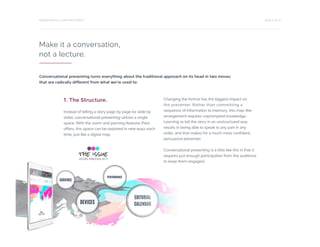
1. The Structure.
Instead of telling a story page by page (or slide by
slide), conversational presenting utilizes a single
space. With the zoom and panning features Prezi
offers, this space can be explored in new ways each
time, just like a digital map.
Changing the format has the biggest impact on
the presenter. Rather than committing a
sequence of information to memory, this map-like
arrangement requires unprompted knowledge.
Learning to tell the story in an unstructured way
results in being able to speak to any part in any
order, and that makes for a much more confident,
persuasive presenter.
Conversational presenting is a little like this in that it
requires just enough participation from the audience
to keep them engaged.
Conversational presenting turns everything about the traditional approach on its head in two moves
that are radically different from what we’re used to:
PAGE 7 OF 12PRESENTING IS A TWO-WAY STREET
2. The Delivery.
Designed for an interactive delivery, a conversational
presentation relies on audience participation.
Beginning with a question can get the dialogue
going, and ultimately allow the presenter to plot
a course. At Prezi, we suggest a simple but
effective start: What would you like to focus on?
Once an audience member declares what he or she
would like to know more about, the presenter is able
to quickly navigate to the area of interest and speak
to it as necessary.
Changing the delivery has the biggest impact on the
audience. Think back to your days in the classroom.
When your teacher asked a question, there was
a possibility of you getting called on to answer it.
Surely this made you more alert and attentive.
Conversational presenting is a little like this in that it
requires just enough participation from the audience
to keep them engaged.“What would you
like to focus on?”
By changing the structure of the presentation and the style in which it’s delivered, both presenter and audience are
able to overcome a handful of pretty big challenges associated with presenting. Because the audience is being asked
to participate in the conversation, they’re more alert and can therefore remain engaged with the material. And because
the presenter needs to be able to jump into any part of the story at any time, there’s no script to forget or stumble over.
The right choice for
the modern office.
CHAPTER THREE
PAGE 9 OF 12THE RIGHT CHOICE FOR MODERN OFFICE
Better your business.
It saves time.
Gone are the days of using filler material in a
presentation, such as the dreaded “About Me/Us”
slide. When you have the flexibility to ask a
boardroom full of executives or potential clients
what they want to learn about that day, and continue
to use their feedback to navigate through the
information you have prepared, you’re only ever
going to present what’s needed.
This super-focused approach amounts to a lot of
saved time for your audience as well as for you the
presenter. And as most of us know by now:
time is money.
The presentation is
always relevant.
A conversational presentation has enough room for
every single little detail you could ever dream of, but
doesn’t bind you to sharing it all. Instead, it allows
you to be prepared for any level of interest in any
topic using the same presentation.
Let’s say that in an effort to gain more budget and
buy-in for a particular project, you’ve prepared a
presentation for a number of colleagues within
your organization. The plan is to deliver it several
times over several days to accommodate different
teams’ schedules, but what about interests? These
are often very specific to department, but nobody
As we move further into an era that sees the first internet-raised generation enter the workforce
in massive waves, the shift in communications is increasingly evident. People—no matter audience
member, presenter, client, or colleague—want to ask questions and provide their own insights. They
want to problem solve and debate. They want their opinions heard and taken into account.
This makes conversational presenting a natural choice for professionals. We’ve spoken to many Prezi
users and have found that the benefits of utilizing our approach in everyday business are diverse, but
some of our favorites include:
PAGE 10 OF 12THE RIGHT CHOICE FOR MODERN OFFICE
wants to put the time into redesigning the same
presentation every time they’re about to approach a
new group of people.
With conversational presenting, this becomes a
non-issue. Simply include all the information needed
and let your audience pick and choose what they
care most about. You’ll be relevant each and every
time without having to do double or triple the work.
This works great for presenting to global
teams too, as interests can also be dependent
on location.
Showing information in context
paints a clearer picture.
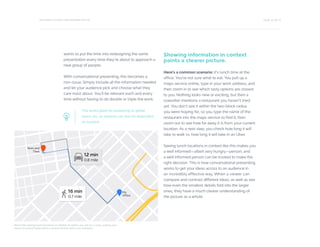
Here’s a common scenario: it’s lunch time at the
office. You’re not sure what to eat. You pull up a
maps service online, type in your work address, and
then zoom in to see which tasty options are closest
to you. Nothing looks new or exciting, but then a
coworker mentions a restaurant you haven’t tried
yet. You don’t see it within the two-block radius
you were hoping for, so you type the name of the
restaurant into the maps service to find it, then
zoom out to see how far away it is from your current
location. As a next step, you check how long it will
take to walk vs. how long it will take in an Uber.
Seeing lunch locations in context like this makes you
a well informed—albeit very hungry—person, and
a well informed person can be trusted to make the
right decision. This is how conversational presenting
works to get your ideas across to an audience in
an incredibly effective way. When a viewer can
compare and contrast different ideas, as well as see
how even the smallest details fold into the larger
ones, they have a much clearer understanding of
the picture as a whole.
Much like seeing lunch locations in relation to where you are on a map, putting your
ideas in context helps paint a clearer picture with your audience.
My
Office
Nom and
Then
PAGE 11 OF 12THE RIGHT CHOICE FOR MODERN OFFICE
Visual storytelling is
more memorable.
At this point, let’s assume you’re convinced
conversational presenting is the way to go (woo!)
and you’re eager to get started. Before you drop
slides directly from PowerPoint into Prezi, know
that tweaking your approach to content is required
in addition to a change in format and delivery.
After all, how can you expect to have a successful
conversation if you’re too busy rattling off bullet
points that—impressive as they may be—likely no
one will remember?
What many of us know these days as visual
storytelling complements conversational presenting
perfectly. We’ve got a ton of research to explain why
visuals work best in presentations, but the gist of it is
simply that our brains are built for them. Between 80
and 90% of the information that our brain processes
comes in through our eyes, and almost incredibly,
two-thirds of the brain’s electrical activity is
dedicated to vision when the eyes are open. In other
words, we are hardwired to consume visuals, and
our brains have evolved powerful storage capacity
for this type of information.
When translating your content into a conversational
presentation, think of what you can condense into
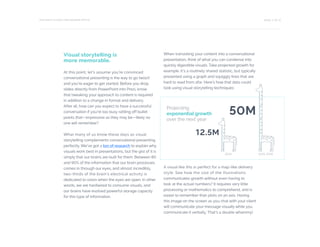
quickly digestible visuals. Take projected growth for
example. It’s a routinely shared statistic, but typically
presented using a graph and squiggly lines that are
hard to read from afar. Here’s how that data could
look using visual storytelling techniques:
A visual like this is perfect for a map-like delivery
style. See how the size of the illustrations
communicates growth without even having to
look at the actual numbers? It requires very little
processing or mathematics to comprehend, and is
easier to remember than plots on an axis. Having
this image on the screen as you chat with your client
will communicate your message visually while you
communicate it verbally. That’s a double whammy!
50M
12.5M
2014 2015-2016
Projecting
exponential growth
over the next year
PAGE 12 OF 12CHAPTER TITLE
Conclusion.
While conversational presenting is not going to
be the right way to go in every single instance, the
direction our workforce is moving in will certainly
make it the best option more often than not. With
a combination of a map-like structure, meaningful
movement, and visually appealing content, Prezi
makes delivering a presentation that operates like
a conversation easier than ever.
We at Prezi are proud to be one of the many
companies to bring productivity into the 21st
century, and the first to offer a solution that treats
presentations as more than just that. Because in
business you’re always adapting, and we believe
you should have a platform with the flexibility to
support you.
Find out more about conversational presenting today
by taking a tour of our Prezi Business workshop.

Conversational Presenting

  • 1.
  • 2.
    Introduction. For many decades,people from ceremonial podiums and famous stages around the world have delivered inspiring linear presentations that help their audiences to feel empowered or see things in a new way (think TED). The delivery style in office spaces has followed suit, but without the same degree of success. Rehearsed and inflexible scripts in the workplace have too often caused listeners to struggle to remain interested. And, in today’s world of rapidly decreasing attention spans and demanding mobile devices, a typical business presentation falling flat is almost expected. The good news is it doesn’t have to be that way. With a shift in approach, presenters can turn their presentations into dialogues, making them interactive and interesting enough to keep viewers tuned in while their pocket-sized screens remain in the pockets where they belong. Welcome to what we at Prezi call Conversational Presenting. This two-way approach enables presenters to jump straight into the content that matters most to any given audience, creating a consistently relevant and engaging experience from beginning to end. In this e-book, we’ll take a closer look at exactly why the traditional approach consistently falls short in business, the future of presenting as we see it, and how adopting our method can help you be more successful in your endeavors.
  • 3.
    One way isthe wrong way. CHAPTER ONE
  • 4.
    PAGE 4 OF12ONE WAY IS THE WRONG WAY Stage fright, sweaty palms, forgotten lines, oh my! Have you ever planned a presentation according to an allotted amount of time? When presenters are tasked with filling up, say, a 15-minute block, they tend to spend a good chunk of it talking about themselves. It should come as no surprise that audiences would rather dig into the parts of the presentation that are most beneficial to them, but memorized slides don’t provide the flexibility needed to discover and prioritize this information. One-way delivery makes such filler material a natural alternative. Have you ever been guilty of reading directly from a slide during a presentation? While doing so can ease any concerns about forgetting what to say, over-reliance on software can make a bad situation even worse. An audience’s attention is influenced by the attention of a presenter, and just like a magician distracting a crowd from the mechanics of his tricks, it can be advantageous. Done wrong, it can be a complete disaster. After all, nothing about reading a screen along with the main act—who should be stealing the show—strikes as particularly compelling. At the end of the day, it’s important to remember that audience members are no different from anyone else: their time is precious. If they have to sit through a presentation that’s impersonal, uninteresting, or only asks them to engage at the start and end, they’re likely going to spend the the majority of it sneaking in personal tasks, like checking email or social media. Public speaking is a visceral fear for many of us, and for good reason. To begin with, nothing triggers our nerves quite like standing up in front of a crowd. Second, speeches are typically memorized, and when we memorize, we create a lot of unnecessary opportunity for those nerves to cause mistakes—such as forgetting a line or stumbling over a word.
  • 5.
    Presenting is a two-waystreet. CHAPTER TWO
  • 6.
    PAGE 6 OF12PRESENTING IS A TWO-WAY STREET Make it a conversation, not a lecture. 1. The Structure. Instead of telling a story page by page (or slide by slide), conversational presenting utilizes a single space. With the zoom and panning features Prezi offers, this space can be explored in new ways each time, just like a digital map. Changing the format has the biggest impact on the presenter. Rather than committing a sequence of information to memory, this map-like arrangement requires unprompted knowledge. Learning to tell the story in an unstructured way results in being able to speak to any part in any order, and that makes for a much more confident, persuasive presenter. Conversational presenting is a little like this in that it requires just enough participation from the audience to keep them engaged. Conversational presenting turns everything about the traditional approach on its head in two moves that are radically different from what we’re used to:
  • 7.
    PAGE 7 OF12PRESENTING IS A TWO-WAY STREET 2. The Delivery. Designed for an interactive delivery, a conversational presentation relies on audience participation. Beginning with a question can get the dialogue going, and ultimately allow the presenter to plot a course. At Prezi, we suggest a simple but effective start: What would you like to focus on? Once an audience member declares what he or she would like to know more about, the presenter is able to quickly navigate to the area of interest and speak to it as necessary. Changing the delivery has the biggest impact on the audience. Think back to your days in the classroom. When your teacher asked a question, there was a possibility of you getting called on to answer it. Surely this made you more alert and attentive. Conversational presenting is a little like this in that it requires just enough participation from the audience to keep them engaged.“What would you like to focus on?” By changing the structure of the presentation and the style in which it’s delivered, both presenter and audience are able to overcome a handful of pretty big challenges associated with presenting. Because the audience is being asked to participate in the conversation, they’re more alert and can therefore remain engaged with the material. And because the presenter needs to be able to jump into any part of the story at any time, there’s no script to forget or stumble over.
  • 8.
    The right choicefor the modern office. CHAPTER THREE
  • 9.
    PAGE 9 OF12THE RIGHT CHOICE FOR MODERN OFFICE Better your business. It saves time. Gone are the days of using filler material in a presentation, such as the dreaded “About Me/Us” slide. When you have the flexibility to ask a boardroom full of executives or potential clients what they want to learn about that day, and continue to use their feedback to navigate through the information you have prepared, you’re only ever going to present what’s needed. This super-focused approach amounts to a lot of saved time for your audience as well as for you the presenter. And as most of us know by now: time is money. The presentation is always relevant. A conversational presentation has enough room for every single little detail you could ever dream of, but doesn’t bind you to sharing it all. Instead, it allows you to be prepared for any level of interest in any topic using the same presentation. Let’s say that in an effort to gain more budget and buy-in for a particular project, you’ve prepared a presentation for a number of colleagues within your organization. The plan is to deliver it several times over several days to accommodate different teams’ schedules, but what about interests? These are often very specific to department, but nobody As we move further into an era that sees the first internet-raised generation enter the workforce in massive waves, the shift in communications is increasingly evident. People—no matter audience member, presenter, client, or colleague—want to ask questions and provide their own insights. They want to problem solve and debate. They want their opinions heard and taken into account. This makes conversational presenting a natural choice for professionals. We’ve spoken to many Prezi users and have found that the benefits of utilizing our approach in everyday business are diverse, but some of our favorites include:
  • 10.
    PAGE 10 OF12THE RIGHT CHOICE FOR MODERN OFFICE wants to put the time into redesigning the same presentation every time they’re about to approach a new group of people. With conversational presenting, this becomes a non-issue. Simply include all the information needed and let your audience pick and choose what they care most about. You’ll be relevant each and every time without having to do double or triple the work. This works great for presenting to global teams too, as interests can also be dependent on location. Showing information in context paints a clearer picture. Here’s a common scenario: it’s lunch time at the office. You’re not sure what to eat. You pull up a maps service online, type in your work address, and then zoom in to see which tasty options are closest to you. Nothing looks new or exciting, but then a coworker mentions a restaurant you haven’t tried yet. You don’t see it within the two-block radius you were hoping for, so you type the name of the restaurant into the maps service to find it, then zoom out to see how far away it is from your current location. As a next step, you check how long it will take to walk vs. how long it will take in an Uber. Seeing lunch locations in context like this makes you a well informed—albeit very hungry—person, and a well informed person can be trusted to make the right decision. This is how conversational presenting works to get your ideas across to an audience in an incredibly effective way. When a viewer can compare and contrast different ideas, as well as see how even the smallest details fold into the larger ones, they have a much clearer understanding of the picture as a whole. Much like seeing lunch locations in relation to where you are on a map, putting your ideas in context helps paint a clearer picture with your audience. My Office Nom and Then
  • 11.
    PAGE 11 OF12THE RIGHT CHOICE FOR MODERN OFFICE Visual storytelling is more memorable. At this point, let’s assume you’re convinced conversational presenting is the way to go (woo!) and you’re eager to get started. Before you drop slides directly from PowerPoint into Prezi, know that tweaking your approach to content is required in addition to a change in format and delivery. After all, how can you expect to have a successful conversation if you’re too busy rattling off bullet points that—impressive as they may be—likely no one will remember? What many of us know these days as visual storytelling complements conversational presenting perfectly. We’ve got a ton of research to explain why visuals work best in presentations, but the gist of it is simply that our brains are built for them. Between 80 and 90% of the information that our brain processes comes in through our eyes, and almost incredibly, two-thirds of the brain’s electrical activity is dedicated to vision when the eyes are open. In other words, we are hardwired to consume visuals, and our brains have evolved powerful storage capacity for this type of information. When translating your content into a conversational presentation, think of what you can condense into quickly digestible visuals. Take projected growth for example. It’s a routinely shared statistic, but typically presented using a graph and squiggly lines that are hard to read from afar. Here’s how that data could look using visual storytelling techniques: A visual like this is perfect for a map-like delivery style. See how the size of the illustrations communicates growth without even having to look at the actual numbers? It requires very little processing or mathematics to comprehend, and is easier to remember than plots on an axis. Having this image on the screen as you chat with your client will communicate your message visually while you communicate it verbally. That’s a double whammy! 50M 12.5M 2014 2015-2016 Projecting exponential growth over the next year
  • 12.
    PAGE 12 OF12CHAPTER TITLE Conclusion. While conversational presenting is not going to be the right way to go in every single instance, the direction our workforce is moving in will certainly make it the best option more often than not. With a combination of a map-like structure, meaningful movement, and visually appealing content, Prezi makes delivering a presentation that operates like a conversation easier than ever. We at Prezi are proud to be one of the many companies to bring productivity into the 21st century, and the first to offer a solution that treats presentations as more than just that. Because in business you’re always adapting, and we believe you should have a platform with the flexibility to support you. Find out more about conversational presenting today by taking a tour of our Prezi Business workshop.