DIFFERENCES
BET WEEN ISL AMIC
NEGOTIABLE
INSTRUMENT AND
CONVENTIONAL
NEGOTIABLE
INSTRUMENT
NEGOTIABLE INSTRUMENT
• a written instrument, signed by the
maker or drawer of the instrument that
contains an unconditional promise or
order to pay an exact sum of money (with
or without interest in a specified amount or
at a specified rate) on demand or at an
exact future time, or to a specific person, or
to order, or to its bearer.
– negotiable instrument is a substitute for money
or serves as an extension of credit.
• Characteristic deemed to be a negotiable
instrument:
i. legal title to the instrument.
 is defined as a thing or property used in performing an
action e.g. a banking transaction, which is freely
transferable. Section 31 Bills of Exchange Act 1949.
ii. the person (usually called the Transferee) to whom
the instrument is negotiated can sue on the
instrument in his own name
iii. a person who takes the negotiated instrument in
good faith and for value (a bona fide transferee) may
acquires a title to the instrument better than that of
the transferor, even though the transferor held a
defective title or no title at all.
LAW APPLICABLE FOR
NEGOTIABLE INSTRUMENT
IN MALAYSIA
• CONVENTIONAL NEGOTIABLE
INSTRUMENT
– Bills of Exchange Act 1949
Malaysia has also incorporated
the provisions of the English
Cheques Act 1957 into its own
principal Acts.
• ISLAMIC NEGOTIABLE INSTRUMENT
– Islamic Financial Services Act 2013
TYPES OF
CONVENTIONAL
NEGOTIABLE
INSTRUMENT
A) BILLS OF EXCHANGE
Defined in Section 3(1) of the Bills of Exchange Act 1949 as:
“an unconditional order in waiting, addressed by one person to
another, signed by the person giving it, requiring the person to whom
it is addressed to, pay on demand or at fixed or determinable future
time, a sum certain in money to or to the order of, a specified person,
or to a bearer.”
– Bill of Exchange transaction usually involves at least three
transacting parties.
• Drawer – person who draws up the bill or who gives the instruction on
the bill
• Drawee – the agent of the Drawer is responsible for carrying out the
instruction of the Drawer.
• Payee – whom the bill is made payable & is entitled to receive
payment on the bill.
B) CHEQUES
• Section 73(1) of the Bills of Exchange Act 1949:
a cheque is a form of bill of exchange drawn on
a banker and made payable on demand.
• Payable on Demand – if the cheque is presented on the
date it bears or within a reasonable time of the date stated,
the bank must effect payment.
B. CHEQUESCONT…
• Difference between cheques and bill of exchange :
– In cheque, there is normally no acceptor.
– The drawee (usually a banker) of the cheque assumes no legal liability
toward a payee or any holder of the cheque for the payment.
– But the drawee is answerable only to his own customer, i.e. the
drawer of the cheque.
– It is to be noted that a post-dated is not an invalid bill of exchange.
Hence, the holder of a post-dated cheque has no legal rights to
institute legal action on the cheques before its date of issue has
arrived.
• Section 13(2) of the Bills of Exchange Act clearly stated
that bill of exchange is not invalid by reason that it is
post-dated or antedated.
Yee Chow Fah v Multihorizon Sdn Bhd [1998] 1
LNS 365.
• the Multihorizon Sdn. Bhd (the respondent), on 19th February
1994 drew a crossed post-dated cheques HSBC in the sum of
RM 23,000.00 made payable to cash or bearer dated 23rd
February 1994 and delivered the cheque to Cipta Hikmat
Development Sdn. Bhd for the purchase of timber logs from the
latter.
• As Cipta Hikmat was unable to supply the logs, the respondent
countermanded the payment. In the meantime, the cheque fell
into the hands of Mr. Yee Teck Fah, counsel who argued this
case in front of the judge on behalf of the appellant, who is his
sister.
• The Counsel negotiated the cheque with the appellant and
obtained cash RM 23,000.00 from her in return for the cheque.
On 23rd February 1984, the appellant presented the cheque for
payment and it was dishonoured, having been countermanded
by th respondent.
• The appellant brought and action against the respondent
on the dishonoured cheque for the sum of RM 23,000.00.
However, the learned magistrate rejected the claim on the
ground that the appellant was a complete stranger to the
respondent, and in the absence of any consideration, the
appellant cannot recover the amount from the respondent.
• According to counsel, the cheque was meant for Cipta
Hikmat as there was a contract between the two, and not
for the appellant who was a fourth party to the cheque. As
such, the learned magistrate was right to dismiss the
appellant's claim. The appellant appealed the claim.
Consequently, the appeal is allowed and the decision of
the learned magistrate be set aside. There will be
judgment for the appellant on her claim for the sum of
RM23,000 with costs, plus interest on the amount at 8%
per annum calculated from the date of the summons, i.e.
23rd April 1994 until the judgment is satisfied.
C) PROMISSORY NOTES
• Section 88(1) of the Bills of Exchange Act 1949 defines
Promissory Note as:
‘an unconditional promise in writing made by one person to
another, signed by the maker, engaging to pay, on demand or
at a fixed or determinable future time, a sum certain in money
to, or to the order of a specified person or to a bearer’.
• There is a difference between a promissory note and
an acknowledgement of a debt, like an “I.O.U”. An
I.O.U. note or receipt may constitute evidence of a
debt, but it is not a negotiable instrument and hence,
the holder of such a document does not possess
legal right to take legal action on the document.
D) BANKER’S DRAFT OR
CHEQUE
• sometimes it is called a banker’s cheques is an
order addressed by a banker to itself, to pay a
specified sum of money.
• A banker’s draft may be issued by one bank upon
another bank.
• It may also be drawn by a bank branch addressed
to its head office or to another branch of the similar
bank.
E) TREASURY BILL
• equivalent to a Promissory Note.
• The only difference is that the Treasury Bills are issued by the
Government at a discount and falling due at certain dates, for
example, for tenure of 92 days.
• government normally treats the issuance of Treasury Bills as a
vehicle to raise short-term funds, whereas, the banks use it as a
means of a short term lending which is one of the safest types of
lending as far as bankers are concerned.
F) SHARE WARRANTS
• Warrants issued by a public company, whether they are listed
or not-listed public companies, are called Share Warrants. All
share warrants issued to bearer are negotiable and the
bearer is entitled to the shares mentioned in the share
warrants.
G) DIVIDEND WARRANTS
• When a company declares dividend, it will normally issue
dividend warrants instructing its banker to pay to a named
shareholders of that company, a specified sum of money.
Dividend warrants which are usually drawn in the form of
cheques or banker’s draft or cheques are negotiable
provided otherwise stated.
E. TRESURY BILLS
H) DEBENTURES PAYABLE TO BEARER
• Debentures are security documents raised as an
acknowledgement of indebtedness. Debentures are usually
issued by a company or corporation acknowledging a mid or
long term loan to the company in favour of the lender, which
is normally issues by banking institutions. Debentures, if
expressly stated as payable to bearer are negotiable.
I) TRAVELLER’S CHEQUES
• Traveller’s cheques are in fact a special type of banker’s draft
or cheques which allows the holder of it to draw cash.
Basically, a traveller’s cheque is an order requested by the
customer, addressed to his banker and requiring the banker
to pay to himself, or at his order, the sum of money specified
therein. Given the availability of credit cards, traveller’s
cheques nowadays is not that popular vis-à-vis the credit
cards.
ISLAMIC
NEGOTIABLE
INSTRUMENTS
ISLAMIC NEGOTIABLE INSTRUMENT
OF DEPOSIT (INID)
• There are two types of Islamic negotiable instruments, Islamic
Negotiable Instrument of Deposit and Negotiable Islamic Debt
Certificate.
• The Islamic Negotiable Instruments of Deposits is based on the
concept of Al-Mudharabah.
• Al-Mudharabah refers to an agreement between the bank and the
customer when the customer agreed to participate in the financial
activities undertaken by the bank. The bank and the customer will share
the profit generated from financing and investment activities based on an
agreed profit-sharing ratio.
• This type of Islamic negotiable instruments can be sold or traded in
the Islamic money market. This instrument is tradable in the secondary
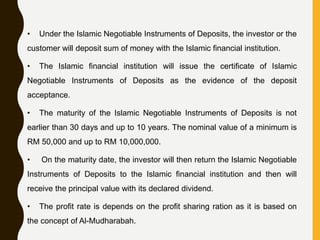
• Under the Islamic Negotiable Instruments of Deposits, the investor or the
customer will deposit sum of money with the Islamic financial institution.
• The Islamic financial institution will issue the certificate of Islamic
Negotiable Instruments of Deposits as the evidence of the deposit
acceptance.
• The maturity of the Islamic Negotiable Instruments of Deposits is not
earlier than 30 days and up to 10 years. The nominal value of a minimum is
RM 50,000 and up to RM 10,000,000.
• On the maturity date, the investor will then return the Islamic Negotiable
Instruments of Deposits to the Islamic financial institution and then will
receive the principal value with its declared dividend.
• The profit rate is depends on the profit sharing ration as it is based on
the concept of Al-Mudharabah.
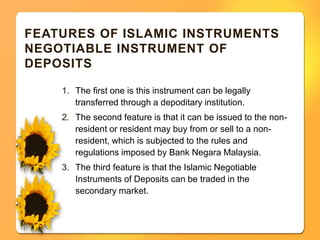
FEATURES OF ISLAMIC INSTRUMENTS
NEGOTIABLE INSTRUMENT OF
DEPOSITS
1. The first one is this instrument can be legally
transferred through a depoditary institution.
2. The second feature is that it can be issued to the non-
resident or resident may buy from or sell to a non-
resident, which is subjected to the rules and
regulations imposed by Bank Negara Malaysia.
3. The third feature is that the Islamic Negotiable
Instruments of Deposits can be traded in the
secondary market.
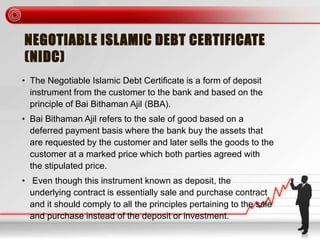
NEGOTIABLE ISLAMIC DEBT CERTIFICATE
(NIDC)
• The Negotiable Islamic Debt Certificate is a form of deposit
instrument from the customer to the bank and based on the
principle of Bai Bithaman Ajil (BBA).
• Bai Bithaman Ajil refers to the sale of good based on a
deferred payment basis where the bank buy the assets that
are requested by the customer and later sells the goods to the
customer at a marked price which both parties agreed with
the stipulated price.
• Even though this instrument known as deposit, the
underlying contract is essentially sale and purchase contract
and it should comply to all the principles pertaining to the sale
and purchase instead of the deposit or investment.
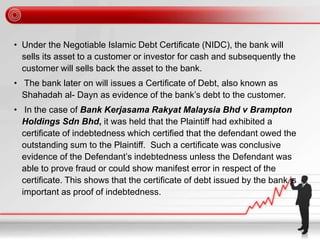
• Under the Negotiable Islamic Debt Certificate (NIDC), the bank will
sells its asset to a customer or investor for cash and subsequently the
customer will sells back the asset to the bank.
• The bank later on will issues a Certificate of Debt, also known as
Shahadah al- Dayn as evidence of the bank’s debt to the customer.
• In the case of Bank Kerjasama Rakyat Malaysia Bhd v Brampton
Holdings Sdn Bhd, it was held that the Plaintiff had exhibited a
certificate of indebtedness which certified that the defendant owed the
outstanding sum to the Plaintiff. Such a certificate was conclusive
evidence of the Defendant’s indebtedness unless the Defendant was
able to prove fraud or could show manifest error in respect of the
certificate. This shows that the certificate of debt issued by the bank is
important as proof of indebtedness.
• Basically this transaction consists of two
steps.
• The first step is the Islamic bank will sells
its assets to an investor at agreed cash
price.
• The second step is that the investor will
then resell the assets that have been
acquired from the bank at a marked up price
and the bank will pay the agreed amount at
an agreed future date.
• The difference of the marked up price will
be the profit to the customer.
• .
LEGAL ANALYSIS
• Commercial paper formats exists to simplify the trade
transactions by having an equivalent value as to a
monetary standard.
• Therefore, for the purpose of this research paper, we
had discussed;
on the types and importance of various negotiable.
divided the discussion into two parts to make a
distinction of these two areas of banking practice;
Conventional Banking and Islamic Banking.
• So under this third part, we will accordingly reveal and
analyse on the difference between the Islamic
Negotiable Instruments and Conventional
Negotiable Instruments.
• Negotiable instrument is a
written order promising to
pay a sum of money payable
to the creditor.
• There are two categories of
negotiable instruments;
Islamic Negotiable
Instruments and
Conventional Negotiable
Instruments.
ISLAMIC MARKET
• utilises Shari’ah-compiant contracts
such as mudarabah, murabahah and
wakalah
 Islamic finance every transaction done
must be in compliance with Shari’ah
principle, which is without riba (interest)
or gharar (uncertainty).
 Taking murabahah as an example. It is a
sale of contract where the bank buys a
product on behalf of a client and resells
the product to the same client.
 monetary obligation arising out of a
murabahah transaction cannot create a
negotiable instrument.
• However, if there is a mixed portfolio
consisting of a number of transactions
like musharakah, leasing and
murabahah, then this portfolio may issue
negotiable certificates subject to certain
CONVENTIONAL MARKET
• focus on issues debt contract
for placement of funds
• conventional finance is loan that
include sum of debt and interest
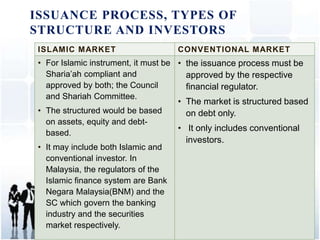
ISSUANCE PROCESS, TYPES OF
STRUCTURE AND INVESTORS
ISLAMIC MARKET CONVENTIONAL MARKET
• For Islamic instrument, it must be
Sharia’ah compliant and
approved by both; the Council
and Shariah Committee.
• The structured would be based
on assets, equity and debt-
based.
• It may include both Islamic and
conventional investor. In
Malaysia, the regulators of the
Islamic finance system are Bank
Negara Malaysia(BNM) and the
SC which govern the banking
industry and the securities
market respectively.
• the issuance process must be
approved by the respective
financial regulator.
• The market is structured based
on debt only.
• It only includes conventional
investors.
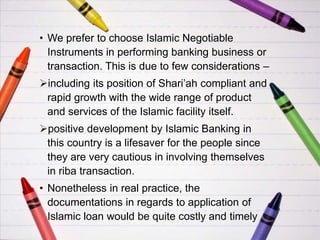
• We prefer to choose Islamic Negotiable
Instruments in performing banking business or
transaction. This is due to few considerations –
including its position of Shari’ah compliant and
rapid growth with the wide range of product
and services of the Islamic facility itself.
positive development by Islamic Banking in
this country is a lifesaver for the people since
they are very cautious in involving themselves
in riba transaction.
• Nonetheless in real practice, the
documentations in regards to application of
Islamic loan would be quite costly and timely
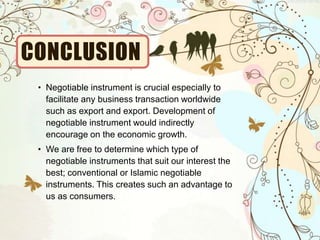
CONCLUSION
• Negotiable instrument is crucial especially to
facilitate any business transaction worldwide
such as export and export. Development of
negotiable instrument would indirectly
encourage on the economic growth.
• We are free to determine which type of
negotiable instruments that suit our interest the
best; conventional or Islamic negotiable
instruments. This creates such an advantage to
us as consumers.
Conventional  & Islamic Negotiable Instrument

Conventional & Islamic Negotiable Instrument

  • 1.
    DIFFERENCES BET WEEN ISLAMIC NEGOTIABLE INSTRUMENT AND CONVENTIONAL NEGOTIABLE INSTRUMENT
  • 2.
    NEGOTIABLE INSTRUMENT • awritten instrument, signed by the maker or drawer of the instrument that contains an unconditional promise or order to pay an exact sum of money (with or without interest in a specified amount or at a specified rate) on demand or at an exact future time, or to a specific person, or to order, or to its bearer. – negotiable instrument is a substitute for money or serves as an extension of credit.
  • 3.
    • Characteristic deemedto be a negotiable instrument: i. legal title to the instrument.  is defined as a thing or property used in performing an action e.g. a banking transaction, which is freely transferable. Section 31 Bills of Exchange Act 1949. ii. the person (usually called the Transferee) to whom the instrument is negotiated can sue on the instrument in his own name iii. a person who takes the negotiated instrument in good faith and for value (a bona fide transferee) may acquires a title to the instrument better than that of the transferor, even though the transferor held a defective title or no title at all.
  • 4.
    LAW APPLICABLE FOR NEGOTIABLEINSTRUMENT IN MALAYSIA • CONVENTIONAL NEGOTIABLE INSTRUMENT – Bills of Exchange Act 1949 Malaysia has also incorporated the provisions of the English Cheques Act 1957 into its own principal Acts. • ISLAMIC NEGOTIABLE INSTRUMENT – Islamic Financial Services Act 2013
  • 5.
  • 6.
    A) BILLS OFEXCHANGE Defined in Section 3(1) of the Bills of Exchange Act 1949 as: “an unconditional order in waiting, addressed by one person to another, signed by the person giving it, requiring the person to whom it is addressed to, pay on demand or at fixed or determinable future time, a sum certain in money to or to the order of, a specified person, or to a bearer.” – Bill of Exchange transaction usually involves at least three transacting parties. • Drawer – person who draws up the bill or who gives the instruction on the bill • Drawee – the agent of the Drawer is responsible for carrying out the instruction of the Drawer. • Payee – whom the bill is made payable & is entitled to receive payment on the bill.
  • 7.
    B) CHEQUES • Section73(1) of the Bills of Exchange Act 1949: a cheque is a form of bill of exchange drawn on a banker and made payable on demand. • Payable on Demand – if the cheque is presented on the date it bears or within a reasonable time of the date stated, the bank must effect payment.
  • 8.
    B. CHEQUESCONT… • Differencebetween cheques and bill of exchange : – In cheque, there is normally no acceptor. – The drawee (usually a banker) of the cheque assumes no legal liability toward a payee or any holder of the cheque for the payment. – But the drawee is answerable only to his own customer, i.e. the drawer of the cheque. – It is to be noted that a post-dated is not an invalid bill of exchange. Hence, the holder of a post-dated cheque has no legal rights to institute legal action on the cheques before its date of issue has arrived. • Section 13(2) of the Bills of Exchange Act clearly stated that bill of exchange is not invalid by reason that it is post-dated or antedated.
  • 9.
    Yee Chow Fahv Multihorizon Sdn Bhd [1998] 1 LNS 365. • the Multihorizon Sdn. Bhd (the respondent), on 19th February 1994 drew a crossed post-dated cheques HSBC in the sum of RM 23,000.00 made payable to cash or bearer dated 23rd February 1994 and delivered the cheque to Cipta Hikmat Development Sdn. Bhd for the purchase of timber logs from the latter. • As Cipta Hikmat was unable to supply the logs, the respondent countermanded the payment. In the meantime, the cheque fell into the hands of Mr. Yee Teck Fah, counsel who argued this case in front of the judge on behalf of the appellant, who is his sister. • The Counsel negotiated the cheque with the appellant and obtained cash RM 23,000.00 from her in return for the cheque. On 23rd February 1984, the appellant presented the cheque for payment and it was dishonoured, having been countermanded by th respondent.
  • 10.
    • The appellantbrought and action against the respondent on the dishonoured cheque for the sum of RM 23,000.00. However, the learned magistrate rejected the claim on the ground that the appellant was a complete stranger to the respondent, and in the absence of any consideration, the appellant cannot recover the amount from the respondent. • According to counsel, the cheque was meant for Cipta Hikmat as there was a contract between the two, and not for the appellant who was a fourth party to the cheque. As such, the learned magistrate was right to dismiss the appellant's claim. The appellant appealed the claim. Consequently, the appeal is allowed and the decision of the learned magistrate be set aside. There will be judgment for the appellant on her claim for the sum of RM23,000 with costs, plus interest on the amount at 8% per annum calculated from the date of the summons, i.e. 23rd April 1994 until the judgment is satisfied.
  • 11.
    C) PROMISSORY NOTES •Section 88(1) of the Bills of Exchange Act 1949 defines Promissory Note as: ‘an unconditional promise in writing made by one person to another, signed by the maker, engaging to pay, on demand or at a fixed or determinable future time, a sum certain in money to, or to the order of a specified person or to a bearer’. • There is a difference between a promissory note and an acknowledgement of a debt, like an “I.O.U”. An I.O.U. note or receipt may constitute evidence of a debt, but it is not a negotiable instrument and hence, the holder of such a document does not possess legal right to take legal action on the document.
  • 12.
    D) BANKER’S DRAFTOR CHEQUE • sometimes it is called a banker’s cheques is an order addressed by a banker to itself, to pay a specified sum of money. • A banker’s draft may be issued by one bank upon another bank. • It may also be drawn by a bank branch addressed to its head office or to another branch of the similar bank.
  • 13.
    E) TREASURY BILL •equivalent to a Promissory Note. • The only difference is that the Treasury Bills are issued by the Government at a discount and falling due at certain dates, for example, for tenure of 92 days. • government normally treats the issuance of Treasury Bills as a vehicle to raise short-term funds, whereas, the banks use it as a means of a short term lending which is one of the safest types of lending as far as bankers are concerned.
  • 14.
    F) SHARE WARRANTS •Warrants issued by a public company, whether they are listed or not-listed public companies, are called Share Warrants. All share warrants issued to bearer are negotiable and the bearer is entitled to the shares mentioned in the share warrants. G) DIVIDEND WARRANTS • When a company declares dividend, it will normally issue dividend warrants instructing its banker to pay to a named shareholders of that company, a specified sum of money. Dividend warrants which are usually drawn in the form of cheques or banker’s draft or cheques are negotiable provided otherwise stated.
  • 15.
    E. TRESURY BILLS H)DEBENTURES PAYABLE TO BEARER • Debentures are security documents raised as an acknowledgement of indebtedness. Debentures are usually issued by a company or corporation acknowledging a mid or long term loan to the company in favour of the lender, which is normally issues by banking institutions. Debentures, if expressly stated as payable to bearer are negotiable. I) TRAVELLER’S CHEQUES • Traveller’s cheques are in fact a special type of banker’s draft or cheques which allows the holder of it to draw cash. Basically, a traveller’s cheque is an order requested by the customer, addressed to his banker and requiring the banker to pay to himself, or at his order, the sum of money specified therein. Given the availability of credit cards, traveller’s cheques nowadays is not that popular vis-à-vis the credit cards.
  • 16.
  • 17.
    ISLAMIC NEGOTIABLE INSTRUMENT OFDEPOSIT (INID) • There are two types of Islamic negotiable instruments, Islamic Negotiable Instrument of Deposit and Negotiable Islamic Debt Certificate. • The Islamic Negotiable Instruments of Deposits is based on the concept of Al-Mudharabah. • Al-Mudharabah refers to an agreement between the bank and the customer when the customer agreed to participate in the financial activities undertaken by the bank. The bank and the customer will share the profit generated from financing and investment activities based on an agreed profit-sharing ratio. • This type of Islamic negotiable instruments can be sold or traded in the Islamic money market. This instrument is tradable in the secondary
  • 18.
    • Under theIslamic Negotiable Instruments of Deposits, the investor or the customer will deposit sum of money with the Islamic financial institution. • The Islamic financial institution will issue the certificate of Islamic Negotiable Instruments of Deposits as the evidence of the deposit acceptance. • The maturity of the Islamic Negotiable Instruments of Deposits is not earlier than 30 days and up to 10 years. The nominal value of a minimum is RM 50,000 and up to RM 10,000,000. • On the maturity date, the investor will then return the Islamic Negotiable Instruments of Deposits to the Islamic financial institution and then will receive the principal value with its declared dividend. • The profit rate is depends on the profit sharing ration as it is based on the concept of Al-Mudharabah.
  • 19.
    FEATURES OF ISLAMICINSTRUMENTS NEGOTIABLE INSTRUMENT OF DEPOSITS 1. The first one is this instrument can be legally transferred through a depoditary institution. 2. The second feature is that it can be issued to the non- resident or resident may buy from or sell to a non- resident, which is subjected to the rules and regulations imposed by Bank Negara Malaysia. 3. The third feature is that the Islamic Negotiable Instruments of Deposits can be traded in the secondary market.
  • 20.
    NEGOTIABLE ISLAMIC DEBTCERTIFICATE (NIDC) • The Negotiable Islamic Debt Certificate is a form of deposit instrument from the customer to the bank and based on the principle of Bai Bithaman Ajil (BBA). • Bai Bithaman Ajil refers to the sale of good based on a deferred payment basis where the bank buy the assets that are requested by the customer and later sells the goods to the customer at a marked price which both parties agreed with the stipulated price. • Even though this instrument known as deposit, the underlying contract is essentially sale and purchase contract and it should comply to all the principles pertaining to the sale and purchase instead of the deposit or investment.
  • 21.
    • Under theNegotiable Islamic Debt Certificate (NIDC), the bank will sells its asset to a customer or investor for cash and subsequently the customer will sells back the asset to the bank. • The bank later on will issues a Certificate of Debt, also known as Shahadah al- Dayn as evidence of the bank’s debt to the customer. • In the case of Bank Kerjasama Rakyat Malaysia Bhd v Brampton Holdings Sdn Bhd, it was held that the Plaintiff had exhibited a certificate of indebtedness which certified that the defendant owed the outstanding sum to the Plaintiff. Such a certificate was conclusive evidence of the Defendant’s indebtedness unless the Defendant was able to prove fraud or could show manifest error in respect of the certificate. This shows that the certificate of debt issued by the bank is important as proof of indebtedness.
  • 22.
    • Basically thistransaction consists of two steps. • The first step is the Islamic bank will sells its assets to an investor at agreed cash price. • The second step is that the investor will then resell the assets that have been acquired from the bank at a marked up price and the bank will pay the agreed amount at an agreed future date. • The difference of the marked up price will be the profit to the customer.
  • 23.
    • . LEGAL ANALYSIS •Commercial paper formats exists to simplify the trade transactions by having an equivalent value as to a monetary standard. • Therefore, for the purpose of this research paper, we had discussed; on the types and importance of various negotiable. divided the discussion into two parts to make a distinction of these two areas of banking practice; Conventional Banking and Islamic Banking. • So under this third part, we will accordingly reveal and analyse on the difference between the Islamic Negotiable Instruments and Conventional Negotiable Instruments.
  • 24.
    • Negotiable instrumentis a written order promising to pay a sum of money payable to the creditor. • There are two categories of negotiable instruments; Islamic Negotiable Instruments and Conventional Negotiable Instruments.
  • 25.
    ISLAMIC MARKET • utilisesShari’ah-compiant contracts such as mudarabah, murabahah and wakalah  Islamic finance every transaction done must be in compliance with Shari’ah principle, which is without riba (interest) or gharar (uncertainty).  Taking murabahah as an example. It is a sale of contract where the bank buys a product on behalf of a client and resells the product to the same client.  monetary obligation arising out of a murabahah transaction cannot create a negotiable instrument. • However, if there is a mixed portfolio consisting of a number of transactions like musharakah, leasing and murabahah, then this portfolio may issue negotiable certificates subject to certain CONVENTIONAL MARKET • focus on issues debt contract for placement of funds • conventional finance is loan that include sum of debt and interest
  • 26.
    ISSUANCE PROCESS, TYPESOF STRUCTURE AND INVESTORS ISLAMIC MARKET CONVENTIONAL MARKET • For Islamic instrument, it must be Sharia’ah compliant and approved by both; the Council and Shariah Committee. • The structured would be based on assets, equity and debt- based. • It may include both Islamic and conventional investor. In Malaysia, the regulators of the Islamic finance system are Bank Negara Malaysia(BNM) and the SC which govern the banking industry and the securities market respectively. • the issuance process must be approved by the respective financial regulator. • The market is structured based on debt only. • It only includes conventional investors.
  • 27.
    • We preferto choose Islamic Negotiable Instruments in performing banking business or transaction. This is due to few considerations – including its position of Shari’ah compliant and rapid growth with the wide range of product and services of the Islamic facility itself. positive development by Islamic Banking in this country is a lifesaver for the people since they are very cautious in involving themselves in riba transaction. • Nonetheless in real practice, the documentations in regards to application of Islamic loan would be quite costly and timely
  • 28.
    CONCLUSION • Negotiable instrumentis crucial especially to facilitate any business transaction worldwide such as export and export. Development of negotiable instrument would indirectly encourage on the economic growth. • We are free to determine which type of negotiable instruments that suit our interest the best; conventional or Islamic negotiable instruments. This creates such an advantage to us as consumers.