Flight Control Systems (Conventional &
Digital) & Enhanced Diagnostic Aid (EDNA)
2a. Identify principles of flight with
at least 80% accuracy.
2a. Identify principles of flight with at least 80% accuracy.

• Overview of Principles of Flight
– Basic Facts and Terms
– Controls and Surfaces
– Axes of Rotation
2a. Identify principles of flight with at least 80% accuracy.

• Principles of Flight
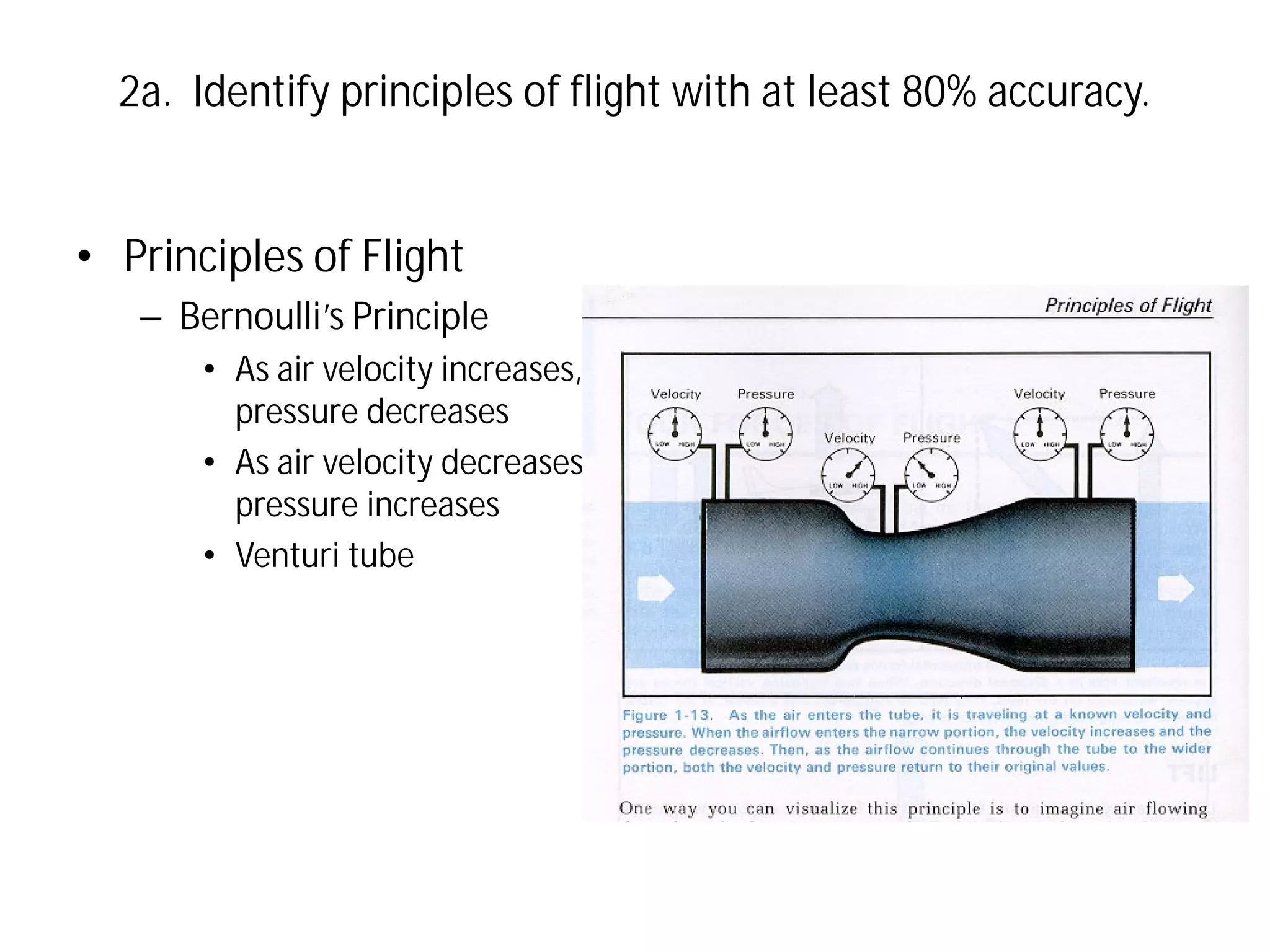
– Bernoulli’s Principle
• As air velocity increases,
pressure decreases
• As air velocity decreases,
pressure increases
• Venturi tube
2a. Identify principles of flight with at least 80% accuracy.

– Density
•
•
•
•

As air is compressed, it becomes more dense
Air has less density at high altitude
Air expands as it is heated – occupies more space
Changes in air density affect flight
– Climate is cold, altitude is low = dense air
» Aircraft achieves takeoff speed more quickly
» Takes off with less runway
– High Altitude = low density (airplane flies faster)
2a. Identify principles of flight with at least 80% accuracy.

– Humidity
• Higher temperature of air – the more water it can
absorb
• Temperature the same – density of air varies with
humidity
• Damp days
– Density is less than it is on dry days
– Airplane requires longer runway for takeoff
2a. Identify principles of flight with at least 80% accuracy.

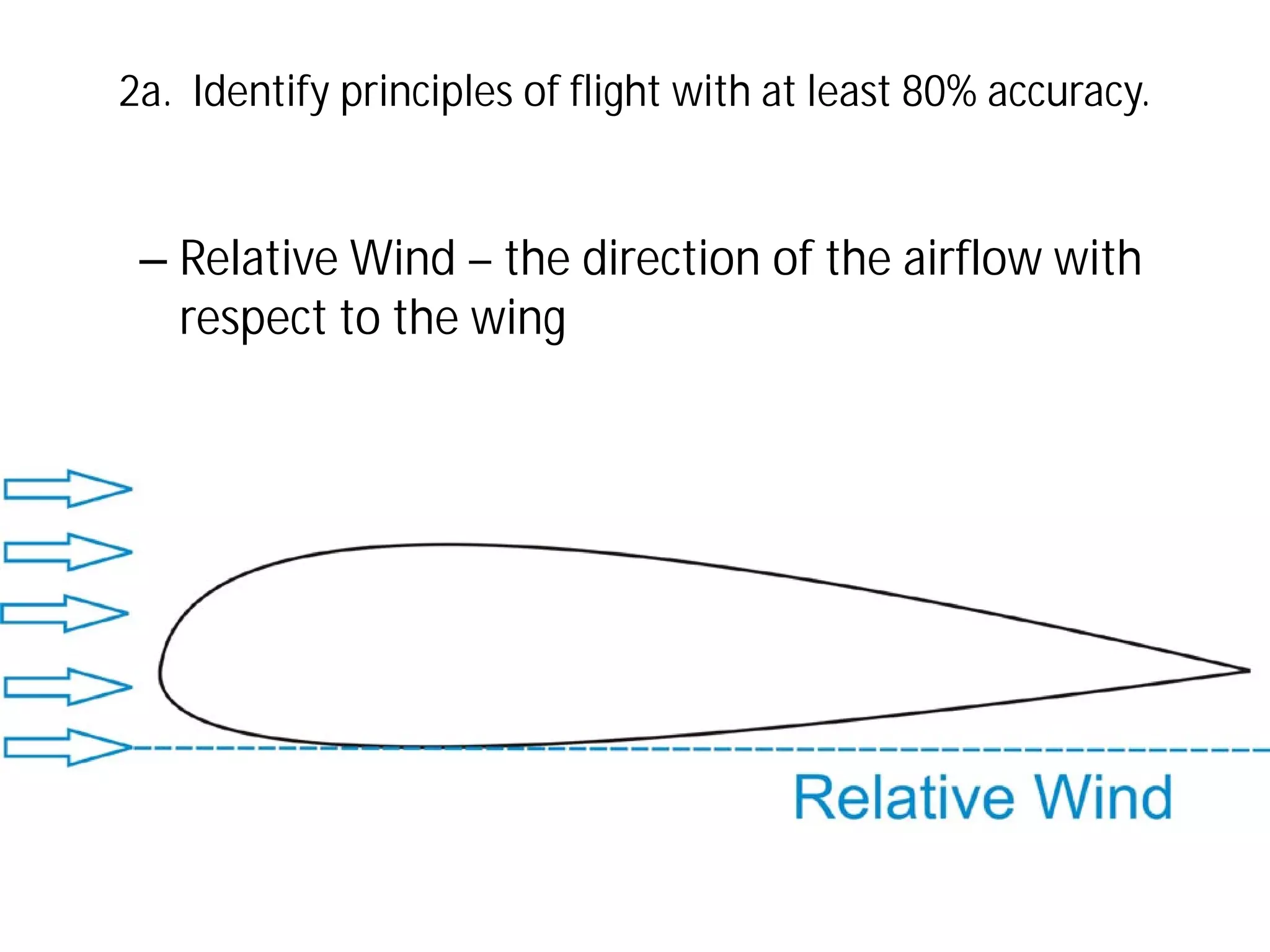
– Relative Wind – the direction of the airflow with
respect to the wing
2a. Identify principles of flight with at least 80% accuracy.

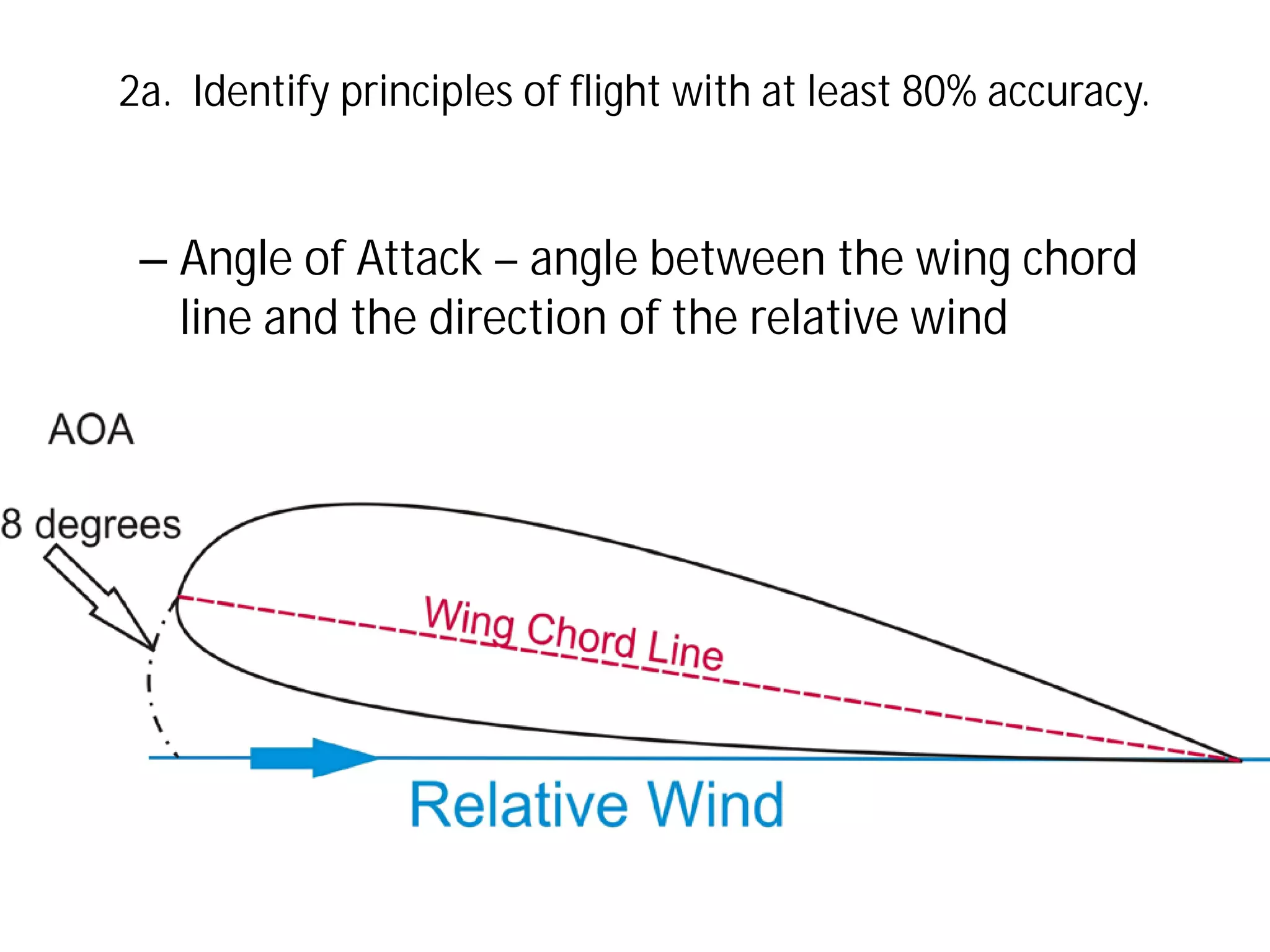
– Angle of Attack – angle between the wing chord
line and the direction of the relative wind
2a. Identify principles of flight with at least 80% accuracy.

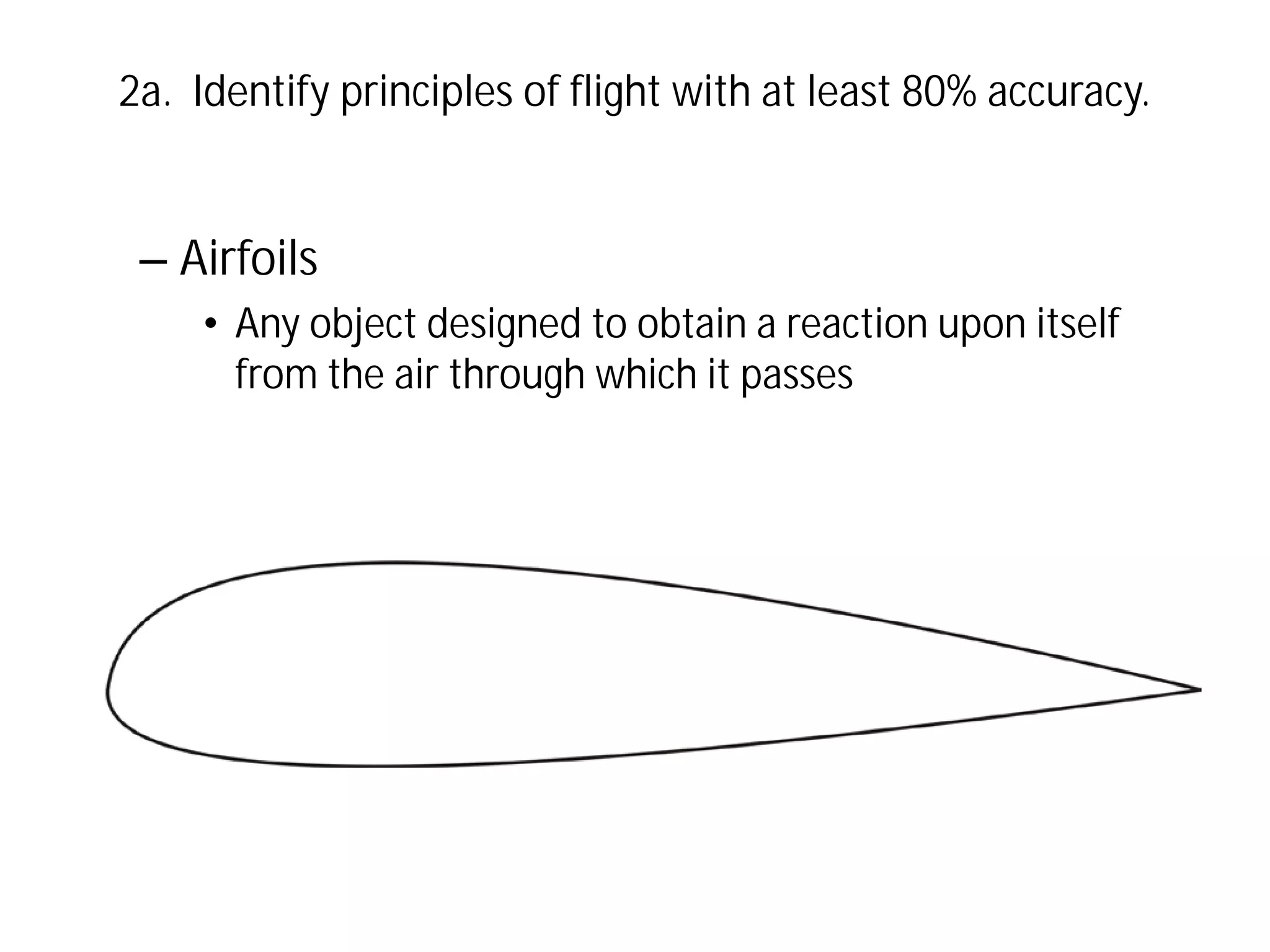
– Airfoils
• Any object designed to obtain a reaction upon itself
from the air through which it passes
2a. Identify principles of flight with at least 80% accuracy.

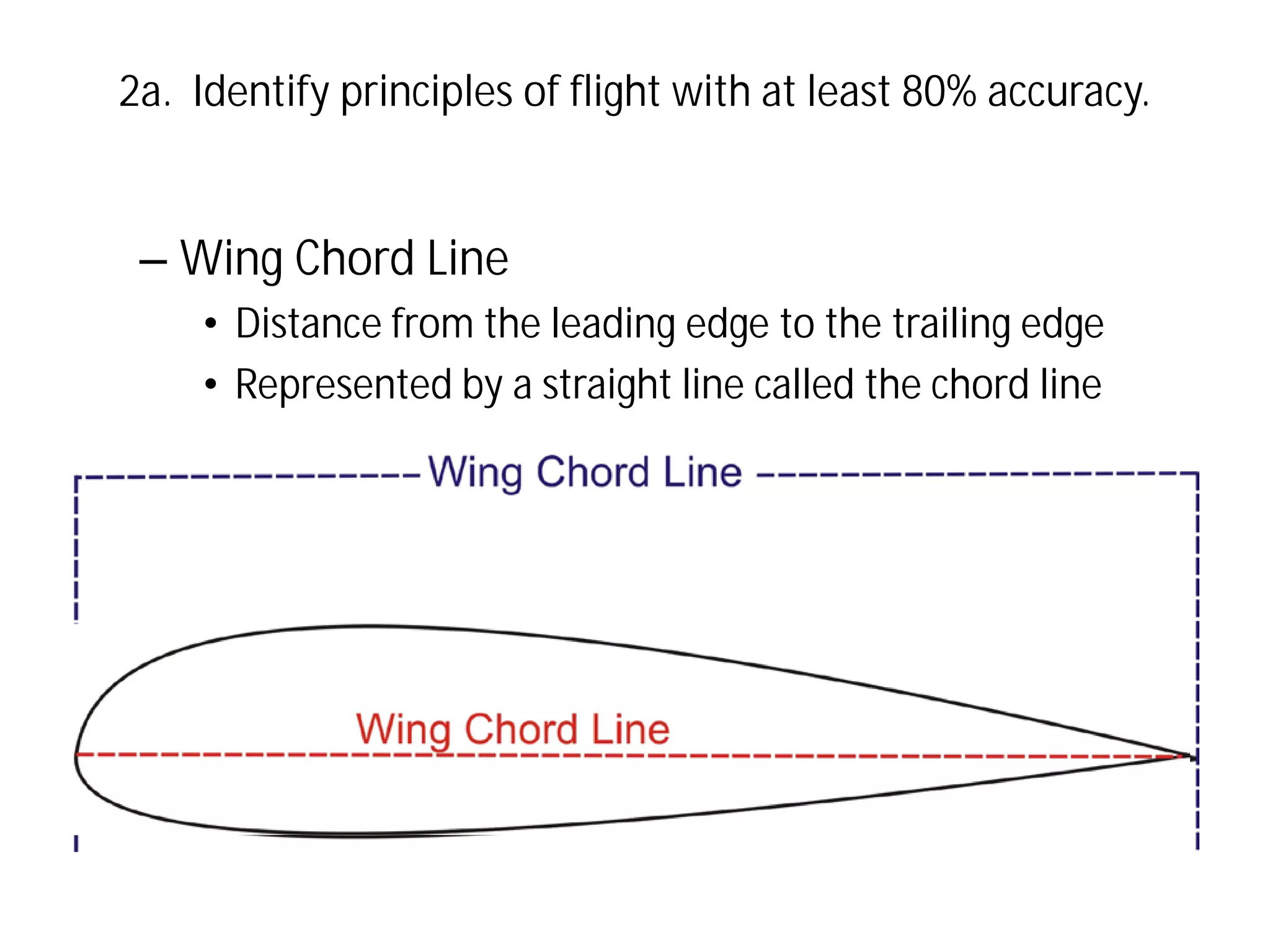
– Wing Chord Line
• Distance from the leading edge to the trailing edge
• Represented by a straight line called the chord line
2a. Identify principles of flight with at least 80% accuracy.

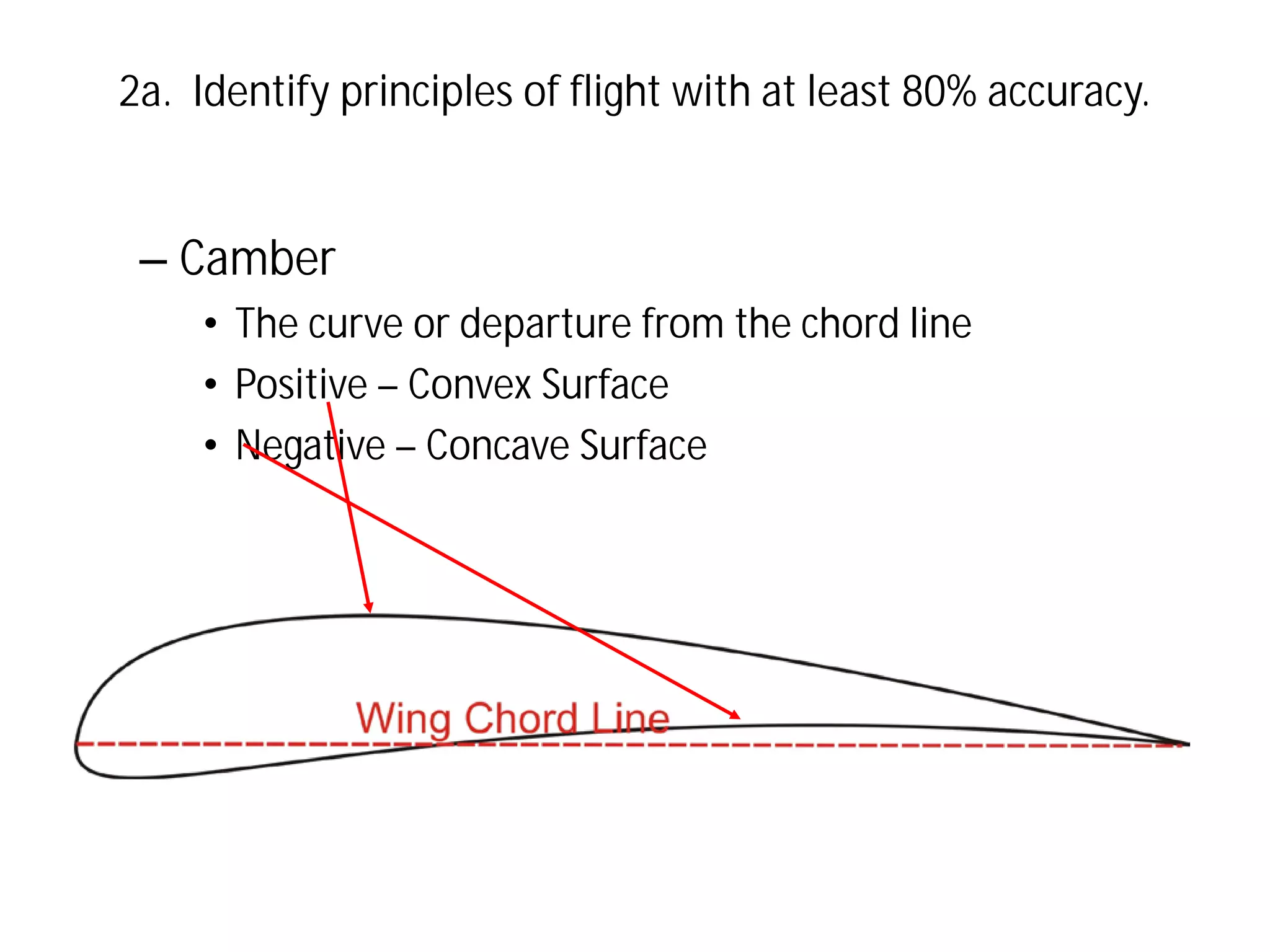
– Camber
• The curve or departure from the chord line
• Positive – Convex Surface
• Negative – Concave Surface
2a. Identify principles of flight with at least 80% accuracy.

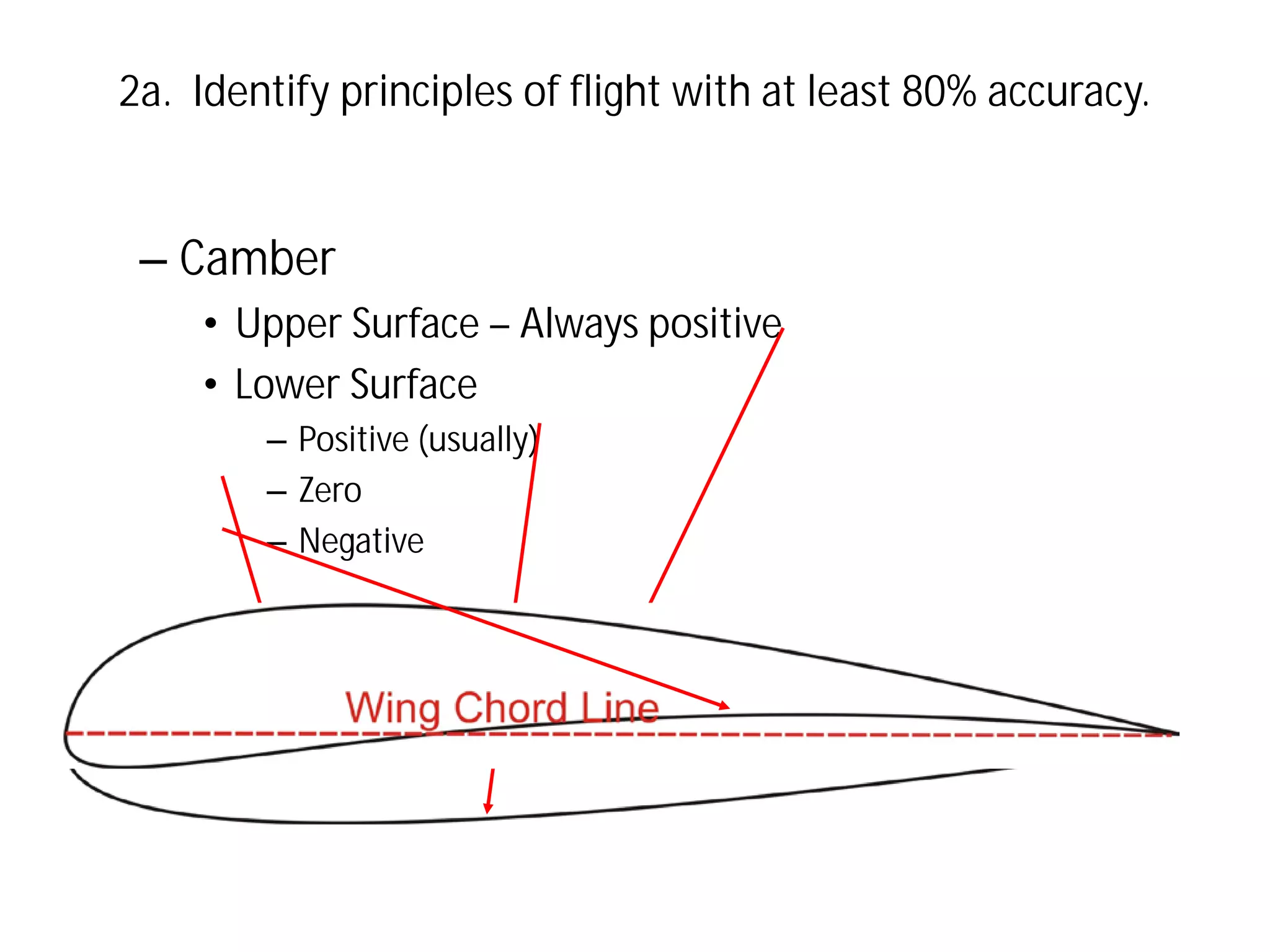
– Camber
• Upper Surface – Always positive
• Lower Surface
– Positive (usually)
– Zero
– Negative
2a. Identify principles of flight with at least 80% accuracy.

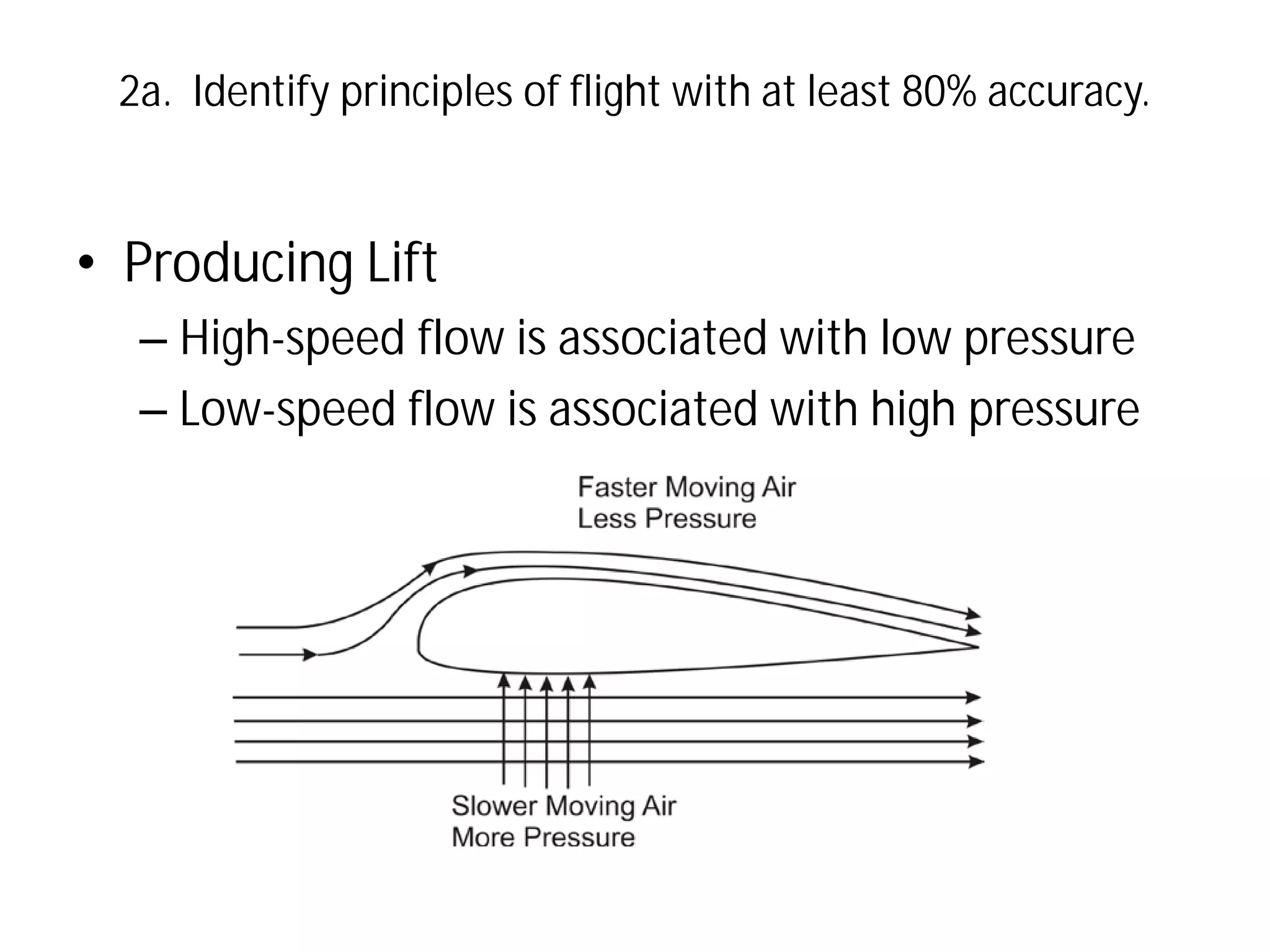
• Producing Lift
– High-speed flow is associated with low pressure
– Low-speed flow is associated with high pressure
2a. Identify principles of flight with at least 80% accuracy.

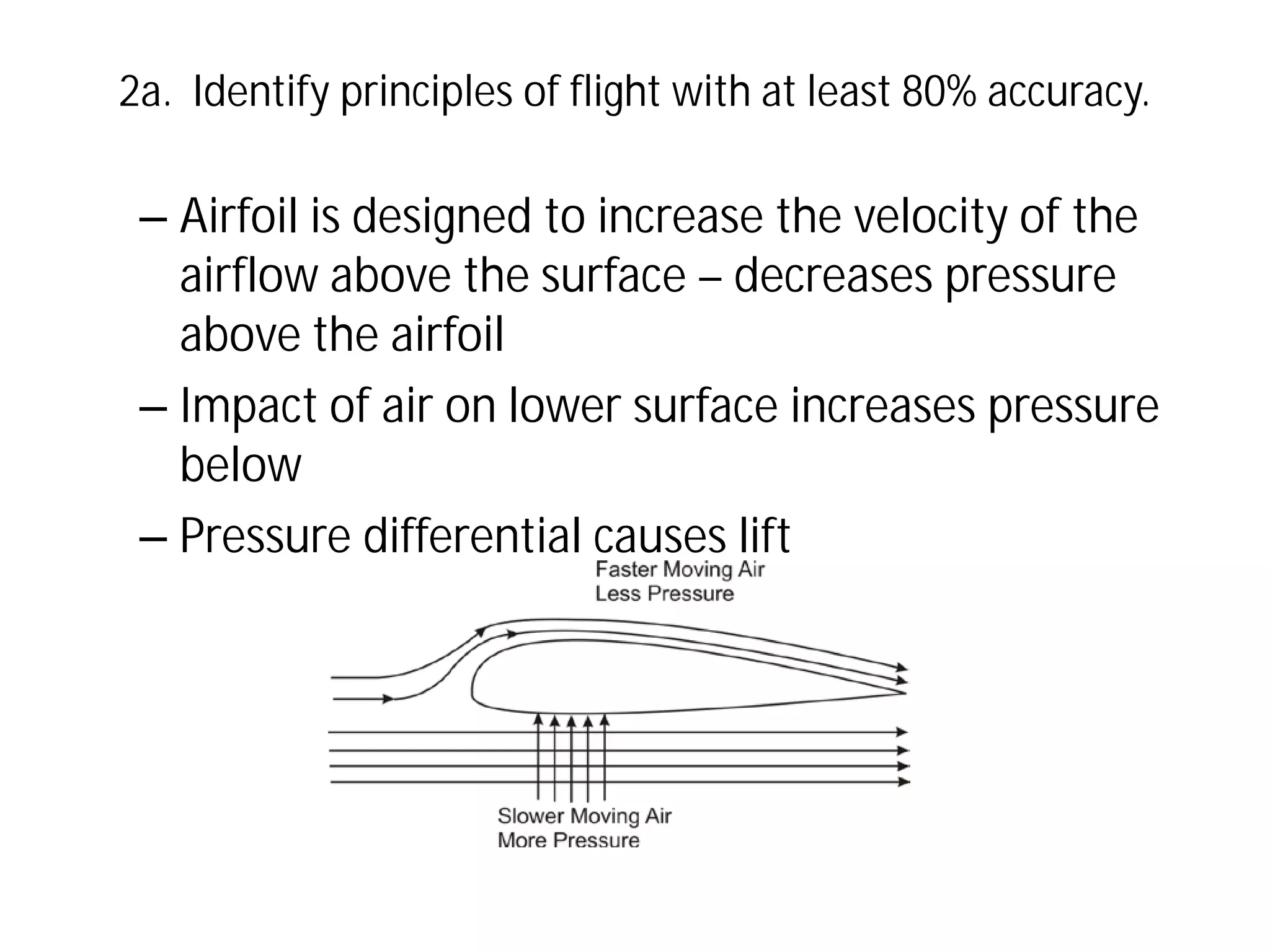
– Airfoil is designed to increase the velocity of the
airflow above the surface – decreases pressure
above the airfoil
– Impact of air on lower surface increases pressure
below
– Pressure differential causes lift
2a. Identify principles of flight with at least 80% accuracy.

• Weight – the force of gravity
acting downward upon
anything that goes into the
aircraft
– Reduced as fuel is burned
– Reduced as missles and
bombs are released
– Reduced the aircraft will
climb
2a. Identify principles of flight with at least 80% accuracy.

• Lift – acts vertically, by doing so counteracts
weight
– Increases to a certain point with
• AOA
• Air Density
• Airspeed

– Lift is increased – aircraft will climb
– Lift is reduced – aircraft will descend
2a. Identify principles of flight with at least 80% accuracy.

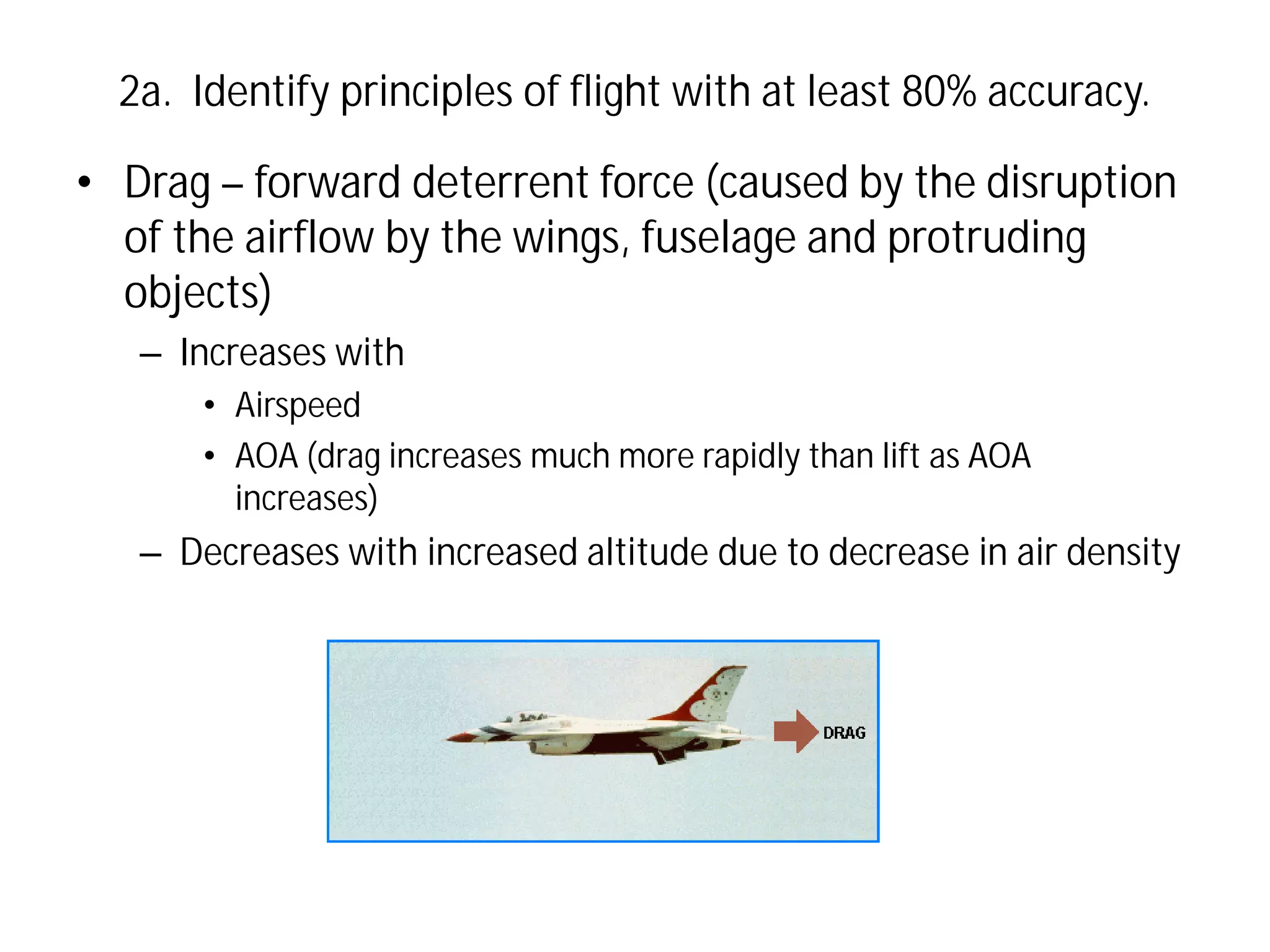
• Drag – forward deterrent force (caused by the disruption
of the airflow by the wings, fuselage and protruding
objects)
– Increases with
• Airspeed
• AOA (drag increases much more rapidly than lift as AOA
increases)

– Decreases with increased altitude due to decrease in air density
2a. Identify principles of flight with at least 80% accuracy.

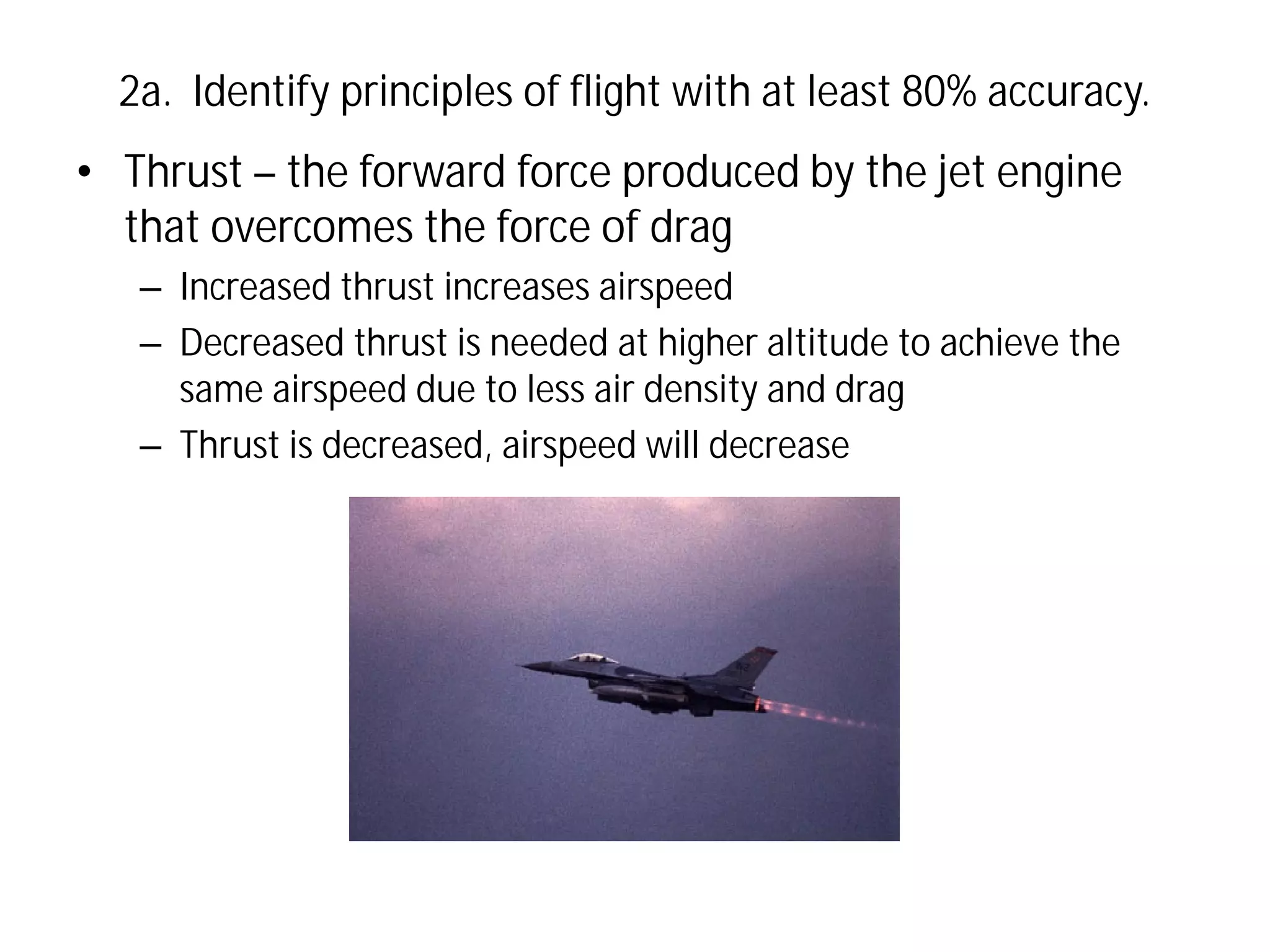
• Thrust – the forward force produced by the jet engine
that overcomes the force of drag
– Increased thrust increases airspeed
– Decreased thrust is needed at higher altitude to achieve the
same airspeed due to less air density and drag
– Thrust is decreased, airspeed will decrease
2a. Identify principles of flight with at least 80% accuracy.

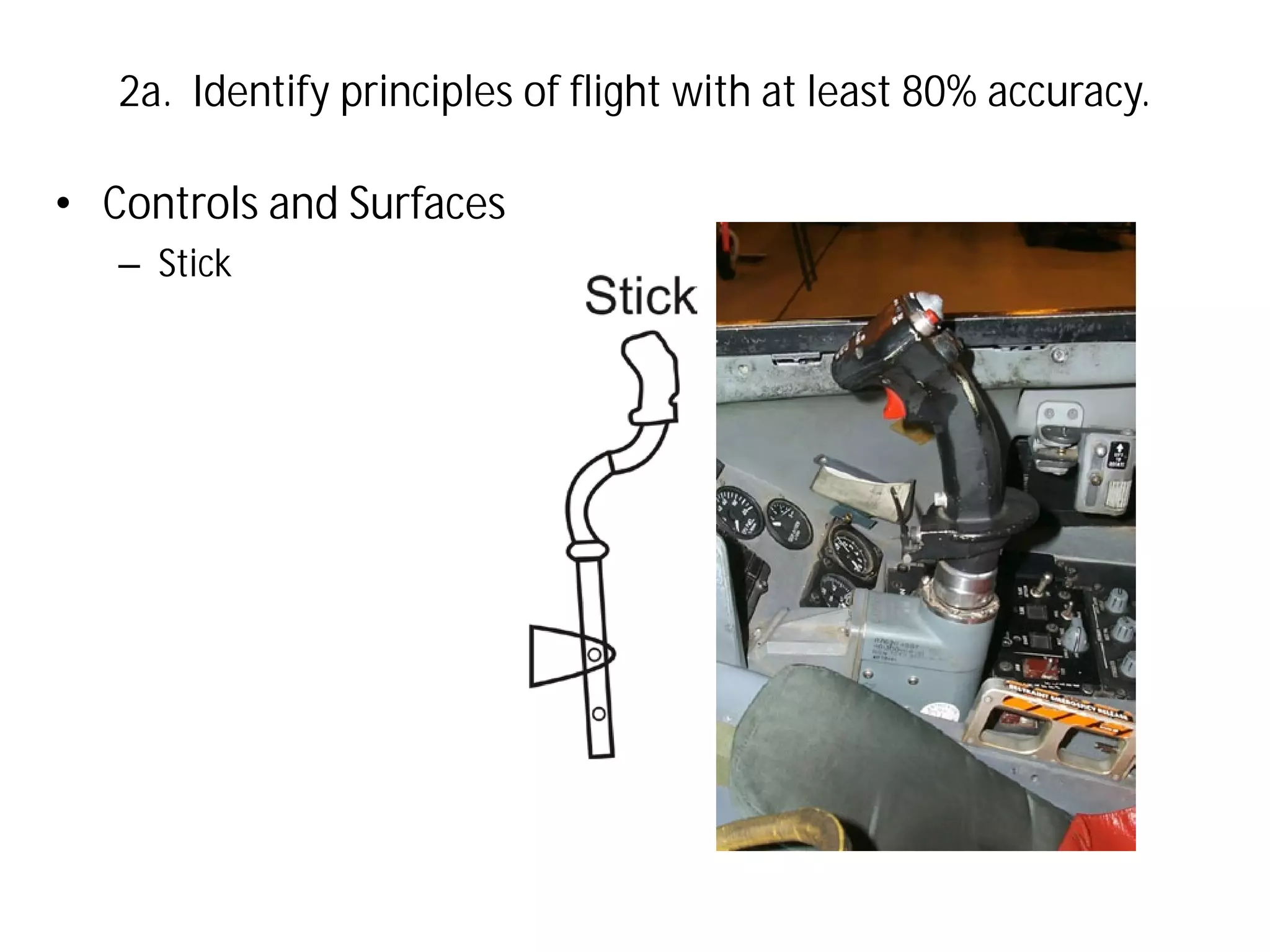
• Controls and Surfaces
– Stick
2a. Identify principles of flight with at least 80% accuracy.

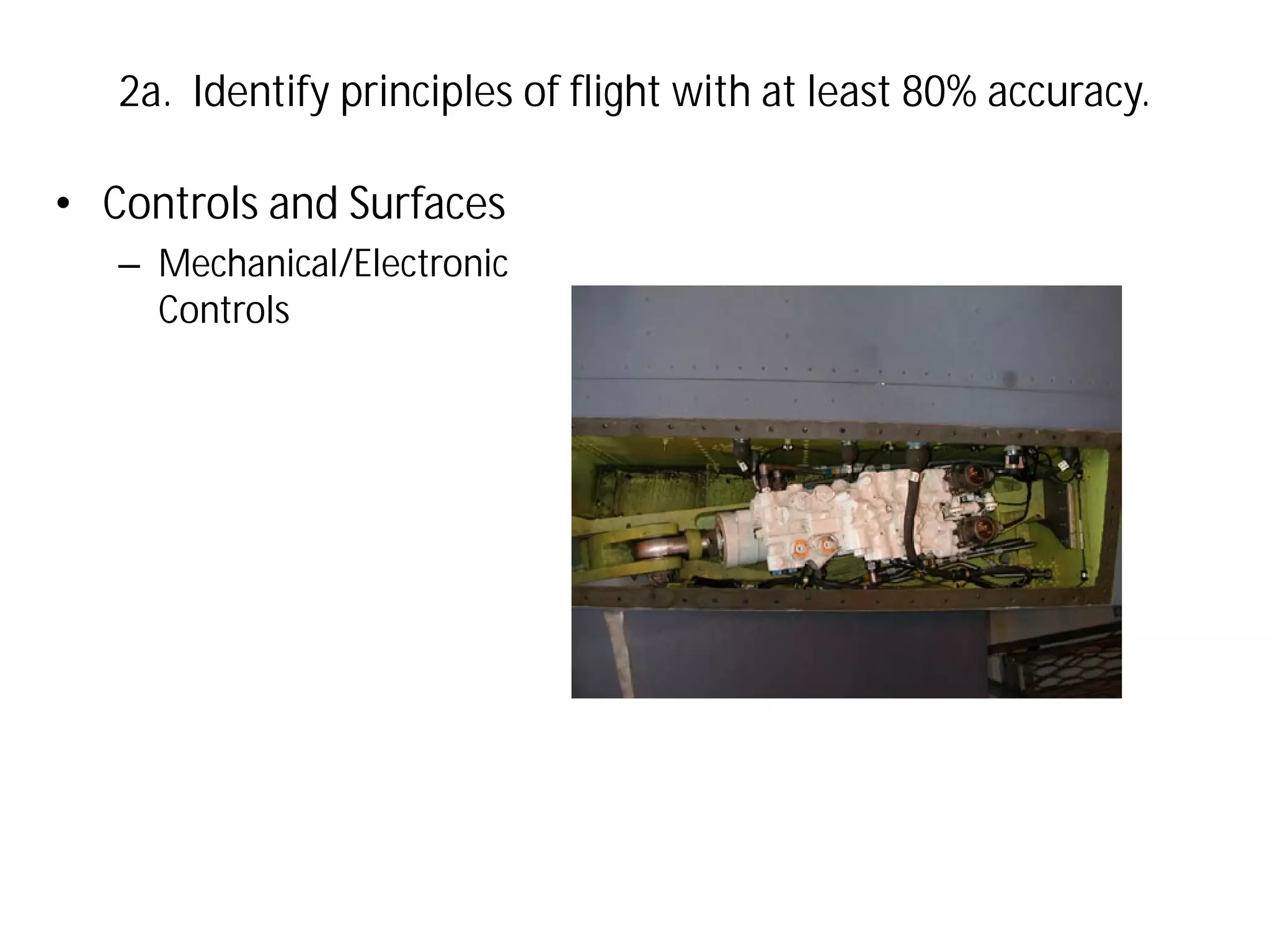
• Controls and Surfaces
– Mechanical/Electronic
Controls
2a. Identify principles of flight with at least 80% accuracy.

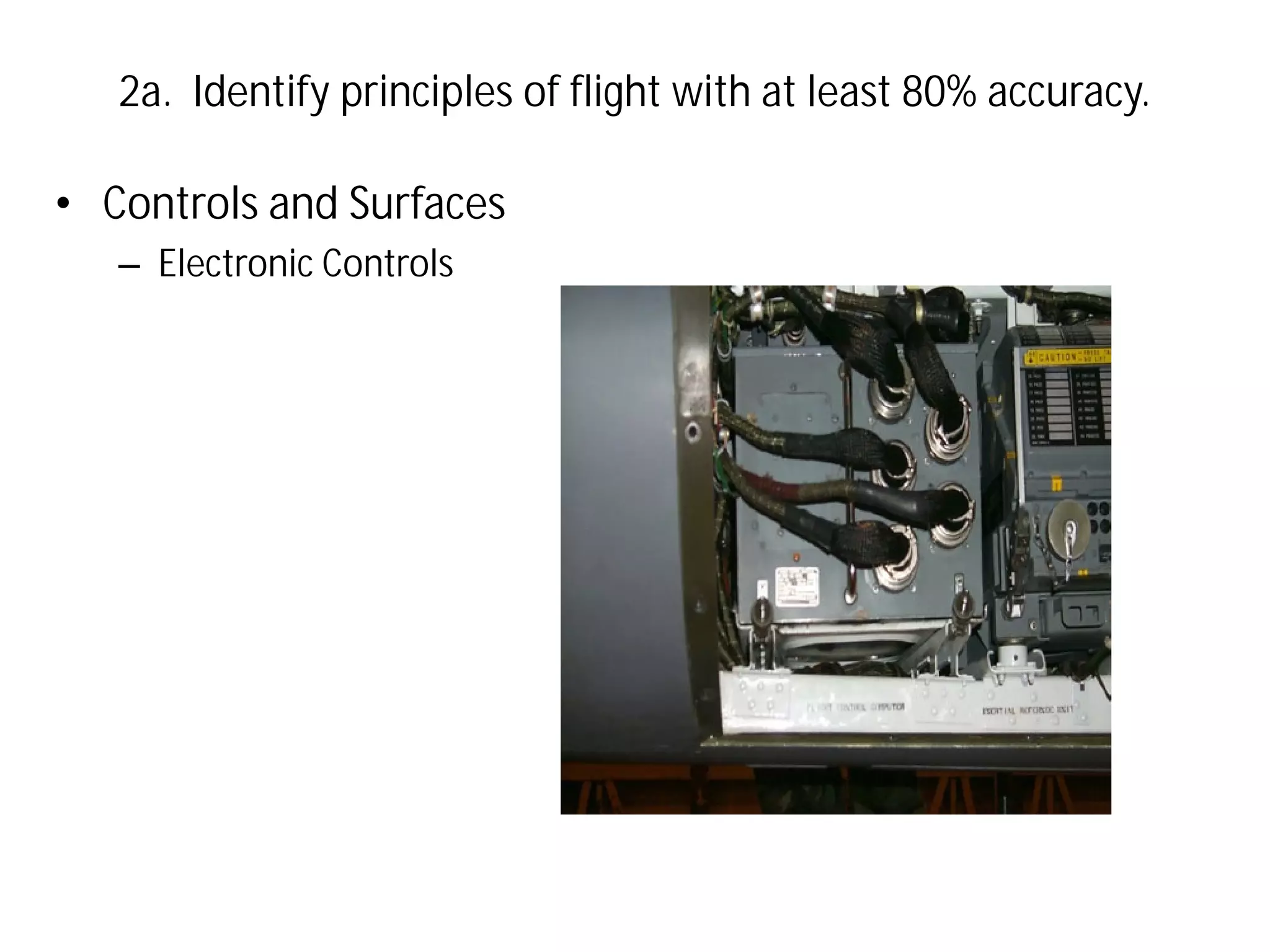
• Controls and Surfaces
– Electronic Controls
2a. Identify principles of flight with at least 80% accuracy.

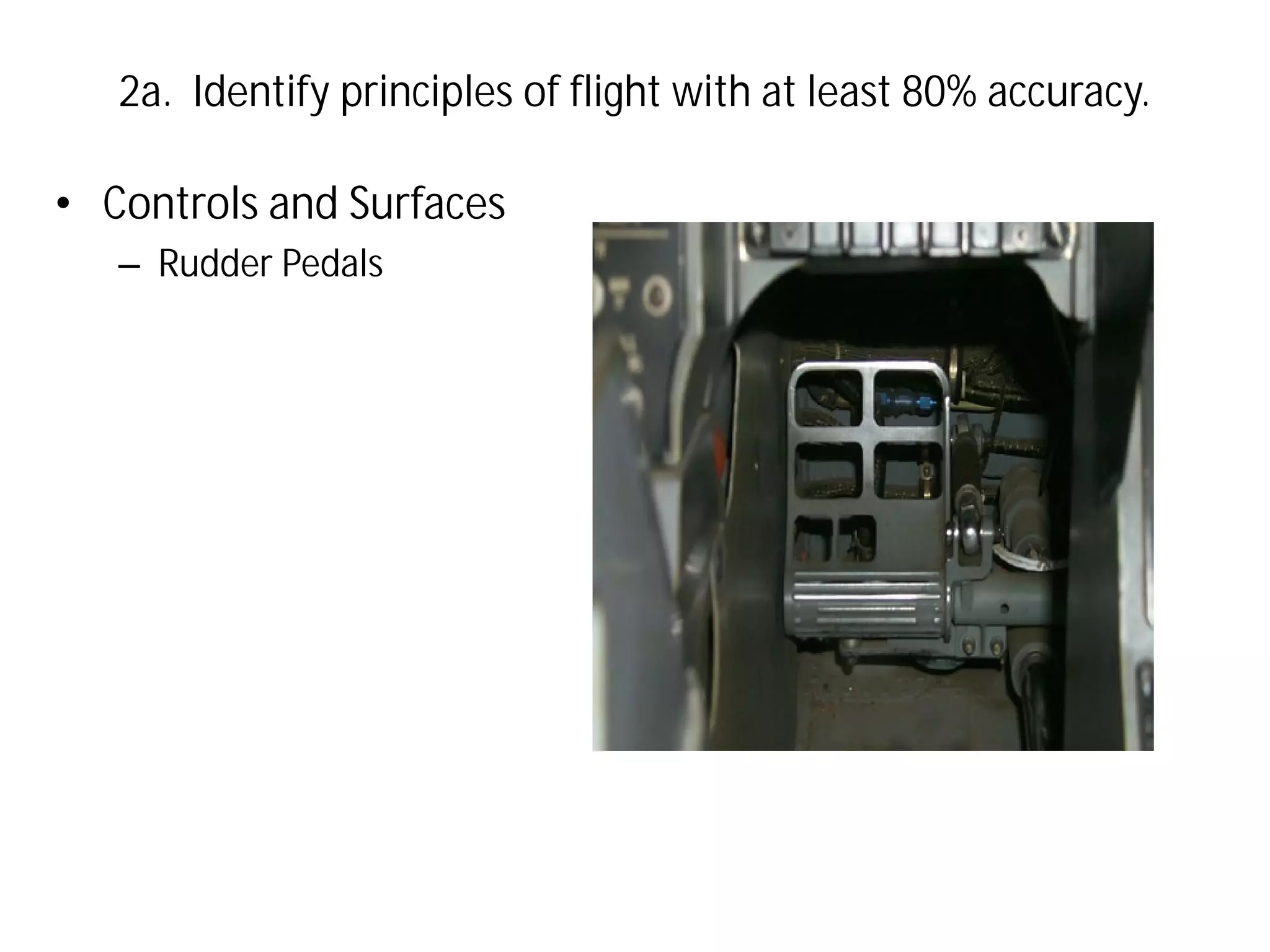
• Controls and Surfaces
– Rudder Pedals
2a. Identify principles of flight with at least 80% accuracy.

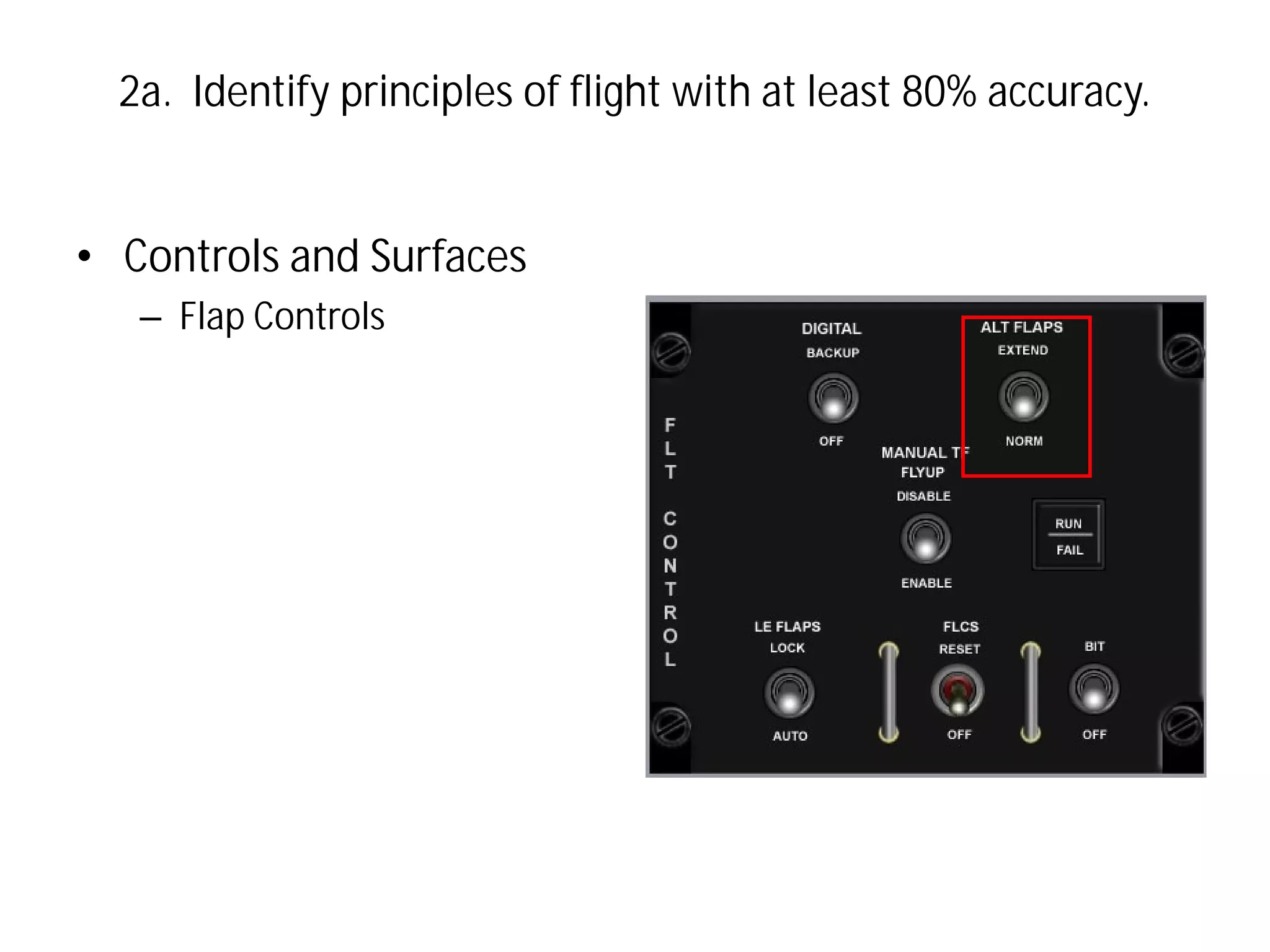
• Controls and Surfaces
– Flap Controls
2a. Identify principles of flight with at least 80% accuracy.

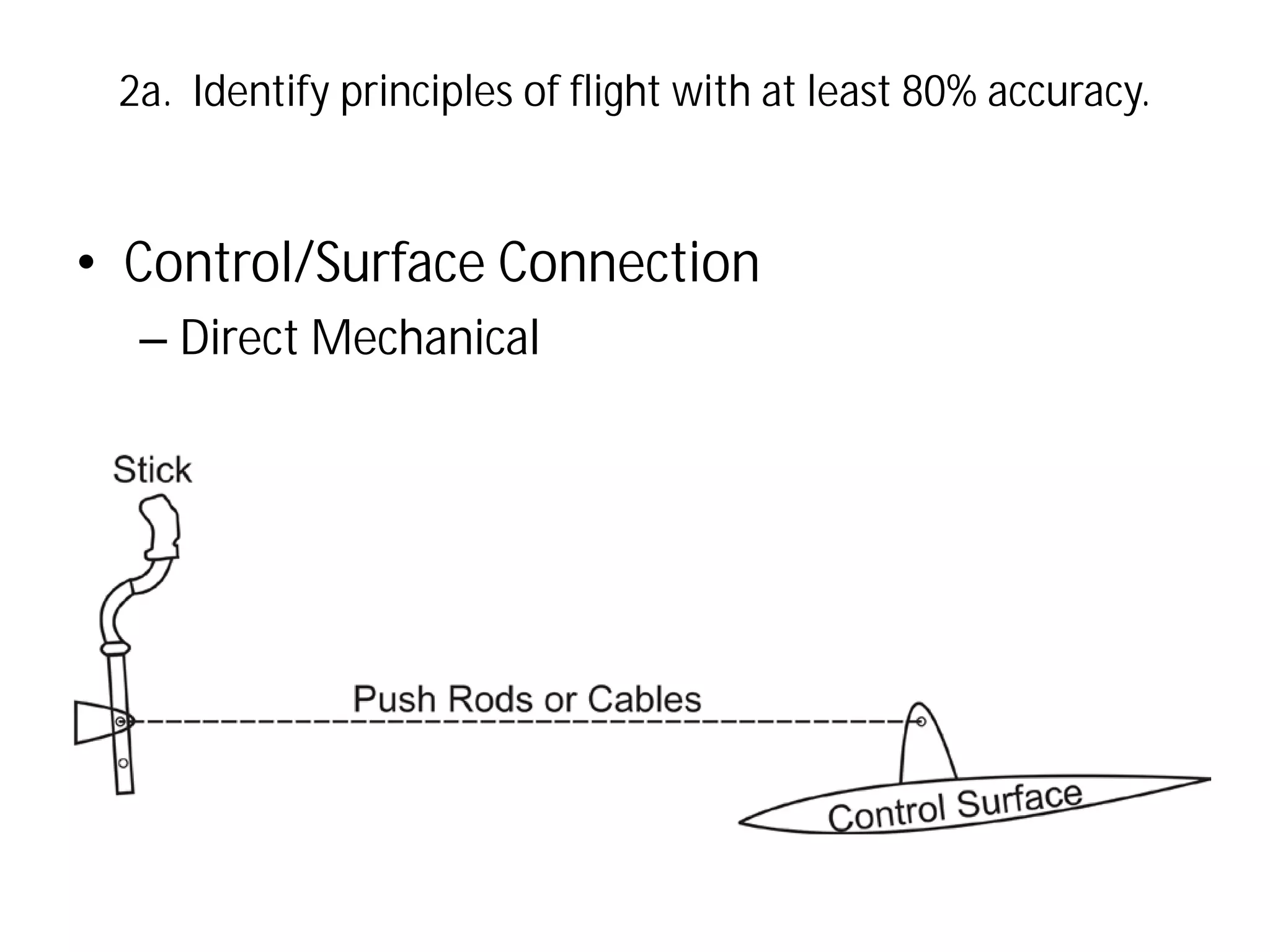
• Control/Surface Connection
– Direct Mechanical
2a. Identify principles of flight with at least 80% accuracy.

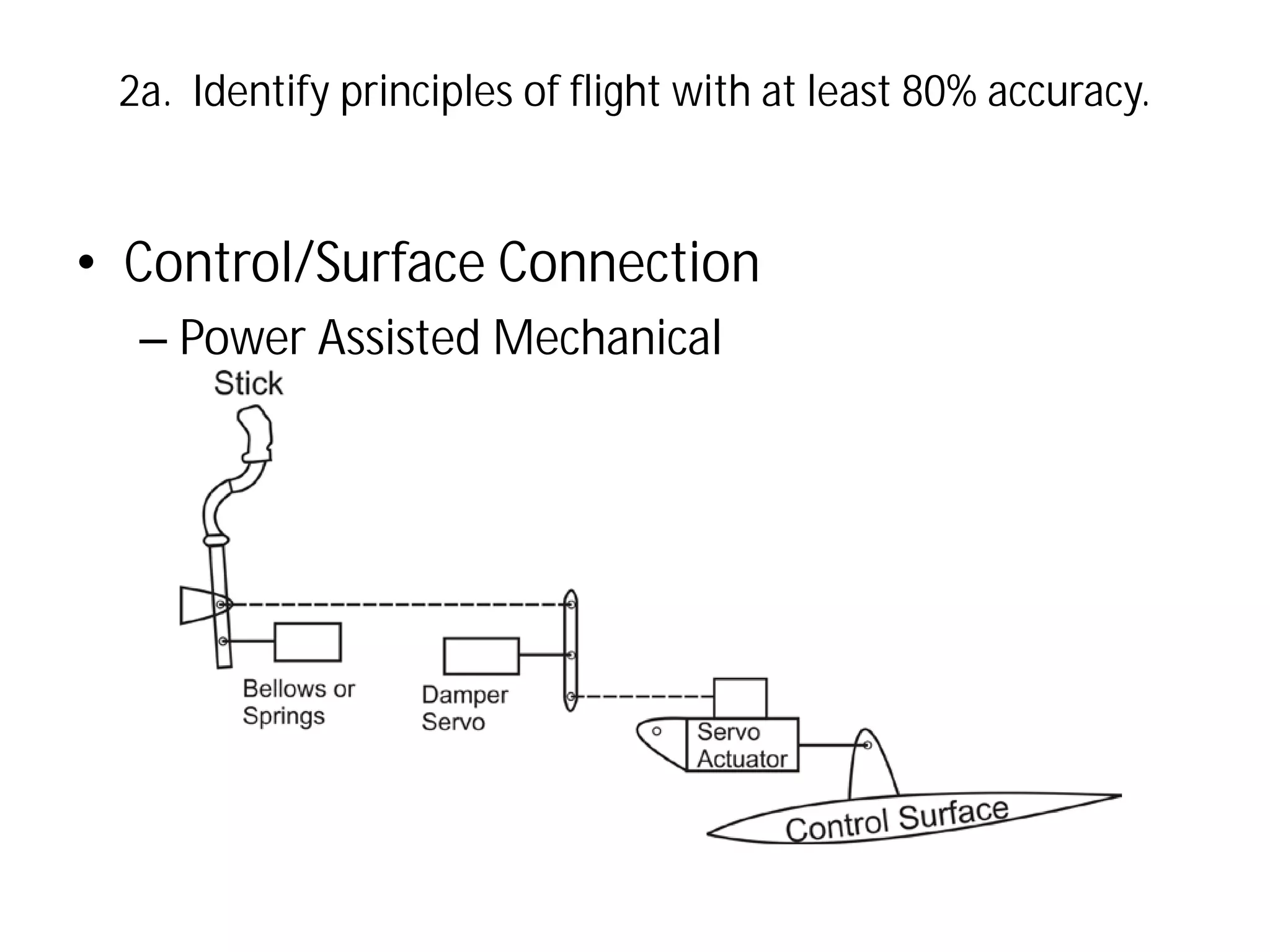
• Control/Surface Connection
– Power Assisted Mechanical
2a. Identify principles of flight with at least 80% accuracy.

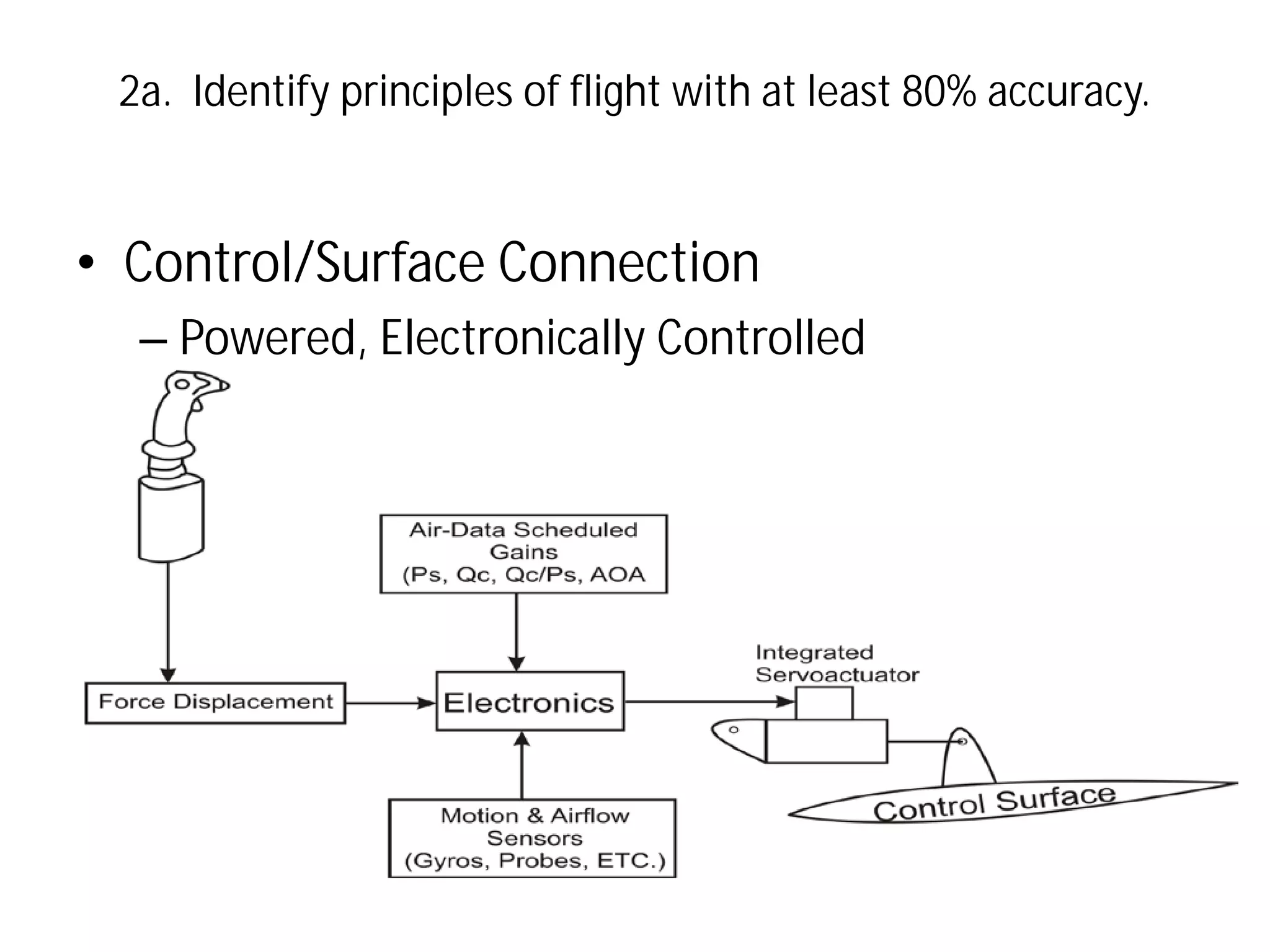
• Control/Surface Connection
– Powered, Electronically Controlled
2a. Identify principles of flight with at least 80% accuracy.

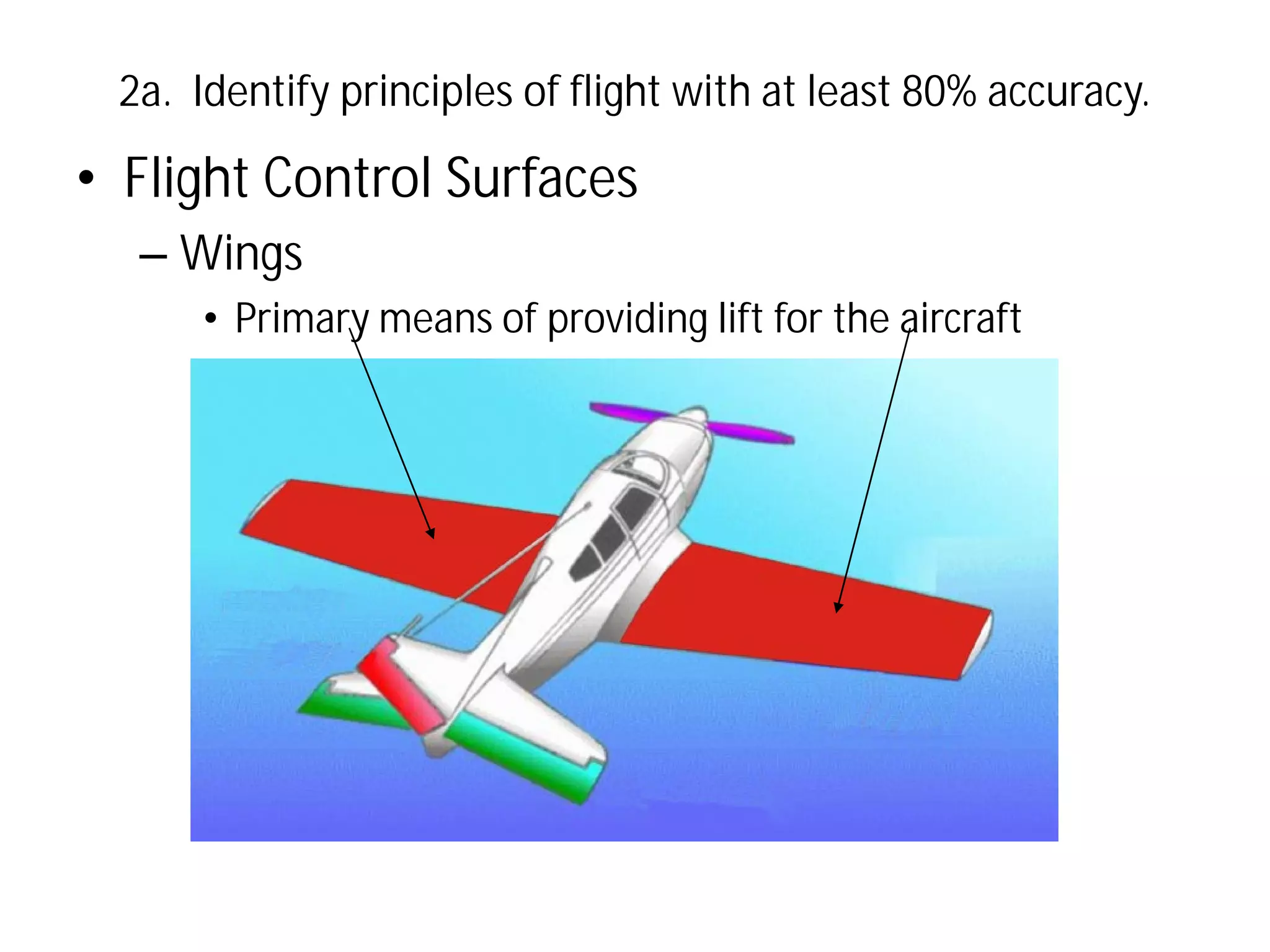
• Flight Control Surfaces
– Wings
• Primary means of providing lift for the aircraft
2a. Identify principles of flight with at least 80% accuracy.

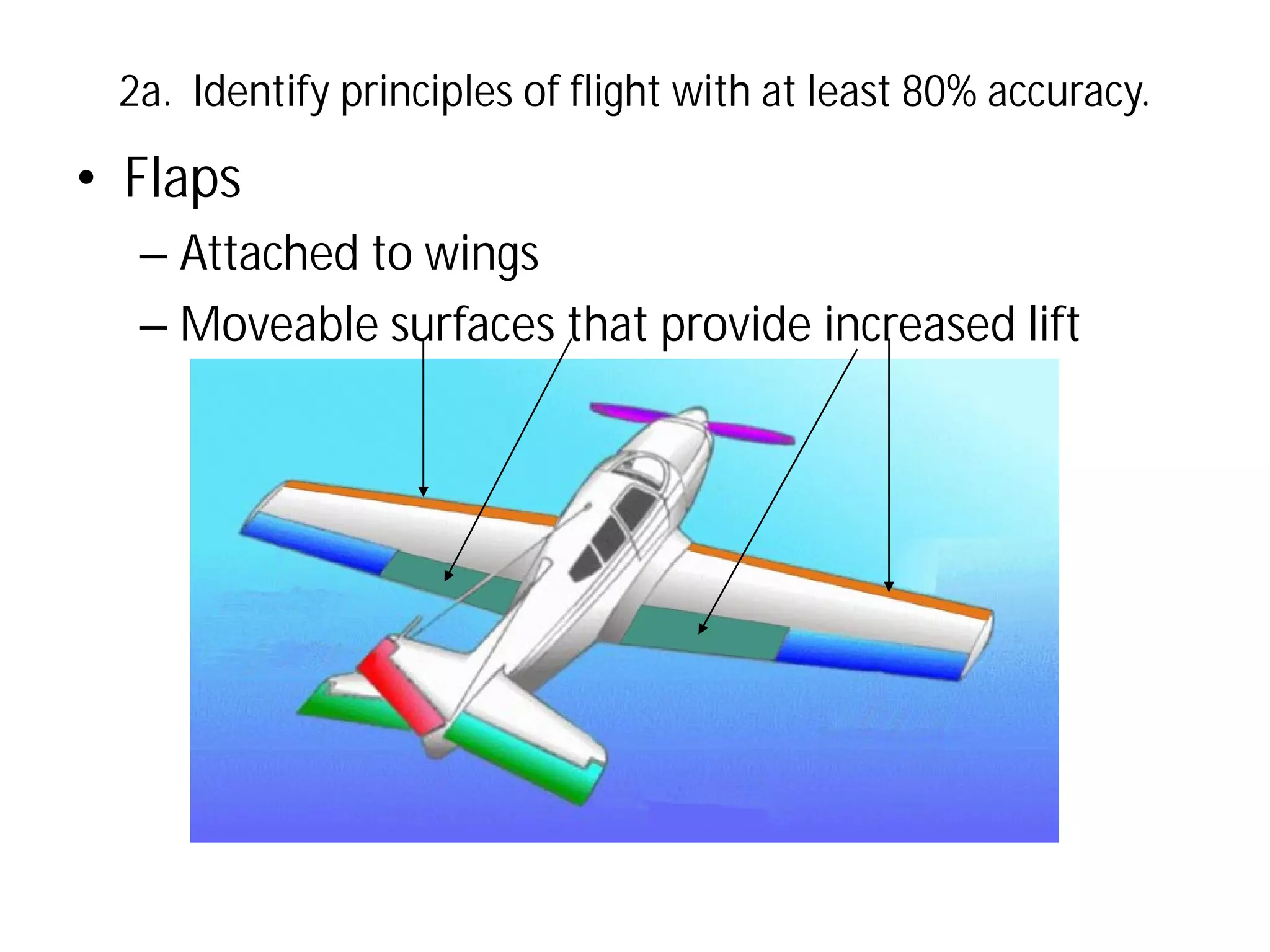
• Flaps
– Attached to wings
– Moveable surfaces that provide increased lift
2a. Identify principles of flight with at least 80% accuracy.

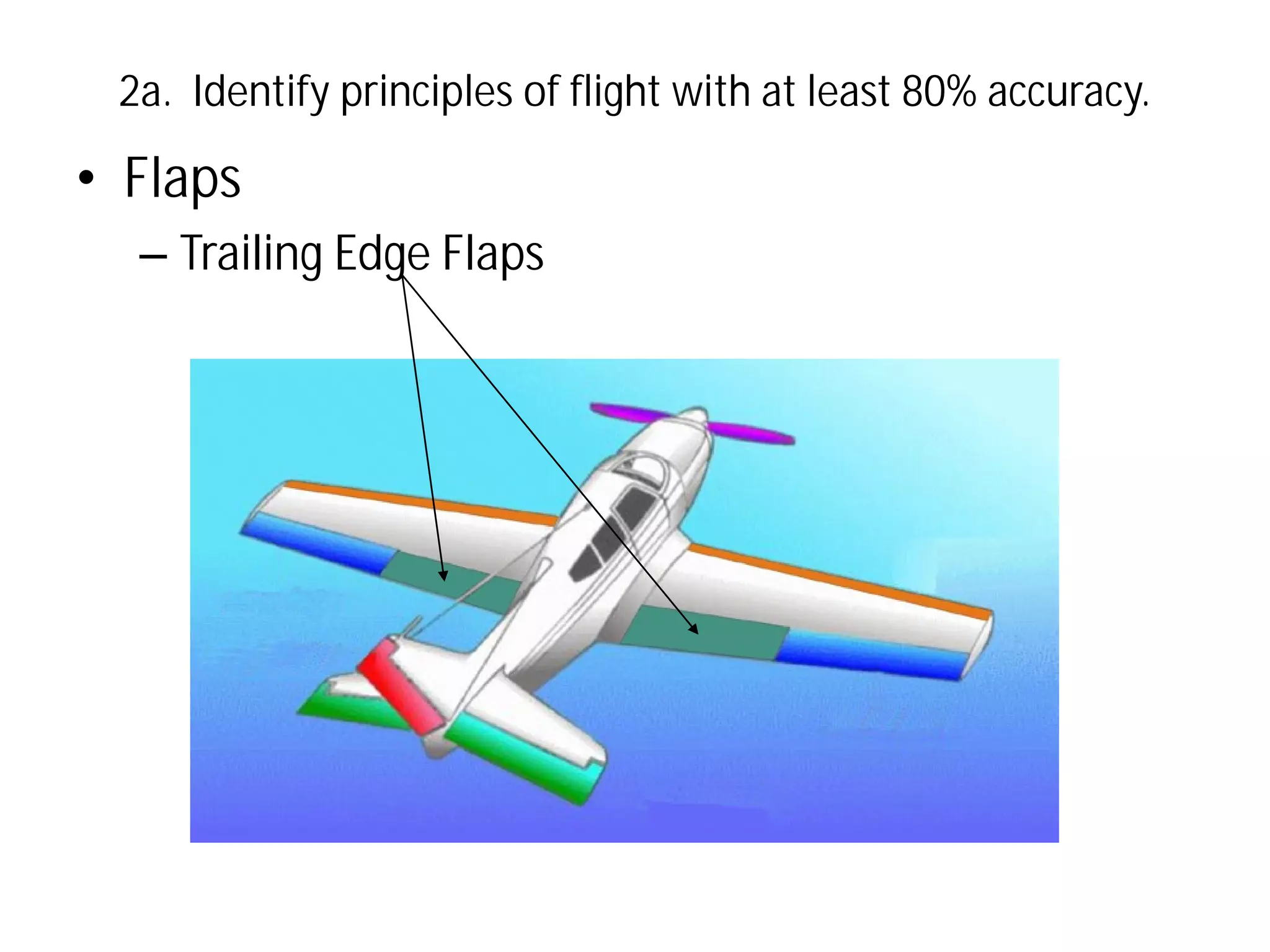
• Flaps
– Trailing Edge Flaps
2a. Identify principles of flight with at least 80% accuracy.

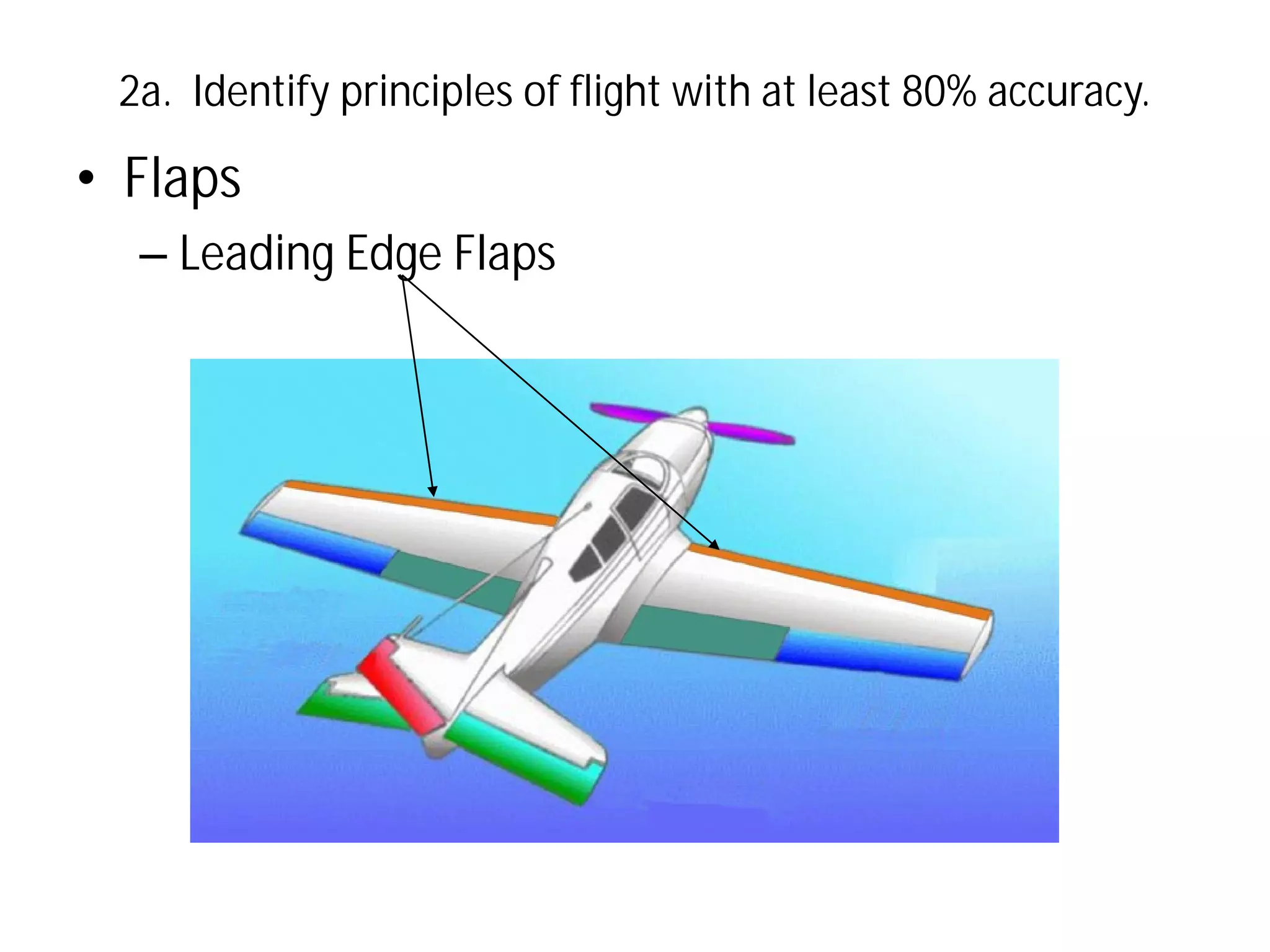
• Flaps
– Leading Edge Flaps
2a. Identify principles of flight with at least 80% accuracy.

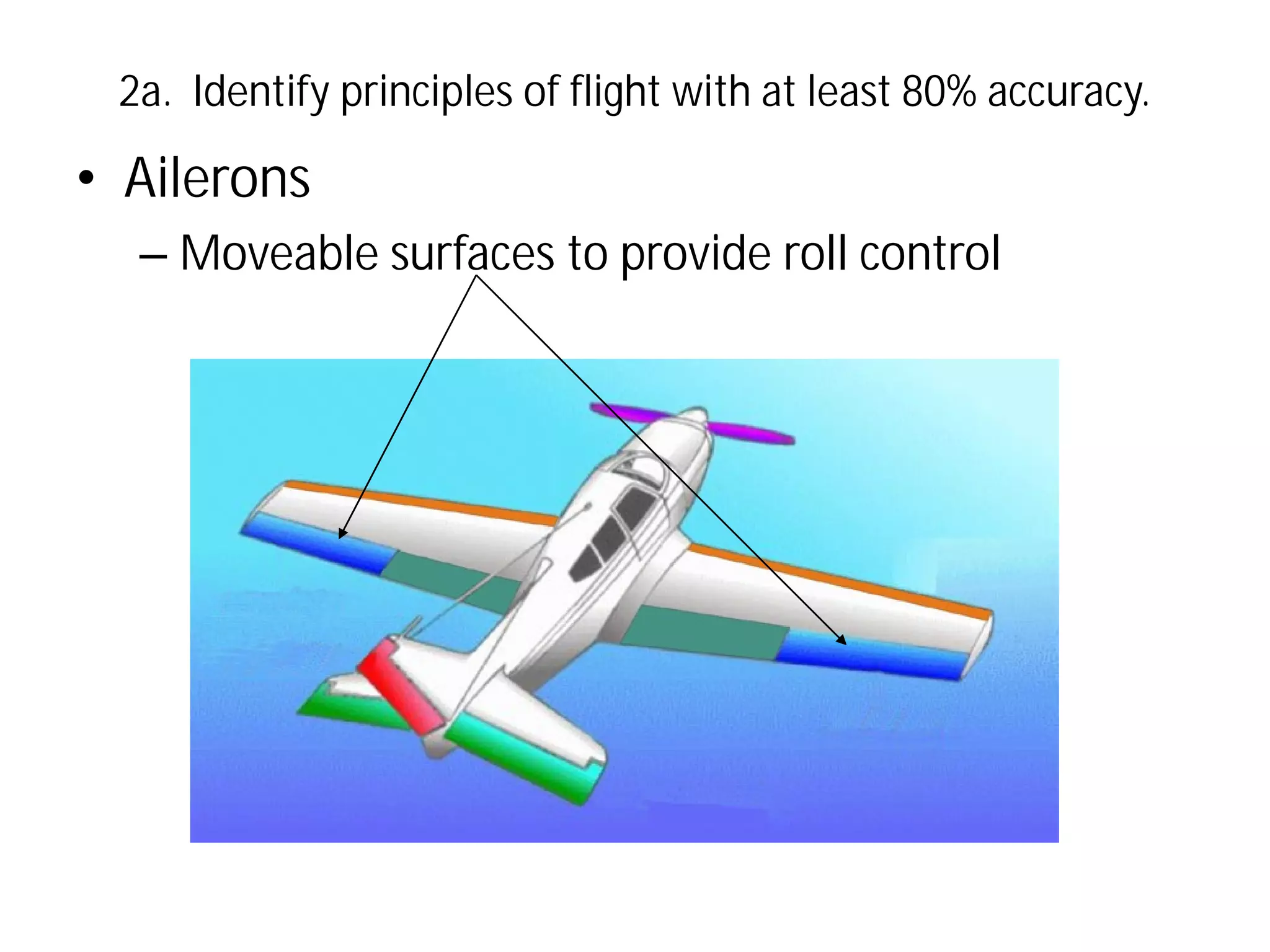
• Ailerons
– Moveable surfaces to provide roll control
2a. Identify principles of flight with at least 80% accuracy.

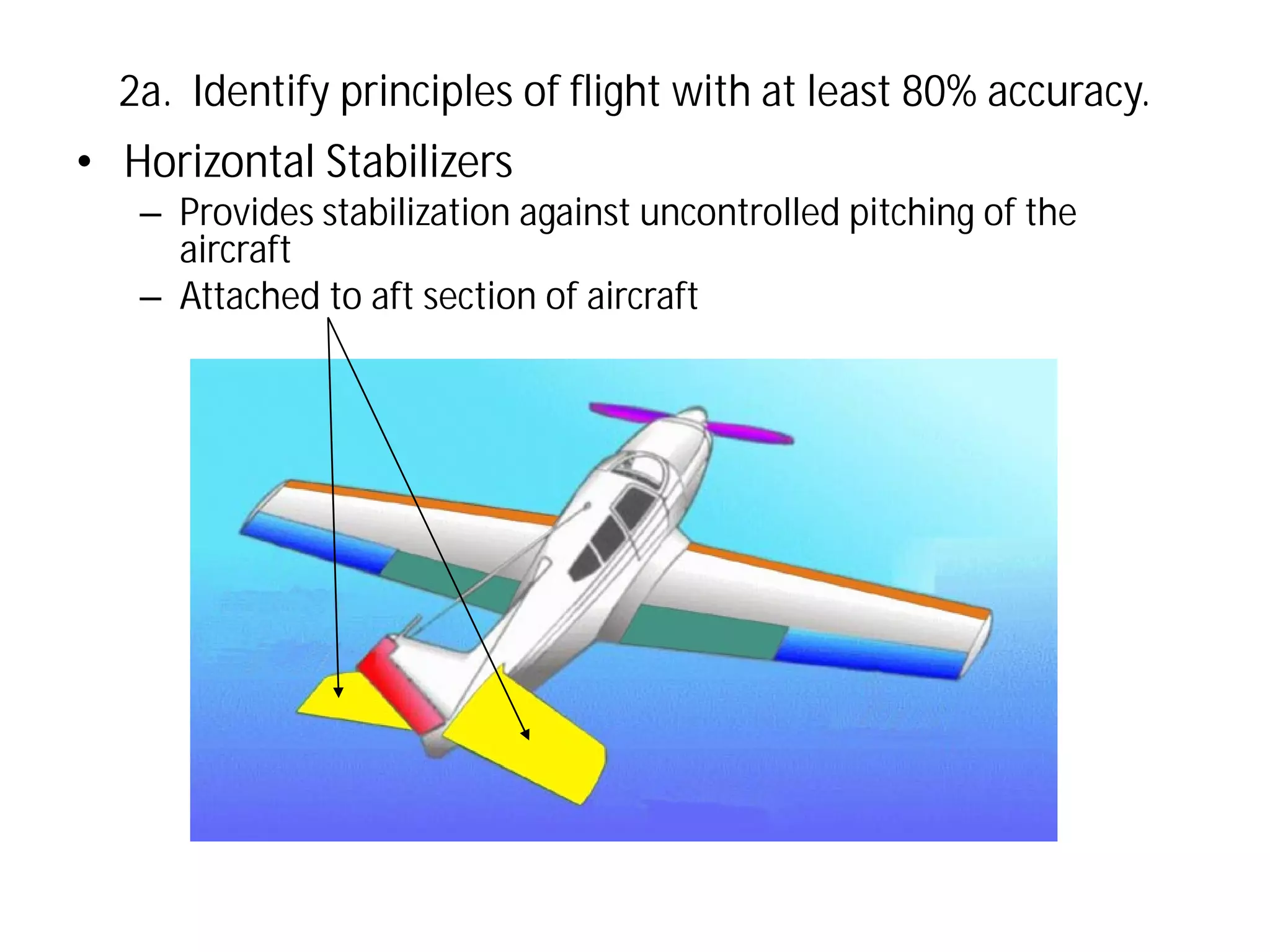
• Horizontal Stabilizers
– Provides stabilization against uncontrolled pitching of the
aircraft
– Attached to aft section of aircraft
2a. Identify principles of flight with at least 80% accuracy.

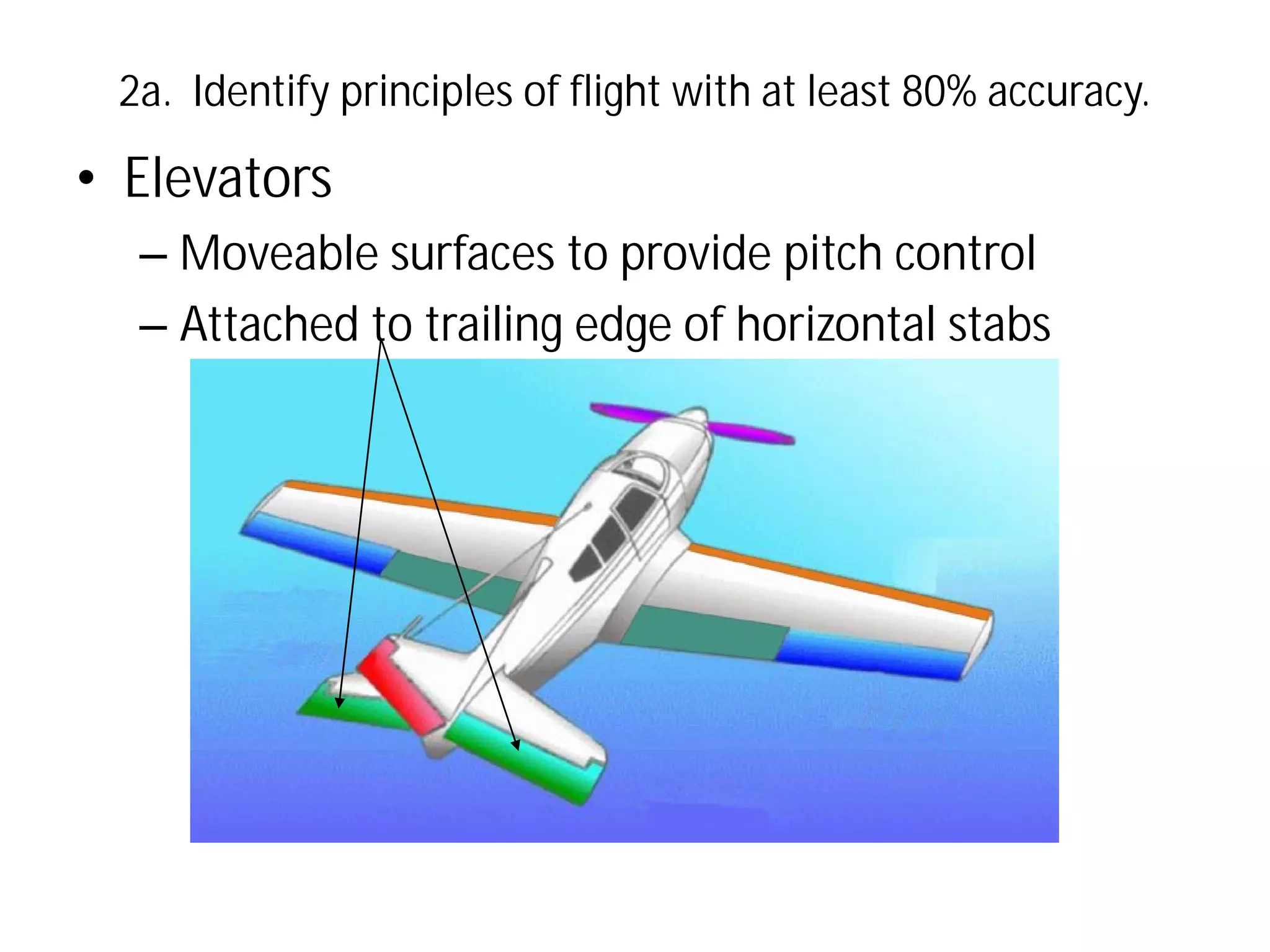
• Elevators
– Moveable surfaces to provide pitch control
– Attached to trailing edge of horizontal stabs
2a. Identify principles of flight with at least 80% accuracy.

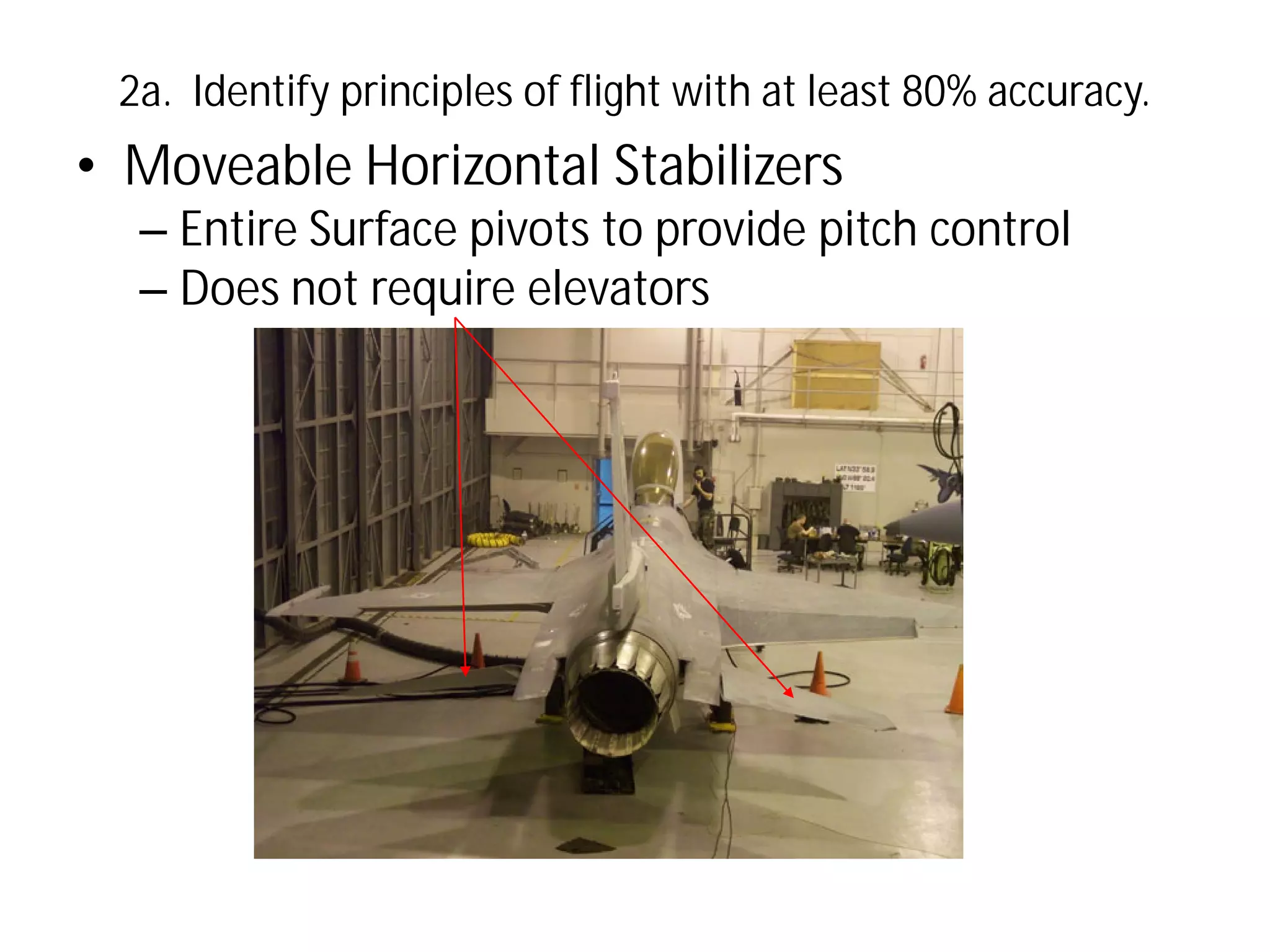
• Moveable Horizontal Stabilizers
– Entire Surface pivots to provide pitch control
– Does not require elevators
2a. Identify principles of flight with at least 80% accuracy.

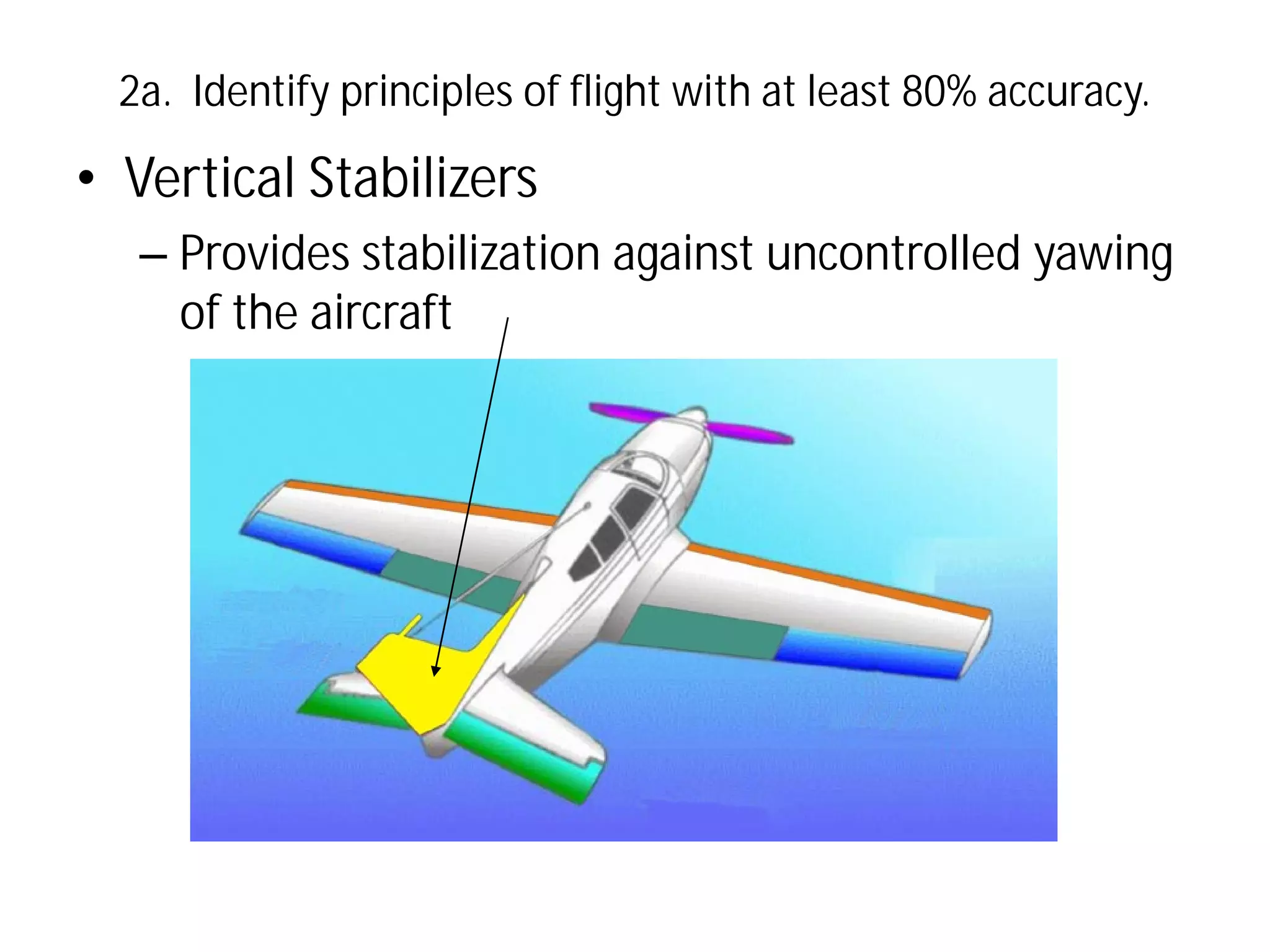
• Vertical Stabilizers
– Provides stabilization against uncontrolled yawing
of the aircraft
2a. Identify principles of flight with at least 80% accuracy.

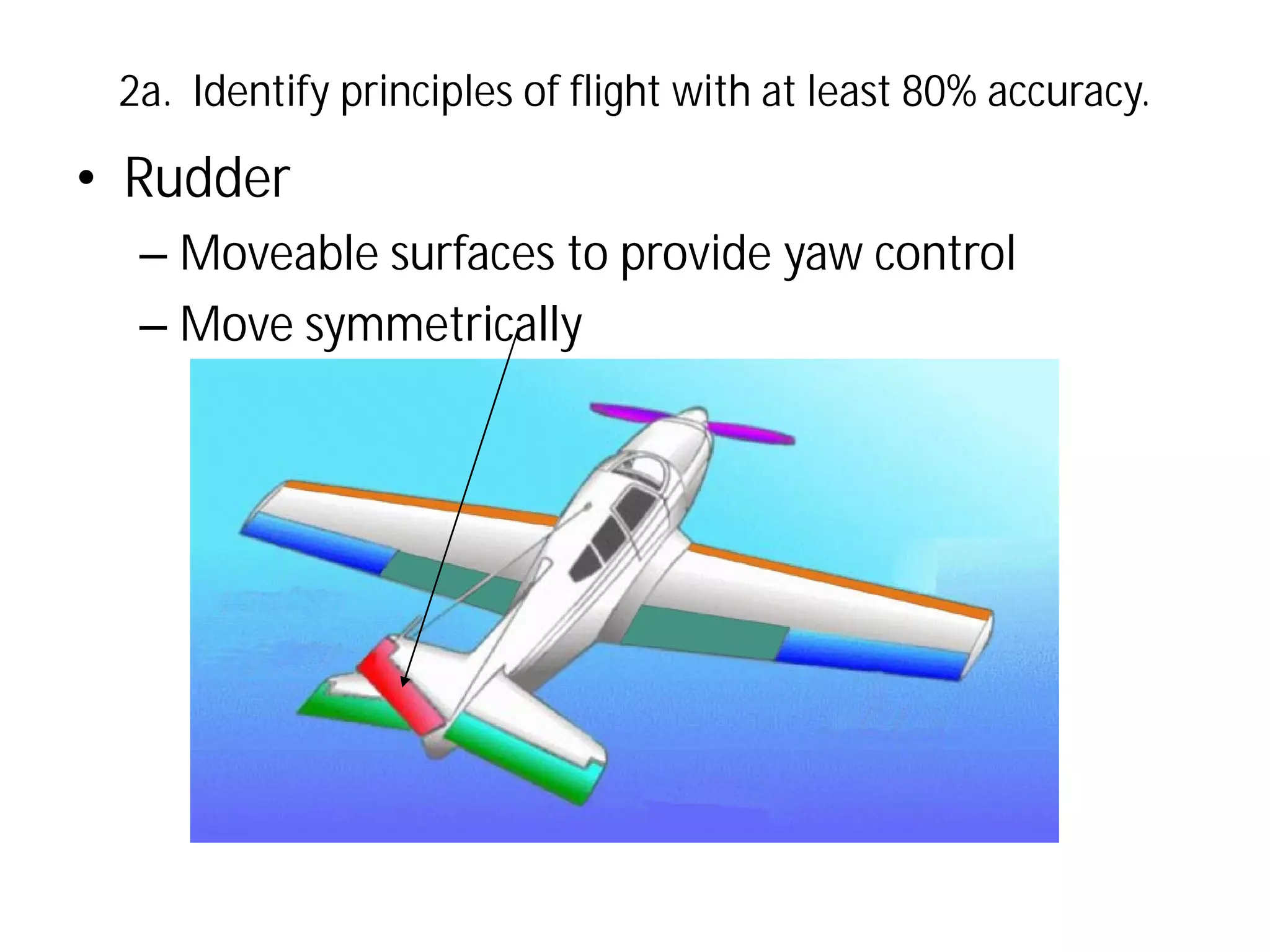
• Rudder
– Moveable surfaces to provide yaw control
– Move symmetrically
2a. Identify principles of flight with at least 80%
accuracy.

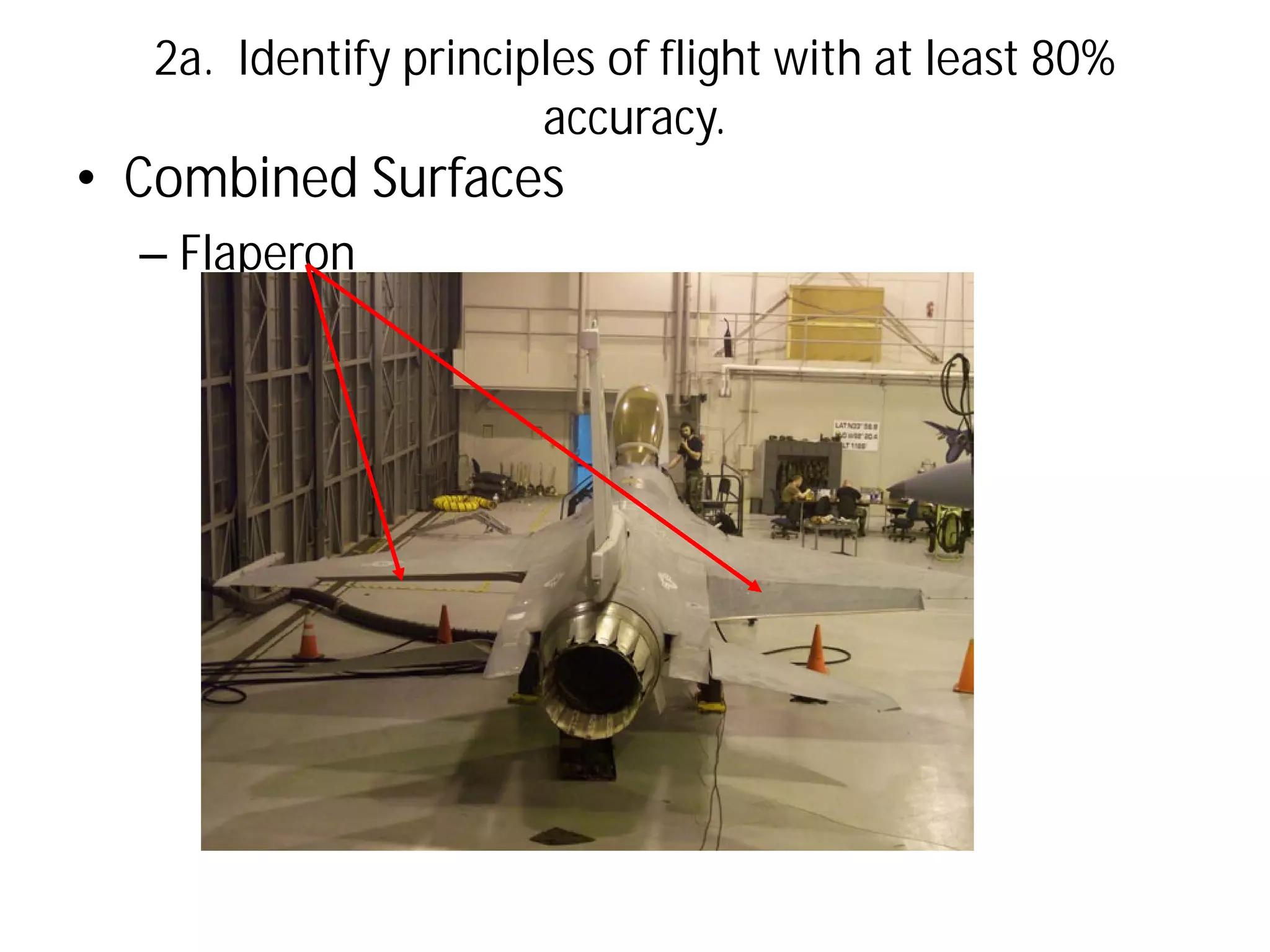
• Combined Surfaces
– Flaperon
2a. Identify principles of flight with at least 80%
accuracy.

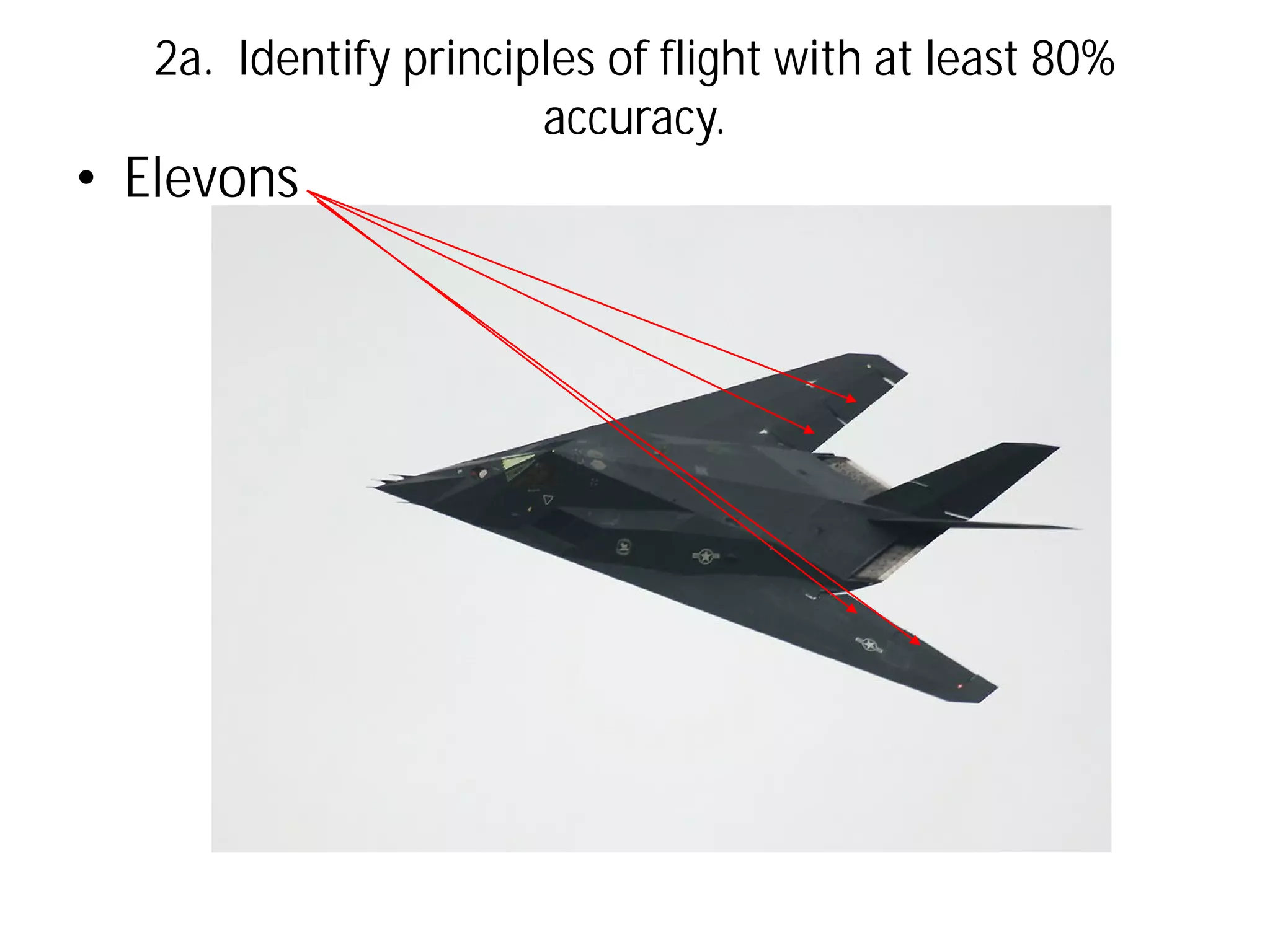
• Elevons
2a. Identify principles of flight with at least 80%
accuracy.

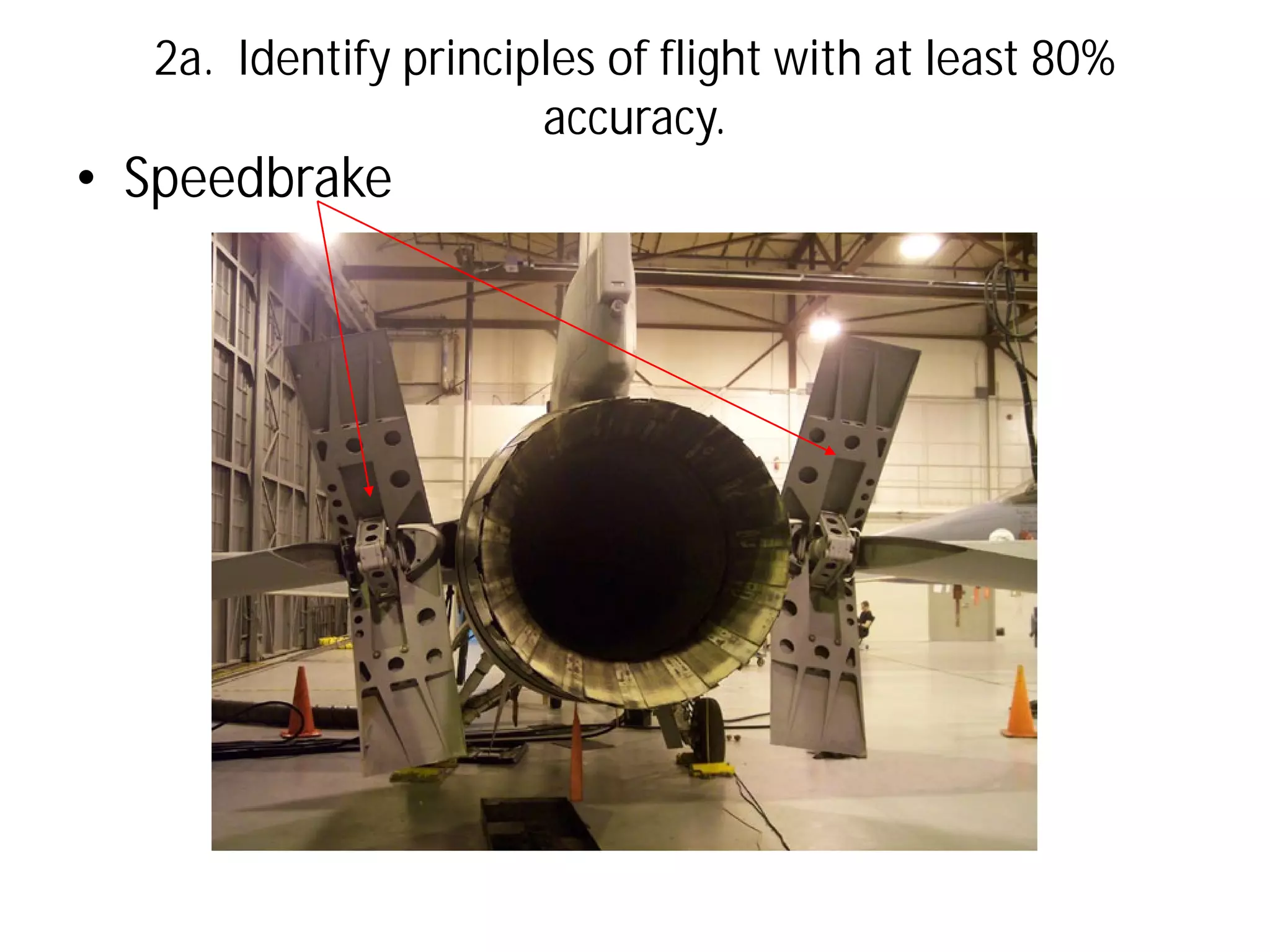
• Speedbrake
2a. Identify principles of flight with at least 80%
accuracy.

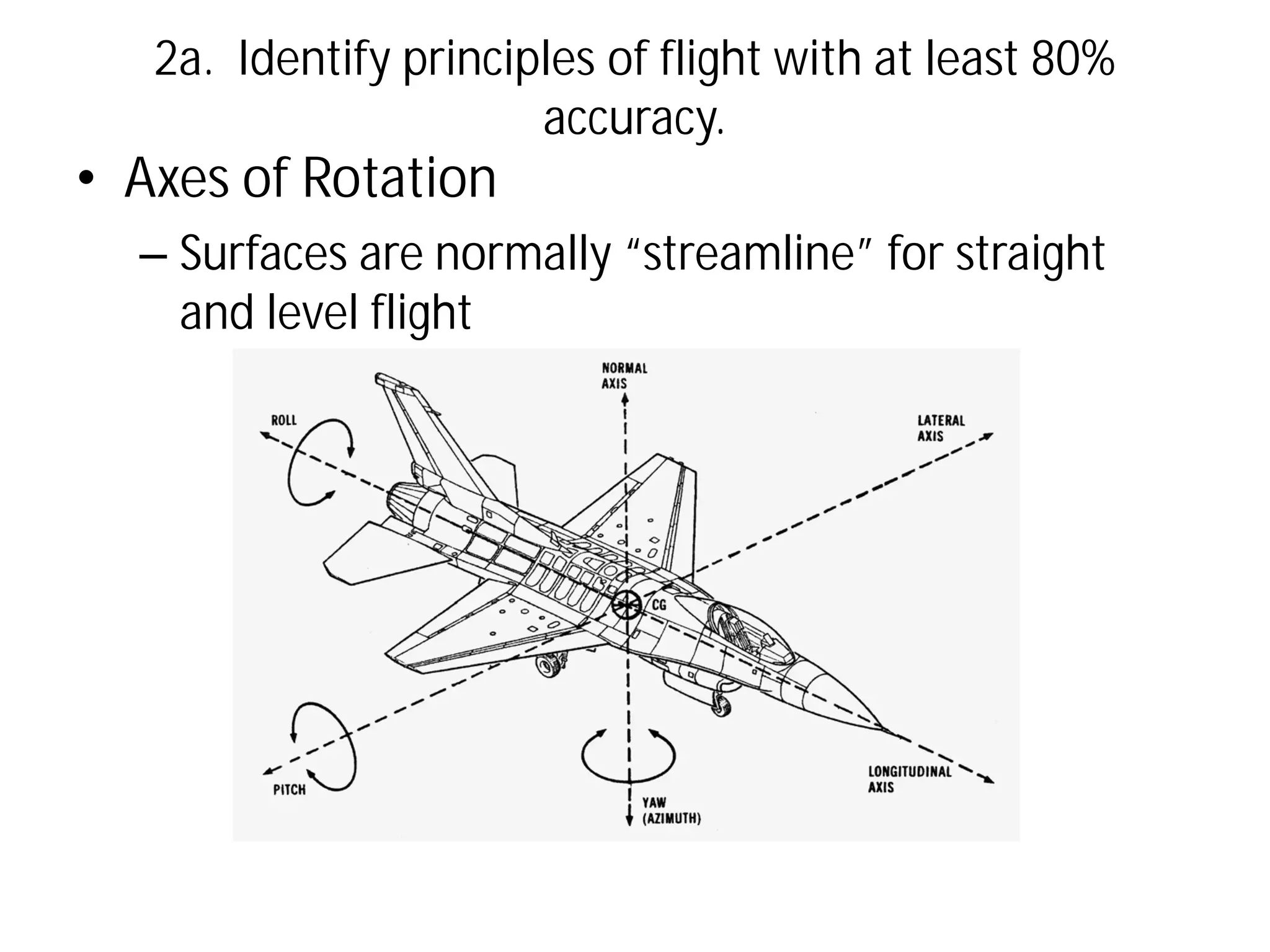
• Axes of Rotation

– Surfaces are normally “streamline” for straight
and level flight
2a. Identify principles of flight with at least 80%
accuracy.

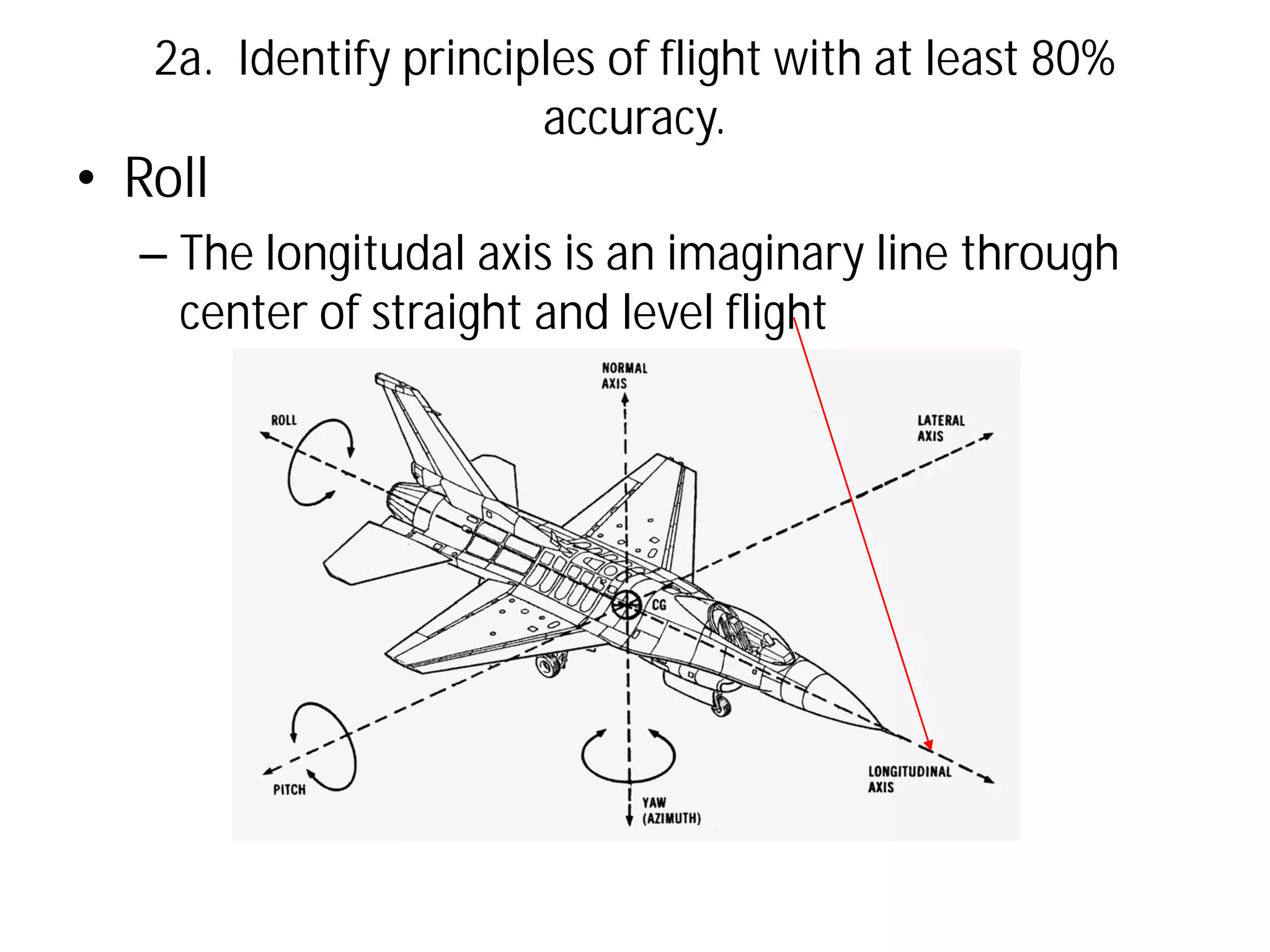
• Roll

– The longitudal axis is an imaginary line through
center of straight and level flight
2a. Identify principles of flight with at least 80%
accuracy.

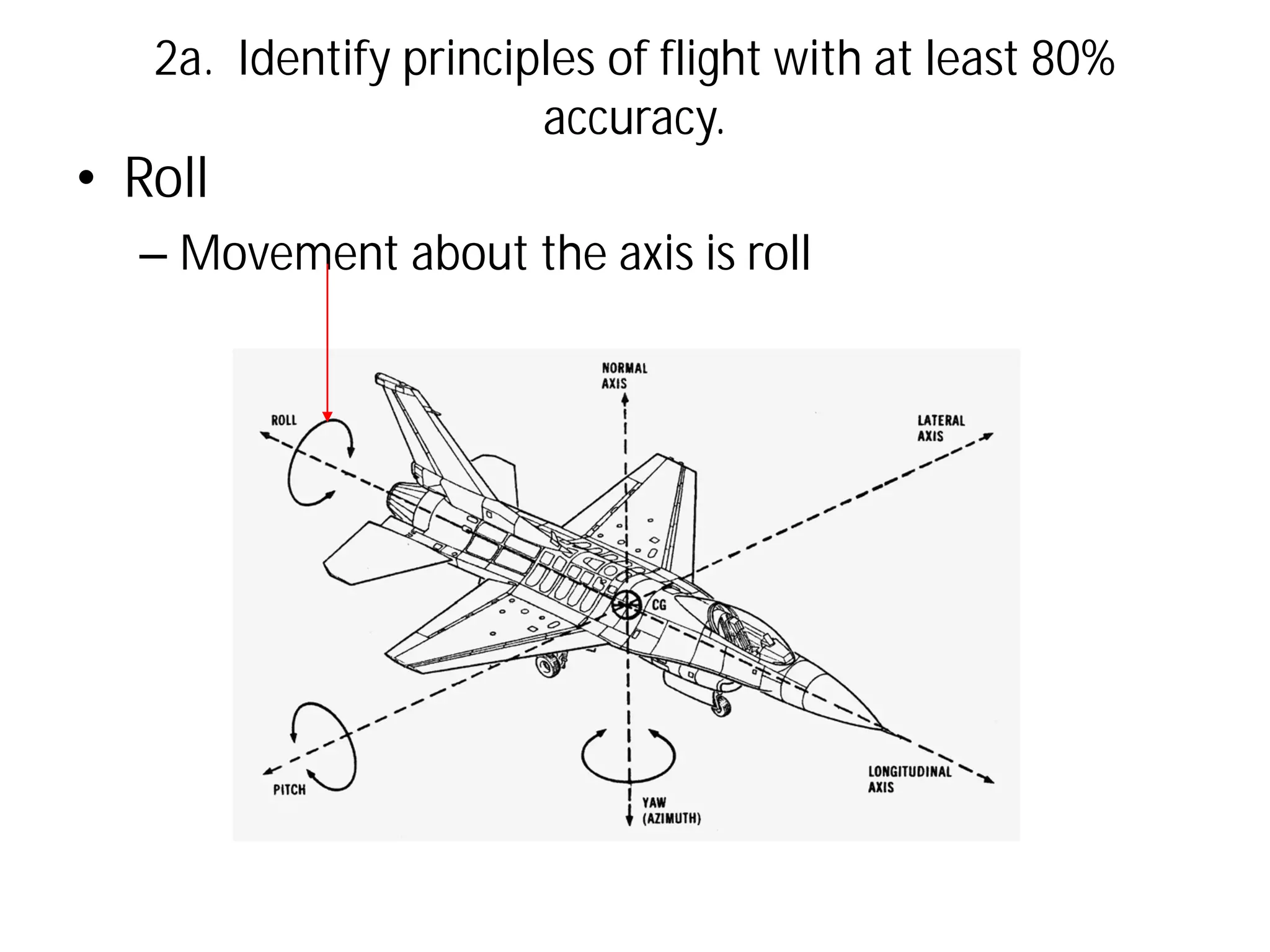
• Roll

– Movement about the axis is roll
2a. Identify principles of flight with at least 80%
accuracy.

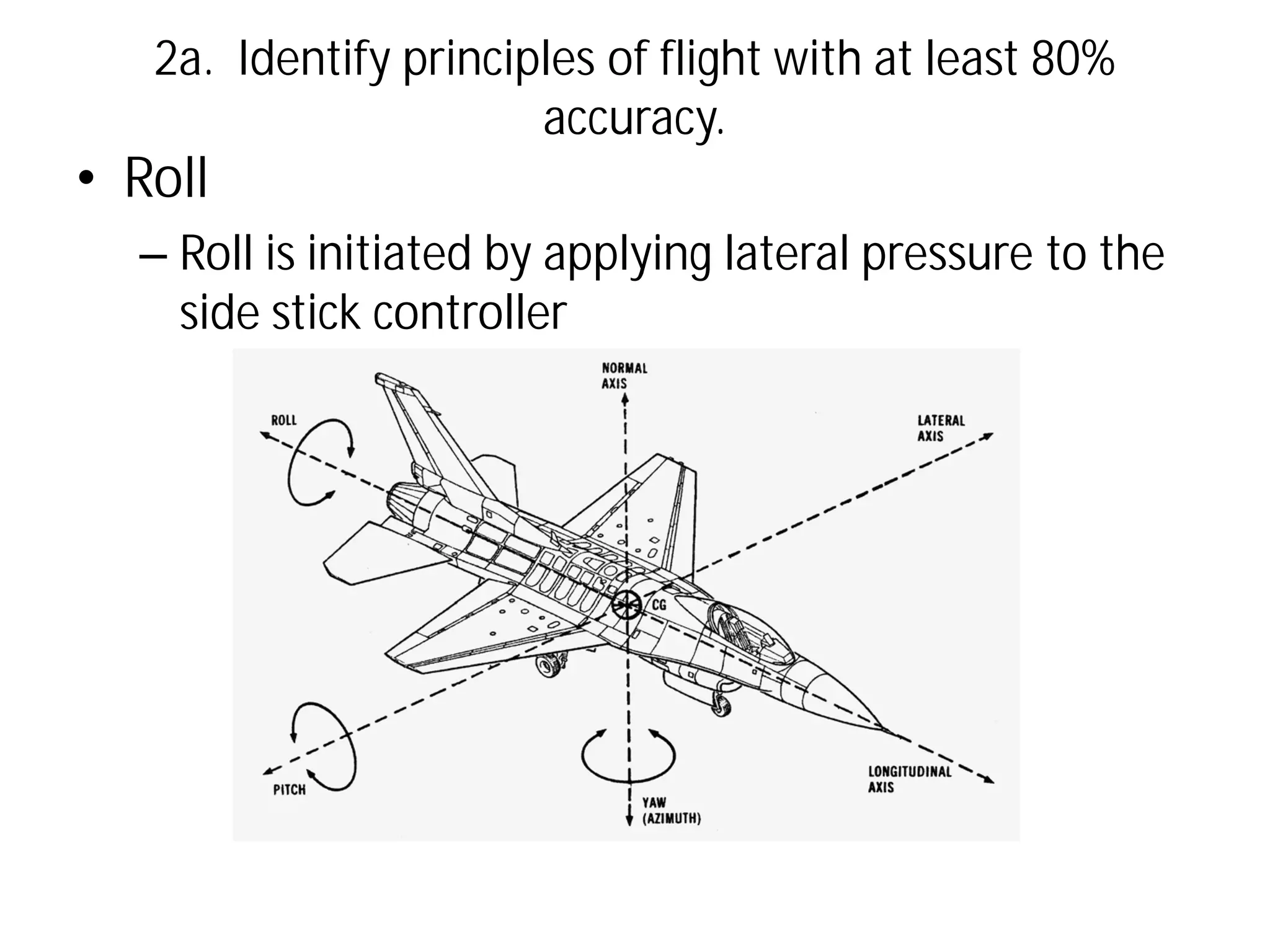
• Roll

– Roll is initiated by applying lateral pressure to the
side stick controller
2a. Identify principles of flight with at least 80%
accuracy.

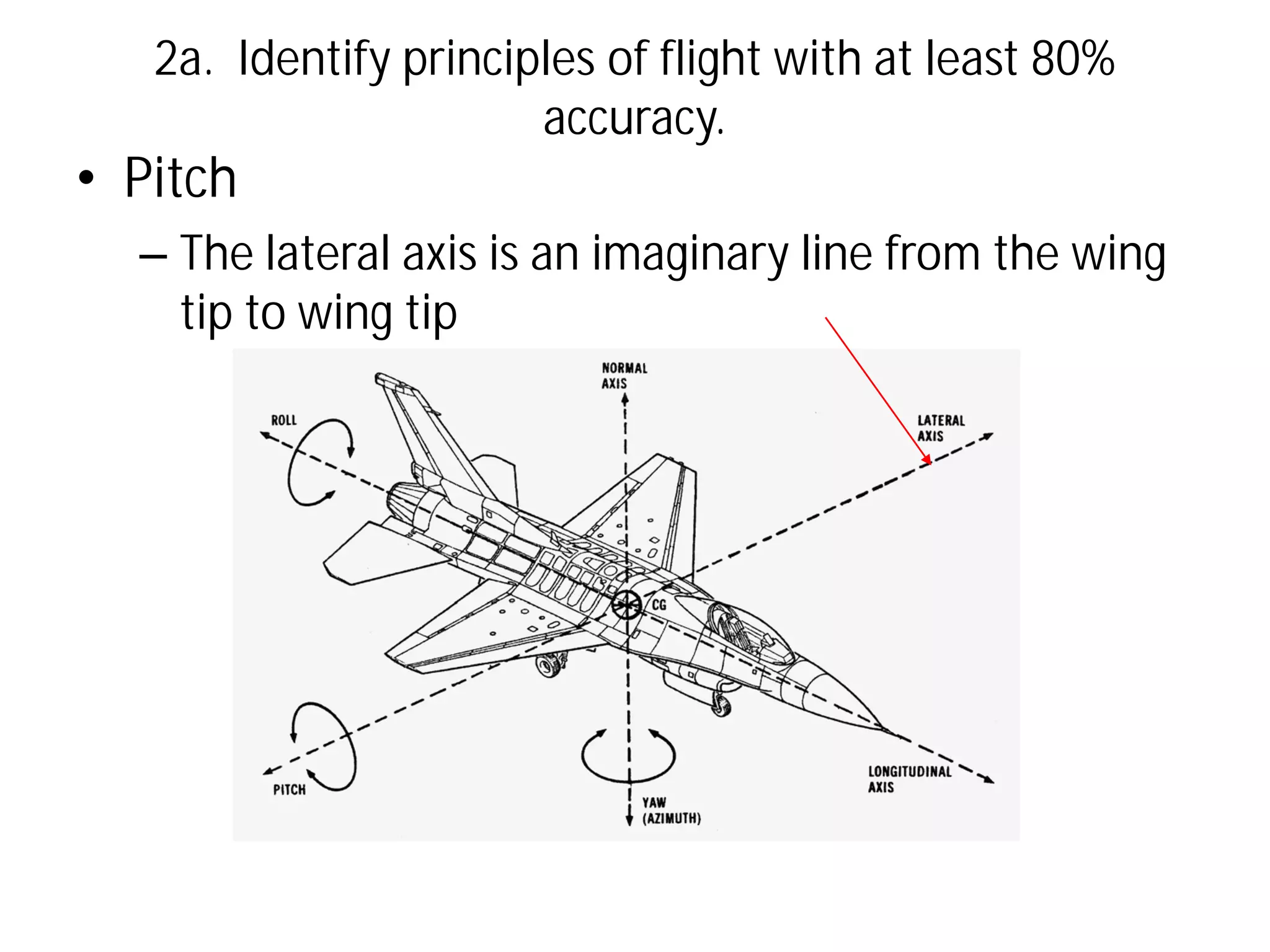
• Pitch

– The lateral axis is an imaginary line from the wing
tip to wing tip
2a. Identify principles of flight with at least 80%
accuracy.

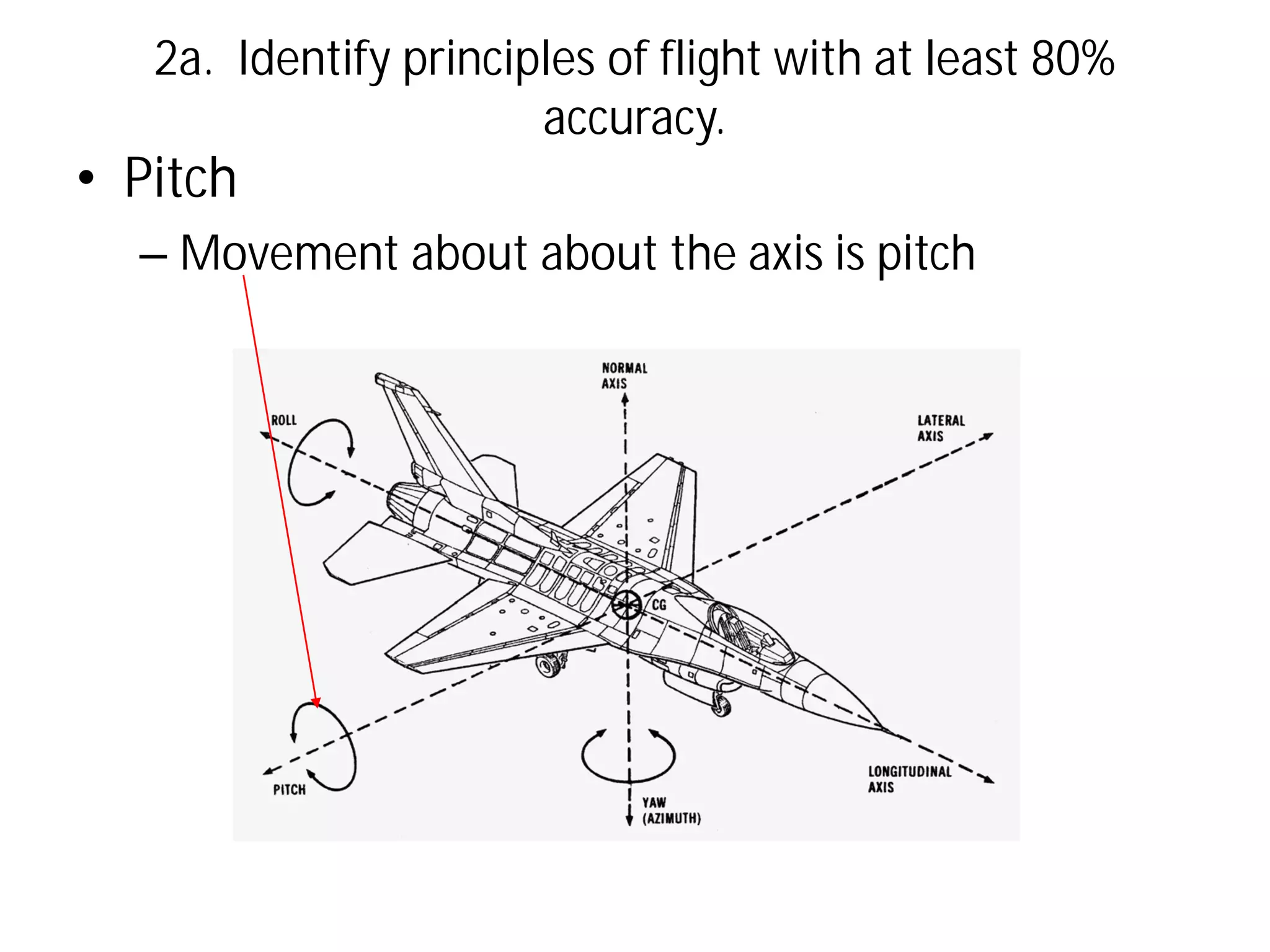
• Pitch

– Movement about about the axis is pitch
2a. Identify principles of flight with at least 80%
accuracy.

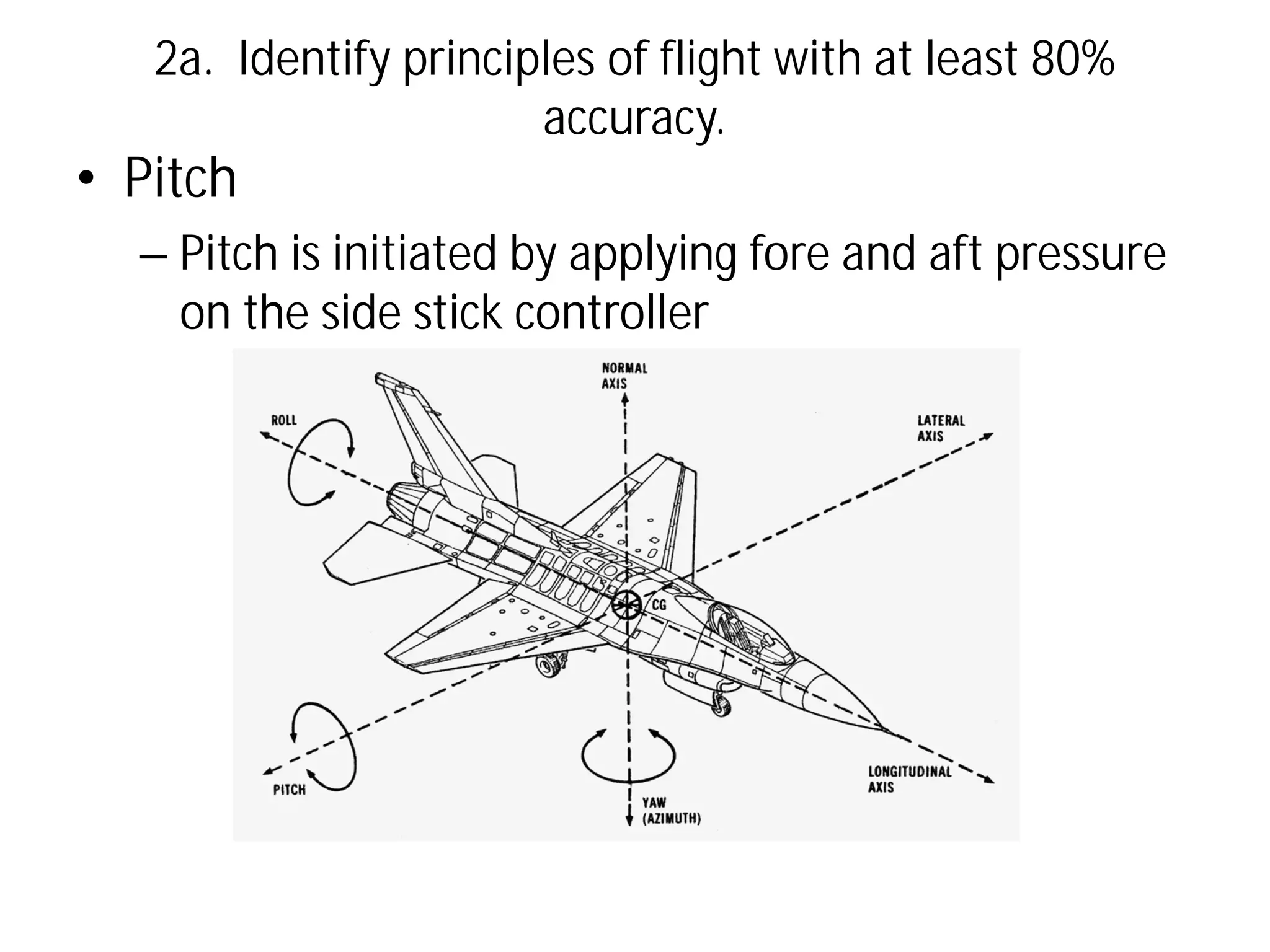
• Pitch

– Pitch is initiated by applying fore and aft pressure
on the side stick controller
2a. Identify principles of flight with at least 80%
accuracy.

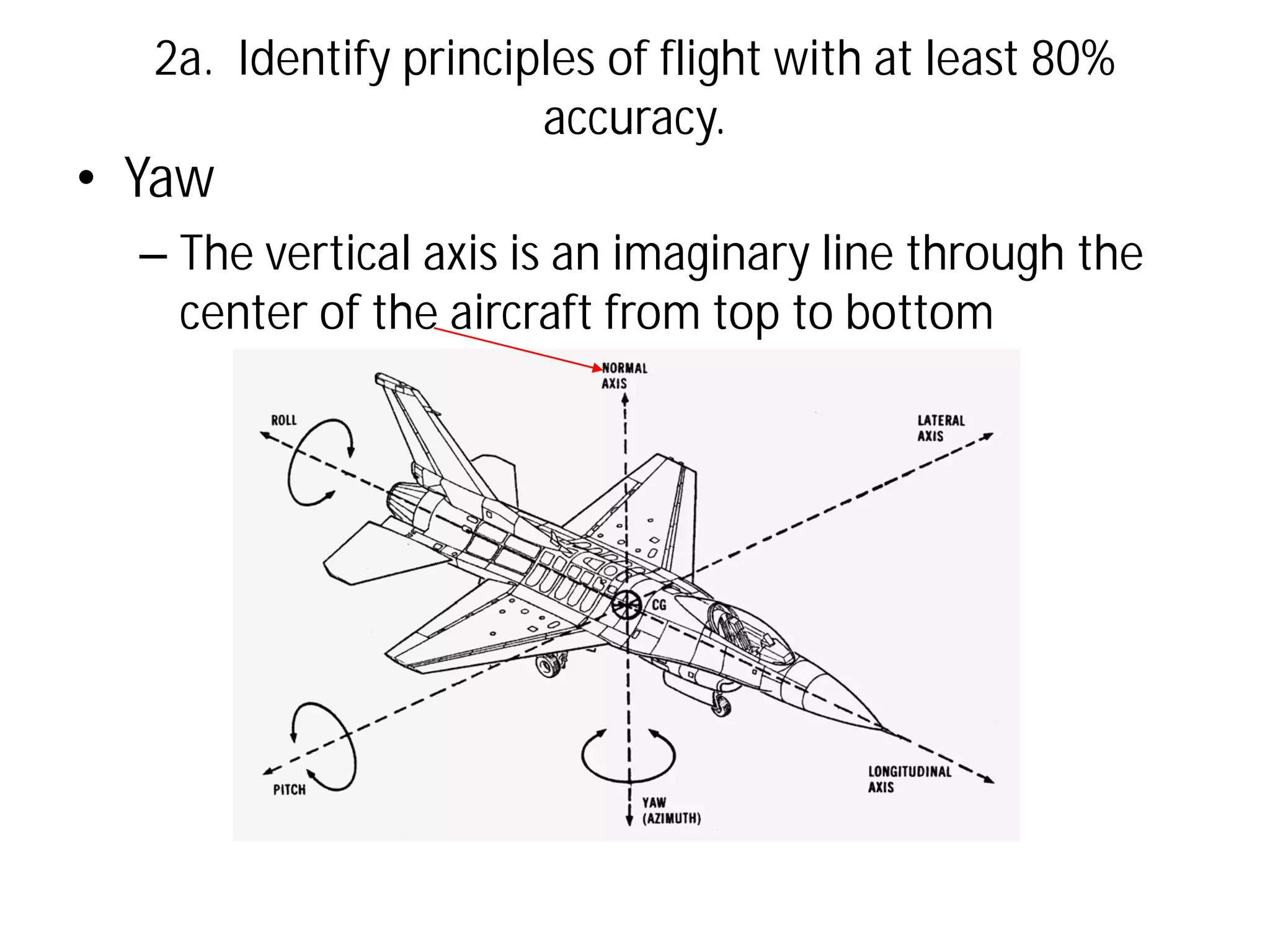
• Yaw

– The vertical axis is an imaginary line through the
center of the aircraft from top to bottom
2a. Identify principles of flight with at least 80%
accuracy.

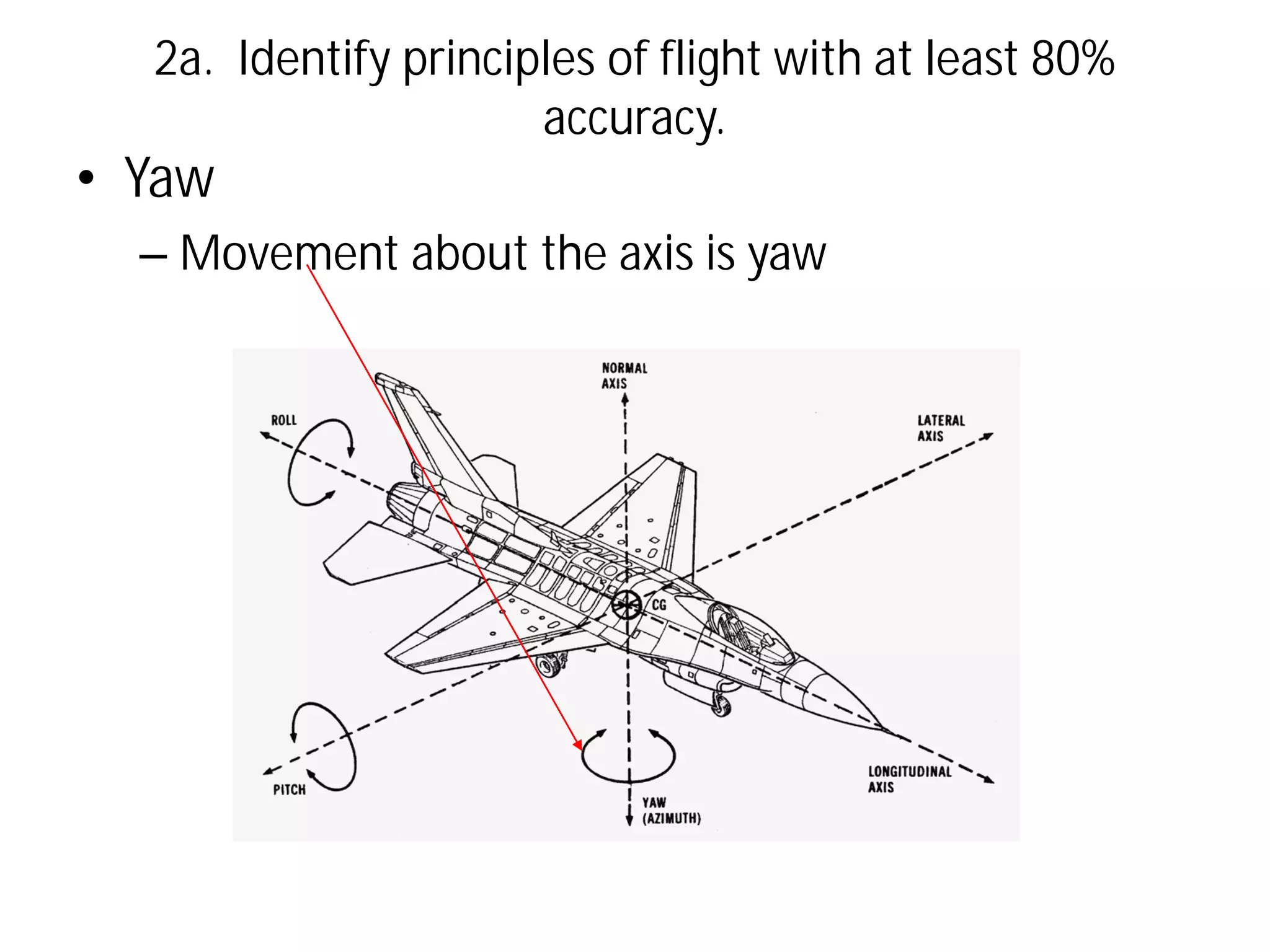
• Yaw

– Movement about the axis is yaw
2a. Identify principles of flight with at least 80%
accuracy.

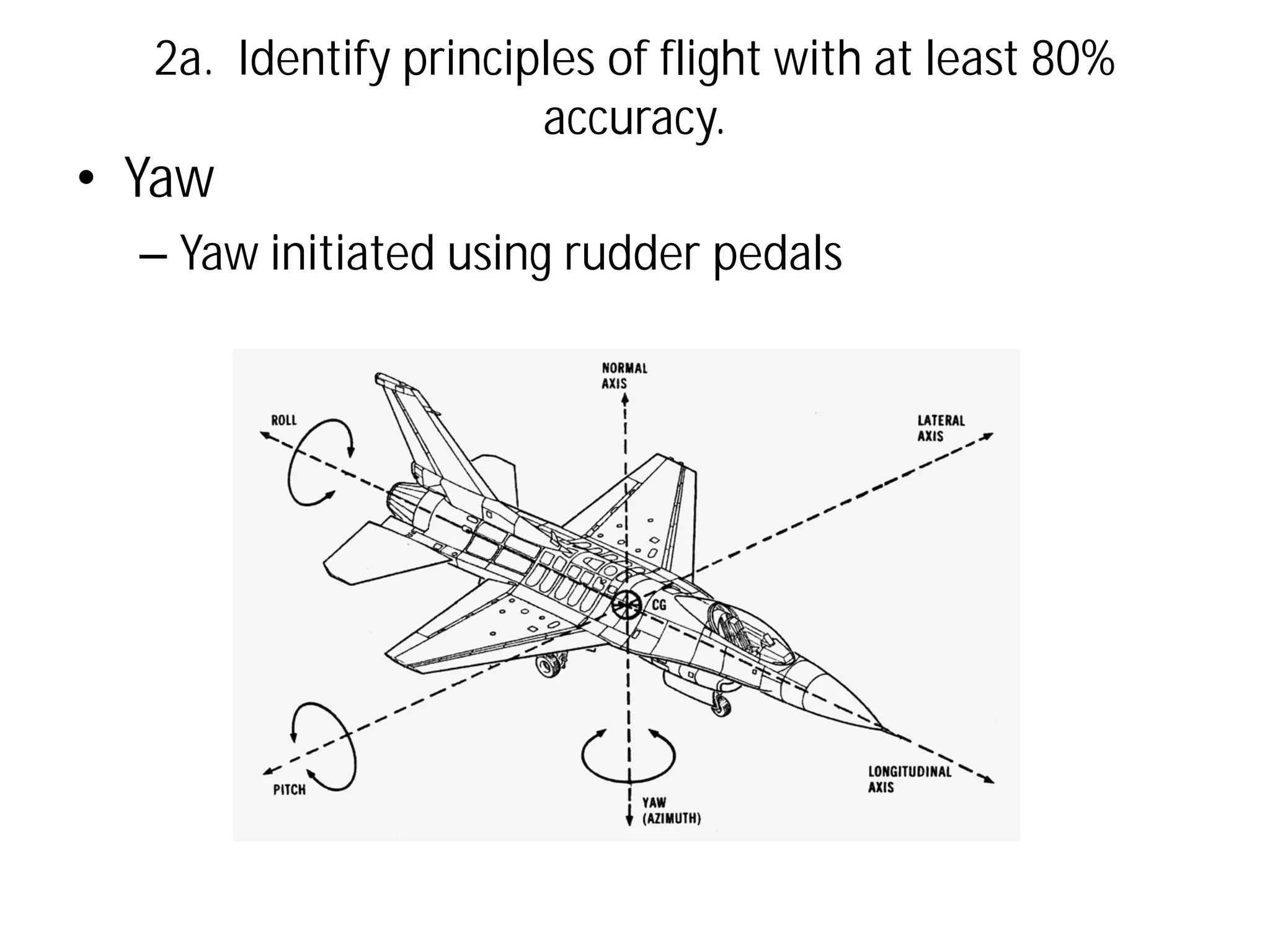
• Yaw

– Yaw initiated using rudder pedals
2a. Identify principles of flight with at least 80%
accuracy.

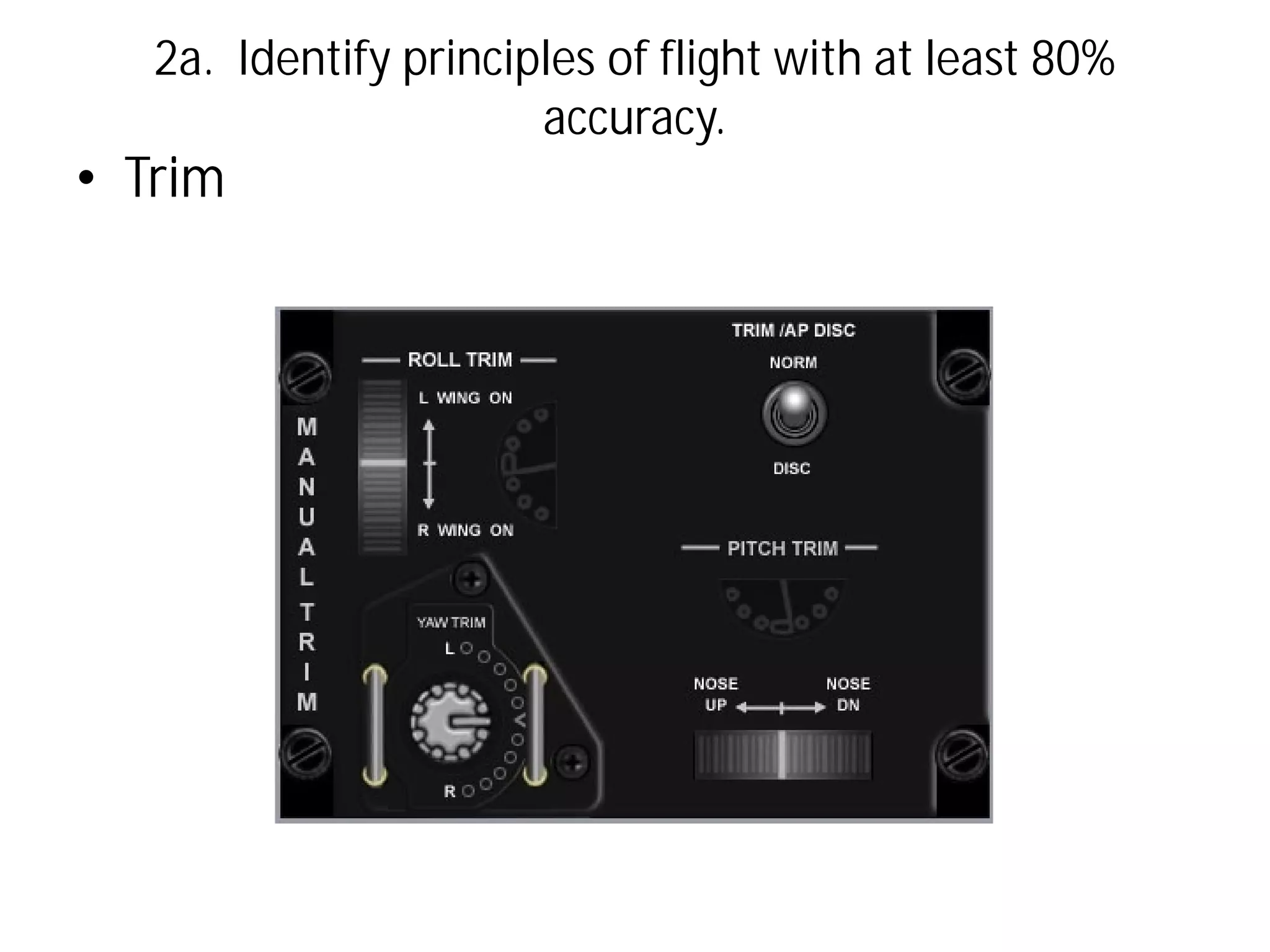
• Trim
2a. Identify principles of flight with at least 80%
accuracy.

• Summary of Principles of Flight
– Defined Basic Facts and Terms
– Covered Controls and Surfaces
– Axes of Rotation

Conventional controls

  • 1.
    Flight Control Systems(Conventional & Digital) & Enhanced Diagnostic Aid (EDNA) 2a. Identify principles of flight with at least 80% accuracy.
  • 2.
    2a. Identify principlesof flight with at least 80% accuracy. • Overview of Principles of Flight – Basic Facts and Terms – Controls and Surfaces – Axes of Rotation
  • 3.
    2a. Identify principlesof flight with at least 80% accuracy. • Principles of Flight – Bernoulli’s Principle • As air velocity increases, pressure decreases • As air velocity decreases, pressure increases • Venturi tube
  • 4.
    2a. Identify principlesof flight with at least 80% accuracy. – Density • • • • As air is compressed, it becomes more dense Air has less density at high altitude Air expands as it is heated – occupies more space Changes in air density affect flight – Climate is cold, altitude is low = dense air » Aircraft achieves takeoff speed more quickly » Takes off with less runway – High Altitude = low density (airplane flies faster)
  • 5.
    2a. Identify principlesof flight with at least 80% accuracy. – Humidity • Higher temperature of air – the more water it can absorb • Temperature the same – density of air varies with humidity • Damp days – Density is less than it is on dry days – Airplane requires longer runway for takeoff
  • 6.
    2a. Identify principlesof flight with at least 80% accuracy. – Relative Wind – the direction of the airflow with respect to the wing
  • 7.
    2a. Identify principlesof flight with at least 80% accuracy. – Angle of Attack – angle between the wing chord line and the direction of the relative wind
  • 8.
    2a. Identify principlesof flight with at least 80% accuracy. – Airfoils • Any object designed to obtain a reaction upon itself from the air through which it passes
  • 9.
    2a. Identify principlesof flight with at least 80% accuracy. – Wing Chord Line • Distance from the leading edge to the trailing edge • Represented by a straight line called the chord line
  • 10.
    2a. Identify principlesof flight with at least 80% accuracy. – Camber • The curve or departure from the chord line • Positive – Convex Surface • Negative – Concave Surface
  • 11.
    2a. Identify principlesof flight with at least 80% accuracy. – Camber • Upper Surface – Always positive • Lower Surface – Positive (usually) – Zero – Negative
  • 12.
    2a. Identify principlesof flight with at least 80% accuracy. • Producing Lift – High-speed flow is associated with low pressure – Low-speed flow is associated with high pressure
  • 13.
    2a. Identify principlesof flight with at least 80% accuracy. – Airfoil is designed to increase the velocity of the airflow above the surface – decreases pressure above the airfoil – Impact of air on lower surface increases pressure below – Pressure differential causes lift
  • 14.
    2a. Identify principlesof flight with at least 80% accuracy. • Weight – the force of gravity acting downward upon anything that goes into the aircraft – Reduced as fuel is burned – Reduced as missles and bombs are released – Reduced the aircraft will climb
  • 15.
    2a. Identify principlesof flight with at least 80% accuracy. • Lift – acts vertically, by doing so counteracts weight – Increases to a certain point with • AOA • Air Density • Airspeed – Lift is increased – aircraft will climb – Lift is reduced – aircraft will descend
  • 16.
    2a. Identify principlesof flight with at least 80% accuracy. • Drag – forward deterrent force (caused by the disruption of the airflow by the wings, fuselage and protruding objects) – Increases with • Airspeed • AOA (drag increases much more rapidly than lift as AOA increases) – Decreases with increased altitude due to decrease in air density
  • 17.
    2a. Identify principlesof flight with at least 80% accuracy. • Thrust – the forward force produced by the jet engine that overcomes the force of drag – Increased thrust increases airspeed – Decreased thrust is needed at higher altitude to achieve the same airspeed due to less air density and drag – Thrust is decreased, airspeed will decrease
  • 18.
    2a. Identify principlesof flight with at least 80% accuracy. • Controls and Surfaces – Stick
  • 19.
    2a. Identify principlesof flight with at least 80% accuracy. • Controls and Surfaces – Mechanical/Electronic Controls
  • 20.
    2a. Identify principlesof flight with at least 80% accuracy. • Controls and Surfaces – Electronic Controls
  • 21.
    2a. Identify principlesof flight with at least 80% accuracy. • Controls and Surfaces – Rudder Pedals
  • 22.
    2a. Identify principlesof flight with at least 80% accuracy. • Controls and Surfaces – Flap Controls
  • 23.
    2a. Identify principlesof flight with at least 80% accuracy. • Control/Surface Connection – Direct Mechanical
  • 24.
    2a. Identify principlesof flight with at least 80% accuracy. • Control/Surface Connection – Power Assisted Mechanical
  • 25.
    2a. Identify principlesof flight with at least 80% accuracy. • Control/Surface Connection – Powered, Electronically Controlled
  • 26.
    2a. Identify principlesof flight with at least 80% accuracy. • Flight Control Surfaces – Wings • Primary means of providing lift for the aircraft
  • 27.
    2a. Identify principlesof flight with at least 80% accuracy. • Flaps – Attached to wings – Moveable surfaces that provide increased lift
  • 28.
    2a. Identify principlesof flight with at least 80% accuracy. • Flaps – Trailing Edge Flaps
  • 29.
    2a. Identify principlesof flight with at least 80% accuracy. • Flaps – Leading Edge Flaps
  • 30.
    2a. Identify principlesof flight with at least 80% accuracy. • Ailerons – Moveable surfaces to provide roll control
  • 31.
    2a. Identify principlesof flight with at least 80% accuracy. • Horizontal Stabilizers – Provides stabilization against uncontrolled pitching of the aircraft – Attached to aft section of aircraft
  • 32.
    2a. Identify principlesof flight with at least 80% accuracy. • Elevators – Moveable surfaces to provide pitch control – Attached to trailing edge of horizontal stabs
  • 33.
    2a. Identify principlesof flight with at least 80% accuracy. • Moveable Horizontal Stabilizers – Entire Surface pivots to provide pitch control – Does not require elevators
  • 34.
    2a. Identify principlesof flight with at least 80% accuracy. • Vertical Stabilizers – Provides stabilization against uncontrolled yawing of the aircraft
  • 35.
    2a. Identify principlesof flight with at least 80% accuracy. • Rudder – Moveable surfaces to provide yaw control – Move symmetrically
  • 36.
    2a. Identify principlesof flight with at least 80% accuracy. • Combined Surfaces – Flaperon
  • 37.
    2a. Identify principlesof flight with at least 80% accuracy. • Elevons
  • 38.
    2a. Identify principlesof flight with at least 80% accuracy. • Speedbrake
  • 39.
    2a. Identify principlesof flight with at least 80% accuracy. • Axes of Rotation – Surfaces are normally “streamline” for straight and level flight
  • 40.
    2a. Identify principlesof flight with at least 80% accuracy. • Roll – The longitudal axis is an imaginary line through center of straight and level flight
  • 41.
    2a. Identify principlesof flight with at least 80% accuracy. • Roll – Movement about the axis is roll
  • 42.
    2a. Identify principlesof flight with at least 80% accuracy. • Roll – Roll is initiated by applying lateral pressure to the side stick controller
  • 43.
    2a. Identify principlesof flight with at least 80% accuracy. • Pitch – The lateral axis is an imaginary line from the wing tip to wing tip
  • 44.
    2a. Identify principlesof flight with at least 80% accuracy. • Pitch – Movement about about the axis is pitch
  • 45.
    2a. Identify principlesof flight with at least 80% accuracy. • Pitch – Pitch is initiated by applying fore and aft pressure on the side stick controller
  • 46.
    2a. Identify principlesof flight with at least 80% accuracy. • Yaw – The vertical axis is an imaginary line through the center of the aircraft from top to bottom
  • 47.
    2a. Identify principlesof flight with at least 80% accuracy. • Yaw – Movement about the axis is yaw
  • 48.
    2a. Identify principlesof flight with at least 80% accuracy. • Yaw – Yaw initiated using rudder pedals
  • 49.
    2a. Identify principlesof flight with at least 80% accuracy. • Trim
  • 50.
    2a. Identify principlesof flight with at least 80% accuracy. • Summary of Principles of Flight – Defined Basic Facts and Terms – Covered Controls and Surfaces – Axes of Rotation