PARABEN
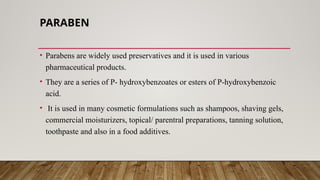
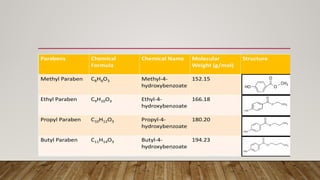
• Parabens arewidely used preservatives and it is used in various
pharmaceutical products.
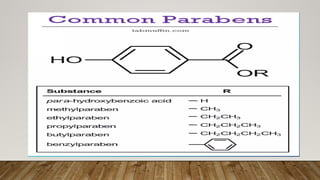
• They are a series of P- hydroxybenzoates or esters of P-hydroxybenzoic
acid.
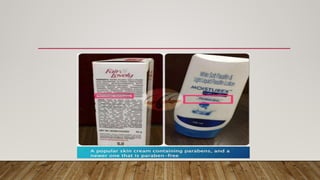
• It is used in many cosmetic formulations such as shampoos, shaving gels,
commercial moisturizers, topical/ parentral preparations, tanning solution,
toothpaste and also in a food additives.
5.
• Parabens canmimic hormones in the body and disrupt functions of the
endocrine system.
• Paraben can enter in your body through your skin when you applied it on
the skin.
• The body can absorb as much as 5 pounds of cosmetic chemicals every
year
7.
HEALTH CONCERNS
Breast cancer
•Cornell university reports that a high lifelong exposure to estrogen can
increase risk of it.
• Paraben accumulate in fat cells including breast tissues and leads to cause
breast cancer.
• Eg:- methyl paraben
8.
EARLY PUBERTY
• Parabenare having ability to adversely affect the endocrine system.
• It also results in early puberty in adolescent girls and boys.
• Paraben causes defectiveness in male reproductive system, results in
decrease in sperm level concentration.
10.
REGULATIONS
• The EuropeanScientific Committee on Consumer Safety (SCCS) stated in
2013 that methyl paraben and ethyl paraben are safe at the maximum
authorized concentration [upto 0.4% for one ester or 0.8% used in
combination]
• They concluded that the use of butyl paraben and propyl paraben as
preservatives in finished cosmetics products is safe to the consumer.
11.
• United States
•The FDA does not currently ban or restrict parabens in cosmetics.
• Parabens are allowed as preservatives and must be listed on ingredient
labels, but no concentration limits exist.
• The FDA monitors safety through post-market surveillance, but action is
usually only taken after safety issues emerge.
12.
• Canada
• Parabensare allowed in cosmetics but are under scrutiny.
• Health Canada classifies some parabens (like butylparaben and
propylparaben) as potential endocrine disruptors and recommends limiting
their use, especially in products for children.
13.
ALTERNATIVES FOR PARABENS
•Phenoxyethanol used in the EU at upto 1.0% in all product categories.
• Sodium benzoate in combination with potassium sorbate, upto 2.5% in
rinse off products, 1.7% in oral care products, 0.5% in leave-on products.
• Benzyl alcohol upto 1.0% and dehydroacetic acid upto 0.6%.
14.
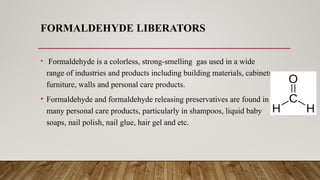
FORMALDEHYDE LIBERATORS
• Formaldehydeis a colorless, strong-smelling gas used in a wide
range of industries and products including building materials, cabinets
furniture, walls and personal care products.
• Formaldehyde and formaldehyde releasing preservatives are found in
many personal care products, particularly in shampoos, liquid baby
soaps, nail polish, nail glue, hair gel and etc.
15.
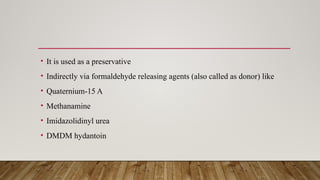
• It isused as a preservative
• Indirectly via formaldehyde releasing agents (also called as donor) like
• Quaternium-15 A
• Methanamine
• Imidazolidinyl urea
• DMDM hydantoin
16.
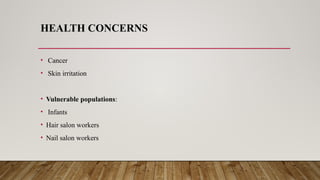
HEALTH CONCERNS
• Cancer
•Skin irritation
• Vulnerable populations:
• Infants
• Hair salon workers
• Nail salon workers
17.
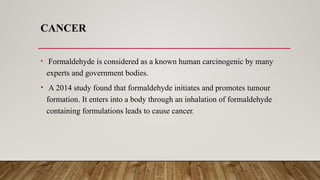
CANCER
• Formaldehyde isconsidered as a known human carcinogenic by many
experts and government bodies.
• A 2014 study found that formaldehyde initiates and promotes tumour
formation. It enters into a body through an inhalation of formaldehyde
containing formulations leads to cause cancer.
18.
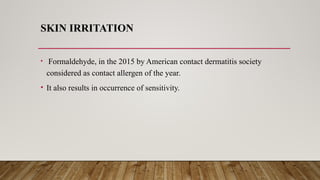
SKIN IRRITATION
• Formaldehyde,in the 2015 by American contact dermatitis society
considered as contact allergen of the year.
• It also results in occurrence of sensitivity.
19.
ALTERNATIVES FOR FORMALDEHYDE
LIBERATORS
•Skin hair smoothing products especially those sold in salons, as salon
based products are exempt from labelling laws.
• Don't use expired cosmetics products or store cosmetic products in the sun
because this can cause more formaldehyde to be released.
• Choose nail products that are labeled formaldehyde free or toxic free
(formaldehyde, toluene and Dibutyl Phthalate).
20.
QUATERNIUM-15A
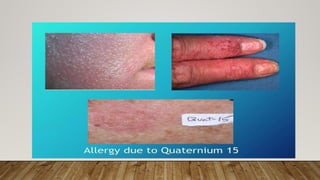
• It isa quaternary ammonium salt used as a surfactant and preservatives in
many cosmetics and pharmaceutical products.
• It is the most sensitizing of FRP and is found in mascara, lotion and shampoo.
• Glyoxal is the smallest dialdehyde and organic compound H which is yellow
colored liquid that evaporates to give a green colored gas. It is found in
conditioner, lotion, nail polish, etc. CIR (Cosmetic ingredient review) expert
panel has declared that glyoxal is a skin allergen.
22.
REGULATIONS
• Banned fromuse in cosmetics and toiletries in Japan and Sweden.
• EU allows the use of quaternium 15 upto 0.2% as preservatives in
cosmetics products till 2017.
• But in new cosmetic rules in 2017 EU Banned quaternium 15 and
formaldehyde.
23.
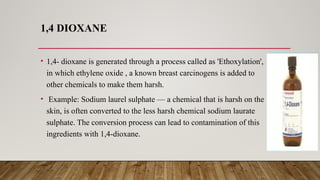
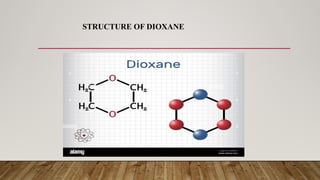
1,4 DIOXANE
• 1,4-dioxane is generated through a process called as 'Ethoxylation',
in which ethylene oxide , a known breast carcinogens is added to
other chemicals to make them harsh.
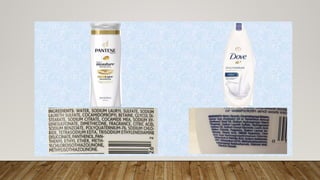
• Example: Sodium laurel sulphate — a chemical that is harsh on the
skin, is often converted to the less harsh chemical sodium laurate
sulphate. The conversion process can lead to contamination of this
ingredients with 1,4-dioxane.
HEALTH CONCERNS
• CANCER–
• Research shows that 1,4-dioxane readily penetrate the skin. It is considered as
a probable human carcinogen by the U.S Environment Protection Agency.
• It is listed as an animal carcinogen by the National Toxicology Program by
US. It is included on California's proposition 65 list of Chemicals known or
suspected to cause cancer or birth defects.
• It is also leads to cause organ toxicity.
27.
VULNERABLE POPULATION
• Infants
•Teenager's
• Pregnant women
• Regulation
• As per regulations, it is found that limit for dioxane safe for human is 10 ppm in
products.
28.
HOW TO AVOID
•There are several ways to avoid the formation of 1,4-dioxane in the
ingredients :
• The FDA does not require 1,4-dioxane to be listed as an ingredients on
product labels because the chemical is a contaminant produced during
manufacturing.
• Without labeling, there is no other options to now for certain whether a
product contains 1,4 dioxane, making it difficult for consumers to avoid
29.
• Alternative processesto ethoxylation do exists but many companies don't
take advantage of them.
• Vacuum stripping can remove 1,4-dioxane from an ethoxylated product.
• Organic standard do not allow ethoxylation and some conventional
companies such as Johnson and Johnson have agreed to alter the process
that results in this contamination.

![REGULATIONS
• The European Scientific Committee on Consumer Safety (SCCS) stated in
2013 that methyl paraben and ethyl paraben are safe at the maximum
authorized concentration [upto 0.4% for one ester or 0.8% used in
combination]
• They concluded that the use of butyl paraben and propyl paraben as
preservatives in finished cosmetics products is safe to the consumer.](https://image.slidesharecdn.com/cosmeticseminar-250413173702-d63d913b/85/Controversial-Ingredients-Paraben-Formaldehyde-and-Dioxane-10-320.jpg)