CONTROL UNIT
The Control Unit was historically defined as one distinct part of the 1946
reference model of Von Neumann architecture.
The function of control unit is to generate relevant timing and control signals to
all operations in the computer.
Control Unit is “the brain within the brain”.
It controls the flow of data between the processor and memory and peripherals.
The examples of devices that require a control unit are CPUs and graphics
processing units (GPUs).
COMPUTER ORGANIZATION AND
ARCHITECTURE
FUNCTIONS
COMPUTER ORGANIZATION AND
ARCHITECTURE
 The control unit directs the entire computer system to carry out stored
program instructions.
 The control unit must communicate with both the arithmetic logic unit
(ALU) and main memory.
 The control unit instructs the arithmetic logic unit that which logical or
arithmetic operation is to be performed.
 The control unit co-ordinates the activities of the other two units as well
as all peripherals and auxiliary storage devices linked to the computer.
TYPES
COMPUTER ORGANIZATION AND
ARCHITECTURE
Control unit generates control signals using one of the two
organizations :
 Hardwired Control Unit.
 Micro-programmed Control Unit.
Hardwired Control Unit
COMPUTER ORGANIZATION AND
ARCHITECTURE
 Hardwired control units are implemented through use of sequential
logic units or circuits like gates , fliflops , decoders in hardware.
 Hardwired control units are generally faster than micro-programmed
designs.
 This architecture is preferred in reduced instruction set computers (RISC)
as they use a simpler instruction set.
 The hardwired approach has become less popular as computers have
evolved as at one time, control units for CPUs were ad-hoc logic, and they
were difficult to design.
ADVANTAGES
COMPUTER ORGANIZATION AND
ARCHITECTURE
 Hardwired Control Unit is fast because control signals are generated by
combinational circuits.
 The delay in generation of control signals depends upon the number of
gates.
 The performances is high as compared to micro-programmed control unit.
DISADVANTAGES
COMPUTER ORGANIZATION AND
ARCHITECTURE
 The control signals required by the CPU will be more complex
 Modifications in control signal are very difficult. That means it requires
rearranging of wires in the hardware circuit.
 It is difficult to correct mistake in original design or adding new features
in existing design of control unit.
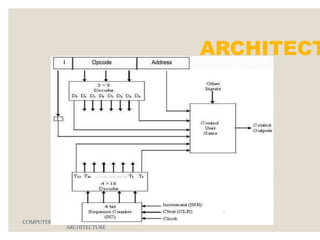
CONSIST OF:
COMPUTER ORGANIZATION AND
ARCHITECTURE
Control unit consist of a:
 Instruction Register
 Number of Control Logic Gates,
 Two Decoders
 4-bit Sequence Counter
ARCHITECT
COMPUTER ORGANIZATION AND
ARCHITECTURE
 An instruction read from memory is placed in the instruction register (IR).
 The instruction register is divided into three parts: the I bit, operation
code, and address part.
 First 12-bits (0-11) to specify an address, next 3-bits specify the
operation code (opcode) field of the instruction and last left most bit
specify the addressing mode I.
 I = 0 for direct address
 I = 1 for indirect address
COMPUTER ORGANIZATION AND
ARCHITECTURE
 First 12-bits (0-11) are applied to the control logic gates.
 The operation code bits (12 – 14) are decoded with a 3 x 8 decoder.
 The eight outputs ( D0 through D7) from a decoder goes to the control
logic gates to perform specific operation.
 Last bit 15 is transferred to a I flip-flop designated by symbol I.
COMPUTER ORGANIZATION AND
ARCHITECTURE
 The 4-bit sequence counter SC can count in binary from 0 through 15.
 The counter output is decoded into 16 timing pulses T0 through T15.
 The sequence counter can be incremented by INR.
 input or clear by CLR input synchronously.
COMPUTER ORGANIZATION AND
ARCHITECTURE
EXAMPL
COMPUTER ORGANIZATION AND
ARCHITECTURE
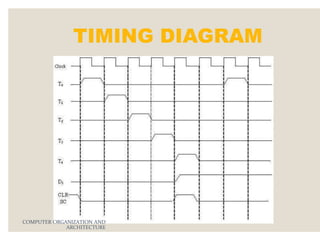
 Consider the case where SC is incremented to provide timing signalsT0,
T1, T 2 , T3, and T4 in sequence. At time T4 , SC is cleared to 0 if decoder
output D3 is active. This is expressed symbolically by the statement:
D3 T4 : SC ← 0
 The timing diagram shows the time relationship of the control signals.
TIMING DIAGRAM
COMPUTER ORGANIZATION AND
ARCHITECTURE
MICRO-PROGRAMMED
CONTROL UNIT
COMPUTER ORGANIZATION AND
ARCHITECTURE
 The idea of microprogramming was introduced by Maurice Wilkes in 1951.
 Micro-programs were organized as a sequence of microinstructions and
stored in special control memory.
 The main advantage of the micro-program control unit is the simplicity of
its structure.
 Outputs of the controller are organized in microinstructions and they can
be easily replaced
 A micro-programmed control unit is implemented using programming
approach. A sequence of micro operations are carried out by executing a
program consisting of micro-instructions.
 Micro-program, consisting of micro-instructions is stored in the control
memory of the control unit.
 Execution of a micro-instruction is responsible for generation of a set of
control signals.
COMPUTER ORGANIZATION AND
ARCHITECTURE
 Micro-Programs: Microprogramming is the concept for generating
control signals using programs. These programs are called micro -
programs.
 Micro-Instructions: The instructions that make micro-program are called
micro-instructions.
 Micro-Code: Micro-program is a group of microinstructions. The micro-
program can also be termed as micro-code.
 Control Memory: Micro-programs are stored in the read only memory
(ROM). That memory is called control memory.
COMPUTER ORGANIZATION AND
ARCHITECTURE
ADVANTAGES
COMPUTER ORGANIZATION AND
ARCHITECTURE
 The design of micro-program control unit is less complex because micro-
programs are implemented using software routines.
 The micro-programmed control unit is more flexible because design
modifications, correction and enhancement is easily possible.
 The new or modified instruction set of CPU can be easily implemented by
simply rewriting or modifying the contents of control memory.
 The fault can be easily diagnosed in the micro-program control unit using
diagnostics tools by maintaining the contents of flags, registers and
counters.
DISADVANTAGES
COMPUTER ORGANIZATION AND
ARCHITECTURE
 The micro-program control unit is slower than hardwired control unit.
 That means to execute an instruction in micro-program control unit
requires more time.
 The micro-program control unit is expensive than hardwired control unit
in case of limited hardware resources.
 The design duration of micro-program control unit is more than hardwired
control unit for smaller CPU.
CONSIST OF :
COMPUTER ORGANIZATION AND
ARCHITECTURE
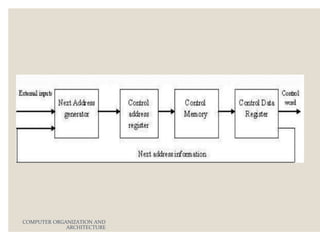
Control unit consist of a :
 Next address generator
 Control address register
 Control memory
 Control data register
ARCHITECTURE
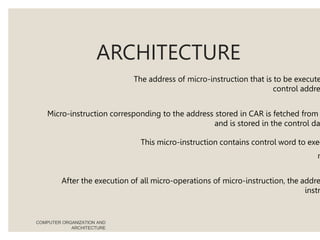
The address of micro-instruction that is to be execute
control addre
Micro-instruction corresponding to the address stored in CAR is fetched from
and is stored in the control da
This micro-instruction contains control word to exec
m
After the execution of all micro-operations of micro-instruction, the addre
instr
COMPUTER ORGANIZATION AND
ARCHITECTURE
COMPUTER ORGANIZATION AND
ARCHITECTURE
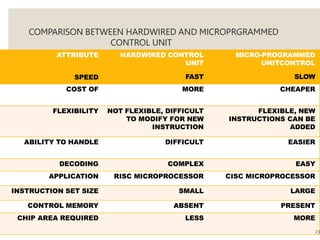
COMPARISON BETWEEN HARDWIRED AND MICROPRGRAMMED
CONTROL UNIT
IMPLEMENTATION
COMPLEX INSTRUCTION
ATTRIBUTE
SPEED
HARDWIRED CONTROL
UNIT
FAST
MICRO-PROGRAMMED
CONTROL
UNIT
SLOW
COST OF MORE CHEAPER
FLEXIBILITY NOT FLEXIBLE, DIFFICULT
TO MODIFY FOR NEW
INSTRUCTION
FLEXIBLE, NEW
INSTRUCTIONS CAN BE
ADDED
ABILITY TO HANDLE DIFFICULT EASIER
DECODING COMPLEX EASY
APPLICATION RISC MICROPROCESSOR CISC MICROPROCESSOR
INSTRUCTION SET SIZE SMALL LARGE
CONTROL MEMORY ABSENT PRESENT
CHIP AREA REQUIRED LESS MORE
23
THANKYOU
24
COMPUTER ORGANIZATION AND ARCHITECTURE
20-May-14

controlunit1a024a025-140520095202-phpapp01.pptx

  • 1.
  • 2.
    The Control Unitwas historically defined as one distinct part of the 1946 reference model of Von Neumann architecture. The function of control unit is to generate relevant timing and control signals to all operations in the computer. Control Unit is “the brain within the brain”. It controls the flow of data between the processor and memory and peripherals. The examples of devices that require a control unit are CPUs and graphics processing units (GPUs). COMPUTER ORGANIZATION AND ARCHITECTURE
  • 3.
    FUNCTIONS COMPUTER ORGANIZATION AND ARCHITECTURE The control unit directs the entire computer system to carry out stored program instructions.  The control unit must communicate with both the arithmetic logic unit (ALU) and main memory.  The control unit instructs the arithmetic logic unit that which logical or arithmetic operation is to be performed.  The control unit co-ordinates the activities of the other two units as well as all peripherals and auxiliary storage devices linked to the computer.
  • 4.
    TYPES COMPUTER ORGANIZATION AND ARCHITECTURE Controlunit generates control signals using one of the two organizations :  Hardwired Control Unit.  Micro-programmed Control Unit.
  • 5.
    Hardwired Control Unit COMPUTERORGANIZATION AND ARCHITECTURE  Hardwired control units are implemented through use of sequential logic units or circuits like gates , fliflops , decoders in hardware.  Hardwired control units are generally faster than micro-programmed designs.  This architecture is preferred in reduced instruction set computers (RISC) as they use a simpler instruction set.  The hardwired approach has become less popular as computers have evolved as at one time, control units for CPUs were ad-hoc logic, and they were difficult to design.
  • 6.
    ADVANTAGES COMPUTER ORGANIZATION AND ARCHITECTURE Hardwired Control Unit is fast because control signals are generated by combinational circuits.  The delay in generation of control signals depends upon the number of gates.  The performances is high as compared to micro-programmed control unit.
  • 7.
    DISADVANTAGES COMPUTER ORGANIZATION AND ARCHITECTURE The control signals required by the CPU will be more complex  Modifications in control signal are very difficult. That means it requires rearranging of wires in the hardware circuit.  It is difficult to correct mistake in original design or adding new features in existing design of control unit.
  • 8.
    CONSIST OF: COMPUTER ORGANIZATIONAND ARCHITECTURE Control unit consist of a:  Instruction Register  Number of Control Logic Gates,  Two Decoders  4-bit Sequence Counter
  • 9.
  • 10.
     An instructionread from memory is placed in the instruction register (IR).  The instruction register is divided into three parts: the I bit, operation code, and address part.  First 12-bits (0-11) to specify an address, next 3-bits specify the operation code (opcode) field of the instruction and last left most bit specify the addressing mode I.  I = 0 for direct address  I = 1 for indirect address COMPUTER ORGANIZATION AND ARCHITECTURE
  • 11.
     First 12-bits(0-11) are applied to the control logic gates.  The operation code bits (12 – 14) are decoded with a 3 x 8 decoder.  The eight outputs ( D0 through D7) from a decoder goes to the control logic gates to perform specific operation.  Last bit 15 is transferred to a I flip-flop designated by symbol I. COMPUTER ORGANIZATION AND ARCHITECTURE
  • 12.
     The 4-bitsequence counter SC can count in binary from 0 through 15.  The counter output is decoded into 16 timing pulses T0 through T15.  The sequence counter can be incremented by INR.  input or clear by CLR input synchronously. COMPUTER ORGANIZATION AND ARCHITECTURE
  • 13.
    EXAMPL COMPUTER ORGANIZATION AND ARCHITECTURE Consider the case where SC is incremented to provide timing signalsT0, T1, T 2 , T3, and T4 in sequence. At time T4 , SC is cleared to 0 if decoder output D3 is active. This is expressed symbolically by the statement: D3 T4 : SC ← 0  The timing diagram shows the time relationship of the control signals.
  • 14.
  • 15.
    MICRO-PROGRAMMED CONTROL UNIT COMPUTER ORGANIZATIONAND ARCHITECTURE  The idea of microprogramming was introduced by Maurice Wilkes in 1951.  Micro-programs were organized as a sequence of microinstructions and stored in special control memory.  The main advantage of the micro-program control unit is the simplicity of its structure.  Outputs of the controller are organized in microinstructions and they can be easily replaced
  • 16.
     A micro-programmedcontrol unit is implemented using programming approach. A sequence of micro operations are carried out by executing a program consisting of micro-instructions.  Micro-program, consisting of micro-instructions is stored in the control memory of the control unit.  Execution of a micro-instruction is responsible for generation of a set of control signals. COMPUTER ORGANIZATION AND ARCHITECTURE
  • 17.
     Micro-Programs: Microprogrammingis the concept for generating control signals using programs. These programs are called micro - programs.  Micro-Instructions: The instructions that make micro-program are called micro-instructions.  Micro-Code: Micro-program is a group of microinstructions. The micro- program can also be termed as micro-code.  Control Memory: Micro-programs are stored in the read only memory (ROM). That memory is called control memory. COMPUTER ORGANIZATION AND ARCHITECTURE
  • 18.
    ADVANTAGES COMPUTER ORGANIZATION AND ARCHITECTURE The design of micro-program control unit is less complex because micro- programs are implemented using software routines.  The micro-programmed control unit is more flexible because design modifications, correction and enhancement is easily possible.  The new or modified instruction set of CPU can be easily implemented by simply rewriting or modifying the contents of control memory.  The fault can be easily diagnosed in the micro-program control unit using diagnostics tools by maintaining the contents of flags, registers and counters.
  • 19.
    DISADVANTAGES COMPUTER ORGANIZATION AND ARCHITECTURE The micro-program control unit is slower than hardwired control unit.  That means to execute an instruction in micro-program control unit requires more time.  The micro-program control unit is expensive than hardwired control unit in case of limited hardware resources.  The design duration of micro-program control unit is more than hardwired control unit for smaller CPU.
  • 20.
    CONSIST OF : COMPUTERORGANIZATION AND ARCHITECTURE Control unit consist of a :  Next address generator  Control address register  Control memory  Control data register
  • 21.
    ARCHITECTURE The address ofmicro-instruction that is to be execute control addre Micro-instruction corresponding to the address stored in CAR is fetched from and is stored in the control da This micro-instruction contains control word to exec m After the execution of all micro-operations of micro-instruction, the addre instr COMPUTER ORGANIZATION AND ARCHITECTURE
  • 22.
  • 23.
    COMPARISON BETWEEN HARDWIREDAND MICROPRGRAMMED CONTROL UNIT IMPLEMENTATION COMPLEX INSTRUCTION ATTRIBUTE SPEED HARDWIRED CONTROL UNIT FAST MICRO-PROGRAMMED CONTROL UNIT SLOW COST OF MORE CHEAPER FLEXIBILITY NOT FLEXIBLE, DIFFICULT TO MODIFY FOR NEW INSTRUCTION FLEXIBLE, NEW INSTRUCTIONS CAN BE ADDED ABILITY TO HANDLE DIFFICULT EASIER DECODING COMPLEX EASY APPLICATION RISC MICROPROCESSOR CISC MICROPROCESSOR INSTRUCTION SET SIZE SMALL LARGE CONTROL MEMORY ABSENT PRESENT CHIP AREA REQUIRED LESS MORE 23
  • 24.