Measurement and control of bioprocess parameters
• Any attempt to understand or control the state of a fermentation/bioreactor depends on the knowledge of critical
variables which affect the process
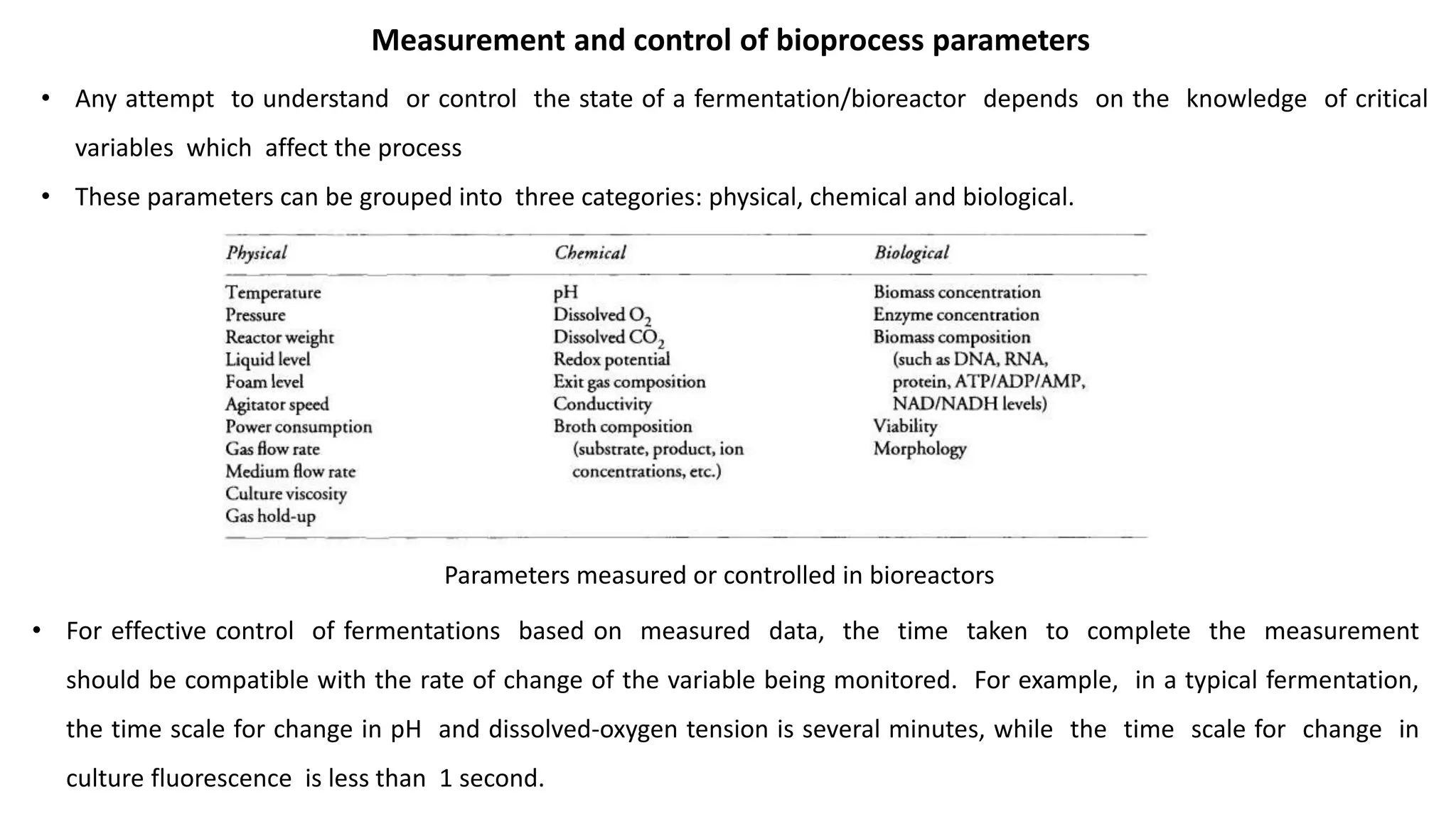
• These parameters can be grouped into three categories: physical, chemical and biological.
Parameters measured or controlled in bioreactors
• For effective control of fermentations based on measured data, the time taken to complete the measurement
should be compatible with the rate of change of the variable being monitored. For example, in a typical fermentation,
the time scale for change in pH and dissolved-oxygen tension is several minutes, while the time scale for change in
culture fluorescence is less than 1 second.
• The frequency and speed of measurement must be consistent with these time scales.
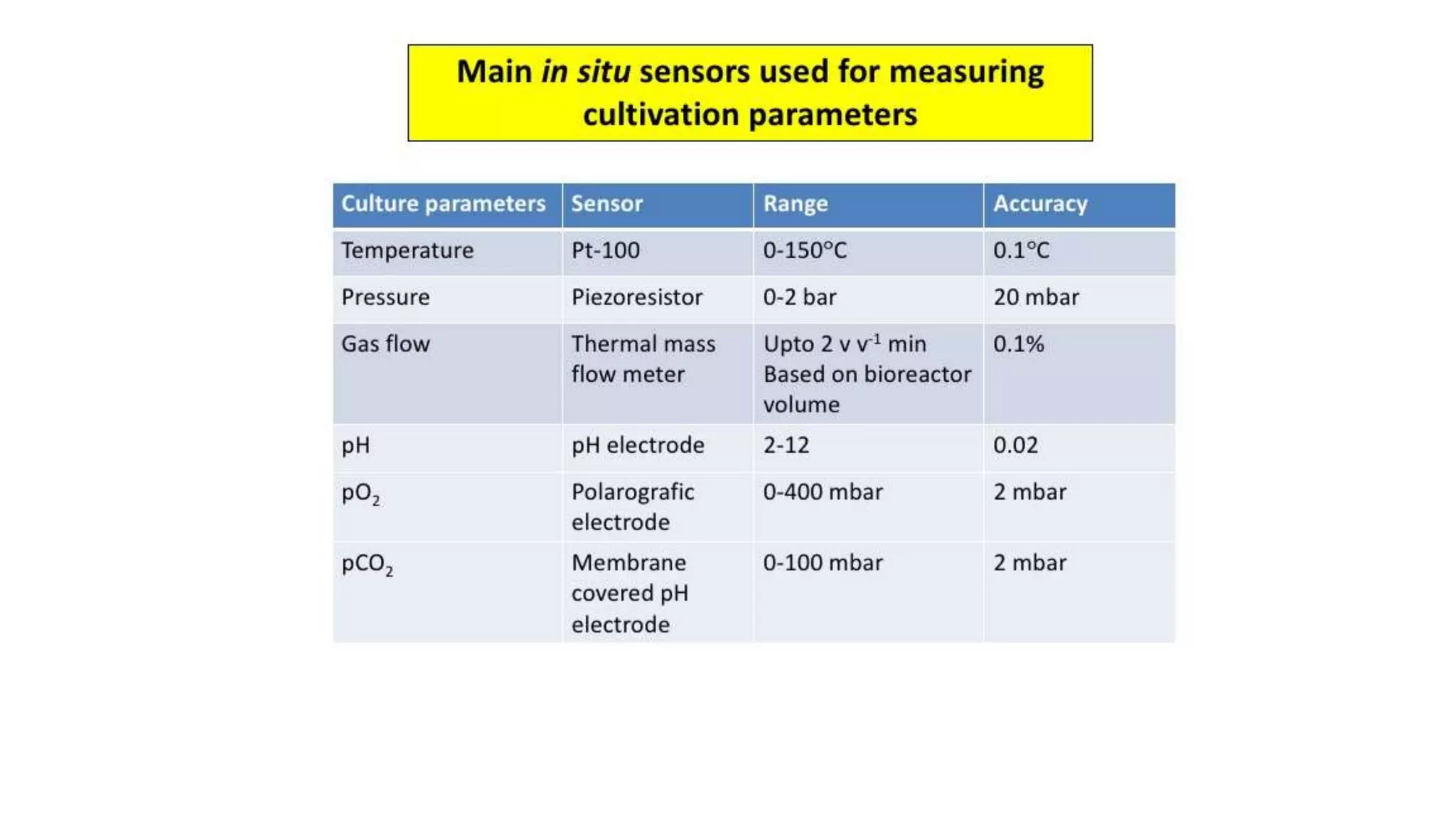
• Ideally, measurements should be made in situ and on-line, i.e. in or near the reactor during operation, so
that the result is available for timely control action.
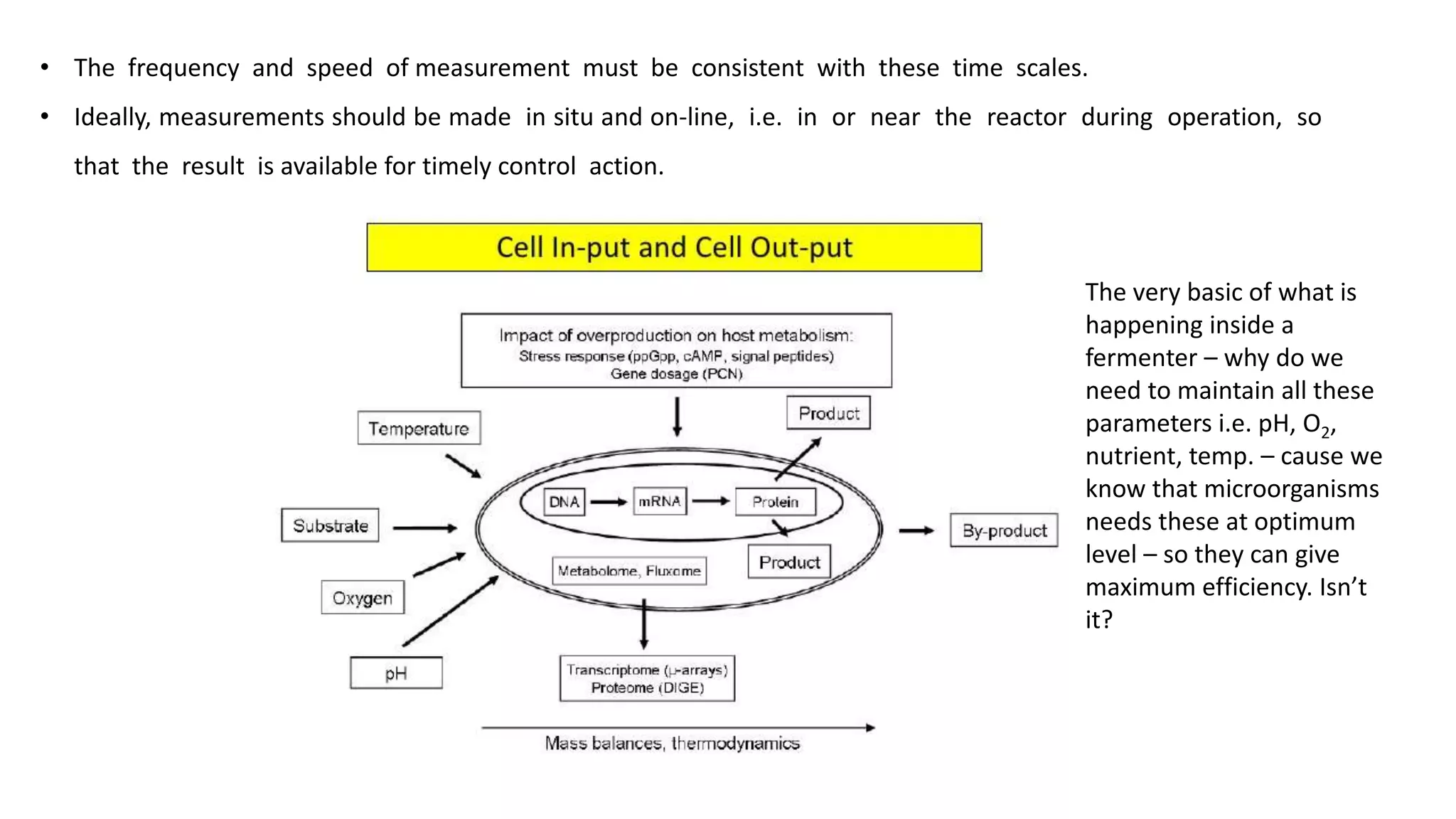
The very basic of what is
happening inside a
fermenter – why do we
need to maintain all these
parameters i.e. pH, O2,
nutrient, temp. – cause we
know that microorganisms
needs these at optimum
level – so they can give
maximum efficiency. Isn’t
it?
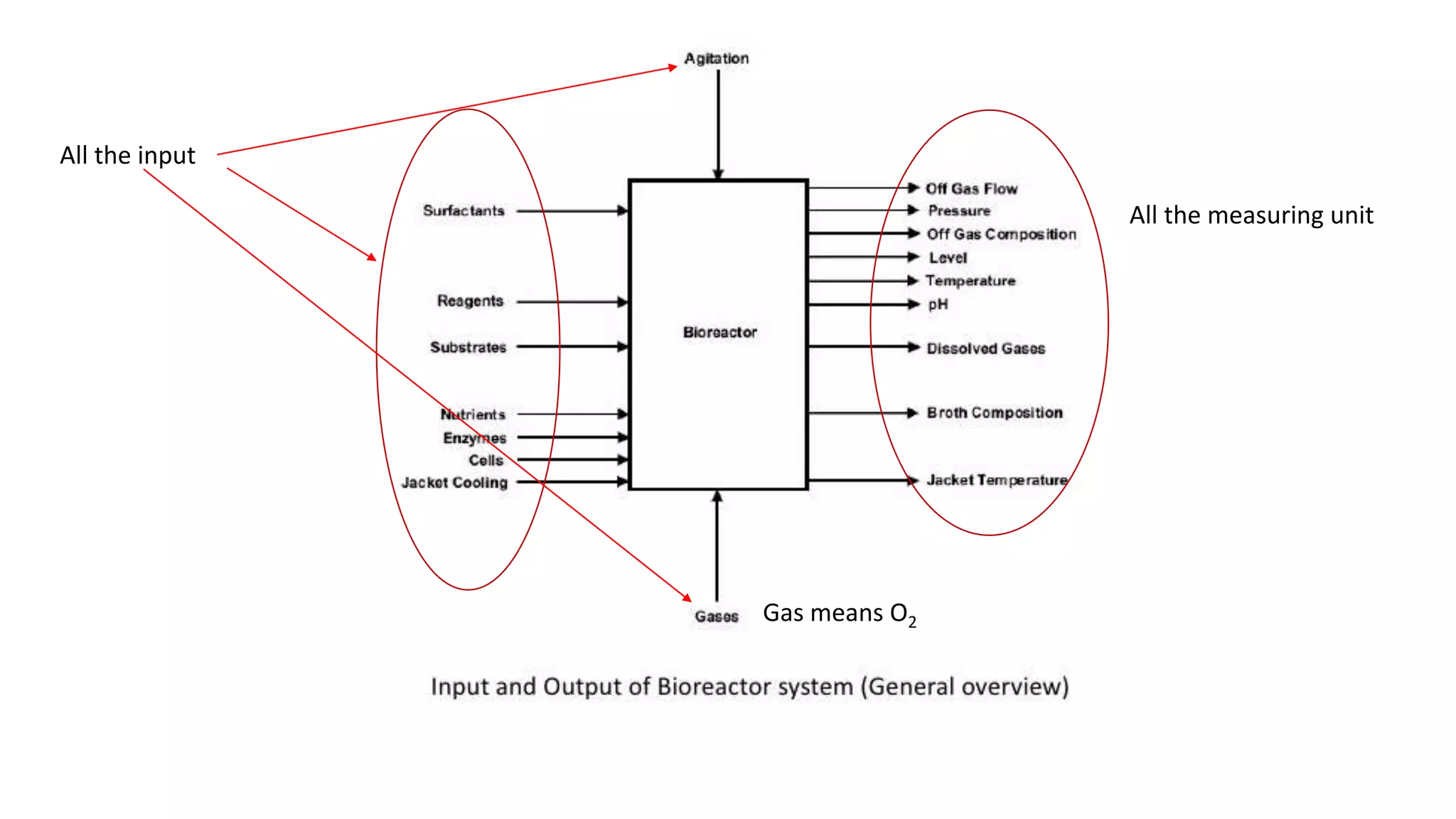
All the input
Gas means O2
All the measuring unit
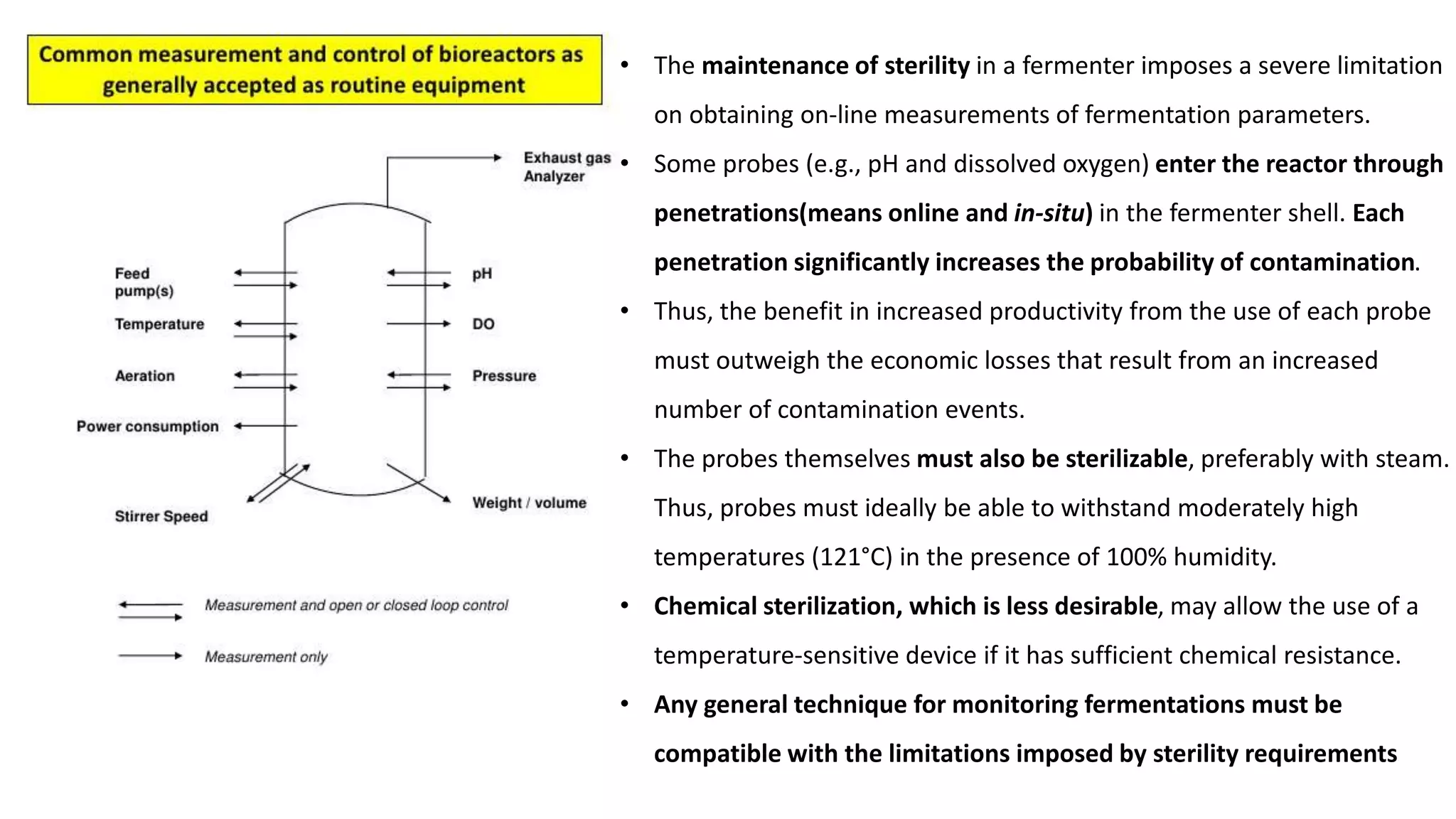
• The maintenance of sterility in a fermenter imposes a severe limitation
on obtaining on-line measurements of fermentation parameters.
• Some probes (e.g., pH and dissolved oxygen) enter the reactor through
penetrations(means online and in-situ) in the fermenter shell. Each
penetration significantly increases the probability of contamination.
• Thus, the benefit in increased productivity from the use of each probe
must outweigh the economic losses that result from an increased
number of contamination events.
• The probes themselves must also be sterilizable, preferably with steam.
Thus, probes must ideally be able to withstand moderately high
temperatures (121°C) in the presence of 100% humidity.
• Chemical sterilization, which is less desirable, may allow the use of a
temperature-sensitive device if it has sufficient chemical resistance.
• Any general technique for monitoring fermentations must be
compatible with the limitations imposed by sterility requirements
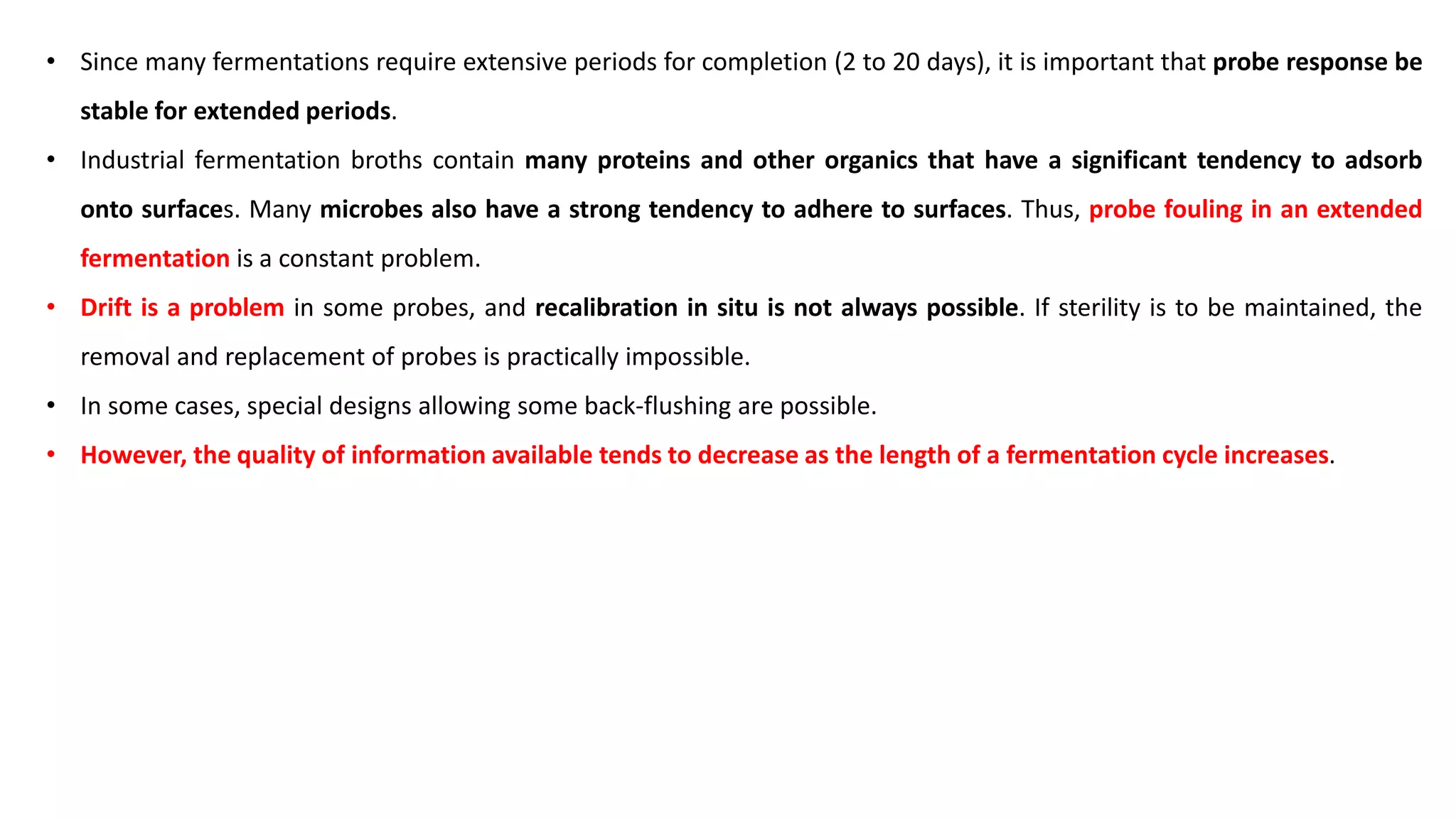
• Since many fermentations require extensive periods for completion (2 to 20 days), it is important that probe response be
stable for extended periods.
• Industrial fermentation broths contain many proteins and other organics that have a significant tendency to adsorb
onto surfaces. Many microbes also have a strong tendency to adhere to surfaces. Thus, probe fouling in an extended
fermentation is a constant problem.
• Drift is a problem in some probes, and recalibration in situ is not always possible. If sterility is to be maintained, the
removal and replacement of probes is practically impossible.
• In some cases, special designs allowing some back-flushing are possible.
• However, the quality of information available tends to decrease as the length of a fermentation cycle increases.
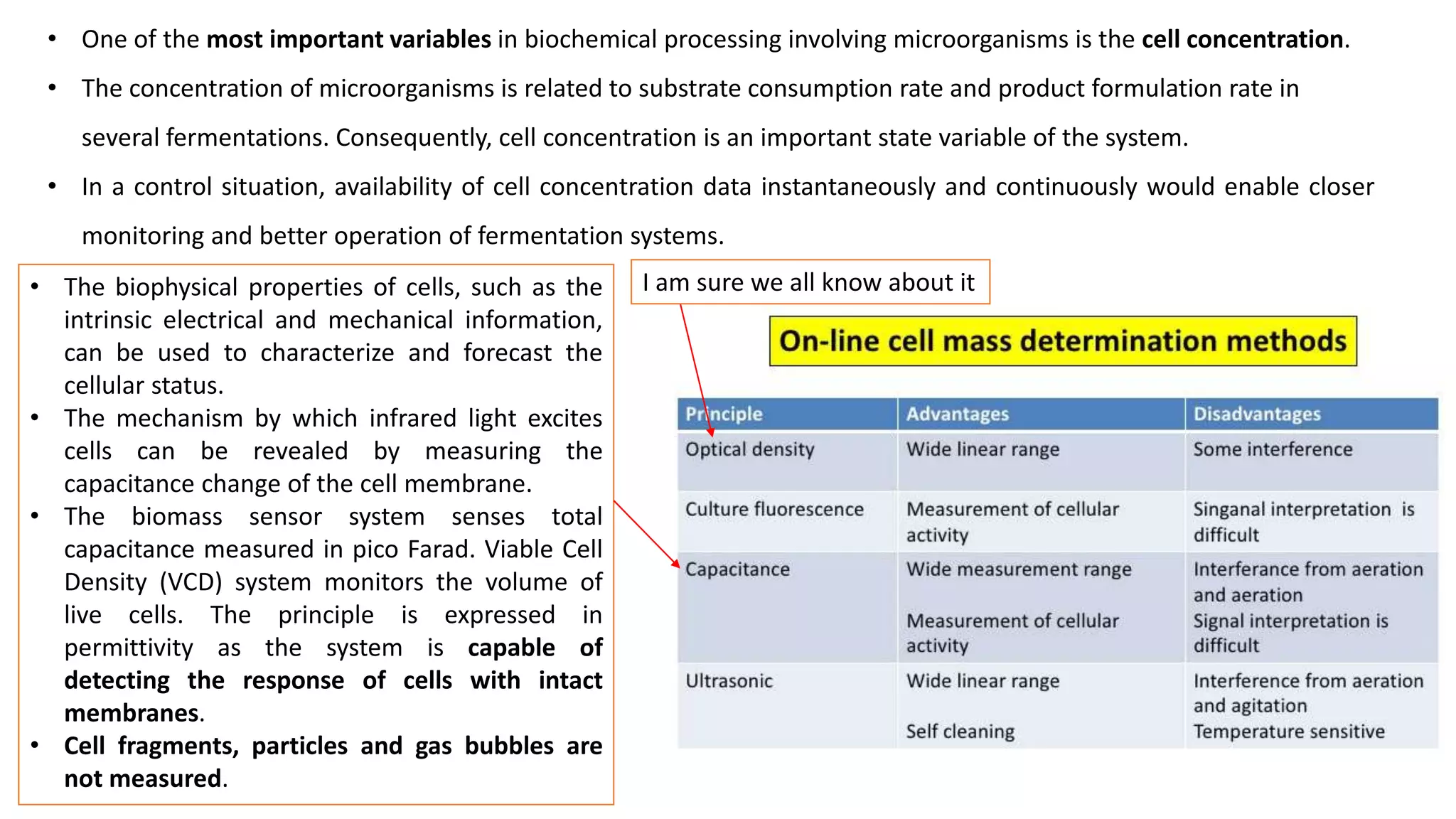
• One of the most important variables in biochemical processing involving microorganisms is the cell concentration.
• The concentration of microorganisms is related to substrate consumption rate and product formulation rate in
several fermentations. Consequently, cell concentration is an important state variable of the system.
• In a control situation, availability of cell concentration data instantaneously and continuously would enable closer
monitoring and better operation of fermentation systems.
• The biophysical properties of cells, such as the
intrinsic electrical and mechanical information,
can be used to characterize and forecast the
cellular status.
• The mechanism by which infrared light excites
cells can be revealed by measuring the
capacitance change of the cell membrane.
• The biomass sensor system senses total
capacitance measured in pico Farad. Viable Cell
Density (VCD) system monitors the volume of
live cells. The principle is expressed in
permittivity as the system is capable of
detecting the response of cells with intact
membranes.
• Cell fragments, particles and gas bubbles are
not measured.
I am sure we all know about it
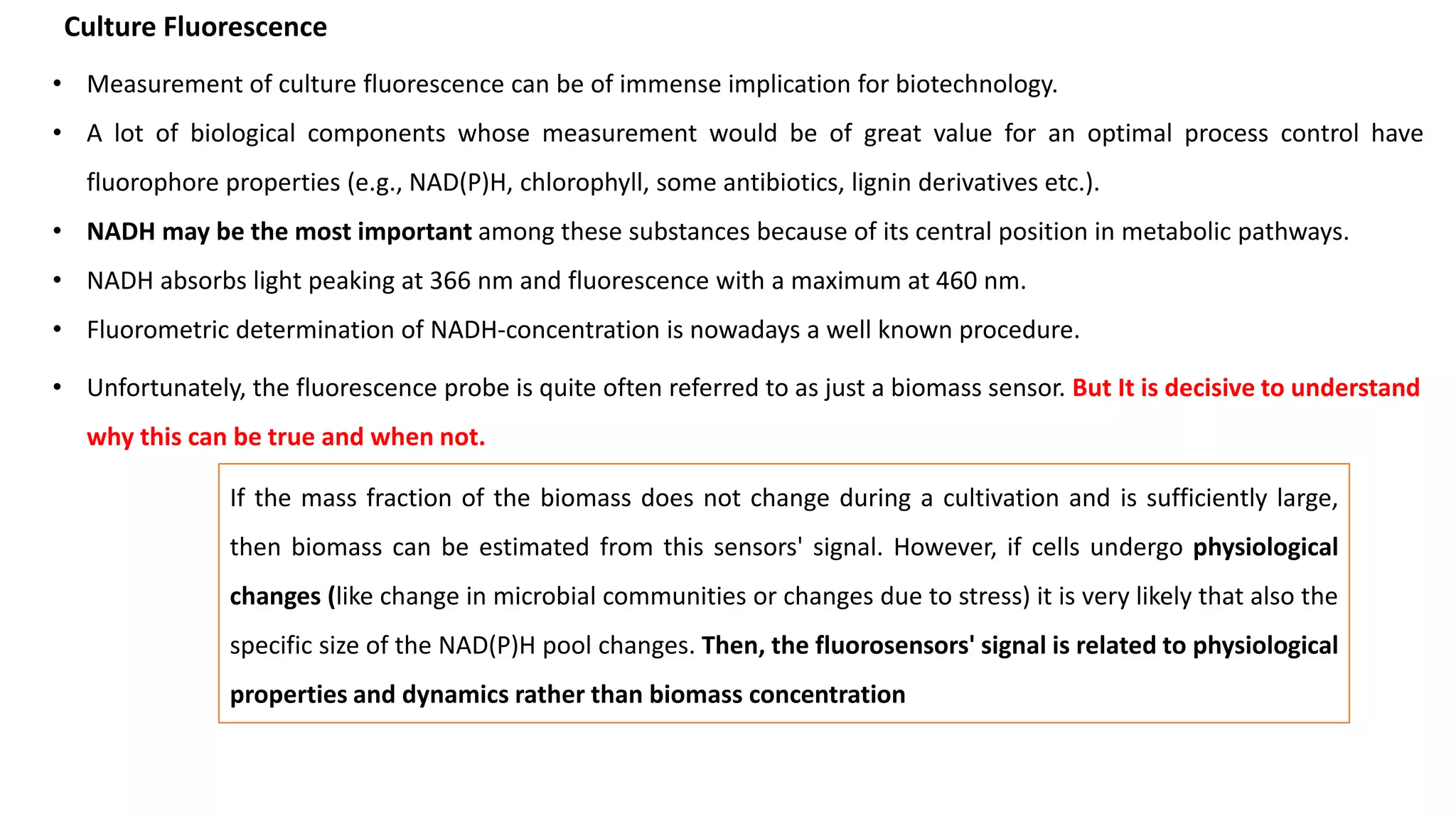
• Measurement of culture fluorescence can be of immense implication for biotechnology.
• A lot of biological components whose measurement would be of great value for an optimal process control have
fluorophore properties (e.g., NAD(P)H, chlorophyll, some antibiotics, lignin derivatives etc.).
• NADH may be the most important among these substances because of its central position in metabolic pathways.
• NADH absorbs light peaking at 366 nm and fluorescence with a maximum at 460 nm.
• Fluorometric determination of NADH-concentration is nowadays a well known procedure.
Culture Fluorescence
• Unfortunately, the fluorescence probe is quite often referred to as just a biomass sensor. But It is decisive to understand
why this can be true and when not.
If the mass fraction of the biomass does not change during a cultivation and is sufficiently large,
then biomass can be estimated from this sensors' signal. However, if cells undergo physiological
changes (like change in microbial communities or changes due to stress) it is very likely that also the
specific size of the NAD(P)H pool changes. Then, the fluorosensors' signal is related to physiological
properties and dynamics rather than biomass concentration
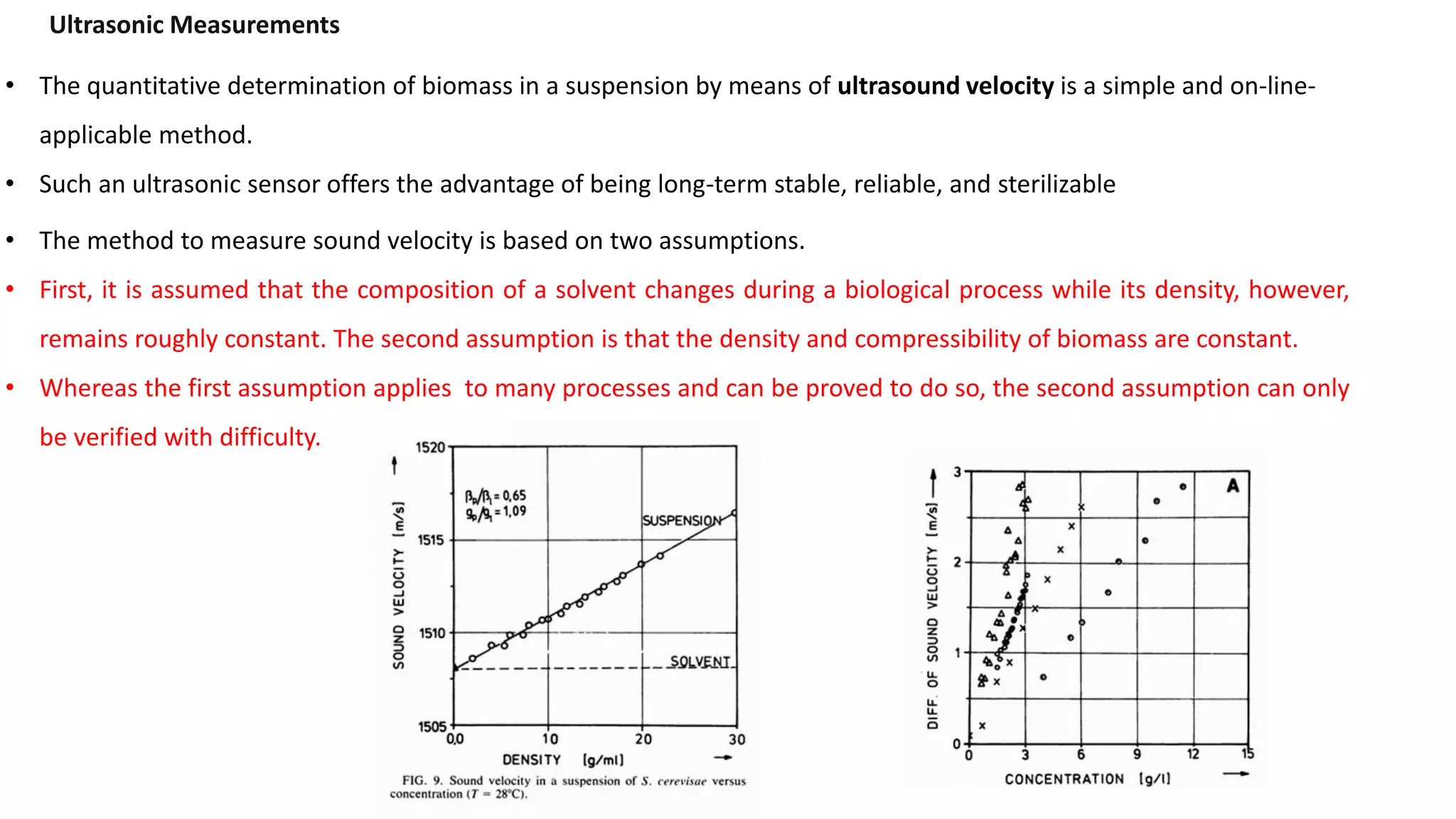
• The quantitative determination of biomass in a suspension by means of ultrasound velocity is a simple and on-line-
applicable method.
• Such an ultrasonic sensor offers the advantage of being long-term stable, reliable, and sterilizable
Ultrasonic Measurements
• The method to measure sound velocity is based on two assumptions.
• First, it is assumed that the composition of a solvent changes during a biological process while its density, however,
remains roughly constant. The second assumption is that the density and compressibility of biomass are constant.
• Whereas the first assumption applies to many processes and can be proved to do so, the second assumption can only
be verified with difficulty.
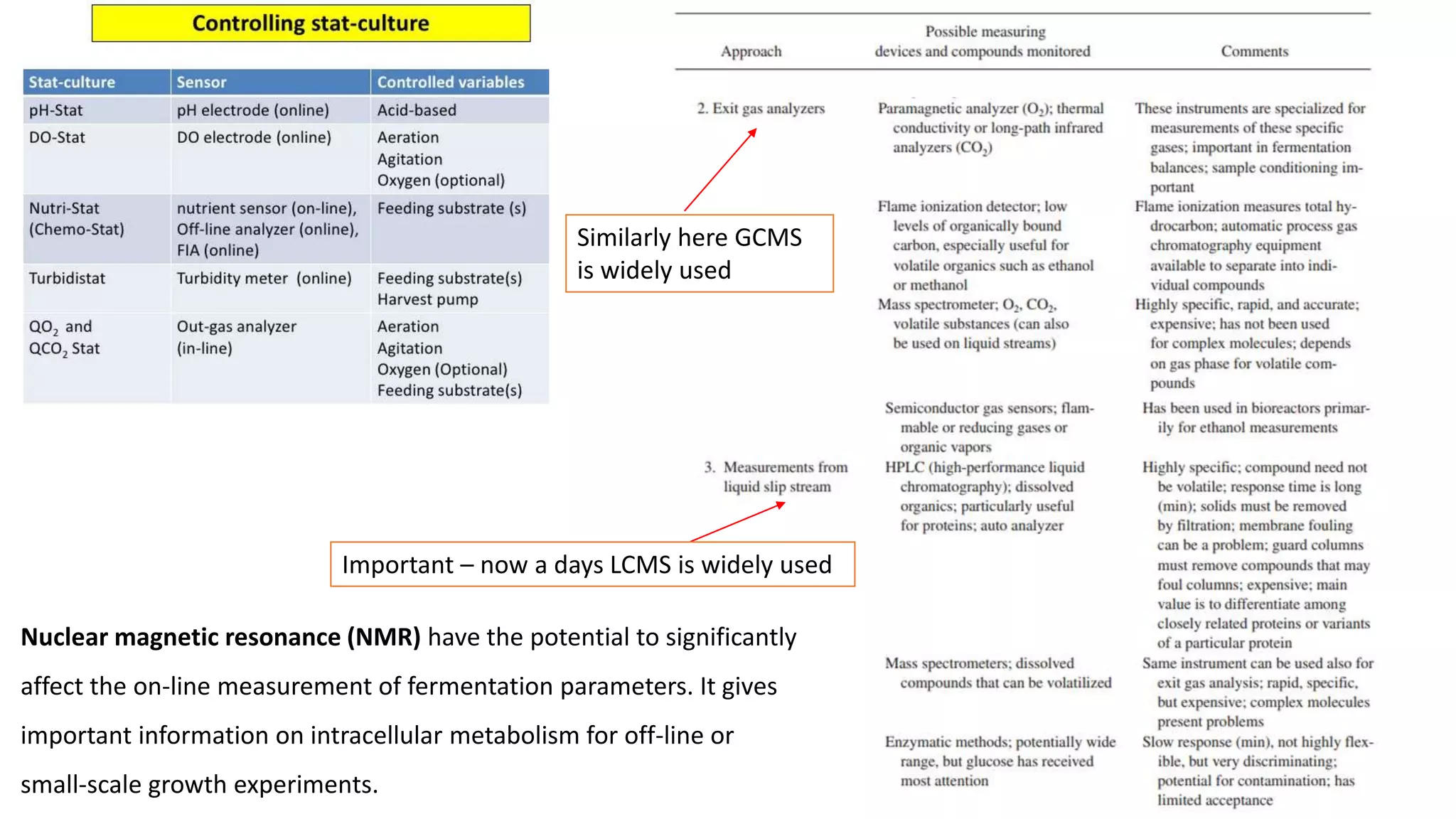
Important – now a days LCMS is widely used
Similarly here GCMS
is widely used
Nuclear magnetic resonance (NMR) have the potential to significantly
affect the on-line measurement of fermentation parameters. It gives
important information on intracellular metabolism for off-line or
small-scale growth experiments.

control.pptx

  • 1.
    Measurement and controlof bioprocess parameters • Any attempt to understand or control the state of a fermentation/bioreactor depends on the knowledge of critical variables which affect the process • These parameters can be grouped into three categories: physical, chemical and biological. Parameters measured or controlled in bioreactors • For effective control of fermentations based on measured data, the time taken to complete the measurement should be compatible with the rate of change of the variable being monitored. For example, in a typical fermentation, the time scale for change in pH and dissolved-oxygen tension is several minutes, while the time scale for change in culture fluorescence is less than 1 second.
  • 2.
    • The frequencyand speed of measurement must be consistent with these time scales. • Ideally, measurements should be made in situ and on-line, i.e. in or near the reactor during operation, so that the result is available for timely control action. The very basic of what is happening inside a fermenter – why do we need to maintain all these parameters i.e. pH, O2, nutrient, temp. – cause we know that microorganisms needs these at optimum level – so they can give maximum efficiency. Isn’t it?
  • 3.
    All the input Gasmeans O2 All the measuring unit
  • 5.
    • The maintenanceof sterility in a fermenter imposes a severe limitation on obtaining on-line measurements of fermentation parameters. • Some probes (e.g., pH and dissolved oxygen) enter the reactor through penetrations(means online and in-situ) in the fermenter shell. Each penetration significantly increases the probability of contamination. • Thus, the benefit in increased productivity from the use of each probe must outweigh the economic losses that result from an increased number of contamination events. • The probes themselves must also be sterilizable, preferably with steam. Thus, probes must ideally be able to withstand moderately high temperatures (121°C) in the presence of 100% humidity. • Chemical sterilization, which is less desirable, may allow the use of a temperature-sensitive device if it has sufficient chemical resistance. • Any general technique for monitoring fermentations must be compatible with the limitations imposed by sterility requirements
  • 6.
    • Since manyfermentations require extensive periods for completion (2 to 20 days), it is important that probe response be stable for extended periods. • Industrial fermentation broths contain many proteins and other organics that have a significant tendency to adsorb onto surfaces. Many microbes also have a strong tendency to adhere to surfaces. Thus, probe fouling in an extended fermentation is a constant problem. • Drift is a problem in some probes, and recalibration in situ is not always possible. If sterility is to be maintained, the removal and replacement of probes is practically impossible. • In some cases, special designs allowing some back-flushing are possible. • However, the quality of information available tends to decrease as the length of a fermentation cycle increases.
  • 7.
    • One ofthe most important variables in biochemical processing involving microorganisms is the cell concentration. • The concentration of microorganisms is related to substrate consumption rate and product formulation rate in several fermentations. Consequently, cell concentration is an important state variable of the system. • In a control situation, availability of cell concentration data instantaneously and continuously would enable closer monitoring and better operation of fermentation systems. • The biophysical properties of cells, such as the intrinsic electrical and mechanical information, can be used to characterize and forecast the cellular status. • The mechanism by which infrared light excites cells can be revealed by measuring the capacitance change of the cell membrane. • The biomass sensor system senses total capacitance measured in pico Farad. Viable Cell Density (VCD) system monitors the volume of live cells. The principle is expressed in permittivity as the system is capable of detecting the response of cells with intact membranes. • Cell fragments, particles and gas bubbles are not measured. I am sure we all know about it
  • 8.
    • Measurement ofculture fluorescence can be of immense implication for biotechnology. • A lot of biological components whose measurement would be of great value for an optimal process control have fluorophore properties (e.g., NAD(P)H, chlorophyll, some antibiotics, lignin derivatives etc.). • NADH may be the most important among these substances because of its central position in metabolic pathways. • NADH absorbs light peaking at 366 nm and fluorescence with a maximum at 460 nm. • Fluorometric determination of NADH-concentration is nowadays a well known procedure. Culture Fluorescence • Unfortunately, the fluorescence probe is quite often referred to as just a biomass sensor. But It is decisive to understand why this can be true and when not. If the mass fraction of the biomass does not change during a cultivation and is sufficiently large, then biomass can be estimated from this sensors' signal. However, if cells undergo physiological changes (like change in microbial communities or changes due to stress) it is very likely that also the specific size of the NAD(P)H pool changes. Then, the fluorosensors' signal is related to physiological properties and dynamics rather than biomass concentration
  • 9.
    • The quantitativedetermination of biomass in a suspension by means of ultrasound velocity is a simple and on-line- applicable method. • Such an ultrasonic sensor offers the advantage of being long-term stable, reliable, and sterilizable Ultrasonic Measurements • The method to measure sound velocity is based on two assumptions. • First, it is assumed that the composition of a solvent changes during a biological process while its density, however, remains roughly constant. The second assumption is that the density and compressibility of biomass are constant. • Whereas the first assumption applies to many processes and can be proved to do so, the second assumption can only be verified with difficulty.
  • 10.
    Important – nowa days LCMS is widely used Similarly here GCMS is widely used Nuclear magnetic resonance (NMR) have the potential to significantly affect the on-line measurement of fermentation parameters. It gives important information on intracellular metabolism for off-line or small-scale growth experiments.