Control Engineering
Lecture 1
Eva.Dulf@aut.utcluj.ro
What is control?
• To cause a machine or process to function
in a predetermined manner
• To energize and de-energize an output, or
to set a data table bit or bits to on or off, by
means of a user program
What is a controller?
• A circuit that excepts inputs
– one input is the action (command signal)
– the other one is the measurement signal
(feedback / feedforward)
Compares these inputs and determines
the output reaction
• A unit that controls a machine or process
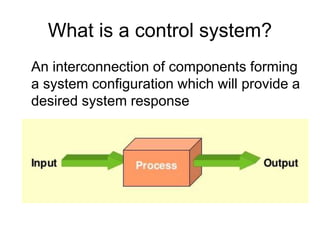
What is a control system?
An interconnection of components forming
a system configuration which will provide a
desired system response
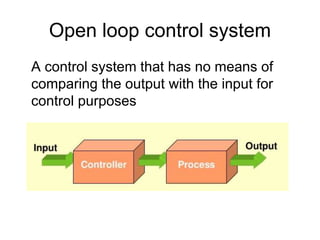
Open loop control system
A control system that has no means of
comparing the output with the input for
control purposes
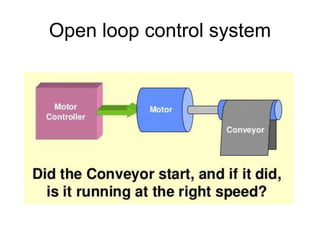
Open loop control system
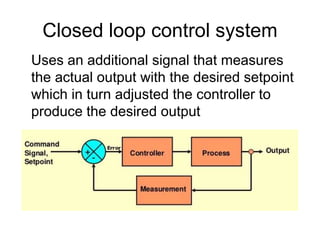
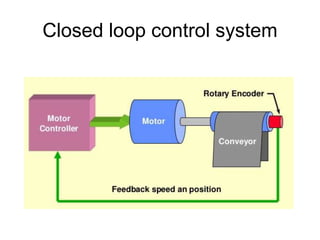
Closed loop control system
Uses an additional signal that measures
the actual output with the desired setpoint
which in turn adjusted the controller to
produce the desired output
Closed loop control system
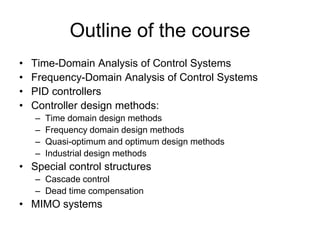
Outline of the course
• Time-Domain Analysis of Control Systems
• Frequency-Domain Analysis of Control Systems
• PID controllers
• Controller design methods:
– Time domain design methods
– Frequency domain design methods
– Quasi-optimum and optimum design methods
– Industrial design methods
• Special control structures
– Cascade control
– Dead time compensation
• MIMO systems
References
• R.C. Dorf, R.H. Bishop, Modern Control Systems (12th
Edition), Prentice Hall; 2010
• K. Ogata, Modern Control Engineering, Prentice Hall,
2010
• K. J. Astrom, R. M. Murray, Feedback Systems: An
Introduction for Scientists and Engineers, Lund Institute of
Technology, 2006
• D. Xue, YQ. Chen, D.P. Atherton, Linear Feedback
Control. Analysis and Design with MATLAB, SIAM, 2007
• Q-G. Wang, Z. Ye, W.-J. Cai, C-C. Hang, PID Control for
Multivariable Processes, Springer, 2008
• A. O*Dwyer, Handbook of PI and PID Controller Tuning
Rules, Imperial College Press, 2006
• B.J. Lurie, P.J. Enricht, Classical Feedback Control with
Matlab abd Simulink, CRC Press 2014
Evaluation
• Course Acquired knowledge+Course
activity - Written exam 60%
• Acquired practical skills+Labor activity -
Oral exam 40%
• Minimum standard of performance
– Exam grade>5
– Laboratory grade>5

Control Engineering1.ppt

  • 1.
  • 2.
  • 3.
    What is control? •To cause a machine or process to function in a predetermined manner • To energize and de-energize an output, or to set a data table bit or bits to on or off, by means of a user program
  • 4.
    What is acontroller? • A circuit that excepts inputs – one input is the action (command signal) – the other one is the measurement signal (feedback / feedforward) Compares these inputs and determines the output reaction • A unit that controls a machine or process
  • 5.
    What is acontrol system? An interconnection of components forming a system configuration which will provide a desired system response
  • 6.
    Open loop controlsystem A control system that has no means of comparing the output with the input for control purposes
  • 7.
  • 8.
    Closed loop controlsystem Uses an additional signal that measures the actual output with the desired setpoint which in turn adjusted the controller to produce the desired output
  • 9.
  • 10.
    Outline of thecourse • Time-Domain Analysis of Control Systems • Frequency-Domain Analysis of Control Systems • PID controllers • Controller design methods: – Time domain design methods – Frequency domain design methods – Quasi-optimum and optimum design methods – Industrial design methods • Special control structures – Cascade control – Dead time compensation • MIMO systems
  • 11.
    References • R.C. Dorf,R.H. Bishop, Modern Control Systems (12th Edition), Prentice Hall; 2010 • K. Ogata, Modern Control Engineering, Prentice Hall, 2010 • K. J. Astrom, R. M. Murray, Feedback Systems: An Introduction for Scientists and Engineers, Lund Institute of Technology, 2006 • D. Xue, YQ. Chen, D.P. Atherton, Linear Feedback Control. Analysis and Design with MATLAB, SIAM, 2007 • Q-G. Wang, Z. Ye, W.-J. Cai, C-C. Hang, PID Control for Multivariable Processes, Springer, 2008 • A. O*Dwyer, Handbook of PI and PID Controller Tuning Rules, Imperial College Press, 2006 • B.J. Lurie, P.J. Enricht, Classical Feedback Control with Matlab abd Simulink, CRC Press 2014
  • 12.
    Evaluation • Course Acquiredknowledge+Course activity - Written exam 60% • Acquired practical skills+Labor activity - Oral exam 40% • Minimum standard of performance – Exam grade>5 – Laboratory grade>5