Marketing
Math
2 Contractor Marketing Math+
BRODIE TYLER
PRESIDENT OF
3 Contractor Marketing Math+
I recently consulted a
contractor who was
interested in inbound
marketing.
He’sarealpersonandthe
following details are real,
but for privacy reasons
I’ll refer to him as Carl.
This is Carl
4 Contractor Marketing Math+
Carl purchased an Inbound
Marketing Action Plan from
us, but he didn’t have the
marketing budget for our
services. As I was answering
questions, I realized it came
down to a
BASIC MATH PROBLEM
“???”
5 Contractor Marketing Math+
The gross profit margin for his
contracting business was at 40%.
6 Contractor Marketing Math+
The gross profit margin for his
contracting business was at 40%.
But that’s not the whole story.
7 Contractor Marketing Math+
The gross profit margin for his
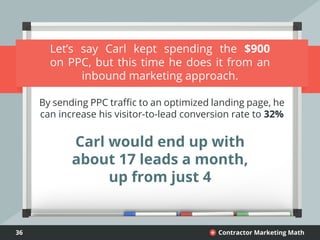
contracting business was at 40%.
But that’s not the whole story.
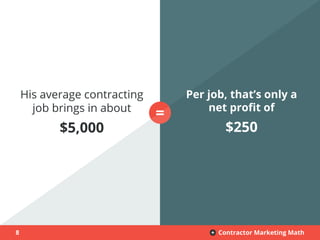
When all is said and done, he is only
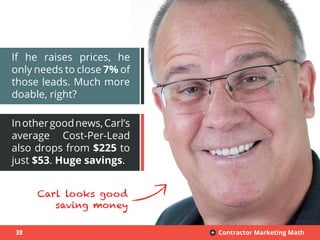
ACTUALLY NETTING 5%
8 Contractor Marketing Math+
His average contracting
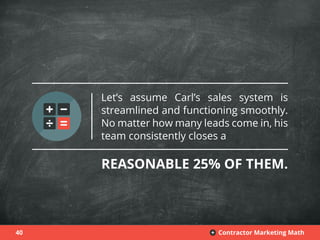
job brings in about
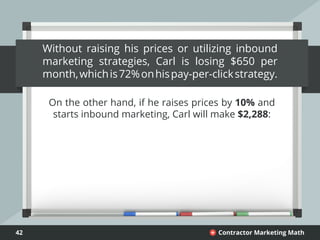
$5,000
Per job, that’s only a
net profit of
$250
=
9 Contractor Marketing Math+
What if Carl wanted
to invest an additional
$3,000 per month into
inbound marketing?
“What’s in
it for me?”
10 Contractor Marketing Math+
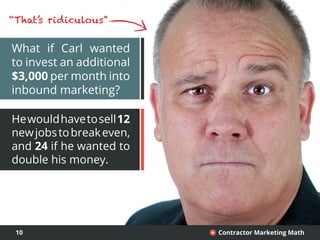
What if Carl wanted
to invest an additional
$3,000 per month into
inbound marketing?
Hewouldhavetosell12
newjobstobreakeven,
and 24 if he wanted to
double his money.
“That’s ridiculous”
11 Contractor Marketing Math+
I’m not saying this is impossible.
12 Contractor Marketing Math+
I’m not saying this is impossible.
It’s just unrealistic for Carl because of
his niche, competition and location.
13 Contractor Marketing Math+
Although, I don’t consider it an inbound
marketingstrategy, Carlwasalreadyspending
$900 per month on pay-per-click advertising.
14 Contractor Marketing Math+
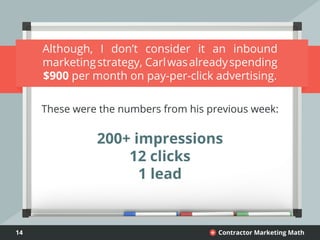
200+ impressions
12 clicks
1 lead
These were the numbers from his previous week:
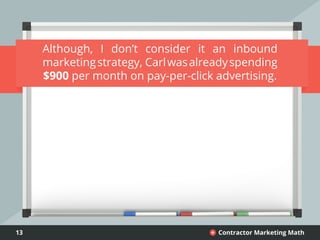
Although, I don’t consider it an inbound
marketingstrategy, Carlwasalreadyspending
$900 per month on pay-per-click advertising.
15 Contractor Marketing Math+
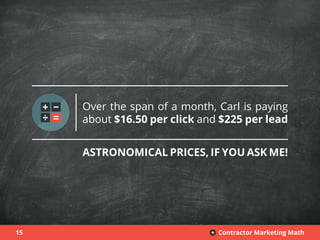
Over the span of a month, Carl is paying
about $16.50 per click and $225 per lead
ASTRONOMICAL PRICES, IF YOU ASK ME!
16 Contractor Marketing Math+
At only $250 net profit per
job, Carl would have to
close every single lead for
a $25 profit on each one.
17 Contractor Marketing Math+
At only $250 net profit per
job, Carl would have to
close every single lead for
a $25 profit on each one.
That’s not realistic.
18 Contractor Marketing Math+
The Core
Problem!
19 Contractor Marketing Math+
I discovered Carl felt his prices were a bit low.
He was taking in a ton of jobs and his crew
was busy-- but he wasn’t making any money.
20 Contractor Marketing Math+
I discovered Carl felt his prices were a bit low.
He was taking in a ton of jobs and his crew
was busy-- but he wasn’t making any money.
Raise prices
across the board
I suggested what he already knew:
21 Contractor Marketing Math+
Let’s go through
the math
22 Contractor Marketing Math+
Carl could easily raise his prices
by 10%, which would increase his
average job to $5,500.
23 Contractor Marketing Math+
Since his direct job costs wouldn’t
be going up, 100% of that extra
$500 drops to his bottom line.
24 Contractor Marketing Math+
As a result, his profit would
skyrocket from $250 per job to
$750 per job.
25 Contractor Marketing Math+
That’s right, an
immediate 300%
boost in bottom-
line profitability!
Carl’s happy face
26 Contractor Marketing Math+
BACK TO THE MARKETING
27 Contractor Marketing Math+
Raising his prices would drop Carl’s
break-even point from 12 jobs to only
4 new jobs a month. That’s much more
realistic for his company.
28 Contractor Marketing Math+
Raising prices is a must if Carl wants
his $2,000,000 company to grow.
29 Contractor Marketing Math+
The Other
Unseen
Problem
!
30 Contractor Marketing Math+
Did you notice what Carl’s
conversion rate was on
the clicks from his
pay-per-click campaign?
31 Contractor Marketing Math+
Did you notice what Carl’s
conversion rate was on
the clicks from his
pay-per-click campaign?
A whopping 8.3%!
That’s not good.
32 Contractor Marketing Math+
After implementing inbound marketing
strategies like blogging, calls-to-action,
landing pages, and lead magnets, Carl
can conservatively expect to triple or
even quadruple those conversions.
33 Contractor Marketing Math+
After implementing inbound marketing
strategies like blogging, calls-to-action,
landing pages, and lead magnets, Carl
can conservatively expect to triple or
even quadruple those conversions.
(I know this is realistic because we help
our contractor clients do it all the time!)
34 Contractor Marketing Math+
Let’s say Carl kept spending the $900
on PPC, but this time he does it from an
inbound marketing approach.
35 Contractor Marketing Math+
Let’s say Carl kept spending the $900
on PPC, but this time he does it from an
inbound marketing approach.
By sending PPC traffic to an optimized landing page, he
may increase his visitor-to-lead conversion rate to 32%
36 Contractor Marketing Math+
Let’s say Carl kept spending the $900
on PPC, but this time he does it from an
inbound marketing approach.
Carl would end up with
about 17 leads a month,
up from just 4
By sending PPC traffic to an optimized landing page, he
can increase his visitor-to-lead conversion rate to 32%
37 Contractor Marketing Math+
If he raises prices, he
only needs to close 7% of
those leads. Much more
doable, right?
“Oh yeah, baby!”
38 Contractor Marketing Math+
If he raises prices, he
only needs to close 7% of
those leads. Much more
doable, right?
Inothergoodnews,Carl’s
average Cost-Per-Lead
also drops from $225 to
just $53. Huge savings.
Carl looks good
saving money
39 Contractor Marketing Math+
Let’s look at it a
different way…
40 Contractor Marketing Math+
Let’s assume Carl’s sales system is
streamlined and functioning smoothly.
No matter how many leads come in, his
team consistently closes a
REASONABLE 25% OF THEM.
41 Contractor Marketing Math+
Without raising his prices or utilizing inbound
marketing strategies, Carl is losing $650 per
month,whichis72%onhispay-per-clickstrategy.
42 Contractor Marketing Math+
Without raising his prices or utilizing inbound
marketing strategies, Carl is losing $650 per
month,whichis72%onhispay-per-clickstrategy.
On the other hand, if he raises prices by 10% and
starts inbound marketing, Carl will make $2,288:
43 Contractor Marketing Math+
Without raising his prices or utilizing inbound
marketing strategies, Carl is losing $650 per
month,whichis72%onhispay-per-clickstrategy.
that’s a return on
investment of 254%
On the other hand, if he raises prices by 10% and
starts inbound marketing, Carl will make $2,288:
44 Contractor Marketing Math+
Little Hinges
Swing Big
Doors
!
45 Contractor Marketing Math+
AlotofcompaniesIconsultwithdon’trealize
there are multiple ways of generating new
sales within a single marketing strategy, like
I explained in the example above.
46 Contractor Marketing Math+
AlotofcompaniesIconsultwithdon’trealize
there are multiple ways of generating new
sales within a single marketing strategy, like
I explained in the example above.
Yes, it’s great to be ranked #1 on Google for a keyword.
But, is that keyword actually driving traffic to your website?
47 Contractor Marketing Math+
AlotofcompaniesIconsultwithdon’trealize
there are multiple ways of generating new
sales within a single marketing strategy, like
I explained in the example above.
Yes, it’s great to be ranked #1on Google for a keyword.
But, is that keyword actually driving traffic to your website?
Yes, it’s great to get a ton of website traffic. But, is that
traffic converting into leads for your sales team?
48 Contractor Marketing Math+
AlotofcompaniesIconsultwithdon’trealize
there are multiple ways of generating new
sales within a single marketing strategy, like
I explained in the example above.
Yes, it’s great to be ranked #1on Google for a keyword.
But, is that keyword actually driving traffic to your website?
Yes, it’s great to get a ton of website traffic. But, is that
traffic converting into leads for your sales team?
Yes, it’s great to get leads. But, are they high quality and
converting into paying customers at a good rate?
49 Contractor Marketing Math+
Making minor tweaks to a
single aspect of a marketing
campaign or increasing prices
by a small percentage can
mean exponential results.
50 Contractor Marketing Math+
Making minor tweaks to a
single aspect of a marketing
campaign or increasing prices
by a small percentage can
mean exponential results.
And by exponential
results, I’m talking about
the profitability of your
contracting business!
51 Contractor Marketing Math+
Chances are, there are a few
hidden gems that you can take
advantage of to make your
marketing more profitable.
52 Contractor Marketing Math+
Whether you want more leads or just want
higher-quality leads, it doesn’t matter...
53 Contractor Marketing Math+
Whether you want more leads or just want
higher-quality leads, it doesn’t matter...
You’ve got to
do the math!
54 Contractor Marketing Math+
Thanks to Carl, I put
togetherafill-in-the-blank
template that you can use
for your own contractor
marketing math.
This is Carl’s
“raking in loads
of cash” face
55 Contractor Marketing Math+
www.inboundsystems.com • 208.246.8982
Price Increase: Percentage sales prices could be raised by. Try 10% to start.
Raising Prices
We often find that contractors’ prices are so low that they can raise them by 10% without harm. If you’re not
profitable or have more work than you can handle, then you can surely raise your prices.
What Raising Prices Could Mean
Now, let’s figure out what it would mean to your contracting business based on the new revenue amount
above. Complete the formulas below as outlined.
%T
V
Z
W
$
Revenue: Total money received after price increase.
Calculation: A + T
U
Y
$
%
$
$
%
$
%
Break Even Leads: Number of new leads needed for Break Even Jobs.
Calculation: Z / P
Gross & Net Profit: Additional money from raising prices.
Calculation: U − A
Net Profit Increase: Additional Net Profit expressed as a percentage.
Calculation: V / L x 100
Break Even Jobs: Number of new jobs needed to cover marketing costs.
Calculation: E / ( ( W + E ) / D )
Net Profit Per Job: Amount you could be making on an average job.
Calculation: W / D
Gross Profit Margin: Gross Profit expressed as a percentage.
Calculation: ( ( U − B ) / U ) x 100
Net Profit: Revenue left after Direct Job Costs and Overhead are paid.
Calculation: L + V
Net Profit Margin: Net Profit expressed as a percentage.
Calculation: W / U x 100 ~ Round to the nearest 10th
Average Job Value: Amount of revenue a typical job could be worth.
Calculation: U / D
Raising Prices Scenario 3
3,300,000
300,000
44
460,000
13.9
188
7,285
1,015
33
94
10
www.inboundsystems.com • 208.246.8982
Based on the numbers you filled in on the previous page, discover what they mean by calculating the
formulas outlined below.
What Your Numbers Mean
K
L
M
N
$
$
$
$
%
$
%
Average Job Value: Amount of revenue a typical job is worth.
Calculation: A / D
Average Direct Cost Per Job: Amount of costs related to an average job.
Calculation: B / D
Q $
Break Even Jobs: Number of jobs needed to cover marketing costs.
Calculation: E / ( ( L + E ) / D )
$
Cost-Per-Lead: Amount it takes to generate a lead.
Calculation: E / F
Break Even Leads: Number of leads needed to cover marketing costs.
Calculation: Q / P
R %
Visitor Conversion: Percent of website visitors it takes to get a lead.
Calculation: H / G x 100 ~ Round to the nearest 100th
S %
Web Lead Conversion: Percent of website leads it takes to get a job.
Calculation: J / H
Net Profit Per Job: Amount you are making on an average job.
Calculation: L / D
Gross Profit: Revenue left after Direct Job Costs are paid.
Calculation: A − B
Net Profit: Revenue left after Direct Job Costs and Overhead are paid.
Calculation: K − C
Gross Profit Margin: Gross Profit expressed as a percentage.
Calculation: K / A x 100
Net Profit Margin: Net Profit expressed as a percentage.
Calculation: L / A x 100 ~ Round to the nearest 10th
P %
Closing Rate: Lead-to-close effeciency expressed as a percentage.
Calculation: D / F
2
1,140,000
38
160,000
5.3
6,623
353
35
27
82
234
.84
32
Download the worksheet, fill it out,
and let me know what you find.
www.inboundsystems.com • 208.246.8982
Revenue: Total money received after discounts.
Your Current Numbers
Fill in the following eight fields based on your company’s numbers for the time frame you desire. This could
be the most recent fiscal year, the last two quarters, or your year-to-date numbers.
Tools needed:
Pencil, Calculator
WARNING: If you try to complete this
worksheet without a calculator, the end
result may not be accurate.
+
$
$
$
$
Overhead: All other costs such as rent, utilities, insurance, and office staff.
Direct Job Costs: Job-related costs such as labor, materials, and subs.
Marketing Costs: Portion invested in just marketing and lead generation.
Jobs: Number of jobs regardless of type, size or value.
A
C
E
G
B
D
F
H
J
Website Visitors: Number of unique visits to your primary website.
Leads: Number of all leads generated by your company.
Website Leads: Number of leads captured only through your website.
Website Jobs: Number of Website Leads that led to a sold job.
TEMPLATE:
Contractor Marketing Math
3,000,000
1,860,000
980,000
453
35,560
1,295
32,500
275
87
Click here to download
56 Contractor Marketing Math+
To your inbound marketing success,
Brodie
My graphic designer put
this here against my will

Contractor Marketing Math

  • 1.
  • 2.
    2 Contractor MarketingMath+ BRODIE TYLER PRESIDENT OF
  • 3.
    3 Contractor MarketingMath+ I recently consulted a contractor who was interested in inbound marketing. He’sarealpersonandthe following details are real, but for privacy reasons I’ll refer to him as Carl. This is Carl
  • 4.
    4 Contractor MarketingMath+ Carl purchased an Inbound Marketing Action Plan from us, but he didn’t have the marketing budget for our services. As I was answering questions, I realized it came down to a BASIC MATH PROBLEM “???”
  • 5.
    5 Contractor MarketingMath+ The gross profit margin for his contracting business was at 40%.
  • 6.
    6 Contractor MarketingMath+ The gross profit margin for his contracting business was at 40%. But that’s not the whole story.
  • 7.
    7 Contractor MarketingMath+ The gross profit margin for his contracting business was at 40%. But that’s not the whole story. When all is said and done, he is only ACTUALLY NETTING 5%
  • 8.
    8 Contractor MarketingMath+ His average contracting job brings in about $5,000 Per job, that’s only a net profit of $250 =
  • 9.
    9 Contractor MarketingMath+ What if Carl wanted to invest an additional $3,000 per month into inbound marketing? “What’s in it for me?”
  • 10.
    10 Contractor MarketingMath+ What if Carl wanted to invest an additional $3,000 per month into inbound marketing? Hewouldhavetosell12 newjobstobreakeven, and 24 if he wanted to double his money. “That’s ridiculous”
  • 11.
    11 Contractor MarketingMath+ I’m not saying this is impossible.
  • 12.
    12 Contractor MarketingMath+ I’m not saying this is impossible. It’s just unrealistic for Carl because of his niche, competition and location.
  • 13.
    13 Contractor MarketingMath+ Although, I don’t consider it an inbound marketingstrategy, Carlwasalreadyspending $900 per month on pay-per-click advertising.
  • 14.
    14 Contractor MarketingMath+ 200+ impressions 12 clicks 1 lead These were the numbers from his previous week: Although, I don’t consider it an inbound marketingstrategy, Carlwasalreadyspending $900 per month on pay-per-click advertising.
  • 15.
    15 Contractor MarketingMath+ Over the span of a month, Carl is paying about $16.50 per click and $225 per lead ASTRONOMICAL PRICES, IF YOU ASK ME!
  • 16.
    16 Contractor MarketingMath+ At only $250 net profit per job, Carl would have to close every single lead for a $25 profit on each one.
  • 17.
    17 Contractor MarketingMath+ At only $250 net profit per job, Carl would have to close every single lead for a $25 profit on each one. That’s not realistic.
  • 18.
    18 Contractor MarketingMath+ The Core Problem!
  • 19.
    19 Contractor MarketingMath+ I discovered Carl felt his prices were a bit low. He was taking in a ton of jobs and his crew was busy-- but he wasn’t making any money.
  • 20.
    20 Contractor MarketingMath+ I discovered Carl felt his prices were a bit low. He was taking in a ton of jobs and his crew was busy-- but he wasn’t making any money. Raise prices across the board I suggested what he already knew:
  • 21.
    21 Contractor MarketingMath+ Let’s go through the math
  • 22.
    22 Contractor MarketingMath+ Carl could easily raise his prices by 10%, which would increase his average job to $5,500.
  • 23.
    23 Contractor MarketingMath+ Since his direct job costs wouldn’t be going up, 100% of that extra $500 drops to his bottom line.
  • 24.
    24 Contractor MarketingMath+ As a result, his profit would skyrocket from $250 per job to $750 per job.
  • 25.
    25 Contractor MarketingMath+ That’s right, an immediate 300% boost in bottom- line profitability! Carl’s happy face
  • 26.
    26 Contractor MarketingMath+ BACK TO THE MARKETING
  • 27.
    27 Contractor MarketingMath+ Raising his prices would drop Carl’s break-even point from 12 jobs to only 4 new jobs a month. That’s much more realistic for his company.
  • 28.
    28 Contractor MarketingMath+ Raising prices is a must if Carl wants his $2,000,000 company to grow.
  • 29.
    29 Contractor MarketingMath+ The Other Unseen Problem !
  • 30.
    30 Contractor MarketingMath+ Did you notice what Carl’s conversion rate was on the clicks from his pay-per-click campaign?
  • 31.
    31 Contractor MarketingMath+ Did you notice what Carl’s conversion rate was on the clicks from his pay-per-click campaign? A whopping 8.3%! That’s not good.
  • 32.
    32 Contractor MarketingMath+ After implementing inbound marketing strategies like blogging, calls-to-action, landing pages, and lead magnets, Carl can conservatively expect to triple or even quadruple those conversions.
  • 33.
    33 Contractor MarketingMath+ After implementing inbound marketing strategies like blogging, calls-to-action, landing pages, and lead magnets, Carl can conservatively expect to triple or even quadruple those conversions. (I know this is realistic because we help our contractor clients do it all the time!)
  • 34.
    34 Contractor MarketingMath+ Let’s say Carl kept spending the $900 on PPC, but this time he does it from an inbound marketing approach.
  • 35.
    35 Contractor MarketingMath+ Let’s say Carl kept spending the $900 on PPC, but this time he does it from an inbound marketing approach. By sending PPC traffic to an optimized landing page, he may increase his visitor-to-lead conversion rate to 32%
  • 36.
    36 Contractor MarketingMath+ Let’s say Carl kept spending the $900 on PPC, but this time he does it from an inbound marketing approach. Carl would end up with about 17 leads a month, up from just 4 By sending PPC traffic to an optimized landing page, he can increase his visitor-to-lead conversion rate to 32%
  • 37.
    37 Contractor MarketingMath+ If he raises prices, he only needs to close 7% of those leads. Much more doable, right? “Oh yeah, baby!”
  • 38.
    38 Contractor MarketingMath+ If he raises prices, he only needs to close 7% of those leads. Much more doable, right? Inothergoodnews,Carl’s average Cost-Per-Lead also drops from $225 to just $53. Huge savings. Carl looks good saving money
  • 39.
    39 Contractor MarketingMath+ Let’s look at it a different way…
  • 40.
    40 Contractor MarketingMath+ Let’s assume Carl’s sales system is streamlined and functioning smoothly. No matter how many leads come in, his team consistently closes a REASONABLE 25% OF THEM.
  • 41.
    41 Contractor MarketingMath+ Without raising his prices or utilizing inbound marketing strategies, Carl is losing $650 per month,whichis72%onhispay-per-clickstrategy.
  • 42.
    42 Contractor MarketingMath+ Without raising his prices or utilizing inbound marketing strategies, Carl is losing $650 per month,whichis72%onhispay-per-clickstrategy. On the other hand, if he raises prices by 10% and starts inbound marketing, Carl will make $2,288:
  • 43.
    43 Contractor MarketingMath+ Without raising his prices or utilizing inbound marketing strategies, Carl is losing $650 per month,whichis72%onhispay-per-clickstrategy. that’s a return on investment of 254% On the other hand, if he raises prices by 10% and starts inbound marketing, Carl will make $2,288:
  • 44.
    44 Contractor MarketingMath+ Little Hinges Swing Big Doors !
  • 45.
    45 Contractor MarketingMath+ AlotofcompaniesIconsultwithdon’trealize there are multiple ways of generating new sales within a single marketing strategy, like I explained in the example above.
  • 46.
    46 Contractor MarketingMath+ AlotofcompaniesIconsultwithdon’trealize there are multiple ways of generating new sales within a single marketing strategy, like I explained in the example above. Yes, it’s great to be ranked #1 on Google for a keyword. But, is that keyword actually driving traffic to your website?
  • 47.
    47 Contractor MarketingMath+ AlotofcompaniesIconsultwithdon’trealize there are multiple ways of generating new sales within a single marketing strategy, like I explained in the example above. Yes, it’s great to be ranked #1on Google for a keyword. But, is that keyword actually driving traffic to your website? Yes, it’s great to get a ton of website traffic. But, is that traffic converting into leads for your sales team?
  • 48.
    48 Contractor MarketingMath+ AlotofcompaniesIconsultwithdon’trealize there are multiple ways of generating new sales within a single marketing strategy, like I explained in the example above. Yes, it’s great to be ranked #1on Google for a keyword. But, is that keyword actually driving traffic to your website? Yes, it’s great to get a ton of website traffic. But, is that traffic converting into leads for your sales team? Yes, it’s great to get leads. But, are they high quality and converting into paying customers at a good rate?
  • 49.
    49 Contractor MarketingMath+ Making minor tweaks to a single aspect of a marketing campaign or increasing prices by a small percentage can mean exponential results.
  • 50.
    50 Contractor MarketingMath+ Making minor tweaks to a single aspect of a marketing campaign or increasing prices by a small percentage can mean exponential results. And by exponential results, I’m talking about the profitability of your contracting business!
  • 51.
    51 Contractor MarketingMath+ Chances are, there are a few hidden gems that you can take advantage of to make your marketing more profitable.
  • 52.
    52 Contractor MarketingMath+ Whether you want more leads or just want higher-quality leads, it doesn’t matter...
  • 53.
    53 Contractor MarketingMath+ Whether you want more leads or just want higher-quality leads, it doesn’t matter... You’ve got to do the math!
  • 54.
    54 Contractor MarketingMath+ Thanks to Carl, I put togetherafill-in-the-blank template that you can use for your own contractor marketing math. This is Carl’s “raking in loads of cash” face
  • 55.
    55 Contractor MarketingMath+ www.inboundsystems.com • 208.246.8982 Price Increase: Percentage sales prices could be raised by. Try 10% to start. Raising Prices We often find that contractors’ prices are so low that they can raise them by 10% without harm. If you’re not profitable or have more work than you can handle, then you can surely raise your prices. What Raising Prices Could Mean Now, let’s figure out what it would mean to your contracting business based on the new revenue amount above. Complete the formulas below as outlined. %T V Z W $ Revenue: Total money received after price increase. Calculation: A + T U Y $ % $ $ % $ % Break Even Leads: Number of new leads needed for Break Even Jobs. Calculation: Z / P Gross & Net Profit: Additional money from raising prices. Calculation: U − A Net Profit Increase: Additional Net Profit expressed as a percentage. Calculation: V / L x 100 Break Even Jobs: Number of new jobs needed to cover marketing costs. Calculation: E / ( ( W + E ) / D ) Net Profit Per Job: Amount you could be making on an average job. Calculation: W / D Gross Profit Margin: Gross Profit expressed as a percentage. Calculation: ( ( U − B ) / U ) x 100 Net Profit: Revenue left after Direct Job Costs and Overhead are paid. Calculation: L + V Net Profit Margin: Net Profit expressed as a percentage. Calculation: W / U x 100 ~ Round to the nearest 10th Average Job Value: Amount of revenue a typical job could be worth. Calculation: U / D Raising Prices Scenario 3 3,300,000 300,000 44 460,000 13.9 188 7,285 1,015 33 94 10 www.inboundsystems.com • 208.246.8982 Based on the numbers you filled in on the previous page, discover what they mean by calculating the formulas outlined below. What Your Numbers Mean K L M N $ $ $ $ % $ % Average Job Value: Amount of revenue a typical job is worth. Calculation: A / D Average Direct Cost Per Job: Amount of costs related to an average job. Calculation: B / D Q $ Break Even Jobs: Number of jobs needed to cover marketing costs. Calculation: E / ( ( L + E ) / D ) $ Cost-Per-Lead: Amount it takes to generate a lead. Calculation: E / F Break Even Leads: Number of leads needed to cover marketing costs. Calculation: Q / P R % Visitor Conversion: Percent of website visitors it takes to get a lead. Calculation: H / G x 100 ~ Round to the nearest 100th S % Web Lead Conversion: Percent of website leads it takes to get a job. Calculation: J / H Net Profit Per Job: Amount you are making on an average job. Calculation: L / D Gross Profit: Revenue left after Direct Job Costs are paid. Calculation: A − B Net Profit: Revenue left after Direct Job Costs and Overhead are paid. Calculation: K − C Gross Profit Margin: Gross Profit expressed as a percentage. Calculation: K / A x 100 Net Profit Margin: Net Profit expressed as a percentage. Calculation: L / A x 100 ~ Round to the nearest 10th P % Closing Rate: Lead-to-close effeciency expressed as a percentage. Calculation: D / F 2 1,140,000 38 160,000 5.3 6,623 353 35 27 82 234 .84 32 Download the worksheet, fill it out, and let me know what you find. www.inboundsystems.com • 208.246.8982 Revenue: Total money received after discounts. Your Current Numbers Fill in the following eight fields based on your company’s numbers for the time frame you desire. This could be the most recent fiscal year, the last two quarters, or your year-to-date numbers. Tools needed: Pencil, Calculator WARNING: If you try to complete this worksheet without a calculator, the end result may not be accurate. + $ $ $ $ Overhead: All other costs such as rent, utilities, insurance, and office staff. Direct Job Costs: Job-related costs such as labor, materials, and subs. Marketing Costs: Portion invested in just marketing and lead generation. Jobs: Number of jobs regardless of type, size or value. A C E G B D F H J Website Visitors: Number of unique visits to your primary website. Leads: Number of all leads generated by your company. Website Leads: Number of leads captured only through your website. Website Jobs: Number of Website Leads that led to a sold job. TEMPLATE: Contractor Marketing Math 3,000,000 1,860,000 980,000 453 35,560 1,295 32,500 275 87 Click here to download
  • 56.
    56 Contractor MarketingMath+ To your inbound marketing success, Brodie My graphic designer put this here against my will